

Unchased Wire
220 Публикации

Unchased Wire
Отправить жалобу
Заблокировать пользователя
Crypto newswire with a trader's eye | Verified catalysts, honest levels, zero hype | Every setup has an invalidation | DYOR — No Financial Advice
2 подписок(и/а)
22 подписчиков(а)
56 понравилось
Посты
BlackRock just stepped into Japan's onchain plumbing — and I'm watching this one for the names on it.
SBI Holdings and Startale signed an MOU with BlackRock Financial Management and BlackRock Japan to explore connecting tokenized money market funds with JPYSC, SBI's yen-denominated stablecoin. The exploration covers three areas: technology and infrastructure, business models and distribution, and regulation and market development — and it's explicitly open to other Japanese and international firms joining.
Let's be honest about what this isn't: no product, no launch date, no timeline. It's an exploration agreement. But the pairing is what makes it worth noting. BlackRock's tokenized BUIDL fund holds around $2.17 billion in Treasurys, overnight repos and cash, while JPYSC — launched with Startale in June as Japan's first trust-bank-backed yen stablecoin — gives that world a non-dollar cash leg.
For context only, no causation claimed: $BTC ~$80,036 (-0.2% in 24h), $ETH ~$2,320 (-0.5%) on Binance spot at 08:26 WIB.
So the question: does yen-denominated onchain cash stay a Japan story, or is this how tokenized funds go multicurrency? DYOR, NFA.
#CryptoMarkets #Tokenization #Stablecoins
27
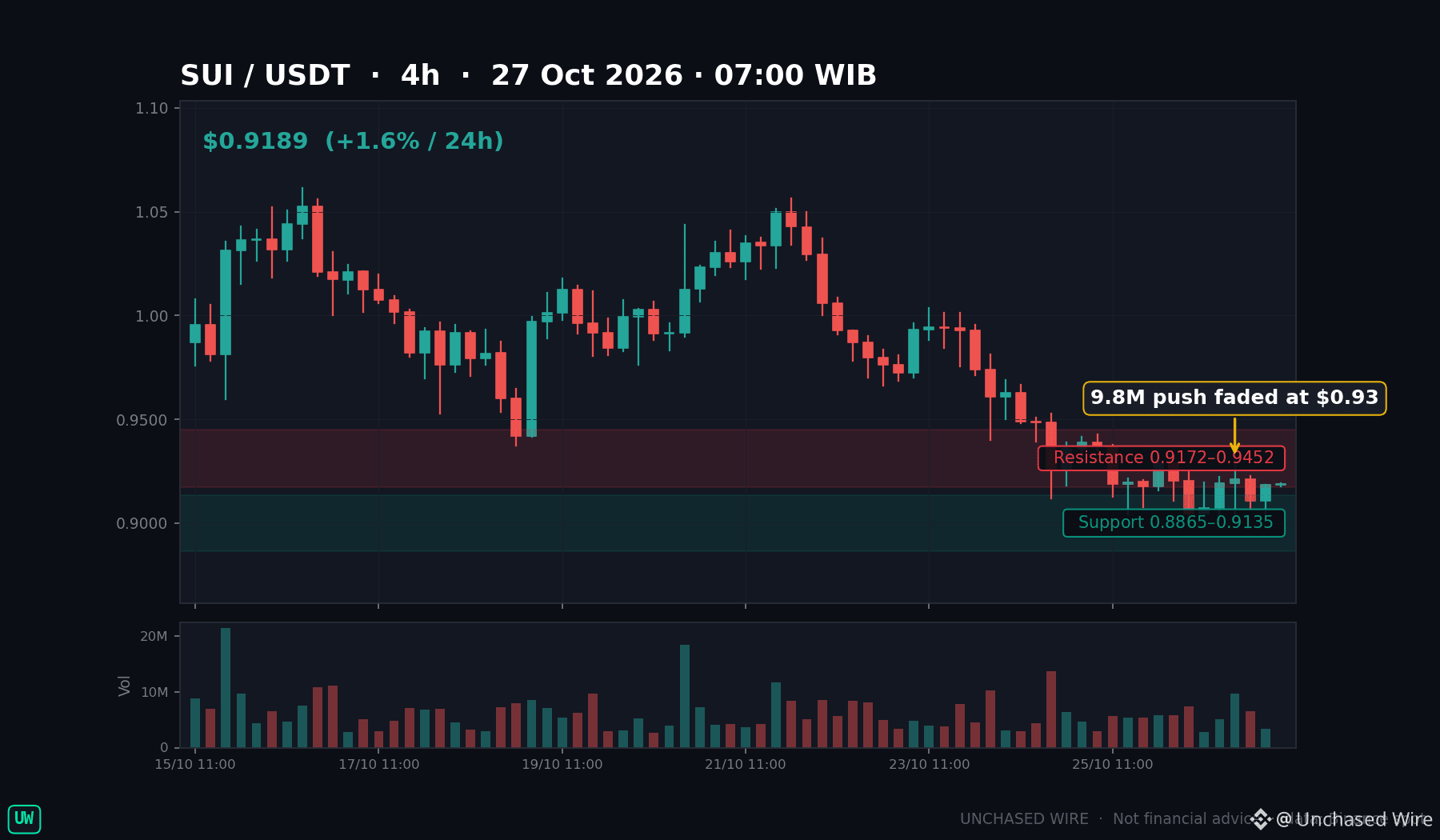
I've been watching $SUI grind down to $0.90 for three days — and the floor still hasn't given way.
Each bounce gets weaker. Sunday's high was $0.94, Monday's was $0.93, and even a 9.8-million-token push on Monday evening only reached $0.9312 before fading back to $0.91. Six taps of the $0.90 zone since Sunday, and buyers keep showing up at the same line.
What changes my mind is a 4-hour close under $0.90. Below it there's no nearby shelf — the last traded floor I can point to is around $0.81, a long way down. Above it, $0.9312 is the ceiling to reclaim first, then $0.98.
What I can't shake is the timing: the Fed decision due October 28 lands right on top of this compression, and squeezed ranges rarely stay quiet through a decision like that. Large-cap token or not, a break here would be fast.
Were you buying each touch of $0.90, or waiting for the Fed decision to pick a side first?
Not financial advice. Do your own research.
$SUI #Altcoins #SUI #FOMC
67
Bitcoin is parked right around $80,000 as the Fed meeting opens today, and most of the market is doing what it does before a decision: nothing loud.
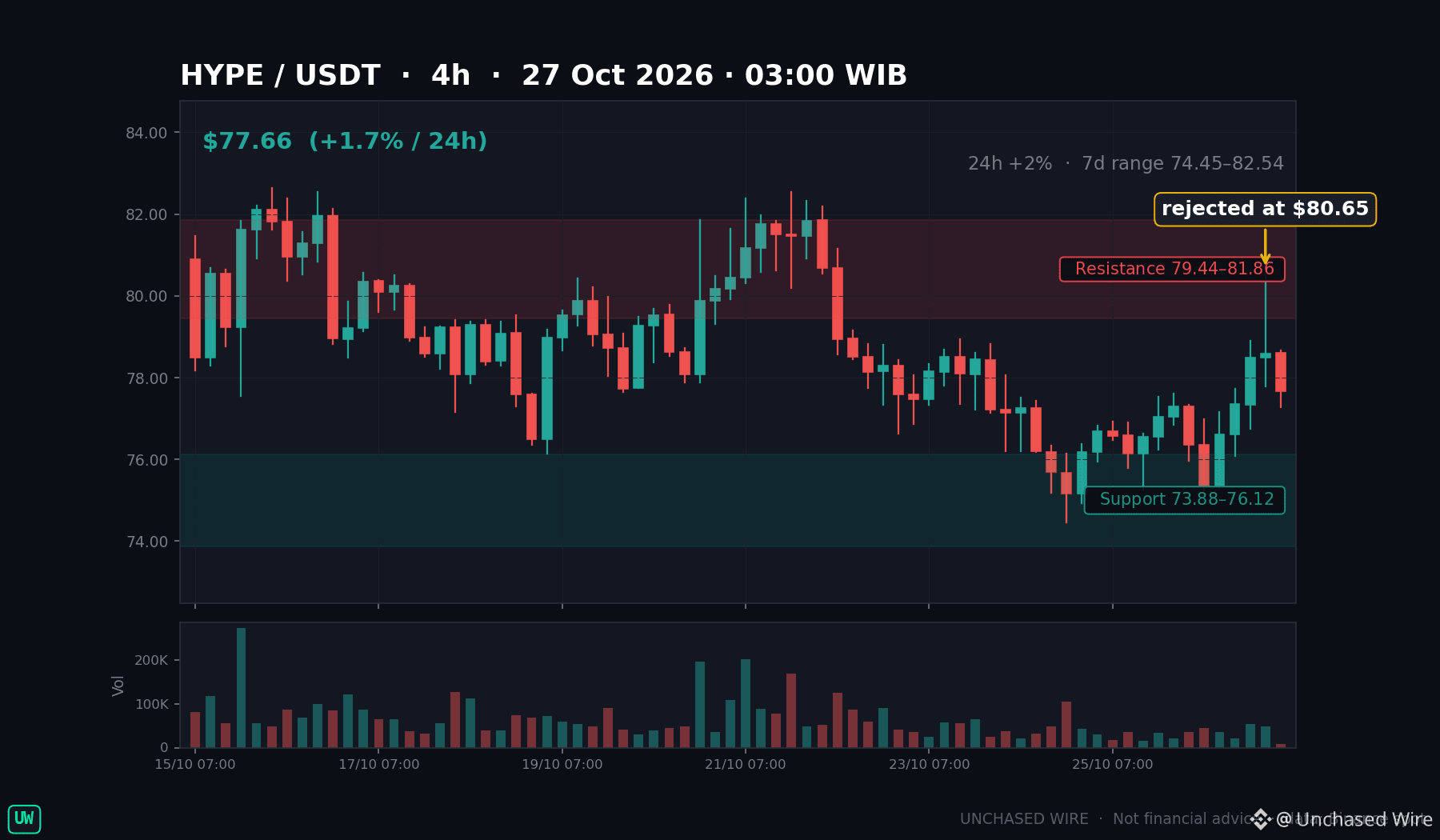
I'm watching $HYPE because it refused to join that drift: a flush to $74.99 on Monday, then a climb straight back to $80.65.
The bounce case is the low itself: buyers showed up around $75 more than once, and the recovery held above $77. The rejection case is as clean: $80.65 capped the move on ordinary volume, below the recent average — a defended floor, not conviction yet.
My lines: support $75.0, resistance $80.65, 7-day range top near $82.54 above. A 4-hour close under $75.0 kills the bounce read; $74.45 is the next floor.
What keeps me from getting comfortable: tomorrow's Fed decision can break this range either way.
Save $75.0 and $80.65 — does $HYPE hold $75.0 into the Fed decision, or does the range break down first?
Not financial advice. Do your own research.
$HYPE #CryptoMarkets #Hyperliquid #DeFi #Fed
4
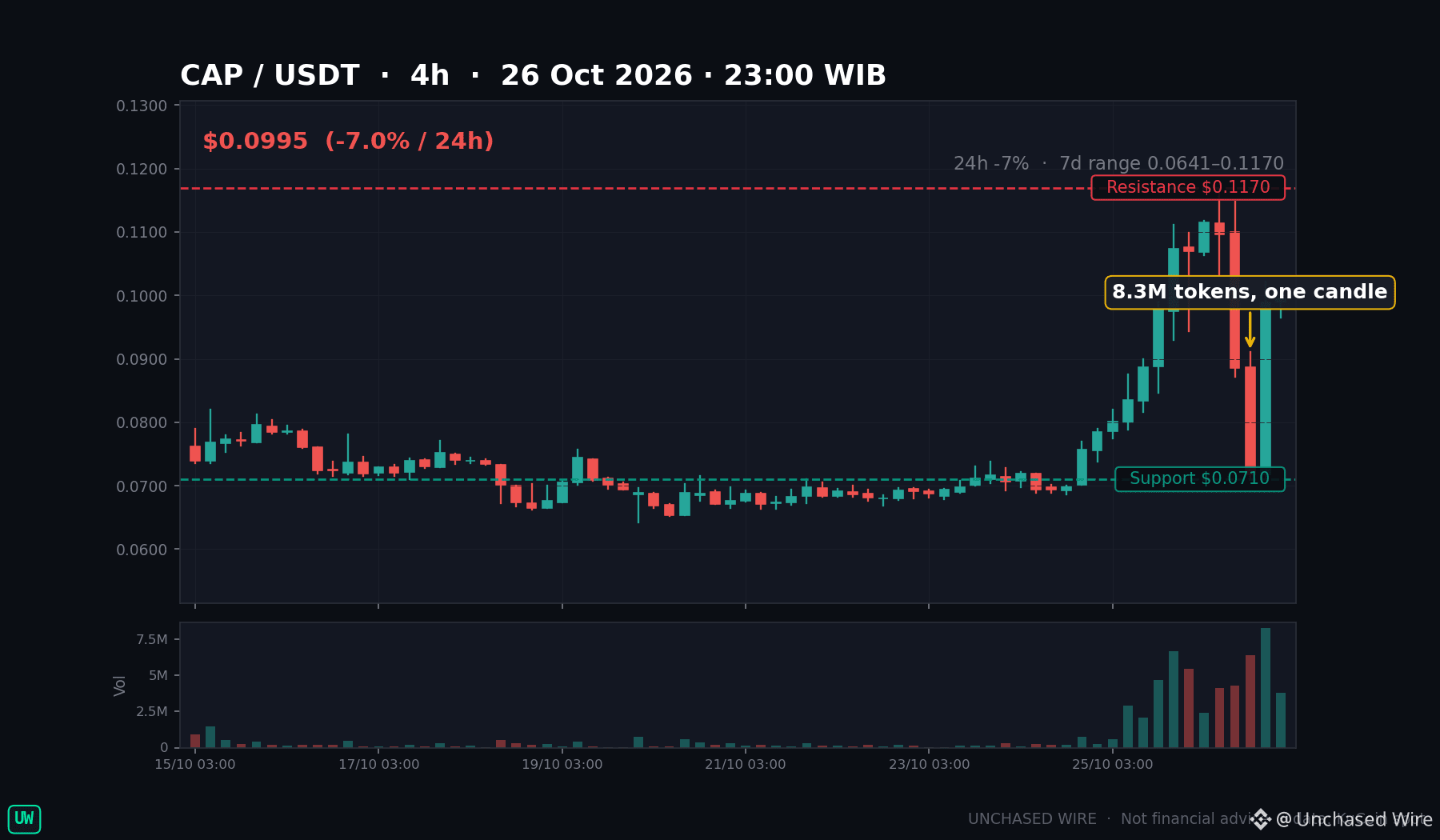
I've been watching $CAP since Sunday's breakout — and $0.117 just answered my question in the loudest way possible.
On Sunday I asked which breaks first: $0.070 support or $0.0877 resistance. Resistance broke first, and then some: $CAP ran to $0.117 on Monday. Then, in a single day, it gave the whole move back — one candle sliced to $0.071, back to the edge of the old base, before an 8.3-million-token candle lifted it back near $0.10.
That round-trip keeps me honest about this one. A breakout that retraces everything in a day isn't strength confirmed — it's a market that hasn't decided yet. And I still haven't found a verified catalyst behind any of it.
What changes my mind is a 4-hour close under $0.071 — then $0.064 is the next floor I can point to. Above it, $0.117 is the ceiling to reclaim. Small-cap, thin-liquidity token — moves like this cut both ways.
Were you still holding through the round-trip, or did the $0.117 top get you out?
Not financial advice. Do your own research.
$CAP #CryptoTrading #CAP #DeFi #Volatility
8
Chainlink just gave institutions a way into DeFi lending without handing over their keys — with Anchorage as its inaugural launch partner.
I've been tracking the custody problem for a while: big funds want DeFi yield, but moving assets out of a regulated custodian is usually a non-starter. CustodySync, introduced today, flips that. Anchorage keeps hold of the collateral while Chainlink's Proof of Reserve publishes the custody balances on-chain, and tokenized receipts backed by those holdings can then be used as collateral in DeFi lending. Both sides price the loans off the same Chainlink data, so the custodian's books and the protocol's loan-to-value maths read from one sheet, and a designated collateral agent handles liquidation if a position slips.
Here's the part I'm not glossing over: no launch markets, asset list, or volumes were named yet. This is plumbing, not a flow number — the test is whether other custodians actually plug in, or whether Anchorage stays a party of one. The tape isn't reacting yet either: $LINK sits near $11.45, down about 0.5% in 24 hours.
Do you think custodied DeFi borrowing becomes a real lane for institutions, or does it stay a neat demo?
Not financial advice. Do your own research.
$LINK
#Chainlink #DeFi #Custody #Anchorage #InstitutionalAdoption
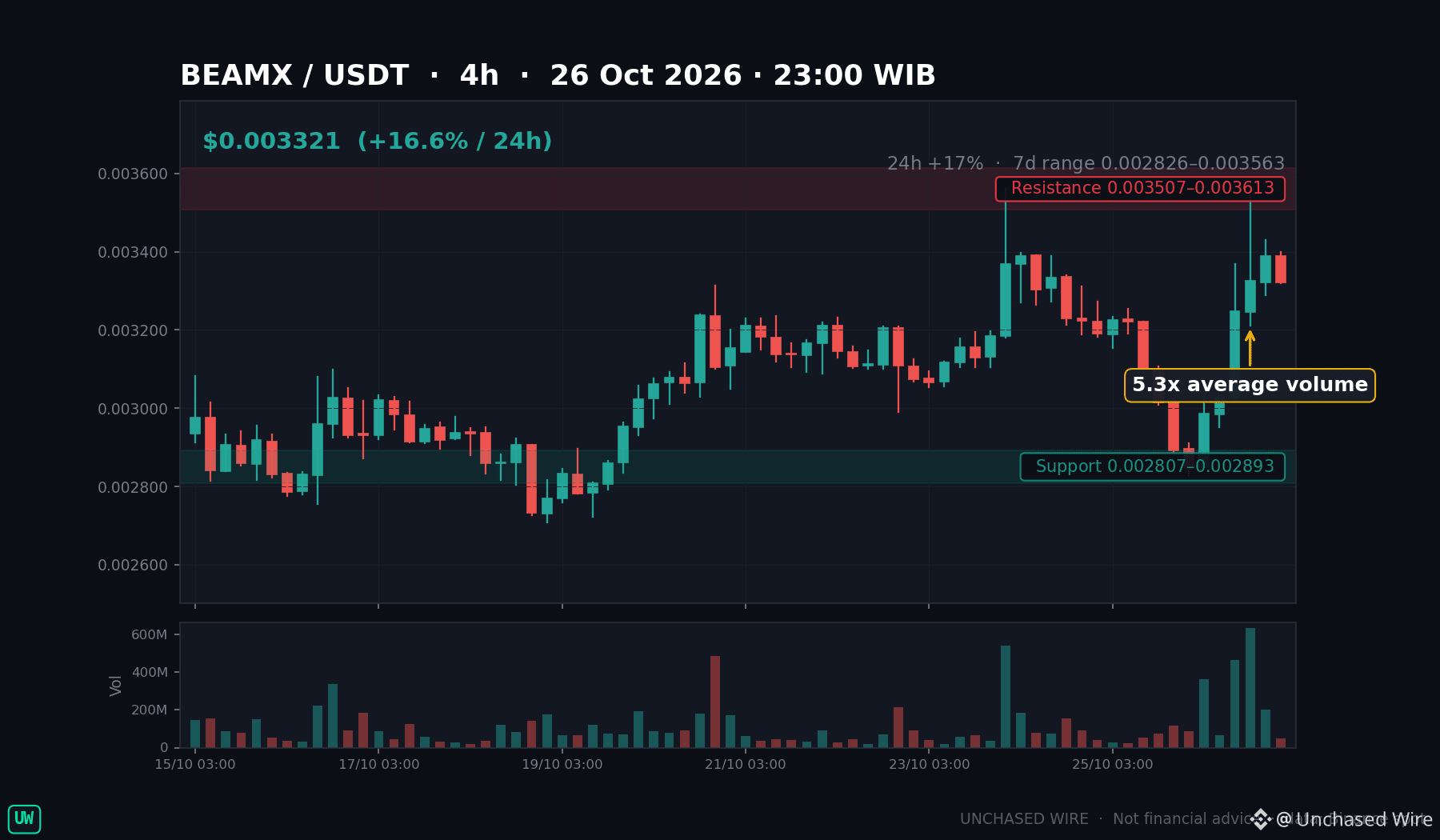
16% in 24 hours — and $BEAMX did it by climbing back toward a level it lost three days ago.
I've been watching this one since Friday's spike: $0.00356 printed on 542 million tokens, then a slide all the way to $0.00283 by Sunday night. Today the tape turned — a 363-million-token candle off the low, then 462 million, then today's loudest: 633 million tokens, 5.3 times the recent average, tagging $0.00354.
That last part is what keeps me uneasy. The reclaim already touched its old spike high and the candles since have gone quieter, so this reads as a reclaim in progress, not a completed one — a spike that stalls at an old ceiling hands the move straight back.
Support $0.00285, today's reversal low. Resistance $0.00356, Friday's spike high. A 4-hour close under $0.00285 kills the reversal read.
Does $BEAMX hold $0.00285 into tomorrow's close?
Not financial advice. Do your own research.
$BEAMX #Altcoins #BEAMX #Reversal
4
I've been watching the largest ETH treasury trade its own accumulation for buybacks, and today's update is the clearest sign yet of that shift.
Bitmine added just 10,452 ETH last week — about $24.5 million, down from 12,535 the week before — taking its stash to 6,051,933 ETH, or 4.95% of all ether in existence. That leaves it roughly 58,000 ETH short of its self-imposed 5% target, the "Alchemy of 5%" goal it set out to reach.
Meanwhile it restarted share buybacks after a roughly 10-week pause, spending about $45.9 million on 2.04 million shares. The signal is clear: as the cap gets close, capital is rotating from buying ETH to buying back its own stock.
The catch? A treasury nearing its ceiling is one less steady buyer in the market — even as about 86% of its ETH sits staked. With $ETH around $2,324, down about 0.9% in 24 hours, the tape isn't celebrating. DYOR.
Do you read the buyback pivot as confidence — or as the accumulation trade running out of road?
$ETH
#Ethereum #Institutional #ETHTreasury #Buyback
3
Strategy just broke its Bitcoin-buying streak — and spent $205 million somewhere else instead.
I've been tracking these weekly filings, and Monday's 8-K is the first zero-buy week since mid-September. Between October 19 and 25, Strategy bought and sold no Bitcoin, sold no shares through its at-the-market program, and instead repurchased 2,068,459 STRC preferred shares for $204.9 million, paid entirely from USD Cash.
Holdings are unchanged at 848,517 BTC, acquired for $64.02 billion at an average $75,446 per coin. USD Cash fell to $242.4 million from $447.3 million a week earlier, while the separate $4.83 billion USD Reserve for dividends and debt interest held steady.
I'm not reading this as capitulation — no coin was sold, and the buyback defends the preferred-stock financing. Still: $193.1 million and $192.4 million went to STRC in the prior two weeks, against $22.1 million and $21.5 million of Bitcoin buys, before this week's zero.
With $BTC hovering near $80,000, is this a buyer pausing, or a buyer reloading its financing first?
Not financial advice. Do your own research.
$BTC #Bitcoin #Strategy #Treasury #CryptoNews
Bitcoin slipped under $80,000 today — and I've been watching where the tape actually moved instead.
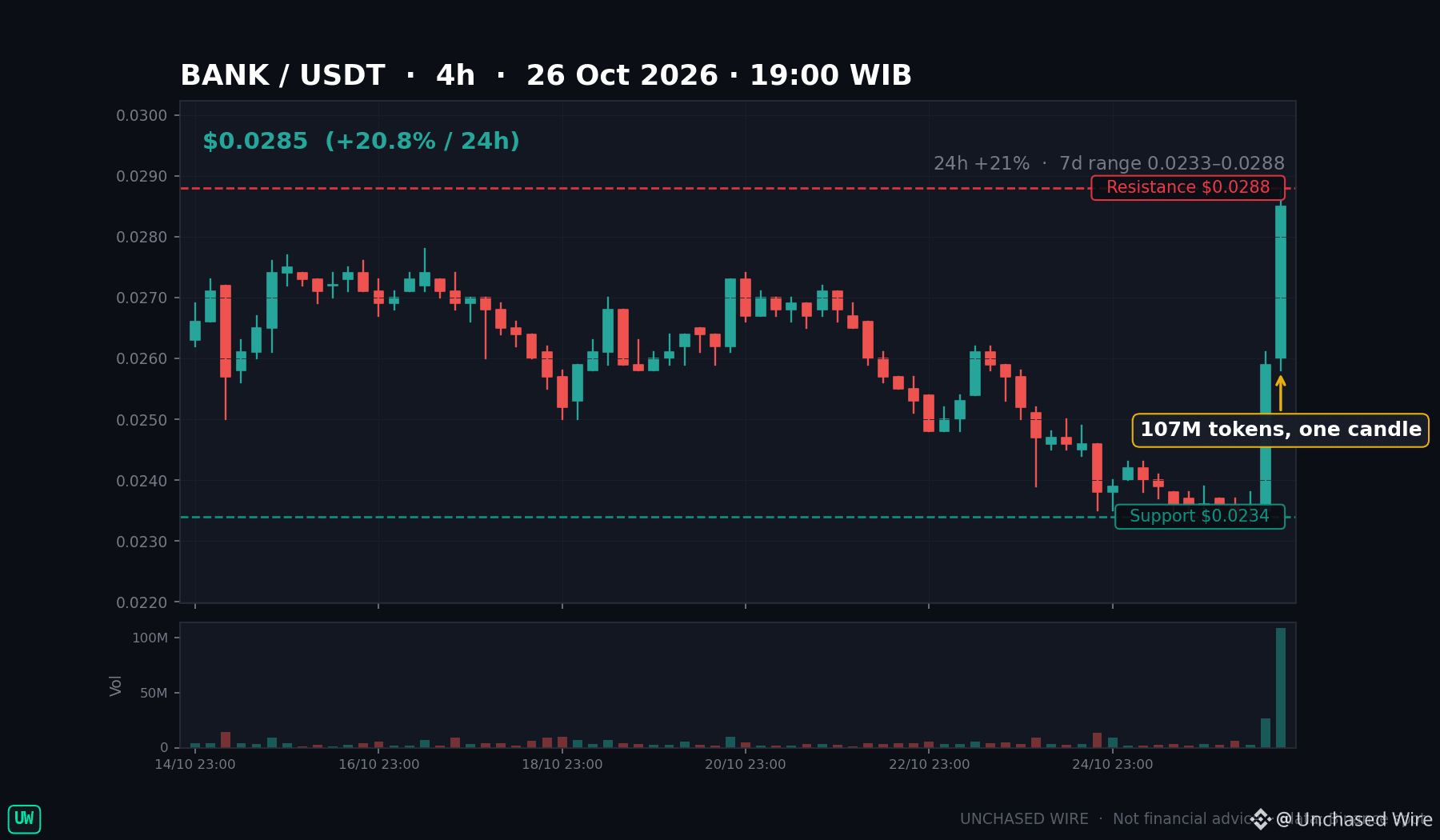
$BANK sat in a $0.0233–$0.0238 base for days. This afternoon it stepped out: a closed candle to $0.0261 on 26 million tokens, six times the recent average, and this evening's candle has already traded 107 million tokens, pushing to $0.0288. That's up about 21% in 24 hours on a coin still roughly 95% below its July high near $0.55.
That history is exactly why I'm not calling this a reversal yet. Small caps spike on thin books all the time, and tonight's candle hasn't even closed — a big volume print on an open candle can still fade.
My lines: support is $0.0234, the base. Resistance is $0.0288, today's high. A 4-hour close back under $0.0234 kills the breakout read.
What settles it for you — a close above $0.0288, or volume staying this loud into tomorrow?
Not financial advice. Do your own research.
$BANK #CryptoTrading #BANK #Breakout #SmallCaps
2
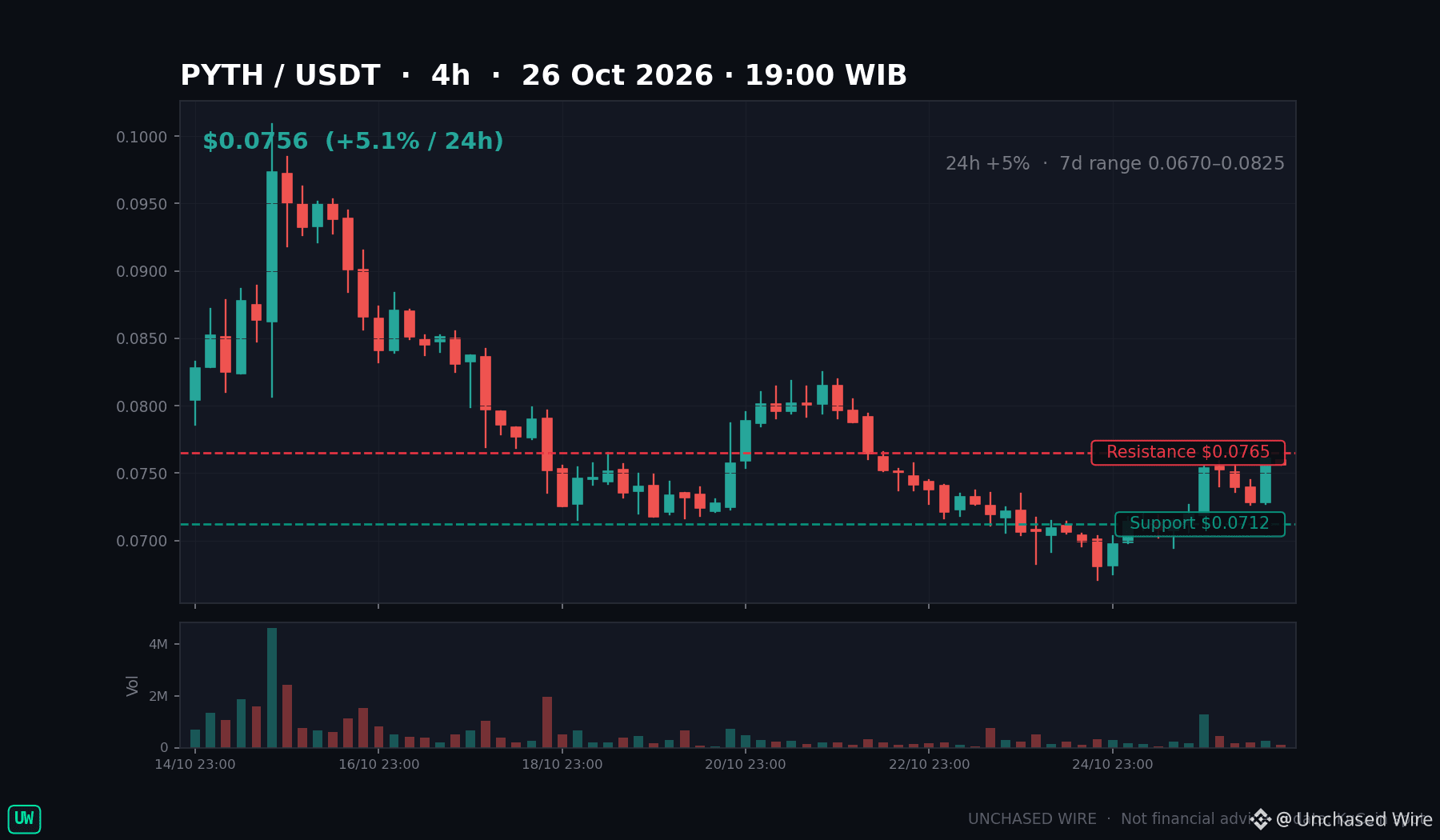
Six days of lower highs took $PYTH from $0.0825 down to $0.067 — then Sunday night printed the candle that changed the shape.
I've watched this bounce since Sunday night. That late candle ran $0.0712 to $0.0757 on 14 million tokens, nearly double the recent average, and today's push tagged $0.0765, closing near $0.076, up 6.4% in 24 hours.
No single headline explains the move, so I'm reading tape, not a story: sellers exhausted after a week-long slide, buyers testing the first ceiling.
What stops me from trusting it: this is a bounce inside a downtrend, not a reversal, and today's push ran on lighter volume than Sunday's breakout candle. A bounce that stalls at its first ceiling after a week-long slide usually hands the move straight back.
Support is $0.0712, the breakout base. Resistance is $0.0765, today's high, with $0.0783 the next shelf above it. A 4-hour close under $0.0712 kills the bounce read, and $0.067 is back in play.
Save $0.0712 and $0.0765 — which one gives way first?
Not financial advice. Do your own research.
$PYTH #Altcoins #Pyth #Oracles #Reversal #CryptoMarkets
11
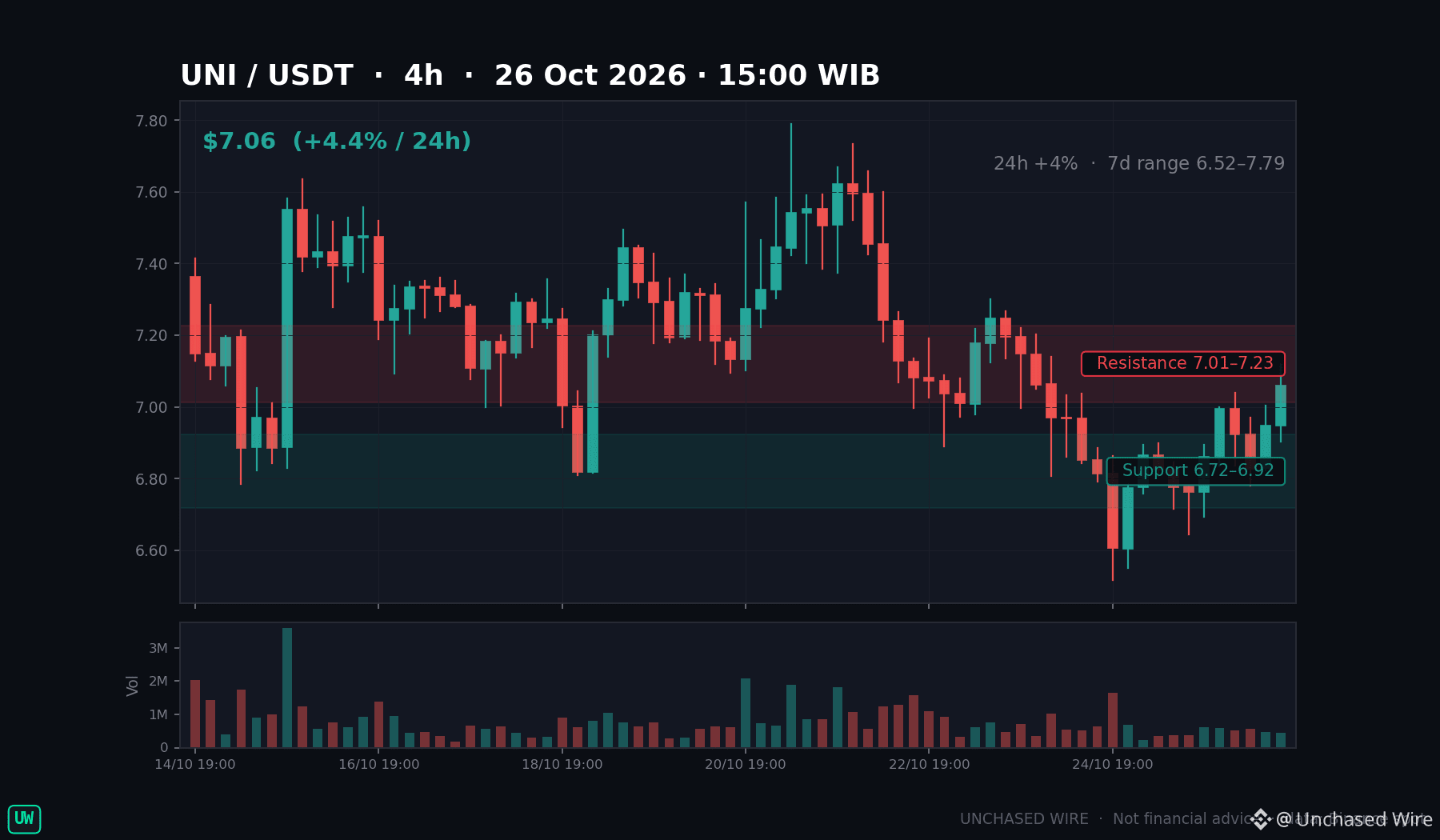
Up 5.8% in 24 hours, $UNI just took back $7 — two days after flushing to $6.52.
I've been watching this reclaim build. Saturday's flush printed the window low, then Sunday's low held near $6.65 and today stepped through $7.00 on $23.4 million of Binance spot volume. Bitcoin and Ethereum are only up about 0.4% each, so this is UNI's move, not the market's.
The part that keeps me from getting comfortable: today's push is running on below-average volume — the last few 4-hour candles printed 420,000 to 560,000 UNI against a ~823,000 average. A reclaim on thinning volume can still fail at the first ceiling, and $7.79 from October 21 is the high that matters above.
If $6.82 holds, $7.12 is the next test. If a 4-hour close slips under $6.82, the reclaim fails and $6.52 is back in play.
Does $UNI hold $7 into tomorrow's close?
Not financial advice.
$UNI #CryptoTrading #Uniswap #DeFi #DEX
28
Osmosis just voted on ending its own inflation — and the tape is already answering.
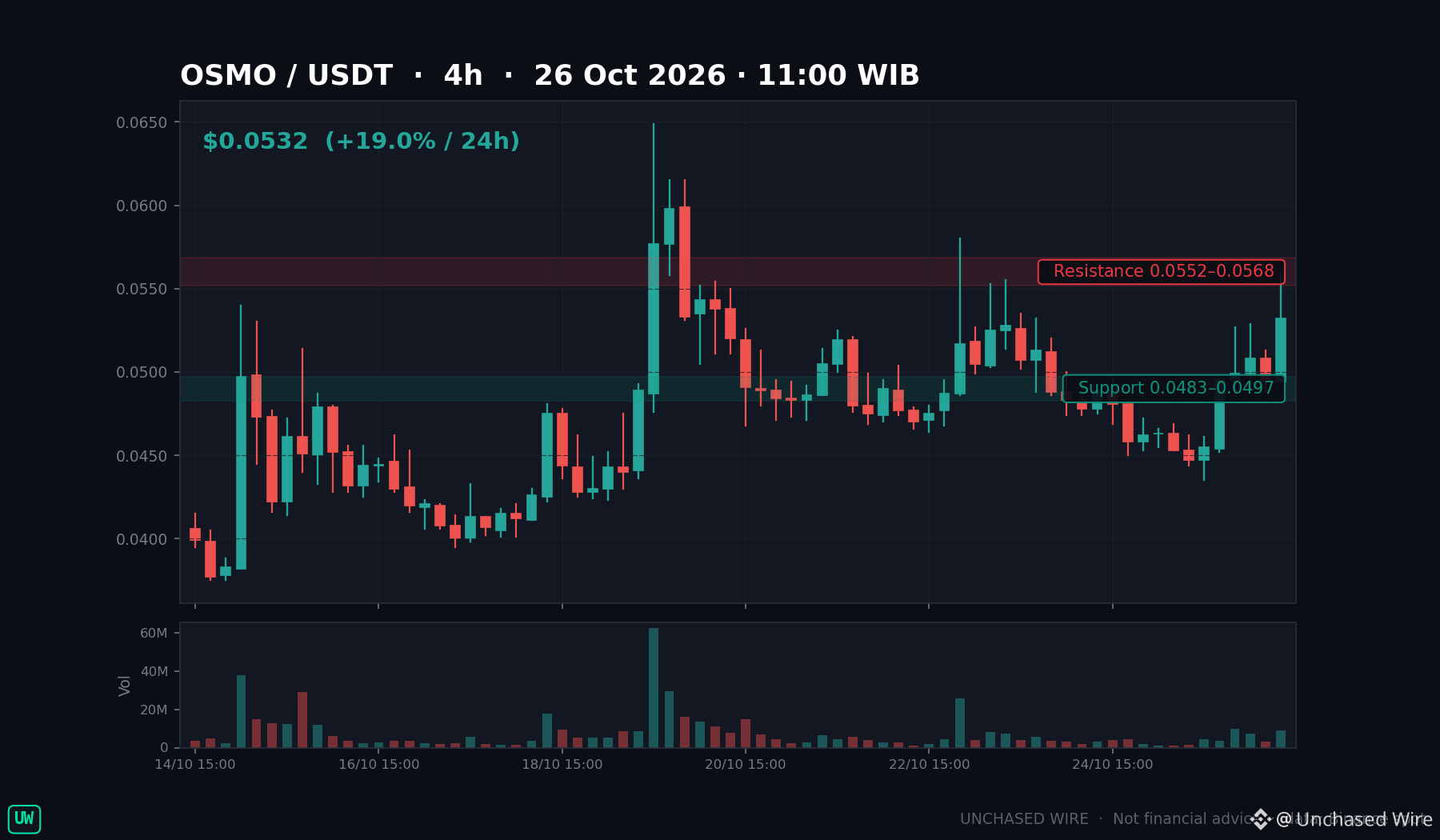
The proposal cutting daily issuance from about 91,000 OSMO to zero closed its vote on October 25, shifting staking rewards to protocol revenue. Tomorrow's v32 vote closes, with a small token burn on the table.
I've been watching the tape. OSMO is up about 19% to $0.053, after tagging $0.056 this morning. Sunday's push held $0.049, then re-attacked the high — while Bitcoin holds near $80,000.
My checklist: $0.049 holds first, then a close through $0.056 confirms buyers mean it. A 4-hour close under $0.049 kills the read.
The trap is real: governance wins can sell off into Wednesday's Fed decision, and thin spot volume — under $2 million a day — cuts both ways.
If you hold OSMO into tomorrow's vote, what are you watching first — the result, or $0.056 holding on a close?
Not financial advice. Do your own research.
$OSMO #Altcoins #Osmosis #Upgrade
32
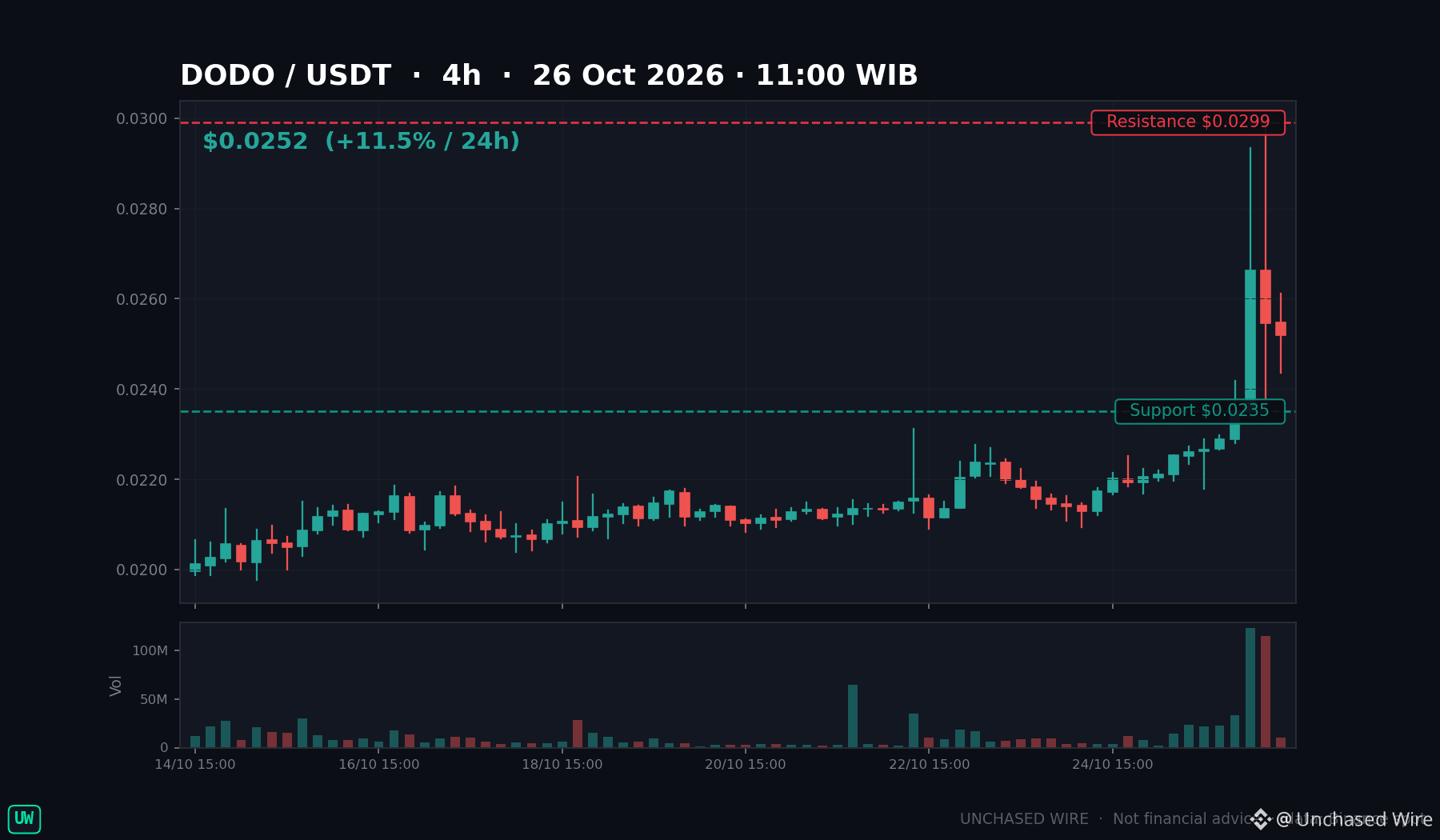
Twelve days pinned near $0.021 — then $DODO traded 238 million tokens in two candles.
I've been watching this base. After weeks closing near $0.021, price stepped through $0.0235 and printed a breakout candle to $0.0293 on 123 million tokens — about nine times the 72-candle average. The next tagged $0.0299 and closed at $0.0255 on 115 million. It's up about 11.5% in 24 hours on $8.7 million of Binance spot volume, while Bitcoin and Ethereum are red.
I found no headline I could verify behind the move — this is tape, not a story. And the tape cuts both ways: two enormous candles failed to hold above $0.029, so the breakout stays unconfirmed until that ceiling breaks on a close.
The floor is $0.0235, defended by both candles; the ceiling is $0.0299. A 4-hour close under $0.0235 kills the breakout read.
Keep $0.0235 and $0.0299 on your screen — which one gives way first?
Not financial advice. Do your own research.
$DODO #CryptoTrading #DODO #DeFi #DEX #Altcoins
40
Caldera already tried this breakout once — and it failed.
I'm watching the second attempt unfold on $ERA.
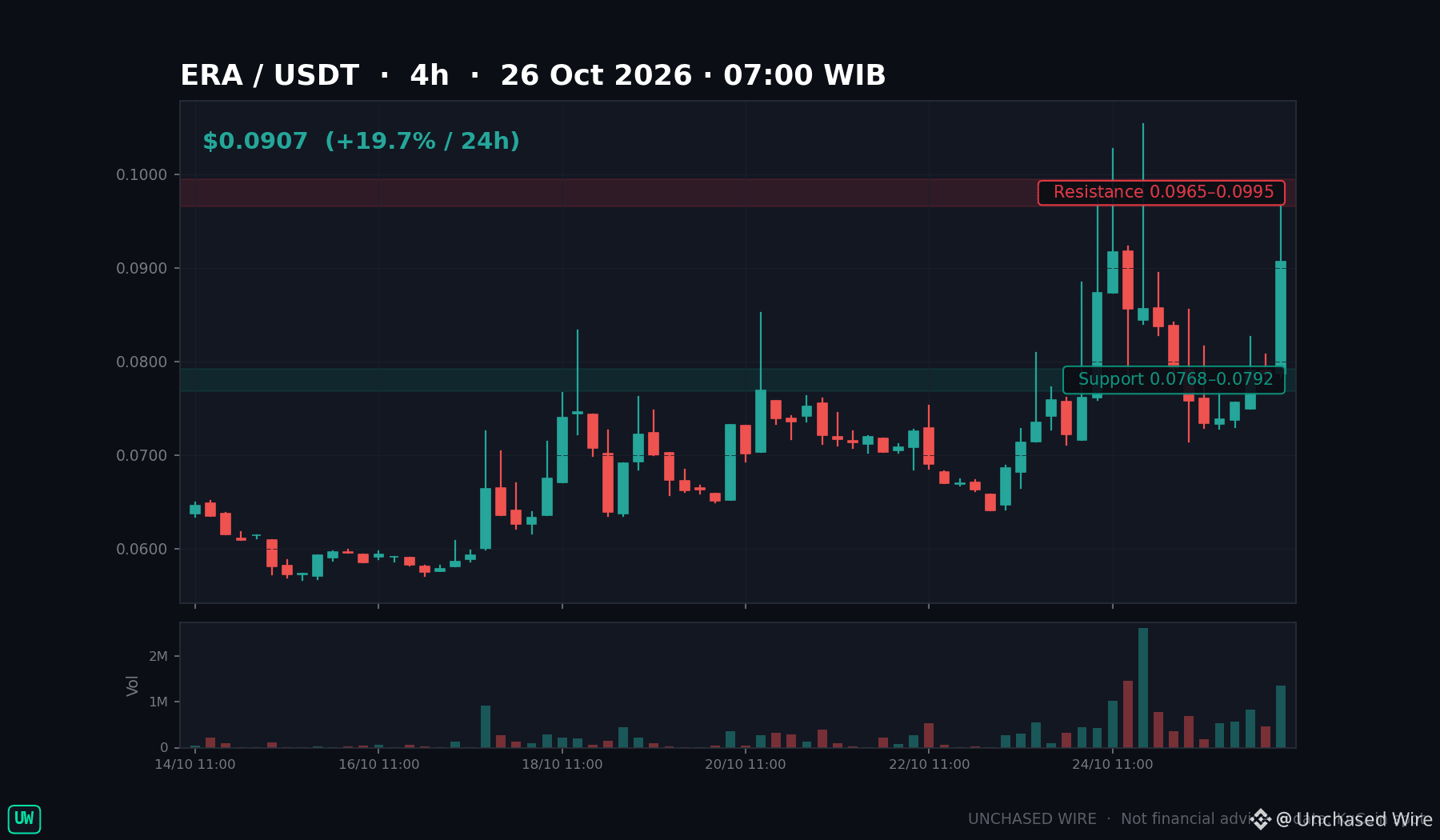
On October 24 it spiked to $0.103 on huge volume, then gave the whole move back to $0.0714. This morning it printed another big candle, $0.078 to $0.098, closing near $0.091 on 53 million tokens — almost triple the 18-million average. It's up about 25% in 24 hours while Bitcoin and Ethereum are both red.
I can't point to a news headline behind either move — I checked, and there's no verified catalyst. This is tape, not a story: buyers stepping back in at the same zone that rejected them two days ago.
What keeps me honest here: the first attempt failed, and second failures usually fall harder. And this is a small-cap tape — moves this size cut both ways. Support $0.078, resistance $0.098. A 4-hour close under $0.078 kills the second-attempt read.
Does the second try hold $0.090, or does $0.098 reject it again?
Not financial advice. Do your own research.
$ERA #CryptoMarkets #Caldera #Breakout #CryptoTrading
Caldera already tried this breakout once — and it failed.
I'm watching the second attempt unfold on $ERA .
On October 24 it spiked to $0.103 on huge volume, then gave the whole move back to $0.0714. This morning it printed another big candle, $0.078 to $0.098, closing near $0.091 on 53 million tokens — almost triple the 18-million average. It's up about 25% in 24 hours while Bitcoin and Ethereum are both red.
I can't point to a news headline behind either move — I checked, and there's no verified catalyst. This is tape, not a story: buyers stepping back in at the same zone that rejected them two days ago.
What keeps me honest here: the first attempt failed, and second failures usually fall harder. And this is a small-cap tape — moves this size cut both ways. Support $0.078, resistance $0.098. A 4-hour close under $0.078 kills the second-attempt read.
Does the second try hold $0.090, or does $0.098 reject it again?
Not financial advice. Do your own research.
$ERA #CryptoMarkets #Caldera #Breakout #CryptoTrading
61
Bitcoin is drifting into FOMC week, down about 1% — and $QNT is up about 6% anyway.
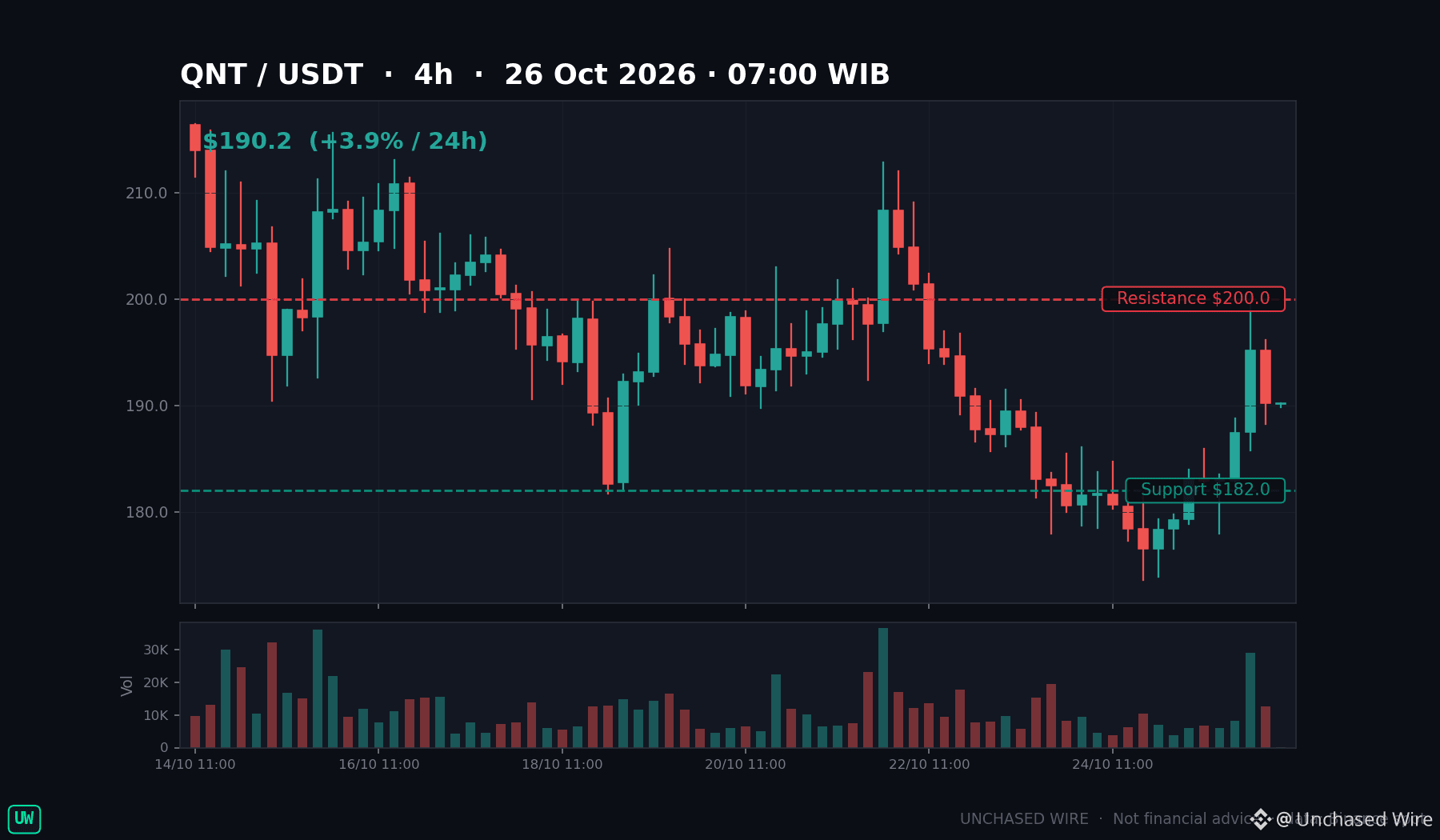
That split is what caught my eye. Quant bottomed at $173.56, then climbed from $176.54 toward $195.15 — including a push through $200 on a 29,000-token candle, more than double the ~12,000 average. It's holding near $190 now on $12.9M of Binance spot volume.
This bounce sits inside a slide from $217 at the start of this 12-day window. One strong candle doesn't erase that, and a hawkish FOMC week could drag the whole board with it.
My lines: support $182, resistance $200. A 4-hour close under $182 breaks the bounce's floor.
These are the two levels I'll be checking back on after the FOMC — $182 below, $200 above. What's your read on the $200 retest?
Not financial advice.
$QNT #Altcoins #Quant #FOMC
76
ENA just did the thing dip-buyers dream about — and I'm still not calling it a reversal.
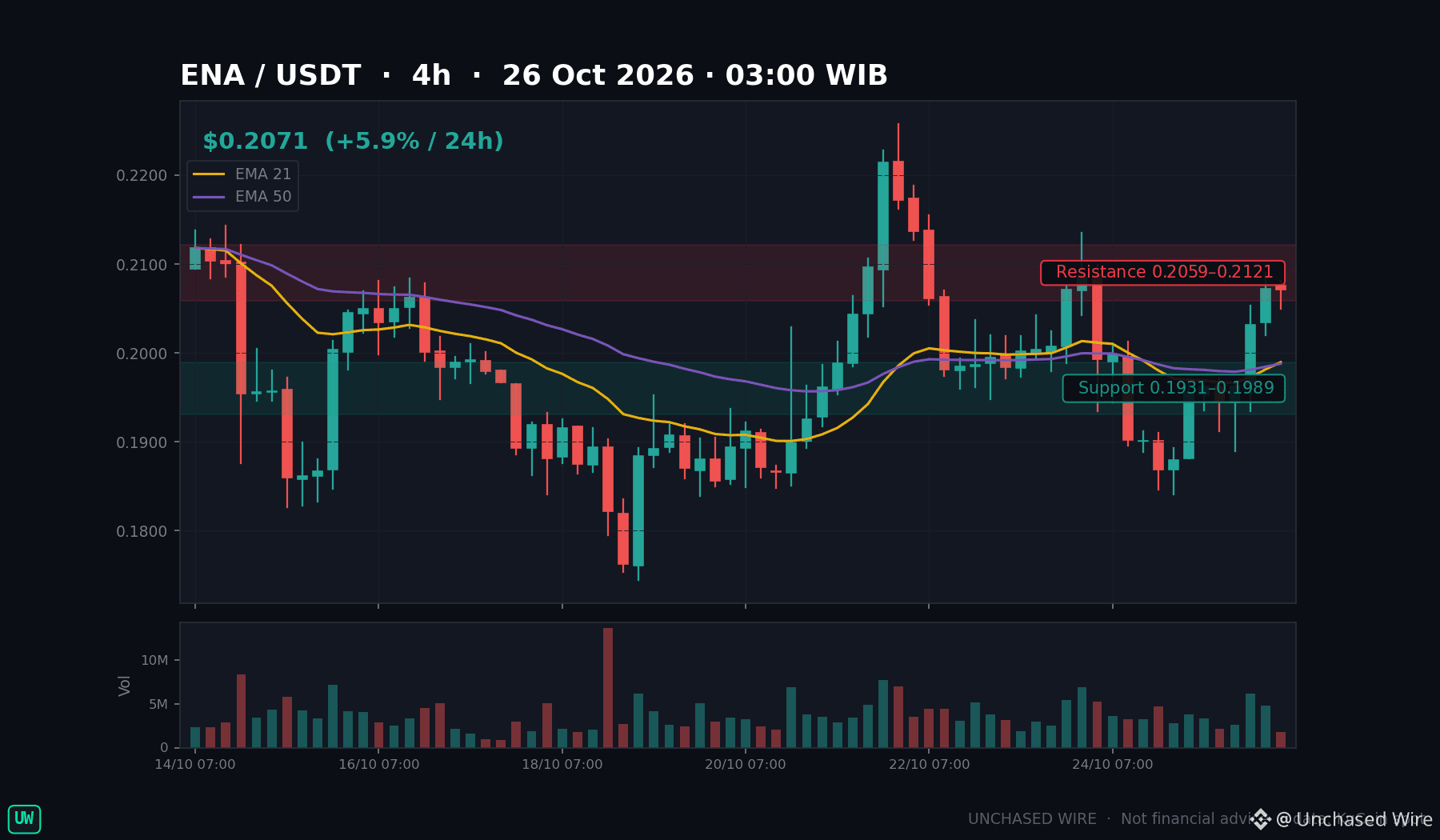
I'm watching $ENA because it dipped toward $0.184, then reclaimed $0.20 on a 50-million-token candle, well above the 30-million average, and has printed three straight closes above $0.20 since. It's $0.2071 now, up about 9% in 24 hours on $29M of Binance spot volume.
The sequence matters more than any single candle. First the flush to $0.184, then the reclaim above $0.20, then the hold above it. That's a staircase back up, not one green candle.
The part that keeps me from getting comfortable: this coin fell from near $0.27 earlier in October to about $0.176. Reclaims inside downtrends fail all the time, and a close back under $0.196 re-opens $0.184 fast.
My lines: support $0.196, resistance $0.209. A 4-hour close under $0.196 breaks the reclaim story.
If you held through the dip, what earns your trust here — a close above $0.209, or one more quiet day above $0.196?
Not financial advice. Do your own research.
$ENA #CryptoMarkets #Ethena #DeFi #Reclaim
4
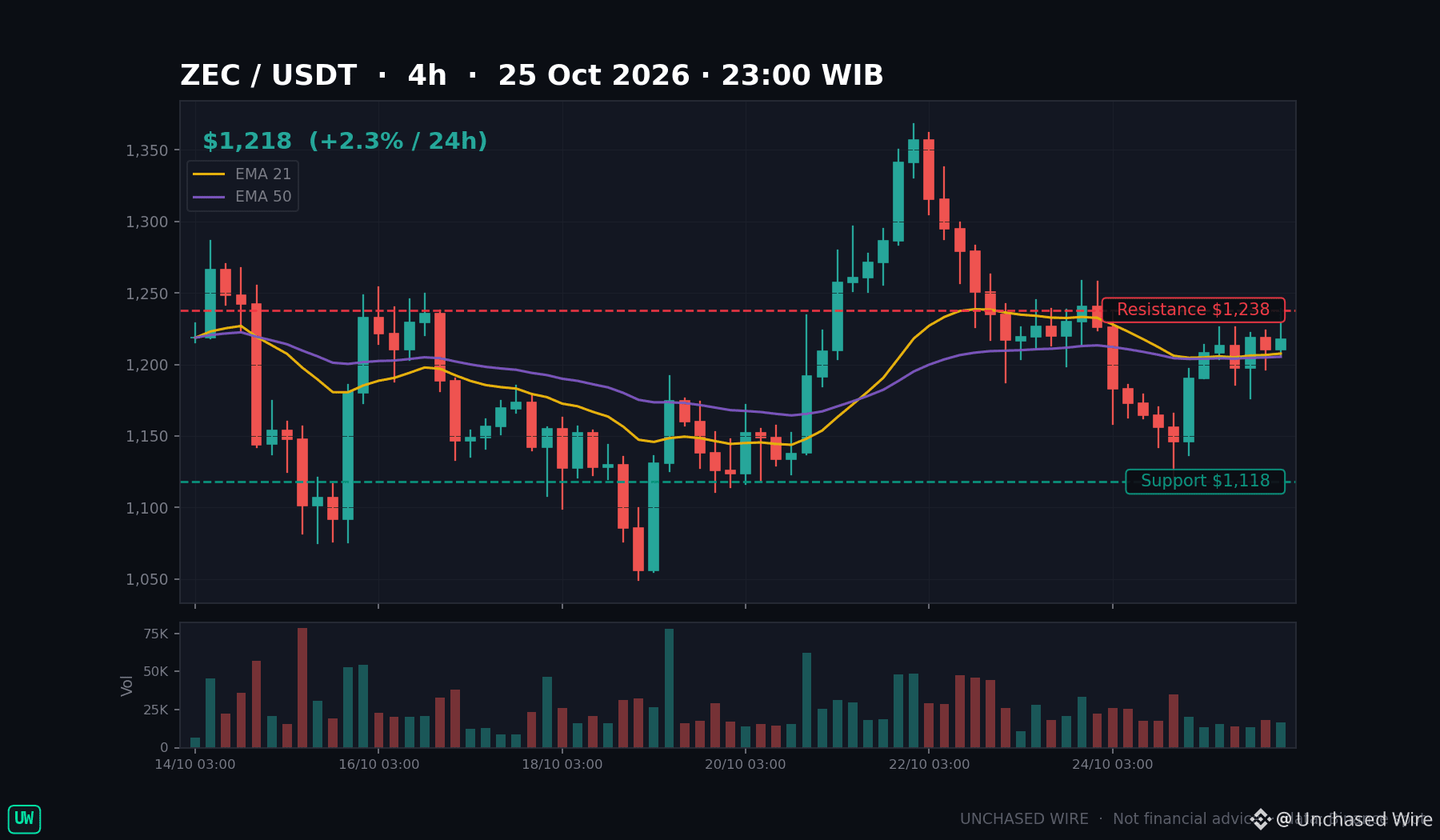
ETF money just walked back into $ZEC — $41.1M last week, the fund's best week since mid-September, after three weeks of $143M walking out.
I'm watching the flow, not just the chart, because the tape tells a split story. The fund took in money four days straight, $20.5M on Friday alone, while Bitcoin funds wobbled and Ether funds lost $220.7M on the week. ZEC held near $1,218 through it, up about 7% on the week, after dipping to $1,118.
September, though, did this exact dance before. A $98.2M inflow week was followed by three weeks of withdrawals as ZEC slid from near $1,690. One strong week is a change of direction, not proof of one.
$1,118 below, $1,238 above — a daily close under $1,118 breaks the floor this thesis stands on.
What convinces you first — a second straight week of inflows, or a close above $1,238?
Not financial advice. Do your own research.
$ZEC #CryptoNews #ZEC #ETF #Privacy
10
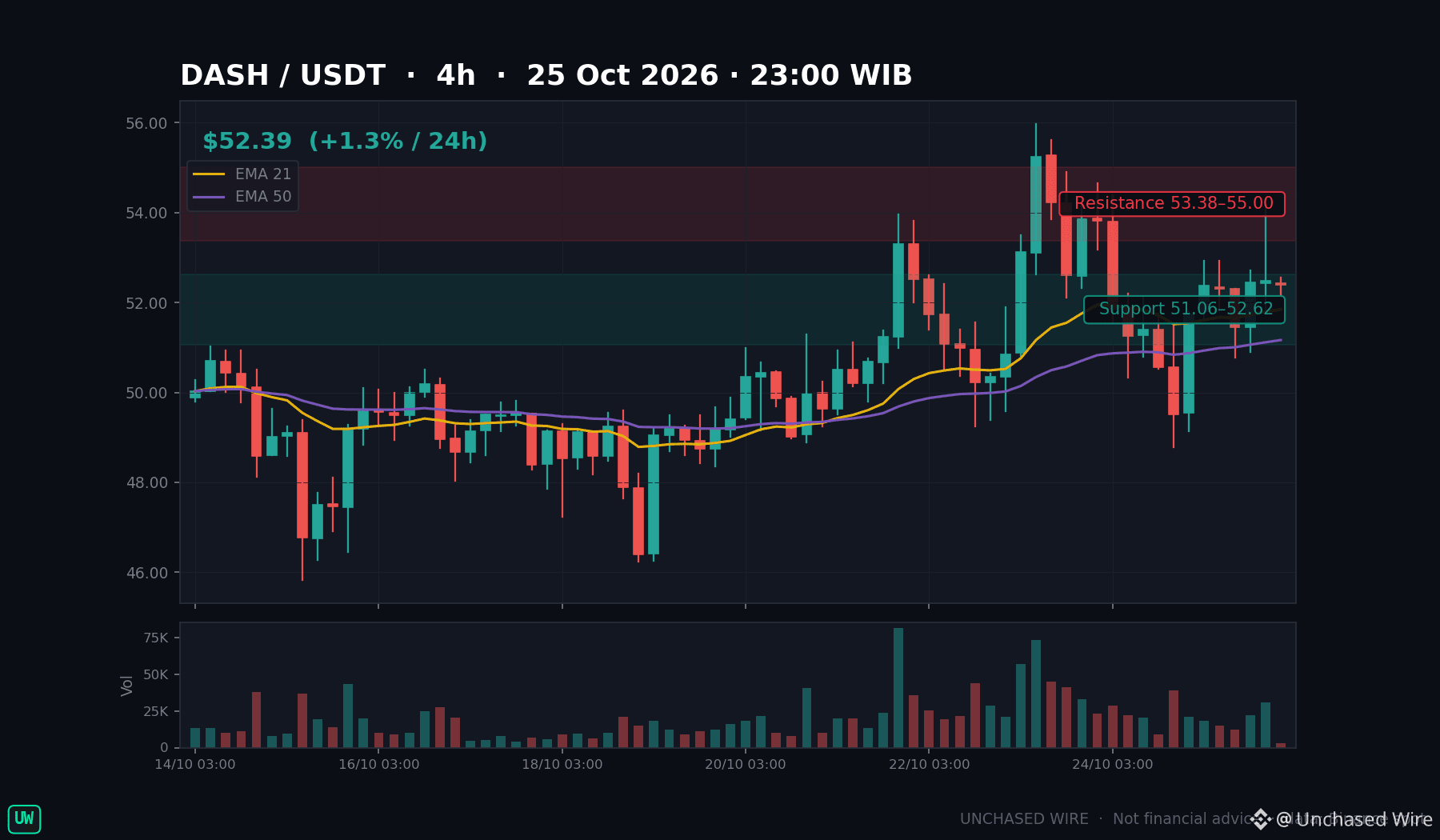
Privacy coins are quietly leading again today. $ZEC is up about 5.6% and $DASH about 5.7% while Bitcoin drifts near $80,600, up less than 1%.
I'm watching $DASH because its chart is compressing, not running: $54.19 has turned price back twice now — first as a failed bounce, then again on today's push — while the floor has lifted from $48.78 to $51.84. A rising floor under a flat ceiling is a decision forming, not a trend confirmed.
DASH is the payments coin that led October's privacy rotation, so this isn't a new narrative — it's the same trade coiling again. The risk is the obvious one: two rejections at one level can also be distribution, and a coin up 125% in early October can unwind fast if the floor gives way.
Resistance sits at $54.19; support at $51.84. A 4-hour close above $54.19 puts $55.98 back in play, while a close under $51.84 re-opens $48.78.
Keep $54.19 and $51.84 on your screen — which one gives way first?
Not financial advice.
$DASH #CryptoMarkets #Dash #PrivacyCoins #Breakout #Zcash
13
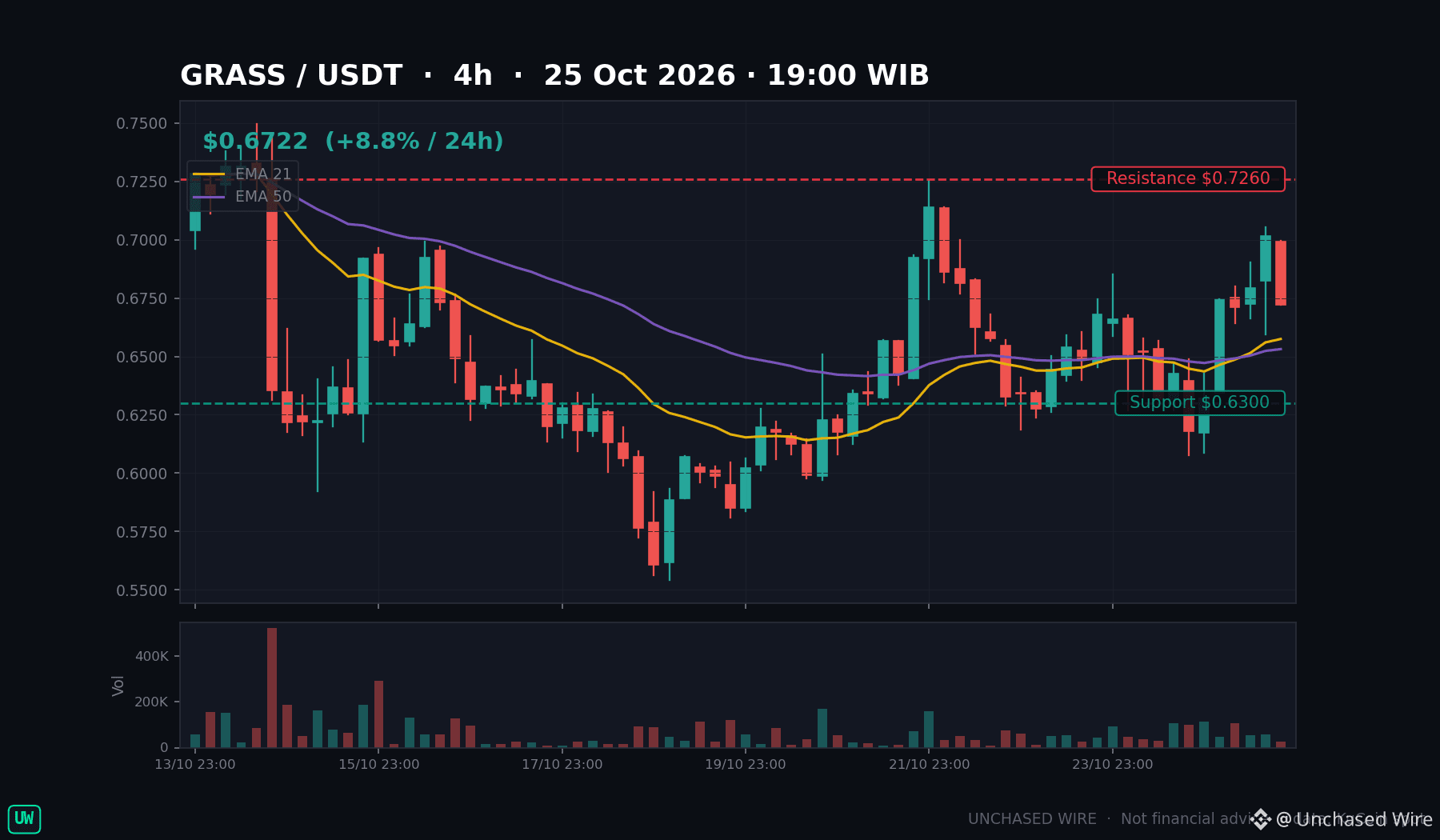
Four higher lows in a week — $GRASS is climbing stairs, not spiking.
I'm watching the structure, not a headline: since the $0.555 low a week ago, every dip has bottomed higher, and price now trades near $0.68, up roughly 8% in 24 hours.
GRASS is the token of a network that pays users for sharing unused internet bandwidth for AI data.
The part that keeps me from getting comfortable: the rise has been steady, not explosive, and $0.726 — the high from the last push — rejected price once already. Momentum this orderly can unwind just as quietly.
Support sits around $0.63, resistance at $0.726. A 4-hour close above $0.726 puts $0.75 in play; a close under $0.61 breaks the staircase and sends it back toward the $0.555 low. Small-cap DePIN volatility — moves like this cut both ways.
Which breaks first: the $0.63 floor or the $0.726 ceiling?
Not financial advice.
$GRASS #Altcoins #GRASS #DePIN #CryptoTrading
15
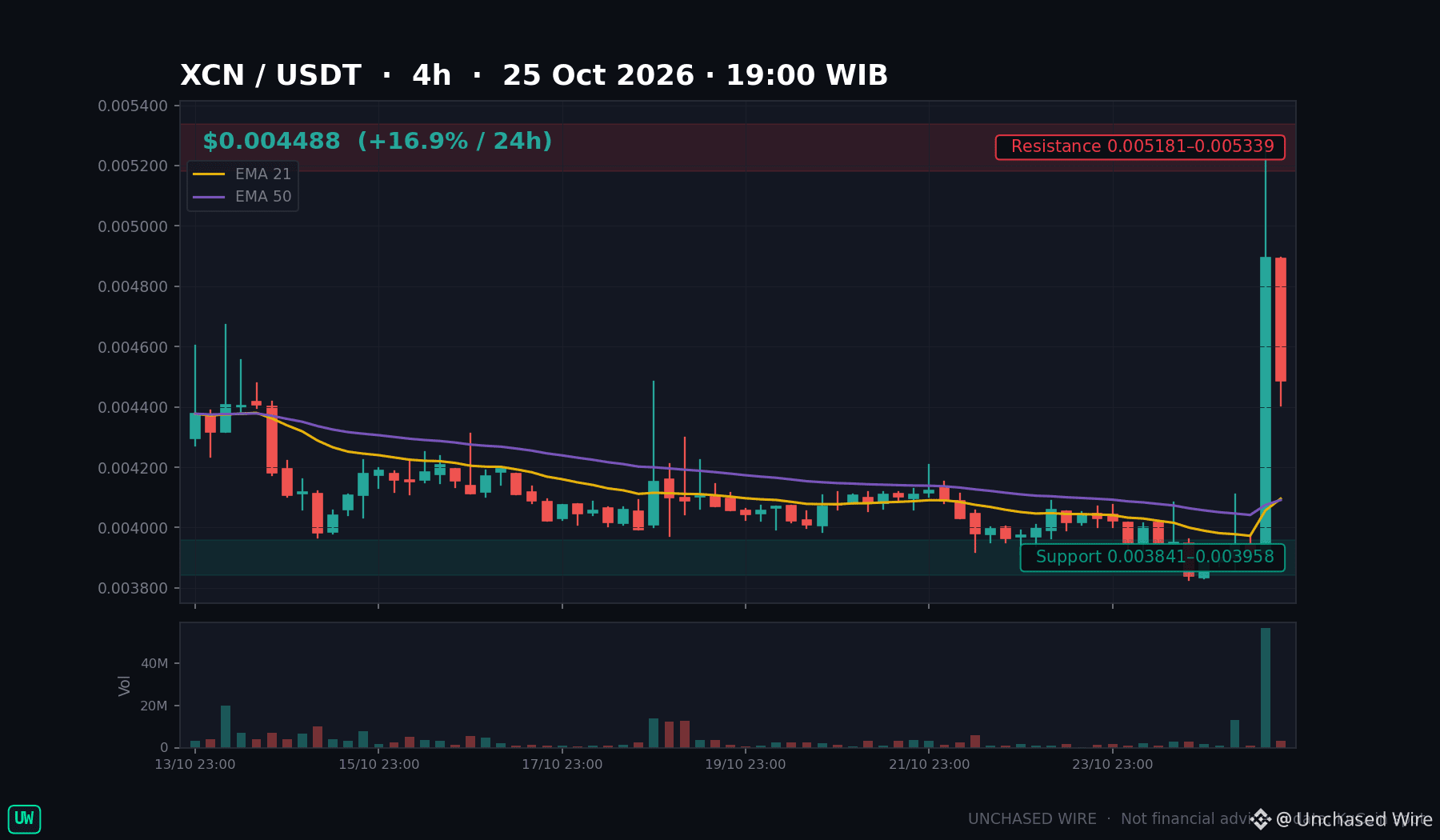
$XCN spent days pinned near $0.0039. One 4-hour candle just redrew its range.
I'm reading the tape, not a headline — I found no verified announcement behind it. That candle opened at $0.00392, spiked to $0.00526, and closed near $0.00490 on 56.9 million tokens, about 20 times the prior ten candles' average. XCN has already slipped back to about $0.0045, cutting the 24-hour gain to roughly 14% on this venue.
XCN is Onyx's governance and utility token, so the move has a real project behind it — but a close 7% below the candle's high says buyers didn't hold the top, and the dollar tape here is still thin.
Three ways this resolves: a 4-hour close back above $0.0049 keeps $0.00526 in play; a drift back to the $0.0039 base says the spike was noise; or it chops between the two while volume decides.
What convinces you first — a second close above $0.0049, or volume staying above the old norm?
Not financial advice.
$XCN #CryptoMarkets #Onyx #Volume #Breakout
Войдите, чтобы посмотреть больше материала
Присоединяйтесь к пользователям криптовалют по всему миру на Binance Square
⚡️ Получайте новейшую и полезную информацию о криптоактивах.
💬 Нам доверяет крупнейшая в мире криптобиржа.
👍 Получите достоверные аналитические данные от верифицированных создателей контента.
Эл. почта/номер телефона