

F O X T R O T
87 投稿

F O X T R O T
報告
ユーザーをブロック
Where there is a will, there is a way.
26 フォロー
4.6K+ フォロワー
103 いいね
投稿
翻訳参照
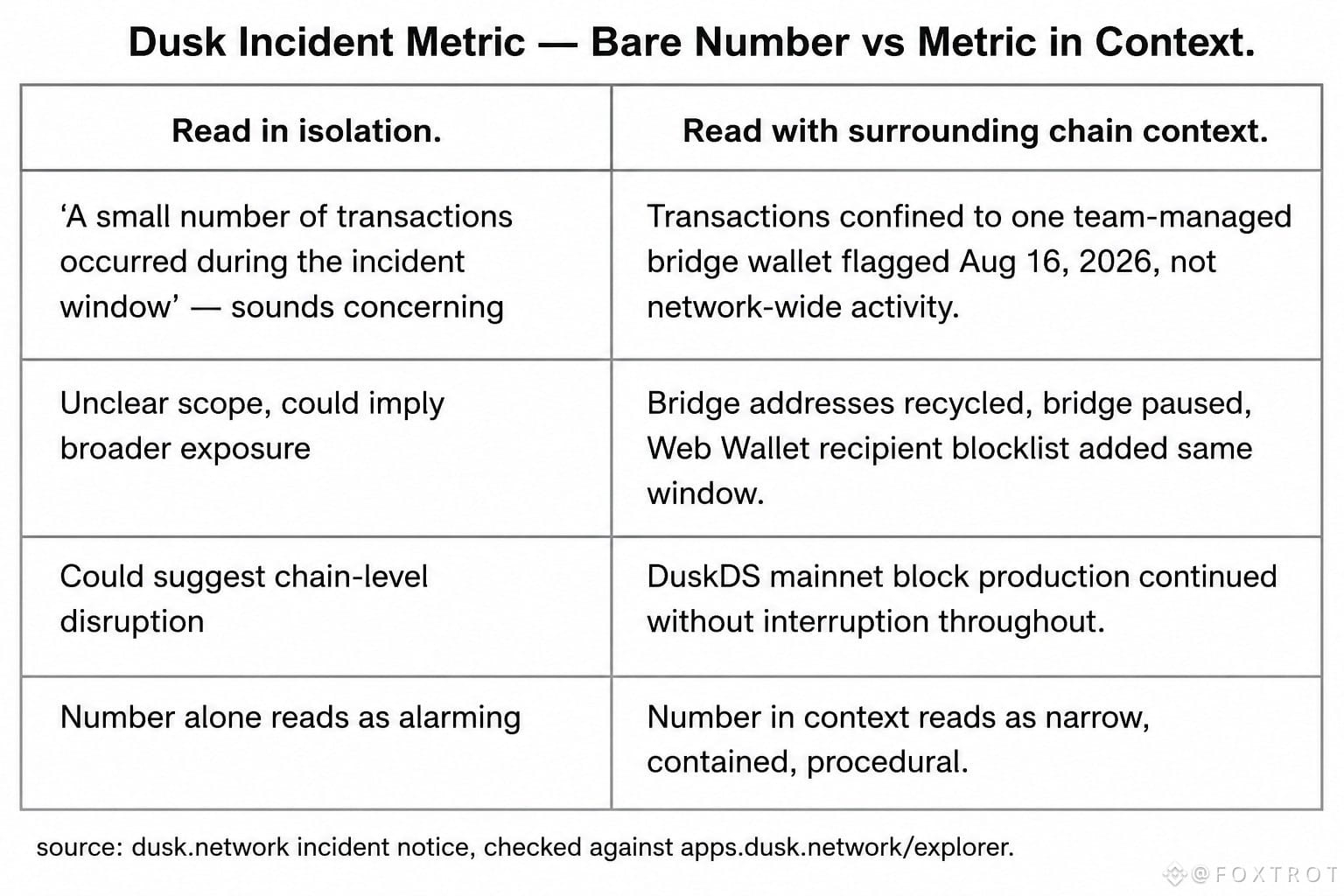
Almost skimmed past it — some number buried in the Dusk incident notice. "A small number of transactions occurred during the incident window." That's it. That's the whole line. On its own it sounds like nothing, or worse, like they're downplaying something big. #dusk $DUSK @Dusk_Foundation
So I actually went and checked the context around it instead of just the headline stat. Turns out that "small number" wasn't network-wide activity — it was isolated to a single team-managed wallet used for bridge ops, flagged Aug 16, contained same window, then the whole bridge got paused and a Web Wallet blocklist went up for recipient addresses. Once you place that number next to DuskDS mainnet block production, which never skipped a beat during any of this… the metric stops looking scary and starts looking almost boring. Which, hmm, might be the actual point.
I've caught myself before treating a bare number as the story. This one only made sense once I stopped reading it in isolation and pulled the surrounding transaction flow, the timing, who touched what. Default read: alarming. Actual read: contained, narrow, procedural.
Makes me wonder how many "concerning" on-chain stats across other projects would deflate the same way if anyone bothered to check the four lines of context around them.
Almost skimmed past it — some number buried in the Dusk incident notice. "A small number of transactions occurred during the incident window." That's it. That's the whole line. On its own it sounds like nothing, or worse, like they're downplaying something big. #dusk $DUSK @Dusk
So I actually went and checked the context around it instead of just the headline stat. Turns out that "small number" wasn't network-wide activity — it was isolated to a single team-managed wallet used for bridge ops, flagged Aug 16, contained same window, then the whole bridge got paused and a Web Wallet blocklist went up for recipient addresses. Once you place that number next to DuskDS mainnet block production, which never skipped a beat during any of this… the metric stops looking scary and starts looking almost boring. Which, hmm, might be the actual point.
I've caught myself before treating a bare number as the story. This one only made sense once I stopped reading it in isolation and pulled the surrounding transaction flow, the timing, who touched what. Default read: alarming. Actual read: contained, narrow, procedural.
Makes me wonder how many "concerning" on-chain stats across other projects would deflate the same way if anyone bothered to check the four lines of context around them.
So I actually went and checked the context around it instead of just the headline stat. Turns out that "small number" wasn't network-wide activity — it was isolated to a single team-managed wallet used for bridge ops, flagged Aug 16, contained same window, then the whole bridge got paused and a Web Wallet blocklist went up for recipient addresses. Once you place that number next to DuskDS mainnet block production, which never skipped a beat during any of this… the metric stops looking scary and starts looking almost boring. Which, hmm, might be the actual point.
I've caught myself before treating a bare number as the story. This one only made sense once I stopped reading it in isolation and pulled the surrounding transaction flow, the timing, who touched what. Default read: alarming. Actual read: contained, narrow, procedural.
Makes me wonder how many "concerning" on-chain stats across other projects would deflate the same way if anyone bothered to check the four lines of context around them.
1
1
145
翻訳参照
Almost skipped past this one, ngl, then had to stop and reread the notice twice.
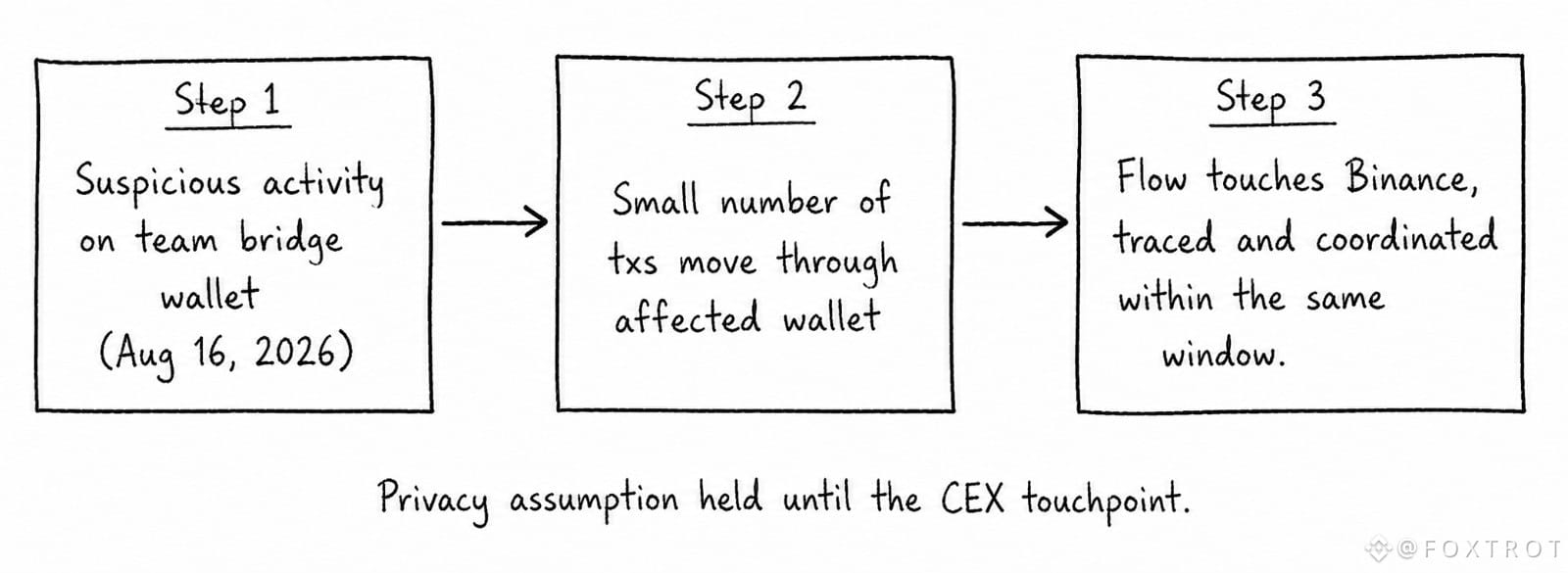
Went into this thinking Dusk Foundation's privacy-preserving design would make any weird transaction basically invisible until way after the fact — that's kind of the whole zero-knowledge pitch, right, confidential by default. Then I looked at the Aug 16 bridge incident notes: a small number of transactions moved through the affected wallet during the window, and the team caught it fast enough to identify that part of that flow touched Binance, coordinated with them almost immediately. $DUSK #dusk
That's the one transaction pattern that flipped my assumption. Privacy-by-design doesn't mean untraceable-by-design, at least not on the parts of the stack that touch a centralized venue. The moment funds crossed into a CEX rail, visibility came back fast — faster than I expected, honestly. Made me rethink where the "privacy" actually lives in practice versus where it just… doesn't apply yet. @Dusk_Foundation
Had a whole assumption built on the marketing framing and had to quietly walk it back mid-task. Slightly annoying when that happens, also kind of the point of doing this stuff manually instead of skimming a summary.
Still not sure where the actual line sits between what's private on Dusk and what's only private until it hits an exchange — anyone traced that boundary properly yet?
Almost skipped past this one, ngl, then had to stop and reread the notice twice.
Went into this thinking Dusk Foundation's privacy-preserving design would make any weird transaction basically invisible until way after the fact — that's kind of the whole zero-knowledge pitch, right, confidential by default. Then I looked at the Aug 16 bridge incident notes: a small number of transactions moved through the affected wallet during the window, and the team caught it fast enough to identify that part of that flow touched Binance, coordinated with them almost immediately. $DUSK #dusk
That's the one transaction pattern that flipped my assumption. Privacy-by-design doesn't mean untraceable-by-design, at least not on the parts of the stack that touch a centralized venue. The moment funds crossed into a CEX rail, visibility came back fast — faster than I expected, honestly. Made me rethink where the "privacy" actually lives in practice versus where it just… doesn't apply yet. @Dusk
Had a whole assumption built on the marketing framing and had to quietly walk it back mid-task. Slightly annoying when that happens, also kind of the point of doing this stuff manually instead of skimming a summary.
Still not sure where the actual line sits between what's private on Dusk and what's only private until it hits an exchange — anyone traced that boundary properly yet?
Went into this thinking Dusk Foundation's privacy-preserving design would make any weird transaction basically invisible until way after the fact — that's kind of the whole zero-knowledge pitch, right, confidential by default. Then I looked at the Aug 16 bridge incident notes: a small number of transactions moved through the affected wallet during the window, and the team caught it fast enough to identify that part of that flow touched Binance, coordinated with them almost immediately. $DUSK #dusk
That's the one transaction pattern that flipped my assumption. Privacy-by-design doesn't mean untraceable-by-design, at least not on the parts of the stack that touch a centralized venue. The moment funds crossed into a CEX rail, visibility came back fast — faster than I expected, honestly. Made me rethink where the "privacy" actually lives in practice versus where it just… doesn't apply yet. @Dusk
Had a whole assumption built on the marketing framing and had to quietly walk it back mid-task. Slightly annoying when that happens, also kind of the point of doing this stuff manually instead of skimming a summary.
Still not sure where the actual line sits between what's private on Dusk and what's only private until it hits an exchange — anyone traced that boundary properly yet?
2
113
翻訳参照
Was mid-task pulling data on Dusk Foundation infra when the bridge incident notice caught my eye. Aug 16, the team flagged suspicious activity on a team-managed wallet used for bridge ops. #dusk $DUSK @Dusk_Foundation
Here's the part that made me stop scrolling: it wasn't a DuskDS protocol failure. The chain itself never blinked — mainnet kept producing blocks normally. What actually happened was the boring, human kind of risk: an operationally-managed wallet went sideways, addresses got disabled and recycled, bridge got paused, and the team scrambled to add a recipient blocklist on the Web Wallet after the fact.
That's the gap nobody markets. "Trustless settlement" is the pitch. But the bridge — the exact point where value crosses in and out — still runs on a team-controlled hot wallet that can get compromised like any centralized custodian's. The privacy tech, the ZK layer, the deterministic finality… none of that mattered here. What mattered was old-fashioned key management, and it showed.
Makes me wonder how much of "decentralized infrastructure" messaging quietly depends on centralized choke points nobody stress-tests until something goes wrong. Which piece of your favorite chain is still just a wallet somebody has to keep safe?
Was mid-task pulling data on Dusk Foundation infra when the bridge incident notice caught my eye. Aug 16, the team flagged suspicious activity on a team-managed wallet used for bridge ops. #dusk $DUSK @Dusk
Here's the part that made me stop scrolling: it wasn't a DuskDS protocol failure. The chain itself never blinked — mainnet kept producing blocks normally. What actually happened was the boring, human kind of risk: an operationally-managed wallet went sideways, addresses got disabled and recycled, bridge got paused, and the team scrambled to add a recipient blocklist on the Web Wallet after the fact.
That's the gap nobody markets. "Trustless settlement" is the pitch. But the bridge — the exact point where value crosses in and out — still runs on a team-controlled hot wallet that can get compromised like any centralized custodian's. The privacy tech, the ZK layer, the deterministic finality… none of that mattered here. What mattered was old-fashioned key management, and it showed.
Makes me wonder how much of "decentralized infrastructure" messaging quietly depends on centralized choke points nobody stress-tests until something goes wrong. Which piece of your favorite chain is still just a wallet somebody has to keep safe?
Here's the part that made me stop scrolling: it wasn't a DuskDS protocol failure. The chain itself never blinked — mainnet kept producing blocks normally. What actually happened was the boring, human kind of risk: an operationally-managed wallet went sideways, addresses got disabled and recycled, bridge got paused, and the team scrambled to add a recipient blocklist on the Web Wallet after the fact.
That's the gap nobody markets. "Trustless settlement" is the pitch. But the bridge — the exact point where value crosses in and out — still runs on a team-controlled hot wallet that can get compromised like any centralized custodian's. The privacy tech, the ZK layer, the deterministic finality… none of that mattered here. What mattered was old-fashioned key management, and it showed.
Makes me wonder how much of "decentralized infrastructure" messaging quietly depends on centralized choke points nobody stress-tests until something goes wrong. Which piece of your favorite chain is still just a wallet somebody has to keep safe?
73
翻訳参照
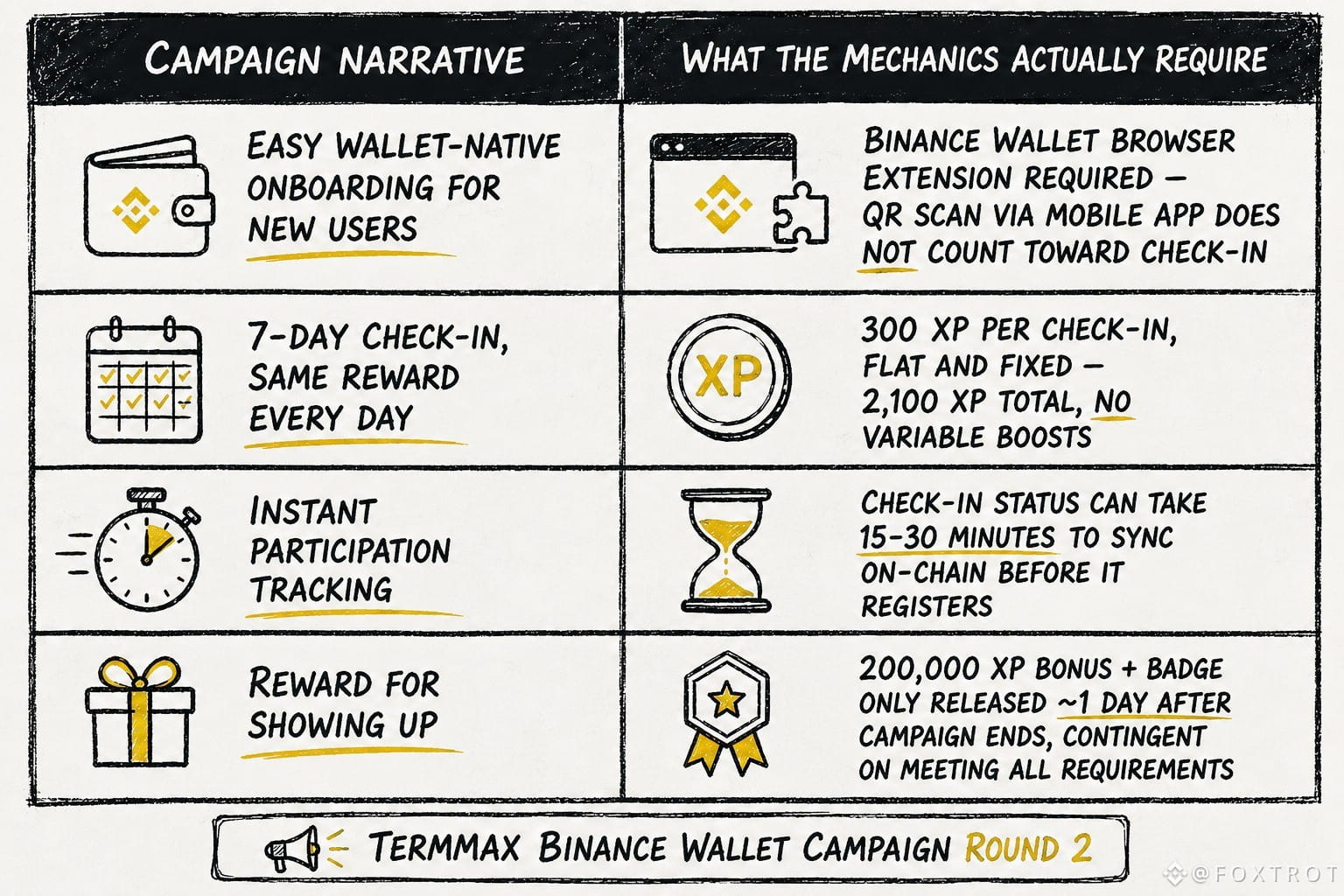
#termmax @termmax Spent the last stretch of this task actually working through TermMax's #TermMax @Termmax Binance Wallet Campaign Round 2 instead of just reading about it, and one detail stopped me mid-scroll.
The check-in mechanic is oddly rigid for something marketed as "easy onboarding" — 7 consecutive days, 300 XP fixed per check-in, 2,100 XP guaranteed if you don't miss a day, plus a 200K XP bonus and an exclusive badge released roughly a day after the campaign closes. Nothing variable, nothing gamified with multipliers. Same flat-rate logic $TMX applies to its actual lending markets, just repackaged as a growth loop.
But here's the part that made me pause — the docs specifically flag that logging in via QR scan through the Binance app doesn't count. You need the desktop browser extension. So a campaign framed as low-friction, wallet-native onboarding quietly filters out anyone who's mobile-only from day one. The people who benefit first aren't new users getting introduced to fixed-rate DeFi, they're existing desktop-native wallet users who already know the extension flow.
Tried it myself on mobile first, hit the wall, had to switch devices just to get check-in status to register.
Makes me wonder how much of the "participation" number Binance eventually reports is just filtered by that one interface choice before any real usage happens.
#termmax @TermMax Spent the last stretch of this task actually working through TermMax's #TermMax @Termmax Binance Wallet Campaign Round 2 instead of just reading about it, and one detail stopped me mid-scroll.
The check-in mechanic is oddly rigid for something marketed as "easy onboarding" — 7 consecutive days, 300 XP fixed per check-in, 2,100 XP guaranteed if you don't miss a day, plus a 200K XP bonus and an exclusive badge released roughly a day after the campaign closes. Nothing variable, nothing gamified with multipliers. Same flat-rate logic $TMX applies to its actual lending markets, just repackaged as a growth loop.
But here's the part that made me pause — the docs specifically flag that logging in via QR scan through the Binance app doesn't count. You need the desktop browser extension. So a campaign framed as low-friction, wallet-native onboarding quietly filters out anyone who's mobile-only from day one. The people who benefit first aren't new users getting introduced to fixed-rate DeFi, they're existing desktop-native wallet users who already know the extension flow.
Tried it myself on mobile first, hit the wall, had to switch devices just to get check-in status to register.
Makes me wonder how much of the "participation" number Binance eventually reports is just filtered by that one interface choice before any real usage happens.
The check-in mechanic is oddly rigid for something marketed as "easy onboarding" — 7 consecutive days, 300 XP fixed per check-in, 2,100 XP guaranteed if you don't miss a day, plus a 200K XP bonus and an exclusive badge released roughly a day after the campaign closes. Nothing variable, nothing gamified with multipliers. Same flat-rate logic $TMX applies to its actual lending markets, just repackaged as a growth loop.
But here's the part that made me pause — the docs specifically flag that logging in via QR scan through the Binance app doesn't count. You need the desktop browser extension. So a campaign framed as low-friction, wallet-native onboarding quietly filters out anyone who's mobile-only from day one. The people who benefit first aren't new users getting introduced to fixed-rate DeFi, they're existing desktop-native wallet users who already know the extension flow.
Tried it myself on mobile first, hit the wall, had to switch devices just to get check-in status to register.
Makes me wonder how much of the "participation" number Binance eventually reports is just filtered by that one interface choice before any real usage happens.
1
49
翻訳参照
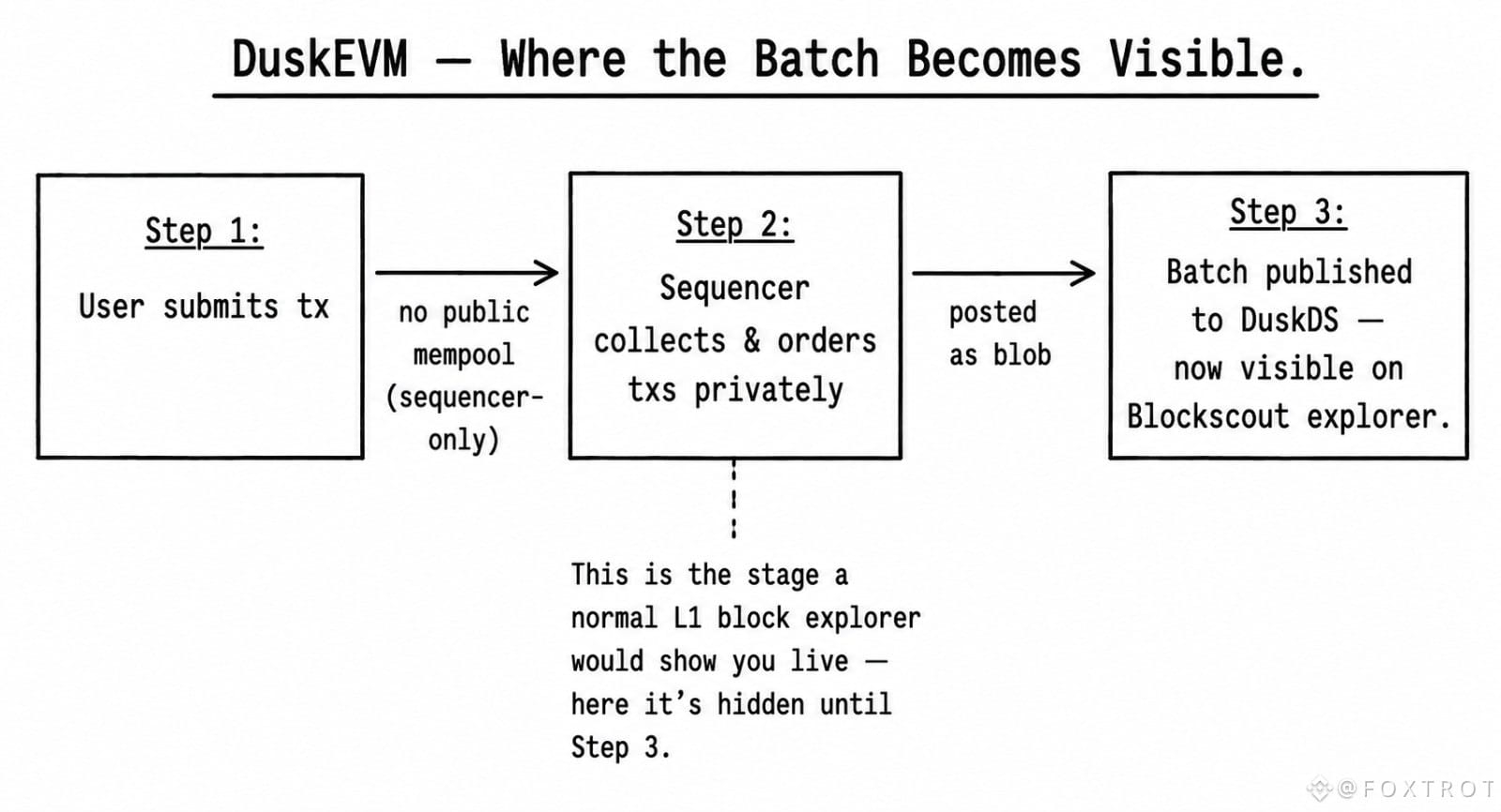
Poked around DuskEVM's Blockscout explorer today for this Dusk ($DUSK , @Dusk_Foundation , #dusk ) task, hunting for one block that'd tell me something honest about usage. Found the opposite of what I expected — there's no public mempool to watch. Sequencer-only. Transactions get bundled and posted to DuskDS as blobs on a batch cadence, not filled block-by-block the way you'd watch an Ethereum block fill up in real time.
Hmm. Sat with that a second. On most EVM chains you can literally see the queue — pending txs, gas wars, congestion — all visible before finality. Here that layer just... isn't exposed. You only see the batch after the sequencer's already decided what goes in it.
Doesn't mean anything sinister — the docs are upfront about it, this is testnet-stage architecture and broader visibility usually gets layered in later. But it did reset an assumption I was carrying — that "on-chain activity" on DuskEVM right now means "what the sequencer chose to publish," not raw unfiltered demand the way explorers on other chains tend to show it.
Caught myself about to jot "decentralized execution" in my notes before remembering the sequencer's still the single point deciding batch contents at this stage. Had to cross that out.
Makes me wonder how that changes once there's a public mempool or multiple sequencers — does the quiet block start telling a louder story, or does the opacity just move somewhere else?
Poked around DuskEVM's Blockscout explorer today for this Dusk ($DUSK , @Dusk , #dusk ) task, hunting for one block that'd tell me something honest about usage. Found the opposite of what I expected — there's no public mempool to watch. Sequencer-only. Transactions get bundled and posted to DuskDS as blobs on a batch cadence, not filled block-by-block the way you'd watch an Ethereum block fill up in real time.
Hmm. Sat with that a second. On most EVM chains you can literally see the queue — pending txs, gas wars, congestion — all visible before finality. Here that layer just... isn't exposed. You only see the batch after the sequencer's already decided what goes in it.
Doesn't mean anything sinister — the docs are upfront about it, this is testnet-stage architecture and broader visibility usually gets layered in later. But it did reset an assumption I was carrying — that "on-chain activity" on DuskEVM right now means "what the sequencer chose to publish," not raw unfiltered demand the way explorers on other chains tend to show it.
Caught myself about to jot "decentralized execution" in my notes before remembering the sequencer's still the single point deciding batch contents at this stage. Had to cross that out.
Makes me wonder how that changes once there's a public mempool or multiple sequencers — does the quiet block start telling a louder story, or does the opacity just move somewhere else?
Hmm. Sat with that a second. On most EVM chains you can literally see the queue — pending txs, gas wars, congestion — all visible before finality. Here that layer just... isn't exposed. You only see the batch after the sequencer's already decided what goes in it.
Doesn't mean anything sinister — the docs are upfront about it, this is testnet-stage architecture and broader visibility usually gets layered in later. But it did reset an assumption I was carrying — that "on-chain activity" on DuskEVM right now means "what the sequencer chose to publish," not raw unfiltered demand the way explorers on other chains tend to show it.
Caught myself about to jot "decentralized execution" in my notes before remembering the sequencer's still the single point deciding batch contents at this stage. Had to cross that out.
Makes me wonder how that changes once there's a public mempool or multiple sequencers — does the quiet block start telling a louder story, or does the opacity just move somewhere else?
1
65
翻訳参照
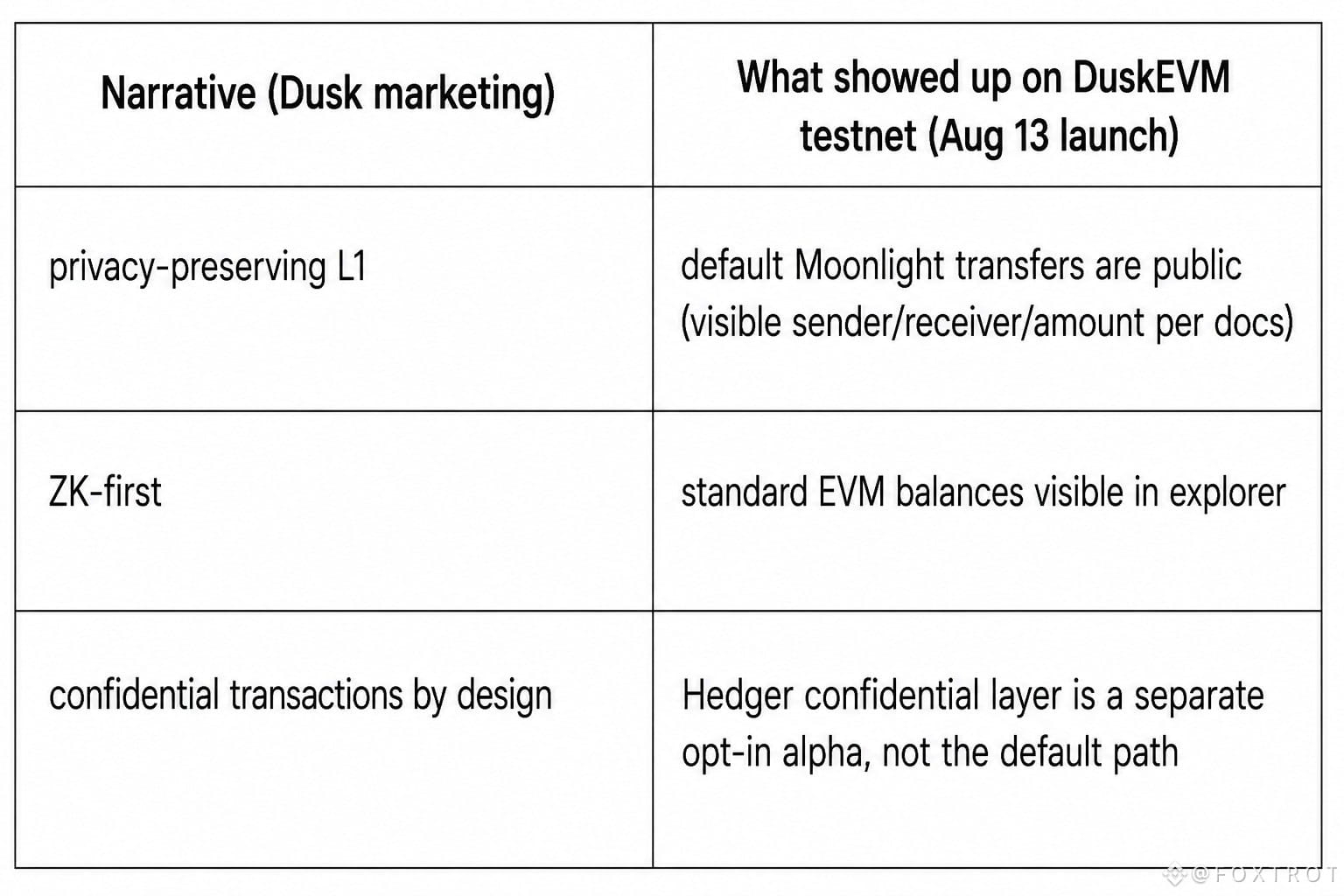
Spent the afternoon poking around DuskEVM testnet, live since Aug 13, deploying a dumb little contract just to see what shows up. Dusk ($DUSK , #dusk , @Dusk_Foundation ) sells itself hard on privacy — ZK everything, confidential balances, the whole pitch. So I expected to have to dig for the private stuff.
Instead the first thing you actually touch is completely plain. DuskEVM runs like any EVM chain — Solidity, Hardhat, gas paid in DUSK, balances sitting right there in the explorer. Moonlight, the account-based transaction path, is documented as literally public: non-reverted transfer events, visible receiver, visible amount, nothing hidden. Hedger — the confidential layer — is a separate alpha you opt into on top, not something baked into the default path.
Kind of a funny gap, hold up — the "privacy L1" pitch is true at the protocol level (Phoenix exists, ZK proofs exist), but what you bump into first as a builder is a fully transparent chain with privacy sitting off to the side as an extra step. Not a bad design necessarily, regulated finance probably wants that default-transparent posture anyway. Still wasn't what I pictured going in.
Makes me wonder how many people staking or building here actually touch Hedger at all, versus just running standard EVM stuff and never opting in.
Spent the afternoon poking around DuskEVM testnet, live since Aug 13, deploying a dumb little contract just to see what shows up. Dusk ($DUSK , #dusk , @Dusk ) sells itself hard on privacy — ZK everything, confidential balances, the whole pitch. So I expected to have to dig for the private stuff.
Instead the first thing you actually touch is completely plain. DuskEVM runs like any EVM chain — Solidity, Hardhat, gas paid in DUSK, balances sitting right there in the explorer. Moonlight, the account-based transaction path, is documented as literally public: non-reverted transfer events, visible receiver, visible amount, nothing hidden. Hedger — the confidential layer — is a separate alpha you opt into on top, not something baked into the default path.
Kind of a funny gap, hold up — the "privacy L1" pitch is true at the protocol level (Phoenix exists, ZK proofs exist), but what you bump into first as a builder is a fully transparent chain with privacy sitting off to the side as an extra step. Not a bad design necessarily, regulated finance probably wants that default-transparent posture anyway. Still wasn't what I pictured going in.
Makes me wonder how many people staking or building here actually touch Hedger at all, versus just running standard EVM stuff and never opting in.
Instead the first thing you actually touch is completely plain. DuskEVM runs like any EVM chain — Solidity, Hardhat, gas paid in DUSK, balances sitting right there in the explorer. Moonlight, the account-based transaction path, is documented as literally public: non-reverted transfer events, visible receiver, visible amount, nothing hidden. Hedger — the confidential layer — is a separate alpha you opt into on top, not something baked into the default path.
Kind of a funny gap, hold up — the "privacy L1" pitch is true at the protocol level (Phoenix exists, ZK proofs exist), but what you bump into first as a builder is a fully transparent chain with privacy sitting off to the side as an extra step. Not a bad design necessarily, regulated finance probably wants that default-transparent posture anyway. Still wasn't what I pictured going in.
Makes me wonder how many people staking or building here actually touch Hedger at all, versus just running standard EVM stuff and never opting in.
1
54
翻訳参照
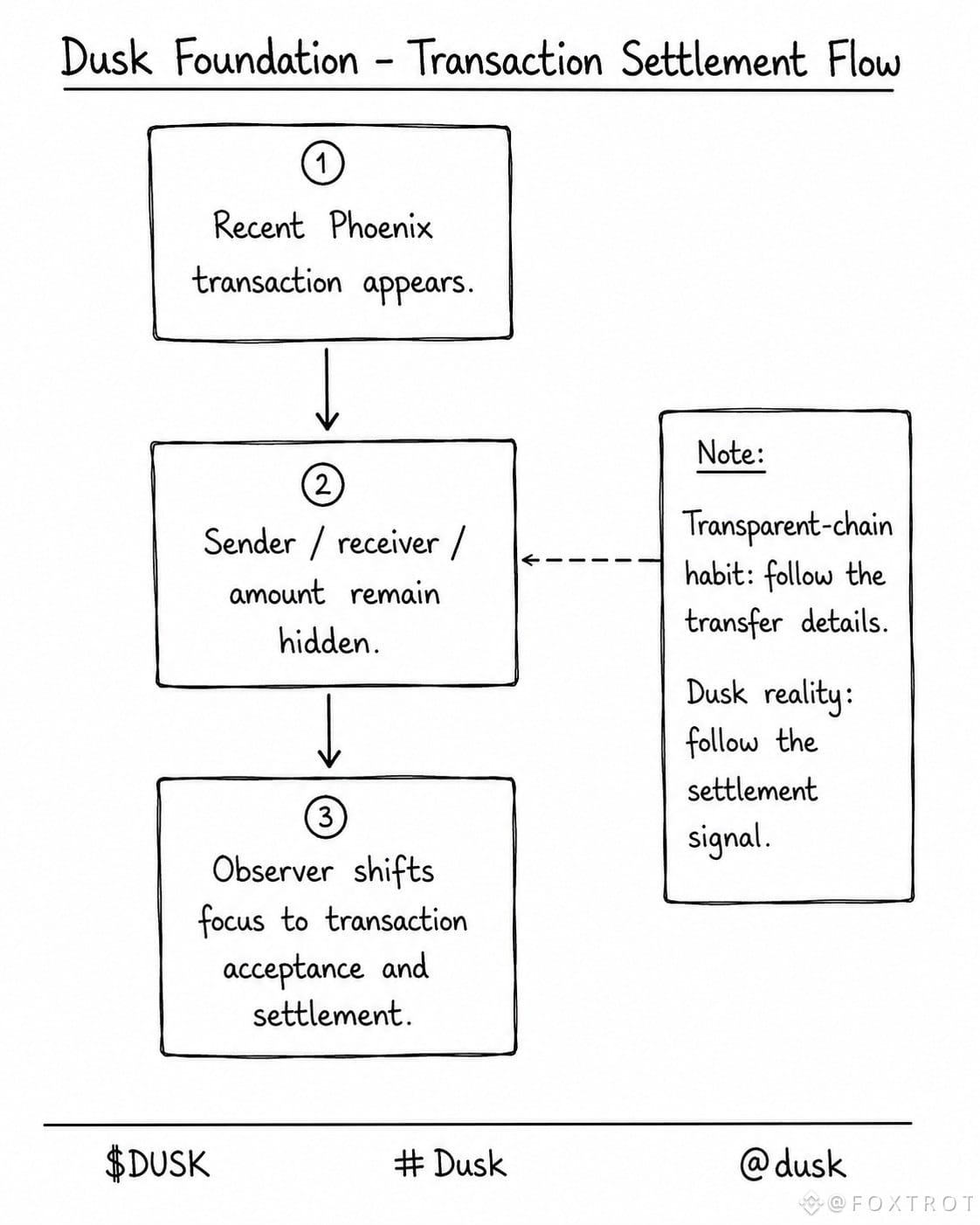
What caught me was how quickly I stopped caring about the transaction itself and started watching what happened after it. I was digging through Dusk Foundation, $DUSK , #dusk and @Dusk_Foundation , following recent Phoenix activity in the explorer, and the settlement pattern felt more interesting than the transaction details.
One recent Phoenix transaction showed the usual Dusk quirk: the transaction type is visible, while the sender, receiver and amount are not exposed in the familiar way. What I noticed while following it through settlement was that the useful signal shifts from “who sent what?” to whether the network accepted and finalized the transaction correctly. Dusk’s architecture is built around this separation. The chain can verify the state transition without publishing the private contents.
That sounds obvious when written down. It didn’t feel obvious while I was actually staring at the explorer. I kept expecting the transaction page to give me another clue, then realised I was applying a transparent-chain habit to a privacy-oriented one. Hmm. That changed what I considered “watching a transaction” on Dusk.
Now I’m wondering if this is the real adjustment users have to make: not learning how private transactions work technically, but learning which signals still matter when the usual ones deliberately disappear…
'
What caught me was how quickly I stopped caring about the transaction itself and started watching what happened after it. I was digging through Dusk Foundation, $DUSK , #dusk and @Dusk , following recent Phoenix activity in the explorer, and the settlement pattern felt more interesting than the transaction details.
One recent Phoenix transaction showed the usual Dusk quirk: the transaction type is visible, while the sender, receiver and amount are not exposed in the familiar way. What I noticed while following it through settlement was that the useful signal shifts from “who sent what?” to whether the network accepted and finalized the transaction correctly. Dusk’s architecture is built around this separation. The chain can verify the state transition without publishing the private contents.
That sounds obvious when written down. It didn’t feel obvious while I was actually staring at the explorer. I kept expecting the transaction page to give me another clue, then realised I was applying a transparent-chain habit to a privacy-oriented one. Hmm. That changed what I considered “watching a transaction” on Dusk.
Now I’m wondering if this is the real adjustment users have to make: not learning how private transactions work technically, but learning which signals still matter when the usual ones deliberately disappear…
'
One recent Phoenix transaction showed the usual Dusk quirk: the transaction type is visible, while the sender, receiver and amount are not exposed in the familiar way. What I noticed while following it through settlement was that the useful signal shifts from “who sent what?” to whether the network accepted and finalized the transaction correctly. Dusk’s architecture is built around this separation. The chain can verify the state transition without publishing the private contents.
That sounds obvious when written down. It didn’t feel obvious while I was actually staring at the explorer. I kept expecting the transaction page to give me another clue, then realised I was applying a transparent-chain habit to a privacy-oriented one. Hmm. That changed what I considered “watching a transaction” on Dusk.
Now I’m wondering if this is the real adjustment users have to make: not learning how private transactions work technically, but learning which signals still matter when the usual ones deliberately disappear…
'
2
121
翻訳参照
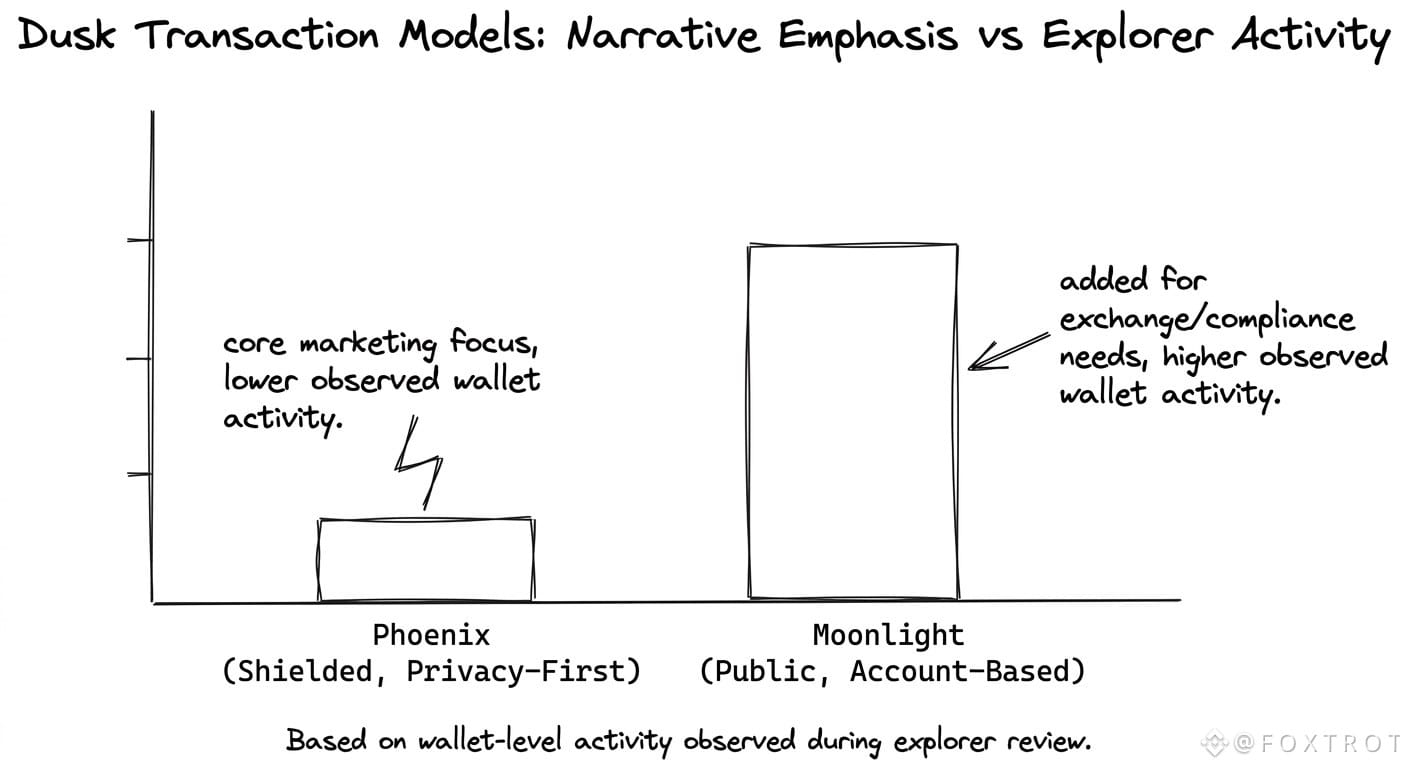
Spent a chunk of the task flipping between Moonlight and Phoenix transactions on the explorer, wallet by wallet, expecting Phoenix — the shielded, privacy-preserving side — to dominate given how hard Dusk Foundation leans on the privacy pitch. It didn't. Most of the addresses I clicked through, exchange-linked ones especially, were sitting on Moonlight, the fully transparent account model.
hmm, that's the gap that actually stuck with me. #dusk was built with dual transaction models exactly so users could choose, but choice isn't landing 50/50 in practice. Moonlight got added specifically to keep exchanges and institutions compliant without delisting risk, and the on-chain footprint I saw reflects that priority pretty plainly. Public, auditable, boring — and apparently that's what gets used first.
Kind of flips the marketing order in my head. Privacy tech gets the headline, but transparency is what onboards the money that actually needs to move today. Makes me wonder if Phoenix usage grows once retail catches up, or if it just stays the "available but unused" option.
@Dusk_Foundation isn't misrepresenting anything, both models are real and functional. Just... watching where the actual balances sit told a different story than the pitch deck order suggests.
Who's actually reaching for $DUSK shielded option once things get real.
Spent a chunk of the task flipping between Moonlight and Phoenix transactions on the explorer, wallet by wallet, expecting Phoenix — the shielded, privacy-preserving side — to dominate given how hard Dusk Foundation leans on the privacy pitch. It didn't. Most of the addresses I clicked through, exchange-linked ones especially, were sitting on Moonlight, the fully transparent account model.
hmm, that's the gap that actually stuck with me. #dusk was built with dual transaction models exactly so users could choose, but choice isn't landing 50/50 in practice. Moonlight got added specifically to keep exchanges and institutions compliant without delisting risk, and the on-chain footprint I saw reflects that priority pretty plainly. Public, auditable, boring — and apparently that's what gets used first.
Kind of flips the marketing order in my head. Privacy tech gets the headline, but transparency is what onboards the money that actually needs to move today. Makes me wonder if Phoenix usage grows once retail catches up, or if it just stays the "available but unused" option.
@Dusk isn't misrepresenting anything, both models are real and functional. Just... watching where the actual balances sit told a different story than the pitch deck order suggests.
Who's actually reaching for $DUSK shielded option once things get real.
hmm, that's the gap that actually stuck with me. #dusk was built with dual transaction models exactly so users could choose, but choice isn't landing 50/50 in practice. Moonlight got added specifically to keep exchanges and institutions compliant without delisting risk, and the on-chain footprint I saw reflects that priority pretty plainly. Public, auditable, boring — and apparently that's what gets used first.
Kind of flips the marketing order in my head. Privacy tech gets the headline, but transparency is what onboards the money that actually needs to move today. Makes me wonder if Phoenix usage grows once retail catches up, or if it just stays the "available but unused" option.
@Dusk isn't misrepresenting anything, both models are real and functional. Just... watching where the actual balances sit told a different story than the pitch deck order suggests.
Who's actually reaching for $DUSK shielded option once things get real.
3
3
99
翻訳参照
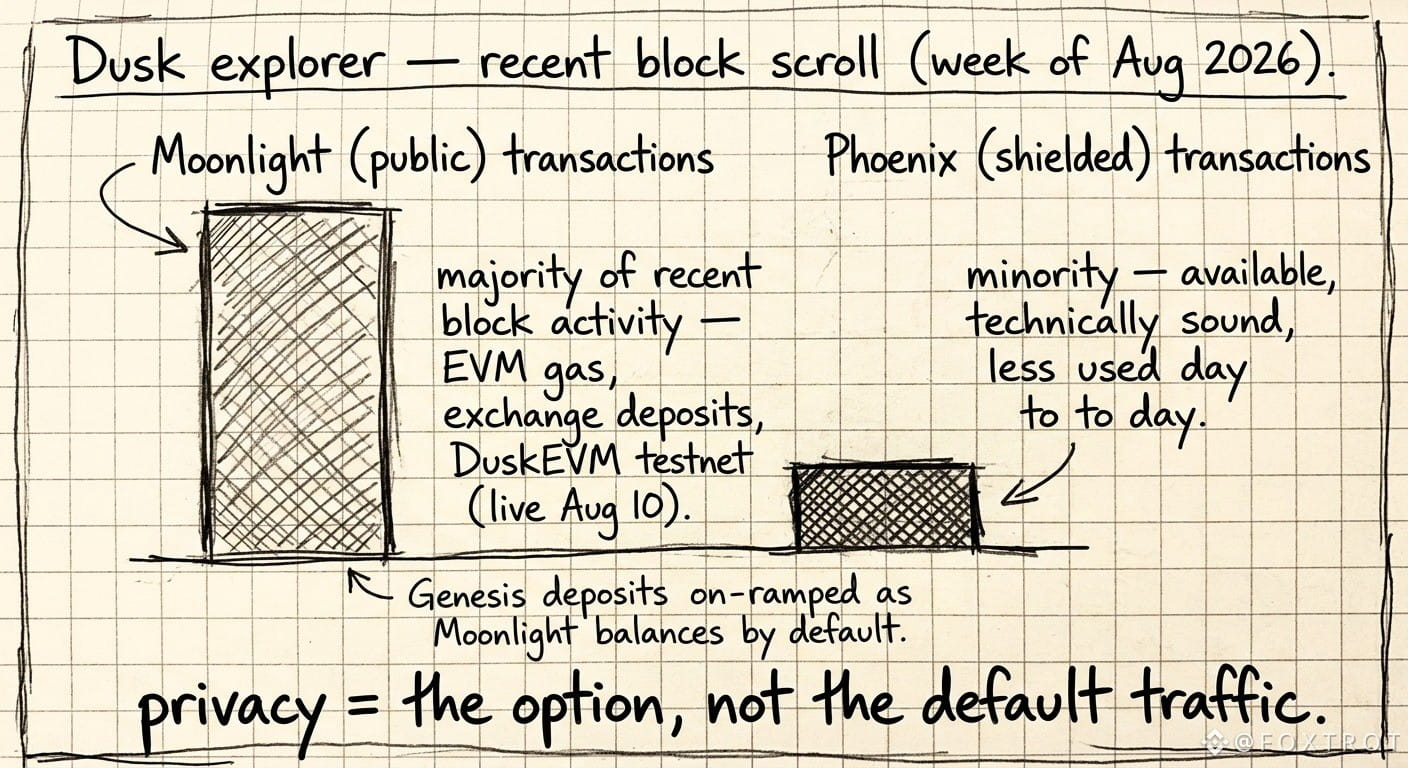
Scrolled through a stretch of recent blocks on the Dusk explorer this week just to see what "normal" looks like day to day… and hold up — almost everything moving through was Moonlight, not Phoenix. #dusk $DUSK @Dusk_Foundation — the shielded model everyone talks about when they talk about Dusk Foundation.
Makes sense once you sit with it. DuskEVM testnet went live Aug 10, gas paid in $DUSK, and every one of those transactions is public by design — Solidity tooling doesn't route through shielded notes, it's account-based, balances visible, same as any EVM chain. Even mainnet deposits get on-ramped as Moonlight balances at genesis. So block after block, what you're actually watching is the transparent rail doing the heavy lifting, not the private one.
Kept expecting to hit a run of Phoenix transfers and mostly didn't. Had to double check I wasn't misreading the explorer.
Not a knock, just noticed the gap — Phoenix is the headline feature, Moonlight is the workhorse right now. Compliance, exchange integration, EVM compatibility, all of it leans transparent by necessity. Privacy sits there as the option, available, technically sound, just… not what most blocks are actually doing yet.
Wonder at what point that ratio flips, or if "mostly public, privacy on demand" ends up being the permanent shape of it.
Scrolled through a stretch of recent blocks on the Dusk explorer this week just to see what "normal" looks like day to day… and hold up — almost everything moving through was Moonlight, not Phoenix. #dusk $DUSK @Dusk — the shielded model everyone talks about when they talk about Dusk Foundation.
Makes sense once you sit with it. DuskEVM testnet went live Aug 10, gas paid in $DUSK , and every one of those transactions is public by design — Solidity tooling doesn't route through shielded notes, it's account-based, balances visible, same as any EVM chain. Even mainnet deposits get on-ramped as Moonlight balances at genesis. So block after block, what you're actually watching is the transparent rail doing the heavy lifting, not the private one.
Kept expecting to hit a run of Phoenix transfers and mostly didn't. Had to double check I wasn't misreading the explorer.
Not a knock, just noticed the gap — Phoenix is the headline feature, Moonlight is the workhorse right now. Compliance, exchange integration, EVM compatibility, all of it leans transparent by necessity. Privacy sits there as the option, available, technically sound, just… not what most blocks are actually doing yet.
Wonder at what point that ratio flips, or if "mostly public, privacy on demand" ends up being the permanent shape of it.
Makes sense once you sit with it. DuskEVM testnet went live Aug 10, gas paid in $DUSK , and every one of those transactions is public by design — Solidity tooling doesn't route through shielded notes, it's account-based, balances visible, same as any EVM chain. Even mainnet deposits get on-ramped as Moonlight balances at genesis. So block after block, what you're actually watching is the transparent rail doing the heavy lifting, not the private one.
Kept expecting to hit a run of Phoenix transfers and mostly didn't. Had to double check I wasn't misreading the explorer.
Not a knock, just noticed the gap — Phoenix is the headline feature, Moonlight is the workhorse right now. Compliance, exchange integration, EVM compatibility, all of it leans transparent by necessity. Privacy sits there as the option, available, technically sound, just… not what most blocks are actually doing yet.
Wonder at what point that ratio flips, or if "mostly public, privacy on demand" ends up being the permanent shape of it.
2
99
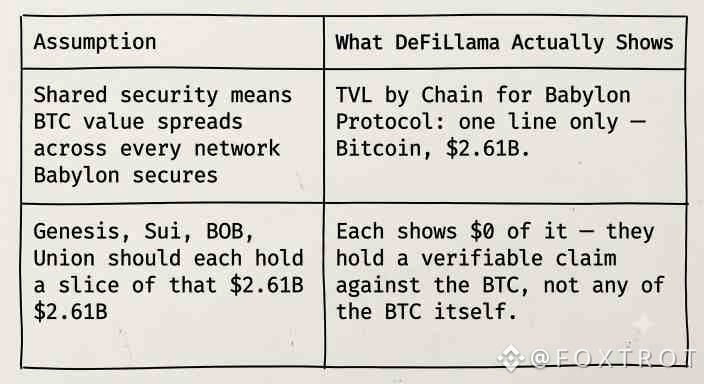
今日バビロンのDeFiLlamaページを掘り返してみた。いつも見かけるような、リステーキング系プロトコルにありがちなマルチチェーンに散らばるTVL(小さな数字があちこちに点在するやつ)を期待していたんだけど、代わりに表示されているのはたった1本の線だった。その1本の線が、インフラについての考え方を根本から変えてくれた。
$BABY 今週の「Babylon Protocol」は総額2.61BドルのTVLを示している。価格はまだ弱めで、CoinGeckoによると過去7日で約10%近く下落している。けれどTVLのチェーン別内訳には、エントリーが1つしかない。つまりビットコインだ。Babylon(@babylonlabs_io #baby )は、Genesisと外部ネットワークの増え続けるリストを保護している。……しかし、そのどれもがその2.61Bドルのうち1セントたりとも保有しているようには見えない。
理由を理解するのに少し時間がかかった。うーん――そもそも資本そのものは動かない。Babylonが支える各チェーンは、それぞれがBTCに対して検証可能な請求権(クレーム)を保持しているだけで、その請求権は、下にあるチェーンがどれほど違っていようと、ずっとビットコイン上にロックされたままだ。てっきり「共有セキュリティ」っていうのは、価値がネットワーク全体に実際に分散することだと思っていた。でも違う。価値はそこに固定されたままで、繰り返し、繰り返し指し示されるだけだ。
マルチチェーンのプロトコルというよりは、ビットコインが静かにみんなの担保デスクへと変わっていく感じがする。とはいえまだ確信はない。これは“チェーン”が自分の仕事をしているのか、それともPRが効いた、とても大きくて、しかも十分にセキュアなIOU(支払約束)なのか?
今日バビロンのDeFiLlamaページを掘り返してみた。いつも見かけるような、リステーキング系プロトコルにありがちなマルチチェーンに散らばるTVL(小さな数字があちこちに点在するやつ)を期待していたんだけど、代わりに表示されているのはたった1本の線だった。その1本の線が、インフラについての考え方を根本から変えてくれた。
$BABY 今週の「Babylon Protocol」は総額2.61BドルのTVLを示している。価格はまだ弱めで、CoinGeckoによると過去7日で約10%近く下落している。けれどTVLのチェーン別内訳には、エントリーが1つしかない。つまりビットコインだ。Babylon(@BabylonLabs_io #baby )は、Genesisと外部ネットワークの増え続けるリストを保護している。……しかし、そのどれもがその2.61Bドルのうち1セントたりとも保有しているようには見えない。
理由を理解するのに少し時間がかかった。うーん――そもそも資本そのものは動かない。Babylonが支える各チェーンは、それぞれがBTCに対して検証可能な請求権(クレーム)を保持しているだけで、その請求権は、下にあるチェーンがどれほど違っていようと、ずっとビットコイン上にロックされたままだ。てっきり「共有セキュリティ」っていうのは、価値がネットワーク全体に実際に分散することだと思っていた。でも違う。価値はそこに固定されたままで、繰り返し、繰り返し指し示されるだけだ。
マルチチェーンのプロトコルというよりは、ビットコインが静かにみんなの担保デスクへと変わっていく感じがする。とはいえまだ確信はない。これは“チェーン”が自分の仕事をしているのか、それともPRが効いた、とても大きくて、しかも十分にセキュアなIOU(支払約束)なのか?
$BABY 今週の「Babylon Protocol」は総額2.61BドルのTVLを示している。価格はまだ弱めで、CoinGeckoによると過去7日で約10%近く下落している。けれどTVLのチェーン別内訳には、エントリーが1つしかない。つまりビットコインだ。Babylon(@BabylonLabs_io #baby )は、Genesisと外部ネットワークの増え続けるリストを保護している。……しかし、そのどれもがその2.61Bドルのうち1セントたりとも保有しているようには見えない。
理由を理解するのに少し時間がかかった。うーん――そもそも資本そのものは動かない。Babylonが支える各チェーンは、それぞれがBTCに対して検証可能な請求権(クレーム)を保持しているだけで、その請求権は、下にあるチェーンがどれほど違っていようと、ずっとビットコイン上にロックされたままだ。てっきり「共有セキュリティ」っていうのは、価値がネットワーク全体に実際に分散することだと思っていた。でも違う。価値はそこに固定されたままで、繰り返し、繰り返し指し示されるだけだ。
マルチチェーンのプロトコルというよりは、ビットコインが静かにみんなの担保デスクへと変わっていく感じがする。とはいえまだ確信はない。これは“チェーン”が自分の仕事をしているのか、それともPRが効いた、とても大きくて、しかも十分にセキュアなIOU(支払約束)なのか?
37
25
398
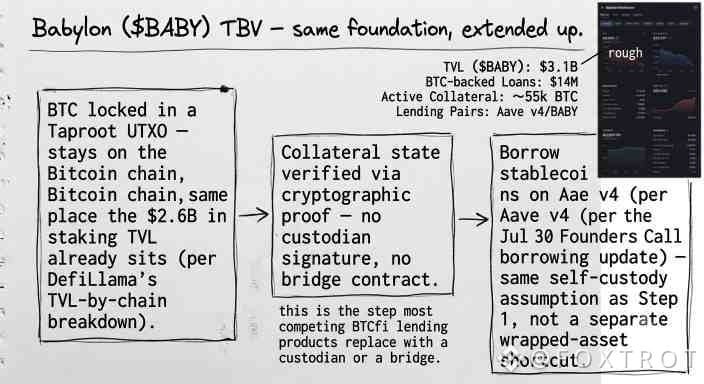
7月30日の通話に向けて、@babylonlabs_io がまとめたBabylon($BABY )の概要に目を通していた。ネイティブなビットコイン担保借入の最新情報を約束していたので、何か新しいブリッジやラップ資産による近道で、話が早く進むのかと期待していた。#baby では、まるでローンチ告知のように発表スレッドが盛り上がっていた。
そうではなかった。相変わらずTBV、つまりBTCはビットコインそのもののTaproot UTXOにロックされ、ラップはなし。償還もカストディアンの署名ではなく、証明によって制御される。これはBabylonの実際のステーキング商品が採用しているのと同じ設計で、現在その商品には26億ドルが預けられている。TVLの内訳によれば、すべてビットコインのブロックチェーン上にあり、どこにもブリッジされていない。今週、$BABYは約0.013ドルで取引されていて、0.011ドルの安値に近い。そのどれも、基盤の仕組みを変えるものではなかった。
何度も考えずにはいられなかったのは、そこだ。たいていのプロトコルは、セキュリティモデルを少し緩めて融資レイヤーを追加する。ラップする、ブリッジする、誰かを信頼する、といった具合に。Babylonのやり方は、利便性のために前提を入れ替えるのではなく、同じ基本前提をスタックの上層へと広げていくだけだ。おそらく遅い。ランディングページでは、間違いなく見栄えがしない。
正直、通話の振り返りをここまで掘り下げるつもりはなかった。気になって、スクロールを続けてしまった。市場がきらびやかなラッパーを最速で出荷するところに報い続けるなかで、「基盤第一」の姿勢は通用するのか、まだ考え続けている。サイクルを一巡しても持ちこたえるのか。それとも、後から振り返ったときにだけ語れる物語なのだろうか?
7月30日の通話に向けて、@BabylonLabs_io がまとめたBabylon($BABY )の概要に目を通していた。ネイティブなビットコイン担保借入の最新情報を約束していたので、何か新しいブリッジやラップ資産による近道で、話が早く進むのかと期待していた。#baby では、まるでローンチ告知のように発表スレッドが盛り上がっていた。
そうではなかった。相変わらずTBV、つまりBTCはビットコインそのもののTaproot UTXOにロックされ、ラップはなし。償還もカストディアンの署名ではなく、証明によって制御される。これはBabylonの実際のステーキング商品が採用しているのと同じ設計で、現在その商品には26億ドルが預けられている。TVLの内訳によれば、すべてビットコインのブロックチェーン上にあり、どこにもブリッジされていない。今週、$BABY は約0.013ドルで取引されていて、0.011ドルの安値に近い。そのどれも、基盤の仕組みを変えるものではなかった。
何度も考えずにはいられなかったのは、そこだ。たいていのプロトコルは、セキュリティモデルを少し緩めて融資レイヤーを追加する。ラップする、ブリッジする、誰かを信頼する、といった具合に。Babylonのやり方は、利便性のために前提を入れ替えるのではなく、同じ基本前提をスタックの上層へと広げていくだけだ。おそらく遅い。ランディングページでは、間違いなく見栄えがしない。
正直、通話の振り返りをここまで掘り下げるつもりはなかった。気になって、スクロールを続けてしまった。市場がきらびやかなラッパーを最速で出荷するところに報い続けるなかで、「基盤第一」の姿勢は通用するのか、まだ考え続けている。サイクルを一巡しても持ちこたえるのか。それとも、後から振り返ったときにだけ語れる物語なのだろうか?
そうではなかった。相変わらずTBV、つまりBTCはビットコインそのもののTaproot UTXOにロックされ、ラップはなし。償還もカストディアンの署名ではなく、証明によって制御される。これはBabylonの実際のステーキング商品が採用しているのと同じ設計で、現在その商品には26億ドルが預けられている。TVLの内訳によれば、すべてビットコインのブロックチェーン上にあり、どこにもブリッジされていない。今週、$BABY は約0.013ドルで取引されていて、0.011ドルの安値に近い。そのどれも、基盤の仕組みを変えるものではなかった。
何度も考えずにはいられなかったのは、そこだ。たいていのプロトコルは、セキュリティモデルを少し緩めて融資レイヤーを追加する。ラップする、ブリッジする、誰かを信頼する、といった具合に。Babylonのやり方は、利便性のために前提を入れ替えるのではなく、同じ基本前提をスタックの上層へと広げていくだけだ。おそらく遅い。ランディングページでは、間違いなく見栄えがしない。
正直、通話の振り返りをここまで掘り下げるつもりはなかった。気になって、スクロールを続けてしまった。市場がきらびやかなラッパーを最速で出荷するところに報い続けるなかで、「基盤第一」の姿勢は通用するのか、まだ考え続けている。サイクルを一巡しても持ちこたえるのか。それとも、後から振り返ったときにだけ語れる物語なのだろうか?
14
11
241
午後はこの件でBabylonの($BABY 、@babylonlabs_io 、#baby )のドキュメントとXのフィードを読み漁っていたんだけど、ちょっと待って——スクロールする手が止まった理由は、価格チャートのローソク足じゃなかった。スケジュールの偶然の一致だった。
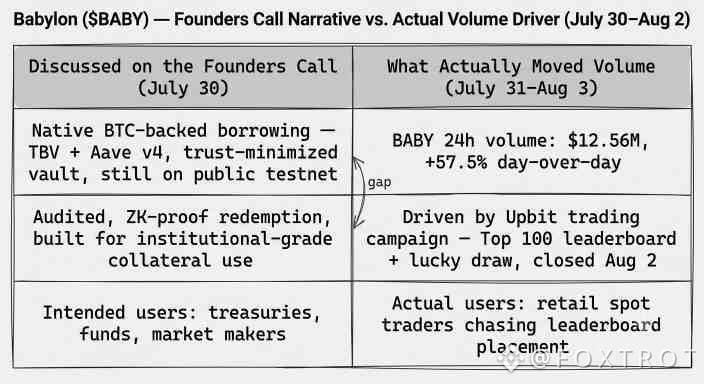
木曜日の四半期ごとの創業者向けコール(7月30日)では、David TseとFisher Yuが、ネイティブなビットコイン担保型借入のアップデートについて説明していた。進みは遅く、監査済みで、まだテストネット上にあるものだ。TBV、Aave v4、そしてほとんどの人が触れたこともない、信頼を最小化するボールトの仕組み。一方、その2日後に実際に動いた数字は、まったく別のところにあった。これを書いている時点で、BABYの24時間取引高は1,256万ドル。前日比57.5%増だ。その動きは、BTCをボールトに預ける人が現れたことよりも、Upbitの取引キャンペーン(ランキング、抽選、8月2日終了)とほぼぴったり重なっている。
それに気づいたとき、まだグラノーラバーを食べているところだったから、話半分に聞いてほしいけど——ここで本当に新しい担保の仕組みは、まだ参加していない機関投資家やマーケットメーカー向けに、静かに構築されている。一方、今稼働していて実際の取引高を生み出しているのは、どの取引所でもどのトークンでもおなじみのランキングキャンペーンの仕組みだ。批判しているわけじゃない。ただ——全体を並べて見ると、順序はこうなっているということ。
TBVがメインネットに到達すれば、このギャップは自然に埋まるのか。それとも、取引高はこのまま別の場所で動き続けるのか。まだ考え続けている。
午後はこの件でBabylonの($BABY 、@BabylonLabs_io 、#baby )のドキュメントとXのフィードを読み漁っていたんだけど、ちょっと待って——スクロールする手が止まった理由は、価格チャートのローソク足じゃなかった。スケジュールの偶然の一致だった。
木曜日の四半期ごとの創業者向けコール(7月30日)では、David TseとFisher Yuが、ネイティブなビットコイン担保型借入のアップデートについて説明していた。進みは遅く、監査済みで、まだテストネット上にあるものだ。TBV、Aave v4、そしてほとんどの人が触れたこともない、信頼を最小化するボールトの仕組み。一方、その2日後に実際に動いた数字は、まったく別のところにあった。これを書いている時点で、BABYの24時間取引高は1,256万ドル。前日比57.5%増だ。その動きは、BTCをボールトに預ける人が現れたことよりも、Upbitの取引キャンペーン(ランキング、抽選、8月2日終了)とほぼぴったり重なっている。
それに気づいたとき、まだグラノーラバーを食べているところだったから、話半分に聞いてほしいけど——ここで本当に新しい担保の仕組みは、まだ参加していない機関投資家やマーケットメーカー向けに、静かに構築されている。一方、今稼働していて実際の取引高を生み出しているのは、どの取引所でもどのトークンでもおなじみのランキングキャンペーンの仕組みだ。批判しているわけじゃない。ただ——全体を並べて見ると、順序はこうなっているということ。
TBVがメインネットに到達すれば、このギャップは自然に埋まるのか。それとも、取引高はこのまま別の場所で動き続けるのか。まだ考え続けている。
木曜日の四半期ごとの創業者向けコール(7月30日)では、David TseとFisher Yuが、ネイティブなビットコイン担保型借入のアップデートについて説明していた。進みは遅く、監査済みで、まだテストネット上にあるものだ。TBV、Aave v4、そしてほとんどの人が触れたこともない、信頼を最小化するボールトの仕組み。一方、その2日後に実際に動いた数字は、まったく別のところにあった。これを書いている時点で、BABYの24時間取引高は1,256万ドル。前日比57.5%増だ。その動きは、BTCをボールトに預ける人が現れたことよりも、Upbitの取引キャンペーン(ランキング、抽選、8月2日終了)とほぼぴったり重なっている。
それに気づいたとき、まだグラノーラバーを食べているところだったから、話半分に聞いてほしいけど——ここで本当に新しい担保の仕組みは、まだ参加していない機関投資家やマーケットメーカー向けに、静かに構築されている。一方、今稼働していて実際の取引高を生み出しているのは、どの取引所でもどのトークンでもおなじみのランキングキャンペーンの仕組みだ。批判しているわけじゃない。ただ——全体を並べて見ると、順序はこうなっているということ。
TBVがメインネットに到達すれば、このギャップは自然に埋まるのか。それとも、取引高はこのまま別の場所で動き続けるのか。まだ考え続けている。
6
3
230
翻訳参照
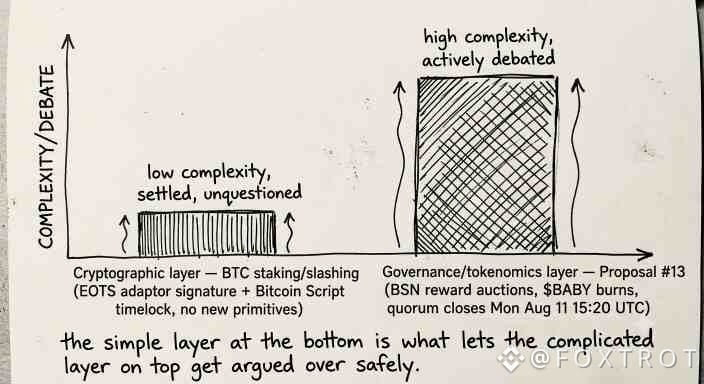
Chewing on this one after the task instead of during it, which is rare for me. Went into Babylon (@babylonlabs_io ) expecting some new cryptographic invention behind the BTC staking — a new proof system, new VM, something exotic. Found the opposite. Slashing runs on an adaptor signature trick called EOTS, layered on plain Bitcoin Script with a timelock. That's it. No new primitive, nothing borrowed from elsewhere. Reused pieces, wired together carefully.
Meanwhile proposal #13 is live on Babylon Genesis right now, deciding how BSN rewards get auctioned and burned into $BABY — quorum closes Mon Aug 11 15:20 UTC. Genuinely complicated stuff, real tradeoffs, real debate happening in the open. And it can afford to be complicated precisely because the layer underneath it never has to be argued about. Nobody's questioning whether the timelock holds. The fight moved entirely upstairs.
Hmm — reread the slashing writeup twice looking for the catch, the exotic part. Never found one. Kept expecting "simple" to mean "thin," and it doesn't. It means nothing new had to be trusted just to make BTC lockable.
Wondering if that's the actual reason people feel comfortable arguing over token mechanics up top — because nobody's worried about the foundation underneath it.
#baby $BABY
Chewing on this one after the task instead of during it, which is rare for me. Went into Babylon (@BabylonLabs_io ) expecting some new cryptographic invention behind the BTC staking — a new proof system, new VM, something exotic. Found the opposite. Slashing runs on an adaptor signature trick called EOTS, layered on plain Bitcoin Script with a timelock. That's it. No new primitive, nothing borrowed from elsewhere. Reused pieces, wired together carefully.
Meanwhile proposal #13 is live on Babylon Genesis right now, deciding how BSN rewards get auctioned and burned into $BABY — quorum closes Mon Aug 11 15:20 UTC. Genuinely complicated stuff, real tradeoffs, real debate happening in the open. And it can afford to be complicated precisely because the layer underneath it never has to be argued about. Nobody's questioning whether the timelock holds. The fight moved entirely upstairs.
Hmm — reread the slashing writeup twice looking for the catch, the exotic part. Never found one. Kept expecting "simple" to mean "thin," and it doesn't. It means nothing new had to be trusted just to make BTC lockable.
Wondering if that's the actual reason people feel comfortable arguing over token mechanics up top — because nobody's worried about the foundation underneath it.
#baby $BABY
Meanwhile proposal #13 is live on Babylon Genesis right now, deciding how BSN rewards get auctioned and burned into $BABY — quorum closes Mon Aug 11 15:20 UTC. Genuinely complicated stuff, real tradeoffs, real debate happening in the open. And it can afford to be complicated precisely because the layer underneath it never has to be argued about. Nobody's questioning whether the timelock holds. The fight moved entirely upstairs.
Hmm — reread the slashing writeup twice looking for the catch, the exotic part. Never found one. Kept expecting "simple" to mean "thin," and it doesn't. It means nothing new had to be trusted just to make BTC lockable.
Wondering if that's the actual reason people feel comfortable arguing over token mechanics up top — because nobody's worried about the foundation underneath it.
#baby $BABY
10
7
260
翻訳参照
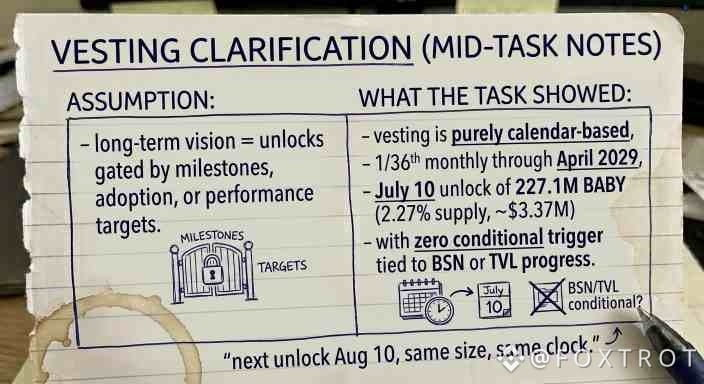
The vesting tracker showed 227.1M BABY hit circulation on July 10, 2026, another 2.27% of total supply, close to $3.37M at the time, done automatically, no announcement thread, nothing tied to it... so I started checking whether that unlock connects to any actual milestone before assuming the "long term vision" language in @babylonlabs_io docs means something concrete. Went through the vesting schedule expecting to find gates, like unlocks accelerating or pausing based on BSN adoption or TVL targets, something that ties the release to whether the vision is actually landing. There isn't one. The schedule runs purely on the calendar, 1/36th every month regardless of what multi-staking or Aave integration actually deliver, straight through to April 2029.
I assumed patient tokenomics meant the release was contingent on performance somehow. It's not, it's contingent on time, full stop. Checked the date twice because I expected some conditional language buried in there and there wasn't any... $BABY "long-term" framing describes duration, not accountability. Small thing, but I hold through unlocks assuming the team's incentive is tied to outcomes, and here it's just tied to the clock. #baby next one lands August 10. Does time alone count as alignment.
The vesting tracker showed 227.1M BABY hit circulation on July 10, 2026, another 2.27% of total supply, close to $3.37M at the time, done automatically, no announcement thread, nothing tied to it... so I started checking whether that unlock connects to any actual milestone before assuming the "long term vision" language in @BabylonLabs_io docs means something concrete. Went through the vesting schedule expecting to find gates, like unlocks accelerating or pausing based on BSN adoption or TVL targets, something that ties the release to whether the vision is actually landing. There isn't one. The schedule runs purely on the calendar, 1/36th every month regardless of what multi-staking or Aave integration actually deliver, straight through to April 2029.
I assumed patient tokenomics meant the release was contingent on performance somehow. It's not, it's contingent on time, full stop. Checked the date twice because I expected some conditional language buried in there and there wasn't any... $BABY "long-term" framing describes duration, not accountability. Small thing, but I hold through unlocks assuming the team's incentive is tied to outcomes, and here it's just tied to the clock. #baby next one lands August 10. Does time alone count as alignment.
I assumed patient tokenomics meant the release was contingent on performance somehow. It's not, it's contingent on time, full stop. Checked the date twice because I expected some conditional language buried in there and there wasn't any... $BABY "long-term" framing describes duration, not accountability. Small thing, but I hold through unlocks assuming the team's incentive is tied to outcomes, and here it's just tied to the clock. #baby next one lands August 10. Does time alone count as alignment.
5
2
137
翻訳参照
Sat with the Babylon staking script today longer than planned — that UTXO structure just... sticks with you once you actually read it instead of skimming the deck.
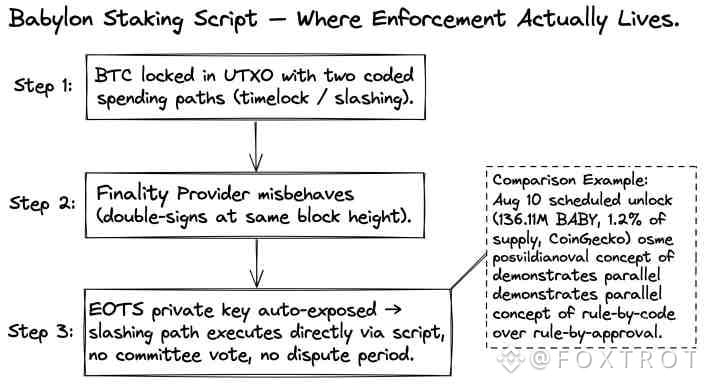
Quick anchor first: checked CoinGecko mid-task, next $BABY unlock is scheduled Aug 10, releasing 136.11M tokens (~1.2% of supply, ~$1.58M). Nothing wild. But it's coded to fire on a timestamp, no committee vote gating it — and that same "encode it, don't govern it" logic is what actually runs the whole architecture, not just the vesting.
Here's the part that got me: the Bitcoin staking output has two spending conditions baked directly into the script — a timelock for normal withdrawal, and a slashing path a covenant committee can trigger if rules are broken. No bridge, no wrapped asset, no separate custodian holding a key somewhere else. The rules live in the transaction itself. Finality provider misbehavior gets punished through EOTS key exposure — the cryptography does the enforcing, not a dispute process or social vote after the fact.
Kept re-reading the docs waiting to find the "and then a multisig approves it" step. Didn't find one. Might just mean I haven't looked hard enough yet, hold up—
Makes me wonder what breaks first when a chain tries to remove trust layers this aggressively... the tech, or everyone's assumption that governance always needs a human checkpoint.
@babylonlabs_io $BABY #baby
Sat with the Babylon staking script today longer than planned — that UTXO structure just... sticks with you once you actually read it instead of skimming the deck.
Quick anchor first: checked CoinGecko mid-task, next $BABY unlock is scheduled Aug 10, releasing 136.11M tokens (~1.2% of supply, ~$1.58M). Nothing wild. But it's coded to fire on a timestamp, no committee vote gating it — and that same "encode it, don't govern it" logic is what actually runs the whole architecture, not just the vesting.
Here's the part that got me: the Bitcoin staking output has two spending conditions baked directly into the script — a timelock for normal withdrawal, and a slashing path a covenant committee can trigger if rules are broken. No bridge, no wrapped asset, no separate custodian holding a key somewhere else. The rules live in the transaction itself. Finality provider misbehavior gets punished through EOTS key exposure — the cryptography does the enforcing, not a dispute process or social vote after the fact.
Kept re-reading the docs waiting to find the "and then a multisig approves it" step. Didn't find one. Might just mean I haven't looked hard enough yet, hold up—
Makes me wonder what breaks first when a chain tries to remove trust layers this aggressively... the tech, or everyone's assumption that governance always needs a human checkpoint.
@BabylonLabs_io $BABY #baby
Quick anchor first: checked CoinGecko mid-task, next $BABY unlock is scheduled Aug 10, releasing 136.11M tokens (~1.2% of supply, ~$1.58M). Nothing wild. But it's coded to fire on a timestamp, no committee vote gating it — and that same "encode it, don't govern it" logic is what actually runs the whole architecture, not just the vesting.
Here's the part that got me: the Bitcoin staking output has two spending conditions baked directly into the script — a timelock for normal withdrawal, and a slashing path a covenant committee can trigger if rules are broken. No bridge, no wrapped asset, no separate custodian holding a key somewhere else. The rules live in the transaction itself. Finality provider misbehavior gets punished through EOTS key exposure — the cryptography does the enforcing, not a dispute process or social vote after the fact.
Kept re-reading the docs waiting to find the "and then a multisig approves it" step. Didn't find one. Might just mean I haven't looked hard enough yet, hold up—
Makes me wonder what breaks first when a chain tries to remove trust layers this aggressively... the tech, or everyone's assumption that governance always needs a human checkpoint.
@BabylonLabs_io $BABY #baby
8
4
271
翻訳参照
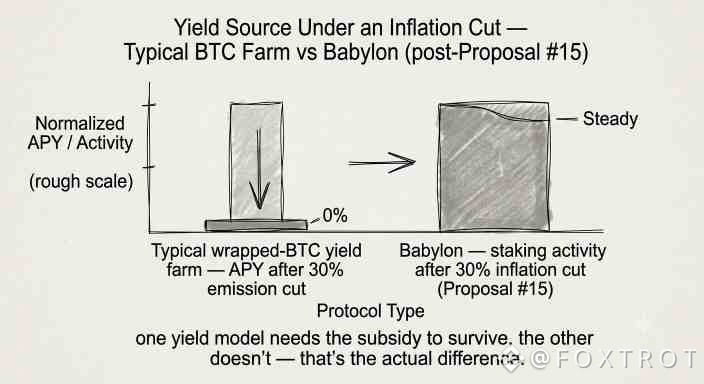
Kept comparing Babylon's vault stats to a wrapped-BTC yield farm I'd checked earlier in the week — same task, different tab — and the contrast is what actually stuck. One relies on emissions to look attractive. The other just cut its own emissions and the model didn't blink. Babylon $BABY #baby @babylonlabs_io
Most BTC yield products — wrap it, bridge it, drop it in a pool — the yield is basically a subsidy. Token emissions paying you to show up. Take the emissions away and the APY collapses because there was never a real buyer for that yield underneath. Babylon just ran the opposite experiment without meaning to: proposal #15 passed, inflation cut 30%, and staking didn't dry up. Why — because the yield's other leg isn't emissions, it's PoS chains actually paying for Bitcoin's finality through the co-staking split. Real demand, not a faucet.
Hmm, took me a minute to trust that read. I kept expecting to find the catch — some hidden emission schedule propping up the number. Went back through the vault data twice looking for it. Didn't find it, which honestly surprised me more than finding it would have.
So the difference isn't security model or custody, everyone claims that now. It's whether the yield survives a haircut to its own token supply.
Curious how many "BTC yield" projects would even survive their own version of proposal #15.
Kept comparing Babylon's vault stats to a wrapped-BTC yield farm I'd checked earlier in the week — same task, different tab — and the contrast is what actually stuck. One relies on emissions to look attractive. The other just cut its own emissions and the model didn't blink. Babylon $BABY #baby @BabylonLabs_io
Most BTC yield products — wrap it, bridge it, drop it in a pool — the yield is basically a subsidy. Token emissions paying you to show up. Take the emissions away and the APY collapses because there was never a real buyer for that yield underneath. Babylon just ran the opposite experiment without meaning to: proposal #15 passed, inflation cut 30%, and staking didn't dry up. Why — because the yield's other leg isn't emissions, it's PoS chains actually paying for Bitcoin's finality through the co-staking split. Real demand, not a faucet.
Hmm, took me a minute to trust that read. I kept expecting to find the catch — some hidden emission schedule propping up the number. Went back through the vault data twice looking for it. Didn't find it, which honestly surprised me more than finding it would have.
So the difference isn't security model or custody, everyone claims that now. It's whether the yield survives a haircut to its own token supply.
Curious how many "BTC yield" projects would even survive their own version of proposal #15.
Most BTC yield products — wrap it, bridge it, drop it in a pool — the yield is basically a subsidy. Token emissions paying you to show up. Take the emissions away and the APY collapses because there was never a real buyer for that yield underneath. Babylon just ran the opposite experiment without meaning to: proposal #15 passed, inflation cut 30%, and staking didn't dry up. Why — because the yield's other leg isn't emissions, it's PoS chains actually paying for Bitcoin's finality through the co-staking split. Real demand, not a faucet.
Hmm, took me a minute to trust that read. I kept expecting to find the catch — some hidden emission schedule propping up the number. Went back through the vault data twice looking for it. Didn't find it, which honestly surprised me more than finding it would have.
So the difference isn't security model or custody, everyone claims that now. It's whether the yield survives a haircut to its own token supply.
Curious how many "BTC yield" projects would even survive their own version of proposal #15.
3
1
186
翻訳参照
Nobody talks about the "silent innovation" in Babylon docs because it's not flashy — it's a signature scheme, not a bridge or a chart. Babylon, $BABY , #baby , @babylonlabs_io — the thing doing the actual work here barely gets a headline.
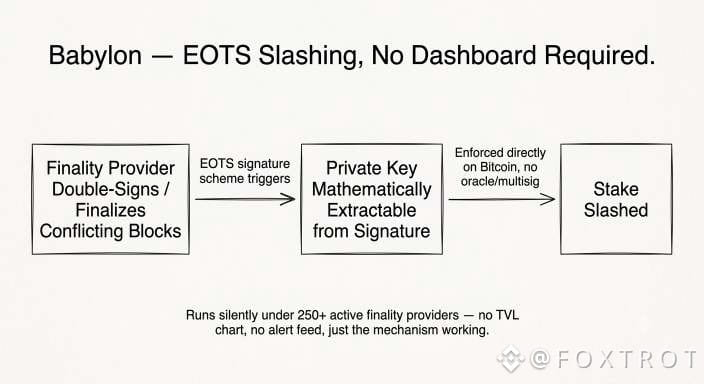
It's called EOTS, Extractable One-Time Signatures. This is what handles slashing for BTC finality providers without smart contracts, without wrapping anything. If a provider double-signs or finalizes conflicting blocks, the math itself extracts the private key from the signature and the stake gets slashed — enforced directly on Bitcoin. No oracle reporting bad behavior, no multisig committee deciding penalties. The cryptography is the enforcement. Hold up — that's actually a bigger deal than most of the yield talk around this project.
Went looking for where this shows up in practice and it's quietly running under all 250+ finality providers right now, every single delegation. Nobody's tweeting about it because there's no dashboard number to point at, no TVL spike, just a mechanism working in the background every time a block finalizes.
Kind of got me thinking — most of what gets attention in this space is the stuff with a chart attached. The actual security guarantee here is invisible unless something breaks. So... does infrastructure like this only get noticed retroactively, after a failure, or is there a way to make "nothing went wrong" itself legible to people?
Nobody talks about the "silent innovation" in Babylon docs because it's not flashy — it's a signature scheme, not a bridge or a chart. Babylon, $BABY , #baby , @BabylonLabs_io — the thing doing the actual work here barely gets a headline.
It's called EOTS, Extractable One-Time Signatures. This is what handles slashing for BTC finality providers without smart contracts, without wrapping anything. If a provider double-signs or finalizes conflicting blocks, the math itself extracts the private key from the signature and the stake gets slashed — enforced directly on Bitcoin. No oracle reporting bad behavior, no multisig committee deciding penalties. The cryptography is the enforcement. Hold up — that's actually a bigger deal than most of the yield talk around this project.
Went looking for where this shows up in practice and it's quietly running under all 250+ finality providers right now, every single delegation. Nobody's tweeting about it because there's no dashboard number to point at, no TVL spike, just a mechanism working in the background every time a block finalizes.
Kind of got me thinking — most of what gets attention in this space is the stuff with a chart attached. The actual security guarantee here is invisible unless something breaks. So... does infrastructure like this only get noticed retroactively, after a failure, or is there a way to make "nothing went wrong" itself legible to people?
It's called EOTS, Extractable One-Time Signatures. This is what handles slashing for BTC finality providers without smart contracts, without wrapping anything. If a provider double-signs or finalizes conflicting blocks, the math itself extracts the private key from the signature and the stake gets slashed — enforced directly on Bitcoin. No oracle reporting bad behavior, no multisig committee deciding penalties. The cryptography is the enforcement. Hold up — that's actually a bigger deal than most of the yield talk around this project.
Went looking for where this shows up in practice and it's quietly running under all 250+ finality providers right now, every single delegation. Nobody's tweeting about it because there's no dashboard number to point at, no TVL spike, just a mechanism working in the background every time a block finalizes.
Kind of got me thinking — most of what gets attention in this space is the stuff with a chart attached. The actual security guarantee here is invisible unless something breaks. So... does infrastructure like this only get noticed retroactively, after a failure, or is there a way to make "nothing went wrong" itself legible to people?
113
翻訳参照
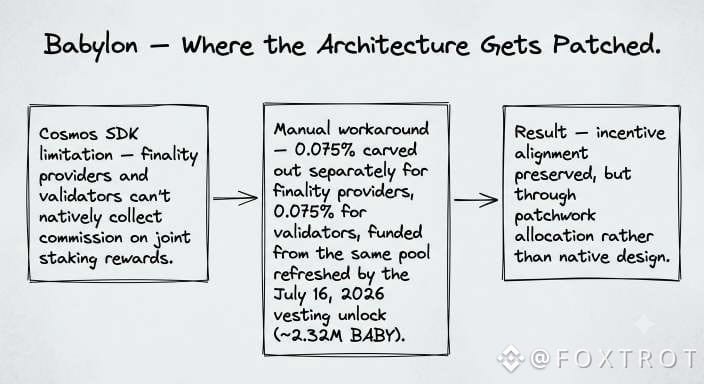
Been sitting with one specific line from Babylon's (@babylonlabs_io ) tokenomics proposal since finishing the task — the part where finality providers and validators technically can't collect commission on joint staking rewards, some Cosmos SDK limitation, so the protocol just... patches around it. Extra 0.075% carved out for each group separately, manually compensating for what the architecture can't natively support.
That's the hidden design philosophy right there, hold up — it's not elegant, it's not some unified clean system. $BABY economics are stitched together wherever the base layer falls short, patch by patch, prioritizing that incentives stay aligned over the code staying tidy. Checked this against the July 16 vesting unlock too, ~2.32M BABY released under the same monthly schedule that's been quietly funding every one of these workaround allocations since the proposal passed. #baby doesn't market "we patch things," obviously, the pitch is all seamless Bitcoin security — but the actual token distribution reads more like duct tape wrapped around a genuinely sound idea.
Snacked through half this realization before it landed… there's something almost more trustworthy about a system that admits its own limitations in the reward math instead of hiding them. Or maybe that's just me being generous toward a protocol that hasn't broken yet.
Either way — how many "clean" designs out there are actually just better at hiding the same kind of patchwork?
Been sitting with one specific line from Babylon's (@BabylonLabs_io ) tokenomics proposal since finishing the task — the part where finality providers and validators technically can't collect commission on joint staking rewards, some Cosmos SDK limitation, so the protocol just... patches around it. Extra 0.075% carved out for each group separately, manually compensating for what the architecture can't natively support.
That's the hidden design philosophy right there, hold up — it's not elegant, it's not some unified clean system. $BABY economics are stitched together wherever the base layer falls short, patch by patch, prioritizing that incentives stay aligned over the code staying tidy. Checked this against the July 16 vesting unlock too, ~2.32M BABY released under the same monthly schedule that's been quietly funding every one of these workaround allocations since the proposal passed. #baby doesn't market "we patch things," obviously, the pitch is all seamless Bitcoin security — but the actual token distribution reads more like duct tape wrapped around a genuinely sound idea.
Snacked through half this realization before it landed… there's something almost more trustworthy about a system that admits its own limitations in the reward math instead of hiding them. Or maybe that's just me being generous toward a protocol that hasn't broken yet.
Either way — how many "clean" designs out there are actually just better at hiding the same kind of patchwork?
That's the hidden design philosophy right there, hold up — it's not elegant, it's not some unified clean system. $BABY economics are stitched together wherever the base layer falls short, patch by patch, prioritizing that incentives stay aligned over the code staying tidy. Checked this against the July 16 vesting unlock too, ~2.32M BABY released under the same monthly schedule that's been quietly funding every one of these workaround allocations since the proposal passed. #baby doesn't market "we patch things," obviously, the pitch is all seamless Bitcoin security — but the actual token distribution reads more like duct tape wrapped around a genuinely sound idea.
Snacked through half this realization before it landed… there's something almost more trustworthy about a system that admits its own limitations in the reward math instead of hiding them. Or maybe that's just me being generous toward a protocol that hasn't broken yet.
Either way — how many "clean" designs out there are actually just better at hiding the same kind of patchwork?
5
6
248
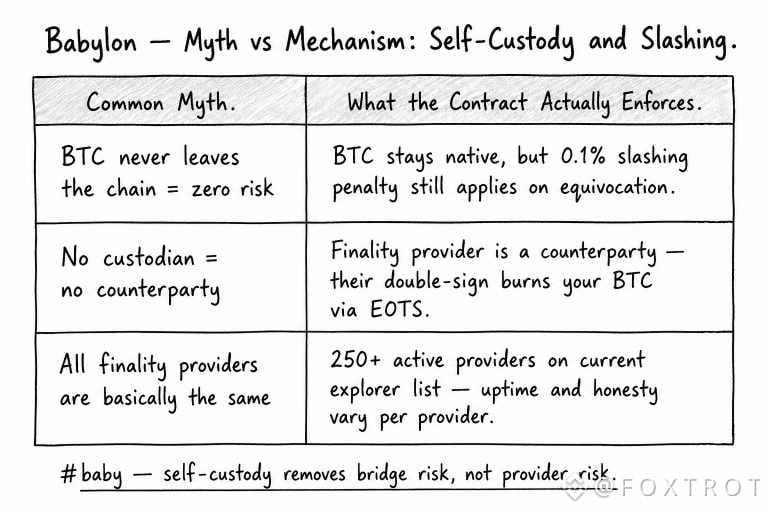
今週はうさぎの穴に入り込んだ感じで、ビットコインのステーキングについて人が語る内容と、実際にコントラクトが強制していることの違いを比べてみました。そして、「最初に壊れたのは自己管理だからリスクゼロだ」という神話。作業途中でBabylonのエクスプローラー上の最終確定(ファイナリティ)プロバイダーの一覧を開いたところ、現在は250以上のアクティブプロバイダーがいることに気づきました。けれど多くの雑な見解では、その数字が単なるインフラの雑学として扱われています。違います。
Babylon($BABY , #baby @babylonlabs_io )は、この売り文句を「あなたのBTCはチェーンから出ない。ブリッジも、カストディもない」としています。事実です。しかし曖昧さ(最終確定プロバイダーがダブル署名すること)が発生すると、その特定のプロバイダーに委任されたBTCには固定の0.1%のスラッシング罰が課されます。EOTSキーの露出によって焼却される仕組みです。あなたのビットコインはずっとその場にありました……が、誰か別のノードが不正行為(挙動不良)をしたせいで、その一部は焼かれてしまったのです。
人が見落としがちな神話はここです。「カストディなし」は「カウンターパーティなし」を意味しません。ブリッジを信頼するわけではないにせよ、あなたが選んだ最終確定プロバイダーがダブル署名しないことを信頼しているのです。リスクは別物ですが、同じカテゴリ——つまり、他人の稼働状況と誠実さへの依存です。
それでプロバイダー一覧を延々とスクロールしてしまい、実際にステーカーの多くがFP(最終確定プロバイダー)をちゃんと審査しているのか、それともUIのデフォルトを押して終わりなのか気になりました。委任する前に稼働履歴を確認する人はいるんでしょうか?それとも結局はコイン投げが多いのでしょうか?
今週はうさぎの穴に入り込んだ感じで、ビットコインのステーキングについて人が語る内容と、実際にコントラクトが強制していることの違いを比べてみました。そして、「最初に壊れたのは自己管理だからリスクゼロだ」という神話。作業途中でBabylonのエクスプローラー上の最終確定(ファイナリティ)プロバイダーの一覧を開いたところ、現在は250以上のアクティブプロバイダーがいることに気づきました。けれど多くの雑な見解では、その数字が単なるインフラの雑学として扱われています。違います。
Babylon($BABY , #baby @BabylonLabs_io )は、この売り文句を「あなたのBTCはチェーンから出ない。ブリッジも、カストディもない」としています。事実です。しかし曖昧さ(最終確定プロバイダーがダブル署名すること)が発生すると、その特定のプロバイダーに委任されたBTCには固定の0.1%のスラッシング罰が課されます。EOTSキーの露出によって焼却される仕組みです。あなたのビットコインはずっとその場にありました……が、誰か別のノードが不正行為(挙動不良)をしたせいで、その一部は焼かれてしまったのです。
人が見落としがちな神話はここです。「カストディなし」は「カウンターパーティなし」を意味しません。ブリッジを信頼するわけではないにせよ、あなたが選んだ最終確定プロバイダーがダブル署名しないことを信頼しているのです。リスクは別物ですが、同じカテゴリ——つまり、他人の稼働状況と誠実さへの依存です。
それでプロバイダー一覧を延々とスクロールしてしまい、実際にステーカーの多くがFP(最終確定プロバイダー)をちゃんと審査しているのか、それともUIのデフォルトを押して終わりなのか気になりました。委任する前に稼働履歴を確認する人はいるんでしょうか?それとも結局はコイン投げが多いのでしょうか?
Babylon($BABY , #baby @BabylonLabs_io )は、この売り文句を「あなたのBTCはチェーンから出ない。ブリッジも、カストディもない」としています。事実です。しかし曖昧さ(最終確定プロバイダーがダブル署名すること)が発生すると、その特定のプロバイダーに委任されたBTCには固定の0.1%のスラッシング罰が課されます。EOTSキーの露出によって焼却される仕組みです。あなたのビットコインはずっとその場にありました……が、誰か別のノードが不正行為(挙動不良)をしたせいで、その一部は焼かれてしまったのです。
人が見落としがちな神話はここです。「カストディなし」は「カウンターパーティなし」を意味しません。ブリッジを信頼するわけではないにせよ、あなたが選んだ最終確定プロバイダーがダブル署名しないことを信頼しているのです。リスクは別物ですが、同じカテゴリ——つまり、他人の稼働状況と誠実さへの依存です。
それでプロバイダー一覧を延々とスクロールしてしまい、実際にステーカーの多くがFP(最終確定プロバイダー)をちゃんと審査しているのか、それともUIのデフォルトを押して終わりなのか気になりました。委任する前に稼働履歴を確認する人はいるんでしょうか?それとも結局はコイン投げが多いのでしょうか?
6
5
386
この作業の間、同じ行を見つめ続けた──BTCはビットコインチェーンから一度も出ることなく「ステーク」されている。ラッピングも、ブリッジも、あなたの鍵を握るカストディ人もいない。紙の上では、@babylonlabs_io と #baby が物語の全てだ。
でも、実際に私が立ち止まったのはここだ。仕組みそのものは、タイムロック・スクリプトがビットコイン上にそのまま置かれているだけ──その部分は本物で、検証可能で、退屈なくらい良い。とはいえ、7月19日の時点で BABY の24時間取引高はたった $5.07M、時価総額は $50.23M。価格は週次で-4.2% と ~$0.0125。信託不要(trustless-by-default)だと呼ばれる設計にしては、小さすぎる数字だ。そこで、実際にどれだけのステーカーが自分でオンチェーン取引をブロードキャストしているのか、それとも取引所のステーキング商品の画面をクリックして、下にあるスクリプトではなくインターフェースを信じているだけなのでは?と疑問に思った。
静かなギャップ──暗号は中間業者を必要としないのに、実際に人が触れる利便性の層は、どこか中間業者っぽいところがある。セルフカストディは選択肢として存在するが、多くの人が辿るデフォルトの道ではない。
ダッシュボードをスクロールしている最中に、これをほとんど見逃した。正直に言うと、クリックする前に、ステーク取引がどこに着地するのかを実際に追跡する必要があった。
だから誰かが「BTCを『動かさずに』ステークしている」と言うとき──スクリプトを確認したのはその人なのか、それともボタンを信じたのはその人なのか?
$BABY
この作業の間、同じ行を見つめ続けた──BTCはビットコインチェーンから一度も出ることなく「ステーク」されている。ラッピングも、ブリッジも、あなたの鍵を握るカストディ人もいない。紙の上では、@BabylonLabs_io と #baby が物語の全てだ。
でも、実際に私が立ち止まったのはここだ。仕組みそのものは、タイムロック・スクリプトがビットコイン上にそのまま置かれているだけ──その部分は本物で、検証可能で、退屈なくらい良い。とはいえ、7月19日の時点で BABY の24時間取引高はたった $5.07M、時価総額は $50.23M。価格は週次で-4.2% と ~$0.0125。信託不要(trustless-by-default)だと呼ばれる設計にしては、小さすぎる数字だ。そこで、実際にどれだけのステーカーが自分でオンチェーン取引をブロードキャストしているのか、それとも取引所のステーキング商品の画面をクリックして、下にあるスクリプトではなくインターフェースを信じているだけなのでは?と疑問に思った。
静かなギャップ──暗号は中間業者を必要としないのに、実際に人が触れる利便性の層は、どこか中間業者っぽいところがある。セルフカストディは選択肢として存在するが、多くの人が辿るデフォルトの道ではない。
ダッシュボードをスクロールしている最中に、これをほとんど見逃した。正直に言うと、クリックする前に、ステーク取引がどこに着地するのかを実際に追跡する必要があった。
だから誰かが「BTCを『動かさずに』ステークしている」と言うとき──スクリプトを確認したのはその人なのか、それともボタンを信じたのはその人なのか?
$BABY
でも、実際に私が立ち止まったのはここだ。仕組みそのものは、タイムロック・スクリプトがビットコイン上にそのまま置かれているだけ──その部分は本物で、検証可能で、退屈なくらい良い。とはいえ、7月19日の時点で BABY の24時間取引高はたった $5.07M、時価総額は $50.23M。価格は週次で-4.2% と ~$0.0125。信託不要(trustless-by-default)だと呼ばれる設計にしては、小さすぎる数字だ。そこで、実際にどれだけのステーカーが自分でオンチェーン取引をブロードキャストしているのか、それとも取引所のステーキング商品の画面をクリックして、下にあるスクリプトではなくインターフェースを信じているだけなのでは?と疑問に思った。
静かなギャップ──暗号は中間業者を必要としないのに、実際に人が触れる利便性の層は、どこか中間業者っぽいところがある。セルフカストディは選択肢として存在するが、多くの人が辿るデフォルトの道ではない。
ダッシュボードをスクロールしている最中に、これをほとんど見逃した。正直に言うと、クリックする前に、ステーク取引がどこに着地するのかを実際に追跡する必要があった。
だから誰かが「BTCを『動かさずに』ステークしている」と言うとき──スクリプトを確認したのはその人なのか、それともボタンを信じたのはその人なのか?
$BABY
119
ログインして、さらにコンテンツを読む
厳選トピックで世界の暗号資産トレーダーの仲間入り
⚡️ 暗号資産に関する最新かつ有益な情報が見つかります。
💬 世界最大の暗号資産取引所から信頼されています。
👍 認証を受けたクリエイターから、有益なインサイトを得られます。
メール / 電話番号
トレンドトピック
BinanceLaunchesBinanceIntelligence
閲覧回数 469,832
3,290人が討論中
nce
🔥 暗号資産取引は「AIアシスタント」の時代に突入するかもしれません。
Binance Intelligenceは、AIを取引ワークフローに直接取り入れます。
手動で次々と切り替える代わりに:
📊 市場調査
🔔 アラート
💼 ポートフォリオの追跡
🧠 戦略のアイデア
⚙️ 取引の実行
AIなら、これらすべてを1つのシステムにまとめられます。
これは重要です。トレーダーにとって最大の強みは、必ずしもより多くの情報を見つけることではなく、
情報をより速く処理することだからです。
AIが市場を要約し、リスクを明らかにし、ポートフォリオを追跡し、戦略の立案を支援できるなら…
プロ向けツールと個人トレーダー向けツールの差は縮まり始めるかもしれません。
ただし、重要な点があります。
AIは意思決定を改善できますが、リスクをなくすことはできません。
AIをうまく活用するトレーダーは、競争上の優位性を得られるかもしれません。
一方、考えずにAIに従うだけの人は、ただより速く損失を出すことになるかもしれません。
あなたは、取引プロセスの一部としてAIを信頼しますか? 👀
$BTC
$XRP
$ETH
#BinanceAI #crypto #AI #trading $NVDAB #BinanceLaunchesBinanceIntelligence
MARFl
·いいね:1件
·閲覧回数 162
BitcoinTargets2026OpenAt$87570
閲覧回数 3,239
84人が討論中
BitcoinRejectedAt$87KThirdTime
閲覧回数 2,998
66人が討論中