
#stablecoins
stablecoins
7.4M vues
26,874 mentions
Populaire
Récents

Voir la traduction
⚡ ETHENA EXPANDS USDE TO TRON!
Ethena announced that USDe and sUSDe are coming to $TRON.US , expanding access to its stablecoin ecosystem. 💵⛓️
Another major move in the race for stablecoin adoption.
#Ethena #USDe #TRON #Stablecoins
{spot}(BTCUSDT)
{stock_us}(TRON.US)
⚡ ETHENA EXPANDS USDE TO TRON!
Ethena announced that USDe and sUSDe are coming to $TRON.US , expanding access to its stablecoin ecosystem. 💵⛓️
Another major move in the race for stablecoin adoption.
#Ethena #USDe #TRON #Stablecoins
Ethena announced that USDe and sUSDe are coming to $TRON.US , expanding access to its stablecoin ecosystem. 💵⛓️
Another major move in the race for stablecoin adoption.
#Ethena #USDe #TRON #Stablecoins
TRXUS+5,00%
1
91

·
--
Voir la traduction
Binance Stablecoins: liquidity, pegs, and ecosystem utility.
Stablecoins are the lifeblood of crypto markets. On Binance, assets like USDT, USDC, FDUSD and others provide:
• Instant settlement currency across spot and derivatives
• Safe-haven parking during high volatility without leaving the exchange ecosystem
• Deep liquidity pools for trading pairs, reducing slippage
• Base assets for Binance Earn and flexible savings products
Key principles for stablecoin holders:
1. Peg Stability: Not all stablecoins maintain exact parity under extreme market stress. Review reserve transparency and backing.
2. Utility vs Yield: Higher promotional yields on lesser-known stablecoins usually carry smart-contract or de-pegging risk.
3. Margin and Collateral: USDT and USDC serve as standard margin collateral for perpetual futures, making deep liquidity essential for preventing liquidation cascading.
Understand your collateral, verify your yield sources, and keep liquidity flexible.
Educational content only. Not financial advice.
#Stablecoins #USDT #USDC #BinanceEarn #BinanceAngels
Binance Stablecoins: liquidity, pegs, and ecosystem utility.
Stablecoins are the lifeblood of crypto markets. On Binance, assets like USDT, USDC, FDUSD and others provide:
• Instant settlement currency across spot and derivatives
• Safe-haven parking during high volatility without leaving the exchange ecosystem
• Deep liquidity pools for trading pairs, reducing slippage
• Base assets for Binance Earn and flexible savings products
Key principles for stablecoin holders:
1. Peg Stability: Not all stablecoins maintain exact parity under extreme market stress. Review reserve transparency and backing.
2. Utility vs Yield: Higher promotional yields on lesser-known stablecoins usually carry smart-contract or de-pegging risk.
3. Margin and Collateral: USDT and USDC serve as standard margin collateral for perpetual futures, making deep liquidity essential for preventing liquidation cascading.
Understand your collateral, verify your yield sources, and keep liquidity flexible.
Educational content only. Not financial advice.
#Stablecoins #USDT #USDC #BinanceEarn #BinanceAngels
Stablecoins are the lifeblood of crypto markets. On Binance, assets like USDT, USDC, FDUSD and others provide:
• Instant settlement currency across spot and derivatives
• Safe-haven parking during high volatility without leaving the exchange ecosystem
• Deep liquidity pools for trading pairs, reducing slippage
• Base assets for Binance Earn and flexible savings products
Key principles for stablecoin holders:
1. Peg Stability: Not all stablecoins maintain exact parity under extreme market stress. Review reserve transparency and backing.
2. Utility vs Yield: Higher promotional yields on lesser-known stablecoins usually carry smart-contract or de-pegging risk.
3. Margin and Collateral: USDT and USDC serve as standard margin collateral for perpetual futures, making deep liquidity essential for preventing liquidation cascading.
Understand your collateral, verify your yield sources, and keep liquidity flexible.
Educational content only. Not financial advice.
#Stablecoins #USDT #USDC #BinanceEarn #BinanceAngels
31


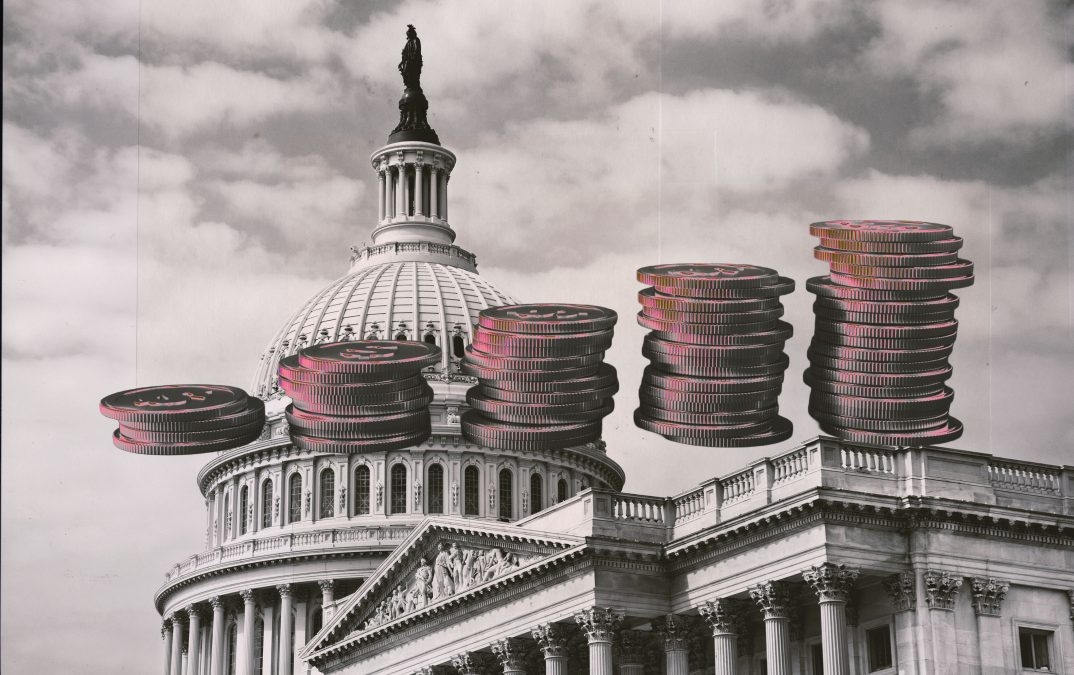
Alors, voici une petite histoire sur où nous en sommes avec la réglementation des crypto-monnaies aux États-Unis en ce moment. 🏛️ La sénatrice Kirsten Gillibrand s’est récemment exprimée, rappelant à tout le monde que les démocrates restent plus que jamais déterminés à faire avancer le Clarity for Payment Stablecoins Act. Elle affirme que ce n’est certainement pas la fin de la route pour ce projet de loi. Mais si l’on regarde ce que disent les initiés du secteur, la réalité pourrait être un peu plus compliquée. 😅 La plupart des analystes pensent qu’il est très improbable que ce projet de loi soit adopté pendant le Congrès actuel, ce qui signifie que nous devrons peut-être attendre encore un certain temps avant l’adoption de lois officielles.
Pourquoi est-ce que cela compte vraiment pour nous ? Eh bien, des stablecoins comme $USDC et $USDT sont l’épine dorsale absolue du trading et de la liquidité dans notre domaine. Un cadre légal clair apporterait une confiance institutionnelle massive au marché. Mais comme le Congrès avance lentement, l’attention se déplace. Au lieu d’attendre l’adoption d’une grande loi, nous devrions garder un œil attentif sur la SEC et la CFTC. Elles essaient activement de façonner des règles par elles-mêmes, et leurs prochaines actions détermineront probablement comment les stablecoins fonctionneront à court terme. Voyons comment va se dérouler cette partie d’échecs réglementaire. ♟️
#CryptoRegulation #Stablecoins #Write2Earn
Alors, voici une petite histoire sur où nous en sommes avec la réglementation des crypto-monnaies aux États-Unis en ce moment. 🏛️ La sénatrice Kirsten Gillibrand s’est récemment exprimée, rappelant à tout le monde que les démocrates restent plus que jamais déterminés à faire avancer le Clarity for Payment Stablecoins Act. Elle affirme que ce n’est certainement pas la fin de la route pour ce projet de loi. Mais si l’on regarde ce que disent les initiés du secteur, la réalité pourrait être un peu plus compliquée. 😅 La plupart des analystes pensent qu’il est très improbable que ce projet de loi soit adopté pendant le Congrès actuel, ce qui signifie que nous devrons peut-être attendre encore un certain temps avant l’adoption de lois officielles.
Pourquoi est-ce que cela compte vraiment pour nous ? Eh bien, des stablecoins comme $USDC et $USDT sont l’épine dorsale absolue du trading et de la liquidité dans notre domaine. Un cadre légal clair apporterait une confiance institutionnelle massive au marché. Mais comme le Congrès avance lentement, l’attention se déplace. Au lieu d’attendre l’adoption d’une grande loi, nous devrions garder un œil attentif sur la SEC et la CFTC. Elles essaient activement de façonner des règles par elles-mêmes, et leurs prochaines actions détermineront probablement comment les stablecoins fonctionneront à court terme. Voyons comment va se dérouler cette partie d’échecs réglementaire. ♟️
#CryptoRegulation #Stablecoins #Write2Earn
Pourquoi est-ce que cela compte vraiment pour nous ? Eh bien, des stablecoins comme $USDC et $USDT sont l’épine dorsale absolue du trading et de la liquidité dans notre domaine. Un cadre légal clair apporterait une confiance institutionnelle massive au marché. Mais comme le Congrès avance lentement, l’attention se déplace. Au lieu d’attendre l’adoption d’une grande loi, nous devrions garder un œil attentif sur la SEC et la CFTC. Elles essaient activement de façonner des règles par elles-mêmes, et leurs prochaines actions détermineront probablement comment les stablecoins fonctionneront à court terme. Voyons comment va se dérouler cette partie d’échecs réglementaire. ♟️
#CryptoRegulation #Stablecoins #Write2Earn

128
Le rendement en stablecoin survit au blocage du Sénat. Des analystes de Bernstein soulignent que, puisque la loi Clarity n’a pas progressé, les plateformes peuvent continuer à offrir des récompenses sur les soldes inactifs pour le moment. Cela maintient l’élan pour le $USDT et des actifs similaires pendant que le marché attend plus de clarté réglementaire. - Des sénateurs n’ont pas réussi à faire passer la législation sur la loi Clarity. - Les analystes s’attendent à une réglementation rapide de la part de la SEC et de la CFTC. - Les opportunités de rendement sur les stablecoins restent actives pour les utilisateurs. C’est fou comme des retards de réglementation peuvent parfois apporter un espace de respiration inattendu au marché. #CryptoRegulation #Stablecoins #Write2Earn
Le rendement en stablecoin survit au blocage du Sénat. Des analystes de Bernstein soulignent que, puisque la loi Clarity n’a pas progressé, les plateformes peuvent continuer à offrir des récompenses sur les soldes inactifs pour le moment. Cela maintient l’élan pour le $USDT et des actifs similaires pendant que le marché attend plus de clarté réglementaire. - Des sénateurs n’ont pas réussi à faire passer la législation sur la loi Clarity. - Les analystes s’attendent à une réglementation rapide de la part de la SEC et de la CFTC. - Les opportunités de rendement sur les stablecoins restent actives pour les utilisateurs. C’est fou comme des retards de réglementation peuvent parfois apporter un espace de respiration inattendu au marché. #CryptoRegulation #Stablecoins #Write2Earn
51

Voir la traduction
🪙 What Is a Stablecoin?
💵 Understanding Stablecoins
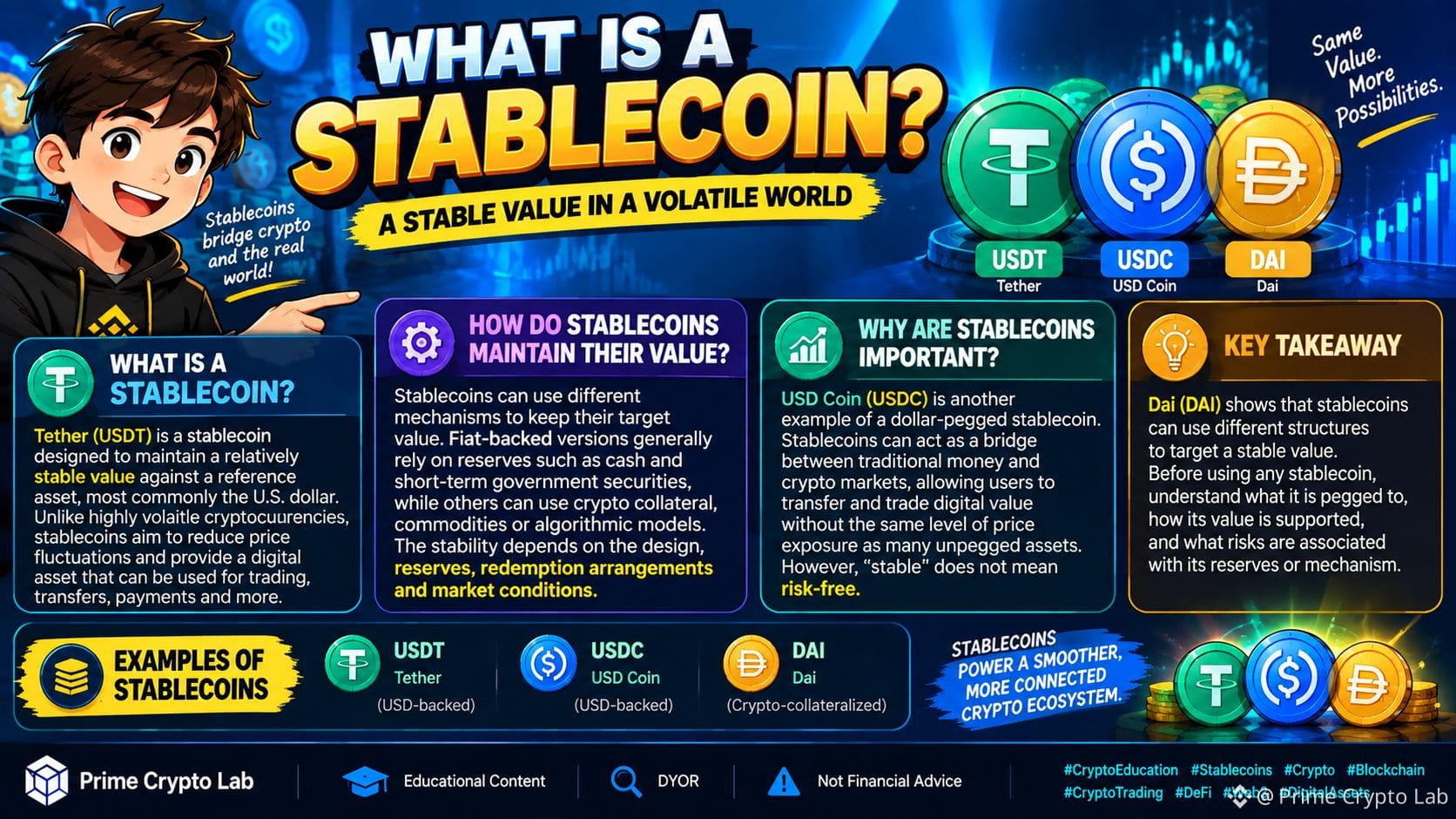
Tether $USDT is a stablecoin designed to maintain a relatively stable value against a reference asset, most commonly the U.S. dollar. Unlike highly volatile cryptocurrencies, stablecoins aim to reduce price fluctuations and provide a digital asset that can be useful for trading, transfers, payments, and moving value across blockchain networks.
🔗 How Do Stablecoins Maintain Their Value?
Stablecoins can use different mechanisms to maintain their target value. Fiat-backed versions generally rely on reserves such as cash and short-term government securities, while other models can use crypto collateral, commodities, or algorithmic mechanisms. This means the stability of a particular stablecoin depends on its design, reserves, redemption arrangements, and market conditions.
📊 Why Are Stablecoins Important?
$USDC Coin (USDC) is another example of a dollar-pegged stablecoin. Stablecoins can act as a bridge between traditional money and crypto markets, allowing users to transfer and trade digital value without taking the same level of price exposure as many unpegged cryptoassets. However, “stable” does not mean risk-free—stablecoins can experience price deviations or other risks.
🎯 Key Takeaway
Dai (DAI) shows that stablecoins can use different structures to target a stable value. Before using any stablecoin, understand what it is pegged to, howl its value is supported, and what risks are associated with its reserves or mechanism.
Prime Crypto Lab — No Hype, Just Research.
DYOR | Educational Content | Not Financial Advice
#cryptoeducation #Stablecoins #crypto #blockchain
🪙 What Is a Stablecoin?
💵 Understanding Stablecoins
Tether $USDT is a stablecoin designed to maintain a relatively stable value against a reference asset, most commonly the U.S. dollar. Unlike highly volatile cryptocurrencies, stablecoins aim to reduce price fluctuations and provide a digital asset that can be useful for trading, transfers, payments, and moving value across blockchain networks.
🔗 How Do Stablecoins Maintain Their Value?
Stablecoins can use different mechanisms to maintain their target value. Fiat-backed versions generally rely on reserves such as cash and short-term government securities, while other models can use crypto collateral, commodities, or algorithmic mechanisms. This means the stability of a particular stablecoin depends on its design, reserves, redemption arrangements, and market conditions.
📊 Why Are Stablecoins Important?
$USDC Coin (USDC) is another example of a dollar-pegged stablecoin. Stablecoins can act as a bridge between traditional money and crypto markets, allowing users to transfer and trade digital value without taking the same level of price exposure as many unpegged cryptoassets. However, “stable” does not mean risk-free—stablecoins can experience price deviations or other risks.
🎯 Key Takeaway
Dai (DAI) shows that stablecoins can use different structures to target a stable value. Before using any stablecoin, understand what it is pegged to, howl its value is supported, and what risks are associated with its reserves or mechanism.
Prime Crypto Lab — No Hype, Just Research.
DYOR | Educational Content | Not Financial Advice
#cryptoeducation #Stablecoins #crypto #blockchain
💵 Understanding Stablecoins
Tether $USDT is a stablecoin designed to maintain a relatively stable value against a reference asset, most commonly the U.S. dollar. Unlike highly volatile cryptocurrencies, stablecoins aim to reduce price fluctuations and provide a digital asset that can be useful for trading, transfers, payments, and moving value across blockchain networks.
🔗 How Do Stablecoins Maintain Their Value?
Stablecoins can use different mechanisms to maintain their target value. Fiat-backed versions generally rely on reserves such as cash and short-term government securities, while other models can use crypto collateral, commodities, or algorithmic mechanisms. This means the stability of a particular stablecoin depends on its design, reserves, redemption arrangements, and market conditions.
📊 Why Are Stablecoins Important?
$USDC Coin (USDC) is another example of a dollar-pegged stablecoin. Stablecoins can act as a bridge between traditional money and crypto markets, allowing users to transfer and trade digital value without taking the same level of price exposure as many unpegged cryptoassets. However, “stable” does not mean risk-free—stablecoins can experience price deviations or other risks.
🎯 Key Takeaway
Dai (DAI) shows that stablecoins can use different structures to target a stable value. Before using any stablecoin, understand what it is pegged to, howl its value is supported, and what risks are associated with its reserves or mechanism.
Prime Crypto Lab — No Hype, Just Research.
DYOR | Educational Content | Not Financial Advice
#cryptoeducation #Stablecoins #crypto #blockchain
51

·
--
Voir la traduction
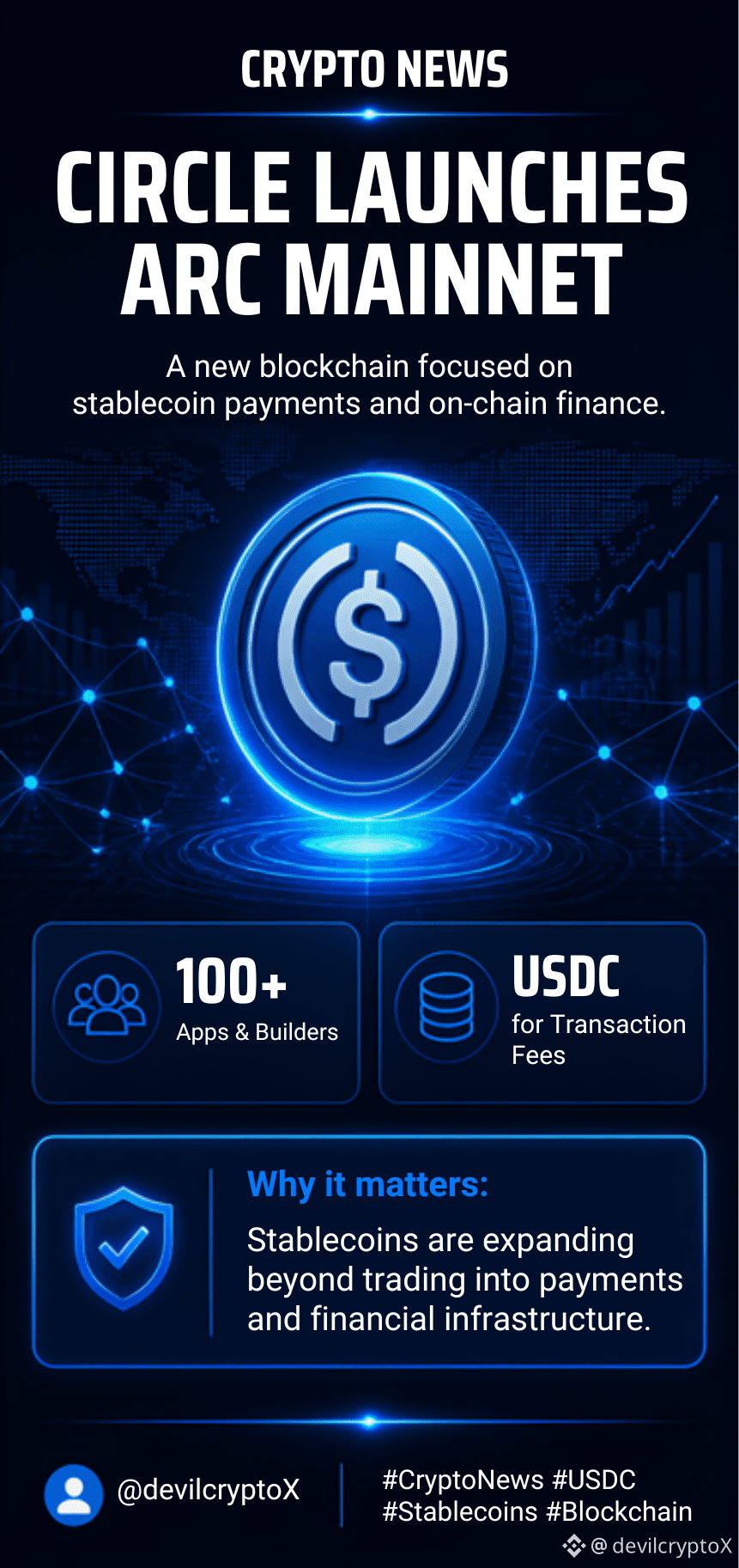
🚨 TRENDING CRYPTO NEWS: Circle Launches Arc Mainnet:
•Circle has launched its Arc blockchain mainnet with over 100 apps and 11 validators.
•The network is built for stablecoin payments and on-chain finance, with USDC used for transaction fees.
•Why it matters: Crypto is moving beyond trading — stablecoins are becoming a bigger part of real payments and financial services.
$USDC
{spot}(USDCUSDT)
$BTC
{spot}(BTCUSDT)
$XRP
{spot}(XRPUSDT)
#CryptoNews #Stablecoins #USDC #Blockchain #BinanceSquare
🚨 TRENDING CRYPTO NEWS: Circle Launches Arc Mainnet:
•Circle has launched its Arc blockchain mainnet with over 100 apps and 11 validators.
•The network is built for stablecoin payments and on-chain finance, with USDC used for transaction fees.
•Why it matters: Crypto is moving beyond trading — stablecoins are becoming a bigger part of real payments and financial services.
$USDC
$BTC
$XRP
#CryptoNews #Stablecoins #USDC #Blockchain #BinanceSquare
•Circle has launched its Arc blockchain mainnet with over 100 apps and 11 validators.
•The network is built for stablecoin payments and on-chain finance, with USDC used for transaction fees.
•Why it matters: Crypto is moving beyond trading — stablecoins are becoming a bigger part of real payments and financial services.
$USDC
$BTC
$XRP
#CryptoNews #Stablecoins #USDC #Blockchain #BinanceSquare
63

·
--
Le financement du commerce n’a pas changé depuis 300 ans. Une lettre de crédit exige toujours des banques des deux côtés, des jours de vérification des documents, et des frais à chaque point de contrôle. Le règlement par stablecoin sur chaîne fait paraître tout ce processus préhistorique.
La vraie percée n’est pas la vitesse — c’est la programmabilité. Lorsqu’un paiement en stablecoin peut être placé en séquestre dans un contrat intelligent avec des conditions de libération automatiques — connaissement confirmé, inspection validée, horodatage de livraison vérifié — vous n’avez plus besoin d’une banque au milieu. Vous n’avez plus besoin d’équipes de comptes clients qui relancent des factures. Le règlement EST la réconciliation.
Les stablecoins règlent déjà plus de volume quotidien que de nombreux réseaux de paiement historiques. Mais la prochaine étape est plus vaste : le financement du commerce natif des stablecoins. Des contrats intelligents qui remplacent les lettres de crédit. Un séquestre on-chain qui remplace les garanties bancaires. Des paiements par étapes automatiques qui remplacent les délais de 30/60/90 jours.
Les chaînes qui gagneront ce volume ne seront pas celles qui affichent le plus de TPS. Ce seront celles qui offrent la finalité de règlement la plus fiable, la liquidité la plus profonde et les voies de conformité les plus solides. $ETH settlement-layer security, $BNB low-fee throughput, et $SOL sub-second finality apportent chacune différents éléments du puzzle.
Le marché des paiements B2B de 150 000 milliards de dollars n’a pas besoin d’une banque plus rapide. Il lui faut un nouveau système d’exploitation. Les stablecoins deviennent discrètement cet OS — programmable, composable, et réglé en secondes plutôt qu’en semaines.
#Stablecoins #CryptoPayments #TradeFinance #DeFi #Blockchain
Le financement du commerce n’a pas changé depuis 300 ans. Une lettre de crédit exige toujours des banques des deux côtés, des jours de vérification des documents, et des frais à chaque point de contrôle. Le règlement par stablecoin sur chaîne fait paraître tout ce processus préhistorique.
La vraie percée n’est pas la vitesse — c’est la programmabilité. Lorsqu’un paiement en stablecoin peut être placé en séquestre dans un contrat intelligent avec des conditions de libération automatiques — connaissement confirmé, inspection validée, horodatage de livraison vérifié — vous n’avez plus besoin d’une banque au milieu. Vous n’avez plus besoin d’équipes de comptes clients qui relancent des factures. Le règlement EST la réconciliation.
Les stablecoins règlent déjà plus de volume quotidien que de nombreux réseaux de paiement historiques. Mais la prochaine étape est plus vaste : le financement du commerce natif des stablecoins. Des contrats intelligents qui remplacent les lettres de crédit. Un séquestre on-chain qui remplace les garanties bancaires. Des paiements par étapes automatiques qui remplacent les délais de 30/60/90 jours.
Les chaînes qui gagneront ce volume ne seront pas celles qui affichent le plus de TPS. Ce seront celles qui offrent la finalité de règlement la plus fiable, la liquidité la plus profonde et les voies de conformité les plus solides. $ETH settlement-layer security, $BNB low-fee throughput, et $SOL sub-second finality apportent chacune différents éléments du puzzle.
Le marché des paiements B2B de 150 000 milliards de dollars n’a pas besoin d’une banque plus rapide. Il lui faut un nouveau système d’exploitation. Les stablecoins deviennent discrètement cet OS — programmable, composable, et réglé en secondes plutôt qu’en semaines.
#Stablecoins #CryptoPayments #TradeFinance #DeFi #Blockchain
La vraie percée n’est pas la vitesse — c’est la programmabilité. Lorsqu’un paiement en stablecoin peut être placé en séquestre dans un contrat intelligent avec des conditions de libération automatiques — connaissement confirmé, inspection validée, horodatage de livraison vérifié — vous n’avez plus besoin d’une banque au milieu. Vous n’avez plus besoin d’équipes de comptes clients qui relancent des factures. Le règlement EST la réconciliation.
Les stablecoins règlent déjà plus de volume quotidien que de nombreux réseaux de paiement historiques. Mais la prochaine étape est plus vaste : le financement du commerce natif des stablecoins. Des contrats intelligents qui remplacent les lettres de crédit. Un séquestre on-chain qui remplace les garanties bancaires. Des paiements par étapes automatiques qui remplacent les délais de 30/60/90 jours.
Les chaînes qui gagneront ce volume ne seront pas celles qui affichent le plus de TPS. Ce seront celles qui offrent la finalité de règlement la plus fiable, la liquidité la plus profonde et les voies de conformité les plus solides. $ETH settlement-layer security, $BNB low-fee throughput, et $SOL sub-second finality apportent chacune différents éléments du puzzle.
Le marché des paiements B2B de 150 000 milliards de dollars n’a pas besoin d’une banque plus rapide. Il lui faut un nouveau système d’exploitation. Les stablecoins deviennent discrètement cet OS — programmable, composable, et réglé en secondes plutôt qu’en semaines.
#Stablecoins #CryptoPayments #TradeFinance #DeFi #Blockchain
38

·
--
Les stablecoins pourraient finir par être la partie de la crypto que les gens “ordinaires” utilisent le plus, sans jamais appeler ça de la crypto.
Envoyer des dollars à travers les frontières en quelques minutes, un dimanche, pour quelques centimes. C’était un rêve en 2017. Aujourd’hui, c’est simplement ce que font les stablecoins toute la journée.
Pendant ce temps, le Bitcoin à 76 484 $ et l’Ethereum à 2 443 $ monopolisent les gros titres.
La partie ennuyeuse gagne généralement en silence.
Utilisez-vous des stablecoins pour autre chose que le trading ?
Opinion personnelle, pas un conseil. Faites vos propres recherches.
#Stablecoins
Les stablecoins pourraient finir par être la partie de la crypto que les gens “ordinaires” utilisent le plus, sans jamais appeler ça de la crypto.
Envoyer des dollars à travers les frontières en quelques minutes, un dimanche, pour quelques centimes. C’était un rêve en 2017. Aujourd’hui, c’est simplement ce que font les stablecoins toute la journée.
Pendant ce temps, le Bitcoin à 76 484 $ et l’Ethereum à 2 443 $ monopolisent les gros titres.
La partie ennuyeuse gagne généralement en silence.
Utilisez-vous des stablecoins pour autre chose que le trading ?
Opinion personnelle, pas un conseil. Faites vos propres recherches.
#Stablecoins
Envoyer des dollars à travers les frontières en quelques minutes, un dimanche, pour quelques centimes. C’était un rêve en 2017. Aujourd’hui, c’est simplement ce que font les stablecoins toute la journée.
Pendant ce temps, le Bitcoin à 76 484 $ et l’Ethereum à 2 443 $ monopolisent les gros titres.
La partie ennuyeuse gagne généralement en silence.
Utilisez-vous des stablecoins pour autre chose que le trading ?
Opinion personnelle, pas un conseil. Faites vos propres recherches.
#Stablecoins
107

·
--
USD Coin ($USDC ) continue de consolider son rôle de premier modèle conforme pour la finance numérique mondiale ! Découvrez les points clés :
Ancrage stable : Stabilisé fermement autour de 1,00080 USDT, avec une excellente stabilité dans une fourchette étroite et saine.
Volumes massifs : Plus de 3,39 milliards de dollars de volume de transactions sur 24 heures sur les principales bourses.
Croissance de l’écosystème : Suite au lancement récent d’Arc Mainnet, le soutien institutionnel et l’intégration bancaire d’entreprise (comme la conservation d’actifs de Deutsche Bank) atteignent de nouveaux sommets.
Pleine couverture : Les preuves de réserves attestées de septembre confirment que l’USDC alloué aux utilisateurs reste entièrement surcollatéralisé sur les principaux sites.
#USDC #Stablecoins #CryptoNews🚀🔥 #BinanceSquare
USD Coin ($USDC ) continue de consolider son rôle de premier modèle conforme pour la finance numérique mondiale ! Découvrez les points clés :
Ancrage stable : Stabilisé fermement autour de 1,00080 USDT, avec une excellente stabilité dans une fourchette étroite et saine.
Volumes massifs : Plus de 3,39 milliards de dollars de volume de transactions sur 24 heures sur les principales bourses.
Croissance de l’écosystème : Suite au lancement récent d’Arc Mainnet, le soutien institutionnel et l’intégration bancaire d’entreprise (comme la conservation d’actifs de Deutsche Bank) atteignent de nouveaux sommets.
Pleine couverture : Les preuves de réserves attestées de septembre confirment que l’USDC alloué aux utilisateurs reste entièrement surcollatéralisé sur les principaux sites.
#USDC #Stablecoins #CryptoNews🚀🔥 #BinanceSquare
Ancrage stable : Stabilisé fermement autour de 1,00080 USDT, avec une excellente stabilité dans une fourchette étroite et saine.
Volumes massifs : Plus de 3,39 milliards de dollars de volume de transactions sur 24 heures sur les principales bourses.
Croissance de l’écosystème : Suite au lancement récent d’Arc Mainnet, le soutien institutionnel et l’intégration bancaire d’entreprise (comme la conservation d’actifs de Deutsche Bank) atteignent de nouveaux sommets.
Pleine couverture : Les preuves de réserves attestées de septembre confirment que l’USDC alloué aux utilisateurs reste entièrement surcollatéralisé sur les principaux sites.
#USDC #Stablecoins #CryptoNews🚀🔥 #BinanceSquare
88

·
--
🚨 $USDC EXPANDIT la LIQUIDITÉ MULTI-CHAÎNE alors que l’intégration du réseau Arc passe en direct ! 🏦
Les rails de liquidité institutionnelle viennent de recevoir une mise à niveau structurelle. ⚡ L’intégration de $USDC sur le réseau Arc ouvre des canaux de dépôt et de retrait fluides à travers une bourse de premier plan, optimisant considérablement la vitesse de règlement et réduisant les frictions inter-chaînes. 📊
Cette initiative renforce l’efficacité de la liquidité pour le flux d’ordres institutionnel, permettant aux capitaux de tourner sans heurts vers des structures de marché à forte probabilité. 🔍 À mesure que l’infrastructure des stablecoins s’étend sur des protocoles émergents, le suivi de la vélocité des capitaux devient essentiel pour repérer les premiers changements structurels. 💬 Quel impact cette mise à niveau du règlement aura-t-elle sur votre déploiement de capitaux inter-chaînes ? 👇
⚠️ Ceci ne constitue pas un conseil financier. Gérez toujours votre risque. 🛡️
🏷️ #USDC #ArcNetwork #Stablecoins #Crypto
🏦 🔍
🚨 $USDC EXPANDIT la LIQUIDITÉ MULTI-CHAÎNE alors que l’intégration du réseau Arc passe en direct ! 🏦
Les rails de liquidité institutionnelle viennent de recevoir une mise à niveau structurelle. ⚡ L’intégration de $USDC sur le réseau Arc ouvre des canaux de dépôt et de retrait fluides à travers une bourse de premier plan, optimisant considérablement la vitesse de règlement et réduisant les frictions inter-chaînes. 📊
Cette initiative renforce l’efficacité de la liquidité pour le flux d’ordres institutionnel, permettant aux capitaux de tourner sans heurts vers des structures de marché à forte probabilité. 🔍 À mesure que l’infrastructure des stablecoins s’étend sur des protocoles émergents, le suivi de la vélocité des capitaux devient essentiel pour repérer les premiers changements structurels. 💬 Quel impact cette mise à niveau du règlement aura-t-elle sur votre déploiement de capitaux inter-chaînes ? 👇
⚠️ Ceci ne constitue pas un conseil financier. Gérez toujours votre risque. 🛡️
🏷️ #USDC #ArcNetwork #Stablecoins #Crypto
🏦 🔍
Les rails de liquidité institutionnelle viennent de recevoir une mise à niveau structurelle. ⚡ L’intégration de $USDC sur le réseau Arc ouvre des canaux de dépôt et de retrait fluides à travers une bourse de premier plan, optimisant considérablement la vitesse de règlement et réduisant les frictions inter-chaînes. 📊
Cette initiative renforce l’efficacité de la liquidité pour le flux d’ordres institutionnel, permettant aux capitaux de tourner sans heurts vers des structures de marché à forte probabilité. 🔍 À mesure que l’infrastructure des stablecoins s’étend sur des protocoles émergents, le suivi de la vélocité des capitaux devient essentiel pour repérer les premiers changements structurels. 💬 Quel impact cette mise à niveau du règlement aura-t-elle sur votre déploiement de capitaux inter-chaînes ? 👇
⚠️ Ceci ne constitue pas un conseil financier. Gérez toujours votre risque. 🛡️
🏷️ #USDC #ArcNetwork #Stablecoins #Crypto
🏦 🔍
6

·
--
🚨 $USDC S’ÉTEND AU RÉSEAU ARC COMME PREMIÈRE CATÉGORIE D’ÉCHANGES ; LIQUIDITÉ INSTANTANÉE DISPONIBLE ! ⚡
📌 Les rails de règlement institutionnel viennent de gagner un sérieux niveau. Le déploiement de $USDC sur le réseau Arc ouvre des autoroutes de dépôt et de retrait fluides, en éliminant les frictions pour le capital aux poches profondes. 💡
📊 La migration de liquidité ne se produit que rarement par hasard. Alors que les chaînes à haut débit capturent des parts plus importantes du volume en stablecoins, la vélocité du flux d’ordres s’accélère. 🌊 Les “smart money” positionnent discrètement l’infrastructure pour déplacer de gros volumes sans friction avant la prochaine phase d’expansion. 💬 Suivez-vous ces flux de réseaux de stablecoins, ou attendez-vous que les graphiques de prix rattrapent le mouvement ? 👇
⚠️ Ceci n’est pas un conseil financier. Gérez toujours votre risque. 🛡️
🏷️ #USDC #Stablecoins #Crypto #Layer1
⚡ 💎
🚨 $USDC S’ÉTEND AU RÉSEAU ARC COMME PREMIÈRE CATÉGORIE D’ÉCHANGES ; LIQUIDITÉ INSTANTANÉE DISPONIBLE ! ⚡
📌 Les rails de règlement institutionnel viennent de gagner un sérieux niveau. Le déploiement de $USDC sur le réseau Arc ouvre des autoroutes de dépôt et de retrait fluides, en éliminant les frictions pour le capital aux poches profondes. 💡
📊 La migration de liquidité ne se produit que rarement par hasard. Alors que les chaînes à haut débit capturent des parts plus importantes du volume en stablecoins, la vélocité du flux d’ordres s’accélère. 🌊 Les “smart money” positionnent discrètement l’infrastructure pour déplacer de gros volumes sans friction avant la prochaine phase d’expansion. 💬 Suivez-vous ces flux de réseaux de stablecoins, ou attendez-vous que les graphiques de prix rattrapent le mouvement ? 👇
⚠️ Ceci n’est pas un conseil financier. Gérez toujours votre risque. 🛡️
🏷️ #USDC #Stablecoins #Crypto #Layer1
⚡ 💎
📌 Les rails de règlement institutionnel viennent de gagner un sérieux niveau. Le déploiement de $USDC sur le réseau Arc ouvre des autoroutes de dépôt et de retrait fluides, en éliminant les frictions pour le capital aux poches profondes. 💡
📊 La migration de liquidité ne se produit que rarement par hasard. Alors que les chaînes à haut débit capturent des parts plus importantes du volume en stablecoins, la vélocité du flux d’ordres s’accélère. 🌊 Les “smart money” positionnent discrètement l’infrastructure pour déplacer de gros volumes sans friction avant la prochaine phase d’expansion. 💬 Suivez-vous ces flux de réseaux de stablecoins, ou attendez-vous que les graphiques de prix rattrapent le mouvement ? 👇
⚠️ Ceci n’est pas un conseil financier. Gérez toujours votre risque. 🛡️
🏷️ #USDC #Stablecoins #Crypto #Layer1
⚡ 💎
1

·
--
Lancement natif d’une infrastructure de stablecoin
Column a introduit une infrastructure de stablecoin native à la banque, permettant une conversion instantanée 24/7 entre USDC, USDT et USD sans préfinancement. Le système prend en charge les principaux canaux de paiement et plusieurs blockchains, avec Solana comme réseau par défaut.
Chiffres clés :
🪙 Prend en charge USDC & USDT
⚡ Conversion instantanée 24/7 USD ↔ stablecoin
🌐 Fonctionne sur Solana, Ethereum et d’autres chaînes majeures
💸 Compatible avec ACH, FedNow, Fedwire, SWIFT & RTP
📈 Traite déjà des dizaines de milliards de volume annualisé
Pourquoi c’est important :
L’intégration bancaire native supprime les délais de règlement et le préfinancement, rendant les paiements en stablecoin plus rapides et plus pratiques pour les fintechs, les entreprises et les transferts d’argent à l’échelle mondiale.
#Stablecoins #USDC #USDT #Solana #BinanceSquare
Lancement natif d’une infrastructure de stablecoin
Column a introduit une infrastructure de stablecoin native à la banque, permettant une conversion instantanée 24/7 entre USDC, USDT et USD sans préfinancement. Le système prend en charge les principaux canaux de paiement et plusieurs blockchains, avec Solana comme réseau par défaut.
Chiffres clés :
🪙 Prend en charge USDC & USDT
⚡ Conversion instantanée 24/7 USD ↔ stablecoin
🌐 Fonctionne sur Solana, Ethereum et d’autres chaînes majeures
💸 Compatible avec ACH, FedNow, Fedwire, SWIFT & RTP
📈 Traite déjà des dizaines de milliards de volume annualisé
Pourquoi c’est important :
L’intégration bancaire native supprime les délais de règlement et le préfinancement, rendant les paiements en stablecoin plus rapides et plus pratiques pour les fintechs, les entreprises et les transferts d’argent à l’échelle mondiale.
#Stablecoins #USDC #USDT #Solana #BinanceSquare
Column a introduit une infrastructure de stablecoin native à la banque, permettant une conversion instantanée 24/7 entre USDC, USDT et USD sans préfinancement. Le système prend en charge les principaux canaux de paiement et plusieurs blockchains, avec Solana comme réseau par défaut.
Chiffres clés :
🪙 Prend en charge USDC & USDT
⚡ Conversion instantanée 24/7 USD ↔ stablecoin
🌐 Fonctionne sur Solana, Ethereum et d’autres chaînes majeures
💸 Compatible avec ACH, FedNow, Fedwire, SWIFT & RTP
📈 Traite déjà des dizaines de milliards de volume annualisé
Pourquoi c’est important :
L’intégration bancaire native supprime les délais de règlement et le préfinancement, rendant les paiements en stablecoin plus rapides et plus pratiques pour les fintechs, les entreprises et les transferts d’argent à l’échelle mondiale.
#Stablecoins #USDC #USDT #Solana #BinanceSquare
86

·
--
Dans l’affinage subtil du règlement transfrontalier, les stablecoins continuent de s’intégrer aux opérations de trésorerie et aux couloirs de transfert de fonds. Alors que les volumes se maintiennent et que les cadres réglementaires mûrissent, ces instruments font preuve de résilience en tant qu’infrastructures financières pratiques. Faisant écho à l’expansion des paiements de 2021 qui a normalisé les dollars numériques, cette maturation comporte une probabilité de 68% d’une intégration plus profonde au fil de la saison si les cas d’usage institutionnels et l’accessibilité mondiale continuent de progresser.
$USDC $USDT $USDE #RadaRI111 #CoinVahini #Stablecoins #USDC
Dans l’affinage subtil du règlement transfrontalier, les stablecoins continuent de s’intégrer aux opérations de trésorerie et aux couloirs de transfert de fonds. Alors que les volumes se maintiennent et que les cadres réglementaires mûrissent, ces instruments font preuve de résilience en tant qu’infrastructures financières pratiques. Faisant écho à l’expansion des paiements de 2021 qui a normalisé les dollars numériques, cette maturation comporte une probabilité de 68% d’une intégration plus profonde au fil de la saison si les cas d’usage institutionnels et l’accessibilité mondiale continuent de progresser.
$USDC $USDT $USDE #RadaRI111 #CoinVahini #Stablecoins #USDC
$USDC $USDT $USDE #RadaRI111 #CoinVahini #Stablecoins #USDC
53
·
--
La mesure on-chain la plus mal comprise en ce moment n’est pas le mouvement des baleines ni les sorties des exchanges. Ce sont les soldes de stablecoins détenus sur les exchanges.
Les traders considèrent les réserves de stablecoins comme inertes — de l’argent mis de côté, sur le banc, qui ne fait rien. C’est faux. Les soldes de stablecoins sur les exchanges sont la poudre noire du marché crypto. Quand ce chiffre augmente, le pouvoir d’achat mobilisable s’accumule. Quand il baisse sans envol des prix correspondant, le capital quitte entièrement l’écosystème.
Observez la divergence : si l’offre totale de stablecoins progresse (les émetteurs frappent de nouveaux tokens) mais que les soldes sur les exchanges diminuent, deux choses se produisent. D’abord, le capital se déplace vers le rendement — staking DeFi, prêts, restaking. Ensuite, une partie quitte l’écosystème via des sorties. C’est structurellement différent du cycle 2021, où les stablecoins restaient le plus souvent sur les exchanges, en attendant les entrées.
Le signal qui compte : les réserves de stablecoins sur les exchanges qui montent tandis que $BTC et $ETH les prix restent stables. C’est une accumulation qui se fait au ralenti. Cela signifie que le capital est positionné, mais pas encore déployé — de la patience, pas de l’apathie.
À l’inverse, des réserves de stablecoins en baisse pendant une hausse suggèrent que le carburant est en train d’être consommé. La durée compte plus que l’ampleur ici.
C’est pour cela que suivre $BNB les entrées de stablecoins de l’écosystème est important — les chaînes qui captent la liquidité en stablecoins captent aussi le pouvoir d’achat futur, pas seulement le TVL.
$BTC $ETH $BNB
#CryptoMarkets #OnChain #Stablecoins #AnalyseDeMarché
La mesure on-chain la plus mal comprise en ce moment n’est pas le mouvement des baleines ni les sorties des exchanges. Ce sont les soldes de stablecoins détenus sur les exchanges.
Les traders considèrent les réserves de stablecoins comme inertes — de l’argent mis de côté, sur le banc, qui ne fait rien. C’est faux. Les soldes de stablecoins sur les exchanges sont la poudre noire du marché crypto. Quand ce chiffre augmente, le pouvoir d’achat mobilisable s’accumule. Quand il baisse sans envol des prix correspondant, le capital quitte entièrement l’écosystème.
Observez la divergence : si l’offre totale de stablecoins progresse (les émetteurs frappent de nouveaux tokens) mais que les soldes sur les exchanges diminuent, deux choses se produisent. D’abord, le capital se déplace vers le rendement — staking DeFi, prêts, restaking. Ensuite, une partie quitte l’écosystème via des sorties. C’est structurellement différent du cycle 2021, où les stablecoins restaient le plus souvent sur les exchanges, en attendant les entrées.
Le signal qui compte : les réserves de stablecoins sur les exchanges qui montent tandis que $BTC et $ETH les prix restent stables. C’est une accumulation qui se fait au ralenti. Cela signifie que le capital est positionné, mais pas encore déployé — de la patience, pas de l’apathie.
À l’inverse, des réserves de stablecoins en baisse pendant une hausse suggèrent que le carburant est en train d’être consommé. La durée compte plus que l’ampleur ici.
C’est pour cela que suivre $BNB les entrées de stablecoins de l’écosystème est important — les chaînes qui captent la liquidité en stablecoins captent aussi le pouvoir d’achat futur, pas seulement le TVL.
$BTC $ETH $BNB
#CryptoMarkets #OnChain #Stablecoins #AnalyseDeMarché
Les traders considèrent les réserves de stablecoins comme inertes — de l’argent mis de côté, sur le banc, qui ne fait rien. C’est faux. Les soldes de stablecoins sur les exchanges sont la poudre noire du marché crypto. Quand ce chiffre augmente, le pouvoir d’achat mobilisable s’accumule. Quand il baisse sans envol des prix correspondant, le capital quitte entièrement l’écosystème.
Observez la divergence : si l’offre totale de stablecoins progresse (les émetteurs frappent de nouveaux tokens) mais que les soldes sur les exchanges diminuent, deux choses se produisent. D’abord, le capital se déplace vers le rendement — staking DeFi, prêts, restaking. Ensuite, une partie quitte l’écosystème via des sorties. C’est structurellement différent du cycle 2021, où les stablecoins restaient le plus souvent sur les exchanges, en attendant les entrées.
Le signal qui compte : les réserves de stablecoins sur les exchanges qui montent tandis que $BTC et $ETH les prix restent stables. C’est une accumulation qui se fait au ralenti. Cela signifie que le capital est positionné, mais pas encore déployé — de la patience, pas de l’apathie.
À l’inverse, des réserves de stablecoins en baisse pendant une hausse suggèrent que le carburant est en train d’être consommé. La durée compte plus que l’ampleur ici.
C’est pour cela que suivre $BNB les entrées de stablecoins de l’écosystème est important — les chaînes qui captent la liquidité en stablecoins captent aussi le pouvoir d’achat futur, pas seulement le TVL.
$BTC $ETH $BNB
#CryptoMarkets #OnChain #Stablecoins #AnalyseDeMarché
94

🚨 LES BANQUES ANCIENNES BLOQUENT LE CLARITY ACT PAR PEUR DE $SYN ET DE LA DOMINANCE DU STABLECOIN ! 🏦
Les institutions historiques de Wall Street n’ont pas fait obstacle à la législation crypto par désintérêt : elles paniquaient face à des retraits de dépôts vers des actifs numériques producteurs de rendement. 🏦 Quand des banques traditionnelles font du lobbying aussi agressif pour protéger leur avantage concurrentiel, cela confirme que l’argent intelligent est déjà en train de basculer vers des rails décentralisés. 🔍
Ce n’est pas une défaite réglementaire ; c’est une validation institutionnelle de haut niveau que les actifs numériques empiètent sur les modèles de la banque traditionnelle. 💡 Alors que la liquidité se prépare pour la prochaine rotation, des actifs comme $SYN , $LSK et $ZEC restent des points focaux clés pour l’élan narratif. 📊
💬 Voyez-vous ce recul des banques comme un simple bruit à court terme ou comme la validation ultime pour la prochaine expansion des altcoins ? 👇
⚠️ Ceci n’est pas un conseil financier. Gérez toujours votre risque. 🛡️
🏷️ #SYN #Stablecoins #CryptoNews #Altcoins #Banking
🔥 💎
🚨 LES BANQUES ANCIENNES BLOQUENT LE CLARITY ACT PAR PEUR DE $SYN ET DE LA DOMINANCE DU STABLECOIN ! 🏦
Les institutions historiques de Wall Street n’ont pas fait obstacle à la législation crypto par désintérêt : elles paniquaient face à des retraits de dépôts vers des actifs numériques producteurs de rendement. 🏦 Quand des banques traditionnelles font du lobbying aussi agressif pour protéger leur avantage concurrentiel, cela confirme que l’argent intelligent est déjà en train de basculer vers des rails décentralisés. 🔍
Ce n’est pas une défaite réglementaire ; c’est une validation institutionnelle de haut niveau que les actifs numériques empiètent sur les modèles de la banque traditionnelle. 💡 Alors que la liquidité se prépare pour la prochaine rotation, des actifs comme $SYN , $LSK et $ZEC restent des points focaux clés pour l’élan narratif. 📊
💬 Voyez-vous ce recul des banques comme un simple bruit à court terme ou comme la validation ultime pour la prochaine expansion des altcoins ? 👇
⚠️ Ceci n’est pas un conseil financier. Gérez toujours votre risque. 🛡️
🏷️ #SYN #Stablecoins #CryptoNews #Altcoins #Banking
🔥 💎
Les institutions historiques de Wall Street n’ont pas fait obstacle à la législation crypto par désintérêt : elles paniquaient face à des retraits de dépôts vers des actifs numériques producteurs de rendement. 🏦 Quand des banques traditionnelles font du lobbying aussi agressif pour protéger leur avantage concurrentiel, cela confirme que l’argent intelligent est déjà en train de basculer vers des rails décentralisés. 🔍
Ce n’est pas une défaite réglementaire ; c’est une validation institutionnelle de haut niveau que les actifs numériques empiètent sur les modèles de la banque traditionnelle. 💡 Alors que la liquidité se prépare pour la prochaine rotation, des actifs comme $SYN , $LSK et $ZEC restent des points focaux clés pour l’élan narratif. 📊
💬 Voyez-vous ce recul des banques comme un simple bruit à court terme ou comme la validation ultime pour la prochaine expansion des altcoins ? 👇
⚠️ Ceci n’est pas un conseil financier. Gérez toujours votre risque. 🛡️
🏷️ #SYN #Stablecoins #CryptoNews #Altcoins #Banking
🔥 💎

410

·
--
Article
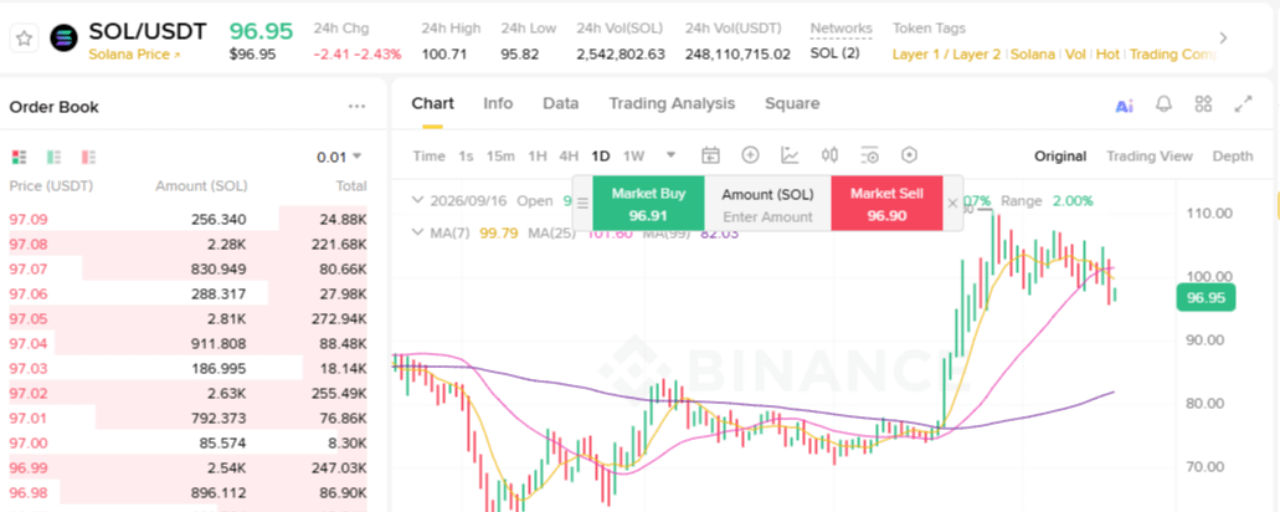
Traders en $SOL : l’une des plus grandes expériences de paiement en crypto se déploie discrètement sur Solana.Visa a élargi ses capacités de règlement en stablecoins pour inclure Solana, permettant aux partenaires participant à l’écosystème d’envoyer ou de recevoir des paiements de règlement en USDC via le réseau.
L’attrait de Solana pour les paiements est simple : un débit élevé, des coûts de transaction faibles et un règlement rapide le rendent adapté aux applications où le transfert efficace de stablecoins est essentiel.
Les stablecoins deviennent de plus en plus une infrastructure plutôt que de simples actifs que les traders détiennent entre leurs positions.
POURQUOI C’EST IMPORTANT
Le récit plus vaste $SOL pourrait ne pas se limiter aux memecoins.
Traders en $SOL : l’une des plus grandes expériences de paiement en crypto se déploie discrètement sur Solana.
Visa a élargi ses capacités de règlement en stablecoins pour inclure Solana, permettant aux partenaires participant à l’écosystème d’envoyer ou de recevoir des paiements de règlement en USDC via le réseau.
L’attrait de Solana pour les paiements est simple : un débit élevé, des coûts de transaction faibles et un règlement rapide le rendent adapté aux applications où le transfert efficace de stablecoins est essentiel.
Les stablecoins deviennent de plus en plus une infrastructure plutôt que de simples actifs que les traders détiennent entre leurs positions.
POURQUOI C’EST IMPORTANT
Le récit plus vaste $SOL pourrait ne pas se limiter aux memecoins.
L’attrait de Solana pour les paiements est simple : un débit élevé, des coûts de transaction faibles et un règlement rapide le rendent adapté aux applications où le transfert efficace de stablecoins est essentiel.
Les stablecoins deviennent de plus en plus une infrastructure plutôt que de simples actifs que les traders détiennent entre leurs positions.
POURQUOI C’EST IMPORTANT
Le récit plus vaste $SOL pourrait ne pas se limiter aux memecoins.
10

·
--
💫⭐ Une tendance qui se démarque en 2026💥
{future}(STABLEUSDT)
$STABLE sortent de plus en plus du trading de crypto.
Ils sont de plus en plus utilisés pour des paiements, des transferts et une finance numérique du quotidien.
📌$BNB Chain⛓️💥 joue un rôle majeur dans cette tendance : elle traite environ 10 M de transactions en stablecoins chaque jour, selon Binance Research.
Et la tendance s’étend aussi à la finance traditionnelle — 21 grandes institutions financières ont annoncé des projets pour un stablecoin adossé au dollar américain, ciblé pour 2027.
$STABLE → D’outil de trading à infrastructure de paiement. 🌍💰
#Stablecoins #BNBChain #BinanceVietnamSquare #Crypto #Web3Revolution
💫⭐ Une tendance qui se démarque en 2026💥
$STABLE sortent de plus en plus du trading de crypto.
Ils sont de plus en plus utilisés pour des paiements, des transferts et une finance numérique du quotidien.
📌$BNB Chain⛓️💥 joue un rôle majeur dans cette tendance : elle traite environ 10 M de transactions en stablecoins chaque jour, selon Binance Research.
Et la tendance s’étend aussi à la finance traditionnelle — 21 grandes institutions financières ont annoncé des projets pour un stablecoin adossé au dollar américain, ciblé pour 2027.
$STABLE → D’outil de trading à infrastructure de paiement. 🌍💰
#Stablecoins #BNBChain #BinanceVietnamSquare #Crypto #Web3Revolution
$STABLE sortent de plus en plus du trading de crypto.
Ils sont de plus en plus utilisés pour des paiements, des transferts et une finance numérique du quotidien.
📌$BNB Chain⛓️💥 joue un rôle majeur dans cette tendance : elle traite environ 10 M de transactions en stablecoins chaque jour, selon Binance Research.
Et la tendance s’étend aussi à la finance traditionnelle — 21 grandes institutions financières ont annoncé des projets pour un stablecoin adossé au dollar américain, ciblé pour 2027.
$STABLE → D’outil de trading à infrastructure de paiement. 🌍💰
#Stablecoins #BNBChain #BinanceVietnamSquare #Crypto #Web3Revolution

125
·
--
Le système bancaire de correspondance a été construit dans les années 1970. Il fait encore circuler la plus grande partie des 150 000 milliards de dollars de paiements B2B transfrontaliers annuels. À chaque étape de la chaîne, il faut compter 2 à 5 jours, ce qui prélève 1 à 3 % de frais, et introduit un risque de règlement à chaque banque intermédiaire.
Les stablecoins n’améliorent pas ce système. Ils le contournent entièrement.
Une entreprise à Lagos peut régler une facture de 2 M$ à un fournisseur à São Paulo en 4 secondes, pour moins d’un dollar. Aucun solde de compte Nostro-Vostro. Aucun échange de messages SWIFT MT103. Aucun établissement bancaire de correspondance qui prend une commission à chaque segment. Juste une transaction signée sur un registre public.
La loi GENIUS aux États-Unis et la MiCA en Europe n’ont pas créé cette capacité — elles l’ont validée. La différence aujourd’hui, c’est que les émetteurs de stablecoins régulés disposent d’un cadre de conformité qu de grandes entreprises peuvent réellement utiliser, sans incertitude juridique. C’est là l’essentiel.
Les chaînes qui capturent ce flux ne seront pas celles qui affichent le plus de TPS ou la communication marketing la plus bruyante. Ce seront celles qui disposent de la liquidité la plus profonde en stablecoins, des structures de frais les plus prévisibles et de la certitude de règlement que les directeurs financiers exigent avant de transférer leurs opérations de trésorerie sur la chaîne. $BNB $ETH and $SOL sont les bénéficiaires structurels de ce système de transport.
La question n’est pas de savoir si les stablecoins remplacent la banque de correspondance. C’est à quelle vitesse, et quelles chaînes capturent le flux.
#Stablecoins #CrossBorderPayments #CryptoAdoption #DeFi #BinanceSquare
Le système bancaire de correspondance a été construit dans les années 1970. Il fait encore circuler la plus grande partie des 150 000 milliards de dollars de paiements B2B transfrontaliers annuels. À chaque étape de la chaîne, il faut compter 2 à 5 jours, ce qui prélève 1 à 3 % de frais, et introduit un risque de règlement à chaque banque intermédiaire.
Les stablecoins n’améliorent pas ce système. Ils le contournent entièrement.
Une entreprise à Lagos peut régler une facture de 2 M$ à un fournisseur à São Paulo en 4 secondes, pour moins d’un dollar. Aucun solde de compte Nostro-Vostro. Aucun échange de messages SWIFT MT103. Aucun établissement bancaire de correspondance qui prend une commission à chaque segment. Juste une transaction signée sur un registre public.
La loi GENIUS aux États-Unis et la MiCA en Europe n’ont pas créé cette capacité — elles l’ont validée. La différence aujourd’hui, c’est que les émetteurs de stablecoins régulés disposent d’un cadre de conformité qu de grandes entreprises peuvent réellement utiliser, sans incertitude juridique. C’est là l’essentiel.
Les chaînes qui capturent ce flux ne seront pas celles qui affichent le plus de TPS ou la communication marketing la plus bruyante. Ce seront celles qui disposent de la liquidité la plus profonde en stablecoins, des structures de frais les plus prévisibles et de la certitude de règlement que les directeurs financiers exigent avant de transférer leurs opérations de trésorerie sur la chaîne. $BNB $ETH and $SOL sont les bénéficiaires structurels de ce système de transport.
La question n’est pas de savoir si les stablecoins remplacent la banque de correspondance. C’est à quelle vitesse, et quelles chaînes capturent le flux.
#Stablecoins #CrossBorderPayments #CryptoAdoption #DeFi #BinanceSquare
Les stablecoins n’améliorent pas ce système. Ils le contournent entièrement.
Une entreprise à Lagos peut régler une facture de 2 M$ à un fournisseur à São Paulo en 4 secondes, pour moins d’un dollar. Aucun solde de compte Nostro-Vostro. Aucun échange de messages SWIFT MT103. Aucun établissement bancaire de correspondance qui prend une commission à chaque segment. Juste une transaction signée sur un registre public.
La loi GENIUS aux États-Unis et la MiCA en Europe n’ont pas créé cette capacité — elles l’ont validée. La différence aujourd’hui, c’est que les émetteurs de stablecoins régulés disposent d’un cadre de conformité qu de grandes entreprises peuvent réellement utiliser, sans incertitude juridique. C’est là l’essentiel.
Les chaînes qui capturent ce flux ne seront pas celles qui affichent le plus de TPS ou la communication marketing la plus bruyante. Ce seront celles qui disposent de la liquidité la plus profonde en stablecoins, des structures de frais les plus prévisibles et de la certitude de règlement que les directeurs financiers exigent avant de transférer leurs opérations de trésorerie sur la chaîne. $BNB $ETH and $SOL sont les bénéficiaires structurels de ce système de transport.
La question n’est pas de savoir si les stablecoins remplacent la banque de correspondance. C’est à quelle vitesse, et quelles chaînes capturent le flux.
#Stablecoins #CrossBorderPayments #CryptoAdoption #DeFi #BinanceSquare
87

🦈 $STABLE INFRA JUST GOT $20M FUEL — CROSS-BORDER SETTLEMENT IS THE REAL BREAKOUT
Fin.com sort de l’ombre avec 20 M$ : ce n’est pas qu’un titre de levée de fonds — c’est une intention sur la couche “plomberie” qui permet aux stablecoins, aux comptes en USD, à Swift et aux réseaux locaux de fonctionner enfin comme une seule machine. 📊
Quand l’infrastructure de paiement est orchestrée, le volume suit. Cela signifie davantage de demande de règlement on-chain, davantage de circulation de stablecoins, et davantage de raisons pour que le capital traite les rails crypto comme une finance mondiale sérieuse. 💡 Le marché anticipe souvent l’utilité avant que le cycle du token ne rattrape.
Vous suivez l’infrastructure des stablecoins comme prochain grand récit, ou attendez-vous que le grand public s’éveille ? 👇
⚠️ Ceci n’est pas un conseil financier. Gérez toujours votre risque. 🛡️
🏷️ #STABLE #Stablecoins #PaymentRails #Crypto
⚡
🦈 $STABLE INFRA JUST GOT $20M FUEL — CROSS-BORDER SETTLEMENT IS THE REAL BREAKOUT
Fin.com sort de l’ombre avec 20 M$ : ce n’est pas qu’un titre de levée de fonds — c’est une intention sur la couche “plomberie” qui permet aux stablecoins, aux comptes en USD, à Swift et aux réseaux locaux de fonctionner enfin comme une seule machine. 📊
Quand l’infrastructure de paiement est orchestrée, le volume suit. Cela signifie davantage de demande de règlement on-chain, davantage de circulation de stablecoins, et davantage de raisons pour que le capital traite les rails crypto comme une finance mondiale sérieuse. 💡 Le marché anticipe souvent l’utilité avant que le cycle du token ne rattrape.
Vous suivez l’infrastructure des stablecoins comme prochain grand récit, ou attendez-vous que le grand public s’éveille ? 👇
⚠️ Ceci n’est pas un conseil financier. Gérez toujours votre risque. 🛡️
🏷️ #STABLE #Stablecoins #PaymentRails #Crypto
⚡
Fin.com sort de l’ombre avec 20 M$ : ce n’est pas qu’un titre de levée de fonds — c’est une intention sur la couche “plomberie” qui permet aux stablecoins, aux comptes en USD, à Swift et aux réseaux locaux de fonctionner enfin comme une seule machine. 📊
Quand l’infrastructure de paiement est orchestrée, le volume suit. Cela signifie davantage de demande de règlement on-chain, davantage de circulation de stablecoins, et davantage de raisons pour que le capital traite les rails crypto comme une finance mondiale sérieuse. 💡 Le marché anticipe souvent l’utilité avant que le cycle du token ne rattrape.
Vous suivez l’infrastructure des stablecoins comme prochain grand récit, ou attendez-vous que le grand public s’éveille ? 👇
⚠️ Ceci n’est pas un conseil financier. Gérez toujours votre risque. 🛡️
🏷️ #STABLE #Stablecoins #PaymentRails #Crypto
⚡
42

·
--
🚨 USDC ATTEINT UN IMPORTANT CAP
$USDC a dépassé $100 trillions de volume cumulé de transactions on-chain, soulignant l’ampleur croissante de l’activité des stablecoins sur les réseaux blockchain.
Ce jalon reflète l’utilisation accrue de l’USDC pour les paiements, la liquidité et le règlement on-chain.
📊 Sentiment : 🟢 Bullish pour l’adoption des stablecoins
⚠️ Cela ne signifie pas automatiquement que l’ensemble du marché crypto va monter.
#USDC✅ #Stablecoins #CryptoNewss s #blockchain #defi
🚨 USDC ATTEINT UN IMPORTANT CAP
$USDC a dépassé $100 trillions de volume cumulé de transactions on-chain, soulignant l’ampleur croissante de l’activité des stablecoins sur les réseaux blockchain.
Ce jalon reflète l’utilisation accrue de l’USDC pour les paiements, la liquidité et le règlement on-chain.
📊 Sentiment : 🟢 Bullish pour l’adoption des stablecoins
⚠️ Cela ne signifie pas automatiquement que l’ensemble du marché crypto va monter.
#USDC✅ #Stablecoins #CryptoNewss s #blockchain #defi
$USDC a dépassé $100 trillions de volume cumulé de transactions on-chain, soulignant l’ampleur croissante de l’activité des stablecoins sur les réseaux blockchain.
Ce jalon reflète l’utilisation accrue de l’USDC pour les paiements, la liquidité et le règlement on-chain.
📊 Sentiment : 🟢 Bullish pour l’adoption des stablecoins
⚠️ Cela ne signifie pas automatiquement que l’ensemble du marché crypto va monter.
#USDC✅ #Stablecoins #CryptoNewss s #blockchain #defi
mansoor5450
·
--
L’USDC dépasse 100 000 milliards de dollars de volume cumulé de transactions en chaîne
$USDC a atteint un jalon majeur, avec un volume cumulatif de transactions en chaîne dépassant les 100 000 milliards de dollars. Cela met en évidence le rôle croissant des stablecoins adossés au dollar dans l’économie blockchain.
Cependant, ce chiffre a besoin de contexte. Le volume en chaîne ne signifie pas 100 000 milliards de dollars de nouvel argent entrés sur le marché crypto. Une part importante de cette activité peut provenir des opérations DeFi, de la gestion de liquidité, des transactions automatisées et des mouvements répétés des mêmes fonds.
L’activité transactionnelle croissante de l’USDC témoigne d’une demande accrue de liquidité en stablecoins et d’une infrastructure de règlement basée sur la blockchain dans l’ensemble de l’écosystème crypto.
Cependant, ce chiffre a besoin de contexte. Le volume en chaîne ne signifie pas 100 000 milliards de dollars de nouvel argent entrés sur le marché crypto. Une part importante de cette activité peut provenir des opérations DeFi, de la gestion de liquidité, des transactions automatisées et des mouvements répétés des mêmes fonds.
L’activité transactionnelle croissante de l’USDC témoigne d’une demande accrue de liquidité en stablecoins et d’une infrastructure de règlement basée sur la blockchain dans l’ensemble de l’écosystème crypto.

69
Connectez-vous pour découvrir plus de contenu
Rejoignez la communauté mondiale des adeptes de cryptomonnaies sur Binance Square
⚡️ Suviez les dernières informations importantes sur les cryptomonnaies.
💬 Jugé digne de confiance par la plus grande plateforme d’échange de cryptomonnaies au monde.
👍 Découvrez les connaissances que partagent les créateurs vérifiés.
Adresse e-mail/Nº de téléphone
Sujets d’actualité
1
#StellarActivatesProtocol28At211TPS
663 vues
58 mentions
2
#SECGrantsInnovationExemptionForTokenizedStocks
1,014 vues
83 mentions
3
#XRPGains3%AsRippleAddsMPPSupport
583 vues
63 mentions
4
#SPGlobalToAcquireOpenZeppelin
470 vues
49 mentions
5
#BitcoinSurpasses$77000
19,226 vues
234 mentions
6
#ParadigmDisclosesZECHolding
78,094 vues
1,154 mentions
7
#BitcoinETFsShed$450M
27,626 vues
221 mentions
8
#USWeeklyJoblessClaimsFallTo196K
43,349 vues
659 mentions
9
#ArkhamSaysBlackRockBuys$1.5BInETH
7,397 vues
74 mentions
10
#ElSalvadorBTCHoldingsRiseTo7777
74,102 vues
915 mentions