
倔犟的小土豆
713 Posts

倔犟的小土豆
Report
Block User
希望有一天我也会变得很优秀!
60 Following
4.2K+ Followers
491 Liked
Posts
All
Quotes
Live
PINNED
·
--
After reading the Vault permissions documentation for TermMax, I found the phrase “passively earn fixed yield” should bold not “fixed yield,” but “who is actually doing the work for you.”
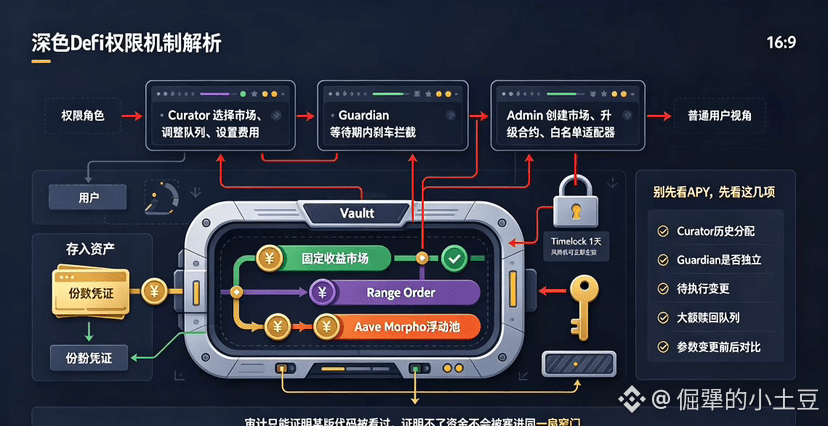
Vault itself follows the ERC-4626 standard: users deposit assets and receive shares. The Curator selects markets, builds Range Orders, manages the capital queues, and sets the pricing curve. Idle funds can also be deployed into floating pools like Aave and Morpho. For ordinary users, it’s convenient—complex term management is packaged into a single entry. This kind of productization is indeed smoother than moving through markets and doing manual “brick-laying” yourself, one by one.
But “less work” doesn’t mean “less trust.” The Curator can determine where capital flows, and can also submit updates such as market whitelists, performance fees, and timelock adjustments. The Guardian can revoke changes that increase risk during the waiting period. The default waiting period is 1 day, while risk-reducing actions can take effect immediately. This design is like having a person sitting next to the fund manager with a brake pedal—yet the steering wheel is still not in the depositor’s hands.
One layer up, the protocol also has roles like DEFAULT_ADMIN, PAUSER, CONFIGURATOR, and more: creating markets, upgrading contracts, whitelisting adapter adjustments, and updating certain configurations. The oracle is more sensitive—price update sources have their own waiting mechanisms and backup sources. The official publication of permissions and the multisig entry points is a definite plus. But publicizing permissions doesn’t mean permissions vanish—it just tells you which wall the keys are mounted on.
So when evaluating Vault, I don’t look at the page APY first. I look at the Curator’s historical allocations, whether the Guardian is independent, and whether pending changes can be understood by ordinary users. Then I look at how the queue is arranged during large redemptions. Ideally, there should also be a before-and-after comparison table for every parameter change. Audits can only prove that a particular version of code was reviewed; they can’t prove the manager won’t shove liquidity through the same narrow door.
What TermMax is truly trying to sell isn’t “saving you clicks.” It’s “making judgments on your behalf while keeping the power constrained.” The first half already exists as a product feature—the second half depends on long-term on-chain records, not on the names of roles.
#termmax @TermMax
After reading the Vault permissions documentation for TermMax, I found the phrase “passively earn fixed yield” should bold not “fixed yield,” but “who is actually doing the work for you.”
Vault itself follows the ERC-4626 standard: users deposit assets and receive shares. The Curator selects markets, builds Range Orders, manages the capital queues, and sets the pricing curve. Idle funds can also be deployed into floating pools like Aave and Morpho. For ordinary users, it’s convenient—complex term management is packaged into a single entry. This kind of productization is indeed smoother than moving through markets and doing manual “brick-laying” yourself, one by one.
But “less work” doesn’t mean “less trust.” The Curator can determine where capital flows, and can also submit updates such as market whitelists, performance fees, and timelock adjustments. The Guardian can revoke changes that increase risk during the waiting period. The default waiting period is 1 day, while risk-reducing actions can take effect immediately. This design is like having a person sitting next to the fund manager with a brake pedal—yet the steering wheel is still not in the depositor’s hands.
One layer up, the protocol also has roles like DEFAULT_ADMIN, PAUSER, CONFIGURATOR, and more: creating markets, upgrading contracts, whitelisting adapter adjustments, and updating certain configurations. The oracle is more sensitive—price update sources have their own waiting mechanisms and backup sources. The official publication of permissions and the multisig entry points is a definite plus. But publicizing permissions doesn’t mean permissions vanish—it just tells you which wall the keys are mounted on.
So when evaluating Vault, I don’t look at the page APY first. I look at the Curator’s historical allocations, whether the Guardian is independent, and whether pending changes can be understood by ordinary users. Then I look at how the queue is arranged during large redemptions. Ideally, there should also be a before-and-after comparison table for every parameter change. Audits can only prove that a particular version of code was reviewed; they can’t prove the manager won’t shove liquidity through the same narrow door.
What TermMax is truly trying to sell isn’t “saving you clicks.” It’s “making judgments on your behalf while keeping the power constrained.” The first half already exists as a product feature—the second half depends on long-term on-chain records, not on the names of roles.
#termmax @TermMax
Vault itself follows the ERC-4626 standard: users deposit assets and receive shares. The Curator selects markets, builds Range Orders, manages the capital queues, and sets the pricing curve. Idle funds can also be deployed into floating pools like Aave and Morpho. For ordinary users, it’s convenient—complex term management is packaged into a single entry. This kind of productization is indeed smoother than moving through markets and doing manual “brick-laying” yourself, one by one.
But “less work” doesn’t mean “less trust.” The Curator can determine where capital flows, and can also submit updates such as market whitelists, performance fees, and timelock adjustments. The Guardian can revoke changes that increase risk during the waiting period. The default waiting period is 1 day, while risk-reducing actions can take effect immediately. This design is like having a person sitting next to the fund manager with a brake pedal—yet the steering wheel is still not in the depositor’s hands.
One layer up, the protocol also has roles like DEFAULT_ADMIN, PAUSER, CONFIGURATOR, and more: creating markets, upgrading contracts, whitelisting adapter adjustments, and updating certain configurations. The oracle is more sensitive—price update sources have their own waiting mechanisms and backup sources. The official publication of permissions and the multisig entry points is a definite plus. But publicizing permissions doesn’t mean permissions vanish—it just tells you which wall the keys are mounted on.
So when evaluating Vault, I don’t look at the page APY first. I look at the Curator’s historical allocations, whether the Guardian is independent, and whether pending changes can be understood by ordinary users. Then I look at how the queue is arranged during large redemptions. Ideally, there should also be a before-and-after comparison table for every parameter change. Audits can only prove that a particular version of code was reviewed; they can’t prove the manager won’t shove liquidity through the same narrow door.
What TermMax is truly trying to sell isn’t “saving you clicks.” It’s “making judgments on your behalf while keeping the power constrained.” The first half already exists as a product feature—the second half depends on long-term on-chain records, not on the names of roles.
#termmax @TermMax
4
1
2
97
·
--
I was bored today, so I went and looked through Dusk’s ecosystem page.
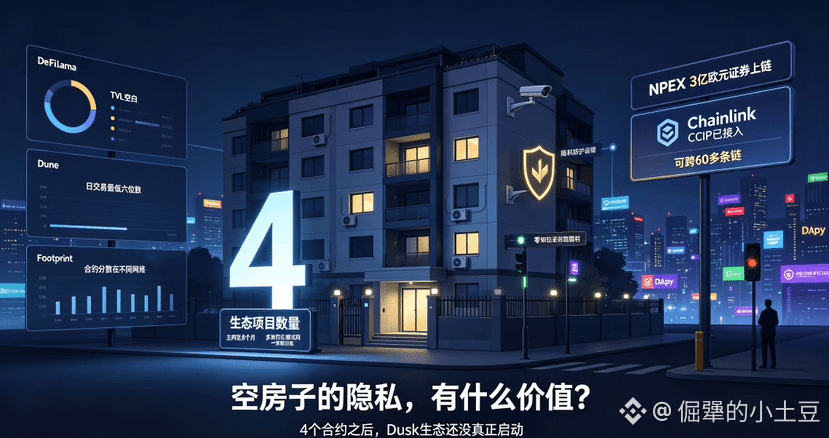
The official data page lists the projects in the ecosystem. I counted—there are 4. A Layer 1 that went live on the mainnet about 8 months ago, and its ecosystem has only 4 projects. I flipped through Dune, DeFiLlama, and Footprint—turns out they’re either blank, or those same 4 contracts keep showing up again and again. Those 4 contracts are spread across different networks, and most of them are still in testnet stage.
Compare that with other L1s that launched on the mainnet around the same time: their ecosystem projects usually number at least dozens or even hundreds. The DApp list is so long you can’t finish paging through it in three screens. With Dusk, you flip one page and it’s done.
Someone might say, “Dusk focuses on institutions, so it doesn’t need a lot of DApps.” But the number—4 contracts—can’t even be considered a “starting stage.” A chain without an ecosystem is like a luxury residential complex that no one lives in. You install the best door locks and the most expensive surveillance system, but what are you protecting—an empty house? What value does an empty house’s privacy have?
Then I checked the TVL data again. DeFiLlama shows TVL as blank, and daily transactions are only in the low six figures. NPEX’s collaboration is indeed Dusk’s biggest selling point—the promise of €300 million in tokenized securities sounds impressive. But one collaboration can’t support an entire chain. I browsed around in the community and, besides NPEX, I couldn’t find a second decent enterprise-level partnership. Also, “the size of existing assets” doesn’t equal “active on-chain settlement.” Analyses have pointed out that the gap between “numbers announced” and “what actually gets implemented” is extremely large.
In January 2026, Dusk and Chainlink fully connected CCIP. Theoretically, the NPEX security tokens issued on Dusk could be bridged to more than 60 chains. But if the infrastructure is set up and nobody uses it, it’s basically wasted effort.
If by the end of this year Dusk still has fewer than two digits of contracts, then I really won’t be able to keep pretending to myself. A privacy chain with no users has meaningless privacy—you need users first, before privacy even needs to be protected. Right now there isn’t even anyone, so privacy has turned into self-congratulation.
The current state of those 4 contracts makes it crystal clear to me that this ecosystem hasn’t truly started. Mainnet stability is only step one. Whether developers come, and whether they can stay—that’s the key. The value of a chain ultimately depends on what runs on it.
#dusk $DUSK @Dusk
I was bored today, so I went and looked through Dusk’s ecosystem page.
The official data page lists the projects in the ecosystem. I counted—there are 4. A Layer 1 that went live on the mainnet about 8 months ago, and its ecosystem has only 4 projects. I flipped through Dune, DeFiLlama, and Footprint—turns out they’re either blank, or those same 4 contracts keep showing up again and again. Those 4 contracts are spread across different networks, and most of them are still in testnet stage.
Compare that with other L1s that launched on the mainnet around the same time: their ecosystem projects usually number at least dozens or even hundreds. The DApp list is so long you can’t finish paging through it in three screens. With Dusk, you flip one page and it’s done.
Someone might say, “Dusk focuses on institutions, so it doesn’t need a lot of DApps.” But the number—4 contracts—can’t even be considered a “starting stage.” A chain without an ecosystem is like a luxury residential complex that no one lives in. You install the best door locks and the most expensive surveillance system, but what are you protecting—an empty house? What value does an empty house’s privacy have?
Then I checked the TVL data again. DeFiLlama shows TVL as blank, and daily transactions are only in the low six figures. NPEX’s collaboration is indeed Dusk’s biggest selling point—the promise of €300 million in tokenized securities sounds impressive. But one collaboration can’t support an entire chain. I browsed around in the community and, besides NPEX, I couldn’t find a second decent enterprise-level partnership. Also, “the size of existing assets” doesn’t equal “active on-chain settlement.” Analyses have pointed out that the gap between “numbers announced” and “what actually gets implemented” is extremely large.
In January 2026, Dusk and Chainlink fully connected CCIP. Theoretically, the NPEX security tokens issued on Dusk could be bridged to more than 60 chains. But if the infrastructure is set up and nobody uses it, it’s basically wasted effort.
If by the end of this year Dusk still has fewer than two digits of contracts, then I really won’t be able to keep pretending to myself. A privacy chain with no users has meaningless privacy—you need users first, before privacy even needs to be protected. Right now there isn’t even anyone, so privacy has turned into self-congratulation.
The current state of those 4 contracts makes it crystal clear to me that this ecosystem hasn’t truly started. Mainnet stability is only step one. Whether developers come, and whether they can stay—that’s the key. The value of a chain ultimately depends on what runs on it.
#dusk $DUSK @Dusk
The official data page lists the projects in the ecosystem. I counted—there are 4. A Layer 1 that went live on the mainnet about 8 months ago, and its ecosystem has only 4 projects. I flipped through Dune, DeFiLlama, and Footprint—turns out they’re either blank, or those same 4 contracts keep showing up again and again. Those 4 contracts are spread across different networks, and most of them are still in testnet stage.
Compare that with other L1s that launched on the mainnet around the same time: their ecosystem projects usually number at least dozens or even hundreds. The DApp list is so long you can’t finish paging through it in three screens. With Dusk, you flip one page and it’s done.
Someone might say, “Dusk focuses on institutions, so it doesn’t need a lot of DApps.” But the number—4 contracts—can’t even be considered a “starting stage.” A chain without an ecosystem is like a luxury residential complex that no one lives in. You install the best door locks and the most expensive surveillance system, but what are you protecting—an empty house? What value does an empty house’s privacy have?
Then I checked the TVL data again. DeFiLlama shows TVL as blank, and daily transactions are only in the low six figures. NPEX’s collaboration is indeed Dusk’s biggest selling point—the promise of €300 million in tokenized securities sounds impressive. But one collaboration can’t support an entire chain. I browsed around in the community and, besides NPEX, I couldn’t find a second decent enterprise-level partnership. Also, “the size of existing assets” doesn’t equal “active on-chain settlement.” Analyses have pointed out that the gap between “numbers announced” and “what actually gets implemented” is extremely large.
In January 2026, Dusk and Chainlink fully connected CCIP. Theoretically, the NPEX security tokens issued on Dusk could be bridged to more than 60 chains. But if the infrastructure is set up and nobody uses it, it’s basically wasted effort.
If by the end of this year Dusk still has fewer than two digits of contracts, then I really won’t be able to keep pretending to myself. A privacy chain with no users has meaningless privacy—you need users first, before privacy even needs to be protected. Right now there isn’t even anyone, so privacy has turned into self-congratulation.
The current state of those 4 contracts makes it crystal clear to me that this ecosystem hasn’t truly started. Mainnet stability is only step one. Whether developers come, and whether they can stay—that’s the key. The value of a chain ultimately depends on what runs on it.
#dusk $DUSK @Dusk
86
·
--
When it comes to the Dusk project, I’ve been watching it for quite a while.
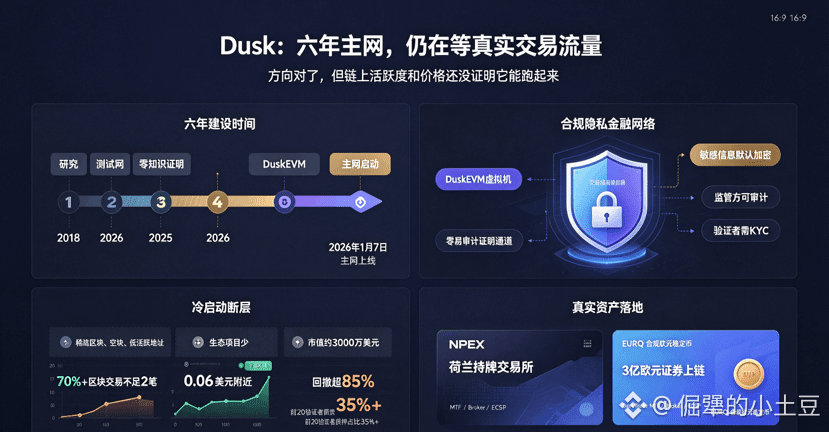
It started in 2018, and only went live on the mainnet in January this year—six years of grinding in between. Unlike the privacy projects on the market that “encrypt everything,” Dusk takes a different route: it stitches privacy and compliance together, specifically serving regulated financial scenarios. On January 7, 2026, the mainnet will officially launch, and DuskEVM will go live at the same time. It is fully compatible with Solidity. Developers migrating from Ethereum generally don’t need to change their code. The core component, Hedger, adds a privacy layer to EVM transactions using zero-knowledge proofs. Sensitive information is encrypted by default, but it keeps an auditable channel for regulators. Validators need to complete KYC—something many people criticize as “not decentralized enough.” But I think it’s an honest response to what finance is really about: real-world financial systems rely on clearly defined accountability chains, so if something goes wrong, you know who to call.
What truly makes it feel different is its execution. Dusk has an official partnership with the regulated Dutch exchange NPEX. On the NPEX platform, more than €300 million in securities assets are set to be moved onto the chain. DuskTrade obtained EU MTF, Broker, and ECSP licenses. Quantoz also issued a compliant euro stablecoin, EURQ, through Dusk. These are real assets running—not demos on a testnet.
But every coin has two sides. The mainnet has been live for almost eight months now, and there are only a few projects listed on the official ecosystem page. In over 70% of blocks, the number of transactions is fewer than two, and you often see consecutive empty blocks. In early August, the price hovered around $0.06, with a market cap of a little over $30 million. Compared with the peak earlier this year, it’s pulled back more than 85%. In June, Binance even delisted the DUSK/BTC trading pair. And the community is arguing, too—among 200 validators, the top 20 control more than 35% of the staked supply.
I recognize the technical direction: people have long struggled to find a balance between privacy and compliance, and Dusk has indeed found a spot where it can actually work. The NPEX partnership also shows that this logic isn’t just spinning wheels. But the price has already gone through a round of emotion-driven pumping. Whether it can be converted into sustained user growth and on-chain activity remains unclear right now. I’ll keep watching to see whether the €300 million assets on NPEX can truly generate ongoing trading flow, and whether genuinely useful applications will grow on DuskEVM. Until then, I’ll watch—no action.
#dusk $DUSK @Dusk
When it comes to the Dusk project, I’ve been watching it for quite a while.
It started in 2018, and only went live on the mainnet in January this year—six years of grinding in between. Unlike the privacy projects on the market that “encrypt everything,” Dusk takes a different route: it stitches privacy and compliance together, specifically serving regulated financial scenarios. On January 7, 2026, the mainnet will officially launch, and DuskEVM will go live at the same time. It is fully compatible with Solidity. Developers migrating from Ethereum generally don’t need to change their code. The core component, Hedger, adds a privacy layer to EVM transactions using zero-knowledge proofs. Sensitive information is encrypted by default, but it keeps an auditable channel for regulators. Validators need to complete KYC—something many people criticize as “not decentralized enough.” But I think it’s an honest response to what finance is really about: real-world financial systems rely on clearly defined accountability chains, so if something goes wrong, you know who to call.
What truly makes it feel different is its execution. Dusk has an official partnership with the regulated Dutch exchange NPEX. On the NPEX platform, more than €300 million in securities assets are set to be moved onto the chain. DuskTrade obtained EU MTF, Broker, and ECSP licenses. Quantoz also issued a compliant euro stablecoin, EURQ, through Dusk. These are real assets running—not demos on a testnet.
But every coin has two sides. The mainnet has been live for almost eight months now, and there are only a few projects listed on the official ecosystem page. In over 70% of blocks, the number of transactions is fewer than two, and you often see consecutive empty blocks. In early August, the price hovered around $0.06, with a market cap of a little over $30 million. Compared with the peak earlier this year, it’s pulled back more than 85%. In June, Binance even delisted the DUSK/BTC trading pair. And the community is arguing, too—among 200 validators, the top 20 control more than 35% of the staked supply.
I recognize the technical direction: people have long struggled to find a balance between privacy and compliance, and Dusk has indeed found a spot where it can actually work. The NPEX partnership also shows that this logic isn’t just spinning wheels. But the price has already gone through a round of emotion-driven pumping. Whether it can be converted into sustained user growth and on-chain activity remains unclear right now. I’ll keep watching to see whether the €300 million assets on NPEX can truly generate ongoing trading flow, and whether genuinely useful applications will grow on DuskEVM. Until then, I’ll watch—no action.
#dusk $DUSK @Dusk
It started in 2018, and only went live on the mainnet in January this year—six years of grinding in between. Unlike the privacy projects on the market that “encrypt everything,” Dusk takes a different route: it stitches privacy and compliance together, specifically serving regulated financial scenarios. On January 7, 2026, the mainnet will officially launch, and DuskEVM will go live at the same time. It is fully compatible with Solidity. Developers migrating from Ethereum generally don’t need to change their code. The core component, Hedger, adds a privacy layer to EVM transactions using zero-knowledge proofs. Sensitive information is encrypted by default, but it keeps an auditable channel for regulators. Validators need to complete KYC—something many people criticize as “not decentralized enough.” But I think it’s an honest response to what finance is really about: real-world financial systems rely on clearly defined accountability chains, so if something goes wrong, you know who to call.
What truly makes it feel different is its execution. Dusk has an official partnership with the regulated Dutch exchange NPEX. On the NPEX platform, more than €300 million in securities assets are set to be moved onto the chain. DuskTrade obtained EU MTF, Broker, and ECSP licenses. Quantoz also issued a compliant euro stablecoin, EURQ, through Dusk. These are real assets running—not demos on a testnet.
But every coin has two sides. The mainnet has been live for almost eight months now, and there are only a few projects listed on the official ecosystem page. In over 70% of blocks, the number of transactions is fewer than two, and you often see consecutive empty blocks. In early August, the price hovered around $0.06, with a market cap of a little over $30 million. Compared with the peak earlier this year, it’s pulled back more than 85%. In June, Binance even delisted the DUSK/BTC trading pair. And the community is arguing, too—among 200 validators, the top 20 control more than 35% of the staked supply.
I recognize the technical direction: people have long struggled to find a balance between privacy and compliance, and Dusk has indeed found a spot where it can actually work. The NPEX partnership also shows that this logic isn’t just spinning wheels. But the price has already gone through a round of emotion-driven pumping. Whether it can be converted into sustained user growth and on-chain activity remains unclear right now. I’ll keep watching to see whether the €300 million assets on NPEX can truly generate ongoing trading flow, and whether genuinely useful applications will grow on DuskEVM. Until then, I’ll watch—no action.
#dusk $DUSK @Dusk
115
·
--
Hyperstaking, at first glance, really does sound quite appealing.
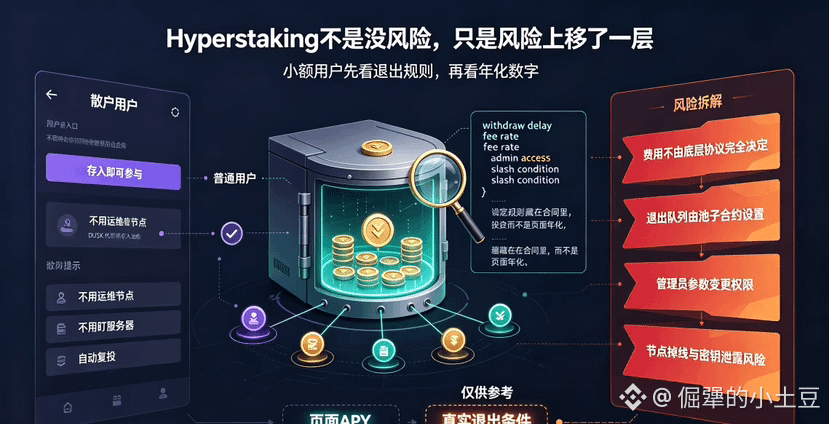
Even retail users who don’t run nodes can take part in staking. The Dusk Stake Abstraction documentation lays it out clearly: smart contracts handle everything for you—collecting your funds, staking them, and even re-staking (reinvesting) them—so small users don’t need to watch server uptime, and you don’t have to worry about penalties. The barrier has dropped from “you have to do your own operations” to “just deposit and you’re done.”
But the underlying risks haven’t disappeared—they’ve just been layered over.
The pool contract has its own rules—how fees are collected, when rewards are distributed, how long withdrawals must wait, whether administrators can change parameters—and these are no longer determined by Dusk’s underlying layer. Even if the protocol itself has no withdrawal waiting period, the pool can still set its own queue. In other words, your freedom to exit depends on what the pool’s contract code includes, not on what Dusk wrote.
There’s another issue that’s easy to overlook: the pool’s revenue source is, in essence, still one or several real nodes. Risks like node downtime, key leaks, or problems with contract callbacks don’t vanish just because the pool is managing it for you. It only shifts the risks from one place to another—from being carried by you alone to being shared by a group.
The annualized difference of one or two percentage points on a page may matter far less than the pool’s withdrawal conditions and the design of its permissions.
I’m not against staking pools. Without them, small users simply wouldn’t participate in network security. But “not having to run your own node” and “not having to worry about who is running the node” are two different things. Once the pools on Dusk publish contract audits, administrator permissions, fee formulas, and withdrawal processes, I’ll look again at the numbers. Until then, when I see which pool has the highest annualized figure, I’ll actually pay closer attention to whether there are any limitations hidden in its contract that I might not have noticed.
With $DUSK Hyperstaking, what you shouldn’t look at first isn’t which pool’s number is highest—it’s which one has written the risks and the exit process more clearly.
#dusk $DUSK @Dusk
Hyperstaking, at first glance, really does sound quite appealing.
Even retail users who don’t run nodes can take part in staking. The Dusk Stake Abstraction documentation lays it out clearly: smart contracts handle everything for you—collecting your funds, staking them, and even re-staking (reinvesting) them—so small users don’t need to watch server uptime, and you don’t have to worry about penalties. The barrier has dropped from “you have to do your own operations” to “just deposit and you’re done.”
But the underlying risks haven’t disappeared—they’ve just been layered over.
The pool contract has its own rules—how fees are collected, when rewards are distributed, how long withdrawals must wait, whether administrators can change parameters—and these are no longer determined by Dusk’s underlying layer. Even if the protocol itself has no withdrawal waiting period, the pool can still set its own queue. In other words, your freedom to exit depends on what the pool’s contract code includes, not on what Dusk wrote.
There’s another issue that’s easy to overlook: the pool’s revenue source is, in essence, still one or several real nodes. Risks like node downtime, key leaks, or problems with contract callbacks don’t vanish just because the pool is managing it for you. It only shifts the risks from one place to another—from being carried by you alone to being shared by a group.
The annualized difference of one or two percentage points on a page may matter far less than the pool’s withdrawal conditions and the design of its permissions.
I’m not against staking pools. Without them, small users simply wouldn’t participate in network security. But “not having to run your own node” and “not having to worry about who is running the node” are two different things. Once the pools on Dusk publish contract audits, administrator permissions, fee formulas, and withdrawal processes, I’ll look again at the numbers. Until then, when I see which pool has the highest annualized figure, I’ll actually pay closer attention to whether there are any limitations hidden in its contract that I might not have noticed.
With $DUSK Hyperstaking, what you shouldn’t look at first isn’t which pool’s number is highest—it’s which one has written the risks and the exit process more clearly.
#dusk $DUSK @Dusk
Even retail users who don’t run nodes can take part in staking. The Dusk Stake Abstraction documentation lays it out clearly: smart contracts handle everything for you—collecting your funds, staking them, and even re-staking (reinvesting) them—so small users don’t need to watch server uptime, and you don’t have to worry about penalties. The barrier has dropped from “you have to do your own operations” to “just deposit and you’re done.”
But the underlying risks haven’t disappeared—they’ve just been layered over.
The pool contract has its own rules—how fees are collected, when rewards are distributed, how long withdrawals must wait, whether administrators can change parameters—and these are no longer determined by Dusk’s underlying layer. Even if the protocol itself has no withdrawal waiting period, the pool can still set its own queue. In other words, your freedom to exit depends on what the pool’s contract code includes, not on what Dusk wrote.
There’s another issue that’s easy to overlook: the pool’s revenue source is, in essence, still one or several real nodes. Risks like node downtime, key leaks, or problems with contract callbacks don’t vanish just because the pool is managing it for you. It only shifts the risks from one place to another—from being carried by you alone to being shared by a group.
The annualized difference of one or two percentage points on a page may matter far less than the pool’s withdrawal conditions and the design of its permissions.
I’m not against staking pools. Without them, small users simply wouldn’t participate in network security. But “not having to run your own node” and “not having to worry about who is running the node” are two different things. Once the pools on Dusk publish contract audits, administrator permissions, fee formulas, and withdrawal processes, I’ll look again at the numbers. Until then, when I see which pool has the highest annualized figure, I’ll actually pay closer attention to whether there are any limitations hidden in its contract that I might not have noticed.
With $DUSK Hyperstaking, what you shouldn’t look at first isn’t which pool’s number is highest—it’s which one has written the risks and the exit process more clearly.
#dusk $DUSK @Dusk
115
·
--
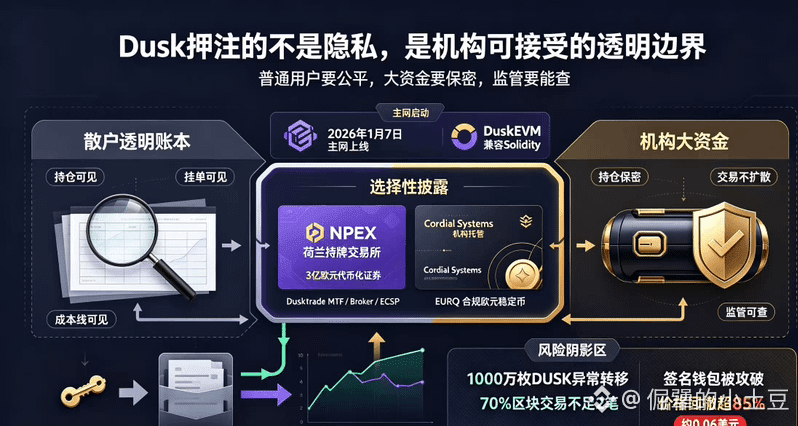
On-chain transparency is retail traders’ benefit, but an institution’s nightmare. Positions, open orders, and cost lines are all exposed—fair to ordinary people, torture for large capital. What Dusk is targeting is this very contradiction. Unlike those privacy projects that say “encrypt everything so nobody can see,” Dusk adopts “selective disclosure”—your everyday trades can’t be seen by others, but when regulators need to investigate, there’s a path for them to do so. It bets that institutions will enter the market in the future, but institutions can’t accept a completely transparent ledger.
On January 7, 2026, the mainnet officially goes live. DuskEVM launches in sync, fully compatible with Solidity, so developers migrating from Ethereum basically don’t need to change code. What truly made me feel it’s different is execution. Dusk has an official partnership with the Dutch licensed exchange NPEX—more than €300 million in tokenized securities have already been issued and traded on-chain. DuskTrade positions itself as a new type of broker, pushing traditional securities buying/selling, screening, and settlement entirely onto the chain, and it also holds EU MTF, Broker, and ECSP licenses. Cordial Systems solves the private key management problem that institutions find most troublesome. Quantoz has also issued a compliant euro stablecoin, EURQ, via Dusk. These are real assets running—not PPT.
But every coin has two sides. In the security incident on January 16, the attacker obtained bridge-signer wallet permissions, and more than 10 million DUSK were transferred out. Afterward, the team implemented architectural isolation between signing and incident handling. On-chain real trading volume is still not high: in over 70% of blocks, the number of transactions is fewer than 2. The price has retraced more than 85% from the early-year peak and is currently hovering around $0.06.
I get the direction—there’s always been no clear balance between privacy and compliance, and Dusk has indeed found a deployable position. But whether the technical logic holds and whether the market accepts it are two different things. Whether bringing assets on-chain can generate sustained trading flow—that’s the real test.
The above is my personal observation and does not constitute investment advice.
#dusk $DUSK @Dusk
On-chain transparency is retail traders’ benefit, but an institution’s nightmare. Positions, open orders, and cost lines are all exposed—fair to ordinary people, torture for large capital. What Dusk is targeting is this very contradiction. Unlike those privacy projects that say “encrypt everything so nobody can see,” Dusk adopts “selective disclosure”—your everyday trades can’t be seen by others, but when regulators need to investigate, there’s a path for them to do so. It bets that institutions will enter the market in the future, but institutions can’t accept a completely transparent ledger.
On January 7, 2026, the mainnet officially goes live. DuskEVM launches in sync, fully compatible with Solidity, so developers migrating from Ethereum basically don’t need to change code. What truly made me feel it’s different is execution. Dusk has an official partnership with the Dutch licensed exchange NPEX—more than €300 million in tokenized securities have already been issued and traded on-chain. DuskTrade positions itself as a new type of broker, pushing traditional securities buying/selling, screening, and settlement entirely onto the chain, and it also holds EU MTF, Broker, and ECSP licenses. Cordial Systems solves the private key management problem that institutions find most troublesome. Quantoz has also issued a compliant euro stablecoin, EURQ, via Dusk. These are real assets running—not PPT.
But every coin has two sides. In the security incident on January 16, the attacker obtained bridge-signer wallet permissions, and more than 10 million DUSK were transferred out. Afterward, the team implemented architectural isolation between signing and incident handling. On-chain real trading volume is still not high: in over 70% of blocks, the number of transactions is fewer than 2. The price has retraced more than 85% from the early-year peak and is currently hovering around $0.06.
I get the direction—there’s always been no clear balance between privacy and compliance, and Dusk has indeed found a deployable position. But whether the technical logic holds and whether the market accepts it are two different things. Whether bringing assets on-chain can generate sustained trading flow—that’s the real test.
The above is my personal observation and does not constitute investment advice.
#dusk $DUSK @Dusk
On January 7, 2026, the mainnet officially goes live. DuskEVM launches in sync, fully compatible with Solidity, so developers migrating from Ethereum basically don’t need to change code. What truly made me feel it’s different is execution. Dusk has an official partnership with the Dutch licensed exchange NPEX—more than €300 million in tokenized securities have already been issued and traded on-chain. DuskTrade positions itself as a new type of broker, pushing traditional securities buying/selling, screening, and settlement entirely onto the chain, and it also holds EU MTF, Broker, and ECSP licenses. Cordial Systems solves the private key management problem that institutions find most troublesome. Quantoz has also issued a compliant euro stablecoin, EURQ, via Dusk. These are real assets running—not PPT.
But every coin has two sides. In the security incident on January 16, the attacker obtained bridge-signer wallet permissions, and more than 10 million DUSK were transferred out. Afterward, the team implemented architectural isolation between signing and incident handling. On-chain real trading volume is still not high: in over 70% of blocks, the number of transactions is fewer than 2. The price has retraced more than 85% from the early-year peak and is currently hovering around $0.06.
I get the direction—there’s always been no clear balance between privacy and compliance, and Dusk has indeed found a deployable position. But whether the technical logic holds and whether the market accepts it are two different things. Whether bringing assets on-chain can generate sustained trading flow—that’s the real test.
The above is my personal observation and does not constitute investment advice.
#dusk $DUSK @Dusk
80
·
--
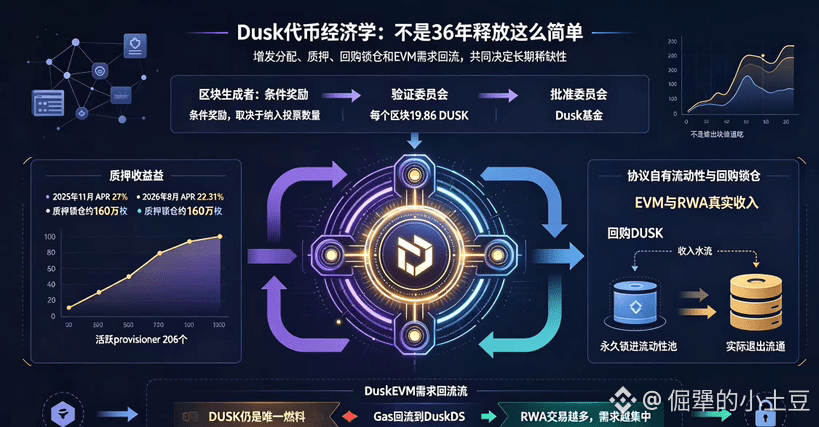
Let’s talk about Dusk’s tokenomics. What’s actually worth thinking through isn’t the “36-year release” label, but how block rewards are distributed.
Each block produces a fixed 19.86 DUSK. The number itself isn’t the point—the distribution ratio is. Most of the rewards go to the block producer, but note that some of it is conditional: it depends on how many votes you can incorporate as much as possible. In other words, you don’t get the full amount just by producing blocks—you have to do the work seriously.
The validation committee and the approval committee each take a portion, and the Dusk Foundation takes a portion too. This reward scheme splits incentives into three parts—those who do the work, those who confirm, and the protocol’s long-term reserves—rather than a simple “whoever produces blocks gets everything.”
Now let’s look at staking returns. As of November 2025, the APR is still around 27%, but by August 2026 it has dropped to 22.31%. About 1.6 million DUSK are locked in the staking pool, and there are 206 active provisioners. The decline in APR has two layers: first, more people have joined and are sharing the same pot; second, the network may be genuinely maturing. That early phase of “stake and earn 27% just for holding” is fading.
After DuskEVM goes live, there’s another easily overlooked detail: no separate Gas token is introduced. Many EVM-compatible chains issue a new Gas asset when they launch, but Dusk doesn’t. DUSK remains the only fuel, and the execution costs ultimately flow back to DuskDS. Any activity running on DuskEVM creates demand that funnels back to the same token—not splitting it into pieces.
The logic behind this design is quite clear. Inflationary incentives encourage early participation, but the issuance itself decays geometrically. At the same time, real income is used to buy back and lock tokens, counteracting the dilutive effect of inflation. Add to that the demand for capturing the entire ecosystem with the token—RWA asset issuance and trading increase the need for Gas and validation, which increases node staking rewards, which means more tokens are locked and less circulates.
Of course, whether this all truly works depends on whether DuskEVM can generate enough real transaction volume. If the chain has little actual usage, there’s nothing to buy back, and any deflationary effect is just a nice assumption. But at least from the design perspective, it isn’t a “just issue, never collect” kind of careless model.
#dusk $DUSK @Dusk
Let’s talk about Dusk’s tokenomics. What’s actually worth thinking through isn’t the “36-year release” label, but how block rewards are distributed.
Each block produces a fixed 19.86 DUSK. The number itself isn’t the point—the distribution ratio is. Most of the rewards go to the block producer, but note that some of it is conditional: it depends on how many votes you can incorporate as much as possible. In other words, you don’t get the full amount just by producing blocks—you have to do the work seriously.
The validation committee and the approval committee each take a portion, and the Dusk Foundation takes a portion too. This reward scheme splits incentives into three parts—those who do the work, those who confirm, and the protocol’s long-term reserves—rather than a simple “whoever produces blocks gets everything.”
Now let’s look at staking returns. As of November 2025, the APR is still around 27%, but by August 2026 it has dropped to 22.31%. About 1.6 million DUSK are locked in the staking pool, and there are 206 active provisioners. The decline in APR has two layers: first, more people have joined and are sharing the same pot; second, the network may be genuinely maturing. That early phase of “stake and earn 27% just for holding” is fading.
After DuskEVM goes live, there’s another easily overlooked detail: no separate Gas token is introduced. Many EVM-compatible chains issue a new Gas asset when they launch, but Dusk doesn’t. DUSK remains the only fuel, and the execution costs ultimately flow back to DuskDS. Any activity running on DuskEVM creates demand that funnels back to the same token—not splitting it into pieces.
The logic behind this design is quite clear. Inflationary incentives encourage early participation, but the issuance itself decays geometrically. At the same time, real income is used to buy back and lock tokens, counteracting the dilutive effect of inflation. Add to that the demand for capturing the entire ecosystem with the token—RWA asset issuance and trading increase the need for Gas and validation, which increases node staking rewards, which means more tokens are locked and less circulates.
Of course, whether this all truly works depends on whether DuskEVM can generate enough real transaction volume. If the chain has little actual usage, there’s nothing to buy back, and any deflationary effect is just a nice assumption. But at least from the design perspective, it isn’t a “just issue, never collect” kind of careless model.
#dusk $DUSK @Dusk
Each block produces a fixed 19.86 DUSK. The number itself isn’t the point—the distribution ratio is. Most of the rewards go to the block producer, but note that some of it is conditional: it depends on how many votes you can incorporate as much as possible. In other words, you don’t get the full amount just by producing blocks—you have to do the work seriously.
The validation committee and the approval committee each take a portion, and the Dusk Foundation takes a portion too. This reward scheme splits incentives into three parts—those who do the work, those who confirm, and the protocol’s long-term reserves—rather than a simple “whoever produces blocks gets everything.”
Now let’s look at staking returns. As of November 2025, the APR is still around 27%, but by August 2026 it has dropped to 22.31%. About 1.6 million DUSK are locked in the staking pool, and there are 206 active provisioners. The decline in APR has two layers: first, more people have joined and are sharing the same pot; second, the network may be genuinely maturing. That early phase of “stake and earn 27% just for holding” is fading.
After DuskEVM goes live, there’s another easily overlooked detail: no separate Gas token is introduced. Many EVM-compatible chains issue a new Gas asset when they launch, but Dusk doesn’t. DUSK remains the only fuel, and the execution costs ultimately flow back to DuskDS. Any activity running on DuskEVM creates demand that funnels back to the same token—not splitting it into pieces.
The logic behind this design is quite clear. Inflationary incentives encourage early participation, but the issuance itself decays geometrically. At the same time, real income is used to buy back and lock tokens, counteracting the dilutive effect of inflation. Add to that the demand for capturing the entire ecosystem with the token—RWA asset issuance and trading increase the need for Gas and validation, which increases node staking rewards, which means more tokens are locked and less circulates.
Of course, whether this all truly works depends on whether DuskEVM can generate enough real transaction volume. If the chain has little actual usage, there’s nothing to buy back, and any deflationary effect is just a nice assumption. But at least from the design perspective, it isn’t a “just issue, never collect” kind of careless model.
#dusk $DUSK @Dusk
1
111
·
--
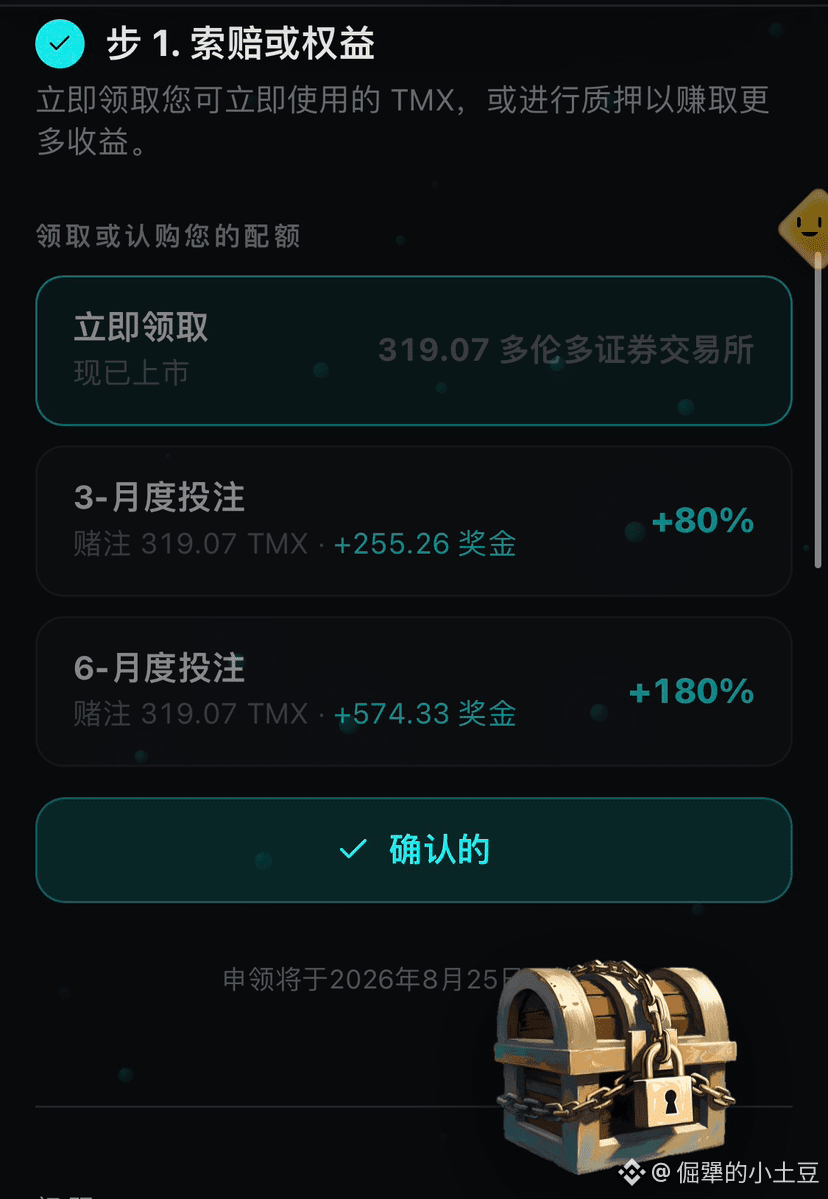
How many TMX airdrops did you guys claim for the 25th? Why do I see some people opening treasure chests and getting thousands of tokens? Am I just an owl? I slogged through daily check-ins for over a year and only got around three hundred coins—this is way too stingy. I heard the opening price is 0.15; if we wait until the time we can sell, wouldn’t it just be left with about 30U? Sure enough, there’s already no “hair” left on-chain…
Yesterday I was drinking with a friend and we talked about TermMax’s governance design. I thought it was pretty decent, but I didn’t expect the community to turn around and outvote us today. The whitepaper @termmax says that TMX holders can vote to adjust core parameters like interest rates, collateral eligibility, protocol upgrades, and so on. So why can’t we vote to participate in the airdrop allocation?
But then I thought of another issue: if a rule can be changed by voting, then is it really a rule? Maybe it still has its own principles.
In traditional finance, interest rates are set by the central bank—you just have to accept it. In DeFi, governance votes set the interest rate; it sounds more democratic. But in practice, the share of voting power held by big players is right there. Whatever they vote for will most likely align with their own interests. It’s not that they would do it—that’s not the problem. The problem is that they can do it, and they can do it legally. So the rules are supposedly set by everyone, but the people who set the rules happen to be the ones who can benefit the most from those rules.
I’m not saying this is definitely a bad design. Any governance system has similar structural issues—some are just hidden more deeply, and some are more obvious. TermMax gives governance power to TMX holders. That choice in itself isn’t a problem. But it naturally forms a loop incentive: you use governance to obtain more favorable rules; you earn more money from those rules; you use that money to buy more TMX; and then you have even more say in governance. This process can reinforce itself, and it doesn’t require any illegal actions.
I don’t have an answer. On one side there are the principles, and on the other there’s sticking it out for a year without getting the result I wanted—now I can only wait until it goes live and see whether there will be a surprise!
#termmax @TermMax
How many TMX airdrops did you guys claim for the 25th? Why do I see some people opening treasure chests and getting thousands of tokens? Am I just an owl? I slogged through daily check-ins for over a year and only got around three hundred coins—this is way too stingy. I heard the opening price is 0.15; if we wait until the time we can sell, wouldn’t it just be left with about 30U? Sure enough, there’s already no “hair” left on-chain…
Yesterday I was drinking with a friend and we talked about TermMax’s governance design. I thought it was pretty decent, but I didn’t expect the community to turn around and outvote us today. The whitepaper @TermMax says that TMX holders can vote to adjust core parameters like interest rates, collateral eligibility, protocol upgrades, and so on. So why can’t we vote to participate in the airdrop allocation?
But then I thought of another issue: if a rule can be changed by voting, then is it really a rule? Maybe it still has its own principles.
In traditional finance, interest rates are set by the central bank—you just have to accept it. In DeFi, governance votes set the interest rate; it sounds more democratic. But in practice, the share of voting power held by big players is right there. Whatever they vote for will most likely align with their own interests. It’s not that they would do it—that’s not the problem. The problem is that they can do it, and they can do it legally. So the rules are supposedly set by everyone, but the people who set the rules happen to be the ones who can benefit the most from those rules.
I’m not saying this is definitely a bad design. Any governance system has similar structural issues—some are just hidden more deeply, and some are more obvious. TermMax gives governance power to TMX holders. That choice in itself isn’t a problem. But it naturally forms a loop incentive: you use governance to obtain more favorable rules; you earn more money from those rules; you use that money to buy more TMX; and then you have even more say in governance. This process can reinforce itself, and it doesn’t require any illegal actions.
I don’t have an answer. On one side there are the principles, and on the other there’s sticking it out for a year without getting the result I wanted—now I can only wait until it goes live and see whether there will be a surprise!
#termmax @TermMax
Yesterday I was drinking with a friend and we talked about TermMax’s governance design. I thought it was pretty decent, but I didn’t expect the community to turn around and outvote us today. The whitepaper @TermMax says that TMX holders can vote to adjust core parameters like interest rates, collateral eligibility, protocol upgrades, and so on. So why can’t we vote to participate in the airdrop allocation?
But then I thought of another issue: if a rule can be changed by voting, then is it really a rule? Maybe it still has its own principles.
In traditional finance, interest rates are set by the central bank—you just have to accept it. In DeFi, governance votes set the interest rate; it sounds more democratic. But in practice, the share of voting power held by big players is right there. Whatever they vote for will most likely align with their own interests. It’s not that they would do it—that’s not the problem. The problem is that they can do it, and they can do it legally. So the rules are supposedly set by everyone, but the people who set the rules happen to be the ones who can benefit the most from those rules.
I’m not saying this is definitely a bad design. Any governance system has similar structural issues—some are just hidden more deeply, and some are more obvious. TermMax gives governance power to TMX holders. That choice in itself isn’t a problem. But it naturally forms a loop incentive: you use governance to obtain more favorable rules; you earn more money from those rules; you use that money to buy more TMX; and then you have even more say in governance. This process can reinforce itself, and it doesn’t require any illegal actions.
I don’t have an answer. On one side there are the principles, and on the other there’s sticking it out for a year without getting the result I wanted—now I can only wait until it goes live and see whether there will be a surprise!
#termmax @TermMax
3
1
249
·
--
To be honest, when I first started looking at Dusk, I also thought it was just a privacy coin.
I don’t really touch the privacy space. Monero and Zcash are old hands—their technical routes are quite mature. But the problem is—they’re too “pure.” Too pure for institutions to get involved. They can’t get over the compliance hurdle. No matter how good the technology is, it can only end up entertaining itself in small circles.
But Dusk is a bit different.
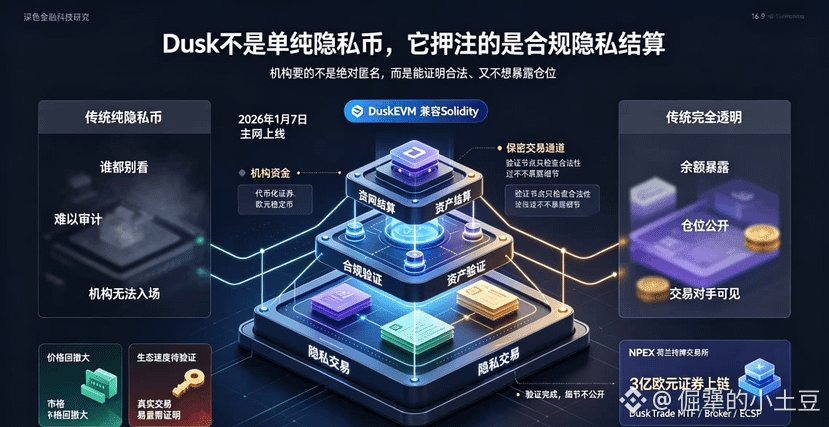
It doesn’t treat privacy as a feature added on. Instead, it welds three things—“privacy + compliance + settlement”—together from the very beginning. If any one of the three is missing, the system can’t work. Financial institutions need privacy, but not that kind of “nobody gets to see anything” privacy. They need to prove that a transaction is legitimate and meets regulatory requirements, but they don’t want balances, positions, and counterparties exposed to everyone.
That’s the contradiction Dusk solves—verification can be done, but the details don’t need to be made public.
On January 7, 2026, the mainnet goes live. DuskEVM launches and is compatible with Solidity, so developer migration costs are low. Its collaboration with the Dutch exchange NPEX has already been implemented; more than €300 million in securities assets have been issued and traded on-chain. DuskTrade has obtained EU MTF, Broker, and ECSP licenses. This is real-world assets running—not PPT.
But the price is indeed not strong. It has pulled back significantly from its early-year peak, and in the community, people have started questioning the speed of ecosystem development. Whether the technical logic holds and whether the market recognizes it are two different things.
What I truly care about is this: if, in the future, more regulated financial assets really come onto the chain, can Dusk become the settlement infrastructure they genuinely rely on? I won’t load up heavily before the data comes out, but I also won’t close my watchlist.
#dusk $DUSK @Dusk
To be honest, when I first started looking at Dusk, I also thought it was just a privacy coin.
I don’t really touch the privacy space. Monero and Zcash are old hands—their technical routes are quite mature. But the problem is—they’re too “pure.” Too pure for institutions to get involved. They can’t get over the compliance hurdle. No matter how good the technology is, it can only end up entertaining itself in small circles.
But Dusk is a bit different.
It doesn’t treat privacy as a feature added on. Instead, it welds three things—“privacy + compliance + settlement”—together from the very beginning. If any one of the three is missing, the system can’t work. Financial institutions need privacy, but not that kind of “nobody gets to see anything” privacy. They need to prove that a transaction is legitimate and meets regulatory requirements, but they don’t want balances, positions, and counterparties exposed to everyone.
That’s the contradiction Dusk solves—verification can be done, but the details don’t need to be made public.
On January 7, 2026, the mainnet goes live. DuskEVM launches and is compatible with Solidity, so developer migration costs are low. Its collaboration with the Dutch exchange NPEX has already been implemented; more than €300 million in securities assets have been issued and traded on-chain. DuskTrade has obtained EU MTF, Broker, and ECSP licenses. This is real-world assets running—not PPT.
But the price is indeed not strong. It has pulled back significantly from its early-year peak, and in the community, people have started questioning the speed of ecosystem development. Whether the technical logic holds and whether the market recognizes it are two different things.
What I truly care about is this: if, in the future, more regulated financial assets really come onto the chain, can Dusk become the settlement infrastructure they genuinely rely on? I won’t load up heavily before the data comes out, but I also won’t close my watchlist.
#dusk $DUSK @Dusk
I don’t really touch the privacy space. Monero and Zcash are old hands—their technical routes are quite mature. But the problem is—they’re too “pure.” Too pure for institutions to get involved. They can’t get over the compliance hurdle. No matter how good the technology is, it can only end up entertaining itself in small circles.
But Dusk is a bit different.
It doesn’t treat privacy as a feature added on. Instead, it welds three things—“privacy + compliance + settlement”—together from the very beginning. If any one of the three is missing, the system can’t work. Financial institutions need privacy, but not that kind of “nobody gets to see anything” privacy. They need to prove that a transaction is legitimate and meets regulatory requirements, but they don’t want balances, positions, and counterparties exposed to everyone.
That’s the contradiction Dusk solves—verification can be done, but the details don’t need to be made public.
On January 7, 2026, the mainnet goes live. DuskEVM launches and is compatible with Solidity, so developer migration costs are low. Its collaboration with the Dutch exchange NPEX has already been implemented; more than €300 million in securities assets have been issued and traded on-chain. DuskTrade has obtained EU MTF, Broker, and ECSP licenses. This is real-world assets running—not PPT.
But the price is indeed not strong. It has pulled back significantly from its early-year peak, and in the community, people have started questioning the speed of ecosystem development. Whether the technical logic holds and whether the market recognizes it are two different things.
What I truly care about is this: if, in the future, more regulated financial assets really come onto the chain, can Dusk become the settlement infrastructure they genuinely rely on? I won’t load up heavily before the data comes out, but I also won’t close my watchlist.
#dusk $DUSK @Dusk
99
·
--
When talking about the Dusk ecosystem, the line of Cordial Systems is rarely mentioned. But in an institution’s decision-making process, it may be the most front-loaded component.
For a regulated institution that wants to touch on-chain assets, the first question isn’t how much profit can be made—it’s who controls the private keys. A seed phrase stored in a browser extension simply can’t pass compliance review.
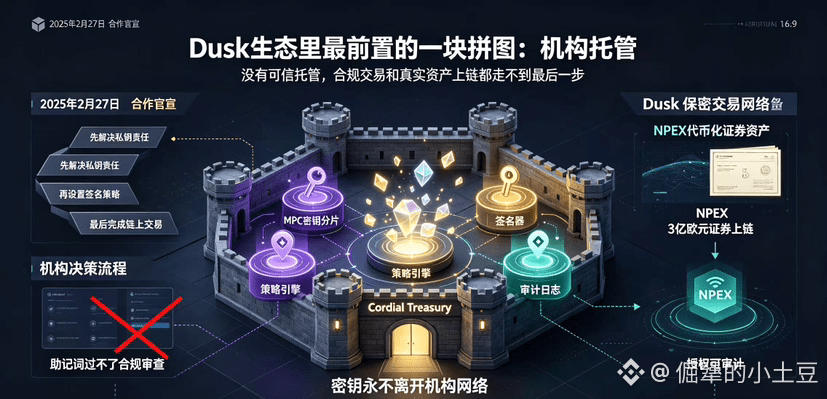
Cordial Systems is an enterprise self-custody software provider that uses a zero-trust security model. Its first product, Cordial Treasury, is an MPC wallet infrastructure that supports full self-deployment. Key sharding, signing flows, and audit logs are all in the institution’s own hands. If you don’t want to operate it yourself, you can also choose the managed cloud option, where the keys run in an AWS hardware-isolated environment.
Dusk and Cordial Systems announced their partnership on February 27, 2025. NPEX, a licensed securities exchange in the Netherlands (MTF), plans to move more than €300 million in securities assets onto the blockchain. NPEX chose to deploy Cordial Treasury within its own environment.
Cordial Treasury’s nodes include a strategy engine and a signer. The keys never leave the network. Once the configured amount threshold is reached, multiple parties must co-sign; transfers are limited to whitelisted addresses only; abnormal operations are automatically blocked and logged. In traditional systems, these rules are enforced through process and role constraints—on-chain, they must be written as code.
In combination with Dusk’s confidential transaction model, there’s also a not-so-obvious benefit: the custodian can complete operation approvals and recordkeeping without letting position information spread to a public ledger. Verifiers need to complete KYC. While it’s been criticized as “not decentralized enough,” this is—precisely—an honest response to the nature of finance. Real-world financial systems rely on a clear chain of responsibility: when something goes wrong, you know who to hold accountable.
That said, custodial risks are also very real. The more complex the solution, the bigger the surface area for mistakes. The key-recovery process for sharding, the service provider’s ongoing ability to operate, the scope of third-party audits and insurance coverage—any weak link can become a reason for an institution to refuse. The credibility of this kind of infrastructure is built over time.
I won’t treat custody as a valuation driver for DUSK, but if it’s missing, none of the compliance design work ahead can get to the final step. It’s a necessary condition, not a bonus.
#dusk $DUSK @Dusk
When talking about the Dusk ecosystem, the line of Cordial Systems is rarely mentioned. But in an institution’s decision-making process, it may be the most front-loaded component.
For a regulated institution that wants to touch on-chain assets, the first question isn’t how much profit can be made—it’s who controls the private keys. A seed phrase stored in a browser extension simply can’t pass compliance review.
Cordial Systems is an enterprise self-custody software provider that uses a zero-trust security model. Its first product, Cordial Treasury, is an MPC wallet infrastructure that supports full self-deployment. Key sharding, signing flows, and audit logs are all in the institution’s own hands. If you don’t want to operate it yourself, you can also choose the managed cloud option, where the keys run in an AWS hardware-isolated environment.
Dusk and Cordial Systems announced their partnership on February 27, 2025. NPEX, a licensed securities exchange in the Netherlands (MTF), plans to move more than €300 million in securities assets onto the blockchain. NPEX chose to deploy Cordial Treasury within its own environment.
Cordial Treasury’s nodes include a strategy engine and a signer. The keys never leave the network. Once the configured amount threshold is reached, multiple parties must co-sign; transfers are limited to whitelisted addresses only; abnormal operations are automatically blocked and logged. In traditional systems, these rules are enforced through process and role constraints—on-chain, they must be written as code.
In combination with Dusk’s confidential transaction model, there’s also a not-so-obvious benefit: the custodian can complete operation approvals and recordkeeping without letting position information spread to a public ledger. Verifiers need to complete KYC. While it’s been criticized as “not decentralized enough,” this is—precisely—an honest response to the nature of finance. Real-world financial systems rely on a clear chain of responsibility: when something goes wrong, you know who to hold accountable.
That said, custodial risks are also very real. The more complex the solution, the bigger the surface area for mistakes. The key-recovery process for sharding, the service provider’s ongoing ability to operate, the scope of third-party audits and insurance coverage—any weak link can become a reason for an institution to refuse. The credibility of this kind of infrastructure is built over time.
I won’t treat custody as a valuation driver for DUSK, but if it’s missing, none of the compliance design work ahead can get to the final step. It’s a necessary condition, not a bonus.
#dusk $DUSK @Dusk
For a regulated institution that wants to touch on-chain assets, the first question isn’t how much profit can be made—it’s who controls the private keys. A seed phrase stored in a browser extension simply can’t pass compliance review.
Cordial Systems is an enterprise self-custody software provider that uses a zero-trust security model. Its first product, Cordial Treasury, is an MPC wallet infrastructure that supports full self-deployment. Key sharding, signing flows, and audit logs are all in the institution’s own hands. If you don’t want to operate it yourself, you can also choose the managed cloud option, where the keys run in an AWS hardware-isolated environment.
Dusk and Cordial Systems announced their partnership on February 27, 2025. NPEX, a licensed securities exchange in the Netherlands (MTF), plans to move more than €300 million in securities assets onto the blockchain. NPEX chose to deploy Cordial Treasury within its own environment.
Cordial Treasury’s nodes include a strategy engine and a signer. The keys never leave the network. Once the configured amount threshold is reached, multiple parties must co-sign; transfers are limited to whitelisted addresses only; abnormal operations are automatically blocked and logged. In traditional systems, these rules are enforced through process and role constraints—on-chain, they must be written as code.
In combination with Dusk’s confidential transaction model, there’s also a not-so-obvious benefit: the custodian can complete operation approvals and recordkeeping without letting position information spread to a public ledger. Verifiers need to complete KYC. While it’s been criticized as “not decentralized enough,” this is—precisely—an honest response to the nature of finance. Real-world financial systems rely on a clear chain of responsibility: when something goes wrong, you know who to hold accountable.
That said, custodial risks are also very real. The more complex the solution, the bigger the surface area for mistakes. The key-recovery process for sharding, the service provider’s ongoing ability to operate, the scope of third-party audits and insurance coverage—any weak link can become a reason for an institution to refuse. The credibility of this kind of infrastructure is built over time.
I won’t treat custody as a valuation driver for DUSK, but if it’s missing, none of the compliance design work ahead can get to the final step. It’s a necessary condition, not a bonus.
#dusk $DUSK @Dusk
1
81
·
--
In traditional finance, custodians reuse customers’ securities for refinancing, keep the returns, and leave the risks with the customer—this is possible mainly because customers can only see a single total number on the statement, without knowing how much of it has already been pledged, how much is frozen, and how much remains free.
If the blockchain only shows one total balance, this problem doesn’t go away—it may even be hidden more deeply. Once internal ledgers are encrypted, customers have no way even to suspect it.
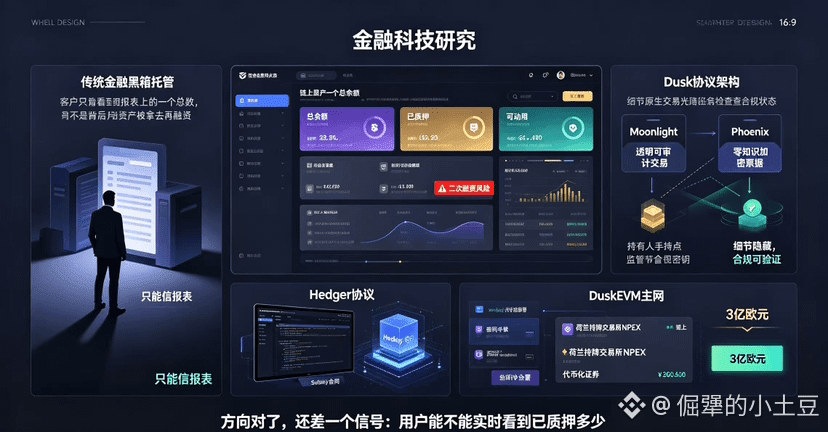
Dusk addresses this by separating “what can be hidden” from “what can be seen.” It created two native transaction models—Moonlight for transparent, auditable transactions, and Phoenix, which uses zero-knowledge proofs to encrypt balances and transfers into invisible “vouchers.” Ordinary transactions aren’t visible to others, but holders and regulators can selectively disclose the information they need by checking the keys. This isn’t an add-on feature; it was written into the protocol design since the project was founded in 2018.
The core value of this architecture is that it allows “restricted states” to be separated from “available balance.” An asset balance isn’t just about “how much,” but also includes things like “how much is pledged” and “what is the maximum that can be re-pledged.” If these fields are visible to the holder themselves, it becomes much harder for a middleman to secretly reuse the securities for secondary financing.
Dusk also built a protocol called Hedger, using zero-knowledge proofs plus homomorphic encryption: transaction details are hidden from the outside, but regulator nodes can verify compliance status at any time. After the DuskEVM mainnet goes live in January 2026, developers can directly deploy Solidity contracts. Its partnership with the Dutch-licensed exchange NPEX is already in place, with more than €300 million in tokenized securities moved on-chain.
My view is: the direction is right, but we still need a concrete signal—whether users can clearly see, in their wallet or on a block explorer, how much of their assets are already pledged and how much remains available to move. Until that signal appears, I will continue to observe. If asset status only shows “how much” there is, without “how much is already restricted,” then please treat re-pledging as something that could default to happening.
#dusk $DUSK @Dusk
In traditional finance, custodians reuse customers’ securities for refinancing, keep the returns, and leave the risks with the customer—this is possible mainly because customers can only see a single total number on the statement, without knowing how much of it has already been pledged, how much is frozen, and how much remains free.
If the blockchain only shows one total balance, this problem doesn’t go away—it may even be hidden more deeply. Once internal ledgers are encrypted, customers have no way even to suspect it.
Dusk addresses this by separating “what can be hidden” from “what can be seen.” It created two native transaction models—Moonlight for transparent, auditable transactions, and Phoenix, which uses zero-knowledge proofs to encrypt balances and transfers into invisible “vouchers.” Ordinary transactions aren’t visible to others, but holders and regulators can selectively disclose the information they need by checking the keys. This isn’t an add-on feature; it was written into the protocol design since the project was founded in 2018.
The core value of this architecture is that it allows “restricted states” to be separated from “available balance.” An asset balance isn’t just about “how much,” but also includes things like “how much is pledged” and “what is the maximum that can be re-pledged.” If these fields are visible to the holder themselves, it becomes much harder for a middleman to secretly reuse the securities for secondary financing.
Dusk also built a protocol called Hedger, using zero-knowledge proofs plus homomorphic encryption: transaction details are hidden from the outside, but regulator nodes can verify compliance status at any time. After the DuskEVM mainnet goes live in January 2026, developers can directly deploy Solidity contracts. Its partnership with the Dutch-licensed exchange NPEX is already in place, with more than €300 million in tokenized securities moved on-chain.
My view is: the direction is right, but we still need a concrete signal—whether users can clearly see, in their wallet or on a block explorer, how much of their assets are already pledged and how much remains available to move. Until that signal appears, I will continue to observe. If asset status only shows “how much” there is, without “how much is already restricted,” then please treat re-pledging as something that could default to happening.
#dusk $DUSK @Dusk
If the blockchain only shows one total balance, this problem doesn’t go away—it may even be hidden more deeply. Once internal ledgers are encrypted, customers have no way even to suspect it.
Dusk addresses this by separating “what can be hidden” from “what can be seen.” It created two native transaction models—Moonlight for transparent, auditable transactions, and Phoenix, which uses zero-knowledge proofs to encrypt balances and transfers into invisible “vouchers.” Ordinary transactions aren’t visible to others, but holders and regulators can selectively disclose the information they need by checking the keys. This isn’t an add-on feature; it was written into the protocol design since the project was founded in 2018.
The core value of this architecture is that it allows “restricted states” to be separated from “available balance.” An asset balance isn’t just about “how much,” but also includes things like “how much is pledged” and “what is the maximum that can be re-pledged.” If these fields are visible to the holder themselves, it becomes much harder for a middleman to secretly reuse the securities for secondary financing.
Dusk also built a protocol called Hedger, using zero-knowledge proofs plus homomorphic encryption: transaction details are hidden from the outside, but regulator nodes can verify compliance status at any time. After the DuskEVM mainnet goes live in January 2026, developers can directly deploy Solidity contracts. Its partnership with the Dutch-licensed exchange NPEX is already in place, with more than €300 million in tokenized securities moved on-chain.
My view is: the direction is right, but we still need a concrete signal—whether users can clearly see, in their wallet or on a block explorer, how much of their assets are already pledged and how much remains available to move. Until that signal appears, I will continue to observe. If asset status only shows “how much” there is, without “how much is already restricted,” then please treat re-pledging as something that could default to happening.
#dusk $DUSK @Dusk
3
86
·
--
When it comes to TermMax, my first reaction is: after all these years of DeFi, finally someone is seriously starting to fill the fixed-rate lending gap.
Last year I borrowed USDC on Aave. When I entered, the rate was a little over 4%, and when I repaid, it had climbed to more than 7%. You could say the interest is high, but it’s really just like that; what makes you uncomfortable is the feeling of “the numbers are calculated favorably when you borrow, but it’s completely different when it comes time to pay back.” Floating interest rates do have their benefits—flexibility and high capital utilization. But for people who truly need to plan their funds, that uncertainty itself becomes a cost.
What TermMax does is actually very straightforward—turn floating rates into fixed rates. The moment you enter, the interest rate is locked in, and you know exactly how much you’ll repay at maturity. Borrowers can calculate their financing cost in advance, and lenders can also know ahead of time how much they’ll earn at the end. In traditional finance, this is common sense, but in DeFi, there are only a handful of projects that can do it.
Its core mechanism is a three-token model. FT is like a zero-coupon bond: it’s bought at a discount and redeemed at face value at maturity, earning the spread. XT is an income token—1 FT plus 1 XT equals one debt token. GT is a leveraged position NFT, bundling collateral and debt together. It’s not the kind of overly complex design that’s hard to explain; more like splitting the same underlying concept into three tools, each serving different needs. There’s also an interesting design called the Range Order AMM: market makers can quote within specific interest-rate ranges, and users automatically match with the best rate.
The data definitely shows that people are willing to pay for “certainty.” Since the mainnet launched in April 2025, TVL has surpassed $100 million, registered wallets are over 1.5 million, and daily active users are over 90,000. On March 25, according to Token Terminal data, TermMax’s daily active addresses ranked second among DeFi lending protocols, behind Aave. It’s deployed on 10 EVM chains including Ethereum, BNB Chain, Arbitrum, Base, and Berachain. Major protocols like Morpho, Aave, Venus, and Pendle have already integrated.
There’s something I found particularly memorable in January: TermMax launched a tokenized-stock-collateral fixed-rate lending market on BNB Chain, integrating Ondo’s tokenized securities. You can pledge stock tokens for stablecoin liquidity—without selling your holdings—while also locking in your interest cost.
#termmax @TermMax
When it comes to TermMax, my first reaction is: after all these years of DeFi, finally someone is seriously starting to fill the fixed-rate lending gap.
Last year I borrowed USDC on Aave. When I entered, the rate was a little over 4%, and when I repaid, it had climbed to more than 7%. You could say the interest is high, but it’s really just like that; what makes you uncomfortable is the feeling of “the numbers are calculated favorably when you borrow, but it’s completely different when it comes time to pay back.” Floating interest rates do have their benefits—flexibility and high capital utilization. But for people who truly need to plan their funds, that uncertainty itself becomes a cost.
What TermMax does is actually very straightforward—turn floating rates into fixed rates. The moment you enter, the interest rate is locked in, and you know exactly how much you’ll repay at maturity. Borrowers can calculate their financing cost in advance, and lenders can also know ahead of time how much they’ll earn at the end. In traditional finance, this is common sense, but in DeFi, there are only a handful of projects that can do it.
Its core mechanism is a three-token model. FT is like a zero-coupon bond: it’s bought at a discount and redeemed at face value at maturity, earning the spread. XT is an income token—1 FT plus 1 XT equals one debt token. GT is a leveraged position NFT, bundling collateral and debt together. It’s not the kind of overly complex design that’s hard to explain; more like splitting the same underlying concept into three tools, each serving different needs. There’s also an interesting design called the Range Order AMM: market makers can quote within specific interest-rate ranges, and users automatically match with the best rate.
The data definitely shows that people are willing to pay for “certainty.” Since the mainnet launched in April 2025, TVL has surpassed $100 million, registered wallets are over 1.5 million, and daily active users are over 90,000. On March 25, according to Token Terminal data, TermMax’s daily active addresses ranked second among DeFi lending protocols, behind Aave. It’s deployed on 10 EVM chains including Ethereum, BNB Chain, Arbitrum, Base, and Berachain. Major protocols like Morpho, Aave, Venus, and Pendle have already integrated.
There’s something I found particularly memorable in January: TermMax launched a tokenized-stock-collateral fixed-rate lending market on BNB Chain, integrating Ondo’s tokenized securities. You can pledge stock tokens for stablecoin liquidity—without selling your holdings—while also locking in your interest cost.
#termmax @TermMax
Last year I borrowed USDC on Aave. When I entered, the rate was a little over 4%, and when I repaid, it had climbed to more than 7%. You could say the interest is high, but it’s really just like that; what makes you uncomfortable is the feeling of “the numbers are calculated favorably when you borrow, but it’s completely different when it comes time to pay back.” Floating interest rates do have their benefits—flexibility and high capital utilization. But for people who truly need to plan their funds, that uncertainty itself becomes a cost.
What TermMax does is actually very straightforward—turn floating rates into fixed rates. The moment you enter, the interest rate is locked in, and you know exactly how much you’ll repay at maturity. Borrowers can calculate their financing cost in advance, and lenders can also know ahead of time how much they’ll earn at the end. In traditional finance, this is common sense, but in DeFi, there are only a handful of projects that can do it.
Its core mechanism is a three-token model. FT is like a zero-coupon bond: it’s bought at a discount and redeemed at face value at maturity, earning the spread. XT is an income token—1 FT plus 1 XT equals one debt token. GT is a leveraged position NFT, bundling collateral and debt together. It’s not the kind of overly complex design that’s hard to explain; more like splitting the same underlying concept into three tools, each serving different needs. There’s also an interesting design called the Range Order AMM: market makers can quote within specific interest-rate ranges, and users automatically match with the best rate.
The data definitely shows that people are willing to pay for “certainty.” Since the mainnet launched in April 2025, TVL has surpassed $100 million, registered wallets are over 1.5 million, and daily active users are over 90,000. On March 25, according to Token Terminal data, TermMax’s daily active addresses ranked second among DeFi lending protocols, behind Aave. It’s deployed on 10 EVM chains including Ethereum, BNB Chain, Arbitrum, Base, and Berachain. Major protocols like Morpho, Aave, Venus, and Pendle have already integrated.
There’s something I found particularly memorable in January: TermMax launched a tokenized-stock-collateral fixed-rate lending market on BNB Chain, integrating Ondo’s tokenized securities. You can pledge stock tokens for stablecoin liquidity—without selling your holdings—while also locking in your interest cost.
#termmax @TermMax
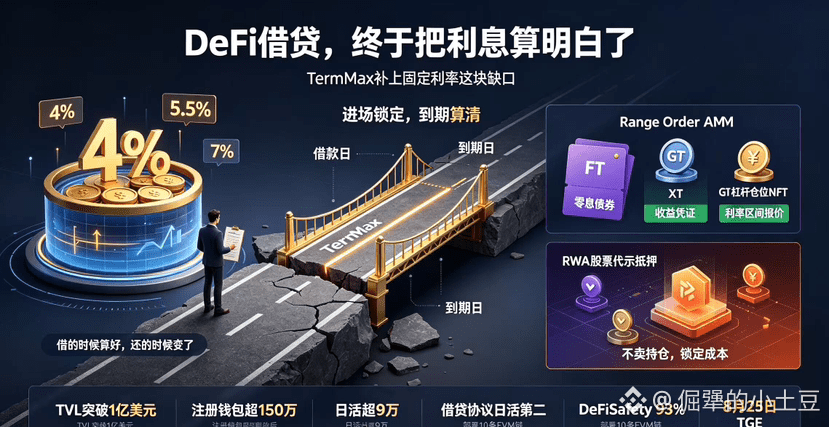
3
281
·
--
I read the Dusk whitepaper three times.
The first time I scrolled down on the third read, something started to feel off.
The first issue that’s hard to get past is that audit key. The whitepaper words it nicely—“auditable privacy,” where regulators can see but ordinary people can’t. But “can see” and “who can see” are two different things.
If that key is in the hands of the user, and the user decides to whom to disclose transaction details, then that’s real privacy. But in Dusk’s architecture, the selective disclosure mechanism is designed for “the issuer, the trading venue, auditors, or regulatory bodies.” Specifically for the Netherlands’ NPEX, regulators can indeed conduct real-time audits via an authorized key. The question is: does the user have any veto power? When a user wants to keep things confidential but regulators require disclosure, whose call is it? The documentation’s description of control ownership and the triggering conditions isn’t nearly as clear as the phrase “default private” suggests.
The second problem hits even closer to my pain point. What’s Dusk’s bet? It’s that future regulated financial applications ultimately need confidentiality at the protocol layer. That sounds good, but it comes with a prerequisite—you have to bet that regulation won’t become even stricter.
What if one day a jurisdiction rules that all transactions must be fully transparent? The Moonlight mode could handle it, but would Phoenix be treated as a compliance obstacle outright? This isn’t a gap that code can fill. Regulatory requirements vary from country to country in the first place—what MiCA recognizes, the SEC may not.
Dusk chose a middle path designed to satisfy users on both sides, and both sides want it. In the end, it may end up being not extreme enough for either.
The NPEX €300 million in assets are indeed already on-chain, and the EURQ stablecoin is running too—these are real. I also agree with the direction: a balance between privacy and compliance, not a forced choice between the two. But my biggest concern isn’t that the technology won’t work—it’s that regulation is changing rapidly, and Dusk picked the narrowest path.
I’ll keep an eye out for one signal: whether Dusk has published a complete explanation of the full triggering conditions and control ownership for selective disclosure. If it has, then audit privacy is a truly verifiable balance. If not, then the key to that door is in someone else’s hands, and users will never know.
Risk warning: The above is my personal observation and does not constitute investment advice. DYOR.
#dusk $DUSK @Dusk
I read the Dusk whitepaper three times.
The first time I scrolled down on the third read, something started to feel off.
The first issue that’s hard to get past is that audit key. The whitepaper words it nicely—“auditable privacy,” where regulators can see but ordinary people can’t. But “can see” and “who can see” are two different things.
If that key is in the hands of the user, and the user decides to whom to disclose transaction details, then that’s real privacy. But in Dusk’s architecture, the selective disclosure mechanism is designed for “the issuer, the trading venue, auditors, or regulatory bodies.” Specifically for the Netherlands’ NPEX, regulators can indeed conduct real-time audits via an authorized key. The question is: does the user have any veto power? When a user wants to keep things confidential but regulators require disclosure, whose call is it? The documentation’s description of control ownership and the triggering conditions isn’t nearly as clear as the phrase “default private” suggests.
The second problem hits even closer to my pain point. What’s Dusk’s bet? It’s that future regulated financial applications ultimately need confidentiality at the protocol layer. That sounds good, but it comes with a prerequisite—you have to bet that regulation won’t become even stricter.
What if one day a jurisdiction rules that all transactions must be fully transparent? The Moonlight mode could handle it, but would Phoenix be treated as a compliance obstacle outright? This isn’t a gap that code can fill. Regulatory requirements vary from country to country in the first place—what MiCA recognizes, the SEC may not.
Dusk chose a middle path designed to satisfy users on both sides, and both sides want it. In the end, it may end up being not extreme enough for either.
The NPEX €300 million in assets are indeed already on-chain, and the EURQ stablecoin is running too—these are real. I also agree with the direction: a balance between privacy and compliance, not a forced choice between the two. But my biggest concern isn’t that the technology won’t work—it’s that regulation is changing rapidly, and Dusk picked the narrowest path.
I’ll keep an eye out for one signal: whether Dusk has published a complete explanation of the full triggering conditions and control ownership for selective disclosure. If it has, then audit privacy is a truly verifiable balance. If not, then the key to that door is in someone else’s hands, and users will never know.
Risk warning: The above is my personal observation and does not constitute investment advice. DYOR.
#dusk $DUSK @Dusk
The first time I scrolled down on the third read, something started to feel off.
The first issue that’s hard to get past is that audit key. The whitepaper words it nicely—“auditable privacy,” where regulators can see but ordinary people can’t. But “can see” and “who can see” are two different things.
If that key is in the hands of the user, and the user decides to whom to disclose transaction details, then that’s real privacy. But in Dusk’s architecture, the selective disclosure mechanism is designed for “the issuer, the trading venue, auditors, or regulatory bodies.” Specifically for the Netherlands’ NPEX, regulators can indeed conduct real-time audits via an authorized key. The question is: does the user have any veto power? When a user wants to keep things confidential but regulators require disclosure, whose call is it? The documentation’s description of control ownership and the triggering conditions isn’t nearly as clear as the phrase “default private” suggests.
The second problem hits even closer to my pain point. What’s Dusk’s bet? It’s that future regulated financial applications ultimately need confidentiality at the protocol layer. That sounds good, but it comes with a prerequisite—you have to bet that regulation won’t become even stricter.
What if one day a jurisdiction rules that all transactions must be fully transparent? The Moonlight mode could handle it, but would Phoenix be treated as a compliance obstacle outright? This isn’t a gap that code can fill. Regulatory requirements vary from country to country in the first place—what MiCA recognizes, the SEC may not.
Dusk chose a middle path designed to satisfy users on both sides, and both sides want it. In the end, it may end up being not extreme enough for either.
The NPEX €300 million in assets are indeed already on-chain, and the EURQ stablecoin is running too—these are real. I also agree with the direction: a balance between privacy and compliance, not a forced choice between the two. But my biggest concern isn’t that the technology won’t work—it’s that regulation is changing rapidly, and Dusk picked the narrowest path.
I’ll keep an eye out for one signal: whether Dusk has published a complete explanation of the full triggering conditions and control ownership for selective disclosure. If it has, then audit privacy is a truly verifiable balance. If not, then the key to that door is in someone else’s hands, and users will never know.
Risk warning: The above is my personal observation and does not constitute investment advice. DYOR.
#dusk $DUSK @Dusk
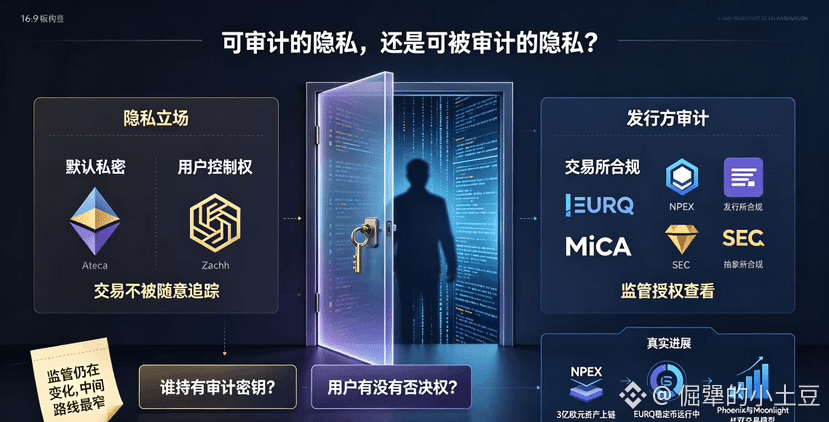
140
·
--
This weekend, chatting in a group about DeFi lending, we eventually found that the most troublesome thing everyone complains about is surprisingly consistent—not that people can’t find liquidity pools, but that interest rates can move too frighteningly. Collateral price volatility is already bad enough; on top of that, the interest changes with market sentiment three times a day. Borrowing a sum is one thing—when it’s time to repay, how much exactly do you have to pay? No one’s really got a clear answer in their head.
What TermMax does is remove this variable entirely. When you enter the market, the interest rate is locked: borrow for three months and you pay three months’ worth of interest; borrow for a year and you pay a year’s worth. At maturity, you owe exactly one amount—no more, no less. By calculating your costs in advance, you can finally feel at ease. It’s not in direct competition with floating-rate protocols like Morpho or Aave. It’s more like adding a fixed-rate “shell” on top of them—underlying liquidity is still routed through those protocols, while the layer above gives you a deterministic quote.
The data really does show that people are willing to pay for “certainty.” TVL has run above $90 million, with over 1.5 million registered wallets, daily active users around 90,000, and a peak of 170,000. It’s deployed on Ethereum, BNB Chain, Arbitrum, Base, and Berachain. Morpho, Aave, Venus, and Pendle have already been integrated. On March 25, daily active addresses ranked No.2 among lending protocols, second only to Aave.
What surprised me even more was what happened in January: TermMax launched a fixed-rate lending market on BNB Chain backed by tokenized stocks, integrating Ondo’s tokenized securities. Users can pledge stock tokens to obtain stablecoin liquidity—without needing to sell their holdings—while also locking in the interest cost. The combination of fixed rates + RWA is like pushing the bridge between on-chain and traditional finance one step further.
On funding, it received money from Cumberland DRW, HashKey Capital, and Decima Fund. YZi Labs’ EASY Residency also graduated in its third season. Its DeFiSafety score is 93%, on par with Aave V3. There are audits and Immunefi vulnerability bounty programs as well. TMX has a total supply of 1 billion, with TGE on August 25.
To be honest, fixed-rate lending has long been the default standard in traditional finance. In DeFi, what we lack today is exactly this kind of “tool that lets you calculate the bill clearly.” Whether TermMax succeeds or not is hard to say, but at least it proves one thing: when borrowing money on-chain, you don’t have to gamble on interest rates every time. The feeling of having the numbers figured out in advance is far more reassuring than chasing high APY.
#termmax @TermMax
This weekend, chatting in a group about DeFi lending, we eventually found that the most troublesome thing everyone complains about is surprisingly consistent—not that people can’t find liquidity pools, but that interest rates can move too frighteningly. Collateral price volatility is already bad enough; on top of that, the interest changes with market sentiment three times a day. Borrowing a sum is one thing—when it’s time to repay, how much exactly do you have to pay? No one’s really got a clear answer in their head.
What TermMax does is remove this variable entirely. When you enter the market, the interest rate is locked: borrow for three months and you pay three months’ worth of interest; borrow for a year and you pay a year’s worth. At maturity, you owe exactly one amount—no more, no less. By calculating your costs in advance, you can finally feel at ease. It’s not in direct competition with floating-rate protocols like Morpho or Aave. It’s more like adding a fixed-rate “shell” on top of them—underlying liquidity is still routed through those protocols, while the layer above gives you a deterministic quote.
The data really does show that people are willing to pay for “certainty.” TVL has run above $90 million, with over 1.5 million registered wallets, daily active users around 90,000, and a peak of 170,000. It’s deployed on Ethereum, BNB Chain, Arbitrum, Base, and Berachain. Morpho, Aave, Venus, and Pendle have already been integrated. On March 25, daily active addresses ranked No.2 among lending protocols, second only to Aave.
What surprised me even more was what happened in January: TermMax launched a fixed-rate lending market on BNB Chain backed by tokenized stocks, integrating Ondo’s tokenized securities. Users can pledge stock tokens to obtain stablecoin liquidity—without needing to sell their holdings—while also locking in the interest cost. The combination of fixed rates + RWA is like pushing the bridge between on-chain and traditional finance one step further.
On funding, it received money from Cumberland DRW, HashKey Capital, and Decima Fund. YZi Labs’ EASY Residency also graduated in its third season. Its DeFiSafety score is 93%, on par with Aave V3. There are audits and Immunefi vulnerability bounty programs as well. TMX has a total supply of 1 billion, with TGE on August 25.
To be honest, fixed-rate lending has long been the default standard in traditional finance. In DeFi, what we lack today is exactly this kind of “tool that lets you calculate the bill clearly.” Whether TermMax succeeds or not is hard to say, but at least it proves one thing: when borrowing money on-chain, you don’t have to gamble on interest rates every time. The feeling of having the numbers figured out in advance is far more reassuring than chasing high APY.
#termmax @TermMax
What TermMax does is remove this variable entirely. When you enter the market, the interest rate is locked: borrow for three months and you pay three months’ worth of interest; borrow for a year and you pay a year’s worth. At maturity, you owe exactly one amount—no more, no less. By calculating your costs in advance, you can finally feel at ease. It’s not in direct competition with floating-rate protocols like Morpho or Aave. It’s more like adding a fixed-rate “shell” on top of them—underlying liquidity is still routed through those protocols, while the layer above gives you a deterministic quote.
The data really does show that people are willing to pay for “certainty.” TVL has run above $90 million, with over 1.5 million registered wallets, daily active users around 90,000, and a peak of 170,000. It’s deployed on Ethereum, BNB Chain, Arbitrum, Base, and Berachain. Morpho, Aave, Venus, and Pendle have already been integrated. On March 25, daily active addresses ranked No.2 among lending protocols, second only to Aave.
What surprised me even more was what happened in January: TermMax launched a fixed-rate lending market on BNB Chain backed by tokenized stocks, integrating Ondo’s tokenized securities. Users can pledge stock tokens to obtain stablecoin liquidity—without needing to sell their holdings—while also locking in the interest cost. The combination of fixed rates + RWA is like pushing the bridge between on-chain and traditional finance one step further.
On funding, it received money from Cumberland DRW, HashKey Capital, and Decima Fund. YZi Labs’ EASY Residency also graduated in its third season. Its DeFiSafety score is 93%, on par with Aave V3. There are audits and Immunefi vulnerability bounty programs as well. TMX has a total supply of 1 billion, with TGE on August 25.
To be honest, fixed-rate lending has long been the default standard in traditional finance. In DeFi, what we lack today is exactly this kind of “tool that lets you calculate the bill clearly.” Whether TermMax succeeds or not is hard to say, but at least it proves one thing: when borrowing money on-chain, you don’t have to gamble on interest rates every time. The feeling of having the numbers figured out in advance is far more reassuring than chasing high APY.
#termmax @TermMax
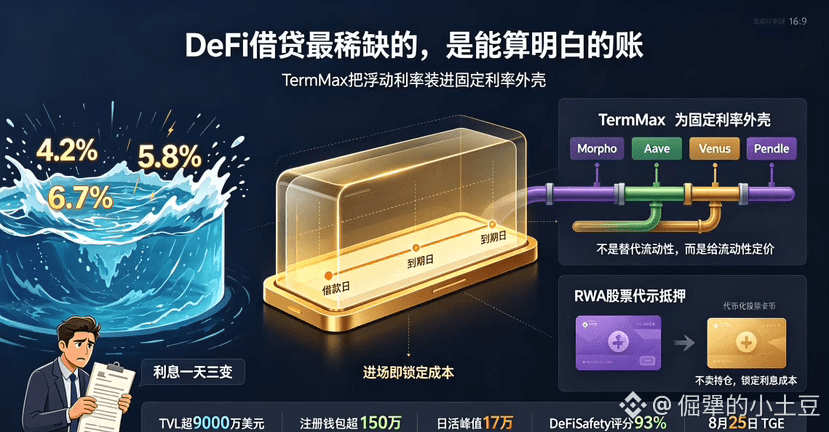
89
·
--
When it comes to staking on the public chain, I gradually realized that many people have actually misread things.
Many newcomers think DUSK staking is as simple as locking the coins away to “lie back and earn.” That’s not really the case. If you choose direct staking, you have to run your own node. You must keep it online continuously and make sure your configuration is properly set up. Node activation takes about 4,320 blocks—roughly 12 hours. Additional staking also has its own rules: when you add funds to an existing stake, only 90% takes effect immediately, while the remaining 10% stays in an inactive state. Unless you completely cancel your stake, you can’t withdraw or use that 10%. Rewards are also not fixed; they depend on your level of consensus participation and the proportion of your effective stake. The reward logic is more like paying you for the contribution you make to the network, not some bubble propped up by the project endlessly inflating subsidies.
What’s even more worth paying attention to is its penalty mechanism. Dusk uses soft slashing (soft slashing), not directly burning your coins. However, repeated mistakes or going offline for a long time will pause your rewards and reduce your effective stake. If your uptime is below 95%, your rewards will be reduced by directly扣掉10%. If you violate rules continuously, then each time 10% of the stake on your node will be removed and transferred to the reward pool.
But there’s still one layer of doubt that keeps lingering in my mind. The node system seems to be improving step by step, but having a complete architecture doesn’t automatically mean true decentralization. In the end, it still depends on whether node distribution is sufficiently dispersed, and whether the hardware and operational costs required for long-term node operators can actually be borne by ordinary participants. Once the threshold gradually rises, and over time concentrates in the hands of a small number of big holders, even the best mechanism will slowly change its nature.
I’m increasingly convinced that what widens the gap between public chains in the future may not necessarily be who can temporarily “trade up” higher staking returns. High returns can indeed quickly attract capital, but most of it comes from arbitrageurs—passing visitors. What truly keeps people around for the long term must be a consensus participation mechanism where rights and responsibilities are properly matched and is reliable enough. What Dusk is gradually building now is exactly that: node identity is hidden during the consensus process. To become a Provisioner, you only need at least 1,000 DUSK. There are already over 270 active node operators. As for whether it can fully work out, I’ll keep watching the node distribution and the real evolution of the staking ecosystem.
#dusk $DUSK @Dusk
When it comes to staking on the public chain, I gradually realized that many people have actually misread things.
Many newcomers think DUSK staking is as simple as locking the coins away to “lie back and earn.” That’s not really the case. If you choose direct staking, you have to run your own node. You must keep it online continuously and make sure your configuration is properly set up. Node activation takes about 4,320 blocks—roughly 12 hours. Additional staking also has its own rules: when you add funds to an existing stake, only 90% takes effect immediately, while the remaining 10% stays in an inactive state. Unless you completely cancel your stake, you can’t withdraw or use that 10%. Rewards are also not fixed; they depend on your level of consensus participation and the proportion of your effective stake. The reward logic is more like paying you for the contribution you make to the network, not some bubble propped up by the project endlessly inflating subsidies.
What’s even more worth paying attention to is its penalty mechanism. Dusk uses soft slashing (soft slashing), not directly burning your coins. However, repeated mistakes or going offline for a long time will pause your rewards and reduce your effective stake. If your uptime is below 95%, your rewards will be reduced by directly扣掉10%. If you violate rules continuously, then each time 10% of the stake on your node will be removed and transferred to the reward pool.
But there’s still one layer of doubt that keeps lingering in my mind. The node system seems to be improving step by step, but having a complete architecture doesn’t automatically mean true decentralization. In the end, it still depends on whether node distribution is sufficiently dispersed, and whether the hardware and operational costs required for long-term node operators can actually be borne by ordinary participants. Once the threshold gradually rises, and over time concentrates in the hands of a small number of big holders, even the best mechanism will slowly change its nature.
I’m increasingly convinced that what widens the gap between public chains in the future may not necessarily be who can temporarily “trade up” higher staking returns. High returns can indeed quickly attract capital, but most of it comes from arbitrageurs—passing visitors. What truly keeps people around for the long term must be a consensus participation mechanism where rights and responsibilities are properly matched and is reliable enough. What Dusk is gradually building now is exactly that: node identity is hidden during the consensus process. To become a Provisioner, you only need at least 1,000 DUSK. There are already over 270 active node operators. As for whether it can fully work out, I’ll keep watching the node distribution and the real evolution of the staking ecosystem.
#dusk $DUSK @Dusk
Many newcomers think DUSK staking is as simple as locking the coins away to “lie back and earn.” That’s not really the case. If you choose direct staking, you have to run your own node. You must keep it online continuously and make sure your configuration is properly set up. Node activation takes about 4,320 blocks—roughly 12 hours. Additional staking also has its own rules: when you add funds to an existing stake, only 90% takes effect immediately, while the remaining 10% stays in an inactive state. Unless you completely cancel your stake, you can’t withdraw or use that 10%. Rewards are also not fixed; they depend on your level of consensus participation and the proportion of your effective stake. The reward logic is more like paying you for the contribution you make to the network, not some bubble propped up by the project endlessly inflating subsidies.
What’s even more worth paying attention to is its penalty mechanism. Dusk uses soft slashing (soft slashing), not directly burning your coins. However, repeated mistakes or going offline for a long time will pause your rewards and reduce your effective stake. If your uptime is below 95%, your rewards will be reduced by directly扣掉10%. If you violate rules continuously, then each time 10% of the stake on your node will be removed and transferred to the reward pool.
But there’s still one layer of doubt that keeps lingering in my mind. The node system seems to be improving step by step, but having a complete architecture doesn’t automatically mean true decentralization. In the end, it still depends on whether node distribution is sufficiently dispersed, and whether the hardware and operational costs required for long-term node operators can actually be borne by ordinary participants. Once the threshold gradually rises, and over time concentrates in the hands of a small number of big holders, even the best mechanism will slowly change its nature.
I’m increasingly convinced that what widens the gap between public chains in the future may not necessarily be who can temporarily “trade up” higher staking returns. High returns can indeed quickly attract capital, but most of it comes from arbitrageurs—passing visitors. What truly keeps people around for the long term must be a consensus participation mechanism where rights and responsibilities are properly matched and is reliable enough. What Dusk is gradually building now is exactly that: node identity is hidden during the consensus process. To become a Provisioner, you only need at least 1,000 DUSK. There are already over 270 active node operators. As for whether it can fully work out, I’ll keep watching the node distribution and the real evolution of the staking ecosystem.
#dusk $DUSK @Dusk
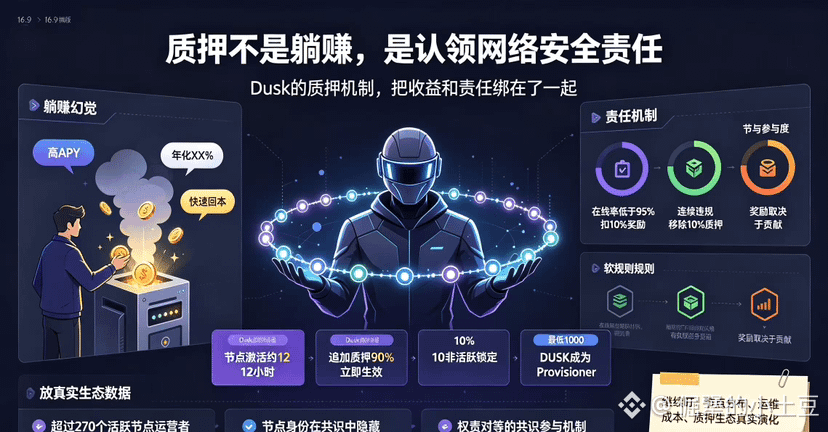
104
·
--
Dusk’s CTO recently confirmed something: DUSK transfers are private by default. The protocol includes a selective disclosure mechanism—allowing the authorized party to view transaction details.
When I read that line, my first reaction wasn’t “good privacy,” but another question—who exactly is the authorized party?
This isn’t a question you can answer off the cuff.
If the disclosure permissions are controlled by the user, then the design is fine. If you want people to see it, you let them; if you don’t, you lock it up. That’s real privacy protection. But if this “authorized party” is the protocol layer or a regulator, and they can open that door unilaterally under certain conditions, then “private by default” becomes a setting that can be overridden—not truly privacy.
From day one, Dusk built MiCA compliance into its architecture. Its target customers are institutional financial markets in Europe. Compliance is its core selling point—that’s fine. But the line between compliance and privacy is much narrower than most people think. Regulatory compliance requires that transactions be viewable “when necessary,” while user privacy requires that “only I decide who can see.” Dusk claims it can satisfy both. But who determines what “necessary” means? What are the trigger conditions? Does the user have any veto power?
I went through the documentation, but couldn’t find any specific explanation.
When the selective disclosure mechanism isn’t triggered, privacy is indeed complete. The problem is: where are the trigger conditions written, who executes them, and whether users even know. If the key to that door is in the user’s hands, that’s auditable privacy; if the key is in someone else’s hands, then it’s a regulatory tool wearing a privacy costume. Those are not the same.
DUSK’s current market cap is 26.63 million, down more than 90% from its peak. The DuskEVM has just gone live, and the development progress is real. But regarding who controls selective disclosure, I only see one signal: either Dusk publishes the complete trigger conditions and control-rights explanation, or users will never know who has the key to that door.
Do you stand A or stand B? Let’s discuss in the comments.
#dusk $DUSK @Dusk
Dusk’s CTO recently confirmed something: DUSK transfers are private by default. The protocol includes a selective disclosure mechanism—allowing the authorized party to view transaction details.
When I read that line, my first reaction wasn’t “good privacy,” but another question—who exactly is the authorized party?
This isn’t a question you can answer off the cuff.
If the disclosure permissions are controlled by the user, then the design is fine. If you want people to see it, you let them; if you don’t, you lock it up. That’s real privacy protection. But if this “authorized party” is the protocol layer or a regulator, and they can open that door unilaterally under certain conditions, then “private by default” becomes a setting that can be overridden—not truly privacy.
From day one, Dusk built MiCA compliance into its architecture. Its target customers are institutional financial markets in Europe. Compliance is its core selling point—that’s fine. But the line between compliance and privacy is much narrower than most people think. Regulatory compliance requires that transactions be viewable “when necessary,” while user privacy requires that “only I decide who can see.” Dusk claims it can satisfy both. But who determines what “necessary” means? What are the trigger conditions? Does the user have any veto power?
I went through the documentation, but couldn’t find any specific explanation.
When the selective disclosure mechanism isn’t triggered, privacy is indeed complete. The problem is: where are the trigger conditions written, who executes them, and whether users even know. If the key to that door is in the user’s hands, that’s auditable privacy; if the key is in someone else’s hands, then it’s a regulatory tool wearing a privacy costume. Those are not the same.
DUSK’s current market cap is 26.63 million, down more than 90% from its peak. The DuskEVM has just gone live, and the development progress is real. But regarding who controls selective disclosure, I only see one signal: either Dusk publishes the complete trigger conditions and control-rights explanation, or users will never know who has the key to that door.
Do you stand A or stand B? Let’s discuss in the comments.
#dusk $DUSK @Dusk
When I read that line, my first reaction wasn’t “good privacy,” but another question—who exactly is the authorized party?
This isn’t a question you can answer off the cuff.
If the disclosure permissions are controlled by the user, then the design is fine. If you want people to see it, you let them; if you don’t, you lock it up. That’s real privacy protection. But if this “authorized party” is the protocol layer or a regulator, and they can open that door unilaterally under certain conditions, then “private by default” becomes a setting that can be overridden—not truly privacy.
From day one, Dusk built MiCA compliance into its architecture. Its target customers are institutional financial markets in Europe. Compliance is its core selling point—that’s fine. But the line between compliance and privacy is much narrower than most people think. Regulatory compliance requires that transactions be viewable “when necessary,” while user privacy requires that “only I decide who can see.” Dusk claims it can satisfy both. But who determines what “necessary” means? What are the trigger conditions? Does the user have any veto power?
I went through the documentation, but couldn’t find any specific explanation.
When the selective disclosure mechanism isn’t triggered, privacy is indeed complete. The problem is: where are the trigger conditions written, who executes them, and whether users even know. If the key to that door is in the user’s hands, that’s auditable privacy; if the key is in someone else’s hands, then it’s a regulatory tool wearing a privacy costume. Those are not the same.
DUSK’s current market cap is 26.63 million, down more than 90% from its peak. The DuskEVM has just gone live, and the development progress is real. But regarding who controls selective disclosure, I only see one signal: either Dusk publishes the complete trigger conditions and control-rights explanation, or users will never know who has the key to that door.
Do you stand A or stand B? Let’s discuss in the comments.
#dusk $DUSK @Dusk
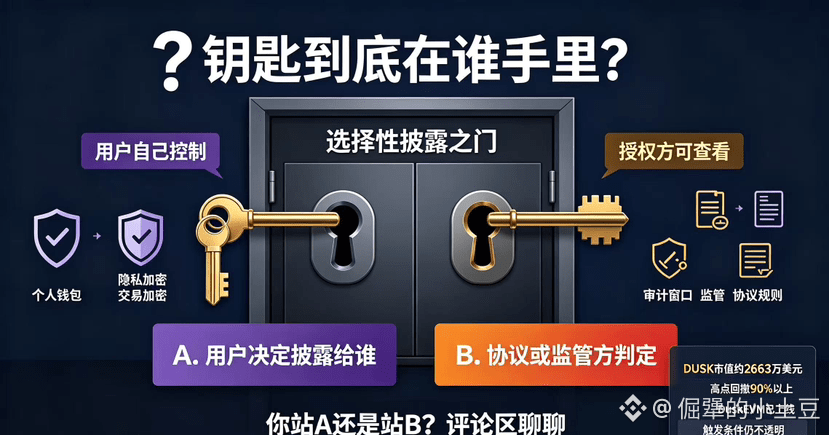
95
·
--
How did I notice this Dusk project? Back in early year, the news about its mainnet launch kept showing up on my homepage for days. At the time, DUSK rallied 240% in a week—pretty impressive. But I didn’t follow it then, because I’ve seen too many scripts where a project pumps on a mainnet launch and then goes to zero.
What really made me go back and dig into its materials was its partnership with the Dutch NPEX exchange. NPEX is licensed—not one of those fly-by-night exchanges. Dusk directly holds equity in NPEX, and the platform’s over €300 million in securities assets need to be moved on-chain. That made it feel different from other privacy projects. It’s not first hyping the tech and then searching for a use case; it locks in a real scenario first, then builds technology around it.
I skimmed through Dusk’s whitepaper. The core idea is basically one sentence: in daily trading, others can’t see it, and when regulators need to check, you have a path that lets them. It’s not about fighting regulators—it’s about turning auditing capability into an optional feature of the protocol. That positioning is quite precise. With a fully anonymous chain like Monero, institutions don’t dare to touch it; with a fully transparent chain like Ethereum, big holders don’t want to use it. Dusk sits right in the middle.
Technically, it has built DuskEVM, compatible with Solidity, and the mainnet went live on January 7, 2026. Developers migrating from Ethereum basically don’t need to change their code. Then it adds a Hedger module to provide privacy protection for EVM transactions, with encryption enabled by default.
But the price has indeed dropped hard. From its early-year peak, it’s retreated more than 85%, and it’s around $0.06 now, with a market cap under $30 million. After the mainnet launch, on-chain transaction volume hasn’t been high either, and the ecosystem applications still have a big gap.
My current take is: the direction is right, and the tech has real-world deployments, but the price has already gone through a round of hype-driven pull-up. Next, we need to see whether that €300 million in NPEX assets can truly generate sustained trading activity, and whether truly useful applications will emerge on the mainnet. Until those data come out, I’ll watch and wait—no action.
#dusk $DUSK @Dusk_Foundation @Dusk_Foundation
How did I notice this Dusk project? Back in early year, the news about its mainnet launch kept showing up on my homepage for days. At the time, DUSK rallied 240% in a week—pretty impressive. But I didn’t follow it then, because I’ve seen too many scripts where a project pumps on a mainnet launch and then goes to zero.
What really made me go back and dig into its materials was its partnership with the Dutch NPEX exchange. NPEX is licensed—not one of those fly-by-night exchanges. Dusk directly holds equity in NPEX, and the platform’s over €300 million in securities assets need to be moved on-chain. That made it feel different from other privacy projects. It’s not first hyping the tech and then searching for a use case; it locks in a real scenario first, then builds technology around it.
I skimmed through Dusk’s whitepaper. The core idea is basically one sentence: in daily trading, others can’t see it, and when regulators need to check, you have a path that lets them. It’s not about fighting regulators—it’s about turning auditing capability into an optional feature of the protocol. That positioning is quite precise. With a fully anonymous chain like Monero, institutions don’t dare to touch it; with a fully transparent chain like Ethereum, big holders don’t want to use it. Dusk sits right in the middle.
Technically, it has built DuskEVM, compatible with Solidity, and the mainnet went live on January 7, 2026. Developers migrating from Ethereum basically don’t need to change their code. Then it adds a Hedger module to provide privacy protection for EVM transactions, with encryption enabled by default.
But the price has indeed dropped hard. From its early-year peak, it’s retreated more than 85%, and it’s around $0.06 now, with a market cap under $30 million. After the mainnet launch, on-chain transaction volume hasn’t been high either, and the ecosystem applications still have a big gap.
My current take is: the direction is right, and the tech has real-world deployments, but the price has already gone through a round of hype-driven pull-up. Next, we need to see whether that €300 million in NPEX assets can truly generate sustained trading activity, and whether truly useful applications will emerge on the mainnet. Until those data come out, I’ll watch and wait—no action.
#dusk $DUSK @Dusk @Dusk
What really made me go back and dig into its materials was its partnership with the Dutch NPEX exchange. NPEX is licensed—not one of those fly-by-night exchanges. Dusk directly holds equity in NPEX, and the platform’s over €300 million in securities assets need to be moved on-chain. That made it feel different from other privacy projects. It’s not first hyping the tech and then searching for a use case; it locks in a real scenario first, then builds technology around it.
I skimmed through Dusk’s whitepaper. The core idea is basically one sentence: in daily trading, others can’t see it, and when regulators need to check, you have a path that lets them. It’s not about fighting regulators—it’s about turning auditing capability into an optional feature of the protocol. That positioning is quite precise. With a fully anonymous chain like Monero, institutions don’t dare to touch it; with a fully transparent chain like Ethereum, big holders don’t want to use it. Dusk sits right in the middle.
Technically, it has built DuskEVM, compatible with Solidity, and the mainnet went live on January 7, 2026. Developers migrating from Ethereum basically don’t need to change their code. Then it adds a Hedger module to provide privacy protection for EVM transactions, with encryption enabled by default.
But the price has indeed dropped hard. From its early-year peak, it’s retreated more than 85%, and it’s around $0.06 now, with a market cap under $30 million. After the mainnet launch, on-chain transaction volume hasn’t been high either, and the ecosystem applications still have a big gap.
My current take is: the direction is right, and the tech has real-world deployments, but the price has already gone through a round of hype-driven pull-up. Next, we need to see whether that €300 million in NPEX assets can truly generate sustained trading activity, and whether truly useful applications will emerge on the mainnet. Until those data come out, I’ll watch and wait—no action.
#dusk $DUSK @Dusk @Dusk
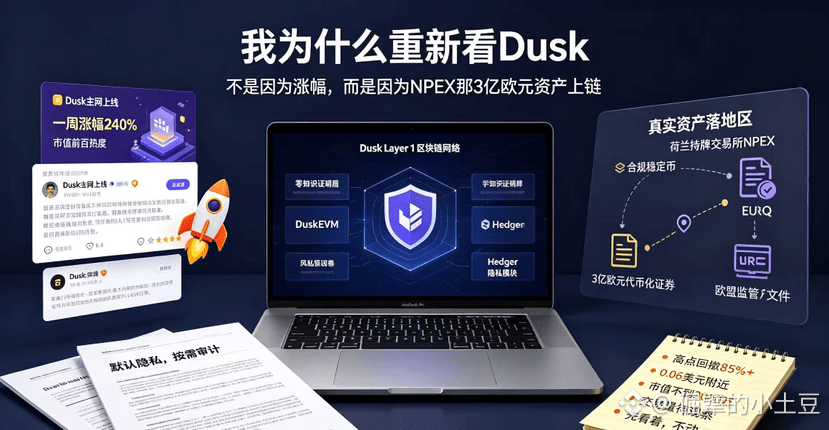
1
133
·
--
Dusk—at first I didn’t take this project very seriously. It wasn’t until the big spike when the mainnet launched earlier this year that I went back and looked through its technical documentation carefully.
Let’s talk about what makes it different from most other privacy coins.
The logic of most privacy coins out there is: encrypt everything, and don’t let anyone see anything. Dusk doesn’t go that route. Its core design is called “auditable privacy.” It uses zero-knowledge proofs to encrypt transaction details, but at the same time leaves regulators a key for compliant audits. In the whitepaper, they call it “default privacy, audits on demand.” In plain terms: everyday transactions are invisible to others, but when regulators need to check, you can provide a compliance proof instead of fighting back.
To achieve this balance, Dusk uses a dual-account model. Moonlight manages the transparent account, while Phoenix manages the privacy account. You can switch with a single click, and assets are interoperable across the two sides. The design is pretty pragmatic: fully anonymous on-chain exchanges don’t dare to integrate, fully transparent on-chain institutions don’t want to use it—so Dusk sits in that middle ground.
On January 7, 2026, the mainnet officially went live, with DuskEVM launched in sync. Developers can deploy Solidity contracts directly, compatible with mainstream tools like MetaMask and Hardhat. The Hedger module is responsible for adding
There are 1 billion DUSK in total supply; currently about 496 million are in circulation. Annualized staking yields have dropped from roughly 27% in November 2025 to about 22.31% recently. After the mainnet launched in January 2026, DUSK surged more than 240% within a week, with a monthly gain close to 470%. Daily trading volume briefly exceeded $200 million. As of early August, the price has been fluctuating around $0.06, with a market cap under $30 million. The pullback from the highs has been quite large—early profit-taking has been steadily realized.
We also need to lay out the risks clearly.
After the mainnet launch, the ecosystem applications have indeed been a bit cold; on-chain transaction volume isn’t that high. Ongoing token unlocks are creating real selling pressure. And the privacy sector is highly competitive—old players like Monero and Zcash already have their scale.
Dusk solves a real problem: traditional finance wants to go on-chain, but it’s been hard to find a balance between privacy and compliance. NPEX’s collaboration proof shows that this isn’t just empty talk. But from this position, it’s still too early to call it a bottom play, and it’s also too early to give up. I’ll keep watching the real transaction volume and user retention data after the mainnet proves stable operation.
#dusk $DUSK @Dusk
Dusk—at first I didn’t take this project very seriously. It wasn’t until the big spike when the mainnet launched earlier this year that I went back and looked through its technical documentation carefully.
Let’s talk about what makes it different from most other privacy coins.
The logic of most privacy coins out there is: encrypt everything, and don’t let anyone see anything. Dusk doesn’t go that route. Its core design is called “auditable privacy.” It uses zero-knowledge proofs to encrypt transaction details, but at the same time leaves regulators a key for compliant audits. In the whitepaper, they call it “default privacy, audits on demand.” In plain terms: everyday transactions are invisible to others, but when regulators need to check, you can provide a compliance proof instead of fighting back.
To achieve this balance, Dusk uses a dual-account model. Moonlight manages the transparent account, while Phoenix manages the privacy account. You can switch with a single click, and assets are interoperable across the two sides. The design is pretty pragmatic: fully anonymous on-chain exchanges don’t dare to integrate, fully transparent on-chain institutions don’t want to use it—so Dusk sits in that middle ground.
On January 7, 2026, the mainnet officially went live, with DuskEVM launched in sync. Developers can deploy Solidity contracts directly, compatible with mainstream tools like MetaMask and Hardhat. The Hedger module is responsible for adding
There are 1 billion DUSK in total supply; currently about 496 million are in circulation. Annualized staking yields have dropped from roughly 27% in November 2025 to about 22.31% recently. After the mainnet launched in January 2026, DUSK surged more than 240% within a week, with a monthly gain close to 470%. Daily trading volume briefly exceeded $200 million. As of early August, the price has been fluctuating around $0.06, with a market cap under $30 million. The pullback from the highs has been quite large—early profit-taking has been steadily realized.
We also need to lay out the risks clearly.
After the mainnet launch, the ecosystem applications have indeed been a bit cold; on-chain transaction volume isn’t that high. Ongoing token unlocks are creating real selling pressure. And the privacy sector is highly competitive—old players like Monero and Zcash already have their scale.
Dusk solves a real problem: traditional finance wants to go on-chain, but it’s been hard to find a balance between privacy and compliance. NPEX’s collaboration proof shows that this isn’t just empty talk. But from this position, it’s still too early to call it a bottom play, and it’s also too early to give up. I’ll keep watching the real transaction volume and user retention data after the mainnet proves stable operation.
#dusk $DUSK @Dusk
Let’s talk about what makes it different from most other privacy coins.
The logic of most privacy coins out there is: encrypt everything, and don’t let anyone see anything. Dusk doesn’t go that route. Its core design is called “auditable privacy.” It uses zero-knowledge proofs to encrypt transaction details, but at the same time leaves regulators a key for compliant audits. In the whitepaper, they call it “default privacy, audits on demand.” In plain terms: everyday transactions are invisible to others, but when regulators need to check, you can provide a compliance proof instead of fighting back.
To achieve this balance, Dusk uses a dual-account model. Moonlight manages the transparent account, while Phoenix manages the privacy account. You can switch with a single click, and assets are interoperable across the two sides. The design is pretty pragmatic: fully anonymous on-chain exchanges don’t dare to integrate, fully transparent on-chain institutions don’t want to use it—so Dusk sits in that middle ground.
On January 7, 2026, the mainnet officially went live, with DuskEVM launched in sync. Developers can deploy Solidity contracts directly, compatible with mainstream tools like MetaMask and Hardhat. The Hedger module is responsible for adding
There are 1 billion DUSK in total supply; currently about 496 million are in circulation. Annualized staking yields have dropped from roughly 27% in November 2025 to about 22.31% recently. After the mainnet launched in January 2026, DUSK surged more than 240% within a week, with a monthly gain close to 470%. Daily trading volume briefly exceeded $200 million. As of early August, the price has been fluctuating around $0.06, with a market cap under $30 million. The pullback from the highs has been quite large—early profit-taking has been steadily realized.
We also need to lay out the risks clearly.
After the mainnet launch, the ecosystem applications have indeed been a bit cold; on-chain transaction volume isn’t that high. Ongoing token unlocks are creating real selling pressure. And the privacy sector is highly competitive—old players like Monero and Zcash already have their scale.
Dusk solves a real problem: traditional finance wants to go on-chain, but it’s been hard to find a balance between privacy and compliance. NPEX’s collaboration proof shows that this isn’t just empty talk. But from this position, it’s still too early to call it a bottom play, and it’s also too early to give up. I’ll keep watching the real transaction volume and user retention data after the mainnet proves stable operation.
#dusk $DUSK @Dusk
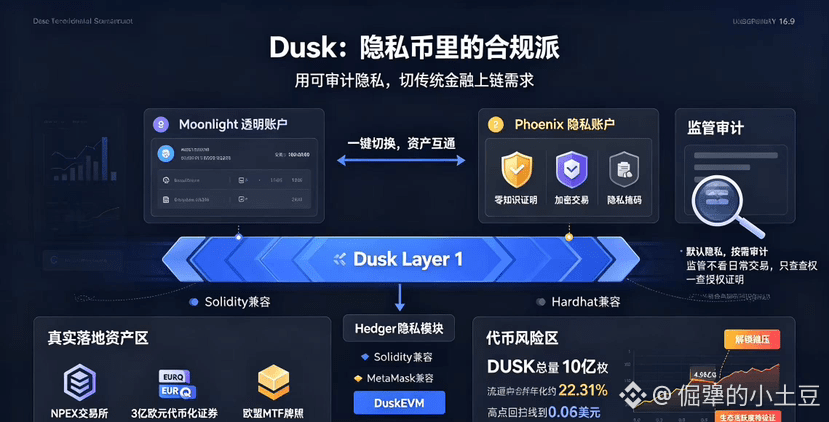
100
·
--
To be honest, I’ve been watching this coin, DUSK, for a while. Unlike the privacy coins out there that just shout “privacy above all, regulations be gone,” DUSK is taking a different route—it’s trying to stitch privacy and compliance together.
Let’s start with the technology.
Dusk is a Layer 1 blockchain specifically built for regulated financial institutions, with the mainnet scheduled to officially launch on January 7, 2026. Its core weapon is DuskEVM— a privacy virtual machine compatible with Solidity. Developers migrating from Ethereum typically don’t need to make major code changes. On top of that is the Hedger privacy module, which uses zero-knowledge proofs to hide sensitive information such as account balances and transaction amounts, so only authorized parties can see them. This “default privacy, audit on demand” design just happens to sync perfectly with the regulatory rhythm of the EU’s MiCA framework.
What truly makes it feel different is the deployment.
Dusk is deeply partnered with the Dutch licensed exchange NPEX. Hundreds of millions of euros worth of tokenized, securitized assets have already been issued and are being traded on-chain. Quantoz has also issued a compliant stablecoin, EURQ, via Dusk. This isn’t a demo on a testnet—real, regulated assets are actively running.
As for the token, the data isn’t that great.
DUSK’s total supply is 1 billion, with roughly 500 million currently circulating. After the mainnet launched in January 2026, it surged over 583% in a single month—from $0.039 to $0.216. But the hype faded quickly. By early August 2026, the price was hovering around $0.06. From the peak, it has retraced more than 85%. Liquidity isn’t high either—daily trading volume is only a little over $1 million—which suggests early profit-takers have been continuously cashing out, and there aren’t many new buyers.
My take.
I agree with Dusk’s direction. Traditional finance wants to go on-chain, but it has always struggled to find a workable balance between privacy and compliance—and Dusk seems to have found a position that can actually be implemented. The NPEX partnership also proves this isn’t just empty talk. But the price has already been pumped once and then fallen back. Whether the €300 million in on-chain assets can land on schedule, whether it can generate sustained trading activity, and whether the ongoing token unlocks create selling pressure—these are all real, concrete tests.
I’ll keep watching the real transaction volume and user retention data after the mainnet has stabilized. At this point, it’s too early to call it a dip-buy; it’s also too early to give up. Let’s observe first. No rush.
#dusk $DUSK @Dusk
To be honest, I’ve been watching this coin, DUSK, for a while. Unlike the privacy coins out there that just shout “privacy above all, regulations be gone,” DUSK is taking a different route—it’s trying to stitch privacy and compliance together.
Let’s start with the technology.
Dusk is a Layer 1 blockchain specifically built for regulated financial institutions, with the mainnet scheduled to officially launch on January 7, 2026. Its core weapon is DuskEVM— a privacy virtual machine compatible with Solidity. Developers migrating from Ethereum typically don’t need to make major code changes. On top of that is the Hedger privacy module, which uses zero-knowledge proofs to hide sensitive information such as account balances and transaction amounts, so only authorized parties can see them. This “default privacy, audit on demand” design just happens to sync perfectly with the regulatory rhythm of the EU’s MiCA framework.
What truly makes it feel different is the deployment.
Dusk is deeply partnered with the Dutch licensed exchange NPEX. Hundreds of millions of euros worth of tokenized, securitized assets have already been issued and are being traded on-chain. Quantoz has also issued a compliant stablecoin, EURQ, via Dusk. This isn’t a demo on a testnet—real, regulated assets are actively running.
As for the token, the data isn’t that great.
DUSK’s total supply is 1 billion, with roughly 500 million currently circulating. After the mainnet launched in January 2026, it surged over 583% in a single month—from $0.039 to $0.216. But the hype faded quickly. By early August 2026, the price was hovering around $0.06. From the peak, it has retraced more than 85%. Liquidity isn’t high either—daily trading volume is only a little over $1 million—which suggests early profit-takers have been continuously cashing out, and there aren’t many new buyers.
My take.
I agree with Dusk’s direction. Traditional finance wants to go on-chain, but it has always struggled to find a workable balance between privacy and compliance—and Dusk seems to have found a position that can actually be implemented. The NPEX partnership also proves this isn’t just empty talk. But the price has already been pumped once and then fallen back. Whether the €300 million in on-chain assets can land on schedule, whether it can generate sustained trading activity, and whether the ongoing token unlocks create selling pressure—these are all real, concrete tests.
I’ll keep watching the real transaction volume and user retention data after the mainnet has stabilized. At this point, it’s too early to call it a dip-buy; it’s also too early to give up. Let’s observe first. No rush.
#dusk $DUSK @Dusk
Let’s start with the technology.
Dusk is a Layer 1 blockchain specifically built for regulated financial institutions, with the mainnet scheduled to officially launch on January 7, 2026. Its core weapon is DuskEVM— a privacy virtual machine compatible with Solidity. Developers migrating from Ethereum typically don’t need to make major code changes. On top of that is the Hedger privacy module, which uses zero-knowledge proofs to hide sensitive information such as account balances and transaction amounts, so only authorized parties can see them. This “default privacy, audit on demand” design just happens to sync perfectly with the regulatory rhythm of the EU’s MiCA framework.
What truly makes it feel different is the deployment.
Dusk is deeply partnered with the Dutch licensed exchange NPEX. Hundreds of millions of euros worth of tokenized, securitized assets have already been issued and are being traded on-chain. Quantoz has also issued a compliant stablecoin, EURQ, via Dusk. This isn’t a demo on a testnet—real, regulated assets are actively running.
As for the token, the data isn’t that great.
DUSK’s total supply is 1 billion, with roughly 500 million currently circulating. After the mainnet launched in January 2026, it surged over 583% in a single month—from $0.039 to $0.216. But the hype faded quickly. By early August 2026, the price was hovering around $0.06. From the peak, it has retraced more than 85%. Liquidity isn’t high either—daily trading volume is only a little over $1 million—which suggests early profit-takers have been continuously cashing out, and there aren’t many new buyers.
My take.
I agree with Dusk’s direction. Traditional finance wants to go on-chain, but it has always struggled to find a workable balance between privacy and compliance—and Dusk seems to have found a position that can actually be implemented. The NPEX partnership also proves this isn’t just empty talk. But the price has already been pumped once and then fallen back. Whether the €300 million in on-chain assets can land on schedule, whether it can generate sustained trading activity, and whether the ongoing token unlocks create selling pressure—these are all real, concrete tests.
I’ll keep watching the real transaction volume and user retention data after the mainnet has stabilized. At this point, it’s too early to call it a dip-buy; it’s also too early to give up. Let’s observe first. No rush.
#dusk $DUSK @Dusk
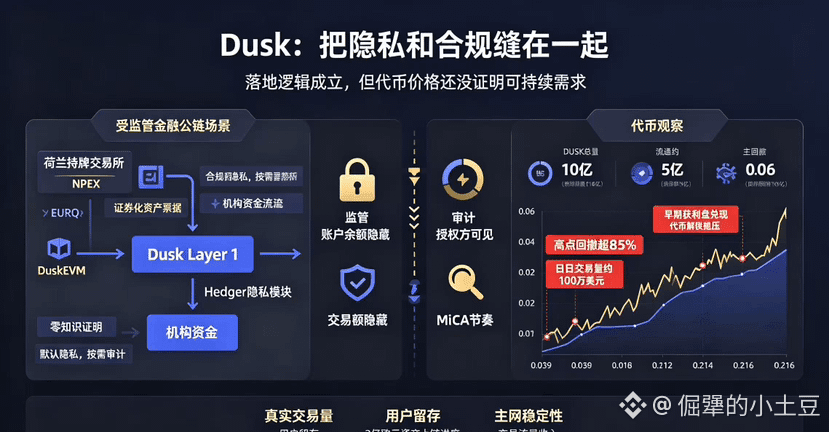
113
·
--
While reading the Babylon documentation, I saw the section about the Covenant Committee, and my first reaction was, “Oh, another committee.” To be honest, whenever an on-chain project sets up a multisig committee, I automatically switch on my defensive mode—this stuff is too easy to be packaged as “decentralized,” but in reality it can become a backdoor. Later, I went through the entire staking and exit flow, and found that I might not fully understand where the bottleneck really is. @babylonlabs_io
In normal cases, when the term expires and the redemption happens, there’s no need for committee signatures—the timelock is on your side, and you can just go. The committee is stuck on two things: early unbonding and malicious behavior slashing. That means only non-standard paths go through them. For a normal BTC redemption, the committee doesn’t touch it at all.
So why design it this way? Because Bitcoin scripts are too “dumb.” If you lock some BTC and want to leave early, the Bitcoin mainnet doesn’t understand the concept of “early.” It only knows it can unlock when the time comes. What the committee does is actually quite straightforward—adding an authorized path for “early exit” using multisig. It’s not permission itself; it’s a conditional executor. Of course, there are risks here. If the committee’s signature mechanism were compromised, in theory they could sign a fake unbonding transaction. The documentation says it’s a 3/5 multisig with members that are publicly known. But whether this threshold is sufficient and how members can be replaced—there’s currently no running data to verify.
So the Covenant Committee isn’t a backdoor, but don’t treat it as a perfectly decentralized design either. It’s more like an engineering compromise stemming from the fact that Bitcoin scripts are too clumsy—it works, but it’s not elegant enough.
Personally, I think the truly important things to look at are: (1) whether the permission boundary will expand with upgrades, (2) whether the member composition will become increasingly concentrated, and (3) whether this mechanism can be replaced once Bitcoin script capabilities improve. Until those three questions are answered, saying it’s “fully decentralized” or calling it a “centralized backdoor” is too early. #baby $BABY
While reading the Babylon documentation, I saw the section about the Covenant Committee, and my first reaction was, “Oh, another committee.” To be honest, whenever an on-chain project sets up a multisig committee, I automatically switch on my defensive mode—this stuff is too easy to be packaged as “decentralized,” but in reality it can become a backdoor. Later, I went through the entire staking and exit flow, and found that I might not fully understand where the bottleneck really is. @BabylonLabs_io
In normal cases, when the term expires and the redemption happens, there’s no need for committee signatures—the timelock is on your side, and you can just go. The committee is stuck on two things: early unbonding and malicious behavior slashing. That means only non-standard paths go through them. For a normal BTC redemption, the committee doesn’t touch it at all.
So why design it this way? Because Bitcoin scripts are too “dumb.” If you lock some BTC and want to leave early, the Bitcoin mainnet doesn’t understand the concept of “early.” It only knows it can unlock when the time comes. What the committee does is actually quite straightforward—adding an authorized path for “early exit” using multisig. It’s not permission itself; it’s a conditional executor. Of course, there are risks here. If the committee’s signature mechanism were compromised, in theory they could sign a fake unbonding transaction. The documentation says it’s a 3/5 multisig with members that are publicly known. But whether this threshold is sufficient and how members can be replaced—there’s currently no running data to verify.
So the Covenant Committee isn’t a backdoor, but don’t treat it as a perfectly decentralized design either. It’s more like an engineering compromise stemming from the fact that Bitcoin scripts are too clumsy—it works, but it’s not elegant enough.
Personally, I think the truly important things to look at are: (1) whether the permission boundary will expand with upgrades, (2) whether the member composition will become increasingly concentrated, and (3) whether this mechanism can be replaced once Bitcoin script capabilities improve. Until those three questions are answered, saying it’s “fully decentralized” or calling it a “centralized backdoor” is too early. #baby $BABY
In normal cases, when the term expires and the redemption happens, there’s no need for committee signatures—the timelock is on your side, and you can just go. The committee is stuck on two things: early unbonding and malicious behavior slashing. That means only non-standard paths go through them. For a normal BTC redemption, the committee doesn’t touch it at all.
So why design it this way? Because Bitcoin scripts are too “dumb.” If you lock some BTC and want to leave early, the Bitcoin mainnet doesn’t understand the concept of “early.” It only knows it can unlock when the time comes. What the committee does is actually quite straightforward—adding an authorized path for “early exit” using multisig. It’s not permission itself; it’s a conditional executor. Of course, there are risks here. If the committee’s signature mechanism were compromised, in theory they could sign a fake unbonding transaction. The documentation says it’s a 3/5 multisig with members that are publicly known. But whether this threshold is sufficient and how members can be replaced—there’s currently no running data to verify.
So the Covenant Committee isn’t a backdoor, but don’t treat it as a perfectly decentralized design either. It’s more like an engineering compromise stemming from the fact that Bitcoin scripts are too clumsy—it works, but it’s not elegant enough.
Personally, I think the truly important things to look at are: (1) whether the permission boundary will expand with upgrades, (2) whether the member composition will become increasingly concentrated, and (3) whether this mechanism can be replaced once Bitcoin script capabilities improve. Until those three questions are answered, saying it’s “fully decentralized” or calling it a “centralized backdoor” is too early. #baby $BABY
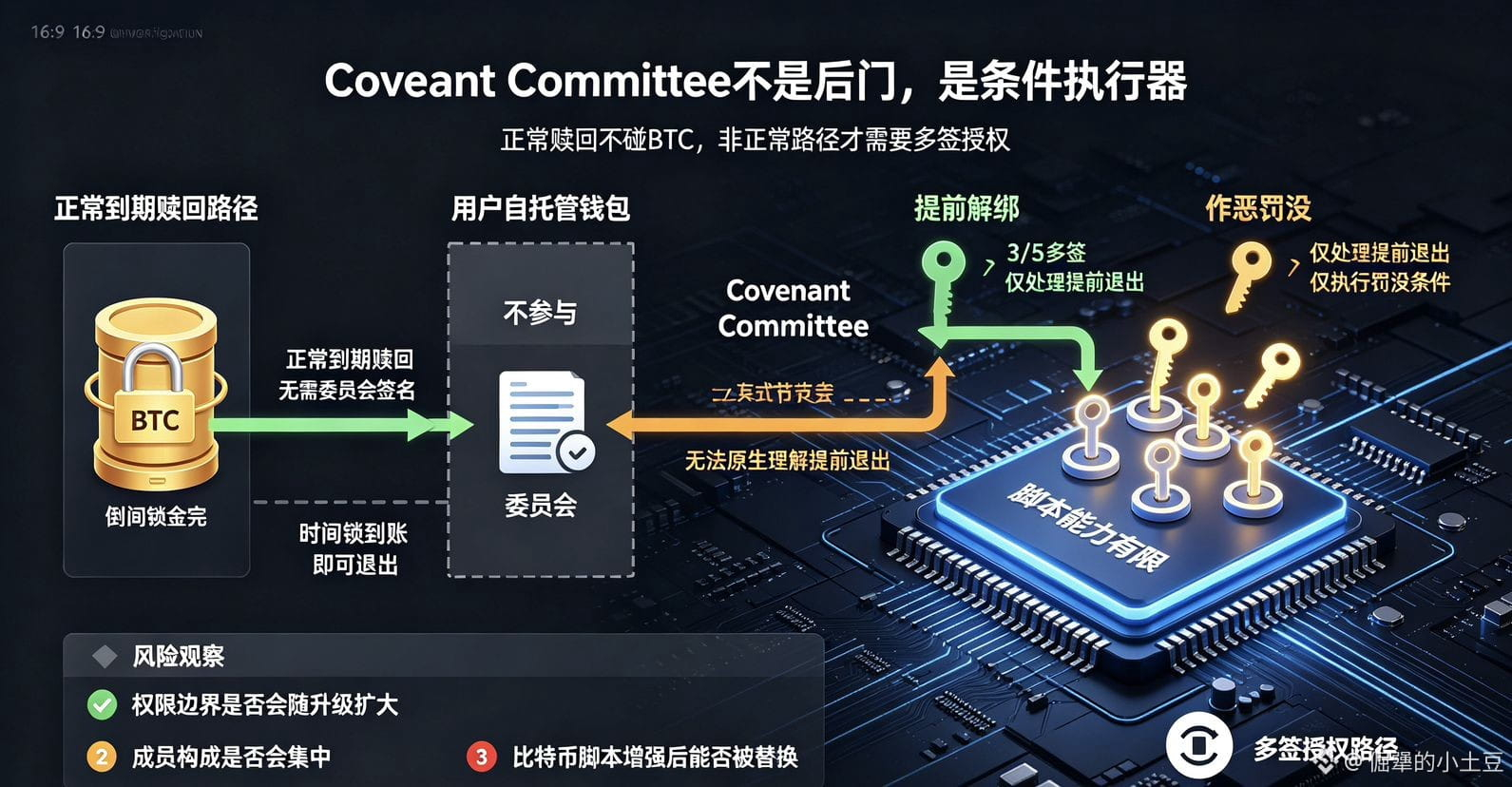
86
Log in to explore more content
Join global crypto users on Binance Square
⚡️ Get latest and useful information about crypto.
💬 Trusted by the world’s largest crypto exchange.
👍 Discover real insights from verified creators.
Email / Phone number
Trending Topics
BOJRaisesRatesTo31YearHigh
24,432 views
632 Discussing
Bitcoin Reclaims the Spotlight as Macro Pressure Fails to Break Crypto Demand
Fatima_Tariq
·9 Likes
·5.4k views
BuffettStepsDownAsBerkshireChairman
6,762 views
247 Discussing
XRPExchangeReservesHitSevenYearLow
10,442 views
273 Discussing