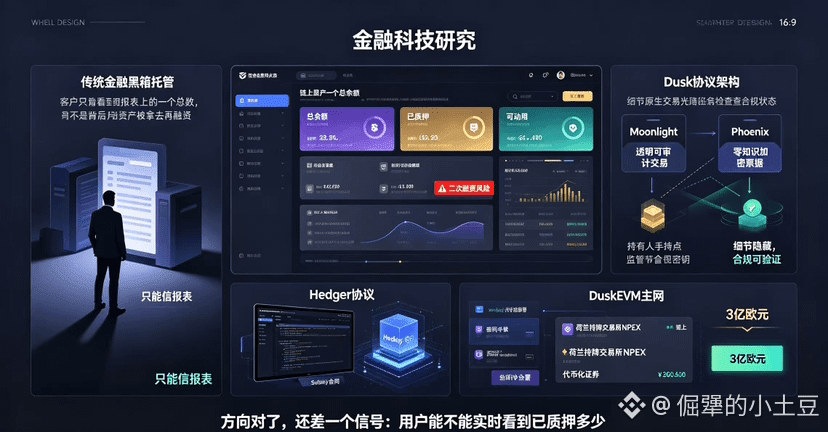
In traditional finance, custodians reuse customers’ securities for refinancing, keep the returns, and leave the risks with the customer—this is possible mainly because customers can only see a single total number on the statement, without knowing how much of it has already been pledged, how much is frozen, and how much remains free.
If the blockchain only shows one total balance, this problem doesn’t go away—it may even be hidden more deeply. Once internal ledgers are encrypted, customers have no way even to suspect it.
Dusk addresses this by separating “what can be hidden” from “what can be seen.” It created two native transaction models—Moonlight for transparent, auditable transactions, and Phoenix, which uses zero-knowledge proofs to encrypt balances and transfers into invisible “vouchers.” Ordinary transactions aren’t visible to others, but holders and regulators can selectively disclose the information they need by checking the keys. This isn’t an add-on feature; it was written into the protocol design since the project was founded in 2018.
The core value of this architecture is that it allows “restricted states” to be separated from “available balance.” An asset balance isn’t just about “how much,” but also includes things like “how much is pledged” and “what is the maximum that can be re-pledged.” If these fields are visible to the holder themselves, it becomes much harder for a middleman to secretly reuse the securities for secondary financing.
Dusk also built a protocol called Hedger, using zero-knowledge proofs plus homomorphic encryption: transaction details are hidden from the outside, but regulator nodes can verify compliance status at any time. After the DuskEVM mainnet goes live in January 2026, developers can directly deploy Solidity contracts. Its partnership with the Dutch-licensed exchange NPEX is already in place, with more than €300 million in tokenized securities moved on-chain.
My view is: the direction is right, but we still need a concrete signal—whether users can clearly see, in their wallet or on a block explorer, how much of their assets are already pledged and how much remains available to move. Until that signal appears, I will continue to observe. If asset status only shows “how much” there is, without “how much is already restricted,” then please treat re-pledging as something that could default to happening.
#dusk $DUSK @Dusk
If the blockchain only shows one total balance, this problem doesn’t go away—it may even be hidden more deeply. Once internal ledgers are encrypted, customers have no way even to suspect it.
Dusk addresses this by separating “what can be hidden” from “what can be seen.” It created two native transaction models—Moonlight for transparent, auditable transactions, and Phoenix, which uses zero-knowledge proofs to encrypt balances and transfers into invisible “vouchers.” Ordinary transactions aren’t visible to others, but holders and regulators can selectively disclose the information they need by checking the keys. This isn’t an add-on feature; it was written into the protocol design since the project was founded in 2018.
The core value of this architecture is that it allows “restricted states” to be separated from “available balance.” An asset balance isn’t just about “how much,” but also includes things like “how much is pledged” and “what is the maximum that can be re-pledged.” If these fields are visible to the holder themselves, it becomes much harder for a middleman to secretly reuse the securities for secondary financing.
Dusk also built a protocol called Hedger, using zero-knowledge proofs plus homomorphic encryption: transaction details are hidden from the outside, but regulator nodes can verify compliance status at any time. After the DuskEVM mainnet goes live in January 2026, developers can directly deploy Solidity contracts. Its partnership with the Dutch-licensed exchange NPEX is already in place, with more than €300 million in tokenized securities moved on-chain.
My view is: the direction is right, but we still need a concrete signal—whether users can clearly see, in their wallet or on a block explorer, how much of their assets are already pledged and how much remains available to move. Until that signal appears, I will continue to observe. If asset status only shows “how much” there is, without “how much is already restricted,” then please treat re-pledging as something that could default to happening.
#dusk $DUSK @Dusk