When it comes to the Dusk project, I’ve been watching it for quite a while.
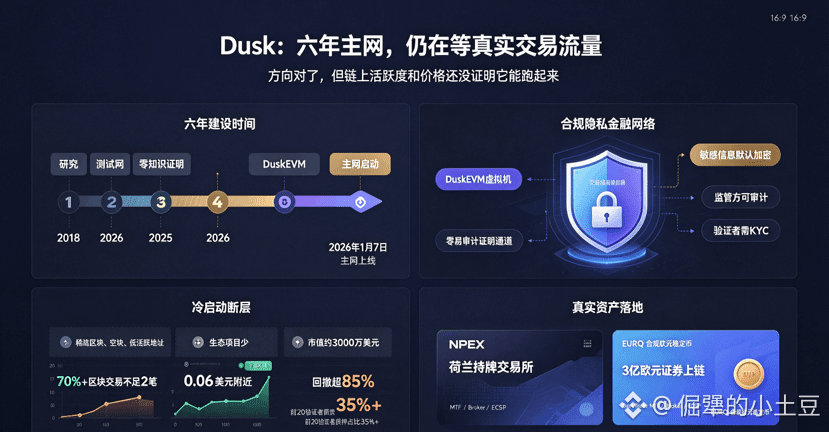
It started in 2018, and only went live on the mainnet in January this year—six years of grinding in between. Unlike the privacy projects on the market that “encrypt everything,” Dusk takes a different route: it stitches privacy and compliance together, specifically serving regulated financial scenarios. On January 7, 2026, the mainnet will officially launch, and DuskEVM will go live at the same time. It is fully compatible with Solidity. Developers migrating from Ethereum generally don’t need to change their code. The core component, Hedger, adds a privacy layer to EVM transactions using zero-knowledge proofs. Sensitive information is encrypted by default, but it keeps an auditable channel for regulators. Validators need to complete KYC—something many people criticize as “not decentralized enough.” But I think it’s an honest response to what finance is really about: real-world financial systems rely on clearly defined accountability chains, so if something goes wrong, you know who to call.
What truly makes it feel different is its execution. Dusk has an official partnership with the regulated Dutch exchange NPEX. On the NPEX platform, more than €300 million in securities assets are set to be moved onto the chain. DuskTrade obtained EU MTF, Broker, and ECSP licenses. Quantoz also issued a compliant euro stablecoin, EURQ, through Dusk. These are real assets running—not demos on a testnet.
But every coin has two sides. The mainnet has been live for almost eight months now, and there are only a few projects listed on the official ecosystem page. In over 70% of blocks, the number of transactions is fewer than two, and you often see consecutive empty blocks. In early August, the price hovered around $0.06, with a market cap of a little over $30 million. Compared with the peak earlier this year, it’s pulled back more than 85%. In June, Binance even delisted the DUSK/BTC trading pair. And the community is arguing, too—among 200 validators, the top 20 control more than 35% of the staked supply.
I recognize the technical direction: people have long struggled to find a balance between privacy and compliance, and Dusk has indeed found a spot where it can actually work. The NPEX partnership also shows that this logic isn’t just spinning wheels. But the price has already gone through a round of emotion-driven pumping. Whether it can be converted into sustained user growth and on-chain activity remains unclear right now. I’ll keep watching to see whether the €300 million assets on NPEX can truly generate ongoing trading flow, and whether genuinely useful applications will grow on DuskEVM. Until then, I’ll watch—no action.
#dusk $DUSK @Dusk
It started in 2018, and only went live on the mainnet in January this year—six years of grinding in between. Unlike the privacy projects on the market that “encrypt everything,” Dusk takes a different route: it stitches privacy and compliance together, specifically serving regulated financial scenarios. On January 7, 2026, the mainnet will officially launch, and DuskEVM will go live at the same time. It is fully compatible with Solidity. Developers migrating from Ethereum generally don’t need to change their code. The core component, Hedger, adds a privacy layer to EVM transactions using zero-knowledge proofs. Sensitive information is encrypted by default, but it keeps an auditable channel for regulators. Validators need to complete KYC—something many people criticize as “not decentralized enough.” But I think it’s an honest response to what finance is really about: real-world financial systems rely on clearly defined accountability chains, so if something goes wrong, you know who to call.
What truly makes it feel different is its execution. Dusk has an official partnership with the regulated Dutch exchange NPEX. On the NPEX platform, more than €300 million in securities assets are set to be moved onto the chain. DuskTrade obtained EU MTF, Broker, and ECSP licenses. Quantoz also issued a compliant euro stablecoin, EURQ, through Dusk. These are real assets running—not demos on a testnet.
But every coin has two sides. The mainnet has been live for almost eight months now, and there are only a few projects listed on the official ecosystem page. In over 70% of blocks, the number of transactions is fewer than two, and you often see consecutive empty blocks. In early August, the price hovered around $0.06, with a market cap of a little over $30 million. Compared with the peak earlier this year, it’s pulled back more than 85%. In June, Binance even delisted the DUSK/BTC trading pair. And the community is arguing, too—among 200 validators, the top 20 control more than 35% of the staked supply.
I recognize the technical direction: people have long struggled to find a balance between privacy and compliance, and Dusk has indeed found a spot where it can actually work. The NPEX partnership also shows that this logic isn’t just spinning wheels. But the price has already gone through a round of emotion-driven pumping. Whether it can be converted into sustained user growth and on-chain activity remains unclear right now. I’ll keep watching to see whether the €300 million assets on NPEX can truly generate ongoing trading flow, and whether genuinely useful applications will grow on DuskEVM. Until then, I’ll watch—no action.
#dusk $DUSK @Dusk