Let’s talk about Dusk’s tokenomics. What’s actually worth thinking through isn’t the “36-year release” label, but how block rewards are distributed.
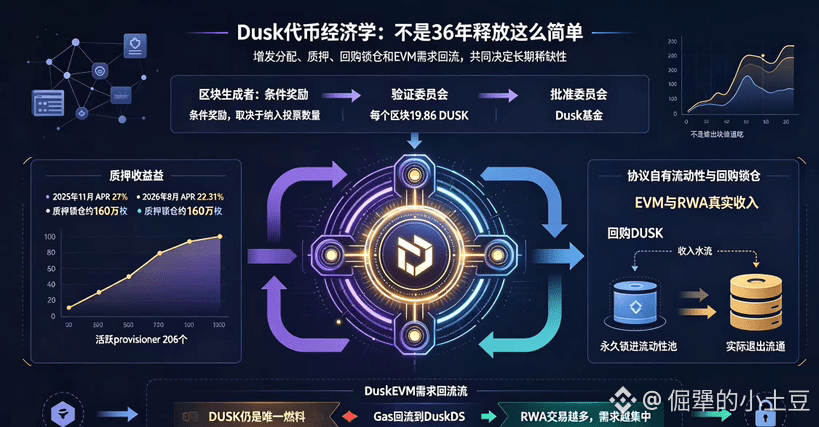
Each block produces a fixed 19.86 DUSK. The number itself isn’t the point—the distribution ratio is. Most of the rewards go to the block producer, but note that some of it is conditional: it depends on how many votes you can incorporate as much as possible. In other words, you don’t get the full amount just by producing blocks—you have to do the work seriously.
The validation committee and the approval committee each take a portion, and the Dusk Foundation takes a portion too. This reward scheme splits incentives into three parts—those who do the work, those who confirm, and the protocol’s long-term reserves—rather than a simple “whoever produces blocks gets everything.”
Now let’s look at staking returns. As of November 2025, the APR is still around 27%, but by August 2026 it has dropped to 22.31%. About 1.6 million DUSK are locked in the staking pool, and there are 206 active provisioners. The decline in APR has two layers: first, more people have joined and are sharing the same pot; second, the network may be genuinely maturing. That early phase of “stake and earn 27% just for holding” is fading.
After DuskEVM goes live, there’s another easily overlooked detail: no separate Gas token is introduced. Many EVM-compatible chains issue a new Gas asset when they launch, but Dusk doesn’t. DUSK remains the only fuel, and the execution costs ultimately flow back to DuskDS. Any activity running on DuskEVM creates demand that funnels back to the same token—not splitting it into pieces.
The logic behind this design is quite clear. Inflationary incentives encourage early participation, but the issuance itself decays geometrically. At the same time, real income is used to buy back and lock tokens, counteracting the dilutive effect of inflation. Add to that the demand for capturing the entire ecosystem with the token—RWA asset issuance and trading increase the need for Gas and validation, which increases node staking rewards, which means more tokens are locked and less circulates.
Of course, whether this all truly works depends on whether DuskEVM can generate enough real transaction volume. If the chain has little actual usage, there’s nothing to buy back, and any deflationary effect is just a nice assumption. But at least from the design perspective, it isn’t a “just issue, never collect” kind of careless model.
#dusk $DUSK @Dusk
Each block produces a fixed 19.86 DUSK. The number itself isn’t the point—the distribution ratio is. Most of the rewards go to the block producer, but note that some of it is conditional: it depends on how many votes you can incorporate as much as possible. In other words, you don’t get the full amount just by producing blocks—you have to do the work seriously.
The validation committee and the approval committee each take a portion, and the Dusk Foundation takes a portion too. This reward scheme splits incentives into three parts—those who do the work, those who confirm, and the protocol’s long-term reserves—rather than a simple “whoever produces blocks gets everything.”
Now let’s look at staking returns. As of November 2025, the APR is still around 27%, but by August 2026 it has dropped to 22.31%. About 1.6 million DUSK are locked in the staking pool, and there are 206 active provisioners. The decline in APR has two layers: first, more people have joined and are sharing the same pot; second, the network may be genuinely maturing. That early phase of “stake and earn 27% just for holding” is fading.
After DuskEVM goes live, there’s another easily overlooked detail: no separate Gas token is introduced. Many EVM-compatible chains issue a new Gas asset when they launch, but Dusk doesn’t. DUSK remains the only fuel, and the execution costs ultimately flow back to DuskDS. Any activity running on DuskEVM creates demand that funnels back to the same token—not splitting it into pieces.
The logic behind this design is quite clear. Inflationary incentives encourage early participation, but the issuance itself decays geometrically. At the same time, real income is used to buy back and lock tokens, counteracting the dilutive effect of inflation. Add to that the demand for capturing the entire ecosystem with the token—RWA asset issuance and trading increase the need for Gas and validation, which increases node staking rewards, which means more tokens are locked and less circulates.
Of course, whether this all truly works depends on whether DuskEVM can generate enough real transaction volume. If the chain has little actual usage, there’s nothing to buy back, and any deflationary effect is just a nice assumption. But at least from the design perspective, it isn’t a “just issue, never collect” kind of careless model.
#dusk $DUSK @Dusk