Dusk—at first I didn’t take this project very seriously. It wasn’t until the big spike when the mainnet launched earlier this year that I went back and looked through its technical documentation carefully.
Let’s talk about what makes it different from most other privacy coins.
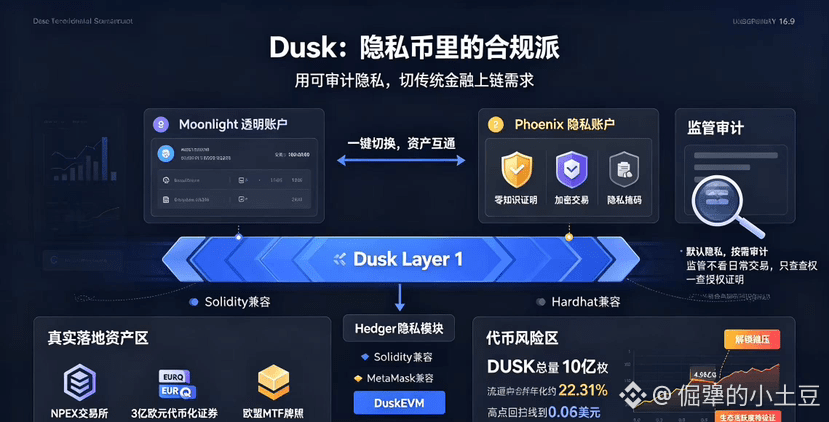
The logic of most privacy coins out there is: encrypt everything, and don’t let anyone see anything. Dusk doesn’t go that route. Its core design is called “auditable privacy.” It uses zero-knowledge proofs to encrypt transaction details, but at the same time leaves regulators a key for compliant audits. In the whitepaper, they call it “default privacy, audits on demand.” In plain terms: everyday transactions are invisible to others, but when regulators need to check, you can provide a compliance proof instead of fighting back.
To achieve this balance, Dusk uses a dual-account model. Moonlight manages the transparent account, while Phoenix manages the privacy account. You can switch with a single click, and assets are interoperable across the two sides. The design is pretty pragmatic: fully anonymous on-chain exchanges don’t dare to integrate, fully transparent on-chain institutions don’t want to use it—so Dusk sits in that middle ground.
On January 7, 2026, the mainnet officially went live, with DuskEVM launched in sync. Developers can deploy Solidity contracts directly, compatible with mainstream tools like MetaMask and Hardhat. The Hedger module is responsible for adding
There are 1 billion DUSK in total supply; currently about 496 million are in circulation. Annualized staking yields have dropped from roughly 27% in November 2025 to about 22.31% recently. After the mainnet launched in January 2026, DUSK surged more than 240% within a week, with a monthly gain close to 470%. Daily trading volume briefly exceeded $200 million. As of early August, the price has been fluctuating around $0.06, with a market cap under $30 million. The pullback from the highs has been quite large—early profit-taking has been steadily realized.
We also need to lay out the risks clearly.
After the mainnet launch, the ecosystem applications have indeed been a bit cold; on-chain transaction volume isn’t that high. Ongoing token unlocks are creating real selling pressure. And the privacy sector is highly competitive—old players like Monero and Zcash already have their scale.
Dusk solves a real problem: traditional finance wants to go on-chain, but it’s been hard to find a balance between privacy and compliance. NPEX’s collaboration proof shows that this isn’t just empty talk. But from this position, it’s still too early to call it a bottom play, and it’s also too early to give up. I’ll keep watching the real transaction volume and user retention data after the mainnet proves stable operation.
#dusk $DUSK @Dusk
Let’s talk about what makes it different from most other privacy coins.
The logic of most privacy coins out there is: encrypt everything, and don’t let anyone see anything. Dusk doesn’t go that route. Its core design is called “auditable privacy.” It uses zero-knowledge proofs to encrypt transaction details, but at the same time leaves regulators a key for compliant audits. In the whitepaper, they call it “default privacy, audits on demand.” In plain terms: everyday transactions are invisible to others, but when regulators need to check, you can provide a compliance proof instead of fighting back.
To achieve this balance, Dusk uses a dual-account model. Moonlight manages the transparent account, while Phoenix manages the privacy account. You can switch with a single click, and assets are interoperable across the two sides. The design is pretty pragmatic: fully anonymous on-chain exchanges don’t dare to integrate, fully transparent on-chain institutions don’t want to use it—so Dusk sits in that middle ground.
On January 7, 2026, the mainnet officially went live, with DuskEVM launched in sync. Developers can deploy Solidity contracts directly, compatible with mainstream tools like MetaMask and Hardhat. The Hedger module is responsible for adding
There are 1 billion DUSK in total supply; currently about 496 million are in circulation. Annualized staking yields have dropped from roughly 27% in November 2025 to about 22.31% recently. After the mainnet launched in January 2026, DUSK surged more than 240% within a week, with a monthly gain close to 470%. Daily trading volume briefly exceeded $200 million. As of early August, the price has been fluctuating around $0.06, with a market cap under $30 million. The pullback from the highs has been quite large—early profit-taking has been steadily realized.
We also need to lay out the risks clearly.
After the mainnet launch, the ecosystem applications have indeed been a bit cold; on-chain transaction volume isn’t that high. Ongoing token unlocks are creating real selling pressure. And the privacy sector is highly competitive—old players like Monero and Zcash already have their scale.
Dusk solves a real problem: traditional finance wants to go on-chain, but it’s been hard to find a balance between privacy and compliance. NPEX’s collaboration proof shows that this isn’t just empty talk. But from this position, it’s still too early to call it a bottom play, and it’s also too early to give up. I’ll keep watching the real transaction volume and user retention data after the mainnet proves stable operation.
#dusk $DUSK @Dusk