Hyperstaking, at first glance, really does sound quite appealing.
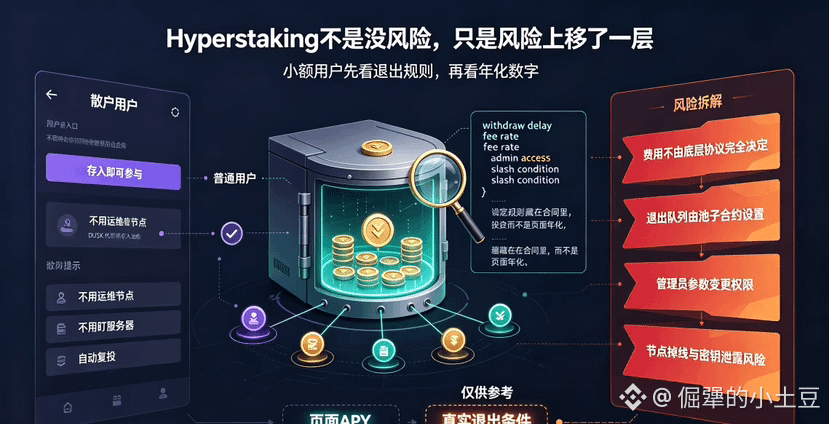
Even retail users who don’t run nodes can take part in staking. The Dusk Stake Abstraction documentation lays it out clearly: smart contracts handle everything for you—collecting your funds, staking them, and even re-staking (reinvesting) them—so small users don’t need to watch server uptime, and you don’t have to worry about penalties. The barrier has dropped from “you have to do your own operations” to “just deposit and you’re done.”
But the underlying risks haven’t disappeared—they’ve just been layered over.
The pool contract has its own rules—how fees are collected, when rewards are distributed, how long withdrawals must wait, whether administrators can change parameters—and these are no longer determined by Dusk’s underlying layer. Even if the protocol itself has no withdrawal waiting period, the pool can still set its own queue. In other words, your freedom to exit depends on what the pool’s contract code includes, not on what Dusk wrote.
There’s another issue that’s easy to overlook: the pool’s revenue source is, in essence, still one or several real nodes. Risks like node downtime, key leaks, or problems with contract callbacks don’t vanish just because the pool is managing it for you. It only shifts the risks from one place to another—from being carried by you alone to being shared by a group.
The annualized difference of one or two percentage points on a page may matter far less than the pool’s withdrawal conditions and the design of its permissions.
I’m not against staking pools. Without them, small users simply wouldn’t participate in network security. But “not having to run your own node” and “not having to worry about who is running the node” are two different things. Once the pools on Dusk publish contract audits, administrator permissions, fee formulas, and withdrawal processes, I’ll look again at the numbers. Until then, when I see which pool has the highest annualized figure, I’ll actually pay closer attention to whether there are any limitations hidden in its contract that I might not have noticed.
With $DUSK Hyperstaking, what you shouldn’t look at first isn’t which pool’s number is highest—it’s which one has written the risks and the exit process more clearly.
#dusk $DUSK @Dusk
Even retail users who don’t run nodes can take part in staking. The Dusk Stake Abstraction documentation lays it out clearly: smart contracts handle everything for you—collecting your funds, staking them, and even re-staking (reinvesting) them—so small users don’t need to watch server uptime, and you don’t have to worry about penalties. The barrier has dropped from “you have to do your own operations” to “just deposit and you’re done.”
But the underlying risks haven’t disappeared—they’ve just been layered over.
The pool contract has its own rules—how fees are collected, when rewards are distributed, how long withdrawals must wait, whether administrators can change parameters—and these are no longer determined by Dusk’s underlying layer. Even if the protocol itself has no withdrawal waiting period, the pool can still set its own queue. In other words, your freedom to exit depends on what the pool’s contract code includes, not on what Dusk wrote.
There’s another issue that’s easy to overlook: the pool’s revenue source is, in essence, still one or several real nodes. Risks like node downtime, key leaks, or problems with contract callbacks don’t vanish just because the pool is managing it for you. It only shifts the risks from one place to another—from being carried by you alone to being shared by a group.
The annualized difference of one or two percentage points on a page may matter far less than the pool’s withdrawal conditions and the design of its permissions.
I’m not against staking pools. Without them, small users simply wouldn’t participate in network security. But “not having to run your own node” and “not having to worry about who is running the node” are two different things. Once the pools on Dusk publish contract audits, administrator permissions, fee formulas, and withdrawal processes, I’ll look again at the numbers. Until then, when I see which pool has the highest annualized figure, I’ll actually pay closer attention to whether there are any limitations hidden in its contract that I might not have noticed.
With $DUSK Hyperstaking, what you shouldn’t look at first isn’t which pool’s number is highest—it’s which one has written the risks and the exit process more clearly.
#dusk $DUSK @Dusk