Binance Square
#bojraisesratesto31yearhigh

bojraisesratesto31yearhigh

Fatima_Tariq
·
--
Article
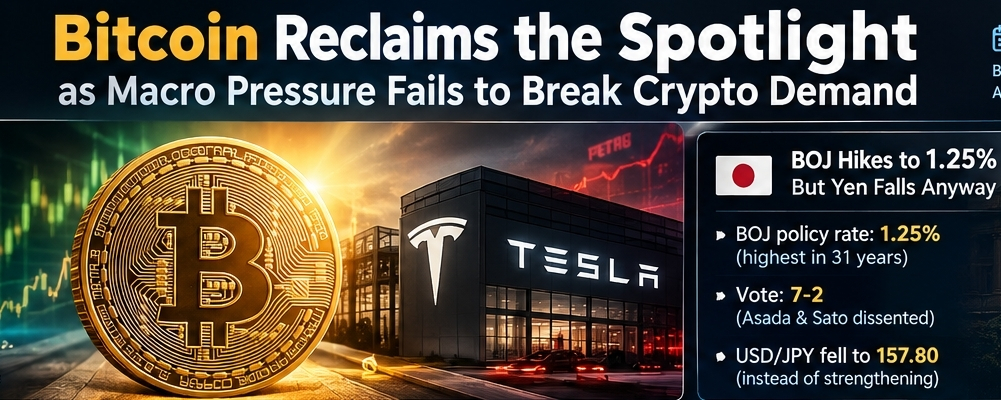
Bitcoin Reclaims the Spotlight as Macro Pressure Fails to Break Crypto DemandThe crypto market is entering the weekend with a very different setup from what the macro headlines suggested. On September 19, 2026, Bitcoin's market capitalization moved above $1.63 trillion, putting it ahead of Tesla's roughly $1.438 trillion market value by around $190 billion and returning Bitcoin to the top tier of global assets. BTC also gained roughly 5% over 24 hours, despite a week that delivered a U.S. rate hike, a Bank of Japan rate hike, elevated oil prices and another setback for U.S. crypto legislation. The more interesting question is not simply why Bitcoin went up. It is why demand remained intact while several traditional macro signals were pointing toward tighter financial conditions. Bitcoin Absorbed a Heavy Macro Week On September 16, the Federal Reserve raised its benchmark rate by 25 basis points to 3.75%-4.00%, the first U.S. rate increase since July 2023. The decision was unanimous at 12-0, while the latest projections indicated that policymakers see the possibility of another hike before the end of 2026. Normally, higher rates create pressure on speculative assets because the opportunity cost of holding riskier investments increases. Yet Bitcoin has remained relatively resilient. Blockware's Mitchell Askew has characterized the September price action as a form of seller exhaustion. BTC is reportedly down only around 1.5% during September, historically one of Bitcoin's weaker calendar months, despite the combination of tighter Fed policy, the failed CLARITY Act cloture vote, elevated energy prices and the BOJ decision. The technical level now matters more. Around 8% of Bitcoin's circulating supply was acquired between $80,000 and $82,000, creating a significant realized-price zone. At the same time, the 50-week moving average sits near $81,081. That puts the $80K-$82K area directly in focus. A sustained move above this region would change the technical structure considerably. Failure to reclaim it would leave the market facing another supply zone where holders may look to exit at breakeven or reduce exposure. Morgan Stanley's ETF Flow Is Quietly Becoming More Interesting One of the less dramatic but potentially more important developments is happening inside Bitcoin ETFs. Morgan Stanley's MSBT reportedly recorded approximately $51.5 million of net inflows across 20 consecutive sessions without a single outflow day, averaging roughly $2.6 million per session. The absolute number is small compared with the approximately $99.5 billion U.S. Bitcoin ETF complex, but the consistency is what deserves attention. The period included extremely volatile sessions, including approximately $731 million of single-day inflows and a $450 million single-day outflow across the broader market. Yet MSBT maintained its streak. That pattern can be consistent with scheduled or model-driven allocation rather than short-term discretionary trading. Morgan Stanley's wealth-management distribution gives that interpretation some context, although ETF flow data alone cannot prove the motivation behind individual purchases. The wider ETF picture is still mixed. U.S. Bitcoin ETFs remain approximately $1 billion negative year-to-date, despite roughly $3.52 billion of net inflows during August. There is also a substantial fee difference inside the sector. Grayscale's GBTC carries a reported 1.50% expense ratio, while BlackRock's IBIT is around 0.25%. That cost gap continues to influence where investors allocate within the ETF complex. So the ETF story is not simply "institutions are buying Bitcoin." It is becoming a more nuanced story of which investors are buying, through which vehicles, and whether the flows are strategic or tactical. The BOJ Hiked — Yet the Yen Fell The Bank of Japan added another unusual macro signal on September 18. The BOJ raised its policy rate by 25 basis points to 1.25%, the highest level in roughly 31 years, with the decision passing 7-2. Board members Toichiro Asada and Ayano Sato dissented. Instead of strengthening, however, the yen weakened sharply, with USD/JPY moving above 157 and reaching around 157.80 in the session. That reaction matters for global liquidity. A rate hike would normally be expected to support the currency. But markets had largely anticipated the move, while the dissenting votes and lack of a firm signal for additional tightening reduced expectations for an aggressive BOJ tightening cycle. The result was continued pressure on the yen. For risk assets, this creates an important distinction. A higher Japanese policy rate does not automatically mean global liquidity is tightening immediately. If the yen remains weak, the incentive to borrow yen and deploy capital into higher-yielding assets can remain relevant. That does not mean a carry-trade unwind cannot happen. It means the September 18 BOJ decision did not deliver the clean risk-off signal that a conventional rate-hike narrative might suggest. Altcoin ETF Competition Is Moving to the Next Stage While Bitcoin continues to dominate institutional attention, the ETF race is expanding. On September 18, 21Shares filed an amended Form S-1 for its proposed 21Shares Injective ETF, adding another altcoin to the growing list of potential U.S. exchange-traded products. The SEC filing confirms that the product is a registration filing, not an approval or guarantee that the ETF will launch. Injective is particularly interesting because staking adds another dimension to the investment thesis. The supplied market data puts INJ's market capitalization around $488 million, while reported 2025 staking yields ranged roughly from 9.3% to 13.62% annually. If an investment product eventually provides regulated exposure while incorporating staking economics, it could create a structure that differs materially from traditional equity ETFs. But the regulatory process still matters. An S-1/A is not an approval. Custody, operational structure, staking treatment and other regulatory considerations still need to be resolved before an actual product can begin trading. And Injective is not alone. The broader filing race now includes products linked to assets such as SOL, XRP, LTC, ADA and DeFi tokens. The market is moving from the question of whether crypto belongs inside regulated investment products to a more competitive question: Which crypto assets will receive that institutional wrapper next? XRP's Supply Picture Is Moving in the Opposite Direction XRP is showing another interesting divergence. On September 17, U.S. spot XRP ETFs recorded approximately $5.15 million in net outflows. Yet the products remained around $9.60 million positive for the week, meaning the weekly inflow streak could potentially reach ten consecutive weeks depending on the final session. More interesting is the exchange-reserve data. XRP held on exchanges reportedly fell to around 1.7 billion XRP, a seven-year low. Lower exchange balances can mean less immediately available supply for spot selling, although exchange reserves alone should never be treated as proof of future price direction. At the same time, CME XRP futures' share of activity reportedly increased from around 10% in mid-August to 17%, suggesting greater participation through regulated derivatives markets. That creates a mixed but important picture: ETF flows show a temporary withdrawal, while exchange balances show declining immediately available supply. Those two signals need to be watched together rather than interpreting either one in isolation. The Bigger Market Signal Put all of these developments together and the current crypto market looks less like a simple risk-on rally and more like a market absorbing multiple conflicting forces. The Fed has returned to rate hikes. The BOJ has moved its policy rate to 1.25%. The yen is still weak around 157-158 per dollar. U.S. Bitcoin ETFs have a mixed year-to-date flow picture. Bitcoin has nevertheless pushed its market capitalization above $1.63 trillion. Morgan Stanley's MSBT has recorded 20 consecutive sessions without an outflow day. XRP exchange reserves have reached a seven-year low. And the U.S. ETF pipeline is expanding beyond Bitcoin and Ethereum toward assets such as Injective. The headline is therefore bigger than Bitcoin simply beating Tesla's market cap. The real story is that crypto demand is continuing to develop underneath a much more complicated macro environment. For Bitcoin, the next major technical test remains the $80,000-$82,000 zone and the $81,081 50-week moving average. For the broader market, the more important developments may be the persistence of institutional ETF flows, the direction of global liquidity and whether the growing altcoin ETF pipeline turns registration filings into actual approved products. The next phase of the market may not be defined by one headline. It may be defined by capital quietly moving through several different channels at the same time. #BOJRaisesRatesTo31YearHigh #Bitcoin #LearnWithFatima #Etherium #Xrp🔥🔥 $BTC {future}(BTCUSDT) $ETH {future}(ETHUSDT) $XRP {future}(XRPUSDT)

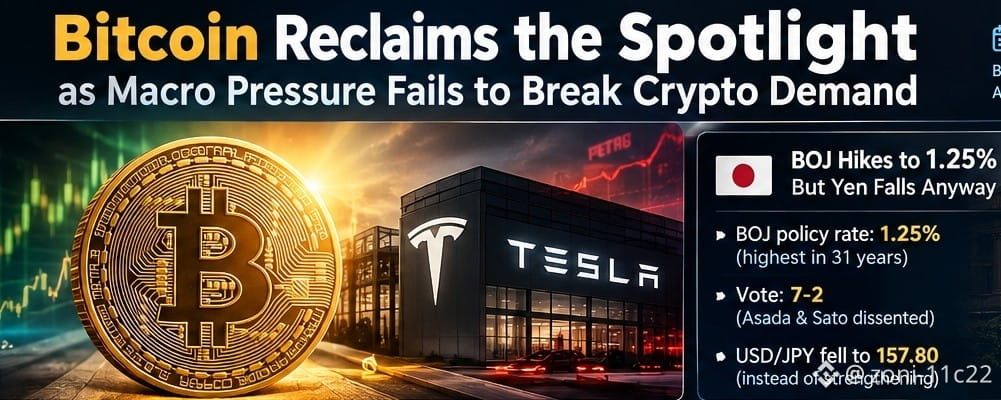
Bitcoin Reclaims the Spotlight as Macro Pressure Fails to Break Crypto Demand

The crypto market is entering the weekend with a very different setup from what the macro headlines suggested.
On September 19, 2026, Bitcoin's market capitalization moved above $1.63 trillion, putting it ahead of Tesla's roughly $1.438 trillion market value by around $190 billion and returning Bitcoin to the top tier of global assets. BTC also gained roughly 5% over 24 hours, despite a week that delivered a U.S. rate hike, a Bank of Japan rate hike, elevated oil prices and another setback for U.S. crypto legislation.
The more interesting question is not simply why Bitcoin went up.
It is why demand remained intact while several traditional macro signals were pointing toward tighter financial conditions.
Bitcoin Absorbed a Heavy Macro Week
On September 16, the Federal Reserve raised its benchmark rate by 25 basis points to 3.75%-4.00%, the first U.S. rate increase since July 2023. The decision was unanimous at 12-0, while the latest projections indicated that policymakers see the possibility of another hike before the end of 2026.
Normally, higher rates create pressure on speculative assets because the opportunity cost of holding riskier investments increases.
Yet Bitcoin has remained relatively resilient.
Blockware's Mitchell Askew has characterized the September price action as a form of seller exhaustion. BTC is reportedly down only around 1.5% during September, historically one of Bitcoin's weaker calendar months, despite the combination of tighter Fed policy, the failed CLARITY Act cloture vote, elevated energy prices and the BOJ decision.
The technical level now matters more.
Around 8% of Bitcoin's circulating supply was acquired between $80,000 and $82,000, creating a significant realized-price zone. At the same time, the 50-week moving average sits near $81,081.
That puts the $80K-$82K area directly in focus.
A sustained move above this region would change the technical structure considerably. Failure to reclaim it would leave the market facing another supply zone where holders may look to exit at breakeven or reduce exposure.
Morgan Stanley's ETF Flow Is Quietly Becoming More Interesting
One of the less dramatic but potentially more important developments is happening inside Bitcoin ETFs.
Morgan Stanley's MSBT reportedly recorded approximately $51.5 million of net inflows across 20 consecutive sessions without a single outflow day, averaging roughly $2.6 million per session.
The absolute number is small compared with the approximately $99.5 billion U.S. Bitcoin ETF complex, but the consistency is what deserves attention.
The period included extremely volatile sessions, including approximately $731 million of single-day inflows and a $450 million single-day outflow across the broader market.
Yet MSBT maintained its streak.
That pattern can be consistent with scheduled or model-driven allocation rather than short-term discretionary trading. Morgan Stanley's wealth-management distribution gives that interpretation some context, although ETF flow data alone cannot prove the motivation behind individual purchases.
The wider ETF picture is still mixed. U.S. Bitcoin ETFs remain approximately $1 billion negative year-to-date, despite roughly $3.52 billion of net inflows during August.
There is also a substantial fee difference inside the sector. Grayscale's GBTC carries a reported 1.50% expense ratio, while BlackRock's IBIT is around 0.25%. That cost gap continues to influence where investors allocate within the ETF complex.
So the ETF story is not simply "institutions are buying Bitcoin."
It is becoming a more nuanced story of which investors are buying, through which vehicles, and whether the flows are strategic or tactical.
The BOJ Hiked — Yet the Yen Fell
The Bank of Japan added another unusual macro signal on September 18.
The BOJ raised its policy rate by 25 basis points to 1.25%, the highest level in roughly 31 years, with the decision passing 7-2. Board members Toichiro Asada and Ayano Sato dissented.
Instead of strengthening, however, the yen weakened sharply, with USD/JPY moving above 157 and reaching around 157.80 in the session.
That reaction matters for global liquidity.
A rate hike would normally be expected to support the currency. But markets had largely anticipated the move, while the dissenting votes and lack of a firm signal for additional tightening reduced expectations for an aggressive BOJ tightening cycle. The result was continued pressure on the yen.
For risk assets, this creates an important distinction.
A higher Japanese policy rate does not automatically mean global liquidity is tightening immediately. If the yen remains weak, the incentive to borrow yen and deploy capital into higher-yielding assets can remain relevant.
That does not mean a carry-trade unwind cannot happen. It means the September 18 BOJ decision did not deliver the clean risk-off signal that a conventional rate-hike narrative might suggest.
Altcoin ETF Competition Is Moving to the Next Stage
While Bitcoin continues to dominate institutional attention, the ETF race is expanding.
On September 18, 21Shares filed an amended Form S-1 for its proposed 21Shares Injective ETF, adding another altcoin to the growing list of potential U.S. exchange-traded products. The SEC filing confirms that the product is a registration filing, not an approval or guarantee that the ETF will launch.
Injective is particularly interesting because staking adds another dimension to the investment thesis.
The supplied market data puts INJ's market capitalization around $488 million, while reported 2025 staking yields ranged roughly from 9.3% to 13.62% annually.
If an investment product eventually provides regulated exposure while incorporating staking economics, it could create a structure that differs materially from traditional equity ETFs.
But the regulatory process still matters.
An S-1/A is not an approval. Custody, operational structure, staking treatment and other regulatory considerations still need to be resolved before an actual product can begin trading.
And Injective is not alone. The broader filing race now includes products linked to assets such as SOL, XRP, LTC, ADA and DeFi tokens.
The market is moving from the question of whether crypto belongs inside regulated investment products to a more competitive question:
Which crypto assets will receive that institutional wrapper next?
XRP's Supply Picture Is Moving in the Opposite Direction
XRP is showing another interesting divergence.
On September 17, U.S. spot XRP ETFs recorded approximately $5.15 million in net outflows. Yet the products remained around $9.60 million positive for the week, meaning the weekly inflow streak could potentially reach ten consecutive weeks depending on the final session.
More interesting is the exchange-reserve data.
XRP held on exchanges reportedly fell to around 1.7 billion XRP, a seven-year low.
Lower exchange balances can mean less immediately available supply for spot selling, although exchange reserves alone should never be treated as proof of future price direction.
At the same time, CME XRP futures' share of activity reportedly increased from around 10% in mid-August to 17%, suggesting greater participation through regulated derivatives markets.
That creates a mixed but important picture:
ETF flows show a temporary withdrawal, while exchange balances show declining immediately available supply.
Those two signals need to be watched together rather than interpreting either one in isolation.
The Bigger Market Signal
Put all of these developments together and the current crypto market looks less like a simple risk-on rally and more like a market absorbing multiple conflicting forces.
The Fed has returned to rate hikes.
The BOJ has moved its policy rate to 1.25%.
The yen is still weak around 157-158 per dollar.
U.S. Bitcoin ETFs have a mixed year-to-date flow picture.
Bitcoin has nevertheless pushed its market capitalization above $1.63 trillion.
Morgan Stanley's MSBT has recorded 20 consecutive sessions without an outflow day.
XRP exchange reserves have reached a seven-year low.
And the U.S. ETF pipeline is expanding beyond Bitcoin and Ethereum toward assets such as Injective.
The headline is therefore bigger than Bitcoin simply beating Tesla's market cap.
The real story is that crypto demand is continuing to develop underneath a much more complicated macro environment.
For Bitcoin, the next major technical test remains the $80,000-$82,000 zone and the $81,081 50-week moving average. For the broader market, the more important developments may be the persistence of institutional ETF flows, the direction of global liquidity and whether the growing altcoin ETF pipeline turns registration filings into actual approved products.
The next phase of the market may not be defined by one headline.
It may be defined by capital quietly moving through several different channels at the same time.
#BOJRaisesRatesTo31YearHigh #Bitcoin #LearnWithFatima #Etherium #Xrp🔥🔥 $BTC
$ETH
$XRP
MR EJaz khan:
I followed like your post please follow me back
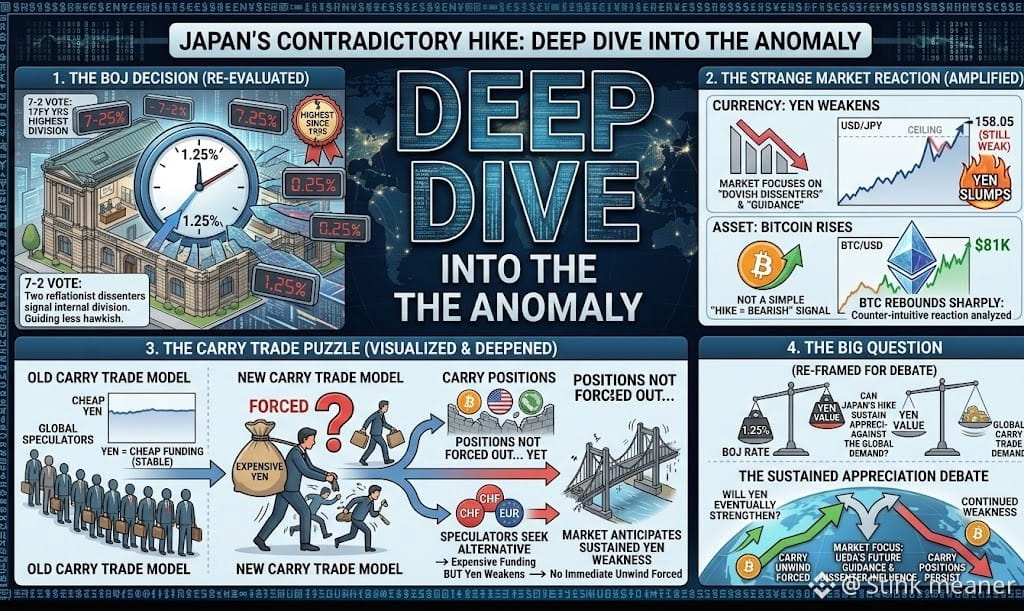
🚨BOJ's Strange Rate Hike... #bojraisesratesto31yearhigh Japan just raised rates to a 31-year high. The yen still weakened. That sounds contradictory — until you look at the carry trade. The BOJ raised its policy rate 25 bps to 1.25%, the highest since 1995, in a 7–2 vote. It was also the second hike in only three months. Yet USD/JPY jumped as high as 158.05 after the decision. Why? Markets focused on the two dissenting BOJ policymakers and judged the guidance less hawkish than expected. That matters far beyond Japan. The yen has been one of the world's major funding currencies for the carry trade — borrow cheaply in yen, deploy into higher-yielding assets elsewhere. So the real chain is: BOJ tightening → yen funding gets more expensive but: yen weakens → carry positions don't automatically get forced out And Bitcoin's reaction makes the picture even more interesting. BTC rebounded sharply after the BOJ decision, reaching around $81K according to Reuters. So today's signal isn't simply: “BOJ hikes = BTC bearish.” The bigger question is whether Japan's tightening eventually produces a sustained yen appreciation strong enough to force a larger carry-trade unwind. For now, the rate moved. The yen didn't follow. That's the part worth watching. $BTC $XRP {future}(BTCUSDT) #BTCBreaks80K #BTC #BinanceSquare #Write2Earn
🚨BOJ's Strange Rate Hike...
#bojraisesratesto31yearhigh

Japan just raised rates to a 31-year high. The yen still weakened.

That sounds contradictory — until you look at the carry trade.

The BOJ raised its policy rate 25 bps to 1.25%, the highest since 1995, in a 7–2 vote. It was also the second hike in only three months.
Yet USD/JPY jumped as high as 158.05 after the decision.

Why?
Markets focused on the two dissenting BOJ policymakers and judged the guidance less hawkish than expected.
That matters far beyond Japan.
The yen has been one of the world's major funding currencies for the carry trade — borrow cheaply in yen, deploy into higher-yielding assets elsewhere.

So the real chain is:
BOJ tightening → yen funding gets more expensive
but:
yen weakens → carry positions don't automatically get forced out
And Bitcoin's reaction makes the picture even more interesting.

BTC rebounded sharply after the BOJ decision, reaching around $81K according to Reuters.
So today's signal isn't simply:
“BOJ hikes = BTC bearish.”

The bigger question is whether Japan's tightening eventually produces a sustained yen appreciation strong enough to force a larger carry-trade unwind.

For now, the rate moved.
The yen didn't follow.
That's the part worth watching.
$BTC $XRP

#BTCBreaks80K #BTC #BinanceSquare #Write2Earn
·
--
Bearish
30D trade $BTC 65K USDT
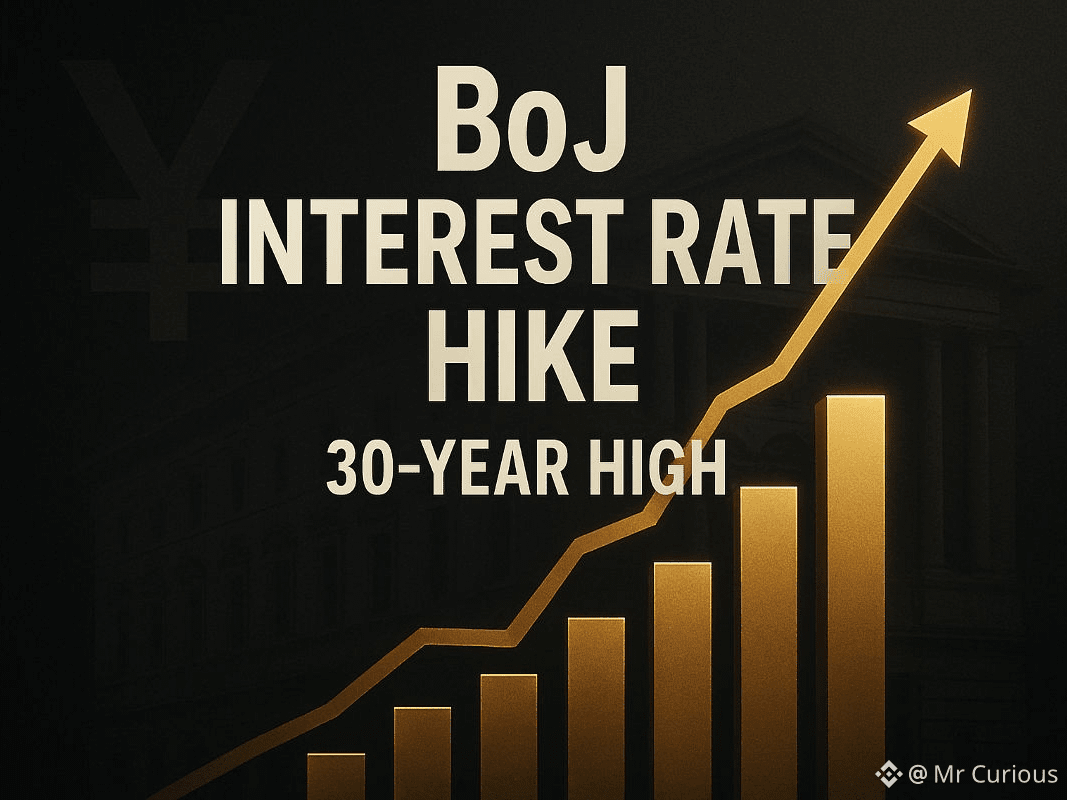
🩸 Why can a Japanese rate hike crash financial markets? Previously, investors could borrow yen cheaply from Japanese banks, convert it into other currencies, and invest across global markets — US Treasuries, stocks, bonds, T-bills, crypto, forex, and more. But when Japanese interest rates rise, borrowing costs increase and profit margins shrink. At the same time, uncertainty and currency risk increase. This can push investors to unwind some of their overseas positions and move capital back into Japan, strengthening the yen and potentially reducing inflation. That’s where the domino effect can begin — money flowing out of global markets can create selling pressure across different asset classes. And if the unwind becomes large enough, financial markets could feel the impact in the coming days. $BTC {future}(BTCUSDT) #BOJRaisesRatesTo31YearHigh
🩸 Why can a Japanese rate hike crash financial markets?

Previously, investors could borrow yen cheaply from Japanese banks, convert it into other currencies, and invest across global markets — US Treasuries, stocks, bonds, T-bills, crypto, forex, and more.

But when Japanese interest rates rise, borrowing costs increase and profit margins shrink. At the same time, uncertainty and currency risk increase.

This can push investors to unwind some of their overseas positions and move capital back into Japan, strengthening the yen and potentially reducing inflation.

That’s where the domino effect can begin — money flowing out of global markets can create selling pressure across different asset classes.

And if the unwind becomes large enough, financial markets could feel the impact in the coming days.

$BTC
#BOJRaisesRatesTo31YearHigh
Al acnoy:
Seit Jahren läuft so. 90% Investieren Japaner inder türkei das geld weil 39% Zinsen
·
--
Bullish
Verified
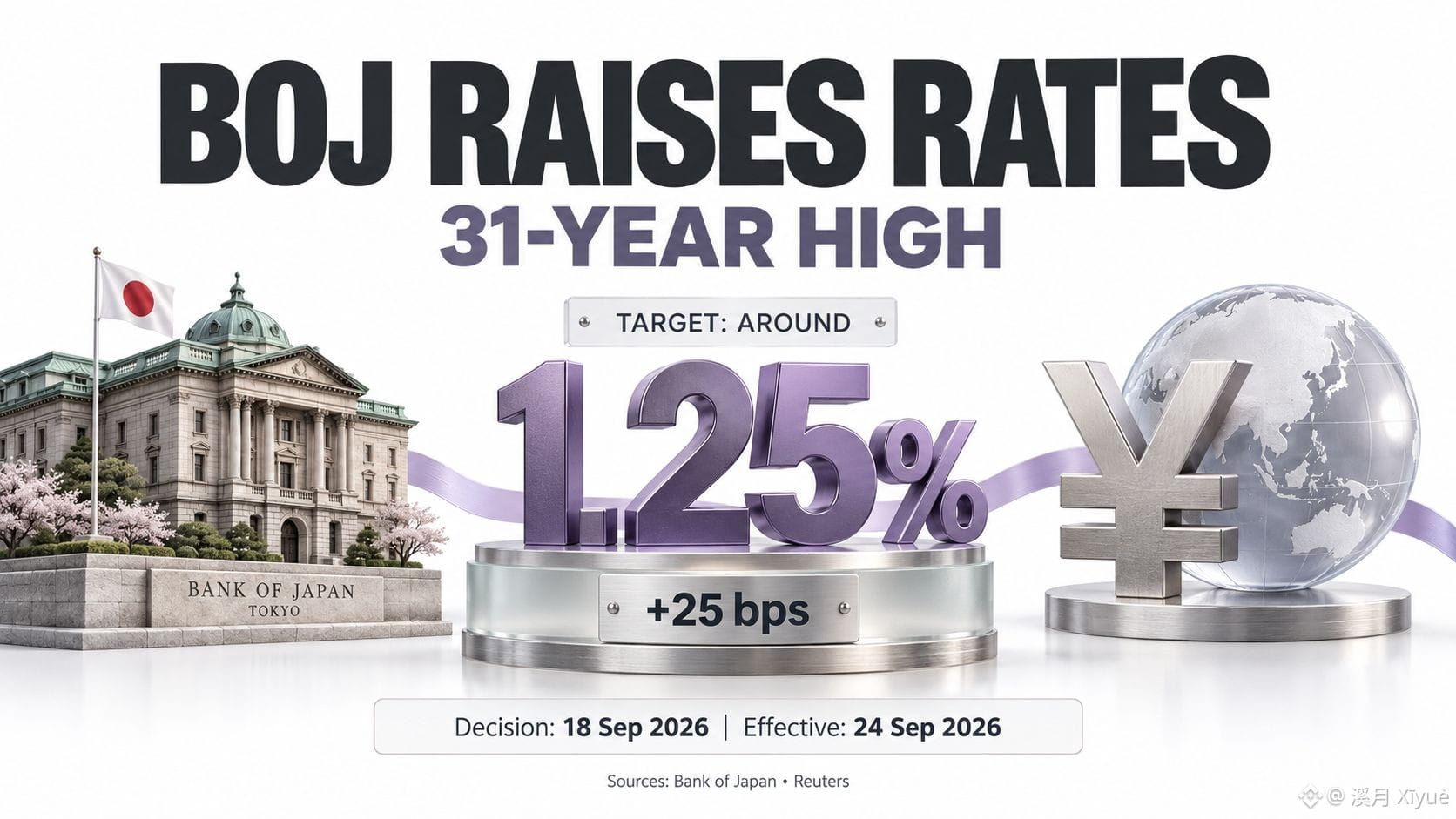
#bojraisesratesto31yearhigh BOJ Raises Rates to a 31-Year High — Why the Yen’s Reaction Matters Japan has approved another rate increase, putting borrowing costs and global funding conditions back in focus. On September 18, 2026, the Bank of Japan voted 7–2 to raise its short-term policy-rate target to around 1.25%, effective September 24. The decision brings the benchmark to its highest level in 31 years. Yet the yen weakened against the dollar afterward, as signals about further tightening fell short of market expectations. That reaction highlights how much the anticipated path of rates matters. My take: the potential global impact runs through funding costs, exchange rates and leverage. Investors borrowing yen to purchase other assets face greater pressure if borrowing becomes more expensive and the yen strengthens, increasing the cost of repaying those loans. However, an announced hike alone cannot establish that these positions are being unwound. The currency’s actual direction, the speed of any move and investors’ positioning all matter. For crypto, I would watch whether sharp yen appreciation coincides with weaker equities, reduced leverage and sustained selling in BTC or ETH. That combination would warrant closer scrutiny, although simultaneous moves would still require evidence before assigning a cause. What are you watching most closely after this decision: the yen, bond yields or crypto leverage? #BOJRaisesRatesTo31YearHigh #BankOfJapan #Macro $AKE $ONE $AR {future}(ARUSDT) {future}(ONEUSDT) {future}(AKEUSDT)
#bojraisesratesto31yearhigh
BOJ Raises Rates to a 31-Year High — Why the Yen’s Reaction Matters
Japan has approved another rate increase, putting borrowing costs and global funding conditions back in focus.
On September 18, 2026, the Bank of Japan voted 7–2 to raise its short-term policy-rate target to around 1.25%, effective September 24.
The decision brings the benchmark to its highest level in 31 years.
Yet the yen weakened against the dollar afterward, as signals about further tightening fell short of market expectations. That reaction highlights how much the anticipated path of rates matters.
My take: the potential global impact runs through funding costs, exchange rates and leverage. Investors borrowing yen to purchase other assets face greater pressure if borrowing becomes more expensive and the yen strengthens, increasing the cost of repaying those loans.
However, an announced hike alone cannot establish that these positions are being unwound. The currency’s actual direction, the speed of any move and investors’ positioning all matter.
For crypto, I would watch whether sharp yen appreciation coincides with weaker equities, reduced leverage and sustained selling in BTC or ETH. That combination would warrant closer scrutiny, although simultaneous moves would still require evidence before assigning a cause.
What are you watching most closely after this decision: the yen, bond yields or crypto leverage?
#BOJRaisesRatesTo31YearHigh #BankOfJapan #Macro
$AKE $ONE $AR
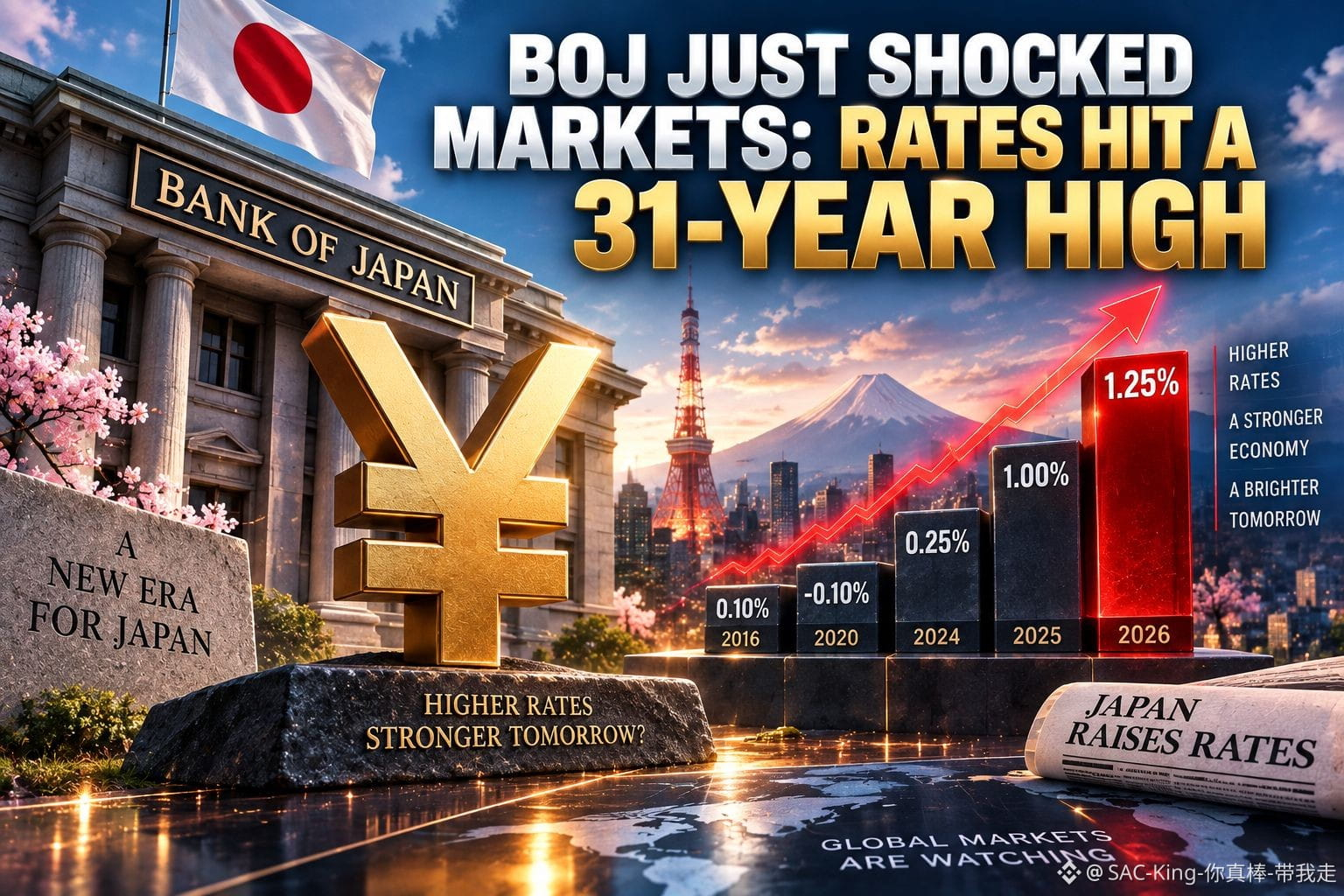
#bojraisesratesto31yearhigh 🌏 BOJ JUST SHOCKED MARKETS: RATES HIT A 31-YEAR HIGH 🌏 For decades, Japan was the land of cheap money. Now the tide is turning, and global capital is listening. The Bank of Japan raised its policy rate from 1% to 1.25%, the highest level since 1995. The 7-2 decision reflects growing concern that inflation could move above the BOJ’s 2% target. The bigger story is not the 25-basis-point hike itself. Japan is moving further away from the ultra-low-rate environment that made the yen a major global funding currency. My Take: This matters beyond Japan. Higher Japanese yields can gradually change where capital seeks returns, potentially affecting global bonds, currencies, equities and risk assets, including crypto. Yet the immediate reaction was unusual. Instead of strengthening, the yen weakened after the decision, partly because two policymakers opposed the hike and markets saw the move as less aggressive than some had expected. That distinction matters. A rate hike does not automatically mean tighter financial conditions everywhere overnight. The pace of future increases, inflation, oil prices and the yen’s response may matter more than this single decision. The era of effortless cheap money is slowly becoming a different story. ❓Could Japan’s tightening cycle become an overlooked driver of global crypto liquidity? Disclaimer: This is market analysis, not financial advice. #BOJ #CryptoMarket #GrowWithSAC $AR $G $STRK #BOJRaisesRatesTo31YearHigh
#bojraisesratesto31yearhigh
🌏 BOJ JUST SHOCKED MARKETS: RATES HIT A 31-YEAR HIGH 🌏

For decades, Japan was the land of cheap money.
Now the tide is turning, and global capital is listening.

The Bank of Japan raised its policy rate from 1% to 1.25%, the highest level since 1995. The 7-2 decision reflects growing concern that inflation could move above the BOJ’s 2% target.

The bigger story is not the 25-basis-point hike itself. Japan is moving further away from the ultra-low-rate environment that made the yen a major global funding currency.

My Take: This matters beyond Japan. Higher Japanese yields can gradually change where capital seeks returns, potentially affecting global bonds, currencies, equities and risk assets, including crypto.

Yet the immediate reaction was unusual. Instead of strengthening, the yen weakened after the decision, partly because two policymakers opposed the hike and markets saw the move as less aggressive than some had expected.

That distinction matters. A rate hike does not automatically mean tighter financial conditions everywhere overnight. The pace of future increases, inflation, oil prices and the yen’s response may matter more than this single decision.

The era of effortless cheap money is slowly becoming a different story.

❓Could Japan’s tightening cycle become an overlooked driver of global crypto liquidity?

Disclaimer: This is market analysis, not financial advice.

#BOJ #CryptoMarket #GrowWithSAC $AR $G $STRK
#BOJRaisesRatesTo31YearHigh
·
--
Bullish
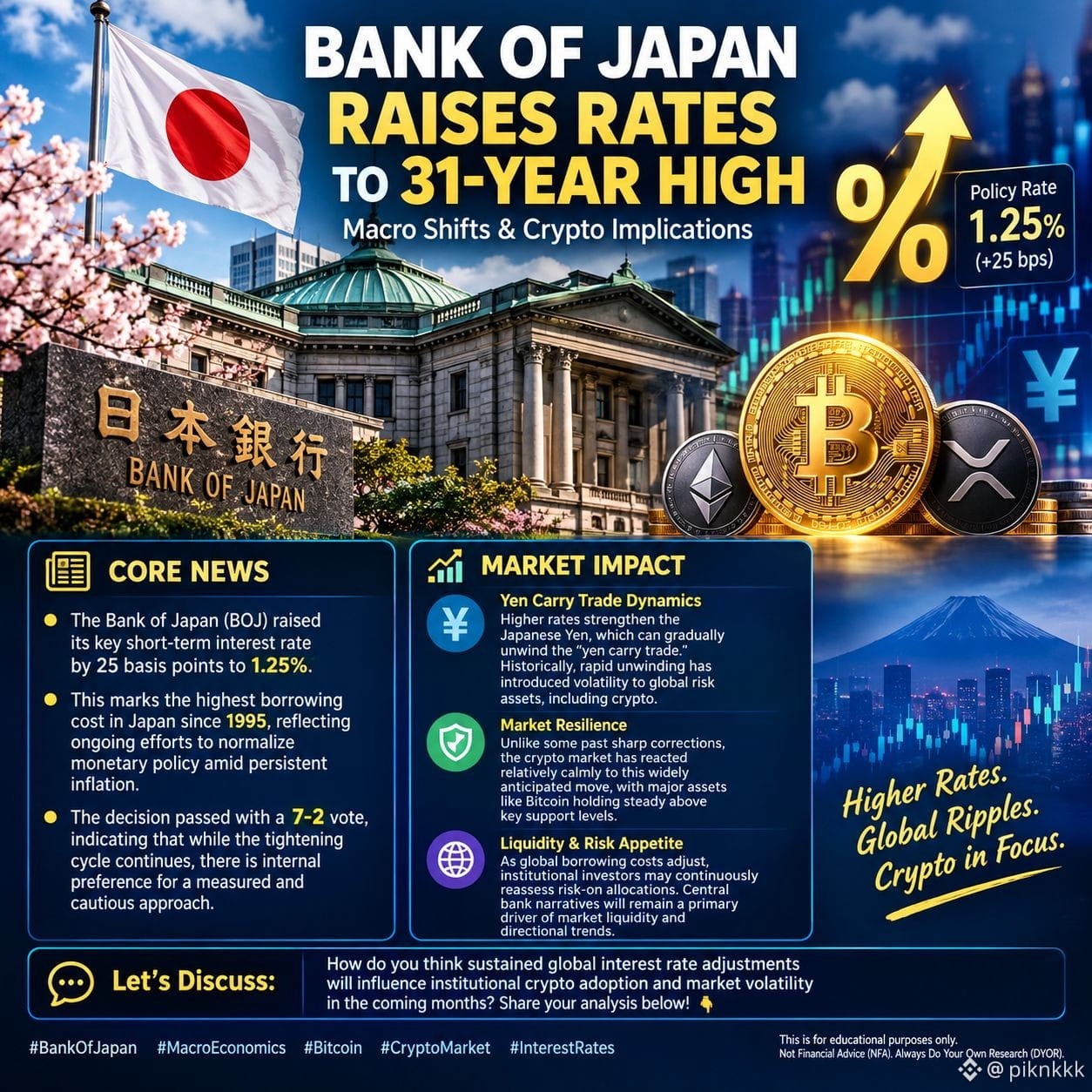
#bojraisesratesto31yearhigh 🏦 Bank of Japan Raises Rates to 31-Year High Macro Shifts & Crypto Implications The global macroeconomic landscape is shifting. The Bank of Japan has officially raised its policy rate to a 31-year high, sending calculated ripples across both traditional and digital asset markets. 📰 Core News • The Bank of Japan (BOJ) raised its key short-term interest rate by 25 basis points to 1.25% [13] • This marks the highest borrowing cost in Japan since 1995, reflecting ongoing efforts to normalize monetary policy amid persistent inflation [[1]]. • The decision passed with a 7-2 vote, indicating that while the tightening cycle continues, there is internal preference for a measured and cautious approach [[27]]. 📊 Market Impact • 💱Yen Carry Trade Dynamics Higher rates strengthen the Japanese Yen, which can gradually unwind the "yen carry trade." Historically, rapid unwinding has introduced volatility to global risk assets, including crypto [[14]]. • 🛡️Market Resilience Unlike some past sharp corrections, the crypto market has reacted relatively calmly to this widely anticipated move, with major assets like Bitcoin holding steady above key support levels [[30]]. • 🌐 Liquidity & Risk Appetite As global borrowing costs adjust, institutional investors may continuously reassess risk-on allocations. Central bank narratives will remain a primary driver of market liquidity and directional trends. 💬 Let’s Discuss How do you think sustained global interest rate adjustments will influence institutional crypto adoption and market volatility in the coming months? Share your analysis below! 👇 #BankOfJapan #MacroEconomics #Bitcoin #CryptoMarket #InterestRates This is for educational purposes only. Not Financial Advice (NFA). Always Do Your Own Research (DYOR). $XTZ $SYN $G {future}(GUSDT) {future}(SYNUSDT) {future}(XTZUSDT)
#bojraisesratesto31yearhigh 🏦 Bank of Japan Raises Rates to 31-Year High Macro Shifts & Crypto Implications

The global macroeconomic landscape is shifting. The Bank of Japan has officially raised its policy rate to a 31-year high, sending calculated ripples across both traditional and digital asset markets.

📰 Core News
• The Bank of Japan (BOJ) raised its key short-term interest rate by 25 basis points to 1.25% [13]
• This marks the highest borrowing cost in Japan since 1995, reflecting ongoing efforts to normalize monetary policy amid persistent inflation [[1]].
• The decision passed with a 7-2 vote, indicating that while the tightening cycle continues, there is internal preference for a measured and cautious approach [[27]].

📊 Market Impact
• 💱Yen Carry Trade Dynamics Higher rates strengthen the Japanese Yen, which can gradually unwind the "yen carry trade." Historically, rapid unwinding has introduced volatility to global risk assets, including crypto [[14]].
• 🛡️Market Resilience Unlike some past sharp corrections, the crypto market has reacted relatively calmly to this widely anticipated move, with major assets like Bitcoin holding steady above key support levels [[30]].
• 🌐 Liquidity & Risk Appetite As global borrowing costs adjust, institutional investors may continuously reassess risk-on allocations. Central bank narratives will remain a primary driver of market liquidity and directional trends.

💬 Let’s Discuss
How do you think sustained global interest rate adjustments will influence institutional crypto adoption and market volatility in the coming months? Share your analysis below! 👇

#BankOfJapan #MacroEconomics #Bitcoin #CryptoMarket #InterestRates

This is for educational purposes only. Not Financial Advice (NFA). Always Do Your Own Research (DYOR).
$XTZ $SYN $G
#bojraisesratesto31yearhigh 🌏 BOJ Raises Rates To 31-Year High: Why Crypto Traders Should Care 🌏 Tokyo wakes to a different financial landscape. A decision that once seemed almost unthinkable is now reality, and its consequences may travel far beyond Japan. The Bank of Japan raised its policy rate from 1.00% to 1.25%, the highest level in 31 years, as officials focus on preventing inflation from overshooting their 2% target. Yet the surprising part came next: the yen weakened after the decision. Two policymakers dissented, while investors viewed the guidance as less hawkish than expected. For crypto, the bigger story is liquidity. Japan has long been associated with exceptionally low borrowing costs, so higher rates can influence funding conditions, currency flows and global appetite for risk. But this is not automatically a bearish crypto signal. Markets react to the gap between expectations and reality, and this hike was widely anticipated. The real variable to watch is what comes next. If the BOJ continues tightening while other major central banks also lean restrictive, global liquidity could become more selective. My takeaway: the rate itself is only half the story. The future path of liquidity may matter far more. When cheap money starts disappearing, every market eventually asks the same question: who is still willing to take risk? ❓ Do you think further BOJ tightening would materially change crypto liquidity, or has the market already absorbed it? Disclaimer: This is educational content, not financial advice. Crypto markets remain highly volatile. #Crypto #GrowWithSAC $LSK $REZ $PROM #BOJRaisesRatesTo31YearHigh
#bojraisesratesto31yearhigh
🌏 BOJ Raises Rates To 31-Year High: Why Crypto Traders Should Care 🌏

Tokyo wakes to a different financial landscape. A decision that once seemed almost unthinkable is now reality, and its consequences may travel far beyond Japan.

The Bank of Japan raised its policy rate from 1.00% to 1.25%, the highest level in 31 years, as officials focus on preventing inflation from overshooting their 2% target.

Yet the surprising part came next: the yen weakened after the decision. Two policymakers dissented, while investors viewed the guidance as less hawkish than expected.

For crypto, the bigger story is liquidity. Japan has long been associated with exceptionally low borrowing costs, so higher rates can influence funding conditions, currency flows and global appetite for risk.

But this is not automatically a bearish crypto signal. Markets react to the gap between expectations and reality, and this hike was widely anticipated.

The real variable to watch is what comes next. If the BOJ continues tightening while other major central banks also lean restrictive, global liquidity could become more selective.

My takeaway: the rate itself is only half the story. The future path of liquidity may matter far more.

When cheap money starts disappearing, every market eventually asks the same question: who is still willing to take risk?

❓ Do you think further BOJ tightening would materially change crypto liquidity, or has the market already absorbed it?

Disclaimer: This is educational content, not financial advice. Crypto markets remain highly volatile.

#Crypto #GrowWithSAC $LSK $REZ $PROM
#BOJRaisesRatesTo31YearHigh
SAQR77:
مقال مفيد، أيتها الحسناء
·
--
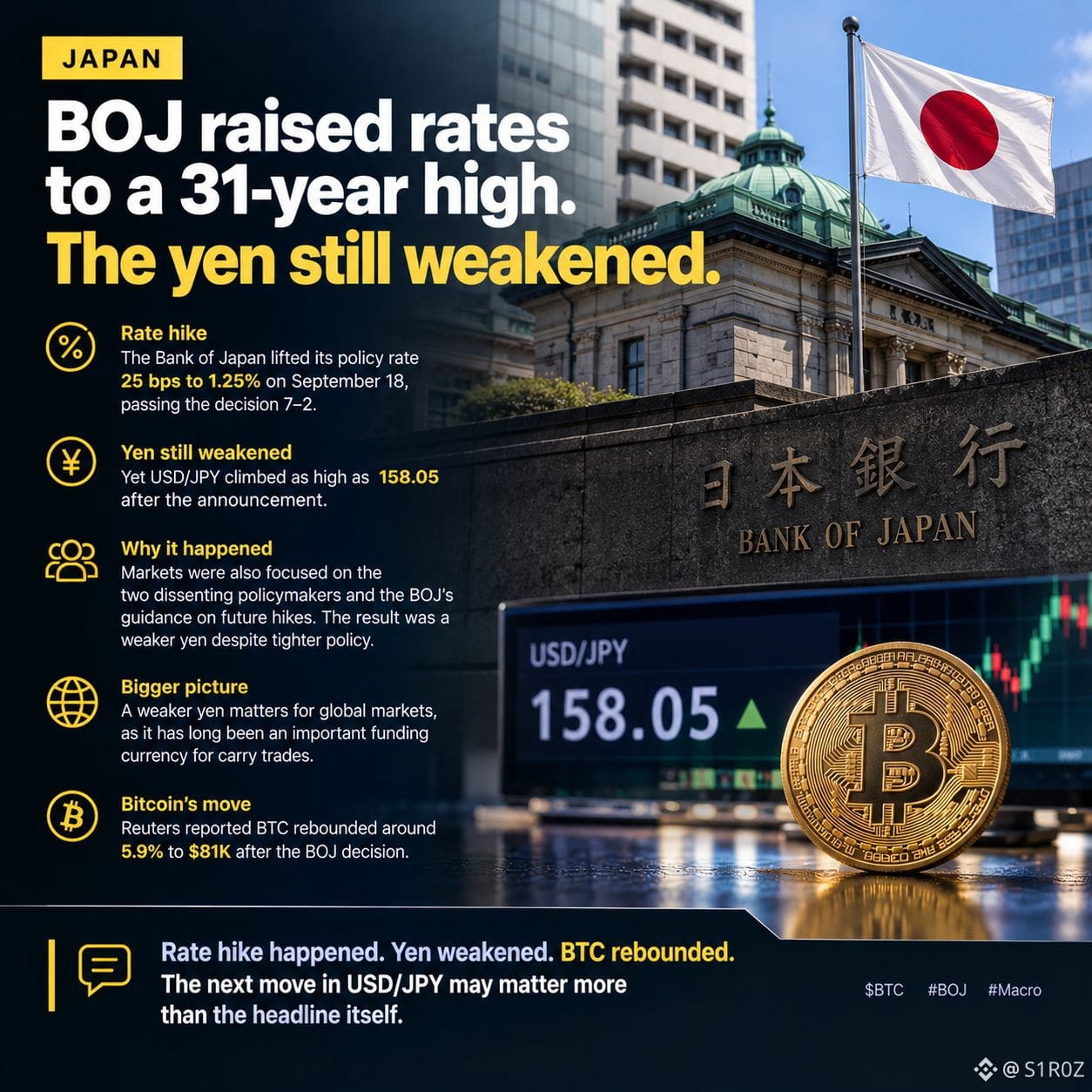
#bojraisesratesto31yearhigh 🇯🇵 BOJ raised rates to a 31-year high. The yen still weakened. The Bank of Japan lifted its policy rate 25 bps to 1.25% on September 18, passing the decision 7–2. Yet USD/JPY climbed as high as 158.05 after the announcement. At first, that looks contradictory. But markets were also focused on the two dissenting policymakers and the BOJ's guidance on future hikes. The result was a weaker yen despite tighter policy. That matters for global markets because the yen has long been an important funding currency for carry trades. And Bitcoin added another interesting signal: Reuters reported BTC rebounded around 5.9% to $81K after the BOJ decision. So the takeaway isn't simply “BOJ hikes = BTC bearish.” The bigger thing to watch is whether continued Japanese tightening eventually produces sustained yen strength and forces a broader carry-trade unwind. Rate hike happened. Yen weakened. BTC rebounded. The next move in USD/JPY may matter more than the headline itself. $BTC {spot}(BTCUSDT) #bitcoin #BoJ #Macro
#bojraisesratesto31yearhigh
🇯🇵 BOJ raised rates to a 31-year high. The yen still weakened.
The Bank of Japan lifted its policy rate 25 bps to 1.25% on September 18, passing the decision 7–2. Yet USD/JPY climbed as high as 158.05 after the announcement.

At first, that looks contradictory.
But markets were also focused on the two dissenting policymakers and the BOJ's guidance on future hikes. The result was a weaker yen despite tighter policy.

That matters for global markets because the yen has long been an important funding currency for carry trades.
And Bitcoin added another interesting signal: Reuters reported BTC rebounded around 5.9% to $81K after the BOJ decision.

So the takeaway isn't simply “BOJ hikes = BTC bearish.”
The bigger thing to watch is whether continued Japanese tightening eventually produces sustained yen strength and forces a broader carry-trade unwind.

Rate hike happened. Yen weakened. BTC rebounded. The next move in USD/JPY may matter more than the headline itself.

$BTC
#bitcoin #BoJ #Macro
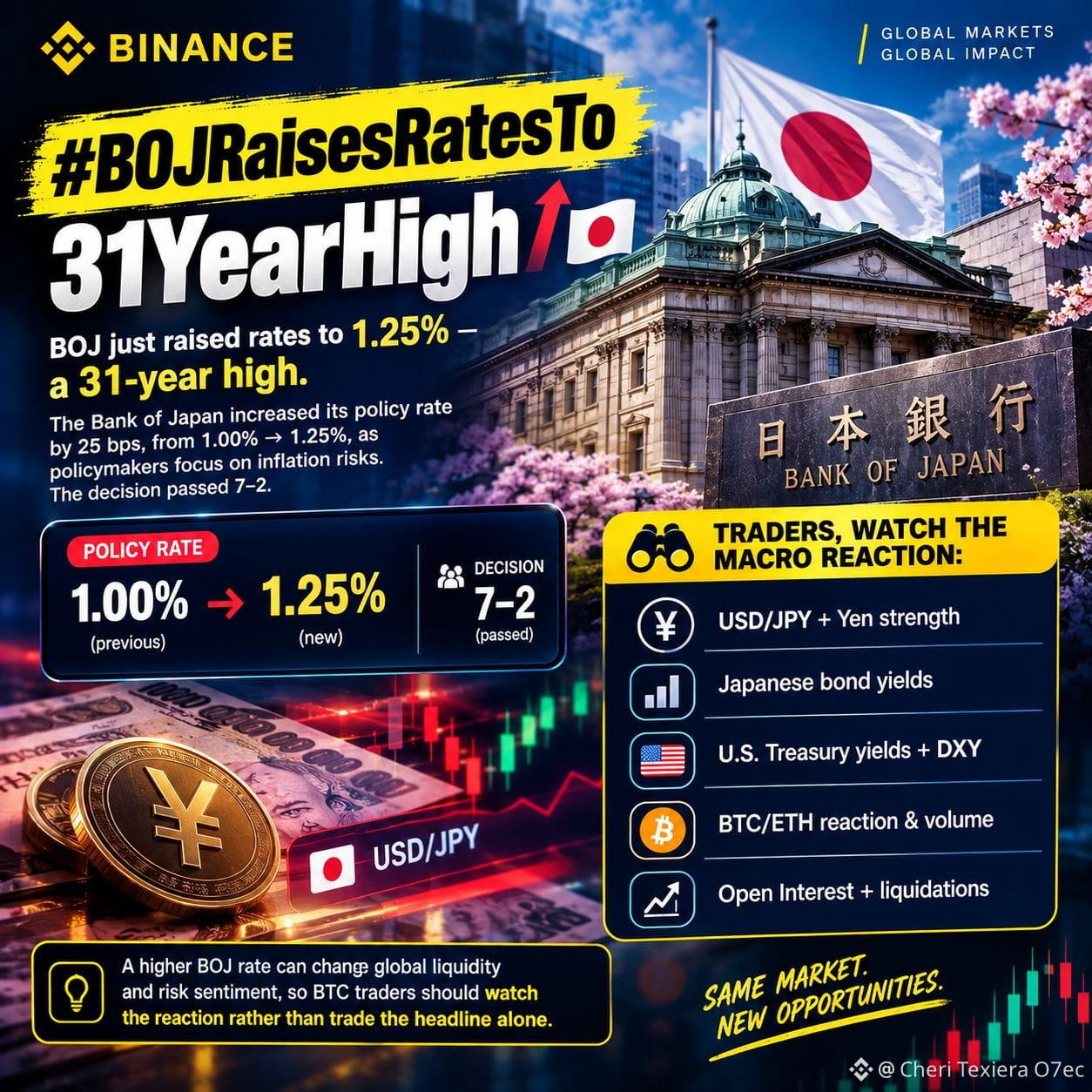
#BOJRaisesRatesTo31YearHigh BOJ just raised rates to 1.25% — a 31-year high. ⚠️ The Bank of Japan increased its policy rate by 25 bps, from 1.00% → 1.25%, as policymakers focus on inflation risks. The decision passed 7–2. 🔥 TRADERS, WATCH THE MACRO REACTION: 💴 USD/JPY + Yen strength 📊 Japanese bond yields 💵 U.S. Treasury yields + DXY ₿ BTC/ETH reaction & volume ⚡ Open Interest + liquidations A higher BOJ rate can change global liquidity and risk sentiment, so BTC traders should watch the reaction rather than trade the headline alone. $ONE $ZAMA $SYN {future}(SYNUSDT) {future}(ZAMAUSDT) {future}(ONEUSDT)
#BOJRaisesRatesTo31YearHigh
BOJ just raised rates to 1.25% — a 31-year high. ⚠️
The Bank of Japan increased its policy rate by 25 bps, from 1.00% → 1.25%, as policymakers focus on inflation risks. The decision passed 7–2.
🔥 TRADERS, WATCH THE MACRO REACTION:
💴 USD/JPY + Yen strength
📊 Japanese bond yields
💵 U.S. Treasury yields + DXY
₿ BTC/ETH reaction & volume
⚡ Open Interest + liquidations
A higher BOJ rate can change global liquidity and risk sentiment, so BTC traders should watch the reaction rather than trade the headline alone.

$ONE $ZAMA $SYN
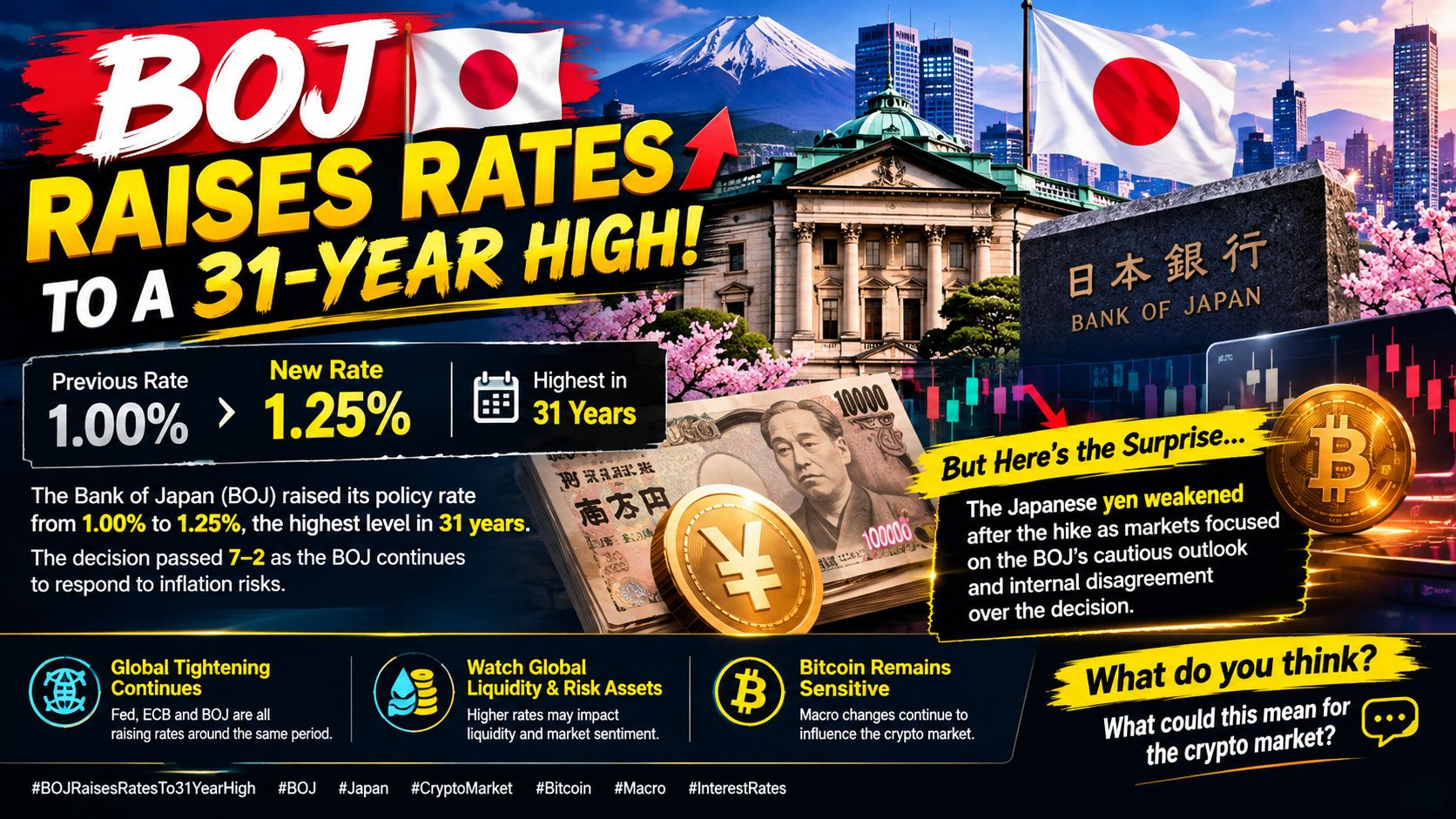
#BOJRaisesRatesTo31YearHigh 🚨 BOJ JUST RAISED RATES TO A 31-YEAR HIGH! 🇯🇵📈 Japan’s Bank of Japan (BOJ) raised its policy rate from 1.00% to 1.25%, the highest level in 31 years. The decision passed 7–2 as the BOJ continues to respond to inflation risks. � Reuters +1 🇯🇵 But here’s the surprising part: The Japanese yen weakened after the hike as markets focused on the BOJ’s cautious outlook and internal disagreement over the decision. � Reuters 🌍 With the Fed, ECB and BOJ all tightening policy around the same period, global liquidity and risk assets remain important areas to watch. ₿ Bitcoin also remains highly sensitive to the changing macro environment. What do you think this means for the crypto market? 👇 # BOJ #Japan #CryptoMarket #bitcoin #Macro #interestrates $BTC {spot}(BTCUSDT) $ETH {spot}(ETHUSDT) $AAPLB {spot}(AAPLBUSDT)
#BOJRaisesRatesTo31YearHigh

🚨 BOJ JUST RAISED RATES TO A 31-YEAR HIGH! 🇯🇵📈

Japan’s Bank of Japan (BOJ) raised its policy rate from 1.00% to 1.25%, the highest level in 31 years. The decision passed 7–2 as the BOJ continues to respond to inflation risks. �
Reuters +1

🇯🇵 But here’s the surprising part:
The Japanese yen weakened after the hike as markets focused on the BOJ’s cautious outlook and internal disagreement over the decision. �
Reuters

🌍 With the Fed, ECB and BOJ all tightening policy around the same period, global liquidity and risk assets remain important areas to watch.
₿ Bitcoin also remains highly sensitive to the changing macro environment.
What do you think this means for the crypto market? 👇
#
BOJ #Japan #CryptoMarket #bitcoin #Macro #interestrates $BTC
$ETH
$AAPLB
#BOJRaisesRatesTo31YearHigh BOJ Raises Rates to 31-Year High The Bank of Japan (BOJ) raised its benchmark policy rate from 1.00% to 1.25%, taking borrowing costs to their highest level in 31 years. The quarter-point increase was announced after the BOJ’s September 17–18 monetary policy meeting and passed by a 7–2 vote. The move marks another step in Japan’s gradual shift away from decades of ultra-loose monetary policy. BOJ Governor Kazuo Ueda said the central bank’s focus is increasingly on preventing inflation from exceeding its 2% target, as underlying price pressures approach that level. The decision could have broad implications for the yen, Japanese government bonds and global markets. Higher Japanese rates can also affect yen-funded investment strategies and global liquidity. Despite the hike, the yen weakened after the announcement, while Japan’s Nikkei 225 gained around 1.4%. Ueda indicated that further increases remain possible, but emphasized that the BOJ will monitor inflation, wages and economic conditions before deciding on its next move. Two of the nine board members opposed the latest increase, citing concerns about economic growth. The BOJ’s latest decision therefore signals a continued normalization of Japanese monetary policy while leaving the path of future rate increases dependent on incoming economic data.$NVDAB $AAPLB
#BOJRaisesRatesTo31YearHigh
BOJ Raises Rates to 31-Year High
The Bank of Japan (BOJ) raised its benchmark policy rate from 1.00% to 1.25%, taking borrowing costs to their highest level in 31 years. The quarter-point increase was announced after the BOJ’s September 17–18 monetary policy meeting and passed by a 7–2 vote.
The move marks another step in Japan’s gradual shift away from decades of ultra-loose monetary policy. BOJ Governor Kazuo Ueda said the central bank’s focus is increasingly on preventing inflation from exceeding its 2% target, as underlying price pressures approach that level.
The decision could have broad implications for the yen, Japanese government bonds and global markets. Higher Japanese rates can also affect yen-funded investment strategies and global liquidity. Despite the hike, the yen weakened after the announcement, while Japan’s Nikkei 225 gained around 1.4%.
Ueda indicated that further increases remain possible, but emphasized that the BOJ will monitor inflation, wages and economic conditions before deciding on its next move. Two of the nine board members opposed the latest increase, citing concerns about economic growth.
The BOJ’s latest decision therefore signals a continued normalization of Japanese monetary policy while leaving the path of future rate increases dependent on incoming economic data.$NVDAB $AAPLB
·
--
Bullish
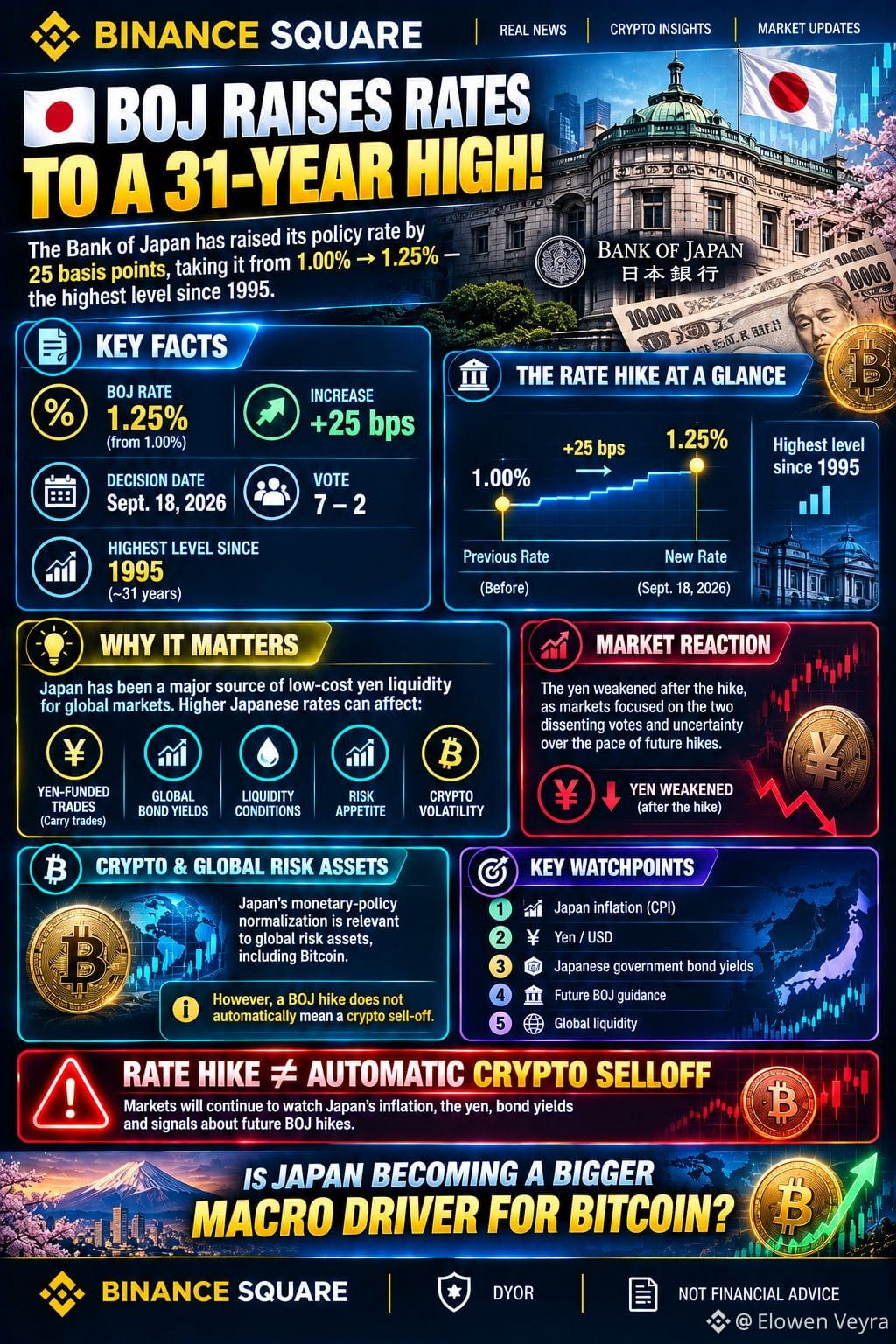
#BOJRaisesRatesTo31YearHigh 🚨🇯🇵 BOJ RAISES RATES TO A 31-YEAR HIGH! The Bank of Japan has raised its policy rate by 25 basis points, taking it from 1.00% → 1.25% — the highest level since 1995. 📈 🔹 BOJ rate: 1.25% 🔺 Increase: +25 bps 📅 Decision: Sept. 18, 2026 🗳️ Vote: 7–2 📊 Highest level: ~31 years 🔥 WHY IT MATTERS FOR MARKETS Japan has been a major source of low-cost yen liquidity for global markets. Higher Japanese rates can affect: ➡️ Yen-funded trades ➡️ Global bond yields ➡️ Liquidity conditions ➡️ Risk appetite ➡️ Crypto volatility 🇯🇵 Interestingly, the yen weakened after the hike, as markets focused on the two dissenting votes and the BOJ's future policy guidance. ⚠️ IMPORTANT: A rate hike does not automatically mean a crypto sell-off. Markets will continue watching Japan's inflation, the yen, bond yields and signals about future BOJ hikes. 👀 Japan's monetary policy is becoming an increasingly important macro factor for Bitcoin and global risk assets. $ONE $AR $ZAMA {future}(ONEUSDT) {future}(ARUSDT) {future}(ZAMAUSDT)
#BOJRaisesRatesTo31YearHigh
🚨🇯🇵 BOJ RAISES RATES TO A 31-YEAR HIGH!
The Bank of Japan has raised its policy rate by 25 basis points, taking it from 1.00% → 1.25% — the highest level since 1995. 📈
🔹 BOJ rate: 1.25%
🔺 Increase: +25 bps
📅 Decision: Sept. 18, 2026
🗳️ Vote: 7–2
📊 Highest level: ~31 years
🔥 WHY IT MATTERS FOR MARKETS
Japan has been a major source of low-cost yen liquidity for global markets.
Higher Japanese rates can affect:
➡️ Yen-funded trades
➡️ Global bond yields
➡️ Liquidity conditions
➡️ Risk appetite
➡️ Crypto volatility
🇯🇵 Interestingly, the yen weakened after the hike, as markets focused on the two dissenting votes and the BOJ's future policy guidance.
⚠️ IMPORTANT: A rate hike does not automatically mean a crypto sell-off. Markets will continue watching Japan's inflation, the yen, bond yields and signals about future BOJ hikes.
👀 Japan's monetary policy is becoming an increasingly important macro factor for Bitcoin and global risk assets.
$ONE $AR $ZAMA
⚡ Japan’s Interest Rates Just Hit a Historic Level The BOJ has raised its policy rate to 1.25%, the highest level in 31 years, as inflation risks remain a major concern. The central bank's decision was not unanimous, with two members voting against the increase. This is significant because Japan spent decades operating with exceptionally low interest rates. Now, the global market is adjusting to a very different monetary environment. The impact can extend through currencies, bonds and international capital flows before reaching risk assets such as cryptocurrencies. For $BTC traders, this means macroeconomic events deserve attention alongside technical levels. $ETH and $BNB may also be affected if global risk appetite shifts, while $SOL and $LINK remain part of the broader liquidity-sensitive crypto market. 🌐 The crypto market is global — and central-bank decisions in Tokyo can matter just as much as decisions in Washington or Frankfurt. #bojraisesratesto31yearhigh #BTC #BNB #bojraisesratesto31yearhigh
⚡ Japan’s Interest Rates Just Hit a Historic Level
The BOJ has raised its policy rate to 1.25%, the highest level in 31 years, as inflation risks remain a major concern. The central bank's decision was not unanimous, with two members voting against the increase.
This is significant because Japan spent decades operating with exceptionally low interest rates.
Now, the global market is adjusting to a very different monetary environment.
The impact can extend through currencies, bonds and international capital flows before reaching risk assets such as cryptocurrencies.
For $BTC traders, this means macroeconomic events deserve attention alongside technical levels.
$ETH and $BNB may also be affected if global risk appetite shifts, while $SOL and $LINK remain part of the broader liquidity-sensitive crypto market.
🌐 The crypto market is global — and central-bank decisions in Tokyo can matter just as much as decisions in Washington or Frankfurt.
#bojraisesratesto31yearhigh #BTC #BNB

#bojraisesratesto31yearhigh
·
--
Bank of Japan Raises Rates to 1.25% — 31-Year High and What It Means for Crypto 🇯🇵 #BOJRaisesRatesTo31YearHigh The Bank of Japan just raised its policy rate to 1.25%, the highest level in 31 years. The move was widely expected, but here's the interesting part: this is the second hike in just three months, breaking the BOJ's previous pattern of slower increases. The decision passed 7–2. For crypto traders, Japan's tightening matters because higher yen borrowing costs can affect global liquidity and risk appetite. But the key question isn't just today's hike. What matters now is whether the BOJ signals more increases ahead — and how markets react to them. Could continued Japanese tightening become another factor for $BTC and broader risk assets to watch? {spot}(BTCUSDT)
Bank of Japan Raises Rates to 1.25% — 31-Year High and What It Means for Crypto
🇯🇵 #BOJRaisesRatesTo31YearHigh
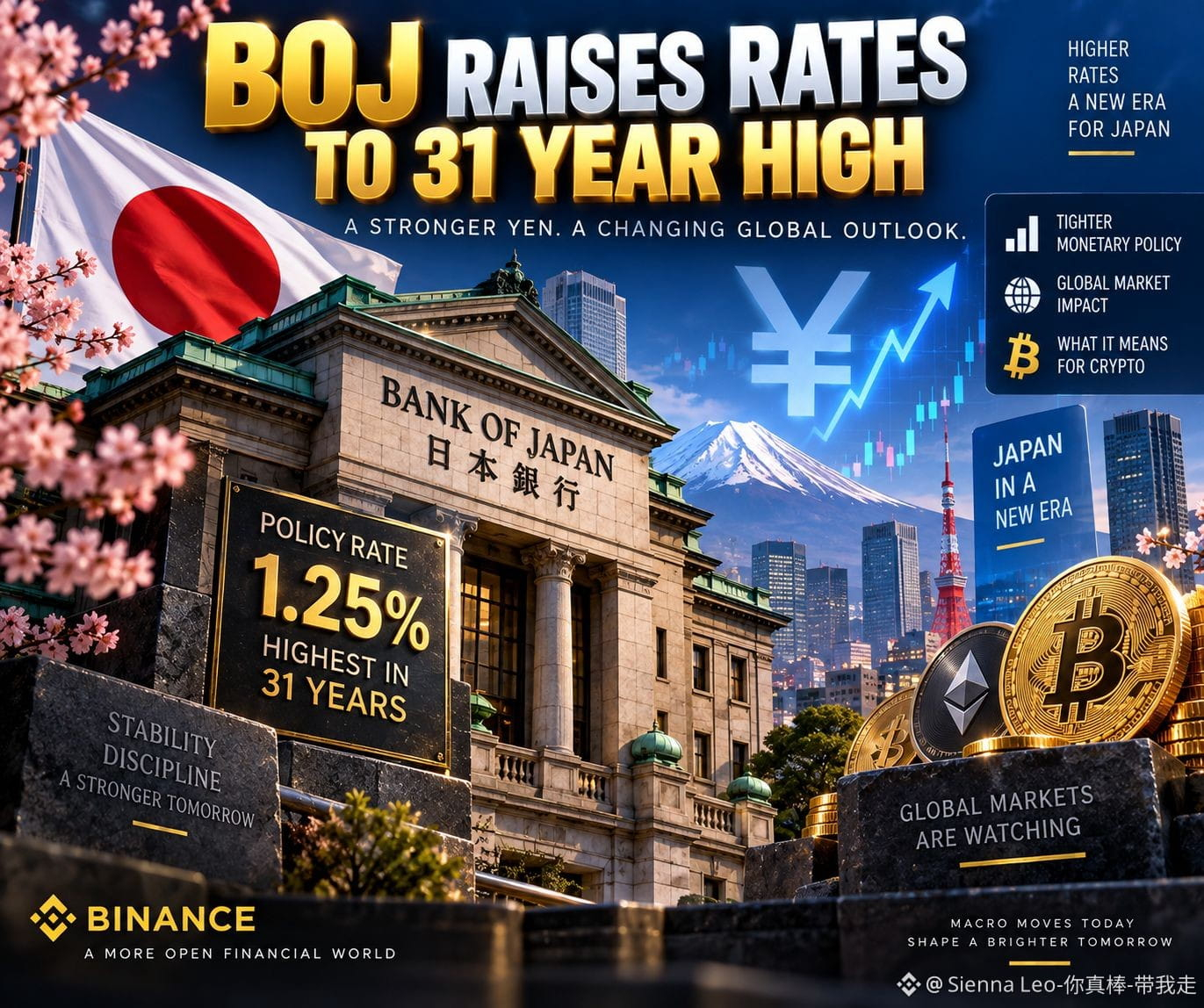
The Bank of Japan just raised its policy rate to 1.25%, the highest level in 31 years.

The move was widely expected, but here's the interesting part: this is the second hike in just three months, breaking the BOJ's previous pattern of slower increases. The decision passed 7–2.

For crypto traders, Japan's tightening matters because higher yen borrowing costs can affect global liquidity and risk appetite.
But the key question isn't just today's hike.

What matters now is whether the BOJ signals more increases ahead — and how markets react to them.
Could continued Japanese tightening become another factor for $BTC and broader risk assets to watch?
·
--
🚨 BOJ Raises Rates to a 31-Year High! 🇯🇵📈 #BOJRaisesRatesTo31YearHigh 🏦 Bank of Japan Turns More Hawkish! The Bank of Japan (BOJ) has raised its policy rate from 1.00% to 1.25%, taking Japanese borrowing costs to their highest level since 1995. The decision passed 7–2, with two policymakers voting against the hike. 🔥 Why Does It Matter? The BOJ says underlying inflation is getting close to its 2% target, while rising energy costs and stronger wage pressures are adding to inflation risks. Governor Kazuo Ueda also left the door open to further rate increases, including potentially larger or consecutive hikes, depending on inflation and economic conditions. 💴 Impact on Markets Higher Japanese rates can influence the yen, global bond yields, stocks, and risk assets because Japan has historically been a major source of low-cost funding. Interestingly, the yen weakened after the decision, as markets focused on the two dissenting votes and the lack of a firm timeline for another hike. 🌍 What Comes Next? Markets will closely watch: • 🇯🇵 Future BOJ rate decisions • 💴 USD/JPY movements • 📊 Japanese bond yields • 🇺🇸 U.S. interest-rate policy • ₿ Bitcoin & broader risk assets • 🛢️ Energy prices and inflation ⚠️ But Remember Central-bank decisions can create sudden volatility across financial markets. A rate hike does not automatically mean every risk asset will fall or rise; the market reaction depends on expectations, liquidity, and future policy guidance. 💬 Do you think the BOJ will continue raising rates from here? #BoJ #BankOfJapan #Japan #InterestRates #Yen #Forex #BTC #Crypto #Trading #Macro $BTC {spot}(BTCUSDT) $XRP {spot}(XRPUSDT)

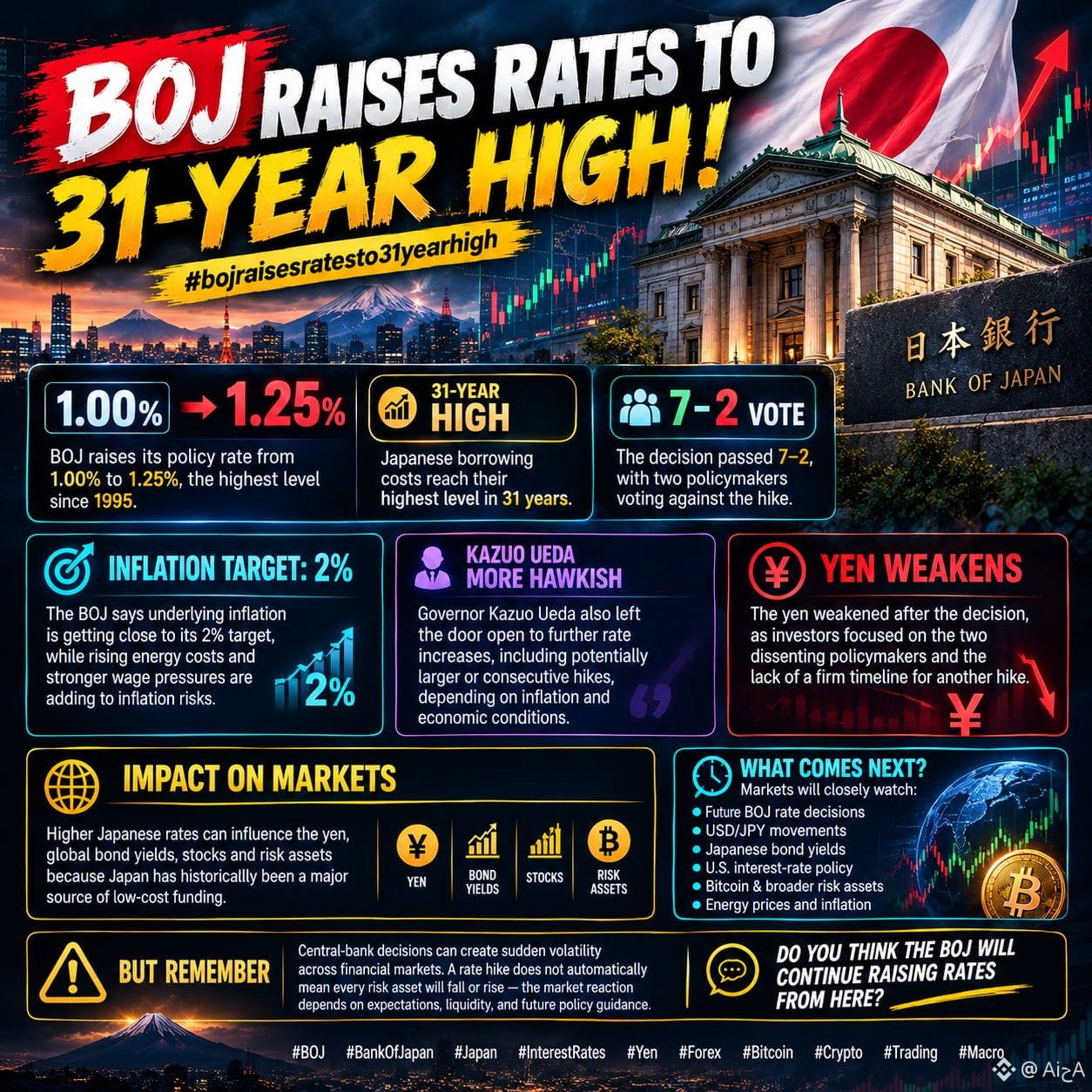
🚨 BOJ Raises Rates to a 31-Year High! 🇯🇵📈

#BOJRaisesRatesTo31YearHigh

🏦 Bank of Japan Turns More Hawkish!
The Bank of Japan (BOJ) has raised its policy rate from 1.00% to 1.25%, taking Japanese borrowing costs to their highest level since 1995.
The decision passed 7–2, with two policymakers voting against the hike.

🔥 Why Does It Matter?
The BOJ says underlying inflation is getting close to its 2% target, while rising energy costs and stronger wage pressures are adding to inflation risks.
Governor Kazuo Ueda also left the door open to further rate increases, including potentially larger or consecutive hikes, depending on inflation and economic conditions.

💴 Impact on Markets
Higher Japanese rates can influence the yen, global bond yields, stocks, and risk assets because Japan has historically been a major source of low-cost funding.
Interestingly, the yen weakened after the decision, as markets focused on the two dissenting votes and the lack of a firm timeline for another hike.

🌍 What Comes Next?
Markets will closely watch:
• 🇯🇵 Future BOJ rate decisions
• 💴 USD/JPY movements
• 📊 Japanese bond yields
• 🇺🇸 U.S. interest-rate policy
• ₿ Bitcoin & broader risk assets
• 🛢️ Energy prices and inflation

⚠️ But Remember
Central-bank decisions can create sudden volatility across financial markets. A rate hike does not automatically mean every risk asset will fall or rise; the market reaction depends on expectations, liquidity, and future policy guidance.
💬 Do you think the BOJ will continue raising rates from here?
#BoJ #BankOfJapan #Japan #InterestRates #Yen #Forex #BTC #Crypto #Trading #Macro
$BTC
$XRP
#bojraisesratesto31yearhigh The Bank of Japan (BOJ) has raised its benchmark interest rate from 1.00% to 1.25%, marking the highest level in 31 years. The decision was approved by a 7–2 vote as the BOJ continues its efforts to contain inflation and move away from decades of ultra-loose monetary policy. 📊 Why it matters for markets: • Higher Japanese rates could influence global bond and currency markets • The yen initially weakened despite the hike • Investors are watching closely for signals of further BOJ increases • Changes in Japanese monetary policy can also affect global liquidity and risk assets, including crypto ₿ Crypto traders: Keep an eye on BTC volatility as markets digest the BOJ decision and broader global tightening. #Binance #BinanceSquare #Bitcoin #BTC
#bojraisesratesto31yearhigh

The Bank of Japan (BOJ) has raised its benchmark interest rate from 1.00% to 1.25%, marking the highest level in 31 years.
The decision was approved by a 7–2 vote as the BOJ continues its efforts to contain inflation and move away from decades of ultra-loose monetary policy.
📊 Why it matters for markets:
• Higher Japanese rates could influence global bond and currency markets
• The yen initially weakened despite the hike
• Investors are watching closely for signals of further BOJ increases
• Changes in Japanese monetary policy can also affect global liquidity and risk assets, including crypto
₿ Crypto traders: Keep an eye on BTC volatility as markets digest the BOJ decision and broader global tightening.
#Binance #BinanceSquare #Bitcoin #BTC
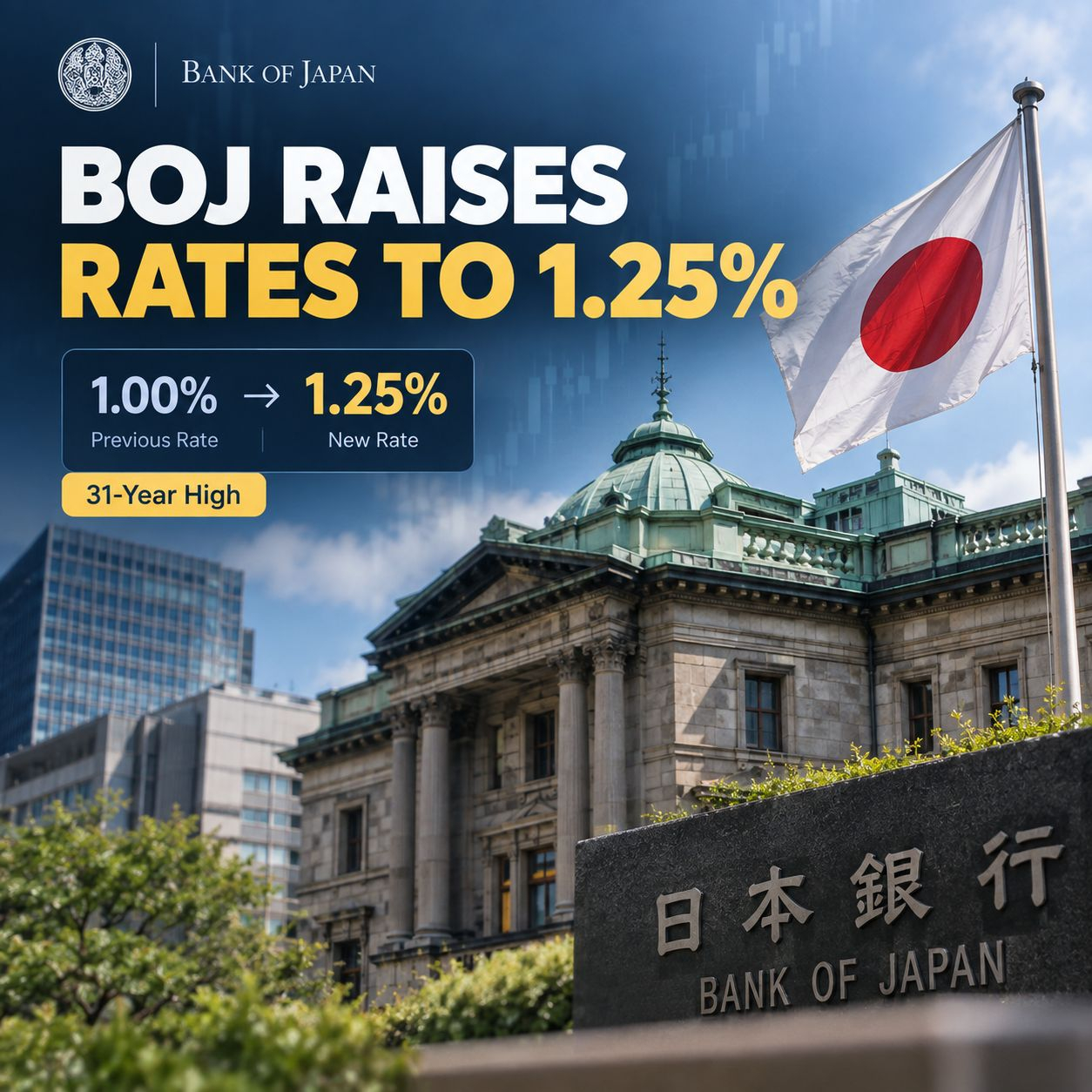
#BOJRaisesRatesTo31YearHigh On Friday, September 18, 2026, the Bank of Japan (BOJ) raised its benchmark interest rate by 25 basis points to 1.25%, marking its highest level in 31 years (since 1995). Governor Kazuo Ueda led the 7–2 vote in a preemptive strike against brewing inflationary pressures. Despite the rate hike, the Japanese Yen paradoxically weakened, with the $USD1 {spot}(USD1USDT) /$JPY.ETF {etf_us}(JPY.ETF) pair jumping as high as 158.05 as macro traders reacted to a less hawkish policy guidance than anticipated. [1, 2, 3, 4]
#BOJRaisesRatesTo31YearHigh

On Friday, September 18, 2026, the Bank of Japan (BOJ) raised its benchmark interest rate by 25 basis points to 1.25%, marking its highest level in 31 years (since 1995). Governor Kazuo Ueda led the 7–2 vote in a preemptive strike against brewing inflationary pressures. Despite the rate hike, the Japanese Yen paradoxically weakened, with the $USD1
/$JPY.ETF
pair jumping as high as 158.05 as macro traders reacted to a less hawkish policy guidance than anticipated. [1, 2, 3, 4]
#BOJRaisesRatesTo31YearHigh The Bank of Japan (BOJ) has raised its benchmark interest rate to 1.25%, its highest level in 31 years, marking another major step away from Japan’s era of ultra-low interest rates. The move reflects persistent inflation, rising wages, and pressure to keep price growth near the BOJ’s 2% target. The decision could raise borrowing costs in Japan and influence the yen, Japanese bonds, and global financial markets.
#BOJRaisesRatesTo31YearHigh
The Bank of Japan (BOJ) has raised its benchmark interest rate to 1.25%, its highest level in 31 years, marking another major step away from Japan’s era of ultra-low interest rates. The move reflects persistent inflation, rising wages, and pressure to keep price growth near the BOJ’s 2% target. The decision could raise borrowing costs in Japan and influence the yen, Japanese bonds, and global financial markets.
·
--
Bearish
🚨 BOJ JUST RAISED RATES TO A 31-YEAR HIGH Japan raised rates to 1.25% — a 31-year high. Higher rates + tighter global liquidity = more volatility for risk assets. Now watch BTC closely. PUMP or DUMP next? Comment: LONG / SHORT / WAIT $BTC $ETH $BNB MAY BE I AM WRONG. NOT FINANCIAL ADVICE. DYOR. {future}(BTCUSDT) {future}(ETHUSDT) {future}(BNBUSDT) #BOJRaisesRatesTo31YearHigh #OMARKHANOK
🚨 BOJ JUST RAISED RATES TO A 31-YEAR HIGH

Japan raised rates to 1.25% — a 31-year high.

Higher rates + tighter global liquidity = more volatility for risk assets.

Now watch BTC closely.

PUMP or DUMP next?
Comment: LONG / SHORT / WAIT
$BTC $ETH $BNB
MAY BE I AM WRONG. NOT FINANCIAL ADVICE. DYOR.
#BOJRaisesRatesTo31YearHigh #OMARKHANOK
Bitcoin Up or Down on September 19?

Bitcoin Up or Down on September 19?

99%Up1%Down
Volume $118,819.02
Log in to explore more content
Join global crypto users on Binance Square
⚡️ Get latest and useful information about crypto.
💬 Trusted by the world’s largest crypto exchange.
👍 Discover real insights from verified creators.
Email / Phone number