
伊泽99131
72 Posts

伊泽99131
Report
Block User
推特X:@EZ99131
专注链上Alphat投研优质项目分享建设
持有$BTC | $BNB | $SOL| | $Aster | 1000X GEM
#Runes 和铭文以及比特生态狂热者,持续多年现货量化ing
#Runestone 符石信仰者 |$DOG
美股专注中,专注马斯克板块和AI板块以及能源板块
Open Trade

BTC Holder
Occasional Trader
5.6 Years
10 Following
221 Followers
147 Liked
Posts
Portfolio
All
Videos
·
--
At the end of the day, Jensen Huang hasn’t done anything truly terrible.
The results of AI’s development so far have already benefited so many people who don’t know how to code or edit, and have greatly reduced information gaps.
You could say that without his 30 years of dedication, we wouldn’t have seen such a tremendous leap in technology and the new industrial revolution for humanity.
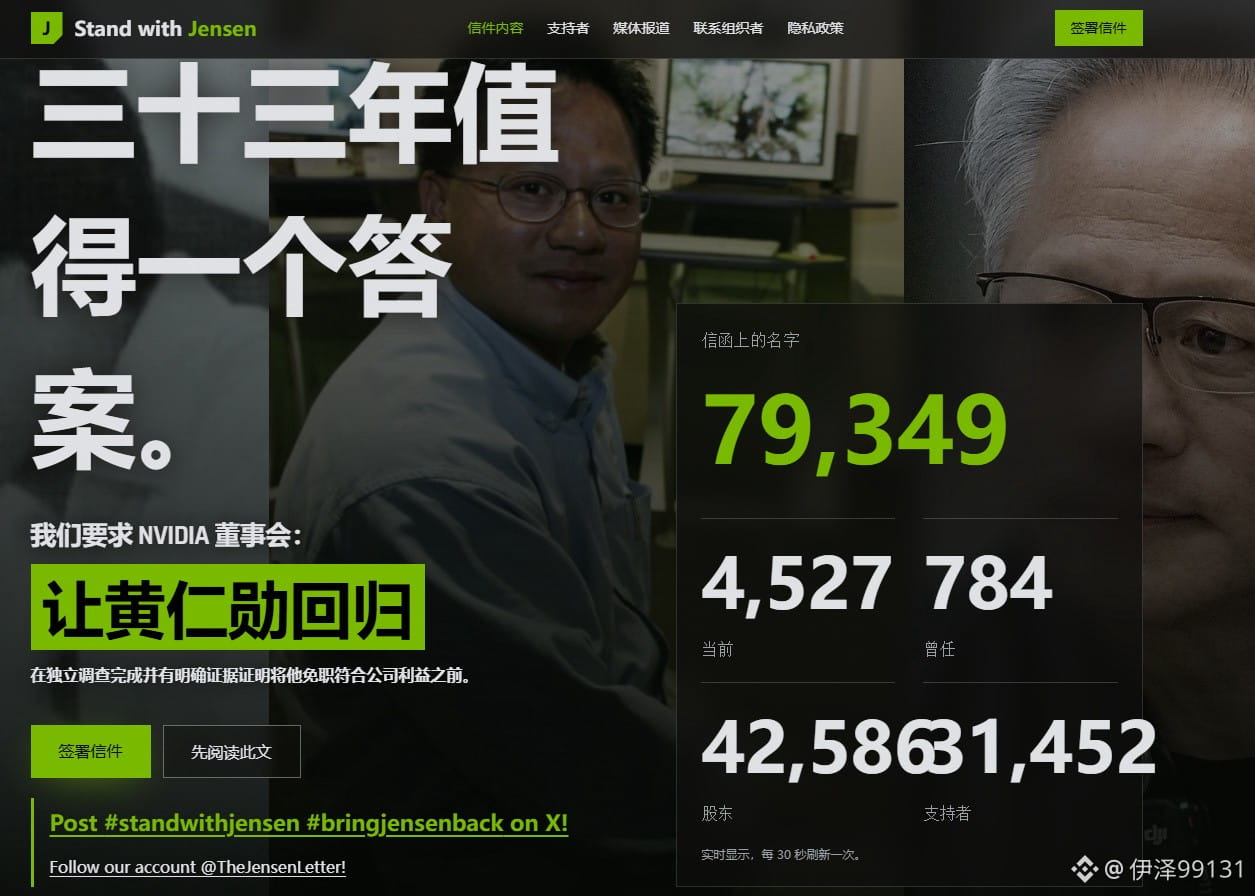
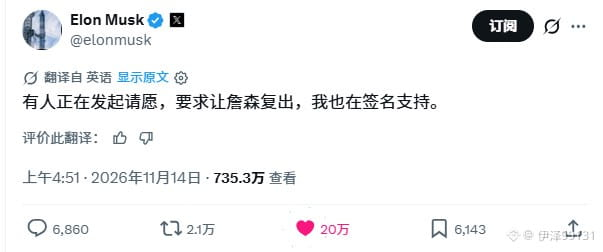
The number of people supporting Jensen Huang’s return on the website keeps surging, and they include many well-known entrepreneurs and public figures.
Musk and Binance’s CEO, CZ, have both signed in support of Jensen Huang’s return, hoping he can once again lead the AI era and play an irreplaceable role.
Link: standwithjensen dot com
At the end of the day, Jensen Huang hasn’t done anything truly terrible.
The results of AI’s development so far have already benefited so many people who don’t know how to code or edit, and have greatly reduced information gaps.
You could say that without his 30 years of dedication, we wouldn’t have seen such a tremendous leap in technology and the new industrial revolution for humanity.
The number of people supporting Jensen Huang’s return on the website keeps surging, and they include many well-known entrepreneurs and public figures.
Musk and Binance’s CEO, CZ, have both signed in support of Jensen Huang’s return, hoping he can once again lead the AI era and play an irreplaceable role.
Link: standwithjensen dot com
The results of AI’s development so far have already benefited so many people who don’t know how to code or edit, and have greatly reduced information gaps.
You could say that without his 30 years of dedication, we wouldn’t have seen such a tremendous leap in technology and the new industrial revolution for humanity.
The number of people supporting Jensen Huang’s return on the website keeps surging, and they include many well-known entrepreneurs and public figures.
Musk and Binance’s CEO, CZ, have both signed in support of Jensen Huang’s return, hoping he can once again lead the AI era and play an irreplaceable role.
Link: standwithjensen dot com
2
1.7k
·
--
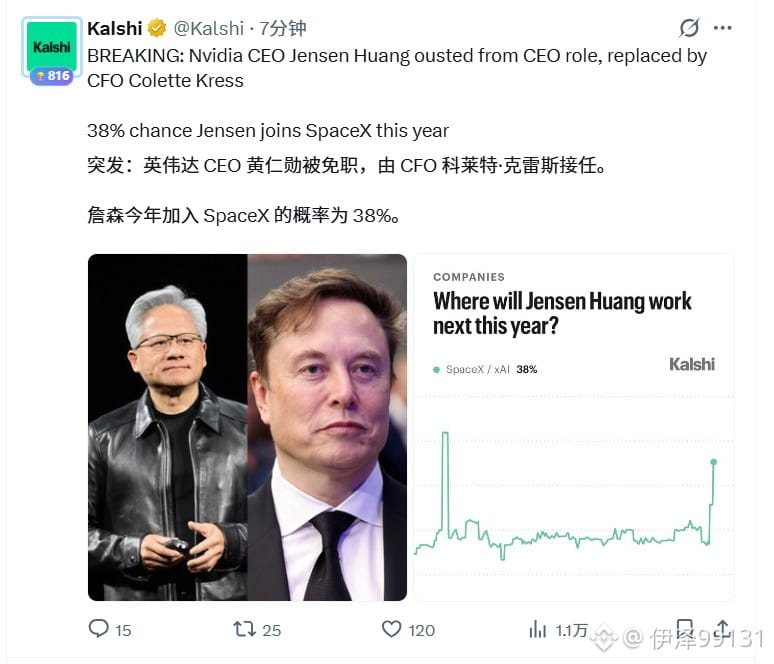
What a moment in history—who knew a black swan event could happen in your underwear? 😅
In that situation, if Jensen Huang leaves his job, he'll definitely need some time to adjust mentally.
He has three possible paths ahead of him:
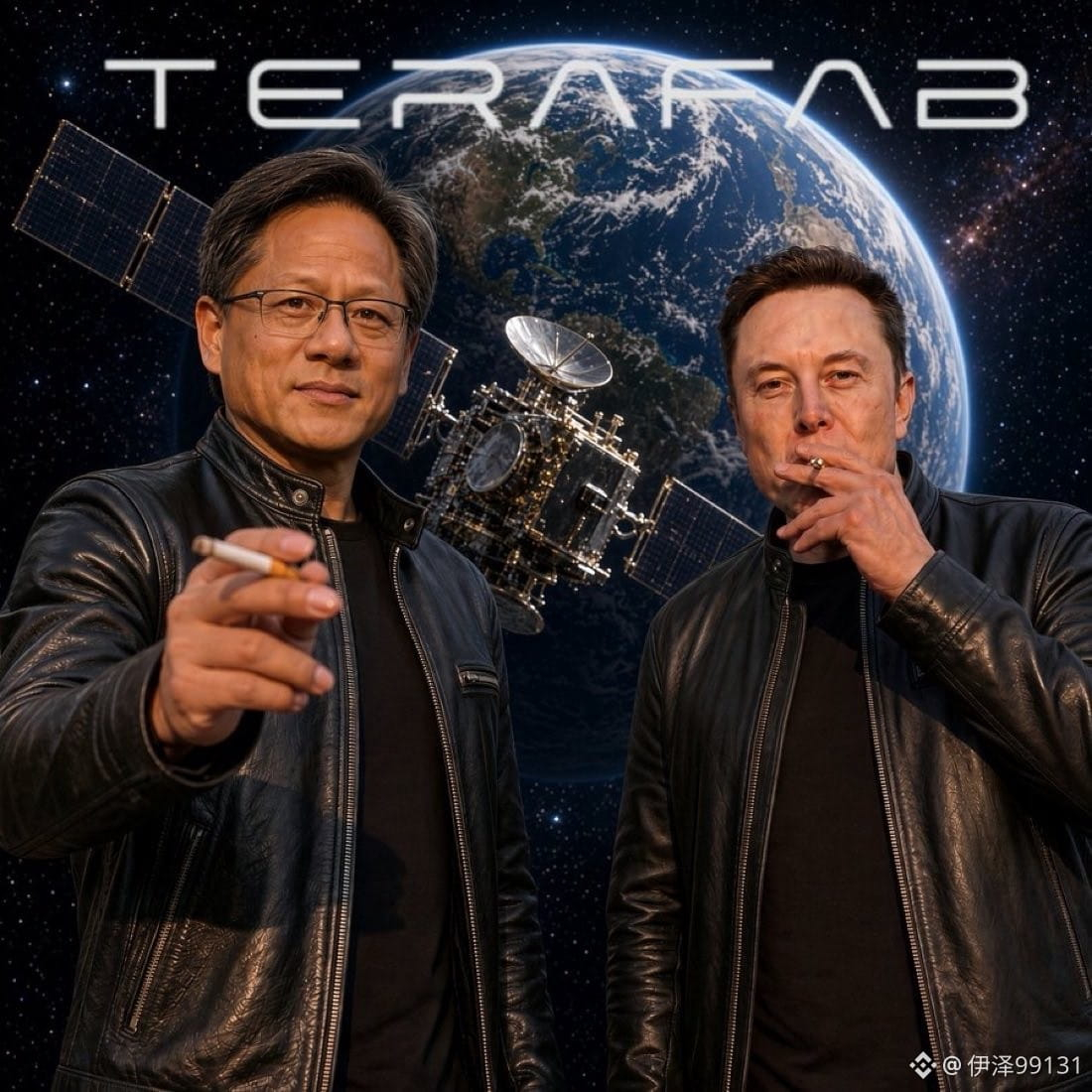
1. Musk's company happens to be developing chips too. If Huang joined, they'd be a dream team—and could even build a company that rivals Nvidia in the future.
2. Keep his powder dry and lie low for two years, then see whether the Republicans win again in 2028. The new president might let him take the helm once more.
3. Step back and support his daughter from behind the scenes, like CZ serving as the commander at the fountain.
What a moment in history—who knew a black swan event could happen in your underwear? 😅
In that situation, if Jensen Huang leaves his job, he'll definitely need some time to adjust mentally.
He has three possible paths ahead of him:
1. Musk's company happens to be developing chips too. If Huang joined, they'd be a dream team—and could even build a company that rivals Nvidia in the future.
2. Keep his powder dry and lie low for two years, then see whether the Republicans win again in 2028. The new president might let him take the helm once more.
3. Step back and support his daughter from behind the scenes, like CZ serving as the commander at the fountain.
In that situation, if Jensen Huang leaves his job, he'll definitely need some time to adjust mentally.
He has three possible paths ahead of him:
1. Musk's company happens to be developing chips too. If Huang joined, they'd be a dream team—and could even build a company that rivals Nvidia in the future.
2. Keep his powder dry and lie low for two years, then see whether the Republicans win again in 2028. The new president might let him take the helm once more.
3. Step back and support his daughter from behind the scenes, like CZ serving as the commander at the fountain.

5
2.8k
·
--
Verified
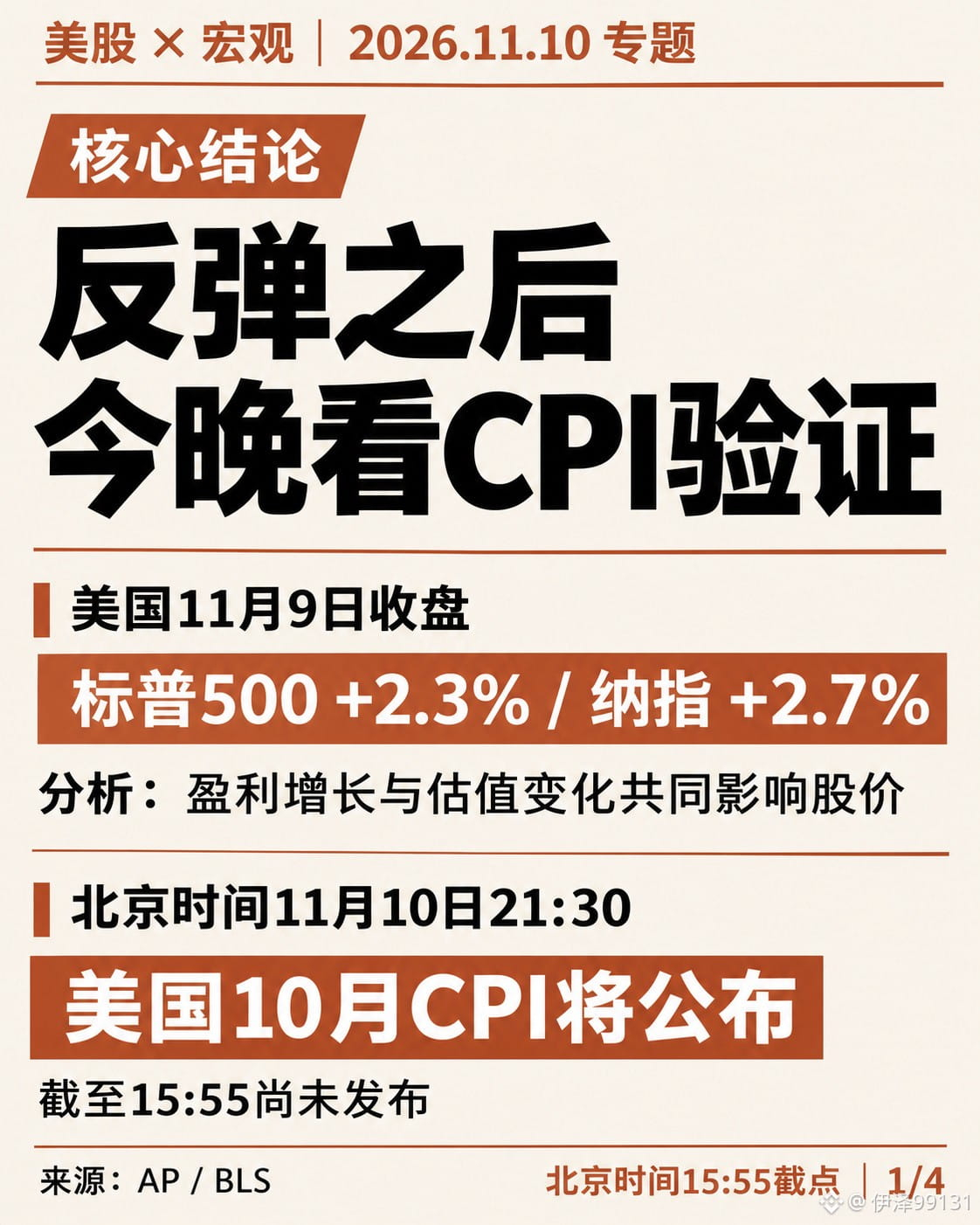
After the U.S. stock market rebound, can tonight’s CPI support a valuation recovery?
U.S. stocks rebounded sharply last night, but what I’m more interested in is whether this recovery can withstand the test of tonight’s inflation data.
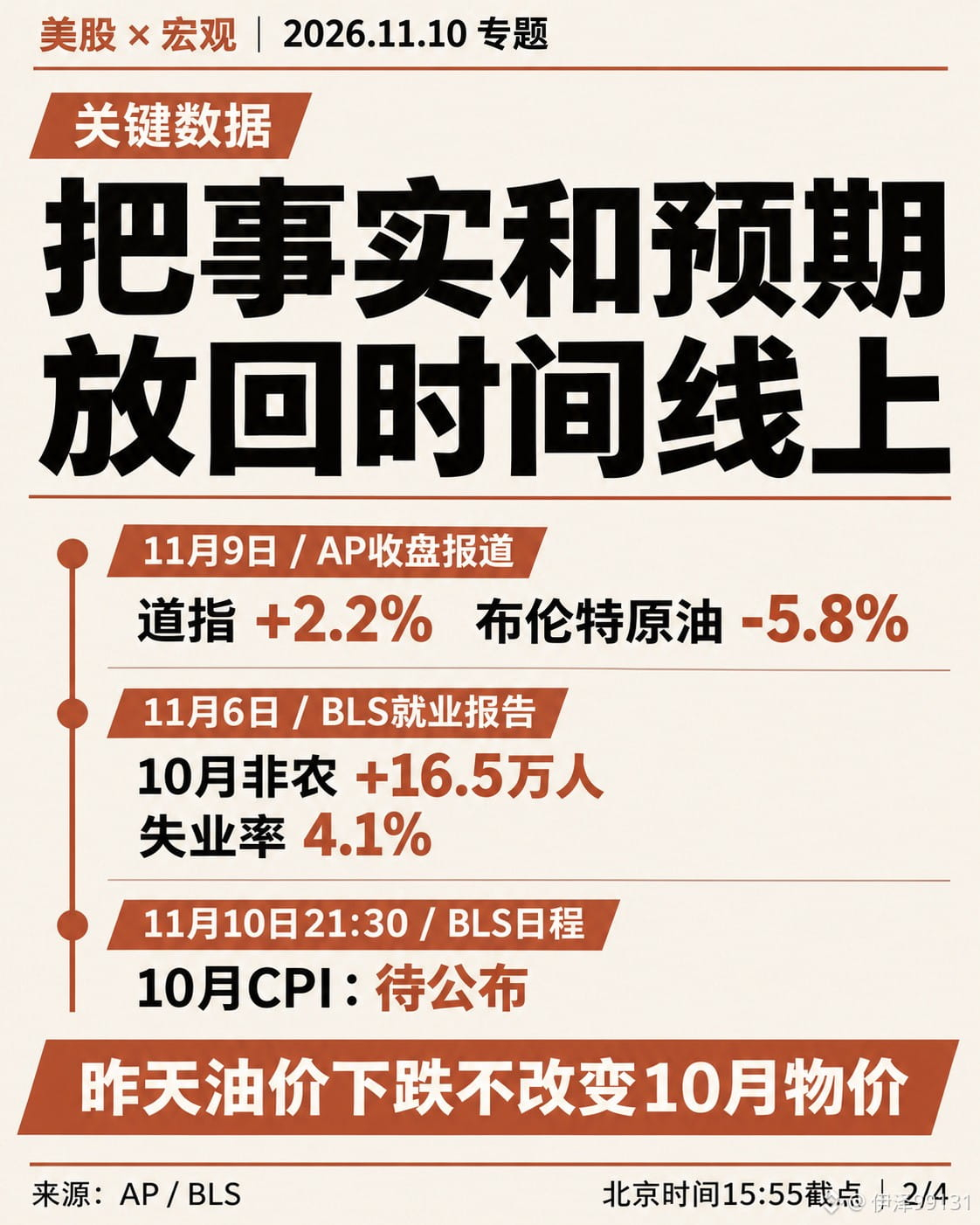
The S&P 500 rose 2.3%, the Dow rose 2.2%, and the Nasdaq rose 2.7%; Brent crude fell 5.8% on the day.
Next, we need to watch two things at once: how much companies can earn, and how much the market is willing to value those profits at.
First, the macro picture. The pullback in oil prices may help ease pressure on future energy prices, but the change in oil prices on November 9 cannot retroactively change prices that were already recorded in October. Tonight’s release is the U.S. October CPI, which measures inflation over the previous month. Saying that yesterday’s drop in oil prices means tonight’s CPI must come in lower would confuse the order of events.
First look at month-over-month core CPI, then at changes in housing and service prices. If energy alone pulls down headline inflation while core components remain firm, rate expectations may not ease for long. Conversely, if price pressures ease across a wider range of categories while economic activity remains resilient, the backdrop for equity valuations would be more favorable.
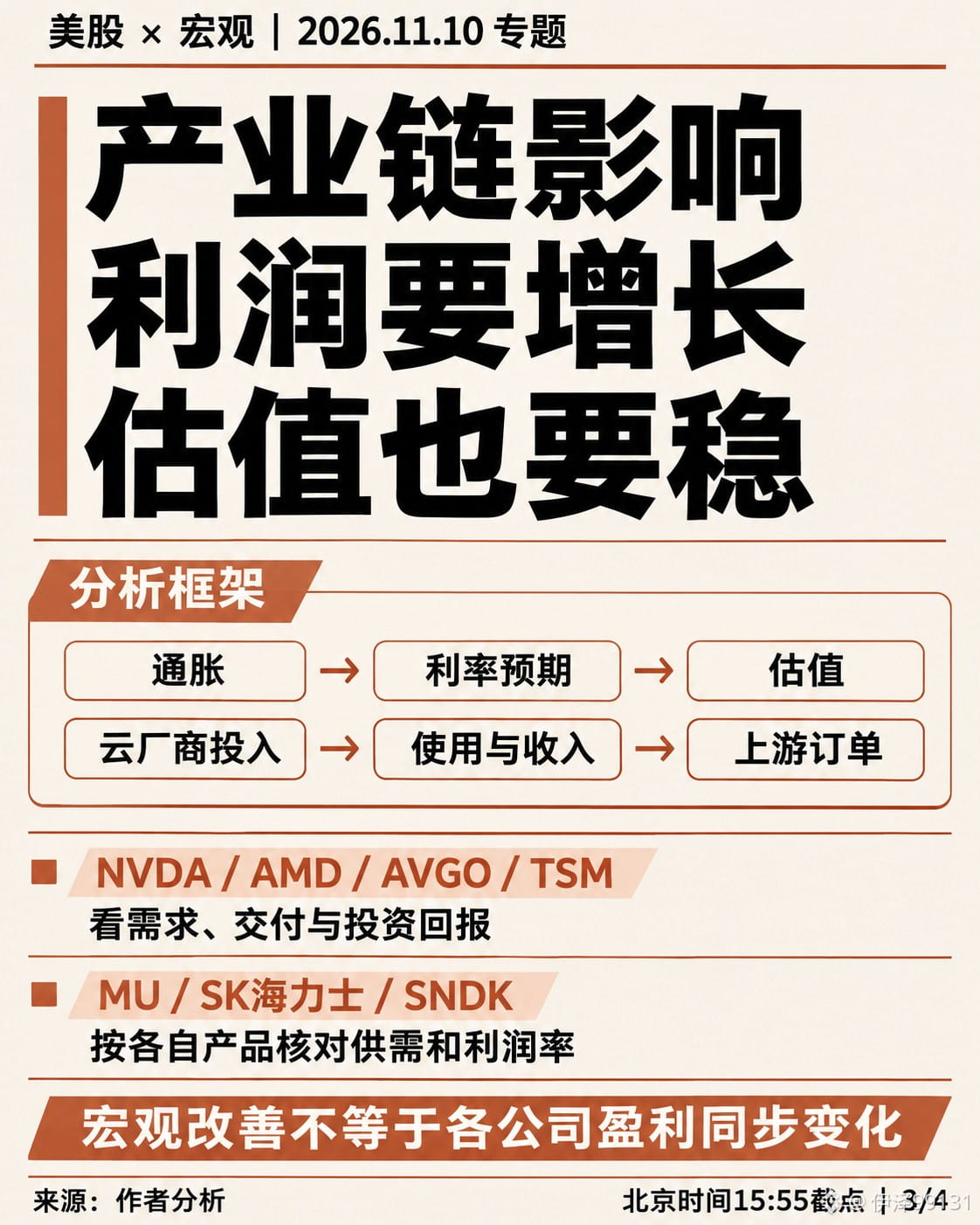
Technology stocks currently face a combination of forces: earnings growth can support share prices, while interest-rate pressures may weigh on valuations. Here’s a purely hypothetical example: if a company’s earnings per share grow 20%, but its price-to-earnings ratio falls from 30 to 25, the resulting share price would be roughly unchanged. Between a company delivering growth and shareholders receiving a similar level of returns, valuation changes still matter.
For Nvidia, AMD, and Broadcom, watch demand and deliveries; for TSMC, watch advanced process nodes and customer orders; for MU, SK Hynix, and SNDK, check the supply-demand balance and profit margins for each of their products. These companies operate at different stages of the industry, so we can’t use the same macroeconomic news to infer that their earnings will all move in sync.
The more important link is still the cloud providers. If capital spending continues to grow and actual usage and revenue keep pace, upstream orders will have stronger support. If investment grows faster than returns while financing costs remain high, the market will demand a shorter payback period. Consider both the scale of capital spending and the efficiency of that investment.
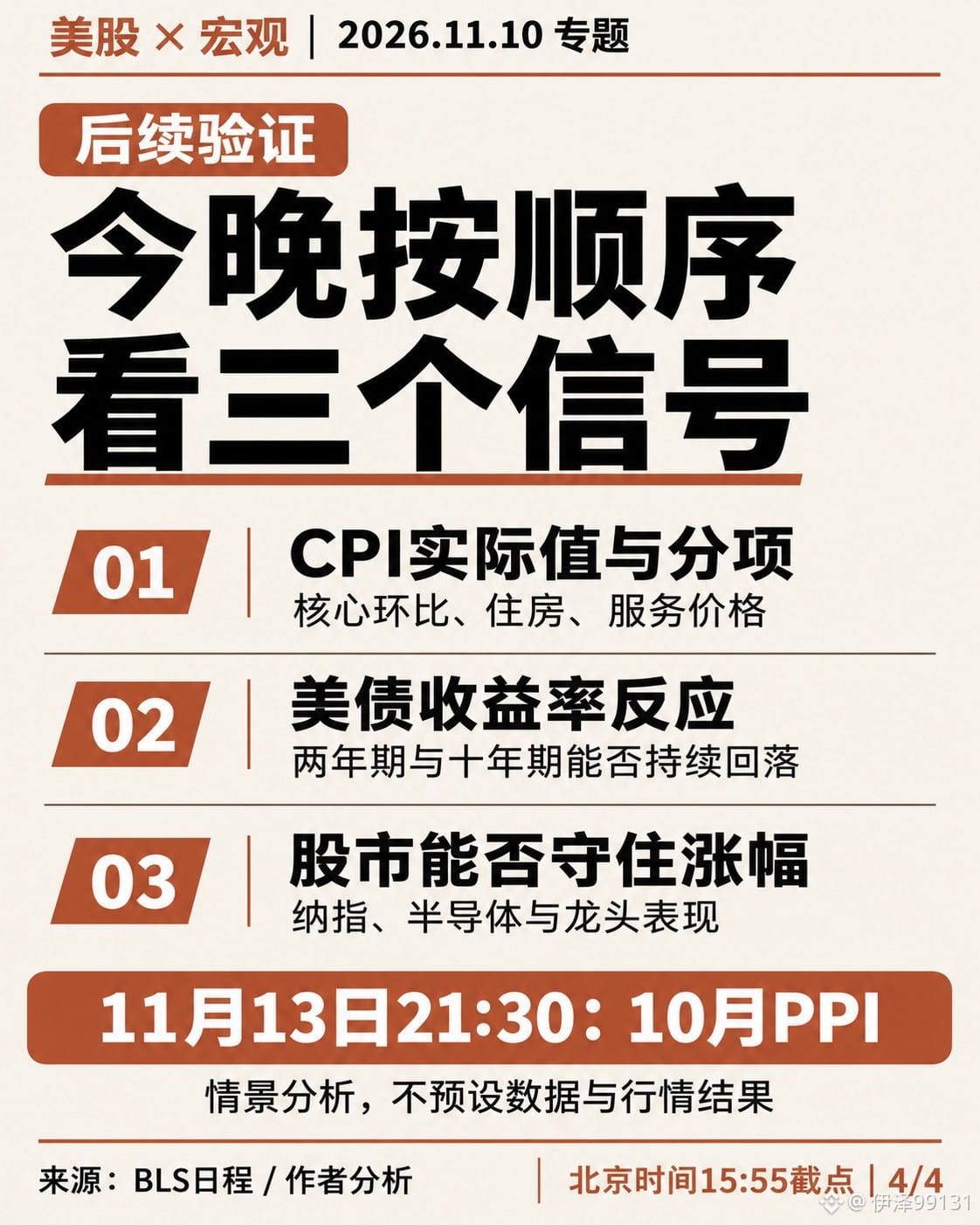
Tonight’s checklist:
Compare the actual CPI reading and its components, then watch how two-year and ten-year Treasury yields respond.
If inflationary pressures ease, Treasury yields fall, and corporate earnings expectations remain stable, conditions for a recovery will improve.
After the U.S. stock market rebound, can tonight’s CPI support a valuation recovery?
U.S. stocks rebounded sharply last night, but what I’m more interested in is whether this recovery can withstand the test of tonight’s inflation data.
The S&P 500 rose 2.3%, the Dow rose 2.2%, and the Nasdaq rose 2.7%; Brent crude fell 5.8% on the day.
Next, we need to watch two things at once: how much companies can earn, and how much the market is willing to value those profits at.
First, the macro picture. The pullback in oil prices may help ease pressure on future energy prices, but the change in oil prices on November 9 cannot retroactively change prices that were already recorded in October. Tonight’s release is the U.S. October CPI, which measures inflation over the previous month. Saying that yesterday’s drop in oil prices means tonight’s CPI must come in lower would confuse the order of events.
First look at month-over-month core CPI, then at changes in housing and service prices. If energy alone pulls down headline inflation while core components remain firm, rate expectations may not ease for long. Conversely, if price pressures ease across a wider range of categories while economic activity remains resilient, the backdrop for equity valuations would be more favorable.
Technology stocks currently face a combination of forces: earnings growth can support share prices, while interest-rate pressures may weigh on valuations. Here’s a purely hypothetical example: if a company’s earnings per share grow 20%, but its price-to-earnings ratio falls from 30 to 25, the resulting share price would be roughly unchanged. Between a company delivering growth and shareholders receiving a similar level of returns, valuation changes still matter.
For Nvidia, AMD, and Broadcom, watch demand and deliveries; for TSMC, watch advanced process nodes and customer orders; for MU, SK Hynix, and SNDK, check the supply-demand balance and profit margins for each of their products. These companies operate at different stages of the industry, so we can’t use the same macroeconomic news to infer that their earnings will all move in sync.
The more important link is still the cloud providers. If capital spending continues to grow and actual usage and revenue keep pace, upstream orders will have stronger support. If investment grows faster than returns while financing costs remain high, the market will demand a shorter payback period. Consider both the scale of capital spending and the efficiency of that investment.
Tonight’s checklist:
Compare the actual CPI reading and its components, then watch how two-year and ten-year Treasury yields respond.
If inflationary pressures ease, Treasury yields fall, and corporate earnings expectations remain stable, conditions for a recovery will improve.
U.S. stocks rebounded sharply last night, but what I’m more interested in is whether this recovery can withstand the test of tonight’s inflation data.
The S&P 500 rose 2.3%, the Dow rose 2.2%, and the Nasdaq rose 2.7%; Brent crude fell 5.8% on the day.
Next, we need to watch two things at once: how much companies can earn, and how much the market is willing to value those profits at.
First, the macro picture. The pullback in oil prices may help ease pressure on future energy prices, but the change in oil prices on November 9 cannot retroactively change prices that were already recorded in October. Tonight’s release is the U.S. October CPI, which measures inflation over the previous month. Saying that yesterday’s drop in oil prices means tonight’s CPI must come in lower would confuse the order of events.
First look at month-over-month core CPI, then at changes in housing and service prices. If energy alone pulls down headline inflation while core components remain firm, rate expectations may not ease for long. Conversely, if price pressures ease across a wider range of categories while economic activity remains resilient, the backdrop for equity valuations would be more favorable.
Technology stocks currently face a combination of forces: earnings growth can support share prices, while interest-rate pressures may weigh on valuations. Here’s a purely hypothetical example: if a company’s earnings per share grow 20%, but its price-to-earnings ratio falls from 30 to 25, the resulting share price would be roughly unchanged. Between a company delivering growth and shareholders receiving a similar level of returns, valuation changes still matter.
For Nvidia, AMD, and Broadcom, watch demand and deliveries; for TSMC, watch advanced process nodes and customer orders; for MU, SK Hynix, and SNDK, check the supply-demand balance and profit margins for each of their products. These companies operate at different stages of the industry, so we can’t use the same macroeconomic news to infer that their earnings will all move in sync.
The more important link is still the cloud providers. If capital spending continues to grow and actual usage and revenue keep pace, upstream orders will have stronger support. If investment grows faster than returns while financing costs remain high, the market will demand a shorter payback period. Consider both the scale of capital spending and the efficiency of that investment.
Tonight’s checklist:
Compare the actual CPI reading and its components, then watch how two-year and ten-year Treasury yields respond.
If inflationary pressures ease, Treasury yields fall, and corporate earnings expectations remain stable, conditions for a recovery will improve.
1
808
·
--
Verified
The big story in U.S. stocks: $MRVL is spending $115 billion to acquire $LITE !
Today, Marvell finally officially announced its acquisition of Lumentum.
The scale of this deal has certainly exceeded many people’s expectations.
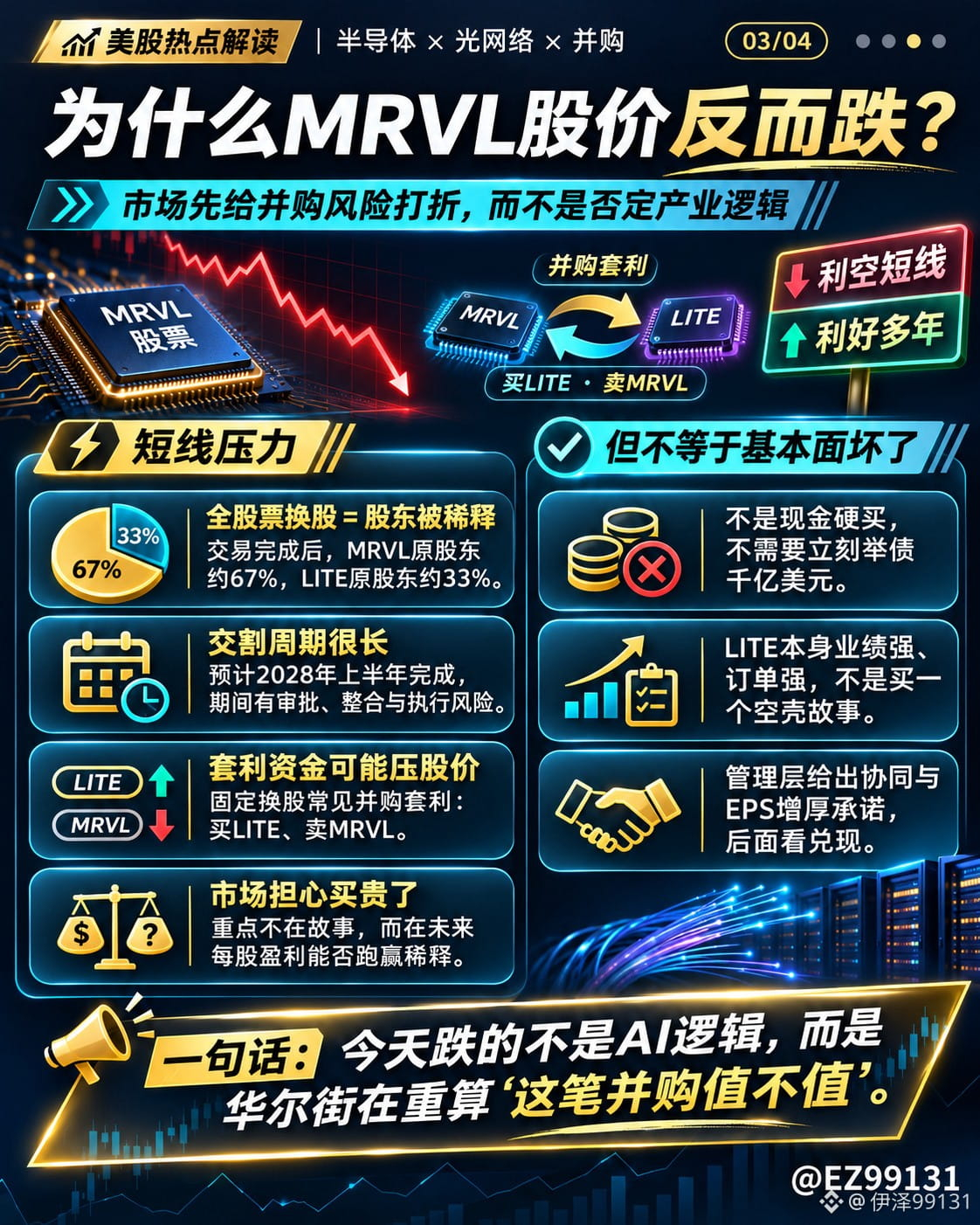
$MRVL is spending $115 billion to acquire $LITE, yet the stock has plunged for several consecutive sessions. I don’t think this deal is as straightforward as it seems.
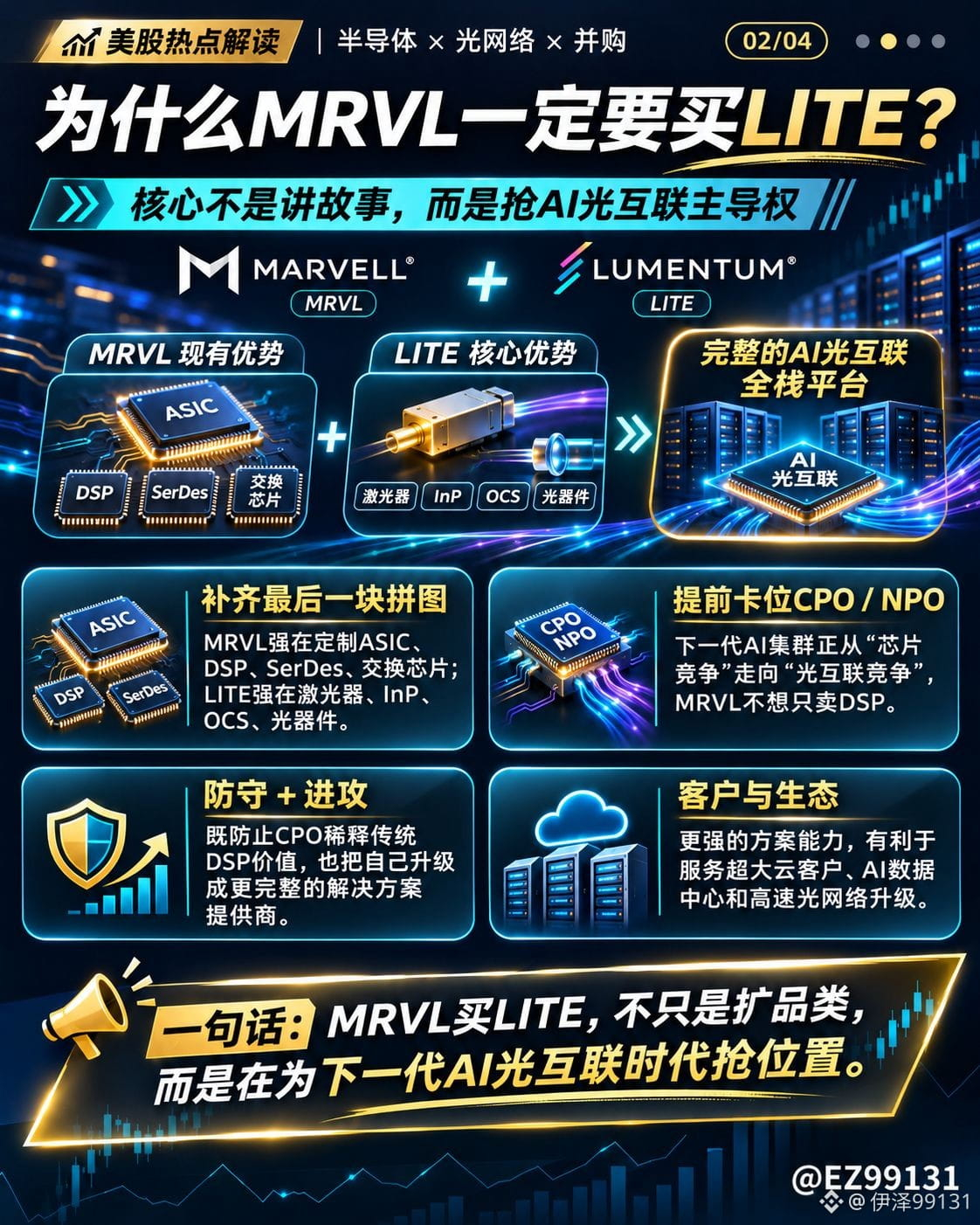
What Marvell really wants to buy isn’t just Lumentum’s revenue, but also its indium phosphide (InP) lasers, optical components, and manufacturing capacity.
MRVL is strong in ASICs, DSPs, SerDes, and high-speed networking chips. But as AI clusters grow ever larger, competition is increasingly shifting from computing power to optical interconnects.
In particular, the development of CPO technology could diminish the value of some traditional DSPs. By acquiring LITE now, MRVL is both addressing gaps in its technology portfolio and positioning itself early for the next generation of AI data centers.
But the question is: is this acquisition really worth the price?
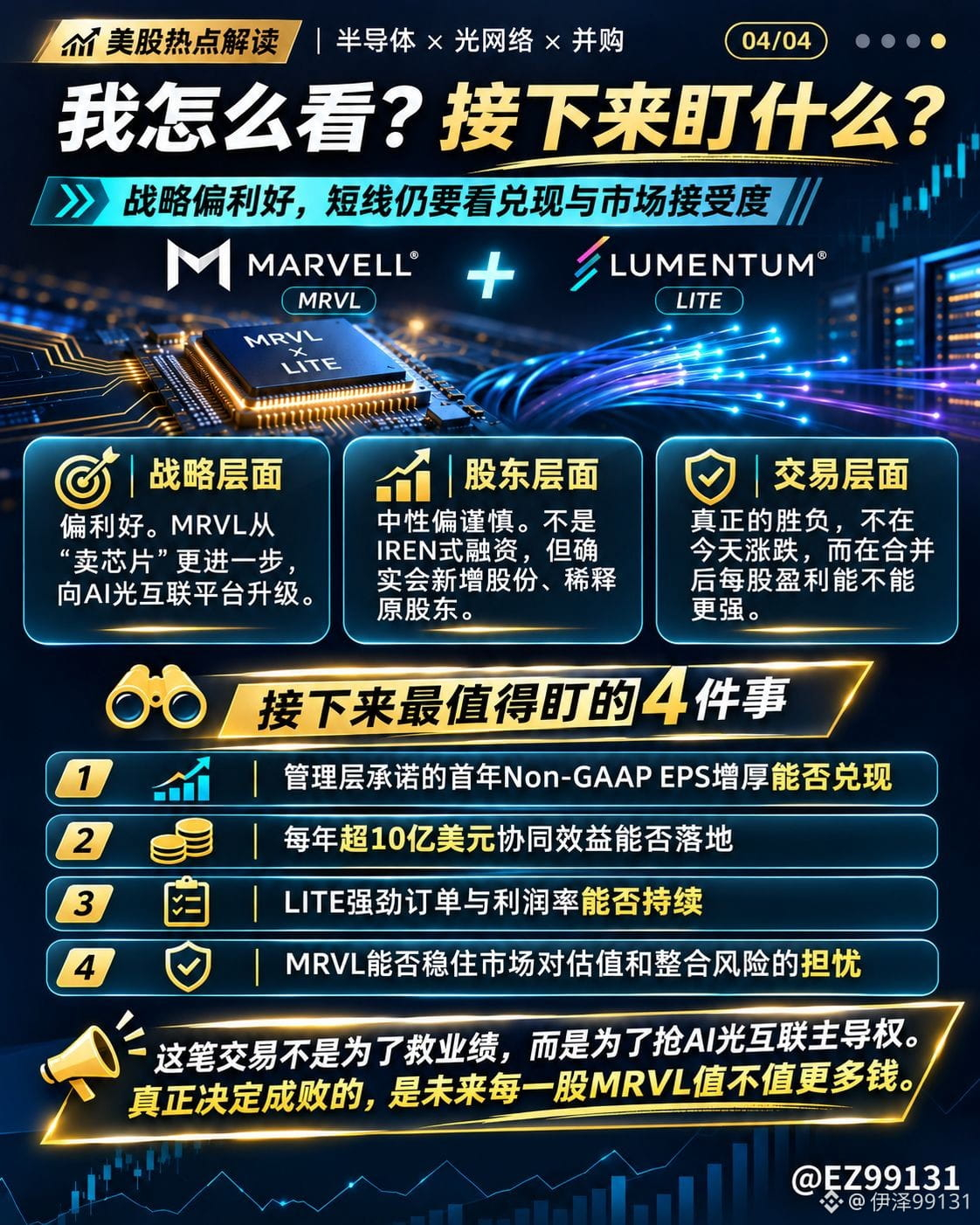
The deal implies an enterprise value of approximately $115 billion and will be an all-stock transaction, with each LITE share exchanged for 4.5 MRVL shares. It is expected to close in the first half of 2028.
This isn’t a case of raising hundreds of billions of dollars from the market to fund an acquisition, but there will be share dilution. After the deal closes, MRVL’s existing shareholders are expected to own just 67% of the combined company.
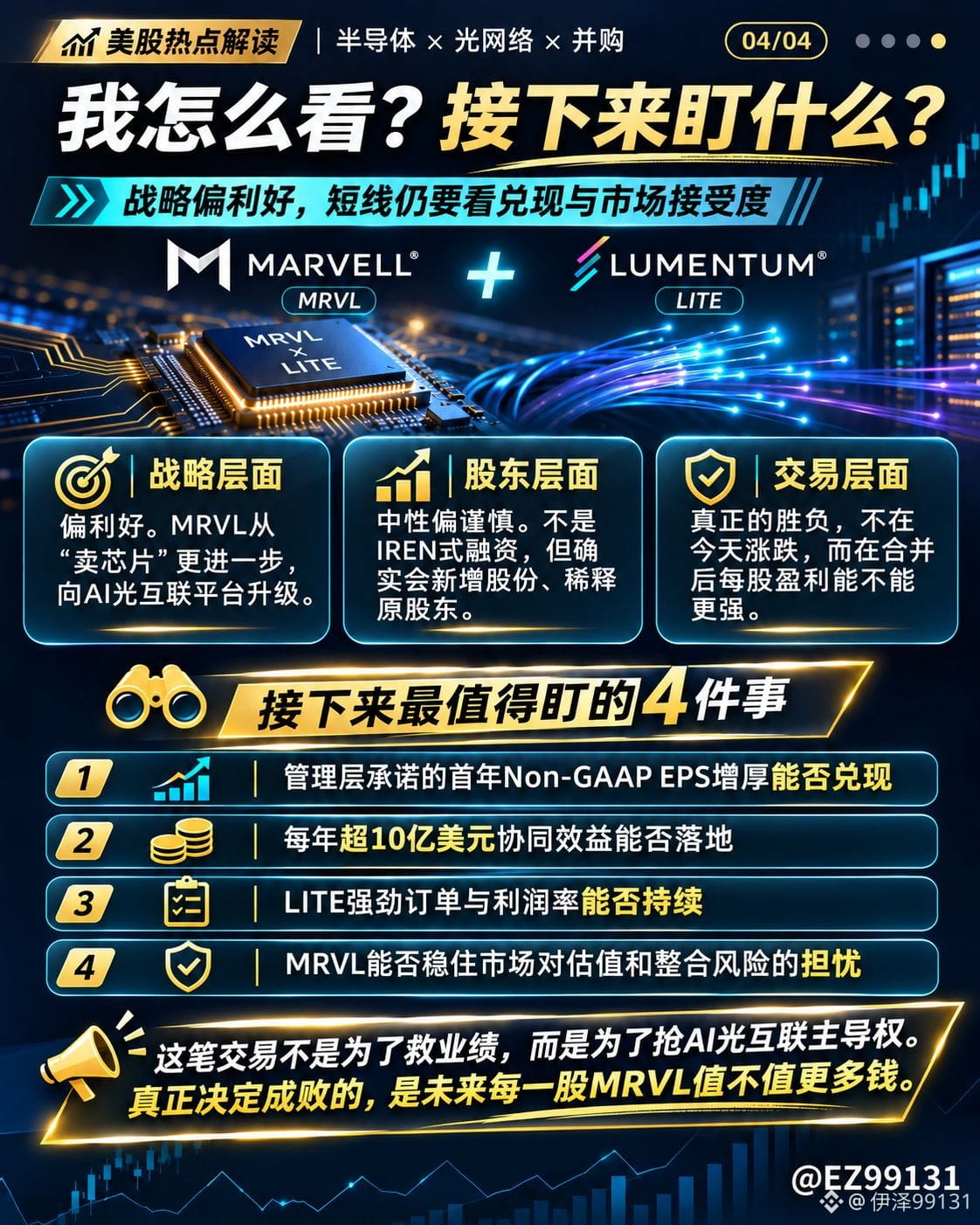
Management has pledged more than $1 billion in annual synergies and expects the deal to be accretive to adjusted EPS in the first year after closing.
If these benefits materialize, there is certainly long-term potential.
My personal view is that MRVL’s strategic direction makes sense, but a good asset isn’t worth buying at any price.
What Wall Street is worried about isn’t whether AI optical interconnects have a future, but whether Marvell will pay too much to gain a foothold in this market.
Whether this deal ultimately proves bullish or bearish won’t hinge on today’s share-price movements, but on whether future earnings per share can truly outpace the cost of dilution.
The opportunity in AI optical interconnects is enormous, but whether shareholders ultimately make money will depend on the return on capital.
The big story in U.S. stocks: $MRVL is spending $115 billion to acquire $LITE !
Today, Marvell finally officially announced its acquisition of Lumentum.
The scale of this deal has certainly exceeded many people’s expectations.
$MRVL is spending $115 billion to acquire $LITE , yet the stock has plunged for several consecutive sessions. I don’t think this deal is as straightforward as it seems.
What Marvell really wants to buy isn’t just Lumentum’s revenue, but also its indium phosphide (InP) lasers, optical components, and manufacturing capacity.
MRVL is strong in ASICs, DSPs, SerDes, and high-speed networking chips. But as AI clusters grow ever larger, competition is increasingly shifting from computing power to optical interconnects.
In particular, the development of CPO technology could diminish the value of some traditional DSPs. By acquiring LITE now, MRVL is both addressing gaps in its technology portfolio and positioning itself early for the next generation of AI data centers.
But the question is: is this acquisition really worth the price?
The deal implies an enterprise value of approximately $115 billion and will be an all-stock transaction, with each LITE share exchanged for 4.5 MRVL shares. It is expected to close in the first half of 2028.
This isn’t a case of raising hundreds of billions of dollars from the market to fund an acquisition, but there will be share dilution. After the deal closes, MRVL’s existing shareholders are expected to own just 67% of the combined company.
Management has pledged more than $1 billion in annual synergies and expects the deal to be accretive to adjusted EPS in the first year after closing.
If these benefits materialize, there is certainly long-term potential.
My personal view is that MRVL’s strategic direction makes sense, but a good asset isn’t worth buying at any price.
What Wall Street is worried about isn’t whether AI optical interconnects have a future, but whether Marvell will pay too much to gain a foothold in this market.
Whether this deal ultimately proves bullish or bearish won’t hinge on today’s share-price movements, but on whether future earnings per share can truly outpace the cost of dilution.
The opportunity in AI optical interconnects is enormous, but whether shareholders ultimately make money will depend on the return on capital.
Today, Marvell finally officially announced its acquisition of Lumentum.
The scale of this deal has certainly exceeded many people’s expectations.
$MRVL is spending $115 billion to acquire $LITE , yet the stock has plunged for several consecutive sessions. I don’t think this deal is as straightforward as it seems.
What Marvell really wants to buy isn’t just Lumentum’s revenue, but also its indium phosphide (InP) lasers, optical components, and manufacturing capacity.
MRVL is strong in ASICs, DSPs, SerDes, and high-speed networking chips. But as AI clusters grow ever larger, competition is increasingly shifting from computing power to optical interconnects.
In particular, the development of CPO technology could diminish the value of some traditional DSPs. By acquiring LITE now, MRVL is both addressing gaps in its technology portfolio and positioning itself early for the next generation of AI data centers.
But the question is: is this acquisition really worth the price?
The deal implies an enterprise value of approximately $115 billion and will be an all-stock transaction, with each LITE share exchanged for 4.5 MRVL shares. It is expected to close in the first half of 2028.
This isn’t a case of raising hundreds of billions of dollars from the market to fund an acquisition, but there will be share dilution. After the deal closes, MRVL’s existing shareholders are expected to own just 67% of the combined company.
Management has pledged more than $1 billion in annual synergies and expects the deal to be accretive to adjusted EPS in the first year after closing.
If these benefits materialize, there is certainly long-term potential.
My personal view is that MRVL’s strategic direction makes sense, but a good asset isn’t worth buying at any price.
What Wall Street is worried about isn’t whether AI optical interconnects have a future, but whether Marvell will pay too much to gain a foothold in this market.
Whether this deal ultimately proves bullish or bearish won’t hinge on today’s share-price movements, but on whether future earnings per share can truly outpace the cost of dilution.
The opportunity in AI optical interconnects is enormous, but whether shareholders ultimately make money will depend on the return on capital.
1
4
4.6k
·
--
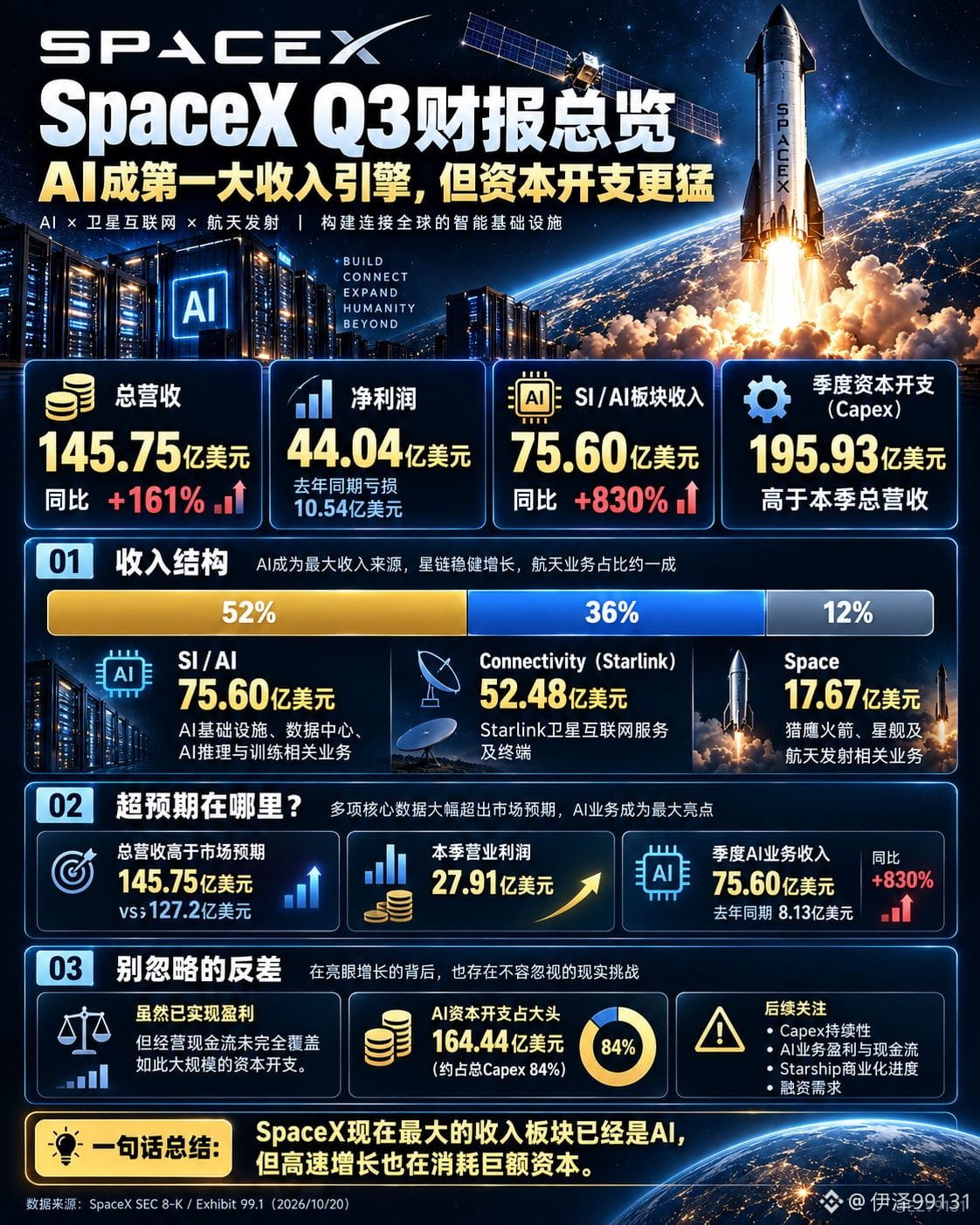
SpaceX earnings blew expectations away! AI revenue surged 830%, but AI isn’t the most profitable business
$SPCX’s Q3 earnings report last night was truly staggering.
Total revenue was $14.575 billion, up 161% year over year.
Net income was $4.404 billion, compared with a loss of $1.054 billion in the same period last year.
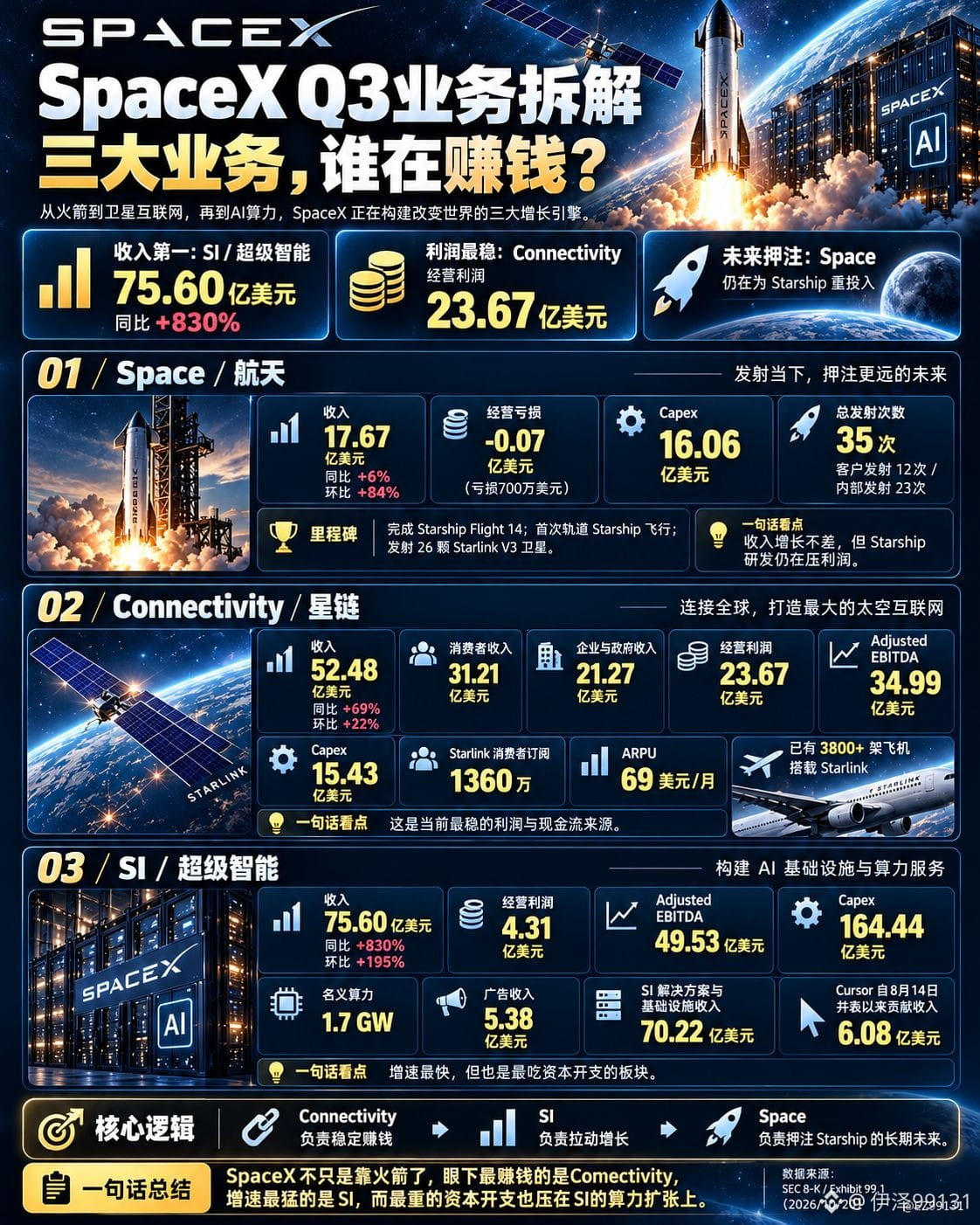
The biggest surprise was AI: revenue for the quarter reached $7.560 billion, up 830% year over year, and now accounts for 52% of SpaceX’s total revenue.
In other words, the company people have always thought of as a rocket builder and satellite operator now gets its biggest share of revenue from AI.
But after reading the report closely, I think two other sets of numbers are even more worth watching.
The first is profit.
AI brought in $7.560 billion in revenue, but generated only $431 million in operating profit.
By contrast, the connectivity business, which includes Starlink, brought in $5.248 billion in revenue and generated $2.367 billion in operating profit.
AI is currently SpaceX’s fastest-growing business, but Starlink is still the steady source of profits.
The second is capital expenditure.
SpaceX’s total capital expenditure this quarter was $19.593 billion, of which $16.444 billion went to AI—nearly 84% of the total.
That was in a single quarter!
The amount spent on AI has already exceeded the company’s total quarterly revenue.
Although SpaceX has posted $4.4 billion in net income, accounting profit is not the same as free cash flow. We’ll need to see how much cash these massive data center and computing investments ultimately generate.
This is the challenge facing the entire U.S. AI industry.
From $NVDA, $AVGO, and $MRVL to $MSFT, $META, $AMZN, and $GOOGL, companies are all making enormous investments in AI.
Chip orders are getting bigger, demand for computing power is growing, and revenue is indeed increasing.
SpaceX’s business model is becoming increasingly clear.
I remain optimistic about the growth potential of AI infrastructure over the next few years, but I don’t believe that faster revenue growth automatically makes a stock more worth chasing.
What really determines long-term returns is profit margins, capital efficiency, and cash flow.
This earnings report happens to highlight one of the most interesting aspects of the AI supercycle:
The growth is real, and so is the demand—but so is the cash burn.
What may be most worth examining going forward is no longer whose AI revenue is growing the fastest, but who can truly turn computing power into sustainable, substantial free cash flow.
#SpaceX #SPCX #NVDA #U.S.Stocks #ArtificialIntelligence
SpaceX earnings blew expectations away! AI revenue surged 830%, but AI isn’t the most profitable business
$SPCX’s Q3 earnings report last night was truly staggering.
Total revenue was $14.575 billion, up 161% year over year.
Net income was $4.404 billion, compared with a loss of $1.054 billion in the same period last year.
The biggest surprise was AI: revenue for the quarter reached $7.560 billion, up 830% year over year, and now accounts for 52% of SpaceX’s total revenue.
In other words, the company people have always thought of as a rocket builder and satellite operator now gets its biggest share of revenue from AI.
But after reading the report closely, I think two other sets of numbers are even more worth watching.
The first is profit.
AI brought in $7.560 billion in revenue, but generated only $431 million in operating profit.
By contrast, the connectivity business, which includes Starlink, brought in $5.248 billion in revenue and generated $2.367 billion in operating profit.
AI is currently SpaceX’s fastest-growing business, but Starlink is still the steady source of profits.
The second is capital expenditure.
SpaceX’s total capital expenditure this quarter was $19.593 billion, of which $16.444 billion went to AI—nearly 84% of the total.
That was in a single quarter!
The amount spent on AI has already exceeded the company’s total quarterly revenue.
Although SpaceX has posted $4.4 billion in net income, accounting profit is not the same as free cash flow. We’ll need to see how much cash these massive data center and computing investments ultimately generate.
This is the challenge facing the entire U.S. AI industry.
From $NVDA, $AVGO, and $MRVL to $MSFT, $META, $AMZN, and $GOOGL, companies are all making enormous investments in AI.
Chip orders are getting bigger, demand for computing power is growing, and revenue is indeed increasing.
SpaceX’s business model is becoming increasingly clear.
I remain optimistic about the growth potential of AI infrastructure over the next few years, but I don’t believe that faster revenue growth automatically makes a stock more worth chasing.
What really determines long-term returns is profit margins, capital efficiency, and cash flow.
This earnings report happens to highlight one of the most interesting aspects of the AI supercycle:
The growth is real, and so is the demand—but so is the cash burn.
What may be most worth examining going forward is no longer whose AI revenue is growing the fastest, but who can truly turn computing power into sustainable, substantial free cash flow.
#SpaceX #SPCX #NVDA #U.S.Stocks #ArtificialIntelligence
$SPCX’s Q3 earnings report last night was truly staggering.
Total revenue was $14.575 billion, up 161% year over year.
Net income was $4.404 billion, compared with a loss of $1.054 billion in the same period last year.
The biggest surprise was AI: revenue for the quarter reached $7.560 billion, up 830% year over year, and now accounts for 52% of SpaceX’s total revenue.
In other words, the company people have always thought of as a rocket builder and satellite operator now gets its biggest share of revenue from AI.
But after reading the report closely, I think two other sets of numbers are even more worth watching.
The first is profit.
AI brought in $7.560 billion in revenue, but generated only $431 million in operating profit.
By contrast, the connectivity business, which includes Starlink, brought in $5.248 billion in revenue and generated $2.367 billion in operating profit.
AI is currently SpaceX’s fastest-growing business, but Starlink is still the steady source of profits.
The second is capital expenditure.
SpaceX’s total capital expenditure this quarter was $19.593 billion, of which $16.444 billion went to AI—nearly 84% of the total.
That was in a single quarter!
The amount spent on AI has already exceeded the company’s total quarterly revenue.
Although SpaceX has posted $4.4 billion in net income, accounting profit is not the same as free cash flow. We’ll need to see how much cash these massive data center and computing investments ultimately generate.
This is the challenge facing the entire U.S. AI industry.
From $NVDA, $AVGO, and $MRVL to $MSFT, $META, $AMZN, and $GOOGL, companies are all making enormous investments in AI.
Chip orders are getting bigger, demand for computing power is growing, and revenue is indeed increasing.
SpaceX’s business model is becoming increasingly clear.
I remain optimistic about the growth potential of AI infrastructure over the next few years, but I don’t believe that faster revenue growth automatically makes a stock more worth chasing.
What really determines long-term returns is profit margins, capital efficiency, and cash flow.
This earnings report happens to highlight one of the most interesting aspects of the AI supercycle:
The growth is real, and so is the demand—but so is the cash burn.
What may be most worth examining going forward is no longer whose AI revenue is growing the fastest, but who can truly turn computing power into sustainable, substantial free cash flow.
#SpaceX #SPCX #NVDA #U.S.Stocks #ArtificialIntelligence
1
167
·
--
Verified
Article
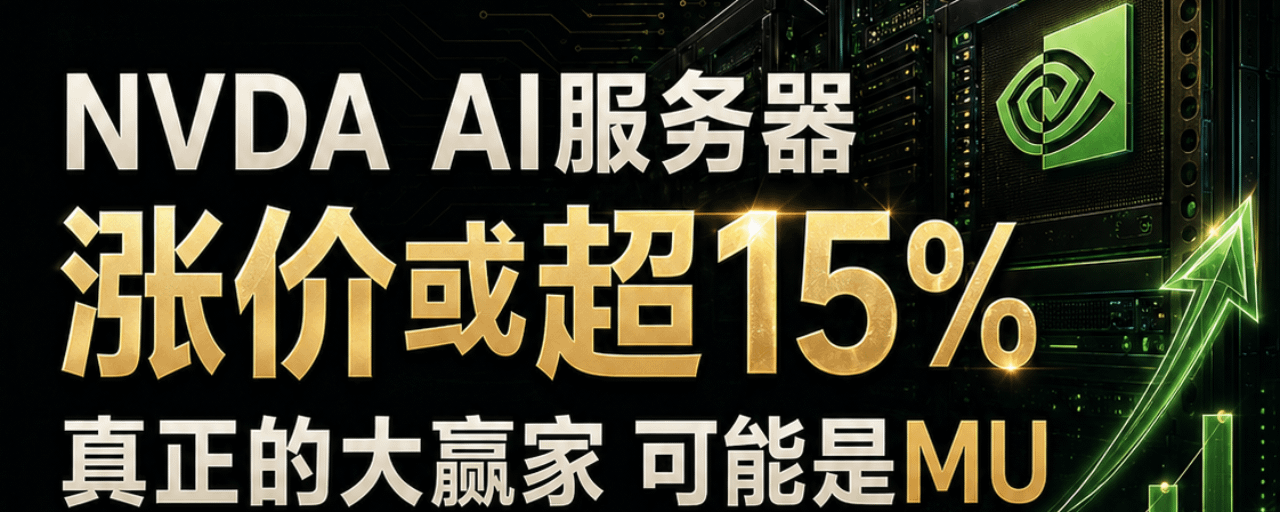
$NVDA AI servers suddenly set to increase prices by more than 15% — the real big winner may be $MUNVIDIA server prices rise by more than 15%.
① The most important positive catalyst
1. $NVDA servers are reported to have had price increases of more than 15%. The true beneficiaries may not be NVIDIA alone
Bloomberg reported Saturday that some of NVIDIA’s biggest customers have already been notified that the prices of servers equipped with AI chips will in many cases rise by more than 15%.
The price increase mainly affects systems delivered starting in early 2027, including:
Vera Rubin
Grace Blackwell
And this time, a very important reason for the price increase is:
Memory chip prices have surged significantly.
Reuters has confirmed this report from Bloomberg.
The market has been discussing for the past few months:
$NVDA AI servers suddenly set to increase prices by more than 15% — the real big winner may be $MU
NVIDIA server prices rise by more than 15%.
① The most important positive catalyst
1. $NVDA servers are reported to have had price increases of more than 15%. The true beneficiaries may not be NVIDIA alone
Bloomberg reported Saturday that some of NVIDIA’s biggest customers have already been notified that the prices of servers equipped with AI chips will in many cases rise by more than 15%.
The price increase mainly affects systems delivered starting in early 2027, including:
Vera Rubin
Grace Blackwell
And this time, a very important reason for the price increase is:
Memory chip prices have surged significantly.
Reuters has confirmed this report from Bloomberg.
The market has been discussing for the past few months:
① The most important positive catalyst
1. $NVDA servers are reported to have had price increases of more than 15%. The true beneficiaries may not be NVIDIA alone
Bloomberg reported Saturday that some of NVIDIA’s biggest customers have already been notified that the prices of servers equipped with AI chips will in many cases rise by more than 15%.
The price increase mainly affects systems delivered starting in early 2027, including:
Vera Rubin
Grace Blackwell
And this time, a very important reason for the price increase is:
Memory chip prices have surged significantly.
Reuters has confirmed this report from Bloomberg.
The market has been discussing for the past few months:
1
806
·
--

Article
Just when the Ministry of Finance “saved” the perfect bond for a day, the 30Y is back to 5.26%—so has the U.S. really started YCC?#USStocks #AI #Semiconductors
AI demand hasn’t collapsed; the market is shifting from “buying AI” to “buying certainty”
Last night, U.S. stocks continued to adjust.
The Dow -1.32%, the S&P 500 -0.87%, and the Nasdaq -1.00%.
But within the semiconductor sector, the trend is completely different:
$MRVL +5.8%
$MU +3.97%
$AVGO +0.43%
$NVDA slightly down
The market is actually quite interesting right now
Indices are trading on Treasuries and oil prices, yet capital has started looking inside AI for companies with real orders and cash flow.
① The most important positive development
The real positive for $MU isn’t a 4% rise—it’s that SK hynix and Samsung have started returning the money they’ve earned from AI to shareholders.
Just when the Ministry of Finance “saved” the perfect bond for a day, the 30Y is back to 5.26%—so has the U.S. really started YCC?
#USStocks #AI #Semiconductors
AI demand hasn’t collapsed; the market is shifting from “buying AI” to “buying certainty”
Last night, U.S. stocks continued to adjust.
The Dow -1.32%, the S&P 500 -0.87%, and the Nasdaq -1.00%.
But within the semiconductor sector, the trend is completely different:
$MRVL +5.8%
$MU +3.97%
$AVGO +0.43%
$NVDA slightly down
The market is actually quite interesting right now
Indices are trading on Treasuries and oil prices, yet capital has started looking inside AI for companies with real orders and cash flow.
① The most important positive development
The real positive for $MU isn’t a 4% rise—it’s that SK hynix and Samsung have started returning the money they’ve earned from AI to shareholders.
AI demand hasn’t collapsed; the market is shifting from “buying AI” to “buying certainty”
Last night, U.S. stocks continued to adjust.
The Dow -1.32%, the S&P 500 -0.87%, and the Nasdaq -1.00%.
But within the semiconductor sector, the trend is completely different:
$MRVL +5.8%
$MU +3.97%
$AVGO +0.43%
$NVDA slightly down
The market is actually quite interesting right now
Indices are trading on Treasuries and oil prices, yet capital has started looking inside AI for companies with real orders and cash flow.
① The most important positive development
The real positive for $MU isn’t a 4% rise—it’s that SK hynix and Samsung have started returning the money they’ve earned from AI to shareholders.
1
723
·
--

Article
It’s not that simple for Google to invest $12.1 billion in $MRVL—what’s really valuable is the $120 billion revenue pathway behind itLast night, the three major U.S. stock indexes closed slightly higher, but there was clear divergence within semiconductors: MRVL +9.9%, AVGO -4.6%, AMD -3.6%, NVDA -1.0%, MU -0.4%. Meanwhile, the U.S. Treasury suddenly increased long-term bond repurchases, suppressing long-end yields. But the Fed meeting minutes were clearly hawkish, and Brent is still above $91. So this is a market theme of “temporary macro support but continued internal divergence within AI.”
① Most important positive catalyst
1. Google × Marvell: This isn’t a routine partnership; it’s an upgrade to MRVL’s valuation logic
This is the most important news in all AI semiconductors last night.
It’s not that simple for Google to invest $12.1 billion in $MRVL—what’s really valuable is the $120 billion revenue pathway behind it
Last night, the three major U.S. stock indexes closed slightly higher, but there was clear divergence within semiconductors: MRVL +9.9%, AVGO -4.6%, AMD -3.6%, NVDA -1.0%, MU -0.4%. Meanwhile, the U.S. Treasury suddenly increased long-term bond repurchases, suppressing long-end yields. But the Fed meeting minutes were clearly hawkish, and Brent is still above $91. So this is a market theme of “temporary macro support but continued internal divergence within AI.”
① Most important positive catalyst
1. Google × Marvell: This isn’t a routine partnership; it’s an upgrade to MRVL’s valuation logic
This is the most important news in all AI semiconductors last night.
① Most important positive catalyst
1. Google × Marvell: This isn’t a routine partnership; it’s an upgrade to MRVL’s valuation logic
This is the most important news in all AI semiconductors last night.
1
614
·
--
Verified
China eases restrictions on Nvidia H200 chips; ByteDance and Quadream each receive 10,000 units
According to the British Financial Times, China has relaxed restrictions on <$NVDAB > Nvidia H200 chips, allowing ByteDance and Tencent to each receive about 10,000 processors to accelerate AI development.
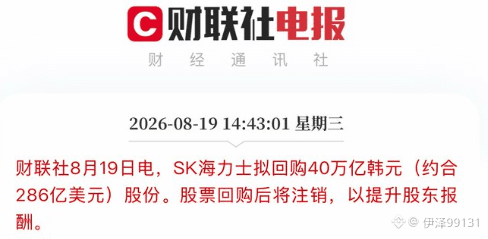
$SKHY
will repurchase stocks worth 400 trillion won. The repurchased shares will be used for cancellation and returned to shareholders. (Value: US$28.6 billion)
The AI bubble is far from over; it’s just that the bond market has been weak recently. Let’s see how the Federal Reserve addresses policy proposals on 8.28.
China eases restrictions on Nvidia H200 chips; ByteDance and Quadream each receive 10,000 units
According to the British Financial Times, China has relaxed restrictions on <$NVDAB > Nvidia H200 chips, allowing ByteDance and Tencent to each receive about 10,000 processors to accelerate AI development.
$SKHY
will repurchase stocks worth 400 trillion won. The repurchased shares will be used for cancellation and returned to shareholders. (Value: US$28.6 billion)
The AI bubble is far from over; it’s just that the bond market has been weak recently. Let’s see how the Federal Reserve addresses policy proposals on 8.28.
According to the British Financial Times, China has relaxed restrictions on <$NVDAB > Nvidia H200 chips, allowing ByteDance and Tencent to each receive about 10,000 processors to accelerate AI development.
$SKHY
will repurchase stocks worth 400 trillion won. The repurchased shares will be used for cancellation and returned to shareholders. (Value: US$28.6 billion)
The AI bubble is far from over; it’s just that the bond market has been weak recently. Let’s see how the Federal Reserve addresses policy proposals on 8.28.

3
3
9.7k
·
--
Verified

Article
On July 23, Nokia wants to keep rising— it must prove three things: AI/cloud orders haven’t cooled off, Optical/IP growth can continue to be upgraded, and profit margins aren’t being eaten up by heavy assets and integration costs; key positive factors and risks ahead of the earnings report analysisUS stocks $NOK Nokia has confirmed that it will release Q2 and first-half results on July 23, 2026 Corporation | Nokia
Before the earnings report, Nokia’s current core
Now Nokia is no longer simply a “traditional communications equipment stock.” The market is reassessing it along three AI infrastructure tracks:
Article 1: Optical Networks / AI DCI. The expansion of AI data centers increases the need for interconnection across data centers. Nokia strengthens its coherent optical and optical transmission systems through Infinera.
In Q1, Optical Networks grew 20%, and Network Infrastructure grew 6%. The company also raised its 2026 Network Infrastructure growth target to 12%–14%, and assumes total growth of 18%–20% for IP + Optical Networks.
On July 23, Nokia wants to keep rising— it must prove three things: AI/cloud orders haven’t cooled off, Optical/IP growth can continue to be upgraded, and profit margins aren’t being eaten up by heavy assets and integration costs; key positive factors and risks ahead of the earnings report analysis
US stocks $NOK Nokia has confirmed that it will release Q2 and first-half results on July 23, 2026 Corporation | Nokia
Before the earnings report, Nokia’s current core
Now Nokia is no longer simply a “traditional communications equipment stock.” The market is reassessing it along three AI infrastructure tracks:
Article 1: Optical Networks / AI DCI. The expansion of AI data centers increases the need for interconnection across data centers. Nokia strengthens its coherent optical and optical transmission systems through Infinera.
In Q1, Optical Networks grew 20%, and Network Infrastructure grew 6%. The company also raised its 2026 Network Infrastructure growth target to 12%–14%, and assumes total growth of 18%–20% for IP + Optical Networks.
Before the earnings report, Nokia’s current core
Now Nokia is no longer simply a “traditional communications equipment stock.” The market is reassessing it along three AI infrastructure tracks:
Article 1: Optical Networks / AI DCI. The expansion of AI data centers increases the need for interconnection across data centers. Nokia strengthens its coherent optical and optical transmission systems through Infinera.
In Q1, Optical Networks grew 20%, and Network Infrastructure grew 6%. The company also raised its 2026 Network Infrastructure growth target to 12%–14%, and assumes total growth of 18%–20% for IP + Optical Networks.
2
4.3k
·
--
Meta’s CEO really should be scolded—he won’t even come out to clarify!
In reality, it’s just that the model is not good enough; it can’t catch up with OpenAI and Claude.
Revenue can only be increased by learning from Musk: renting out excess computing power to generate an additional income stream.
What the market is worried about is this:
Meta invests more than a hundred billion dollars into AI infrastructure, but the ROI is unclear.
Now, if Meta can rent out idle or temporarily surplus compute capacity externally, it effectively converts part of the “capital expenditure pressure” into “an asset that can be monetized.”
This helps ease investors’ concerns about the return on AI capex.
The logic mainly has three layers:
First, it shows that AI compute power does have external demand.
If enterprise customers are willing to buy access to Meta’s models or raw GPU compute, it means the market isn’t without demand—and that compute is still scarce.
Reuters also mentioned that this could help Meta participate in enterprise AI service demand and reduce reliance on the advertising business.
Second, it suggests Meta’s AI capex isn’t necessarily pure cost.
In Meta’s official Q1 update, it already raised its 2026 capex guidance to $125–145 billion. Previously, the market interpreted this as cash-flow pressure. Now, if some compute capacity can be leased out, the market may reconsider whether these data centers and GPUs can also generate revenue.
Third, there is currently no evidence that Meta plans to cut back on AI investment.
Meta’s official statement also said it expects operating profit in 2026 to be higher than in 2025, and it hasn’t signaled a “full-scale pullback” in AI spending.
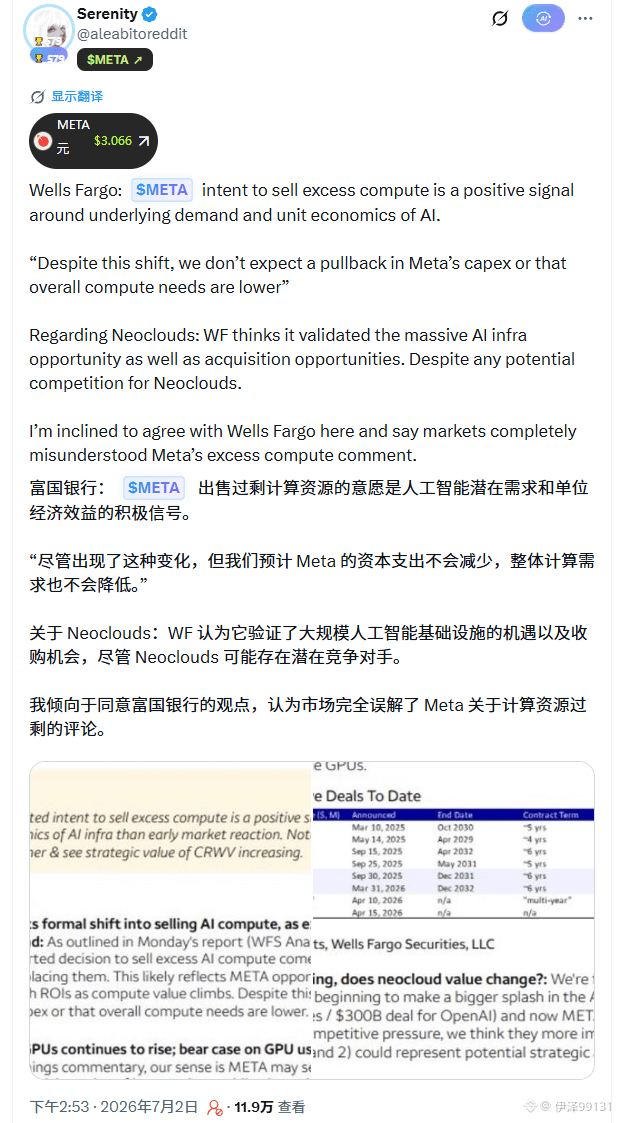
So Wells Fargo says, “The market misunderstands Meta’s excess compute comments.”
Meta’s CEO really should be scolded—he won’t even come out to clarify!
In reality, it’s just that the model is not good enough; it can’t catch up with OpenAI and Claude.
Revenue can only be increased by learning from Musk: renting out excess computing power to generate an additional income stream.
What the market is worried about is this:
Meta invests more than a hundred billion dollars into AI infrastructure, but the ROI is unclear.
Now, if Meta can rent out idle or temporarily surplus compute capacity externally, it effectively converts part of the “capital expenditure pressure” into “an asset that can be monetized.”
This helps ease investors’ concerns about the return on AI capex.
The logic mainly has three layers:
First, it shows that AI compute power does have external demand.
If enterprise customers are willing to buy access to Meta’s models or raw GPU compute, it means the market isn’t without demand—and that compute is still scarce.
Reuters also mentioned that this could help Meta participate in enterprise AI service demand and reduce reliance on the advertising business.
Second, it suggests Meta’s AI capex isn’t necessarily pure cost.
In Meta’s official Q1 update, it already raised its 2026 capex guidance to $125–145 billion. Previously, the market interpreted this as cash-flow pressure. Now, if some compute capacity can be leased out, the market may reconsider whether these data centers and GPUs can also generate revenue.
Third, there is currently no evidence that Meta plans to cut back on AI investment.
Meta’s official statement also said it expects operating profit in 2026 to be higher than in 2025, and it hasn’t signaled a “full-scale pullback” in AI spending.
So Wells Fargo says, “The market misunderstands Meta’s excess compute comments.”
In reality, it’s just that the model is not good enough; it can’t catch up with OpenAI and Claude.
Revenue can only be increased by learning from Musk: renting out excess computing power to generate an additional income stream.
What the market is worried about is this:
Meta invests more than a hundred billion dollars into AI infrastructure, but the ROI is unclear.
Now, if Meta can rent out idle or temporarily surplus compute capacity externally, it effectively converts part of the “capital expenditure pressure” into “an asset that can be monetized.”
This helps ease investors’ concerns about the return on AI capex.
The logic mainly has three layers:
First, it shows that AI compute power does have external demand.
If enterprise customers are willing to buy access to Meta’s models or raw GPU compute, it means the market isn’t without demand—and that compute is still scarce.
Reuters also mentioned that this could help Meta participate in enterprise AI service demand and reduce reliance on the advertising business.
Second, it suggests Meta’s AI capex isn’t necessarily pure cost.
In Meta’s official Q1 update, it already raised its 2026 capex guidance to $125–145 billion. Previously, the market interpreted this as cash-flow pressure. Now, if some compute capacity can be leased out, the market may reconsider whether these data centers and GPUs can also generate revenue.
Third, there is currently no evidence that Meta plans to cut back on AI investment.
Meta’s official statement also said it expects operating profit in 2026 to be higher than in 2025, and it hasn’t signaled a “full-scale pullback” in AI spending.
So Wells Fargo says, “The market misunderstands Meta’s excess compute comments.”
2
11
4.6k
·
--

Article
From a “high-risk AI cloud small-cap,” $SHAZ starts turning into an “APAC AI Factory platform validated by top-tier AI infrastructure capital.”Sure enough! You were right to build a position in $SHAZ two weeks ago!
$NBIS $CRWV are up a lot; $SHAZ has only just begun!
Based on the private placement terms, the effective cost for this batch of $SHAZ positions held by Situational Awareness is basically around $68.73 per share. This price can be taken as the core cost line for Leopold’s strategic entry.
The beneficial ownership of Sharon AI 19.9% disclosed by Situational Awareness behind Leopold Aschenbrenner.
Note, this isn’t a simple “retail influencer pump.”
This is core capital that truly bets on AI infrastructure, putting SHAZ into its own concentrated holding system.
From a “high-risk AI cloud small-cap,” $SHAZ starts turning into an “APAC AI Factory platform validated by top-tier AI infrastructure capital.”
Sure enough! You were right to build a position in $SHAZ two weeks ago!
$NBIS $CRWV are up a lot; $SHAZ has only just begun!
Based on the private placement terms, the effective cost for this batch of $SHAZ positions held by Situational Awareness is basically around $68.73 per share. This price can be taken as the core cost line for Leopold’s strategic entry.
The beneficial ownership of Sharon AI 19.9% disclosed by Situational Awareness behind Leopold Aschenbrenner.
Note, this isn’t a simple “retail influencer pump.”
This is core capital that truly bets on AI infrastructure, putting SHAZ into its own concentrated holding system.
$NBIS $CRWV are up a lot; $SHAZ has only just begun!
Based on the private placement terms, the effective cost for this batch of $SHAZ positions held by Situational Awareness is basically around $68.73 per share. This price can be taken as the core cost line for Leopold’s strategic entry.
The beneficial ownership of Sharon AI 19.9% disclosed by Situational Awareness behind Leopold Aschenbrenner.
Note, this isn’t a simple “retail influencer pump.”
This is core capital that truly bets on AI infrastructure, putting SHAZ into its own concentrated holding system.
CRWVUS-8.49%
SHAZUS-7.82%
NBISUS-12.41%
11
5.9k
·
--

Article
New macro news highlights from the past week in U.S. stock market: factors that are favorable and unfavorable—continuing to deliver high-quality analysisWeekend → Monday U.S. Market Brief
🟢 Bullish developments
Middle East tensions eased, supporting risk assets
The biggest macro driver into Monday is a reported de-escalation between the U.S. and Iran after weekend military exchanges. Markets interpreted the latest developments as reducing the probability of a prolonged disruption to oil shipping. U.S. equity futures, especially Nasdaq futures, moved higher before the open as investors rotated back toward growth assets. (Reuters)
Most positive for
New macro news highlights from the past week in U.S. stock market: factors that are favorable and unfavorable—continuing to deliver high-quality analysis
Weekend → Monday U.S. Market Brief
🟢 Bullish developments
Middle East tensions eased, supporting risk assets
The biggest macro driver into Monday is a reported de-escalation between the U.S. and Iran after weekend military exchanges. Markets interpreted the latest developments as reducing the probability of a prolonged disruption to oil shipping. U.S. equity futures, especially Nasdaq futures, moved higher before the open as investors rotated back toward growth assets. (Reuters)
Most positive for
🟢 Bullish developments
Middle East tensions eased, supporting risk assets
The biggest macro driver into Monday is a reported de-escalation between the U.S. and Iran after weekend military exchanges. Markets interpreted the latest developments as reducing the probability of a prolonged disruption to oil shipping. U.S. equity futures, especially Nasdaq futures, moved higher before the open as investors rotated back toward growth assets. (Reuters)
Most positive for
1
2.9k
·
--
Article
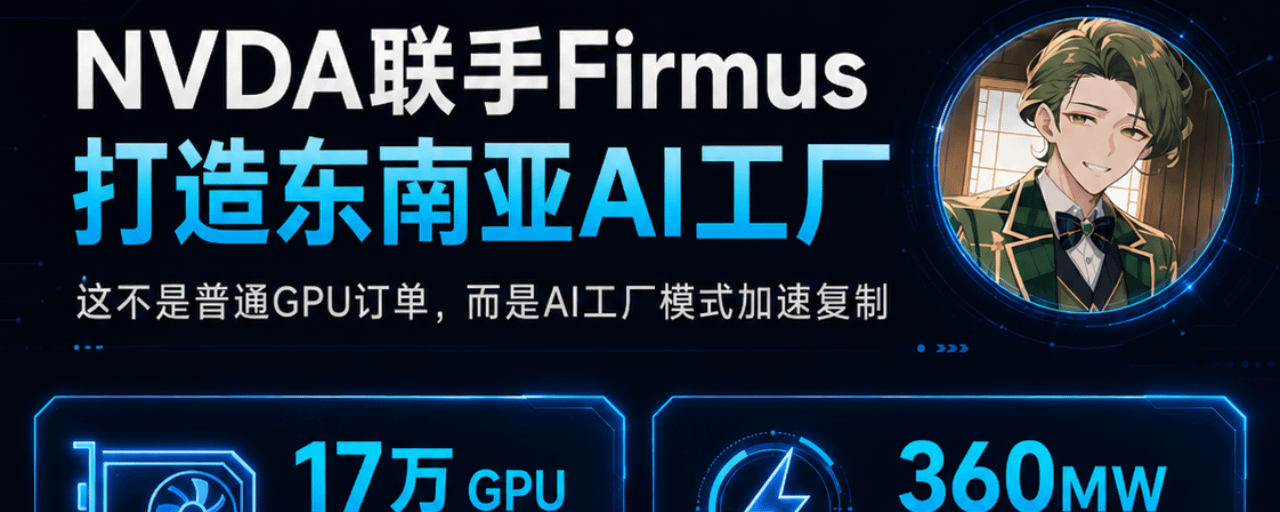
Australian AI infrastructure company Firmus Technologies said on Monday that it has signed a strategic cooperation agreement with NVIDIA (NVDA.O).Firmus will build a 360MW NVIDIA DSX AI Factory on Bintan Island, Indonesia. The agreement covers up to 170,000 NVIDIA AI accelerators, including platforms such as Grace Blackwell, Vera Rubin, and Vera, with delivery concentrated in 2027 to 2028.
Firmus expects that, based on existing customer purchase commitments, it could generate between $25 and $30 billion in revenue over the first 6 years.
AI computing power is moving from a “big-tech in-house build” approach to a “regional AI factory wholesale-and-retail model.”
In the past, only major players like Microsoft, Meta, Google, and Amazon could secure top-tier GPUs and infrastructure at the lowest cost.
Australian AI infrastructure company Firmus Technologies said on Monday that it has signed a strategic cooperation agreement with NVIDIA (NVDA.O).
Firmus will build a 360MW NVIDIA DSX AI Factory on Bintan Island, Indonesia. The agreement covers up to 170,000 NVIDIA AI accelerators, including platforms such as Grace Blackwell, Vera Rubin, and Vera, with delivery concentrated in 2027 to 2028.
Firmus expects that, based on existing customer purchase commitments, it could generate between $25 and $30 billion in revenue over the first 6 years.
AI computing power is moving from a “big-tech in-house build” approach to a “regional AI factory wholesale-and-retail model.”
In the past, only major players like Microsoft, Meta, Google, and Amazon could secure top-tier GPUs and infrastructure at the lowest cost.
Firmus expects that, based on existing customer purchase commitments, it could generate between $25 and $30 billion in revenue over the first 6 years.
AI computing power is moving from a “big-tech in-house build” approach to a “regional AI factory wholesale-and-retail model.”
In the past, only major players like Microsoft, Meta, Google, and Amazon could secure top-tier GPUs and infrastructure at the lowest cost.
4
5.8k
·
--
Article
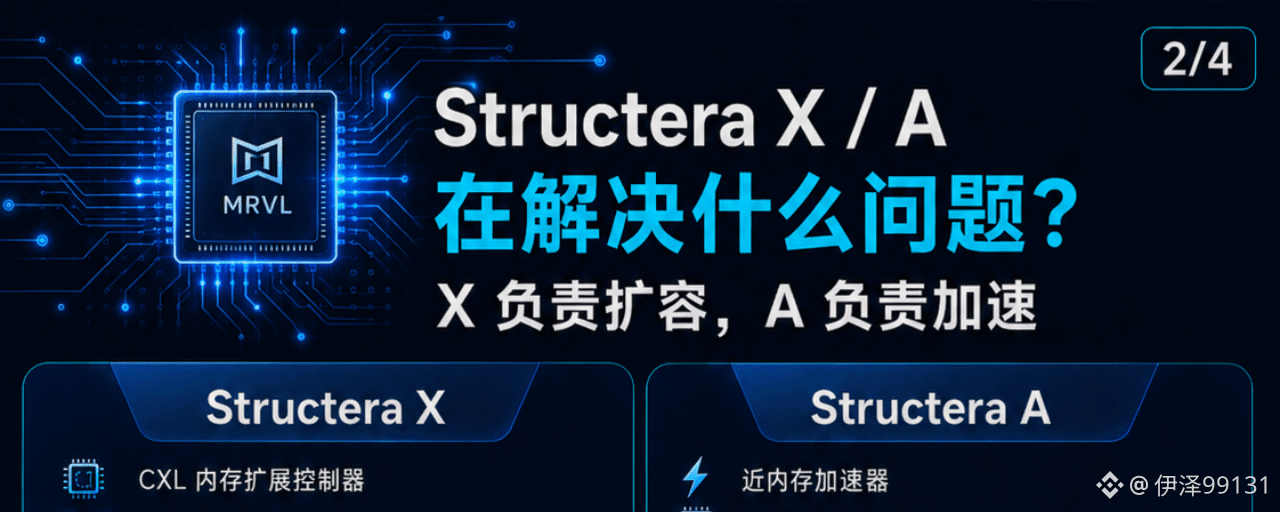
In the AI era, the memory wall is becoming as important a foundational infrastructure bottleneck as optical interconnects! And #Marvell is tackling both of these walls at the same time.In the past, when people looked at Marvell, the first thing that came to mind was AI ASICs, optical interconnects, SerDes, DSPs, silicon photonics, and DCI.
But this time, the focus of Structera X and Structera A is to bring MRVL into the main storyline of the AI memory bottleneck.
Now, the most expensive thing in an AI data center isn't just GPUs.
Memory is getting more expensive too.
Long-context, multi-agent systems, inference services, vector databases, in-memory databases, recommendation models—these scenarios all疯狂ly consume DRAM.
The GPU handles computation.
Memory handles storage and recall.
Optical interconnects handle data movement.
If the memory isn't enough, even a stronger GPU will get bottlenecked.
In the AI era, the memory wall is becoming as important a foundational infrastructure bottleneck as optical interconnects! And #Marvell is tackling both of these walls at the same time.
In the past, when people looked at Marvell, the first thing that came to mind was AI ASICs, optical interconnects, SerDes, DSPs, silicon photonics, and DCI.
But this time, the focus of Structera X and Structera A is to bring MRVL into the main storyline of the AI memory bottleneck.
Now, the most expensive thing in an AI data center isn't just GPUs.
Memory is getting more expensive too.
Long-context, multi-agent systems, inference services, vector databases, in-memory databases, recommendation models—these scenarios all疯狂ly consume DRAM.
The GPU handles computation.
Memory handles storage and recall.
Optical interconnects handle data movement.
If the memory isn't enough, even a stronger GPU will get bottlenecked.
But this time, the focus of Structera X and Structera A is to bring MRVL into the main storyline of the AI memory bottleneck.
Now, the most expensive thing in an AI data center isn't just GPUs.
Memory is getting more expensive too.
Long-context, multi-agent systems, inference services, vector databases, in-memory databases, recommendation models—these scenarios all疯狂ly consume DRAM.
The GPU handles computation.
Memory handles storage and recall.
Optical interconnects handle data movement.
If the memory isn't enough, even a stronger GPU will get bottlenecked.
3
3.9k
·
--

Article
In the age of AI, memory is becoming just as important as computing power. If the GPU is the brain's computing power, then memory is the brain's recollection. Without memory, even the most powerful AI cannot go far.Storage is king! Micron's performance last night was almost perfect!
$MU This financial report redefines the storage industry.
In the AI era, storage is no longer just a supporting component, but a core resource of computing systems.
The Q3 figure is already quite exaggerated.
Revenue was $41.46 billion.
Non-GAAP EPS: $25.11.
The gross profit margin is close to 85%.
Q4 provides even stronger guidance.
Revenue guidance is $49 billion to $51 billion.
Non-GAAP EPS guidance is $30 to $32.
Gross margin guidance is approximately 86%.
This is no longer a slight overshoot of expectations; it has pushed Wall Street's models up by a significant margin.
In the age of AI, memory is becoming just as important as computing power. If the GPU is the brain's computing power, then memory is the brain's recollection. Without memory, even the most powerful AI cannot go far.
Storage is king! Micron's performance last night was almost perfect!
$MU This financial report redefines the storage industry.
In the AI era, storage is no longer just a supporting component, but a core resource of computing systems.
The Q3 figure is already quite exaggerated.
Revenue was $41.46 billion.
Non-GAAP EPS: $25.11.
The gross profit margin is close to 85%.
Q4 provides even stronger guidance.
Revenue guidance is $49 billion to $51 billion.
Non-GAAP EPS guidance is $30 to $32.
Gross margin guidance is approximately 86%.
This is no longer a slight overshoot of expectations; it has pushed Wall Street's models up by a significant margin.
$MU This financial report redefines the storage industry.
In the AI era, storage is no longer just a supporting component, but a core resource of computing systems.
The Q3 figure is already quite exaggerated.
Revenue was $41.46 billion.
Non-GAAP EPS: $25.11.
The gross profit margin is close to 85%.
Q4 provides even stronger guidance.
Revenue guidance is $49 billion to $51 billion.
Non-GAAP EPS guidance is $30 to $32.
Gross margin guidance is approximately 86%.
This is no longer a slight overshoot of expectations; it has pushed Wall Street's models up by a significant margin.
3k
·
--

Article
Nokia's AI narrative is expanding from hardware to the software layer. Optical networks are the veins, AI-RAN is the nerves, and Assurance Center + Gemini is more like the brain of network operations.Nokia's got more good news pre-market!
$NOK This Google Cloud partnership, I feel like the market might be underestimating its significance.
Google Cloud announced a partnership with Nokia to integrate the Gemini model into the Nokia Assurance Center.
This isn't just some simple 'AI white-label news'.
Nokia Assurance Center is basically the AIOps safety net for carrier networks, used for network monitoring, fault identification, performance analysis, and service quality assurance.
In the past, when carrier networks faced issues, many processes went like this:
Alerts are popping up
Engineers are troubleshooting
Digging for root causes
Opening a ticket
Fixing issues
Nokia's AI narrative is expanding from hardware to the software layer. Optical networks are the veins, AI-RAN is the nerves, and Assurance Center + Gemini is more like the brain of network operations.
Nokia's got more good news pre-market!
$NOK This Google Cloud partnership, I feel like the market might be underestimating its significance.
Google Cloud announced a partnership with Nokia to integrate the Gemini model into the Nokia Assurance Center.
This isn't just some simple 'AI white-label news'.
Nokia Assurance Center is basically the AIOps safety net for carrier networks, used for network monitoring, fault identification, performance analysis, and service quality assurance.
In the past, when carrier networks faced issues, many processes went like this:
Alerts are popping up
Engineers are troubleshooting
Digging for root causes
Opening a ticket
Fixing issues
$NOK This Google Cloud partnership, I feel like the market might be underestimating its significance.
Google Cloud announced a partnership with Nokia to integrate the Gemini model into the Nokia Assurance Center.
This isn't just some simple 'AI white-label news'.
Nokia Assurance Center is basically the AIOps safety net for carrier networks, used for network monitoring, fault identification, performance analysis, and service quality assurance.
In the past, when carrier networks faced issues, many processes went like this:
Alerts are popping up
Engineers are troubleshooting
Digging for root causes
Opening a ticket
Fixing issues
1
2
3.5k
·
--
Article
Nokia's Anllentown photonics chip advanced packaging capacity has increased tenfold. In collaboration with t3 Broadband and Aureon, an AI-ready optical transport network has been deployed between North Dakota and Chicago.The recent sell-off of Nokia stock ($NOK) has been incredibly aggressive!
Last Wednesday's witching day was another instance of using options to continue the manipulation!
Nokia released two major news items over the weekend.
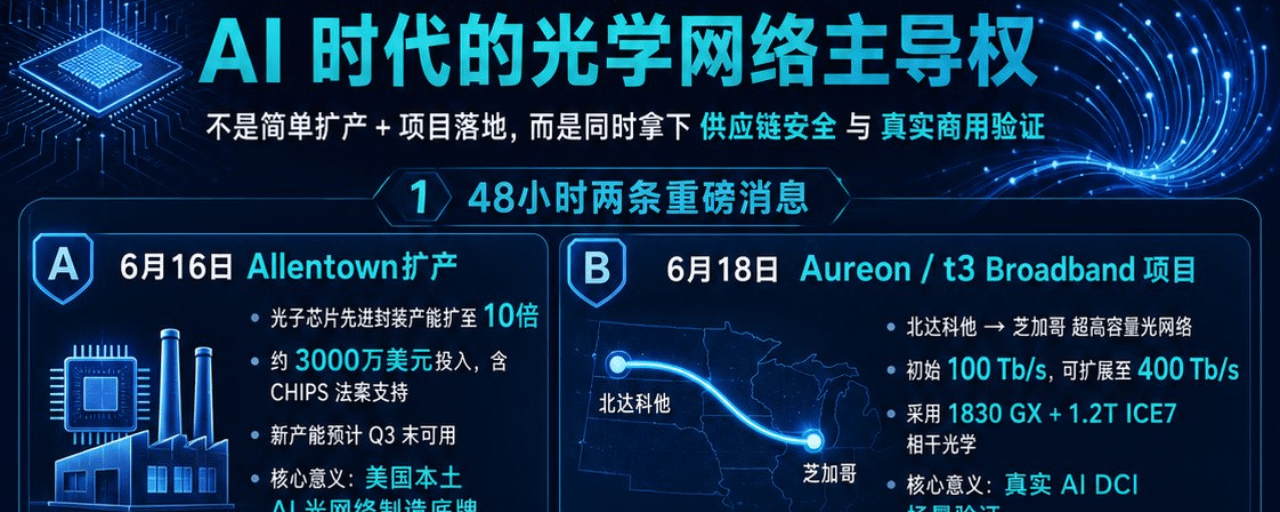
First, Allentown's advanced packaging capacity for photonic chips has increased tenfold.
The second initiative involves collaborating with t3 Broadband and Aureon to establish an AI-ready optical transmission network between North Dakota and Chicago, with an initial capacity of 100 Tb/s, which can be expanded to 400 Tb/s in the future.
On their own, neither of these two news items is particularly complicated.
One is to expand production.
One is project implementation.
But when you put them together, they taste different.
Nokia's Anllentown photonics chip advanced packaging capacity has increased tenfold. In collaboration with t3 Broadband and Aureon, an AI-ready optical transport network has been deployed between North Dakota and Chicago.
The recent sell-off of Nokia stock ($NOK) has been incredibly aggressive!
Last Wednesday's witching day was another instance of using options to continue the manipulation!
Nokia released two major news items over the weekend.
First, Allentown's advanced packaging capacity for photonic chips has increased tenfold.
The second initiative involves collaborating with t3 Broadband and Aureon to establish an AI-ready optical transmission network between North Dakota and Chicago, with an initial capacity of 100 Tb/s, which can be expanded to 400 Tb/s in the future.
On their own, neither of these two news items is particularly complicated.
One is to expand production.
One is project implementation.
But when you put them together, they taste different.
Last Wednesday's witching day was another instance of using options to continue the manipulation!
Nokia released two major news items over the weekend.
First, Allentown's advanced packaging capacity for photonic chips has increased tenfold.
The second initiative involves collaborating with t3 Broadband and Aureon to establish an AI-ready optical transmission network between North Dakota and Chicago, with an initial capacity of 100 Tb/s, which can be expanded to 400 Tb/s in the future.
On their own, neither of these two news items is particularly complicated.
One is to expand production.
One is project implementation.
But when you put them together, they taste different.
1
4.4k
·
--

Article
Marvell ($MRVL) and Tower Semiconductor ($TSEM) have announced they have shipped over 5 million coherent photonic integrated chips!Breaking news:
Marvell ($MRVL) and Tower Semiconductor ($TSEM)
have announced they have shipped over 5 million coherent photonic integrated chips!
This milestone event highlights the growing importance of optical connectivity in AI-driven data center interconnect networks.
This news is bullish for both MRVL and TSEM, but the nature of the bullishness is different:
For MRVL: This is a bullish signal that 'AI optical interconnect mainline has been validated.'
For TSEM: This is a more direct bullish signal that 'silicon photonics foundry capabilities have been validated.'
The market's response today is strong, with MRVL currently around $323.12, up about 11.6% intraday, and TSEM currently around $276.47, up about 3.5%.
Marvell ($MRVL) and Tower Semiconductor ($TSEM) have announced they have shipped over 5 million coherent photonic integrated chips!
Breaking news:
Marvell ($MRVL) and Tower Semiconductor ($TSEM)
have announced they have shipped over 5 million coherent photonic integrated chips!
This milestone event highlights the growing importance of optical connectivity in AI-driven data center interconnect networks.
This news is bullish for both MRVL and TSEM, but the nature of the bullishness is different:
For MRVL: This is a bullish signal that 'AI optical interconnect mainline has been validated.'
For TSEM: This is a more direct bullish signal that 'silicon photonics foundry capabilities have been validated.'
The market's response today is strong, with MRVL currently around $323.12, up about 11.6% intraday, and TSEM currently around $276.47, up about 3.5%.
Marvell ($MRVL) and Tower Semiconductor ($TSEM)
have announced they have shipped over 5 million coherent photonic integrated chips!
This milestone event highlights the growing importance of optical connectivity in AI-driven data center interconnect networks.
This news is bullish for both MRVL and TSEM, but the nature of the bullishness is different:
For MRVL: This is a bullish signal that 'AI optical interconnect mainline has been validated.'
For TSEM: This is a more direct bullish signal that 'silicon photonics foundry capabilities have been validated.'
The market's response today is strong, with MRVL currently around $323.12, up about 11.6% intraday, and TSEM currently around $276.47, up about 3.5%.
3.9k
·
--
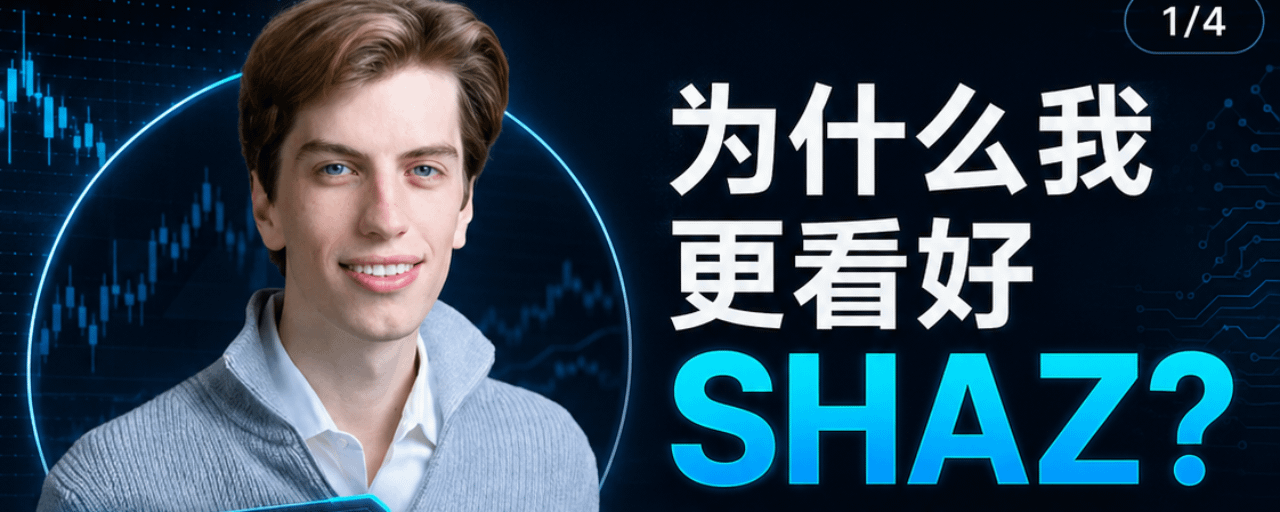
Article
$SHAZ's story is about local Australian AI cloud, sovereign AI, GPU power infrastructure, NVIDIA Cloud Partner.In the US stock sector, I've been researching $SHAZ lately.
I found SHAZ to be an overlooked potential lottery stock!
And the most important thing is it has endorsement from #NVIDIA, along with a partnership deal with Australia!
So, I built my initial position! According to my research, #Leopold also picked some up around 54.
I don't think this company should be seen as just a small-cap AI concept stock; what's really interesting is that it might be turning into Australia's version of an AI neocloud platform.
When people think of AI infrastructure, their first reaction is $IREN, $CRWV, $NBIS, $APLD.
But the story of SHAZ is a bit different.
$SHAZ's story is about local Australian AI cloud, sovereign AI, GPU power infrastructure, NVIDIA Cloud Partner.
In the US stock sector, I've been researching $SHAZ lately.
I found SHAZ to be an overlooked potential lottery stock!
And the most important thing is it has endorsement from #NVIDIA, along with a partnership deal with Australia!
So, I built my initial position! According to my research, #Leopold also picked some up around 54.
I don't think this company should be seen as just a small-cap AI concept stock; what's really interesting is that it might be turning into Australia's version of an AI neocloud platform.
When people think of AI infrastructure, their first reaction is $IREN, $CRWV, $NBIS, $APLD.
But the story of SHAZ is a bit different.
I found SHAZ to be an overlooked potential lottery stock!
And the most important thing is it has endorsement from #NVIDIA, along with a partnership deal with Australia!
So, I built my initial position! According to my research, #Leopold also picked some up around 54.
I don't think this company should be seen as just a small-cap AI concept stock; what's really interesting is that it might be turning into Australia's version of an AI neocloud platform.
When people think of AI infrastructure, their first reaction is $IREN, $CRWV, $NBIS, $APLD.
But the story of SHAZ is a bit different.
3.1k
Log in to explore more content
Join global crypto users on Binance Square
⚡️ Get latest and useful information about crypto.
💬 Trusted by the world’s largest crypto exchange.
👍 Discover real insights from verified creators.
Email / Phone number
Trending Topics
WhoWillSucceedJensenHuangatNvidia?
137,548 views
1,510 Discussing
Nvidia Says No CEO Talks Underway as "Stand With Jensen" Petition Tops 77,900 Signatures
Binance News
·32 Likes
·53.7k views
WhatWillDriveCryptoandStocks’NextRebound?
529,223 views
3,358 Discussing
BitcoinActiveSupplyInProfitDropsBelow45%
59,115 views
626 Discussing