
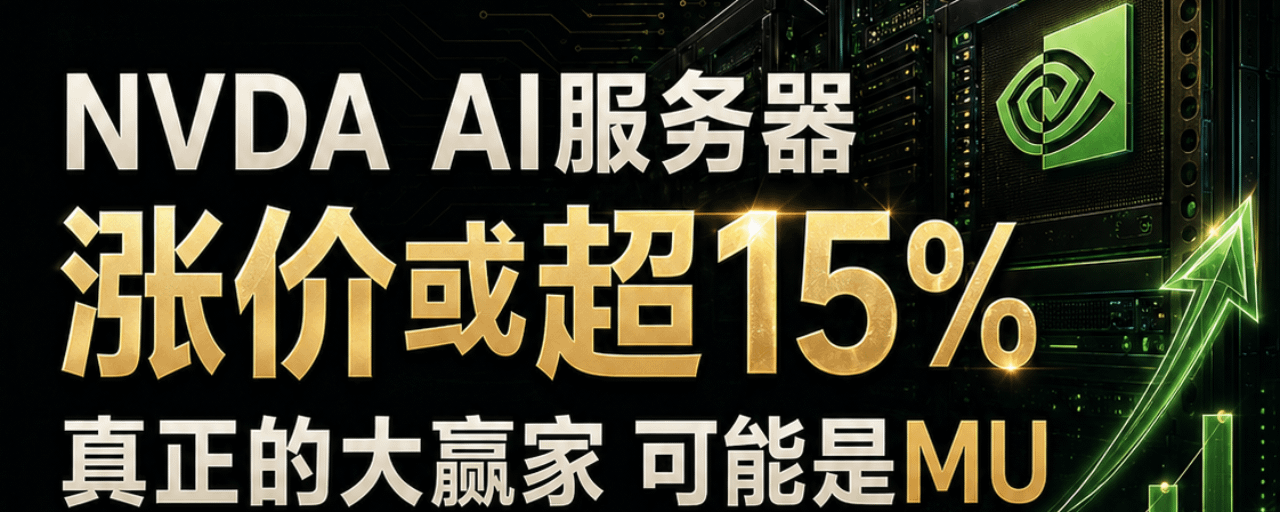

NVIDIA server prices rise by more than 15%.
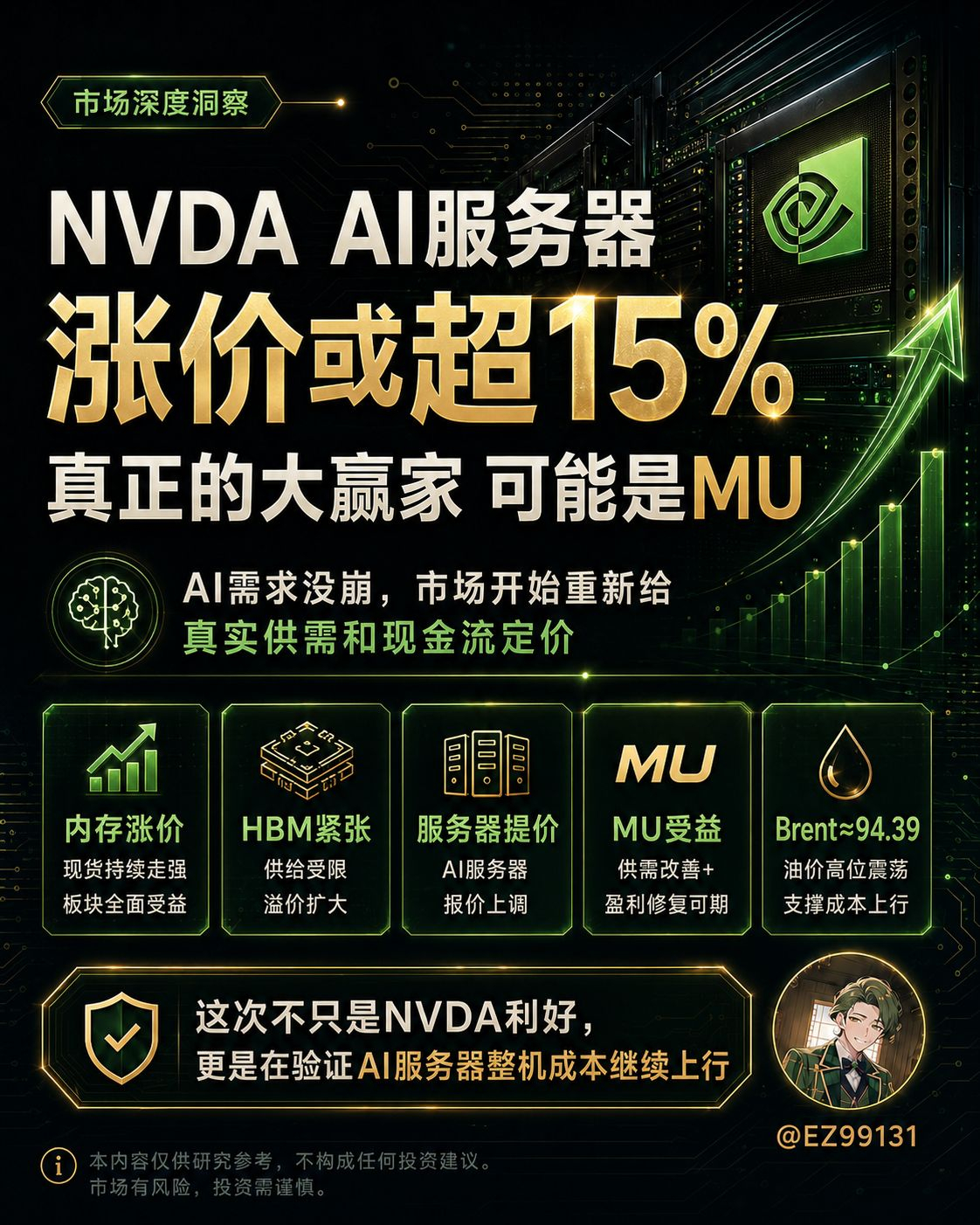
① The most important positive catalyst
1. $NVDA servers are reported to have had price increases of more than 15%. The true beneficiaries may not be NVIDIA alone
Bloomberg reported Saturday that some of NVIDIA’s biggest customers have already been notified that the prices of servers equipped with AI chips will in many cases rise by more than 15%.
The price increase mainly affects systems delivered starting in early 2027, including:
Vera Rubin
Grace Blackwell
And this time, a very important reason for the price increase is:
Memory chip prices have surged significantly.
Reuters has confirmed this report from Bloomberg.
The market has been discussing for the past few months:
Is HBM getting close to the cyclical peak?
The signals appearing now are actually:
Memory prices have already started to rise so high that they directly push up the price of the entire AI server.
This news isn’t just positive for $NVDA.
For:
$MU
SK Hynix
Samsung
HBM supply chain
Instead, it might be even more important.
Server manufacturers have already begun passing costs directly on to customers like Microsoft, Google, and Oracle.
This indicates that current AI demand is still strong to a certain extent:
Price increases haven’t immediately crushed demand.
But there’s also a risk here.
If an AI server keeps getting more expensive, will hyperscalers start to recalculate in the future:
For every additional $1 of Capex, how much AI revenue can it actually generate?
This will be a very important issue next year.
So the view is:
In the near term, it’s positive for NVDA and MU, but in the long run it will further amplify the market’s focus on AI Capex return on investment.
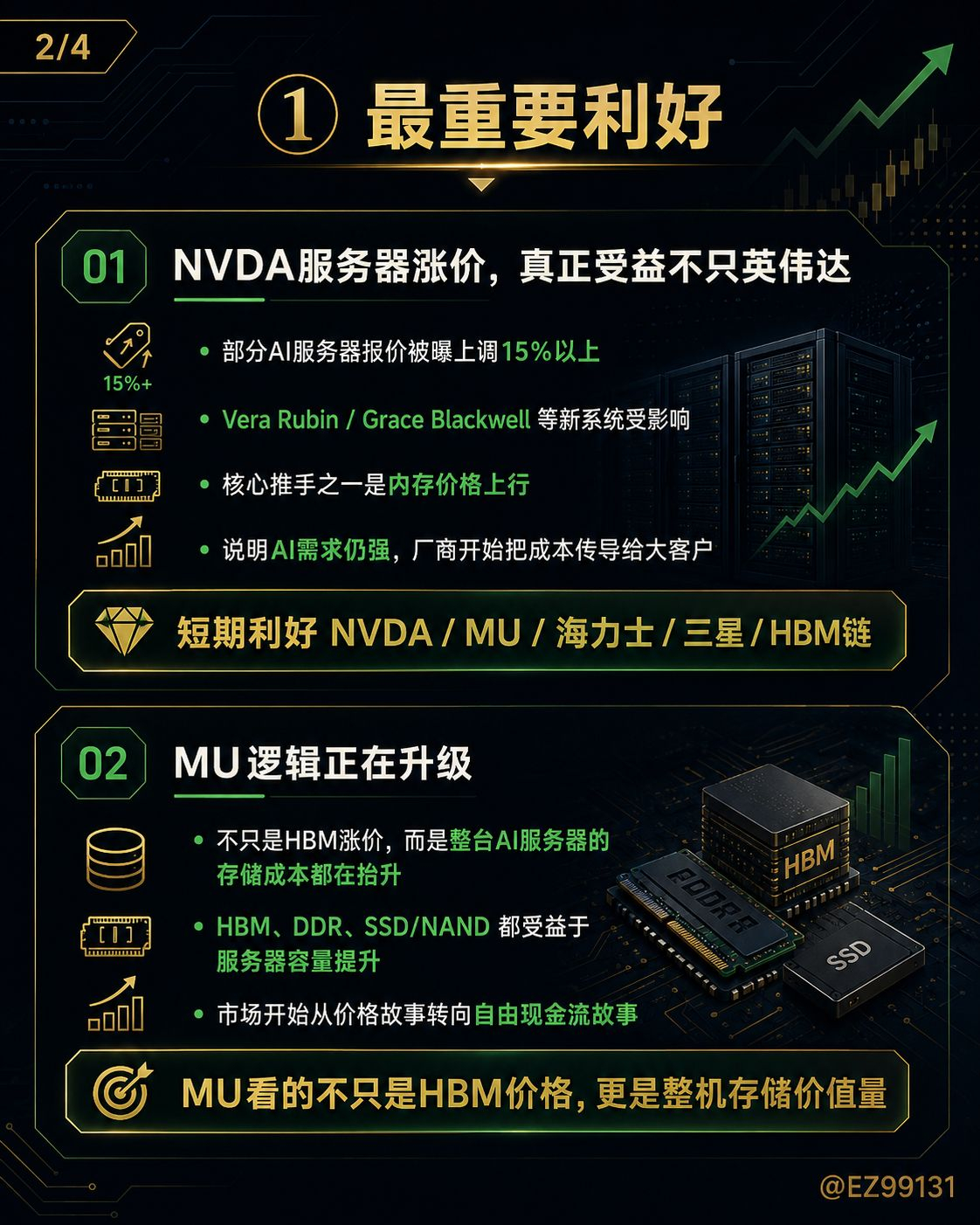
2. MU’s current logic has started shifting from “HBM prices are rising” to “the cost of the entire AI server stack is rising.”
Hynix to repurchase $28.7 billion
Samsung is preparing shareholder returns on a scale of more than $70 billion.
MU continues investing in AI storage
All of this indicates that storage manufacturers’ cash flow is very strong.
But today’s news that NVIDIA servers are being repriced higher is, from another angle, verifying something:
Memory supply and demand are really extremely tight.
And it’s not only HBM.
AI servers themselves require a lot of:
HBM
DDR
SSD / NAND
So as long as shipments of AI servers continue to grow, what MU captures is not just incremental single-use HBM demand, but the increase in storage capacity across the whole AI server stack.
But long term, you still have to keep an eye on YMTC.
YMTC’s parent company plans to raise about $4.9 billion on the Shanghai STAR Market, continuing to invest in advanced NAND capacity and R&D. Reuters’ data shows YMTC is already in the global top three for NAND.
So my take on MU right now is:
Supply and demand are still strong in the near and mid term; what really needs attention is the supply in the next two or three years—not a sudden collapse in demand next quarter.
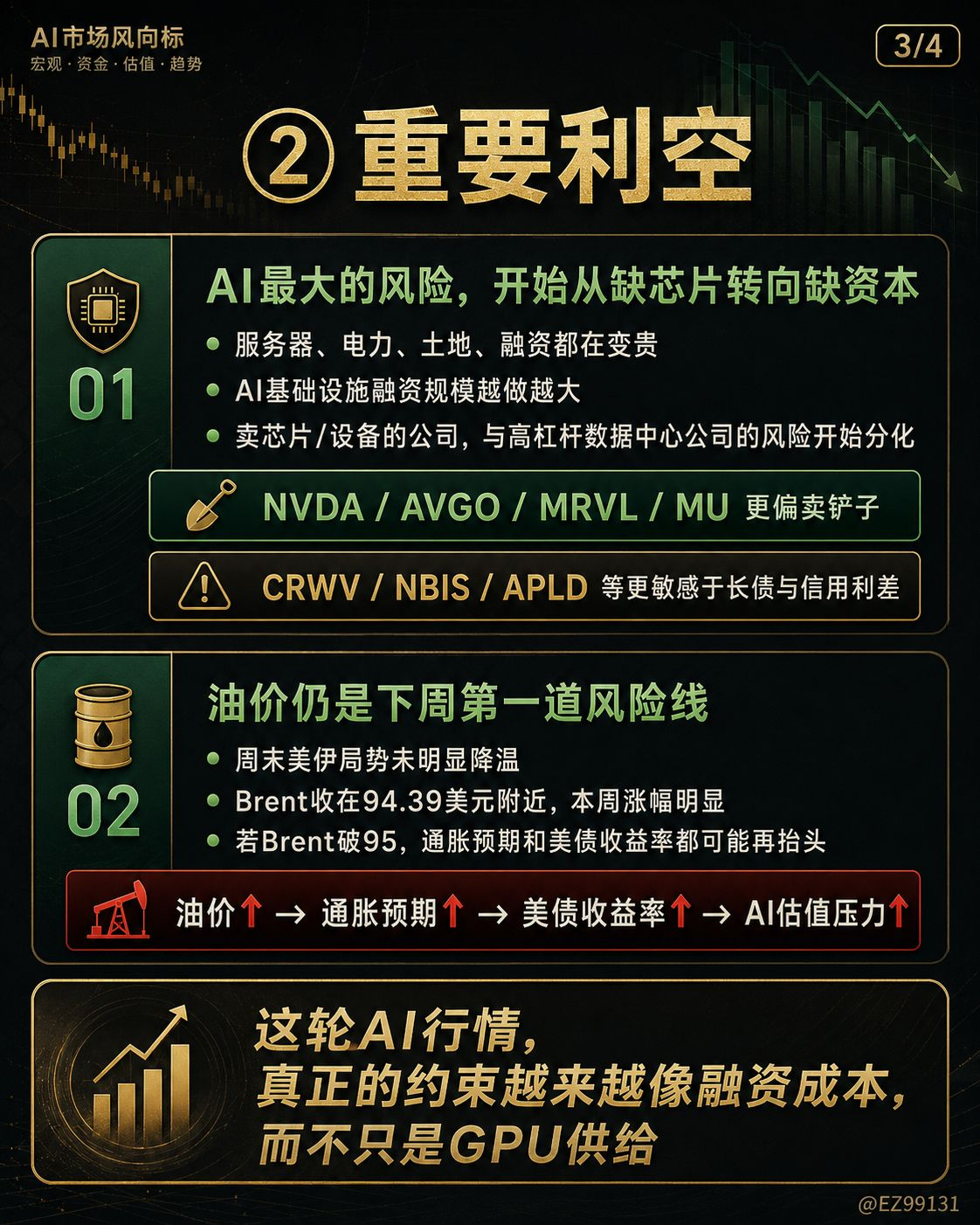
② Important negative
1. The biggest risk for AI right now is starting to shift from “are there enough chips?” to “is there enough capital?”
This week, Broadcom discussed more than $60 billion in AI financing, and the overall scale could even approach $100 billion.
NVIDIA is again partnering with major financial institutions, hoping to unlock more than $500 billion in AI infrastructure funding.
Meanwhile, AI servers are starting to get more expensive again—by over 15%.
Put these messages together, and you’ll find a very clear change:
In the past two years, the problem for the AI industry has been:
Not enough GPUs.
Now it’s becoming more like:
Is there enough money?
Servers are getting more expensive
Electricity is getting more expensive.
Land is getting more expensive.
Financing costs are also rising more and more.
So I believe the next phase will see an even bigger divergence among AI companies.
Like: $NVDA
$AVGO
$MRVL
$MU
In essence, it’s closer to selling chips, selling equipment, and selling infrastructure.
and:
$CRWV
$NBIS
$APLD
Some highly levered AI data center companies
You need to keep borrowing money to build the infrastructure.
The latter is far more sensitive to the 30-year Treasury and credit spreads.
2. The U.S.-Iran weekend standoff continues escalating; Brent at $95 remains the first risk line for next week.
No clear cooling over the weekend between the U.S. and Iran.
Iran’s latest statement says the new U.S. sanctions are illegal, and it continues to threaten oil tankers that pass through the Strait of Hormuz without authorization.
On Monday, U.S. Treasury Secretary Bessent will release details of a new round of sanctions on Iran and call it the “harshest” sanctions ever.
There’s a piece of news that looks like a softening:
Iran allows some Iraqi oil tankers to pass through the Strait of Hormuz.
But don’t misread it here.
This is a special permission—not the strait returning to normal navigation.
So you can’t conclude that oil-price risk is resolved just because of this news.
On Friday, Brent finished at:
$94.39
Up 6.39% cumulatively this week.
Next Monday, the first thing is still to watch:
Brent $95
If the sanction details are stricter than the market expects, while Iran continues to retaliate, oil prices could move back toward $100.
Then the transmission chain will still be:
Oil price ↑ → inflation expectations ↑ → U.S. Treasury yields ↑ → AI valuation pressure ↑
③ Macro / U.S. Treasuries / U.S. dollar / BTC
U.S. Treasuries
After the Ministry of Finance expanded its long-term Treasury buyback program, the market only breathed a sigh of relief.
By Friday, global markets were still trading high long-term bond yields. Reuters even directly pointed out that the 30-year U.S. Treasury yield had already surged to near the highest level since 2007.
So I’m sticking with my original view:
This is not formal YCC now.
The Ministry of Finance can improve liquidity, but:
$40 trillion in Treasuries
More than 6% fiscal deficit
More than $1 trillion in interest expense.
These things haven’t disappeared.
U.S. dollar
The U.S. dollar actually fell by nearly 1% last week.
Markets have started to worry that after the Ministry of Finance pushes out long-term Treasuries, the pressure may shift from the bond market to the U.S. dollar.
This logic is currently a positive for:
Gold
BTC
$BTC rose nearly 20% cumulatively last week—one of the best weeks in about two and a half years.
So the market is not broadly in a full Risk-off mode right now.
More like:
I don’t like long-term U.S. dollar assets, but I’m willing to buy scarce assets.
It could be more interesting for companies like $HUT, which have both BTC and AI-infrastructure attributes.
But for pure-play AI data center companies, I’ll say this again:
Long bonds matter more than BTC.
④ Company / orders / policy
$NVDA
The biggest new headline today is that server prices have risen by more than 15%.
Also, next Wednesday, August 26, is the earnings day.
So after this news comes out, a few questions in the earnings report will matter more:
Is Blackwell demand slowing down because prices are rising?
Rubin order situation
Can HBM cost increases be fully passed through to customers?
Will hyperscalers continue to maintain high Capex?
Customer financing capability
I don’t think the market will focus only on EPS this earnings season.
$MRVL / $AVGO
As of this morning, there are no new tier-one customer orders.
Google × MRVL and Broadcom’s massive financing have both been news from the past few days.
No major new updates.
$AMD / $TSM / $ASML / $AMAT / $LRCX
No new formal orders or guidance have been found that are sufficient to change the fundamentals.
No major updates.
$CRWV / $NBIS / $HUT / $APLD
No new major tier-one customer contract.
But financing costs remain the biggest risk worth watching for the entire sector.
No company-level major updates.
⑤ What you must watch next week
What really needs to be prepared is next week.
First item:
New U.S.-Iran sanctions on Monday
Bessent will release the details on Monday afternoon in U.S. East Time.
First, see whether Brent breaks 95.
The second item:
August 26 $NVDA earnings report
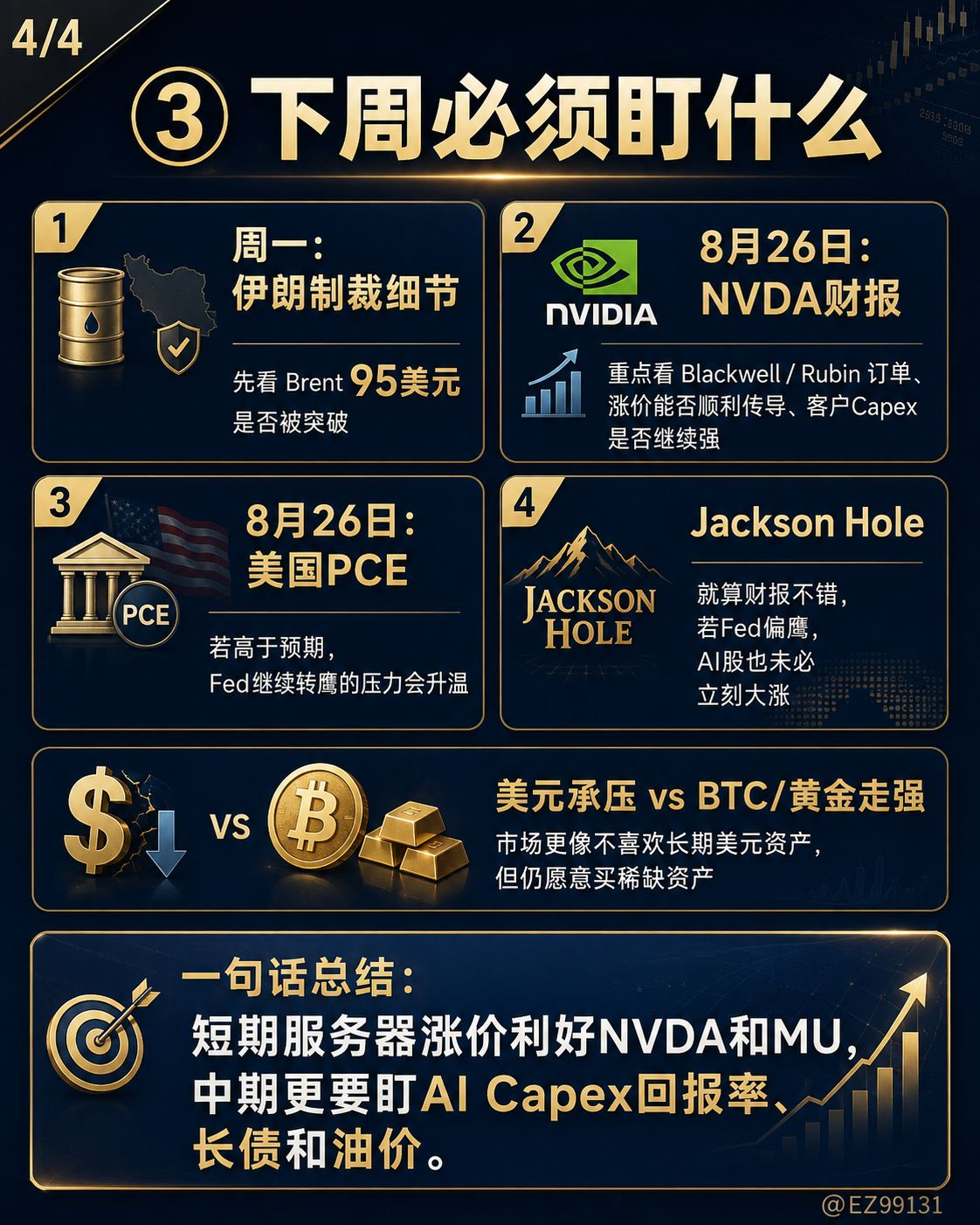
This will directly determine:
$NVDA
$AVGO
$MRVL
$MU
$CRWV
$NBIS
$APLD
How the second half of the week for the whole AI chain will play out.
The third item:
U.S. PCE on August 26
Oil prices are already back near $95.
If PCE comes in higher than expected again, market expectations for the Fed to keep hiking could stay hot.
The fourth item:
Jackson Hole
The market is still pricing in the possibility of more rate hikes this year.
Reuters previously reported that the market assigns about a 35% probability to a September rate hike, and about 66% by year-end.
So even if NVDA’s earnings are very good,
If the Fed turns clearly hawkish in the same week, it could also lead to:
Earnings are great, but the stock doesn’t rise.