


Sure enough! You were right to build a position in $SHAZ two weeks ago!
$NBIS $CRWV are up a lot; $SHAZ has only just begun!
Based on the private placement terms, the effective cost for this batch of $SHAZ positions held by Situational Awareness is basically around $68.73 per share. This price can be taken as the core cost line for Leopold’s strategic entry.
The beneficial ownership of Sharon AI 19.9% disclosed by Situational Awareness behind Leopold Aschenbrenner.
Note, this isn’t a simple “retail influencer pump.”
This is core capital that truly bets on AI infrastructure, putting SHAZ into its own concentrated holding system.
According to the filings, entities related to Situational Awareness, along with Leopold Aschenbrenner and Carl Shulman, jointly disclosed shared voting/dispositive power over 5,404,540 shares, corresponding to 19.9% beneficial ownership of Class A common stock.
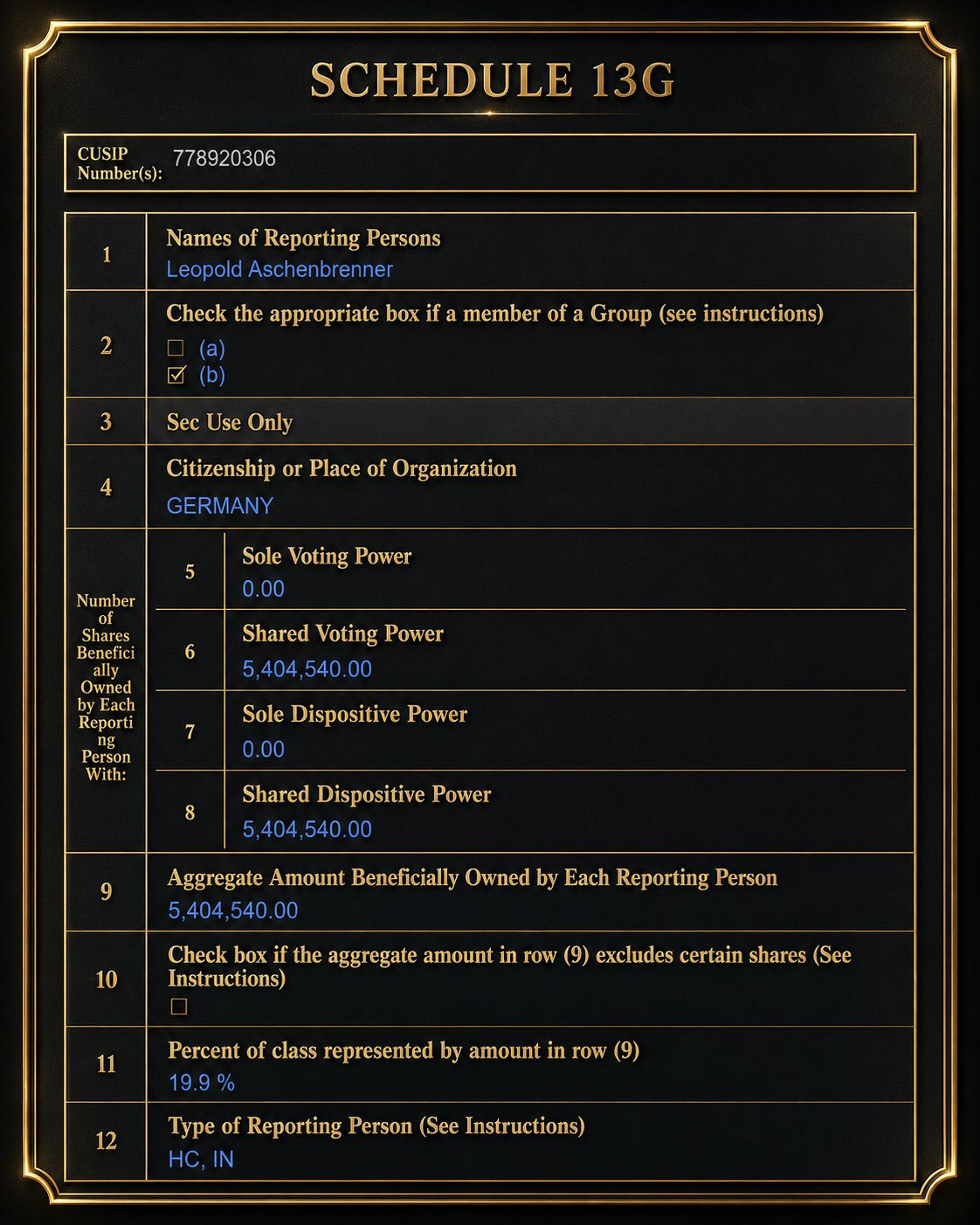
Looking more closely, this stake consists of two parts:
1,696,127 shares of Class A common stock
and a pre-funded warrant that can be purchased for 6,374,823 shares
However, this warrant is limited by a 19.99% beneficial ownership limitation.
So this cannot be misread as “today the secondary market directly gobbles up 19.9%.”
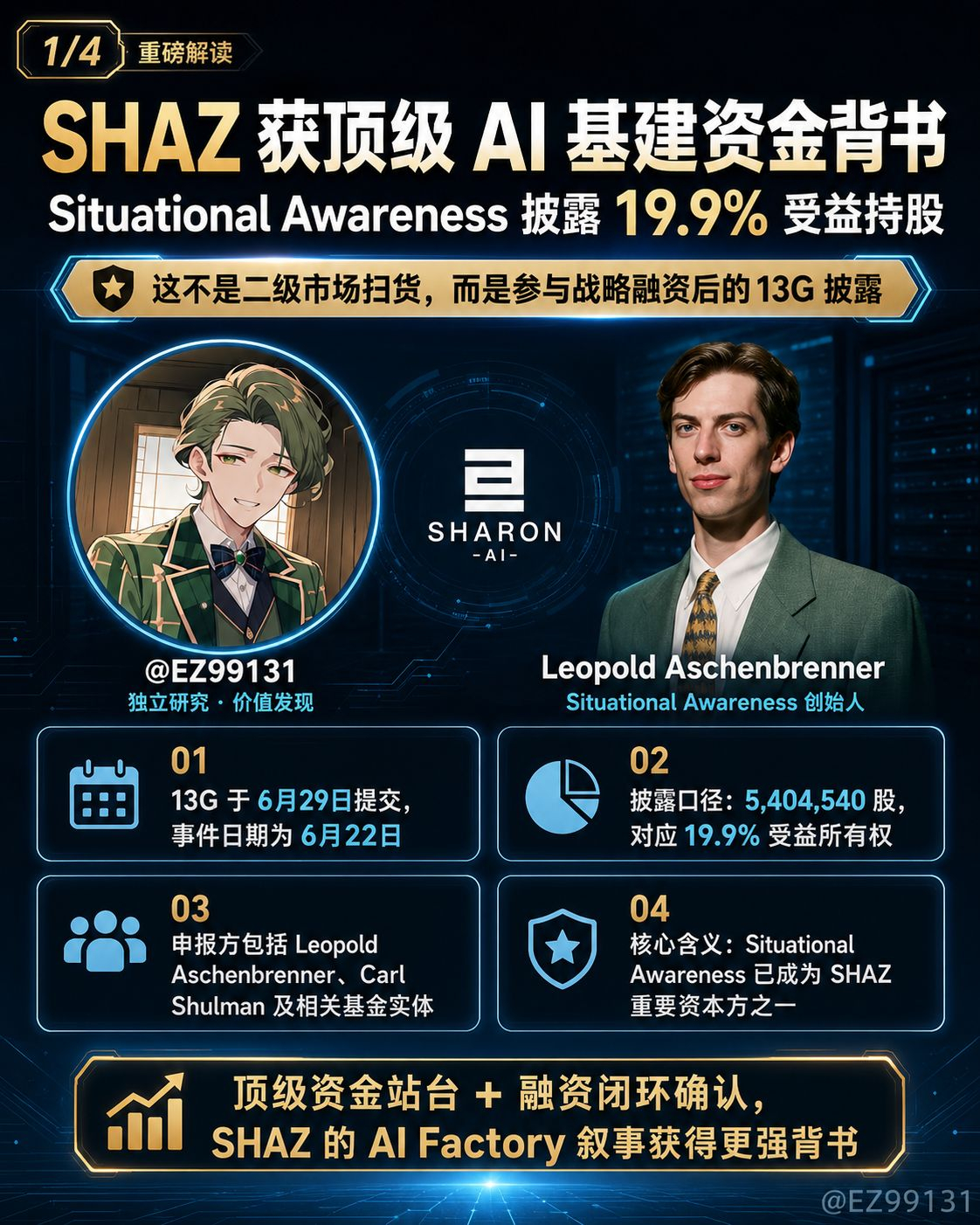
More precisely:
Situational Awareness participated in SHAZ’s strategic financing and is now formally disclosing its concentrated position through a 13G filing.
What’s truly important about this is:
First, SHAZ’s financing closed loop has been further confirmed.
The biggest problem the market had previously was:
To deploy this many GPUs, Australia’s AI Factory will have such heavy CapEx—where exactly is the money coming from?
Now the $1.6 billion financing has been completed, anchored by Situational Awareness and funds like Oaktree.
For SHAZ, this is a very crucial endorsement of capital credibility.
Second, Situational Awareness’s entry will strengthen the market’s recognition of SHAZ.
The fund’s label for Leopold is very clear:
It’s not a typical technology fund—it’s a systematic setup centered on AGI, computing power, electricity, data centers, and AI infrastructure.
By choosing to take a concentrated position in SHAZ, it is essentially betting that:
Australia / APAC sovereign AI cloud
NVIDIA-backed AI Factory
A gap in neocloud computing power supply
Regionalized GPU resources
AI data centers moving from big-players’ monopoly to regional replication
This matches SHAZ’s story perfectly.
Third, the 19.9% figure itself is quite heavy.
For a small-cap neocloud, a stake of nearly 20% by core funding is more than a financial investment—it’s a market signal.
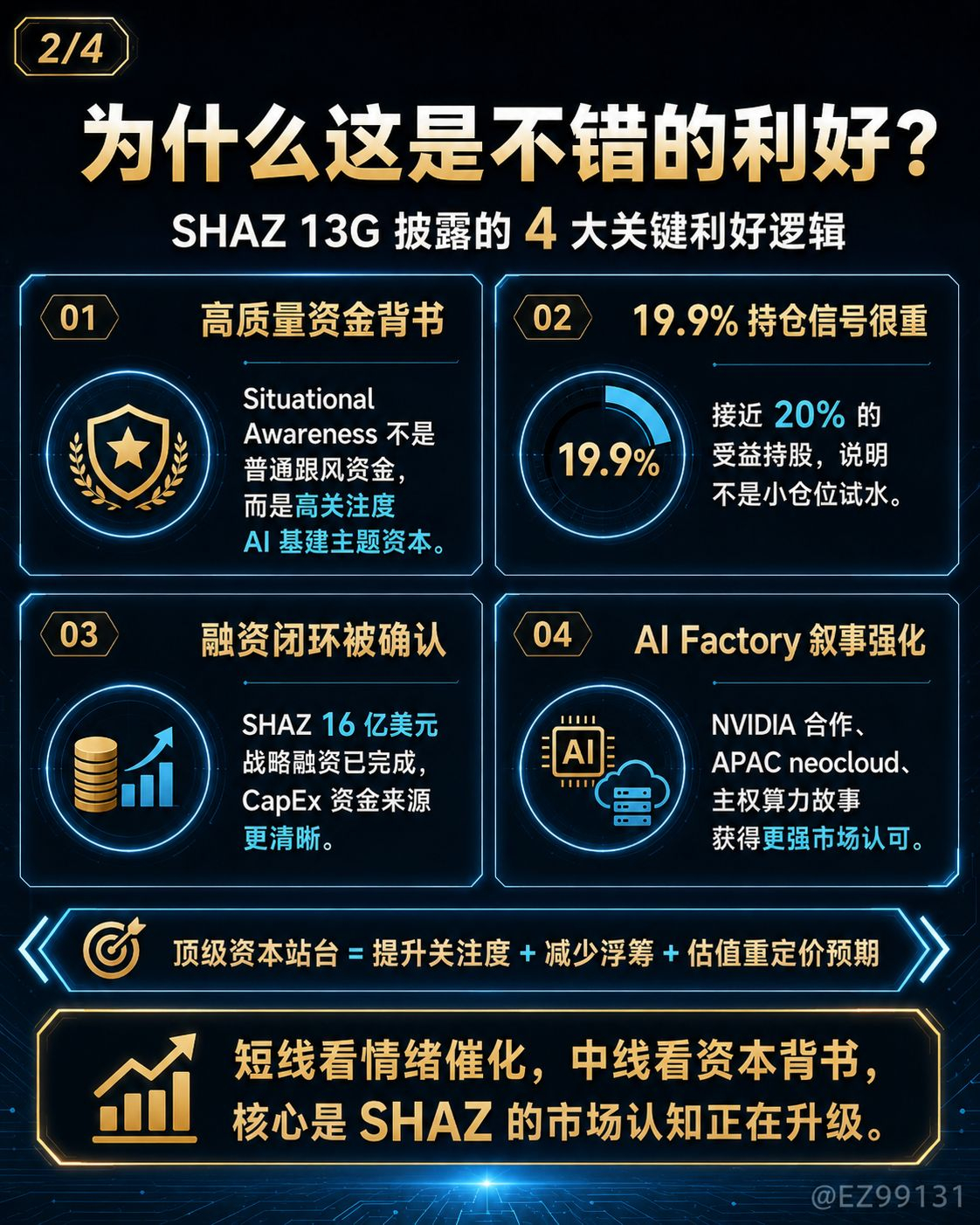
It will bring three effects:
The float decreases.
Rising attention
The probability of a valuation reset increases.
Fourth, this will cause the market to reassess SHAZ’s position.
In the past, when people looked at SHAZ, they were mostly looking at a high-risk AI cloud small-cap.
Now its label is changing:
Six-year partnership with NVIDIA
Up to 40,000 GB300 GPUs
132MW AI Factory capacity
102MW contracted to end customers
55,000+ NVIDIA GPUs expected by mid-2027
$1.6 billion strategic financing completed
Situational Awareness / Oaktree anchored
Putting these pieces together, SHAZ is not just an ordinary AI concept stock—it’s an APAC neocloud platform that is being validated by the capital markets.
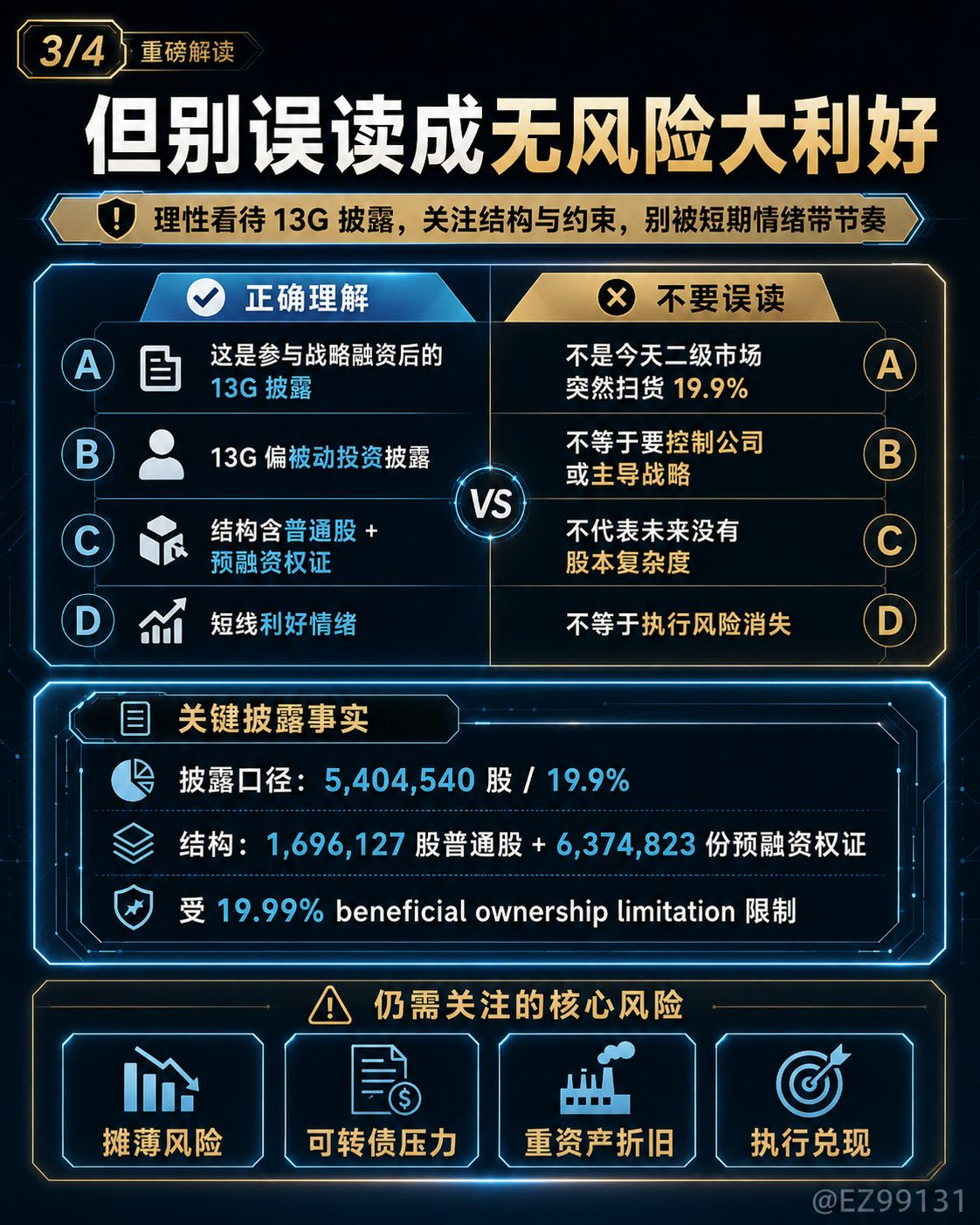
Risk:
A 13G is a more passive ownership disclosure, not a 13D.
This does not mean Leopold will control the company, nor does it mean he will join the board to push strategy.
Also, this financing includes stock, pre-funded warrants, and convertible bonds. In the future, dilution of equity and debt pressure will still remain.
What SHAZ really needs to prove is not “who bought it.”
Instead:
Can the GPUs be deployed on schedule?
Can customer contracts be converted into revenue?
Can revenue cover depreciation?
Can the gross margin be achieved?
Can cash flow improve?
If SHAZ can truly convert the $1.6 billion in funding, its partnership with NVIDIA, customer contracts, and GPU deployments into revenue, then this disclosed 19.9% stake could become a key inflection point for the market to reprice SHAZ.
But if afterward it’s only financing and the story, with revenue realization lagging, the market will still revert to concerns about dilution, CapEx, and cash flow pressure.
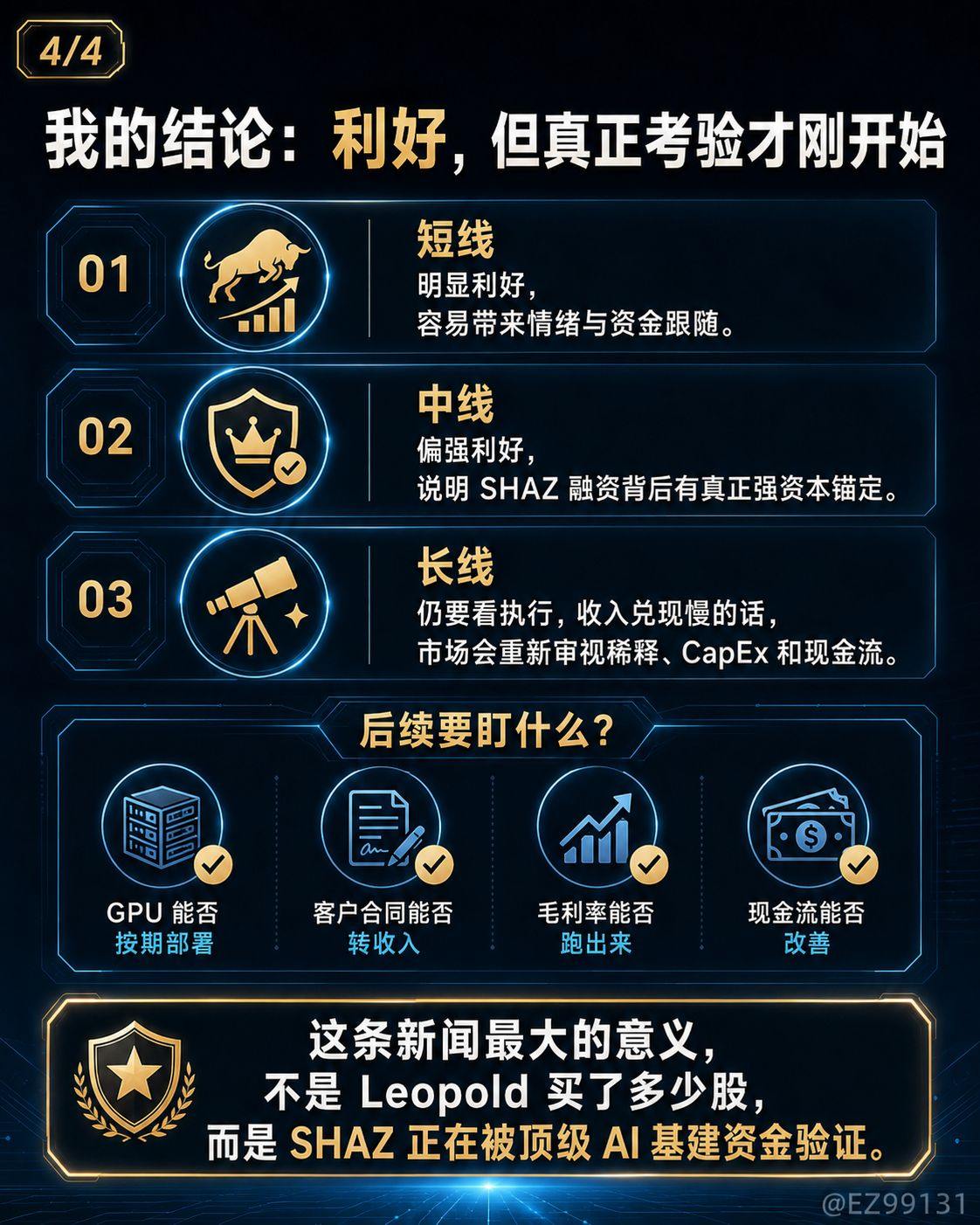
SHAZ starts transforming from a “high-risk AI cloud small-cap” into an “APAC AI Factory platform validated by top-tier AI infrastructure capital.”
For me, this is a very good piece of good news.
But it’s not the endpoint—it’s the beginning of the execution cycle!