
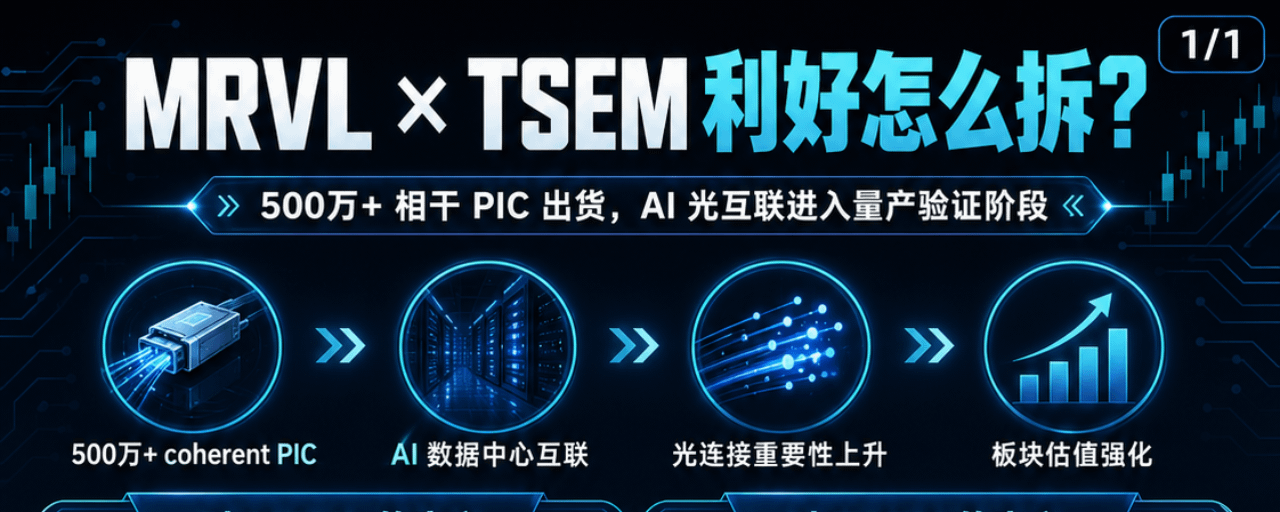

Breaking news:
Marvell ($MRVL) and Tower Semiconductor ($TSEM)
have announced they have shipped over 5 million coherent photonic integrated chips!
This milestone event highlights the growing importance of optical connectivity in AI-driven data center interconnect networks.
This news is bullish for both MRVL and TSEM, but the nature of the bullishness is different:
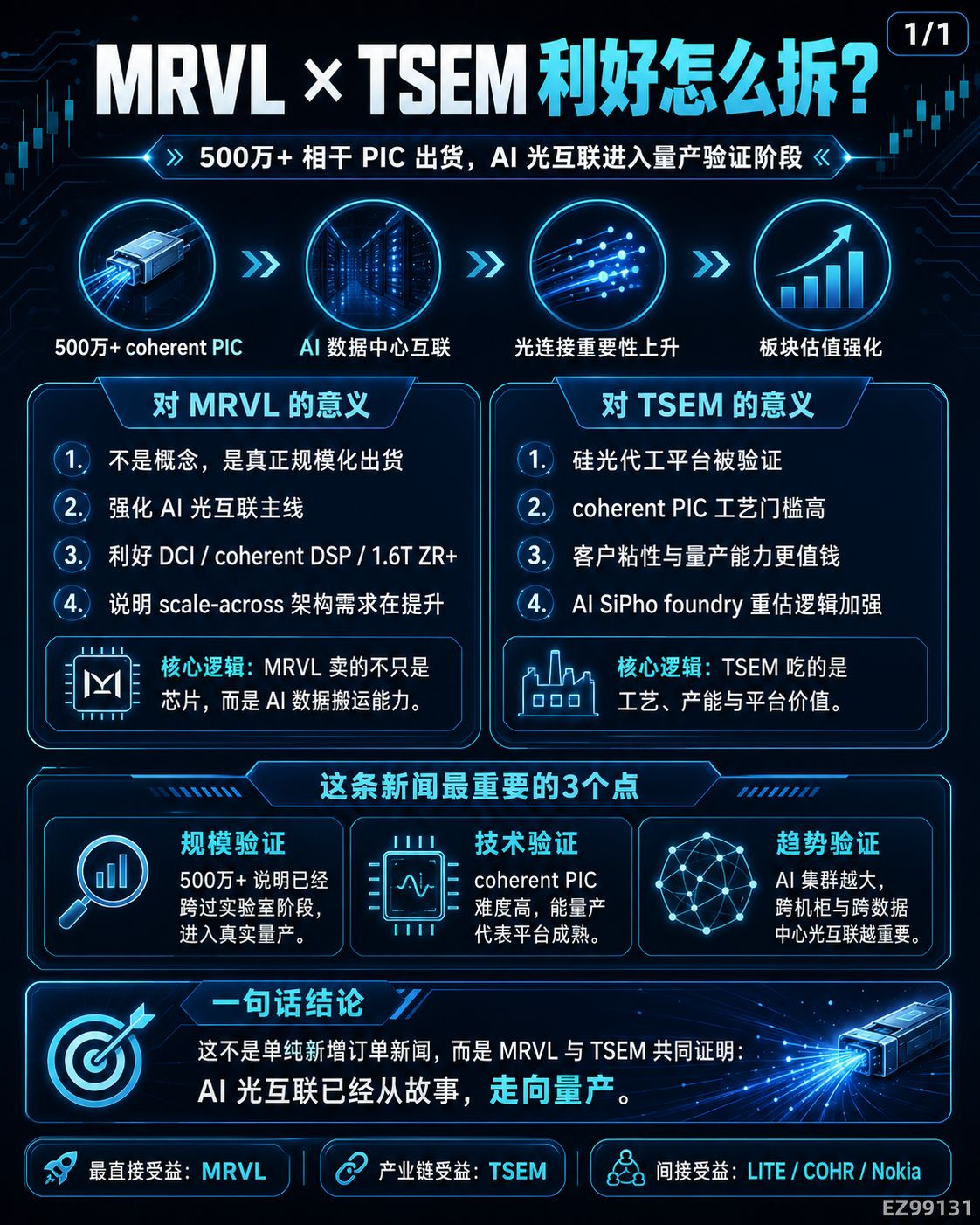
For MRVL: This is a bullish signal that 'AI optical interconnect mainline has been validated.'
For TSEM: This is a more direct bullish signal that 'silicon photonics foundry capabilities have been validated.'
The market's response today is strong, with MRVL currently around $323.12, up about 11.6% intraday, and TSEM currently around $276.47, up about 3.5%.
Proving that #MRVL's coherent optical interconnect products are no longer just a lab concept, but have scaled into shipments.
MRVL's optical interconnect products already have mass production experience.
TSEM's silicon photonics platform has already been validated by major clients.
AI data center interconnect is accelerating its shift from 'copper/traditional electrical interconnect' to 'optical interconnect.'
AI data centers need coherent PIC.
As AI clusters grow larger, the bottleneck is no longer just GPU compute power, but rather how data is transported.
Previously, everyone focused more on the connections within a single rack or server. Now, as AI training and inference clusters get larger, traffic will flow across servers, racks, and data centers.
As the distance increases, traditional electrical connections face several issues:
Insufficient bandwidth.
AI workloads require massive data exchange between GPUs; the larger the model, the greater the communication pressure.
Power consumption is too high.
Data transport itself is becoming more power-hungry; the longer the electrical interconnect distance, the harder it is to suppress loss and power consumption.
Increased latency and signal integrity pressure.
Large-scale clusters aren't just about stacking more GPUs; interconnect efficiency directly impacts training efficiency.
The demand for connections between data centers is rising.
This is DCI, or data center interconnect. MRVL also defined connectivity in its OFC 2026 presentation as one of the main bottlenecks for modern hyperscale and cloud data centers, emphasizing the need for specialized semiconductor interconnect solutions to address performance, power consumption, and design challenges. (Marvell Technology)
The significance of coherent PIC lies here:
It can transmit data with more complex optical modulation and reception methods over longer distances, at higher bandwidths, and with greater efficiency.
In short:
The larger the AI, the more expensive the data transport. The more expensive the data transport, the more valuable optical interconnect becomes.
MRVL's current market narrative is no longer just about being a 'chip company,' but rather:
AI ASIC + SerDes + DSP + optical modules + silicon photonics + DCI + photonic fabric.
This shipment of 5 million coherent PICs directly validates MRVL's core position in optical interconnect.
First, proving that MRVL's coherent / DCI products are genuinely in mass production.
This isn't an early demo, nor is it validation from a single customer; it's over 5 million units cumulatively. The Tower announcement stated that these coherent PICs have been delivered to Marvell's global clients to meet the bandwidth and energy efficiency demands of AI-driven DCI networks. (Tower Semiconductor)
For MRVL, this indicates that it has a real market share in DCI optical interconnect.
Second, it strengthens MRVL's 'scale-across' narrative.
Tower's announcement quoted Marvell's optical engineering CTO, mentioning that both parties will continue to promote next-generation coherent technologies to support scale-across data center architectures for advanced AI workloads. (Tower Semiconductor)
AI networks can be roughly divided into three layers:
The levels roughly correspond to opportunities: scale-up single rack or short-distance chip/GPU interconnect NVLink, CPO, NPO, photonic fabric; scale-out multi-rack, multi-server cluster interconnect Ethernet, switch, DSP, optics; scale-across interconnect across data centers, across campuses DCI, coherent optics, ZR/ZR+.
MRVL previously showcased its products at OFC 2026 covering scale-up, scale-out, and scale-across, and demonstrated DCI modules, coherent DSPs, 800G ZR/ZR+ pluggable optics, etc.
Third, the acquisition of Celestial AI and Polariton by MRVL is part of the same main line.
MRVL's prior acquisition of Celestial AI was to enhance photonic fabric and AI chip interconnect. Reuters reported that Celestial AI's photonic fabric technology would enhance Marvell's CPO capabilities, expected to contribute $500 million in annualized revenue by late FY2028, and double to $1 billion the following year. (Reuters)
This year, MRVL again acquired Polariton, officially stating it was to enhance the optical roadmap, promote bandwidth expansion of 3.2T and above, and strengthen the coherent and optical interconnect platforms. (Marvell Technology, Inc.)
Thus, this news of 5 million PICs actually ties MRVL's narrative together:
In the past: coherent PICs have been shipped in large volumes.
Currently: 1.6T, 800G ZR/ZR+, DCI, silicon photonics continues to ramp up.
In the future: Celestial AI + Polariton + photonic fabric / CPO / NPO continue to penetrate AI clusters.
This is why the market is excited. It’s not a one-off news item, but proof that MRVL's optical interconnect is not just a PPT.
AI customer demand is shifting from 'validation' to 'securing capacity.'
Tower announced in May that it signed a contract with clients for $1.3 billion in silicon photonics revenue by 2027, indicating that today’s shipment of 5 million units is not an isolated event, but a systematic increase in Tower’s silicon photonics orders.
It is being repriced by the market from a traditional specialty process foundry to an AI silicon photonics foundry platform.
LITE / COHR
They are more focused on lasers, optical components, materials, and modules. NVIDIA announced this year to invest $2 billion each in Lumentum and Coherent to strengthen AI data center chips and photonic technology ecosystem, which itself indicates that optical devices are one of the bottlenecks in AI infrastructure. (Reuters)
If MRVL / TSEM's coherent PIC ramps up, the market will logically continue to be bullish:
laser
modulator
optical engine
InP / SiPho
CPO / NPO
800G / 1.6T / 3.2T
Nokia
Nokia is not a direct beneficiary of this news.
However, if the demand for AI DCI and interconnect across data centers continues to rise, Nokia's Optical / IP / DCI network equipment will indirectly benefit. It is more focused on the infrastructure layer, not the front-end PIC or DSP.
AVGO
Broadcom also has exposures related to AI networking, custom ASICs, switches, DSPs, and optical interconnect.
This news about MRVL will reinforce the overall 'custom AI silicon + connectivity' narrative, but MRVL benefits more directly, as the news represents a milestone in its collaboration with Tower.
Over 5 million units. So it’s not a traditional ‘new order announcement.’
Three values:
First, scale validation.
5 million units indicate that the product has crossed the mass production threshold.
Second, technology validation.
Coherent PIC technology is difficult, and being able to ship at scale represents high platform maturity.
Third, trend validation.
The demand for high-bandwidth, low-power optical interconnect in AI DCI is growing stronger.
The market is revaluing AI connectivity.
MRVL currently has a market cap of about $288.9 billion, with a PE of around 111. This indicates it is no longer a cheap stock; the market is pricing in high growth expectations.
The impact of this news on MRVL, I will break it down into three layers:
Time dimension impacts short-term sentiment positively, validating the AI optical interconnect narrative, which may continue to attract momentum funds; in the medium to long term, if AI cluster architecture continues to migrate toward optical interconnect, MRVL's data center interconnect revenue potential will be revised upward.
However, short-term risks also need to be monitored:
First, a rapid increase could lead to a pullback.
Today, MRVL's intraday gains have been substantial; chasing higher prices could lead to shakeouts.
Second, valuations are already high.
111x PE means the market tolerance is not high.
Third, this isn't new revenue guidance.
If subsequent earnings reports do not reflect stronger orders or upward guidance, the market may digest it as an emotional catalyst.
I believe the core highlights of TSEM are:
Will the $1.3 billion silicon photonics revenue contract for 2027 be fulfilled?
Tower's IR page shows that it released an announcement about 'signing a contract for $1.3 billion silicon photonics revenue clients by 2027' on May 13. (Tower Semiconductor)
Are there more major clients beyond Marvell?
If Tower's SiPho platform serves not only MRVL but also LITE, COHR, Scintil, and other AI optical device companies, the valuation potential is even greater.
Can the 300mm / 200mm capacity expansion keep up?
Silicon photonics is not ordinary logic foundry; process and packaging yields are critical. Slow capacity expansion leads to slow revenue realization.
MRVL and TSEM have jointly proven that the trend of optical interconnect in AI data center interconnect has entered the mass production stage. MRVL is the AI optical interconnect solution provider, while TSEM is the silicon photonics process platform provider. The former captures system and chip value, while the latter captures process and capacity value.