
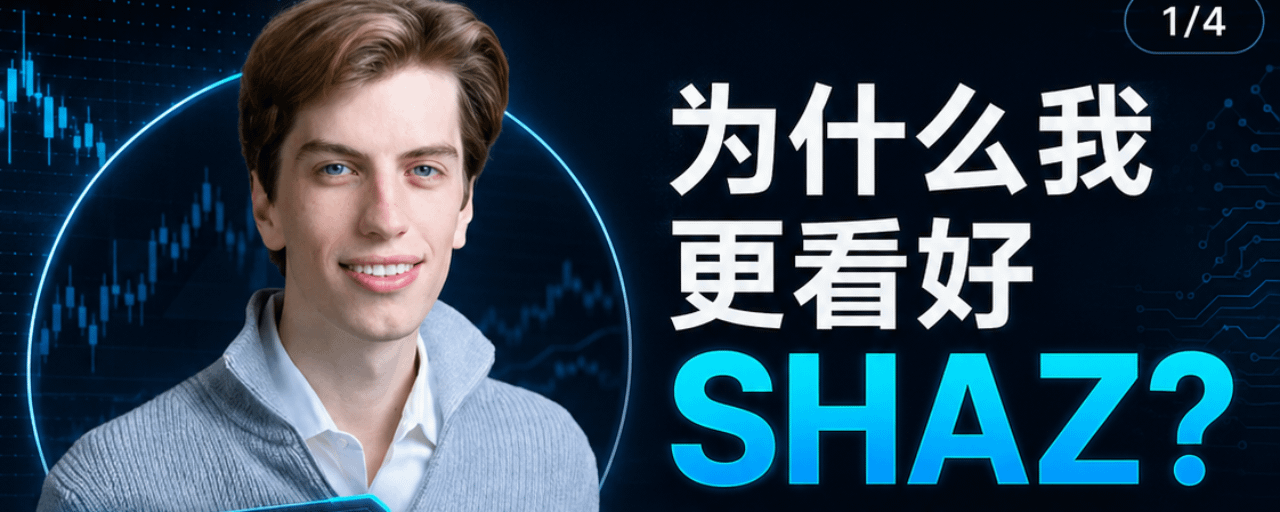

In the US stock sector, I've been researching $SHAZ lately.
I found SHAZ to be an overlooked potential lottery stock!
And the most important thing is it has endorsement from #NVIDIA, along with a partnership deal with Australia!
So, I built my initial position! According to my research, #Leopold also picked some up around 54.
I don't think this company should be seen as just a small-cap AI concept stock; what's really interesting is that it might be turning into Australia's version of an AI neocloud platform.
When people think of AI infrastructure, their first reaction is $IREN, $CRWV, $NBIS, $APLD.
But the story of SHAZ is a bit different.
#IREN's foundation is still mining companies transitioning to AI data centers, and the market will struggle with whether it's a Bitcoin miner, an energy stock, or an AI cloud platform.
$SHAZ has a cleaner story.
It's currently talking about local AI cloud in Australia, sovereign AI, GPU computing infrastructure, and being an NVIDIA Cloud Partner.
When these tags overlap, the elasticity changes completely.
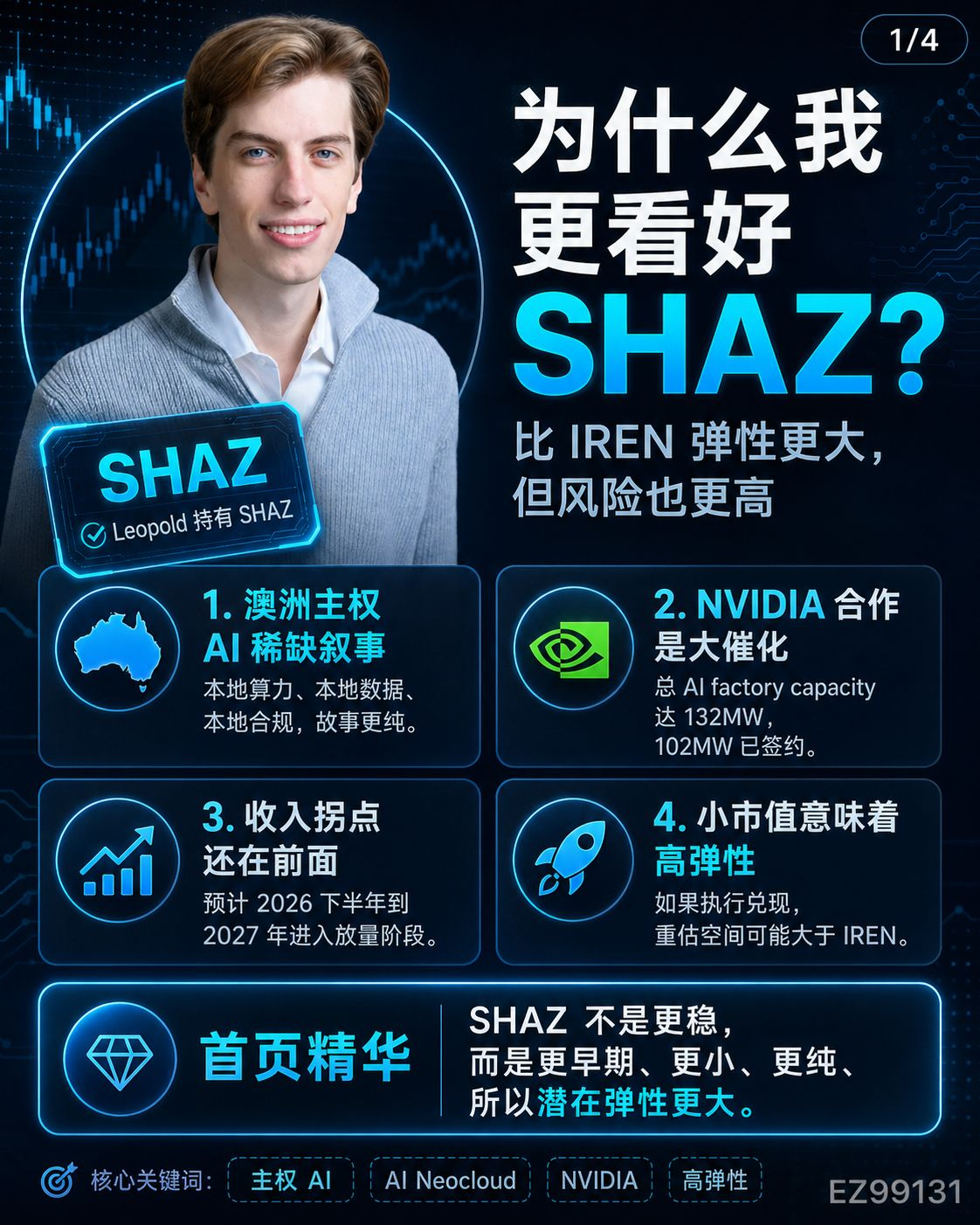
The first reason I'm bullish on #SHAZ is that its narrative is quite rare.
AI isn't just something the U.S. is pushing. Australia, the Asia-Pacific, governments, enterprises, universities, and research institutions all need locally available AI computing power.
Especially in scenarios involving data security, compliance, and sovereign AI, not all clients are willing to put their data and training tasks on overseas clouds.
This is where SHAZ is positioned.
What it sells isn't just software or a regular data center, but a package of GPUs, networking, storage, data center capacity, and operations delivered as an AI factory.
Clients don't need to buy GPUs themselves, set up clusters, or handle power, cooling, networking, and scheduling.
Clients only need to buy computing power.
This is what makes neocloud so attractive.
The second reason is the NVIDIA line.
SHAZ and NVIDIA's six-year strategic computing partnership plans to deploy up to 40,000 Grace Blackwell GB300 GPUs.
After the collaboration, the company's total AI factory capacity increased to 132MW, with 102MW already contracted to end customers, aiming to deploy over 55,000 NVIDIA GPUs by mid-2027.
For a small-cap company, this isn't just ordinary news.
It’s like the market suddenly realizes that SHAZ isn't just talking about PPT; they really have upstream resources and are pushing production capacity forward.
Of course, collaborating with NVIDIA doesn't mean NVIDIA is directly funding it, nor does it guarantee a rise in stock price.
But in the AI infrastructure space, being able to secure NVIDIA GPUs, enter NVIDIA's ecosystem, and align customer contracts with GPU supply is itself a rare resource.
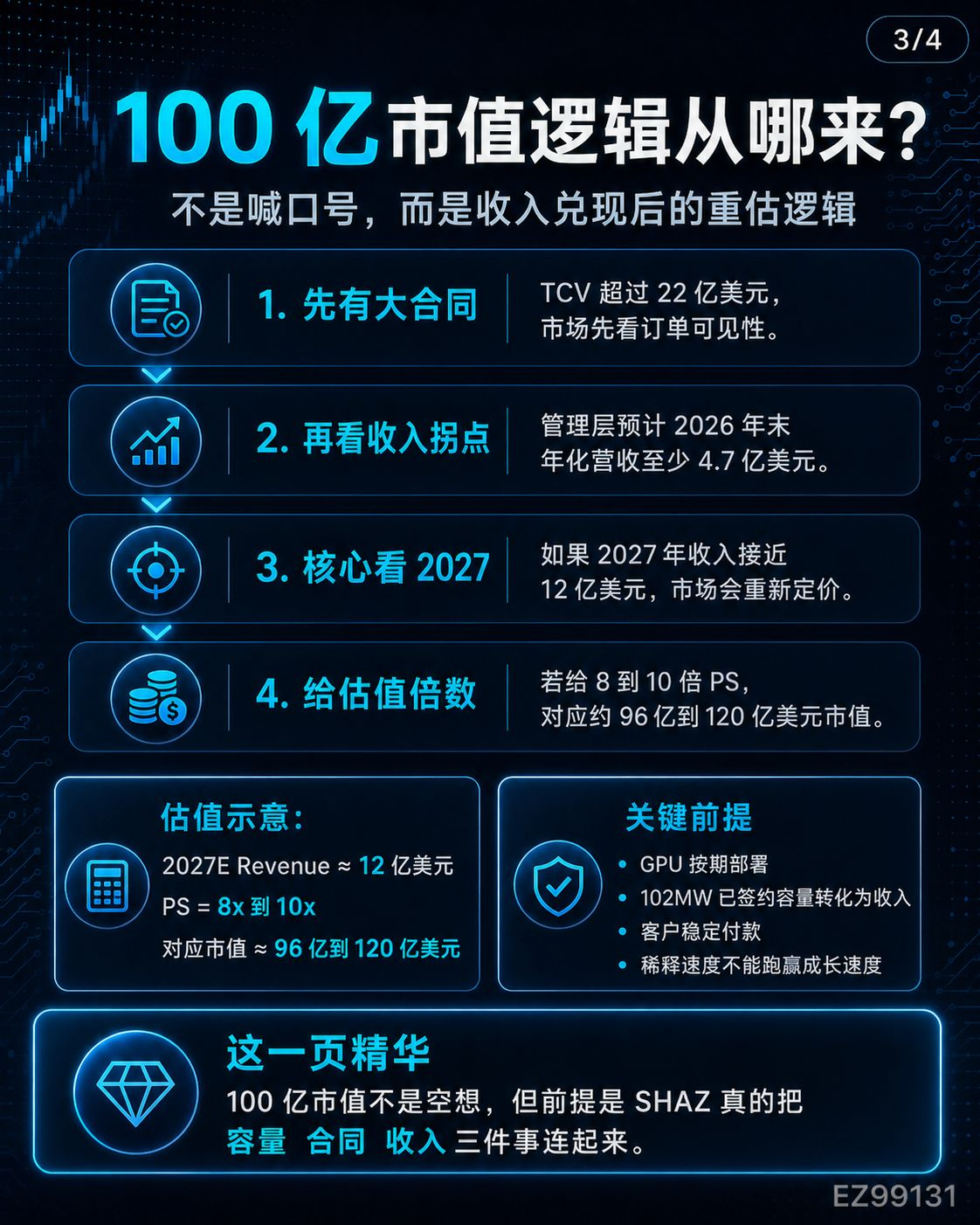
The third reason is that the revenue inflection point may not have been fully digested by the market yet.
Currently, SHAZ's historical revenue is small, so looking at it through traditional PE is meaningless.
Its true pricing mechanism is based on whether future contracted capacity can convert to revenue.
If contracts start confirming revenue in the second half of 2026 and revenue continues to climb in 2027, the market might reprice it from a 'small-cap AI concept stock' to an 'Australian AI infrastructure platform.'
This is why some are calling for a $10 billion market cap.
I don't think this target will definitely be met, but I believe this logic isn't just a wild shout.
If the company achieves over $1 billion in annual revenue in the future, a market cap of $10 to $100 billion isn't out of the question at an 8 to 10x PS.
The key isn’t the slogan, but rather the speed of revenue realization.
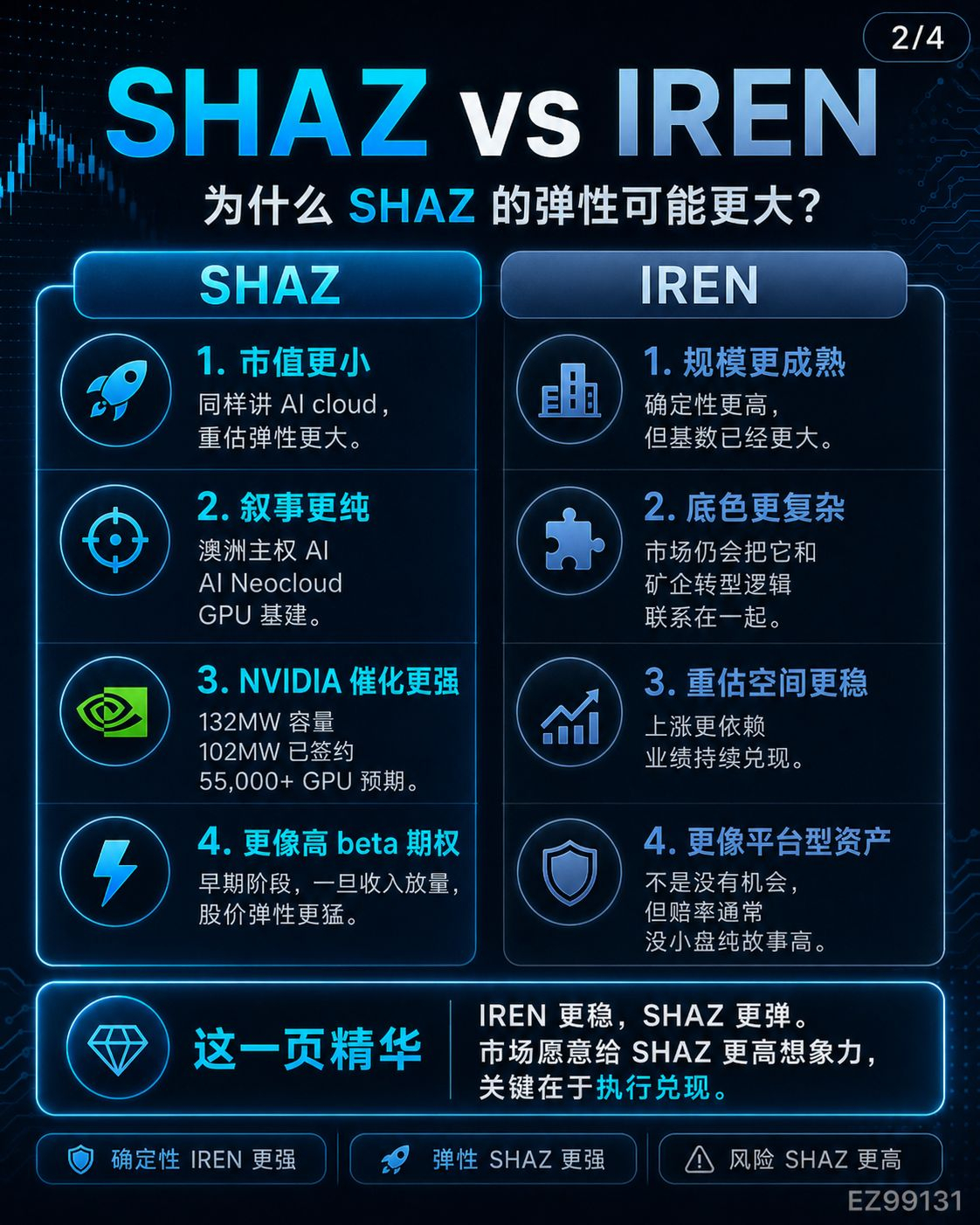
The fourth reason is that SHAZ is more elastic than IREN.
IREN has higher certainty and is larger, but its market cap is already much bigger.
SHAZ's advantage lies in being early, small, with a pure story, and the market perception hasn't fully aligned yet.
Once a small company shifts from 'can we survive' to 'can we scale up', the valuation elasticity can be extremely exaggerated.
This is what makes small-cap growth stocks so captivating.
But that's also where the greatest risks lie.
SHAZ's biggest problem isn't that the story isn't big enough, but rather that the story is too big and the execution is too hard.
Buying that many GPUs costs money.
Deploying so many AI factories costs money.
Expanding this quickly also requires capital.
So the dilution risk definitely needs to be on the table.
The company just completed a $1.6 billion financing round, part of which is equity and pre-financing warrants, and part is convertible bonds.
This fuels the fundamentals and dilutes old shareholders.
If revenue is realized quickly later, the market will call this growth financing.
If revenue realization is slow, the market will say this is just continued dilution.
So SHAZ isn't a low-risk asset.
It's neither MRVL nor Nokia.
MRVL is the core chain for AI interconnect and ASICs, Nokia is about undervalued AI network revaluation.
SHAZ resembles a VC project in the public market.
If successful, it could be revalued from a small-cap AI cloud to a regional sovereign AI infrastructure platform.
If it fails, it could turn into a high capex, high dilution, high volatility small-cap story stock.
Right now, I'm keeping an eye on four core things about SHAZ.
First, the speed of GPU deployment in the NVIDIA partnership.
Secondly, when will the 102MW contracted capacity start contributing stable income?
Third, can the gross margin and cash flow prove that this isn't just a money-burning scale game?
Fourth, whether there will be further dilution or debt pressure down the line.
SHAZ has greater potential than IREN, not because it's more stable, but because it's earlier stage, smaller, scarcer, and has a purer narrative.
IREN is a more certain AI data center platform.
SHAZ is a more elastic Australian sovereign AI cloud option.
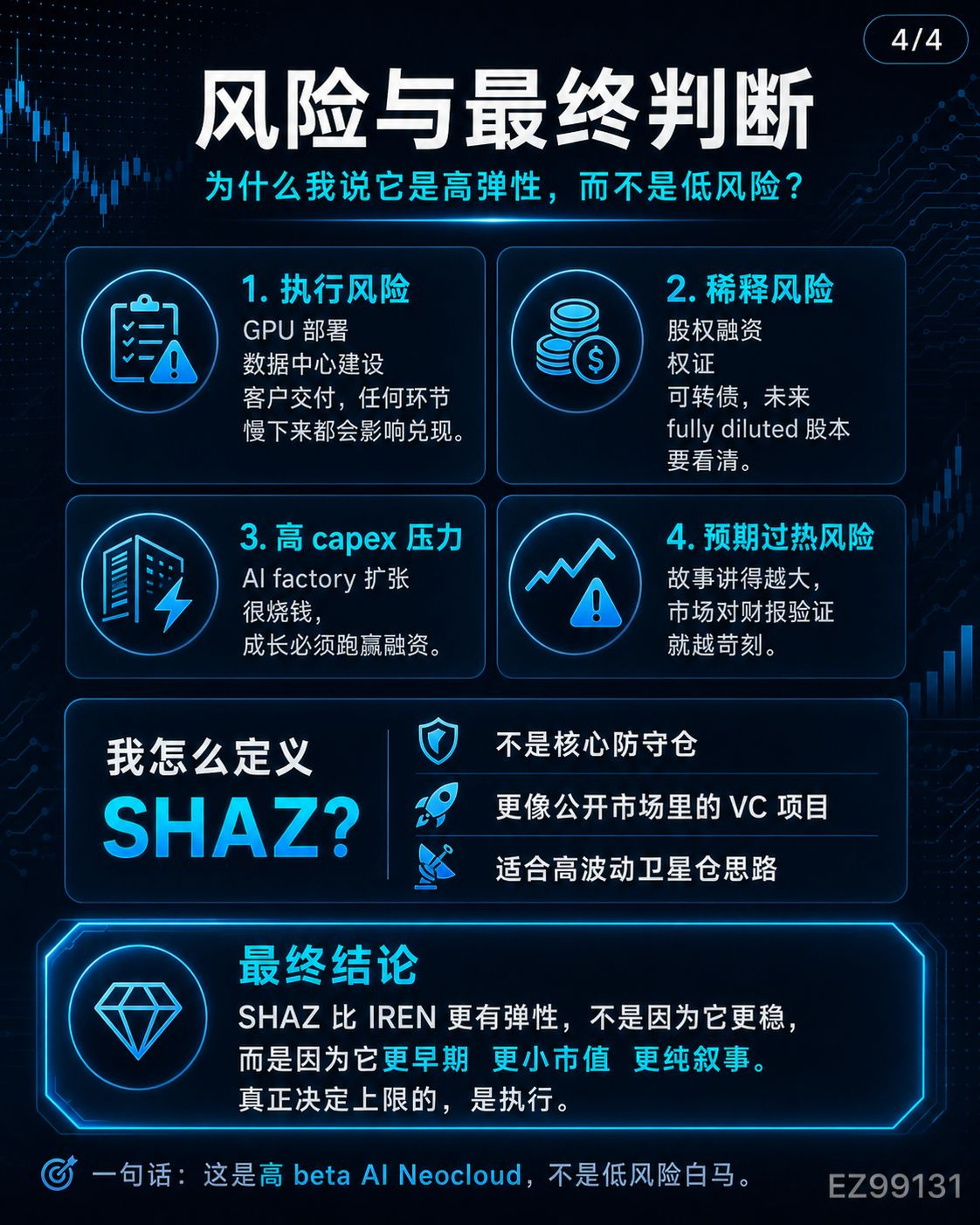
You can't over-leverage faith in this stock, nor can you chase it blindly.
But if it really delivers on the #NVIDIA collaboration, AI factory capacity, customer contracts, and revenue inflection point, then the current market pricing might just be the first phase.
I'll keep it in my high-volatility satellite portfolio.
This isn't a call to buy, just documenting an AI infrastructure small-cap opportunity I think is worth digging into.
#DYOR