

The recent sell-off of Nokia stock ($NOK) has been incredibly aggressive!
Last Wednesday's witching day was another instance of using options to continue the manipulation!
Nokia released two major news items over the weekend.
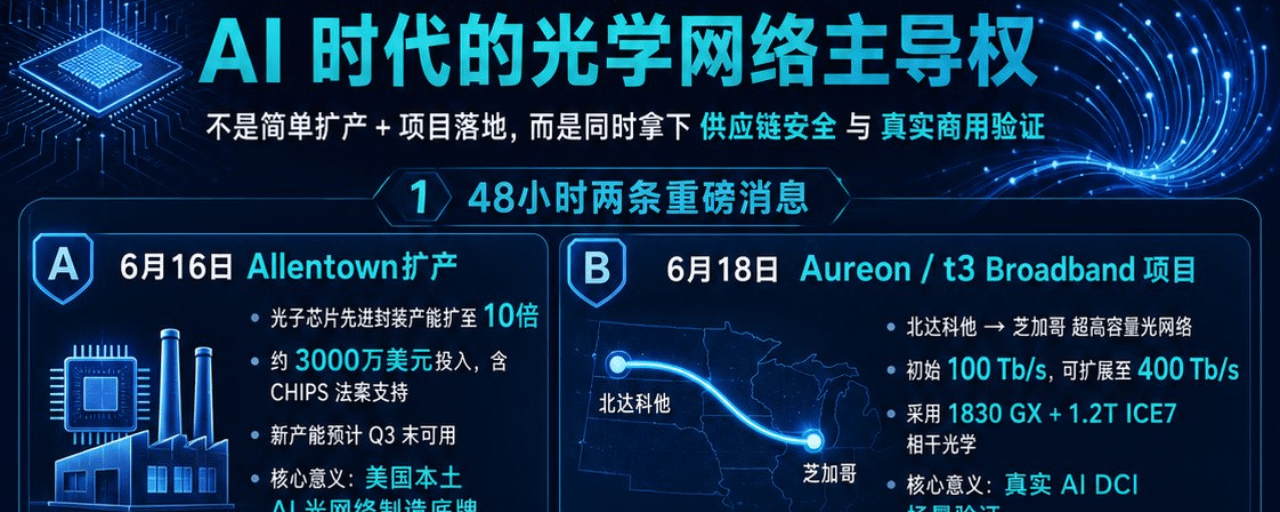
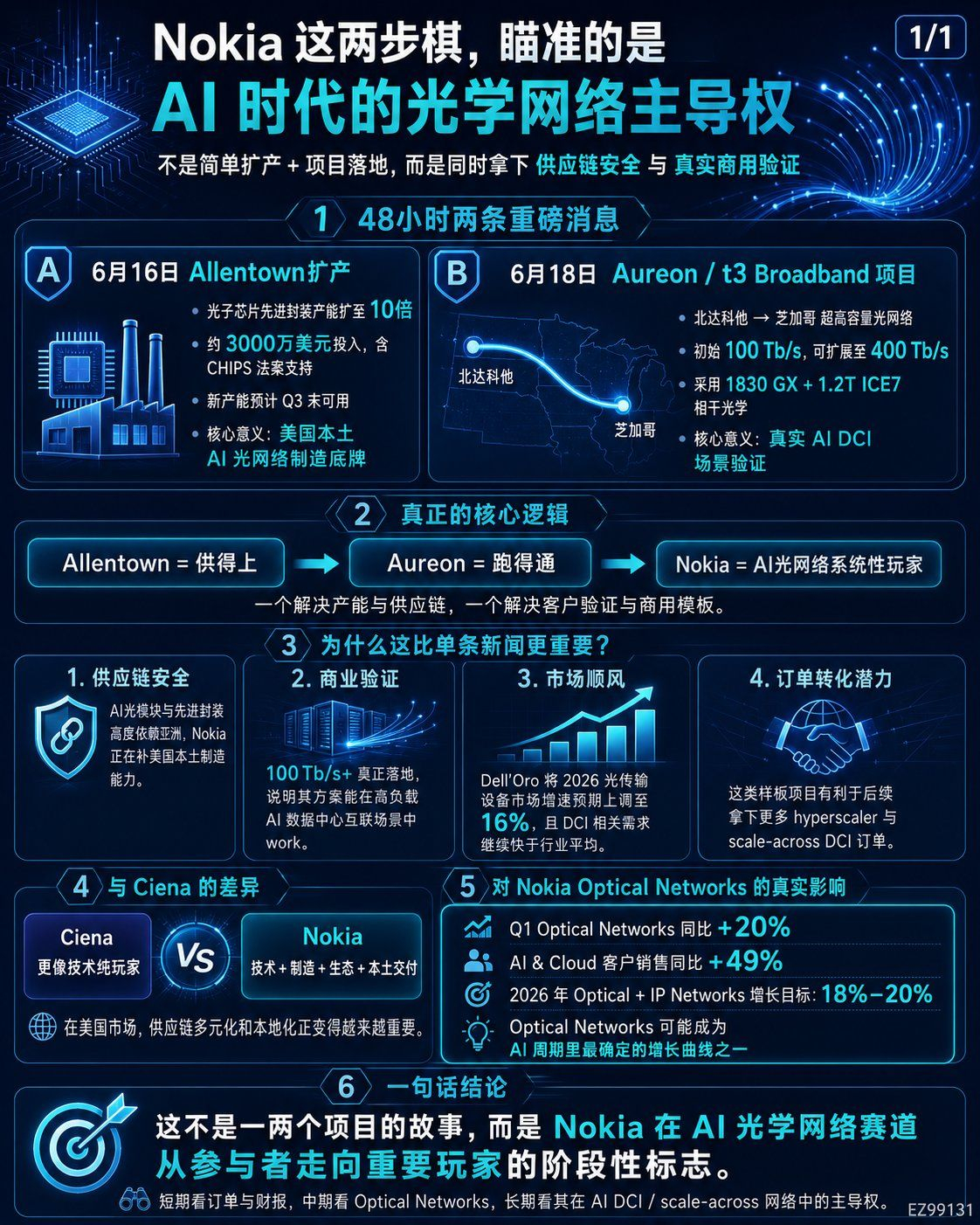
First, Allentown's advanced packaging capacity for photonic chips has increased tenfold.
The second initiative involves collaborating with t3 Broadband and Aureon to establish an AI-ready optical transmission network between North Dakota and Chicago, with an initial capacity of 100 Tb/s, which can be expanded to 400 Tb/s in the future.
On their own, neither of these two news items is particularly complicated.
One is to expand production.
One is project implementation.
But when you put them together, they taste different.
I think Nokia's real goal with these two moves is not to secure more orders in the short term, but to gain dominance in optical networks in the AI era.
The biggest problem for AI data centers right now is not just a lack of GPUs, nor is electricity a variable.
The bigger problem is how to move the data.
As GPU clusters and models grow larger, training and inference require massive amounts of data to flow between servers, racks, campuses, and data centers.
Therefore, optical networks are transforming from "communication infrastructure" into the "vascular system" of AI factories.
That's why I think Nokia's move this time is crucial.
Allentown addresses the supply problem.
Aureon solves the verification problem.
One question is, if the US market really needs a large number of AI optical network devices in the future, will you be able to supply them?
Another question is whether your technology can run in real-world AI data center interconnection scenarios.
The fact that these two events occurred simultaneously carries far greater significance than a single news item.
Let's start with Allentown.
Nokia's expansion this time refers to its advanced test and packaging capabilities in the United States.
The key point is not how much money it spent, but that it increased its production capacity tenfold in one of the few places in the United States where photonic chips can be packaged into optical modules.
This matter is very sensitive in the current context.
The demand for optical modules, coherent optics, and low-power transmission is surging in AI data centers, but the global packaging and optical device supply chain remains highly dependent on Asia.
If the US hyperscaler continues to build AI data centers on a large scale, it cannot completely ignore issues such as supply chain security, domestic manufacturing, tariffs, and geopolitical risks.
Nokia's increased investment in Allentown is essentially providing a localized foundation for US AI optical networks.
This is not simply about expanding production.
This is telling the customer:
I can not only provide you with technology, but I can also deliver key optical components within the United States.
This will likely become increasingly important in the future for attracting hyperscalers, carriers, governments, and customers with high security needs.
Now let's look at the Aureon route.
From North Dakota to Chicago, the initial speed is 100 Tb/s, which will be expanded to 400 Tb/s in the future.
It uses the Nokia 1830 GX platform, Super C/L-band optical circuitry system, and 1.2T ICE7 coherent optics.
The value of this project is not just its large capacity.
What's truly important is that it has put Nokia's latest generation of optical transmission solutions into the real-world scenario of AI data center interconnection.
In the AI era, DCI (Digital Integration) is no longer just about laying more fiber optic cables in the metropolitan area.
In the future, more and more demands will become:
Further away.
Higher single-fiber capacity.
Lower power consumption.
To better connect regional data centers to core cloud nodes.
Routes like those from North Dakota to Chicago are a microcosm of this trend.
Many people who look at AI infrastructure only focus on GPUs, HBMs, ASICs, and optical modules.
However, if AI factories begin to expand in a distributed manner, cross-regional data center interconnection will inevitably become a necessity.
This is where Nokia Optical Networks truly shines.
What's even more interesting is that industry data also supports this logic.
Dell’Oro previously stated that the global optical transmission equipment market will grow by 10% to reach approximately $16 billion by 2025, with direct procurement revenue from DCI-related WDM systems expected to grow by nearly 40%.
The latest version of the prediction is even more alarming.
They raised their 2026 growth forecast for the optical transmission equipment market from 10% to 16%, projecting market revenue to exceed $18 billion.
The reason is straightforward:
AI data centers are driving demand for DCI (Data Center Integration), and many suppliers are already experiencing order backlogs and longer delivery times.
This sentence is actually very important.
This illustrates that optical networks are not an obscure component, but rather a supply chain that is becoming increasingly tight within AI infrastructure.
The demand is not nonexistent.
The real question now is, who can deliver?
This brings us back to Nokia's two-step strategy.
Allentown represents production capacity.
Aureon is the template.
The former convinces customers that it can supply the goods.
The latter convinces customers that it will work.
With both factors combined, Nokia is not just saying "we also have optical network products," but is building a more complete business loop.
Compared to Ciena, Nokia wasn't the most dedicated player in the DCI field before.
Ciena has long been a dominant company in optical transmission, and WaveLogic also has a strong presence in hyperscalers.
But things changed after Nokia acquired Infinera.
It complements coherent engines, optical transmission systems, and vertical integration capabilities.
Now, with the addition of ATP capacity expansion in the US and the launch of the real AI DCI project in North America, Nokia's hand has become more complete.
Ciena is more like a highly focused optical technology enthusiast.
Nokia is now employing a different strategy:
Optical technology.
IP networks.
Made in China.
System delivery.
Carrier relationships.
Hyperscaler and AI cloud opportunities.
This is not a single breakthrough, but a combination of attacks.
In the short term, Ciena will not easily relinquish its market share.
Even in many hyperscaler projects, Ciena still has traditional advantages.
However, looking at the time window from 2026 to 2028, customers may care about more things.
It's not just about performance.
There is also supply chain diversification.
Local delivery capability.
Production capacity certainty.
System-level solutions.
In this dimension, Nokia is filling the most crucial gap.
That's why I think Nokia can't be viewed solely as an "old telecommunications equipment stock" now.
The data for Q1 has begun to reflect the changes.
AI & Cloud customer sales grew by 49%.
Optical Networks grew by 20%.
The company has raised its 2026 growth target for Optical + IP Networks to 18% to 20%.
This shows that optical networks are no longer a side project in Nokia's story, but rather the most representative growth curve of the AI cycle within Network Infrastructure.
The expansion at Allentown addresses the issue of supply capacity.
The Aureon project addresses whether or not people are willing to buy.
Q1 order and growth data address whether this line has begun to deliver results.
These three things together are what made me interested in Nokia again.
Of course, the risks must also be discussed.
First, the competition is fierce.
Ciena, Huawei, ZTE, Cisco Acacia, and Marvell are all vying for a place in the optical network market at different levels.
Secondly, hyperscaler will continue to promote pluggable optical modules and IPoDWDM, and some value may shift from system equipment to modules and chips.
Third, Nokia needs to prove that the integration of Infinera will truly improve gross margins and delivery efficiency.
Fourth, if the short-term stock price has already reflected the expectations for AI optical networks, then financial report verification will be more important.
Therefore, I would not describe Nokia as a risk-free, undervalued blue-chip stock.
More accurately, it is an established infrastructure company that is being repriced in the AI optical network cycle.
Its flexibility may not be as good as that of more advanced optical interconnect targets such as $MRVL, $LITE, and $COHR.
However, its advantages are a more systematic location, a lower valuation, and a narrative that is shifting from "telecom equipment" to "AI data center interconnect infrastructure".
My understanding of Nokia's two moves is:
Allentown is a supply chain brand.
Aureon is a customer verification badge.
Q1: Optical network growth is the fundamental driver.
If Nokia can continue to replicate similar North American DCI projects and fully utilize Infinera's capabilities, then Optical Networks could very well become its most important growth driver in the next two to three years.
This is not the story of a single project.
It's not simply a matter of expanding production capacity.
This is Nokia repositioning itself in the AI era.
In the past, people remembered Nokia for its mobile phones.
Later, people viewed it as a 5G equipment manufacturer.
But now, it may be becoming a key player in the "invisible optical path" between AI data centers.
My current assessment of Nokia is simple:
In the short term, look at orders and financial reports.
In the medium term, we need to see if Optical Networks can continue to outperform the group average in terms of growth.
In the long run, it remains to be seen whether it can evolve from a participant into one of the core suppliers in AI DCI and scale-across networks.
If this path leads to success, Nokia's revaluation may have only just begun.
I've rewritten the article into a longer, more personal analysis. I quickly checked the facts: The Allentown expansion was announced by Nokia on June 16th, with the core being a potential 10-fold increase in ATP capacity in the US. The new capacity is expected to be commercially available by the end of Q3, and it's part of Nokia's $4 billion multi-year investment plan for US AI network connectivity. (markets.businessinsider.com) The Aureon project was announced by Nokia on June 18th, with an initial capacity of 100 Tb/s, expandable to 400 Tb/s. The route connects the North Dakota data center to Chicago, using 1830 GX, Super C/L-band, and 1.2T ICE7. (Nokia Corporation | Nokia) On the market front, Dell’Oro recently raised its 2026 growth forecast for the optical transmission equipment market from 10% to 16%, and believes that DCI direct procurement revenue will continue to grow by approximately 40% in Q1. (Dell'Oro Group) Nokia's Q1 results also showed a 49% increase in sales to AI & Cloud customers and a 20% increase in Optical Networks, and it raised its 2026 growth target for Optical + IP Networks to 18%–20%. (Nokia Corporation | Nokia)
Looking at Nokia lately, I increasingly feel that it's not just a typical rebound story for a telecommunications equipment stock.
It's more like it's quietly reintegrating itself into the core chain of AI infrastructure.
In mid-June, Nokia released two announcements.
First, Allentown's advanced packaging capacity for photonic chips has increased tenfold.
The second initiative involves collaborating with t3 Broadband and Aureon to establish an AI-ready optical transmission network between North Dakota and Chicago, with an initial capacity of 100 Tb/s, which can be expanded to 400 Tb/s in the future.
On their own, neither of these two news items is particularly complicated.
One is to expand production.
One is project implementation.
But when you put them together, they taste different.
I think Nokia's real goal with these two moves is not to secure more orders in the short term, but to gain dominance in optical networks in the AI era.
The biggest problem for AI data centers right now is not just a lack of GPUs, nor is electricity a variable.
The bigger problem is how to move the data.
As GPU clusters and models grow larger, training and inference require massive amounts of data to flow between servers, racks, campuses, and data centers.
Therefore, optical networks are transforming from "communication infrastructure" into the "vascular system" of AI factories.
That's why I think Nokia's move this time is crucial.
Allentown addresses the supply problem.
Aureon solves the verification problem.
One question is, if the US market really needs a large number of AI optical network devices in the future, will you be able to supply them?
Another question is whether your technology can run in real-world AI data center interconnection scenarios.
The fact that these two events occurred simultaneously carries far greater significance than a single news item.
Let's start with Allentown.
Nokia's expansion this time refers to its advanced test and packaging capabilities in the United States.
The key point is not how much money it spent, but that it increased its production capacity tenfold in one of the few places in the United States where photonic chips can be packaged into optical modules.
This matter is very sensitive in the current context.
The demand for optical modules, coherent optics, and low-power transmission is surging in AI data centers, but the global packaging and optical device supply chain remains highly dependent on Asia.
If the US hyperscaler continues to build AI data centers on a large scale, it cannot completely ignore issues such as supply chain security, domestic manufacturing, tariffs, and geopolitical risks.
Nokia's increased investment in Allentown is essentially providing a localized foundation for US AI optical networks.
This is not simply about expanding production.
This is telling the customer:
I can not only provide you with technology, but I can also deliver key optical components within the United States.
This will likely become increasingly important in the future for attracting hyperscalers, carriers, governments, and customers with high security needs.
Now let's look at the Aureon route.
From North Dakota to Chicago, the initial speed is 100 Tb/s, which will be expanded to 400 Tb/s in the future.
It uses the Nokia 1830 GX platform, Super C/L-band optical circuitry system, and 1.2T ICE7 coherent optics.
The value of this project is not just its large capacity.
What's truly important is that it has put Nokia's latest generation of optical transmission solutions into the real-world scenario of AI data center interconnection.
In the AI era, DCI (Digital Integration) is no longer just about laying more fiber optic cables in the metropolitan area.
In the future, more and more demands will become:
Further away.
Higher single-fiber capacity.
Lower power consumption.
To better connect regional data centers to core cloud nodes.
Routes like those from North Dakota to Chicago are a microcosm of this trend.
Many people who look at AI infrastructure only focus on GPUs, HBMs, ASICs, and optical modules.
However, if AI factories begin to expand in a distributed manner, cross-regional data center interconnection will inevitably become a necessity.
This is where Nokia Optical Networks truly shines.
What's even more interesting is that industry data also supports this logic.
Dell’Oro previously stated that the global optical transmission equipment market will grow by 10% to reach approximately $16 billion by 2025, with direct procurement revenue from DCI-related WDM systems expected to grow by nearly 40%.
The latest version of the prediction is even more alarming.
They raised their 2026 growth forecast for the optical transmission equipment market from 10% to 16%, projecting market revenue to exceed $18 billion.
The reason is straightforward:
AI data centers are driving demand for DCI (Data Center Integration), and many suppliers are already experiencing order backlogs and longer delivery times.
This sentence is actually very important.
This illustrates that optical networks are not an obscure component, but rather a supply chain that is becoming increasingly tight within AI infrastructure.
The demand is not nonexistent.
The real question now is, who can deliver?
This brings us back to Nokia's two-step strategy.
Allentown represents production capacity.
Aureon is the template.
The former convinces customers that it can supply the goods.
The latter convinces customers that it will work.
With both factors combined, Nokia is not just saying "we also have optical network products," but is building a more complete business loop.
Compared to Ciena, Nokia wasn't the most dedicated player in the DCI field before.
Ciena has long been a dominant company in optical transmission, and WaveLogic also has a strong presence in hyperscalers.
But things changed after Nokia acquired Infinera.
It complements coherent engines, optical transmission systems, and vertical integration capabilities.
Now, with the addition of ATP capacity expansion in the US and the launch of the real AI DCI project in North America, Nokia's hand has become more complete.
Ciena is more like a highly focused optical technology enthusiast.
Nokia is now employing a different strategy:
Optical technology.
IP networks.
Made in China.
System delivery.
Carrier relationships.
Hyperscaler and AI cloud opportunities.
This is not a single breakthrough, but a combination of attacks.
In the short term, Ciena will not easily relinquish its market share.
Even in many hyperscaler projects, Ciena still has traditional advantages.
However, looking at the time window from 2026 to 2028, customers may care about more things.
It's not just about performance.
There is also supply chain diversification.
Local delivery capability.
Production capacity certainty.
System-level solutions.
In this dimension, Nokia is filling the most crucial gap.
That's why I think Nokia can't be viewed solely as an "old telecommunications equipment stock" now.
The data for Q1 has begun to reflect the changes.
AI & Cloud customer sales grew by 49%.
Optical Networks grew by 20%.
The company has raised its 2026 growth target for Optical + IP Networks to 18% to 20%.
This shows that optical networks are no longer a side project in Nokia's story, but rather the most representative growth curve of the AI cycle within Network Infrastructure.
The expansion at Allentown addresses the issue of supply capacity.
The Aureon project addresses whether or not people are willing to buy.
Q1 order and growth data address whether this line has begun to deliver results.
These three things together are what made me interested in Nokia again.
Of course, the risks must also be discussed.
First, the competition is fierce.
Ciena, Huawei, ZTE, Cisco Acacia, and Marvell are all vying for a place in the optical network market at different levels.
Secondly, Hyperscaler will continue to promote pluggable optical modules and IPoDWDM, and some value may shift from system equipment to modules and chips.
Third, Nokia needs to prove that the integration of Infinera will truly improve gross margins and delivery efficiency.
Fourth, if the short-term stock price has already reflected the expectations for AI optical networks, then financial report verification will be more important.
Therefore, I would not describe Nokia as a risk-free, undervalued blue-chip stock.
More accurately, it is an established infrastructure company that is being repriced by the AI optical network cycle.
Its flexibility may not be as good as that of more advanced optical interconnect targets such as MRVL, LITE, and COHR.
However, its advantages are a more systematic location, a lower valuation, and a narrative that is shifting from "telecom equipment" to "AI data center interconnect infrastructure".
My understanding of Nokia's two moves is:
Allentown is a supply chain brand.
Aureon is a customer verification badge.
Q1: Optical network growth is the fundamental driver.
If Nokia can continue to replicate similar North American DCI projects and fully utilize Infinera's capabilities, then Optical Networks could very well become its most important growth driver in the next two to three years.
This is not the story of a single project.
It's not simply a matter of expanding production capacity.
This is Nokia repositioning itself in the AI era.
In the past, people remembered Nokia for its mobile phones.
Later, people viewed it as a 5G equipment manufacturer.
But now, it may be becoming a key player in the "invisible optical path" between AI data centers.
My current assessment of Nokia is simple:
In the short term, look at orders and financial reports.
In the medium term, we need to see if Optical Networks can continue to outperform the group average in terms of growth.
In the long run, it remains to be seen whether it can evolve from a participant into one of the core suppliers in AI DCI and scale-across networks.
If this path leads to success, Nokia's revaluation may have only just begun.
I've rewritten the article into a longer, more personal analysis. I quickly checked the facts: The Allentown expansion was announced by Nokia on June 16th, with the core being a potential 10-fold increase in ATP capacity in the US. The new capacity is expected to be commercially available by the end of Q3, and it's part of Nokia's $4 billion multi-year investment plan for US AI network connectivity. (markets.businessinsider.com) The Aureon project was announced by Nokia on June 18th, with an initial capacity of 100 Tb/s, expandable to 400 Tb/s. The route connects the North Dakota data center to Chicago, using 1830 GX, Super C/L-band, and 1.2T ICE7. (Nokia Corporation | Nokia) On the market front, Dell’Oro recently raised its 2026 growth forecast for the optical transmission equipment market from 10% to 16%, and believes that DCI direct procurement revenue will continue to grow by approximately 40% in Q1. (Dell'Oro Group) Nokia's Q1 results also showed a 49% increase in sales to AI & Cloud customers and a 20% increase in Optical Networks, and it raised its 2026 growth target for Optical + IP Networks to 18%–20%. (Nokia Corporation | Nokia)
Looking at Nokia lately, I increasingly feel that it's not just a typical rebound story for a telecommunications equipment stock.
It's more like it's quietly reintegrating itself into the core chain of AI infrastructure.
In mid-June, Nokia released two announcements.
First, Allentown's advanced packaging capacity for photonic chips has increased tenfold.
The second initiative involves collaborating with t3 Broadband and Aureon to establish an AI-ready optical transmission network between North Dakota and Chicago, with an initial capacity of 100 Tb/s, which can be expanded to 400 Tb/s in the future.
On their own, neither of these two news items is particularly complicated.
One is to expand production.
One is project implementation.
But when you put them together, they taste different.
I think Nokia's real goal with these two moves is not to secure more orders in the short term, but to gain dominance in optical networks in the AI era.
The biggest problem for AI data centers right now is not just a lack of GPUs, nor is electricity a variable.
The bigger problem is how to move the data.
As GPU clusters and models grow larger, training and inference require massive amounts of data to flow between servers, racks, campuses, and data centers.
Therefore, optical networks are transforming from "communication infrastructure" into the "vascular system" of AI factories.
That's why I think Nokia's move this time is crucial.
Allentown addresses the supply problem.
Aureon solves the verification problem.
One question is, if the US market really needs a large number of AI optical network devices in the future, will you be able to supply them?
Another question is whether your technology can run in real-world AI data center interconnection scenarios.
The fact that these two events occurred simultaneously carries far greater significance than a single news item.
Let's start with Allentown.
Nokia's expansion this time refers to its advanced test and packaging capabilities in the United States.
The key point is not how much money it spent, but that it increased its production capacity tenfold in one of the few places in the United States where photonic chips can be packaged into optical modules.
This matter is very sensitive in the current context.
The demand for optical modules, coherent optics, and low-power transmission is surging in AI data centers, but the global packaging and optical device supply chain remains highly dependent on Asia.
If the US hyperscaler continues to build AI data centers on a large scale, it cannot completely ignore issues such as supply chain security, domestic manufacturing, tariffs, and geopolitical risks.
Nokia's increased investment in Allentown is essentially providing a localized foundation for US AI optical networks.
This is not simply about expanding production.
This is telling the customer:
I can not only provide you with technology, but I can also deliver key optical components within the United States.
This will likely become increasingly important in the future for attracting hyperscalers, carriers, governments, and customers with high security needs.
Now let's look at the Aureon route.
From North Dakota to Chicago, the initial speed is 100 Tb/s, which will be expanded to 400 Tb/s in the future.
It uses the Nokia 1830 GX platform, Super C/L-band optical circuitry system, and 1.2T ICE7 coherent optics.
The value of this project is not just its large capacity.
What's truly important is that it has put Nokia's latest generation of optical transmission solutions into the real-world scenario of AI data center interconnection.
In the AI era, DCI (Digital Integration) is no longer just about laying more fiber optic cables in the metropolitan area.
In the future, more and more demands will become:
Further away.
Higher single-fiber capacity.
Lower power consumption.
To better connect regional data centers to core cloud nodes.
Routes like those from North Dakota to Chicago are a microcosm of this trend.
Many people who look at AI infrastructure only focus on GPUs, HBMs, ASICs, and optical modules.
However, if AI factories begin to expand in a distributed manner, cross-regional data center interconnection will inevitably become a necessity.
This is where Nokia Optical Networks truly shines.
What's even more interesting is that industry data also supports this logic.
Dell’Oro previously stated that the global optical transmission equipment market will grow by 10% to reach approximately $16 billion by 2025, with direct procurement revenue from DCI-related WDM systems expected to grow by nearly 40%.
The latest version of the prediction is even more alarming.
They raised their 2026 growth forecast for the optical transmission equipment market from 10% to 16%, projecting market revenue to exceed $18 billion.
The reason is straightforward:
AI data centers are driving demand for DCI (Data Center Integration), and many suppliers are already experiencing order backlogs and longer delivery times.
This sentence is actually very important.
This illustrates that optical networks are not an obscure component, but rather a supply chain that is becoming increasingly tight within AI infrastructure.
The demand is not nonexistent.
The real question now is, who can deliver?
This brings us back to Nokia's two-step strategy.
Allentown represents production capacity.
Aureon is the template.
The former convinces customers that it can supply the goods.
The latter convinces customers that it will work.
With both factors combined, Nokia is not just saying "we also have optical network products," but is building a more complete business loop.
Compared to Ciena, Nokia wasn't the most dedicated player in the DCI field before.
Ciena has long been a dominant company in optical transmission, and WaveLogic also has a strong presence in hyperscalers.
But things changed after Nokia acquired Infinera.
It complements coherent engines, optical transmission systems, and vertical integration capabilities.
Now, with the addition of ATP capacity expansion in the US and the launch of the real AI DCI project in North America, Nokia's hand has become more complete.
Ciena is more like a highly focused optical technology enthusiast.
Nokia is now employing a different strategy:
Optical technology.
IP networks.
Made in China.
System delivery.
Carrier relationships.
Hyperscaler and AI cloud opportunities.
This is not a single breakthrough, but a combination of attacks.
In the short term, Ciena will not easily relinquish its market share.
Even in many hyperscaler projects, Ciena still has traditional advantages.
However, looking at the time window from 2026 to 2028, customers may care about more things.
It's not just about performance.
There is also supply chain diversification.
Local delivery capability.
Production capacity certainty.
System-level solutions.
In this dimension, Nokia is filling the most crucial gap.
That's why I think Nokia can't be viewed solely as an "old telecommunications equipment stock" now.
The data for Q1 has begun to reflect the changes.
AI & Cloud customer sales grew by 49%.
Optical Networks grew by 20%.
The company has raised its 2026 growth target for Optical + IP Networks to 18% to 20%.
This shows that optical networks are no longer a side project in Nokia's story, but rather the most representative growth curve of the AI cycle within Network Infrastructure.
The Allentown expansion project addresses the issue of supply capacity.
The Aureon project addresses whether or not people are willing to buy.
Q1 order and growth data address whether this line has begun to deliver results.
These three things together are what made me interested in Nokia again.
Of course, the risks must also be discussed.
First, the competition is fierce.
Ciena, Huawei, ZTE, Cisco Acacia, and Marvell are all vying for a place in the optical network market at different levels.
Secondly, hyperscaler will continue to promote pluggable optical modules and IPoDWDM, and some value may shift from system equipment to modules and chips.
Third, Nokia needs to prove that the integration of Infinera will truly improve gross margins and delivery efficiency.
Fourth, if the short-term stock price has already reflected the expectations for AI optical networks, then financial report verification will be more important.
Therefore, I would not describe Nokia as a risk-free, undervalued blue-chip stock.
More accurately, it is an established infrastructure company that is being repriced by the AI optical network cycle.
Its flexibility may not be as good as that of more advanced optical interconnect targets such as MRVL, LITE, and COHR.
However, its advantages are a more systematic location, a lower valuation, and a narrative that is shifting from "telecom equipment" to "AI data center interconnect infrastructure".
My understanding of Nokia's two moves is:
Allentown is a supply chain brand.
Aureon is a customer verification badge.
Q1: Optical network growth is the fundamental driver.
If Nokia can continue to replicate similar North American DCI projects and fully utilize Infinera's capabilities, then Optical Networks could very well become its most important growth driver in the next two to three years.
This is not the story of a single project.
It's not simply a matter of expanding production capacity.
This is Nokia repositioning itself in the AI era.
In the past, people remembered Nokia for its mobile phones.
Later, people viewed it as a 5G equipment manufacturer.
But now, it may be becoming a key player in the "invisible optical path" between AI data centers.
My current assessment of Nokia is simple:
In the short term, look at orders and financial reports.
In the medium term, we need to see if Optical Networks can continue to outperform the group average in terms of growth.
In the long run, it remains to be seen whether it can evolve from a participant into one of the core suppliers in AI DCI and scale-across networks.
If this path leads to success, Nokia's revaluation may have only just begun.