
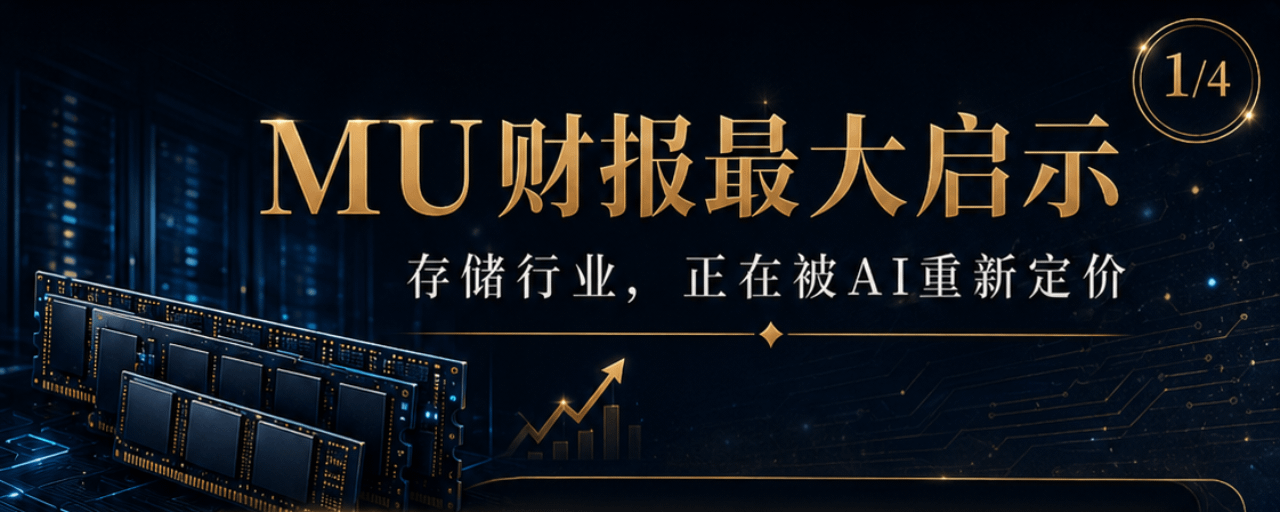

Storage is king! Micron's performance last night was almost perfect!
$MU This financial report redefines the storage industry.
In the AI era, storage is no longer just a supporting component, but a core resource of computing systems.
The Q3 figure is already quite exaggerated.
Revenue was $41.46 billion.
Non-GAAP EPS: $25.11.
The gross profit margin is close to 85%.
Q4 provides even stronger guidance.
Revenue guidance is $49 billion to $51 billion.
Non-GAAP EPS guidance is $30 to $32.
Gross margin guidance is approximately 86%.
This is no longer a slight overshoot of expectations; it has pushed Wall Street's models up by a significant margin.
The most noteworthy aspect of this financial report is not the numbers themselves, but the industry changes behind them.
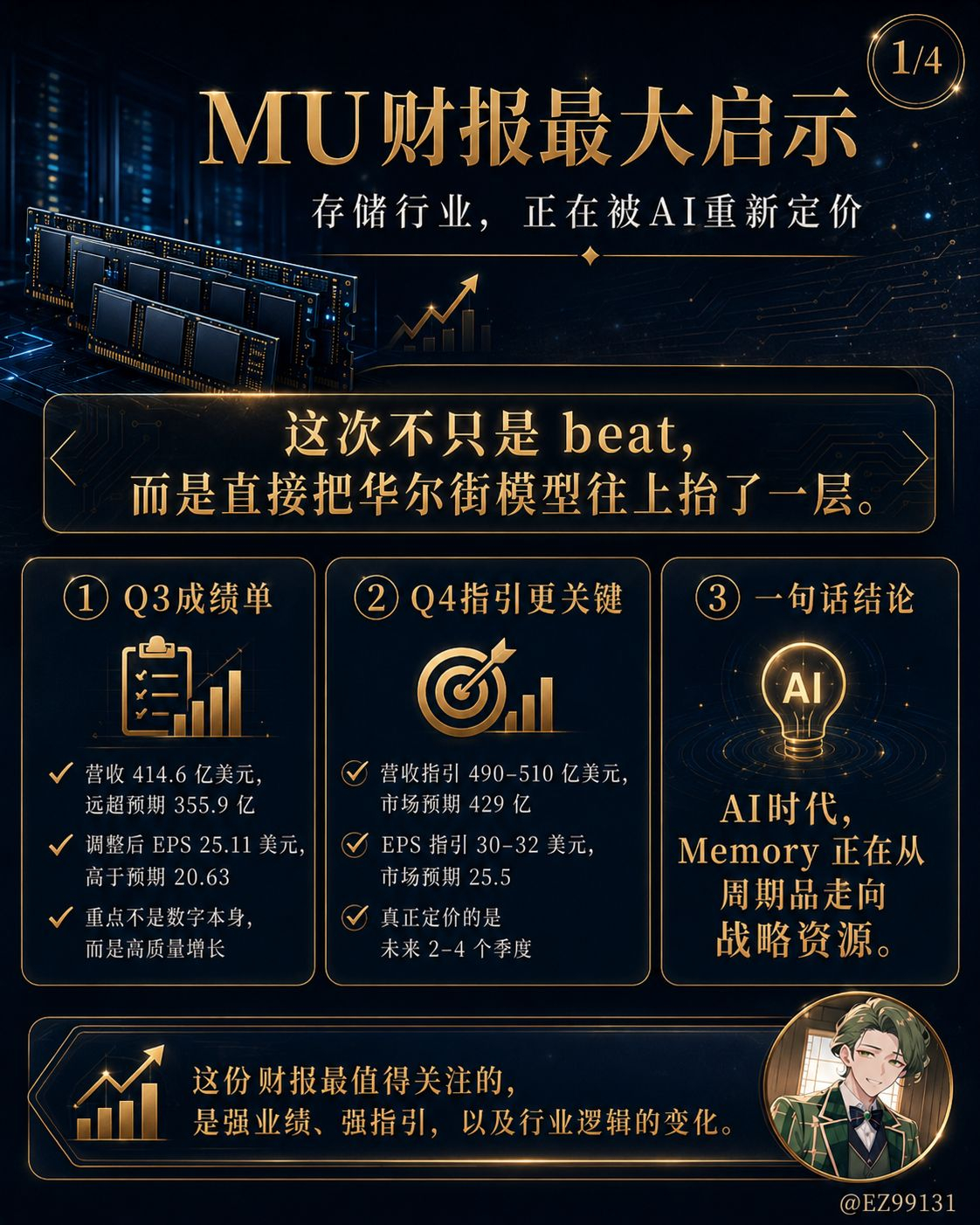
First, storage is transforming from a cyclical commodity into a scarce resource for AI infrastructure.
In the past, the market focused on DRAM and NAND, and the logic was very simple.
The price increase cycle has arrived, and profits are soaring.
Excessive expansion has caused prices to collapse.
Then wait for the next cycle.
But this time it's different.
AI has changed the structure of storage requirements.
Previously, people thought that the most important part of AI infrastructure was GPUs.
It is becoming increasingly clear that the GPU is just the computing core, while memory and storage determine whether the system can actually run.
Agentic AI, multi-agent systems, long context, inference load, data caching, vector databases, and model services will all continuously consume memory and storage.
AI does not just increase the demand for HBM.
AI is also increasing the demand for data center DRAM, enterprise SSD, NAND, LPDRAM, CXL memory, and server memory modules.
This is why Micron's management has repeatedly emphasized:
Memory has become a strategic asset in the AI era.
This statement is crucial.
Strategic assets are different from ordinary commodities.
For regular goods, look at the price.
Strategic assets are defined by supply security, long-term cooperation, capacity lock-in, and customer relationships.
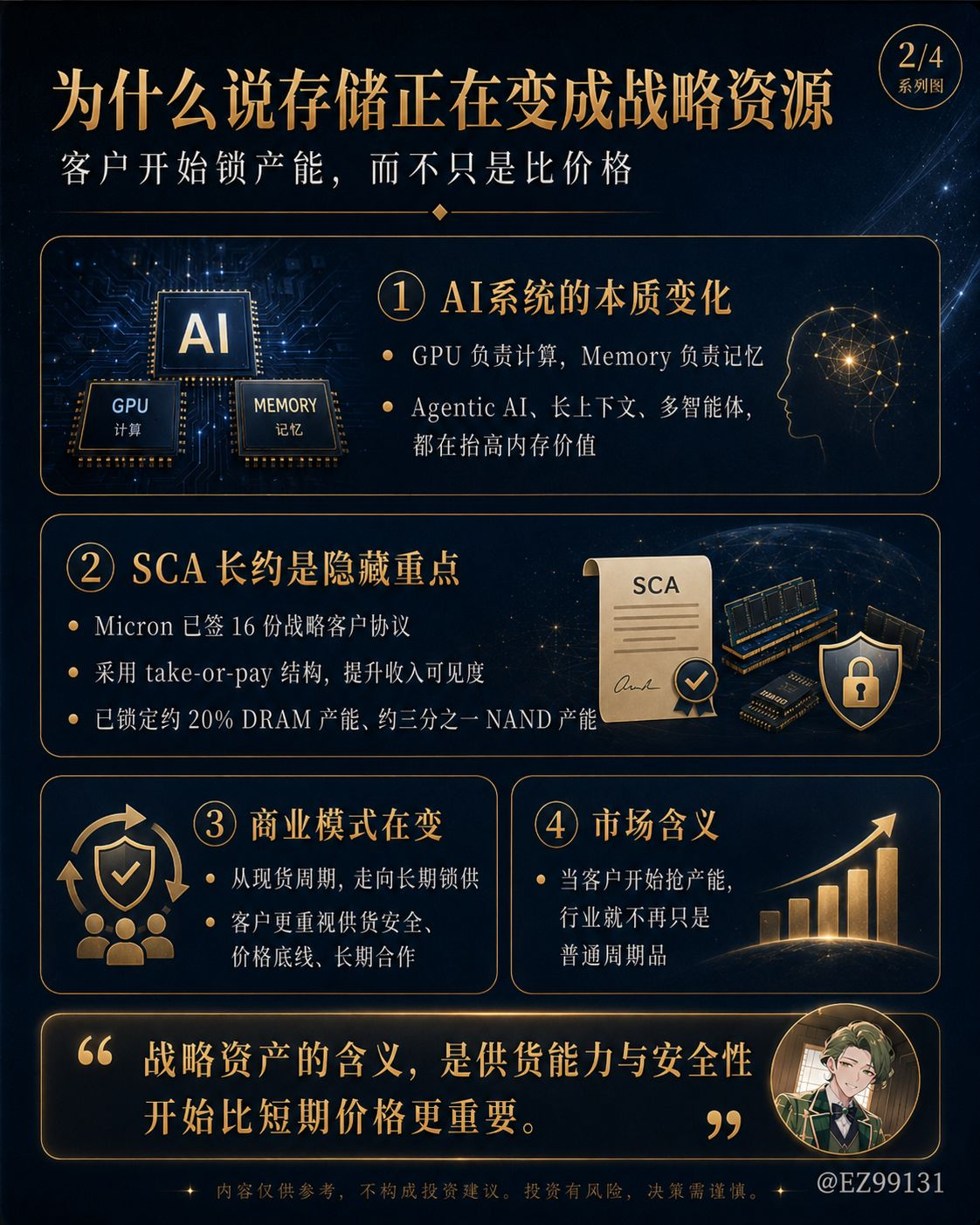
Second, customers have started using long-term contracts to lock in supplies.
The most easily underestimated aspect this time is Micron's Strategic Customer Agreements.
The company disclosed that it has signed 16 SCAs, covering markets such as data centers, consumer electronics, and automobiles.
These agreements are not ordinary letters of intent.
They have a take-or-pay structure.
Simply put, it means that customers lock in the supply and still bear the corresponding obligations even if they don't buy.
More importantly, these agreements also include cash deposits, price floor, and long-term supply arrangements.
The biggest drawback of the storage industry in the past was that customers were too flexible and prices were too cyclical.
When demand is high, everyone rushes to buy.
When demand is low, customers will immediately cancel orders.
However, after the emergence of SCA, Micron's business model began to change.
Income visibility is higher.
Stronger price protection.
Deeper customer relationships.
Capacity utilization is more stable.
This is not simply a matter of having a few more contracts.
This represents the storage industry's gradual shift from short-cycle spot trading to a long-term infrastructure supply model.
If this trend continues, the way the market values MU will also change.
Previously, it was the cyclical PE ratio.
In the future, pricing may be repriced towards core suppliers of AI infrastructure.
Third, the supply side cannot be expanded at will.
The core support for this bullish trend is not just strong demand, but also that supply cannot keep up.
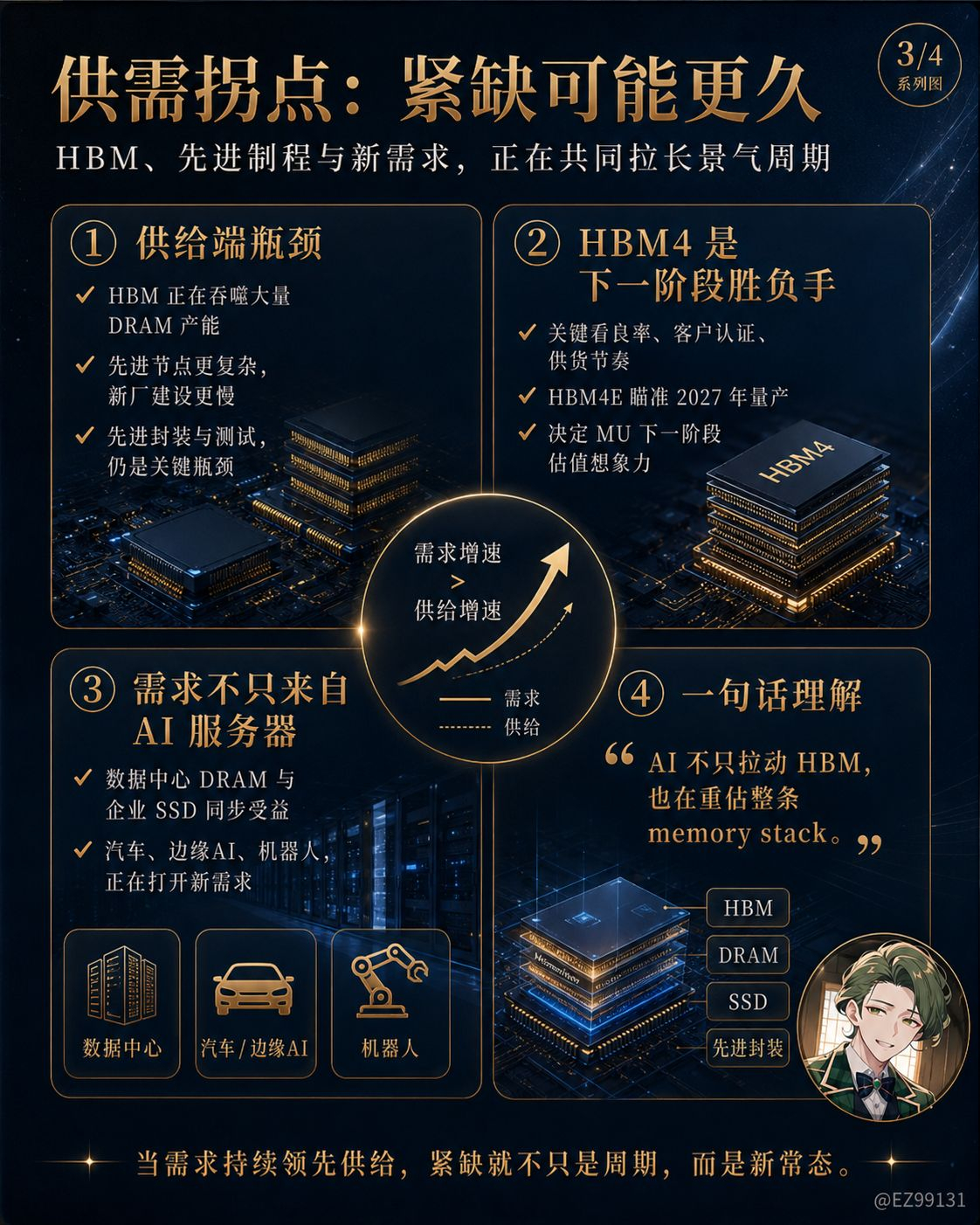
HBM will consume a large amount of DRAM wafer capacity.
Advanced DRAM nodes are becoming increasingly difficult to achieve.
The construction period for the new fab is very long.
Advanced packaging and testing cannot be mastered overnight.
The same applies to NAND. The industry has been plagued by low prices for too long in the past few years, and manufacturers cannot immediately expand production at a frenzied pace.
Some NAND resources may even be reallocated to DRAM.
That's why management says they don't see when supply will catch up with demand.
It does not mean a short-term shortage, but a structural shortage.
If supply shortages do indeed continue beyond 2027, MU's pricing power and profit margins may be more sustainable than the market anticipates.
Fourth, HBM4 will be the key to victory in the next stage.
The information about HBM4 in this financial report is crucial.
Micron says the HBM4 is already being shipped in large quantities to lead customer platforms and has also sent certification samples to multiple end customers.
HBM4E is also under development and is expected to enter mass production in 2027.
This shows that MU is not just relying on HBM3E for a single boom; it is already migrating to the next generation of products.
This is very important.
HBM is the core of the valuation of the AI memory trade.
If MU continues to maintain its advantages in customer certification, supply chain pace, and yield in the HBM4 generation, the market will continue to regard it as a core AI chain company, rather than a regular DRAM company.
Conversely, if HBM4's pace is not smooth, valuations will be pushed back down to cyclical stocks.
Therefore, what we should focus on most later is not the phrase "strong demand," but rather:
HBM4 yield.
Customer certification progress.
2027 order visibility.
HBM4E mass production time.
The depth of its partnerships with #NVIDIA,#ASICcustomers, and cloud providers.
Fifth, non-HBM businesses are also being driven by AI.
Many people only look at HBM, but the bigger change this time is:
Regular DRAM and NAND are also beginning to benefit.
Data centers require more than just GPU nodes; they also need CPU servers, storage servers, caching tiers, databases, enterprise SSDs, and tiered systems for cold and hot data.
As AI inference becomes more frequent, memory pressure is no longer limited to the training cluster.
Edge inference, enterprise private AI, robotics, autonomous driving, AI PCs, and large mobile models will all bring new storage demands.
The automotive section is also worth looking at.
L2+ models require more#DRAMand #NAND.
Robotaxi requires higher reliability and higher capacity.
If robots are mass-produced in the future, the storage demand may be greater than currently modeled in the market.
That's why I think the story of MU isn't just about HBM, but about the entire memory stack being repriced by AI.
Sixth, CapEx is the biggest point of contention.
The bulls are seeing a shortage of supply.
The short sellers are seeing an increase in capital expenditure.
Micron's capital expenditures in Q3 have already exceeded $7 billion, and they are expected to continue to rise in Q4. In 2027, the capital expenditures per quarter may be even higher than in Q4.
This is the biggest point of contention in the future.
If this money is primarily invested in HBM, advanced DRAM, advanced packaging, cleanroom, and securing capacity with high-value customers, the market will interpret it as a high-return investment.
However, if all players in the industry start to expand production, the industry may still face oversupply again in a few years.
Therefore, the biggest risk for MU is not that demand will suddenly disappear tomorrow, but that supply discipline will be broken by the temptation of high profits.
That's why I wouldn't say that the storage industry will never have cycles again.
More accurately:
The cycle is still there, but its form has changed.
Previously, price cycles were the dominant factor.
In the future, the cycle will likely be jointly determined by AI long-term contracts, advanced manufacturing processes, HBM capacity, customer loyalty, and capital expenditure discipline.
Seventh, this financial report also offers insights for the entire AI industry chain.
If MU's claim is true, then the logic behind AI investment needs to be reordered.
In the past, people were used to dividing the AI chain into:
GPU First
The internet is second.
Application 3
But now it might need to be changed to:
Computing power and memory together constitute the first layer.
Optical interconnects and networks constitute the second layer.
The third layer consists of power, heat dissipation, encapsulation, and materials.
Applications are placed later.
The real bottleneck of AI systems is not single-point computing power, but system-wide throughput.
No matter how powerful the GPU is, if the HBM, DRAM, and SSD are insufficient, data cannot be moved, and the efficiency of the entire system will drop.
Therefore, I now tend to view AI infrastructure as a system:
Calculation is responsible for reasoning.
Memory is responsible for the context.
Store the responsible data.
Optical interconnect is responsible for transporting data.
The power supply and heat dissipation are responsible for bearing the load.
Any shortage in any link can become a profit pool.
That's the significance of MU's financial report.
This proves that storage is transforming from a supporting role in AI to one of the main components of AI infrastructure.
This financial report is no ordinary beat.
It's more like a role reversal for the storage industry.
From cyclical commodities to strategic resources.
From spot market fluctuations to long-term contract-based supply lock-in.
From simply raising prices to addressing structural shortages driven by AI demand.
From a regular DRAM company to an AI memory infrastructure company.
Of course, the risks are also clear.
First, the stock price has already risen significantly, and expectations are extremely high.
Second, the gross profit margin is already very high, and every step from here on out must continue to demonstrate its sustainability.
Third, the growth of CapEx will raise market concerns about the next round of oversupply.
Fourth, once customer demand slows down or supply eases, pricing power will be the first to be questioned.
But at least this time, MU's answer was very strong.
Strong performance
Strong guidance
Strong Gross Profit
Strong HBM4 progress
Strong customer long-term contracts
Strong supply and demand shortage narrative
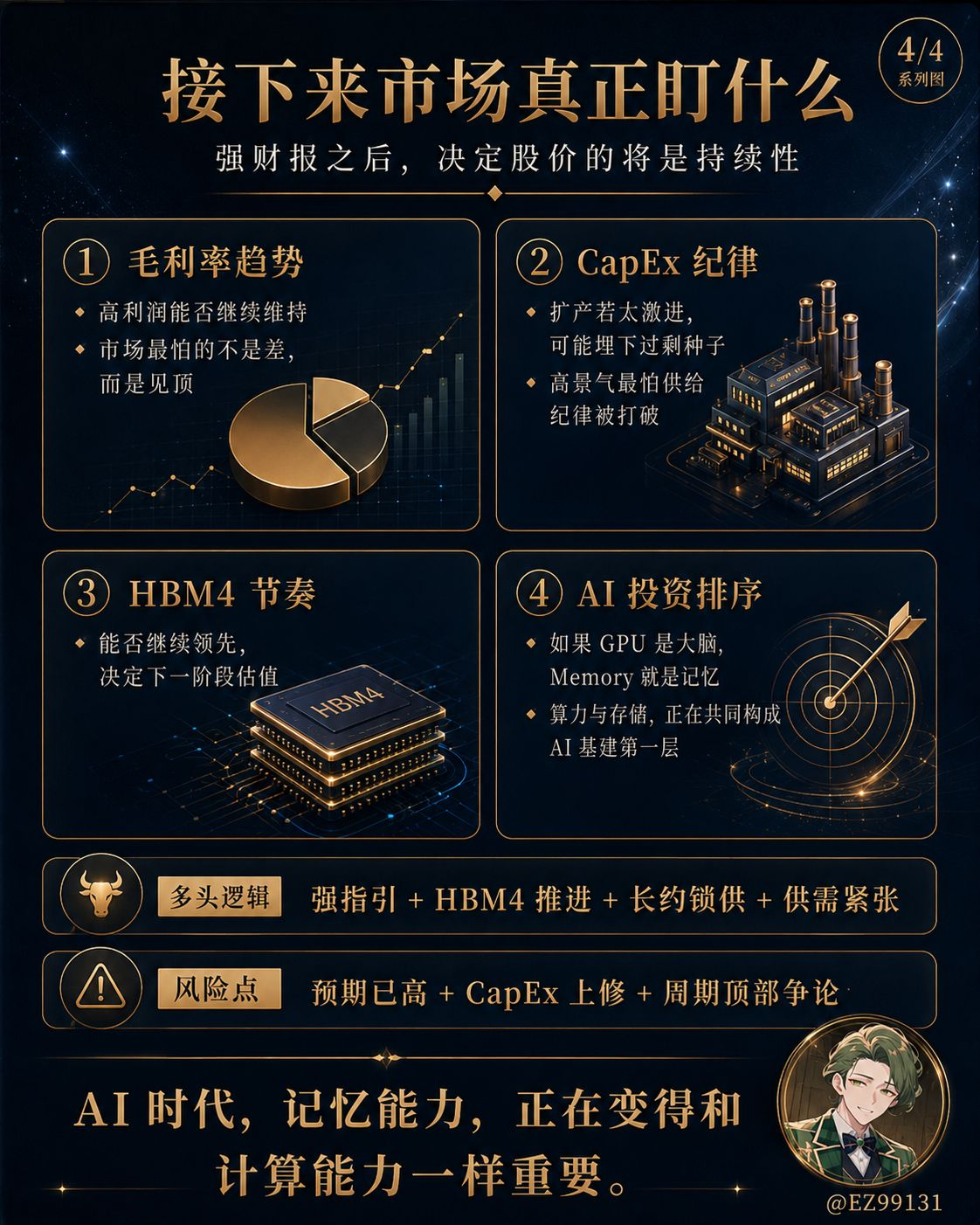
In the age of AI, memory is becoming just as important as computing power.
If the GPU is the brain's computing power, then memory is the brain's recollection.
Without memory, even the most powerful AI cannot go far.