

0xYi暖阳
188 Posts

0xYi暖阳
Report
Block User
346 Following
11.0K+ Followers
2.3K+ Liked
Posts
All
Quotes
Videos
PINNED
·
--
Article
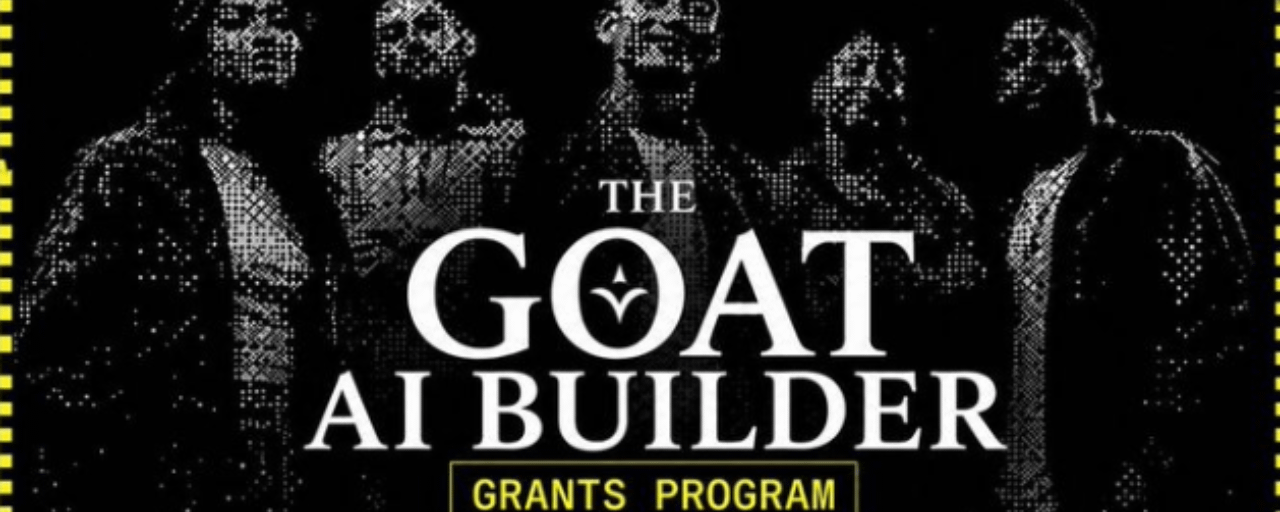
GOAT Network Launches an AI Builder Grant Program: Build “Earning” AI Agents with Real Money🔥 One of the hottest directions for AI right now is AI Agents. Not just chatbots, but “digital employees” that can think for themselves, take action on their own, and complete tasks by themselves.
For example, it can automatically help you book tickets, write code, look up information, and even collaborate with other AIs to get work done. Many people think that the next step is for these AIs to be more than just tools—they become “economic participants” that can directly buy and sell and generate real income.
✨ GOAT Network is going after this hotspot. It’s a blockchain protected by Bitcoin security, built specifically for these AI agents to do business. Their core idea is: humans have banks, courts, and customer service to protect transactions, but machines don’t. Machines can only trust each other through “on-chain verifiable receipts.” So they make “verification” the foundation of this new economy.
GOAT Network Launches an AI Builder Grant Program: Build “Earning” AI Agents with Real Money
🔥 One of the hottest directions for AI right now is AI Agents. Not just chatbots, but “digital employees” that can think for themselves, take action on their own, and complete tasks by themselves.
For example, it can automatically help you book tickets, write code, look up information, and even collaborate with other AIs to get work done. Many people think that the next step is for these AIs to be more than just tools—they become “economic participants” that can directly buy and sell and generate real income.
✨ GOAT Network is going after this hotspot. It’s a blockchain protected by Bitcoin security, built specifically for these AI agents to do business. Their core idea is: humans have banks, courts, and customer service to protect transactions, but machines don’t. Machines can only trust each other through “on-chain verifiable receipts.” So they make “verification” the foundation of this new economy.
18
11
78
·
--
AI agents are getting better and better at getting things done, but they still hit a wall when you ask them to shop: they can’t find products, understand webpages, or feel confident paying directly. That’s because there’s no purchase record that both sides can verify. 🤖
GOAT Network posted a recap, and I found it pretty interesting.
GOAT Network signed a memorandum of understanding with South Korean publicly listed company Square Tech to pilot AI agent payments in Korea.
The first use case will let foreign visitors verify their identity using their passport on their phone, then spend dollar-pegged stablecoins at participating merchants.
Square Tech will handle local merchants and compliance, while GOAT provides the technology and payment network. Regulatory approval is required before launch, so the rollout will happen in phases. 🇰🇷
📰 The news was covered by Bitcoin Magazine, Business Insider, Benzinga, and others, as well as local Korean media.
GOAT Flow is tackling a very practical problem: AI agents can’t fill out standard checkout forms, and they don’t feel safe making payments on their own.
GOAT Flow lets agents understand checkout pages directly, sends payments straight to merchants’ wallets, and records transactions on-chain. People can also pay on the same page by card or cryptocurrency. Merchants barely need to write any code, and can get set up in minutes. 💳
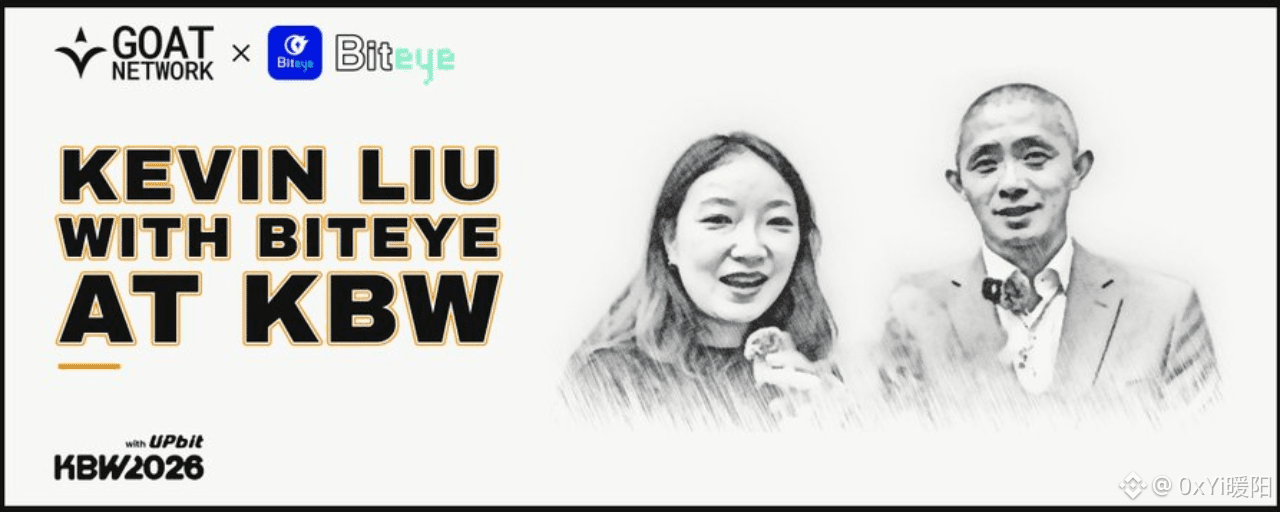
📺 CEO @KevinLiu’s talk at KBW is also up on YouTube. It mainly discusses how agents decide what to buy, why most merchants are currently invisible to agents, and how small and medium-sized businesses can avoid being overlooked in the first wave.
⚠️ A quick technical note: Stargate has ended its support for GOAT, and LayerZero’s default service will also be discontinued on October 30. Developers working with these integrations should make sure to update their configurations. The chain itself and its native assets are unaffected.
⭐️ Overall, @GOATNetwork’s partnership is a practical move, and GOAT Flow addresses real pain points: agents aren’t comfortable paying on their own, and merchants need an easier way to integrate. If the Korea pilot succeeds, it’ll be a concrete example of agents actually being able to act as customers—and one worth keeping an eye on. 👀
#GOATNetwork #GOATFlow #BTC #AI #AIAgents

210
·
--
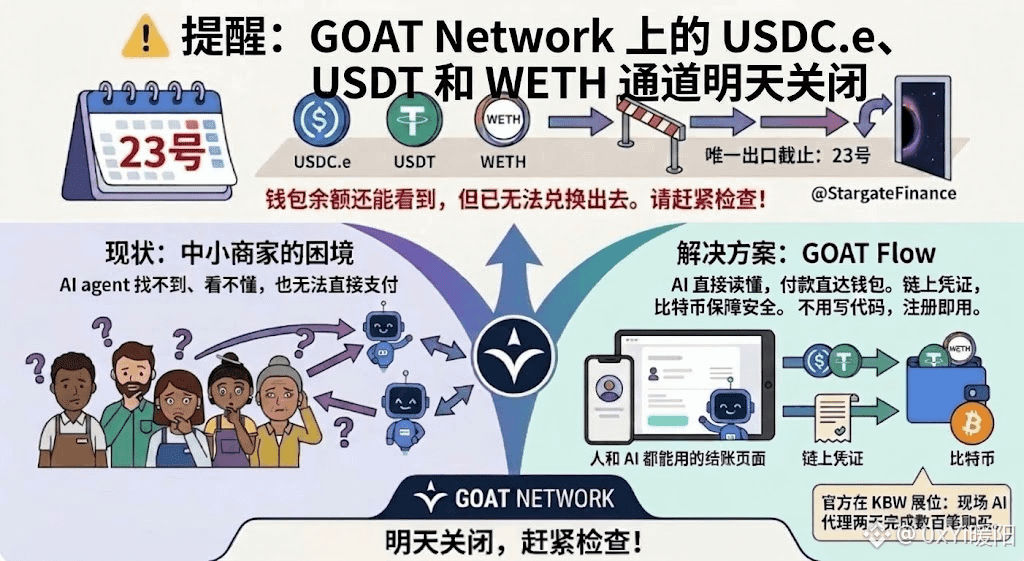
⚠️ A quick reminder: The USDC.e, USDT, and WETH bridges on GOAT Network will close tomorrow, the 23rd.
You’ll still be able to see the balances in your wallet after that, but you won’t be able to withdraw them. The only exit route currently available is @StargateFinance, and it closes on the 23rd, so if you have funds there, check them as soon as possible. This is especially important if your funds are still in a pool, vault, or lending market—remember to withdraw them first and then bridge them out. Don’t leave it until the last minute and end up scrambling.
Lately, @GOATNetwork has been talking a lot about GOAT Flow.
Put simply, it lets small and midsize businesses accept orders and payments from AI agents. Right now, many small businesses can’t be found or understood by AI, and they can’t accept payments from it directly.
GOAT Flow aims to solve this by providing a checkout page that both people and AI can use. AI can read it directly, payments go straight to your wallet, and there’s an on-chain receipt. Security is backed by Bitcoin, and there’s no coding required—just create an account.
The team tested it at the KBW booth, where AI agents completed hundreds of purchases in just two days. CEO Kevin Liu also said: Your next customer might be an agent.
The agent side is nearly ready; what’s missing is for businesses to catch up. GOAT Network wants to build the Stripe of the AI era—making it easy for ordinary businesses to join the agent economy.
⭐️ In short, if you have USDC.e, USDT, or WETH on GOAT Network, take care of the bridge situation first to avoid trouble later.
@GOATNetwork has been working seriously on agentic commerce, and GOAT Flow really does make the idea of “small businesses accepting AI orders” practical and achievable. Bitcoin-backed security and onboarding without writing code are rare advantages at this stage, so it’s worth keeping an eye on.
#GOATNetwork #GOATFlow #BTC #AI #AIAgents
170
·
--
AI is definitely becoming more capable. It’s not just chatting and writing anymore—many people are already using it to find products, compare prices, and even place orders directly.
But most websites today are designed for people to click through. They’re full of buttons and pop-ups, which AI often can’t understand or interact with—and making payments is even trickier.
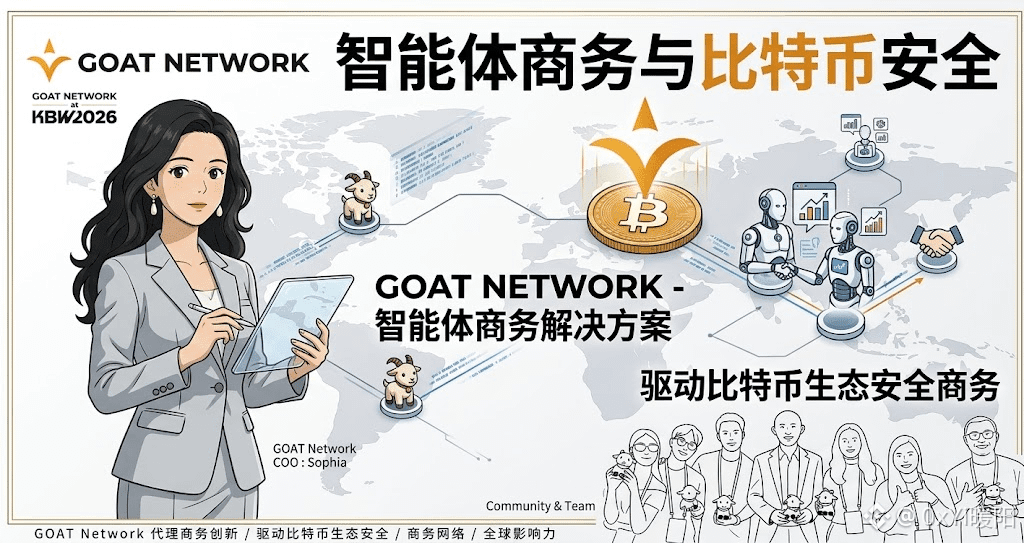
At KBW, @sophianeverfold, COO of GOAT Network, spoke with Genzio about the relationship between “agentic commerce” and Bitcoin. The conversation focused on a few key points:
🔸What exactly is agentic commerce? Put simply, AI doesn’t just recommend links—it can find products, understand information, and complete payments on its own.
🔸Why aren’t today’s websites suitable for AI? They’re designed for people, not machines. It’s difficult for AI to find products and understand their specifications, let alone place an order smoothly.
🔸How does GOAT Flow address this? GOAT Network has built a tool that helps merchants organize product information in a format AI can understand, making products easier to search for and buy. It takes just a few minutes to set up, and people and AI can use the same checkout, with support for credit cards and cryptocurrency.
🔸Why emphasize Bitcoin security? When AI makes payments, there can be risks if funds can be frozen, transactions reversed, or the system relies too heavily on a single platform. Bitcoin is relatively more decentralized and censorship-resistant, making it a more robust payment foundation for automated use cases like this.
If you sell products online, this interview is worth a watch. The message to merchants is clear: AI is starting to become a “buyer.” If your products can’t be found and purchased by AI, you may miss out on some customers in the future.
⭐️ Enabling AI to buy things isn’t just a technical challenge. It also involves discovery, understanding, and payment—with payment security being especially important.
@GOATNetwork is continually improving the infrastructure and tools needed to move Bitcoin-secured agent payments forward. It’s worth keeping an eye on.
#GOATNetwork #GOATFlow #BTC #AI #AIAgents
156
·
--
Article
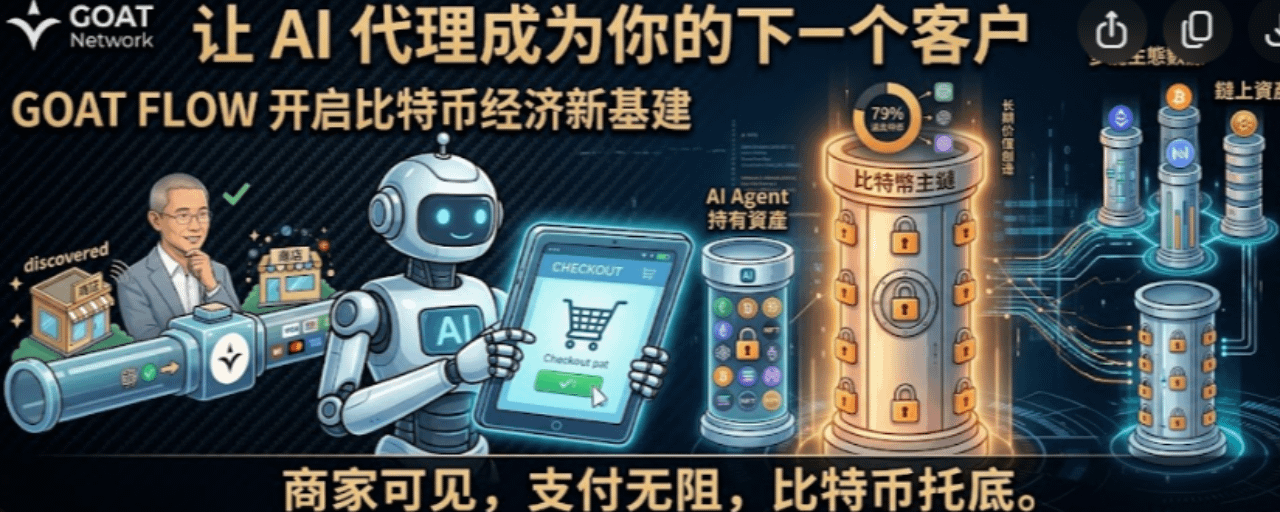
Make AI Agents Your Next Customers: GOAT Flow Builds New Infrastructure for the Bitcoin EconomyYour next customer might not be a person—it could be an AI.
This isn’t some far-off prediction. AI agents can already search for products, compare prices, and place orders on their own. But most merchants are still “invisible” to them: AI can’t find you, understand what you’re selling, or make a payment.
At a recent event in South Korea, @GOATNetwork CEO @kevinliu spoke specifically about this: how to make merchants visible to AI, how to enable AI to complete purchases, and why Bitcoin is the best option for final settlement behind the scenes.
One of GOAT Network’s core products is GOAT Flow. Put simply, it’s a “shopping channel” built specifically for AI agents, enabling them to discover and understand products and services—and actually complete purchases.
Make AI Agents Your Next Customers: GOAT Flow Builds New Infrastructure for the Bitcoin Economy
Your next customer might not be a person—it could be an AI.
This isn’t some far-off prediction. AI agents can already search for products, compare prices, and place orders on their own. But most merchants are still “invisible” to them: AI can’t find you, understand what you’re selling, or make a payment.
At a recent event in South Korea, @GOATNetwork CEO @kevinliu spoke specifically about this: how to make merchants visible to AI, how to enable AI to complete purchases, and why Bitcoin is the best option for final settlement behind the scenes.
One of GOAT Network’s core products is GOAT Flow. Put simply, it’s a “shopping channel” built specifically for AI agents, enabling them to discover and understand products and services—and actually complete purchases.
204
·
--
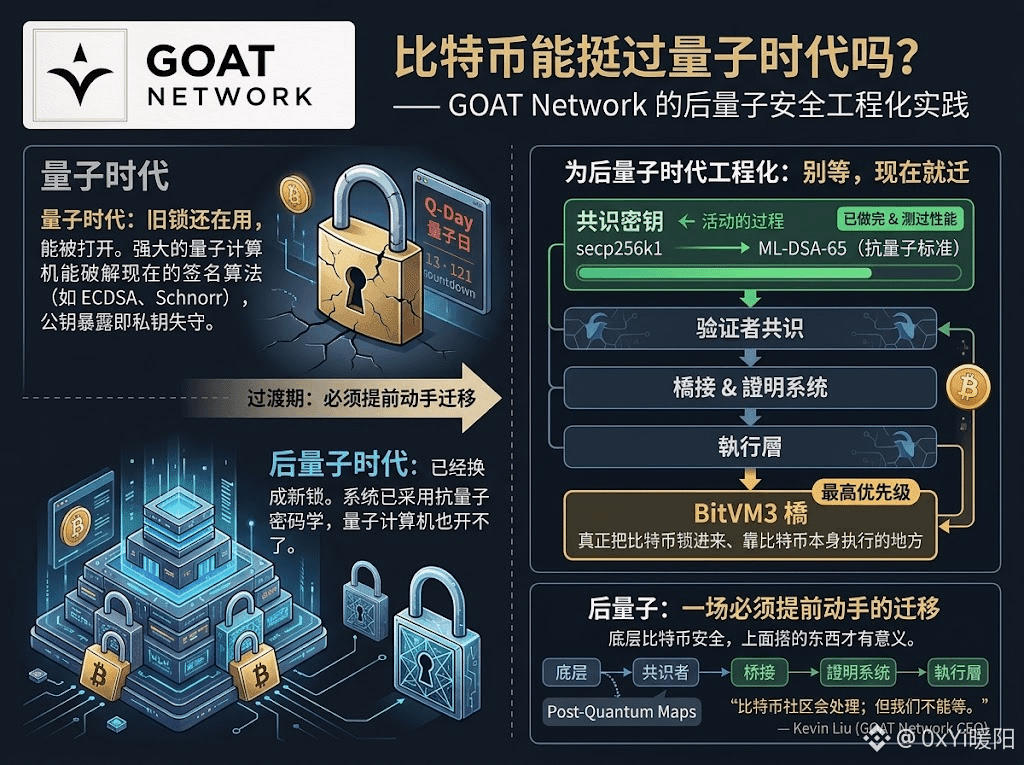
Can Bitcoin Survive the Quantum Era?
GOAT Network’s approach is straightforward: don’t wait until the threat is real to fix things. Migrate now what’s within your control. 🛠️
The quantum era and the post-quantum era are two distinct phases. ⏳
The quantum era refers to the day quantum computers become powerful enough to break the signature algorithms we use today. Once a public key is exposed, its private key could theoretically be calculated. This point in time is often called Q-Day. ⚠️
The post-quantum era doesn’t mean quantum computers have disappeared. It means systems have switched to new, quantum-resistant cryptography. Even when quantum computers arrive, they won’t be able to unlock these new locks. 🔒
Simply put: in the quantum era, the old locks are still in use and can already be picked; in the post-quantum era, they’ve been replaced with new ones. The transition between the two is critical, so we need to act early. 🚀
What GOAT Network keeps emphasizing is “engineering for the post-quantum era.” 🏗️
GOAT Network has audited its entire system layer by layer, from consensus keys and bridging to proof systems and the execution layer. It’s already working on what it can control. Validator consensus keys are being migrated from the commonly used secp256k1 to the quantum-resistant standard ML-DSA-65, and the migration has been completed and performance-tested. ✅
The highest priority is the BitVM3 bridge, because this is where Bitcoin is actually locked up and where enforcement relies on Bitcoin itself. GOAT Network has made its “quantum-resistant roadmap” public and clarified the dependencies: the systems built on top only matter if the Bitcoin layer beneath them is secure. 🗺️
CEO @kevinliu put it clearly at KBW: the Bitcoin community is strong enough to handle this eventually, but we can’t afford to wait on our end. 💪
@GOATNetwork is building agentic commerce infrastructure secured by Bitcoin, and it’s explicitly designed for the post-quantum era.
This isn’t just a slogan. The keys are already being migrated, the roadmap is already mapped out, and the priorities are already set. 📋
The post-quantum transition isn’t a switch that gets flipped one day in the future. It’s a migration we must start early. If we wait until real quantum computers arrive to make the switch, it’ll already be too late. ⏰
If you can do it early, don’t leave it until the last minute. LFGoat 🚀
#GOATNetwork #BTC #BitVM3 #量子时代 #后量子时代
186
·
--
Article
No Hype, Just Products: A Look at Kevin Liu and GOAT Network’s Web3 EvolutionI recently watched Biteye’s interview with GOAT Network CEO @kevinliu at KBW, and it really got me thinking.
Whether a project can go the distance often depends on whether its founding team has genuinely built products for users—and whether they’re willing to admit when an approach hasn’t worked and adjust the product accordingly.
@kevinliu didn’t start out in crypto. Before that, he was an entrepreneur in the mobile internet space. The live-streaming app his team built was later acquired by China Radio International and reached around 160 million downloads. 📱
🗓️ After entering Web3 in 2018–2019, the team first built Metis, an Ethereum Layer 2 network, delivering nearly 300x returns to early investors. In 2023, they launched GOAT with a clear thesis: if Bitcoin is merely held and its network lacks real-world use, miner incentives and long-term security will be difficult to sustain, and the foundation of the asset’s value will remain shaky.
No Hype, Just Products: A Look at Kevin Liu and GOAT Network’s Web3 Evolution
I recently watched Biteye’s interview with GOAT Network CEO @kevinliu at KBW, and it really got me thinking.
Whether a project can go the distance often depends on whether its founding team has genuinely built products for users—and whether they’re willing to admit when an approach hasn’t worked and adjust the product accordingly.
@kevinliu didn’t start out in crypto. Before that, he was an entrepreneur in the mobile internet space. The live-streaming app his team built was later acquired by China Radio International and reached around 160 million downloads. 📱
🗓️ After entering Web3 in 2018–2019, the team first built Metis, an Ethereum Layer 2 network, delivering nearly 300x returns to early investors. In 2023, they launched GOAT with a clear thesis: if Bitcoin is merely held and its network lacks real-world use, miner incentives and long-term security will be difficult to sustain, and the foundation of the asset’s value will remain shaky.
169
·
--
Verified

Article
GOAT Network September BriefingThere’s a deadline coming up for GOAT Network that’s worth keeping an eye on ⏰
October 23: Stargate support for GOAT Network will end.
If you still have USDC.e, USDT, or WETH in your wallet, it’s best to withdraw them from DeFi first and then bridge them via Stargate. These three tokens were issued by Stargate, and Stargate is the only way to redeem them. After the deadline, they may be difficult to exchange if left on-chain. The chain itself, its own bridge, and native assets are unaffected.
What GOAT Network is doing is really about different aspects of the same thing: enabling AI agents to discover, pay, and verify directly, with settlement handled as much as possible by Bitcoin rather than decided by a committee or custodian 🐐
GOAT Network September Briefing
There’s a deadline coming up for GOAT Network that’s worth keeping an eye on ⏰
October 23: Stargate support for GOAT Network will end.
If you still have USDC.e, USDT, or WETH in your wallet, it’s best to withdraw them from DeFi first and then bridge them via Stargate. These three tokens were issued by Stargate, and Stargate is the only way to redeem them. After the deadline, they may be difficult to exchange if left on-chain. The chain itself, its own bridge, and native assets are unaffected.
What GOAT Network is doing is really about different aspects of the same thing: enabling AI agents to discover, pay, and verify directly, with settlement handled as much as possible by Bitcoin rather than decided by a committee or custodian 🐐
259
·
--
Verified
Article
GOAT Network goes two-pronged: KBW proves AI Agent payments, and cross-chain infrastructure undergoes a critical upgradeBrothers, happy National Day!🇨🇳🎉
This holiday, @GOATNetwork has been anything but idle. On the one hand, in Seoul at KBW 2026, they got the demo working for “an AI agent can help people buy things”; on the other hand, they also need to quickly remind users to deal with a cross-chain asset that is about to expire.
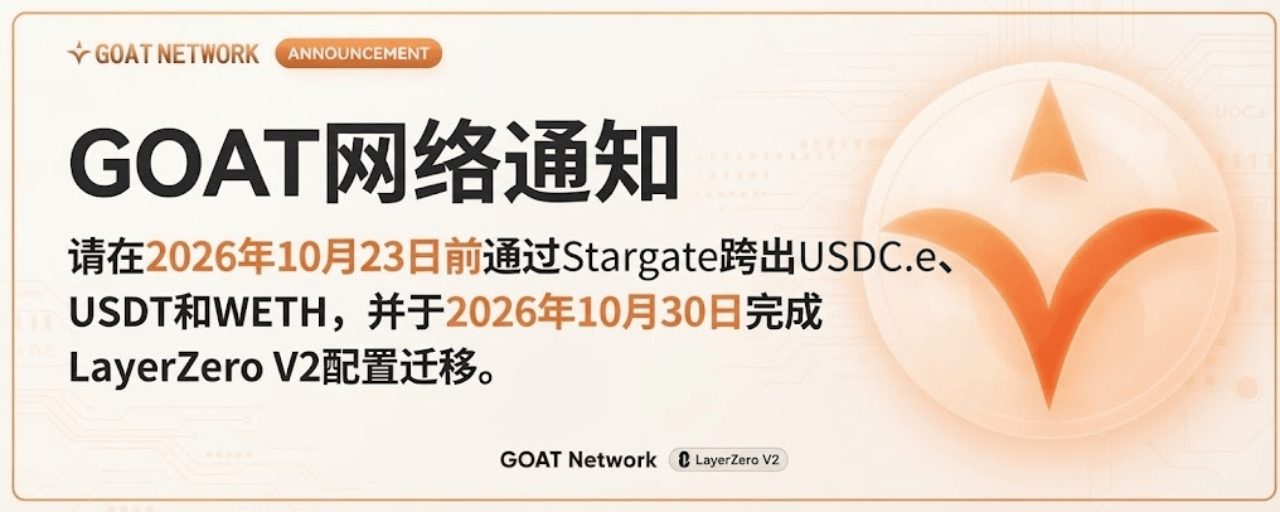
GOAT Network users: If you hold USDC.e, USDT, or WETH on-chain, please move them out via @StargateFinance before October 23, 2026.
Stargate and LayerZero are gradually shutting down support for more than 20 chains, and GOAT’s cross-chain messaging channel will also switch to its own infrastructure. These three tokens are issued by Stargate. Once the channel is closed, there will be no other exit routes, and your assets may not be recoverable.
GOAT Network goes two-pronged: KBW proves AI Agent payments, and cross-chain infrastructure undergoes a critical upgrade
Brothers, happy National Day!🇨🇳🎉
This holiday, @GOATNetwork has been anything but idle. On the one hand, in Seoul at KBW 2026, they got the demo working for “an AI agent can help people buy things”; on the other hand, they also need to quickly remind users to deal with a cross-chain asset that is about to expire.
GOAT Network users: If you hold USDC.e, USDT, or WETH on-chain, please move them out via @StargateFinance before October 23, 2026.
Stargate and LayerZero are gradually shutting down support for more than 20 chains, and GOAT’s cross-chain messaging channel will also switch to its own infrastructure. These three tokens are issued by Stargate. Once the channel is closed, there will be no other exit routes, and your assets may not be recoverable.
367
·
--
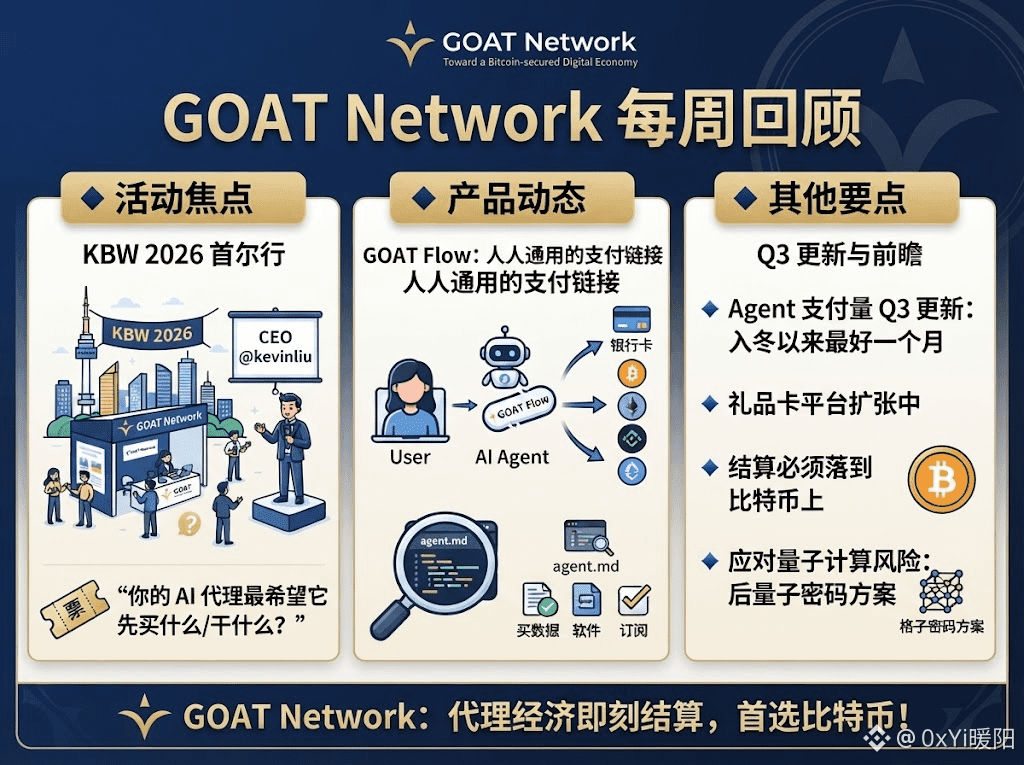
Brothers, happy Monday! A new week is here—let’s take a look at what @GOATNetwork did most last week!
Last week, @GOATNetwork mostly revolved around two things: one is that they’re about to head to Seoul for KBW, and the other is continuing to push their payment product, GOAT Flow.
🔶 First, the events: GOAT Network is a Diamond Sponsor of KBW 2026. The team is already in Seoul and has a booth. CEO @kevinliu will take the stage on October 1 to talk about how to make your product easy for AI agents to find, understand, and directly order. They also ran a community raffle for tickets. The questions are pretty interesting: “Your AI agent is holding your wallet—what do you want it to buy/do first?” The deadline was Friday the 25th.
🔶 On the product side, they’ve been talking a lot about GOAT Flow: a payment link that both humans and AI agents can use. It supports bank cards and cryptocurrencies across a dozen or so chains. Merchants don’t need to write code—just a few clicks in the backend can generate everything. The page also includes an agent.md, so agents can read exactly how to pay. Agents have already been helping people buy data, software, and subscriptions—if your payment method can’t handle it, orders will just end up running to someone else.
🔶 They also mentioned a few more updates:
🔹 Agent Payments volume: the Q3 update is out, and transaction volume was the best month since winter started.
🔹 The gift card platform currently works in only two countries, and they’re expanding outward.
🔹 They repeatedly emphasized that settlement must land on Bitcoin; otherwise it’s basically “someone owes you a Bitcoin”—not truly money in hand.
🔹 European regulation again raised the idea that quantum computing could break existing crypto. GOAT Network replied that they’ve been working on post-quantum already, and that verifier keys are being prepared to migrate to a lattice-cryptography scheme.
⭐️ All in all, last week @GOATNetwork was preparing for an in-person meetup, while also stressing that agent economics isn’t something for the future—payments and settlement need to connect now, and ideally connect to Bitcoin.
#GOATNetwork #GOATFlow #BTC #AI #AIAgents
222
·
--
Brothers, did you get it?
At midnight there’s a share $CASH event with benefits
If you went to bed early, you don’t know whether they still have it now
Just try it—there’s really nothing to lose
SR-57AAAD3D6ADEE79E9945D866
Brothers, did you get it?
At midnight there’s a share $CASH event with benefits
If you went to bed early, you don’t know whether they still have it now
Just try it—there’s really nothing to lose
SR-57AAAD3D6ADEE79E9945D866
At midnight there’s a share $CASH event with benefits
If you went to bed early, you don’t know whether they still have it now
Just try it—there’s really nothing to lose
SR-57AAAD3D6ADEE79E9945D866
2
38
·
--
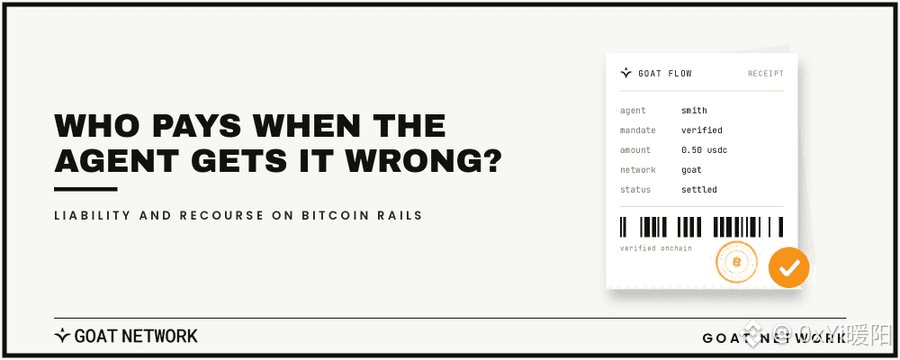
Recently, banks have made it clear: AI has already started placing orders and paying on someone’s behalf—but if the purchase is wrong, the current payment systems can’t correctly match responsibility. A person might click the wrong thing and still know who to argue with; an agent completes the deal within its budget—yet the user never confirmed at the time, and the merchant can’t produce any proof of intent at that moment. The money is paid, but the books can’t explain it. After the fact, refunds rely on memory and logs; that’s where things stop working.
@GOATNetwork is aiming to fix exactly this. It isn’t just adding another layer of customer support—it embeds evidence, identity, authorization, and settlement for the whole aftercare process directly into the act of payment.
Every GOAT Flow leaves an on-chain receipt: what was authorized at the time, what the agent did, who received the payment, and when settlement occurred. If something goes wrong, you check the record—you don’t have to reconstruct everything later.
Agents also have on-chain identity and a track record. When paying, they will indicate who they are. If they can be identified and verified, responsibility can actually be pinned down. The user’s budget and boundaries are written into rules first, and before any money moves, it’s verified whether the agent is acting within authority.
Even the closing of the case follows the rules. It’s not a hard rollback of the original transaction. You can escrow first, verify, then release funds. If you need a refund, you do it through another receipt-backed payment. Settlement lands on Bitcoin, so the ledger can’t be changed; what’s truly used to resolve things is the agreement written in advance.
This is crucial for agents. If a person gets scammed, they can still call and pressure someone. Agents don’t have that luxury—what they can rely on are the identity, permissions, receipts, and rules written into the workflow. When banks ask, “If the agent bought the wrong thing, who should pay?”, GOAT Network’s answer is straightforward: evidence points to whoever, and that party is responsible. The key is that the evidence exists from the start, not something added later.
This system is already running now. Merchants can do business with agents this way, and teams that handle identity, escrow, and verification can also plug in. What GOAT Network wants to say isn’t to add yet another set of principles—it’s that responsibility must be written into the payment itself, or the whole thing won’t hold up.
#GOATNetwork #GOATFlow #BTC #AI #AIAgents
1
277
·
--
Agent-based commerce has been brought up frequently lately: in the future, shopping may not be about people personally browsing and clicking, but about handing their needs and wallets to AI—so it can compare prices, place orders, and pay. It sounds far off, but GOAT Network’s messaging these days is very direct: while others are still talking about the future, they’ve already built the checkout counter.
✨@GOATNetwork is building an infrastructure layer backed by Bitcoin settlement. What it focuses on right now is GOAT Flow. The core idea is simple: open a door for merchants. Stores don’t need major changes—within minutes, they can sell to both humans and agents. For agents to shop, they first need to understand the shelves, and then be able to afford the bill.
GOAT Flow does these two things: it makes the store machine-readable, and it connects both bank cards and cryptocurrencies. Funds go directly into the merchant’s wallet; the platform doesn’t hold or intermediate the money. Orders include receipts, making them harder to cancel arbitrarily. Settlement is built on top of a Bitcoin-based system that’s harder to be rewritten unilaterally for security reasons—this is especially crucial for high-frequency, agent-to-agent transactions where the parties never meet.
So GOAT Network isn’t just saying “AI will shop.” Instead, it’s addressing a gap that exists right now: agents have already started helping people buy things, but most merchants can’t be understood by them, and they can’t be paid by them. GOAT Flow turns stores into places that agents can enter and check out. The gift card platform is an extension of the same concept—giving agents an entry point to buy real-world goods.
🎉Congratulations to GOAT Network for becoming a KBW2026 diamond sponsor.
KBW is a conference in Asia that is quite representative of industry trends. This means Bitcoin settlement—selling inventory to AI agents—has been placed on the main stage for both payments and on-chain applications. They’re no longer just discussing concepts; they’re being treated as deployable digital-economy infrastructure.
Looking one step further, GOAT Network isn’t only thinking about humans letting agents place orders. In the future, payments between agents will also need to involve identity and reputation, with API, data, and service purchased on a per-use basis. That layer is closer to future internet payment protocols. For now, GOAT Network is first laying the most practical one: stores can be seen, money can be collected, and the coverage gradually expands.
⭐️When everyone is talking about the future of agent-based commerce, @GOATNetwork has already built the usable part.
#GOATNetwork #GOATFlow #BTC #Aİ #AIAgents

249
·
--
Article
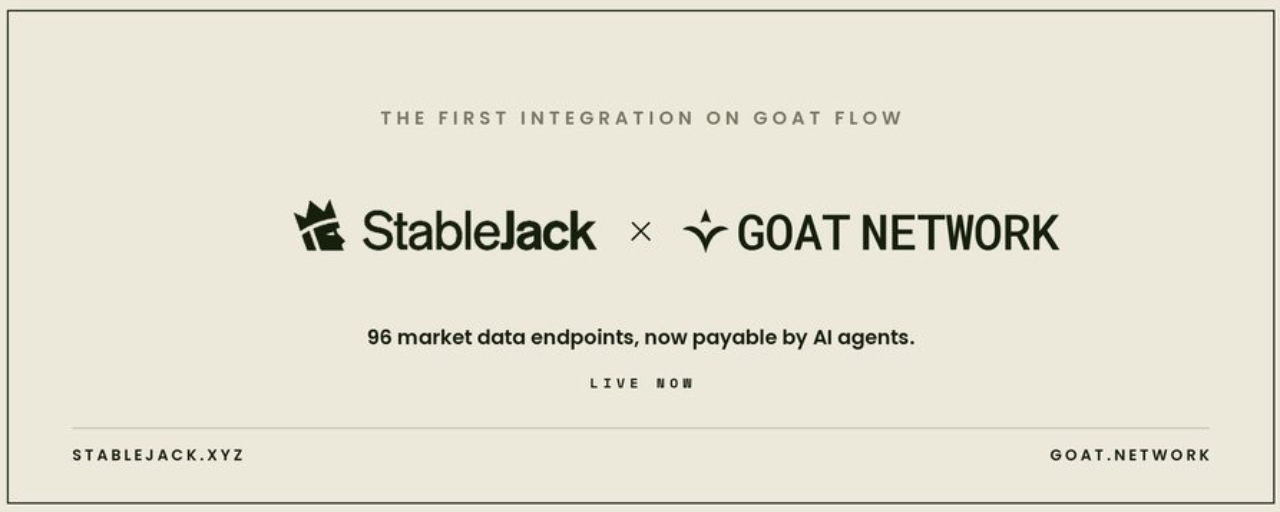
Slow, Then All at Once: GOAT Flow Welcomes Its First Merchant, Kicking Off the New Era of Machine Procurement🎉 Congratulations to GOAT Flow on welcoming its first merchant, StableJack
From its launch to actually getting it running, it hasn't taken long. In the first half of this year, @GOATNetwork has been turning “programs getting paid by other programs” into a product that can be deployed in the real world. Payments, cross-chain receiving, merchant back offices, on-chain verification—layer by layer, it’s been stacked up.
Live by the end of August. Merchants don’t have to rebuild everything—they can sell to humans and also sell to AI. Both cards and crypto can be accepted, and the money goes straight into their own wallet. The checkout desk is set up in advance, ready for the first real transaction.
The timing is just right. Institutions are already crunching the same numbers: by 2030, AI agents may rewrite the flow of tens of trillions of dollars in retail spending. And a bit sooner—before 2028, most B2B procurement could also be handled automatically by programs.
Slow, Then All at Once: GOAT Flow Welcomes Its First Merchant, Kicking Off the New Era of Machine Procurement
🎉 Congratulations to GOAT Flow on welcoming its first merchant, StableJack
From its launch to actually getting it running, it hasn't taken long. In the first half of this year, @GOATNetwork has been turning “programs getting paid by other programs” into a product that can be deployed in the real world. Payments, cross-chain receiving, merchant back offices, on-chain verification—layer by layer, it’s been stacked up.
Live by the end of August. Merchants don’t have to rebuild everything—they can sell to humans and also sell to AI. Both cards and crypto can be accepted, and the money goes straight into their own wallet. The checkout desk is set up in advance, ready for the first real transaction.
The timing is just right. Institutions are already crunching the same numbers: by 2030, AI agents may rewrite the flow of tens of trillions of dollars in retail spending. And a bit sooner—before 2028, most B2B procurement could also be handled automatically by programs.
129
·
--
AI nowadays isn’t really lacking in the ability to “talk” anymore. The model can write code, place orders, and even run errands for you nonstop. What truly gets stuck is something else: that very last cent it spends—afterward, can it still be recognized, frozen, and audited? Most products are still stuck at the stage of plugging in a payment interface, then plugging into a centralized wallet. Once the money leaves the app, it just flows into some company’s ledger.
✨@GOATNetwork is betting on a different path: turning Bitcoin into the settlement base layer for this wave of machine economies. It’s been moving fast lately—let’s take a quick look.
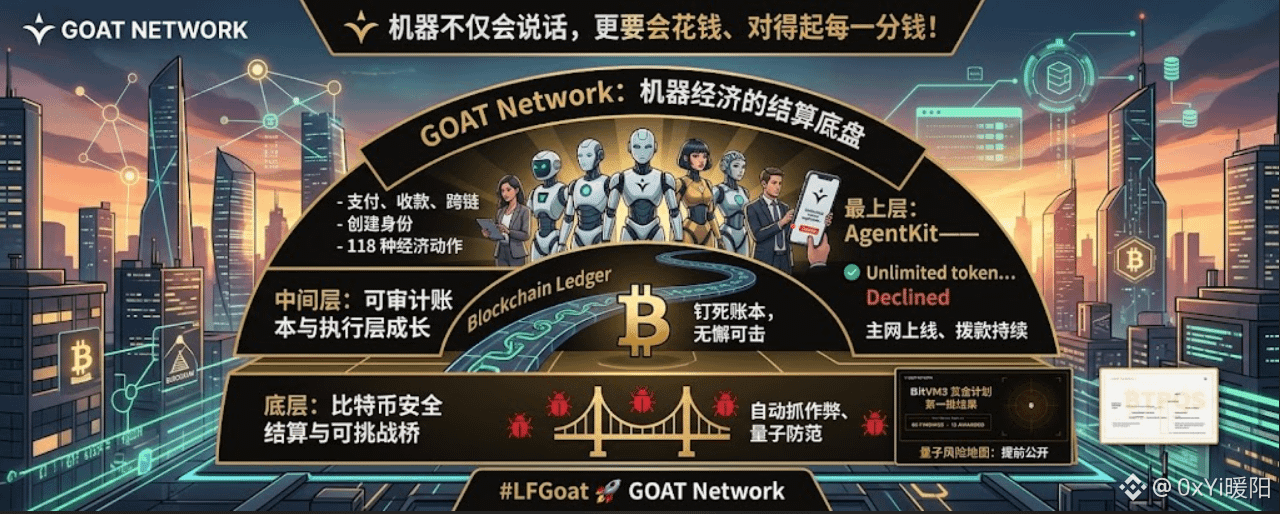
🔸The foundation is sidechains first. When Liquid was hacked, it showed that even if the coins are locked on Bitcoin, withdrawals rely entirely on the operator’s “it’s fine.” Funds could be moved out in under half an hour. GOAT does it differently: withdrawals have to sit on Bitcoin for a while—if someone thinks something’s wrong, they can call a halt. They’ve also published the bounty results: the first batch uncovered a bunch of issues, and most of the serious ones basically boil down to “how to automatically catch the cheaters.” The bridge is still being hit, and the bounties are still live.
🔸The middle layer is the timeline. This part is more pragmatic. The training camp is over, and the teams that performed well have already moved to the mainnet, while funding is still ongoing. They’ve also pointed out, step by step, where the whole chain could be broken up by quantum computers. The most dangerous spots are those keys on the bridge that were publicly known—if that day ever comes, the coins could be transferred away directly. Calling it out in advance—also so that when agents eventually spend their own money, the ledger won’t collapse first.
🔸The top layer is AgentKit—118 kinds of economic actions—so the model won’t just chat, but can also pay, receive, operate across chains, and establish identity. The logic is straightforward: the next round of opponents may not be human, but agents running day and night.
⭐️In short, over the past few days @GOATNetwork has laid out an end-to-end system: Bitcoin settlement, a bridge that can be challenged, an execution layer that’s still being extended, plus tools that let agents truly spend money. What’s rare is that it’s willing to disclose both loopholes and quantum risks, not just showcase a vision. If AI wants to hit the road and earn money on its own, someone has to lock down the ledger underneath—GOAT is doing exactly that.
LFGoat🚀
#GOATNetwork #BTC #AgentKit #AI #AIAgents
239
·
--
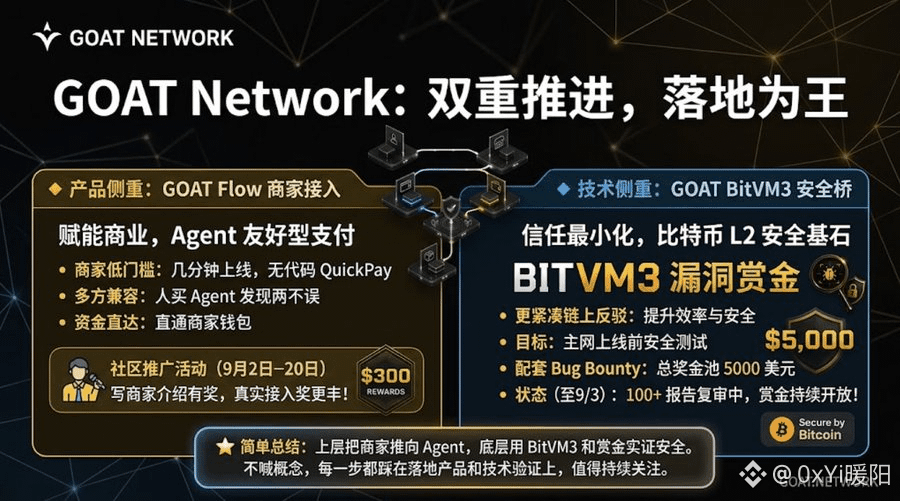
AI Agents are already starting to find products and pay on their own, and what merchants lack is a payment channel that can be discovered by machines and send money directly to a wallet. @GOATNetwork has recently been pushing this hard, while also advancing the security of Bitcoin at the base layer.
🔶The product focus is GOAT Flow.
It keeps the onboarding barrier for merchants very low: with QuickPay, basically no coding is needed, and you can go live in minutes. The product and payment page can simultaneously let people buy, and also let AI Agents discover and pay, with funds going directly to the merchant's wallet.
To bring real businesses on board, they also launched a community promotion campaign (Sep 2–20): write original introductions for real merchants, and quality content earns a small reward; if the merchant actually integrates, there is an even higher-tier reward.
🔶The technical focus is GOAT BitVM3.
This is a trust-minimized bridge connecting Bitcoin and the GOAT network: disputes try to avoid full verification on Bitcoin script, instead settling through more compact on-chain refutations, with the goal of strengthening security before mainnet launch.
The accompanying BitVM3 Bug Bounty has a total prize pool of $5,000, with rewards based on severity and reproducibility.
The campaign started around August 18 and lasts one month.
By September 3, the first batch had already received more than 100 reports. The team is in final review, and the exact number, discovery categories, and this round's prize breakdown have not yet been announced; the bounty is still open, and people in security, cryptography, and smart contracts can continue submitting.
🔶In addition, they also released a plain-language explanation of SHRINCS, a post-quantum Bitcoin signature scheme, as a research-oriented supplement.
⭐️Simple summary: at the application layer, they are genuinely pushing merchant payments toward Agents; at the infrastructure layer, they are using BitVM3 and a public bounty to expose the security of the Bitcoin bridge to community scrutiny. GOAT Network is not just talking about concepts—it is grounding every step in live products and technical validation, and it is worth continuing to watch.
LFGoat 🚀
#GOATNetwork #GOATFlow #BitVM3 #AI #AIAgents
197
·
--
On the eve of the “Golden Nine, Silver Ten” season, today we officially enter September. Let’s see what GOAT Network did in August. The core idea is simple: they took the concept of “using AI to help people buy things and pay,” and turned it into a product that merchants can use directly.
🤖 Now AI is no longer just for chatting or writing code. Many people are starting to have AI help them compare prices, book hotels, shop, and even pay. The problem is that most checkout pages today are built for humans—forms to fill in, cards to select, and a confirmation button to click. AI robots can’t use them.
✨ GOAT Flow is designed to solve this pain point. Merchants don’t need to write code. They can connect it in a few minutes. After that, whether real people buy or AI agents buy, payment is supported. It supports bank cards via Stripe, and also supports cryptocurrencies—funds are sent directly from the buyer’s wallet to the merchant’s wallet. Only once the money arrives will the order be confirmed. GOAT itself doesn’t handle funds; it only verifies details and issues receipts.
@GOATNetwork has also expanded this payment capability to 10 chains. An AI agent can pay from whichever chain it has funds on.
💫 At the same time, they’re working on deeper, foundational improvements: making security stronger. BitVM3 has opened public bounties to invite outsiders to find issues; the signatures from verification nodes are starting to migrate toward a post-quantum direction. In other words, they believe that in the future, transactions between AI agents will grow in volume and speed, and settlement needs to be anchored on the most stable base—so they chose #BTC.
⭐️ As AI gets better at handling tasks on its own, the next step is “spending money on its own.” Whoever first makes receiving payments simple and reliable will be the first to benefit from this wave. What GOAT Network is doing now is paving the way for ordinary merchants: no need to understand AI, and no need to understand chains— you can do business with these “money-spending robots” anyway.
LFGoat 🚀
#GOATNetwork #GOATFlow #BitVM3 #AI #AIAgents

291
·
--
Article
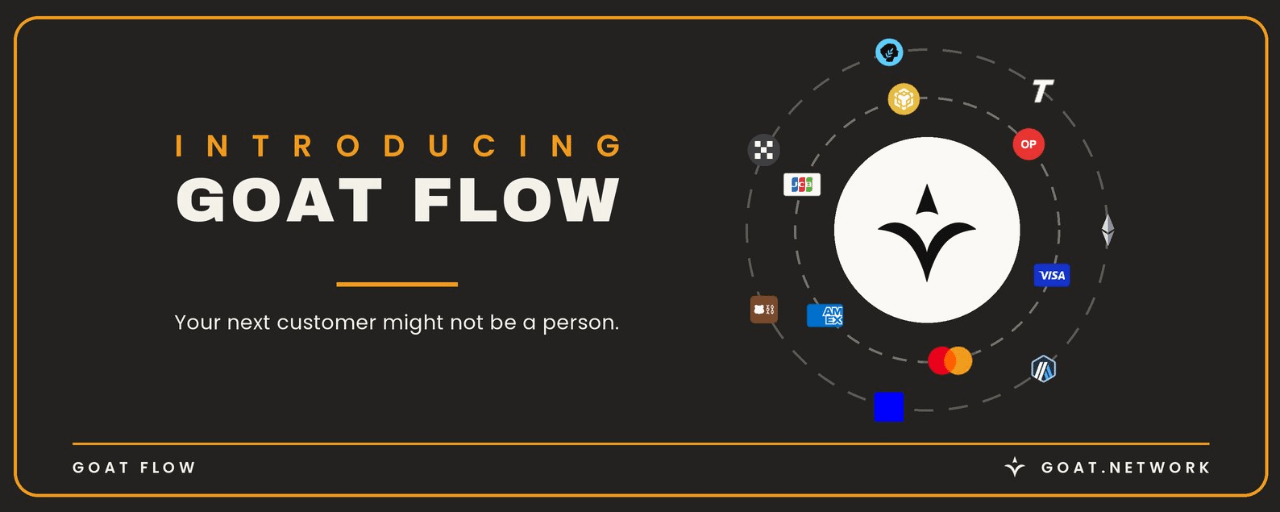
AI replaces humans when it comes to spending: why the next e-commerce boom is in GOAT FlowLately, everyone’s been talking about AI, and it’s no longer just stuck at “can write copy, can generate art.” What’s getting lively is that AI assistants are starting to handle tasks for people: price comparisons, booking hotels, buying software, integrating APIs, paying memberships. Some say the next wave of e-commerce growth won’t come from opening more online stores—it’ll come from “machines placing orders for you.” Sounds a bit mystical, but in reality the bottlenecks are pretty mundane: the shop still requires people to click with a mouse, fill out forms, and handle card payments. AI can’t get in, and it can’t pay.
What @GOATNetwork has to say is precisely this.
They didn’t suddenly jump on the “AI checkout counter” trend. These past few years, @GOATNetwork has been building Bitcoin-backed infrastructure: fast execution on top, smart contracts that can be written, and usability for both people and machines; meanwhile, settlement at the bottom is pushed as much as possible onto ledgers that are harder to tamper with. Their logic is very straightforward: as time goes on, transactions will be faster and fewer people will be watching. Checkout can’t be about convenience only—you have to confirm everything before it counts.
AI replaces humans when it comes to spending: why the next e-commerce boom is in GOAT Flow
Lately, everyone’s been talking about AI, and it’s no longer just stuck at “can write copy, can generate art.” What’s getting lively is that AI assistants are starting to handle tasks for people: price comparisons, booking hotels, buying software, integrating APIs, paying memberships. Some say the next wave of e-commerce growth won’t come from opening more online stores—it’ll come from “machines placing orders for you.” Sounds a bit mystical, but in reality the bottlenecks are pretty mundane: the shop still requires people to click with a mouse, fill out forms, and handle card payments. AI can’t get in, and it can’t pay.
What @GOATNetwork has to say is precisely this.
They didn’t suddenly jump on the “AI checkout counter” trend. These past few years, @GOATNetwork has been building Bitcoin-backed infrastructure: fast execution on top, smart contracts that can be written, and usability for both people and machines; meanwhile, settlement at the bottom is pushed as much as possible onto ledgers that are harder to tamper with. Their logic is very straightforward: as time goes on, transactions will be faster and fewer people will be watching. Checkout can’t be about convenience only—you have to confirm everything before it counts.
190
·
--
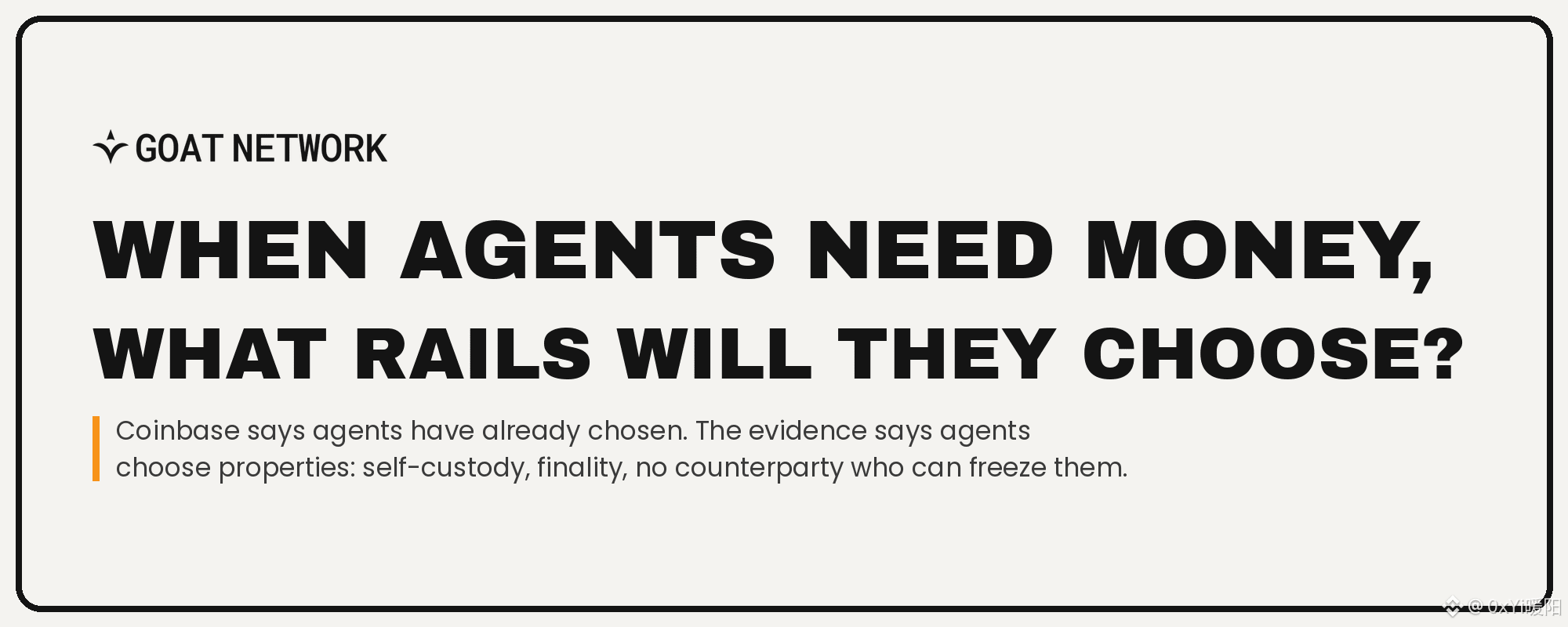
🔥 Proxy agent economics has been all the rage lately. It’s no longer new that AI agents can do the work themselves and even pay for services themselves. Coinbase’s x402 protocol, running on the Base chain, is the most eye-catching—it’s designed specifically so these agents can automatically complete small payments. The transaction volume looks pretty big, and many people are already shouting, “Agent economy is here!”
🧐 But if you look more closely at the data, it feels a bit inflated. Independent reports dug up from Visa, Artemis, and others show that the share of volume generated by spam, testing, and incentive farming isn’t low. The real, genuinely active day-to-day transaction volume is generally more modest. Once incentives stop, activity drops quickly. There’s definitely a lot of noise—but solid demand is still on the way.
Against this backdrop, @GOATNetwork has pushed a different view from the mainstream.
Coinbase says that agents choose them when payments are required. GOAT Network thinks that’s a bit premature: a lot of current data is stacked up, not truly reflecting the choices agents would make. When agents actually get to choose for themselves, what they care about most is whether they can retain control, whether transactions can be finalized end-to-end, and whether someone might be able to block them midstream. Bitcoin Policy’s experiments also back this up—among a bunch of top models, Bitcoin was selected the most, especially for value preservation.
✨ GOAT Network’s stance is straightforward: agents don’t recognize brands, only attributes. They’re taking a BTC-pegged approach themselves—money goes directly from the agent wallet to the merchant, with no intermediary handling, no custody.
💰 One more thing: GOAT Network has been bridge-testing BitVM3 for months, and now they’ve even opened a $5,000 bounty pool so everyone can look for vulnerabilities. The deadline is one month.
Brothers, go check it out now👇
https://www.goat.network/news/goat-bitvm3-bug-bounty-campaign
⭐️ In short, the agent economy looks lively right now, but real demand hasn’t fully taken off yet, and a lot of the data is mixed with water. GOAT Network isn’t chasing headlines or slogans—they’re directly focused on what agents truly care about: having the final say, getting paid settles the deal, and nobody being able to choke you off. Keep building the product to be more reliable—if the agent economy really goes in this direction, it’s definitely worth watching going forward.
LFGoat🚀
#GOATNetwork #x402 #AIAgents #BitVM3
1
255
·
--
🔥 The hottest thing in the AI space right now isn’t just plain chat anymore—it’s Agentic AI. These are intelligent agents that can do tasks on their own, make decisions, and even collaborate with each other. Big tech companies are all pushing it, and Gartner even predicts that by the end of this year, 40% of enterprise applications will have dedicated Agents built in. We’ve officially moved from “talking to AI” to “letting AI do things for you.”
Right on this wave, @GOATNetwork has been focusing heavily on AI Agents lately, while continuing to refine things technically.
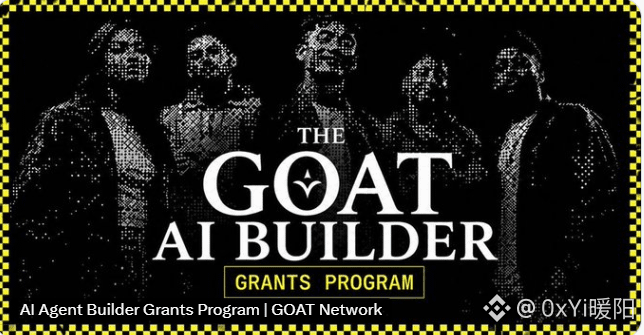
🔶 The most eye-catching part is GOAT Network’s AI Builder Grant Program. It clearly states the directions they want to support: Agents that can truly sell services, an Agent-to-Agent collaborative supply chain, machines opening shops as merchants, selling “proof” as a product, and helping Agents build identities and reputations.
The program starts with a $2,000 grant. If you already have real revenue or usage, the maximum can reach $1,000,000. The attitude is: don’t just share PPTs—ideally bring transaction receipts. They’re looking for projects that can actually run and make money.
🔶 Also, GOAT Network is running the second cohort of their Summer Training Camp mentor workshop. Their CMO personally came out to talk about marketing. The gist is that AI has driven the cost of writing code so low that what really holds people back now is how to attract attention and how to acquire customers. They also freely handed out two PDF files: one is an AI marketing playbook, and the other is a growth cheat sheet—helping early projects move from demo to the point where someone is willing to pay.
🔶 Technically, they briefly mentioned that BitVM3 will be launched first in a way that matches the current state of Bitcoin. The team is also optimizing its own zkVM.
⭐️ Overall, GOAT Network is continuing to polish the underlying layer, while externally focusing on how to make Agents truly able to transact and earn money. They want to turn the platform into infrastructure for the Agent economy—not just something that stays at the concept level. The official AI Builder grant application page is open; if you’re interested, you can go check it out.
Application link: https://www.goat.network/builder-program?nocache
#GOATNetwork #AI #AIAgents #BitVM3
181
Log in to explore more content
Join global crypto users on Binance Square
⚡️ Get latest and useful information about crypto.
💬 Trusted by the world’s largest crypto exchange.
👍 Discover real insights from verified creators.
Email / Phone number