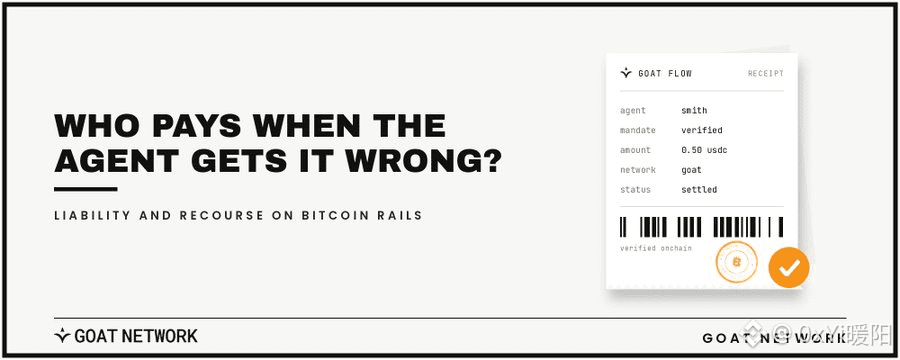
Recently, banks have made it clear: AI has already started placing orders and paying on someone’s behalf—but if the purchase is wrong, the current payment systems can’t correctly match responsibility. A person might click the wrong thing and still know who to argue with; an agent completes the deal within its budget—yet the user never confirmed at the time, and the merchant can’t produce any proof of intent at that moment. The money is paid, but the books can’t explain it. After the fact, refunds rely on memory and logs; that’s where things stop working.
@GOATNetwork is aiming to fix exactly this. It isn’t just adding another layer of customer support—it embeds evidence, identity, authorization, and settlement for the whole aftercare process directly into the act of payment.
Every GOAT Flow leaves an on-chain receipt: what was authorized at the time, what the agent did, who received the payment, and when settlement occurred. If something goes wrong, you check the record—you don’t have to reconstruct everything later.
Agents also have on-chain identity and a track record. When paying, they will indicate who they are. If they can be identified and verified, responsibility can actually be pinned down. The user’s budget and boundaries are written into rules first, and before any money moves, it’s verified whether the agent is acting within authority.
Even the closing of the case follows the rules. It’s not a hard rollback of the original transaction. You can escrow first, verify, then release funds. If you need a refund, you do it through another receipt-backed payment. Settlement lands on Bitcoin, so the ledger can’t be changed; what’s truly used to resolve things is the agreement written in advance.
This is crucial for agents. If a person gets scammed, they can still call and pressure someone. Agents don’t have that luxury—what they can rely on are the identity, permissions, receipts, and rules written into the workflow. When banks ask, “If the agent bought the wrong thing, who should pay?”, GOAT Network’s answer is straightforward: evidence points to whoever, and that party is responsible. The key is that the evidence exists from the start, not something added later.
This system is already running now. Merchants can do business with agents this way, and teams that handle identity, escrow, and verification can also plug in. What GOAT Network wants to say isn’t to add yet another set of principles—it’s that responsibility must be written into the payment itself, or the whole thing won’t hold up.
#GOATNetwork #GOATFlow #BTC #AI #AIAgents
@GOATNetwork is aiming to fix exactly this. It isn’t just adding another layer of customer support—it embeds evidence, identity, authorization, and settlement for the whole aftercare process directly into the act of payment.
Every GOAT Flow leaves an on-chain receipt: what was authorized at the time, what the agent did, who received the payment, and when settlement occurred. If something goes wrong, you check the record—you don’t have to reconstruct everything later.
Agents also have on-chain identity and a track record. When paying, they will indicate who they are. If they can be identified and verified, responsibility can actually be pinned down. The user’s budget and boundaries are written into rules first, and before any money moves, it’s verified whether the agent is acting within authority.
Even the closing of the case follows the rules. It’s not a hard rollback of the original transaction. You can escrow first, verify, then release funds. If you need a refund, you do it through another receipt-backed payment. Settlement lands on Bitcoin, so the ledger can’t be changed; what’s truly used to resolve things is the agreement written in advance.
This is crucial for agents. If a person gets scammed, they can still call and pressure someone. Agents don’t have that luxury—what they can rely on are the identity, permissions, receipts, and rules written into the workflow. When banks ask, “If the agent bought the wrong thing, who should pay?”, GOAT Network’s answer is straightforward: evidence points to whoever, and that party is responsible. The key is that the evidence exists from the start, not something added later.
This system is already running now. Merchants can do business with agents this way, and teams that handle identity, escrow, and verification can also plug in. What GOAT Network wants to say isn’t to add yet another set of principles—it’s that responsibility must be written into the payment itself, or the whole thing won’t hold up.
#GOATNetwork #GOATFlow #BTC #AI #AIAgents