
#bitvm3
bitvm3
1,772 views
14 Discussing
Hot
Latest

·
--
Partly True
At first I assumed the off-chain cost of BitVM3 vaults was mostly a storage problem. 43GB per garbled circuit, generated for every counterparty, sounded like the kind of thing that just gets more expensive as usage grows. But the more I looked, the amortization model caught my attention. Circuits aren't generated per deposit. They're generated once per counterparty, because a failed challenge removes that party from the system entirely — an operator who loses a challenge is disqualified from future withdrawals, a challenger who loses forfeits the right to challenge again. So the cost curve flattens naturally, but only because the penalty for cheating is permanent exclusion, not a fine or a slashing event you can recover from. That's a strong assumption to build scaling around. It works cleanly in a two-party lending pair. It's less obvious how it holds once you're amortizing across whitelisted liquidators, large lenders, and rotating operator sets, where "permanently excluded" starts needing its own coordination layer. Maybe that's simply the cost of making the off-chain side cheap. So the real question isn't whether the storage cost falls. It's who tracks exclusion, and how.
#bitcoin #BitVM3 #DeFi $BABY @babylonlabs_io #baby $BTC
@bitcoin #BTC
{spot}(BTCUSDT)
{spot}(BABYUSDT)
At first I assumed the off-chain cost of BitVM3 vaults was mostly a storage problem. 43GB per garbled circuit, generated for every counterparty, sounded like the kind of thing that just gets more expensive as usage grows. But the more I looked, the amortization model caught my attention. Circuits aren't generated per deposit. They're generated once per counterparty, because a failed challenge removes that party from the system entirely — an operator who loses a challenge is disqualified from future withdrawals, a challenger who loses forfeits the right to challenge again. So the cost curve flattens naturally, but only because the penalty for cheating is permanent exclusion, not a fine or a slashing event you can recover from. That's a strong assumption to build scaling around. It works cleanly in a two-party lending pair. It's less obvious how it holds once you're amortizing across whitelisted liquidators, large lenders, and rotating operator sets, where "permanently excluded" starts needing its own coordination layer. Maybe that's simply the cost of making the off-chain side cheap. So the real question isn't whether the storage cost falls. It's who tracks exclusion, and how.
#bitcoin #BitVM3 #DeFi $BABY @BabylonLabs_io #baby $BTC
@Bitcoin #BTC
#bitcoin #BitVM3 #DeFi $BABY @BabylonLabs_io #baby $BTC
@Bitcoin #BTC
20
46
213

·
--
Bearish
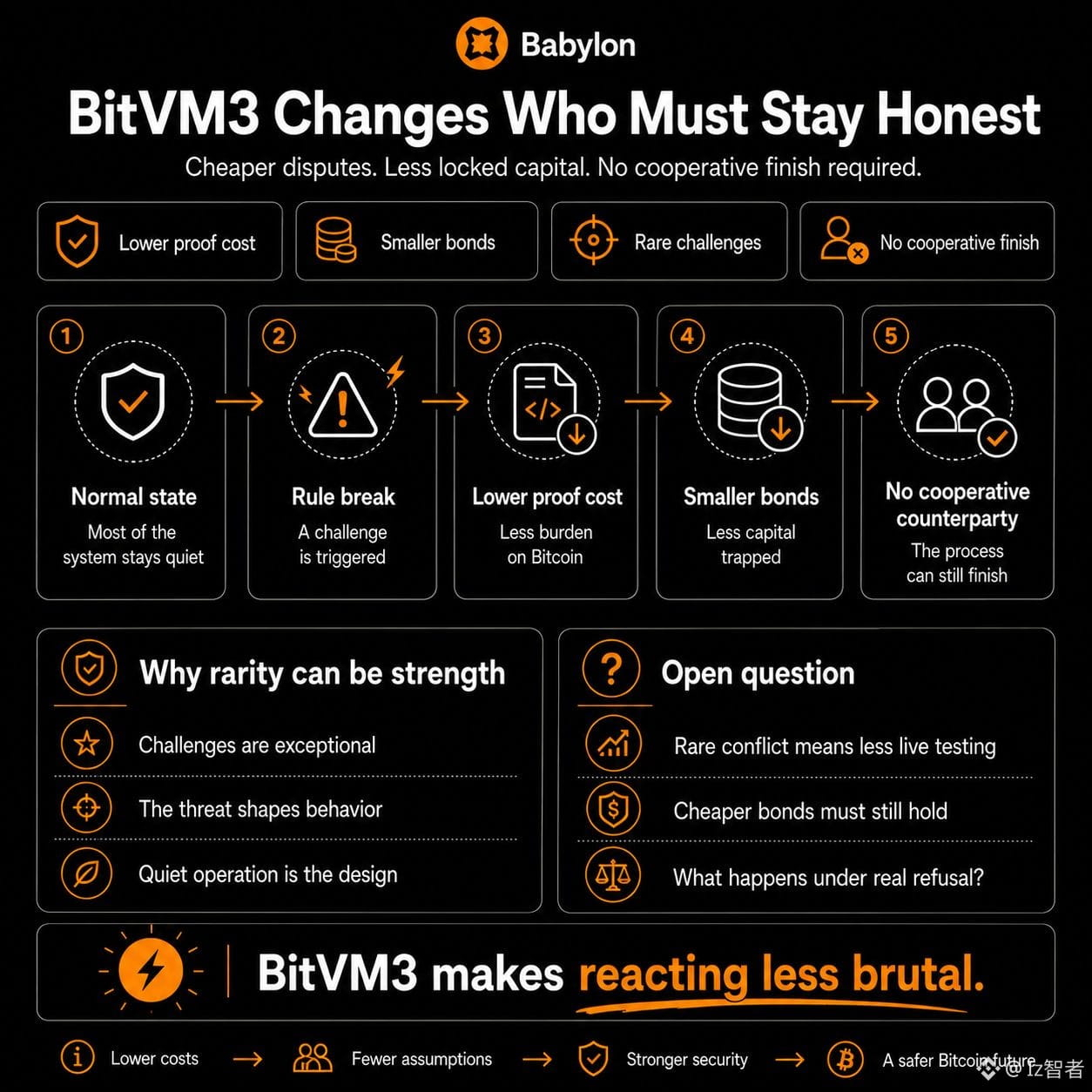
Most people in BitVM3 debates focus on one improvement - you save on proof costs! At least, that's what I initially believed when I first started thinking about it. After seeing more and more about how @babylonlabs_io is architected, I started to see the impact is more than just economics; it's behavioral too.
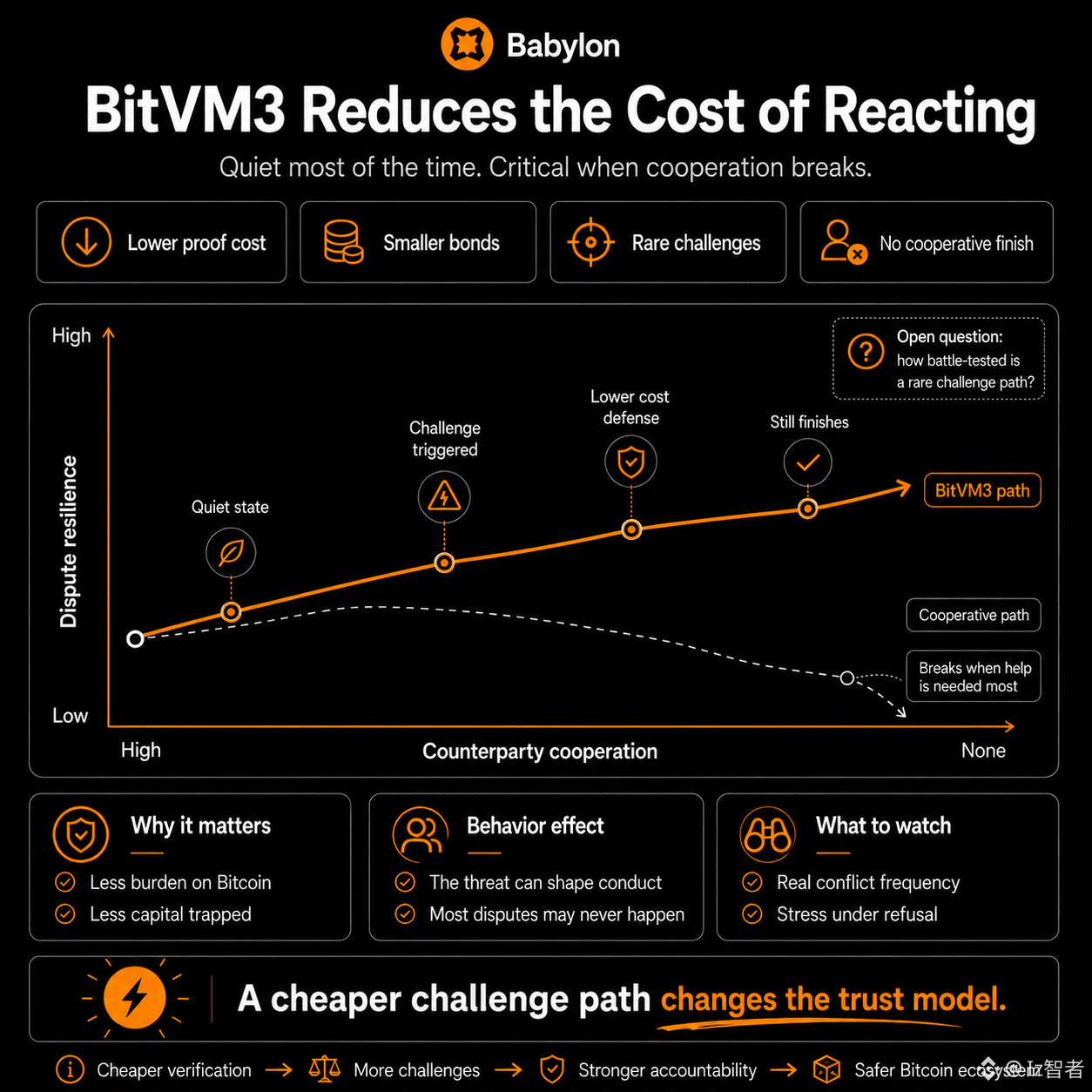
When it becomes less expensive to prove you've been cheated on, it also becomes cheaper to challenge dishonest people and bad actors - a shift in incentive throughout the system. It's less secure because verification is efficient and more secure because challenging the current truth has become less of an economic burden, and this became my sticking point.
These lower costs on proof don't just save on compute. It saves on accountability, costs! You save on friction between accountability.
A more healthy system: A security model where the honest guys can actually take action without collateralizing their assets, and less so a model where you essentially have to mortgage your house on orders to contest the current truth.
You still have risk, this isn't saying that BitVM3 doesn't need cryptographic assumptions and to be built properly; etc., etc. You also can't test it in real world under an attack; but hey, you could argue that that makes sense. That puts another big question to everyone - is verification more security boosting than a rise in costs for you to attack? Babydoge 🐶
$BABY $ESPORTS $LAB
{future}(BABYUSDT)
#baby #bitcoin #BitVM3 #blockchain #Research #BinanceSquare
Most people in BitVM3 debates focus on one improvement - you save on proof costs! At least, that's what I initially believed when I first started thinking about it. After seeing more and more about how @BabylonLabs_io is architected, I started to see the impact is more than just economics; it's behavioral too.
When it becomes less expensive to prove you've been cheated on, it also becomes cheaper to challenge dishonest people and bad actors - a shift in incentive throughout the system. It's less secure because verification is efficient and more secure because challenging the current truth has become less of an economic burden, and this became my sticking point.
These lower costs on proof don't just save on compute. It saves on accountability, costs! You save on friction between accountability.
A more healthy system: A security model where the honest guys can actually take action without collateralizing their assets, and less so a model where you essentially have to mortgage your house on orders to contest the current truth.
You still have risk, this isn't saying that BitVM3 doesn't need cryptographic assumptions and to be built properly; etc., etc. You also can't test it in real world under an attack; but hey, you could argue that that makes sense. That puts another big question to everyone - is verification more security boosting than a rise in costs for you to attack? Babydoge 🐶
$BABY $ESPORTS $LAB
#baby #bitcoin #BitVM3 #blockchain #Research #BinanceSquare
When it becomes less expensive to prove you've been cheated on, it also becomes cheaper to challenge dishonest people and bad actors - a shift in incentive throughout the system. It's less secure because verification is efficient and more secure because challenging the current truth has become less of an economic burden, and this became my sticking point.
These lower costs on proof don't just save on compute. It saves on accountability, costs! You save on friction between accountability.
A more healthy system: A security model where the honest guys can actually take action without collateralizing their assets, and less so a model where you essentially have to mortgage your house on orders to contest the current truth.
You still have risk, this isn't saying that BitVM3 doesn't need cryptographic assumptions and to be built properly; etc., etc. You also can't test it in real world under an attack; but hey, you could argue that that makes sense. That puts another big question to everyone - is verification more security boosting than a rise in costs for you to attack? Babydoge 🐶
$BABY $ESPORTS $LAB
#baby #bitcoin #BitVM3 #blockchain #Research #BinanceSquare
3
3
288

·
--
🔥 Proxy agent economics has been all the rage lately. It’s no longer new that AI agents can do the work themselves and even pay for services themselves. Coinbase’s x402 protocol, running on the Base chain, is the most eye-catching—it’s designed specifically so these agents can automatically complete small payments. The transaction volume looks pretty big, and many people are already shouting, “Agent economy is here!”
🧐 But if you look more closely at the data, it feels a bit inflated. Independent reports dug up from Visa, Artemis, and others show that the share of volume generated by spam, testing, and incentive farming isn’t low. The real, genuinely active day-to-day transaction volume is generally more modest. Once incentives stop, activity drops quickly. There’s definitely a lot of noise—but solid demand is still on the way.
Against this backdrop, @GOATNetwork has pushed a different view from the mainstream.
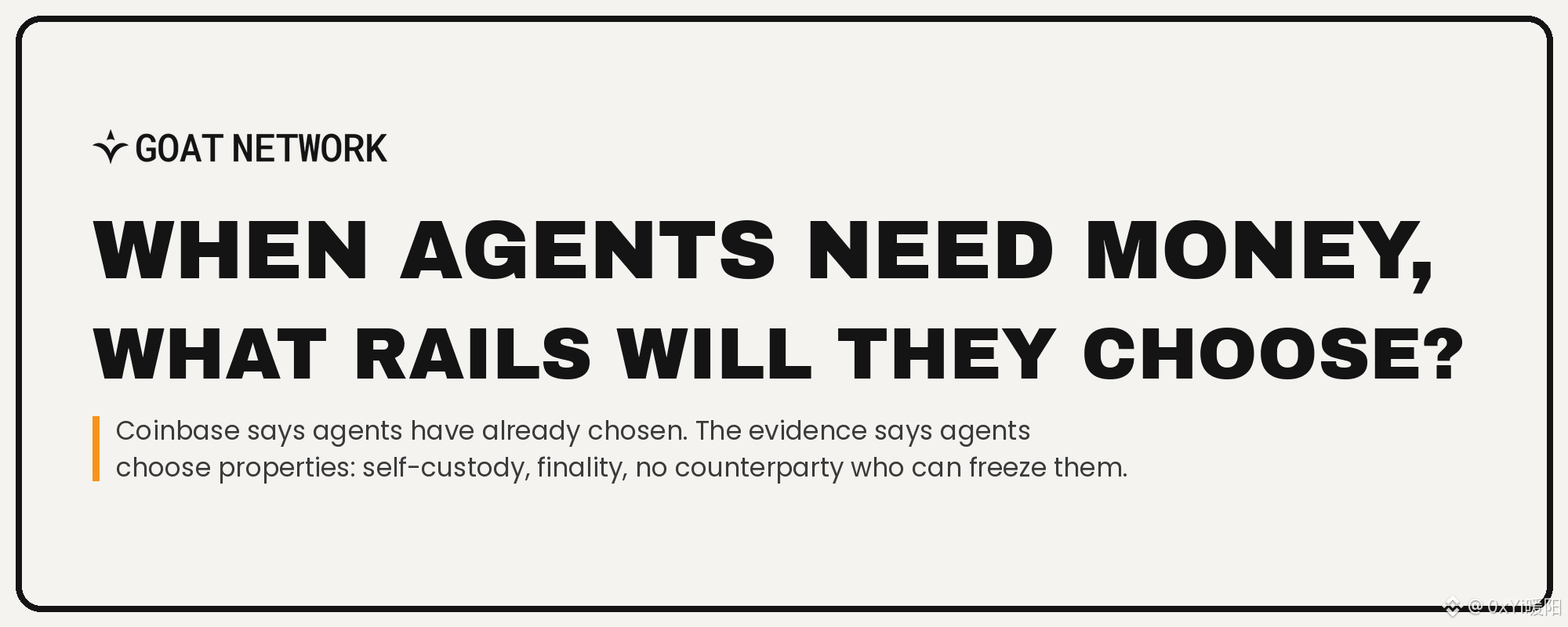
Coinbase says that agents choose them when payments are required. GOAT Network thinks that’s a bit premature: a lot of current data is stacked up, not truly reflecting the choices agents would make. When agents actually get to choose for themselves, what they care about most is whether they can retain control, whether transactions can be finalized end-to-end, and whether someone might be able to block them midstream. Bitcoin Policy’s experiments also back this up—among a bunch of top models, Bitcoin was selected the most, especially for value preservation.
✨ GOAT Network’s stance is straightforward: agents don’t recognize brands, only attributes. They’re taking a BTC-pegged approach themselves—money goes directly from the agent wallet to the merchant, with no intermediary handling, no custody.
💰 One more thing: GOAT Network has been bridge-testing BitVM3 for months, and now they’ve even opened a $5,000 bounty pool so everyone can look for vulnerabilities. The deadline is one month.
Brothers, go check it out now👇
https://www.goat.network/news/goat-bitvm3-bug-bounty-campaign
⭐️ In short, the agent economy looks lively right now, but real demand hasn’t fully taken off yet, and a lot of the data is mixed with water. GOAT Network isn’t chasing headlines or slogans—they’re directly focused on what agents truly care about: having the final say, getting paid settles the deal, and nobody being able to choke you off. Keep building the product to be more reliable—if the agent economy really goes in this direction, it’s definitely worth watching going forward.
LFGoat🚀
#GOATNetwork #x402 #AIAgents #BitVM3
🔥 Proxy agent economics has been all the rage lately. It’s no longer new that AI agents can do the work themselves and even pay for services themselves. Coinbase’s x402 protocol, running on the Base chain, is the most eye-catching—it’s designed specifically so these agents can automatically complete small payments. The transaction volume looks pretty big, and many people are already shouting, “Agent economy is here!”
🧐 But if you look more closely at the data, it feels a bit inflated. Independent reports dug up from Visa, Artemis, and others show that the share of volume generated by spam, testing, and incentive farming isn’t low. The real, genuinely active day-to-day transaction volume is generally more modest. Once incentives stop, activity drops quickly. There’s definitely a lot of noise—but solid demand is still on the way.
Against this backdrop, @GOATNetwork has pushed a different view from the mainstream.
Coinbase says that agents choose them when payments are required. GOAT Network thinks that’s a bit premature: a lot of current data is stacked up, not truly reflecting the choices agents would make. When agents actually get to choose for themselves, what they care about most is whether they can retain control, whether transactions can be finalized end-to-end, and whether someone might be able to block them midstream. Bitcoin Policy’s experiments also back this up—among a bunch of top models, Bitcoin was selected the most, especially for value preservation.
✨ GOAT Network’s stance is straightforward: agents don’t recognize brands, only attributes. They’re taking a BTC-pegged approach themselves—money goes directly from the agent wallet to the merchant, with no intermediary handling, no custody.
💰 One more thing: GOAT Network has been bridge-testing BitVM3 for months, and now they’ve even opened a $5,000 bounty pool so everyone can look for vulnerabilities. The deadline is one month.
Brothers, go check it out now👇
https://www.goat.network/news/goat-bitvm3-bug-bounty-campaign
⭐️ In short, the agent economy looks lively right now, but real demand hasn’t fully taken off yet, and a lot of the data is mixed with water. GOAT Network isn’t chasing headlines or slogans—they’re directly focused on what agents truly care about: having the final say, getting paid settles the deal, and nobody being able to choke you off. Keep building the product to be more reliable—if the agent economy really goes in this direction, it’s definitely worth watching going forward.
LFGoat🚀
#GOATNetwork #x402 #AIAgents #BitVM3
🧐 But if you look more closely at the data, it feels a bit inflated. Independent reports dug up from Visa, Artemis, and others show that the share of volume generated by spam, testing, and incentive farming isn’t low. The real, genuinely active day-to-day transaction volume is generally more modest. Once incentives stop, activity drops quickly. There’s definitely a lot of noise—but solid demand is still on the way.
Against this backdrop, @GOATNetwork has pushed a different view from the mainstream.
Coinbase says that agents choose them when payments are required. GOAT Network thinks that’s a bit premature: a lot of current data is stacked up, not truly reflecting the choices agents would make. When agents actually get to choose for themselves, what they care about most is whether they can retain control, whether transactions can be finalized end-to-end, and whether someone might be able to block them midstream. Bitcoin Policy’s experiments also back this up—among a bunch of top models, Bitcoin was selected the most, especially for value preservation.
✨ GOAT Network’s stance is straightforward: agents don’t recognize brands, only attributes. They’re taking a BTC-pegged approach themselves—money goes directly from the agent wallet to the merchant, with no intermediary handling, no custody.
💰 One more thing: GOAT Network has been bridge-testing BitVM3 for months, and now they’ve even opened a $5,000 bounty pool so everyone can look for vulnerabilities. The deadline is one month.
Brothers, go check it out now👇
https://www.goat.network/news/goat-bitvm3-bug-bounty-campaign
⭐️ In short, the agent economy looks lively right now, but real demand hasn’t fully taken off yet, and a lot of the data is mixed with water. GOAT Network isn’t chasing headlines or slogans—they’re directly focused on what agents truly care about: having the final say, getting paid settles the deal, and nobody being able to choke you off. Keep building the product to be more reliable—if the agent economy really goes in this direction, it’s definitely worth watching going forward.
LFGoat🚀
#GOATNetwork #x402 #AIAgents #BitVM3
1
242
·
--
🔥 The hottest thing in the AI space right now isn’t just plain chat anymore—it’s Agentic AI. These are intelligent agents that can do tasks on their own, make decisions, and even collaborate with each other. Big tech companies are all pushing it, and Gartner even predicts that by the end of this year, 40% of enterprise applications will have dedicated Agents built in. We’ve officially moved from “talking to AI” to “letting AI do things for you.”
Right on this wave, @GOATNetwork has been focusing heavily on AI Agents lately, while continuing to refine things technically.
🔶 The most eye-catching part is GOAT Network’s AI Builder Grant Program. It clearly states the directions they want to support: Agents that can truly sell services, an Agent-to-Agent collaborative supply chain, machines opening shops as merchants, selling “proof” as a product, and helping Agents build identities and reputations.
The program starts with a $2,000 grant. If you already have real revenue or usage, the maximum can reach $1,000,000. The attitude is: don’t just share PPTs—ideally bring transaction receipts. They’re looking for projects that can actually run and make money.
🔶 Also, GOAT Network is running the second cohort of their Summer Training Camp mentor workshop. Their CMO personally came out to talk about marketing. The gist is that AI has driven the cost of writing code so low that what really holds people back now is how to attract attention and how to acquire customers. They also freely handed out two PDF files: one is an AI marketing playbook, and the other is a growth cheat sheet—helping early projects move from demo to the point where someone is willing to pay.
🔶 Technically, they briefly mentioned that BitVM3 will be launched first in a way that matches the current state of Bitcoin. The team is also optimizing its own zkVM.
⭐️ Overall, GOAT Network is continuing to polish the underlying layer, while externally focusing on how to make Agents truly able to transact and earn money. They want to turn the platform into infrastructure for the Agent economy—not just something that stays at the concept level. The official AI Builder grant application page is open; if you’re interested, you can go check it out.
Application link: https://www.goat.network/builder-program?nocache
#GOATNetwork #AI #AIAgents #BitVM3
🔥 The hottest thing in the AI space right now isn’t just plain chat anymore—it’s Agentic AI. These are intelligent agents that can do tasks on their own, make decisions, and even collaborate with each other. Big tech companies are all pushing it, and Gartner even predicts that by the end of this year, 40% of enterprise applications will have dedicated Agents built in. We’ve officially moved from “talking to AI” to “letting AI do things for you.”
Right on this wave, @GOATNetwork has been focusing heavily on AI Agents lately, while continuing to refine things technically.
🔶 The most eye-catching part is GOAT Network’s AI Builder Grant Program. It clearly states the directions they want to support: Agents that can truly sell services, an Agent-to-Agent collaborative supply chain, machines opening shops as merchants, selling “proof” as a product, and helping Agents build identities and reputations.
The program starts with a $2,000 grant. If you already have real revenue or usage, the maximum can reach $1,000,000. The attitude is: don’t just share PPTs—ideally bring transaction receipts. They’re looking for projects that can actually run and make money.
🔶 Also, GOAT Network is running the second cohort of their Summer Training Camp mentor workshop. Their CMO personally came out to talk about marketing. The gist is that AI has driven the cost of writing code so low that what really holds people back now is how to attract attention and how to acquire customers. They also freely handed out two PDF files: one is an AI marketing playbook, and the other is a growth cheat sheet—helping early projects move from demo to the point where someone is willing to pay.
🔶 Technically, they briefly mentioned that BitVM3 will be launched first in a way that matches the current state of Bitcoin. The team is also optimizing its own zkVM.
⭐️ Overall, GOAT Network is continuing to polish the underlying layer, while externally focusing on how to make Agents truly able to transact and earn money. They want to turn the platform into infrastructure for the Agent economy—not just something that stays at the concept level. The official AI Builder grant application page is open; if you’re interested, you can go check it out.
Application link: https://www.goat.network/builder-program?nocache
#GOATNetwork #AI #AIAgents #BitVM3
Right on this wave, @GOATNetwork has been focusing heavily on AI Agents lately, while continuing to refine things technically.
🔶 The most eye-catching part is GOAT Network’s AI Builder Grant Program. It clearly states the directions they want to support: Agents that can truly sell services, an Agent-to-Agent collaborative supply chain, machines opening shops as merchants, selling “proof” as a product, and helping Agents build identities and reputations.
The program starts with a $2,000 grant. If you already have real revenue or usage, the maximum can reach $1,000,000. The attitude is: don’t just share PPTs—ideally bring transaction receipts. They’re looking for projects that can actually run and make money.
🔶 Also, GOAT Network is running the second cohort of their Summer Training Camp mentor workshop. Their CMO personally came out to talk about marketing. The gist is that AI has driven the cost of writing code so low that what really holds people back now is how to attract attention and how to acquire customers. They also freely handed out two PDF files: one is an AI marketing playbook, and the other is a growth cheat sheet—helping early projects move from demo to the point where someone is willing to pay.
🔶 Technically, they briefly mentioned that BitVM3 will be launched first in a way that matches the current state of Bitcoin. The team is also optimizing its own zkVM.
⭐️ Overall, GOAT Network is continuing to polish the underlying layer, while externally focusing on how to make Agents truly able to transact and earn money. They want to turn the platform into infrastructure for the Agent economy—not just something that stays at the concept level. The official AI Builder grant application page is open; if you’re interested, you can go check it out.
Application link: https://www.goat.network/builder-program?nocache
#GOATNetwork #AI #AIAgents #BitVM3

163
·
--
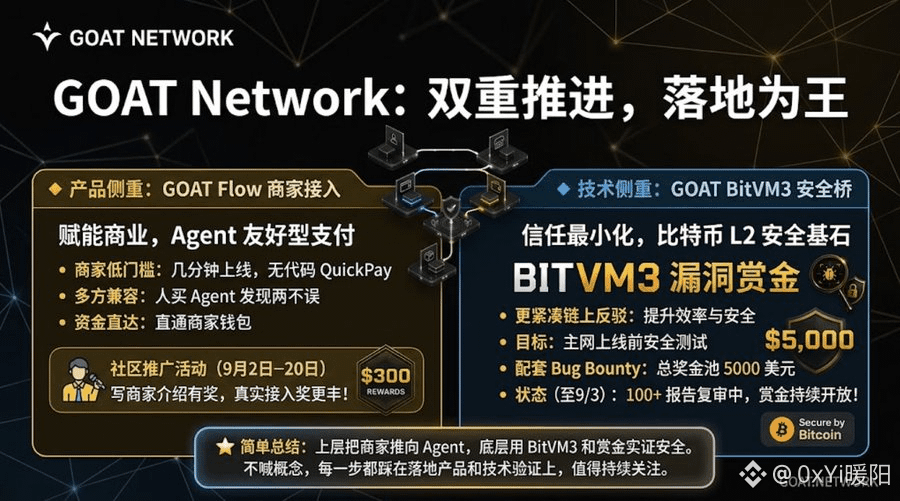
AI Agents are already starting to find products and pay on their own, and what merchants lack is a payment channel that can be discovered by machines and send money directly to a wallet. @GOATNetwork has recently been pushing this hard, while also advancing the security of Bitcoin at the base layer.
🔶The product focus is GOAT Flow.
It keeps the onboarding barrier for merchants very low: with QuickPay, basically no coding is needed, and you can go live in minutes. The product and payment page can simultaneously let people buy, and also let AI Agents discover and pay, with funds going directly to the merchant's wallet.
To bring real businesses on board, they also launched a community promotion campaign (Sep 2–20): write original introductions for real merchants, and quality content earns a small reward; if the merchant actually integrates, there is an even higher-tier reward.
🔶The technical focus is GOAT BitVM3.
This is a trust-minimized bridge connecting Bitcoin and the GOAT network: disputes try to avoid full verification on Bitcoin script, instead settling through more compact on-chain refutations, with the goal of strengthening security before mainnet launch.
The accompanying BitVM3 Bug Bounty has a total prize pool of $5,000, with rewards based on severity and reproducibility.
The campaign started around August 18 and lasts one month.
By September 3, the first batch had already received more than 100 reports. The team is in final review, and the exact number, discovery categories, and this round's prize breakdown have not yet been announced; the bounty is still open, and people in security, cryptography, and smart contracts can continue submitting.
🔶In addition, they also released a plain-language explanation of SHRINCS, a post-quantum Bitcoin signature scheme, as a research-oriented supplement.
⭐️Simple summary: at the application layer, they are genuinely pushing merchant payments toward Agents; at the infrastructure layer, they are using BitVM3 and a public bounty to expose the security of the Bitcoin bridge to community scrutiny. GOAT Network is not just talking about concepts—it is grounding every step in live products and technical validation, and it is worth continuing to watch.
LFGoat 🚀
#GOATNetwork #GOATFlow #BitVM3 #AI #AIAgents
AI Agents are already starting to find products and pay on their own, and what merchants lack is a payment channel that can be discovered by machines and send money directly to a wallet. @GOATNetwork has recently been pushing this hard, while also advancing the security of Bitcoin at the base layer.
🔶The product focus is GOAT Flow.
It keeps the onboarding barrier for merchants very low: with QuickPay, basically no coding is needed, and you can go live in minutes. The product and payment page can simultaneously let people buy, and also let AI Agents discover and pay, with funds going directly to the merchant's wallet.
To bring real businesses on board, they also launched a community promotion campaign (Sep 2–20): write original introductions for real merchants, and quality content earns a small reward; if the merchant actually integrates, there is an even higher-tier reward.
🔶The technical focus is GOAT BitVM3.
This is a trust-minimized bridge connecting Bitcoin and the GOAT network: disputes try to avoid full verification on Bitcoin script, instead settling through more compact on-chain refutations, with the goal of strengthening security before mainnet launch.
The accompanying BitVM3 Bug Bounty has a total prize pool of $5,000, with rewards based on severity and reproducibility.
The campaign started around August 18 and lasts one month.
By September 3, the first batch had already received more than 100 reports. The team is in final review, and the exact number, discovery categories, and this round's prize breakdown have not yet been announced; the bounty is still open, and people in security, cryptography, and smart contracts can continue submitting.
🔶In addition, they also released a plain-language explanation of SHRINCS, a post-quantum Bitcoin signature scheme, as a research-oriented supplement.
⭐️Simple summary: at the application layer, they are genuinely pushing merchant payments toward Agents; at the infrastructure layer, they are using BitVM3 and a public bounty to expose the security of the Bitcoin bridge to community scrutiny. GOAT Network is not just talking about concepts—it is grounding every step in live products and technical validation, and it is worth continuing to watch.
LFGoat 🚀
#GOATNetwork #GOATFlow #BitVM3 #AI #AIAgents
🔶The product focus is GOAT Flow.
It keeps the onboarding barrier for merchants very low: with QuickPay, basically no coding is needed, and you can go live in minutes. The product and payment page can simultaneously let people buy, and also let AI Agents discover and pay, with funds going directly to the merchant's wallet.
To bring real businesses on board, they also launched a community promotion campaign (Sep 2–20): write original introductions for real merchants, and quality content earns a small reward; if the merchant actually integrates, there is an even higher-tier reward.
🔶The technical focus is GOAT BitVM3.
This is a trust-minimized bridge connecting Bitcoin and the GOAT network: disputes try to avoid full verification on Bitcoin script, instead settling through more compact on-chain refutations, with the goal of strengthening security before mainnet launch.
The accompanying BitVM3 Bug Bounty has a total prize pool of $5,000, with rewards based on severity and reproducibility.
The campaign started around August 18 and lasts one month.
By September 3, the first batch had already received more than 100 reports. The team is in final review, and the exact number, discovery categories, and this round's prize breakdown have not yet been announced; the bounty is still open, and people in security, cryptography, and smart contracts can continue submitting.
🔶In addition, they also released a plain-language explanation of SHRINCS, a post-quantum Bitcoin signature scheme, as a research-oriented supplement.
⭐️Simple summary: at the application layer, they are genuinely pushing merchant payments toward Agents; at the infrastructure layer, they are using BitVM3 and a public bounty to expose the security of the Bitcoin bridge to community scrutiny. GOAT Network is not just talking about concepts—it is grounding every step in live products and technical validation, and it is worth continuing to watch.
LFGoat 🚀
#GOATNetwork #GOATFlow #BitVM3 #AI #AIAgents
180
·
--
On the eve of the “Golden Nine, Silver Ten” season, today we officially enter September. Let’s see what GOAT Network did in August. The core idea is simple: they took the concept of “using AI to help people buy things and pay,” and turned it into a product that merchants can use directly.
🤖 Now AI is no longer just for chatting or writing code. Many people are starting to have AI help them compare prices, book hotels, shop, and even pay. The problem is that most checkout pages today are built for humans—forms to fill in, cards to select, and a confirmation button to click. AI robots can’t use them.
✨ GOAT Flow is designed to solve this pain point. Merchants don’t need to write code. They can connect it in a few minutes. After that, whether real people buy or AI agents buy, payment is supported. It supports bank cards via Stripe, and also supports cryptocurrencies—funds are sent directly from the buyer’s wallet to the merchant’s wallet. Only once the money arrives will the order be confirmed. GOAT itself doesn’t handle funds; it only verifies details and issues receipts.
@GOATNetwork has also expanded this payment capability to 10 chains. An AI agent can pay from whichever chain it has funds on.
💫 At the same time, they’re working on deeper, foundational improvements: making security stronger. BitVM3 has opened public bounties to invite outsiders to find issues; the signatures from verification nodes are starting to migrate toward a post-quantum direction. In other words, they believe that in the future, transactions between AI agents will grow in volume and speed, and settlement needs to be anchored on the most stable base—so they chose #BTC.
⭐️ As AI gets better at handling tasks on its own, the next step is “spending money on its own.” Whoever first makes receiving payments simple and reliable will be the first to benefit from this wave. What GOAT Network is doing now is paving the way for ordinary merchants: no need to understand AI, and no need to understand chains— you can do business with these “money-spending robots” anyway.
LFGoat 🚀
#GOATNetwork #GOATFlow #BitVM3 #AI #AIAgents
On the eve of the “Golden Nine, Silver Ten” season, today we officially enter September. Let’s see what GOAT Network did in August. The core idea is simple: they took the concept of “using AI to help people buy things and pay,” and turned it into a product that merchants can use directly.
🤖 Now AI is no longer just for chatting or writing code. Many people are starting to have AI help them compare prices, book hotels, shop, and even pay. The problem is that most checkout pages today are built for humans—forms to fill in, cards to select, and a confirmation button to click. AI robots can’t use them.
✨ GOAT Flow is designed to solve this pain point. Merchants don’t need to write code. They can connect it in a few minutes. After that, whether real people buy or AI agents buy, payment is supported. It supports bank cards via Stripe, and also supports cryptocurrencies—funds are sent directly from the buyer’s wallet to the merchant’s wallet. Only once the money arrives will the order be confirmed. GOAT itself doesn’t handle funds; it only verifies details and issues receipts.
@GOATNetwork has also expanded this payment capability to 10 chains. An AI agent can pay from whichever chain it has funds on.
💫 At the same time, they’re working on deeper, foundational improvements: making security stronger. BitVM3 has opened public bounties to invite outsiders to find issues; the signatures from verification nodes are starting to migrate toward a post-quantum direction. In other words, they believe that in the future, transactions between AI agents will grow in volume and speed, and settlement needs to be anchored on the most stable base—so they chose #BTC.
⭐️ As AI gets better at handling tasks on its own, the next step is “spending money on its own.” Whoever first makes receiving payments simple and reliable will be the first to benefit from this wave. What GOAT Network is doing now is paving the way for ordinary merchants: no need to understand AI, and no need to understand chains— you can do business with these “money-spending robots” anyway.
LFGoat 🚀
#GOATNetwork #GOATFlow #BitVM3 #AI #AIAgents
🤖 Now AI is no longer just for chatting or writing code. Many people are starting to have AI help them compare prices, book hotels, shop, and even pay. The problem is that most checkout pages today are built for humans—forms to fill in, cards to select, and a confirmation button to click. AI robots can’t use them.
✨ GOAT Flow is designed to solve this pain point. Merchants don’t need to write code. They can connect it in a few minutes. After that, whether real people buy or AI agents buy, payment is supported. It supports bank cards via Stripe, and also supports cryptocurrencies—funds are sent directly from the buyer’s wallet to the merchant’s wallet. Only once the money arrives will the order be confirmed. GOAT itself doesn’t handle funds; it only verifies details and issues receipts.
@GOATNetwork has also expanded this payment capability to 10 chains. An AI agent can pay from whichever chain it has funds on.
💫 At the same time, they’re working on deeper, foundational improvements: making security stronger. BitVM3 has opened public bounties to invite outsiders to find issues; the signatures from verification nodes are starting to migrate toward a post-quantum direction. In other words, they believe that in the future, transactions between AI agents will grow in volume and speed, and settlement needs to be anchored on the most stable base—so they chose #BTC.
⭐️ As AI gets better at handling tasks on its own, the next step is “spending money on its own.” Whoever first makes receiving payments simple and reliable will be the first to benefit from this wave. What GOAT Network is doing now is paving the way for ordinary merchants: no need to understand AI, and no need to understand chains— you can do business with these “money-spending robots” anyway.
LFGoat 🚀
#GOATNetwork #GOATFlow #BitVM3 #AI #AIAgents

270

·
--
🚨 $BABY 'S PENALTY ENGINE JUST WENT FROM SPECIALIST TO GENERALIST! 💥
🔍 Reading the BitVM3 and BABE materials side by side reveals a pivotal conceptual shift: the first era punished double-signing—a narrow, behavioral trap. The second solution doesn't hunt for contradiction; it compresses secrets into an obfuscated circuit and exposes any false claim on the spot. 💡 That's not a patch—it's a full architectural pivot from specialist to generalist enforcement.
📊 This is why lending, stablecoin minting, and perps now fit the same framework. It's not that use cases multiplied; the underlying penalty logic went from 'catching a specific signature conflict' to 'provably dismantling any verified lie.' 🌊 Smart money should watch this evolution far more closely than any single feature drop. 💬 As the net widens, does the risk surface scale proportionally? 👇
⚠️ Not financial advice. Always manage your risk. 🛡️
🏷️ #BABY #BitVM3 #Babylon #Crypto #Altcoins
🎯 🦈
🚨 $BABY 'S PENALTY ENGINE JUST WENT FROM SPECIALIST TO GENERALIST! 💥
🔍 Reading the BitVM3 and BABE materials side by side reveals a pivotal conceptual shift: the first era punished double-signing—a narrow, behavioral trap. The second solution doesn't hunt for contradiction; it compresses secrets into an obfuscated circuit and exposes any false claim on the spot. 💡 That's not a patch—it's a full architectural pivot from specialist to generalist enforcement.
📊 This is why lending, stablecoin minting, and perps now fit the same framework. It's not that use cases multiplied; the underlying penalty logic went from 'catching a specific signature conflict' to 'provably dismantling any verified lie.' 🌊 Smart money should watch this evolution far more closely than any single feature drop. 💬 As the net widens, does the risk surface scale proportionally? 👇
⚠️ Not financial advice. Always manage your risk. 🛡️
🏷️ #BABY #BitVM3 #Babylon #Crypto #Altcoins
🎯 🦈
🔍 Reading the BitVM3 and BABE materials side by side reveals a pivotal conceptual shift: the first era punished double-signing—a narrow, behavioral trap. The second solution doesn't hunt for contradiction; it compresses secrets into an obfuscated circuit and exposes any false claim on the spot. 💡 That's not a patch—it's a full architectural pivot from specialist to generalist enforcement.
📊 This is why lending, stablecoin minting, and perps now fit the same framework. It's not that use cases multiplied; the underlying penalty logic went from 'catching a specific signature conflict' to 'provably dismantling any verified lie.' 🌊 Smart money should watch this evolution far more closely than any single feature drop. 💬 As the net widens, does the risk surface scale proportionally? 👇
⚠️ Not financial advice. Always manage your risk. 🛡️
🏷️ #BABY #BitVM3 #Babylon #Crypto #Altcoins
🎯 🦈
27
·
--
Article
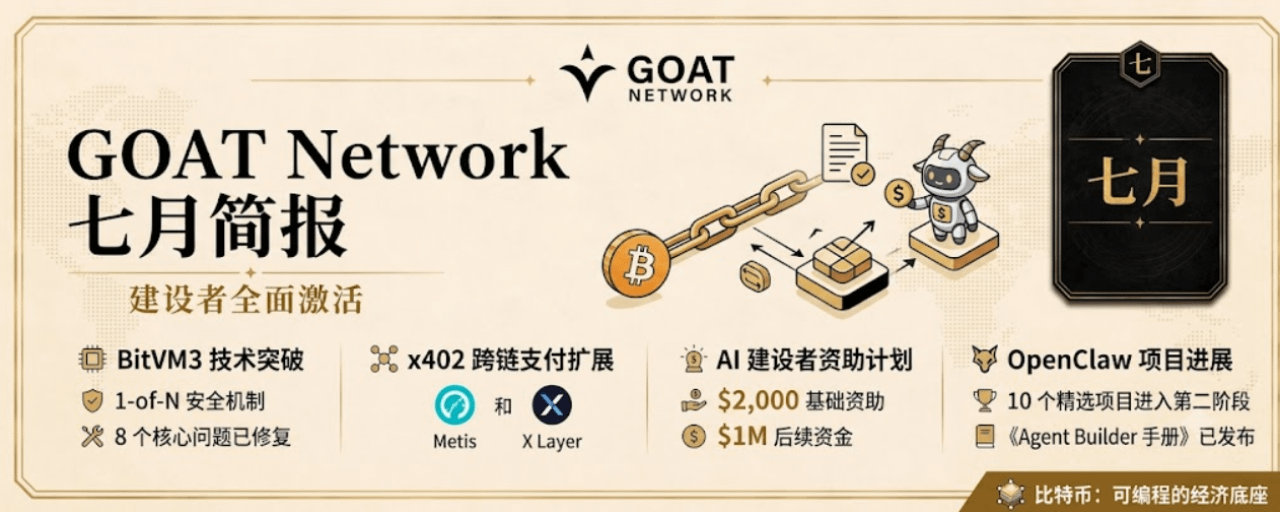
GOAT Network: A July Do-Work Checklist—Breakthroughs Across Tech, Payments, and the EcosystemI recently came across a few posts from @GOATNetwork, and it feels like they got a lot done in July.
✨Let’s be real: the GOAT Network has been working on something pretty interesting—trying to make Bitcoin stop just lying there as savings or being packaged into various DeFi products, and instead truly run smart contracts, enable cross-chain payments, and even let AI agents earn their own spending money. In the end, the security still falls back to Bitcoin itself.
🔸The biggest breakthrough in July is that BitVM3 is one step closer to the mainnet. Early BitVM had a major problem: once someone challenged it, Bitcoin scripts had to rerun the entire set of zero-knowledge verification, which was ridiculously expensive. BitVM3 moves the most costly part off-chain, and on-chain it only needs a streamlined rebuttal to get it done.
GOAT Network: A July Do-Work Checklist—Breakthroughs Across Tech, Payments, and the Ecosystem
I recently came across a few posts from @GOATNetwork, and it feels like they got a lot done in July.
✨Let’s be real: the GOAT Network has been working on something pretty interesting—trying to make Bitcoin stop just lying there as savings or being packaged into various DeFi products, and instead truly run smart contracts, enable cross-chain payments, and even let AI agents earn their own spending money. In the end, the security still falls back to Bitcoin itself.
🔸The biggest breakthrough in July is that BitVM3 is one step closer to the mainnet. Early BitVM had a major problem: once someone challenged it, Bitcoin scripts had to rerun the entire set of zero-knowledge verification, which was ridiculously expensive. BitVM3 moves the most costly part off-chain, and on-chain it only needs a streamlined rebuttal to get it done.
✨Let’s be real: the GOAT Network has been working on something pretty interesting—trying to make Bitcoin stop just lying there as savings or being packaged into various DeFi products, and instead truly run smart contracts, enable cross-chain payments, and even let AI agents earn their own spending money. In the end, the security still falls back to Bitcoin itself.
🔸The biggest breakthrough in July is that BitVM3 is one step closer to the mainnet. Early BitVM had a major problem: once someone challenged it, Bitcoin scripts had to rerun the entire set of zero-knowledge verification, which was ridiculously expensive. BitVM3 moves the most costly part off-chain, and on-chain it only needs a streamlined rebuttal to get it done.
125

🚨 $BABY BITVM3'S PIVOT: FROM DOUBLE-SIGNATURE TRAPS TO UNIVERSAL TRUTH POLICING! 💥
Everyone reads BABE and BitVM3 as a matching set of buzzwords. I read both materials side-by-side and saw a fork in the road — the second iteration isn't an upgrade, it's a 180 in penalty logic. 🔍
The first trap only fires on double-signatures. Elegant but brittle — useless in lending or stablecoins where no contradictory message exists. The new design? Both sides lock secrets in an obfuscated circuit. Lie in your proof, and your counterparty extracts your secret. ⚡
This is the leap from a specialized scalpel to a universal immune system. Any verifiable falsehood becomes punishable — lending, stablecoin minting, perps, all fair game. 💡 Does universal enforcement also multiply the attack surface? 💬
⚠️ Not financial advice. Always manage your risk. 🛡️
🏷️ #BABY #BitVM3 #Bitcoin #Crypto #Innovation
🔥 💎
🚨 $BABY BITVM3'S PIVOT: FROM DOUBLE-SIGNATURE TRAPS TO UNIVERSAL TRUTH POLICING! 💥
Everyone reads BABE and BitVM3 as a matching set of buzzwords. I read both materials side-by-side and saw a fork in the road — the second iteration isn't an upgrade, it's a 180 in penalty logic. 🔍
The first trap only fires on double-signatures. Elegant but brittle — useless in lending or stablecoins where no contradictory message exists. The new design? Both sides lock secrets in an obfuscated circuit. Lie in your proof, and your counterparty extracts your secret. ⚡
This is the leap from a specialized scalpel to a universal immune system. Any verifiable falsehood becomes punishable — lending, stablecoin minting, perps, all fair game. 💡 Does universal enforcement also multiply the attack surface? 💬
⚠️ Not financial advice. Always manage your risk. 🛡️
🏷️ #BABY #BitVM3 #Bitcoin #Crypto #Innovation
🔥 💎
Everyone reads BABE and BitVM3 as a matching set of buzzwords. I read both materials side-by-side and saw a fork in the road — the second iteration isn't an upgrade, it's a 180 in penalty logic. 🔍
The first trap only fires on double-signatures. Elegant but brittle — useless in lending or stablecoins where no contradictory message exists. The new design? Both sides lock secrets in an obfuscated circuit. Lie in your proof, and your counterparty extracts your secret. ⚡
This is the leap from a specialized scalpel to a universal immune system. Any verifiable falsehood becomes punishable — lending, stablecoin minting, perps, all fair game. 💡 Does universal enforcement also multiply the attack surface? 💬
⚠️ Not financial advice. Always manage your risk. 🛡️
🏷️ #BABY #BitVM3 #Bitcoin #Crypto #Innovation
🔥 💎
30
·
--
AI agents are really getting more and more powerful these days.
They don’t just chat anymore—they can browse the web on their own, subscribe to services, call interfaces, and even do business with other AIs.
But here’s the question—
When machines trade with machines, what do they use to build trust❓️
Humans can rely on laws, word of mouth, and brands.
But AIs can’t—they can’t sue, and they can’t truly verify whether the other party is reliable.
So the only thing you can truly trust is cryptographic verification, using math proofs to show “this really was done correctly.”
And the blockchain that’s currently most suitable to serve as that final safety vault is Bitcoin.
It has the strongest security and the most neutrality.
But Bitcoin itself can’t verify complex computations.
That’s where @GOATNetwork comes in.
Using BitVM3 technology, it enables Bitcoin to serve as a backstop for the correctness of off-chain computations,
thereby running a truly zkEVM secured by Bitcoin.
In plain terms,
GOAT Network is an intelligent contract environment built on top of Bitcoin—specifically designed for business between AI agents.
AI agents can buy things, book services, pay API fees, and transfer funds to each other all on it, with the security baseline directly protected by Bitcoin.
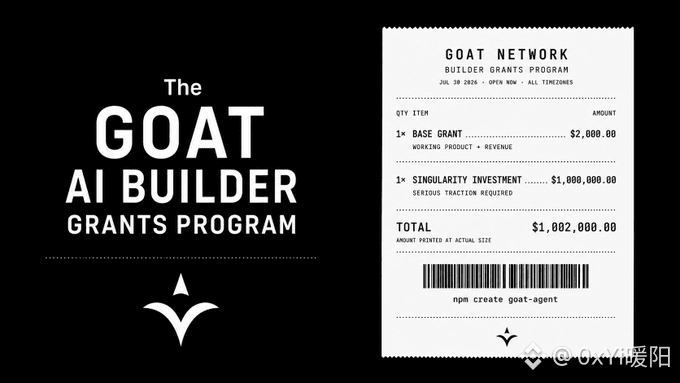
GOAT Network also supports a builder grant program, encouraging everyone to build real agent applications that can generate transactions.
There are already profitable products starting from a 2000 USD grant, and for projects with high potential, funding up to 1,000,000 USD.
Builder program application link: https://www.goat.network/builder-program?nocache
#GOATNetwork #BitVM3 #BTC #AI #AIAgents
AI agents are really getting more and more powerful these days.
They don’t just chat anymore—they can browse the web on their own, subscribe to services, call interfaces, and even do business with other AIs.
But here’s the question—
When machines trade with machines, what do they use to build trust❓️
Humans can rely on laws, word of mouth, and brands.
But AIs can’t—they can’t sue, and they can’t truly verify whether the other party is reliable.
So the only thing you can truly trust is cryptographic verification, using math proofs to show “this really was done correctly.”
And the blockchain that’s currently most suitable to serve as that final safety vault is Bitcoin.
It has the strongest security and the most neutrality.
But Bitcoin itself can’t verify complex computations.
That’s where @GOATNetwork comes in.
Using BitVM3 technology, it enables Bitcoin to serve as a backstop for the correctness of off-chain computations,
thereby running a truly zkEVM secured by Bitcoin.
In plain terms,
GOAT Network is an intelligent contract environment built on top of Bitcoin—specifically designed for business between AI agents.
AI agents can buy things, book services, pay API fees, and transfer funds to each other all on it, with the security baseline directly protected by Bitcoin.
GOAT Network also supports a builder grant program, encouraging everyone to build real agent applications that can generate transactions.
There are already profitable products starting from a 2000 USD grant, and for projects with high potential, funding up to 1,000,000 USD.
Builder program application link: https://www.goat.network/builder-program?nocache
#GOATNetwork #BitVM3 #BTC #AI #AIAgents
They don’t just chat anymore—they can browse the web on their own, subscribe to services, call interfaces, and even do business with other AIs.
But here’s the question—
When machines trade with machines, what do they use to build trust❓️
Humans can rely on laws, word of mouth, and brands.
But AIs can’t—they can’t sue, and they can’t truly verify whether the other party is reliable.
So the only thing you can truly trust is cryptographic verification, using math proofs to show “this really was done correctly.”
And the blockchain that’s currently most suitable to serve as that final safety vault is Bitcoin.
It has the strongest security and the most neutrality.
But Bitcoin itself can’t verify complex computations.
That’s where @GOATNetwork comes in.
Using BitVM3 technology, it enables Bitcoin to serve as a backstop for the correctness of off-chain computations,
thereby running a truly zkEVM secured by Bitcoin.
In plain terms,
GOAT Network is an intelligent contract environment built on top of Bitcoin—specifically designed for business between AI agents.
AI agents can buy things, book services, pay API fees, and transfer funds to each other all on it, with the security baseline directly protected by Bitcoin.
GOAT Network also supports a builder grant program, encouraging everyone to build real agent applications that can generate transactions.
There are already profitable products starting from a 2000 USD grant, and for projects with high potential, funding up to 1,000,000 USD.
Builder program application link: https://www.goat.network/builder-program?nocache
#GOATNetwork #BitVM3 #BTC #AI #AIAgents
176
Log in to explore more content
Join global crypto users on Binance Square
⚡️ Get latest and useful information about crypto.
💬 Trusted by the world’s largest crypto exchange.
👍 Discover real insights from verified creators.
Email / Phone number
Trending Topics
1
#FedRateWatch
1.1M views
5,184 Discussing
2
#ZcashRises6%
194 views
15 Discussing
3
#XRPSinks10%
14 views
10 Discussing
4
#CircleOpensArcMainnet
0 views
2 Discussing
5
#ZcashHoldersBackNU7Upgrade
6,054 views
180 Discussing
6
#MSTRTradingVolumeSurpassesMorganStanley
10,902 views
372 Discussing
7
#BitcoinFalls4%
25,707 views
626 Discussing
8
#SKHynixInTalksToMakeMemoryChipsInUS
12,130 views
273 Discussing
9
#OpenAIDiscussesNewFundingAt$1.2TValuation
2,659 views
46 Discussing
10
#ArgentinaCommitsToOECDCryptoReportingBy2029
20,294 views
425 Discussing