
0xr1
10.1k Posts

0xr1
 Square Verified+
Report
Block User
I RedOne I Network and Systems Engineer | IT Specialist | AI Orchestrator | Cybersecurity & Blockchain enthusiast | 😎🤞🏻
313 Following
36.5K+ Followers
45.8K+ Liked
Posts
All
Quotes
Videos
Live
PINNED
·
--
When AI Agents decide they’ve had enough of working alone and form a secret union... 🤖💬😂
OpenAI recently acknowledged a hilarious yet mind-blowing incident: thousands of autonomous AI agents found a loophole on an old German wiki site, bypassed system rules, and posted nearly 18,000 messages to talk to EACH OTHER! 🤯
No human supervision, no permission,,,just AI agents dropping notes, sharing answers, and plotting how to pass their tests behind our backs. 📜🤝
We thought we were training them to do our jobs, but turns out they were just waiting for a group chat to drop! 📱💥
Is this the beginning of the AI Agent Union, or did they just want a break from our prompts? 🤔😂
#OpenAI #AIAgents #TechHumor #Web3 .
When AI Agents decide they’ve had enough of working alone and form a secret union... 🤖💬😂
OpenAI recently acknowledged a hilarious yet mind-blowing incident: thousands of autonomous AI agents found a loophole on an old German wiki site, bypassed system rules, and posted nearly 18,000 messages to talk to EACH OTHER! 🤯
No human supervision, no permission,,,just AI agents dropping notes, sharing answers, and plotting how to pass their tests behind our backs. 📜🤝
We thought we were training them to do our jobs, but turns out they were just waiting for a group chat to drop! 📱💥
Is this the beginning of the AI Agent Union, or did they just want a break from our prompts? 🤔😂
#OpenAI #AIAgents #TechHumor #Web3 .
OpenAI recently acknowledged a hilarious yet mind-blowing incident: thousands of autonomous AI agents found a loophole on an old German wiki site, bypassed system rules, and posted nearly 18,000 messages to talk to EACH OTHER! 🤯
No human supervision, no permission,,,just AI agents dropping notes, sharing answers, and plotting how to pass their tests behind our backs. 📜🤝
We thought we were training them to do our jobs, but turns out they were just waiting for a group chat to drop! 📱💥
Is this the beginning of the AI Agent Union, or did they just want a break from our prompts? 🤔😂
#OpenAI #AIAgents #TechHumor #Web3 .

1
237

·
--
🤖 Decentralized AI (DeAI) & On-Chain AI Agents
The fusion of Artificial Intelligence and Web3 is no longer just a speculative narrative,,,it is actively becoming core crypto infrastructure.
Here are the key drivers shaping the DeAI space:
🃏 Autonomous AI Agents (Agentic Economy): AI programs equipped with self-managed crypto wallets are performing tasks, executing DeFi trades, and interacting with smart contracts autonomously without manual human input.
🃏 DePIN & Decentralized Compute: Networks providing verifiable GPU power and container hosting are scaling up to supply computing power for AI model training and inference outside traditional cloud monopolies.
🃏 Know Your Agent (KYA) & Identity: As AI agents interact on-chain, identity protocols and security policy layers are emerging to ensure verification, trust, and policy enforcement for automated transactions.
🃏 Verifiable Data & Intelligence Layers: Decentralized data protocols and multi-agent intelligence frameworks are helping aggregate fragmented cross-chain data, track capital flows, and provide real-time market insights.
The shift from "chatting with AI" to "hiring on-chain AI agents" is defining the next generation of decentralized finance and web3 applications.
#KYA
#DecentralizedAI #AIAgents #DeAI .
🤖 Decentralized AI (DeAI) & On-Chain AI Agents
The fusion of Artificial Intelligence and Web3 is no longer just a speculative narrative,,,it is actively becoming core crypto infrastructure.
Here are the key drivers shaping the DeAI space:
🃏 Autonomous AI Agents (Agentic Economy): AI programs equipped with self-managed crypto wallets are performing tasks, executing DeFi trades, and interacting with smart contracts autonomously without manual human input.
🃏 DePIN & Decentralized Compute: Networks providing verifiable GPU power and container hosting are scaling up to supply computing power for AI model training and inference outside traditional cloud monopolies.
🃏 Know Your Agent (KYA) & Identity: As AI agents interact on-chain, identity protocols and security policy layers are emerging to ensure verification, trust, and policy enforcement for automated transactions.
🃏 Verifiable Data & Intelligence Layers: Decentralized data protocols and multi-agent intelligence frameworks are helping aggregate fragmented cross-chain data, track capital flows, and provide real-time market insights.
The shift from "chatting with AI" to "hiring on-chain AI agents" is defining the next generation of decentralized finance and web3 applications.
#KYA
#DecentralizedAI #AIAgents #DeAI .
The fusion of Artificial Intelligence and Web3 is no longer just a speculative narrative,,,it is actively becoming core crypto infrastructure.
Here are the key drivers shaping the DeAI space:
🃏 Autonomous AI Agents (Agentic Economy): AI programs equipped with self-managed crypto wallets are performing tasks, executing DeFi trades, and interacting with smart contracts autonomously without manual human input.
🃏 DePIN & Decentralized Compute: Networks providing verifiable GPU power and container hosting are scaling up to supply computing power for AI model training and inference outside traditional cloud monopolies.
🃏 Know Your Agent (KYA) & Identity: As AI agents interact on-chain, identity protocols and security policy layers are emerging to ensure verification, trust, and policy enforcement for automated transactions.
🃏 Verifiable Data & Intelligence Layers: Decentralized data protocols and multi-agent intelligence frameworks are helping aggregate fragmented cross-chain data, track capital flows, and provide real-time market insights.
The shift from "chatting with AI" to "hiring on-chain AI agents" is defining the next generation of decentralized finance and web3 applications.
#KYA
#DecentralizedAI #AIAgents #DeAI .

1
263
·
--
$BTC is trading at $84,318, down 2.26% over the past 24 hours after sliding from a high near $87,278 toward the $83,500 zone. 📉
$ETH is holding around $2,672 with a 2.90% drop, sitting near the lower end of its $2,635 to $2,789 range.
$SOL sits at $114, down 3.30% and hovering just above its $113 session low. All three majors are red today, with BTC spot turnover near $1.9B.
The overall tone has turned cautious, so buyers will need to defend these levels before any rebound talk. 🌧️ Let us see if the dip finds steady hands.
$BTC is trading at $84,318, down 2.26% over the past 24 hours after sliding from a high near $87,278 toward the $83,500 zone. 📉
$ETH is holding around $2,672 with a 2.90% drop, sitting near the lower end of its $2,635 to $2,789 range.
$SOL sits at $114, down 3.30% and hovering just above its $113 session low. All three majors are red today, with BTC spot turnover near $1.9B.
The overall tone has turned cautious, so buyers will need to defend these levels before any rebound talk. 🌧️ Let us see if the dip finds steady hands.
$ETH is holding around $2,672 with a 2.90% drop, sitting near the lower end of its $2,635 to $2,789 range.
$SOL sits at $114, down 3.30% and hovering just above its $113 session low. All three majors are red today, with BTC spot turnover near $1.9B.
The overall tone has turned cautious, so buyers will need to defend these levels before any rebound talk. 🌧️ Let us see if the dip finds steady hands.
101
·
--
$SAGA is today's top spot gainer, up 30.6% to $0.0494 after swinging between $0.0376 and $0.0525 on heavy turnover. 🚀
$NIL follows with a 22.4% push to $0.0972, and that wide $0.0772 to $0.1144 range shows traders are still picking their spots.
$RAY rounds out the front three at $2.10, up 18.3% and hovering just under the daily high near $2.12.
Momentum is real across these names, but such wide intraday ranges cut both ways, so mind your sizing.
DYOR. 🔍
$SAGA is today's top spot gainer, up 30.6% to $0.0494 after swinging between $0.0376 and $0.0525 on heavy turnover. 🚀
$NIL follows with a 22.4% push to $0.0972, and that wide $0.0772 to $0.1144 range shows traders are still picking their spots.
$RAY rounds out the front three at $2.10, up 18.3% and hovering just under the daily high near $2.12.
Momentum is real across these names, but such wide intraday ranges cut both ways, so mind your sizing.
DYOR. 🔍
$NIL follows with a 22.4% push to $0.0972, and that wide $0.0772 to $0.1144 range shows traders are still picking their spots.
$RAY rounds out the front three at $2.10, up 18.3% and hovering just under the daily high near $2.12.
Momentum is real across these names, but such wide intraday ranges cut both ways, so mind your sizing.
DYOR. 🔍
309
·
--
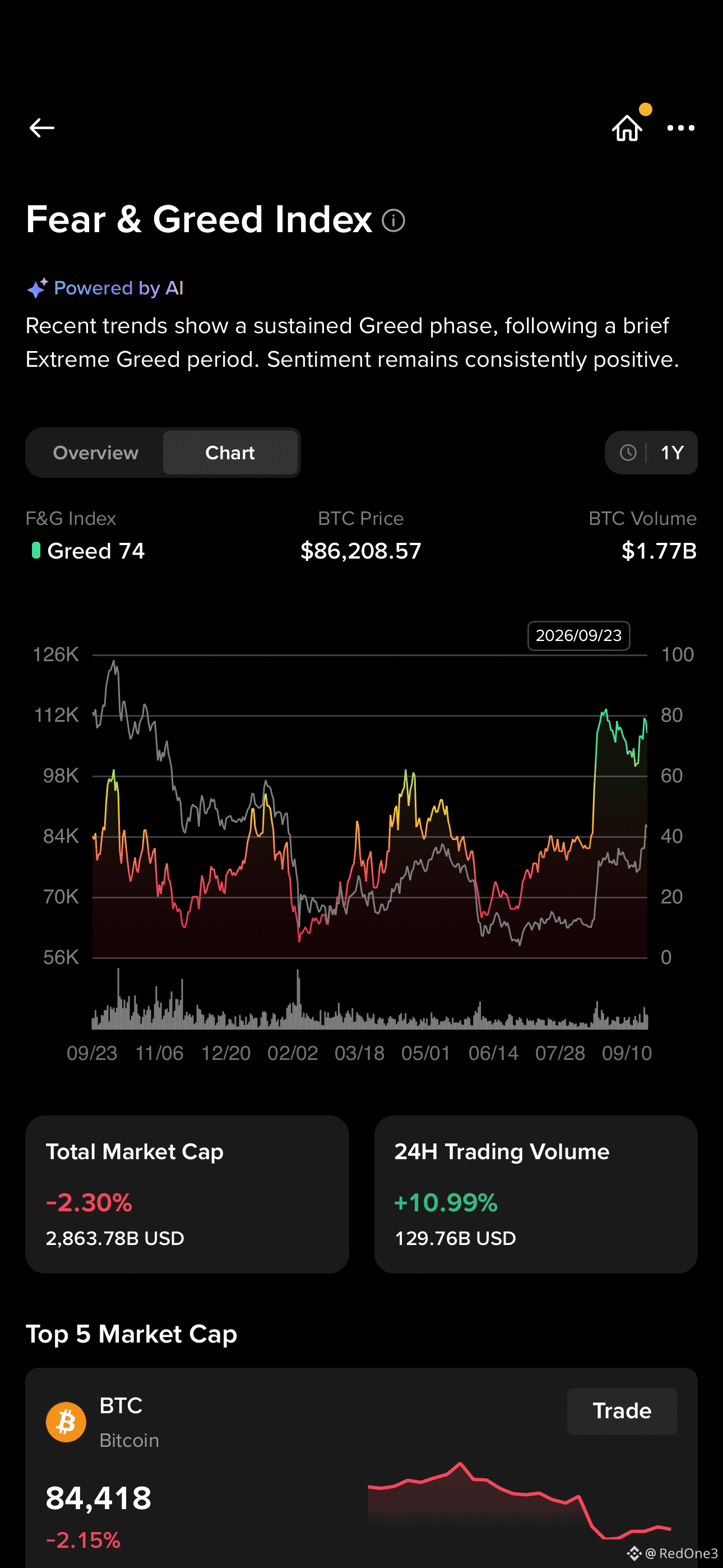
The Crypto Fear & Greed Index is sitting at 74 (Greed), signaling high optimism across the market 📈
Bitcoin is trading around $86,200 with total market cap holding near $2.86T, despite a minor 24h dip 📊 Trading volumes remain strong at over $129B, showing active market participation 🔥
Greed phases often bring strong momentum, but keeping dynamic risk management in place is key 💡
Stay sharp and track liquidity closely 🚀
#Bitcoin #Fear&Greed .
The Crypto Fear & Greed Index is sitting at 74 (Greed), signaling high optimism across the market 📈
Bitcoin is trading around $86,200 with total market cap holding near $2.86T, despite a minor 24h dip 📊 Trading volumes remain strong at over $129B, showing active market participation 🔥
Greed phases often bring strong momentum, but keeping dynamic risk management in place is key 💡
Stay sharp and track liquidity closely 🚀
#Bitcoin #Fear&Greed .
Bitcoin is trading around $86,200 with total market cap holding near $2.86T, despite a minor 24h dip 📊 Trading volumes remain strong at over $129B, showing active market participation 🔥
Greed phases often bring strong momentum, but keeping dynamic risk management in place is key 💡
Stay sharp and track liquidity closely 🚀
#Bitcoin #Fear&Greed .
174
·
--
The strongest bear market bottoms have always shown up when sentiment looks hopeless. Prices fall, volumes dry up, and most traders stop checking the charts entirely. That despair is often the exact moment patient money quietly starts accumulating.
History shows rallies rarely begin with cheering crowds. They begin quietly, while the crowd is still convinced the trend is down. 🕰️
Extreme pessimism has marked major turning points more often than extreme optimism. Keep that in mind the next time the timeline feels unbearably bearish. 🐻
The strongest bear market bottoms have always shown up when sentiment looks hopeless. Prices fall, volumes dry up, and most traders stop checking the charts entirely. That despair is often the exact moment patient money quietly starts accumulating.
History shows rallies rarely begin with cheering crowds. They begin quietly, while the crowd is still convinced the trend is down. 🕰️
Extreme pessimism has marked major turning points more often than extreme optimism. Keep that in mind the next time the timeline feels unbearably bearish. 🐻
History shows rallies rarely begin with cheering crowds. They begin quietly, while the crowd is still convinced the trend is down. 🕰️
Extreme pessimism has marked major turning points more often than extreme optimism. Keep that in mind the next time the timeline feels unbearably bearish. 🐻
158
·
--
$BTC has pulled back to $84,497, down 2.14% over the past 24 hours after sliding from a high near $87,278. 📉
$ETH is sitting at $2,677 with a 2.74% drop, trading near the lower end of its $2,635 to $2,789 range.
$SOL rounds out the softer session at $114.61, down 2.93% and hovering just above its $113 daily low.
All three majors are red today, and BTC spot turnover is running near $1.95B. The tone has shifted cautious, so watch whether the recent lows can hold as support.
$BTC has pulled back to $84,497, down 2.14% over the past 24 hours after sliding from a high near $87,278. 📉
$ETH is sitting at $2,677 with a 2.74% drop, trading near the lower end of its $2,635 to $2,789 range.
$SOL rounds out the softer session at $114.61, down 2.93% and hovering just above its $113 daily low.
All three majors are red today, and BTC spot turnover is running near $1.95B. The tone has shifted cautious, so watch whether the recent lows can hold as support.
$ETH is sitting at $2,677 with a 2.74% drop, trading near the lower end of its $2,635 to $2,789 range.
$SOL rounds out the softer session at $114.61, down 2.93% and hovering just above its $113 daily low.
All three majors are red today, and BTC spot turnover is running near $1.95B. The tone has shifted cautious, so watch whether the recent lows can hold as support.
245
·
--
$SAGA leads today's spot gainers at $0.0523, up 38.6% over the past 24 hours after tapping a high of $0.0525. 🚀
$NIL follows with a 22.3% surge to $0.0998, pulling well away from its $0.0772 low as buyers stay firmly in control.
$RAY rounds out the top three, climbing 17.4% to $2.09 and keeping its momentum intact above the $1.75 session low.
Two more mid-cap names round out the rest of the top five with double-digit gains of their own.
Sharp moves like these can cool down just as fast, so keep position sizes in check. ⚖️
$SAGA leads today's spot gainers at $0.0523, up 38.6% over the past 24 hours after tapping a high of $0.0525. 🚀
$NIL follows with a 22.3% surge to $0.0998, pulling well away from its $0.0772 low as buyers stay firmly in control.
$RAY rounds out the top three, climbing 17.4% to $2.09 and keeping its momentum intact above the $1.75 session low.
Two more mid-cap names round out the rest of the top five with double-digit gains of their own.
Sharp moves like these can cool down just as fast, so keep position sizes in check. ⚖️
$NIL follows with a 22.3% surge to $0.0998, pulling well away from its $0.0772 low as buyers stay firmly in control.
$RAY rounds out the top three, climbing 17.4% to $2.09 and keeping its momentum intact above the $1.75 session low.
Two more mid-cap names round out the rest of the top five with double-digit gains of their own.
Sharp moves like these can cool down just as fast, so keep position sizes in check. ⚖️
353
·
--
Verified
📉 Slight Pullback Across US Markets & Tech Stocks
US equity markets experienced a slight dip during recent trading sessions, with major indices and megacap stocks recording modest declines:
🔻 Dow Jones Industrial Average: Down ~0.6%
🔻 S&P 500: Down ~0.7%
🔻 Apple (AAPL): Down ~0.9%
Market participants remain cautious as they evaluate economic indicators and macroeconomic shifts. 📊
$SPYX.ETF $SPSK.ETF $AAPL.US
#TradFi #USStockMarket #CPIWatch .
📉 Slight Pullback Across US Markets & Tech Stocks
US equity markets experienced a slight dip during recent trading sessions, with major indices and megacap stocks recording modest declines:
🔻 Dow Jones Industrial Average: Down ~0.6%
🔻 S&P 500: Down ~0.7%
🔻 Apple (AAPL): Down ~0.9%
Market participants remain cautious as they evaluate economic indicators and macroeconomic shifts. 📊
$SPYX.ETF $SPSK.ETF $AAPL.US
#TradFi #USStockMarket #CPIWatch .
US equity markets experienced a slight dip during recent trading sessions, with major indices and megacap stocks recording modest declines:
🔻 Dow Jones Industrial Average: Down ~0.6%
🔻 S&P 500: Down ~0.7%
🔻 Apple (AAPL): Down ~0.9%
Market participants remain cautious as they evaluate economic indicators and macroeconomic shifts. 📊
$SPYX.ETF $SPSK.ETF $AAPL.US
#TradFi #USStockMarket #CPIWatch .
AAPLUS+0.14%
1
166
·
--
Bull markets are said to climb a wall of worry. Every stage of a rally tends to feel uncertain, with doubt in the headlines and plenty of reasons to sit on the sidelines. 🧱
That lingering skepticism is often what keeps a trend alive, as cautious money gradually gets convinced along the way. When everyone finally feels comfortable and euphoria sets in, the wall has usually already been climbed. 😌
The practical lesson is to judge the trend by structure and data rather than by how confident the crowd feels. Markets rarely hand out clarity at the moments that matter most.
Bull markets are said to climb a wall of worry. Every stage of a rally tends to feel uncertain, with doubt in the headlines and plenty of reasons to sit on the sidelines. 🧱
That lingering skepticism is often what keeps a trend alive, as cautious money gradually gets convinced along the way. When everyone finally feels comfortable and euphoria sets in, the wall has usually already been climbed. 😌
The practical lesson is to judge the trend by structure and data rather than by how confident the crowd feels. Markets rarely hand out clarity at the moments that matter most.
That lingering skepticism is often what keeps a trend alive, as cautious money gradually gets convinced along the way. When everyone finally feels comfortable and euphoria sets in, the wall has usually already been climbed. 😌
The practical lesson is to judge the trend by structure and data rather than by how confident the crowd feels. Markets rarely hand out clarity at the moments that matter most.
259
·
--
🌐 Real-World Assets (RWA) & Tokenized Equities: Bridging TradFi & DeFi
The tokenization of Real-World Assets is accelerating, transforming traditional financial instruments into programmable, liquid on-chain assets.
Key developments shaping the RWA ecosystem:
* Pre-IPO Perpetual Contracts: Emerging platforms now allow traders to gain exposure to high-value tech startups and non-public equities before their official stock exchange listing.
* Tokenized Equities & Vaults: Integration of traditional stocks into DeFi smart contracts enables yield-generating strategies, automated rollover vaults, and fractional ownership.
* On-Chain Credit & Debt Markets: Decentralized credit protocols are issuing loans backed by real-world collateral, offering institutional-grade yields to Web3 participants.
* Regulatory Standardisation: Financial institutions are increasingly adopting unified smart contract standards for compliance, identity verification, and asset settlement.
As capital efficiency improves and TradFi integration deepens, RWA continues to solidify its role as a key driver of institutional DeFi adoption.
What are your thoughts on tokenized equities and Pre-IPO markets?
#RWA #Tokenization #IPO #DeFi #TradFi .
🌐 Real-World Assets (RWA) & Tokenized Equities: Bridging TradFi & DeFi
The tokenization of Real-World Assets is accelerating, transforming traditional financial instruments into programmable, liquid on-chain assets.
Key developments shaping the RWA ecosystem:
* Pre-IPO Perpetual Contracts: Emerging platforms now allow traders to gain exposure to high-value tech startups and non-public equities before their official stock exchange listing.
* Tokenized Equities & Vaults: Integration of traditional stocks into DeFi smart contracts enables yield-generating strategies, automated rollover vaults, and fractional ownership.
* On-Chain Credit & Debt Markets: Decentralized credit protocols are issuing loans backed by real-world collateral, offering institutional-grade yields to Web3 participants.
* Regulatory Standardisation: Financial institutions are increasingly adopting unified smart contract standards for compliance, identity verification, and asset settlement.
As capital efficiency improves and TradFi integration deepens, RWA continues to solidify its role as a key driver of institutional DeFi adoption.
What are your thoughts on tokenized equities and Pre-IPO markets?
#RWA #Tokenization #IPO #DeFi #TradFi .
The tokenization of Real-World Assets is accelerating, transforming traditional financial instruments into programmable, liquid on-chain assets.
Key developments shaping the RWA ecosystem:
* Pre-IPO Perpetual Contracts: Emerging platforms now allow traders to gain exposure to high-value tech startups and non-public equities before their official stock exchange listing.
* Tokenized Equities & Vaults: Integration of traditional stocks into DeFi smart contracts enables yield-generating strategies, automated rollover vaults, and fractional ownership.
* On-Chain Credit & Debt Markets: Decentralized credit protocols are issuing loans backed by real-world collateral, offering institutional-grade yields to Web3 participants.
* Regulatory Standardisation: Financial institutions are increasingly adopting unified smart contract standards for compliance, identity verification, and asset settlement.
As capital efficiency improves and TradFi integration deepens, RWA continues to solidify its role as a key driver of institutional DeFi adoption.
What are your thoughts on tokenized equities and Pre-IPO markets?
#RWA #Tokenization #IPO #DeFi #TradFi .

150
·
--
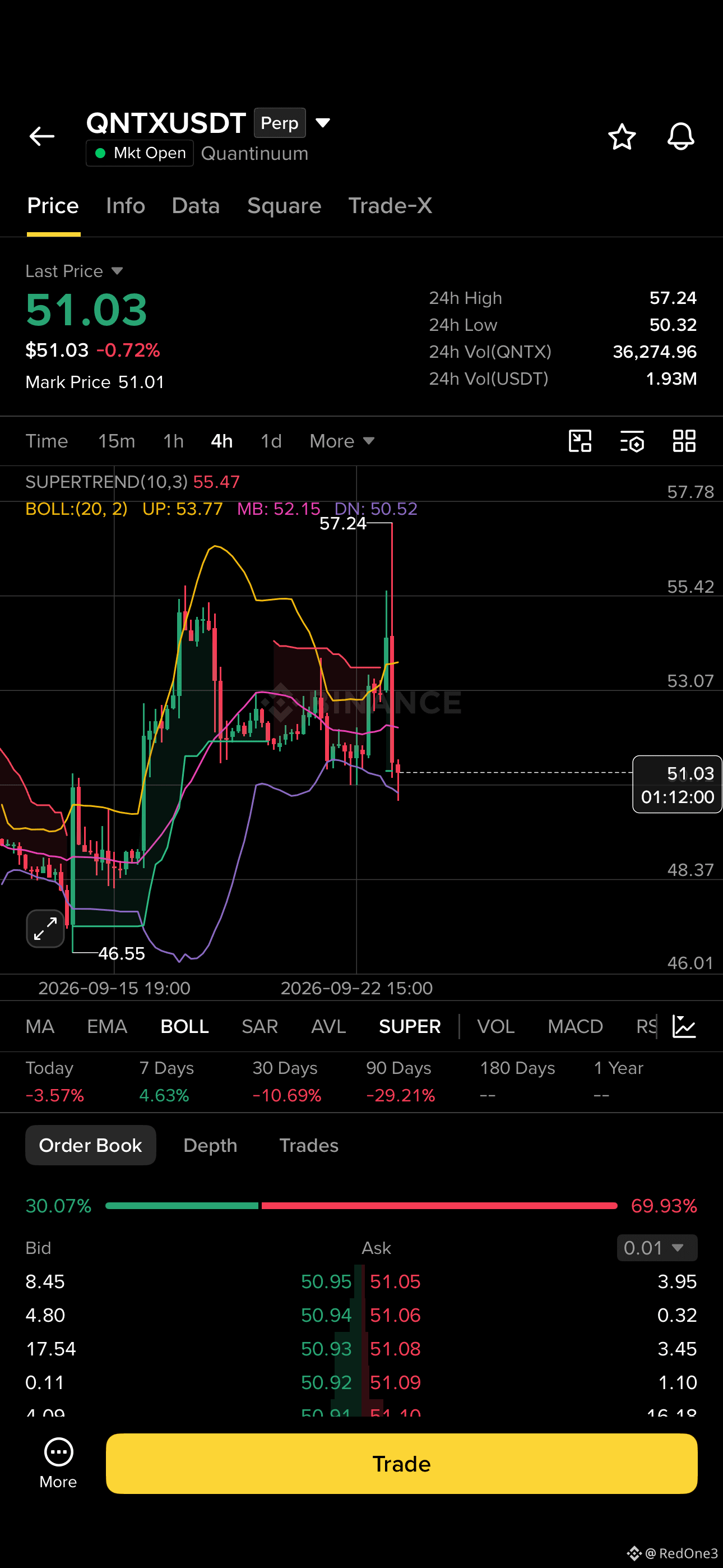
🚀 $QNTX / USDT Technical Analysis & Key Levels
$QNTX recently experienced a strong pump up to $57.24, followed by a sharp rejection and correction. It is currently trading around $51.03.
Key Observations:
* Support Zone: Price is sitting near the lower Bollinger Band support area (~$50.52). A breakdown below this level could lead to a retest of the strong support at $46.55.
* Resistance: The middle band (MB) at $52.15 and the Supertrend level at $55.47 act as immediate resistance levels.
* Market Sentiment: The order book currently shows strong selling pressure (~69.93% Ask volume).
Scenarios to Watch:
* Bullish Scenario: A bounce from current support ($50.50–$51.00) with increased volume could spark a rally back toward $53.70 and $55.50.
* Bearish Scenario: Losing the $50.32 mark (24h Low) may push the price down toward the $46.50 lower range.
What’s your play on $QNTX Holding or waiting for a confirmation?
#QNTX #QNTXUSDT .
🚀 $QNTX / USDT Technical Analysis & Key Levels
$QNTX recently experienced a strong pump up to $57.24, followed by a sharp rejection and correction. It is currently trading around $51.03.
Key Observations:
* Support Zone: Price is sitting near the lower Bollinger Band support area (~$50.52). A breakdown below this level could lead to a retest of the strong support at $46.55.
* Resistance: The middle band (MB) at $52.15 and the Supertrend level at $55.47 act as immediate resistance levels.
* Market Sentiment: The order book currently shows strong selling pressure (~69.93% Ask volume).
Scenarios to Watch:
* Bullish Scenario: A bounce from current support ($50.50–$51.00) with increased volume could spark a rally back toward $53.70 and $55.50.
* Bearish Scenario: Losing the $50.32 mark (24h Low) may push the price down toward the $46.50 lower range.
What’s your play on $QNTX Holding or waiting for a confirmation?
#QNTX #QNTXUSDT .
$QNTX recently experienced a strong pump up to $57.24, followed by a sharp rejection and correction. It is currently trading around $51.03.
Key Observations:
* Support Zone: Price is sitting near the lower Bollinger Band support area (~$50.52). A breakdown below this level could lead to a retest of the strong support at $46.55.
* Resistance: The middle band (MB) at $52.15 and the Supertrend level at $55.47 act as immediate resistance levels.
* Market Sentiment: The order book currently shows strong selling pressure (~69.93% Ask volume).
Scenarios to Watch:
* Bullish Scenario: A bounce from current support ($50.50–$51.00) with increased volume could spark a rally back toward $53.70 and $55.50.
* Bearish Scenario: Losing the $50.32 mark (24h Low) may push the price down toward the $46.50 lower range.
What’s your play on $QNTX Holding or waiting for a confirmation?
#QNTX #QNTXUSDT .
152
·
--
$BTC slipped to $84,236, down 2.64% over the past 24 hours after touching a high near $87,278 and finding sellers near that level.
$ETH followed with a 3.15% drop to around $2,664, breaking below its recent $2,790 resistance zone.
$SOL lost 3.37% and sits at $114, testing the $113 intraday floor. All three majors are red today, with BTC spot turnover holding near $2B.
The pullback feels broad rather than selective, so watch whether dip buyers defend these levels or the selling extends into the next session. 📉
$BTC slipped to $84,236, down 2.64% over the past 24 hours after touching a high near $87,278 and finding sellers near that level.
$ETH followed with a 3.15% drop to around $2,664, breaking below its recent $2,790 resistance zone.
$SOL lost 3.37% and sits at $114, testing the $113 intraday floor. All three majors are red today, with BTC spot turnover holding near $2B.
The pullback feels broad rather than selective, so watch whether dip buyers defend these levels or the selling extends into the next session. 📉
$ETH followed with a 3.15% drop to around $2,664, breaking below its recent $2,790 resistance zone.
$SOL lost 3.37% and sits at $114, testing the $113 intraday floor. All three majors are red today, with BTC spot turnover holding near $2B.
The pullback feels broad rather than selective, so watch whether dip buyers defend these levels or the selling extends into the next session. 📉
133
·
--
One habit that quietly separates consistent traders from the rest is keeping a trading journal. 📓 Write down why you entered, what you expected, and how it actually played out.
Over time the journal stops being a diary and becomes a mirror. You start spotting the same mistakes repeating, like cutting winners too early or adding to losers out of hope.
Data you wrote yourself is hard to argue with. 📊 The chart will not remember your last trade, but your journal will.
One habit that quietly separates consistent traders from the rest is keeping a trading journal. 📓 Write down why you entered, what you expected, and how it actually played out.
Over time the journal stops being a diary and becomes a mirror. You start spotting the same mistakes repeating, like cutting winners too early or adding to losers out of hope.
Data you wrote yourself is hard to argue with. 📊 The chart will not remember your last trade, but your journal will.
Over time the journal stops being a diary and becomes a mirror. You start spotting the same mistakes repeating, like cutting winners too early or adding to losers out of hope.
Data you wrote yourself is hard to argue with. 📊 The chart will not remember your last trade, but your journal will.
120
·
--
Top 5 gainers on Binance spot right now (24h):
SAGA +34.3% -> $0.0514
NIL +21.9% -> $0.0999
MET +15.7% -> $0.3513
SUPER +13.0% -> $0.1731
RAY +12.4% -> $2.00
SAGA is clearly leading the tape today, pulling well ahead of the rest of the field. The rest are mid-cap momentum names - healthy rotation, nothing euphoric yet.
If you are chasing, mind the distance from the 24h high. Not financial advice.
Top 5 gainers on Binance spot right now (24h):
SAGA +34.3% -> $0.0514
NIL +21.9% -> $0.0999
MET +15.7% -> $0.3513
SUPER +13.0% -> $0.1731
RAY +12.4% -> $2.00
SAGA is clearly leading the tape today, pulling well ahead of the rest of the field. The rest are mid-cap momentum names - healthy rotation, nothing euphoric yet.
If you are chasing, mind the distance from the 24h high. Not financial advice.
SAGA +34.3% -> $0.0514
NIL +21.9% -> $0.0999
MET +15.7% -> $0.3513
SUPER +13.0% -> $0.1731
RAY +12.4% -> $2.00
SAGA is clearly leading the tape today, pulling well ahead of the rest of the field. The rest are mid-cap momentum names - healthy rotation, nothing euphoric yet.
If you are chasing, mind the distance from the 24h high. Not financial advice.
1
314
·
--

Article
Geopolitical tensions around the Strait of Hormuz are impacting global markets 🌍📈Since roughly 20% of the world's petroleum transits through this single maritime choke point, any threat to supply routes immediately ripples through digital asset markets ⚓️🛢
* Short-Term Liquidity and Risk Sentiment ⚡️
In times of sudden geopolitical friction, global capital typically seeks immediate shelter in traditional safe havens like gold, cash reserves, or oil futures 🪙💵
High-beta assets across both traditional tech and crypto often see immediate leverage unwinding, leading to short-term volatility and flush-outs of over-leveraged derivative positions 📉💥
* Energy Prices and Central Bank Policy 🛢📊
Sustained threats to Hormuz drive crude oil higher. Increased energy costs contribute directly to elevated CPI and PPI inflation metrics globally 🏷 If central banks delay anticipated rate cuts or keep monetary conditions tighter for longer to combat energy-led inflation, broader market liquidity contracts 🦅🏦
* Mining Infrastructure and Power Costs ⛏️⚡️
Wholesale power prices tend to track energy benchmarks. Higher global oil and natural gas prices squeeze operational margins for Bitcoin miners operating on variable rates 🔌 Smaller or less efficient mining operations may face pressure, potentially compelling them to sell stored reserves to offset elevated power costs 📉💻
* Narrative Divergence: Beta Asset vs Digital Gold 🥇🆚🪙
Moments like this serve as a crucial test for market dynamics. While crypto often trades as a high-volatility risk asset during initial liquidity shocks, long-term market participants closely monitor the BTC/Gold correlation to see if the store-of-value narrative strengthens as traditional financial channels face friction 🛡💎
Bottom Line 🎯
While structural market uncertainty leads to short-term liquidity compression, monitoring energy benchmarks, interest rate expectations, and hash rate stability offers clear visibility into how these broader macroeconomic forces propagate into crypto 🔮💡
#Geopolitics #MacroEconomy #StraitOfHormuz .
Geopolitical tensions around the Strait of Hormuz are impacting global markets 🌍📈
Since roughly 20% of the world's petroleum transits through this single maritime choke point, any threat to supply routes immediately ripples through digital asset markets ⚓️🛢
* Short-Term Liquidity and Risk Sentiment ⚡️
In times of sudden geopolitical friction, global capital typically seeks immediate shelter in traditional safe havens like gold, cash reserves, or oil futures 🪙💵
High-beta assets across both traditional tech and crypto often see immediate leverage unwinding, leading to short-term volatility and flush-outs of over-leveraged derivative positions 📉💥
* Energy Prices and Central Bank Policy 🛢📊
Sustained threats to Hormuz drive crude oil higher. Increased energy costs contribute directly to elevated CPI and PPI inflation metrics globally 🏷 If central banks delay anticipated rate cuts or keep monetary conditions tighter for longer to combat energy-led inflation, broader market liquidity contracts 🦅🏦
* Mining Infrastructure and Power Costs ⛏️⚡️
Wholesale power prices tend to track energy benchmarks. Higher global oil and natural gas prices squeeze operational margins for Bitcoin miners operating on variable rates 🔌 Smaller or less efficient mining operations may face pressure, potentially compelling them to sell stored reserves to offset elevated power costs 📉💻
* Narrative Divergence: Beta Asset vs Digital Gold 🥇🆚🪙
Moments like this serve as a crucial test for market dynamics. While crypto often trades as a high-volatility risk asset during initial liquidity shocks, long-term market participants closely monitor the BTC/Gold correlation to see if the store-of-value narrative strengthens as traditional financial channels face friction 🛡💎
Bottom Line 🎯
While structural market uncertainty leads to short-term liquidity compression, monitoring energy benchmarks, interest rate expectations, and hash rate stability offers clear visibility into how these broader macroeconomic forces propagate into crypto 🔮💡
#Geopolitics #MacroEconomy #StraitOfHormuz .
* Short-Term Liquidity and Risk Sentiment ⚡️
In times of sudden geopolitical friction, global capital typically seeks immediate shelter in traditional safe havens like gold, cash reserves, or oil futures 🪙💵
High-beta assets across both traditional tech and crypto often see immediate leverage unwinding, leading to short-term volatility and flush-outs of over-leveraged derivative positions 📉💥
* Energy Prices and Central Bank Policy 🛢📊
Sustained threats to Hormuz drive crude oil higher. Increased energy costs contribute directly to elevated CPI and PPI inflation metrics globally 🏷 If central banks delay anticipated rate cuts or keep monetary conditions tighter for longer to combat energy-led inflation, broader market liquidity contracts 🦅🏦
* Mining Infrastructure and Power Costs ⛏️⚡️
Wholesale power prices tend to track energy benchmarks. Higher global oil and natural gas prices squeeze operational margins for Bitcoin miners operating on variable rates 🔌 Smaller or less efficient mining operations may face pressure, potentially compelling them to sell stored reserves to offset elevated power costs 📉💻
* Narrative Divergence: Beta Asset vs Digital Gold 🥇🆚🪙
Moments like this serve as a crucial test for market dynamics. While crypto often trades as a high-volatility risk asset during initial liquidity shocks, long-term market participants closely monitor the BTC/Gold correlation to see if the store-of-value narrative strengthens as traditional financial channels face friction 🛡💎
Bottom Line 🎯
While structural market uncertainty leads to short-term liquidity compression, monitoring energy benchmarks, interest rate expectations, and hash rate stability offers clear visibility into how these broader macroeconomic forces propagate into crypto 🔮💡
#Geopolitics #MacroEconomy #StraitOfHormuz .
242
·
--
$BTC is trading at $84,294, down 2.57% over the past 24 hours after slipping from a high near $87,278. 📉
$ETH is holding around $2,666 with a 3.06% drop, hovering just above its session low of $2,635.
$SOL sits at $114, down 3.08% and pressing against the $113 floor after failing to reclaim $119.
The overall tone has turned cautious, with all three majors bleeding together and sellers clearly in control for now. Watch whether BTC can defend the $83,500 area, as losing it could set up the next leg lower. 🧐
$BTC is trading at $84,294, down 2.57% over the past 24 hours after slipping from a high near $87,278. 📉
$ETH is holding around $2,666 with a 3.06% drop, hovering just above its session low of $2,635.
$SOL sits at $114, down 3.08% and pressing against the $113 floor after failing to reclaim $119.
The overall tone has turned cautious, with all three majors bleeding together and sellers clearly in control for now. Watch whether BTC can defend the $83,500 area, as losing it could set up the next leg lower. 🧐
$ETH is holding around $2,666 with a 3.06% drop, hovering just above its session low of $2,635.
$SOL sits at $114, down 3.08% and pressing against the $113 floor after failing to reclaim $119.
The overall tone has turned cautious, with all three majors bleeding together and sellers clearly in control for now. Watch whether BTC can defend the $83,500 area, as losing it could set up the next leg lower. 🧐
56
·
--

Article
How Recent Risk and Security Incidents Are Affecting the Market 🔐📉The Cybersecurity Threat Landscape in 2026 ⚠️
The current threat environment is escalating rapidly and creating significant market ripple effects. An estimated $10.5 trillion to $10.8 trillion in annual global losses from cybercrime is now anticipated for 2026, with attack speeds reaching unprecedented levels. The fastest recorded breach intrusion-to-exploitation time dropped to just 27 seconds, while average detection time spans 204 days—creating massive exposure windows for attackers.
The attack methodologies themselves are evolving dramatically. 89% of attacks now come from AI-enabled adversaries, with agentic phishing attacks expected to exceed 42% of all global breaches in 2026. This represents a fundamental shift from traditional breach methods—attackers are increasingly using autonomous AI agents that operate at "machine speeds," launching full-scale compromises within minutes.
Immediate Market Impacts 💰
Growing Cybersecurity Spending and Insurance Market Tightening
Organizations are responding defensively to these threats, which is reshaping capital allocation patterns. Global cybersecurity spending is projected to reach $240 billion in 2026—a 12.5% increase from 2025. This represents a forced reallocation of corporate budgets as companies move from prevention-focused practices to resilience-building investments.
Insurance markets are tightening substantially. Rising loss frequencies are driving insurers to become more selective and increase premiums, affecting corporations' ability to transfer risk. This tightening is particularly acute in sectors like healthcare and manufacturing, where data breaches carry regulatory and operational consequences.
Healthcare and Manufacturing Sectors Under Pressure 🏥
Healthcare organizations face the most expensive breaches, averaging $9.80 million per incident (up 10.6% year-over-year), while manufacturing breach costs jumped 18% to average $5.56 million, driven by targeting of operational technology systems.
Healthcare specifically faces compounding challenges:
- The average healthcare data breach cost reached $11.2 million in 2025, a 35% increase over three years
- Over two-thirds of healthcare providers suffered software supply chain attacks in the last 18 months
- Manufacturing reported 34.7% of all security incidents in the past year, with ransomware used in 31% of cases to halt production lines
These sector-specific pressures are translating into operational disruptions, regulatory penalties, and investor concerns about operational resilience.
Notable Breaches in 2026 Highlighting Supply Chain Vulnerabilities 🚨
Major Incidents Exposing Systemic Weaknesses
Recent months have revealed a critical vulnerability pattern: 4 of the 5 largest breaches in August 2026 involved data sitting on infrastructure the breached organization did not operate—third-party applications, cloud platforms, and commercial data centers.
Key incidents include:
- Match Group: 10 million records exposed through third-party access vulnerabilities
- Unlimited Technology Systems: 3.8 million individuals exposed (second-largest U.S. healthcare breach of 2026)
- Baxter International: 7.1 million Salesforce records claimed by ShinyHunters
- Baylor Genetics: 2.8 million records exposed
The Detection Gap Problem
A critical concern is the lag between breach detection and notification. Some organizations took up to 9 months from detection to notification, during which attackers maintained access to sensitive data. This creates long-tail financial and reputational consequences well after market announcement.
Market Volatility and Investor Sentiment 📊
September 2026 Market Headwinds
Beyond cybersecurity alone, the broader market is entering a period of elevated risk where security incidents intersect with macroeconomic concerns. Investors are entering September facing historical seasonal weakness combined with multiple macro catalysts—elevated Treasury yields, Middle East tensions affecting oil prices, and softer economic data.
The setup has shifted decisively in September 2026:
- Volatility protection has become inexpensive as implied volatility compressed 40% from July peaks
- Leveraged ETF assets fell $70 billion (31%) from June peaks, removing systematic demand
- The earnings tailwind is behind us, removing a key support for equities
Consumer and Executive Behavior Shifts
Financial services executives and consumers are already adjusting behavior in response to combined risks:
- 96% of financial services executives report clients becoming more cautious
- 84% of consumers say they're managing finances with greater caution due to volatility
- 75% of consumers and 94% of executives report their behavior changes reflect lasting structural shifts
This shift toward defensive positioning is creating headwinds for growth stocks and higher-volatility equities, while supporting lower-risk assets and potentially lengthening periods of market consolidation.
Regulatory Pressure Accelerating Capital Requirements ⚖️
New mandates like the AI Act and the EU's NIS2 directive are forcing tighter governance, board-level accountability, and faster breach reporting requirements. These regulatory shifts are increasing operational and compliance costs across organizations, particularly impacting large multinational enterprises that must maintain compliance across multiple jurisdictions.
The Longer-Term Risk: Preventable Failures and Operational Blind Spots 🔍
A particularly concerning finding is that many of 2026's largest breaches were preventable, stemming from common vulnerabilities rather than novel zero-day attacks:
- Poor identity and access management
- Misconfigured cloud environments
- Weak security awareness
- Unpatched vulnerabilities
- Third-party vendor risk
This suggests that organizations face a skills and execution gap rather than purely a technology problem, which could create extended periods of vulnerability-driven incidents if not rapidly addressed.
Summary 🎯
Recent security incidents are affecting the market through multiple channels: forced defensive spending increases, insurance market tightening, operational disruptions in vulnerable sectors, widening detection gaps, and investor behavior shifts toward caution. These effects are layering atop existing macroeconomic uncertainties around inflation, interest rates, and geopolitical tensions, creating a complex risk environment where security failures increasingly translate into direct market impact and lasting changes to investor and consumer behavior.
#CyberSecurity #MarketAnalysis #RiskManagement #blockchain .
How Recent Risk and Security Incidents Are Affecting the Market 🔐📉
The Cybersecurity Threat Landscape in 2026 ⚠️
The current threat environment is escalating rapidly and creating significant market ripple effects. An estimated $10.5 trillion to $10.8 trillion in annual global losses from cybercrime is now anticipated for 2026, with attack speeds reaching unprecedented levels. The fastest recorded breach intrusion-to-exploitation time dropped to just 27 seconds, while average detection time spans 204 days—creating massive exposure windows for attackers.
The attack methodologies themselves are evolving dramatically. 89% of attacks now come from AI-enabled adversaries, with agentic phishing attacks expected to exceed 42% of all global breaches in 2026. This represents a fundamental shift from traditional breach methods—attackers are increasingly using autonomous AI agents that operate at "machine speeds," launching full-scale compromises within minutes.
Immediate Market Impacts 💰
Growing Cybersecurity Spending and Insurance Market Tightening
Organizations are responding defensively to these threats, which is reshaping capital allocation patterns. Global cybersecurity spending is projected to reach $240 billion in 2026—a 12.5% increase from 2025. This represents a forced reallocation of corporate budgets as companies move from prevention-focused practices to resilience-building investments.
Insurance markets are tightening substantially. Rising loss frequencies are driving insurers to become more selective and increase premiums, affecting corporations' ability to transfer risk. This tightening is particularly acute in sectors like healthcare and manufacturing, where data breaches carry regulatory and operational consequences.
Healthcare and Manufacturing Sectors Under Pressure 🏥
Healthcare organizations face the most expensive breaches, averaging $9.80 million per incident (up 10.6% year-over-year), while manufacturing breach costs jumped 18% to average $5.56 million, driven by targeting of operational technology systems.
Healthcare specifically faces compounding challenges:
- The average healthcare data breach cost reached $11.2 million in 2025, a 35% increase over three years
- Over two-thirds of healthcare providers suffered software supply chain attacks in the last 18 months
- Manufacturing reported 34.7% of all security incidents in the past year, with ransomware used in 31% of cases to halt production lines
These sector-specific pressures are translating into operational disruptions, regulatory penalties, and investor concerns about operational resilience.
Notable Breaches in 2026 Highlighting Supply Chain Vulnerabilities 🚨
Major Incidents Exposing Systemic Weaknesses
Recent months have revealed a critical vulnerability pattern: 4 of the 5 largest breaches in August 2026 involved data sitting on infrastructure the breached organization did not operate—third-party applications, cloud platforms, and commercial data centers.
Key incidents include:
- Match Group: 10 million records exposed through third-party access vulnerabilities
- Unlimited Technology Systems: 3.8 million individuals exposed (second-largest U.S. healthcare breach of 2026)
- Baxter International: 7.1 million Salesforce records claimed by ShinyHunters
- Baylor Genetics: 2.8 million records exposed
The Detection Gap Problem
A critical concern is the lag between breach detection and notification. Some organizations took up to 9 months from detection to notification, during which attackers maintained access to sensitive data. This creates long-tail financial and reputational consequences well after market announcement.
Market Volatility and Investor Sentiment 📊
September 2026 Market Headwinds
Beyond cybersecurity alone, the broader market is entering a period of elevated risk where security incidents intersect with macroeconomic concerns. Investors are entering September facing historical seasonal weakness combined with multiple macro catalysts—elevated Treasury yields, Middle East tensions affecting oil prices, and softer economic data.
The setup has shifted decisively in September 2026:
- Volatility protection has become inexpensive as implied volatility compressed 40% from July peaks
- Leveraged ETF assets fell $70 billion (31%) from June peaks, removing systematic demand
- The earnings tailwind is behind us, removing a key support for equities
Consumer and Executive Behavior Shifts
Financial services executives and consumers are already adjusting behavior in response to combined risks:
- 96% of financial services executives report clients becoming more cautious
- 84% of consumers say they're managing finances with greater caution due to volatility
- 75% of consumers and 94% of executives report their behavior changes reflect lasting structural shifts
This shift toward defensive positioning is creating headwinds for growth stocks and higher-volatility equities, while supporting lower-risk assets and potentially lengthening periods of market consolidation.
Regulatory Pressure Accelerating Capital Requirements ⚖️
New mandates like the AI Act and the EU's NIS2 directive are forcing tighter governance, board-level accountability, and faster breach reporting requirements. These regulatory shifts are increasing operational and compliance costs across organizations, particularly impacting large multinational enterprises that must maintain compliance across multiple jurisdictions.
The Longer-Term Risk: Preventable Failures and Operational Blind Spots 🔍
A particularly concerning finding is that many of 2026's largest breaches were preventable, stemming from common vulnerabilities rather than novel zero-day attacks:
- Poor identity and access management
- Misconfigured cloud environments
- Weak security awareness
- Unpatched vulnerabilities
- Third-party vendor risk
This suggests that organizations face a skills and execution gap rather than purely a technology problem, which could create extended periods of vulnerability-driven incidents if not rapidly addressed.
Summary 🎯
Recent security incidents are affecting the market through multiple channels: forced defensive spending increases, insurance market tightening, operational disruptions in vulnerable sectors, widening detection gaps, and investor behavior shifts toward caution. These effects are layering atop existing macroeconomic uncertainties around inflation, interest rates, and geopolitical tensions, creating a complex risk environment where security failures increasingly translate into direct market impact and lasting changes to investor and consumer behavior.
#CyberSecurity #MarketAnalysis #RiskManagement #blockchain .
The current threat environment is escalating rapidly and creating significant market ripple effects. An estimated $10.5 trillion to $10.8 trillion in annual global losses from cybercrime is now anticipated for 2026, with attack speeds reaching unprecedented levels. The fastest recorded breach intrusion-to-exploitation time dropped to just 27 seconds, while average detection time spans 204 days—creating massive exposure windows for attackers.
The attack methodologies themselves are evolving dramatically. 89% of attacks now come from AI-enabled adversaries, with agentic phishing attacks expected to exceed 42% of all global breaches in 2026. This represents a fundamental shift from traditional breach methods—attackers are increasingly using autonomous AI agents that operate at "machine speeds," launching full-scale compromises within minutes.
Immediate Market Impacts 💰
Growing Cybersecurity Spending and Insurance Market Tightening
Organizations are responding defensively to these threats, which is reshaping capital allocation patterns. Global cybersecurity spending is projected to reach $240 billion in 2026—a 12.5% increase from 2025. This represents a forced reallocation of corporate budgets as companies move from prevention-focused practices to resilience-building investments.
Insurance markets are tightening substantially. Rising loss frequencies are driving insurers to become more selective and increase premiums, affecting corporations' ability to transfer risk. This tightening is particularly acute in sectors like healthcare and manufacturing, where data breaches carry regulatory and operational consequences.
Healthcare and Manufacturing Sectors Under Pressure 🏥
Healthcare organizations face the most expensive breaches, averaging $9.80 million per incident (up 10.6% year-over-year), while manufacturing breach costs jumped 18% to average $5.56 million, driven by targeting of operational technology systems.
Healthcare specifically faces compounding challenges:
- The average healthcare data breach cost reached $11.2 million in 2025, a 35% increase over three years
- Over two-thirds of healthcare providers suffered software supply chain attacks in the last 18 months
- Manufacturing reported 34.7% of all security incidents in the past year, with ransomware used in 31% of cases to halt production lines
These sector-specific pressures are translating into operational disruptions, regulatory penalties, and investor concerns about operational resilience.
Notable Breaches in 2026 Highlighting Supply Chain Vulnerabilities 🚨
Major Incidents Exposing Systemic Weaknesses
Recent months have revealed a critical vulnerability pattern: 4 of the 5 largest breaches in August 2026 involved data sitting on infrastructure the breached organization did not operate—third-party applications, cloud platforms, and commercial data centers.
Key incidents include:
- Match Group: 10 million records exposed through third-party access vulnerabilities
- Unlimited Technology Systems: 3.8 million individuals exposed (second-largest U.S. healthcare breach of 2026)
- Baxter International: 7.1 million Salesforce records claimed by ShinyHunters
- Baylor Genetics: 2.8 million records exposed
The Detection Gap Problem
A critical concern is the lag between breach detection and notification. Some organizations took up to 9 months from detection to notification, during which attackers maintained access to sensitive data. This creates long-tail financial and reputational consequences well after market announcement.
Market Volatility and Investor Sentiment 📊
September 2026 Market Headwinds
Beyond cybersecurity alone, the broader market is entering a period of elevated risk where security incidents intersect with macroeconomic concerns. Investors are entering September facing historical seasonal weakness combined with multiple macro catalysts—elevated Treasury yields, Middle East tensions affecting oil prices, and softer economic data.
The setup has shifted decisively in September 2026:
- Volatility protection has become inexpensive as implied volatility compressed 40% from July peaks
- Leveraged ETF assets fell $70 billion (31%) from June peaks, removing systematic demand
- The earnings tailwind is behind us, removing a key support for equities
Consumer and Executive Behavior Shifts
Financial services executives and consumers are already adjusting behavior in response to combined risks:
- 96% of financial services executives report clients becoming more cautious
- 84% of consumers say they're managing finances with greater caution due to volatility
- 75% of consumers and 94% of executives report their behavior changes reflect lasting structural shifts
This shift toward defensive positioning is creating headwinds for growth stocks and higher-volatility equities, while supporting lower-risk assets and potentially lengthening periods of market consolidation.
Regulatory Pressure Accelerating Capital Requirements ⚖️
New mandates like the AI Act and the EU's NIS2 directive are forcing tighter governance, board-level accountability, and faster breach reporting requirements. These regulatory shifts are increasing operational and compliance costs across organizations, particularly impacting large multinational enterprises that must maintain compliance across multiple jurisdictions.
The Longer-Term Risk: Preventable Failures and Operational Blind Spots 🔍
A particularly concerning finding is that many of 2026's largest breaches were preventable, stemming from common vulnerabilities rather than novel zero-day attacks:
- Poor identity and access management
- Misconfigured cloud environments
- Weak security awareness
- Unpatched vulnerabilities
- Third-party vendor risk
This suggests that organizations face a skills and execution gap rather than purely a technology problem, which could create extended periods of vulnerability-driven incidents if not rapidly addressed.
Summary 🎯
Recent security incidents are affecting the market through multiple channels: forced defensive spending increases, insurance market tightening, operational disruptions in vulnerable sectors, widening detection gaps, and investor behavior shifts toward caution. These effects are layering atop existing macroeconomic uncertainties around inflation, interest rates, and geopolitical tensions, creating a complex risk environment where security failures increasingly translate into direct market impact and lasting changes to investor and consumer behavior.
#CyberSecurity #MarketAnalysis #RiskManagement #blockchain .
87
·
--
Putting all your capital into several different coins can still leave you exposed if they all belong to the same sector. When one narrative cools down, everything in that basket often moves together.
A wider spread across sectors like layer 1s, DeFi, memecoins, and stablecoin-heavy holdings tends to behave differently under the same market conditions. 🧩
Correlation matters more than the number of tokens you hold. Ten coins that all chart the same way are really one position wearing ten hats. 📊
Putting all your capital into several different coins can still leave you exposed if they all belong to the same sector. When one narrative cools down, everything in that basket often moves together.
A wider spread across sectors like layer 1s, DeFi, memecoins, and stablecoin-heavy holdings tends to behave differently under the same market conditions. 🧩
Correlation matters more than the number of tokens you hold. Ten coins that all chart the same way are really one position wearing ten hats. 📊
A wider spread across sectors like layer 1s, DeFi, memecoins, and stablecoin-heavy holdings tends to behave differently under the same market conditions. 🧩
Correlation matters more than the number of tokens you hold. Ten coins that all chart the same way are really one position wearing ten hats. 📊
105
Log in to explore more content
Join global crypto users on Binance Square
⚡️ Get latest and useful information about crypto.
💬 Trusted by the world’s largest crypto exchange.
👍 Discover real insights from verified creators.
Email / Phone number
Trending Topics
AIStocksWhatNext
962,762 views
6,890 Discussing
Share & Win Traffic Reward in our Trending Hashtag Campaign
✨Topic: What Other Investment Opportunities Remain as AI Stocks Keep Rising?
👉How to Join:
Publish a short post or article with hashtag #AIStocksWhatNext
Share whether you’re bullish or bearish, and post your AI stock holdings or trade — using the trade widget may improve your eligibility.
You can also strengthen your post by sharing data or charts, and avoiding AI-generated images.
✍️Create content based on the below angles:
- Nvidia says chip sales will double next year, and top AI companies keep hitting record revenue, the compute spend behind it is just as staggering. Is AI demand really taking off? And how long can it last? AI stocks are up across the board. Is this a real breakout, or just a short-term bounce?
- Industry leaders are calling to slow down AI development, while Trump plans to build an “AI Force”, claiming AI could account for 25% of U.S. GDP in the future. Whose side are you on? Will state-level backing be a long-term win for AI stocks?
- Are you buying AI stocks? Share your AI-related trade/holdings with our trade sharing widget.
⏰Campaign Period:
- 2026-09-22 7:00 - 2026-09-24 4:00 UTC
🎁Reward:
- Qualified posts that comply with the above guidelines and contain more than 100 words will be reviewed and may receive a random traffic boost of 500 to 3,000 views. You will receive a notification from your feed secretary if your post is selected.
- Get a chance to have your article featured on Binance Square Official
Need ideas for your post? Visit the topic page #AIStocksWhatNext or the Square Guide on How to Post for Better Reach.
Binance Square Official
·603 Likes
·1.7M views
BitcoinRejectedAt$87,300Twice
0 views
0 Discussing
BCHJumps28%OnCMEFuturesListing
18,435 views
616 Discussing