
#blockchain
blockchain
34.5M views
160,000 Discussing
Hot
Latest
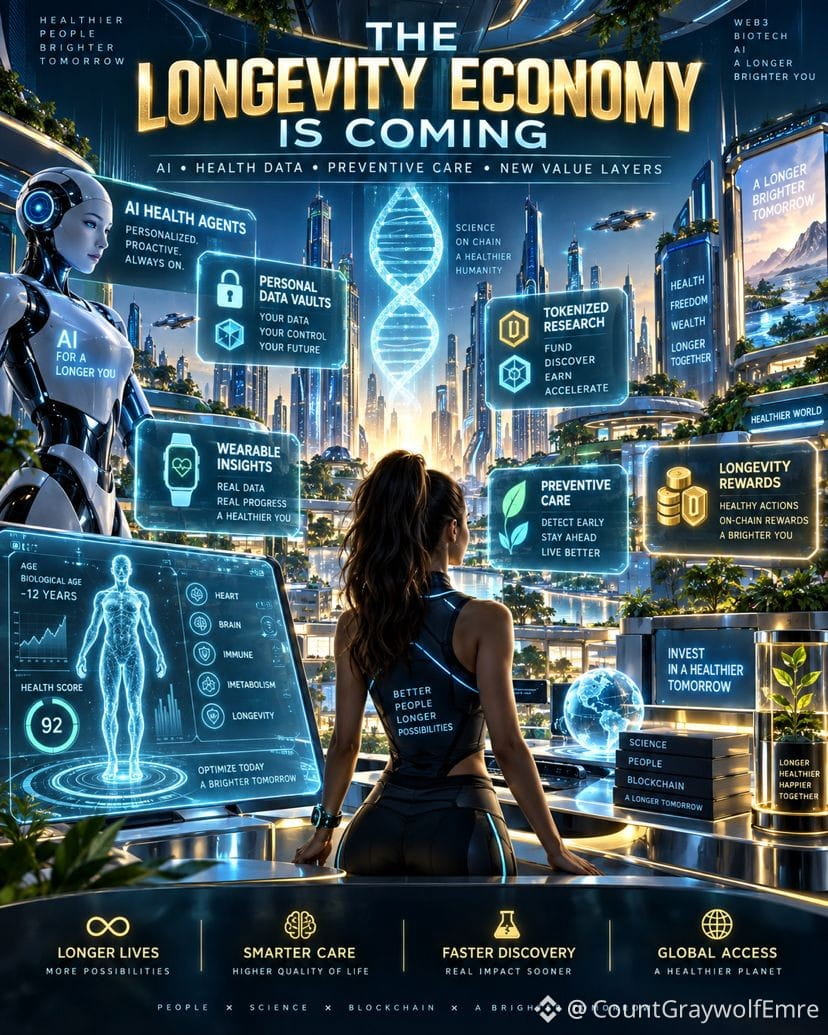
🚀 My prediction: the next major Web3 frontier could be LONGEVITY.
For years, crypto has focused on money, ownership, payments, and digital assets.
But what happens when blockchain, AI, biotechnology, and personal health data begin to converge?
Imagine a future where:
🧬 AI analyzes health data to support earlier, more personalized decisions.
⌚ Wearables continuously generate useful insights about sleep, activity, recovery, and lifestyle.
🔐 Personal health data stays inside user-controlled digital vaults.
🔬 Research projects raise funding globally through tokenized models.
🌍 Scientists collaborate across borders with transparent data and incentives.
🏆 People may even earn digital rewards for contributing verified data to research—with consent and privacy protections.
The real breakthrough may not be about “living forever.”
It could be about helping people live longer, healthier, and more informed lives.
🔥 AI accelerates discovery.
🧬 Biotech expands possibilities.
⛓️ Blockchain can improve ownership and transparency.
🌍 Global networks can connect researchers, funding, and participants.
My bold prediction:
AI + biotech + blockchain could create an entirely new “Longevity Economy” over the next decade.
Which area becomes mainstream first?
A) AI Health Agents 🤖
B) Personal Data Vaults 🔐
C) Tokenized Medical Research 🔬
D) Longevity & Wellness Rewards 🏆
👇 Drop your prediction below. Could the next major Web3 revolution happen in health and science rather than finance?
#Binance #BinanceSquare #crypto #Web3 #blockchain
🚀 My prediction: the next major Web3 frontier could be LONGEVITY.
For years, crypto has focused on money, ownership, payments, and digital assets.
But what happens when blockchain, AI, biotechnology, and personal health data begin to converge?
Imagine a future where:
🧬 AI analyzes health data to support earlier, more personalized decisions.
⌚ Wearables continuously generate useful insights about sleep, activity, recovery, and lifestyle.
🔐 Personal health data stays inside user-controlled digital vaults.
🔬 Research projects raise funding globally through tokenized models.
🌍 Scientists collaborate across borders with transparent data and incentives.
🏆 People may even earn digital rewards for contributing verified data to research—with consent and privacy protections.
The real breakthrough may not be about “living forever.”
It could be about helping people live longer, healthier, and more informed lives.
🔥 AI accelerates discovery.
🧬 Biotech expands possibilities.
⛓️ Blockchain can improve ownership and transparency.
🌍 Global networks can connect researchers, funding, and participants.
My bold prediction:
AI + biotech + blockchain could create an entirely new “Longevity Economy” over the next decade.
Which area becomes mainstream first?
A) AI Health Agents 🤖
B) Personal Data Vaults 🔐
C) Tokenized Medical Research 🔬
D) Longevity & Wellness Rewards 🏆
👇 Drop your prediction below. Could the next major Web3 revolution happen in health and science rather than finance?
#Binance #BinanceSquare #crypto #Web3 #blockchain
For years, crypto has focused on money, ownership, payments, and digital assets.
But what happens when blockchain, AI, biotechnology, and personal health data begin to converge?
Imagine a future where:
🧬 AI analyzes health data to support earlier, more personalized decisions.
⌚ Wearables continuously generate useful insights about sleep, activity, recovery, and lifestyle.
🔐 Personal health data stays inside user-controlled digital vaults.
🔬 Research projects raise funding globally through tokenized models.
🌍 Scientists collaborate across borders with transparent data and incentives.
🏆 People may even earn digital rewards for contributing verified data to research—with consent and privacy protections.
The real breakthrough may not be about “living forever.”
It could be about helping people live longer, healthier, and more informed lives.
🔥 AI accelerates discovery.
🧬 Biotech expands possibilities.
⛓️ Blockchain can improve ownership and transparency.
🌍 Global networks can connect researchers, funding, and participants.
My bold prediction:
AI + biotech + blockchain could create an entirely new “Longevity Economy” over the next decade.
Which area becomes mainstream first?
A) AI Health Agents 🤖
B) Personal Data Vaults 🔐
C) Tokenized Medical Research 🔬
D) Longevity & Wellness Rewards 🏆
👇 Drop your prediction below. Could the next major Web3 revolution happen in health and science rather than finance?
#Binance #BinanceSquare #crypto #Web3 #blockchain
57
If you are still assuming hard-capped tokenomics make a network immune to infinite supply bugs, stop now.
Most traders think getting caught in an infinite mint exploit is a modern DeFi nightmare. The brutal truth is that blind trust in code has nearly wiped out entire market caps before most people even entered the space.
Back in 2010, an integer overflow bug allowed a single transaction to generate over 184 billion $BTC in block 74638. At that moment only about 3.8 million existed, meaning one person had just printed almost 8,800 times the entire supply that will ever exist.
Much like the early $ETH DAO crisis or recent cross-chain bridge collapses, it threatened to render the asset worthless overnight. The difference came down to emergency consensus, as Satoshi and node operators patched the client and reorganized the chain within five hours before exchanges could be flooded.
If an exploit of that magnitude hit a top network today, do you think validators would coordinate a rollback or let the market absorb the damage?
#Bitcoin #CryptoHistory #Blockchain
If you are still assuming hard-capped tokenomics make a network immune to infinite supply bugs, stop now.
Most traders think getting caught in an infinite mint exploit is a modern DeFi nightmare. The brutal truth is that blind trust in code has nearly wiped out entire market caps before most people even entered the space.
Back in 2010, an integer overflow bug allowed a single transaction to generate over 184 billion $BTC in block 74638. At that moment only about 3.8 million existed, meaning one person had just printed almost 8,800 times the entire supply that will ever exist.
Much like the early $ETH DAO crisis or recent cross-chain bridge collapses, it threatened to render the asset worthless overnight. The difference came down to emergency consensus, as Satoshi and node operators patched the client and reorganized the chain within five hours before exchanges could be flooded.
If an exploit of that magnitude hit a top network today, do you think validators would coordinate a rollback or let the market absorb the damage?
#Bitcoin #CryptoHistory #Blockchain
Most traders think getting caught in an infinite mint exploit is a modern DeFi nightmare. The brutal truth is that blind trust in code has nearly wiped out entire market caps before most people even entered the space.
Back in 2010, an integer overflow bug allowed a single transaction to generate over 184 billion $BTC in block 74638. At that moment only about 3.8 million existed, meaning one person had just printed almost 8,800 times the entire supply that will ever exist.
Much like the early $ETH DAO crisis or recent cross-chain bridge collapses, it threatened to render the asset worthless overnight. The difference came down to emergency consensus, as Satoshi and node operators patched the client and reorganized the chain within five hours before exchanges could be flooded.
If an exploit of that magnitude hit a top network today, do you think validators would coordinate a rollback or let the market absorb the damage?
#Bitcoin #CryptoHistory #Blockchain
12

·
--
Everyone thinks blockchain code is completely immune to catastrophic failure, but actually, even the most secure networks were one hidden glitch away from total collapse.
Too many investors blindly trust protocol code without realizing that a single calculation error can drain liquidity and render an entire portfolio worthless overnight.
Think of it like an old digital scoreboard rolling past its maximum number and displaying an impossible score. Back in 2010, developer Jeff Garzik noticed block 74638 on $BTC, where an integer overflow bug silently generated over 184 billion coins out of thin air. Satoshi and core developers had to hard-fork the chain within five hours to erase the bogus transaction and restore balance.
Modern decentralized protocols and smart contracts on $ETH face the exact same arithmetic and logic vulnerabilities today. When a protocol miscalculates token balances or debt ceilings, automated bots exploit it in seconds, proving that code requires constant vigilance and disciplined auditing.
Where do you think the crypto market would be today if that glitch had gone unnoticed for another week?
#Bitcoin #CryptoSecurity #Blockchain
Everyone thinks blockchain code is completely immune to catastrophic failure, but actually, even the most secure networks were one hidden glitch away from total collapse.
Too many investors blindly trust protocol code without realizing that a single calculation error can drain liquidity and render an entire portfolio worthless overnight.
Think of it like an old digital scoreboard rolling past its maximum number and displaying an impossible score. Back in 2010, developer Jeff Garzik noticed block 74638 on $BTC , where an integer overflow bug silently generated over 184 billion coins out of thin air. Satoshi and core developers had to hard-fork the chain within five hours to erase the bogus transaction and restore balance.
Modern decentralized protocols and smart contracts on $ETH face the exact same arithmetic and logic vulnerabilities today. When a protocol miscalculates token balances or debt ceilings, automated bots exploit it in seconds, proving that code requires constant vigilance and disciplined auditing.
Where do you think the crypto market would be today if that glitch had gone unnoticed for another week?
#Bitcoin #CryptoSecurity #Blockchain
Too many investors blindly trust protocol code without realizing that a single calculation error can drain liquidity and render an entire portfolio worthless overnight.
Think of it like an old digital scoreboard rolling past its maximum number and displaying an impossible score. Back in 2010, developer Jeff Garzik noticed block 74638 on $BTC , where an integer overflow bug silently generated over 184 billion coins out of thin air. Satoshi and core developers had to hard-fork the chain within five hours to erase the bogus transaction and restore balance.
Modern decentralized protocols and smart contracts on $ETH face the exact same arithmetic and logic vulnerabilities today. When a protocol miscalculates token balances or debt ceilings, automated bots exploit it in seconds, proving that code requires constant vigilance and disciplined auditing.
Where do you think the crypto market would be today if that glitch had gone unnoticed for another week?
#Bitcoin #CryptoSecurity #Blockchain

1

·
--
If you think modern blockchain exploits are wild, ignoring the history of code vulnerabilities will cost you real money.
Most traders lose their capital not because of bad market timing, but because they blind-trust smart contracts without understanding structural risk. Getting rugged by an unexpected mint exploit hurts just as much as buying the absolute top.
Back on August 15, developer Jeff Garzik opened a forum thread with a quiet title: Strange block 74638. That modest post documented an integer overflow exploit that accidentally minted over 184 billion $BTC out of thin air in a single transaction.
Compare that response to how modern protocols or ecosystems around $ETH and $BNB handle catastrophic bugs today. Back in 2010, the network was patched and soft-forked within five hours to erase the phantom supply. Today, an exploit of that scale usually triggers days of governance gridlock, bridge halts, and drained liquidity pools before anyone agrees on a fix.
How do you think modern markets would react if a top network had to coordinate a chain rollback in under five hours today?
#Bitcoin #CryptoHistory #Blockchain
If you think modern blockchain exploits are wild, ignoring the history of code vulnerabilities will cost you real money.
Most traders lose their capital not because of bad market timing, but because they blind-trust smart contracts without understanding structural risk. Getting rugged by an unexpected mint exploit hurts just as much as buying the absolute top.
Back on August 15, developer Jeff Garzik opened a forum thread with a quiet title: Strange block 74638. That modest post documented an integer overflow exploit that accidentally minted over 184 billion $BTC out of thin air in a single transaction.
Compare that response to how modern protocols or ecosystems around $ETH and $BNB handle catastrophic bugs today. Back in 2010, the network was patched and soft-forked within five hours to erase the phantom supply. Today, an exploit of that scale usually triggers days of governance gridlock, bridge halts, and drained liquidity pools before anyone agrees on a fix.
How do you think modern markets would react if a top network had to coordinate a chain rollback in under five hours today?
#Bitcoin #CryptoHistory #Blockchain
Most traders lose their capital not because of bad market timing, but because they blind-trust smart contracts without understanding structural risk. Getting rugged by an unexpected mint exploit hurts just as much as buying the absolute top.
Back on August 15, developer Jeff Garzik opened a forum thread with a quiet title: Strange block 74638. That modest post documented an integer overflow exploit that accidentally minted over 184 billion $BTC out of thin air in a single transaction.
Compare that response to how modern protocols or ecosystems around $ETH and $BNB handle catastrophic bugs today. Back in 2010, the network was patched and soft-forked within five hours to erase the phantom supply. Today, an exploit of that scale usually triggers days of governance gridlock, bridge halts, and drained liquidity pools before anyone agrees on a fix.
How do you think modern markets would react if a top network had to coordinate a chain rollback in under five hours today?
#Bitcoin #CryptoHistory #Blockchain

12

Everyone thinks blockchain code is completely infallible, but history shows that even the most secure networks have faced catastrophic bugs.
Assuming any protocol is completely immune to errors often leads investors to let their guard down, risking severe capital loss when unexpected exploits occur.
Back on August 15, 2010, an integer overflow bug in block 74638 created over 184 billion $BTC out of thin air. Think of it like a bank ATM glitching and suddenly crediting trillions of dollars to a single account, threatening to destroy the value of all circulating currency in seconds.
Satoshi Nakamoto and developers patched the code and reset the chain within five hours. If a supply bug of that magnitude hit $ETH or modern DeFi infrastructure today, billions in liquidity would unravel across interconnected protocols before most traders even realized what happened.
Smart contracts and layer one code are still built by humans, which means protocol risk is always present. Managing risk means respecting the software layer rather than assuming code is absolute truth.
Do you think modern crypto markets could survive a critical supply bug as smoothly as early Bitcoin did?
#Bitcoin #CryptoSecurity #Blockchain
Everyone thinks blockchain code is completely infallible, but history shows that even the most secure networks have faced catastrophic bugs.
Assuming any protocol is completely immune to errors often leads investors to let their guard down, risking severe capital loss when unexpected exploits occur.
Back on August 15, 2010, an integer overflow bug in block 74638 created over 184 billion $BTC out of thin air. Think of it like a bank ATM glitching and suddenly crediting trillions of dollars to a single account, threatening to destroy the value of all circulating currency in seconds.
Satoshi Nakamoto and developers patched the code and reset the chain within five hours. If a supply bug of that magnitude hit $ETH or modern DeFi infrastructure today, billions in liquidity would unravel across interconnected protocols before most traders even realized what happened.
Smart contracts and layer one code are still built by humans, which means protocol risk is always present. Managing risk means respecting the software layer rather than assuming code is absolute truth.
Do you think modern crypto markets could survive a critical supply bug as smoothly as early Bitcoin did?
#Bitcoin #CryptoSecurity #Blockchain
Assuming any protocol is completely immune to errors often leads investors to let their guard down, risking severe capital loss when unexpected exploits occur.
Back on August 15, 2010, an integer overflow bug in block 74638 created over 184 billion $BTC out of thin air. Think of it like a bank ATM glitching and suddenly crediting trillions of dollars to a single account, threatening to destroy the value of all circulating currency in seconds.
Satoshi Nakamoto and developers patched the code and reset the chain within five hours. If a supply bug of that magnitude hit $ETH or modern DeFi infrastructure today, billions in liquidity would unravel across interconnected protocols before most traders even realized what happened.
Smart contracts and layer one code are still built by humans, which means protocol risk is always present. Managing risk means respecting the software layer rather than assuming code is absolute truth.
Do you think modern crypto markets could survive a critical supply bug as smoothly as early Bitcoin did?
#Bitcoin #CryptoSecurity #Blockchain
8
If you still assume any blockchain is completely immune to catastrophic software bugs, you are setting yourself up for a nasty surprise.
Most investors blindly trust code immutability right until an exploit drains liquidity or freezes their assets. Watching a network halt or rollback can completely shatter your thesis in seconds.
Back in August 2010, an integer overflow bug quietly generated 184.4 billion $BTC out of thin air at block 74638. Satoshi and early developers had to coordinate an emergency chain rollback within five hours to overwrite the bad transactions while most of the world was asleep.
We often point fingers at modern halts on $SOL or the historic hard fork that split $ETH and Classic as proof that newer chains are sloppy. In reality, even the oldest network required manual human intervention to survive its early days.
If an exploit of that scale happened on a top network today, do you think validators would coordinate a rollback or let the market take the hit?
#Bitcoin #CryptoHistory #Blockchain
If you still assume any blockchain is completely immune to catastrophic software bugs, you are setting yourself up for a nasty surprise.
Most investors blindly trust code immutability right until an exploit drains liquidity or freezes their assets. Watching a network halt or rollback can completely shatter your thesis in seconds.
Back in August 2010, an integer overflow bug quietly generated 184.4 billion $BTC out of thin air at block 74638. Satoshi and early developers had to coordinate an emergency chain rollback within five hours to overwrite the bad transactions while most of the world was asleep.
We often point fingers at modern halts on $SOL or the historic hard fork that split $ETH and Classic as proof that newer chains are sloppy. In reality, even the oldest network required manual human intervention to survive its early days.
If an exploit of that scale happened on a top network today, do you think validators would coordinate a rollback or let the market take the hit?
#Bitcoin #CryptoHistory #Blockchain
Most investors blindly trust code immutability right until an exploit drains liquidity or freezes their assets. Watching a network halt or rollback can completely shatter your thesis in seconds.
Back in August 2010, an integer overflow bug quietly generated 184.4 billion $BTC out of thin air at block 74638. Satoshi and early developers had to coordinate an emergency chain rollback within five hours to overwrite the bad transactions while most of the world was asleep.
We often point fingers at modern halts on $SOL or the historic hard fork that split $ETH and Classic as proof that newer chains are sloppy. In reality, even the oldest network required manual human intervention to survive its early days.
If an exploit of that scale happened on a top network today, do you think validators would coordinate a rollback or let the market take the hit?
#Bitcoin #CryptoHistory #Blockchain
29
🚨 My prediction: one of the most powerful crypto use cases of the next decade may appear when the world needs speed the most.
Today, disaster response often struggles with delays, fragmented information, slow payments, and unclear aid distribution.
But imagine a different system.
🛰️ Satellite data detects damage within minutes.
🤖 AI identifies the areas that need help first.
🚁 Drones deliver medicine, food, and emergency supplies.
💵 Stablecoins move relief funds instantly across borders.
⛓️ Blockchain records where aid was sent and how it was used.
📦 Tokenized supply chains help verify critical goods from warehouse to survivor.
The biggest breakthrough may not be another trading feature.
It may be financial infrastructure that keeps working when traditional systems are under pressure.
🔥 AI sees the problem.
🛰️ Satellites map it.
🚁 Drones reach it.
⛓️ Blockchain verifies it.
💵 Digital payments fund the response.
My bold prediction:
Disaster resilience could become one of Web3’s most meaningful real-world applications.
What becomes mainstream first?
A) Instant Relief Payments 💵
B) AI + Drone Logistics 🚁
C) On-Chain Aid Transparency ⛓️
D) Parametric Disaster Funds 🌍
👇 Drop your prediction below. Which technology could make the biggest difference when every minute matters?
#Binance #BİNANCESQUARE #crypto #Web3 #blockchain
🚨 My prediction: one of the most powerful crypto use cases of the next decade may appear when the world needs speed the most.
Today, disaster response often struggles with delays, fragmented information, slow payments, and unclear aid distribution.
But imagine a different system.
🛰️ Satellite data detects damage within minutes.
🤖 AI identifies the areas that need help first.
🚁 Drones deliver medicine, food, and emergency supplies.
💵 Stablecoins move relief funds instantly across borders.
⛓️ Blockchain records where aid was sent and how it was used.
📦 Tokenized supply chains help verify critical goods from warehouse to survivor.
The biggest breakthrough may not be another trading feature.
It may be financial infrastructure that keeps working when traditional systems are under pressure.
🔥 AI sees the problem.
🛰️ Satellites map it.
🚁 Drones reach it.
⛓️ Blockchain verifies it.
💵 Digital payments fund the response.
My bold prediction:
Disaster resilience could become one of Web3’s most meaningful real-world applications.
What becomes mainstream first?
A) Instant Relief Payments 💵
B) AI + Drone Logistics 🚁
C) On-Chain Aid Transparency ⛓️
D) Parametric Disaster Funds 🌍
👇 Drop your prediction below. Which technology could make the biggest difference when every minute matters?
#Binance #BİNANCESQUARE #crypto #Web3 #blockchain
Today, disaster response often struggles with delays, fragmented information, slow payments, and unclear aid distribution.
But imagine a different system.
🛰️ Satellite data detects damage within minutes.
🤖 AI identifies the areas that need help first.
🚁 Drones deliver medicine, food, and emergency supplies.
💵 Stablecoins move relief funds instantly across borders.
⛓️ Blockchain records where aid was sent and how it was used.
📦 Tokenized supply chains help verify critical goods from warehouse to survivor.
The biggest breakthrough may not be another trading feature.
It may be financial infrastructure that keeps working when traditional systems are under pressure.
🔥 AI sees the problem.
🛰️ Satellites map it.
🚁 Drones reach it.
⛓️ Blockchain verifies it.
💵 Digital payments fund the response.
My bold prediction:
Disaster resilience could become one of Web3’s most meaningful real-world applications.
What becomes mainstream first?
A) Instant Relief Payments 💵
B) AI + Drone Logistics 🚁
C) On-Chain Aid Transparency ⛓️
D) Parametric Disaster Funds 🌍
👇 Drop your prediction below. Which technology could make the biggest difference when every minute matters?
#Binance #BİNANCESQUARE #crypto #Web3 #blockchain

58
Optimized Post Text (Binance Square Final Draft):
The global financial ecosystem isn’t just evolving—it’s shifting permanently. 🚀
We are moving away from rigid, legacy structures toward a decentralized, high-accessibility future led by $BTC and blockchain technology.
What used to take traditional banking days now happens in milliseconds.
What was once reserved for institutional elites is now accessible to anyone with a smartphone.
Here is what is driving this shift right now:
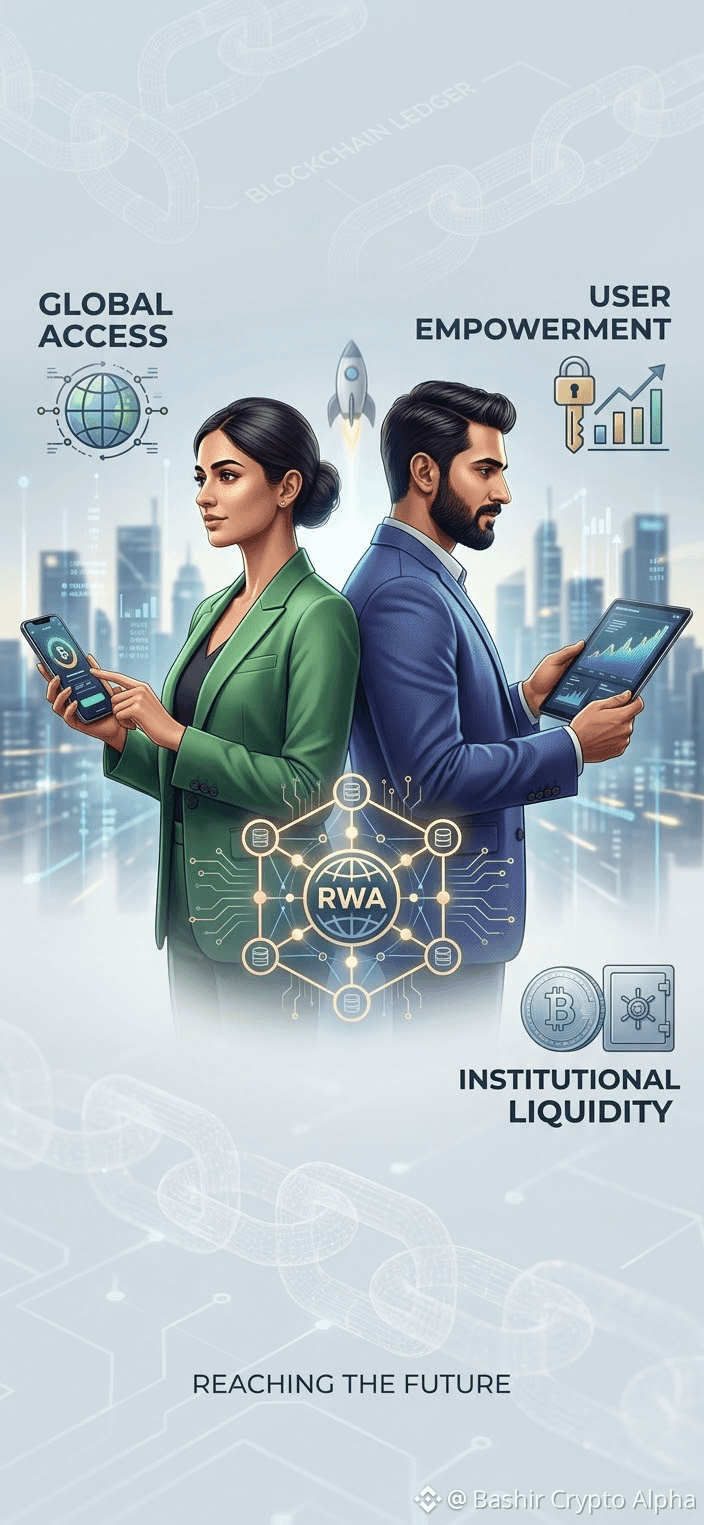
🌐 Global Access: Seamless cross-border adoption removing geographic barriers.
💧 Institutional Liquidity: Real-World Assets (RWA) and digital ecosystems merging like never before.
⚡ User Empowerment: Complete control over assets, data, and participation.
The future of finance belongs to those who adapt early.
Are you actively positioning yourself for this transition, or watching from the sidelines?
Let’s discuss in the comments below 👇
$BTC
#Web3 #Finance #blockchain #Innovation #MarketTrends"
Optimized Post Text (Binance Square Final Draft):
The global financial ecosystem isn’t just evolving—it’s shifting permanently. 🚀
We are moving away from rigid, legacy structures toward a decentralized, high-accessibility future led by $BTC and blockchain technology.
What used to take traditional banking days now happens in milliseconds.
What was once reserved for institutional elites is now accessible to anyone with a smartphone.
Here is what is driving this shift right now:
🌐 Global Access: Seamless cross-border adoption removing geographic barriers.
💧 Institutional Liquidity: Real-World Assets (RWA) and digital ecosystems merging like never before.
⚡ User Empowerment: Complete control over assets, data, and participation.
The future of finance belongs to those who adapt early.
Are you actively positioning yourself for this transition, or watching from the sidelines?
Let’s discuss in the comments below 👇
$BTC
#Web3 #Finance #blockchain #Innovation #MarketTrends"
The global financial ecosystem isn’t just evolving—it’s shifting permanently. 🚀
We are moving away from rigid, legacy structures toward a decentralized, high-accessibility future led by $BTC and blockchain technology.
What used to take traditional banking days now happens in milliseconds.
What was once reserved for institutional elites is now accessible to anyone with a smartphone.
Here is what is driving this shift right now:
🌐 Global Access: Seamless cross-border adoption removing geographic barriers.
💧 Institutional Liquidity: Real-World Assets (RWA) and digital ecosystems merging like never before.
⚡ User Empowerment: Complete control over assets, data, and participation.
The future of finance belongs to those who adapt early.
Are you actively positioning yourself for this transition, or watching from the sidelines?
Let’s discuss in the comments below 👇
$BTC
#Web3 #Finance #blockchain #Innovation #MarketTrends"
57
·
--
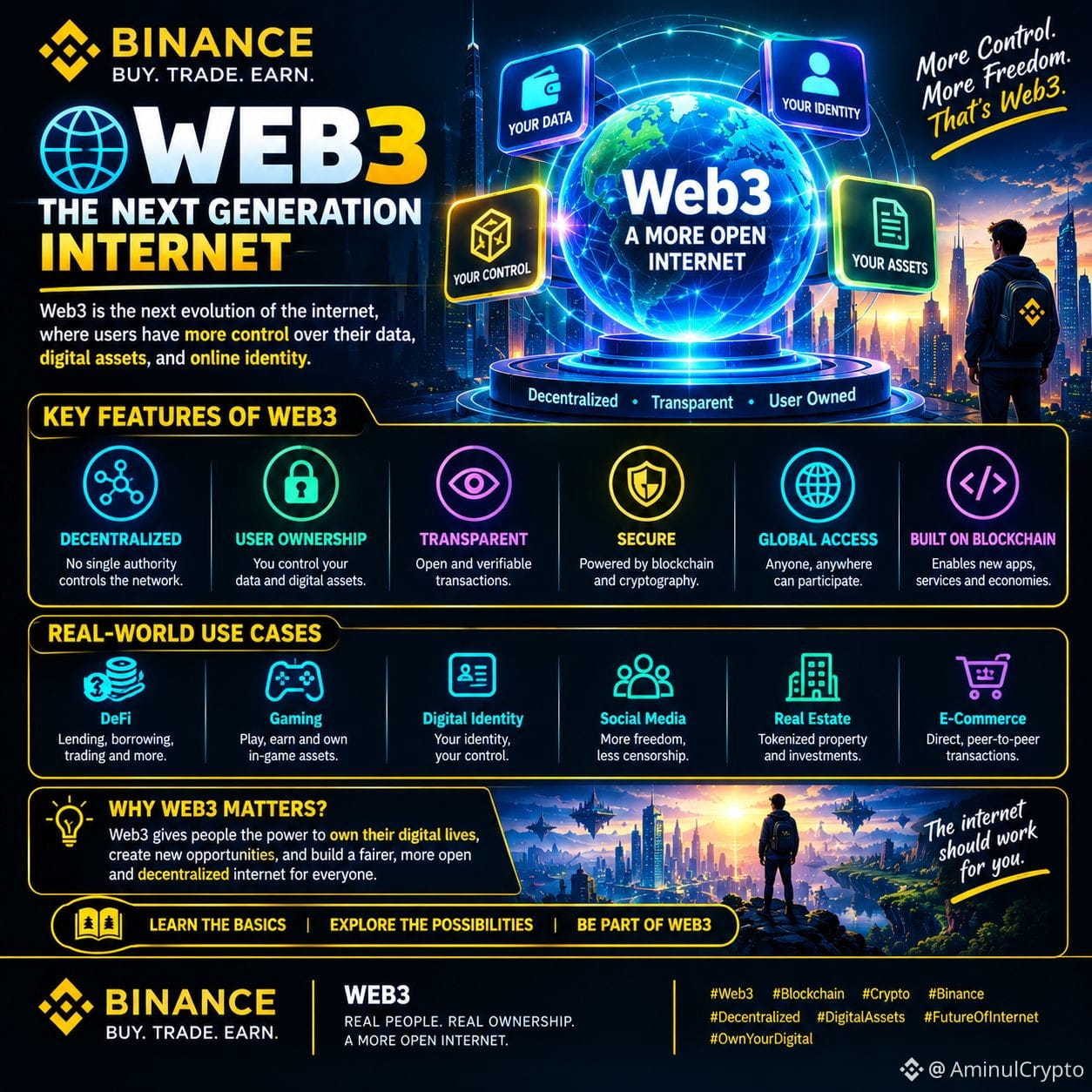
🌐 WEB3: THE NEXT GENERATION OF THE INTERNET
Web3 is an evolving vision of the internet where blockchain technology can give users more control over their data, digital assets, and online identity.
🔹 Decentralized
🔹 User Ownership
🔹 Transparent
🔹 Blockchain-powered
🔹 Global Access
Web3 is opening new possibilities across:
💰 DeFi
🎮 Gaming
🪪 Digital Identity
💬 Social Platforms
🏠 Tokenized Assets
🛒 E-Commerce
The idea behind Web3 is simple: instead of everything being controlled by a few centralized platforms, users can have a greater role in owning and interacting with digital assets and services.
📚 Learn the basics.
🔍 Explore the technology.
💡 Understand the risks before participating.
Web3 is still evolving — but its impact on the future of the internet could be significant. 🚀
What interests you most about Web3: DeFi, Gaming, Digital Identity, or Digital Ownership? 👇
#Web3 #Blockchain #Crypto #Binance #CryptoEducation
🌐 WEB3: THE NEXT GENERATION OF THE INTERNET
Web3 is an evolving vision of the internet where blockchain technology can give users more control over their data, digital assets, and online identity.
🔹 Decentralized
🔹 User Ownership
🔹 Transparent
🔹 Blockchain-powered
🔹 Global Access
Web3 is opening new possibilities across:
💰 DeFi
🎮 Gaming
🪪 Digital Identity
💬 Social Platforms
🏠 Tokenized Assets
🛒 E-Commerce
The idea behind Web3 is simple: instead of everything being controlled by a few centralized platforms, users can have a greater role in owning and interacting with digital assets and services.
📚 Learn the basics.
🔍 Explore the technology.
💡 Understand the risks before participating.
Web3 is still evolving — but its impact on the future of the internet could be significant. 🚀
What interests you most about Web3: DeFi, Gaming, Digital Identity, or Digital Ownership? 👇
#Web3 #Blockchain #Crypto #Binance #CryptoEducation
Web3 is an evolving vision of the internet where blockchain technology can give users more control over their data, digital assets, and online identity.
🔹 Decentralized
🔹 User Ownership
🔹 Transparent
🔹 Blockchain-powered
🔹 Global Access
Web3 is opening new possibilities across:
💰 DeFi
🎮 Gaming
🪪 Digital Identity
💬 Social Platforms
🏠 Tokenized Assets
🛒 E-Commerce
The idea behind Web3 is simple: instead of everything being controlled by a few centralized platforms, users can have a greater role in owning and interacting with digital assets and services.
📚 Learn the basics.
🔍 Explore the technology.
💡 Understand the risks before participating.
Web3 is still evolving — but its impact on the future of the internet could be significant. 🚀
What interests you most about Web3: DeFi, Gaming, Digital Identity, or Digital Ownership? 👇
#Web3 #Blockchain #Crypto #Binance #CryptoEducation
72

Cryptocurrency is revolutionizing how we think about money, transactions, and digital ownership. Powered by decentralized blockchain technology, it offers a secure, fast, and borderless way to transfer value globally without relying on traditional intermediaries.
Key Highlights:
Decentralization: Operating on blockchain networks, crypto eliminates central points of failure and middleman fees.
Financial Inclusion: Anyone with an internet connection can access global financial services instantly.
Innovation & Utility: Beyond simple transactions, smart contracts and Web3 apps are creating entirely new digital economies.
While the market offers tremendous opportunities for growth, staying informed and prioritizing security are essential for navigating this space safely.
Are you currently investing in crypto, or are you still exploring how it works? Let me know your thoughts in the comments! 👇
#Cryptocurrency
#Blockchain #Web3 #Finance #FutureOfMoney
Cryptocurrency is revolutionizing how we think about money, transactions, and digital ownership. Powered by decentralized blockchain technology, it offers a secure, fast, and borderless way to transfer value globally without relying on traditional intermediaries.
Key Highlights:
Decentralization: Operating on blockchain networks, crypto eliminates central points of failure and middleman fees.
Financial Inclusion: Anyone with an internet connection can access global financial services instantly.
Innovation & Utility: Beyond simple transactions, smart contracts and Web3 apps are creating entirely new digital economies.
While the market offers tremendous opportunities for growth, staying informed and prioritizing security are essential for navigating this space safely.
Are you currently investing in crypto, or are you still exploring how it works? Let me know your thoughts in the comments! 👇
#Cryptocurrency
#Blockchain #Web3 #Finance #FutureOfMoney
Key Highlights:
Decentralization: Operating on blockchain networks, crypto eliminates central points of failure and middleman fees.
Financial Inclusion: Anyone with an internet connection can access global financial services instantly.
Innovation & Utility: Beyond simple transactions, smart contracts and Web3 apps are creating entirely new digital economies.
While the market offers tremendous opportunities for growth, staying informed and prioritizing security are essential for navigating this space safely.
Are you currently investing in crypto, or are you still exploring how it works? Let me know your thoughts in the comments! 👇
#Cryptocurrency
#Blockchain #Web3 #Finance #FutureOfMoney
60

·
--
$ARKM
{future}(ARKMUSDT)
ARKM focuses on blockchain intelligence and on-chain data. The ecosystem aims to make blockchain activity easier to analyze and understand.
As crypto markets become more data-driven, tools that help users research wallets, transactions, and on-chain activity can become increasingly useful.
#ARKM #Blockchain #OnChain #BinanceSquare
$ARKM
ARKM focuses on blockchain intelligence and on-chain data. The ecosystem aims to make blockchain activity easier to analyze and understand.
As crypto markets become more data-driven, tools that help users research wallets, transactions, and on-chain activity can become increasingly useful.
#ARKM #Blockchain #OnChain #BinanceSquare
ARKM focuses on blockchain intelligence and on-chain data. The ecosystem aims to make blockchain activity easier to analyze and understand.
As crypto markets become more data-driven, tools that help users research wallets, transactions, and on-chain activity can become increasingly useful.
#ARKM #Blockchain #OnChain #BinanceSquare
90


Sending One Block 1,000 Times Doesn’t Scale 📡
$ETH and $SOL have radically different approaches to block production, but both depend on information spreading from a relatively small number of sources toward much larger sets of machines.
On the normal internet, sending the same information to many destinations can mean repeatedly creating and transmitting separate copies.
That becomes increasingly inefficient as the number of receivers and amount of data grow.
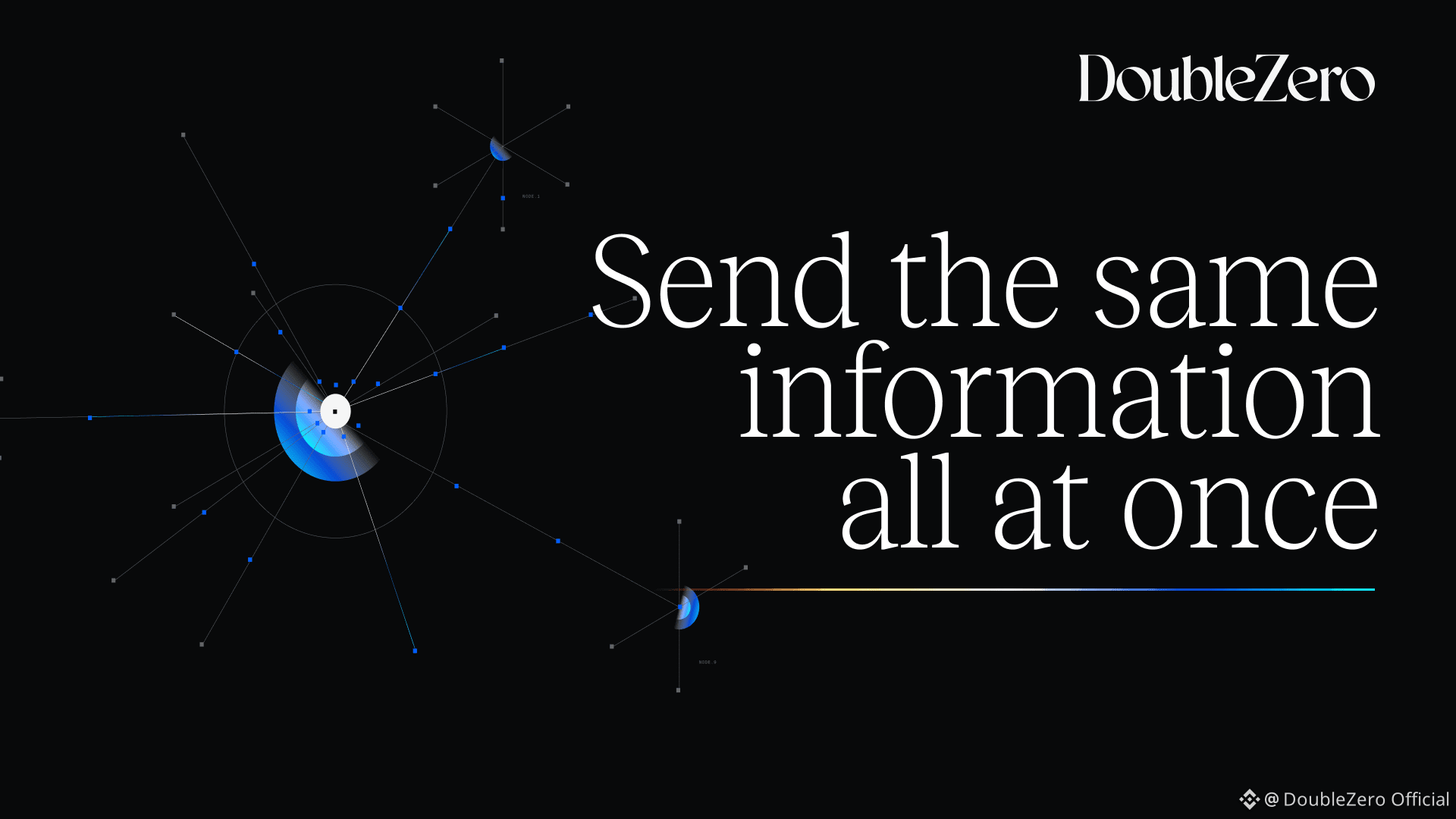
DoubleZero’s inner network is designed to support multicast.
Instead of forcing the sender to individually transmit the same stream toward every destination, data can enter the network once and be replicated inside the network as it moves toward multiple receivers.
The distinction matters because bandwidth at the sender is no longer required to grow in lockstep with the number of machines receiving the same information.
Blockchains spend enormous engineering effort making block production faster.
But after a block exists, somebody still has to tell everyone else about it.
#blockchain #Scaling
Sending One Block 1,000 Times Doesn’t Scale 📡
$ETH and $SOL have radically different approaches to block production, but both depend on information spreading from a relatively small number of sources toward much larger sets of machines.
On the normal internet, sending the same information to many destinations can mean repeatedly creating and transmitting separate copies.
That becomes increasingly inefficient as the number of receivers and amount of data grow.
DoubleZero’s inner network is designed to support multicast.
Instead of forcing the sender to individually transmit the same stream toward every destination, data can enter the network once and be replicated inside the network as it moves toward multiple receivers.
The distinction matters because bandwidth at the sender is no longer required to grow in lockstep with the number of machines receiving the same information.
Blockchains spend enormous engineering effort making block production faster.
But after a block exists, somebody still has to tell everyone else about it.
#blockchain #Scaling
$ETH and $SOL have radically different approaches to block production, but both depend on information spreading from a relatively small number of sources toward much larger sets of machines.
On the normal internet, sending the same information to many destinations can mean repeatedly creating and transmitting separate copies.
That becomes increasingly inefficient as the number of receivers and amount of data grow.
DoubleZero’s inner network is designed to support multicast.
Instead of forcing the sender to individually transmit the same stream toward every destination, data can enter the network once and be replicated inside the network as it moves toward multiple receivers.
The distinction matters because bandwidth at the sender is no longer required to grow in lockstep with the number of machines receiving the same information.
Blockchains spend enormous engineering effort making block production faster.
But after a block exists, somebody still has to tell everyone else about it.
#blockchain #Scaling
94
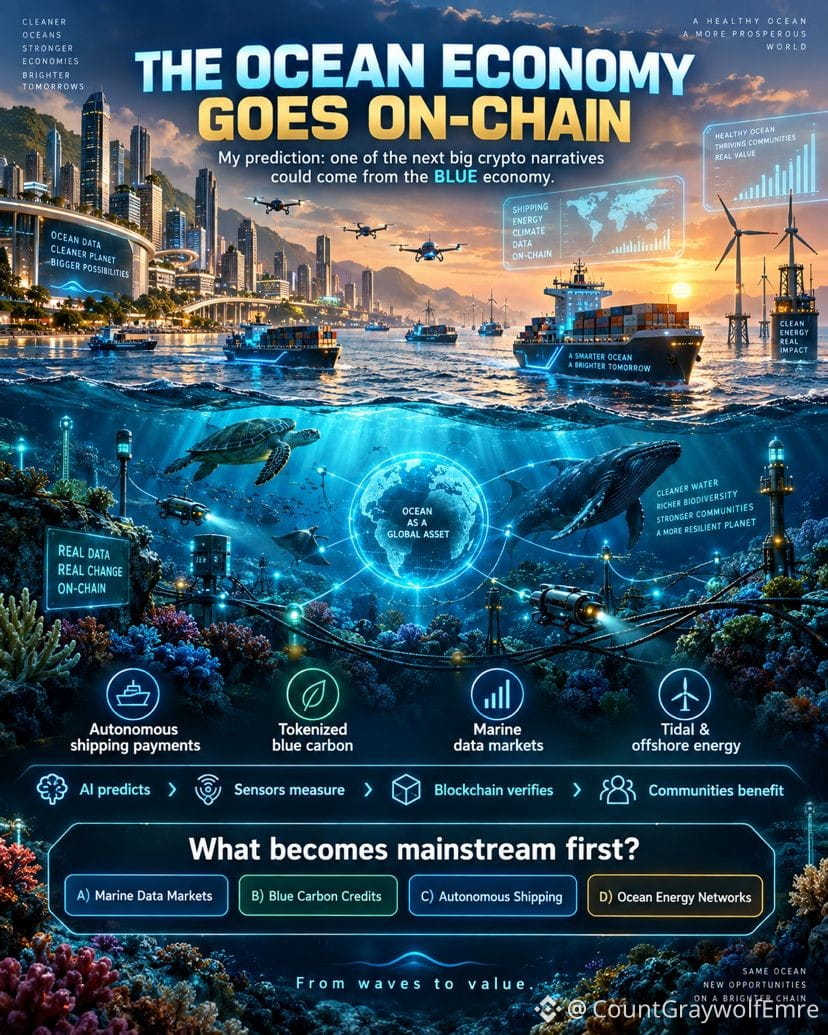
🚀 My prediction: one of the most unexpected crypto narratives of the next decade could come from the OCEAN ECONOMY.
We usually talk about crypto through finance, AI, gaming, and tokenization.
But what if one of the next major real-world use cases comes from the sea?
Imagine a future where:
🌊 Marine data is traded transparently on-chain
🚢 Autonomous ships pay for fuel, ports, and services automatically
🌱 Blue-carbon projects are tracked and verified digitally
⚡ Offshore wind and tidal energy connect to decentralized markets
🤖 AI monitors shipping routes, pollution, biodiversity, and ocean infrastructure in real time
📡 Sensors continuously feed verified environmental data into blockchain networks
The ocean already connects global trade, energy, climate, and food systems.
Blockchain could eventually become a coordination layer connecting the data, payments, incentives, and infrastructure behind that economy.
🔥 AI predicts.
📡 Sensors measure.
⛓️ Blockchain verifies.
🌍 Communities and industries benefit.
My bold prediction:
The “Blue Economy” could become one of Web3’s most interesting real-world frontiers.
What becomes mainstream first?
A) Marine Data Markets 🌊
B) Blue Carbon Credits 🌱
C) Autonomous Shipping 🚢
D) Ocean Energy Networks ⚡
👇 Drop your prediction below. Which one sounds futuristic today but obvious tomorrow?
#Binance #BinanceSquare #crypto #Web3 #blockchain
🚀 My prediction: one of the most unexpected crypto narratives of the next decade could come from the OCEAN ECONOMY.
We usually talk about crypto through finance, AI, gaming, and tokenization.
But what if one of the next major real-world use cases comes from the sea?
Imagine a future where:
🌊 Marine data is traded transparently on-chain
🚢 Autonomous ships pay for fuel, ports, and services automatically
🌱 Blue-carbon projects are tracked and verified digitally
⚡ Offshore wind and tidal energy connect to decentralized markets
🤖 AI monitors shipping routes, pollution, biodiversity, and ocean infrastructure in real time
📡 Sensors continuously feed verified environmental data into blockchain networks
The ocean already connects global trade, energy, climate, and food systems.
Blockchain could eventually become a coordination layer connecting the data, payments, incentives, and infrastructure behind that economy.
🔥 AI predicts.
📡 Sensors measure.
⛓️ Blockchain verifies.
🌍 Communities and industries benefit.
My bold prediction:
The “Blue Economy” could become one of Web3’s most interesting real-world frontiers.
What becomes mainstream first?
A) Marine Data Markets 🌊
B) Blue Carbon Credits 🌱
C) Autonomous Shipping 🚢
D) Ocean Energy Networks ⚡
👇 Drop your prediction below. Which one sounds futuristic today but obvious tomorrow?
#Binance #BinanceSquare #crypto #Web3 #blockchain
We usually talk about crypto through finance, AI, gaming, and tokenization.
But what if one of the next major real-world use cases comes from the sea?
Imagine a future where:
🌊 Marine data is traded transparently on-chain
🚢 Autonomous ships pay for fuel, ports, and services automatically
🌱 Blue-carbon projects are tracked and verified digitally
⚡ Offshore wind and tidal energy connect to decentralized markets
🤖 AI monitors shipping routes, pollution, biodiversity, and ocean infrastructure in real time
📡 Sensors continuously feed verified environmental data into blockchain networks
The ocean already connects global trade, energy, climate, and food systems.
Blockchain could eventually become a coordination layer connecting the data, payments, incentives, and infrastructure behind that economy.
🔥 AI predicts.
📡 Sensors measure.
⛓️ Blockchain verifies.
🌍 Communities and industries benefit.
My bold prediction:
The “Blue Economy” could become one of Web3’s most interesting real-world frontiers.
What becomes mainstream first?
A) Marine Data Markets 🌊
B) Blue Carbon Credits 🌱
C) Autonomous Shipping 🚢
D) Ocean Energy Networks ⚡
👇 Drop your prediction below. Which one sounds futuristic today but obvious tomorrow?
#Binance #BinanceSquare #crypto #Web3 #blockchain
60

🌐 CRYPTO: THE INTERNET OF MONEY?
You’ve probably heard people talk about Bitcoin, Ethereum, USDT, Web3, and blockchain.
But what exactly is crypto?
Let’s break it down in 60 seconds. 👇
🔹 1. Crypto = Digital Asset
Cryptocurrency is a digital asset that exists electronically. It can be transferred between people without necessarily relying on a traditional bank for every transaction.
🔹 2. Blockchain = The Technology Behind It
Imagine a digital ledger that records transactions across a network of computers.
That technology is called blockchain.
It helps make transaction records transparent, verifiable, and difficult to change.
🔹 3. Bitcoin = The Pioneer ₿
Bitcoin was the first widely adopted cryptocurrency.
Its main idea was simple but powerful:
“Can people transfer value digitally without depending on a central authority?”
🔹 4. Ethereum = More Than a Cryptocurrency
Ethereum introduced a blockchain designed to support smart contracts and decentralized applications—not just digital payments.
🔹 5. USDT = A Stablecoin
Unlike highly volatile cryptocurrencies, stablecoins such as USDT are designed to maintain a value close to the US dollar.
⚠️ But here’s the part beginners should never ignore:
Crypto is NOT a guaranteed way to make money.
Prices can move dramatically, scams exist, and every investment carries risk.
📚 Learn first. Research second. Invest only when you understand the risk.
💬 YOUR TURN:
If you could learn only ONE crypto topic next, which would you choose?
1️⃣ Bitcoin
2️⃣ Ethereum
3️⃣ Trading
4️⃣ Blockchain
#Ethereum #Blockchain #BinanceSquareTalks #bitcoin
Drop the number below 👇
🌐 CRYPTO: THE INTERNET OF MONEY?
You’ve probably heard people talk about Bitcoin, Ethereum, USDT, Web3, and blockchain.
But what exactly is crypto?
Let’s break it down in 60 seconds. 👇
🔹 1. Crypto = Digital Asset
Cryptocurrency is a digital asset that exists electronically. It can be transferred between people without necessarily relying on a traditional bank for every transaction.
🔹 2. Blockchain = The Technology Behind It
Imagine a digital ledger that records transactions across a network of computers.
That technology is called blockchain.
It helps make transaction records transparent, verifiable, and difficult to change.
🔹 3. Bitcoin = The Pioneer ₿
Bitcoin was the first widely adopted cryptocurrency.
Its main idea was simple but powerful:
“Can people transfer value digitally without depending on a central authority?”
🔹 4. Ethereum = More Than a Cryptocurrency
Ethereum introduced a blockchain designed to support smart contracts and decentralized applications—not just digital payments.
🔹 5. USDT = A Stablecoin
Unlike highly volatile cryptocurrencies, stablecoins such as USDT are designed to maintain a value close to the US dollar.
⚠️ But here’s the part beginners should never ignore:
Crypto is NOT a guaranteed way to make money.
Prices can move dramatically, scams exist, and every investment carries risk.
📚 Learn first. Research second. Invest only when you understand the risk.
💬 YOUR TURN:
If you could learn only ONE crypto topic next, which would you choose?
1️⃣ Bitcoin
2️⃣ Ethereum
3️⃣ Trading
4️⃣ Blockchain
#Ethereum #Blockchain #BinanceSquareTalks #bitcoin
Drop the number below 👇
You’ve probably heard people talk about Bitcoin, Ethereum, USDT, Web3, and blockchain.
But what exactly is crypto?
Let’s break it down in 60 seconds. 👇
🔹 1. Crypto = Digital Asset
Cryptocurrency is a digital asset that exists electronically. It can be transferred between people without necessarily relying on a traditional bank for every transaction.
🔹 2. Blockchain = The Technology Behind It
Imagine a digital ledger that records transactions across a network of computers.
That technology is called blockchain.
It helps make transaction records transparent, verifiable, and difficult to change.
🔹 3. Bitcoin = The Pioneer ₿
Bitcoin was the first widely adopted cryptocurrency.
Its main idea was simple but powerful:
“Can people transfer value digitally without depending on a central authority?”
🔹 4. Ethereum = More Than a Cryptocurrency
Ethereum introduced a blockchain designed to support smart contracts and decentralized applications—not just digital payments.
🔹 5. USDT = A Stablecoin
Unlike highly volatile cryptocurrencies, stablecoins such as USDT are designed to maintain a value close to the US dollar.
⚠️ But here’s the part beginners should never ignore:
Crypto is NOT a guaranteed way to make money.
Prices can move dramatically, scams exist, and every investment carries risk.
📚 Learn first. Research second. Invest only when you understand the risk.
💬 YOUR TURN:
If you could learn only ONE crypto topic next, which would you choose?
1️⃣ Bitcoin
2️⃣ Ethereum
3️⃣ Trading
4️⃣ Blockchain
#Ethereum #Blockchain #BinanceSquareTalks #bitcoin
Drop the number below 👇
Bitcoin
75%
Ethereum
25%
Trading
0%
Blockchain
0%
4 votes • Voting closed
214

·
--
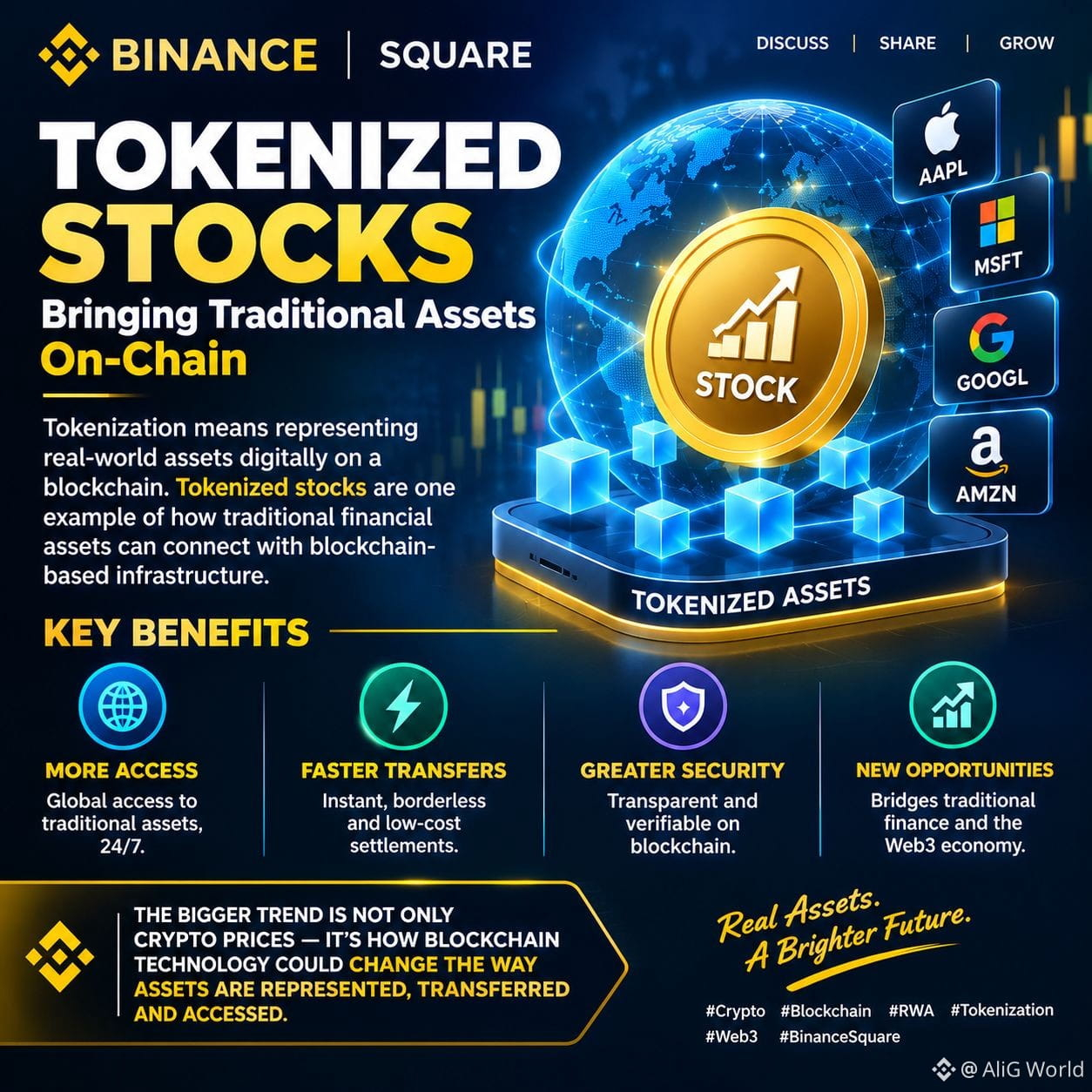
Tokenized Stocks: Bringing Traditional Assets On-Chain 🌐
$RWA Tokenization means representing real-world assets digitally on a blockchain. Tokenized stocks are one example of how traditional financial assets can connect with blockchain-based infrastructure.
The bigger trend is not only crypto prices — it’s how blockchain technology could change the way assets are represented, transferred and accessed.
{alpha}(560x9c8b5ca345247396bdfac0395638ca9045c6586e)
#Crypto #Blockchain #RWA #Web3 #cryptoeducation
Tokenized Stocks: Bringing Traditional Assets On-Chain 🌐
$RWA Tokenization means representing real-world assets digitally on a blockchain. Tokenized stocks are one example of how traditional financial assets can connect with blockchain-based infrastructure.
The bigger trend is not only crypto prices — it’s how blockchain technology could change the way assets are represented, transferred and accessed.
#Crypto #Blockchain #RWA #Web3 #cryptoeducation
$RWA Tokenization means representing real-world assets digitally on a blockchain. Tokenized stocks are one example of how traditional financial assets can connect with blockchain-based infrastructure.
The bigger trend is not only crypto prices — it’s how blockchain technology could change the way assets are represented, transferred and accessed.
#Crypto #Blockchain #RWA #Web3 #cryptoeducation
123

🌐 Binance: Where the Future of Digital Finance BeginsThe world of finance is changing faster than ever. Today, digital assets and blockchain technology are creating new possibilities for people around the world.
Binance has become one of the best-known platforms in the crypto industry, bringing trading, blockchain services, and digital-asset education together in one ecosystem.
✨ Why is Binance interesting?
🔹 Global Crypto Ecosystem
Binance provides a wide range of services designed to help users explore the digital-asset world.
🔹 Technology & Innovation
Blockchain technology is opening the door to faster, more transparent and innovative financial systems.
🔹 Learning Matters
Crypto isn't just about prices going up or down. Understanding blockchain, risk management and responsible decision-making is equally important.
🔹 A Changing Financial Future
As digital finance continues to evolve, platforms like Binance are part of a much bigger conversation about how people may interact with money and technology in the future.
💡 My takeaway:
The most exciting part of crypto isn't simply watching the market — it's learning how the technology works and understanding the opportunities and risks that come with it.
The future of finance is being built today. #blockchain #DigitalFinance #Web3 #cryptocurrency #BinanceCommunity
🌐 Binance: Where the Future of Digital Finance Begins
The world of finance is changing faster than ever. Today, digital assets and blockchain technology are creating new possibilities for people around the world.
Binance has become one of the best-known platforms in the crypto industry, bringing trading, blockchain services, and digital-asset education together in one ecosystem.
✨ Why is Binance interesting?
🔹 Global Crypto Ecosystem
Binance provides a wide range of services designed to help users explore the digital-asset world.
🔹 Technology & Innovation
Blockchain technology is opening the door to faster, more transparent and innovative financial systems.
🔹 Learning Matters
Crypto isn't just about prices going up or down. Understanding blockchain, risk management and responsible decision-making is equally important.
🔹 A Changing Financial Future
As digital finance continues to evolve, platforms like Binance are part of a much bigger conversation about how people may interact with money and technology in the future.
💡 My takeaway:
The most exciting part of crypto isn't simply watching the market — it's learning how the technology works and understanding the opportunities and risks that come with it.
The future of finance is being built today. #blockchain #DigitalFinance #Web3 #cryptocurrency #BinanceCommunity
Binance has become one of the best-known platforms in the crypto industry, bringing trading, blockchain services, and digital-asset education together in one ecosystem.
✨ Why is Binance interesting?
🔹 Global Crypto Ecosystem
Binance provides a wide range of services designed to help users explore the digital-asset world.
🔹 Technology & Innovation
Blockchain technology is opening the door to faster, more transparent and innovative financial systems.
🔹 Learning Matters
Crypto isn't just about prices going up or down. Understanding blockchain, risk management and responsible decision-making is equally important.
🔹 A Changing Financial Future
As digital finance continues to evolve, platforms like Binance are part of a much bigger conversation about how people may interact with money and technology in the future.
💡 My takeaway:
The most exciting part of crypto isn't simply watching the market — it's learning how the technology works and understanding the opportunities and risks that come with it.
The future of finance is being built today. #blockchain #DigitalFinance #Web3 #cryptocurrency #BinanceCommunity
1
77

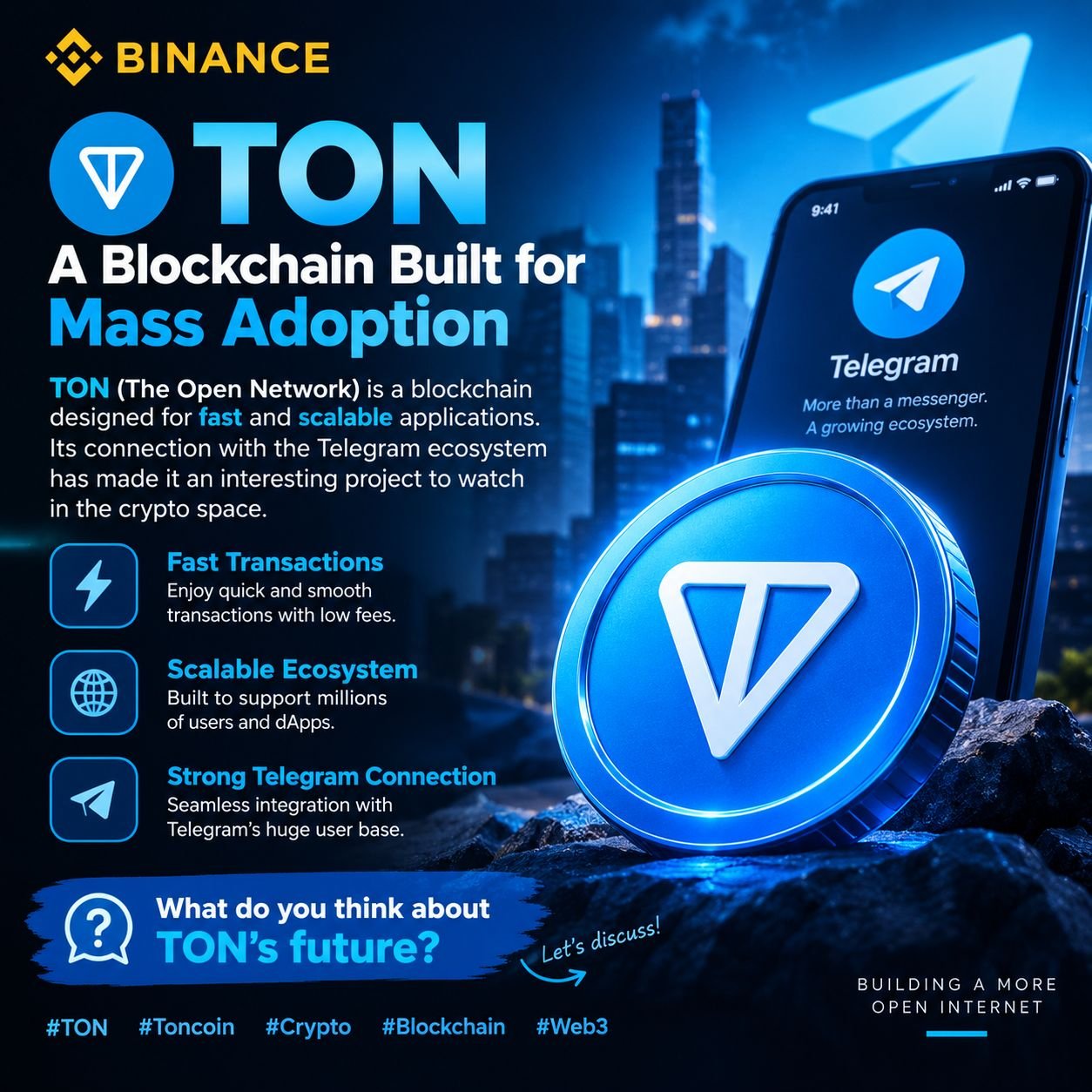
$TON 🔵 TON: A Blockchain Built for Mass Adoption
TON (The Open Network) is a blockchain designed for fast and scalable applications. Its connection with the Telegram ecosystem has made it an interesting project to watch in the crypto space.
🚀 Fast transactions
🌐 Scalable ecosystem
💬 Strong Telegram connection
What do you think about TON's future? 👀
#TON #Toncoin #crypto #blockchain #Web3
$TON 🔵 TON: A Blockchain Built for Mass Adoption
TON (The Open Network) is a blockchain designed for fast and scalable applications. Its connection with the Telegram ecosystem has made it an interesting project to watch in the crypto space.
🚀 Fast transactions
🌐 Scalable ecosystem
💬 Strong Telegram connection
What do you think about TON's future? 👀
#TON #Toncoin #crypto #blockchain #Web3
TON (The Open Network) is a blockchain designed for fast and scalable applications. Its connection with the Telegram ecosystem has made it an interesting project to watch in the crypto space.
🚀 Fast transactions
🌐 Scalable ecosystem
💬 Strong Telegram connection
What do you think about TON's future? 👀
#TON #Toncoin #crypto #blockchain #Web3
77

·
--
Verified
#usbankcompletescrossborderpaymentpilotonstellar
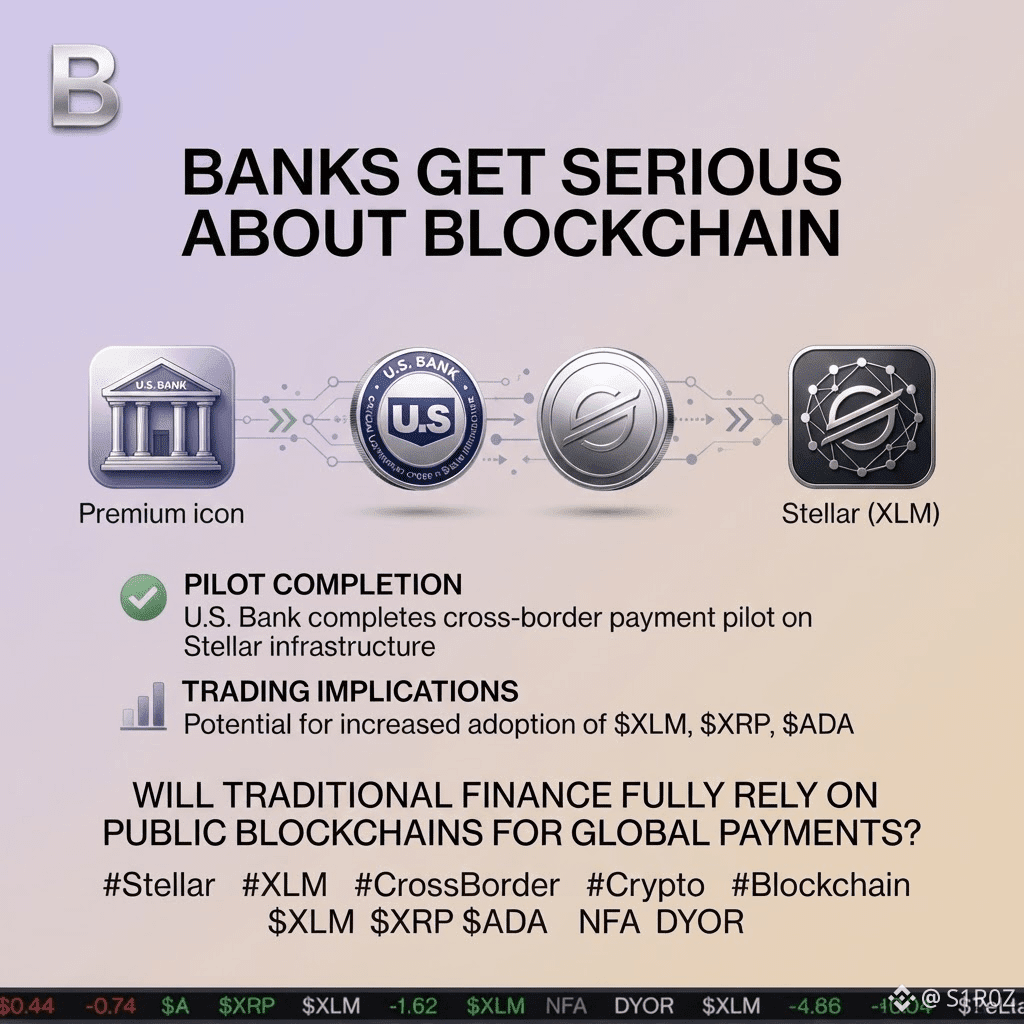
😂🏦 Banks are finally getting serious about blockchain payments.
U.S. Bank has completed a cross-border payment pilot on Stellar, testing blockchain infrastructure for international transfers.
Crypto users have been watching this use case for years, but seeing a major U.S. bank experiment with public blockchain rails is still worth paying attention to.
For traders, the interesting part is what happens next.
If financial institutions continue testing blockchain for cross-border payments and settlement, payment-focused networks like $XLM and $XRP could get more attention as real-world adoption develops.
But a pilot is still just a pilot. The bigger question is whether banks can turn these experiments into scalable, everyday payment infrastructure.
Do you think traditional finance will eventually rely on public blockchains for global payments?
#stellar #XLM #CrossBorder #Crypto #blockchain
$ADA
{spot}(XLMUSDT)
{spot}(XRPUSDT)
{spot}(ADAUSDT)
NFA. DYOR.
#usbankcompletescrossborderpaymentpilotonstellar
😂🏦 Banks are finally getting serious about blockchain payments.
U.S. Bank has completed a cross-border payment pilot on Stellar, testing blockchain infrastructure for international transfers.
Crypto users have been watching this use case for years, but seeing a major U.S. bank experiment with public blockchain rails is still worth paying attention to.
For traders, the interesting part is what happens next.
If financial institutions continue testing blockchain for cross-border payments and settlement, payment-focused networks like $XLM and $XRP could get more attention as real-world adoption develops.
But a pilot is still just a pilot. The bigger question is whether banks can turn these experiments into scalable, everyday payment infrastructure.
Do you think traditional finance will eventually rely on public blockchains for global payments?
#stellar #XLM #CrossBorder #Crypto #blockchain
$ADA
NFA. DYOR.
😂🏦 Banks are finally getting serious about blockchain payments.
U.S. Bank has completed a cross-border payment pilot on Stellar, testing blockchain infrastructure for international transfers.
Crypto users have been watching this use case for years, but seeing a major U.S. bank experiment with public blockchain rails is still worth paying attention to.
For traders, the interesting part is what happens next.
If financial institutions continue testing blockchain for cross-border payments and settlement, payment-focused networks like $XLM and $XRP could get more attention as real-world adoption develops.
But a pilot is still just a pilot. The bigger question is whether banks can turn these experiments into scalable, everyday payment infrastructure.
Do you think traditional finance will eventually rely on public blockchains for global payments?
#stellar #XLM #CrossBorder #Crypto #blockchain
$ADA
NFA. DYOR.
2
406
·
--
Quantum-proof blockchain: math, not machines, holds the key to quantum safety. MIT professor Muriel Médard (Optimum co-founder) argues blockchains don’t need quantum computers to be quantum-safe; classic math already provides the tools. Are you ready for a math-first post-quantum era? $BTC #QuantumSecurity #Blockchain #Crypto
Quantum-proof blockchain: math, not machines, holds the key to quantum safety. MIT professor Muriel Médard (Optimum co-founder) argues blockchains don’t need quantum computers to be quantum-safe; classic math already provides the tools. Are you ready for a math-first post-quantum era? $BTC #QuantumSecurity #Blockchain #Crypto

17

·
--
#CanadaOSFISaysTokenizedDepositsEqualTraditionalDeposits
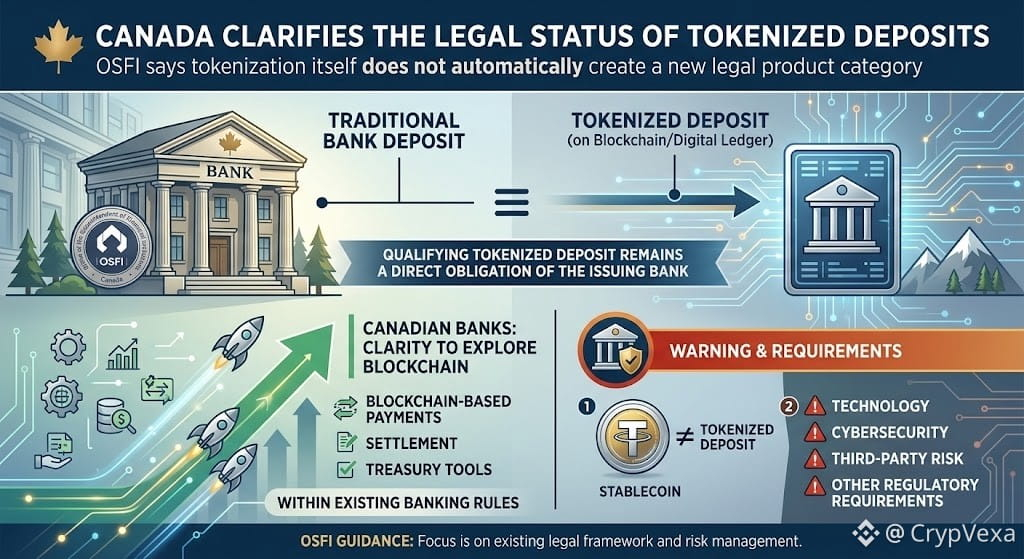
🇨🇦 Canada Clarifies the Legal Status of Tokenized Deposits
🏦 Canada’s banking regulator, OSFI, said tokenized deposits are not legally distinct from traditional bank deposits simply because they use blockchain or another digital ledger.
🔗 A qualifying tokenized deposit remains a direct obligation of the issuing bank, meaning tokenization itself does not automatically create a new legal product category.
🚀 This could give Canadian banks more clarity to explore blockchain-based payments, settlement, and treasury tools within existing banking rules.
⚠️ But tokenized deposits are not automatically the same as stablecoins, and banks still face technology, cybersecurity, third-party-risk, and other regulatory requirements.
👀 Could clearer rules accelerate blockchain adoption by Canadian banks?
#TokenizedDeposits #Blockchain #RWA #CryptoRegulation
#CanadaOSFISaysTokenizedDepositsEqualTraditionalDeposits
🇨🇦 Canada Clarifies the Legal Status of Tokenized Deposits
🏦 Canada’s banking regulator, OSFI, said tokenized deposits are not legally distinct from traditional bank deposits simply because they use blockchain or another digital ledger.
🔗 A qualifying tokenized deposit remains a direct obligation of the issuing bank, meaning tokenization itself does not automatically create a new legal product category.
🚀 This could give Canadian banks more clarity to explore blockchain-based payments, settlement, and treasury tools within existing banking rules.
⚠️ But tokenized deposits are not automatically the same as stablecoins, and banks still face technology, cybersecurity, third-party-risk, and other regulatory requirements.
👀 Could clearer rules accelerate blockchain adoption by Canadian banks?
#TokenizedDeposits #Blockchain #RWA #CryptoRegulation
🇨🇦 Canada Clarifies the Legal Status of Tokenized Deposits
🏦 Canada’s banking regulator, OSFI, said tokenized deposits are not legally distinct from traditional bank deposits simply because they use blockchain or another digital ledger.
🔗 A qualifying tokenized deposit remains a direct obligation of the issuing bank, meaning tokenization itself does not automatically create a new legal product category.
🚀 This could give Canadian banks more clarity to explore blockchain-based payments, settlement, and treasury tools within existing banking rules.
⚠️ But tokenized deposits are not automatically the same as stablecoins, and banks still face technology, cybersecurity, third-party-risk, and other regulatory requirements.
👀 Could clearer rules accelerate blockchain adoption by Canadian banks?
#TokenizedDeposits #Blockchain #RWA #CryptoRegulation
1
1
Log in to explore more content
Join global crypto users on Binance Square
⚡️ Get latest and useful information about crypto.
💬 Trusted by the world’s largest crypto exchange.
👍 Discover real insights from verified creators.
Email / Phone number
Trending Topics
1
#FedRateWatch
1M views
4,897 Discussing
2
#ZcashHoldersBackNU7Upgrade
2,011 views
85 Discussing
3
#MSTRTradingVolumeSurpassesMorganStanley
8,546 views
302 Discussing
4
#BitcoinFalls4%
21,134 views
562 Discussing
5
#SKHynixInTalksToMakeMemoryChipsInUS
9,310 views
236 Discussing
6
#OpenAIDiscussesNewFundingAt$1.2TValuation
2,387 views
41 Discussing
7
#ArgentinaCommitsToOECDCryptoReportingBy2029
18,588 views
403 Discussing
8
#EthereumFallsBelow$2400
7,327 views
92 Discussing
9
#USDTLaunchesOnZamaPrivacyProtocol
7,750 views
228 Discussing
10
#USSenateBlocksClarityAct
63,184 views
537 Discussing