

#cftcsubmitstwoeventcontractrulestowhitehouse
cftcsubmitstwoeventcontractrulestowhitehouse
Hot
Latest

·
--
🚨 CFTC JUST SENT TWO PREDICTION-MARKET RULES TO THE WHITE HOUSE — THIS COULD BE HUGE
The CFTC has submitted two event-contract rules to the White House’s OIRA for review, putting the regulatory future of U.S. prediction markets back in focus.
And the interesting part? The two approaches point in different directions.
One would further define “swap” to exclude casino-style gambling products, while the other would define swaps to include event contracts. Both entered White House review on September 28.
Why does this matter?
Prediction markets like Kalshi and Polymarket are fighting a much bigger battle over whether event contracts belong primarily under federal derivatives regulation or state gambling laws. A recent appeals-court ruling against Kalshi deepened that legal conflict.
Meanwhile, the sector is moving closer to traditional finance: prediction markets have expanded into contracts tied to stocks and corporate events, raising fresh questions about CFTC vs. SEC oversight.
🔥 TRADING TRIGGER: Watch for which regulatory approach survives White House review.
A clearer federal framework could materially change the operating environment for U.S. prediction-market platforms; a narrower definition could leave more products exposed to state gambling regulation.
Prediction markets aren't just betting on the future anymore — Washington is deciding what these markets actually ARE. 👀
$GOOGL.US $SPCX.US $NVDA.US
#cftcsubmitstwoeventcontractrulestowhitehouse
🚨 CFTC JUST SENT TWO PREDICTION-MARKET RULES TO THE WHITE HOUSE — THIS COULD BE HUGE
The CFTC has submitted two event-contract rules to the White House’s OIRA for review, putting the regulatory future of U.S. prediction markets back in focus.
And the interesting part? The two approaches point in different directions.
One would further define “swap” to exclude casino-style gambling products, while the other would define swaps to include event contracts. Both entered White House review on September 28.
Why does this matter?
Prediction markets like Kalshi and Polymarket are fighting a much bigger battle over whether event contracts belong primarily under federal derivatives regulation or state gambling laws. A recent appeals-court ruling against Kalshi deepened that legal conflict.
Meanwhile, the sector is moving closer to traditional finance: prediction markets have expanded into contracts tied to stocks and corporate events, raising fresh questions about CFTC vs. SEC oversight.
🔥 TRADING TRIGGER: Watch for which regulatory approach survives White House review.
A clearer federal framework could materially change the operating environment for U.S. prediction-market platforms; a narrower definition could leave more products exposed to state gambling regulation.
Prediction markets aren't just betting on the future anymore — Washington is deciding what these markets actually ARE. 👀
$GOOGL.US $SPCX.US $NVDA.US
#cftcsubmitstwoeventcontractrulestowhitehouse
The CFTC has submitted two event-contract rules to the White House’s OIRA for review, putting the regulatory future of U.S. prediction markets back in focus.
And the interesting part? The two approaches point in different directions.
One would further define “swap” to exclude casino-style gambling products, while the other would define swaps to include event contracts. Both entered White House review on September 28.
Why does this matter?
Prediction markets like Kalshi and Polymarket are fighting a much bigger battle over whether event contracts belong primarily under federal derivatives regulation or state gambling laws. A recent appeals-court ruling against Kalshi deepened that legal conflict.
Meanwhile, the sector is moving closer to traditional finance: prediction markets have expanded into contracts tied to stocks and corporate events, raising fresh questions about CFTC vs. SEC oversight.
🔥 TRADING TRIGGER: Watch for which regulatory approach survives White House review.
A clearer federal framework could materially change the operating environment for U.S. prediction-market platforms; a narrower definition could leave more products exposed to state gambling regulation.
Prediction markets aren't just betting on the future anymore — Washington is deciding what these markets actually ARE. 👀
$GOOGL.US $SPCX.US $NVDA.US
#cftcsubmitstwoeventcontractrulestowhitehouse
NVDAUS+1.42%
GOOGLUS-1.84%
SPCXUS-0.89%
1
2.6k

·
--
Bearish
#cftcsubmitstwoeventcontractrulestowhitehouse 🏛️ CFTC Submits Two Pivotal Event Contract Rules to White House
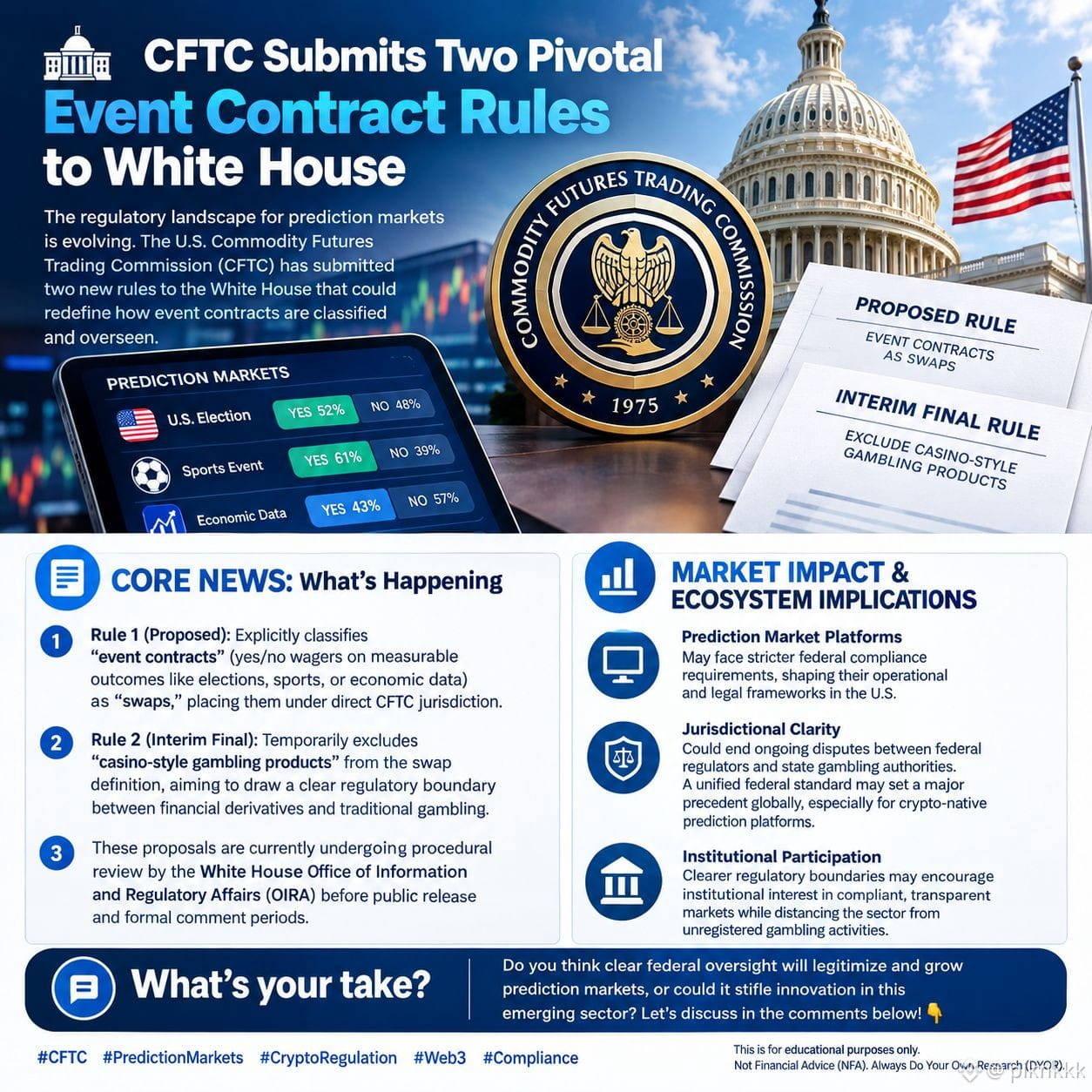
The regulatory landscape for prediction markets is evolving. The U.S. Commodity Futures Trading Commission (CFTC) has submitted two new rules to the White House that could redefine how event contracts are classified and overseen.
Core News What’s Happening
•Rule 1 (Proposed) Explicitly classifies event contracts (yes/no wagers on measurable outcomes like elections, sports or economic data) as swaps placing them under direct CFTC jurisdiction.
Rule 2 (Interim Final) Temporarily excludes casino-style gambling products from the swap definition aiming to draw a clear regulatory boundary between financial derivatives and traditional gambling.
• These proposals are currently undergoing procedural review by the White House Office of Information and Regulatory Affairs (OIRA) before public release and formal comment periods.
📊 Market Impact & Ecosystem Implications
Prediction Market Platforms Platforms facilitating event contracts may face stricter federal compliance requirements which could shape their operational and legal frameworks in the U.S.
•Jurisdictional Clarity This move addresses ongoing legal disputes between federal regulators and state gambling authorities. A unified federal standard could set a major precedent for how crypto-native prediction platforms are treated globally
Institutional Participation Clearer regulatory boundaries may encourage institutional interest in compliant transparent prediction markets while distancing the sector from unregistered gambling activities.
What’s your take?
Do you think clear federal oversight will legitimize and grow prediction markets or could it stifle innovation in this emerging sector? Let’s discuss in the comments below
#CFTC #PredictionMarkets #CryptoRegulation #Web3 #Compliance
This is for educational purposes only. Not Financial Advice (NFA) Always Do Your Own Research (DYOR).
$ARK $GTC $0G
{future}(0GUSDT)
{future}(GTCUSDT)
{future}(ARKUSDT)
#cftcsubmitstwoeventcontractrulestowhitehouse 🏛️ CFTC Submits Two Pivotal Event Contract Rules to White House
The regulatory landscape for prediction markets is evolving. The U.S. Commodity Futures Trading Commission (CFTC) has submitted two new rules to the White House that could redefine how event contracts are classified and overseen.
Core News What’s Happening
•Rule 1 (Proposed) Explicitly classifies event contracts (yes/no wagers on measurable outcomes like elections, sports or economic data) as swaps placing them under direct CFTC jurisdiction.
Rule 2 (Interim Final) Temporarily excludes casino-style gambling products from the swap definition aiming to draw a clear regulatory boundary between financial derivatives and traditional gambling.
• These proposals are currently undergoing procedural review by the White House Office of Information and Regulatory Affairs (OIRA) before public release and formal comment periods.
📊 Market Impact & Ecosystem Implications
Prediction Market Platforms Platforms facilitating event contracts may face stricter federal compliance requirements which could shape their operational and legal frameworks in the U.S.
•Jurisdictional Clarity This move addresses ongoing legal disputes between federal regulators and state gambling authorities. A unified federal standard could set a major precedent for how crypto-native prediction platforms are treated globally
Institutional Participation Clearer regulatory boundaries may encourage institutional interest in compliant transparent prediction markets while distancing the sector from unregistered gambling activities.
What’s your take?
Do you think clear federal oversight will legitimize and grow prediction markets or could it stifle innovation in this emerging sector? Let’s discuss in the comments below
#CFTC #PredictionMarkets #CryptoRegulation #Web3 #Compliance
This is for educational purposes only. Not Financial Advice (NFA) Always Do Your Own Research (DYOR).
$ARK $GTC $0G
The regulatory landscape for prediction markets is evolving. The U.S. Commodity Futures Trading Commission (CFTC) has submitted two new rules to the White House that could redefine how event contracts are classified and overseen.
Core News What’s Happening
•Rule 1 (Proposed) Explicitly classifies event contracts (yes/no wagers on measurable outcomes like elections, sports or economic data) as swaps placing them under direct CFTC jurisdiction.
Rule 2 (Interim Final) Temporarily excludes casino-style gambling products from the swap definition aiming to draw a clear regulatory boundary between financial derivatives and traditional gambling.
• These proposals are currently undergoing procedural review by the White House Office of Information and Regulatory Affairs (OIRA) before public release and formal comment periods.
📊 Market Impact & Ecosystem Implications
Prediction Market Platforms Platforms facilitating event contracts may face stricter federal compliance requirements which could shape their operational and legal frameworks in the U.S.
•Jurisdictional Clarity This move addresses ongoing legal disputes between federal regulators and state gambling authorities. A unified federal standard could set a major precedent for how crypto-native prediction platforms are treated globally
Institutional Participation Clearer regulatory boundaries may encourage institutional interest in compliant transparent prediction markets while distancing the sector from unregistered gambling activities.
What’s your take?
Do you think clear federal oversight will legitimize and grow prediction markets or could it stifle innovation in this emerging sector? Let’s discuss in the comments below
#CFTC #PredictionMarkets #CryptoRegulation #Web3 #Compliance
This is for educational purposes only. Not Financial Advice (NFA) Always Do Your Own Research (DYOR).
$ARK $GTC $0G
3.8k

·
--
#cftcsubmitstwoeventcontractrulestowhitehouse 🚨 CFTC Targets Prediction Markets: Big Regulatory Shift?
A big change in U.S. Regulation is bringing prediction markets into the focus.
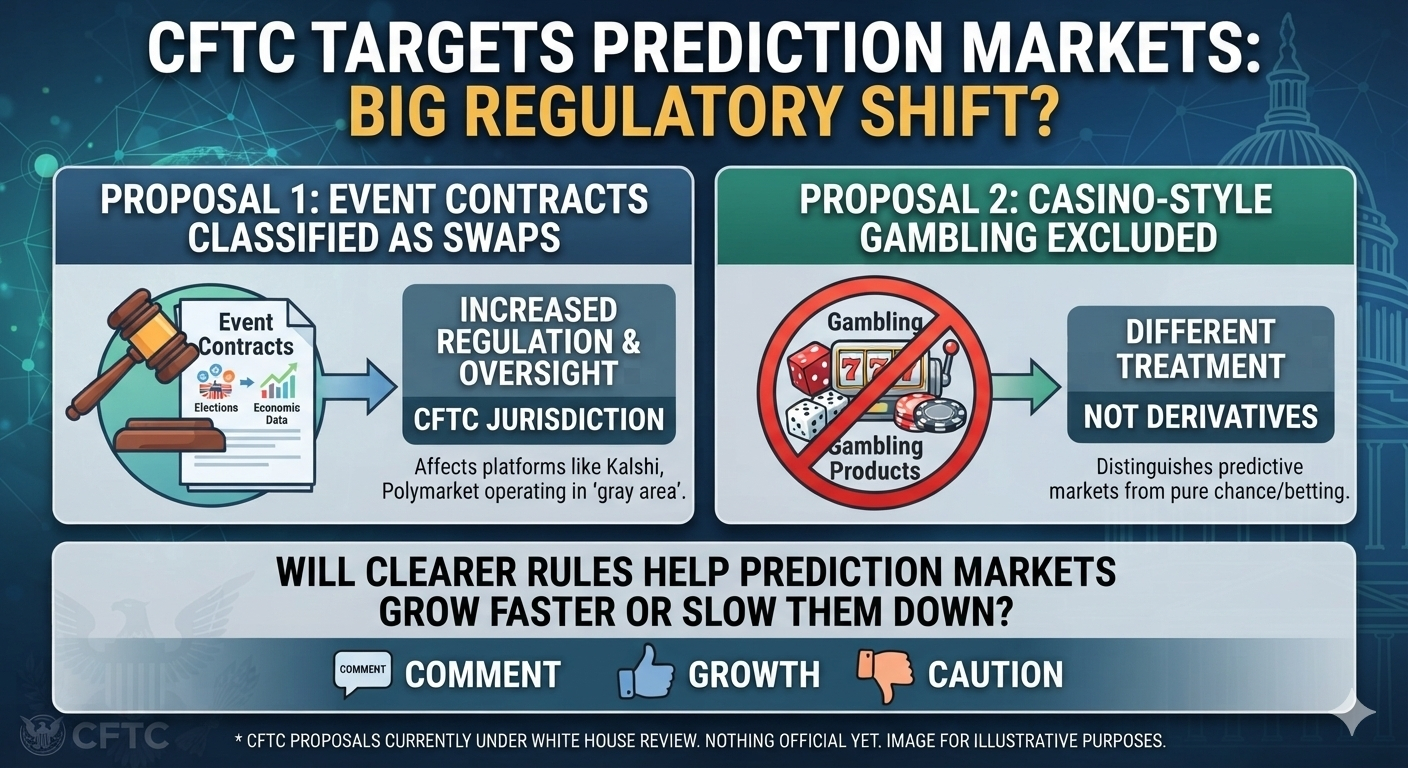
The Commodity Futures Trading Commission or CFTC has sent two rule proposals about event contracts to the White House for review.
One proposal would classify some event contracts as swaps. That means they would fall under rules possibly making them more regulated.
Another proposal would keep casino-style gambling products out of the swap definition. That could mean these types of products aren’t treated the same as derivatives.
These changes could affect how platf
orms like Kalshi and Polymarket run their services. Now those platforms are trying to operate in a gray area of the law.
The rules are still being reviewed. Nothing is official yet.. The direction matters.
For people who trade crypto or look at assets the outcome of this review could affect how event-based contracts grow in the United States.
💬 Will clearer rules, from the government help prediction markets grow faster?. Could it slow things down? Let us know what you think.
#crypto #trading #Khan62 #blockchain $HYPE $COIN $BTC
{future}(HYPEUSDT)
{future}(COINUSDT)
{future}(BTCUSDT)
#cftcsubmitstwoeventcontractrulestowhitehouse 🚨 CFTC Targets Prediction Markets: Big Regulatory Shift?
A big change in U.S. Regulation is bringing prediction markets into the focus.
The Commodity Futures Trading Commission or CFTC has sent two rule proposals about event contracts to the White House for review.
One proposal would classify some event contracts as swaps. That means they would fall under rules possibly making them more regulated.
Another proposal would keep casino-style gambling products out of the swap definition. That could mean these types of products aren’t treated the same as derivatives.
These changes could affect how platf
orms like Kalshi and Polymarket run their services. Now those platforms are trying to operate in a gray area of the law.
The rules are still being reviewed. Nothing is official yet.. The direction matters.
For people who trade crypto or look at assets the outcome of this review could affect how event-based contracts grow in the United States.
💬 Will clearer rules, from the government help prediction markets grow faster?. Could it slow things down? Let us know what you think.
#crypto #trading #Khan62 #blockchain $HYPE $COIN $BTC
A big change in U.S. Regulation is bringing prediction markets into the focus.
The Commodity Futures Trading Commission or CFTC has sent two rule proposals about event contracts to the White House for review.
One proposal would classify some event contracts as swaps. That means they would fall under rules possibly making them more regulated.
Another proposal would keep casino-style gambling products out of the swap definition. That could mean these types of products aren’t treated the same as derivatives.
These changes could affect how platf
orms like Kalshi and Polymarket run their services. Now those platforms are trying to operate in a gray area of the law.
The rules are still being reviewed. Nothing is official yet.. The direction matters.
For people who trade crypto or look at assets the outcome of this review could affect how event-based contracts grow in the United States.
💬 Will clearer rules, from the government help prediction markets grow faster?. Could it slow things down? Let us know what you think.
#crypto #trading #Khan62 #blockchain $HYPE $COIN $BTC
1.4k

·
--
#cftcsubmitstwoeventcontractrulestowhitehouse
🚨 Regulatory Update: CFTC Submits Two Event Contract Rules to White House!
The Market Update: Federal oversight of predictive and derivative markets is reaching a critical milestone as the CFTC officially submits two major event contract rules to the White House for review. As tracked by our regulatory compliance dashboard, this move signals accelerated federal scrutiny and potential formal framework finalization for election, economic, and political event contracts operating within regulated financial rails.
What This Means for Traders: Clearer regulatory frameworks for prediction and event-based derivatives impact market accessibility, institutional participation, and volume distribution across both traditional derivative exchanges and decentralized prediction protocols. Market participants are closely monitoring compliance updates and jurisdictional rulings.
Highlighted Tradeable Coins to Watch (Prediction & Derivative Sectors):
$UMA (UMA): Decentralized optimistic oracle protocol powering on-chain prediction markets and dispute resolution; tracking demand for decentralized data validation.
$SOL (Solana): High-throughput layer-1 network hosting fast execution prediction and derivative protocols; monitoring network activity and volume flows.
$ETH (Ethereum): The foundational smart contract settlement layer for leading decentralized financial and forecasting markets; observing institutional DeFi liquidity.
(Disclaimer: While requested alongside a tech and hardware focus mentioning AMD, traditional semiconductor equities are company stocks rather than tradeable crypto coins; the digital assets above highlight leading decentralized protocols aligned with prediction, derivatives, and high-performance infrastructure.)
How do you think federal oversight and White House review of event contracts will impact the growth of decentralized prediction markets this quarter? Let's discuss your strategy in the comments below! 👇
{spot}(UMAUSDT)
{spot}(SOLUSDT)
{spot}(ETHUSDT)
#CFTC #CryptoRegulation #PredictionMarkets
#cftcsubmitstwoeventcontractrulestowhitehouse
🚨 Regulatory Update: CFTC Submits Two Event Contract Rules to White House!
The Market Update: Federal oversight of predictive and derivative markets is reaching a critical milestone as the CFTC officially submits two major event contract rules to the White House for review. As tracked by our regulatory compliance dashboard, this move signals accelerated federal scrutiny and potential formal framework finalization for election, economic, and political event contracts operating within regulated financial rails.
What This Means for Traders: Clearer regulatory frameworks for prediction and event-based derivatives impact market accessibility, institutional participation, and volume distribution across both traditional derivative exchanges and decentralized prediction protocols. Market participants are closely monitoring compliance updates and jurisdictional rulings.
Highlighted Tradeable Coins to Watch (Prediction & Derivative Sectors):
$UMA (UMA): Decentralized optimistic oracle protocol powering on-chain prediction markets and dispute resolution; tracking demand for decentralized data validation.
$SOL (Solana): High-throughput layer-1 network hosting fast execution prediction and derivative protocols; monitoring network activity and volume flows.
$ETH (Ethereum): The foundational smart contract settlement layer for leading decentralized financial and forecasting markets; observing institutional DeFi liquidity.
(Disclaimer: While requested alongside a tech and hardware focus mentioning AMD, traditional semiconductor equities are company stocks rather than tradeable crypto coins; the digital assets above highlight leading decentralized protocols aligned with prediction, derivatives, and high-performance infrastructure.)
How do you think federal oversight and White House review of event contracts will impact the growth of decentralized prediction markets this quarter? Let's discuss your strategy in the comments below! 👇
#CFTC #CryptoRegulation #PredictionMarkets
🚨 Regulatory Update: CFTC Submits Two Event Contract Rules to White House!
The Market Update: Federal oversight of predictive and derivative markets is reaching a critical milestone as the CFTC officially submits two major event contract rules to the White House for review. As tracked by our regulatory compliance dashboard, this move signals accelerated federal scrutiny and potential formal framework finalization for election, economic, and political event contracts operating within regulated financial rails.
What This Means for Traders: Clearer regulatory frameworks for prediction and event-based derivatives impact market accessibility, institutional participation, and volume distribution across both traditional derivative exchanges and decentralized prediction protocols. Market participants are closely monitoring compliance updates and jurisdictional rulings.
Highlighted Tradeable Coins to Watch (Prediction & Derivative Sectors):
$UMA (UMA): Decentralized optimistic oracle protocol powering on-chain prediction markets and dispute resolution; tracking demand for decentralized data validation.
$SOL (Solana): High-throughput layer-1 network hosting fast execution prediction and derivative protocols; monitoring network activity and volume flows.
$ETH (Ethereum): The foundational smart contract settlement layer for leading decentralized financial and forecasting markets; observing institutional DeFi liquidity.
(Disclaimer: While requested alongside a tech and hardware focus mentioning AMD, traditional semiconductor equities are company stocks rather than tradeable crypto coins; the digital assets above highlight leading decentralized protocols aligned with prediction, derivatives, and high-performance infrastructure.)
How do you think federal oversight and White House review of event contracts will impact the growth of decentralized prediction markets this quarter? Let's discuss your strategy in the comments below! 👇
#CFTC #CryptoRegulation #PredictionMarkets

1
1.2k

·
--
The Commodity Futures Trading Commission (CFTC) has submitted proposed rules for the new event contract, #CFTCSubmitTwo, to the White House for review. This initiative aims to enhance market transparency and provide new trading opportunities. The proposed regulations focus on allowing event contracts linked to specific outcomes, such as elections or sports events. Stakeholders believe this could attract a broader audience to derivatives trading, promoting greater participation. However, the CFTC remains mindful of potential market manipulation and risks associated with event contracts, ensuring robust safeguards are in place. The move reflects a growing interest in innovative financial instruments in the U.S. markets.#CFTCSubmitsTwoEventContractRulesToWhiteHouse
The Commodity Futures Trading Commission (CFTC) has submitted proposed rules for the new event contract, #CFTCSubmitTwo, to the White House for review. This initiative aims to enhance market transparency and provide new trading opportunities. The proposed regulations focus on allowing event contracts linked to specific outcomes, such as elections or sports events. Stakeholders believe this could attract a broader audience to derivatives trading, promoting greater participation. However, the CFTC remains mindful of potential market manipulation and risks associated with event contracts, ensuring robust safeguards are in place. The move reflects a growing interest in innovative financial instruments in the U.S. markets.#CFTCSubmitsTwoEventContractRulesToWhiteHouse
47

·
--
Bullish
#cftcsubmitstwoeventcontractrulestowhitehouse 🚨 CFTC SENDS TWO PREDICTION-MARKET RULES TO WHITE HOUSE REVIEW
Washington is taking another major step toward defining how U.S. prediction markets should be regulated.
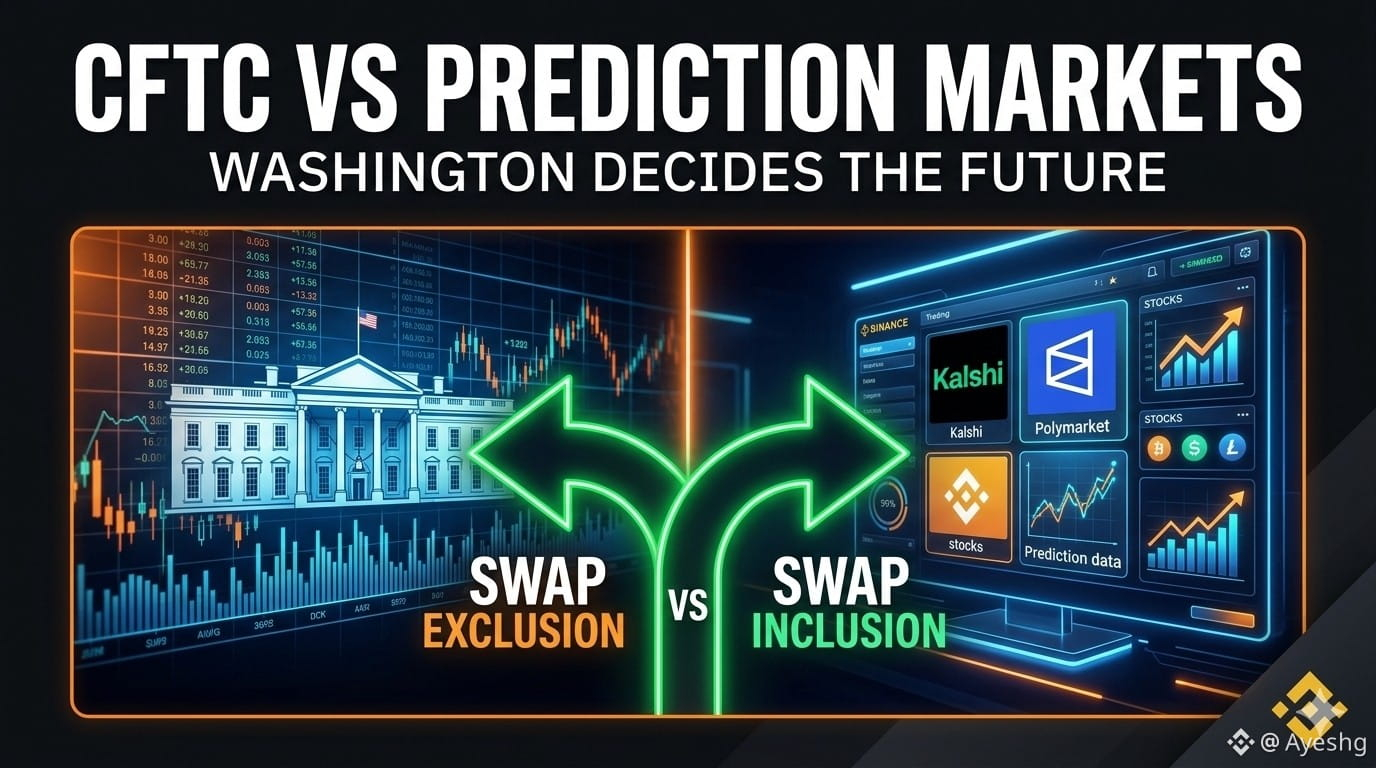
The CFTC submitted two event-contract regulatory actions to White House OIRA review on September 28 — and the approaches point in different directions.
📌 What’s being considered?
🔹 One proposal would clarify the definition of “swap” to include event contracts.
🔹 Another interim-final approach would exclude certain casino-style gambling products from the swap framework.
Why does this matter?
Prediction markets such as Kalshi and Polymarket are at the center of a broader legal battle over whether certain event contracts fall primarily under federal derivatives regulation or state gambling laws.
A September 25 appeals-court ruling involving Kalshi held that the contracts at issue were not swaps and allowed Ohio and Tennessee gambling laws to apply — adding another layer of uncertainty.
Meanwhile, prediction platforms are expanding into stock and corporate-event contracts, creating additional questions around the respective roles of the CFTC and SEC. Reuters reported that more than $220 million had been traded on Polymarket's equity-linked prediction markets.
⚠️ Important: OIRA review does not mean either approach is final. The regulatory process is still developing.
👀 The key catalyst: Which framework ultimately moves forward — and how courts and regulators define the boundary between derivatives and gambling.
$GOOGL $NVDA $SPX
#CFTC #PredictionMarkets #Kalshi #Polymarket #CryptoNews #Regulation #Markets
#cftcsubmitstwoeventcontractrulestowhitehouse 🚨 CFTC SENDS TWO PREDICTION-MARKET RULES TO WHITE HOUSE REVIEW
Washington is taking another major step toward defining how U.S. prediction markets should be regulated.
The CFTC submitted two event-contract regulatory actions to White House OIRA review on September 28 — and the approaches point in different directions.
📌 What’s being considered?
🔹 One proposal would clarify the definition of “swap” to include event contracts.
🔹 Another interim-final approach would exclude certain casino-style gambling products from the swap framework.
Why does this matter?
Prediction markets such as Kalshi and Polymarket are at the center of a broader legal battle over whether certain event contracts fall primarily under federal derivatives regulation or state gambling laws.
A September 25 appeals-court ruling involving Kalshi held that the contracts at issue were not swaps and allowed Ohio and Tennessee gambling laws to apply — adding another layer of uncertainty.
Meanwhile, prediction platforms are expanding into stock and corporate-event contracts, creating additional questions around the respective roles of the CFTC and SEC. Reuters reported that more than $220 million had been traded on Polymarket's equity-linked prediction markets.
⚠️ Important: OIRA review does not mean either approach is final. The regulatory process is still developing.
👀 The key catalyst: Which framework ultimately moves forward — and how courts and regulators define the boundary between derivatives and gambling.
$GOOGL $NVDA $SPX
#CFTC #PredictionMarkets #Kalshi #Polymarket #CryptoNews #Regulation #Markets
Washington is taking another major step toward defining how U.S. prediction markets should be regulated.
The CFTC submitted two event-contract regulatory actions to White House OIRA review on September 28 — and the approaches point in different directions.
📌 What’s being considered?
🔹 One proposal would clarify the definition of “swap” to include event contracts.
🔹 Another interim-final approach would exclude certain casino-style gambling products from the swap framework.
Why does this matter?
Prediction markets such as Kalshi and Polymarket are at the center of a broader legal battle over whether certain event contracts fall primarily under federal derivatives regulation or state gambling laws.
A September 25 appeals-court ruling involving Kalshi held that the contracts at issue were not swaps and allowed Ohio and Tennessee gambling laws to apply — adding another layer of uncertainty.
Meanwhile, prediction platforms are expanding into stock and corporate-event contracts, creating additional questions around the respective roles of the CFTC and SEC. Reuters reported that more than $220 million had been traded on Polymarket's equity-linked prediction markets.
⚠️ Important: OIRA review does not mean either approach is final. The regulatory process is still developing.
👀 The key catalyst: Which framework ultimately moves forward — and how courts and regulators define the boundary between derivatives and gambling.
$GOOGL $NVDA $SPX
#CFTC #PredictionMarkets #Kalshi #Polymarket #CryptoNews #Regulation #Markets
1
106

·
--
#CFTCSubmitsTwoEventContractRulesToWhiteHouse 🚨 CFTC Targets Prediction Markets: What You Need to Know!
The U.S. Commodity Futures Trading Commission (CFTC) has officially submitted two critical proposed rules on event contracts to the White House for executive review.
If approved, this decision could permanently reshape prediction markets and event-based derivatives.
Here is the quick breakdown of what’s happening and why it matters to traders 👇
📊 The 2 New Rules Explained
Event Contracts = Swaps: The CFTC wants to officially classify prediction market contracts as standard "swaps." This brings them under strict federal oversight via the Commodity Exchange Act (CEA).
Casino Exclusion Zone: The second rule draws a clear legal boundary—excluding standard casino-style gambling from the derivatives classification.
⚡ Why This Matters for the Market
Federal vs. State War: U.S. states have been cracking down on prediction platforms like Kalshi and Polymarket, labeling them as illegal gambling. By defining these contracts as federal swaps, the CFTC is claiming total federal jurisdiction to override state-level bans.
Crypto Prediction Impact: Decentralized prediction protocols and tokenized event markets serving U.S. liquidity will face tighter compliance pressure if federal rules take effect.
Regulatory Certainty: Clearer boundaries could open the door for institutional capital to legally enter hedging and event-based trading setups.
📉 Trader’s Takeaway
This is a massive step toward defining whether prediction markets are legitimate financial hedging tools or just glorified gambling. Regulatory clarity is coming—and Web3 markets will have to adapt.
💬 What’s your take? Are event contracts a vital financial risk management tool, or just online betting with extra steps?
Let us know in the comments below! 👇
#PredictionMarkets #Web3 #CryptoNews #CryptoRegulation
$MOVR
{future}(MOVRUSDT)
$AGT
{future}(AGTUSDT)
$BTW
{future}(BTWUSDT)
#CFTCSubmitsTwoEventContractRulesToWhiteHouse 🚨 CFTC Targets Prediction Markets: What You Need to Know!
The U.S. Commodity Futures Trading Commission (CFTC) has officially submitted two critical proposed rules on event contracts to the White House for executive review.
If approved, this decision could permanently reshape prediction markets and event-based derivatives.
Here is the quick breakdown of what’s happening and why it matters to traders 👇
📊 The 2 New Rules Explained
Event Contracts = Swaps: The CFTC wants to officially classify prediction market contracts as standard "swaps." This brings them under strict federal oversight via the Commodity Exchange Act (CEA).
Casino Exclusion Zone: The second rule draws a clear legal boundary—excluding standard casino-style gambling from the derivatives classification.
⚡ Why This Matters for the Market
Federal vs. State War: U.S. states have been cracking down on prediction platforms like Kalshi and Polymarket, labeling them as illegal gambling. By defining these contracts as federal swaps, the CFTC is claiming total federal jurisdiction to override state-level bans.
Crypto Prediction Impact: Decentralized prediction protocols and tokenized event markets serving U.S. liquidity will face tighter compliance pressure if federal rules take effect.
Regulatory Certainty: Clearer boundaries could open the door for institutional capital to legally enter hedging and event-based trading setups.
📉 Trader’s Takeaway
This is a massive step toward defining whether prediction markets are legitimate financial hedging tools or just glorified gambling. Regulatory clarity is coming—and Web3 markets will have to adapt.
💬 What’s your take? Are event contracts a vital financial risk management tool, or just online betting with extra steps?
Let us know in the comments below! 👇
#PredictionMarkets #Web3 #CryptoNews #CryptoRegulation
$MOVR
$AGT
$BTW
The U.S. Commodity Futures Trading Commission (CFTC) has officially submitted two critical proposed rules on event contracts to the White House for executive review.
If approved, this decision could permanently reshape prediction markets and event-based derivatives.
Here is the quick breakdown of what’s happening and why it matters to traders 👇
📊 The 2 New Rules Explained
Event Contracts = Swaps: The CFTC wants to officially classify prediction market contracts as standard "swaps." This brings them under strict federal oversight via the Commodity Exchange Act (CEA).
Casino Exclusion Zone: The second rule draws a clear legal boundary—excluding standard casino-style gambling from the derivatives classification.
⚡ Why This Matters for the Market
Federal vs. State War: U.S. states have been cracking down on prediction platforms like Kalshi and Polymarket, labeling them as illegal gambling. By defining these contracts as federal swaps, the CFTC is claiming total federal jurisdiction to override state-level bans.
Crypto Prediction Impact: Decentralized prediction protocols and tokenized event markets serving U.S. liquidity will face tighter compliance pressure if federal rules take effect.
Regulatory Certainty: Clearer boundaries could open the door for institutional capital to legally enter hedging and event-based trading setups.
📉 Trader’s Takeaway
This is a massive step toward defining whether prediction markets are legitimate financial hedging tools or just glorified gambling. Regulatory clarity is coming—and Web3 markets will have to adapt.
💬 What’s your take? Are event contracts a vital financial risk management tool, or just online betting with extra steps?
Let us know in the comments below! 👇
#PredictionMarkets #Web3 #CryptoNews #CryptoRegulation
$MOVR
$AGT
$BTW

320


#cftcsubmitstwoeventcontractrulestowhitehouse
CFTC Sends Two Event-Contract Rules to White House Review
A major U.S. regulatory debate over prediction markets has moved into a new phase—but these rules are not final yet.
The Commodity Futures Trading Commission submitted two event-contract rulemakings to the White House’s Office of Information and Regulatory Affairs on September 28, according to regulatory filings. One proposed rule would further define “swaps” to include event contracts. The other, listed as an interim final rule, would exclude “casino-style gambling products” from that definition.finance.yahoo+1
The distinction matters for platforms offering contracts tied to political, economic, sports and other real-world events. A broader swap definition could reinforce the CFTC’s position that qualifying prediction-market products fall under federal derivatives oversight, while the gambling carve-out could help draw a boundary between financial contracts and casino-style wagers.
However, OIRA review is a procedural step—not approval. The filings remain under review, and the proposed rule concerning event contracts would generally still need publication and public comment before any final rule could take effect. The full text was not yet publicly available in the reports reviewed.
My take: Clearer federal definitions could improve compliance certainty and market access, but they may also intensify conflicts with state gaming regulators. The next signals are publication of the texts, the comment period, court challenges and how platforms such as Kalshi and Polymarket respond.
Will clearer CFTC rules strengthen prediction markets—or increase regulatory friction?
#CFTC #PredictionMarkets #CryptoRegulation
$MOVR $AGT $NOM
{future}(NOMUSDT)
{future}(AGTUSDT)
{future}(MOVRUSDT)
#cftcsubmitstwoeventcontractrulestowhitehouse
CFTC Sends Two Event-Contract Rules to White House Review
A major U.S. regulatory debate over prediction markets has moved into a new phase—but these rules are not final yet.
The Commodity Futures Trading Commission submitted two event-contract rulemakings to the White House’s Office of Information and Regulatory Affairs on September 28, according to regulatory filings. One proposed rule would further define “swaps” to include event contracts. The other, listed as an interim final rule, would exclude “casino-style gambling products” from that definition.finance.yahoo+1
The distinction matters for platforms offering contracts tied to political, economic, sports and other real-world events. A broader swap definition could reinforce the CFTC’s position that qualifying prediction-market products fall under federal derivatives oversight, while the gambling carve-out could help draw a boundary between financial contracts and casino-style wagers.
However, OIRA review is a procedural step—not approval. The filings remain under review, and the proposed rule concerning event contracts would generally still need publication and public comment before any final rule could take effect. The full text was not yet publicly available in the reports reviewed.
My take: Clearer federal definitions could improve compliance certainty and market access, but they may also intensify conflicts with state gaming regulators. The next signals are publication of the texts, the comment period, court challenges and how platforms such as Kalshi and Polymarket respond.
Will clearer CFTC rules strengthen prediction markets—or increase regulatory friction?
#CFTC #PredictionMarkets #CryptoRegulation
$MOVR $AGT $NOM
CFTC Sends Two Event-Contract Rules to White House Review
A major U.S. regulatory debate over prediction markets has moved into a new phase—but these rules are not final yet.
The Commodity Futures Trading Commission submitted two event-contract rulemakings to the White House’s Office of Information and Regulatory Affairs on September 28, according to regulatory filings. One proposed rule would further define “swaps” to include event contracts. The other, listed as an interim final rule, would exclude “casino-style gambling products” from that definition.finance.yahoo+1
The distinction matters for platforms offering contracts tied to political, economic, sports and other real-world events. A broader swap definition could reinforce the CFTC’s position that qualifying prediction-market products fall under federal derivatives oversight, while the gambling carve-out could help draw a boundary between financial contracts and casino-style wagers.
However, OIRA review is a procedural step—not approval. The filings remain under review, and the proposed rule concerning event contracts would generally still need publication and public comment before any final rule could take effect. The full text was not yet publicly available in the reports reviewed.
My take: Clearer federal definitions could improve compliance certainty and market access, but they may also intensify conflicts with state gaming regulators. The next signals are publication of the texts, the comment period, court challenges and how platforms such as Kalshi and Polymarket respond.
Will clearer CFTC rules strengthen prediction markets—or increase regulatory friction?
#CFTC #PredictionMarkets #CryptoRegulation
$MOVR $AGT $NOM

1
5.2k

🚨 The next big prediction market battle may be decided by regulation, not trading volume.
The US Commodity Futures Trading Commission (CFTC) has submitted two event contract rules to the White House for review, targeting how prediction markets are classified under federal derivatives law.
One proposal would explicitly include event contracts in the definition of swaps, while the other would exclude casino-style gambling products. The distinction could shape how platforms like Kalshi and Polymarket operate in the US.
Why does this matter? Clearer rules could influence market access, available contracts, liquidity and institutional participation. However, the legal battle is far from settled. A recent appeals court ruling allowed Ohio and Tennessee to regulate Kalshi’s sports contracts, highlighting the ongoing conflict between federal and state authority.
My take: This is a major regulatory development for prediction markets, but the outcome matters more than the headline. Greater clarity could support long-term growth, while restrictive interpretations could limit certain markets. The impact will depend on the final rules, court decisions and enforcement.
For crypto, the key question is whether regulatory clarity can encourage wider participation without creating new barriers.
$GOOGL $ZEC
{future}(ZECUSDT)
{future}(GOOGLUSDT)
Will these CFTC rules help prediction markets grow, or create more uncertainty for platforms and traders?
#CFTC #PredictionMarkets #CryptoRegulation
#CFTCSubmitsTwoEventContractRulesToWhiteHouse
🚨 The next big prediction market battle may be decided by regulation, not trading volume.
The US Commodity Futures Trading Commission (CFTC) has submitted two event contract rules to the White House for review, targeting how prediction markets are classified under federal derivatives law.
One proposal would explicitly include event contracts in the definition of swaps, while the other would exclude casino-style gambling products. The distinction could shape how platforms like Kalshi and Polymarket operate in the US.
Why does this matter? Clearer rules could influence market access, available contracts, liquidity and institutional participation. However, the legal battle is far from settled. A recent appeals court ruling allowed Ohio and Tennessee to regulate Kalshi’s sports contracts, highlighting the ongoing conflict between federal and state authority.
My take: This is a major regulatory development for prediction markets, but the outcome matters more than the headline. Greater clarity could support long-term growth, while restrictive interpretations could limit certain markets. The impact will depend on the final rules, court decisions and enforcement.
For crypto, the key question is whether regulatory clarity can encourage wider participation without creating new barriers.
$GOOGL $ZEC
Will these CFTC rules help prediction markets grow, or create more uncertainty for platforms and traders?
#CFTC #PredictionMarkets #CryptoRegulation
#CFTCSubmitsTwoEventContractRulesToWhiteHouse
The US Commodity Futures Trading Commission (CFTC) has submitted two event contract rules to the White House for review, targeting how prediction markets are classified under federal derivatives law.
One proposal would explicitly include event contracts in the definition of swaps, while the other would exclude casino-style gambling products. The distinction could shape how platforms like Kalshi and Polymarket operate in the US.
Why does this matter? Clearer rules could influence market access, available contracts, liquidity and institutional participation. However, the legal battle is far from settled. A recent appeals court ruling allowed Ohio and Tennessee to regulate Kalshi’s sports contracts, highlighting the ongoing conflict between federal and state authority.
My take: This is a major regulatory development for prediction markets, but the outcome matters more than the headline. Greater clarity could support long-term growth, while restrictive interpretations could limit certain markets. The impact will depend on the final rules, court decisions and enforcement.
For crypto, the key question is whether regulatory clarity can encourage wider participation without creating new barriers.
$GOOGL $ZEC
Will these CFTC rules help prediction markets grow, or create more uncertainty for platforms and traders?
#CFTC #PredictionMarkets #CryptoRegulation
#CFTCSubmitsTwoEventContractRulesToWhiteHouse

1
389

Article
CFTC submits two event contract rules to white house#cftcsubmitstwoeventcontractrulestowhitehouse
CFTC Draws the Line: Two Event-Contract Rules Head to the White House
On 28 September 2026 the U.S. Commodity Futures Trading Commission submitted a pair of tightly focused rulemakings to the White House Office of Information and Regulatory Affairs (OIRA):
RIN 3038-AF82 (proposed rule) — further definition of “swap” to explicitly include event contractsRIN 3038-AF81 (interim final rule) — further definition of “swap” to exclude casino-style gambling products
Both filings are marked “not economically significant.” Full text remains under review and has not yet been published.
This is the CFTC’s clearest attempt yet to settle a multi-year jurisdictional war. If event contracts are confirmed as swaps under the Commodity Exchange Act, they fall under the Commission’s exclusive federal oversight — placing platforms such as Kalshi, Polymarket US, Crypto.com and others beyond the reach of state gambling regulators. Recent appellate decisions (Sixth Circuit on Kalshi sports contracts, 25 September; earlier Ninth Circuit rulings) have left the legal status fragmented. The new definitions aim to resolve that ambiguity at the definitional level.
Market context (latest available data through late September 2026)
Prediction-market notional volume has exploded:
Last 30 days: ~$75–76 billion across major venues Kalshi alone: ~$60 billion (≈80 % share) Year-to-date: Kalshi >$238 billion; multi-platform totals already in the hundreds of billions Monthly run-rate: from ~$20–26 billion in May to $50–74 billion in July–September, driven overwhelmingly by sports outcomes
Valuations have followed: Kalshi discussions near $40 billion, Polymarket around $15 billion. Sports remain the dominant category, but crypto, economic indicators and political contracts continue to expand.
Technical foresight
By cleanly separating genuine event contracts (binary or multi-outcome instruments whose settlement rests on independently verifiable occurrences) from pure casino-style products, the CFTC is attempting to create a durable federal perimeter. Success would:
reduce regulatory arbitrage and multi-state compliance costs accelerate institutional liquidity and clearing infrastructure open clearer pathways for crypto-native and traditional platforms to list event products under uniform federal rules potentially influence Supreme Court review of the pre-emption question
Risks remain: an interim final rule can face immediate APA challenges, and states may continue litigating. Yet the direction of travel is unambiguous — the agency is no longer waiting for Congress and is writing the definitional boundaries itself.
A clearer legal foundation for one of the fastest-growing segments of U.S. derivatives markets is now on the White House desk. The next 30–90 days of OIRA review will determine how quickly that clarity reaches the market.
{future}(MONUSDT)
{spot}(QNTUSDT)
{spot}(BTCUSDT)
$POL $XUSD $NEAR
#CFTC #Kalshi #Polymarket #MetaMaskExitsLidoValidatorsAfterSecurityIncident
[For another article by "Trikuta Analyst" click here 👍](https://app.binance.com/uni-qr/cpos/372302143100833?r=bubuyvnj&l=en&uco=cuthsvmhrnhukta6pswucq&uc=app_square_share_link&us=copylink)
51 web pages
CFTC submits two event contract rules to white house
#cftcsubmitstwoeventcontractrulestowhitehouse
CFTC Draws the Line: Two Event-Contract Rules Head to the White House
On 28 September 2026 the U.S. Commodity Futures Trading Commission submitted a pair of tightly focused rulemakings to the White House Office of Information and Regulatory Affairs (OIRA):
RIN 3038-AF82 (proposed rule) — further definition of “swap” to explicitly include event contractsRIN 3038-AF81 (interim final rule) — further definition of “swap” to exclude casino-style gambling products
Both filings are marked “not economically significant.” Full text remains under review and has not yet been published.
This is the CFTC’s clearest attempt yet to settle a multi-year jurisdictional war. If event contracts are confirmed as swaps under the Commodity Exchange Act, they fall under the Commission’s exclusive federal oversight — placing platforms such as Kalshi, Polymarket US, Crypto.com and others beyond the reach of state gambling regulators. Recent appellate decisions (Sixth Circuit on Kalshi sports contracts, 25 September; earlier Ninth Circuit rulings) have left the legal status fragmented. The new definitions aim to resolve that ambiguity at the definitional level.
Market context (latest available data through late September 2026)
Prediction-market notional volume has exploded:
Last 30 days: ~$75–76 billion across major venues Kalshi alone: ~$60 billion (≈80 % share) Year-to-date: Kalshi >$238 billion; multi-platform totals already in the hundreds of billions Monthly run-rate: from ~$20–26 billion in May to $50–74 billion in July–September, driven overwhelmingly by sports outcomes
Valuations have followed: Kalshi discussions near $40 billion, Polymarket around $15 billion. Sports remain the dominant category, but crypto, economic indicators and political contracts continue to expand.
Technical foresight
By cleanly separating genuine event contracts (binary or multi-outcome instruments whose settlement rests on independently verifiable occurrences) from pure casino-style products, the CFTC is attempting to create a durable federal perimeter. Success would:
reduce regulatory arbitrage and multi-state compliance costs accelerate institutional liquidity and clearing infrastructure open clearer pathways for crypto-native and traditional platforms to list event products under uniform federal rules potentially influence Supreme Court review of the pre-emption question
Risks remain: an interim final rule can face immediate APA challenges, and states may continue litigating. Yet the direction of travel is unambiguous — the agency is no longer waiting for Congress and is writing the definitional boundaries itself.
A clearer legal foundation for one of the fastest-growing segments of U.S. derivatives markets is now on the White House desk. The next 30–90 days of OIRA review will determine how quickly that clarity reaches the market.
$POL $XUSD $NEAR
#CFTC #Kalshi #Polymarket #MetaMaskExitsLidoValidatorsAfterSecurityIncident
For another article by "Trikuta Analyst" click here 👍
51 web pages
CFTC Draws the Line: Two Event-Contract Rules Head to the White House
On 28 September 2026 the U.S. Commodity Futures Trading Commission submitted a pair of tightly focused rulemakings to the White House Office of Information and Regulatory Affairs (OIRA):
RIN 3038-AF82 (proposed rule) — further definition of “swap” to explicitly include event contractsRIN 3038-AF81 (interim final rule) — further definition of “swap” to exclude casino-style gambling products
Both filings are marked “not economically significant.” Full text remains under review and has not yet been published.
This is the CFTC’s clearest attempt yet to settle a multi-year jurisdictional war. If event contracts are confirmed as swaps under the Commodity Exchange Act, they fall under the Commission’s exclusive federal oversight — placing platforms such as Kalshi, Polymarket US, Crypto.com and others beyond the reach of state gambling regulators. Recent appellate decisions (Sixth Circuit on Kalshi sports contracts, 25 September; earlier Ninth Circuit rulings) have left the legal status fragmented. The new definitions aim to resolve that ambiguity at the definitional level.
Market context (latest available data through late September 2026)
Prediction-market notional volume has exploded:
Last 30 days: ~$75–76 billion across major venues Kalshi alone: ~$60 billion (≈80 % share) Year-to-date: Kalshi >$238 billion; multi-platform totals already in the hundreds of billions Monthly run-rate: from ~$20–26 billion in May to $50–74 billion in July–September, driven overwhelmingly by sports outcomes
Valuations have followed: Kalshi discussions near $40 billion, Polymarket around $15 billion. Sports remain the dominant category, but crypto, economic indicators and political contracts continue to expand.
Technical foresight
By cleanly separating genuine event contracts (binary or multi-outcome instruments whose settlement rests on independently verifiable occurrences) from pure casino-style products, the CFTC is attempting to create a durable federal perimeter. Success would:
reduce regulatory arbitrage and multi-state compliance costs accelerate institutional liquidity and clearing infrastructure open clearer pathways for crypto-native and traditional platforms to list event products under uniform federal rules potentially influence Supreme Court review of the pre-emption question
Risks remain: an interim final rule can face immediate APA challenges, and states may continue litigating. Yet the direction of travel is unambiguous — the agency is no longer waiting for Congress and is writing the definitional boundaries itself.
A clearer legal foundation for one of the fastest-growing segments of U.S. derivatives markets is now on the White House desk. The next 30–90 days of OIRA review will determine how quickly that clarity reaches the market.
$POL $XUSD $NEAR
#CFTC #Kalshi #Polymarket #MetaMaskExitsLidoValidatorsAfterSecurityIncident
For another article by "Trikuta Analyst" click here 👍
51 web pages
CryptoMind学道:
OIRA is just paperwork. Real test is whether NEAR holds this 11% or fades like every rotation before it. You scaling in or waiting for the pullback?
4
4
4.5k

·
--
Bearish
#cftcsubmitstwoeventcontractrulestowhitehouse 🏛️ Regulatory Update CFTC Advances Event Contract Rules to the White House
The regulatory landscape for crypto prediction markets is evolving. The CFTC has taken a significant step forward in defining how event contracts will be governed in the US. 🇺🇸
📰 The Core News
The Commodity Futures Trading Commission (CFTC) has officially submitted two proposed rules regarding "event contracts" to the White House. This submission marks a critical phase in the federal rulemaking process, moving these regulations closer to final implementation. The rules aim to clarify the legal framework for prediction markets and event-based derivatives, which have become a rapidly growing sector in the digital asset space.
📊 Potential Market Impact
Here is how this development could influence the broader crypto ecosystem:
• Regulatory Clarity Establishing a defined legal framework for prediction markets could help structure the sector and clarify operational boundaries for market participants and platforms.
• Operational Adjustmentn Platforms offering event contracts may need to update their compliance protocols to align with the new rules, which could influence how these services are structured and offered.
• Ecosystem Attention Projects, protocols, and tokens associated with decentralized prediction markets, oracle networks, and related DeFi infrastructure may experience shifts in market focus as the industry adapts to these regulatory developments.
💬 What are your thoughts?
How do you think these new regulatory frameworks will impact the future development and adoption of decentralized prediction markets? Share your perspective in the comments below! 👇
#CFTC #CryptoRegulation #PredictionMarkets #BinanceSquare #CryptoNews
This is for educational purposes only. Not Financial Advice (NFA). Always Do Your Own Research (DYOR).
$GTC $0G $GNS
{spot}(GNSUSDT)
{future}(0GUSDT)
{future}(GTCUSDT)
#cftcsubmitstwoeventcontractrulestowhitehouse 🏛️ Regulatory Update CFTC Advances Event Contract Rules to the White House
The regulatory landscape for crypto prediction markets is evolving. The CFTC has taken a significant step forward in defining how event contracts will be governed in the US. 🇺🇸
📰 The Core News
The Commodity Futures Trading Commission (CFTC) has officially submitted two proposed rules regarding "event contracts" to the White House. This submission marks a critical phase in the federal rulemaking process, moving these regulations closer to final implementation. The rules aim to clarify the legal framework for prediction markets and event-based derivatives, which have become a rapidly growing sector in the digital asset space.
📊 Potential Market Impact
Here is how this development could influence the broader crypto ecosystem:
• Regulatory Clarity Establishing a defined legal framework for prediction markets could help structure the sector and clarify operational boundaries for market participants and platforms.
• Operational Adjustmentn Platforms offering event contracts may need to update their compliance protocols to align with the new rules, which could influence how these services are structured and offered.
• Ecosystem Attention Projects, protocols, and tokens associated with decentralized prediction markets, oracle networks, and related DeFi infrastructure may experience shifts in market focus as the industry adapts to these regulatory developments.
💬 What are your thoughts?
How do you think these new regulatory frameworks will impact the future development and adoption of decentralized prediction markets? Share your perspective in the comments below! 👇
#CFTC #CryptoRegulation #PredictionMarkets #BinanceSquare #CryptoNews
This is for educational purposes only. Not Financial Advice (NFA). Always Do Your Own Research (DYOR).
$GTC $0G $GNS
The regulatory landscape for crypto prediction markets is evolving. The CFTC has taken a significant step forward in defining how event contracts will be governed in the US. 🇺🇸
📰 The Core News
The Commodity Futures Trading Commission (CFTC) has officially submitted two proposed rules regarding "event contracts" to the White House. This submission marks a critical phase in the federal rulemaking process, moving these regulations closer to final implementation. The rules aim to clarify the legal framework for prediction markets and event-based derivatives, which have become a rapidly growing sector in the digital asset space.
📊 Potential Market Impact
Here is how this development could influence the broader crypto ecosystem:
• Regulatory Clarity Establishing a defined legal framework for prediction markets could help structure the sector and clarify operational boundaries for market participants and platforms.
• Operational Adjustmentn Platforms offering event contracts may need to update their compliance protocols to align with the new rules, which could influence how these services are structured and offered.
• Ecosystem Attention Projects, protocols, and tokens associated with decentralized prediction markets, oracle networks, and related DeFi infrastructure may experience shifts in market focus as the industry adapts to these regulatory developments.
💬 What are your thoughts?
How do you think these new regulatory frameworks will impact the future development and adoption of decentralized prediction markets? Share your perspective in the comments below! 👇
#CFTC #CryptoRegulation #PredictionMarkets #BinanceSquare #CryptoNews
This is for educational purposes only. Not Financial Advice (NFA). Always Do Your Own Research (DYOR).
$GTC $0G $GNS
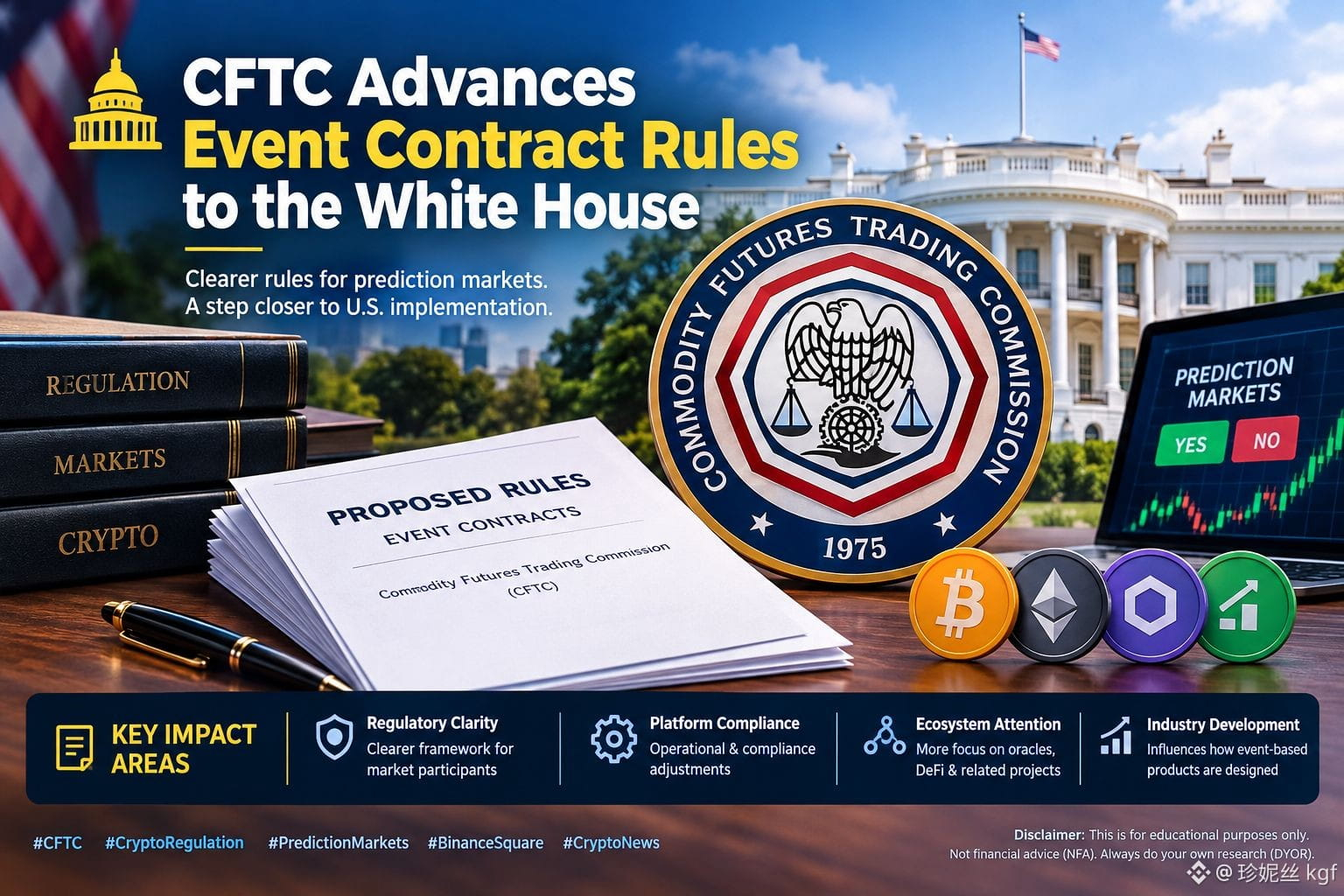
1
1.7k

·
--
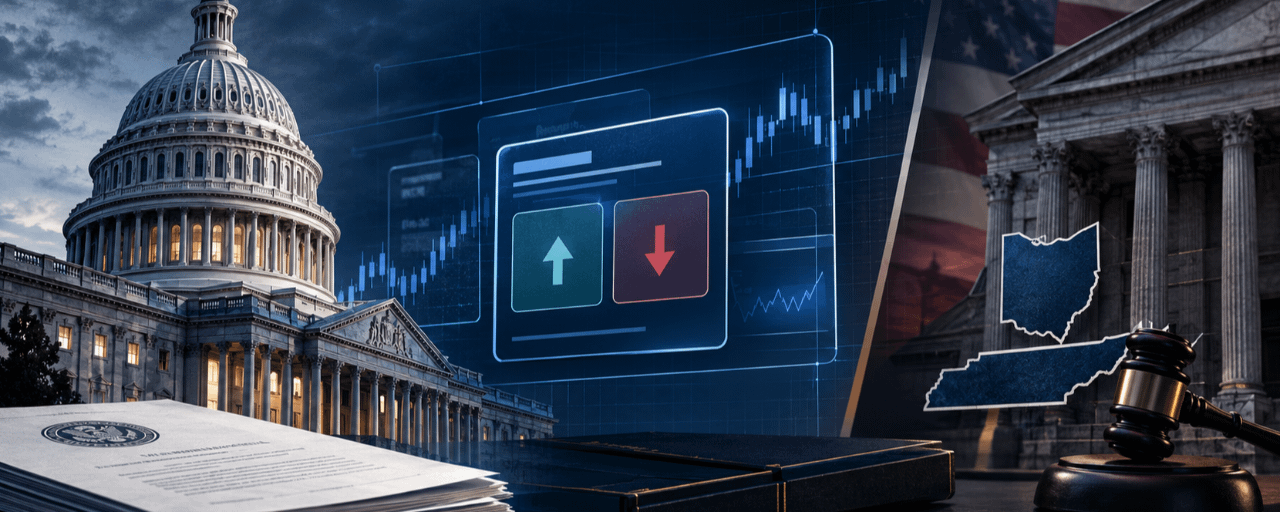
Article
A Federal Agency Just Moved to Settle Prediction Markets' Biggest Legal Question — By Rulemaking#cftcsubmitstwoeventcontractrulestowhitehouse
While New York and Polymarket fight it out in court over whether prediction markets are gambling or finance, the CFTC just took a direct shot at answering that question itself — through regulation rather than litigation.
Here's what happened: on September 28, the CFTC submitted two rule proposals to the White House's Office of Information and Regulatory Affairs for review. The first, a proposed rule, would formally define event contracts — the yes-or-no wagers traded on platforms like Kalshi, Polymarket, and Robinhood — as "swaps" under federal derivatives law. The second, a temporary final rule, would simultaneously carve out "casino-style gambling products" from that same swap definition, taking effect immediately upon approval rather than waiting for public comment. CFTC Chairman Michael Selig has argued the agency holds exclusive federal jurisdiction over these markets, a position directly contested by several states currently suing platforms like Kalshi and Polymarket under state gambling law. This submission extends a broader pattern this year of the CFTC moving ahead with rulemaking on its own authority rather than waiting for stalled congressional legislation like the CLARITY Act.
Why does this matter? If finalized, classifying event contracts as federally regulated swaps — rather than gambling — could directly undercut the legal basis for multiple state lawsuits currently working through the courts, including New York's case against Polymarket and a similar one against Kalshi. It's a meaningful jurisdictional move in an area where federal and state authority have been colliding repeatedly this year, and it illustrates how administrative rulemaking is increasingly shaping crypto-adjacent policy while Congress remains gridlocked.
Whether this rule survives the ongoing legal battles unchanged, or gets challenged just as fiercely as the platforms it aims to protect, remains to be seen.
Can a federal rule really settle a fight that's already playing out across multiple state courtrooms? 🤔
#CFTC #PredictionMarkets #Regulation #Polymarket
$MOVR $AGT
{future}(AGTUSDT)
{future}(MOVRUSDT)
A Federal Agency Just Moved to Settle Prediction Markets' Biggest Legal Question — By Rulemaking
#cftcsubmitstwoeventcontractrulestowhitehouse
While New York and Polymarket fight it out in court over whether prediction markets are gambling or finance, the CFTC just took a direct shot at answering that question itself — through regulation rather than litigation.
Here's what happened: on September 28, the CFTC submitted two rule proposals to the White House's Office of Information and Regulatory Affairs for review. The first, a proposed rule, would formally define event contracts — the yes-or-no wagers traded on platforms like Kalshi, Polymarket, and Robinhood — as "swaps" under federal derivatives law. The second, a temporary final rule, would simultaneously carve out "casino-style gambling products" from that same swap definition, taking effect immediately upon approval rather than waiting for public comment. CFTC Chairman Michael Selig has argued the agency holds exclusive federal jurisdiction over these markets, a position directly contested by several states currently suing platforms like Kalshi and Polymarket under state gambling law. This submission extends a broader pattern this year of the CFTC moving ahead with rulemaking on its own authority rather than waiting for stalled congressional legislation like the CLARITY Act.
Why does this matter? If finalized, classifying event contracts as federally regulated swaps — rather than gambling — could directly undercut the legal basis for multiple state lawsuits currently working through the courts, including New York's case against Polymarket and a similar one against Kalshi. It's a meaningful jurisdictional move in an area where federal and state authority have been colliding repeatedly this year, and it illustrates how administrative rulemaking is increasingly shaping crypto-adjacent policy while Congress remains gridlocked.
Whether this rule survives the ongoing legal battles unchanged, or gets challenged just as fiercely as the platforms it aims to protect, remains to be seen.
Can a federal rule really settle a fight that's already playing out across multiple state courtrooms? 🤔
#CFTC #PredictionMarkets #Regulation #Polymarket
$MOVR $AGT
While New York and Polymarket fight it out in court over whether prediction markets are gambling or finance, the CFTC just took a direct shot at answering that question itself — through regulation rather than litigation.
Here's what happened: on September 28, the CFTC submitted two rule proposals to the White House's Office of Information and Regulatory Affairs for review. The first, a proposed rule, would formally define event contracts — the yes-or-no wagers traded on platforms like Kalshi, Polymarket, and Robinhood — as "swaps" under federal derivatives law. The second, a temporary final rule, would simultaneously carve out "casino-style gambling products" from that same swap definition, taking effect immediately upon approval rather than waiting for public comment. CFTC Chairman Michael Selig has argued the agency holds exclusive federal jurisdiction over these markets, a position directly contested by several states currently suing platforms like Kalshi and Polymarket under state gambling law. This submission extends a broader pattern this year of the CFTC moving ahead with rulemaking on its own authority rather than waiting for stalled congressional legislation like the CLARITY Act.
Why does this matter? If finalized, classifying event contracts as federally regulated swaps — rather than gambling — could directly undercut the legal basis for multiple state lawsuits currently working through the courts, including New York's case against Polymarket and a similar one against Kalshi. It's a meaningful jurisdictional move in an area where federal and state authority have been colliding repeatedly this year, and it illustrates how administrative rulemaking is increasingly shaping crypto-adjacent policy while Congress remains gridlocked.
Whether this rule survives the ongoing legal battles unchanged, or gets challenged just as fiercely as the platforms it aims to protect, remains to be seen.
Can a federal rule really settle a fight that's already playing out across multiple state courtrooms? 🤔
#CFTC #PredictionMarkets #Regulation #Polymarket
$MOVR $AGT
3
1k
·
--
#CFTCSubmitsTwoEventContractRulesToWhiteHouse
The U.S. Commodity Futures Trading Commission (CFTC) has submitted two landmark regulatory proposals to the White House. This move aims to redraw the legal definitions governing prediction markets, asserting federal control over platforms like Kalshi and Polymarket. [1, 2, 3, 4]
Both rules entered review at the Office of Information and Regulatory Affairs (OIRA) on September 28, 2026. [1, 2]
The Two Proposed Rules
The CFTC's dual-track approach seeks to clarify a long-disputed legal boundary by altering the definition of a financial "swap": [1, 2]
The Event-Contract Proposed Rule (RIN 3038-AF82): This proposal would expand the regulatory definition of a "swap" to explicitly include event contracts. This would cement federal derivatives law over yes-or-no wagers tied to real-world outcomes (e.g., elections, economic metrics, and corporate events). [1, 2, 3, 4]
$RAY
{spot}(RAYUSDT)
$RED
{future}(REDUSDT)
$US
{future}(USUSDT)
#CFTCSubmitsTwoEventContractRulesToWhiteHouse
The U.S. Commodity Futures Trading Commission (CFTC) has submitted two landmark regulatory proposals to the White House. This move aims to redraw the legal definitions governing prediction markets, asserting federal control over platforms like Kalshi and Polymarket. [1, 2, 3, 4]
Both rules entered review at the Office of Information and Regulatory Affairs (OIRA) on September 28, 2026. [1, 2]
The Two Proposed Rules
The CFTC's dual-track approach seeks to clarify a long-disputed legal boundary by altering the definition of a financial "swap": [1, 2]
The Event-Contract Proposed Rule (RIN 3038-AF82): This proposal would expand the regulatory definition of a "swap" to explicitly include event contracts. This would cement federal derivatives law over yes-or-no wagers tied to real-world outcomes (e.g., elections, economic metrics, and corporate events). [1, 2, 3, 4]
$RAY
$RED
$US
The U.S. Commodity Futures Trading Commission (CFTC) has submitted two landmark regulatory proposals to the White House. This move aims to redraw the legal definitions governing prediction markets, asserting federal control over platforms like Kalshi and Polymarket. [1, 2, 3, 4]
Both rules entered review at the Office of Information and Regulatory Affairs (OIRA) on September 28, 2026. [1, 2]
The Two Proposed Rules
The CFTC's dual-track approach seeks to clarify a long-disputed legal boundary by altering the definition of a financial "swap": [1, 2]
The Event-Contract Proposed Rule (RIN 3038-AF82): This proposal would expand the regulatory definition of a "swap" to explicitly include event contracts. This would cement federal derivatives law over yes-or-no wagers tied to real-world outcomes (e.g., elections, economic metrics, and corporate events). [1, 2, 3, 4]
$RAY
$RED
$US
445

·
--
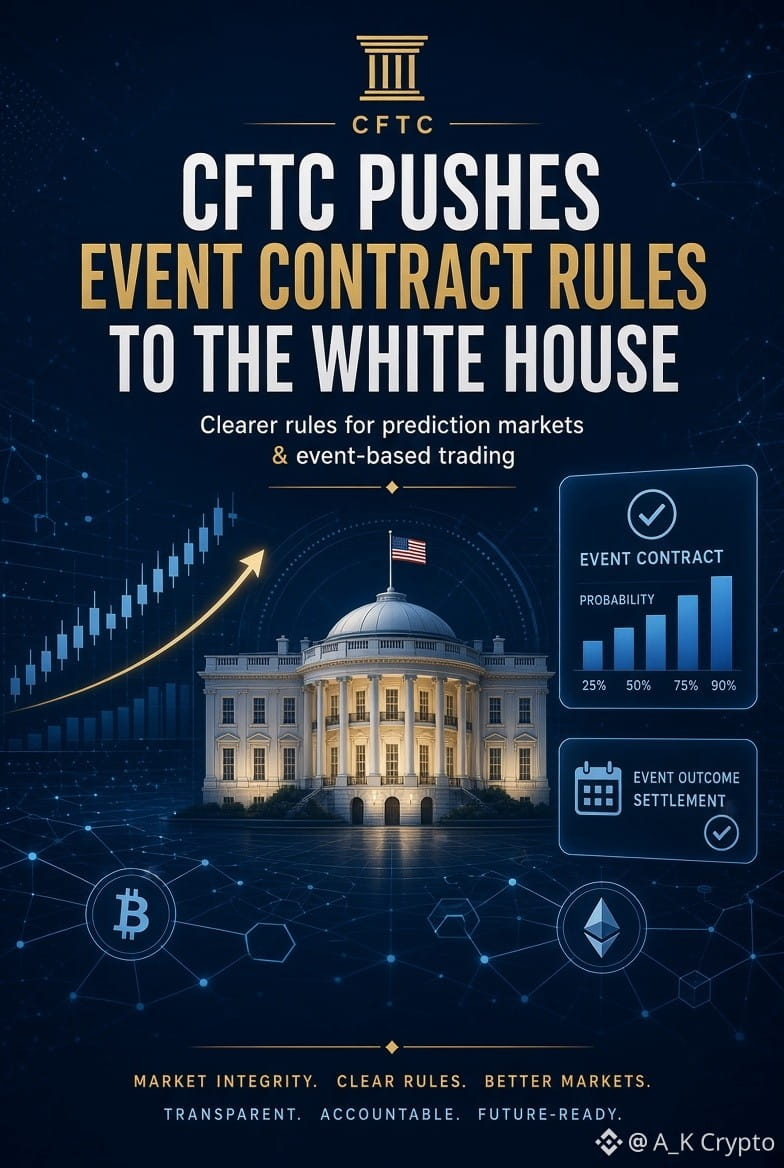
#CFTCSubmitsTwoEventContractRulesToWhiteHouse 🚨 CFTC PUSHES EVENT CONTRACT RULES TO THE WHITE HOUSE
The U.S. CFTC has reportedly sent two proposed event-contract rules to the White House for review.
Event contracts let traders take positions on outcomes tied to events, including economic, political and other real-world developments.
This could be an important step toward clearer rules for prediction markets and regulated event-based trading in the U.S.
Regulatory clarity around event contracts could have a wider impact than it first appears. If the rules create a clear framework, prediction markets may attract more participants and liquidity. For crypto, the key question is whether similar structures eventually connect with blockchain-based markets, creating new opportunities alongside new regulatory risks.
#CFTC #crypto #binana #MicronBeatsEarningsLiftsGuidance
#CFTCSubmitsTwoEventContractRulesToWhiteHouse 🚨 CFTC PUSHES EVENT CONTRACT RULES TO THE WHITE HOUSE
The U.S. CFTC has reportedly sent two proposed event-contract rules to the White House for review.
Event contracts let traders take positions on outcomes tied to events, including economic, political and other real-world developments.
This could be an important step toward clearer rules for prediction markets and regulated event-based trading in the U.S.
Regulatory clarity around event contracts could have a wider impact than it first appears. If the rules create a clear framework, prediction markets may attract more participants and liquidity. For crypto, the key question is whether similar structures eventually connect with blockchain-based markets, creating new opportunities alongside new regulatory risks.
#CFTC #crypto #binana #MicronBeatsEarningsLiftsGuidance
The U.S. CFTC has reportedly sent two proposed event-contract rules to the White House for review.
Event contracts let traders take positions on outcomes tied to events, including economic, political and other real-world developments.
This could be an important step toward clearer rules for prediction markets and regulated event-based trading in the U.S.
Regulatory clarity around event contracts could have a wider impact than it first appears. If the rules create a clear framework, prediction markets may attract more participants and liquidity. For crypto, the key question is whether similar structures eventually connect with blockchain-based markets, creating new opportunities alongside new regulatory risks.
#CFTC #crypto #binana #MicronBeatsEarningsLiftsGuidance
62

·
--
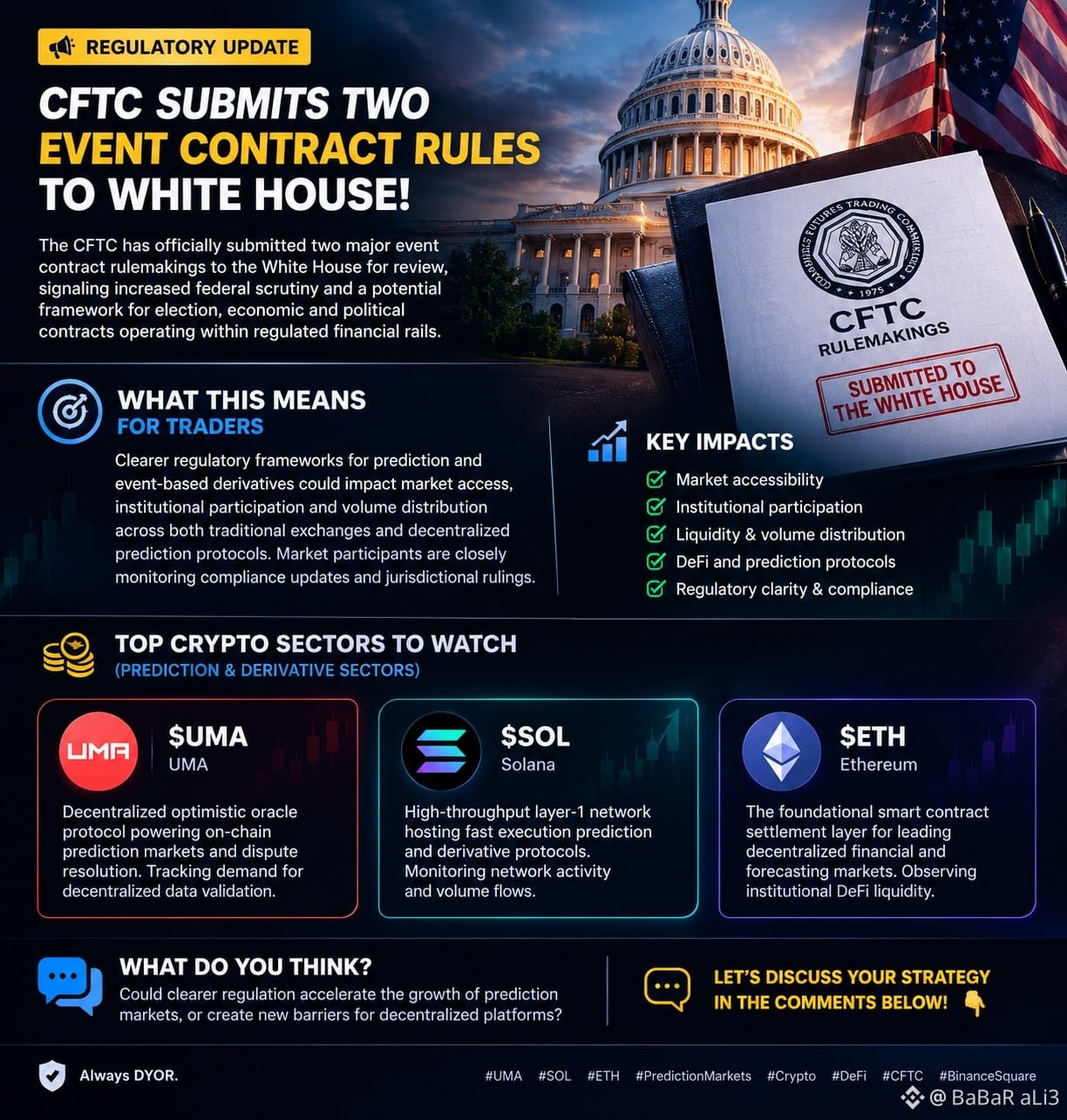
🚨 REGULATORY UPDATE | CFTC EVENT-CONTRACT RULES
The CFTC has submitted two event-contract rulemakings to the White House’s OIRA for review, marking another important step in the evolving U.S. regulatory framework for prediction markets. The submissions would address how event contracts are treated under the federal definition of “swap,” including a proposal to include event contracts and a companion interim final rule addressing casino-style gambling products.
👀 CRYPTO SECTORS TO WATCH
🔹 $UMA — Oracle infrastructure connected to on-chain prediction markets
🔹 $SOL — High-throughput ecosystem supporting DeFi and derivatives activity
🔹 $ETH — Core settlement and smart-contract infrastructure for decentralized markets
For traders, the key question is how clearer federal rules could affect market access, institutional participation, liquidity, and the development of decentralized prediction protocols.
⚠️ Important: These submissions are still under review and are not final rules, so the eventual regulatory impact remains uncertain.
What do you think — could clearer regulation accelerate the growth of prediction markets, or create new barriers for decentralized platforms?
👇 Let’s discuss.
Always DYOR.
#CFTCSubmitsTwoEventContractRulesToWhiteHouse
🚨 REGULATORY UPDATE | CFTC EVENT-CONTRACT RULES
The CFTC has submitted two event-contract rulemakings to the White House’s OIRA for review, marking another important step in the evolving U.S. regulatory framework for prediction markets. The submissions would address how event contracts are treated under the federal definition of “swap,” including a proposal to include event contracts and a companion interim final rule addressing casino-style gambling products.
👀 CRYPTO SECTORS TO WATCH
🔹 $UMA — Oracle infrastructure connected to on-chain prediction markets
🔹 $SOL — High-throughput ecosystem supporting DeFi and derivatives activity
🔹 $ETH — Core settlement and smart-contract infrastructure for decentralized markets
For traders, the key question is how clearer federal rules could affect market access, institutional participation, liquidity, and the development of decentralized prediction protocols.
⚠️ Important: These submissions are still under review and are not final rules, so the eventual regulatory impact remains uncertain.
What do you think — could clearer regulation accelerate the growth of prediction markets, or create new barriers for decentralized platforms?
👇 Let’s discuss.
Always DYOR.
#CFTCSubmitsTwoEventContractRulesToWhiteHouse
The CFTC has submitted two event-contract rulemakings to the White House’s OIRA for review, marking another important step in the evolving U.S. regulatory framework for prediction markets. The submissions would address how event contracts are treated under the federal definition of “swap,” including a proposal to include event contracts and a companion interim final rule addressing casino-style gambling products.
👀 CRYPTO SECTORS TO WATCH
🔹 $UMA — Oracle infrastructure connected to on-chain prediction markets
🔹 $SOL — High-throughput ecosystem supporting DeFi and derivatives activity
🔹 $ETH — Core settlement and smart-contract infrastructure for decentralized markets
For traders, the key question is how clearer federal rules could affect market access, institutional participation, liquidity, and the development of decentralized prediction protocols.
⚠️ Important: These submissions are still under review and are not final rules, so the eventual regulatory impact remains uncertain.
What do you think — could clearer regulation accelerate the growth of prediction markets, or create new barriers for decentralized platforms?
👇 Let’s discuss.
Always DYOR.
#CFTCSubmitsTwoEventContractRulesToWhiteHouse
3

#CFTCSubmitsTwoEventContractRulesToWhiteHouse
The CFTC has submitted two proposed rules on event contracts to the White House for review, marking another step in the development of the U.S. regulatory framework for event-based markets.
#CFTC #eventcontracts s #CryptoTrends2024 #Market_Update s #Regulation
#CFTCSubmitsTwoEventContractRulesToWhiteHouse
The CFTC has submitted two proposed rules on event contracts to the White House for review, marking another step in the development of the U.S. regulatory framework for event-based markets.
#CFTC #eventcontracts s #CryptoTrends2024 #Market_Update s #Regulation
The CFTC has submitted two proposed rules on event contracts to the White House for review, marking another step in the development of the U.S. regulatory framework for event-based markets.
#CFTC #eventcontracts s #CryptoTrends2024 #Market_Update s #Regulation
42

·
--
Bullish
#cftcsubmitstwoeventcontractrulestowhitehouse
🏛️ CFTC just sent "Event Contract" rules to the White House! But wait, what on earth is an event contract? 🤔
Simply put, it's a financial contract that lets you bet on real-world outcomes—like who wins the election or what the Fed will do next.
So, what are these two rules about?
- Rule 1: Ban casino-style gambling products from being classified as swaps. (Sorry, no poker chips here! 🎰)
- Rule 2: Officially pull event contracts into the regulated swap definition.
Does this affect your crypto or stocks?
Directly? No. But indirectly, it's a huge deal for decentralized prediction markets (like Polymarket) where users bet on events using crypto. CFTC wants to regulate these event bets under strict financial frameworks!
What should traders do?
Keep your eyes on the regulations, don't overleverage on prediction markets, and focus on your spot/futures bags.
Not financial advice.
Support me by using code VINHTOCDO or link: [https://www.binance.com/register?ref=VINHTOCDO](https://www.binance.com/register?ref=VINHTOCDO)
👇 Click trade below to support me:
$BTC
{future}(BTCUSDT)
$ETH
{future}(ETHUSDT)
$BNB
{future}(BNBUSDT)
#CFTC #EventContracts #CryptoRegulation #PredictionMarkets #CryptoNews #VINHTOCDO
#cftcsubmitstwoeventcontractrulestowhitehouse
🏛️ CFTC just sent "Event Contract" rules to the White House! But wait, what on earth is an event contract? 🤔
Simply put, it's a financial contract that lets you bet on real-world outcomes—like who wins the election or what the Fed will do next.
So, what are these two rules about?
- Rule 1: Ban casino-style gambling products from being classified as swaps. (Sorry, no poker chips here! 🎰)
- Rule 2: Officially pull event contracts into the regulated swap definition.
Does this affect your crypto or stocks?
Directly? No. But indirectly, it's a huge deal for decentralized prediction markets (like Polymarket) where users bet on events using crypto. CFTC wants to regulate these event bets under strict financial frameworks!
What should traders do?
Keep your eyes on the regulations, don't overleverage on prediction markets, and focus on your spot/futures bags.
Not financial advice.
Support me by using code VINHTOCDO or link: https://www.binance.com/register?ref=VINHTOCDO
👇 Click trade below to support me:
$BTC
$ETH
$BNB
#CFTC #EventContracts #CryptoRegulation #PredictionMarkets #CryptoNews #VINHTOCDO
🏛️ CFTC just sent "Event Contract" rules to the White House! But wait, what on earth is an event contract? 🤔
Simply put, it's a financial contract that lets you bet on real-world outcomes—like who wins the election or what the Fed will do next.
So, what are these two rules about?
- Rule 1: Ban casino-style gambling products from being classified as swaps. (Sorry, no poker chips here! 🎰)
- Rule 2: Officially pull event contracts into the regulated swap definition.
Does this affect your crypto or stocks?
Directly? No. But indirectly, it's a huge deal for decentralized prediction markets (like Polymarket) where users bet on events using crypto. CFTC wants to regulate these event bets under strict financial frameworks!
What should traders do?
Keep your eyes on the regulations, don't overleverage on prediction markets, and focus on your spot/futures bags.
Not financial advice.
Support me by using code VINHTOCDO or link: https://www.binance.com/register?ref=VINHTOCDO
👇 Click trade below to support me:
$BTC
$ETH
$BNB
#CFTC #EventContracts #CryptoRegulation #PredictionMarkets #CryptoNews #VINHTOCDO
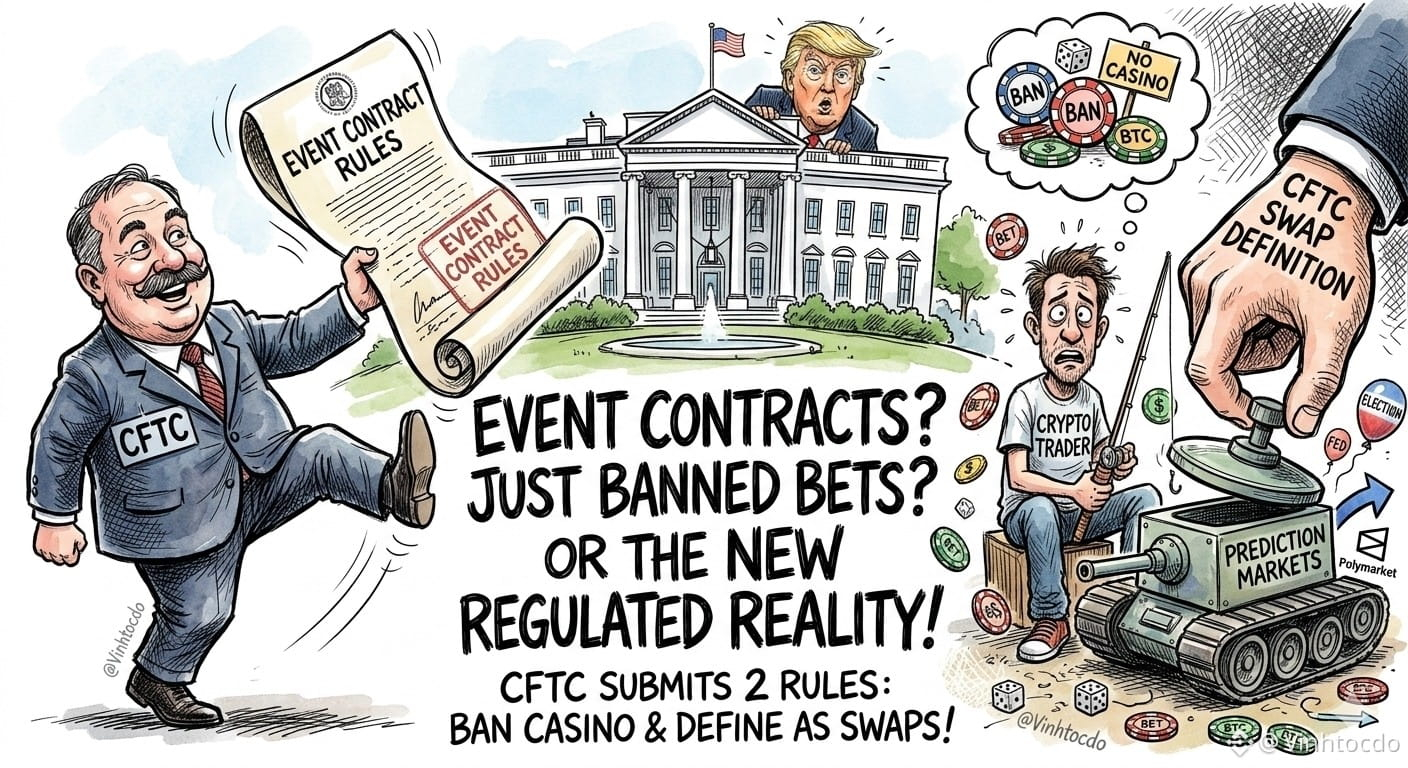
4
489

📢 A Big Regulatory Question for Sports Markets
Are event contracts financial instruments or gambling products?
The CFTC's latest proposals seek to draw a clearer federal line, while courts and states continue to challenge the regulatory framework.
📊 Sports trading is entering a closely watched phase.
$BTC $ETH $BNB
#cftcsubmitstwoeventcontractrulestowhitehouse
📢 A Big Regulatory Question for Sports Markets
Are event contracts financial instruments or gambling products?
The CFTC's latest proposals seek to draw a clearer federal line, while courts and states continue to challenge the regulatory framework.
📊 Sports trading is entering a closely watched phase.
$BTC $ETH $BNB
#cftcsubmitstwoeventcontractrulestowhitehouse
Are event contracts financial instruments or gambling products?
The CFTC's latest proposals seek to draw a clearer federal line, while courts and states continue to challenge the regulatory framework.
📊 Sports trading is entering a closely watched phase.
$BTC $ETH $BNB
#cftcsubmitstwoeventcontractrulestowhitehouse
600
⚡ Sports Trading Faces a Regulatory Test
The CFTC has sent two event-contract rules for White House review.
The proposals could reshape how sports-related prediction contracts are classified and regulated in the U.S.
🏟️ Sports markets
📜 New rules
📊 More regulatory clarity
$BTC $ETH
#cftcsubmitstwoeventcontractrulestowhitehouse
⚡ Sports Trading Faces a Regulatory Test
The CFTC has sent two event-contract rules for White House review.
The proposals could reshape how sports-related prediction contracts are classified and regulated in the U.S.
🏟️ Sports markets
📜 New rules
📊 More regulatory clarity
$BTC $ETH
#cftcsubmitstwoeventcontractrulestowhitehouse
The CFTC has sent two event-contract rules for White House review.
The proposals could reshape how sports-related prediction contracts are classified and regulated in the U.S.
🏟️ Sports markets
📜 New rules
📊 More regulatory clarity
$BTC $ETH
#cftcsubmitstwoeventcontractrulestowhitehouse
16
🚨 CFTC Takes Another Step on Event Contracts
Two new rules are now with the White House for review, including a proposal to treat event contracts as swaps.
Sports prediction markets could be significantly affected as the regulatory battle continues. 📊
$BTC $ETH
#cftcsubmitstwoeventcontractrulestowhitehouse
🚨 CFTC Takes Another Step on Event Contracts
Two new rules are now with the White House for review, including a proposal to treat event contracts as swaps.
Sports prediction markets could be significantly affected as the regulatory battle continues. 📊
$BTC $ETH
#cftcsubmitstwoeventcontractrulestowhitehouse
Two new rules are now with the White House for review, including a proposal to treat event contracts as swaps.
Sports prediction markets could be significantly affected as the regulatory battle continues. 📊
$BTC $ETH
#cftcsubmitstwoeventcontractrulestowhitehouse
6
Log in to explore more content
Join global crypto users on Binance Square
⚡️ Get latest and useful information about crypto.
💬 Trusted by the world’s largest crypto exchange.
👍 Discover real insights from verified creators.
Email / Phone number
Trending Topics
1
#EtherGains70.9%InQ3
71,087 views
756 Discussing
2
#TreasuryLetsStatesFileStablecoinCertificationsEarly
3,418 views
36 Discussing
3
#US10YearYieldNears5.3%
102,207 views
893 Discussing
4
#DollarIndexHitsHighestSinceMay2025
21,036 views
460 Discussing
5
#USWeeklyJoblessClaimsFallTo197000
22,219 views
394 Discussing
6
#BitcoinETFsTake$6.34BillionInQ3
7,194 views
57 Discussing
7
#KoreaProposesTokenizingStocksAndBonds
55,470 views
723 Discussing
8
#MetaMaskExitsLidoValidatorsAfterSecurityIncident
151,049 views
1,440 Discussing
9
#MicronBeatsEarningsLiftsGuidance
74,928 views
1,037 Discussing
10
#CFTCSubmitsTwoEventContractRulesToWhiteHouse
51,049 views
778 Discussing