

Crypto__Today
1.9k Posts

Crypto__Today
Report
Block User
Make impactful strides with the all-in-one, intelligent marketing platform designed to accelerate the growth of blockchain projects.Any promo: @Theodore_finch1
Open Trade
Occasional Trader
4.7 Years
15 Following
12.8K+ Followers
12.1K+ Liked
Posts
Portfolio
All
Quotes
Live
PINNED

Article
DOGS (DOGS) Price Prediction 2024, 2025–2030Explore short and medium-term DOGS price prediction analysis and check long-term DOGS forecasts for 2025, 2030, and beyond.
According to our current DOGS price prediction, the price of DOGS is predicted to rise by 228.05% and reach $ 0.007002 by September 25, 2024. Per our technical indicators, the current sentiment is Bearish while the Fear & Greed Index is showing 55 (Greed). DOGS recorded 5/7 (71%) green days with price volatility over the last 30 days. Based on the DOGS forecast, it's now a bad time to buy DOGS.
Based on the historical price movements of DOGS and the BTC halving cycles, the yearly low DOGS price prediction for 2025 is estimated at $ 0.002134. Meanwhile, the price of DOGS is predicted to reach as high as $ 0.010086 next year. Using the same basis, here is the DOGS price prediction for each year up until 2030.
DOGS price prediction 2025
The DOGS price prediction for 2025 is currently between $ 0.002134 on the lower end and $ 0.010086 on the high end. Compared to today’s price, DOGS could gain 372.57% by 2025 if DOGS reaches the upper price target.
DOGS price prediction 2030
The DOGS price prediction for 2030 is currently between $ 0.005381 on the lower end and $ 0.008725 on the high end. Compared to today’s price, DOGS could gain 308.82% by 2030 if it reaches the upper price target.
DOGS Price Forecast Based on Technical Analysis
Popular DOGS Moving Averages and Oscillators for Mon, Aug 26, 2024
Moving averages (MA) are a popular indicator in all financial markets, designed to smooth price action over a certain amount of time. They are a lagging indicator which means they are influenced by historical price activity. In the table below you can find two types of moving averages, simple moving average (SMA) and exponential moving average (EMA).
DOGS Key Price Levels
Based on today's classical pivot point (P1) with the value of $ 0.00205, DOGS has support levels of $ 0.001864, $ 0.001593, and the strongest at $ 0.001407. Similarly, DOGS resistance levels are at $ 0.002321, $ 0.002507, and $ 0.002778.
#BinanceLaunchpoolDOGS #TelegramCEO #CryptoMarketMoves #BinanceBlockchainWeek #LowestCPI2021
DOGS (DOGS) Price Prediction 2024, 2025–2030
Explore short and medium-term DOGS price prediction analysis and check long-term DOGS forecasts for 2025, 2030, and beyond.
According to our current DOGS price prediction, the price of DOGS is predicted to rise by 228.05% and reach $ 0.007002 by September 25, 2024. Per our technical indicators, the current sentiment is Bearish while the Fear & Greed Index is showing 55 (Greed). DOGS recorded 5/7 (71%) green days with price volatility over the last 30 days. Based on the DOGS forecast, it's now a bad time to buy DOGS.
Based on the historical price movements of DOGS and the BTC halving cycles, the yearly low DOGS price prediction for 2025 is estimated at $ 0.002134. Meanwhile, the price of DOGS is predicted to reach as high as $ 0.010086 next year. Using the same basis, here is the DOGS price prediction for each year up until 2030.
DOGS price prediction 2025
The DOGS price prediction for 2025 is currently between $ 0.002134 on the lower end and $ 0.010086 on the high end. Compared to today’s price, DOGS could gain 372.57% by 2025 if DOGS reaches the upper price target.
DOGS price prediction 2030
The DOGS price prediction for 2030 is currently between $ 0.005381 on the lower end and $ 0.008725 on the high end. Compared to today’s price, DOGS could gain 308.82% by 2030 if it reaches the upper price target.
DOGS Price Forecast Based on Technical Analysis
Popular DOGS Moving Averages and Oscillators for Mon, Aug 26, 2024
Moving averages (MA) are a popular indicator in all financial markets, designed to smooth price action over a certain amount of time. They are a lagging indicator which means they are influenced by historical price activity. In the table below you can find two types of moving averages, simple moving average (SMA) and exponential moving average (EMA).
DOGS Key Price Levels
Based on today's classical pivot point (P1) with the value of $ 0.00205, DOGS has support levels of $ 0.001864, $ 0.001593, and the strongest at $ 0.001407. Similarly, DOGS resistance levels are at $ 0.002321, $ 0.002507, and $ 0.002778.
#BinanceLaunchpoolDOGS #TelegramCEO #CryptoMarketMoves #BinanceBlockchainWeek #LowestCPI2021
177
8
1.8k
651.6k
Article
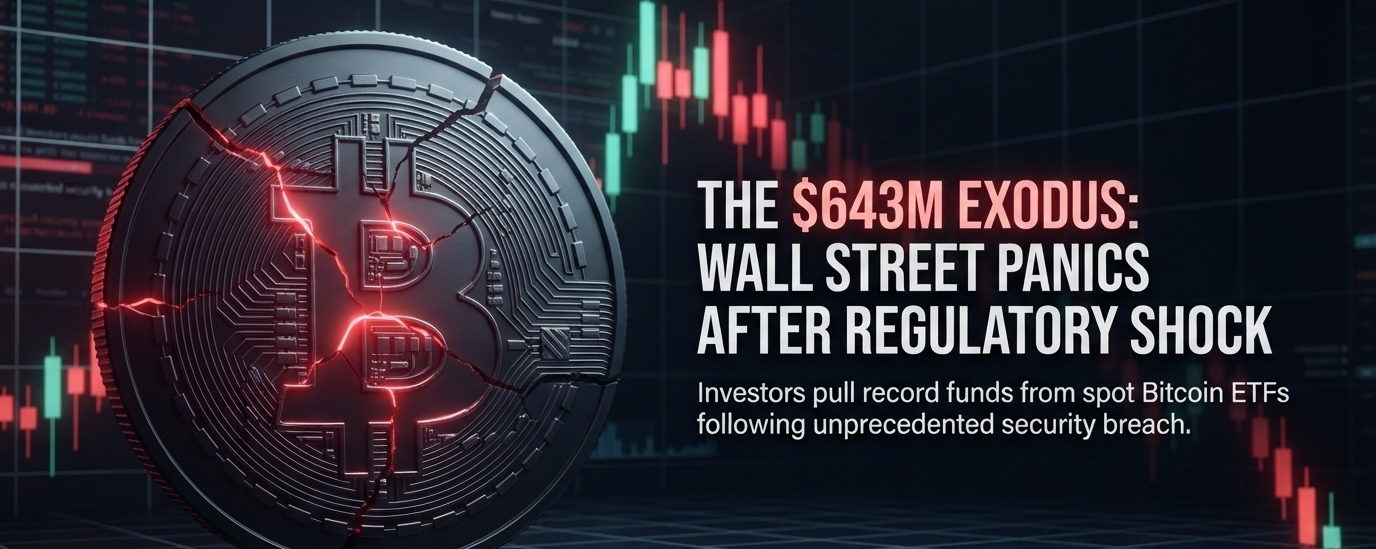
Institutional Volatility Hits Wall Street: What the $643M Bitcoin ETF Outflow Means for the MarketThe digital asset ecosystem just experienced one of its sharpest single-day institutional de-risking events. On October 30, traditional finance participants executed a massive capital flight, pulling a staggering $643.33 million out of U.S. spot Bitcoin ETFs in a single session according to data from SoSoValue.
This aggressive institutional exodus follows a major infrastructure shock. Just 24 hours prior on October 29, the ecosystem faced a massive $6.3 billion security breach targeting hot wallets across multiple chains, causing temporary withdrawal suspensions to stabilize reserves.
Understanding the Market Impact
The rapid capital movement from public equities highlights the evolving relationship between traditional finance and crypto-native platforms:
The TradFi Reflex: Fearing cascading liquidity failures and regulatory uncertainty right before the U.S. midterm elections, institutional fund managers immediately pulled back on spot ETF exposure.Technical Fallout: The sudden selling pressure pushed Bitcoin below its 50-day moving average, forcing the asset down to the $77,300 level.Altcoin Pressure: Large-cap protocols took heavier hits as leverage flushed out, with Ethereum dropping over 20% and Solana sliding down toward $95.80.
Cyclical Dip or Structural Break?
While the headline numbers are massive, macroeconomic analysts urge perspective. The broader market structure reveals that this is an infrastructure-driven leverage flush rather than a terminal blow to the macro cycle.
Bitcoin’s long-term cyclical baseline remains intact, supported by heavy institutional accumulation earlier in the year. Strong structural support is currently holding steady around the $73,000 to $75,000 range. This sharp correction may clear out speculative froth, paving the way for a more stable accumulation zone heading into the final months of Q4.
How are you managing your portfolio during this leverage flush? Are you buying the dip or waiting for the election volatility to settle? Let's discuss below.
#CryptoMarket #BitcoinETF #Binance #BTC #DeFi
Institutional Volatility Hits Wall Street: What the $643M Bitcoin ETF Outflow Means for the Market
The digital asset ecosystem just experienced one of its sharpest single-day institutional de-risking events. On October 30, traditional finance participants executed a massive capital flight, pulling a staggering $643.33 million out of U.S. spot Bitcoin ETFs in a single session according to data from SoSoValue.
This aggressive institutional exodus follows a major infrastructure shock. Just 24 hours prior on October 29, the ecosystem faced a massive $6.3 billion security breach targeting hot wallets across multiple chains, causing temporary withdrawal suspensions to stabilize reserves.
Understanding the Market Impact
The rapid capital movement from public equities highlights the evolving relationship between traditional finance and crypto-native platforms:
The TradFi Reflex: Fearing cascading liquidity failures and regulatory uncertainty right before the U.S. midterm elections, institutional fund managers immediately pulled back on spot ETF exposure.Technical Fallout: The sudden selling pressure pushed Bitcoin below its 50-day moving average, forcing the asset down to the $77,300 level.Altcoin Pressure: Large-cap protocols took heavier hits as leverage flushed out, with Ethereum dropping over 20% and Solana sliding down toward $95.80.
Cyclical Dip or Structural Break?
While the headline numbers are massive, macroeconomic analysts urge perspective. The broader market structure reveals that this is an infrastructure-driven leverage flush rather than a terminal blow to the macro cycle.
Bitcoin’s long-term cyclical baseline remains intact, supported by heavy institutional accumulation earlier in the year. Strong structural support is currently holding steady around the $73,000 to $75,000 range. This sharp correction may clear out speculative froth, paving the way for a more stable accumulation zone heading into the final months of Q4.
How are you managing your portfolio during this leverage flush? Are you buying the dip or waiting for the election volatility to settle? Let's discuss below.
#CryptoMarket #BitcoinETF #Binance #BTC #DeFi
1
171
·
--
Bearish
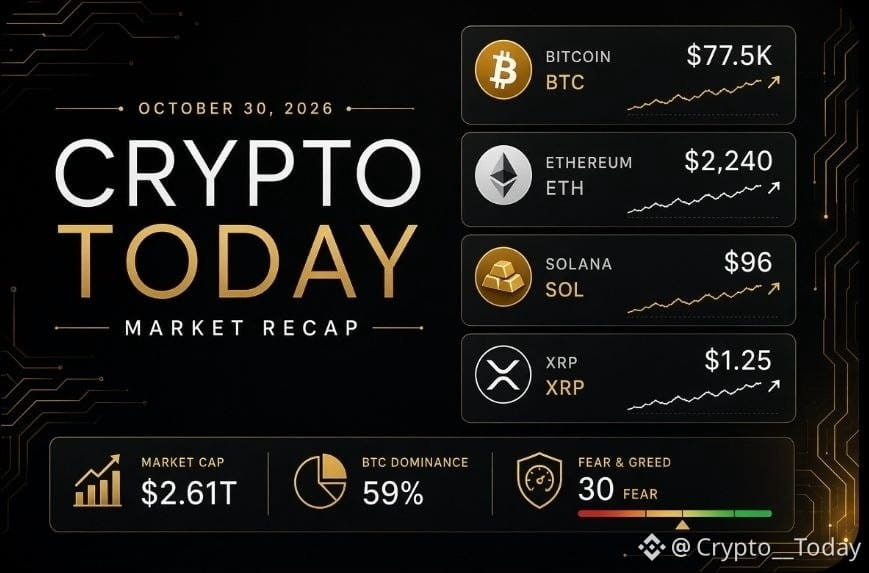
🚀 Weekend Crypto Recap – 30 Oct 2026 📈
$BTC : $76,500–$78,000 after a sharp dip toward $76.5k on Binance security news before partial recovery
Spot BTC ETFs: small positive flow on the latest day (~+$17M) amid recent mixed/negative prints and October volatility
$ETH : ~$2,230–$2,250
$SOL : ~$95–$97
$XRP : ~$1.24–$1.26
Market cap: ~$2.60T–$2.68T
Sentiment: Fear (Fear & Greed ~29–30)
Read: Majors absorbed the fallout from a reported $6.3B Binance incident (largest crypto theft on record, linked by tracers to North Korean actors), which triggered $900M+ in liquidations and a swift drop into Fear territory from Neutral. Breadth stayed weak as BTC tested lower supports; Binance has pledged full coverage and aims to restore withdrawals over the weekend. Key levels around $77k–$78k are in focus into thinner weekend trading.
Next catalyst: Binance withdrawal restart + any further hack updates + weekend headlines.
What are you watching this weekend? 👀
#Crypto #Bitcoin #WeekendRecap #DYOR
NFA.

JOIN & MORE 📊
From Crypto__Today
4
391

Article
Market Shockwaves: Binance Hit by Unprecedented $5.6 Billion Security BreachThe global cryptocurrency market is adjusting to severe headwinds following a historic security breach at Binance, the world’s largest digital asset exchange. Early on-chain forensics and transaction data confirm that over $5.6 billion in digital assets have been illicitly extracted from the platform, marking this as the largest cyber exploit in the history of the cryptocurrency industry.
The scale of the incident has triggered immediate cross-industry containment efforts. While the market capitalisation of major assets has felt the impact of localized selling pressure and leveraged liquidations, systemic risk-mitigation protocols across the broader blockchain ecosystem were deployed almost instantly.
Quantifying the Asset Exposure
The breach involves a diverse basket of blue-chip cryptocurrencies, high-liquidity stablecoins, and tokenized commodities. The primary assets identified in the unauthorized transfers include:
Tether (USDT): $1.57 BillionBitcoin (BTC): $1.45 BillionEthereum (ETH): $875 MillionUSD Coin (USDC): $823 MillionTRON (TRX): $234 MillionRipple USD (RLUSD): $88.5 MillionWrapped Beacon ETH (WBETH): $75 MillionTether Gold (XAUT): $50 MillionAlternative Cryptocurrencies: $447.5 Million
Ecosystem Mobilization and Countermeasures
In the wake of the exploit, the response from core infrastructure providers, security firms, and stablecoin issuers has been swift and highly coordinated:
Targeted Asset Freezes: Utilizing on-chain smart contract blacklisting capabilities, major stablecoin issuers—including Tether and Circle—have successfully immobilized approximately $3 billion of the stolen fiat-pegged tokens. This rapid intervention effectively isolates a massive portion of the exploiter's capital, severely restricting immediate liquidity exit ramps.Liquidity and Market Pricing: The total digital asset market capitalization experienced an immediate contraction of 3% to 5% as algorithmic trading desks and retail market participants adjusted risk parameters. High bid/ask spreads were observed across central order books, leading to localized cascading liquidations of leveraged long positions.Base-Layer Tracking: Forensics teams are heavily monitoring the $1.45 billion in Bitcoin and $875 million in Ethereum. While base-layer architecture prevents these assets from being frozen remotely, the transparent nature of public ledgers renders these specific funds highly toxic, virtually preventing them from being moved onto compliant centralized exchanges or institutional off-ramps.
Looking Ahead
The incident represents a critical inflection point for institutional digital asset infrastructure. The focus now shifts toward internal forensic audits, structural key-management protocols, and the deployment of emergency insurance backstops to preserve user capital.
This is a rapidly evolving market event. Further updates regarding security post-mortems, institutional asset recovery, and official operational statements will be integrated as verified data becomes available.
Market Shockwaves: Binance Hit by Unprecedented $5.6 Billion Security Breach
The global cryptocurrency market is adjusting to severe headwinds following a historic security breach at Binance, the world’s largest digital asset exchange. Early on-chain forensics and transaction data confirm that over $5.6 billion in digital assets have been illicitly extracted from the platform, marking this as the largest cyber exploit in the history of the cryptocurrency industry.
The scale of the incident has triggered immediate cross-industry containment efforts. While the market capitalisation of major assets has felt the impact of localized selling pressure and leveraged liquidations, systemic risk-mitigation protocols across the broader blockchain ecosystem were deployed almost instantly.
Quantifying the Asset Exposure
The breach involves a diverse basket of blue-chip cryptocurrencies, high-liquidity stablecoins, and tokenized commodities. The primary assets identified in the unauthorized transfers include:
Tether (USDT): $1.57 BillionBitcoin (BTC): $1.45 BillionEthereum (ETH): $875 MillionUSD Coin (USDC): $823 MillionTRON (TRX): $234 MillionRipple USD (RLUSD): $88.5 MillionWrapped Beacon ETH (WBETH): $75 MillionTether Gold (XAUT): $50 MillionAlternative Cryptocurrencies: $447.5 Million
Ecosystem Mobilization and Countermeasures
In the wake of the exploit, the response from core infrastructure providers, security firms, and stablecoin issuers has been swift and highly coordinated:
Targeted Asset Freezes: Utilizing on-chain smart contract blacklisting capabilities, major stablecoin issuers—including Tether and Circle—have successfully immobilized approximately $3 billion of the stolen fiat-pegged tokens. This rapid intervention effectively isolates a massive portion of the exploiter's capital, severely restricting immediate liquidity exit ramps.Liquidity and Market Pricing: The total digital asset market capitalization experienced an immediate contraction of 3% to 5% as algorithmic trading desks and retail market participants adjusted risk parameters. High bid/ask spreads were observed across central order books, leading to localized cascading liquidations of leveraged long positions.Base-Layer Tracking: Forensics teams are heavily monitoring the $1.45 billion in Bitcoin and $875 million in Ethereum. While base-layer architecture prevents these assets from being frozen remotely, the transparent nature of public ledgers renders these specific funds highly toxic, virtually preventing them from being moved onto compliant centralized exchanges or institutional off-ramps.
Looking Ahead
The incident represents a critical inflection point for institutional digital asset infrastructure. The focus now shifts toward internal forensic audits, structural key-management protocols, and the deployment of emergency insurance backstops to preserve user capital.
This is a rapidly evolving market event. Further updates regarding security post-mortems, institutional asset recovery, and official operational statements will be integrated as verified data becomes available.
1
609
Polymarket is expanding its footprint by introducing ultra-short-term cryptocurrency prediction markThe core feature of these new markets hinges on a binary outcome model: payouts are determined entirely by whether an asset's price finishes above or below a strict threshold at expiration. Unlike traditional derivatives or spot trading, the total distance the underlying crypto asset moves does not impact the final payout, creating a distinct risk-reward profile for short-timeframe traders.
Shift to High-Velocity Binary Outcomes
This product rollout brings fast-paced, event-based contracts directly to U.S. users. By focusing on ultra-short expirations—often measured in hours or minutes—the platform caters to growing demand for rapid trade resolutions.
The pricing mechanism simplifies price action into a straightforward "Yes" or "No" proposition:
Threshold-Based Settlements: Traded contracts settle at either 0 or 100 based entirely on the asset's final tick relative to the target strike price.
Independent of Magnitude: A fraction of a cent determines the winning side just as effectively as a massive market candle.
Fixed Risk Profiles: Traders risk only the capital deployed to purchase the contract, eliminating the risk of liquidation from sudden spikes or flash crashes.
Navigating the U.S. Regulatory Framework
Launching these specific contracts within the United States highlights a strategic effort to operate within compliant financial structures. By utilizing strict binary resolutions rather than leveraging underlying spot assets, the platform aligns with CFTC-style event contract models.
This structural distinction differentiates the offering from standard perpetual contracts or margin-based retail derivatives, which face rigorous regulatory restrictions in the U.S. market.
Market Implications for Retail Liquidity
The arrival of micro-duration prediction markets represents a broader convergence between traditional sports betting psychology, event wagering, and digital asset trading. For the wider crypto ecosystem, these contracts offer a capital-efficient tool to hedge near-instantaneous volatility during major economic releases, protocol upgrades, or breaking news events without requiring direct exposure to the underlying tokens.
#Polymarket #CryptoTrading #Web3 #PredictionMarkets #CryptoNews
Polymarket is expanding its footprint by introducing ultra-short-term cryptocurrency prediction mark
The core feature of these new markets hinges on a binary outcome model: payouts are determined entirely by whether an asset's price finishes above or below a strict threshold at expiration. Unlike traditional derivatives or spot trading, the total distance the underlying crypto asset moves does not impact the final payout, creating a distinct risk-reward profile for short-timeframe traders.
Shift to High-Velocity Binary Outcomes
This product rollout brings fast-paced, event-based contracts directly to U.S. users. By focusing on ultra-short expirations—often measured in hours or minutes—the platform caters to growing demand for rapid trade resolutions.
The pricing mechanism simplifies price action into a straightforward "Yes" or "No" proposition:
Threshold-Based Settlements: Traded contracts settle at either 0 or 100 based entirely on the asset's final tick relative to the target strike price.
Independent of Magnitude: A fraction of a cent determines the winning side just as effectively as a massive market candle.
Fixed Risk Profiles: Traders risk only the capital deployed to purchase the contract, eliminating the risk of liquidation from sudden spikes or flash crashes.
Navigating the U.S. Regulatory Framework
Launching these specific contracts within the United States highlights a strategic effort to operate within compliant financial structures. By utilizing strict binary resolutions rather than leveraging underlying spot assets, the platform aligns with CFTC-style event contract models.
This structural distinction differentiates the offering from standard perpetual contracts or margin-based retail derivatives, which face rigorous regulatory restrictions in the U.S. market.
Market Implications for Retail Liquidity
The arrival of micro-duration prediction markets represents a broader convergence between traditional sports betting psychology, event wagering, and digital asset trading. For the wider crypto ecosystem, these contracts offer a capital-efficient tool to hedge near-instantaneous volatility during major economic releases, protocol upgrades, or breaking news events without requiring direct exposure to the underlying tokens.
#Polymarket #CryptoTrading #Web3 #PredictionMarkets #CryptoNews
1
252
THE COST OF PAPER BITCOIN: Nasdaq Stock Collapses 50% Over $150M Crypto Illusion!The traditional stock market just received a brutal wake-up call about the ultimate rule of crypto: "Not your keys, not your coins."
Shares of Nasdaq-listed Datavault AI (NASDAQ: DVLT) crashed by a staggering 49.6% on Tuesday. Trading volumes surged eightfold as investors fled a major corporate emergency. A massive $150 million Bitcoin treasury deal has vanished from the asset column, morphing into a severe accounting nightmare.
Here is how a nine-figure crypto transaction triggered an SEC crisis and vaporized half of a public company's market value overnight.
The Trap: Off-Chain Illusion vs. On-Chain Reality
The financial disaster traces back to a high-profile September 2025 strategic agreement. Pharmaceuticals firm Scilex Holding Co. agreed to acquire $150 million worth of Datavault securities. Instead of utilizing cash, they settled the transaction using approximately 1,328 BTC.
However, the transaction skipped the actual blockchain.
Instead of routing the funds directly via an on-chain ledger transfer, the Bitcoin allocation was recorded via internal off-chain ledger adjustments at centralized platform Biconomy. Datavault quickly cashed out a portion of this credit, selling 491.4 BTC back to Scilex for $40.5 million in hard fiat cash.
The critical flaw emerged when Datavault attempted to transfer the remaining 818 BTC to a self-custodied secure cold storage wallet.
The withdrawal request stalled out completely. Four months later, the transaction remains locked in processing limbo with zero response from the platform.
The Retraction: Erasing Over $92 Million in Balance Sheet Assets
With millions in Bitcoin fundamentally inaccessible, Datavault's audit committee was forced to make a drastic corporate admission. In an official SEC Form 8-K filing, management declared that over a full year of their previous financial disclosures are completely unreliable.
Because Datavault exercises zero real-world operational control over the frozen tokens, auditors cannot categorize the balance as a liquid corporate asset. The company is executing massive restatements to pull the Bitcoin off its ledger, reclassifying it strictly as a "subscription receivable" (money still owed by an investor).
This forced accounting recalculation severely damages the firm’s balance sheets, slashing past recorded assets by massive margins:
Dec 31, 2025: Asset valuation cut by $92.2 million.March 31, 2026: Asset valuation cut by $57.1 million.June 30, 2026: Asset valuation cut by $49.0 million.
A Harsh Lesson in Solvency and Going-Concern Risks
The immediate fallout goes far beyond falling share prices. Datavault had explicitly assured investors that its sizable Bitcoin reserve would serve as the primary liquidity pool to fund day-to-day operations. Now that the treasury asset is functionally frozen, the company has officially admitted it is re-evaluating its status as a "going concern" to determine if it has enough available cash left to survive.
While the stock experienced a mild 22% technical rebound on Wednesday to hover around $0.08, it remains deeply scarred by the ongoing crisis.
For the broader Web3 and corporate communities, this Nasdaq meltdown serves as a monumental case study. When dealing with digital assets, internal database credits on a centralized entity mean absolutely nothing without true cryptographic control. If a public enterprise cannot independently sign a transaction to move its funds on-chain, it doesn't actually own the Bitcoin.
What are your thoughts on this accounting scandal? Will this force Wall Street to mandate strict on-chain self-custody for all public crypto treasuries?
#Bitcoin #DVLT #CryptoNews #Nasdaq #Web3
THE COST OF PAPER BITCOIN: Nasdaq Stock Collapses 50% Over $150M Crypto Illusion!
The traditional stock market just received a brutal wake-up call about the ultimate rule of crypto: "Not your keys, not your coins."
Shares of Nasdaq-listed Datavault AI (NASDAQ: DVLT) crashed by a staggering 49.6% on Tuesday. Trading volumes surged eightfold as investors fled a major corporate emergency. A massive $150 million Bitcoin treasury deal has vanished from the asset column, morphing into a severe accounting nightmare.
Here is how a nine-figure crypto transaction triggered an SEC crisis and vaporized half of a public company's market value overnight.
The Trap: Off-Chain Illusion vs. On-Chain Reality
The financial disaster traces back to a high-profile September 2025 strategic agreement. Pharmaceuticals firm Scilex Holding Co. agreed to acquire $150 million worth of Datavault securities. Instead of utilizing cash, they settled the transaction using approximately 1,328 BTC.
However, the transaction skipped the actual blockchain.
Instead of routing the funds directly via an on-chain ledger transfer, the Bitcoin allocation was recorded via internal off-chain ledger adjustments at centralized platform Biconomy. Datavault quickly cashed out a portion of this credit, selling 491.4 BTC back to Scilex for $40.5 million in hard fiat cash.
The critical flaw emerged when Datavault attempted to transfer the remaining 818 BTC to a self-custodied secure cold storage wallet.
The withdrawal request stalled out completely. Four months later, the transaction remains locked in processing limbo with zero response from the platform.
The Retraction: Erasing Over $92 Million in Balance Sheet Assets
With millions in Bitcoin fundamentally inaccessible, Datavault's audit committee was forced to make a drastic corporate admission. In an official SEC Form 8-K filing, management declared that over a full year of their previous financial disclosures are completely unreliable.
Because Datavault exercises zero real-world operational control over the frozen tokens, auditors cannot categorize the balance as a liquid corporate asset. The company is executing massive restatements to pull the Bitcoin off its ledger, reclassifying it strictly as a "subscription receivable" (money still owed by an investor).
This forced accounting recalculation severely damages the firm’s balance sheets, slashing past recorded assets by massive margins:
Dec 31, 2025: Asset valuation cut by $92.2 million.March 31, 2026: Asset valuation cut by $57.1 million.June 30, 2026: Asset valuation cut by $49.0 million.
A Harsh Lesson in Solvency and Going-Concern Risks
The immediate fallout goes far beyond falling share prices. Datavault had explicitly assured investors that its sizable Bitcoin reserve would serve as the primary liquidity pool to fund day-to-day operations. Now that the treasury asset is functionally frozen, the company has officially admitted it is re-evaluating its status as a "going concern" to determine if it has enough available cash left to survive.
While the stock experienced a mild 22% technical rebound on Wednesday to hover around $0.08, it remains deeply scarred by the ongoing crisis.
For the broader Web3 and corporate communities, this Nasdaq meltdown serves as a monumental case study. When dealing with digital assets, internal database credits on a centralized entity mean absolutely nothing without true cryptographic control. If a public enterprise cannot independently sign a transaction to move its funds on-chain, it doesn't actually own the Bitcoin.
What are your thoughts on this accounting scandal? Will this force Wall Street to mandate strict on-chain self-custody for all public crypto treasuries?
#Bitcoin #DVLT #CryptoNews #Nasdaq #Web3
1
236

Article
Will China’s Deflating AI Stock Bubble Crash Bitcoin?China’s AI sector is facing a severe reality check. On October 27, 2026, the tech-heavy STAR50 index plunged another 4.81%, extending a brutal 40% slide since July that has wiped out roughly $480 billion in market value.
As liquidations cascade through mainland equities, crypto traders are asking one critical question: Will the contagion spill over into Bitcoin?
Historically, severe market shocks in China act as a double-edged sword for crypto. While initial panic can spark broad de-risking, the secondary economic response often acts as a massive tailwind for hard assets. Here is how the deflating AI bubble could impact Bitcoin's price trajectory.
The Bear Case: Capital Flight and Liquidity Squeezes
When major equity markets experience a structural meltdown, correlation across all risk assets tends to tighten temporarily.
Margin Call Cascades: Institutional funds and multi-asset managers facing heavy losses in Chinese tech may be forced to liquidate liquid offshore assets—including crypto—to cover margin calls and shore up balance sheets.The USD Liquidity Crunch: Global sell-offs frequently trigger a flight to the U.S. dollar, strengthening the DXY index. Historically, a surging dollar exerts heavy downward pressure on Bitcoin.
The Bull Case: The "Safe Haven" Shift & Stimulus Injections
While a stock crash triggers short-term panic, the medium-term macroeconomic response paints a very different picture for Bitcoin.
Capital Flight Into Crypto: Despite regulatory restrictions, capital flight out of mainland China remains highly active via over-the-counter (OTC) desks and stablecoin networks. As domestic equities bleed, Chinese investors looking to preserve wealth traditionally look to hard assets like gold and Bitcoin.Aggressive Monetary Easing: A deflating equity bubble puts immense pressure on the People's Bank of China (PBOC) to intervene. To prevent a broader economic slowdown, Beijing is highly likely to counter with aggressive interest rate cuts and massive liquidity injections.Global Liquidity Correlation: Bitcoin thrives on global fiat debasement. When the PBOC opens the liquidity floodgates, that capital inevitably leaks into global financial markets, historically fueling massive crypto bull runs.
The Verdict: Short-Term Pain, Long-Term Gain?
If the STAR50 index and the broader Chinese tech sector continue their downward spiral, Bitcoin may face localized volatility and minor corrections as global risk appetite cools.
However, Bitcoin’s macro thesis remains intact. As fiat currencies face further devaluation through inevitable central bank bailouts and stimulus packages, the deflationary design of Bitcoin continues to stand out. Smart money will likely view any China-induced dip as a structural accumulation window.
What’s your take? Is this AI bubble burst going to drag BTC down, or will Chinese stimulus send crypto to the moon? Let me know in the comments below!
Disclaimer: This post is for informational purposes only and does not constitute financial advice. Always do your own research (DYOR).
#btc #BitcoinSlipsBelow$80KAgain #FOMCWatch
Will China’s Deflating AI Stock Bubble Crash Bitcoin?
China’s AI sector is facing a severe reality check. On October 27, 2026, the tech-heavy STAR50 index plunged another 4.81%, extending a brutal 40% slide since July that has wiped out roughly $480 billion in market value.
As liquidations cascade through mainland equities, crypto traders are asking one critical question: Will the contagion spill over into Bitcoin?
Historically, severe market shocks in China act as a double-edged sword for crypto. While initial panic can spark broad de-risking, the secondary economic response often acts as a massive tailwind for hard assets. Here is how the deflating AI bubble could impact Bitcoin's price trajectory.
The Bear Case: Capital Flight and Liquidity Squeezes
When major equity markets experience a structural meltdown, correlation across all risk assets tends to tighten temporarily.
Margin Call Cascades: Institutional funds and multi-asset managers facing heavy losses in Chinese tech may be forced to liquidate liquid offshore assets—including crypto—to cover margin calls and shore up balance sheets.The USD Liquidity Crunch: Global sell-offs frequently trigger a flight to the U.S. dollar, strengthening the DXY index. Historically, a surging dollar exerts heavy downward pressure on Bitcoin.
The Bull Case: The "Safe Haven" Shift & Stimulus Injections
While a stock crash triggers short-term panic, the medium-term macroeconomic response paints a very different picture for Bitcoin.
Capital Flight Into Crypto: Despite regulatory restrictions, capital flight out of mainland China remains highly active via over-the-counter (OTC) desks and stablecoin networks. As domestic equities bleed, Chinese investors looking to preserve wealth traditionally look to hard assets like gold and Bitcoin.Aggressive Monetary Easing: A deflating equity bubble puts immense pressure on the People's Bank of China (PBOC) to intervene. To prevent a broader economic slowdown, Beijing is highly likely to counter with aggressive interest rate cuts and massive liquidity injections.Global Liquidity Correlation: Bitcoin thrives on global fiat debasement. When the PBOC opens the liquidity floodgates, that capital inevitably leaks into global financial markets, historically fueling massive crypto bull runs.
The Verdict: Short-Term Pain, Long-Term Gain?
If the STAR50 index and the broader Chinese tech sector continue their downward spiral, Bitcoin may face localized volatility and minor corrections as global risk appetite cools.
However, Bitcoin’s macro thesis remains intact. As fiat currencies face further devaluation through inevitable central bank bailouts and stimulus packages, the deflationary design of Bitcoin continues to stand out. Smart money will likely view any China-induced dip as a structural accumulation window.
What’s your take? Is this AI bubble burst going to drag BTC down, or will Chinese stimulus send crypto to the moon? Let me know in the comments below!
Disclaimer: This post is for informational purposes only and does not constitute financial advice. Always do your own research (DYOR).
#btc #BitcoinSlipsBelow$80KAgain #FOMCWatch
1
455

Article
🚨 Jamie Dimon Warns: 5 Massive Risks Threatening US Stocks and BondsWhile the US economy shows near-term resilience, JPMorgan Chase CEO Jamie Dimon is advising market participants to look beyond the immediate horizon. With Wall Street fixed on the Federal Reserve’s upcoming interest rate decisions, Dimon has pointed to five structural headwinds that could introduce significant volatility to both equity and fixed-income markets.
Understanding these broader macroeconomic shifts is crucial for managing risk across all asset classes, including digital assets:
Persistent Inflationary Pressures: Core inflation may remain structurally sticky, potentially forcing central banks to keep benchmark interest rates higher for longer than current market models project.Elevated Fiscal Deficits: Sustained government spending and an expanding national debt load continue to place long-term structural strain on the broader economy.Quantitative Tightening (QT): The steady reduction of central bank balance sheets systematically drains liquidity from the financial system, which can crimp capital flows.Geopolitical Instability: Escalating international conflicts and evolving trade fragmentations introduce unpredictable operational risks for global markets.Global Remilitarization: A worldwide pivot toward higher defense expenditures risks distorting traditional fiscal priorities and altering capital allocation patterns.
The Crypto Impact:
Macro shifts driven by institutional banking frameworks heavily influence the global liquidity cycle. When traditional stocks and bonds experience margin compression or rising yields, capital flows inevitably adapt—directly impacting the risk appetite within the digital asset ecosystem.
How are you adjusting your portfolio to manage these broader macroeconomic risks? Let's discuss in the comments below.
NFA
#Macroeconomics #JPMorgan #FinanceNews #MarketAnalysis #CryptoLiquidity
🚨 Jamie Dimon Warns: 5 Massive Risks Threatening US Stocks and Bonds
While the US economy shows near-term resilience, JPMorgan Chase CEO Jamie Dimon is advising market participants to look beyond the immediate horizon. With Wall Street fixed on the Federal Reserve’s upcoming interest rate decisions, Dimon has pointed to five structural headwinds that could introduce significant volatility to both equity and fixed-income markets.
Understanding these broader macroeconomic shifts is crucial for managing risk across all asset classes, including digital assets:
Persistent Inflationary Pressures: Core inflation may remain structurally sticky, potentially forcing central banks to keep benchmark interest rates higher for longer than current market models project.Elevated Fiscal Deficits: Sustained government spending and an expanding national debt load continue to place long-term structural strain on the broader economy.Quantitative Tightening (QT): The steady reduction of central bank balance sheets systematically drains liquidity from the financial system, which can crimp capital flows.Geopolitical Instability: Escalating international conflicts and evolving trade fragmentations introduce unpredictable operational risks for global markets.Global Remilitarization: A worldwide pivot toward higher defense expenditures risks distorting traditional fiscal priorities and altering capital allocation patterns.
The Crypto Impact:
Macro shifts driven by institutional banking frameworks heavily influence the global liquidity cycle. When traditional stocks and bonds experience margin compression or rising yields, capital flows inevitably adapt—directly impacting the risk appetite within the digital asset ecosystem.
How are you adjusting your portfolio to manage these broader macroeconomic risks? Let's discuss in the comments below.
NFA
#Macroeconomics #JPMorgan #FinanceNews #MarketAnalysis #CryptoLiquidity
JOIN & SHARE 📊🤝
From Crypto__Today
1
5
282
Verified

Article
Brazil’s Shocking Election Result: Lula Re-elected, Bovespa Plunges 15%—What's Next for Markets?Brazil just witnessed one of the most volatile political outcomes of the year. Incumbent President Luiz Inácio Lula da Silva secured re-election, narrowly defeating right-wing challenger Flávio Bolsonaro with 51.77% of the vote.
The immediate reaction from the financial sector was swift and severe, with the Ibovespa stock market index crashing 15% following the announcement. For global investors, macroeconomic strategists, and cryptocurrency traders tracking emerging markets, this political pivot triggers a massive wave of capital re-allocation.
Here is an analysis of why the markets reacted so aggressively and what comes next.
Why the Stock Market Panicked
The 15% drop reflects a classic market knee-jerk reaction to political uncertainty and a shifting economic philosophy.
Fear of Fiscal Expansion: Investors are bracing for increased government spending, social welfare programs, and tighter state control over major industries—hallmarks of Lula's traditional economic platform.The Fate of State-Owned Giants: Heavyweight state-backed entities like Petrobras and Banco do Brasil face immediate selling pressure as traders anticipate potential shifts in corporate governance, dividend policies, and strategic priorities away from pure privatization.Currency Volatility: The Brazilian Real (BRL) is experiencing extreme friction, driving up import costs and complicating the inflation outlook for the Central Bank of Brazil.
What's Next? Key Triggers to Watch
While the initial crash signals panic, the medium-term outlook will depend entirely on Lula’s next structural moves. Savvy market participants are tracking three critical areas:
1. Cabinet Appointments & Fiscal Frameworks
The market’s primary focus will be on who Lula appoints to lead the Ministry of Finance. A pragmatic, orthodox economic team could quickly restore market confidence and stabilize the Bovespa. Conversely, choosing highly interventionist policymakers could prolong the capital flight.
2. Legislative Gridlock
Lula won by a razor-thin margin (51.77%), meaning the country remains deeply polarized. More importantly, the Brazilian Congress features a strong conservative and centrist presence. Lula will be forced to negotiate every major policy, likely diluting any extreme fiscal proposals and creating a stabilizing political checks-and-balances system.
3. The Digital Asset and Crypto Outlook
Brazil remains a crown jewel for cryptocurrency adoption in Latin America. Under the current regulatory framework, the Central Bank of Brazil has aggressively pushed for institutional crypto integration, stablecoin guidelines, and the development of its central bank digital currency (CBDC), Drex.
Historically, Lula’s administration has supported formalizing digital economies to boost financial inclusion and tax compliance. While traditional equities bleed, Brazil’s crypto infrastructure is likely to remain resilient, potentially acting as an alternative capital sanctuary if the BRL continues to weaken.
Investor Takeaway
A 15% market crash represents extreme panic, but it also opens the door for historic mispricings. Historically, emerging market shocks of this magnitude tend to overextend.
If the new administration signals structural fiscal discipline and cooperates with a divided Congress, Brazil's beaten-down equity valuations, high-yielding fixed-income instruments, and robust digital asset ecosystems could offer a compelling asymmetric risk-reward profile once the dust settles.
#EarningsSeason #Write2Earn
Brazil’s Shocking Election Result: Lula Re-elected, Bovespa Plunges 15%—What's Next for Markets?
Brazil just witnessed one of the most volatile political outcomes of the year. Incumbent President Luiz Inácio Lula da Silva secured re-election, narrowly defeating right-wing challenger Flávio Bolsonaro with 51.77% of the vote.
The immediate reaction from the financial sector was swift and severe, with the Ibovespa stock market index crashing 15% following the announcement. For global investors, macroeconomic strategists, and cryptocurrency traders tracking emerging markets, this political pivot triggers a massive wave of capital re-allocation.
Here is an analysis of why the markets reacted so aggressively and what comes next.
Why the Stock Market Panicked
The 15% drop reflects a classic market knee-jerk reaction to political uncertainty and a shifting economic philosophy.
Fear of Fiscal Expansion: Investors are bracing for increased government spending, social welfare programs, and tighter state control over major industries—hallmarks of Lula's traditional economic platform.The Fate of State-Owned Giants: Heavyweight state-backed entities like Petrobras and Banco do Brasil face immediate selling pressure as traders anticipate potential shifts in corporate governance, dividend policies, and strategic priorities away from pure privatization.Currency Volatility: The Brazilian Real (BRL) is experiencing extreme friction, driving up import costs and complicating the inflation outlook for the Central Bank of Brazil.
What's Next? Key Triggers to Watch
While the initial crash signals panic, the medium-term outlook will depend entirely on Lula’s next structural moves. Savvy market participants are tracking three critical areas:
1. Cabinet Appointments & Fiscal Frameworks
The market’s primary focus will be on who Lula appoints to lead the Ministry of Finance. A pragmatic, orthodox economic team could quickly restore market confidence and stabilize the Bovespa. Conversely, choosing highly interventionist policymakers could prolong the capital flight.
2. Legislative Gridlock
Lula won by a razor-thin margin (51.77%), meaning the country remains deeply polarized. More importantly, the Brazilian Congress features a strong conservative and centrist presence. Lula will be forced to negotiate every major policy, likely diluting any extreme fiscal proposals and creating a stabilizing political checks-and-balances system.
3. The Digital Asset and Crypto Outlook
Brazil remains a crown jewel for cryptocurrency adoption in Latin America. Under the current regulatory framework, the Central Bank of Brazil has aggressively pushed for institutional crypto integration, stablecoin guidelines, and the development of its central bank digital currency (CBDC), Drex.
Historically, Lula’s administration has supported formalizing digital economies to boost financial inclusion and tax compliance. While traditional equities bleed, Brazil’s crypto infrastructure is likely to remain resilient, potentially acting as an alternative capital sanctuary if the BRL continues to weaken.
Investor Takeaway
A 15% market crash represents extreme panic, but it also opens the door for historic mispricings. Historically, emerging market shocks of this magnitude tend to overextend.
If the new administration signals structural fiscal discipline and cooperates with a divided Congress, Brazil's beaten-down equity valuations, high-yielding fixed-income instruments, and robust digital asset ecosystems could offer a compelling asymmetric risk-reward profile once the dust settles.
#EarningsSeason #Write2Earn
2
490
Partly True

Article
Geopolitical Flashpoint: Trump Warns of Potential Iran Strikes—Can Bitcoin Hold the Critical $80,000The cryptocurrency market is bracing for acute volatility as escalating geopolitical tensions intersect with a critical technical retest for digital assets. President Donald Trump publicly declared that military strikes against Iran could initiate as soon as Sunday, though he maintained that a diplomatic resolution remains an open possibility.
Against this highly charged global backdrop, Bitcoin ($BTC) is fighting to protect its structural baseline, currently trading at $80,546 after briefly violating the critical psychological threshold by dipping below $80,000 on Saturday.
The Geopolitical Engine: Safe Haven or Risk Asset?
The immediate horizon presents a complex macroeconomic paradigm for digital asset traders. Historical precedents suggest that localized military conflicts act as significant catalysts for immediate capital reallocation.
Initial Shock Volatility: Sudden geopolitical updates typically trigger immediate cascading liquidations across highly leveraged derivative markets, as evidenced by Saturday's brief dip below $80,000.The De-Risking Reflex: In the immediate wake of military uncertainty, institutional managers often rotate capital into physical cash equivalents or short-term sovereign debt instruments, temporarily starving risk markets of liquidity.Long-Term Alternative Narrative: Conversely, structural instability within traditional banking hours often accelerates the core thesis of decentralized, borderless networks. If standard fiat rails encounter friction, hard assets like $BTC frequently experience powerful secondary accumulation waves.
Technical Realities: The $80,000 Defense Line
From a pure market structure perspective, the weekend price action has isolated the exact boundaries of the current structural playing field.
The Saturday Flush: The brief drop below $80,000 successfully flushed out short-term speculative longs, resetting open interest metrics to healthier baseline levels.Aggressive Limit Orders: The swift recovery back toward $80,546 proves that robust, institutional scale buy-walls remain highly active right beneath the round-number support zone.Weekend Illiquidity Risks: Because traditional banking infrastructure is dark over the weekend, the market remains highly susceptible to localized order-book exploitation if sudden headlines drop before the Monday morning bell.
Strategy for Active Market Participants
The next 24 hours require heightened risk management protocols. Traders must treat the macro headlines not as speculative trading signals, but as indicators of sudden liquidity shifts. A definitive daily close below the $80,000 cluster could rapidly open the doors to test the structural support nodes situated in the mid-$70,000 range. Conversely, if $BTC successfully absorbs the geopolitical headline risk above $80,000, it sets a incredibly strong foundation for a relief rally once institutional trading desks reopen globally.
#WriteToEarn #BTC #Geopolitics #MarketVolatility #CryptoNews
Geopolitical Flashpoint: Trump Warns of Potential Iran Strikes—Can Bitcoin Hold the Critical $80,000
The cryptocurrency market is bracing for acute volatility as escalating geopolitical tensions intersect with a critical technical retest for digital assets. President Donald Trump publicly declared that military strikes against Iran could initiate as soon as Sunday, though he maintained that a diplomatic resolution remains an open possibility.
Against this highly charged global backdrop, Bitcoin ($BTC ) is fighting to protect its structural baseline, currently trading at $80,546 after briefly violating the critical psychological threshold by dipping below $80,000 on Saturday.
The Geopolitical Engine: Safe Haven or Risk Asset?
The immediate horizon presents a complex macroeconomic paradigm for digital asset traders. Historical precedents suggest that localized military conflicts act as significant catalysts for immediate capital reallocation.
Initial Shock Volatility: Sudden geopolitical updates typically trigger immediate cascading liquidations across highly leveraged derivative markets, as evidenced by Saturday's brief dip below $80,000.The De-Risking Reflex: In the immediate wake of military uncertainty, institutional managers often rotate capital into physical cash equivalents or short-term sovereign debt instruments, temporarily starving risk markets of liquidity.Long-Term Alternative Narrative: Conversely, structural instability within traditional banking hours often accelerates the core thesis of decentralized, borderless networks. If standard fiat rails encounter friction, hard assets like $BTC frequently experience powerful secondary accumulation waves.
Technical Realities: The $80,000 Defense Line
From a pure market structure perspective, the weekend price action has isolated the exact boundaries of the current structural playing field.
The Saturday Flush: The brief drop below $80,000 successfully flushed out short-term speculative longs, resetting open interest metrics to healthier baseline levels.Aggressive Limit Orders: The swift recovery back toward $80,546 proves that robust, institutional scale buy-walls remain highly active right beneath the round-number support zone.Weekend Illiquidity Risks: Because traditional banking infrastructure is dark over the weekend, the market remains highly susceptible to localized order-book exploitation if sudden headlines drop before the Monday morning bell.
Strategy for Active Market Participants
The next 24 hours require heightened risk management protocols. Traders must treat the macro headlines not as speculative trading signals, but as indicators of sudden liquidity shifts. A definitive daily close below the $80,000 cluster could rapidly open the doors to test the structural support nodes situated in the mid-$70,000 range. Conversely, if $BTC successfully absorbs the geopolitical headline risk above $80,000, it sets a incredibly strong foundation for a relief rally once institutional trading desks reopen globally.
#WriteToEarn #BTC #Geopolitics #MarketVolatility #CryptoNews
1
3
894

Article
Capital Rotation? ETF Investors Pour Millions Into Zcash (ZEC) as Bitcoin (BTC) Outflows AccelerateThe cryptocurrency market is witnessing a fascinating shift in institutional capital dynamics. While traditional market eyes have been glued to the cooling momentum of primary assets, sophisticated Wall Street players are quietly redirecting liquidity. Over a volatile two-day window last week, spot Bitcoin ($NVDAB ETFs experienced over half a billion dollars in net outflows, while institutional investors simultaneously poured $41.1 million into Zcash ($ZEC).
This stark divergence raises a critical question for the broader market: Is smart money positioning itself ahead of a major privacy-centric narrative shift and an impending Zcash rally?
The Liquidity Contrast: Institutional De-risking vs. Targeted Re-entry
The contrasting flows indicate that large-scale market participants are not entirely exiting the digital asset ecosystem, but rather shifting strategies to exploit specific technical setups.
Bitcoin ETF Exhaustion: The massive deceleration in Bitcoin ETF net inflows suggests that institutional buyers are temporarily taking profits or hedging exposure as BTC consolidates beneath critical structural barriers.The Zcash Capital Influx: Allocating $41.1 million into a relatively mid-cap asset like Zcash in such a compressed timeframe represents a significant percentage of its circulating liquidity, creating massive localized buying pressure.Narrative Rotation: Historically, when capital drains from large-cap index drivers like $BTC, it triggers a rotation phase into specific altcoin categories offering higher volatility profiles or distinct utility arguments.
Why Zcash ($ZEC) Is Catching Wall Street's Attention
The sudden concentration of institutional interest in Zcash is rarely accidental. Several underlying catalysts could be driving this quiet accumulation phase.
Privacy Infrastructure Demand: As global regulatory oversight scales up, the foundational value proposition of robust, zero-knowledge security protocols is regaining institutional validation.Technological Maturation: Strategic upgrades within the Zcash network, particularly its transitions toward more scalable consensus layers and programmatic privacy tools, make it a highly viable long-term infrastructure bet.Asymmetric Risk-Reward Profile: Compared to major layer-1 assets that have already extended heavily into macro resistance, $ZEC presents an attractive, deeply discounted valuation relative to its historical high-water marks.
Market Outlook: Positioning for the Next Move
The upcoming trading week will be critical in confirming whether this institutional rotation has sustained structural legs. If Bitcoin stabilizes and stops the bleeding from its spot investment vehicles, the fresh capital injected into $ZEC could act as a high-powered spring, igniting broader speculative momentum across the entire privacy and zero-knowledge storage sector.
Traders should monitor near-term volume spikes on $ZEC to verify if Wall Street's accumulation phase translates into a definitive breakout above macro-resistance levels.
#WriteToEarn #ZEC #BTC #MacroOutlook #TrendingTopic
Capital Rotation? ETF Investors Pour Millions Into Zcash (ZEC) as Bitcoin (BTC) Outflows Accelerate
The cryptocurrency market is witnessing a fascinating shift in institutional capital dynamics. While traditional market eyes have been glued to the cooling momentum of primary assets, sophisticated Wall Street players are quietly redirecting liquidity. Over a volatile two-day window last week, spot Bitcoin ($NVDAB ETFs experienced over half a billion dollars in net outflows, while institutional investors simultaneously poured $41.1 million into Zcash ($ZEC ).
This stark divergence raises a critical question for the broader market: Is smart money positioning itself ahead of a major privacy-centric narrative shift and an impending Zcash rally?
The Liquidity Contrast: Institutional De-risking vs. Targeted Re-entry
The contrasting flows indicate that large-scale market participants are not entirely exiting the digital asset ecosystem, but rather shifting strategies to exploit specific technical setups.
Bitcoin ETF Exhaustion: The massive deceleration in Bitcoin ETF net inflows suggests that institutional buyers are temporarily taking profits or hedging exposure as BTC consolidates beneath critical structural barriers.The Zcash Capital Influx: Allocating $41.1 million into a relatively mid-cap asset like Zcash in such a compressed timeframe represents a significant percentage of its circulating liquidity, creating massive localized buying pressure.Narrative Rotation: Historically, when capital drains from large-cap index drivers like $BTC, it triggers a rotation phase into specific altcoin categories offering higher volatility profiles or distinct utility arguments.
Why Zcash ($ZEC ) Is Catching Wall Street's Attention
The sudden concentration of institutional interest in Zcash is rarely accidental. Several underlying catalysts could be driving this quiet accumulation phase.
Privacy Infrastructure Demand: As global regulatory oversight scales up, the foundational value proposition of robust, zero-knowledge security protocols is regaining institutional validation.Technological Maturation: Strategic upgrades within the Zcash network, particularly its transitions toward more scalable consensus layers and programmatic privacy tools, make it a highly viable long-term infrastructure bet.Asymmetric Risk-Reward Profile: Compared to major layer-1 assets that have already extended heavily into macro resistance, $ZEC presents an attractive, deeply discounted valuation relative to its historical high-water marks.
Market Outlook: Positioning for the Next Move
The upcoming trading week will be critical in confirming whether this institutional rotation has sustained structural legs. If Bitcoin stabilizes and stops the bleeding from its spot investment vehicles, the fresh capital injected into $ZEC could act as a high-powered spring, igniting broader speculative momentum across the entire privacy and zero-knowledge storage sector.
Traders should monitor near-term volume spikes on $ZEC to verify if Wall Street's accumulation phase translates into a definitive breakout above macro-resistance levels.
#WriteToEarn #ZEC #BTC #MacroOutlook #TrendingTopic
2
575

Article
Bitcoin Faces Critical Make-or-Break Weekend as Market Liquidity Tests $80,000The global cryptocurrency market is entering a high-stakes weekend as Bitcoin ($BTC ) struggles to maintain its bullish momentum, sparking intense debate over an impending market correction. After a failed attempt to consolidate above the psychological $83,000 resistance level, the premier digital asset has pulled back, forcing traders to closely monitor a critical line in the sand: the $80,000 baseline.
This crucial threshold represents more than just a round number. It serves as a pivotal support zone that could dictate the market's trajectory heading into the new week.
The Technical Battleground: Why $80,000 Matters
Bitcoin’s rejection at the higher bounds has shifted short-term market dynamics from aggressive accumulation to cautious defensive positioning.
Crucial Support Zone: The area between $79,500 and $80,400 is acting as the primary line of defense against deeper liquidations.Failed $83K Breakout: The inability to turn $83,000 into support triggered a wave of leveraged long liquidations, exhausting immediate buying pressure.Volume Metrics: Weekend trading typically brings lower volume and thinner order books, which could amplify price volatility in either direction.
Two Scenarios for the Days Ahead
Market participants are currently split between a healthy consolidation narrative and fears of a broader systemic flush.
The Bullish Defense: If buyers successfully absorb selling pressure above $80,000, this pullback will likely be classified as a standard retest. A successful defense here lays the groundwork for another leg up toward macro resistance.The Bearish Flush: A decisive daily close below $80,000 could trigger stop-loss orders and cascading liquidations. This scenario opens the door for a deeper correction, potentially testing lower support structures near the mid-$70,000 range.
Institutional Dominance vs. Retail Fear
Despite the immediate price anxiety, underlying market structures tell a story of resilience. Bitcoin continues to command a dominance rate of over 60% across the total digital asset landscape. This high concentration indicates that while capital is de-risking out of highly volatile altcoins, institutional allocations to $BTC remain structurally intact.
Market Outlook: The next 48 hours will test the market's true risk appetite. Traders should prepare for heightened volatility and closely monitor order book depth around the $80,000 level before committing to heavy positions.
#WriteToEarn #BTC #MarketDownturn #BinancePick
Bitcoin Faces Critical Make-or-Break Weekend as Market Liquidity Tests $80,000
The global cryptocurrency market is entering a high-stakes weekend as Bitcoin ($BTC ) struggles to maintain its bullish momentum, sparking intense debate over an impending market correction. After a failed attempt to consolidate above the psychological $83,000 resistance level, the premier digital asset has pulled back, forcing traders to closely monitor a critical line in the sand: the $80,000 baseline.
This crucial threshold represents more than just a round number. It serves as a pivotal support zone that could dictate the market's trajectory heading into the new week.
The Technical Battleground: Why $80,000 Matters
Bitcoin’s rejection at the higher bounds has shifted short-term market dynamics from aggressive accumulation to cautious defensive positioning.
Crucial Support Zone: The area between $79,500 and $80,400 is acting as the primary line of defense against deeper liquidations.Failed $83K Breakout: The inability to turn $83,000 into support triggered a wave of leveraged long liquidations, exhausting immediate buying pressure.Volume Metrics: Weekend trading typically brings lower volume and thinner order books, which could amplify price volatility in either direction.
Two Scenarios for the Days Ahead
Market participants are currently split between a healthy consolidation narrative and fears of a broader systemic flush.
The Bullish Defense: If buyers successfully absorb selling pressure above $80,000, this pullback will likely be classified as a standard retest. A successful defense here lays the groundwork for another leg up toward macro resistance.The Bearish Flush: A decisive daily close below $80,000 could trigger stop-loss orders and cascading liquidations. This scenario opens the door for a deeper correction, potentially testing lower support structures near the mid-$70,000 range.
Institutional Dominance vs. Retail Fear
Despite the immediate price anxiety, underlying market structures tell a story of resilience. Bitcoin continues to command a dominance rate of over 60% across the total digital asset landscape. This high concentration indicates that while capital is de-risking out of highly volatile altcoins, institutional allocations to $BTC remain structurally intact.
Market Outlook: The next 48 hours will test the market's true risk appetite. Traders should prepare for heightened volatility and closely monitor order book depth around the $80,000 level before committing to heavy positions.
#WriteToEarn #BTC #MarketDownturn #BinancePick
1
1
293

Article
OIL SURGES TOWARD YEARLY HIGHS: Are Stocks & Crypto Next to Crash?The timing couldn’t be worse for global markets. As crude oil targets its yearly peak, Wall Street is flashing red, Bitcoin is breaking key supports, and a massive geopolitical storm is brewing on the horizon.
Here is the brutal reality of what’s coming—and how it impacts your portfolio:
1️The Energy Tax on Growth
Rising oil prices act as a direct tax on consumers and corporations.
Inflation Resurgence: High crude spikes transportation costs, forcing the Federal Reserve to keep interest rates higher for longer.Wall Street Bleeding: Higher input costs compress corporate profit margins, triggering institutional de-risking across tech and growth stocks.
2️The Crypto Liquidity Squeeze 📉
Bitcoin and altcoins are no longer detached safe havens; they are hyper-sensitive liquidity gauges.
Risk-Off Dominance: As oil triggers broader market anxiety, investors are fleeing to cash, pulling massive capital out of digital assets.ETF Outflows: The cooling risk appetite has already sparked aggressive spot crypto ETF exits, accelerating the downward pressure.
3️ The Geopolitical Wildcard: US-Iran Escalation 🚀
The biggest threat isn't just economic; it’s structural. Rumors of a renewed US conflict with Iran post-midterm elections are freezing market sentiment.
Supply Shock: A war in the Middle East risks choking major energy chokepoints, sending oil past $100+ and breaking global supply chains.Panic Selling: Historically, the onset of major conflicts triggers immediate "sell-first, ask-questions-later" behavior in speculative assets like crypto.
The Bottom Line
Markets hate uncertainty, and right now, we are facing a perfect storm of energy inflation, monetary tightening, and wartime risk.
Buckle up. The next few weeks will determine if this is a temporary correction or the start of a deep structural crash.
#Crypto #EarningsSeason #macroeconomic #OilPrice #Bitcoin $BTC
OIL SURGES TOWARD YEARLY HIGHS: Are Stocks & Crypto Next to Crash?
The timing couldn’t be worse for global markets. As crude oil targets its yearly peak, Wall Street is flashing red, Bitcoin is breaking key supports, and a massive geopolitical storm is brewing on the horizon.
Here is the brutal reality of what’s coming—and how it impacts your portfolio:
1️The Energy Tax on Growth
Rising oil prices act as a direct tax on consumers and corporations.
Inflation Resurgence: High crude spikes transportation costs, forcing the Federal Reserve to keep interest rates higher for longer.Wall Street Bleeding: Higher input costs compress corporate profit margins, triggering institutional de-risking across tech and growth stocks.
2️The Crypto Liquidity Squeeze 📉
Bitcoin and altcoins are no longer detached safe havens; they are hyper-sensitive liquidity gauges.
Risk-Off Dominance: As oil triggers broader market anxiety, investors are fleeing to cash, pulling massive capital out of digital assets.ETF Outflows: The cooling risk appetite has already sparked aggressive spot crypto ETF exits, accelerating the downward pressure.
3️ The Geopolitical Wildcard: US-Iran Escalation 🚀
The biggest threat isn't just economic; it’s structural. Rumors of a renewed US conflict with Iran post-midterm elections are freezing market sentiment.
Supply Shock: A war in the Middle East risks choking major energy chokepoints, sending oil past $100+ and breaking global supply chains.Panic Selling: Historically, the onset of major conflicts triggers immediate "sell-first, ask-questions-later" behavior in speculative assets like crypto.
The Bottom Line
Markets hate uncertainty, and right now, we are facing a perfect storm of energy inflation, monetary tightening, and wartime risk.
Buckle up. The next few weeks will determine if this is a temporary correction or the start of a deep structural crash.
#Crypto #EarningsSeason #macroeconomic #OilPrice #Bitcoin $BTC
1
2
908
Article
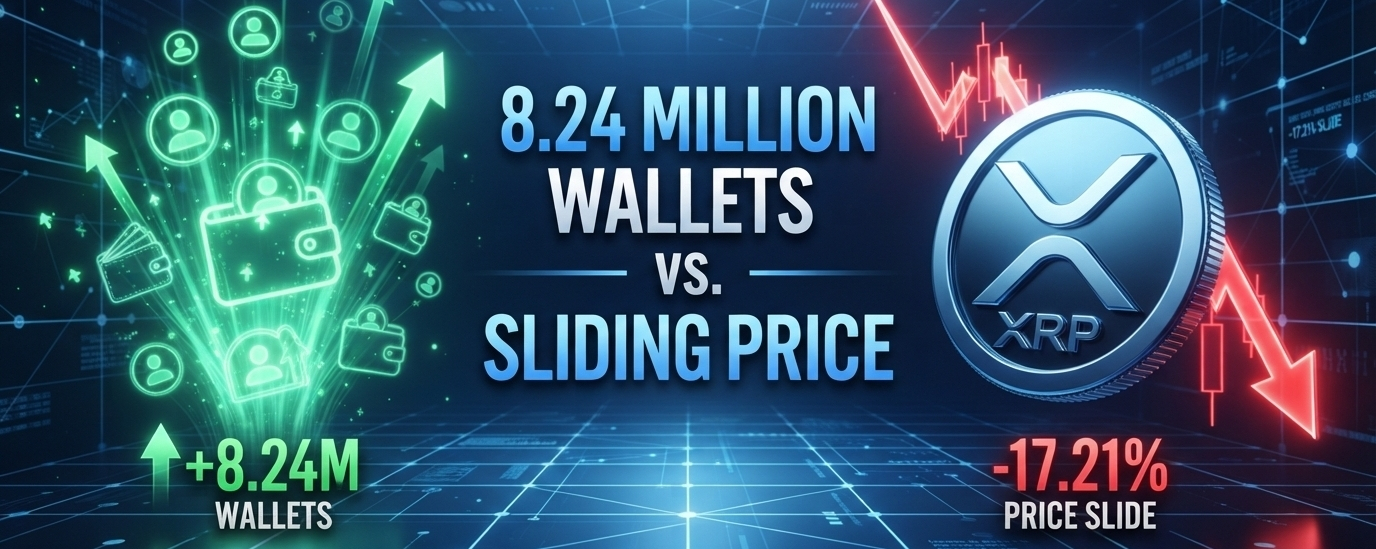
XRP Wallets Hit a Record 8.24 Million, So Why Is the Price Still Sliding?The Ripple ledger is experiencing an unprecedented surge in network adoption, yet the token's price remains stuck in a persistent downtrend. According to recent data from blockchain analytics firm Santiment, XRP has reached a historic milestone of 8.24 million non-empty wallets.
Despite this massive influx of address growth, the token has shed 17.21% of its value over the past month, slipping down to the $1.31 level.
This stark divergence between network growth and price action has left many investors scratching their heads. If more people are holding XRP than ever before, why is the price still sliding?
1. The "Dust Account" Dilution Effect
A primary reason for the mismatch between wallet growth and price appreciation is the nature of the addresses being created. A sharp rise in non-empty wallets does not automatically equal fresh, institutional capital entering the market. Many of these new accounts are retail users holding small fractions of XRP, often referred to as "dust." While the absolute number of holders looks impressive on a chart, the actual buying volume generated by these addresses is insufficient to absorb structural sell walls.
2. General Crypto Market De-risking
XRP does not trade in a vacuum. The broader digital asset market has faced significant headwinds recently, largely driven by macroeconomic shifts and tech-sector liquidations on Wall Street. As capital rotates out of riskier altcoins and moves toward cash or Bitcoin dominance (which recently hovered near 58%), XRP has suffered from a lack of independent upward momentum. When the tides of the overall market recede, even networks with strong fundamentals get dragged down.
3. Supply Inflation and Escrow Releases
Price is fundamentally governed by supply and demand. Even as demand grows via new wallet creation, Ripple’s predictable monthly escrow releases continue to introduce hundreds of millions of tokens into the circulating supply. When these massive unlocks coincide with periods of low market liquidity, they create a natural ceiling for price growth, requiring immense buying pressure just to maintain a flat baseline.
4. Speculative Fatigue vs. Real Utility
While enterprise adoption is steadily climbing—highlighted by major institutions expanding tokenized fund pilots across public ledgers—retail speculation still dictates short-term price movements. Many long-term holders have grown fatigued by prolonged consolidation phases, leading to localized distribution (selling) that counteracts the accumulation seen from new, smaller market entrants.
The Bottom Line
Record-breaking wallet growth proves that the XRP ledger remains one of the most resilient and widely distributed networks in crypto. However, a growing user base is a lagging indicator of network health, not a guarantee of immediate price pumps.
For XRP to reverse its 17% monthly slide and catch up to its network growth, it will need a combination of broader macroeconomic relief, a return of high-volume retail trading, and a sustained break above immediate technical resistance levels. Until then, the ledger will keep growing, even if the price has to wait.
#BinancePick #EarningsSeason #BitcoinSurpasses$82K #Write2Earn $XRP
{future}(XRPUSDT)
XRP Wallets Hit a Record 8.24 Million, So Why Is the Price Still Sliding?
The Ripple ledger is experiencing an unprecedented surge in network adoption, yet the token's price remains stuck in a persistent downtrend. According to recent data from blockchain analytics firm Santiment, XRP has reached a historic milestone of 8.24 million non-empty wallets.
Despite this massive influx of address growth, the token has shed 17.21% of its value over the past month, slipping down to the $1.31 level.
This stark divergence between network growth and price action has left many investors scratching their heads. If more people are holding XRP than ever before, why is the price still sliding?
1. The "Dust Account" Dilution Effect
A primary reason for the mismatch between wallet growth and price appreciation is the nature of the addresses being created. A sharp rise in non-empty wallets does not automatically equal fresh, institutional capital entering the market. Many of these new accounts are retail users holding small fractions of XRP, often referred to as "dust." While the absolute number of holders looks impressive on a chart, the actual buying volume generated by these addresses is insufficient to absorb structural sell walls.
2. General Crypto Market De-risking
XRP does not trade in a vacuum. The broader digital asset market has faced significant headwinds recently, largely driven by macroeconomic shifts and tech-sector liquidations on Wall Street. As capital rotates out of riskier altcoins and moves toward cash or Bitcoin dominance (which recently hovered near 58%), XRP has suffered from a lack of independent upward momentum. When the tides of the overall market recede, even networks with strong fundamentals get dragged down.
3. Supply Inflation and Escrow Releases
Price is fundamentally governed by supply and demand. Even as demand grows via new wallet creation, Ripple’s predictable monthly escrow releases continue to introduce hundreds of millions of tokens into the circulating supply. When these massive unlocks coincide with periods of low market liquidity, they create a natural ceiling for price growth, requiring immense buying pressure just to maintain a flat baseline.
4. Speculative Fatigue vs. Real Utility
While enterprise adoption is steadily climbing—highlighted by major institutions expanding tokenized fund pilots across public ledgers—retail speculation still dictates short-term price movements. Many long-term holders have grown fatigued by prolonged consolidation phases, leading to localized distribution (selling) that counteracts the accumulation seen from new, smaller market entrants.
The Bottom Line
Record-breaking wallet growth proves that the XRP ledger remains one of the most resilient and widely distributed networks in crypto. However, a growing user base is a lagging indicator of network health, not a guarantee of immediate price pumps.
For XRP to reverse its 17% monthly slide and catch up to its network growth, it will need a combination of broader macroeconomic relief, a return of high-volume retail trading, and a sustained break above immediate technical resistance levels. Until then, the ledger will keep growing, even if the price has to wait.
#BinancePick #EarningsSeason #BitcoinSurpasses$82K #Write2Earn $XRP
1
1.3k

Article
Bitcoin Price Erases Two-Day Gains After $85,000 Rejection: Will It Fall to $80,000?The cryptocurrency market faced a sharp reality check as Bitcoin (BTC) erased its entire two-day winning streak, sliding roughly 4% from local highs to hit an intraday low of $81,652. This sudden downturn follows a stiff rejection near the highly anticipated $85,000 psychological threshold, leaving traders wondering if a deeper correction toward $80,000 is inevitable.
Here is a deep dive into the technical levels, on-chain metrics, and market dynamics dictating Bitcoin’s next move.
The Catalyst: Rejection at the Gates of $85,000
After staging a robust rally earlier in the week, Bitcoin bulls encountered heavy sell-side liquidity just shy of $85,000, peaking at $84,840. The inability to clear this overhead resistance triggered a cascading liquidation event, wiping out over $431 million in leveraged positions network-wide.
Macroeconomic headwinds also played a major role. Hotter-than-expected inflation data pushed the U.S. Dollar Index (DXY) and Treasury yields higher, dampening investor appetite for risk assets and stalling institutional inflows into Spot Bitcoin ETFs.
Why a Drop to $80,000 is on the Table
Several structural indicators suggest that Bitcoin could test the $80,000 mark before finding a permanent bottom:
Institutional Profitability Line: According to on-chain data, corporate Bitcoin treasuries hold a collective average cost basis right at $80,000. Breaking below this critical psych level would push major corporate holders into net-unrealized losses, potentially sparking defensive risk-management selling.Draining Liquidity Footprint: Stablecoin reserves across major exchanges have plunged to a one-year low. This reduction in stablecoin supply indicates a lack of immediate buying power (dry powder) sitting on the sidelines to aggressively buy the dip.Slowing Corporate Demand: Corporate treasury accumulation has slowed down significantly compared to the high-velocity buying cycles observed in previous quarters, leaving the market highly dependent on retail spot absorption.
Critical Technical Support Levels to Watch
As volatility spikes, Bitcoin is currently battling within a very tight technical corridor:
The $81,500 Support Cluster: On the 4-hour chart, an ascending trendline stretching back to mid-October intersects directly around the $81,500 swing low. A daily candle close below this cluster confirms a short-term bearish breakdown.The 50-Day Moving Average: Bitcoin is actively testing its 50-day moving average at $81,835. As long as BTC holds above this indicator on a weekly closing basis, the overarching macro structure remains cautiously bullish.
The Outlook
If bulls fail to hold the $81,500 line, a swift retest of the $80,000 support level is highly probable. A catastrophic breach of $80,000 would open the door for a deeper correction toward the weekly order block between $73,000 and $75,000.
DYOR. NFA
#Write2Earn #EarningsSeason #btc
Bitcoin Price Erases Two-Day Gains After $85,000 Rejection: Will It Fall to $80,000?
The cryptocurrency market faced a sharp reality check as Bitcoin (BTC) erased its entire two-day winning streak, sliding roughly 4% from local highs to hit an intraday low of $81,652. This sudden downturn follows a stiff rejection near the highly anticipated $85,000 psychological threshold, leaving traders wondering if a deeper correction toward $80,000 is inevitable.
Here is a deep dive into the technical levels, on-chain metrics, and market dynamics dictating Bitcoin’s next move.
The Catalyst: Rejection at the Gates of $85,000
After staging a robust rally earlier in the week, Bitcoin bulls encountered heavy sell-side liquidity just shy of $85,000, peaking at $84,840. The inability to clear this overhead resistance triggered a cascading liquidation event, wiping out over $431 million in leveraged positions network-wide.
Macroeconomic headwinds also played a major role. Hotter-than-expected inflation data pushed the U.S. Dollar Index (DXY) and Treasury yields higher, dampening investor appetite for risk assets and stalling institutional inflows into Spot Bitcoin ETFs.
Why a Drop to $80,000 is on the Table
Several structural indicators suggest that Bitcoin could test the $80,000 mark before finding a permanent bottom:
Institutional Profitability Line: According to on-chain data, corporate Bitcoin treasuries hold a collective average cost basis right at $80,000. Breaking below this critical psych level would push major corporate holders into net-unrealized losses, potentially sparking defensive risk-management selling.Draining Liquidity Footprint: Stablecoin reserves across major exchanges have plunged to a one-year low. This reduction in stablecoin supply indicates a lack of immediate buying power (dry powder) sitting on the sidelines to aggressively buy the dip.Slowing Corporate Demand: Corporate treasury accumulation has slowed down significantly compared to the high-velocity buying cycles observed in previous quarters, leaving the market highly dependent on retail spot absorption.
Critical Technical Support Levels to Watch
As volatility spikes, Bitcoin is currently battling within a very tight technical corridor:
The $81,500 Support Cluster: On the 4-hour chart, an ascending trendline stretching back to mid-October intersects directly around the $81,500 swing low. A daily candle close below this cluster confirms a short-term bearish breakdown.The 50-Day Moving Average: Bitcoin is actively testing its 50-day moving average at $81,835. As long as BTC holds above this indicator on a weekly closing basis, the overarching macro structure remains cautiously bullish.
The Outlook
If bulls fail to hold the $81,500 line, a swift retest of the $80,000 support level is highly probable. A catastrophic breach of $80,000 would open the door for a deeper correction toward the weekly order block between $73,000 and $75,000.
DYOR. NFA
#Write2Earn #EarningsSeason #btc
1
235

Article
Crypto Long & Short: Why Real-World Assets Need Fixed-Rate Loans OnchainThe buzz around Real-World Assets (RWAs) in DeFi is real, with everyone talking about bringing institutional trillions onchain. By tokenizing real estate, private credit, and trade finance, Web3 can tap into massive, battle-tested markets.
But let's be honest: there is a massive roadblock keeping traditional businesses from actually scaling onchain—crazy interest rate volatility.
If we want to bridge TradFi and DeFi, we need a foundational pillar of traditional credit markets: fixed-rate loans.
The Trap: Why Variable Rates Don't Work for Real Businesses
Most DeFi lending protocols rely on variable-rate models driven by utilization pools. Demand goes up? Borrowing rates skyrocket. Demand drops? Rates plunge.
This works fine for crypto degens and hedge funds chasing quick leverage, but it’s a nightmare for real-world businesses:
Zero Budgeting Control: You can't run a real business financing a construction project or an export shipment when your capital costs swing from 4% to 25% in a matter of weeks.The Yield Mismatch: Real-world projects yield predictable, fixed returns. Matching a fixed-yield asset with a highly volatile variable-rate loan is a recipe for disaster.CFOs Will Say No: Chief Financial Officers demand predictability. If they can’t lock in a multi-month cost of capital, they will stay far away from Web3.
The Fix: Enter Fixed-Rate Lending
By bringing fixed-rate protocols into the RWA space, DeFi unlocks the missing puzzle pieces:
True Financial Planning: Fixed-rate loans let enterprises forecast expenses with 100% accuracy. Knowing the exact cost of capital over a 180 or 360-day term keeps profit margins safe.Predictable Yields for Lenders: Institutional investors and DAOs managing treasuries want steady, predictable income. Fixed-rate RWA pools offer a reliable alternative to volatile yield-farming, acting as a safe haven during market downturns.Better Capital Efficiency: Because fixed-rate terms are locked upfront, protocols can build more precise risk models. This opens the door to structured, under-collateralized lending for verified institutional players.
The Bottom Line
For RWAs to mature, putting a property deed or a bond on the blockchain isn't enough. The credit markets supporting them have to step up.
Once businesses can lock in predictable, fixed-rate loans onchain, the migration of traditional debt to Web3 will move from a nice theory to an absolute operational reality.
What’s your take? Will fixed-rate lending finally bring the big traditional players onchain, or is DeFi liquidity too volatile to support it?
#RWA #DeFi #Web3 #TradFi
Crypto Long & Short: Why Real-World Assets Need Fixed-Rate Loans Onchain
The buzz around Real-World Assets (RWAs) in DeFi is real, with everyone talking about bringing institutional trillions onchain. By tokenizing real estate, private credit, and trade finance, Web3 can tap into massive, battle-tested markets.
But let's be honest: there is a massive roadblock keeping traditional businesses from actually scaling onchain—crazy interest rate volatility.
If we want to bridge TradFi and DeFi, we need a foundational pillar of traditional credit markets: fixed-rate loans.
The Trap: Why Variable Rates Don't Work for Real Businesses
Most DeFi lending protocols rely on variable-rate models driven by utilization pools. Demand goes up? Borrowing rates skyrocket. Demand drops? Rates plunge.
This works fine for crypto degens and hedge funds chasing quick leverage, but it’s a nightmare for real-world businesses:
Zero Budgeting Control: You can't run a real business financing a construction project or an export shipment when your capital costs swing from 4% to 25% in a matter of weeks.The Yield Mismatch: Real-world projects yield predictable, fixed returns. Matching a fixed-yield asset with a highly volatile variable-rate loan is a recipe for disaster.CFOs Will Say No: Chief Financial Officers demand predictability. If they can’t lock in a multi-month cost of capital, they will stay far away from Web3.
The Fix: Enter Fixed-Rate Lending
By bringing fixed-rate protocols into the RWA space, DeFi unlocks the missing puzzle pieces:
True Financial Planning: Fixed-rate loans let enterprises forecast expenses with 100% accuracy. Knowing the exact cost of capital over a 180 or 360-day term keeps profit margins safe.Predictable Yields for Lenders: Institutional investors and DAOs managing treasuries want steady, predictable income. Fixed-rate RWA pools offer a reliable alternative to volatile yield-farming, acting as a safe haven during market downturns.Better Capital Efficiency: Because fixed-rate terms are locked upfront, protocols can build more precise risk models. This opens the door to structured, under-collateralized lending for verified institutional players.
The Bottom Line
For RWAs to mature, putting a property deed or a bond on the blockchain isn't enough. The credit markets supporting them have to step up.
Once businesses can lock in predictable, fixed-rate loans onchain, the migration of traditional debt to Web3 will move from a nice theory to an absolute operational reality.
What’s your take? Will fixed-rate lending finally bring the big traditional players onchain, or is DeFi liquidity too volatile to support it?
#RWA #DeFi #Web3 #TradFi
1
316
Article
🚨 JPMorgan Outlines 3 Bold Bitcoin Price Scenarios for 2036: Will It Outperform Gold?A striking new projection from JPMorgan Asset Management has caught the financial world's attention. The banking giant suggests that Bitcoin (BTC) could potentially outperform both US stocks and gold over the next decade.
As institutional adoption accelerates and macro landscapes shift, JPMorgan analysts have mapped out three distinct paths for Bitcoin’s valuation by the year 2036. Here is a breakdown of what the future might hold for the world’s leading digital asset.
1. The Bearish Reality: Regulatory & Macro Headwinds
In the most conservative scenario, Bitcoin faces stringent global regulatory frameworks, localized crackdowns on proof-of-work mining, and sustained high-interest-rate environments.
The Outcome: Growth slows down dramatically. Bitcoin remains a highly speculative niche asset rather than a global reserve. Under this lens, traditional equities and gold maintain their historical dominance, while BTC struggles to break past its structural resistance levels.
2. The Base Case: Steady Institutional Integration
JPMorgan’s baseline scenario assumes that current trends continue smoothly. Spot ETFs see steady, predictable inflows, and sovereign wealth funds gradually allocate 1% to 3% of their portfolios to digital assets.
The Outcome: Bitcoin establishes itself firmly as "Digital Gold." It matches or slightly beats the performance of the S&P 500 over the 10-year horizon. Volatility dampens, turning BTC into a mature, widely accepted macroeconomic hedge against fiat inflation.
3. The Bullish Supercycle: Hyper-Bitcoinization
The most optimistic scenario relies on Bitcoin completely disrupting traditional asset classes. In this future, global central banks begin holding BTC on their balance sheets, and hyper-inflationary pressures in developing fiat economies drive mass retail migration to decentralized networks.
The Outcome: Bitcoin massively outperforms both US stocks and gold. As its market cap aggressively chases the multi-trillion-dollar valuation of physical gold, BTC achieves unprecedented price milestones, cementing its status as the ultimate global store of value.
The Bottom Line for Crypto Investors
JPMorgan's projection underscores a massive shift in Wall Street's sentiment. An asset once dismissed by major banks is now being directly compared to—and projected to potentially beat—the bedrock of traditional finance: gold and American equities.
While the 2036 timeline leaves plenty of room for short-term volatility and cyclical bear markets, the long-term structural outlook remains highly compelling for patient holders.
What is your take on JPMorgan's 2036 outlook? Which scenario do you think is most likely to play out?
Disclaimer: This post is for informational and educational purposes only and does not constitute financial advice.
#Bitcoin #BTC #JPMorgan #CryptoNews #CryptoMarket
🚨 JPMorgan Outlines 3 Bold Bitcoin Price Scenarios for 2036: Will It Outperform Gold?
A striking new projection from JPMorgan Asset Management has caught the financial world's attention. The banking giant suggests that Bitcoin (BTC) could potentially outperform both US stocks and gold over the next decade.
As institutional adoption accelerates and macro landscapes shift, JPMorgan analysts have mapped out three distinct paths for Bitcoin’s valuation by the year 2036. Here is a breakdown of what the future might hold for the world’s leading digital asset.
1. The Bearish Reality: Regulatory & Macro Headwinds
In the most conservative scenario, Bitcoin faces stringent global regulatory frameworks, localized crackdowns on proof-of-work mining, and sustained high-interest-rate environments.
The Outcome: Growth slows down dramatically. Bitcoin remains a highly speculative niche asset rather than a global reserve. Under this lens, traditional equities and gold maintain their historical dominance, while BTC struggles to break past its structural resistance levels.
2. The Base Case: Steady Institutional Integration
JPMorgan’s baseline scenario assumes that current trends continue smoothly. Spot ETFs see steady, predictable inflows, and sovereign wealth funds gradually allocate 1% to 3% of their portfolios to digital assets.
The Outcome: Bitcoin establishes itself firmly as "Digital Gold." It matches or slightly beats the performance of the S&P 500 over the 10-year horizon. Volatility dampens, turning BTC into a mature, widely accepted macroeconomic hedge against fiat inflation.
3. The Bullish Supercycle: Hyper-Bitcoinization
The most optimistic scenario relies on Bitcoin completely disrupting traditional asset classes. In this future, global central banks begin holding BTC on their balance sheets, and hyper-inflationary pressures in developing fiat economies drive mass retail migration to decentralized networks.
The Outcome: Bitcoin massively outperforms both US stocks and gold. As its market cap aggressively chases the multi-trillion-dollar valuation of physical gold, BTC achieves unprecedented price milestones, cementing its status as the ultimate global store of value.
The Bottom Line for Crypto Investors
JPMorgan's projection underscores a massive shift in Wall Street's sentiment. An asset once dismissed by major banks is now being directly compared to—and projected to potentially beat—the bedrock of traditional finance: gold and American equities.
While the 2036 timeline leaves plenty of room for short-term volatility and cyclical bear markets, the long-term structural outlook remains highly compelling for patient holders.
What is your take on JPMorgan's 2036 outlook? Which scenario do you think is most likely to play out?
Disclaimer: This post is for informational and educational purposes only and does not constitute financial advice.
#Bitcoin #BTC #JPMorgan #CryptoNews #CryptoMarket
252
Article
Supply Shock Alert: 3 Massive Token Unlocks to Watch This WeekThe crypto market is bracing for a heavy influx of liquidity during the fourth week of October 2026. Across the broader market, scheduled token unlocks are projected to flood the space with more than $793.6 million in newly available supply.
For smart traders, massive unlocks represent a double-edged sword: they can trigger localized panic and sell-offs, or they can present the perfect "buy the dip" opportunity once the initial supply is absorbed.
If you are trading LayerZero (ZRO), Plasma (XPL), or Humanity (H), here are the critical dates, token distributions, and potential market impacts you need to keep on your radar this week.
1. LayerZero (ZRO) — October 20
Unlock Value: ~$43.54 MillionTokens Released: 23.28 Million ZROPercentage of Circulating Supply: 3.83%
As a leading interoperability protocol facilitating seamless cross-chain communication, LayerZero's upcoming release is the largest single-day dollar value event among the three. The distribution will allocate 10.99 million tokens to strategic partners, 10.63 million to core contributors, and 1.67 million toward team-repurchased tokens.
Market Outlook: Because a significant portion goes directly to core contributors and insiders, the short-term price action will heavily depend on whether these entities decide to monetize immediately or hold for the long haul. Keep a close eye on ZRO's 24-hour trading volume; if the volume begins to taper off while supply enters the market, expect localized sell pressure.
2. Plasma (XPL) — October 25
Unlock Value: ~$17.50 MillionTokens Released: 227.78 Million XPLPercentage of Circulating Supply: 5.02%
Plasma, the specialized Layer 1 blockchain optimized for zero-fee stablecoin transactions and confidential payments, is entering its next supply expansion phase. The upcoming unlock will direct 88.89 million XPL to ecosystem growth, while investors and the core team will split the remainder by receiving 69.44 million tokens each.
Market Outlook: While XPL has seen decent tailwinds recently due to its integration milestones—such as native payment tracking and high-profile stablecoin payout use cases—this release still expands the liquid float by over 5%. The asset has experienced front-running sell pressure ahead of the date, meaning much of the dilution risk might already be priced in.
3. Humanity (H) — October 25
Unlock Value: ~$15.30 MillionTokens Released: 266.47 Million HPercentage of Circulating Supply: 6.84%
Humanity Protocol utilizes unique biometric palm recognition alongside zero-knowledge proofs to build decentralized identity infrastructure. This unlock represents the largest percentage increase in circulating supply among the three primary projects. The supply will split six ways, heavily favoring early contributors (79.17 million H) and investors (55.56 million H). The rest will fund identity verification rewards, the ecosystem pot, and the treasury.
Market Outlook: A 6.84% supply expansion concentrated heavily around early backers and contributors introduces significant sell-side risk. Watch the order books carefully around October 25; a sharp drop in liquidity could result in higher volatility if early investors choose to take profits.
Pro-Trader Takeaway
Token unlocks are structurally bearish in the short term due to the sudden increase in floating supply, but they also act as a vital health check for a project’s community conviction. If a token manages to hold its key support levels during a massive unlock event, it signals intense buyer demand and long-term accumulation interest.
Always cross-reference these schedules with active decentralized exchange (DEX) liquidity and incoming exchange inflows to spot where the whales are moving their newly unlocked bags.
Disclaimer: Token unlock schedules can be adjusted by project foundations, and exact distribution values fluctuate based on real-time market prices. Always manage your risk.
What are your thoughts on this week's unlocks? Are you planning to de-risk your positions, or are you looking to buy the volatility? Let me know in the comments below!
#Write2Earn #H #zro
Supply Shock Alert: 3 Massive Token Unlocks to Watch This Week
The crypto market is bracing for a heavy influx of liquidity during the fourth week of October 2026. Across the broader market, scheduled token unlocks are projected to flood the space with more than $793.6 million in newly available supply.
For smart traders, massive unlocks represent a double-edged sword: they can trigger localized panic and sell-offs, or they can present the perfect "buy the dip" opportunity once the initial supply is absorbed.
If you are trading LayerZero (ZRO), Plasma (XPL), or Humanity (H), here are the critical dates, token distributions, and potential market impacts you need to keep on your radar this week.
1. LayerZero (ZRO) — October 20
Unlock Value: ~$43.54 MillionTokens Released: 23.28 Million ZROPercentage of Circulating Supply: 3.83%
As a leading interoperability protocol facilitating seamless cross-chain communication, LayerZero's upcoming release is the largest single-day dollar value event among the three. The distribution will allocate 10.99 million tokens to strategic partners, 10.63 million to core contributors, and 1.67 million toward team-repurchased tokens.
Market Outlook: Because a significant portion goes directly to core contributors and insiders, the short-term price action will heavily depend on whether these entities decide to monetize immediately or hold for the long haul. Keep a close eye on ZRO's 24-hour trading volume; if the volume begins to taper off while supply enters the market, expect localized sell pressure.
2. Plasma (XPL) — October 25
Unlock Value: ~$17.50 MillionTokens Released: 227.78 Million XPLPercentage of Circulating Supply: 5.02%
Plasma, the specialized Layer 1 blockchain optimized for zero-fee stablecoin transactions and confidential payments, is entering its next supply expansion phase. The upcoming unlock will direct 88.89 million XPL to ecosystem growth, while investors and the core team will split the remainder by receiving 69.44 million tokens each.
Market Outlook: While XPL has seen decent tailwinds recently due to its integration milestones—such as native payment tracking and high-profile stablecoin payout use cases—this release still expands the liquid float by over 5%. The asset has experienced front-running sell pressure ahead of the date, meaning much of the dilution risk might already be priced in.
3. Humanity (H) — October 25
Unlock Value: ~$15.30 MillionTokens Released: 266.47 Million HPercentage of Circulating Supply: 6.84%
Humanity Protocol utilizes unique biometric palm recognition alongside zero-knowledge proofs to build decentralized identity infrastructure. This unlock represents the largest percentage increase in circulating supply among the three primary projects. The supply will split six ways, heavily favoring early contributors (79.17 million H) and investors (55.56 million H). The rest will fund identity verification rewards, the ecosystem pot, and the treasury.
Market Outlook: A 6.84% supply expansion concentrated heavily around early backers and contributors introduces significant sell-side risk. Watch the order books carefully around October 25; a sharp drop in liquidity could result in higher volatility if early investors choose to take profits.
Pro-Trader Takeaway
Token unlocks are structurally bearish in the short term due to the sudden increase in floating supply, but they also act as a vital health check for a project’s community conviction. If a token manages to hold its key support levels during a massive unlock event, it signals intense buyer demand and long-term accumulation interest.
Always cross-reference these schedules with active decentralized exchange (DEX) liquidity and incoming exchange inflows to spot where the whales are moving their newly unlocked bags.
Disclaimer: Token unlock schedules can be adjusted by project foundations, and exact distribution values fluctuate based on real-time market prices. Always manage your risk.
What are your thoughts on this week's unlocks? Are you planning to de-risk your positions, or are you looking to buy the volatility? Let me know in the comments below!
#Write2Earn #H #zro
2
918
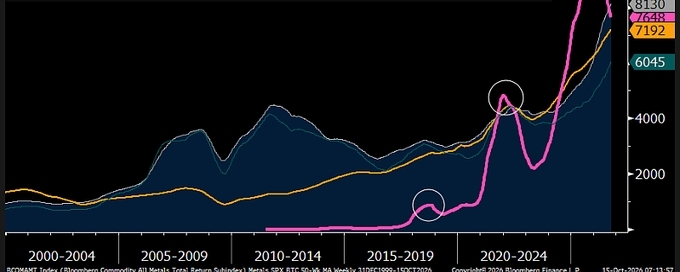
Article
🚨 Will Bitcoin Crash to $10,000? Evaluating Bloomberg’s Grim Macro WarningA stark forecast from Bloomberg Intelligence senior commodity strategist Mike McGlone has reignited intense debate across the cryptocurrency market. McGlone warned that Bitcoin (BTC) could plummet toward the $10,000 level if United States stock indexes experience a severe 20% correction.
While Bitcoin has solidified its position as a major institutional asset class, this projection serves as a sobering reminder of the deep liquidity ties connecting crypto markets to traditional finance.
The Macro Link: Why $10,000 is on the Radar
The core of the bearish thesis relies heavily on macro liquidity and asset correlation:
Equity Market Contagion: A sudden 20% drop in US equities would trigger a massive liquidity squeeze. In high-risk environments, institutional investors historically liquidate volatile assets—including cryptocurrencies—to cover margins and hoard cash.The High-Beta Reality: Despite its "digital gold" narrative, Bitcoin continues to trade as a high-beta risk asset during broader market panics.Historic Precedent: Major stock market drawdowns, such as the 2020 liquidity crunch, have historically dragged the crypto market down in tandem before a decoupling or recovery occurs.
The Counter-Argument: Institutional Floors & ETF Support
While a severe macroeconomic shock could trigger sharp liquidations, many analysts argue that a drop to $10,000 faces massive structural roadblocks:
The ETF Cushion: The introduction of spot Bitcoin ETFs has established a robust institutional floor. Massive capital inflows from traditional finance giants have fundamentally changed the asset's supply dynamics.Long-Term Holder Resilience: On-chain data reveals that the percentage of supply held by long-term entities remains near historic highs, indicating strong conviction that resists panic selling.Production Cost Floor: The underlying cost of mining a single Bitcoin acts as a psychological and economic floor, making a sustained drop to four figures highly unlikely without a total network collapse.
⚖ Final Verdict: Risk Management is Key
McGlone’s warning shouldn't be dismissed as mere bearishness, but rather interpreted as a worst-case macro scenario. If global markets experience a severe systemic shock, crypto will not be immune to the initial damage.
For creators and investors on Binance Square, this serves as an important reminder to look beyond simple crypto charts. Keeping a close eye on broader macroeconomic indicators, interest rates, and Wall Street equity health is vital for navigating the next phase of the market cycle.
What do you think? Is a $10,000 Bitcoin completely out of the question, or are we underestimating macro risks?
#Bitcoin #CryptoNews #BinanceSquare #MacroEconomics
🚨 Will Bitcoin Crash to $10,000? Evaluating Bloomberg’s Grim Macro Warning
A stark forecast from Bloomberg Intelligence senior commodity strategist Mike McGlone has reignited intense debate across the cryptocurrency market. McGlone warned that Bitcoin (BTC) could plummet toward the $10,000 level if United States stock indexes experience a severe 20% correction.
While Bitcoin has solidified its position as a major institutional asset class, this projection serves as a sobering reminder of the deep liquidity ties connecting crypto markets to traditional finance.
The Macro Link: Why $10,000 is on the Radar
The core of the bearish thesis relies heavily on macro liquidity and asset correlation:
Equity Market Contagion: A sudden 20% drop in US equities would trigger a massive liquidity squeeze. In high-risk environments, institutional investors historically liquidate volatile assets—including cryptocurrencies—to cover margins and hoard cash.The High-Beta Reality: Despite its "digital gold" narrative, Bitcoin continues to trade as a high-beta risk asset during broader market panics.Historic Precedent: Major stock market drawdowns, such as the 2020 liquidity crunch, have historically dragged the crypto market down in tandem before a decoupling or recovery occurs.
The Counter-Argument: Institutional Floors & ETF Support
While a severe macroeconomic shock could trigger sharp liquidations, many analysts argue that a drop to $10,000 faces massive structural roadblocks:
The ETF Cushion: The introduction of spot Bitcoin ETFs has established a robust institutional floor. Massive capital inflows from traditional finance giants have fundamentally changed the asset's supply dynamics.Long-Term Holder Resilience: On-chain data reveals that the percentage of supply held by long-term entities remains near historic highs, indicating strong conviction that resists panic selling.Production Cost Floor: The underlying cost of mining a single Bitcoin acts as a psychological and economic floor, making a sustained drop to four figures highly unlikely without a total network collapse.
⚖ Final Verdict: Risk Management is Key
McGlone’s warning shouldn't be dismissed as mere bearishness, but rather interpreted as a worst-case macro scenario. If global markets experience a severe systemic shock, crypto will not be immune to the initial damage.
For creators and investors on Binance Square, this serves as an important reminder to look beyond simple crypto charts. Keeping a close eye on broader macroeconomic indicators, interest rates, and Wall Street equity health is vital for navigating the next phase of the market cycle.
What do you think? Is a $10,000 Bitcoin completely out of the question, or are we underestimating macro risks?
#Bitcoin #CryptoNews #BinanceSquare #MacroEconomics
284
🚨 Is $NIL the Missing Piece for Web3 Privacy & AI? 🌐
Everyone is talking about Zero-Knowledge (ZK) tech, but Nillion ($NIL) is tackling the holy grail of crypto security: Blind Computation
Blockchains are inherently public, which means your trading intents, smart contract strategies, and private data are exposed to MEV bots and front-runners. Nillion fixes this by processing data without ever "seeing" it.
Here is what you need to know about this massive ecosystem push:
Encrypted Markets via Covenants: Nillion's Covenants completely shield advanced order details and proprietary trading strategies, keeping them 100% private during execution while maintaining clean on-chain verification. Say goodbye to structural front-running leaks!
Dusk is Live on Ethereum Mainnet: With Dusk, EVM developers can seamlessly plug into Nillion’s private compute network without rewriting their protocols from scratch.
Decentralized AI Fuel: As AI agents take over Web3, they need private data (like API keys and custom trading algorithms). Nillion provides the necessary secure infrastructure to scale decentralized AI models safely.
The crossover between Privacy DeFi and AI is expanding rapidly. Don't sleep on this narrative! 📈
💬 What do you think? Will Nillion's Covenants finally kill off predatory MEV bots for good?
#NIL #Nillion #PrivacyDeFi
#nil $NIL @nillionnetwork
🚨 Is $NIL the Missing Piece for Web3 Privacy & AI? 🌐
Everyone is talking about Zero-Knowledge (ZK) tech, but Nillion ($NIL ) is tackling the holy grail of crypto security: Blind Computation
Blockchains are inherently public, which means your trading intents, smart contract strategies, and private data are exposed to MEV bots and front-runners. Nillion fixes this by processing data without ever "seeing" it.
Here is what you need to know about this massive ecosystem push:
Encrypted Markets via Covenants: Nillion's Covenants completely shield advanced order details and proprietary trading strategies, keeping them 100% private during execution while maintaining clean on-chain verification. Say goodbye to structural front-running leaks!
Dusk is Live on Ethereum Mainnet: With Dusk, EVM developers can seamlessly plug into Nillion’s private compute network without rewriting their protocols from scratch.
Decentralized AI Fuel: As AI agents take over Web3, they need private data (like API keys and custom trading algorithms). Nillion provides the necessary secure infrastructure to scale decentralized AI models safely.
The crossover between Privacy DeFi and AI is expanding rapidly. Don't sleep on this narrative! 📈
💬 What do you think? Will Nillion's Covenants finally kill off predatory MEV bots for good?
#NIL #Nillion #PrivacyDeFi
#nil $NIL @Nillion
1
777
Log in to explore more content
Join global crypto users on Binance Square
⚡️ Get latest and useful information about crypto.
💬 Trusted by the world’s largest crypto exchange.
👍 Discover real insights from verified creators.
Email / Phone number
Trending Topics
BinanceSAFUFundTransferCompleted7499BTC
19,043 views
532 Discussing
Binance Says SAFU Fund Transfer Completed, Covering 7,499 BTC
Binance News
·21 Likes
·8.1k views
BinanceRecovery90% of stolen assets
79,652 views
140 Discussing
YiHe:ProofOfReserves:10TokensAt100%Backing
99,617 views
603 Discussing