
#stablecoins
stablecoins
7.7M views
29,845 Discussing
Hot
Latest

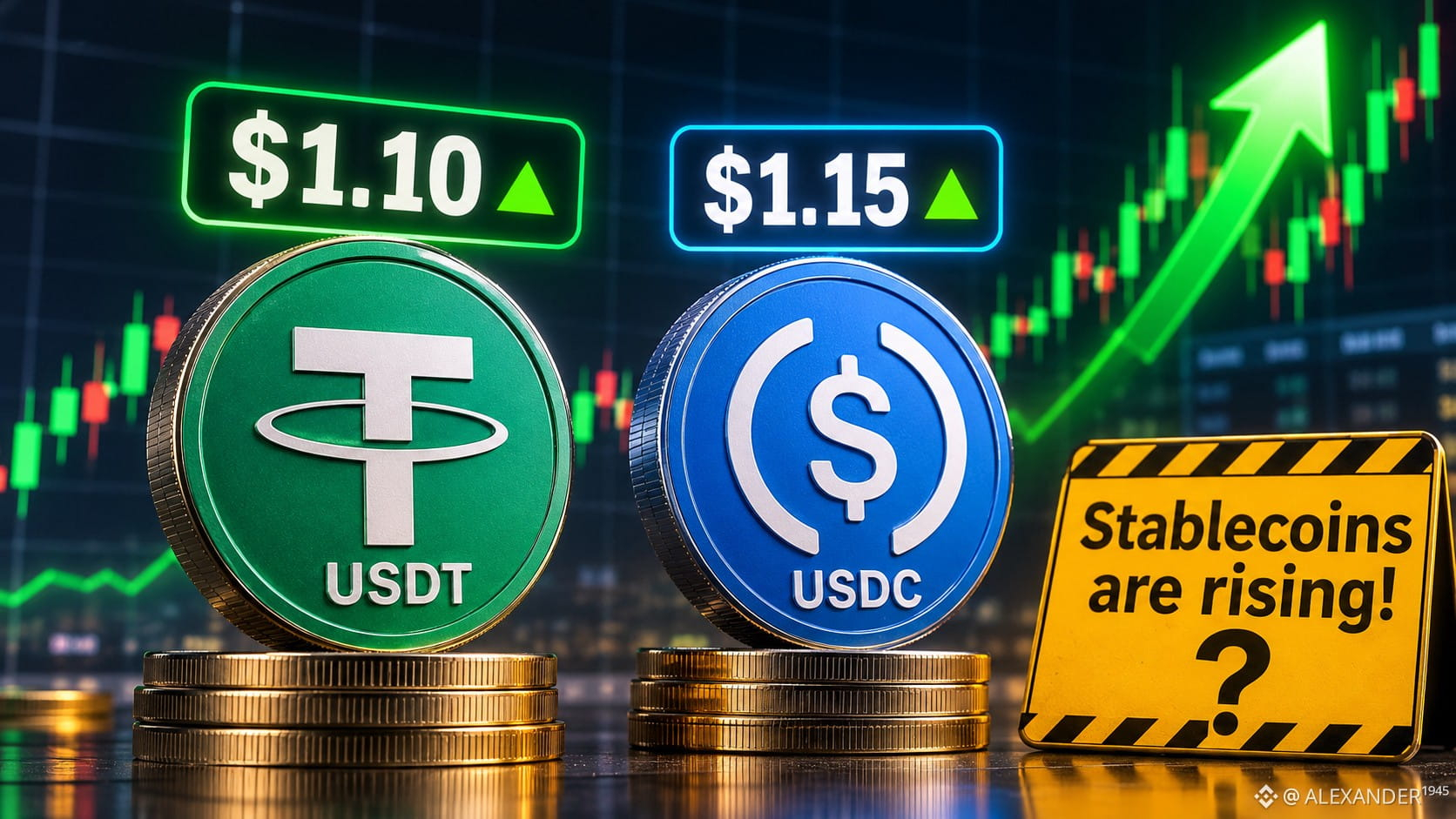
🚨 WHAT IF STABLECOINS DECIDED TO STOP BEING STABLE?
Imagine waking up tomorrow to find that USDT is no longer worth $1, but $1.10! And USDC has risen to $1.15 as well!
Some might think this is great news, believing that stablecoin holders are making profits without even trading.
But wait a moment…
Stablecoins were designed to maintain their value close to $1, not to become investment assets whose prices keep rising.
A price increase above $1 is not necessarily good news. It could signal a liquidity shortage, rising demand, or market disruption, making traders question what is really happening.
And the strangest part? What we consider a safe haven in the crypto world could suddenly become a source of concern!
The real question is: Would you want stablecoins to rise in price, or is their stability exactly what makes them useful?
{future}(USDCUSDT)
$USDT $USDC #USDT #USDC #Stablecoins #Crypto #Binance
🚨 WHAT IF STABLECOINS DECIDED TO STOP BEING STABLE?
Imagine waking up tomorrow to find that USDT is no longer worth $1, but $1.10! And USDC has risen to $1.15 as well!
Some might think this is great news, believing that stablecoin holders are making profits without even trading.
But wait a moment…
Stablecoins were designed to maintain their value close to $1, not to become investment assets whose prices keep rising.
A price increase above $1 is not necessarily good news. It could signal a liquidity shortage, rising demand, or market disruption, making traders question what is really happening.
And the strangest part? What we consider a safe haven in the crypto world could suddenly become a source of concern!
The real question is: Would you want stablecoins to rise in price, or is their stability exactly what makes them useful?
$USDT $USDC #USDT #USDC #Stablecoins #Crypto #Binance

1
189

🔥 At 02:17 UTC, a lone Tennessee branch flicked a switch and opened the floodgates for digital dollars, just as the BTC clock ticked past $75,796, whispering that the market’s extreme fear (25/100) might be about to crack.
📊 The Tennessee Bankers Association announced a partnership with Stablecore, giving member banks the tools to issue #Stablecoins, tokenized deposits and #CryptoLending products—while #BTC hovers at a bearish RSI 38.6 and a $528 M 24‑hour volume, futures open interest sits at $7.29 B with longs paying a modest +0.0058% funding, signaling institutional confidence despite the gloom. Across the chain, smart‑money wallets are quietly buying Solana, a reminder that capital is already repositioning toward on‑chain assets even as traditional finance steps in.
💡 The twist? The very institutions that once warned clients away from crypto are now the conduit for the next wave of liquidity, effectively turning the market’s “fear” into a catalyst for mainstream adoption.
❓ Will this silent alliance between regional banks and Stablecore be the spark that flips the sentiment needle, or will the bear‑ish crossover keep the price stuck in the shadows?
2

The Phone Wallet Move That’s Bringing Stablecoins to Millions👇
#SamsungWallet has officially enabled USDC support for 82 million Galaxy devices in the United States. Users can now buy, hold, and transact Solana-based USDC directly from their phones without relying on separate crypto apps.
The integration marks a meaningful step toward mainstream stablecoin adoption by embedding crypto payments into one of the world’s largest consumer hardware ecosystems. By placing USDC inside a familiar mobile wallet experience, Samsung is lowering the barrier for everyday users to interact with digital dollars on Solana.
$SAMSUNG $USDC $SOL #CoinVahini #USDC #SamsungWallet #Stablecoins
3

·
--
🌐 CIRCLE REPORTS $864.9 MILLION IN QUARTERLY REVENUE
Stablecoin issuer Circle reported quarterly revenue and reserve income of approximately $864.9 million, up 17%.
Its report also highlighted:
🔹 Adjusted EBITDA: $317 million
🔹 USDC on-chain transaction volume: $13.9 trillion
🔹 USDC transaction volume growth: 49%
Stablecoins remain an important part of crypto payments and financial infrastructure.
Can stablecoins become a bigger part of everyday finance?
#Circle #USDC #Stablecoins #CryptoAdoption $USDT
140

·
--
Bullish
💸 Will Cash Disappear? Justin Sun Says Money Is Going Digital
📌 The claim
Justin Sun (Tron founder) argues cash is becoming inconvenient as we do more with our phones, and that stablecoins like USDT on TRON can serve as everyday payments. (I couldn't confirm his exact words, so treat this as the debated idea.)
🐂 The case for "yes, it's going digital"
• Many people already pay with their phones and skip the wallet
• USDT on TRON is widely used for fast, low-cost transfers
• Digital payments are easy to send across borders
🐻 The case for "not so fast"
• Cash is still essential for people without bank access or reliable internet
• Stablecoins can depeg, be frozen, or face regulation
• Sun runs Tron, so he benefits when TRX and USDT-on-TRON usage grows
• Fees and network choice matter: always check the fee before sending
✅ Practical tips if you use stablecoins for payments
1️⃣ Confirm the network matches (TRC20 to TRC20, etc.)
2️⃣ Check fees on each network before you send
3️⃣ Keep some local cash or a bank option as a backup
4️⃣ Never send large sums to an address you haven't tested with a small amount
💬 Will you be mostly cash-free in 5 years? Vote below 👇
🅰️ Yes 📱 🅱️ No 💵 🅲 Both 🤝
Not financial advice. DYOR.
$TRX
{spot}(TRXUSDT)
$USDT #TRON #USDT #Stablecoins #BinanceSquare
💸 Will Cash Disappear? Justin Sun Says Money Is Going Digital
📌 The claim
Justin Sun (Tron founder) argues cash is becoming inconvenient as we do more with our phones, and that stablecoins like USDT on TRON can serve as everyday payments. (I couldn't confirm his exact words, so treat this as the debated idea.)
🐂 The case for "yes, it's going digital"
• Many people already pay with their phones and skip the wallet
• USDT on TRON is widely used for fast, low-cost transfers
• Digital payments are easy to send across borders
🐻 The case for "not so fast"
• Cash is still essential for people without bank access or reliable internet
• Stablecoins can depeg, be frozen, or face regulation
• Sun runs Tron, so he benefits when TRX and USDT-on-TRON usage grows
• Fees and network choice matter: always check the fee before sending
✅ Practical tips if you use stablecoins for payments
1️⃣ Confirm the network matches (TRC20 to TRC20, etc.)
2️⃣ Check fees on each network before you send
3️⃣ Keep some local cash or a bank option as a backup
4️⃣ Never send large sums to an address you haven't tested with a small amount
💬 Will you be mostly cash-free in 5 years? Vote below 👇
🅰️ Yes 📱 🅱️ No 💵 🅲 Both 🤝
Not financial advice. DYOR.
$TRX
$USDT #TRON #USDT #Stablecoins #BinanceSquare

11

·
--
🔥 TRON LEADS THE WAY IN STABLECOIN GROWTH!
TRON is continuing to attract significant stablecoin liquidity, recording the strongest growth among major blockchain networks over the past seven days.
According to @trondao, the network added an impressive $256.5 million in stablecoin supply within just one week — more than twice the growth recorded by the next closest network.
Why This Matters
Stablecoin growth is an important indicator of liquidity and demand across blockchain ecosystems.
More stablecoin supply can support:
🔹 Greater liquidity for DeFi applications
🔹 More capacity for digital payments and transfers
🔹 Increased opportunities for users and businesses
🔹 Stronger infrastructure for onchain financial activity
My Take
TRON's growth is another signal that stablecoins remain one of the strongest real-world use cases for blockchain technology.
The competition is not just about who builds the technology. It is also about where liquidity flows and where people choose to transact.
With $256.5M added in seven days, TRON is making a strong statement.
#TRON #TRX #USDT #Stablecoins @Square-Creator-123571426 #TRONEcoStar🔥
🔥 TRON LEADS THE WAY IN STABLECOIN GROWTH!
TRON is continuing to attract significant stablecoin liquidity, recording the strongest growth among major blockchain networks over the past seven days.
According to @trondao, the network added an impressive $256.5 million in stablecoin supply within just one week — more than twice the growth recorded by the next closest network.
Why This Matters
Stablecoin growth is an important indicator of liquidity and demand across blockchain ecosystems.
More stablecoin supply can support:
🔹 Greater liquidity for DeFi applications
🔹 More capacity for digital payments and transfers
🔹 Increased opportunities for users and businesses
🔹 Stronger infrastructure for onchain financial activity
My Take
TRON's growth is another signal that stablecoins remain one of the strongest real-world use cases for blockchain technology.
The competition is not just about who builds the technology. It is also about where liquidity flows and where people choose to transact.
With $256.5M added in seven days, TRON is making a strong statement.
#TRON #TRX #USDT #Stablecoins @JustinSun #TRONEcoStar🔥

14
·
--
🚀 TRON STRENGTHENS ITS POSITION AS A LEADING USDT SETTLEMENT NETWORK!
TRON continues to demonstrate its importance in the global stablecoin economy, recording an impressive $19.4 billion in USDT transfers within a single day.
According to @Crypto_Briefing, TRON also accounts for approximately 73% of stablecoin transfer volume across major blockchain networks.
📊 Key Highlights:
🔹 Daily USDT Transfers: $19.4 billion moved across TRON in just 24 hours.
🔹 Stablecoin Market Share: Approximately 73% of transfer volume across major tracked blockchains.
🔹 Strong Liquidity: Significant USDT activity supports payments, trading, and decentralized finance.
🔹 Global Utility: TRON continues to support digital dollar transfers and cross-border settlements.
💡 Why Does This Matter?
Stablecoins are becoming an important part of global digital finance. Their usefulness depends on networks that can provide accessible, reliable, and cost-efficient transactions.
TRON's growing transfer activity highlights the demand for blockchain infrastructure that makes moving digital dollars easier.
🔥 My Take:
The $19.4 billion daily transfer milestone shows the scale of activity taking place on TRON.
Its importance goes beyond transaction numbers. It demonstrates how blockchain networks are increasingly supporting real financial activities, from international payments to everyday digital asset transfers.
TRON is helping move the global stablecoin economy forward, one transaction at a time. 🌐
#TRON #USDT #Stablecoins @Square-Creator-123571426 #TRONEcoStar🔥
🚀 TRON STRENGTHENS ITS POSITION AS A LEADING USDT SETTLEMENT NETWORK!
TRON continues to demonstrate its importance in the global stablecoin economy, recording an impressive $19.4 billion in USDT transfers within a single day.
According to @Crypto_Briefing, TRON also accounts for approximately 73% of stablecoin transfer volume across major blockchain networks.
📊 Key Highlights:
🔹 Daily USDT Transfers: $19.4 billion moved across TRON in just 24 hours.
🔹 Stablecoin Market Share: Approximately 73% of transfer volume across major tracked blockchains.
🔹 Strong Liquidity: Significant USDT activity supports payments, trading, and decentralized finance.
🔹 Global Utility: TRON continues to support digital dollar transfers and cross-border settlements.
💡 Why Does This Matter?
Stablecoins are becoming an important part of global digital finance. Their usefulness depends on networks that can provide accessible, reliable, and cost-efficient transactions.
TRON's growing transfer activity highlights the demand for blockchain infrastructure that makes moving digital dollars easier.
🔥 My Take:
The $19.4 billion daily transfer milestone shows the scale of activity taking place on TRON.
Its importance goes beyond transaction numbers. It demonstrates how blockchain networks are increasingly supporting real financial activities, from international payments to everyday digital asset transfers.
TRON is helping move the global stablecoin economy forward, one transaction at a time. 🌐
#TRON #USDT #Stablecoins @JustinSun #TRONEcoStar🔥
7
·
--
🚀 TRON STRENGTHENS ITS DOMINANCE IN THE GLOBAL USDT MARKET!
The competition for stablecoin liquidity continues, and TRON is widening the gap.
According to data from The Block, TRON's USDT supply has climbed to approximately $93 billion, putting it $25 billion ahead of Ethereum.
📊 A Closer Look at the Numbers:
🔹 TRON: $93 billion in USDT supply.
🔹 Ethereum: $68 billion in USDT supply.
🔹 Market Difference: A record $25 billion gap in TRON's favor.
🔹 Ethereum's Position: USDT supply has dropped from its previous high of nearly $89 billion.
💡 What Does This Tell Us?
The growing concentration of USDT on TRON highlights the network's importance in the movement of digital dollars.
Its expanding stablecoin ecosystem supports:
✅ Cross-border payments and international transfers.
✅ Access to dollar-denominated digital assets.
✅ Onchain liquidity for decentralized finance.
✅ Affordable and efficient stablecoin transactions.
🔥 The Bigger Picture
Stablecoins are becoming an essential part of the digital financial system, and blockchain networks are competing to provide the infrastructure that powers their adoption.
TRON's growing USDT supply demonstrates how important network accessibility, transaction costs, liquidity, and reliability are to this market.
My Take: The $25 billion difference is a significant milestone, but the bigger story is TRON's growing role in global stablecoin movement.
The future of digital finance will depend not only on how much liquidity a network holds, but also on how effectively people can use it.
🌐 TRON is building a stronger position in the global digital dollar economy.
#TRON #USDT #Stablecoins #TRONEcoStar🔥 @Square-Creator-123571426
🚀 TRON STRENGTHENS ITS DOMINANCE IN THE GLOBAL USDT MARKET!
The competition for stablecoin liquidity continues, and TRON is widening the gap.
According to data from The Block, TRON's USDT supply has climbed to approximately $93 billion, putting it $25 billion ahead of Ethereum.
📊 A Closer Look at the Numbers:
🔹 TRON: $93 billion in USDT supply.
🔹 Ethereum: $68 billion in USDT supply.
🔹 Market Difference: A record $25 billion gap in TRON's favor.
🔹 Ethereum's Position: USDT supply has dropped from its previous high of nearly $89 billion.
💡 What Does This Tell Us?
The growing concentration of USDT on TRON highlights the network's importance in the movement of digital dollars.
Its expanding stablecoin ecosystem supports:
✅ Cross-border payments and international transfers.
✅ Access to dollar-denominated digital assets.
✅ Onchain liquidity for decentralized finance.
✅ Affordable and efficient stablecoin transactions.
🔥 The Bigger Picture
Stablecoins are becoming an essential part of the digital financial system, and blockchain networks are competing to provide the infrastructure that powers their adoption.
TRON's growing USDT supply demonstrates how important network accessibility, transaction costs, liquidity, and reliability are to this market.
My Take: The $25 billion difference is a significant milestone, but the bigger story is TRON's growing role in global stablecoin movement.
The future of digital finance will depend not only on how much liquidity a network holds, but also on how effectively people can use it.
🌐 TRON is building a stronger position in the global digital dollar economy.
#TRON #USDT #Stablecoins #TRONEcoStar🔥 @JustinSun
7

·
--
What is a stablecoin?
A stablecoin is a token designed to track the value of something stable, usually the US dollar.
Some hold reserves such as cash and short-term government debt. Others use crypto collateral or other mechanisms.
Stable does not mean safe from loss. Stablecoins can lose their peg, so it is worth reading how each one is backed.
For information only, not financial advice.
#Stablecoins #CryptoBasics
40

·
--
Bullish
Having billions of dollars in stablecoin supply is one thing. Knowing how much of that capital is actually being put to work is another.
Think about it.
#Stablecoins are used for payments, trading, collateral, lending and borrowing. But simply knowing how much has been issued doesn’t tell us where the liquidity is going.
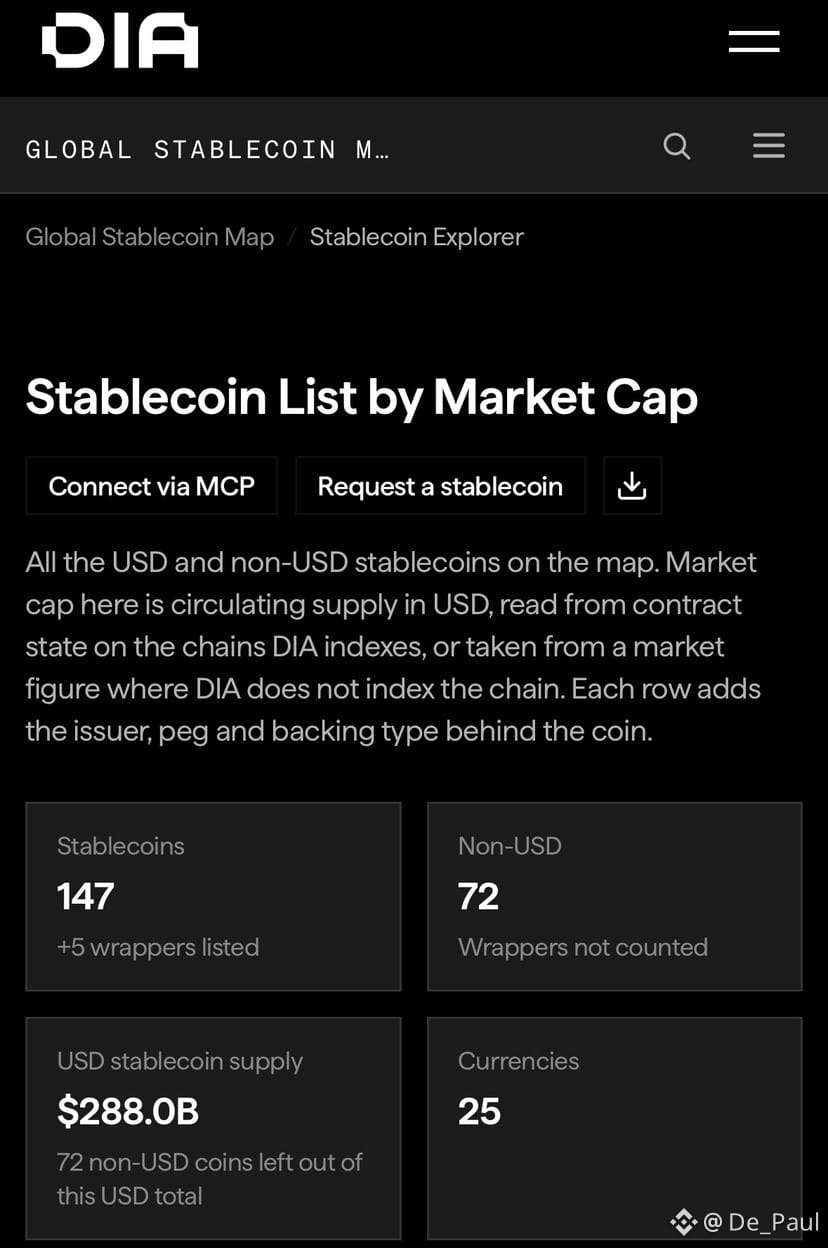
$DIA ’s Global Stablecoin Map offers an interesting look at this.
According to its latest data, at least 8.2% of the supply across 147 stablecoins has been supplied to lending markets.
Even more interesting, 81.2% of that supplied amount is currently on loan across 37 lending protocols.
$USDC leads in absolute lending balances, with approximately $10.3B supplied, followed by $USDT at $5.7B.
This tells us something important about stablecoin adoption.
It’s not just about how many tokens exist or how large their market caps become. It’s also about how they move through financial applications and the economic activity they support.
For me, that’s a much more interesting way to examine stablecoin growth.
Explore the research: https://www.diadata.org/map/global-stablecoins/stablecoin-explorer/
1
103

·
--
Article
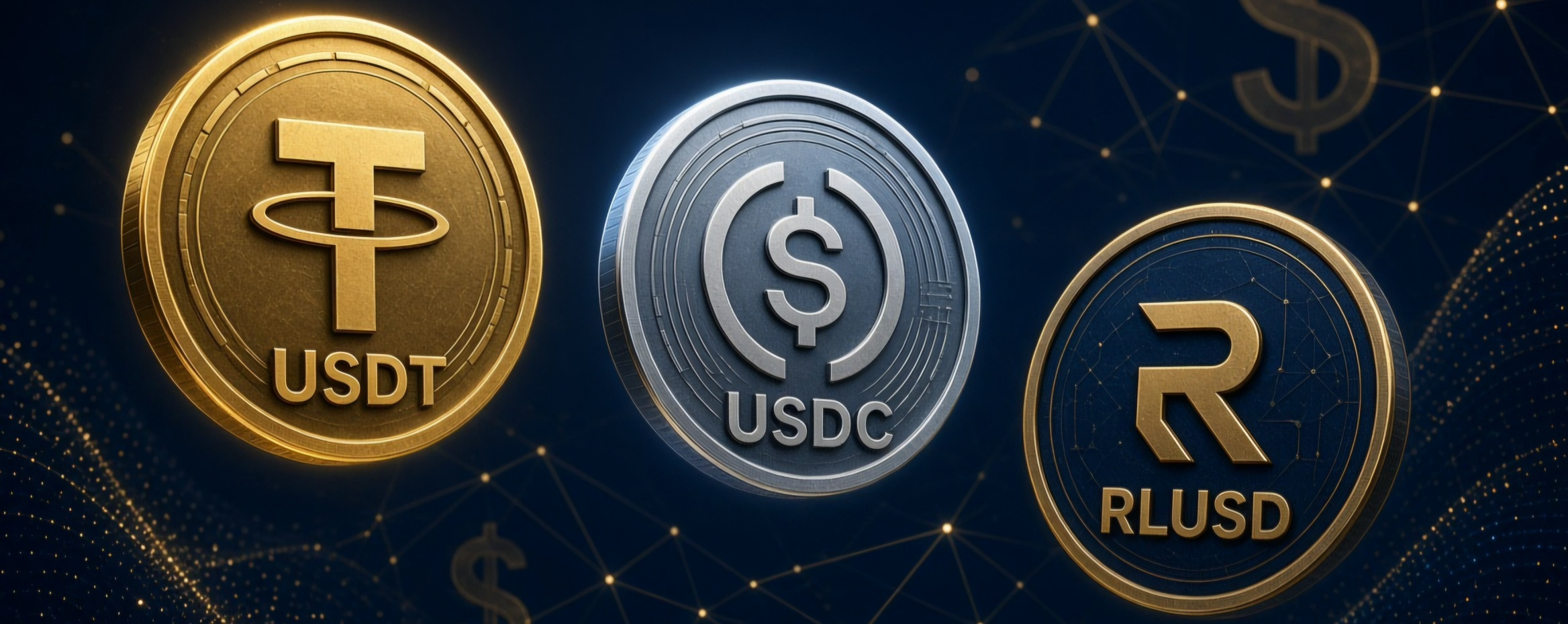
Stablecoins Explained 2026: USDT vs USDC vs RLUSD — Which Ones Are Actually Safe?The stablecoin market has crossed $280 billion. These are the digital dollars that power almost every trade on Binance and every DeFi protocol.
Here’s the clear breakdown (as of early November 2026):
Top Stablecoins by Size
$USDT (Tether) ~$177-180B
$USDC (Circle) ~$70B
$USDS ~$6.5B+
$USDe (Ethena) ~$4.5B
$DAI ~$4.5B
$USD1, $USDG, $PYUSD, $RLUSD - each around $2.6–2.7B
Are they algorithmic?
No - the big ones are not algorithmic.
Type of Stable Coins:
Fiat-backed : USDT, USDC, RLUSD, PYUSD
Backed 1:1 by cash + short-term Treasuries, Lower Risk
Crypto-collateralized : DAI, USDS, GHO
Over-collateralized with crypto, Medium Risk
Synthetic / Algorithmic : USDe, old UST
Hedging or algorithms, Higher Risk
How are USDT, USDC & RLUSD minted?
Authorized institutions (exchanges, market makers) wire real USD to the issuer.
Issuer confirms the money is in the reserve.
They mint the exact number of tokens on-chain.
When someone wants dollars back → they burn the tokens and get USD wired.
Retail users never mint directly. We just buy and sell on Binance.
Quick Take
$USDT still dominates liquidity and trading volume.
$USDC is preferred by institutions for transparency.
$RLUSD is the new regulated challenger from Ripple (NYDFS supervised).
Which stablecoin do you hold the most and why? Comment below 👇
#Stablecoins #USDT #USDC #RLUSD #CryptoEducation
Stablecoins Explained 2026: USDT vs USDC vs RLUSD — Which Ones Are Actually Safe?
The stablecoin market has crossed $280 billion. These are the digital dollars that power almost every trade on Binance and every DeFi protocol.
Here’s the clear breakdown (as of early November 2026):
Top Stablecoins by Size
$USDT (Tether) ~$177-180B
$USDC (Circle) ~$70B
$USDS ~$6.5B+
$USDe (Ethena) ~$4.5B
$DAI ~$4.5B
$USD1, $USDG, $PYUSD, $RLUSD - each around $2.6–2.7B
Are they algorithmic?
No - the big ones are not algorithmic.
Type of Stable Coins:
Fiat-backed : USDT, USDC, RLUSD, PYUSD
Backed 1:1 by cash + short-term Treasuries, Lower Risk
Crypto-collateralized : DAI, USDS, GHO
Over-collateralized with crypto, Medium Risk
Synthetic / Algorithmic : USDe, old UST
Hedging or algorithms, Higher Risk
How are USDT, USDC & RLUSD minted?
Authorized institutions (exchanges, market makers) wire real USD to the issuer.
Issuer confirms the money is in the reserve.
They mint the exact number of tokens on-chain.
When someone wants dollars back → they burn the tokens and get USD wired.
Retail users never mint directly. We just buy and sell on Binance.
Quick Take
$USDT still dominates liquidity and trading volume.
$USDC is preferred by institutions for transparency.
$RLUSD is the new regulated challenger from Ripple (NYDFS supervised).
Which stablecoin do you hold the most and why? Comment below 👇
#Stablecoins #USDT #USDC #RLUSD #CryptoEducation
1
95


Article
$11.5 Billion Vanishes from Stablecoin Supply: Is Crypto Liquidity Drying Up?💰Tether and Circle Account for 77% of the Decline. What the Latest Stablecoin Data Reveals About Crypto Market Liquidity, Investor Confidence and Bitcoin’s Next Move.
🚨 Billions in stablecoin supply have disappeared in just 30 days. Could this be an early warning sign for the crypto market?
Stablecoins are the financial backbone of crypto trading. They allow investors to hold dollar linked assets, move between cryptocurrencies and keep capital ready for new opportunities.
But recent figures reveal a development that deserves attention.
The total stablecoin supply has fallen by $11.5 billion in just one month. And the majority of that decline is coming from two of the industry's biggest names: Tether and Circle.
Is this a sign that investors are becoming cautious, or does the data reveal a bigger shift in crypto liquidity?
Let's break down what is happening and why Bitcoin traders should pay attention.
📊 What Happened?
According to figures shared by Matthew Sigel, Head of Digital Assets Research at VanEck, total stablecoin supply declined by $11.5 billion over 30 days, reaching approximately $291.2 billion.
Here are the key figures:
💰 Total stablecoin supply: $291.2 billion
📉 Supply decline over 30 days: $11.5 billion
📊 Approximate contraction: 3.8%
⚠️ Distance from the 52-week high: 7%
This is not just another crypto market statistic. Stablecoins provide liquidity that traders use to enter positions, manage risk and move capital across digital assets.
When their circulating supply contracts, it raises questions about the amount of capital available within the crypto ecosystem.
🏦 Tether and Circle: Where Is the Money Going?
The most significant detail is the concentration of the decline.
Tether and Circle together account for approximately 77% of the reported contraction.
🔴 Tether: Supply declined by $5.7 billion.
🔵 Circle: Supply declined by $3.2 billion.
Combined, that represents approximately $8.9 billion.
These two issuers play a major role in the stablecoin market. Their currencies, USDT and USDC, are widely used for trading, payments and decentralized finance.
A contraction of this size naturally raises questions about stablecoin demand and investor positioning.
However, falling supply does not automatically mean investors are withdrawing all their money from crypto. Redemptions, reduced issuance and changes in demand can all contribute to the decline.
The reason behind the contraction matters just as much as the number itself.
🔍 Is the Entire Stablecoin Market Declining?
There is another detail that deserves attention.
The median supply decline among stablecoins with more than $100 million in circulation was approximately 1%.
That is considerably smaller than the overall market contraction of 3.8%.
This suggests the decline is not affecting every stablecoin equally.
Instead, a large share of the reduction is concentrated among the biggest issuers.
For investors, this distinction is important. Looking only at the total market figure could create an incomplete picture of what is happening across the stablecoin ecosystem.
₿ Why Should Bitcoin Traders Care?
Stablecoin supply is one of the indicators investors monitor when assessing crypto market liquidity.
Think of stablecoins as readily available dollar-based capital within the crypto market.
When supply expands, it can reflect increasing demand for stablecoin liquidity.
When supply contracts, it may indicate that some capital is being redeemed, withdrawn or repositioned.
For Bitcoin, the concern is straightforward:
If stablecoin supply continues to decline, could there be less readily available buying power to support the market?
That does not guarantee a Bitcoin price drop. BTC is also influenced by institutional demand, ETF flows, macroeconomic conditions, derivatives positioning and overall investor sentiment.
But ignoring liquidity would mean overlooking an important part of the market.
⚖️ What Happens Next?
There are two possible scenarios investors should watch.
🟢 Bullish Scenario
Stablecoin supply stabilizes and starts expanding again. This could indicate renewed demand for dollar liquidity within crypto markets.
If that happens alongside stronger trading activity and improving Bitcoin demand, it could support a healthier market recovery.
🔴 Bearish Scenario
Stablecoin supply continues contracting, while trading activity and demand for digital assets weaken.
That combination could point towards tighter market liquidity and make it more difficult for Bitcoin and other cryptocurrencies to sustain strong rallies.
The coming weeks could provide important clues about which direction the market is taking.
👀 What Investors Should Watch
Three indicators deserve close attention:
USDT and USDC supply: Are their circulating supplies continuing to decline, or beginning to recover?Bitcoin market activity: Is fresh buying demand returning, or are rallies losing momentum?Stablecoin flows: Is capital returning to crypto markets, or continuing to move elsewhere?
Watching these indicators together can provide a more complete picture than relying on one headline figure.
💡 Key Takeaway
The $11.5 billion decline is significant, but it does not prove that investors are abandoning crypto.
The bigger concern is whether stablecoin liquidity will continue shrinking or begin recovering.
For Bitcoin traders, this is worth watching closely. Price movements tell us what the market is doing. Liquidity indicators can help explain what may be happening underneath.
The real question is not how much stablecoin supply has disappeared. It is whether fresh capital will return to the crypto market.
⚠️ Disclaimer: This article is for educational and informational purposes only. It is not financial or investment advice. Always conduct your own research before making investment decisions.
#BinanceSquare #Stablecoins #CryptoLiquidity #Bitcoin #USDT
{spot}(BTCUSDT)
$11.5 Billion Vanishes from Stablecoin Supply: Is Crypto Liquidity Drying Up?
💰Tether and Circle Account for 77% of the Decline. What the Latest Stablecoin Data Reveals About Crypto Market Liquidity, Investor Confidence and Bitcoin’s Next Move.
🚨 Billions in stablecoin supply have disappeared in just 30 days. Could this be an early warning sign for the crypto market?
Stablecoins are the financial backbone of crypto trading. They allow investors to hold dollar linked assets, move between cryptocurrencies and keep capital ready for new opportunities.
But recent figures reveal a development that deserves attention.
The total stablecoin supply has fallen by $11.5 billion in just one month. And the majority of that decline is coming from two of the industry's biggest names: Tether and Circle.
Is this a sign that investors are becoming cautious, or does the data reveal a bigger shift in crypto liquidity?
Let's break down what is happening and why Bitcoin traders should pay attention.
📊 What Happened?
According to figures shared by Matthew Sigel, Head of Digital Assets Research at VanEck, total stablecoin supply declined by $11.5 billion over 30 days, reaching approximately $291.2 billion.
Here are the key figures:
💰 Total stablecoin supply: $291.2 billion
📉 Supply decline over 30 days: $11.5 billion
📊 Approximate contraction: 3.8%
⚠️ Distance from the 52-week high: 7%
This is not just another crypto market statistic. Stablecoins provide liquidity that traders use to enter positions, manage risk and move capital across digital assets.
When their circulating supply contracts, it raises questions about the amount of capital available within the crypto ecosystem.
🏦 Tether and Circle: Where Is the Money Going?
The most significant detail is the concentration of the decline.
Tether and Circle together account for approximately 77% of the reported contraction.
🔴 Tether: Supply declined by $5.7 billion.
🔵 Circle: Supply declined by $3.2 billion.
Combined, that represents approximately $8.9 billion.
These two issuers play a major role in the stablecoin market. Their currencies, USDT and USDC, are widely used for trading, payments and decentralized finance.
A contraction of this size naturally raises questions about stablecoin demand and investor positioning.
However, falling supply does not automatically mean investors are withdrawing all their money from crypto. Redemptions, reduced issuance and changes in demand can all contribute to the decline.
The reason behind the contraction matters just as much as the number itself.
🔍 Is the Entire Stablecoin Market Declining?
There is another detail that deserves attention.
The median supply decline among stablecoins with more than $100 million in circulation was approximately 1%.
That is considerably smaller than the overall market contraction of 3.8%.
This suggests the decline is not affecting every stablecoin equally.
Instead, a large share of the reduction is concentrated among the biggest issuers.
For investors, this distinction is important. Looking only at the total market figure could create an incomplete picture of what is happening across the stablecoin ecosystem.
₿ Why Should Bitcoin Traders Care?
Stablecoin supply is one of the indicators investors monitor when assessing crypto market liquidity.
Think of stablecoins as readily available dollar-based capital within the crypto market.
When supply expands, it can reflect increasing demand for stablecoin liquidity.
When supply contracts, it may indicate that some capital is being redeemed, withdrawn or repositioned.
For Bitcoin, the concern is straightforward:
If stablecoin supply continues to decline, could there be less readily available buying power to support the market?
That does not guarantee a Bitcoin price drop. BTC is also influenced by institutional demand, ETF flows, macroeconomic conditions, derivatives positioning and overall investor sentiment.
But ignoring liquidity would mean overlooking an important part of the market.
⚖️ What Happens Next?
There are two possible scenarios investors should watch.
🟢 Bullish Scenario
Stablecoin supply stabilizes and starts expanding again. This could indicate renewed demand for dollar liquidity within crypto markets.
If that happens alongside stronger trading activity and improving Bitcoin demand, it could support a healthier market recovery.
🔴 Bearish Scenario
Stablecoin supply continues contracting, while trading activity and demand for digital assets weaken.
That combination could point towards tighter market liquidity and make it more difficult for Bitcoin and other cryptocurrencies to sustain strong rallies.
The coming weeks could provide important clues about which direction the market is taking.
👀 What Investors Should Watch
Three indicators deserve close attention:
USDT and USDC supply: Are their circulating supplies continuing to decline, or beginning to recover?Bitcoin market activity: Is fresh buying demand returning, or are rallies losing momentum?Stablecoin flows: Is capital returning to crypto markets, or continuing to move elsewhere?
Watching these indicators together can provide a more complete picture than relying on one headline figure.
💡 Key Takeaway
The $11.5 billion decline is significant, but it does not prove that investors are abandoning crypto.
The bigger concern is whether stablecoin liquidity will continue shrinking or begin recovering.
For Bitcoin traders, this is worth watching closely. Price movements tell us what the market is doing. Liquidity indicators can help explain what may be happening underneath.
The real question is not how much stablecoin supply has disappeared. It is whether fresh capital will return to the crypto market.
⚠️ Disclaimer: This article is for educational and informational purposes only. It is not financial or investment advice. Always conduct your own research before making investment decisions.
#BinanceSquare #Stablecoins #CryptoLiquidity #Bitcoin #USDT
1
1
143

·
--
Nigeria just banned algorithmic stablecoins.
Its central bank issued stablecoin licensing rules (The Block):
• Issuers need a license
• Algorithmic designs are prohibited
Africa's biggest crypto market is choosing sides: fully backed, regulated stablecoins in, UST-style experiments out.
Meanwhile, 24h flows show $USDC +$302M net inflow and $USDT +$55M, while BTC saw net outflows (TokenPost, 13:02 UTC). Money is parking in dollars, not leaving crypto.
My take: licensing favors big, transparent issuers. Watch whether other emerging markets copy this.
Will more countries ban algorithmic stablecoins by mid-2027? Yes or no?
#Stablecoins #Nigeria #CryptoRegulation
Not financial advice.
1

Holding $USDC 0.6 USDT
💵 THE BIGGEST CRYPTO REVOLUTION MIGHT NOT BE BITCOIN!
Everyone talks about Bitcoin hitting new highs.
But something else is quietly changing global finance: STABLECOINS.
Why should we pay attention?
🌍 Faster cross-border payments. ⚡ 24/7 digital transactions. 💰 Dollar-linked digital money. 🔗 Growing connections between traditional finance and blockchain.
Crypto is not only about buying and selling coins anymore.
It's about building a new financial infrastructure.
Are stablecoins the future of global payments?
#Stablecoins #USDT #USDC #CryptoInnovation #Web3
$USDC
{future}(USDCUSDT)
$HIMSB
{spot}(HIMSBUSDT)
$SAND
💵 THE BIGGEST CRYPTO REVOLUTION MIGHT NOT BE BITCOIN!
Everyone talks about Bitcoin hitting new highs.
But something else is quietly changing global finance: STABLECOINS.
Why should we pay attention?
🌍 Faster cross-border payments. ⚡ 24/7 digital transactions. 💰 Dollar-linked digital money. 🔗 Growing connections between traditional finance and blockchain.
Crypto is not only about buying and selling coins anymore.
It's about building a new financial infrastructure.
Are stablecoins the future of global payments?
#Stablecoins #USDT #USDC #CryptoInnovation #Web3
$USDC
$HIMSB
$SAND

108

·
--
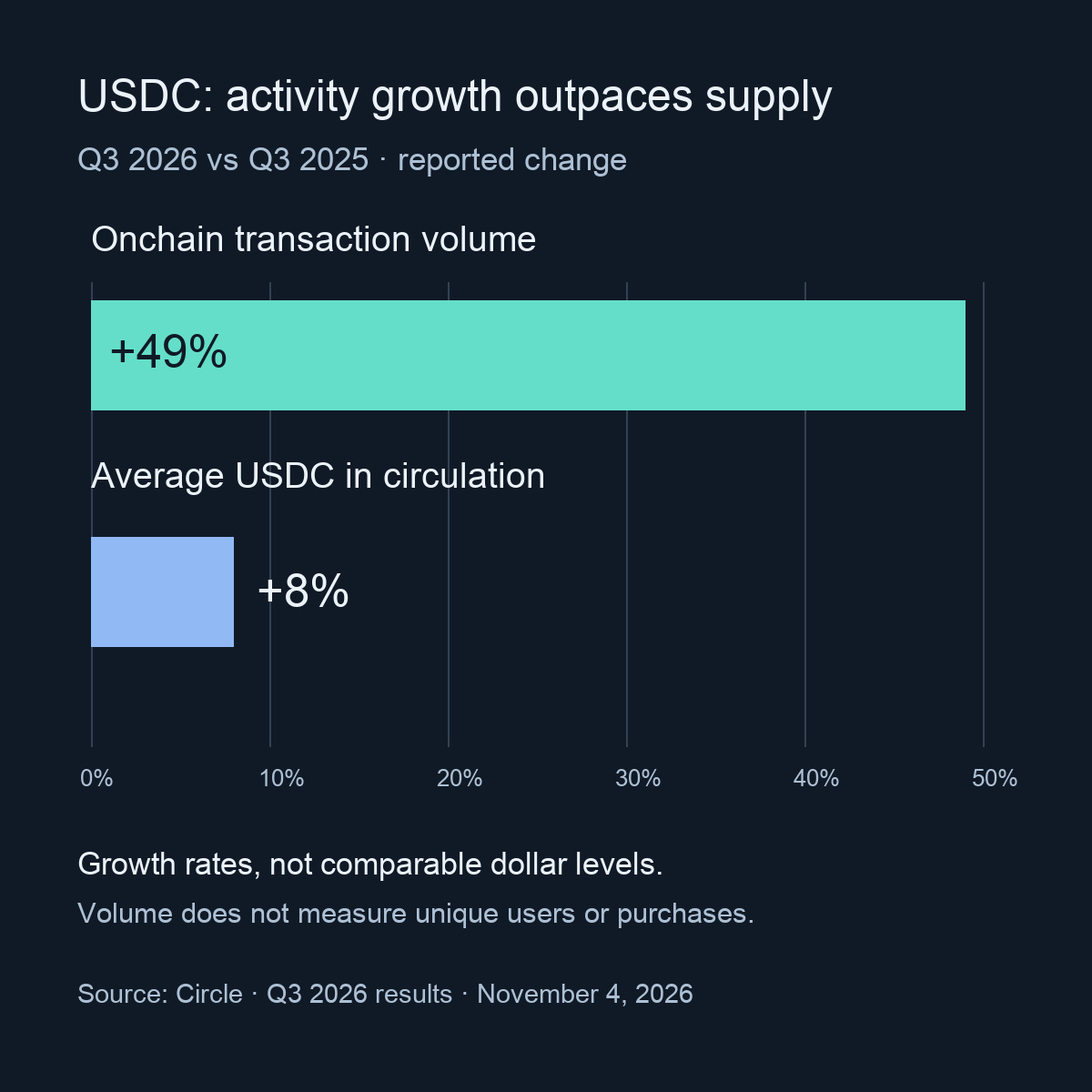
USDC's onchain transaction volume grew much faster than its average circulating supply in the third quarter.
Circle's November 4 disclosure puts Q3 volume at $13.9 trillion, up 49% from a year earlier. Average USDC in circulation rose 8% to $73.3 billion over the same comparison.
The gap shows that growth in the dollar amount moving onchain outpaced growth in the amount of USDC outstanding. It doesn't tell us how many people used it or how much went toward buying goods: the same tokens can move repeatedly.
Source: Circle's Q3 2026 results. Chart compares reported year-over-year growth, not the dollar levels of supply and transactions.
https://www.circle.com/pressroom/circle-reports-third-quarter-2026-results
#USDC #Stablecoins
305

🚨 Stablecoin sub-cent payments draw attention 📈 Risks and controversy coexist 🧠
📊 | $BTC | $ETH | $BNB |
- Follow and like, and leave a comment sharing your thoughts on the development of stablecoins. 📈
- Coinbase CEO Brian Armstrong says stablecoins can enable instant global dollar transfers for less than a penny.
- On November 6, Armstrong posted on X, emphasizing that stablecoins make cross-border payments more convenient for individuals.
- Critics point out that stablecoins pose risks related to privacy protection and the freezing of funds.
- These remarks have drawn market attention to stablecoin use cases and regulatory boundaries. 🔥
- If stablecoin payment costs continue to fall, demand for retail cross-border settlements may grow.
- Privacy and freezing risks may intensify regulatory scrutiny, affecting the pace of institutional adoption.
- In the short term, market sentiment is turning neutral, and price fluctuations are expected to remain limited.
- Whale fund movements are currently steady, with no clear directional signals emerging yet.
- Do you think stablecoins are better suited for payments, or as a safe-haven tool in the crypto market?
- Follow us and share your professional insights in the comments.
#Stablecoins #Crypto #Payments #Blockchain #Whales
72
🚨 BEINCRYPTO AND COINHOLD TO HOST A LATAM STABLECOIN AMA 🧠
📊 | $BTC | $ETH | $BNB |
- Follow us, like, and leave a comment to share your market views. 📈
- BeInCrypto LATAM and the Coinhold wallet will host an AMA on November 9, focusing on stablecoins and inflation in Latin America.
- The event will take place from 18:00 to 19:00 in the GMT-5 time zone and will be livestreamed on X.
- Inflation, currency depreciation, and economic uncertainty continue to intensify across Latin America, making stablecoins a key hedge.
- The event aims to explore the practical use of stablecoins in high-inflation environments and trends in their market adoption. 🔥
- Demand for stablecoins in Latin America may continue to grow as inflationary pressures rise.
- Investors may focus on changes in stablecoin adoption for regional payments and savings.
- Large capital flows are expected to remain neutral, with no significant short-term market catalysts.
- In the short term, the stablecoin sector may continue to trade within a range.
- What is your view on the long-term prospects for stablecoins in Latin American markets? Leave a comment to join the discussion.
- Follow this account for the latest crypto market updates and to join the discussion.
#Stablecoins #Crypto #LATAM #Inflation #DeFi
66
🚨 Nigeria’s Central Bank Sets New Capital Rules for Stablecoins 🧠
📊 | $BTC | $ETH | $BNB |
- Follow, like, and comment to keep up with crypto market developments 📈
- Nigeria’s central bank has introduced new rules requiring foreign stablecoin issuers to maintain capital of 15 billion naira.
- Regulators have also banned the issuance of algorithmic tokens and introduced a new licensing system.
- The move is seen as a further restriction on high-risk crypto products.
- Once the new rules take effect, local compliance costs and barriers to market entry will rise significantly. 🔥
- Tighter regulation could intensify short-term selling pressure, with market sentiment turning cautious.
- Whale activity shows signs of some distribution, while there is also selective buying on dips.
- If panic spreads, volatility is expected to increase temporarily.
- In the short term, related assets may come under pressure, and the risk of capital outflows should be watched.
- Do you think Nigeria’s regulatory changes will affect the global stablecoin landscape?
- Follow us and leave a comment to share your views.
#Crypto #Stablecoins #Nigeria #Regulation #Whales
89

·
--
Nigeria has issued its new stablecoin rules: stablecoins pegged to foreign currencies must be issued through a local company licensed by the central bank, while algorithmic stablecoins are banned. Existing providers have 180 days to apply 🏦📜🌍 What impact do you think this will have on the $USDT market there? #Stablecoins #Nigeria
Nigeria has issued its new stablecoin rules: stablecoins pegged to foreign currencies must be issued through a local company licensed by the central bank, while algorithmic stablecoins are banned. Existing providers have 180 days to apply 🏦📜🌍 What impact do you think this will have on the $USDT market there? #Stablecoins #Nigeria

130

Verified
Article
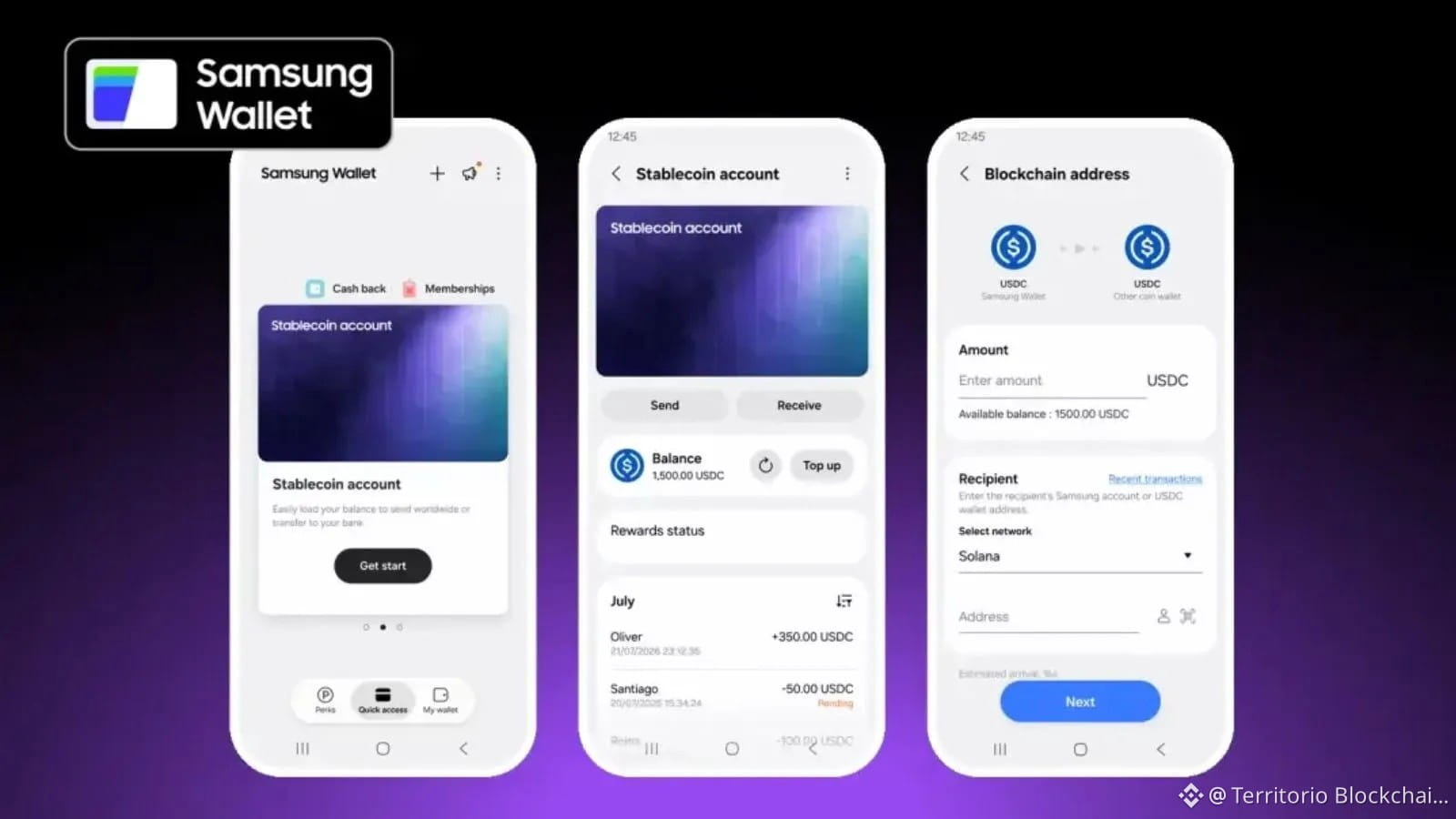
Samsung Wallet enables USDC on Solana for U.S. usersSince November 2, eligible Galaxy users in the United States can buy, hold, send, and receive USDC on Solana directly in Samsung Wallet, with no need for another crypto app or to manage private keys.
🔹 The new Stablecoin Account is available on around 82 million compatible Galaxy devices in the U.S. Transfers settle on Solana.
🔹 Bastion acts as the licensed custodian, with Coinbase serving as subcustodian through Coinbase Prime Vault.
🔹 Sending USDC to other Samsung Wallet users in the U.S. and to compatible external wallets is free of Samsung fees, though fees from other providers may apply.
Samsung Wallet enables USDC on Solana for U.S. users
Since November 2, eligible Galaxy users in the United States can buy, hold, send, and receive USDC on Solana directly in Samsung Wallet, with no need for another crypto app or to manage private keys.
🔹 The new Stablecoin Account is available on around 82 million compatible Galaxy devices in the U.S. Transfers settle on Solana.
🔹 Bastion acts as the licensed custodian, with Coinbase serving as subcustodian through Coinbase Prime Vault.
🔹 Sending USDC to other Samsung Wallet users in the U.S. and to compatible external wallets is free of Samsung fees, though fees from other providers may apply.
1
1.6k
Log in to explore more content
Join global crypto users on Binance Square
⚡️ Get latest and useful information about crypto.
💬 Trusted by the world’s largest crypto exchange.
👍 Discover real insights from verified creators.
Email / Phone number
Trending Topics
1
#JobsReportRaisesHikeOdds
520,327 views
3,354 Discussing
2
#CPITestsDecemberRateOutlook
151,361 views
1,122 Discussing
3
#BitcoinRebounds$75KAsChipsLead
48,276 views
343 Discussing
4
#US Data Center Rules May Constrain AI Expansion
72,754 views
229 Discussing
5
#ARKPlans14ThematicETFsCoveringAIAndTokenizedMarkets
4,289 views
68 Discussing
6
#WillAnthropicListOnTime
156,249 views
1,361 Discussing
7
#WillUS-IranTensionsBoostSafe-HavenDemand?
69,944 views
507 Discussing
8
#BitcoinETFsSee$412MNetOutflows
15,619 views
77 Discussing
9
#HKSFCPlansToRestrictCryptoAndExchangeTerms
60,033 views
544 Discussing
10
#TradFiForBeginners
92,258 views
1,002 Discussing