
#dataprivacy
dataprivacy
70,028 views
294 Discussing
Hot
Latest

·
--
Picture this: you wake up to a screenshot floating around Telegram claiming your personal financial records are being auctioned off until a major fintech app pays up.
For anyone holding crypto, that sinking feeling is all too familiar. A single leaked database can expose user identities, turning your assets into prime targets for targeted phishing and account takeovers.
We saw this dynamic during past hardware wallet breaches, where leaked customer records led to relentless phishing waves aimed at draining $BTC and $ETH holdings. Now, attackers are allegedly threatening to release daily tranches of customer information unless an extortion fee is settled. But before panic sets in, there is a fundamental difference between an unverified hacker claim and a confirmed security compromise.
In crypto risk management, treating attacker claims with healthy skepticism is just as critical as securing your private keys. When similar extortion attempts targeted fiat gateways and platforms trading $BNB in the past, threat actors routinely inflated breach claims to create panic and force quick payouts. Until independent forensic investigations or law enforcement confirm the scope, reacting to unverified ransom claims usually creates unnecessary panic.
How do you separate credible security reports from extortion bluffing when breaking headlines hit your feed?
#CryptoSecurity #DataPrivacy #BlockchainSecurity
Picture this: you wake up to a screenshot floating around Telegram claiming your personal financial records are being auctioned off until a major fintech app pays up.
For anyone holding crypto, that sinking feeling is all too familiar. A single leaked database can expose user identities, turning your assets into prime targets for targeted phishing and account takeovers.
We saw this dynamic during past hardware wallet breaches, where leaked customer records led to relentless phishing waves aimed at draining $BTC and $ETH holdings. Now, attackers are allegedly threatening to release daily tranches of customer information unless an extortion fee is settled. But before panic sets in, there is a fundamental difference between an unverified hacker claim and a confirmed security compromise.
In crypto risk management, treating attacker claims with healthy skepticism is just as critical as securing your private keys. When similar extortion attempts targeted fiat gateways and platforms trading $BNB in the past, threat actors routinely inflated breach claims to create panic and force quick payouts. Until independent forensic investigations or law enforcement confirm the scope, reacting to unverified ransom claims usually creates unnecessary panic.
How do you separate credible security reports from extortion bluffing when breaking headlines hit your feed?
#CryptoSecurity #DataPrivacy #BlockchainSecurity
For anyone holding crypto, that sinking feeling is all too familiar. A single leaked database can expose user identities, turning your assets into prime targets for targeted phishing and account takeovers.
We saw this dynamic during past hardware wallet breaches, where leaked customer records led to relentless phishing waves aimed at draining $BTC and $ETH holdings. Now, attackers are allegedly threatening to release daily tranches of customer information unless an extortion fee is settled. But before panic sets in, there is a fundamental difference between an unverified hacker claim and a confirmed security compromise.
In crypto risk management, treating attacker claims with healthy skepticism is just as critical as securing your private keys. When similar extortion attempts targeted fiat gateways and platforms trading $BNB in the past, threat actors routinely inflated breach claims to create panic and force quick payouts. Until independent forensic investigations or law enforcement confirm the scope, reacting to unverified ransom claims usually creates unnecessary panic.
How do you separate credible security reports from extortion bluffing when breaking headlines hit your feed?
#CryptoSecurity #DataPrivacy #BlockchainSecurity
15

Everyone thinks centralized fintech apps are safer than storing coins in a cold wallet, but actually, your personal data is only as secure as their weakest back door.
When major services suffer a breach, everyday users face the real nightmare of targeted phishing attacks and drained funds before they even realize what happened.
Think of a traditional financial platform like a giant apartment complex where everyone leaves a spare key at the front desk. Recent reports show attackers demanding a massive 10,000 $BTC ransom while threatening to release customer records daily if the company refuses to pay. That massive sum of $BTC represents more than just digital currency, as it is leverage built entirely on exposed customer identities.
Leaving your sensitive details on third-party servers creates an ongoing target for bad actors across the web. Whether you hold $ETH or keep your funds in conventional accounts, relying on centralized databases always introduces a single point of failure that no insurance policy can instantly fix.
Where do you think the line between everyday convenience and personal data security should be drawn?
#CryptoSecurity #Bitcoin #DataPrivacy
Everyone thinks centralized fintech apps are safer than storing coins in a cold wallet, but actually, your personal data is only as secure as their weakest back door.
When major services suffer a breach, everyday users face the real nightmare of targeted phishing attacks and drained funds before they even realize what happened.
Think of a traditional financial platform like a giant apartment complex where everyone leaves a spare key at the front desk. Recent reports show attackers demanding a massive 10,000 $BTC ransom while threatening to release customer records daily if the company refuses to pay. That massive sum of $BTC represents more than just digital currency, as it is leverage built entirely on exposed customer identities.
Leaving your sensitive details on third-party servers creates an ongoing target for bad actors across the web. Whether you hold $ETH or keep your funds in conventional accounts, relying on centralized databases always introduces a single point of failure that no insurance policy can instantly fix.
Where do you think the line between everyday convenience and personal data security should be drawn?
#CryptoSecurity #Bitcoin #DataPrivacy
When major services suffer a breach, everyday users face the real nightmare of targeted phishing attacks and drained funds before they even realize what happened.
Think of a traditional financial platform like a giant apartment complex where everyone leaves a spare key at the front desk. Recent reports show attackers demanding a massive 10,000 $BTC ransom while threatening to release customer records daily if the company refuses to pay. That massive sum of $BTC represents more than just digital currency, as it is leverage built entirely on exposed customer identities.
Leaving your sensitive details on third-party servers creates an ongoing target for bad actors across the web. Whether you hold $ETH or keep your funds in conventional accounts, relying on centralized databases always introduces a single point of failure that no insurance policy can instantly fix.
Where do you think the line between everyday convenience and personal data security should be drawn?
#CryptoSecurity #Bitcoin #DataPrivacy
11
·
--
Everyone thinks fintech apps are as secure as traditional vaults, but centralized databases remain the most vulnerable honeypots in modern finance.
You trust these platforms with your sensitive identity details, only to wake up finding your personal information leaked and your accounts targeted by relentless phishing attacks.
Think of a centralized platform like a giant hotel with a single front desk holding every guest key. If an intruder slips past the clerk, they do not just enter one room; they gain access to the entire building. That structural weakness is exactly why attackers are reportedly demanding a massive 10,000 $BTC ransom following the recent Revolut customer data breach.
That demand represents hundreds of millions of dollars simply to stop user records from hitting the dark web. While decentralized networks like $BTC and $ETH maintain unbroken cryptographic ledger security, the centralized web servers storing your real-world data still suffer from single points of failure. Storing everything under one roof makes every customer an accidental target when security slips.
Where do you draw the line between third-party convenience and your personal security?
#CryptoSecurity #Bitcoin #DataPrivacy
Everyone thinks fintech apps are as secure as traditional vaults, but centralized databases remain the most vulnerable honeypots in modern finance.
You trust these platforms with your sensitive identity details, only to wake up finding your personal information leaked and your accounts targeted by relentless phishing attacks.
Think of a centralized platform like a giant hotel with a single front desk holding every guest key. If an intruder slips past the clerk, they do not just enter one room; they gain access to the entire building. That structural weakness is exactly why attackers are reportedly demanding a massive 10,000 $BTC ransom following the recent Revolut customer data breach.
That demand represents hundreds of millions of dollars simply to stop user records from hitting the dark web. While decentralized networks like $BTC and $ETH maintain unbroken cryptographic ledger security, the centralized web servers storing your real-world data still suffer from single points of failure. Storing everything under one roof makes every customer an accidental target when security slips.
Where do you draw the line between third-party convenience and your personal security?
#CryptoSecurity #Bitcoin #DataPrivacy
You trust these platforms with your sensitive identity details, only to wake up finding your personal information leaked and your accounts targeted by relentless phishing attacks.
Think of a centralized platform like a giant hotel with a single front desk holding every guest key. If an intruder slips past the clerk, they do not just enter one room; they gain access to the entire building. That structural weakness is exactly why attackers are reportedly demanding a massive 10,000 $BTC ransom following the recent Revolut customer data breach.
That demand represents hundreds of millions of dollars simply to stop user records from hitting the dark web. While decentralized networks like $BTC and $ETH maintain unbroken cryptographic ledger security, the centralized web servers storing your real-world data still suffer from single points of failure. Storing everything under one roof makes every customer an accidental target when security slips.
Where do you draw the line between third-party convenience and your personal security?
#CryptoSecurity #Bitcoin #DataPrivacy
3


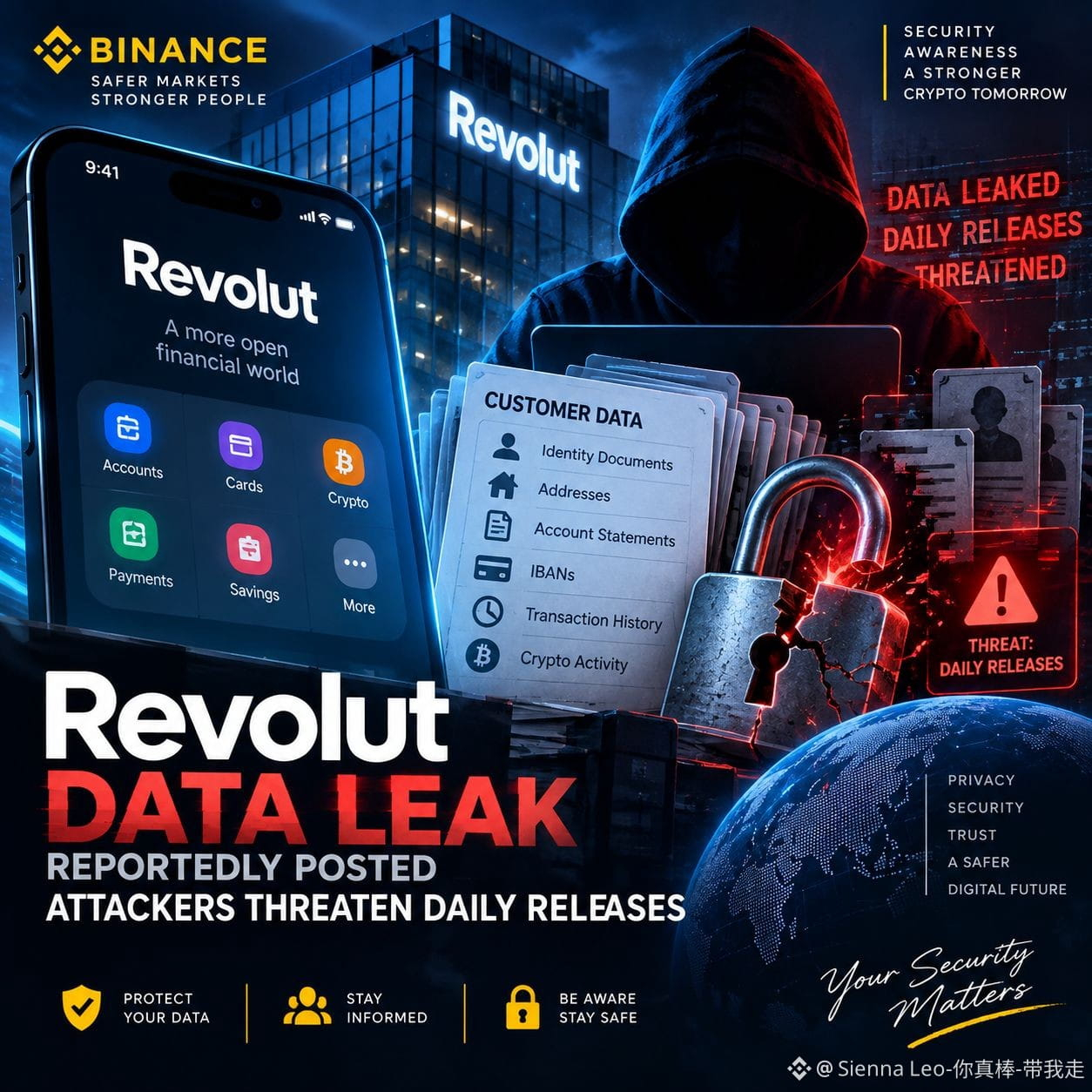
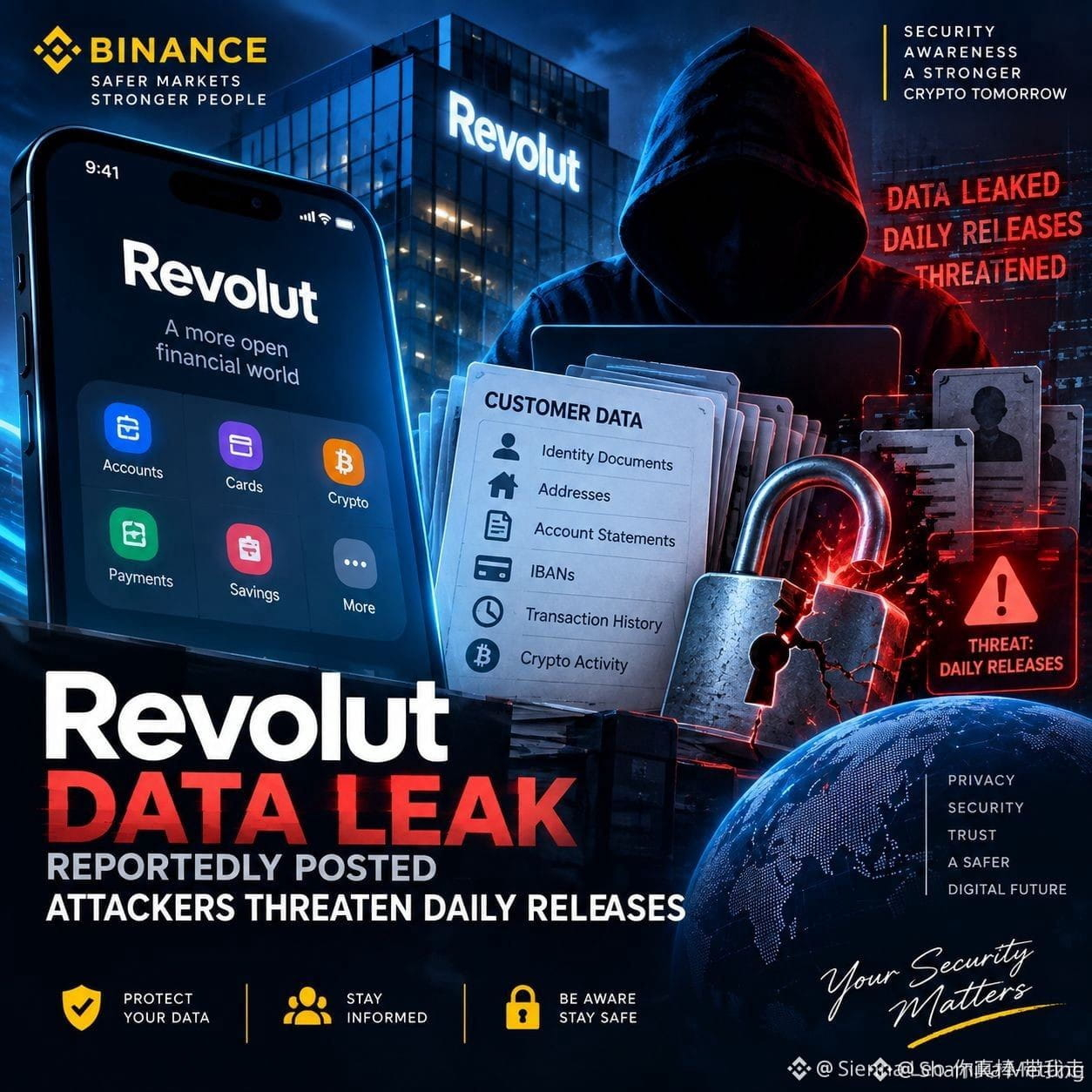
#RevolutDataLeakReportedlyPostedAttackersThreatenDailyReleases 🔐 Revolut Data Leak: Attackers Reportedly Threaten Daily Releases 🚨
Imagine checking your financial app expecting routine updates, only to discover that private records may now be part of an extortion campaign. That is the unsettling situation surrounding Revolut this week.
Revolut confirmed that an unauthorized party used fraudulent requests appearing to come from a legitimate government agency domain, leading to the disclosure of sensitive customer information. The company says a limited number of customers were affected and that customer funds remained safe.
Reportedly exposed information may include identity documents, addresses, account statements, IBANs, withdrawal records and transaction histories, including Bitcoin activity.
The most important detail is what this incident reveals: cybersecurity is not only about protecting databases. Attackers can target the trust and verification processes surrounding access to those databases.
Reports now say attackers have begun publishing customer dossiers and are threatening further daily releases as an extortion tactic. The exact scope remains unclear, so sensational claims should be treated carefully until independently verified.
My take: the incident is a reminder that crypto users should care about privacy beyond wallet security. Your transaction history can become sensitive information when connected to your real-world identity.
In crypto, protecting the keys is only half the battle. Protecting the identity behind them may be just as important.
❓ Do incidents like this make you more concerned about centralized platforms holding detailed crypto histories?
Disclaimer: This is educational content, not financial or investment advice.
#Cybersecurity #DataPrivacy #GrowWithSAC $BTC $BNB $XRP
#RevolutDataLeakReportedlyPostedAttackersThreatenDailyReleases 🔐 Revolut Data Leak: Attackers Reportedly Threaten Daily Releases 🚨
Imagine checking your financial app expecting routine updates, only to discover that private records may now be part of an extortion campaign. That is the unsettling situation surrounding Revolut this week.
Revolut confirmed that an unauthorized party used fraudulent requests appearing to come from a legitimate government agency domain, leading to the disclosure of sensitive customer information. The company says a limited number of customers were affected and that customer funds remained safe.
Reportedly exposed information may include identity documents, addresses, account statements, IBANs, withdrawal records and transaction histories, including Bitcoin activity.
The most important detail is what this incident reveals: cybersecurity is not only about protecting databases. Attackers can target the trust and verification processes surrounding access to those databases.
Reports now say attackers have begun publishing customer dossiers and are threatening further daily releases as an extortion tactic. The exact scope remains unclear, so sensational claims should be treated carefully until independently verified.
My take: the incident is a reminder that crypto users should care about privacy beyond wallet security. Your transaction history can become sensitive information when connected to your real-world identity.
In crypto, protecting the keys is only half the battle. Protecting the identity behind them may be just as important.
❓ Do incidents like this make you more concerned about centralized platforms holding detailed crypto histories?
Disclaimer: This is educational content, not financial or investment advice.
#Cybersecurity #DataPrivacy #GrowWithSAC $BTC $BNB $XRP
Imagine checking your financial app expecting routine updates, only to discover that private records may now be part of an extortion campaign. That is the unsettling situation surrounding Revolut this week.
Revolut confirmed that an unauthorized party used fraudulent requests appearing to come from a legitimate government agency domain, leading to the disclosure of sensitive customer information. The company says a limited number of customers were affected and that customer funds remained safe.
Reportedly exposed information may include identity documents, addresses, account statements, IBANs, withdrawal records and transaction histories, including Bitcoin activity.
The most important detail is what this incident reveals: cybersecurity is not only about protecting databases. Attackers can target the trust and verification processes surrounding access to those databases.
Reports now say attackers have begun publishing customer dossiers and are threatening further daily releases as an extortion tactic. The exact scope remains unclear, so sensational claims should be treated carefully until independently verified.
My take: the incident is a reminder that crypto users should care about privacy beyond wallet security. Your transaction history can become sensitive information when connected to your real-world identity.
In crypto, protecting the keys is only half the battle. Protecting the identity behind them may be just as important.
❓ Do incidents like this make you more concerned about centralized platforms holding detailed crypto histories?
Disclaimer: This is educational content, not financial or investment advice.
#Cybersecurity #DataPrivacy #GrowWithSAC $BTC $BNB $XRP
ABO3ZAM:
اختراق البيانات يعيد تذكيرنا بأن السيولة في المنصات المركزية تظل عرضة لمخاطر خارجية تؤثر على تمركز الزخم. احمِ أصولك بتنويع المحافظ، والتزم بإدارة المخاطر الصارمة عند مناطق الرفض السعري لضمان خروج آمن للأرباح قبل أي تقلبات حادة في السوق.
3
178

Revolut leaking Bitcoin data to fake gov requests proves centralized platforms are a major privacy risk. Your data is only as secure as their weakest link. Self-custody isn't just about funds—it's about personal data. $BTC #CryptoSecurity #DataPrivacy #Fintech
Revolut leaking Bitcoin data to fake gov requests proves centralized platforms are a major privacy risk. Your data is only as secure as their weakest link. Self-custody isn't just about funds—it's about personal data. $BTC #CryptoSecurity #DataPrivacy #Fintech
47

Article
Revolut Data Breach: Is Your Financial Data Safe?🚨 Your money may be safe, but what about your data? 👀
Revolut reportedly faced fake information requests using a legitimate government email domain.
Sensitive customer details were reportedly involved, including identity information and Bitcoin transaction records.
Revolut says customer funds were safe.
But one question remains:
How safe is our financial data? 🔐
For crypto users, privacy matters too.
$LSK $LAB
#Revolut
{future}(LABUSDT)
{future}(LSKUSDT)
#DataPrivacy #CryptoSecurity
Revolut Data Breach: Is Your Financial Data Safe?
🚨 Your money may be safe, but what about your data? 👀
Revolut reportedly faced fake information requests using a legitimate government email domain.
Sensitive customer details were reportedly involved, including identity information and Bitcoin transaction records.
Revolut says customer funds were safe.
But one question remains:
How safe is our financial data? 🔐
For crypto users, privacy matters too.
$LSK $LAB
#Revolut
#DataPrivacy #CryptoSecurity
Revolut reportedly faced fake information requests using a legitimate government email domain.
Sensitive customer details were reportedly involved, including identity information and Bitcoin transaction records.
Revolut says customer funds were safe.
But one question remains:
How safe is our financial data? 🔐
For crypto users, privacy matters too.
$LSK $LAB
#Revolut
#DataPrivacy #CryptoSecurity
29

·
--
⚡ Enterprise Data Under Siege: Law Firm Cyberattacks Nearly Double, Pushing Web3 Security to Forefront
📌 Key Highlights:
• **Escalating Threat:** Prominent legal firm Greenberg Traurig confirms sensitive client documents were exfiltrated and subsequently leaked to the dark web, spotlighting critical vulnerabilities in traditional enterprise data security.
• **Alarming Surge:** Cybersecurity leader BakerHostetler reports a near-doubling of cyber incidents targeting law firms in the past year, underscoring the escalating sophistication and volume of data breach attempts.
• **Web3 Imperative:** This surge in high-profile data theft amplifies the urgent need for immutable, decentralized data storage and robust privacy solutions, potentially accelerating institutional demand for Web3 security frameworks.
📊 Market Takeaway:
The escalating frequency and severity of traditional data breaches could fast-track enterprise adoption of blockchain-native security and privacy protocols. This trend may drive increased interest in projects offering decentralized storage and enhanced data protection features as a more resilient alternative.
#Cybersecurity #DataPrivacy #Web3Security
⚡ Enterprise Data Under Siege: Law Firm Cyberattacks Nearly Double, Pushing Web3 Security to Forefront
📌 Key Highlights:
• **Escalating Threat:** Prominent legal firm Greenberg Traurig confirms sensitive client documents were exfiltrated and subsequently leaked to the dark web, spotlighting critical vulnerabilities in traditional enterprise data security.
• **Alarming Surge:** Cybersecurity leader BakerHostetler reports a near-doubling of cyber incidents targeting law firms in the past year, underscoring the escalating sophistication and volume of data breach attempts.
• **Web3 Imperative:** This surge in high-profile data theft amplifies the urgent need for immutable, decentralized data storage and robust privacy solutions, potentially accelerating institutional demand for Web3 security frameworks.
📊 Market Takeaway:
The escalating frequency and severity of traditional data breaches could fast-track enterprise adoption of blockchain-native security and privacy protocols. This trend may drive increased interest in projects offering decentralized storage and enhanced data protection features as a more resilient alternative.
#Cybersecurity #DataPrivacy #Web3Security
📌 Key Highlights:
• **Escalating Threat:** Prominent legal firm Greenberg Traurig confirms sensitive client documents were exfiltrated and subsequently leaked to the dark web, spotlighting critical vulnerabilities in traditional enterprise data security.
• **Alarming Surge:** Cybersecurity leader BakerHostetler reports a near-doubling of cyber incidents targeting law firms in the past year, underscoring the escalating sophistication and volume of data breach attempts.
• **Web3 Imperative:** This surge in high-profile data theft amplifies the urgent need for immutable, decentralized data storage and robust privacy solutions, potentially accelerating institutional demand for Web3 security frameworks.
📊 Market Takeaway:
The escalating frequency and severity of traditional data breaches could fast-track enterprise adoption of blockchain-native security and privacy protocols. This trend may drive increased interest in projects offering decentralized storage and enhanced data protection features as a more resilient alternative.
#Cybersecurity #DataPrivacy #Web3Security

61

#RevolutDataLeakReportedlyPostedAttackersThreaten 🔐 Revolut data leak: attackers threaten with daily releases 🚨
Imagine opening your financial app and expecting routine updates, only to find that your records may have become part of an extortion campaign. This is the troubling situation surrounding Revolut this week.
Revolut confirmed that an unauthorized party used fraudulent requests that appeared to be issued from a range belonging to a legitimate government entity, resulting in the exposure of sensitive customer information. The company says a limited number of customers were affected, and that customers' funds remained safe.
According to reports, the exposed information may include identity documents, addresses, account statements, IBANs, withdrawal records, and transaction logs—including Bitcoin activity.
The key detail revealed by this incident is this: cybersecurity is not only about protecting databases. Attackers can target trust and the verification processes surrounding access to those databases.
Reports now say the attackers have started posting customer profiles and are threatening additional daily releases as an extortion tactic. The scope of the matter is still not fully clear, so such provocative claims should be handled with caution until they are independently verified.
❓ Do incidents like this make you more worried about centralized platforms that keep detailed records of encrypted transactions?
Please follow up
#Cybersecurity #DataPrivacy #GrowWithSAC $BTC $BNB $XRP
#RevolutDataLeakReportedlyPostedAttackersThreaten 🔐 Revolut data leak: attackers threaten with daily releases 🚨
Imagine opening your financial app and expecting routine updates, only to find that your records may have become part of an extortion campaign. This is the troubling situation surrounding Revolut this week.
Revolut confirmed that an unauthorized party used fraudulent requests that appeared to be issued from a range belonging to a legitimate government entity, resulting in the exposure of sensitive customer information. The company says a limited number of customers were affected, and that customers' funds remained safe.
According to reports, the exposed information may include identity documents, addresses, account statements, IBANs, withdrawal records, and transaction logs—including Bitcoin activity.
The key detail revealed by this incident is this: cybersecurity is not only about protecting databases. Attackers can target trust and the verification processes surrounding access to those databases.
Reports now say the attackers have started posting customer profiles and are threatening additional daily releases as an extortion tactic. The scope of the matter is still not fully clear, so such provocative claims should be handled with caution until they are independently verified.
❓ Do incidents like this make you more worried about centralized platforms that keep detailed records of encrypted transactions?
Please follow up
#Cybersecurity #DataPrivacy #GrowWithSAC $BTC $BNB $XRP
Imagine opening your financial app and expecting routine updates, only to find that your records may have become part of an extortion campaign. This is the troubling situation surrounding Revolut this week.
Revolut confirmed that an unauthorized party used fraudulent requests that appeared to be issued from a range belonging to a legitimate government entity, resulting in the exposure of sensitive customer information. The company says a limited number of customers were affected, and that customers' funds remained safe.
According to reports, the exposed information may include identity documents, addresses, account statements, IBANs, withdrawal records, and transaction logs—including Bitcoin activity.
The key detail revealed by this incident is this: cybersecurity is not only about protecting databases. Attackers can target trust and the verification processes surrounding access to those databases.
Reports now say the attackers have started posting customer profiles and are threatening additional daily releases as an extortion tactic. The scope of the matter is still not fully clear, so such provocative claims should be handled with caution until they are independently verified.
❓ Do incidents like this make you more worried about centralized platforms that keep detailed records of encrypted transactions?
Please follow up
#Cybersecurity #DataPrivacy #GrowWithSAC $BTC $BNB $XRP
1
46
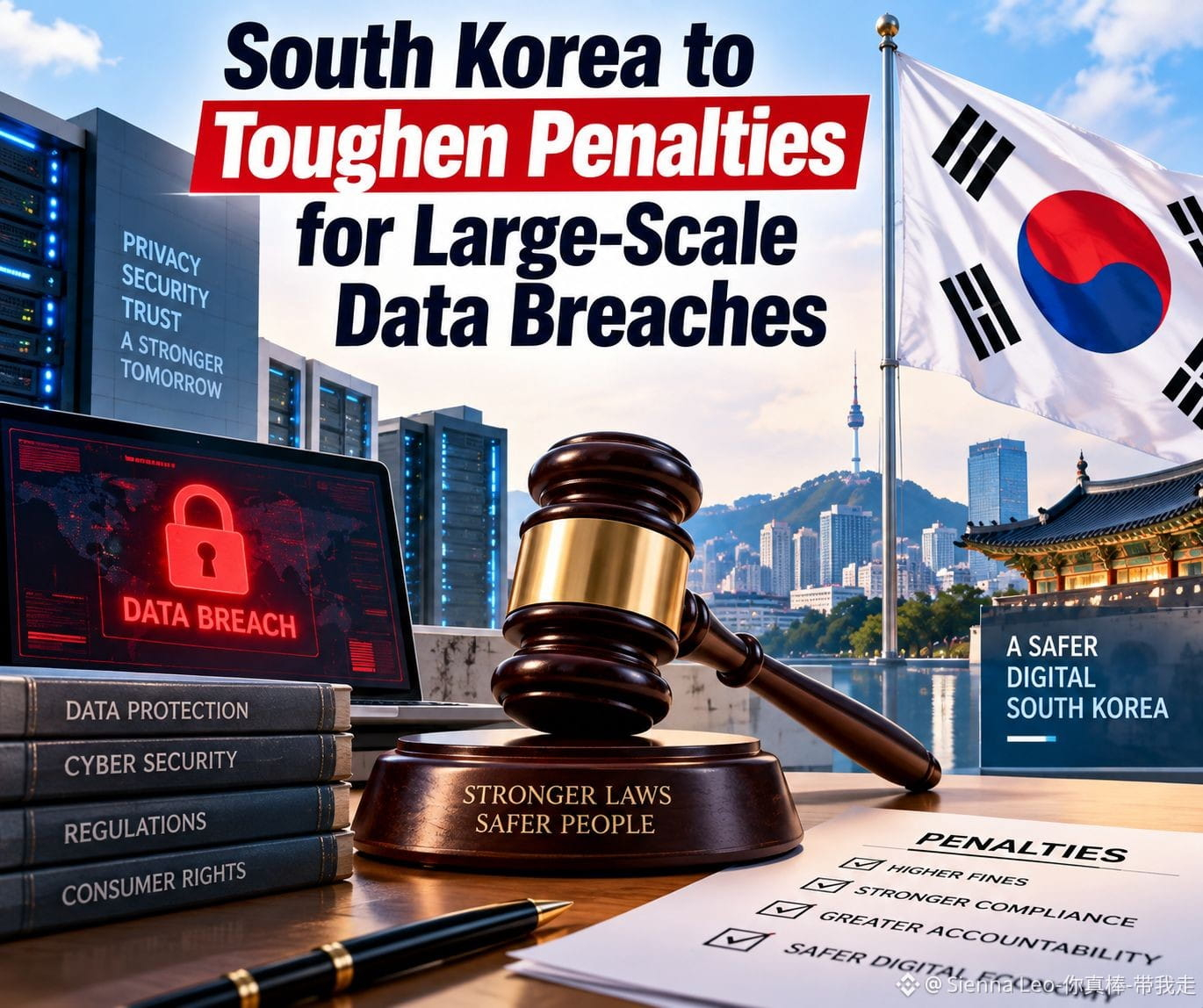
🔐 South Korea to Toughen Penalties for Large-Scale Data Breaches
A data breach used to look like a technical failure. Increasingly, it is becoming a boardroom risk with a very real financial price.
From September 11, South Korea’s revised privacy rules will allow punitive fines of up to 10% of a company’s total revenue for certain repeated, intentional, or grossly negligent large-scale data breaches.
The key threshold is not simply “data was leaked.” The tougher penalties target serious cases, including breaches affecting 10 million or more people, while companies that invest in preventive protection can receive reductions of up to 40%.
My takeaway is simple: cybersecurity is moving from an IT expense toward a core business responsibility. When the cost of failure becomes material, prevention gets a very different priority.
The bigger question is whether stronger penalties will actually change corporate security culture.
Educational purposes only. Not financial advice.
#DataPrivacy #CyberSecurity #GrowWithSAC $VTHO $LSK $REZ
🔐 South Korea to Toughen Penalties for Large-Scale Data Breaches
A data breach used to look like a technical failure. Increasingly, it is becoming a boardroom risk with a very real financial price.
From September 11, South Korea’s revised privacy rules will allow punitive fines of up to 10% of a company’s total revenue for certain repeated, intentional, or grossly negligent large-scale data breaches.
The key threshold is not simply “data was leaked.” The tougher penalties target serious cases, including breaches affecting 10 million or more people, while companies that invest in preventive protection can receive reductions of up to 40%.
My takeaway is simple: cybersecurity is moving from an IT expense toward a core business responsibility. When the cost of failure becomes material, prevention gets a very different priority.
The bigger question is whether stronger penalties will actually change corporate security culture.
Educational purposes only. Not financial advice.
#DataPrivacy #CyberSecurity #GrowWithSAC $VTHO $LSK $REZ
A data breach used to look like a technical failure. Increasingly, it is becoming a boardroom risk with a very real financial price.
From September 11, South Korea’s revised privacy rules will allow punitive fines of up to 10% of a company’s total revenue for certain repeated, intentional, or grossly negligent large-scale data breaches.
The key threshold is not simply “data was leaked.” The tougher penalties target serious cases, including breaches affecting 10 million or more people, while companies that invest in preventive protection can receive reductions of up to 40%.
My takeaway is simple: cybersecurity is moving from an IT expense toward a core business responsibility. When the cost of failure becomes material, prevention gets a very different priority.
The bigger question is whether stronger penalties will actually change corporate security culture.
Educational purposes only. Not financial advice.
#DataPrivacy #CyberSecurity #GrowWithSAC $VTHO $LSK $REZ
542

⚠️ How is lottery prize data used to scam seniors?
This report reveals how participant data from sweepstakes contests reaches scammers, fueling fraudulent marketing files. The Epsilon fraud case shows that targeted lists led to harm to seniors, highlighting the risks of sharing personal data.
━━━━━━━━━━━━━━
📊 Impact: 📊 Medium
🏷️ OTHER
#DataPrivacy #ScamAlert #ConsumerProtection #ElderFraud #Cybersecurity
🔗 Source: https://www.foxnews.com/tech/sweepstakes-entry-data-reach-scammers
⚠️ How is lottery prize data used to scam seniors?
This report reveals how participant data from sweepstakes contests reaches scammers, fueling fraudulent marketing files. The Epsilon fraud case shows that targeted lists led to harm to seniors, highlighting the risks of sharing personal data.
━━━━━━━━━━━━━━
📊 Impact: 📊 Medium
🏷️ OTHER
#DataPrivacy #ScamAlert #ConsumerProtection #ElderFraud #Cybersecurity
🔗 Source: https://www.foxnews.com/tech/sweepstakes-entry-data-reach-scammers
This report reveals how participant data from sweepstakes contests reaches scammers, fueling fraudulent marketing files. The Epsilon fraud case shows that targeted lists led to harm to seniors, highlighting the risks of sharing personal data.
━━━━━━━━━━━━━━
📊 Impact: 📊 Medium
🏷️ OTHER
#DataPrivacy #ScamAlert #ConsumerProtection #ElderFraud #Cybersecurity
🔗 Source: https://www.foxnews.com/tech/sweepstakes-entry-data-reach-scammers
56

·
--
Bullish
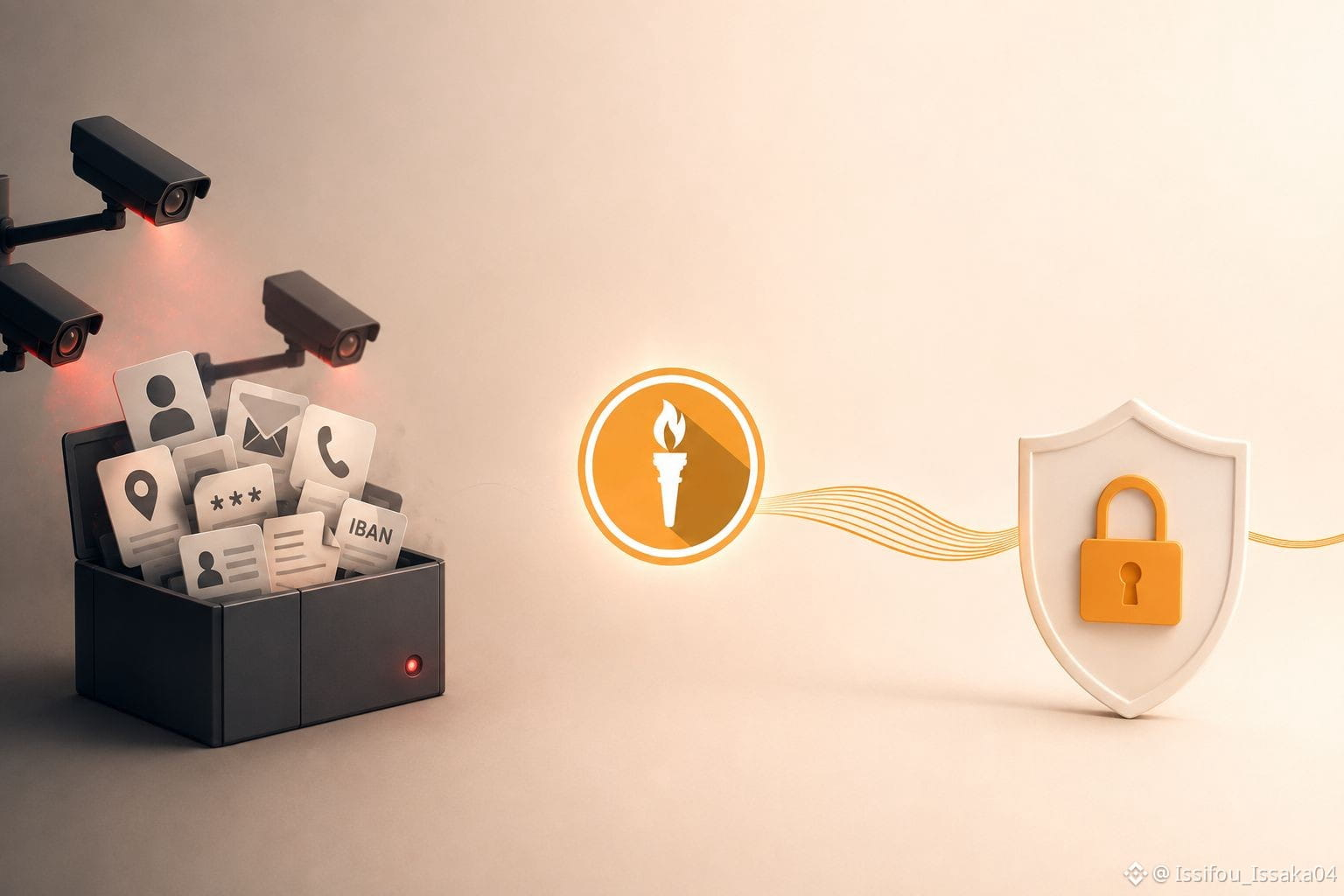
Your Data Isn't “Just Data.”
🔐 The more data a system stores about you, the bigger the prize becomes when that system is compromised.
Look at what gets exposed in major data breaches:
Names.
Addresses.
Emails.
Phone numbers.
Dates of birth.
IBANs.
Documents.
Credentials.
Some breaches affect hundreds of thousands, even millions of people.
And there's a lesson we shouldn't ignore:
Your data is not “just data.”
Every database storing your identity becomes another potential target.
Every centralized system collecting more information creates a bigger prize for attackers.
That's why privacy by design matters.
Instead of collecting everything first and protecting it later, why not build systems that require less personal information from the beginning?
That's the idea behind #Liberdus :
🔐 Private communication
🌐 Decentralized infrastructure
🛡️ Less dependence on centralized identities
We can't prevent every cyberattack.
But we can ask a better question:
Why give away so much data to systems that don't actually need to own it?
The future of digital communication should collect less, expose less, and give users more control.
Privacy shouldn't be a premium feature.
🔐 It should be the default.
#Liberdus #Privacy #CyberSecurity #DataPrivacy
Your Data Isn't “Just Data.”
🔐 The more data a system stores about you, the bigger the prize becomes when that system is compromised.
Look at what gets exposed in major data breaches:
Names.
Addresses.
Emails.
Phone numbers.
Dates of birth.
IBANs.
Documents.
Credentials.
Some breaches affect hundreds of thousands, even millions of people.
And there's a lesson we shouldn't ignore:
Your data is not “just data.”
Every database storing your identity becomes another potential target.
Every centralized system collecting more information creates a bigger prize for attackers.
That's why privacy by design matters.
Instead of collecting everything first and protecting it later, why not build systems that require less personal information from the beginning?
That's the idea behind #Liberdus :
🔐 Private communication
🌐 Decentralized infrastructure
🛡️ Less dependence on centralized identities
We can't prevent every cyberattack.
But we can ask a better question:
Why give away so much data to systems that don't actually need to own it?
The future of digital communication should collect less, expose less, and give users more control.
Privacy shouldn't be a premium feature.
🔐 It should be the default.
#Liberdus #Privacy #CyberSecurity #DataPrivacy
🔐 The more data a system stores about you, the bigger the prize becomes when that system is compromised.
Look at what gets exposed in major data breaches:
Names.
Addresses.
Emails.
Phone numbers.
Dates of birth.
IBANs.
Documents.
Credentials.
Some breaches affect hundreds of thousands, even millions of people.
And there's a lesson we shouldn't ignore:
Your data is not “just data.”
Every database storing your identity becomes another potential target.
Every centralized system collecting more information creates a bigger prize for attackers.
That's why privacy by design matters.
Instead of collecting everything first and protecting it later, why not build systems that require less personal information from the beginning?
That's the idea behind #Liberdus :
🔐 Private communication
🌐 Decentralized infrastructure
🛡️ Less dependence on centralized identities
We can't prevent every cyberattack.
But we can ask a better question:
Why give away so much data to systems that don't actually need to own it?
The future of digital communication should collect less, expose less, and give users more control.
Privacy shouldn't be a premium feature.
🔐 It should be the default.
#Liberdus #Privacy #CyberSecurity #DataPrivacy
3
5.3k

🛡️ Research Spotlight: Data Privacy & AI Verification with OpenLedger @OpenLedger
In the AI landscape of 2026, data ownership is a crucial issue. Many big AI companies use public data for free without giving attribution or value back to the data owners. This is where @OpenLedger provides a real solution for a fair AI economy.
Latest Research Findings:
1. Zero-Knowledge Proofs (ZKP): OpenLedger uses ZKP to prove that the AI model has been trained with the right data without exposing the raw data itself. This is a significant breakthrough for the financial and healthcare sectors that are highly sensitive to privacy.
2. Verified Digital Certificates: Every piece of data used in the OpenLedger network generates a unique hash and digital certificate. This ensures that data providers receive clear attribution and fair payment through the $OPEN token.
3. Enterprise Compliance: The 2026 roadmap includes a compliance layer that allows large companies to adopt on-chain AI while still adhering to global data protection regulations.
4. AI Agent Marketplace: OpenLedger is building an economy where AI agents can autonomously and audibly transact payments, creating a fully liquid marketplace for AI assets.
Conclusion: OpenLedger is not just about technology, but about AI ethics. By securing data through blockchain, $OPEN becomes key to a future where AI is transparent, private, and incentivizes all its contributors.
#OpenLedger $OPEN #DataPrivacy #ZKP #FutureOfAI
🛡️ Research Spotlight: Data Privacy & AI Verification with OpenLedger @OpenLedger
In the AI landscape of 2026, data ownership is a crucial issue. Many big AI companies use public data for free without giving attribution or value back to the data owners. This is where @OpenLedger provides a real solution for a fair AI economy.
Latest Research Findings:
1. Zero-Knowledge Proofs (ZKP): OpenLedger uses ZKP to prove that the AI model has been trained with the right data without exposing the raw data itself. This is a significant breakthrough for the financial and healthcare sectors that are highly sensitive to privacy.
2. Verified Digital Certificates: Every piece of data used in the OpenLedger network generates a unique hash and digital certificate. This ensures that data providers receive clear attribution and fair payment through the $OPEN token.
3. Enterprise Compliance: The 2026 roadmap includes a compliance layer that allows large companies to adopt on-chain AI while still adhering to global data protection regulations.
4. AI Agent Marketplace: OpenLedger is building an economy where AI agents can autonomously and audibly transact payments, creating a fully liquid marketplace for AI assets.
Conclusion: OpenLedger is not just about technology, but about AI ethics. By securing data through blockchain, $OPEN becomes key to a future where AI is transparent, private, and incentivizes all its contributors.
#OpenLedger $OPEN #DataPrivacy #ZKP #FutureOfAI
In the AI landscape of 2026, data ownership is a crucial issue. Many big AI companies use public data for free without giving attribution or value back to the data owners. This is where @OpenLedger provides a real solution for a fair AI economy.
Latest Research Findings:
1. Zero-Knowledge Proofs (ZKP): OpenLedger uses ZKP to prove that the AI model has been trained with the right data without exposing the raw data itself. This is a significant breakthrough for the financial and healthcare sectors that are highly sensitive to privacy.
2. Verified Digital Certificates: Every piece of data used in the OpenLedger network generates a unique hash and digital certificate. This ensures that data providers receive clear attribution and fair payment through the $OPEN token.
3. Enterprise Compliance: The 2026 roadmap includes a compliance layer that allows large companies to adopt on-chain AI while still adhering to global data protection regulations.
4. AI Agent Marketplace: OpenLedger is building an economy where AI agents can autonomously and audibly transact payments, creating a fully liquid marketplace for AI assets.
Conclusion: OpenLedger is not just about technology, but about AI ethics. By securing data through blockchain, $OPEN becomes key to a future where AI is transparent, private, and incentivizes all its contributors.
#OpenLedger $OPEN #DataPrivacy #ZKP #FutureOfAI
15

·
--
Imagine storing your files on a network powered by millions of everyday devices instead of big tech servers — that is Autonomi.
Autonomi (ANT) is a decentralized ecosystem where data is securely stored across countless nodes like laptops and phones, with privacy built in by default. No single company controls it, and nodes validate each other autonomously without middlemen. Think of it as a community-run cloud where you keep ownership of your data. The token ANT fuels this network, currently trading around $0.076 with a 6.6 percent daily gain and a $25.4 million market cap. While still early ranked 711, the vision is bold: a truly private, censorship-resistant internet infrastructure powered by people, not corporations.
#DecentralizedStorage #DataPrivacy
Would you trust your personal files to a network run by strangers devices instead of Google or Amazon?
Imagine storing your files on a network powered by millions of everyday devices instead of big tech servers — that is Autonomi.
Autonomi (ANT) is a decentralized ecosystem where data is securely stored across countless nodes like laptops and phones, with privacy built in by default. No single company controls it, and nodes validate each other autonomously without middlemen. Think of it as a community-run cloud where you keep ownership of your data. The token ANT fuels this network, currently trading around $0.076 with a 6.6 percent daily gain and a $25.4 million market cap. While still early ranked 711, the vision is bold: a truly private, censorship-resistant internet infrastructure powered by people, not corporations.
#DecentralizedStorage #DataPrivacy
Would you trust your personal files to a network run by strangers devices instead of Google or Amazon?
Autonomi (ANT) is a decentralized ecosystem where data is securely stored across countless nodes like laptops and phones, with privacy built in by default. No single company controls it, and nodes validate each other autonomously without middlemen. Think of it as a community-run cloud where you keep ownership of your data. The token ANT fuels this network, currently trading around $0.076 with a 6.6 percent daily gain and a $25.4 million market cap. While still early ranked 711, the vision is bold: a truly private, censorship-resistant internet infrastructure powered by people, not corporations.
#DecentralizedStorage #DataPrivacy
Would you trust your personal files to a network run by strangers devices instead of Google or Amazon?
65

·
--
Article
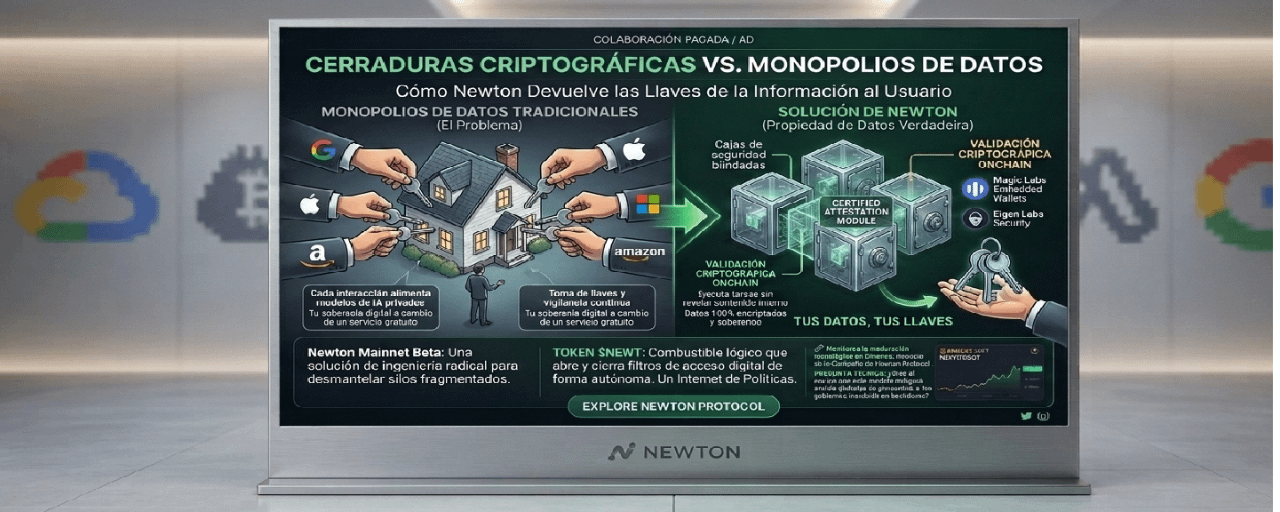
Cryptographic Locks vs. Data Monopolies: How Newton Returns the Keys to InformationCryptographic Locks vs. Data Monopolies: How Newton Returns the Keys to Information to Users
Imagine that, to live in your own home, you had to hand over a copy of the key to your bedroom to a technology corporation so it can record what clothes you wear, what books you read, and what time you go to sleep, all under the excuse of "optimizing your life experience." That’s exactly what happens today with data storage on Big Tech’s central servers. Every interaction feeds their private Artificial Intelligence (AI) models, siphoning off your digital sovereignty in exchange for a free service.
Cryptographic Locks vs. Data Monopolies: How Newton Returns the Keys to Information
Cryptographic Locks vs. Data Monopolies: How Newton Returns the Keys to Information to Users
Imagine that, to live in your own home, you had to hand over a copy of the key to your bedroom to a technology corporation so it can record what clothes you wear, what books you read, and what time you go to sleep, all under the excuse of "optimizing your life experience." That’s exactly what happens today with data storage on Big Tech’s central servers. Every interaction feeds their private Artificial Intelligence (AI) models, siphoning off your digital sovereignty in exchange for a free service.
Imagine that, to live in your own home, you had to hand over a copy of the key to your bedroom to a technology corporation so it can record what clothes you wear, what books you read, and what time you go to sleep, all under the excuse of "optimizing your life experience." That’s exactly what happens today with data storage on Big Tech’s central servers. Every interaction feeds their private Artificial Intelligence (AI) models, siphoning off your digital sovereignty in exchange for a free service.
2
1
72

·
--
If you are still feeding your private trading strategies and personal data into centralized Web2 AI chatbots, stop now.
Most traders do not realize they are literally handing over their alpha and identity to tech giants who train models on their private data. We value decentralization in our portfolios but happily leak our entire search history to centralized databases just for a quick market analysis.
The narrative is shifting toward trustless systems. While mainstream bots ask for blind trust, projects like OpenGradient are trying to change the game on the $BNB chain. By encrypting messages directly on your device and decoupling your identity from your prompts, $OPG is attempting to prove privacy with math rather than corporate promises.
It is a sharp contrast to how we historically interacted with AI, and frankly, a much-needed upgrade. We have seen how data leaks hurt users in the past, so seeing decentralized infrastructure actually tackle the privacy problem instead of just riding the AI hype wave is a breath of fresh air.
Do you think decentralized AI can actually compete with the convenience of Web2 giants, or is the average user too lazy to care about data privacy?
#CryptoAI #DataPrivacy #Web3
If you are still feeding your private trading strategies and personal data into centralized Web2 AI chatbots, stop now.
Most traders do not realize they are literally handing over their alpha and identity to tech giants who train models on their private data. We value decentralization in our portfolios but happily leak our entire search history to centralized databases just for a quick market analysis.
The narrative is shifting toward trustless systems. While mainstream bots ask for blind trust, projects like OpenGradient are trying to change the game on the $BNB chain. By encrypting messages directly on your device and decoupling your identity from your prompts, $OPG is attempting to prove privacy with math rather than corporate promises.
It is a sharp contrast to how we historically interacted with AI, and frankly, a much-needed upgrade. We have seen how data leaks hurt users in the past, so seeing decentralized infrastructure actually tackle the privacy problem instead of just riding the AI hype wave is a breath of fresh air.
Do you think decentralized AI can actually compete with the convenience of Web2 giants, or is the average user too lazy to care about data privacy?
#CryptoAI #DataPrivacy #Web3
Most traders do not realize they are literally handing over their alpha and identity to tech giants who train models on their private data. We value decentralization in our portfolios but happily leak our entire search history to centralized databases just for a quick market analysis.
The narrative is shifting toward trustless systems. While mainstream bots ask for blind trust, projects like OpenGradient are trying to change the game on the $BNB chain. By encrypting messages directly on your device and decoupling your identity from your prompts, $OPG is attempting to prove privacy with math rather than corporate promises.
It is a sharp contrast to how we historically interacted with AI, and frankly, a much-needed upgrade. We have seen how data leaks hurt users in the past, so seeing decentralized infrastructure actually tackle the privacy problem instead of just riding the AI hype wave is a breath of fresh air.
Do you think decentralized AI can actually compete with the convenience of Web2 giants, or is the average user too lazy to care about data privacy?
#CryptoAI #DataPrivacy #Web3
25

$BITHUMB FINED $13.6K FOR SHARING USER DATA WITHOUT CONSENT 📉
South Korea's data watchdog just dropped a fine on Bithumb for handing over user data to overseas platforms without proper consent. This isn't just about privacy — it's a reminder that regulatory heat is real and can shift liquidity patterns. The 210 million won penalty is small, but the signal matters: compliance is getting tighter.
If you're trading on exchanges with weak KYC processes, this should be a yellow flag. Are you checking which exchanges share your data?
Not financial advice. Always manage your risk.
#BITHUMB #CryptoNews #Regulation #DataPrivacy
🔥
$BITHUMB FINED $13.6K FOR SHARING USER DATA WITHOUT CONSENT 📉
South Korea's data watchdog just dropped a fine on Bithumb for handing over user data to overseas platforms without proper consent. This isn't just about privacy — it's a reminder that regulatory heat is real and can shift liquidity patterns. The 210 million won penalty is small, but the signal matters: compliance is getting tighter.
If you're trading on exchanges with weak KYC processes, this should be a yellow flag. Are you checking which exchanges share your data?
Not financial advice. Always manage your risk.
#BITHUMB #CryptoNews #Regulation #DataPrivacy
🔥
South Korea's data watchdog just dropped a fine on Bithumb for handing over user data to overseas platforms without proper consent. This isn't just about privacy — it's a reminder that regulatory heat is real and can shift liquidity patterns. The 210 million won penalty is small, but the signal matters: compliance is getting tighter.
If you're trading on exchanges with weak KYC processes, this should be a yellow flag. Are you checking which exchanges share your data?
Not financial advice. Always manage your risk.
#BITHUMB #CryptoNews #Regulation #DataPrivacy
🔥
48

·
--
Article
Web3 Platforms Are Tracking You Just Like Web2Have you noticed how many decentralized platforms are quietly tracking your every move just like old-school Web2 sites?
Most traders think they are operating privately, only to realize their IP addresses and wallet histories are being linked behind the scenes. This data leak exposes you to front-running bots and destroys the censorship resistance you actually paid for.
Let's look at the front-ends of major protocols like $UNI as a case study. They claim these tracking cookies are just anonymous metrics to improve site performance. But in reality, aggregating this traffic data builds a detailed map of user behavior that compromises the core promise of DeFi. When you accept these terms, you are opting back into the exact surveillance economy we built crypto to escape.
True decentralization means hosting front-ends on censorship-resistant networks and using privacy-focused browsers powered by $BAT to block these trackers entirely. We need to stop giving projects a pass just because they have a token. If a dApp requires Web2-style surveillance cookies to monitor its performance, it is not truly decentralized.
How much privacy are you willing to sacrifice for a smoother trading interface?
#DeFi #DataPrivacy #Web3
Web3 Platforms Are Tracking You Just Like Web2
Have you noticed how many decentralized platforms are quietly tracking your every move just like old-school Web2 sites?
Most traders think they are operating privately, only to realize their IP addresses and wallet histories are being linked behind the scenes. This data leak exposes you to front-running bots and destroys the censorship resistance you actually paid for.
Let's look at the front-ends of major protocols like $UNI as a case study. They claim these tracking cookies are just anonymous metrics to improve site performance. But in reality, aggregating this traffic data builds a detailed map of user behavior that compromises the core promise of DeFi. When you accept these terms, you are opting back into the exact surveillance economy we built crypto to escape.
True decentralization means hosting front-ends on censorship-resistant networks and using privacy-focused browsers powered by $BAT to block these trackers entirely. We need to stop giving projects a pass just because they have a token. If a dApp requires Web2-style surveillance cookies to monitor its performance, it is not truly decentralized.
How much privacy are you willing to sacrifice for a smoother trading interface?
#DeFi #DataPrivacy #Web3
Most traders think they are operating privately, only to realize their IP addresses and wallet histories are being linked behind the scenes. This data leak exposes you to front-running bots and destroys the censorship resistance you actually paid for.
Let's look at the front-ends of major protocols like $UNI as a case study. They claim these tracking cookies are just anonymous metrics to improve site performance. But in reality, aggregating this traffic data builds a detailed map of user behavior that compromises the core promise of DeFi. When you accept these terms, you are opting back into the exact surveillance economy we built crypto to escape.
True decentralization means hosting front-ends on censorship-resistant networks and using privacy-focused browsers powered by $BAT to block these trackers entirely. We need to stop giving projects a pass just because they have a token. If a dApp requires Web2-style surveillance cookies to monitor its performance, it is not truly decentralized.
How much privacy are you willing to sacrifice for a smoother trading interface?
#DeFi #DataPrivacy #Web3
31
🛡️ Research Highlight: Cryptographic Security & AI Privacy at OpenLedger @OpenLedger
In the midst of rampant user data leak scandals by giant AI companies, the big question is: can we build advanced AI without sacrificing privacy? By 2026, @OpenLedger provides a clear answer through a blend of cutting-edge cryptographic technology.
Privacy & Security Research Points:
1. ZKML (Zero-Knowledge Machine Learning): OpenLedger uses ZKML to prove the validity of machine learning processes without ever exposing raw data to the public or centralized servers. This ends the era where your data is "exploited" for free to train models.
2. FHE Synergy (Fully Homomorphic Encryption): With FHE, AI agents in the OpenLedger network can perform computations on encrypted data. This means the data remains hidden even while being processed by the AI model. This is the new gold standard for on-chain data privacy.
3. Payable AI & Provenance: Every byte of data contributing to the AI model is recorded on-chain with its provenance. Through the $OPEN token, data owners receive automatic compensation (Payable AI) whenever their data adds value to the model's output.
4. Protection from Surveillance: The OpenLedger infrastructure is designed to combat mass surveillance of AI data, giving individuals full control over their digital identity and intelligence.
Conclusion: @OpenLedger is not just building a blockchain, but a stronghold for our data in the AI era. Through $OPEN, we support an ecosystem where privacy is a fundamental right, not an option.
#OpenLedger $OPEN #ZKP #DataPrivacy #AIInfrastructure
🛡️ Research Highlight: Cryptographic Security & AI Privacy at OpenLedger @OpenLedger
In the midst of rampant user data leak scandals by giant AI companies, the big question is: can we build advanced AI without sacrificing privacy? By 2026, @OpenLedger provides a clear answer through a blend of cutting-edge cryptographic technology.
Privacy & Security Research Points:
1. ZKML (Zero-Knowledge Machine Learning): OpenLedger uses ZKML to prove the validity of machine learning processes without ever exposing raw data to the public or centralized servers. This ends the era where your data is "exploited" for free to train models.
2. FHE Synergy (Fully Homomorphic Encryption): With FHE, AI agents in the OpenLedger network can perform computations on encrypted data. This means the data remains hidden even while being processed by the AI model. This is the new gold standard for on-chain data privacy.
3. Payable AI & Provenance: Every byte of data contributing to the AI model is recorded on-chain with its provenance. Through the $OPEN token, data owners receive automatic compensation (Payable AI) whenever their data adds value to the model's output.
4. Protection from Surveillance: The OpenLedger infrastructure is designed to combat mass surveillance of AI data, giving individuals full control over their digital identity and intelligence.
Conclusion: @OpenLedger is not just building a blockchain, but a stronghold for our data in the AI era. Through $OPEN , we support an ecosystem where privacy is a fundamental right, not an option.
#OpenLedger $OPEN #ZKP #DataPrivacy #AIInfrastructure
In the midst of rampant user data leak scandals by giant AI companies, the big question is: can we build advanced AI without sacrificing privacy? By 2026, @OpenLedger provides a clear answer through a blend of cutting-edge cryptographic technology.
Privacy & Security Research Points:
1. ZKML (Zero-Knowledge Machine Learning): OpenLedger uses ZKML to prove the validity of machine learning processes without ever exposing raw data to the public or centralized servers. This ends the era where your data is "exploited" for free to train models.
2. FHE Synergy (Fully Homomorphic Encryption): With FHE, AI agents in the OpenLedger network can perform computations on encrypted data. This means the data remains hidden even while being processed by the AI model. This is the new gold standard for on-chain data privacy.
3. Payable AI & Provenance: Every byte of data contributing to the AI model is recorded on-chain with its provenance. Through the $OPEN token, data owners receive automatic compensation (Payable AI) whenever their data adds value to the model's output.
4. Protection from Surveillance: The OpenLedger infrastructure is designed to combat mass surveillance of AI data, giving individuals full control over their digital identity and intelligence.
Conclusion: @OpenLedger is not just building a blockchain, but a stronghold for our data in the AI era. Through $OPEN , we support an ecosystem where privacy is a fundamental right, not an option.
#OpenLedger $OPEN #ZKP #DataPrivacy #AIInfrastructure
1
149

Partly True
$NANA 💡 The $70B+ Health Data Heist: Why We Need Decentralized Science (DeSci)
Every single day, your smart devices, clinical visits, and fitness trackers generate valuable health data.
To you, it’s just numbers. To big-tech middlemen, health data brokers, and corporations, it’s gold.
The Reality: The global health data market is worth over $70 Billion.
The Scam: Big pharma, AI labs, and insurance giants pay billions to middleman brokers for this data.
Your Share? 0%. You create the value; they extract the profit.
🛡️ Why the Middlemen Don't Want You to Wake Up
The centralized giants controlling this market will fight to keep their monopoly. They will claim:
"Only our data is verified."
"Decentralized sharing is unsafe."
"Users don't care about data ownership."
They are wrong.
🚀 Enter NanoVita & DeSci (Decentralized Science)
The paradigm is shifting. By anchoring verified health data on-chain as THP NFTs and power-looping it through advanced AI, projects like NanoVita are building a direct bridge:
No Middlemen: Sell directly to researchers who actually need it.
True Ownership: You hold the keys (NFTs) to your medical identity.
Fair Economics: Earn $NANA directly into your wallet when your data is used.
"If the data belongs to you, the value should too."
It's time to stop giving away our most sensitive assets for free. The technology is here. The economics are ready. The ownership revolution has begun.
Are you ready to claim your share? 🟢
$BTC
#DeSci #Web3 #DataPrivacy #NanoVita #DePIN #bnb一輩子 #CZBİNANCE
$NANA 💡 The $70B+ Health Data Heist: Why We Need Decentralized Science (DeSci)
Every single day, your smart devices, clinical visits, and fitness trackers generate valuable health data.
To you, it’s just numbers. To big-tech middlemen, health data brokers, and corporations, it’s gold.
The Reality: The global health data market is worth over $70 Billion.
The Scam: Big pharma, AI labs, and insurance giants pay billions to middleman brokers for this data.
Your Share? 0%. You create the value; they extract the profit.
🛡️ Why the Middlemen Don't Want You to Wake Up
The centralized giants controlling this market will fight to keep their monopoly. They will claim:
"Only our data is verified."
"Decentralized sharing is unsafe."
"Users don't care about data ownership."
They are wrong.
🚀 Enter NanoVita & DeSci (Decentralized Science)
The paradigm is shifting. By anchoring verified health data on-chain as THP NFTs and power-looping it through advanced AI, projects like NanoVita are building a direct bridge:
No Middlemen: Sell directly to researchers who actually need it.
True Ownership: You hold the keys (NFTs) to your medical identity.
Fair Economics: Earn $NANA directly into your wallet when your data is used.
"If the data belongs to you, the value should too."
It's time to stop giving away our most sensitive assets for free. The technology is here. The economics are ready. The ownership revolution has begun.
Are you ready to claim your share? 🟢
$BTC
#DeSci #Web3 #DataPrivacy #NanoVita #DePIN #bnb一輩子 #CZBİNANCE
Every single day, your smart devices, clinical visits, and fitness trackers generate valuable health data.
To you, it’s just numbers. To big-tech middlemen, health data brokers, and corporations, it’s gold.
The Reality: The global health data market is worth over $70 Billion.
The Scam: Big pharma, AI labs, and insurance giants pay billions to middleman brokers for this data.
Your Share? 0%. You create the value; they extract the profit.
🛡️ Why the Middlemen Don't Want You to Wake Up
The centralized giants controlling this market will fight to keep their monopoly. They will claim:
"Only our data is verified."
"Decentralized sharing is unsafe."
"Users don't care about data ownership."
They are wrong.
🚀 Enter NanoVita & DeSci (Decentralized Science)
The paradigm is shifting. By anchoring verified health data on-chain as THP NFTs and power-looping it through advanced AI, projects like NanoVita are building a direct bridge:
No Middlemen: Sell directly to researchers who actually need it.
True Ownership: You hold the keys (NFTs) to your medical identity.
Fair Economics: Earn $NANA directly into your wallet when your data is used.
"If the data belongs to you, the value should too."
It's time to stop giving away our most sensitive assets for free. The technology is here. The economics are ready. The ownership revolution has begun.
Are you ready to claim your share? 🟢
$BTC
#DeSci #Web3 #DataPrivacy #NanoVita #DePIN #bnb一輩子 #CZBİNANCE
2
309
·
--
yo, quick thought on those annoying cookies you always click 'accept' on without reading. ngl, these 'targeting cookies' are basically letting sites and their buddies build a whole profile on you. they're watching your browsing habits, seeing what you click, what you search, all to figure out what you're into.
this isn't just random stuff either. they're literally fingerprinting your browser and whatever device you're using. so they know it's you specifically. kinda wild when you think about it, especially if you're trying to stay low-key with your $SOL gains.
and here's the kicker: even if you tell them no, you're still gonna see ads. they just won't be tailored to your specific interests. it'll be generic spam instead of creepily relevant spam, lol. just something to keep in mind while you're checking your $BTC and $ETH.
wagmi, but maybe with less data tracking.
#web3privacy #dataprivacy #degenlife #techthoughts
yo, quick thought on those annoying cookies you always click 'accept' on without reading. ngl, these 'targeting cookies' are basically letting sites and their buddies build a whole profile on you. they're watching your browsing habits, seeing what you click, what you search, all to figure out what you're into.
this isn't just random stuff either. they're literally fingerprinting your browser and whatever device you're using. so they know it's you specifically. kinda wild when you think about it, especially if you're trying to stay low-key with your $SOL gains.
and here's the kicker: even if you tell them no, you're still gonna see ads. they just won't be tailored to your specific interests. it'll be generic spam instead of creepily relevant spam, lol. just something to keep in mind while you're checking your $BTC and $ETH .
wagmi, but maybe with less data tracking.
#web3privacy #dataprivacy #degenlife #techthoughts
this isn't just random stuff either. they're literally fingerprinting your browser and whatever device you're using. so they know it's you specifically. kinda wild when you think about it, especially if you're trying to stay low-key with your $SOL gains.
and here's the kicker: even if you tell them no, you're still gonna see ads. they just won't be tailored to your specific interests. it'll be generic spam instead of creepily relevant spam, lol. just something to keep in mind while you're checking your $BTC and $ETH .
wagmi, but maybe with less data tracking.
#web3privacy #dataprivacy #degenlife #techthoughts
43
Log in to explore more content
Join global crypto users on Binance Square
⚡️ Get latest and useful information about crypto.
💬 Trusted by the world’s largest crypto exchange.
👍 Discover real insights from verified creators.
Email / Phone number
Trending Topics
1
#BitcoinReboundsTo$79K
21,973 views
201 Discussing
2
#BitcoinSpotETFsNetInflow$160M
464 views
42 Discussing
3
#SouthKoreaCryptoTaxDelayPetitionTops50000
14,063 views
391 Discussing
4
#SolanaTransactionV1GoesLiveOnMainnet
8,685 views
257 Discussing
5
#RussianCentralBankFlagsCryptoAsFinancialRisk
7,848 views
246 Discussing
6
#GrayscalePutsXRPAt26.11%InAdvisorPortfolio
21,414 views
352 Discussing
7
#PhiladelphiaSemiconductorIndexFalls5.9%
7,217 views
213 Discussing
8
#SECChairUrgesCongressToAdvanceClarityAct
21,091 views
239 Discussing
9
#FedHikeOddsRiseTo89%
116,317 views
1,267 Discussing
10
#RLUSDSupplyHitsRecord$2.442B
8,354 views
71 Discussing