

Sienna Leo-你真棒-带我走
10.1k Posts

Sienna Leo-你真棒-带我走
 Square Verified+
Report
Block User
内容创作者🔹积极思考者🔹高级分析者🔹高精准预测者🔹影响力人物🔹深度研究与高频现货交易策略🔹区块链 | WEB3 | 未来科技研究 | 🔹 ID#285783567 🔹X.@SiennaLeo80
797 Following
36.0K+ Followers
28.7K+ Liked
Posts
Portfolio
All
Quotes
Videos
Live
#usq3gdpandseptemberpceduenextweek
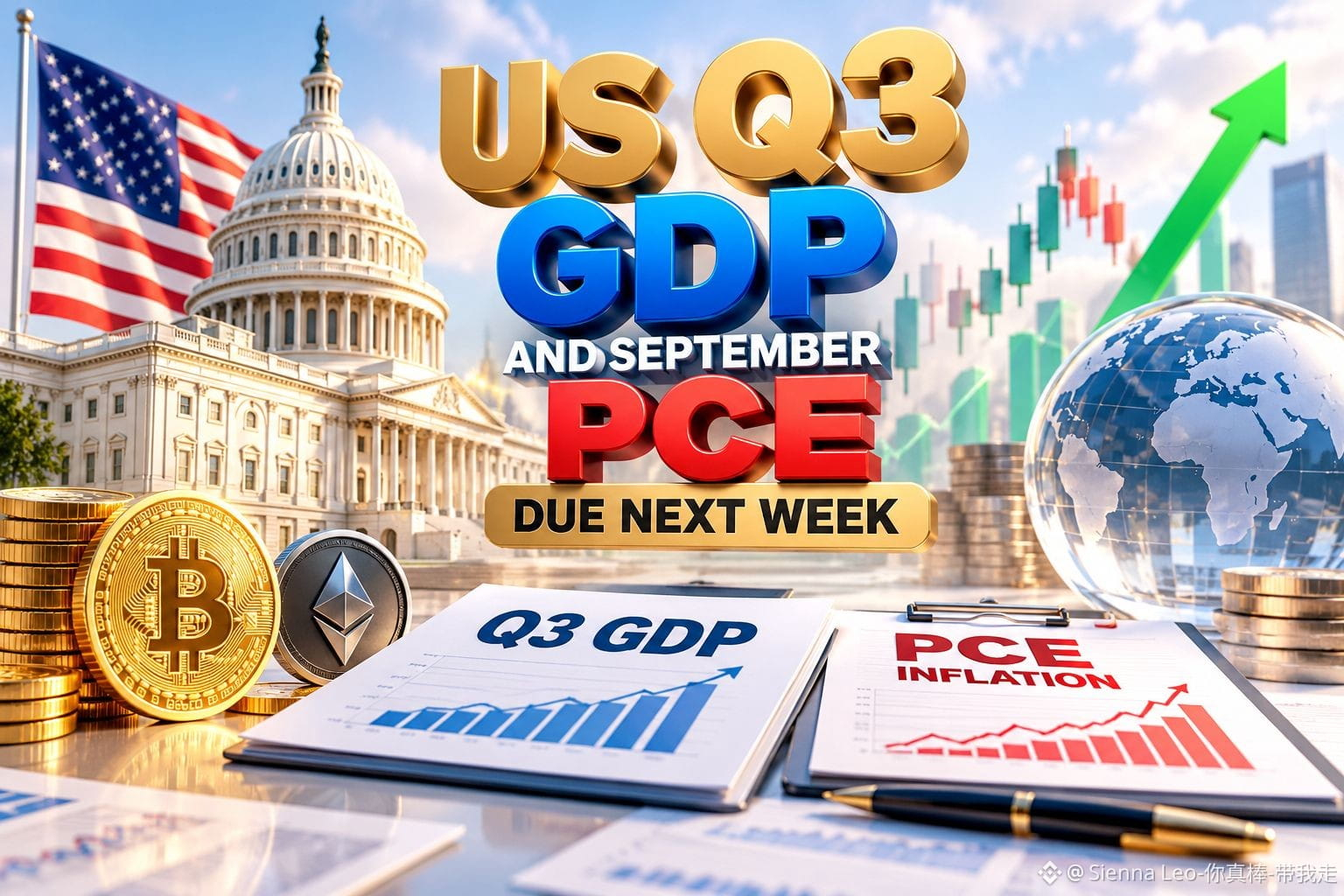
🌎📊 US Q3 GDP And September PCE: Two Economic Reports That Could Move Crypto 📊🌎
Imagine the market opening on Thursday with two very different signals: the US economy is growing faster than expected, but inflation is refusing to cool. Suddenly, the outlook for interest rates becomes much less straightforward.
On October 29, the US Bureau of Economic Analysis is scheduled to release its advance Q3 GDP estimate alongside September Personal Income and Outlays, including the PCE inflation data. Both reports could influence market expectations for Federal Reserve policy.
GDP tells us how the economy is performing. PCE reveals how consumer prices are changing. Together, they help investors assess whether economic growth is sustainable without keeping inflation uncomfortably high.
For crypto traders, the combination matters more than either number alone. Strong growth with cooling inflation could support risk appetite. Persistent inflation could strengthen expectations for tighter monetary policy, potentially pressuring speculative assets.
Meanwhile, weak growth and easing inflation could create a different debate around economic risks and future rate cuts.
My take: the most revealing outcome may be a disagreement between the two reports. Resilient growth and stubborn inflation could complicate the Fed's decisions, while softer inflation alongside healthy growth could offer a more constructive backdrop for risk assets.
Still, no single release determines Bitcoin's direction. Treasury yields, the dollar, liquidity, positioning, and the Fed's interpretation can all shape the reaction.
Watch the actual figures against expectations, then observe how markets respond. The first price move is not always the final verdict.
Which will matter more for Bitcoin next week: US growth or PCE inflation?
Disclaimer: This content is for educational purposes only and is not financial advice.
#USGDP #PCEInflation #GrowWithSAC $ZEC $DASH $ENA
#USQ3GDPAndSeptemberPCEDueNextWeek
#usq3gdpandseptemberpceduenextweek
🌎📊 US Q3 GDP And September PCE: Two Economic Reports That Could Move Crypto 📊🌎
Imagine the market opening on Thursday with two very different signals: the US economy is growing faster than expected, but inflation is refusing to cool. Suddenly, the outlook for interest rates becomes much less straightforward.
On October 29, the US Bureau of Economic Analysis is scheduled to release its advance Q3 GDP estimate alongside September Personal Income and Outlays, including the PCE inflation data. Both reports could influence market expectations for Federal Reserve policy.
GDP tells us how the economy is performing. PCE reveals how consumer prices are changing. Together, they help investors assess whether economic growth is sustainable without keeping inflation uncomfortably high.
For crypto traders, the combination matters more than either number alone. Strong growth with cooling inflation could support risk appetite. Persistent inflation could strengthen expectations for tighter monetary policy, potentially pressuring speculative assets.
Meanwhile, weak growth and easing inflation could create a different debate around economic risks and future rate cuts.
My take: the most revealing outcome may be a disagreement between the two reports. Resilient growth and stubborn inflation could complicate the Fed's decisions, while softer inflation alongside healthy growth could offer a more constructive backdrop for risk assets.
Still, no single release determines Bitcoin's direction. Treasury yields, the dollar, liquidity, positioning, and the Fed's interpretation can all shape the reaction.
Watch the actual figures against expectations, then observe how markets respond. The first price move is not always the final verdict.
Which will matter more for Bitcoin next week: US growth or PCE inflation?
Disclaimer: This content is for educational purposes only and is not financial advice.
#USGDP #PCEInflation #GrowWithSAC $ZEC $DASH $ENA
#USQ3GDPAndSeptemberPCEDueNextWeek
🌎📊 US Q3 GDP And September PCE: Two Economic Reports That Could Move Crypto 📊🌎
Imagine the market opening on Thursday with two very different signals: the US economy is growing faster than expected, but inflation is refusing to cool. Suddenly, the outlook for interest rates becomes much less straightforward.
On October 29, the US Bureau of Economic Analysis is scheduled to release its advance Q3 GDP estimate alongside September Personal Income and Outlays, including the PCE inflation data. Both reports could influence market expectations for Federal Reserve policy.
GDP tells us how the economy is performing. PCE reveals how consumer prices are changing. Together, they help investors assess whether economic growth is sustainable without keeping inflation uncomfortably high.
For crypto traders, the combination matters more than either number alone. Strong growth with cooling inflation could support risk appetite. Persistent inflation could strengthen expectations for tighter monetary policy, potentially pressuring speculative assets.
Meanwhile, weak growth and easing inflation could create a different debate around economic risks and future rate cuts.
My take: the most revealing outcome may be a disagreement between the two reports. Resilient growth and stubborn inflation could complicate the Fed's decisions, while softer inflation alongside healthy growth could offer a more constructive backdrop for risk assets.
Still, no single release determines Bitcoin's direction. Treasury yields, the dollar, liquidity, positioning, and the Fed's interpretation can all shape the reaction.
Watch the actual figures against expectations, then observe how markets respond. The first price move is not always the final verdict.
Which will matter more for Bitcoin next week: US growth or PCE inflation?
Disclaimer: This content is for educational purposes only and is not financial advice.
#USGDP #PCEInflation #GrowWithSAC $ZEC $DASH $ENA
#USQ3GDPAndSeptemberPCEDueNextWeek
1.1k
#usq3gdpandseptemberpceduenextweek
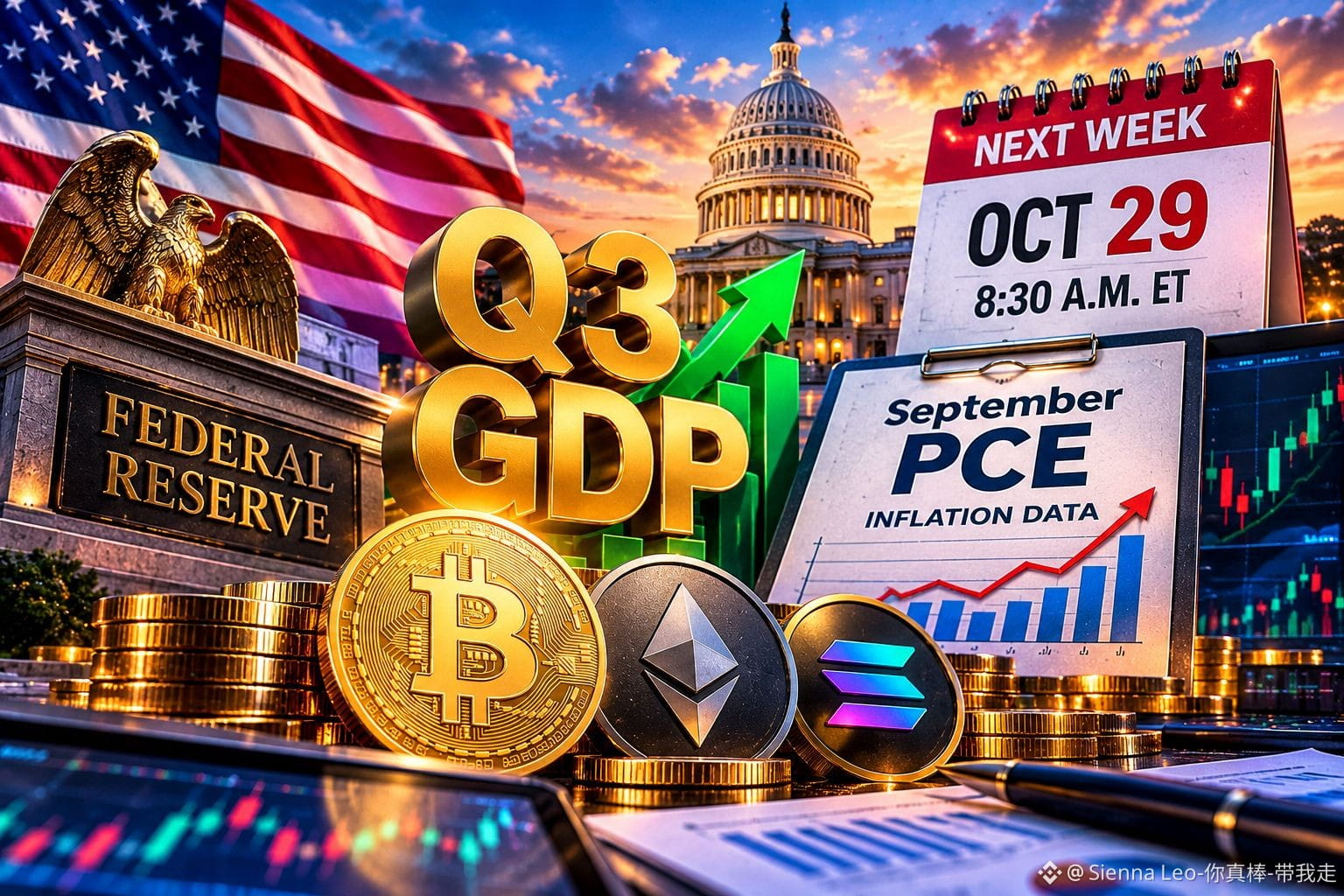
🇺🇸 📊 US Q3 GDP and September PCE: The Data That Could Move Crypto Next Week 📊 🇺🇸
Imagine Bitcoin climbing as traders anticipate easier monetary policy, only for one economic report to change the mood overnight. Next week, markets face a crucial test: is the US economy still growing strongly, and is inflation cooling fast enough?
On October 29, the US Bureau of Economic Analysis is scheduled to release its advance estimate of third-quarter GDP alongside September Personal Consumption Expenditures (PCE) inflation data. Both reports are due at 8:30 a.m. Eastern Time.
GDP measures economic growth, while PCE tracks changes in consumer prices. The core PCE measure, which excludes food and energy, is especially important when assessing underlying inflation pressure.
Here is the market dilemma: Strong GDP can support confidence in the economy, but persistent inflation could limit the Federal Reserve’s room to ease policy. Slower growth combined with softer inflation could strengthen expectations of a more accommodative stance.
For Bitcoin and other cryptocurrencies, the reaction will depend on how the figures compare with expectations. Softer inflation may support risk appetite, while hotter-than-expected readings could pressure speculative assets through interest-rate expectations and financial conditions.
Neither report guarantees a rally or a sell-off. Treasury yields, the dollar, positioning, and the Fed’s interpretation will also matter.
My strategy: watch the surprise versus expectations, not just whether the numbers look good or bad. Markets trade the difference between what investors expect and what actually arrives.
Which will matter more for Bitcoin next week: GDP growth or core PCE inflation?
Disclaimer: For educational purposes only. Not financial advice.
#Bitcoin #PCEInflation #GrowWithSAC $XEC $POLYX $ANKR
#USQ3GDPAndSeptemberPCEDueNextWeek
#usq3gdpandseptemberpceduenextweek
🇺🇸 📊 US Q3 GDP and September PCE: The Data That Could Move Crypto Next Week 📊 🇺🇸
Imagine Bitcoin climbing as traders anticipate easier monetary policy, only for one economic report to change the mood overnight. Next week, markets face a crucial test: is the US economy still growing strongly, and is inflation cooling fast enough?
On October 29, the US Bureau of Economic Analysis is scheduled to release its advance estimate of third-quarter GDP alongside September Personal Consumption Expenditures (PCE) inflation data. Both reports are due at 8:30 a.m. Eastern Time.
GDP measures economic growth, while PCE tracks changes in consumer prices. The core PCE measure, which excludes food and energy, is especially important when assessing underlying inflation pressure.
Here is the market dilemma: Strong GDP can support confidence in the economy, but persistent inflation could limit the Federal Reserve’s room to ease policy. Slower growth combined with softer inflation could strengthen expectations of a more accommodative stance.
For Bitcoin and other cryptocurrencies, the reaction will depend on how the figures compare with expectations. Softer inflation may support risk appetite, while hotter-than-expected readings could pressure speculative assets through interest-rate expectations and financial conditions.
Neither report guarantees a rally or a sell-off. Treasury yields, the dollar, positioning, and the Fed’s interpretation will also matter.
My strategy: watch the surprise versus expectations, not just whether the numbers look good or bad. Markets trade the difference between what investors expect and what actually arrives.
Which will matter more for Bitcoin next week: GDP growth or core PCE inflation?
Disclaimer: For educational purposes only. Not financial advice.
#Bitcoin #PCEInflation #GrowWithSAC $XEC $POLYX $ANKR
#USQ3GDPAndSeptemberPCEDueNextWeek
🇺🇸 📊 US Q3 GDP and September PCE: The Data That Could Move Crypto Next Week 📊 🇺🇸
Imagine Bitcoin climbing as traders anticipate easier monetary policy, only for one economic report to change the mood overnight. Next week, markets face a crucial test: is the US economy still growing strongly, and is inflation cooling fast enough?
On October 29, the US Bureau of Economic Analysis is scheduled to release its advance estimate of third-quarter GDP alongside September Personal Consumption Expenditures (PCE) inflation data. Both reports are due at 8:30 a.m. Eastern Time.
GDP measures economic growth, while PCE tracks changes in consumer prices. The core PCE measure, which excludes food and energy, is especially important when assessing underlying inflation pressure.
Here is the market dilemma: Strong GDP can support confidence in the economy, but persistent inflation could limit the Federal Reserve’s room to ease policy. Slower growth combined with softer inflation could strengthen expectations of a more accommodative stance.
For Bitcoin and other cryptocurrencies, the reaction will depend on how the figures compare with expectations. Softer inflation may support risk appetite, while hotter-than-expected readings could pressure speculative assets through interest-rate expectations and financial conditions.
Neither report guarantees a rally or a sell-off. Treasury yields, the dollar, positioning, and the Fed’s interpretation will also matter.
My strategy: watch the surprise versus expectations, not just whether the numbers look good or bad. Markets trade the difference between what investors expect and what actually arrives.
Which will matter more for Bitcoin next week: GDP growth or core PCE inflation?
Disclaimer: For educational purposes only. Not financial advice.
#Bitcoin #PCEInflation #GrowWithSAC $XEC $POLYX $ANKR
#USQ3GDPAndSeptemberPCEDueNextWeek
1.6k
🎙️ WELCOME || GROW TOGETHER ||

End
02 h 51 m 46 s
472
5
0
#electrumfixeshighriskexploitinversionsbefore4.8.3
🔐⚠️ Electrum Fixes High-Risk Exploit in Versions Before 4.8.3 ⚠️🔐
Imagine sending Bitcoin to the correct address, only to reopen your wallet and discover a different destination. The transaction looks real, the fee needs increasing, and one click could turn a security flaw into a financial loss.
Electrum has released version 4.8.3 to fix a high-severity vulnerability affecting every earlier version. Developers confirmed reports of real-world exploitation, including a case in which a user lost funds after increasing a transaction fee.
The attack exploited how older Electrum versions handled unconfirmed transactions. A malicious server could hide a legitimate outgoing payment and display a conflicting transaction directing funds to an attacker. If the user tried to speed it up using Replace-by-Fee (RBF), the wallet could sign the fraudulent replacement.
Version 4.8.3 adds signature verification for unconfirmed transactions spending funds controlled by the wallet, blocking the specific attack described in the advisory. However, this does not turn Electrum into a full Bitcoin node or eliminate every possible security risk.
The bigger lesson: Self-custody gives you control over your keys, but lightweight wallets still rely on external infrastructure for certain information. Security depends on more than protecting a seed phrase.
If you use Electrum, upgrade to version 4.8.3 or later from the official source. Until updated, carefully verify every recipient address and amount before signing or increasing transaction fees.
In crypto, protecting your Bitcoin means questioning what your wallet displays, not blindly trusting what you see.
Discussion: Should crypto wallets verify every unconfirmed transaction before displaying it to users?
Disclaimer: This content is for educational purposes only, not financial or security advice.
#BitcoinSecurity #CryptoSecurity #GrowWithSAC $BTC $DASH $ZEC
#ElectrumFixesHighRiskExploitInVersionsBefore4.8.3
#electrumfixeshighriskexploitinversionsbefore4.8.3
🔐⚠️ Electrum Fixes High-Risk Exploit in Versions Before 4.8.3 ⚠️🔐
Imagine sending Bitcoin to the correct address, only to reopen your wallet and discover a different destination. The transaction looks real, the fee needs increasing, and one click could turn a security flaw into a financial loss.
Electrum has released version 4.8.3 to fix a high-severity vulnerability affecting every earlier version. Developers confirmed reports of real-world exploitation, including a case in which a user lost funds after increasing a transaction fee.
The attack exploited how older Electrum versions handled unconfirmed transactions. A malicious server could hide a legitimate outgoing payment and display a conflicting transaction directing funds to an attacker. If the user tried to speed it up using Replace-by-Fee (RBF), the wallet could sign the fraudulent replacement.
Version 4.8.3 adds signature verification for unconfirmed transactions spending funds controlled by the wallet, blocking the specific attack described in the advisory. However, this does not turn Electrum into a full Bitcoin node or eliminate every possible security risk.
The bigger lesson: Self-custody gives you control over your keys, but lightweight wallets still rely on external infrastructure for certain information. Security depends on more than protecting a seed phrase.
If you use Electrum, upgrade to version 4.8.3 or later from the official source. Until updated, carefully verify every recipient address and amount before signing or increasing transaction fees.
In crypto, protecting your Bitcoin means questioning what your wallet displays, not blindly trusting what you see.
Discussion: Should crypto wallets verify every unconfirmed transaction before displaying it to users?
Disclaimer: This content is for educational purposes only, not financial or security advice.
#BitcoinSecurity #CryptoSecurity #GrowWithSAC $BTC $DASH $ZEC
#ElectrumFixesHighRiskExploitInVersionsBefore4.8.3
🔐⚠️ Electrum Fixes High-Risk Exploit in Versions Before 4.8.3 ⚠️🔐
Imagine sending Bitcoin to the correct address, only to reopen your wallet and discover a different destination. The transaction looks real, the fee needs increasing, and one click could turn a security flaw into a financial loss.
Electrum has released version 4.8.3 to fix a high-severity vulnerability affecting every earlier version. Developers confirmed reports of real-world exploitation, including a case in which a user lost funds after increasing a transaction fee.
The attack exploited how older Electrum versions handled unconfirmed transactions. A malicious server could hide a legitimate outgoing payment and display a conflicting transaction directing funds to an attacker. If the user tried to speed it up using Replace-by-Fee (RBF), the wallet could sign the fraudulent replacement.
Version 4.8.3 adds signature verification for unconfirmed transactions spending funds controlled by the wallet, blocking the specific attack described in the advisory. However, this does not turn Electrum into a full Bitcoin node or eliminate every possible security risk.
The bigger lesson: Self-custody gives you control over your keys, but lightweight wallets still rely on external infrastructure for certain information. Security depends on more than protecting a seed phrase.
If you use Electrum, upgrade to version 4.8.3 or later from the official source. Until updated, carefully verify every recipient address and amount before signing or increasing transaction fees.
In crypto, protecting your Bitcoin means questioning what your wallet displays, not blindly trusting what you see.
Discussion: Should crypto wallets verify every unconfirmed transaction before displaying it to users?
Disclaimer: This content is for educational purposes only, not financial or security advice.
#BitcoinSecurity #CryptoSecurity #GrowWithSAC $BTC $DASH $ZEC
#ElectrumFixesHighRiskExploitInVersionsBefore4.8.3

1
1
2.9k
#southkoreadelayscryptoincometax
🇰🇷 💰 South Korea’s Crypto Income Tax Delay Faces Uncertainty 💰 🇰🇷
Imagine making a profit on crypto, watching your portfolio grow, and then discovering that tax rules could change how much you ultimately keep. For South Korean investors, the debate over crypto taxation is becoming a question of timing, fairness, and confidence.
South Korea’s planned crypto income tax has faced renewed calls for postponement, but a delay has not been confirmed. Recent reporting indicates that authorities intend to proceed with implementation on January 1, 2027, despite growing pressure from investors.
Under the current plan, eligible annual crypto gains exceeding 2.5 million won would face an effective 22% tax rate, including local tax. The framework covers gains from activities such as selling, transferring, and lending digital assets.
The real issue goes beyond taxation. Investors need predictable rules before they can plan their trades, calculate potential returns, or decide how long to hold an asset. Repeated uncertainty can influence behavior even before a tax becomes effective.
A confirmed postponement could give investors and exchanges more time to prepare reporting systems. However, proceeding as scheduled could provide greater regulatory certainty, provided the implementation rules are clear and practical.
My take: taxation does not automatically push crypto markets down or up. Market direction still depends on liquidity, demand, sentiment, and broader economic conditions. The bigger concern is whether investors receive enough clarity to make informed decisions.
In crypto, knowing the rules can be just as important as knowing the price.
Should South Korea postpone crypto taxation again, or implement the planned rules in 2027?
Disclaimer: This content is for educational purposes only and is not tax or financial advice.
#CryptoTax #CryptoRegulation #GrowWithSAC $ZEC $DASH $ENA
#SouthKoreaDelaysCryptoIncomeTax
#southkoreadelayscryptoincometax
🇰🇷 💰 South Korea’s Crypto Income Tax Delay Faces Uncertainty 💰 🇰🇷
Imagine making a profit on crypto, watching your portfolio grow, and then discovering that tax rules could change how much you ultimately keep. For South Korean investors, the debate over crypto taxation is becoming a question of timing, fairness, and confidence.
South Korea’s planned crypto income tax has faced renewed calls for postponement, but a delay has not been confirmed. Recent reporting indicates that authorities intend to proceed with implementation on January 1, 2027, despite growing pressure from investors.
Under the current plan, eligible annual crypto gains exceeding 2.5 million won would face an effective 22% tax rate, including local tax. The framework covers gains from activities such as selling, transferring, and lending digital assets.
The real issue goes beyond taxation. Investors need predictable rules before they can plan their trades, calculate potential returns, or decide how long to hold an asset. Repeated uncertainty can influence behavior even before a tax becomes effective.
A confirmed postponement could give investors and exchanges more time to prepare reporting systems. However, proceeding as scheduled could provide greater regulatory certainty, provided the implementation rules are clear and practical.
My take: taxation does not automatically push crypto markets down or up. Market direction still depends on liquidity, demand, sentiment, and broader economic conditions. The bigger concern is whether investors receive enough clarity to make informed decisions.
In crypto, knowing the rules can be just as important as knowing the price.
Should South Korea postpone crypto taxation again, or implement the planned rules in 2027?
Disclaimer: This content is for educational purposes only and is not tax or financial advice.
#CryptoTax #CryptoRegulation #GrowWithSAC $ZEC $DASH $ENA
#SouthKoreaDelaysCryptoIncomeTax
🇰🇷 💰 South Korea’s Crypto Income Tax Delay Faces Uncertainty 💰 🇰🇷
Imagine making a profit on crypto, watching your portfolio grow, and then discovering that tax rules could change how much you ultimately keep. For South Korean investors, the debate over crypto taxation is becoming a question of timing, fairness, and confidence.
South Korea’s planned crypto income tax has faced renewed calls for postponement, but a delay has not been confirmed. Recent reporting indicates that authorities intend to proceed with implementation on January 1, 2027, despite growing pressure from investors.
Under the current plan, eligible annual crypto gains exceeding 2.5 million won would face an effective 22% tax rate, including local tax. The framework covers gains from activities such as selling, transferring, and lending digital assets.
The real issue goes beyond taxation. Investors need predictable rules before they can plan their trades, calculate potential returns, or decide how long to hold an asset. Repeated uncertainty can influence behavior even before a tax becomes effective.
A confirmed postponement could give investors and exchanges more time to prepare reporting systems. However, proceeding as scheduled could provide greater regulatory certainty, provided the implementation rules are clear and practical.
My take: taxation does not automatically push crypto markets down or up. Market direction still depends on liquidity, demand, sentiment, and broader economic conditions. The bigger concern is whether investors receive enough clarity to make informed decisions.
In crypto, knowing the rules can be just as important as knowing the price.
Should South Korea postpone crypto taxation again, or implement the planned rules in 2027?
Disclaimer: This content is for educational purposes only and is not tax or financial advice.
#CryptoTax #CryptoRegulation #GrowWithSAC $ZEC $DASH $ENA
#SouthKoreaDelaysCryptoIncomeTax

1
1
1.8k
·
--
Bullish
#southkoreaplanstoregulatestablecoinsunderfxlaw
🌏 💱 South Korea Plans to Regulate Stablecoins Under FX Law 💱 🌏
Imagine sending money overseas in seconds, without a traditional bank transfer, while regulators struggle to track where that money goes. That convenience is precisely what makes stablecoins both attractive and difficult to oversee.
South Korea is preparing to amend its Foreign Exchange Transactions Act to regulate stablecoins as payment instruments, according to recent reports. The Bank of Korea plans to work with the government on drafting legislation before the end of 2026.
The focus is bigger than crypto prices. Authorities want stronger oversight of cross-border digital-asset transactions and a monitoring framework that can help address illicit financial activity.
The deeper shift? Stablecoins are increasingly being treated not merely as crypto assets, but as tools for moving money. Once a token starts functioning like a payment rail, governments naturally become more concerned about reporting, compliance, and financial transparency.
However, this remains a legislative plan, not an enacted law. The precise requirements, implementation timeline, and effects on individual stablecoins are not yet established.
What could this mean for crypto? Clearer rules could improve institutional confidence and create a more predictable environment for compliant stablecoin services. On the other hand, stricter reporting obligations could increase costs and reduce some of the flexibility that makes blockchain transfers appealing.
My take: the next stablecoin battle may not be about maintaining a Dollor 1 peg. It may be about who controls the rules governing how that dollar moves.
Discussion: Will tighter stablecoin regulation accelerate mainstream adoption, or weaken crypto's borderless advantage?
Disclaimer: This article is for educational purposes only, not financial advice.
#Stablecoins #CryptoRegulation #GrowWithSAC $TRX $XEC $POLYX
#SouthKoreaPlansToRegulateStablecoinsUnderFXLaw
#southkoreaplanstoregulatestablecoinsunderfxlaw
🌏 💱 South Korea Plans to Regulate Stablecoins Under FX Law 💱 🌏
Imagine sending money overseas in seconds, without a traditional bank transfer, while regulators struggle to track where that money goes. That convenience is precisely what makes stablecoins both attractive and difficult to oversee.
South Korea is preparing to amend its Foreign Exchange Transactions Act to regulate stablecoins as payment instruments, according to recent reports. The Bank of Korea plans to work with the government on drafting legislation before the end of 2026.
The focus is bigger than crypto prices. Authorities want stronger oversight of cross-border digital-asset transactions and a monitoring framework that can help address illicit financial activity.
The deeper shift? Stablecoins are increasingly being treated not merely as crypto assets, but as tools for moving money. Once a token starts functioning like a payment rail, governments naturally become more concerned about reporting, compliance, and financial transparency.
However, this remains a legislative plan, not an enacted law. The precise requirements, implementation timeline, and effects on individual stablecoins are not yet established.
What could this mean for crypto? Clearer rules could improve institutional confidence and create a more predictable environment for compliant stablecoin services. On the other hand, stricter reporting obligations could increase costs and reduce some of the flexibility that makes blockchain transfers appealing.
My take: the next stablecoin battle may not be about maintaining a Dollor 1 peg. It may be about who controls the rules governing how that dollar moves.
Discussion: Will tighter stablecoin regulation accelerate mainstream adoption, or weaken crypto's borderless advantage?
Disclaimer: This article is for educational purposes only, not financial advice.
#Stablecoins #CryptoRegulation #GrowWithSAC $TRX $XEC $POLYX
#SouthKoreaPlansToRegulateStablecoinsUnderFXLaw
🌏 💱 South Korea Plans to Regulate Stablecoins Under FX Law 💱 🌏
Imagine sending money overseas in seconds, without a traditional bank transfer, while regulators struggle to track where that money goes. That convenience is precisely what makes stablecoins both attractive and difficult to oversee.
South Korea is preparing to amend its Foreign Exchange Transactions Act to regulate stablecoins as payment instruments, according to recent reports. The Bank of Korea plans to work with the government on drafting legislation before the end of 2026.
The focus is bigger than crypto prices. Authorities want stronger oversight of cross-border digital-asset transactions and a monitoring framework that can help address illicit financial activity.
The deeper shift? Stablecoins are increasingly being treated not merely as crypto assets, but as tools for moving money. Once a token starts functioning like a payment rail, governments naturally become more concerned about reporting, compliance, and financial transparency.
However, this remains a legislative plan, not an enacted law. The precise requirements, implementation timeline, and effects on individual stablecoins are not yet established.
What could this mean for crypto? Clearer rules could improve institutional confidence and create a more predictable environment for compliant stablecoin services. On the other hand, stricter reporting obligations could increase costs and reduce some of the flexibility that makes blockchain transfers appealing.
My take: the next stablecoin battle may not be about maintaining a Dollor 1 peg. It may be about who controls the rules governing how that dollar moves.
Discussion: Will tighter stablecoin regulation accelerate mainstream adoption, or weaken crypto's borderless advantage?
Disclaimer: This article is for educational purposes only, not financial advice.
#Stablecoins #CryptoRegulation #GrowWithSAC $TRX $XEC $POLYX
#SouthKoreaPlansToRegulateStablecoinsUnderFXLaw

204
·
--
Bullish
#BinancePick
Google Earnings Watch: Is AI Becoming a Revenue Engine or a Free-Cash-Flow Challenge?
The AI race is no longer just about building smarter machines. It is about turning intelligence into sustainable profit. 🤖💰
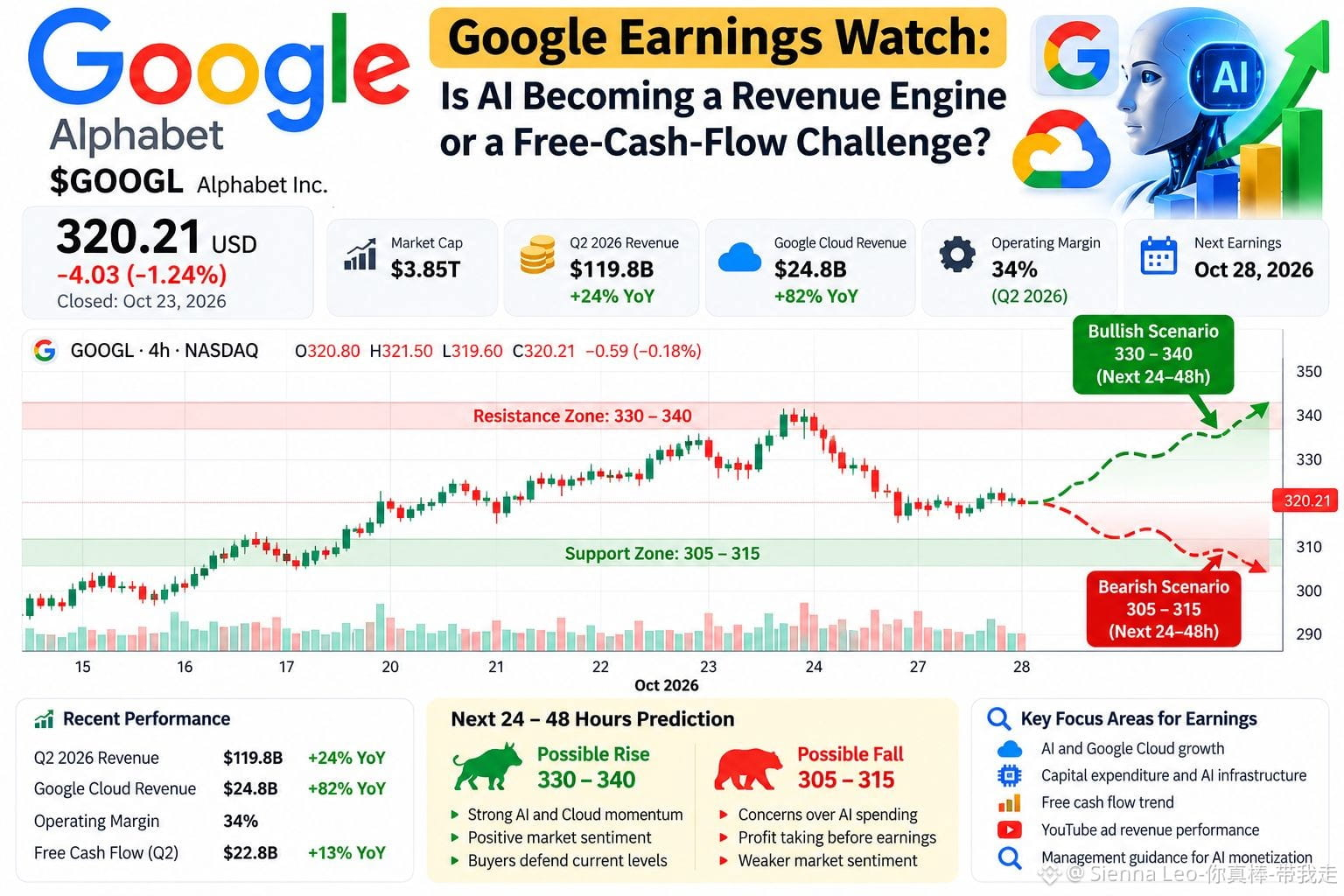
Alphabet ($GOOGL ) faces a crucial test ahead of its October 28 earnings report: can AI growth justify the enormous cost of building the infrastructure behind it?
In Q2 2026, Alphabet generated $119.8 billion in revenue, up 24% year over year. Google Cloud revenue surged 82% to $24.8 billion, while operating margin expanded to 34%.
That is powerful evidence of demand. But revenue growth alone cannot tell the whole story.
AI infrastructure requires expensive data centers, advanced chips, and massive computing capacity. If spending rises faster than cash generation, even impressive growth could disappoint investors.
Stock update: $GOOGL closed at $320.21 on October 23, down 1.24% for the session.
Prediction: Next 24 to 48 hours
My near-term outlook is cautious ahead of earnings.
Bullish scenario: Improving sentiment and optimism about Cloud and AI monetization could support a rebound.
Bearish scenario: Investors may sell further if concerns about AI spending outweigh expectations for future revenue.
These are conditional scenarios, not guaranteed outcomes. With markets closed over the weekend, the next regular session is the key test. No reliable live price is available here to establish confirmed breakout levels.
Active traders may find opportunities in either direction, but earnings volatility can quickly magnify losses.
The real AI winner will not simply spend the most. It will convert computing power into lasting cash flow.
Would you prioritize Google Cloud's explosive growth or its ability to turn AI investment into free cash flow?
For educational purposes only. Not financial advice.
#GoogleStock #ArtificialIntelligence #GrowWithSAC #EarningsSeason $GOOGL
#BinancePick
Google Earnings Watch: Is AI Becoming a Revenue Engine or a Free-Cash-Flow Challenge?
The AI race is no longer just about building smarter machines. It is about turning intelligence into sustainable profit. 🤖💰
Alphabet ($GOOGL ) faces a crucial test ahead of its October 28 earnings report: can AI growth justify the enormous cost of building the infrastructure behind it?
In Q2 2026, Alphabet generated $119.8 billion in revenue, up 24% year over year. Google Cloud revenue surged 82% to $24.8 billion, while operating margin expanded to 34%.
That is powerful evidence of demand. But revenue growth alone cannot tell the whole story.
AI infrastructure requires expensive data centers, advanced chips, and massive computing capacity. If spending rises faster than cash generation, even impressive growth could disappoint investors.
Stock update: $GOOGL closed at $320.21 on October 23, down 1.24% for the session.
Prediction: Next 24 to 48 hours
My near-term outlook is cautious ahead of earnings.
Bullish scenario: Improving sentiment and optimism about Cloud and AI monetization could support a rebound.
Bearish scenario: Investors may sell further if concerns about AI spending outweigh expectations for future revenue.
These are conditional scenarios, not guaranteed outcomes. With markets closed over the weekend, the next regular session is the key test. No reliable live price is available here to establish confirmed breakout levels.
Active traders may find opportunities in either direction, but earnings volatility can quickly magnify losses.
The real AI winner will not simply spend the most. It will convert computing power into lasting cash flow.
Would you prioritize Google Cloud's explosive growth or its ability to turn AI investment into free cash flow?
For educational purposes only. Not financial advice.
#GoogleStock #ArtificialIntelligence #GrowWithSAC #EarningsSeason $GOOGL
Google Earnings Watch: Is AI Becoming a Revenue Engine or a Free-Cash-Flow Challenge?
The AI race is no longer just about building smarter machines. It is about turning intelligence into sustainable profit. 🤖💰
Alphabet ($GOOGL ) faces a crucial test ahead of its October 28 earnings report: can AI growth justify the enormous cost of building the infrastructure behind it?
In Q2 2026, Alphabet generated $119.8 billion in revenue, up 24% year over year. Google Cloud revenue surged 82% to $24.8 billion, while operating margin expanded to 34%.
That is powerful evidence of demand. But revenue growth alone cannot tell the whole story.
AI infrastructure requires expensive data centers, advanced chips, and massive computing capacity. If spending rises faster than cash generation, even impressive growth could disappoint investors.
Stock update: $GOOGL closed at $320.21 on October 23, down 1.24% for the session.
Prediction: Next 24 to 48 hours
My near-term outlook is cautious ahead of earnings.
Bullish scenario: Improving sentiment and optimism about Cloud and AI monetization could support a rebound.
Bearish scenario: Investors may sell further if concerns about AI spending outweigh expectations for future revenue.
These are conditional scenarios, not guaranteed outcomes. With markets closed over the weekend, the next regular session is the key test. No reliable live price is available here to establish confirmed breakout levels.
Active traders may find opportunities in either direction, but earnings volatility can quickly magnify losses.
The real AI winner will not simply spend the most. It will convert computing power into lasting cash flow.
Would you prioritize Google Cloud's explosive growth or its ability to turn AI investment into free cash flow?
For educational purposes only. Not financial advice.
#GoogleStock #ArtificialIntelligence #GrowWithSAC #EarningsSeason $GOOGL
156
·
--
Bullish
#BinancePick
Amazon’s $200 Billion Revenue Question: Can Growth Translate Into Stronger Margins?
Big numbers make headlines, but lasting value is built in the profit hidden behind every dollar. 📈
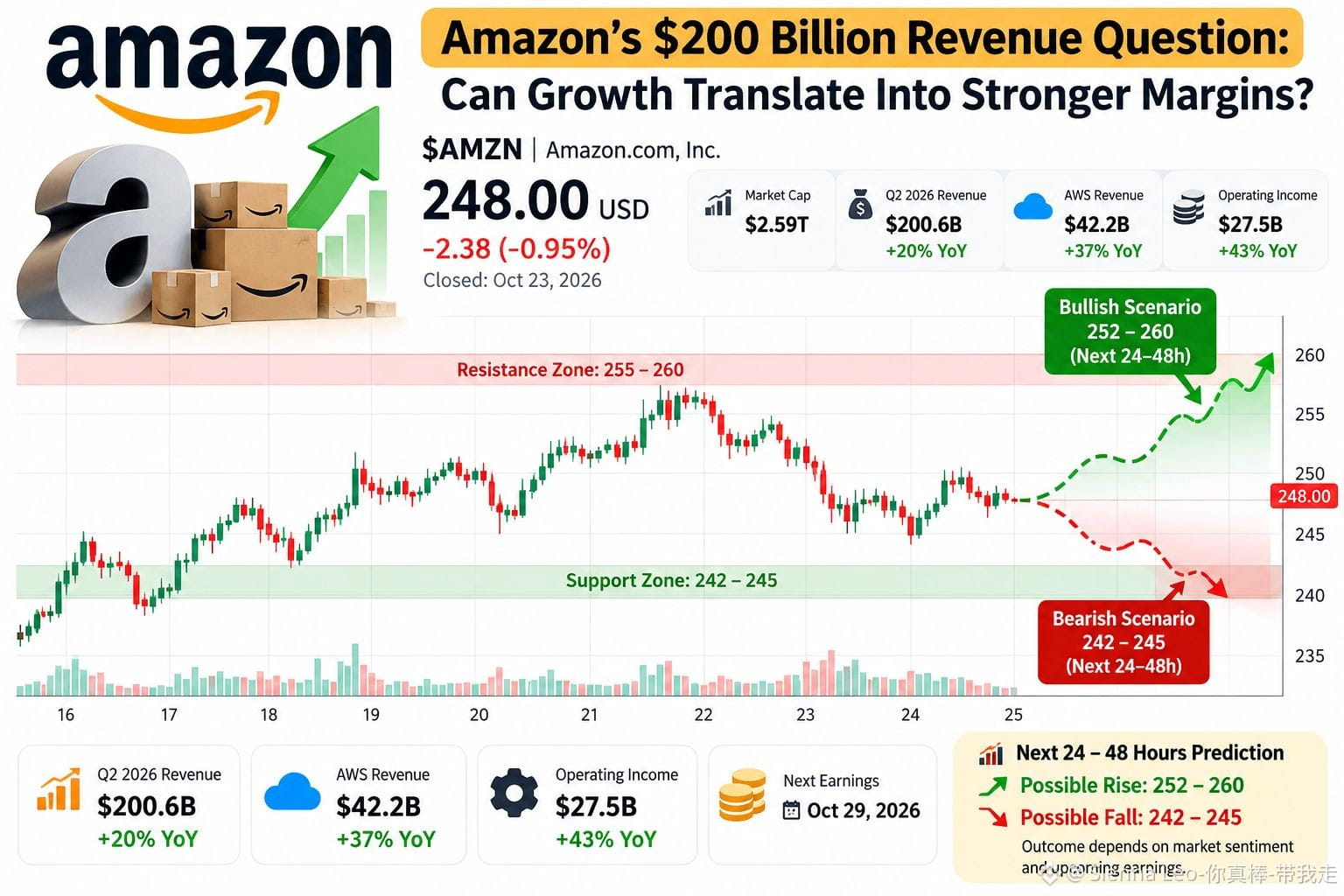
Amazon ($AMZN ) has crossed a remarkable milestone. In Q2 2026, revenue reached $200.6 billion, up 20% year over year, while operating income climbed 43% to $27.5 billion.
The standout? ☁️ AWS is becoming a powerful growth engine.
AWS revenue surged 37% to $42.2 billion, its fastest growth in 18 quarters. That matters because cloud computing and AI infrastructure could support stronger profitability, not just bigger sales.
But there is another side to the story: heavy AI and data-center investment can pressure cash flow before the returns fully arrive.
Stock update: AMZN closed at $248.00 on October 23, 2026, down 0.95% for the session. Its next earnings report is scheduled for October 29, making the coming week particularly important.
Prediction: Next 24 to 48 hours
With markets closed for the weekend, the next session could remain volatile. The bias is cautious to slightly bearish after recent losses, but earnings optimism could trigger a rebound. A sustained recovery needs buyers to defend recent lows; renewed selling could extend weakness.
Investors will watch AWS growth, operating margins, capital spending and free cash flow in the October 29 report.
Traders may find opportunities in either direction, but earnings-related gaps can cause rapid losses. Manage risk rather than chasing momentum.
The real question is not whether Amazon can generate $200 billion in sales. It is whether its AI investments can turn that growth into durable cash flow.
Would you prioritize AWS growth or stronger free cash flow when evaluating Amazon today?
For educational purposes only. Not financial advice.
#AmazonStock #CloudComputing #GrowWithSAC #EarningsSeason $AMZN
#BinancePick
Amazon’s $200 Billion Revenue Question: Can Growth Translate Into Stronger Margins?
Big numbers make headlines, but lasting value is built in the profit hidden behind every dollar. 📈
Amazon ($AMZN ) has crossed a remarkable milestone. In Q2 2026, revenue reached $200.6 billion, up 20% year over year, while operating income climbed 43% to $27.5 billion.
The standout? ☁️ AWS is becoming a powerful growth engine.
AWS revenue surged 37% to $42.2 billion, its fastest growth in 18 quarters. That matters because cloud computing and AI infrastructure could support stronger profitability, not just bigger sales.
But there is another side to the story: heavy AI and data-center investment can pressure cash flow before the returns fully arrive.
Stock update: AMZN closed at $248.00 on October 23, 2026, down 0.95% for the session. Its next earnings report is scheduled for October 29, making the coming week particularly important.
Prediction: Next 24 to 48 hours
With markets closed for the weekend, the next session could remain volatile. The bias is cautious to slightly bearish after recent losses, but earnings optimism could trigger a rebound. A sustained recovery needs buyers to defend recent lows; renewed selling could extend weakness.
Investors will watch AWS growth, operating margins, capital spending and free cash flow in the October 29 report.
Traders may find opportunities in either direction, but earnings-related gaps can cause rapid losses. Manage risk rather than chasing momentum.
The real question is not whether Amazon can generate $200 billion in sales. It is whether its AI investments can turn that growth into durable cash flow.
Would you prioritize AWS growth or stronger free cash flow when evaluating Amazon today?
For educational purposes only. Not financial advice.
#AmazonStock #CloudComputing #GrowWithSAC #EarningsSeason $AMZN
Amazon’s $200 Billion Revenue Question: Can Growth Translate Into Stronger Margins?
Big numbers make headlines, but lasting value is built in the profit hidden behind every dollar. 📈
Amazon ($AMZN ) has crossed a remarkable milestone. In Q2 2026, revenue reached $200.6 billion, up 20% year over year, while operating income climbed 43% to $27.5 billion.
The standout? ☁️ AWS is becoming a powerful growth engine.
AWS revenue surged 37% to $42.2 billion, its fastest growth in 18 quarters. That matters because cloud computing and AI infrastructure could support stronger profitability, not just bigger sales.
But there is another side to the story: heavy AI and data-center investment can pressure cash flow before the returns fully arrive.
Stock update: AMZN closed at $248.00 on October 23, 2026, down 0.95% for the session. Its next earnings report is scheduled for October 29, making the coming week particularly important.
Prediction: Next 24 to 48 hours
With markets closed for the weekend, the next session could remain volatile. The bias is cautious to slightly bearish after recent losses, but earnings optimism could trigger a rebound. A sustained recovery needs buyers to defend recent lows; renewed selling could extend weakness.
Investors will watch AWS growth, operating margins, capital spending and free cash flow in the October 29 report.
Traders may find opportunities in either direction, but earnings-related gaps can cause rapid losses. Manage risk rather than chasing momentum.
The real question is not whether Amazon can generate $200 billion in sales. It is whether its AI investments can turn that growth into durable cash flow.
Would you prioritize AWS growth or stronger free cash flow when evaluating Amazon today?
For educational purposes only. Not financial advice.
#AmazonStock #CloudComputing #GrowWithSAC #EarningsSeason $AMZN
1
229
·
--
Bullish
#BinancePick
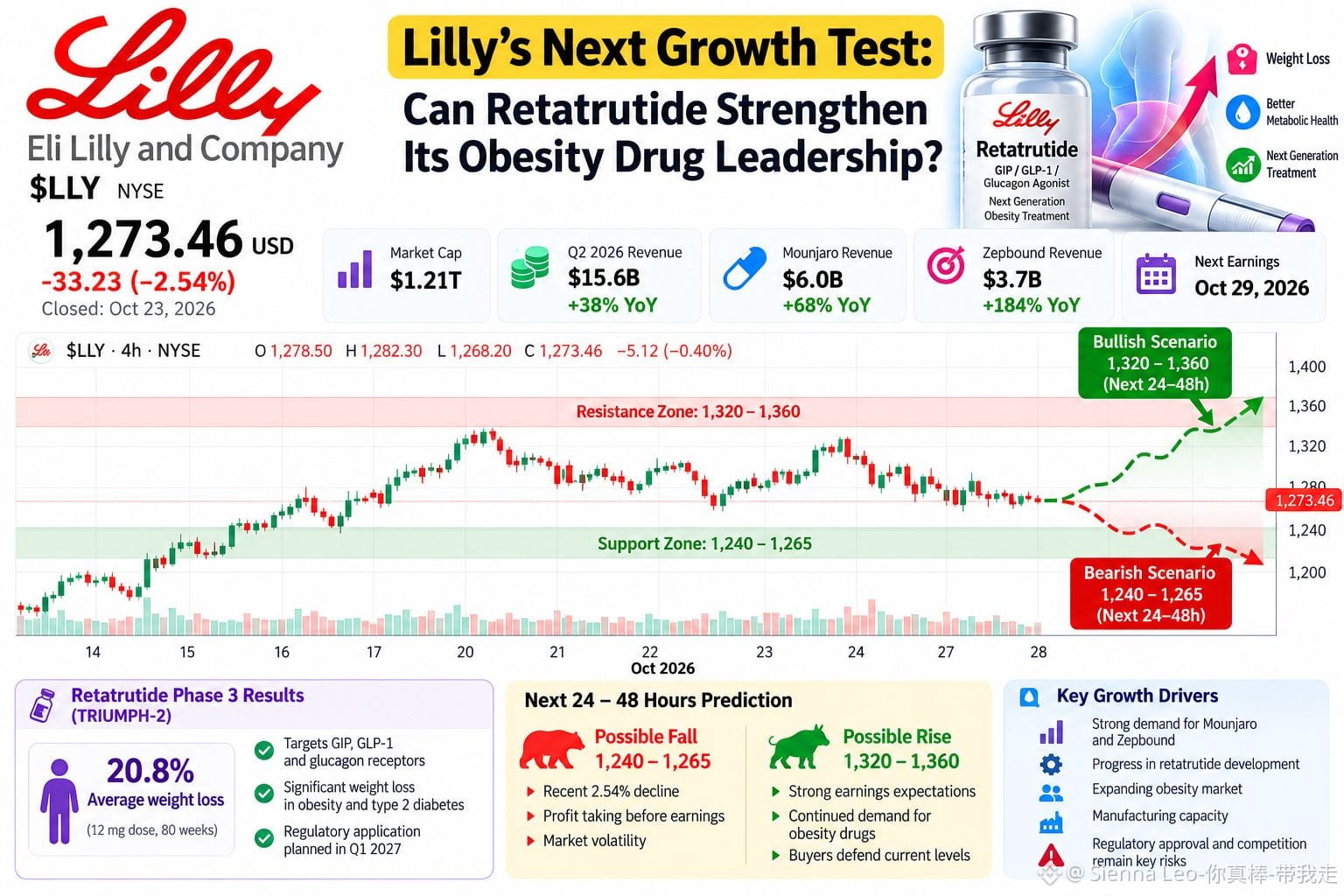
Lilly’s Next Growth Test: Can Retatrutide Strengthen Its Obesity Drug Leadership?
The next breakthrough in obesity treatment may not just change lives. It could reshape the future of pharmaceutical growth. 💊📈
Eli Lilly ($LLY ) is advancing retatrutide, an investigational triple-hormone receptor agonist targeting GIP, GLP-1, and glucagon receptors.
The latest Phase 3 results are turning heads. In the TRIUMPH-2 trial, participants with obesity and type 2 diabetes taking the 12 mg dose lost an average of 20.8% of their body weight over 80 weeks.
That is significant, but the bigger investment question is whether retatrutide can eventually expand Lilly’s market leadership beyond its existing blockbuster medicines.
The opportunity: Lilly has reported positive results across multiple Phase 3 trials and plans to submit a US regulatory application in Q1 2027.
The challenge: Retatrutide remains investigational. Regulatory review, safety, manufacturing capacity, affordability, and competition could all influence its commercial future.
Stock update: $LLY closed at $1,273.46 on October 23, 2026, down 2.54% for the session. Lilly’s Q3 earnings call is scheduled for October 29.
Prediction: Next 24 to 48 hours
My outlook is cautiously neutral to bearish after Friday’s decline. A rebound is possible if buyers return, while continued selling could extend weakness. The upcoming earnings report may influence sentiment, but no short-term direction is guaranteed.
Traders could benefit from a confirmed recovery, while momentum buyers risk losses if selling resumes.
The real test is not how much weight retatrutide can help patients lose, but whether Lilly can turn clinical success into sustainable growth.
Will retatrutide strengthen Lilly’s leadership, or is too much optimism already priced in?
For educational purposes only. Not financial advice.
#EliLilly #Retatrutide #GrowWithSAC #EarningsSeason $LLY
#BinancePick
Lilly’s Next Growth Test: Can Retatrutide Strengthen Its Obesity Drug Leadership?
The next breakthrough in obesity treatment may not just change lives. It could reshape the future of pharmaceutical growth. 💊📈
Eli Lilly ($LLY ) is advancing retatrutide, an investigational triple-hormone receptor agonist targeting GIP, GLP-1, and glucagon receptors.
The latest Phase 3 results are turning heads. In the TRIUMPH-2 trial, participants with obesity and type 2 diabetes taking the 12 mg dose lost an average of 20.8% of their body weight over 80 weeks.
That is significant, but the bigger investment question is whether retatrutide can eventually expand Lilly’s market leadership beyond its existing blockbuster medicines.
The opportunity: Lilly has reported positive results across multiple Phase 3 trials and plans to submit a US regulatory application in Q1 2027.
The challenge: Retatrutide remains investigational. Regulatory review, safety, manufacturing capacity, affordability, and competition could all influence its commercial future.
Stock update: $LLY closed at $1,273.46 on October 23, 2026, down 2.54% for the session. Lilly’s Q3 earnings call is scheduled for October 29.
Prediction: Next 24 to 48 hours
My outlook is cautiously neutral to bearish after Friday’s decline. A rebound is possible if buyers return, while continued selling could extend weakness. The upcoming earnings report may influence sentiment, but no short-term direction is guaranteed.
Traders could benefit from a confirmed recovery, while momentum buyers risk losses if selling resumes.
The real test is not how much weight retatrutide can help patients lose, but whether Lilly can turn clinical success into sustainable growth.
Will retatrutide strengthen Lilly’s leadership, or is too much optimism already priced in?
For educational purposes only. Not financial advice.
#EliLilly #Retatrutide #GrowWithSAC #EarningsSeason $LLY
Lilly’s Next Growth Test: Can Retatrutide Strengthen Its Obesity Drug Leadership?
The next breakthrough in obesity treatment may not just change lives. It could reshape the future of pharmaceutical growth. 💊📈
Eli Lilly ($LLY ) is advancing retatrutide, an investigational triple-hormone receptor agonist targeting GIP, GLP-1, and glucagon receptors.
The latest Phase 3 results are turning heads. In the TRIUMPH-2 trial, participants with obesity and type 2 diabetes taking the 12 mg dose lost an average of 20.8% of their body weight over 80 weeks.
That is significant, but the bigger investment question is whether retatrutide can eventually expand Lilly’s market leadership beyond its existing blockbuster medicines.
The opportunity: Lilly has reported positive results across multiple Phase 3 trials and plans to submit a US regulatory application in Q1 2027.
The challenge: Retatrutide remains investigational. Regulatory review, safety, manufacturing capacity, affordability, and competition could all influence its commercial future.
Stock update: $LLY closed at $1,273.46 on October 23, 2026, down 2.54% for the session. Lilly’s Q3 earnings call is scheduled for October 29.
Prediction: Next 24 to 48 hours
My outlook is cautiously neutral to bearish after Friday’s decline. A rebound is possible if buyers return, while continued selling could extend weakness. The upcoming earnings report may influence sentiment, but no short-term direction is guaranteed.
Traders could benefit from a confirmed recovery, while momentum buyers risk losses if selling resumes.
The real test is not how much weight retatrutide can help patients lose, but whether Lilly can turn clinical success into sustainable growth.
Will retatrutide strengthen Lilly’s leadership, or is too much optimism already priced in?
For educational purposes only. Not financial advice.
#EliLilly #Retatrutide #GrowWithSAC #EarningsSeason $LLY
1
210
·
--
Bullish
Verified
#BinancePick
Visa Q4 2026 Earnings: Could Cross-Border Payments Unlock the Next Growth Signal?
Every border crossed by money tells a story about the strength of global commerce.
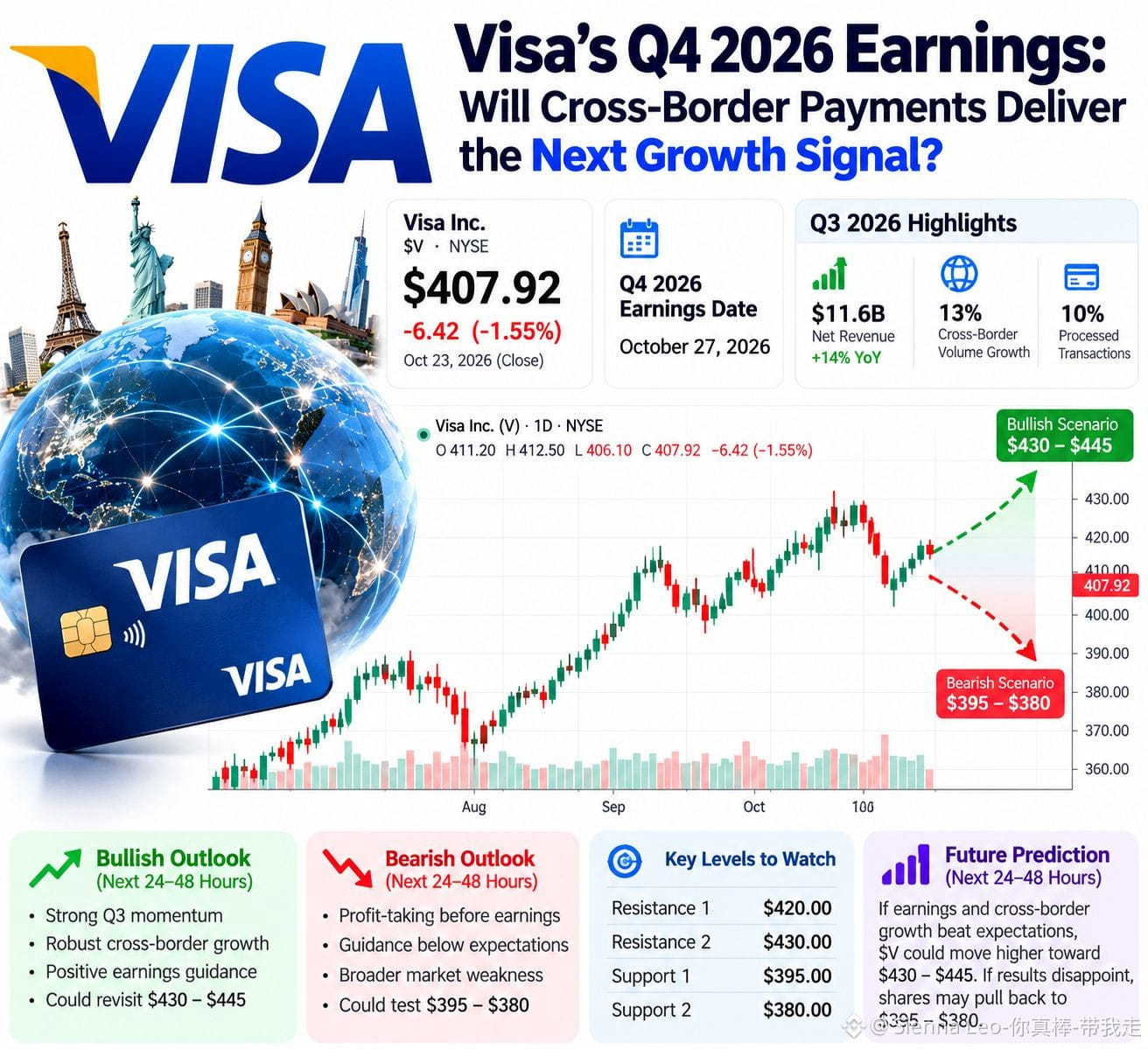
Visa ($V) reports its fiscal Q4 and full-year 2026 results on October 27, making cross-border payment growth a key metric to watch.
The numbers already set a high bar.
In Q3 2026, Visa generated $11.6 billion in net revenue, up 14% year over year. Total cross-border volume grew 13%, while processed transactions increased 10%.
That matters because international travel, overseas shopping, and global business payments can create opportunities for Visa to monetize its vast payment network.
What could the market be overlooking?
Revenue growth alone is not the whole story. Investors need to see whether cross-border momentum remains strong and whether management signals continued growth ahead. Expectations matter just as much as reported results.
24 to 48-hour prediction:
Visa ($V) closed at $407.92 on October 23, 2026, down 1.55% that session.
Ahead of earnings, the stock could rebound if buyers return and optimism builds. However, profit-taking or disappointing guidance could push shares lower.
The actual earnings release arrives October 27, so the next 48 hours are primarily about positioning and expectations, not confirmed results.
Traders may find opportunities in volatility, while late buyers risk losses if expectations prove too optimistic.
The takeaway: Strong growth is encouraging, but sustainable momentum is what earns investor confidence.
Will cross-border payments surprise investors positively, or has the market already priced in the good news?
For educational purposes only. Not financial advice.
#VisaEarnings #CrossBorderPayments #GrowWithSAC #EarningsSeason
$GOOGL $LLY
#BinancePick
Visa Q4 2026 Earnings: Could Cross-Border Payments Unlock the Next Growth Signal?
Every border crossed by money tells a story about the strength of global commerce.
Visa ($V) reports its fiscal Q4 and full-year 2026 results on October 27, making cross-border payment growth a key metric to watch.
The numbers already set a high bar.
In Q3 2026, Visa generated $11.6 billion in net revenue, up 14% year over year. Total cross-border volume grew 13%, while processed transactions increased 10%.
That matters because international travel, overseas shopping, and global business payments can create opportunities for Visa to monetize its vast payment network.
What could the market be overlooking?
Revenue growth alone is not the whole story. Investors need to see whether cross-border momentum remains strong and whether management signals continued growth ahead. Expectations matter just as much as reported results.
24 to 48-hour prediction:
Visa ($V) closed at $407.92 on October 23, 2026, down 1.55% that session.
Ahead of earnings, the stock could rebound if buyers return and optimism builds. However, profit-taking or disappointing guidance could push shares lower.
The actual earnings release arrives October 27, so the next 48 hours are primarily about positioning and expectations, not confirmed results.
Traders may find opportunities in volatility, while late buyers risk losses if expectations prove too optimistic.
The takeaway: Strong growth is encouraging, but sustainable momentum is what earns investor confidence.
Will cross-border payments surprise investors positively, or has the market already priced in the good news?
For educational purposes only. Not financial advice.
#VisaEarnings #CrossBorderPayments #GrowWithSAC #EarningsSeason
$GOOGL $LLY
Visa Q4 2026 Earnings: Could Cross-Border Payments Unlock the Next Growth Signal?
Every border crossed by money tells a story about the strength of global commerce.
Visa ($V) reports its fiscal Q4 and full-year 2026 results on October 27, making cross-border payment growth a key metric to watch.
The numbers already set a high bar.
In Q3 2026, Visa generated $11.6 billion in net revenue, up 14% year over year. Total cross-border volume grew 13%, while processed transactions increased 10%.
That matters because international travel, overseas shopping, and global business payments can create opportunities for Visa to monetize its vast payment network.
What could the market be overlooking?
Revenue growth alone is not the whole story. Investors need to see whether cross-border momentum remains strong and whether management signals continued growth ahead. Expectations matter just as much as reported results.
24 to 48-hour prediction:
Visa ($V) closed at $407.92 on October 23, 2026, down 1.55% that session.
Ahead of earnings, the stock could rebound if buyers return and optimism builds. However, profit-taking or disappointing guidance could push shares lower.
The actual earnings release arrives October 27, so the next 48 hours are primarily about positioning and expectations, not confirmed results.
Traders may find opportunities in volatility, while late buyers risk losses if expectations prove too optimistic.
The takeaway: Strong growth is encouraging, but sustainable momentum is what earns investor confidence.
Will cross-border payments surprise investors positively, or has the market already priced in the good news?
For educational purposes only. Not financial advice.
#VisaEarnings #CrossBorderPayments #GrowWithSAC #EarningsSeason
$GOOGL $LLY
1
2
721
·
--
Bullish
#BinancePick
Microsoft’s AI Boom Meets a Tough Question: Where Is the Next Wave of Growth Coming From?
Every technological revolution reaches a moment when investors stop asking how big it can become and start asking how much it can earn. 🤖
Microsoft is approaching that test.
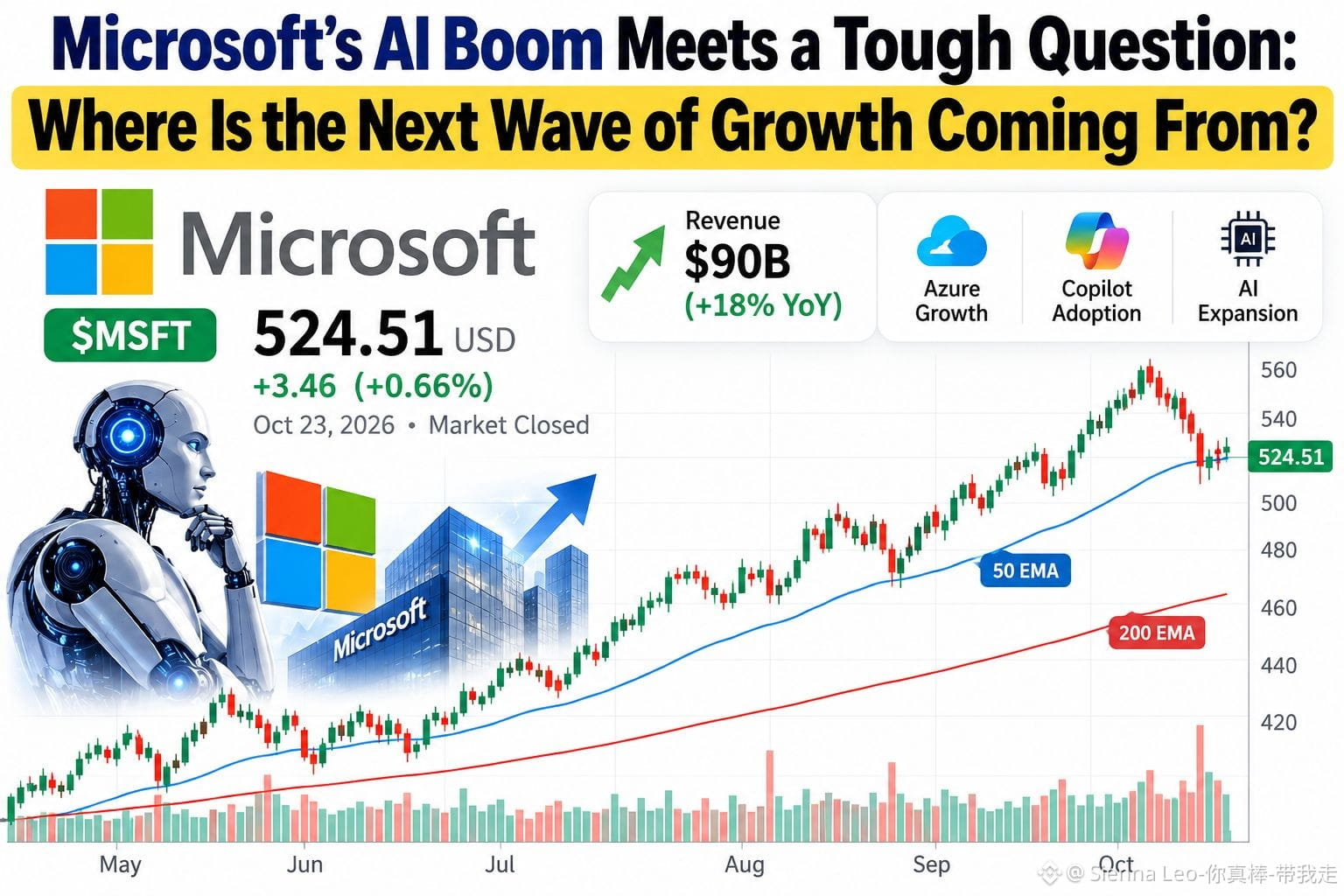
In its latest reported quarter, revenue reached $90 billion, up 18% year over year, while its fiscal 2026 annual revenue climbed to $331.8 billion. AI and cloud are powerful growth engines, but the next challenge is turning massive infrastructure investments into sustainable returns.
Azure expansion, AI-powered Copilot tools, and enterprise adoption could fuel the next chapter. Yet rising computing costs, capacity constraints, and competition mean demand alone is not enough. Profitability matters too.
$MSFT price: $524.51 at the October 23, 2026 market close, up 0.66% that session.
The real catalyst is October 28, when Microsoft is expected to report its next quarterly results. Wall Street will be watching Azure growth, Copilot adoption, and whether AI spending can generate enough returns.
Prediction | Next 24 to 48 hours: My bias is neutral to cautiously bullish, but confidence is limited. A recovery could gain traction if buyers defend recent lows and technology sentiment improves. Continued weakness could pressure the stock further. Earnings uncertainty and heavy AI spending remain key risks.
Traders may find opportunities in a confirmed rebound, while late buyers risk losses if momentum fades. Avoid treating either scenario as certain.
The next AI winner may not be the company spending the most, but the one proving that every dollar invested can create lasting value.
What matters more for Microsoft’s next move: faster Azure growth or stronger returns on AI spending?
For educational purposes only. Not financial advice.
#MicrosoftAI #Azure #GrowWithSAC #EarningsSeason
$MSFT
#BinancePick
Microsoft’s AI Boom Meets a Tough Question: Where Is the Next Wave of Growth Coming From?
Every technological revolution reaches a moment when investors stop asking how big it can become and start asking how much it can earn. 🤖
Microsoft is approaching that test.
In its latest reported quarter, revenue reached $90 billion, up 18% year over year, while its fiscal 2026 annual revenue climbed to $331.8 billion. AI and cloud are powerful growth engines, but the next challenge is turning massive infrastructure investments into sustainable returns.
Azure expansion, AI-powered Copilot tools, and enterprise adoption could fuel the next chapter. Yet rising computing costs, capacity constraints, and competition mean demand alone is not enough. Profitability matters too.
$MSFT price: $524.51 at the October 23, 2026 market close, up 0.66% that session.
The real catalyst is October 28, when Microsoft is expected to report its next quarterly results. Wall Street will be watching Azure growth, Copilot adoption, and whether AI spending can generate enough returns.
Prediction | Next 24 to 48 hours: My bias is neutral to cautiously bullish, but confidence is limited. A recovery could gain traction if buyers defend recent lows and technology sentiment improves. Continued weakness could pressure the stock further. Earnings uncertainty and heavy AI spending remain key risks.
Traders may find opportunities in a confirmed rebound, while late buyers risk losses if momentum fades. Avoid treating either scenario as certain.
The next AI winner may not be the company spending the most, but the one proving that every dollar invested can create lasting value.
What matters more for Microsoft’s next move: faster Azure growth or stronger returns on AI spending?
For educational purposes only. Not financial advice.
#MicrosoftAI #Azure #GrowWithSAC #EarningsSeason
$MSFT
Microsoft’s AI Boom Meets a Tough Question: Where Is the Next Wave of Growth Coming From?
Every technological revolution reaches a moment when investors stop asking how big it can become and start asking how much it can earn. 🤖
Microsoft is approaching that test.
In its latest reported quarter, revenue reached $90 billion, up 18% year over year, while its fiscal 2026 annual revenue climbed to $331.8 billion. AI and cloud are powerful growth engines, but the next challenge is turning massive infrastructure investments into sustainable returns.
Azure expansion, AI-powered Copilot tools, and enterprise adoption could fuel the next chapter. Yet rising computing costs, capacity constraints, and competition mean demand alone is not enough. Profitability matters too.
$MSFT price: $524.51 at the October 23, 2026 market close, up 0.66% that session.
The real catalyst is October 28, when Microsoft is expected to report its next quarterly results. Wall Street will be watching Azure growth, Copilot adoption, and whether AI spending can generate enough returns.
Prediction | Next 24 to 48 hours: My bias is neutral to cautiously bullish, but confidence is limited. A recovery could gain traction if buyers defend recent lows and technology sentiment improves. Continued weakness could pressure the stock further. Earnings uncertainty and heavy AI spending remain key risks.
Traders may find opportunities in a confirmed rebound, while late buyers risk losses if momentum fades. Avoid treating either scenario as certain.
The next AI winner may not be the company spending the most, but the one proving that every dollar invested can create lasting value.
What matters more for Microsoft’s next move: faster Azure growth or stronger returns on AI spending?
For educational purposes only. Not financial advice.
#MicrosoftAI #Azure #GrowWithSAC #EarningsSeason
$MSFT
268
#UKAlgorithmicCryptoTradingAppsMayNeedFCAAuthorization
🤖🇬🇧 UK Algorithmic Crypto Trading Apps May Need FCA Authorization 🇬🇧🤖
Imagine opening a crypto trading app, setting a few rules, and letting software buy and sell while you sleep. The convenience feels effortless, until regulation asks a critical question: who is responsible when an automated system makes decisions with your money?
The UK is moving toward a more comprehensive crypto regulatory framework. The Financial Conduct Authority (FCA) opened applications for crypto firms seeking authorization on September 30, 2026, ahead of the new regime taking effect on October 25, 2027.
Under the framework, activities such as operating crypto trading platforms, dealing in cryptoassets, and arranging transactions may require authorization. Algorithmic trading apps could therefore fall within scope depending on the services they provide and how their business operates.
The important distinction is that automation itself does not automatically make every app subject to identical requirements. The actual activity, business model, and applicable regulatory rules matter.
For users, stronger oversight could improve accountability, consumer protection, and operational standards. For developers, however, authorization may bring additional compliance costs, documentation, and operational responsibilities.
Smaller providers could face difficult choices: invest in compliance, change their services, or reconsider operating in the UK. Established firms may be better equipped to absorb those costs, although regulation alone does not guarantee a safer product.
My take: Crypto automation is becoming more than a coding challenge. Sustainable platforms will need to demonstrate not only that their algorithms work, but also that their businesses operate within the rules.
Will FCA authorization make algorithmic crypto trading safer, or could compliance costs reduce competition?
Disclaimer: Educational content only, not financial advice.
#CryptoRegulation #AlgorithmicTrading #GrowWithSAC $MUB $CUDIS $SLF
#UKAlgorithmicCryptoTradingAppsMayNeedFCAAuthorization
🤖🇬🇧 UK Algorithmic Crypto Trading Apps May Need FCA Authorization 🇬🇧🤖
Imagine opening a crypto trading app, setting a few rules, and letting software buy and sell while you sleep. The convenience feels effortless, until regulation asks a critical question: who is responsible when an automated system makes decisions with your money?
The UK is moving toward a more comprehensive crypto regulatory framework. The Financial Conduct Authority (FCA) opened applications for crypto firms seeking authorization on September 30, 2026, ahead of the new regime taking effect on October 25, 2027.
Under the framework, activities such as operating crypto trading platforms, dealing in cryptoassets, and arranging transactions may require authorization. Algorithmic trading apps could therefore fall within scope depending on the services they provide and how their business operates.
The important distinction is that automation itself does not automatically make every app subject to identical requirements. The actual activity, business model, and applicable regulatory rules matter.
For users, stronger oversight could improve accountability, consumer protection, and operational standards. For developers, however, authorization may bring additional compliance costs, documentation, and operational responsibilities.
Smaller providers could face difficult choices: invest in compliance, change their services, or reconsider operating in the UK. Established firms may be better equipped to absorb those costs, although regulation alone does not guarantee a safer product.
My take: Crypto automation is becoming more than a coding challenge. Sustainable platforms will need to demonstrate not only that their algorithms work, but also that their businesses operate within the rules.
Will FCA authorization make algorithmic crypto trading safer, or could compliance costs reduce competition?
Disclaimer: Educational content only, not financial advice.
#CryptoRegulation #AlgorithmicTrading #GrowWithSAC $MUB $CUDIS $SLF
🤖🇬🇧 UK Algorithmic Crypto Trading Apps May Need FCA Authorization 🇬🇧🤖
Imagine opening a crypto trading app, setting a few rules, and letting software buy and sell while you sleep. The convenience feels effortless, until regulation asks a critical question: who is responsible when an automated system makes decisions with your money?
The UK is moving toward a more comprehensive crypto regulatory framework. The Financial Conduct Authority (FCA) opened applications for crypto firms seeking authorization on September 30, 2026, ahead of the new regime taking effect on October 25, 2027.
Under the framework, activities such as operating crypto trading platforms, dealing in cryptoassets, and arranging transactions may require authorization. Algorithmic trading apps could therefore fall within scope depending on the services they provide and how their business operates.
The important distinction is that automation itself does not automatically make every app subject to identical requirements. The actual activity, business model, and applicable regulatory rules matter.
For users, stronger oversight could improve accountability, consumer protection, and operational standards. For developers, however, authorization may bring additional compliance costs, documentation, and operational responsibilities.
Smaller providers could face difficult choices: invest in compliance, change their services, or reconsider operating in the UK. Established firms may be better equipped to absorb those costs, although regulation alone does not guarantee a safer product.
My take: Crypto automation is becoming more than a coding challenge. Sustainable platforms will need to demonstrate not only that their algorithms work, but also that their businesses operate within the rules.
Will FCA authorization make algorithmic crypto trading safer, or could compliance costs reduce competition?
Disclaimer: Educational content only, not financial advice.
#CryptoRegulation #AlgorithmicTrading #GrowWithSAC $MUB $CUDIS $SLF

1
1
352
·
--
Bearish
#dowdrops653points
📉🇺🇸 Dow Drops 653 Points: What Spooked Wall Street? 🇺🇸📉
The trading day was almost over when investors faced a familiar dilemma: hold through uncertainty or reduce risk before the next shock arrives. By the closing bell, the Dow had lost more than 650 points, reminding markets how quickly confidence can shift.
On Friday, October 23, the Dow Jones Industrial Average fell 652.82 points, or 1.23%, to 52,215.16. The S&P 500 dropped 0.52%, while the Nasdaq slipped 0.21%.
One major pressure point was oil. Brent crude climbed above $116 per barrel amid renewed Middle East tensions, reviving concerns that higher energy costs could keep inflation elevated.
Rising Treasury yields added another challenge. When borrowing costs increase, companies face more expensive financing, and investors become more cautious about valuations, especially when future growth depends on heavy spending.
American Express also weighed on sentiment, falling after announcing plans to cut around 3,500 jobs. Meanwhile, questions about the cost and profitability of artificial intelligence infrastructure continued to unsettle investors.
My take: This sell-off reflects more than one bad trading session. Oil-driven inflation fears, financing costs, and uncertainty over AI investment are colliding at a time when markets are preparing for a Federal Reserve decision and major technology earnings.
For crypto traders, the connection is liquidity and risk appetite. If yields and geopolitical concerns keep pressure on financial markets, Bitcoin could face headwinds, although stock-market declines do not guarantee crypto losses.
One red day is a warning to examine risk, not proof that a larger crash is inevitable.
Will falling stock prices deepen next week, or can earnings and the Fed restore confidence?
Disclaimer: Educational content only, not financial advice.
#DowJones #StockMarket #GrowWithSAC $BIRB $IRYS $ORDER
#DowDrops653Points
#dowdrops653points
📉🇺🇸 Dow Drops 653 Points: What Spooked Wall Street? 🇺🇸📉
The trading day was almost over when investors faced a familiar dilemma: hold through uncertainty or reduce risk before the next shock arrives. By the closing bell, the Dow had lost more than 650 points, reminding markets how quickly confidence can shift.
On Friday, October 23, the Dow Jones Industrial Average fell 652.82 points, or 1.23%, to 52,215.16. The S&P 500 dropped 0.52%, while the Nasdaq slipped 0.21%.
One major pressure point was oil. Brent crude climbed above $116 per barrel amid renewed Middle East tensions, reviving concerns that higher energy costs could keep inflation elevated.
Rising Treasury yields added another challenge. When borrowing costs increase, companies face more expensive financing, and investors become more cautious about valuations, especially when future growth depends on heavy spending.
American Express also weighed on sentiment, falling after announcing plans to cut around 3,500 jobs. Meanwhile, questions about the cost and profitability of artificial intelligence infrastructure continued to unsettle investors.
My take: This sell-off reflects more than one bad trading session. Oil-driven inflation fears, financing costs, and uncertainty over AI investment are colliding at a time when markets are preparing for a Federal Reserve decision and major technology earnings.
For crypto traders, the connection is liquidity and risk appetite. If yields and geopolitical concerns keep pressure on financial markets, Bitcoin could face headwinds, although stock-market declines do not guarantee crypto losses.
One red day is a warning to examine risk, not proof that a larger crash is inevitable.
Will falling stock prices deepen next week, or can earnings and the Fed restore confidence?
Disclaimer: Educational content only, not financial advice.
#DowJones #StockMarket #GrowWithSAC $BIRB $IRYS $ORDER
#DowDrops653Points
📉🇺🇸 Dow Drops 653 Points: What Spooked Wall Street? 🇺🇸📉
The trading day was almost over when investors faced a familiar dilemma: hold through uncertainty or reduce risk before the next shock arrives. By the closing bell, the Dow had lost more than 650 points, reminding markets how quickly confidence can shift.
On Friday, October 23, the Dow Jones Industrial Average fell 652.82 points, or 1.23%, to 52,215.16. The S&P 500 dropped 0.52%, while the Nasdaq slipped 0.21%.
One major pressure point was oil. Brent crude climbed above $116 per barrel amid renewed Middle East tensions, reviving concerns that higher energy costs could keep inflation elevated.
Rising Treasury yields added another challenge. When borrowing costs increase, companies face more expensive financing, and investors become more cautious about valuations, especially when future growth depends on heavy spending.
American Express also weighed on sentiment, falling after announcing plans to cut around 3,500 jobs. Meanwhile, questions about the cost and profitability of artificial intelligence infrastructure continued to unsettle investors.
My take: This sell-off reflects more than one bad trading session. Oil-driven inflation fears, financing costs, and uncertainty over AI investment are colliding at a time when markets are preparing for a Federal Reserve decision and major technology earnings.
For crypto traders, the connection is liquidity and risk appetite. If yields and geopolitical concerns keep pressure on financial markets, Bitcoin could face headwinds, although stock-market declines do not guarantee crypto losses.
One red day is a warning to examine risk, not proof that a larger crash is inevitable.
Will falling stock prices deepen next week, or can earnings and the Fed restore confidence?
Disclaimer: Educational content only, not financial advice.
#DowJones #StockMarket #GrowWithSAC $BIRB $IRYS $ORDER
#DowDrops653Points

2
9
5.7k
#marketspricejust10%chanceoffedhikenextweek
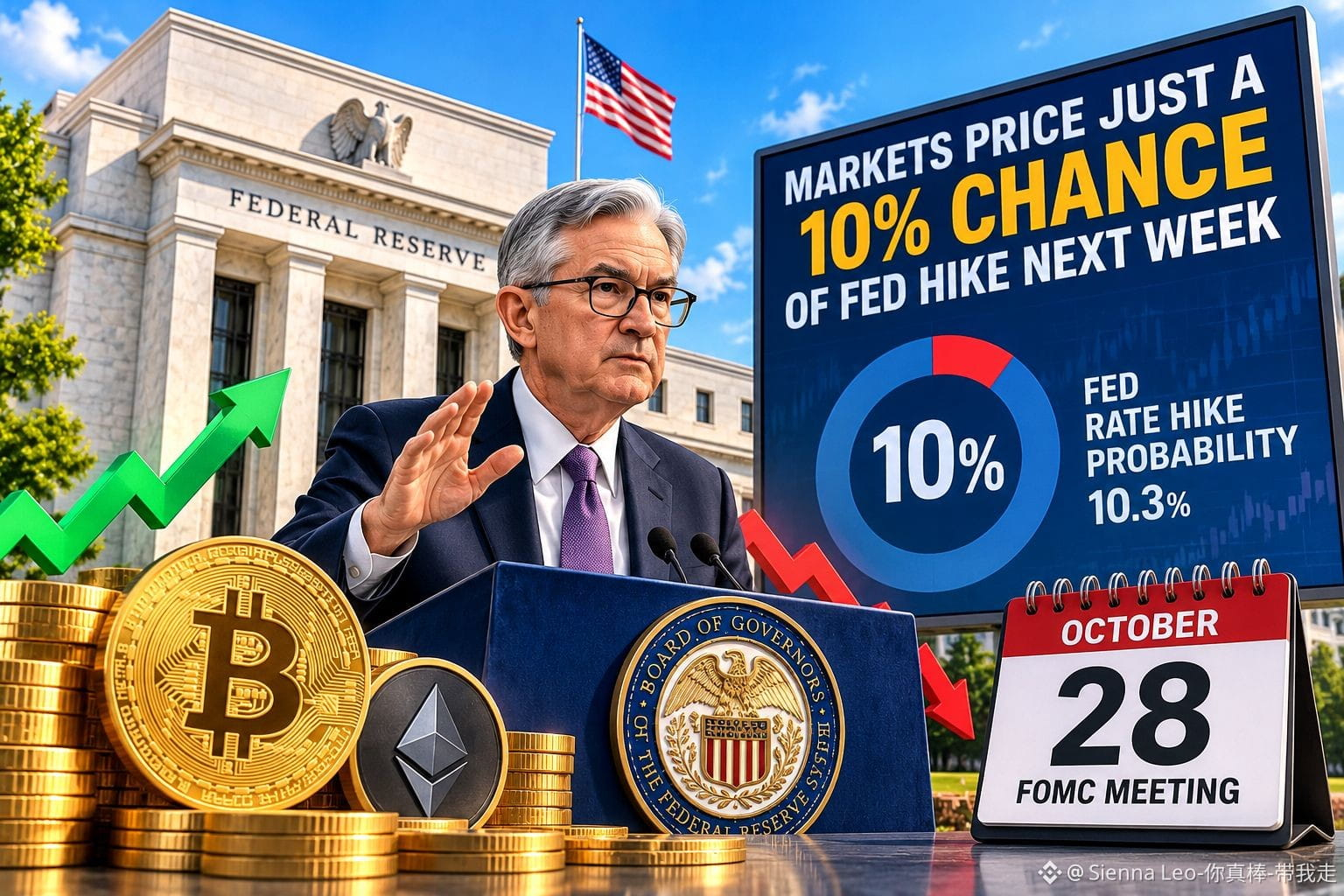
🏦📉 Markets Price Just a 10% Chance of a Fed Rate Hike Next Week 📉🏦
Imagine preparing for a storm, watching the clouds gather, then realizing most traders expect only a light shower. That is the tension in markets ahead of the Federal Reserve’s next policy decision: a rate hike remains possible, but investors see it as an unlikely outcome.
Current market pricing puts the probability of a 25-basis-point rate hike at approximately 10.3% for the October 28 meeting. That leaves the odds heavily tilted toward the Fed holding rates steady.
But low probability does not mean zero risk. Inflation pressures, economic resilience, and unexpected developments could still change policymakers’ calculations before the announcement.
Here is the important distinction: markets price expectations, not guarantees. When traders largely agree on one outcome, the bigger market reaction can come from the Fed’s language, its inflation assessment, and clues about future decisions.
What does this mean for crypto? A steady rate decision could offer temporary relief to risk assets, but it does not automatically make Bitcoin bullish. If the Fed signals that rates may stay elevated for longer, financial conditions could remain restrictive.
Traders should watch Treasury yields, the US dollar, and Bitcoin’s reaction to the announcement rather than treating the probability figure as a trading signal.
The real opportunity is not predicting the expected decision. It is understanding what markets have already priced in, and what could surprise them.
Will the Fed hold rates steady, and could its guidance matter more than the decision itself?
Disclaimer: For educational purposes only. Not financial advice.
#FederalReserve #Bitcoin #GrowWithSAC $UP $FORTH $PROMPT
#MarketsPriceJust10%ChanceOfFedHikeNextWeek
#marketspricejust10%chanceoffedhikenextweek
🏦📉 Markets Price Just a 10% Chance of a Fed Rate Hike Next Week 📉🏦
Imagine preparing for a storm, watching the clouds gather, then realizing most traders expect only a light shower. That is the tension in markets ahead of the Federal Reserve’s next policy decision: a rate hike remains possible, but investors see it as an unlikely outcome.
Current market pricing puts the probability of a 25-basis-point rate hike at approximately 10.3% for the October 28 meeting. That leaves the odds heavily tilted toward the Fed holding rates steady.
But low probability does not mean zero risk. Inflation pressures, economic resilience, and unexpected developments could still change policymakers’ calculations before the announcement.
Here is the important distinction: markets price expectations, not guarantees. When traders largely agree on one outcome, the bigger market reaction can come from the Fed’s language, its inflation assessment, and clues about future decisions.
What does this mean for crypto? A steady rate decision could offer temporary relief to risk assets, but it does not automatically make Bitcoin bullish. If the Fed signals that rates may stay elevated for longer, financial conditions could remain restrictive.
Traders should watch Treasury yields, the US dollar, and Bitcoin’s reaction to the announcement rather than treating the probability figure as a trading signal.
The real opportunity is not predicting the expected decision. It is understanding what markets have already priced in, and what could surprise them.
Will the Fed hold rates steady, and could its guidance matter more than the decision itself?
Disclaimer: For educational purposes only. Not financial advice.
#FederalReserve #Bitcoin #GrowWithSAC $UP $FORTH $PROMPT
#MarketsPriceJust10%ChanceOfFedHikeNextWeek
🏦📉 Markets Price Just a 10% Chance of a Fed Rate Hike Next Week 📉🏦
Imagine preparing for a storm, watching the clouds gather, then realizing most traders expect only a light shower. That is the tension in markets ahead of the Federal Reserve’s next policy decision: a rate hike remains possible, but investors see it as an unlikely outcome.
Current market pricing puts the probability of a 25-basis-point rate hike at approximately 10.3% for the October 28 meeting. That leaves the odds heavily tilted toward the Fed holding rates steady.
But low probability does not mean zero risk. Inflation pressures, economic resilience, and unexpected developments could still change policymakers’ calculations before the announcement.
Here is the important distinction: markets price expectations, not guarantees. When traders largely agree on one outcome, the bigger market reaction can come from the Fed’s language, its inflation assessment, and clues about future decisions.
What does this mean for crypto? A steady rate decision could offer temporary relief to risk assets, but it does not automatically make Bitcoin bullish. If the Fed signals that rates may stay elevated for longer, financial conditions could remain restrictive.
Traders should watch Treasury yields, the US dollar, and Bitcoin’s reaction to the announcement rather than treating the probability figure as a trading signal.
The real opportunity is not predicting the expected decision. It is understanding what markets have already priced in, and what could surprise them.
Will the Fed hold rates steady, and could its guidance matter more than the decision itself?
Disclaimer: For educational purposes only. Not financial advice.
#FederalReserve #Bitcoin #GrowWithSAC $UP $FORTH $PROMPT
#MarketsPriceJust10%ChanceOfFedHikeNextWeek
1
2
2.6k
#occremovesstablecoinsevendayredemptionextension
🏦💵 OCC Removes Seven-Day Stablecoin Redemption Extension 💵🏦
Imagine holding a digital dollar that promises stability, only to discover that getting your money back may depend on more than a button marked “Redeem.” In stablecoins, confidence is built not just on the dollar peg, but on how reliably holders can access their funds.
The Office of the Comptroller of the Currency (OCC) is the US banking regulator at the center of this headline. Any change to stablecoin redemption rules matters because it can affect how issuers manage liquidity, meet customer requests, and maintain trust during periods of market stress.
Under the OCC's final rule, the standard redemption deadline remains two business days. The regulator removed the automatic seven-day extension that had been proposed for situations where redemption requests exceed 10% of a stablecoin's outstanding issuance within 24 hours.
Instead, issuers must notify the OCC within 24 hours after crossing that threshold. They may request additional time, but the regulator decides whether an extension is justified. The final rule is scheduled to take effect on January 18, 2027.
My take: Removing an automatic delay could help prevent fear from spreading during a redemption surge. If holders believe everyone will face a week-long wait, anxiety itself can intensify the rush to exit.
💧 This does not eliminate liquidity risk. Stablecoin confidence still depends on adequate reserves, reliable redemption operations, and transparent disclosures. Regulatory oversight can strengthen the framework, but it cannot guarantee that every redemption will be effortless.
For crypto users, the important distinction is simple: a stablecoin's dollar peg is only part of its value. The ability to redeem it reliably matters just as much.
Will this change strengthen confidence in US-regulated stablecoins, or will reserve transparency matter more than redemption deadlines?
#CryptoRegulation #GrowWithSAC $BMT $TREE #OCCRemovesStablecoinSevenDayRedemptionExtension
#occremovesstablecoinsevendayredemptionextension
🏦💵 OCC Removes Seven-Day Stablecoin Redemption Extension 💵🏦
Imagine holding a digital dollar that promises stability, only to discover that getting your money back may depend on more than a button marked “Redeem.” In stablecoins, confidence is built not just on the dollar peg, but on how reliably holders can access their funds.
The Office of the Comptroller of the Currency (OCC) is the US banking regulator at the center of this headline. Any change to stablecoin redemption rules matters because it can affect how issuers manage liquidity, meet customer requests, and maintain trust during periods of market stress.
Under the OCC's final rule, the standard redemption deadline remains two business days. The regulator removed the automatic seven-day extension that had been proposed for situations where redemption requests exceed 10% of a stablecoin's outstanding issuance within 24 hours.
Instead, issuers must notify the OCC within 24 hours after crossing that threshold. They may request additional time, but the regulator decides whether an extension is justified. The final rule is scheduled to take effect on January 18, 2027.
My take: Removing an automatic delay could help prevent fear from spreading during a redemption surge. If holders believe everyone will face a week-long wait, anxiety itself can intensify the rush to exit.
💧 This does not eliminate liquidity risk. Stablecoin confidence still depends on adequate reserves, reliable redemption operations, and transparent disclosures. Regulatory oversight can strengthen the framework, but it cannot guarantee that every redemption will be effortless.
For crypto users, the important distinction is simple: a stablecoin's dollar peg is only part of its value. The ability to redeem it reliably matters just as much.
Will this change strengthen confidence in US-regulated stablecoins, or will reserve transparency matter more than redemption deadlines?
#CryptoRegulation #GrowWithSAC $BMT $TREE #OCCRemovesStablecoinSevenDayRedemptionExtension
🏦💵 OCC Removes Seven-Day Stablecoin Redemption Extension 💵🏦
Imagine holding a digital dollar that promises stability, only to discover that getting your money back may depend on more than a button marked “Redeem.” In stablecoins, confidence is built not just on the dollar peg, but on how reliably holders can access their funds.
The Office of the Comptroller of the Currency (OCC) is the US banking regulator at the center of this headline. Any change to stablecoin redemption rules matters because it can affect how issuers manage liquidity, meet customer requests, and maintain trust during periods of market stress.
Under the OCC's final rule, the standard redemption deadline remains two business days. The regulator removed the automatic seven-day extension that had been proposed for situations where redemption requests exceed 10% of a stablecoin's outstanding issuance within 24 hours.
Instead, issuers must notify the OCC within 24 hours after crossing that threshold. They may request additional time, but the regulator decides whether an extension is justified. The final rule is scheduled to take effect on January 18, 2027.
My take: Removing an automatic delay could help prevent fear from spreading during a redemption surge. If holders believe everyone will face a week-long wait, anxiety itself can intensify the rush to exit.
💧 This does not eliminate liquidity risk. Stablecoin confidence still depends on adequate reserves, reliable redemption operations, and transparent disclosures. Regulatory oversight can strengthen the framework, but it cannot guarantee that every redemption will be effortless.
For crypto users, the important distinction is simple: a stablecoin's dollar peg is only part of its value. The ability to redeem it reliably matters just as much.
Will this change strengthen confidence in US-regulated stablecoins, or will reserve transparency matter more than redemption deadlines?
#CryptoRegulation #GrowWithSAC $BMT $TREE #OCCRemovesStablecoinSevenDayRedemptionExtension
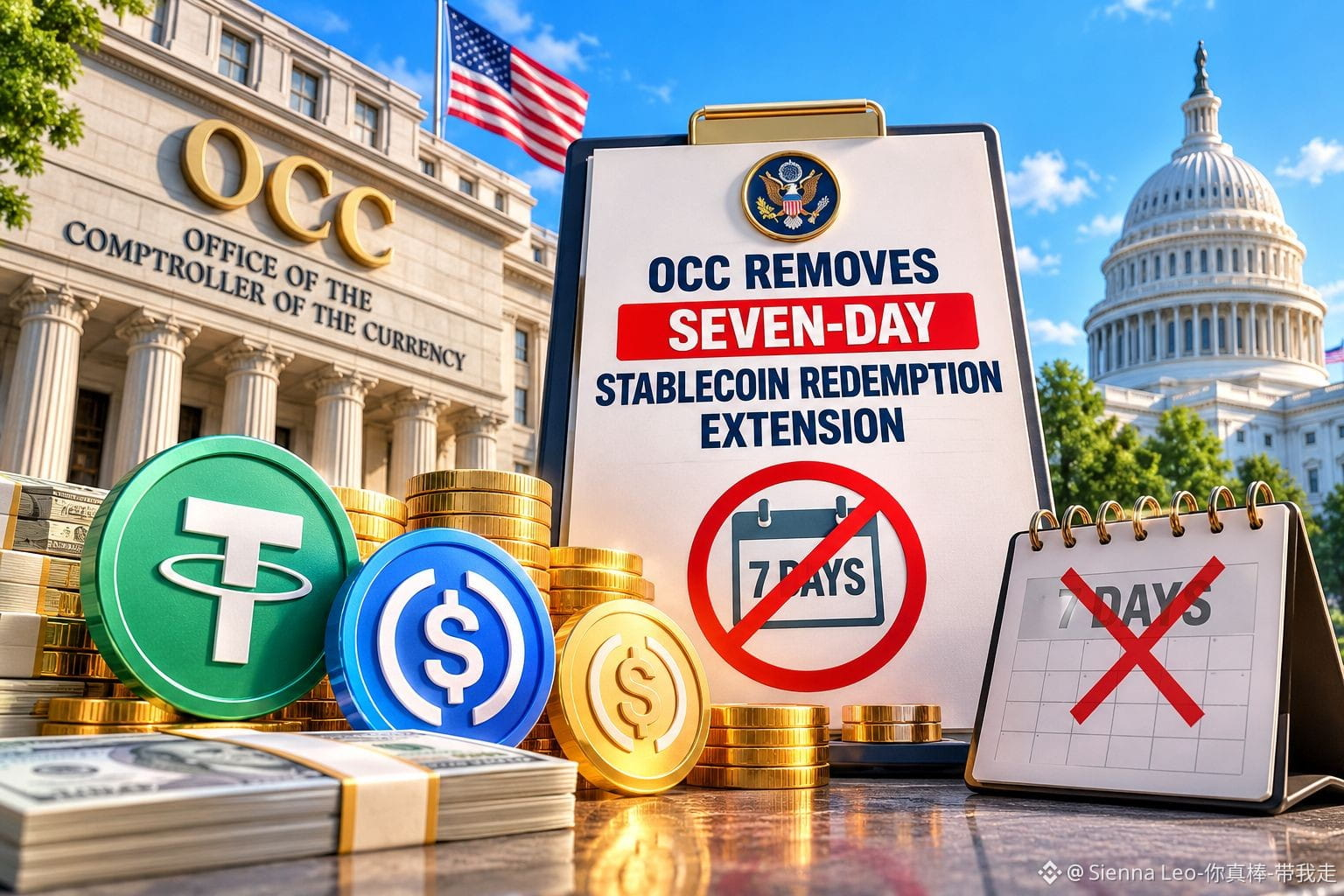
1
2.7k
Verified
#usconsumersentimentholdsatsecondlowestonrecord
🛒🇺🇸 US Consumer Sentiment Holds at Second-Lowest Level on Record 🇺🇸🛒
Imagine walking into a supermarket with the same paycheck, only to discover that your usual shopping basket costs more. You put a few items back, postpone a purchase, and start worrying about next month. For millions of households, this pressure is shaping how they see the American economy.
The University of Michigan’s October consumer sentiment index settled at 48.0, barely changing from September’s 48.1. It remains the second-lowest reading on record, following the historic low of 44.8 in May.
The deeper problem is purchasing power. Persistent price pressures linked to the Middle East conflict are squeezing household budgets, while higher borrowing costs make expensive purchases harder to justify.
One detail deserves attention: the current economic conditions index dropped to 46.7, while the expectations index improved to 48.8. Americans appear slightly more hopeful about the future, even as their assessment of present conditions deteriorates.
Why does this matter for markets? Weak consumer confidence can signal cautious spending, potentially affecting retailers, corporate earnings, and expectations for economic growth. Rising inflation expectations also complicate the Federal Reserve’s efforts to bring inflation toward its 2% target.
For crypto investors, the connection is indirect but important. If economic weakness changes expectations for interest rates and liquidity, Bitcoin and other risk assets could react. However, sentiment alone cannot predict the Fed’s next move or determine crypto prices.
The real signal is not simply pessimism. It is the growing gap between what households earn and what they can afford.
Will weakening consumer confidence eventually push the Fed toward rate cuts, or will persistent inflation keep monetary policy restrictive?
#ConsumerConfidence #USInflation #GrowWithSAC $IRYS $ORDER $BIRB
#USConsumerSentimentHoldsAtSecondLowestOnRecord
#usconsumersentimentholdsatsecondlowestonrecord
🛒🇺🇸 US Consumer Sentiment Holds at Second-Lowest Level on Record 🇺🇸🛒
Imagine walking into a supermarket with the same paycheck, only to discover that your usual shopping basket costs more. You put a few items back, postpone a purchase, and start worrying about next month. For millions of households, this pressure is shaping how they see the American economy.
The University of Michigan’s October consumer sentiment index settled at 48.0, barely changing from September’s 48.1. It remains the second-lowest reading on record, following the historic low of 44.8 in May.
The deeper problem is purchasing power. Persistent price pressures linked to the Middle East conflict are squeezing household budgets, while higher borrowing costs make expensive purchases harder to justify.
One detail deserves attention: the current economic conditions index dropped to 46.7, while the expectations index improved to 48.8. Americans appear slightly more hopeful about the future, even as their assessment of present conditions deteriorates.
Why does this matter for markets? Weak consumer confidence can signal cautious spending, potentially affecting retailers, corporate earnings, and expectations for economic growth. Rising inflation expectations also complicate the Federal Reserve’s efforts to bring inflation toward its 2% target.
For crypto investors, the connection is indirect but important. If economic weakness changes expectations for interest rates and liquidity, Bitcoin and other risk assets could react. However, sentiment alone cannot predict the Fed’s next move or determine crypto prices.
The real signal is not simply pessimism. It is the growing gap between what households earn and what they can afford.
Will weakening consumer confidence eventually push the Fed toward rate cuts, or will persistent inflation keep monetary policy restrictive?
#ConsumerConfidence #USInflation #GrowWithSAC $IRYS $ORDER $BIRB
#USConsumerSentimentHoldsAtSecondLowestOnRecord
🛒🇺🇸 US Consumer Sentiment Holds at Second-Lowest Level on Record 🇺🇸🛒
Imagine walking into a supermarket with the same paycheck, only to discover that your usual shopping basket costs more. You put a few items back, postpone a purchase, and start worrying about next month. For millions of households, this pressure is shaping how they see the American economy.
The University of Michigan’s October consumer sentiment index settled at 48.0, barely changing from September’s 48.1. It remains the second-lowest reading on record, following the historic low of 44.8 in May.
The deeper problem is purchasing power. Persistent price pressures linked to the Middle East conflict are squeezing household budgets, while higher borrowing costs make expensive purchases harder to justify.
One detail deserves attention: the current economic conditions index dropped to 46.7, while the expectations index improved to 48.8. Americans appear slightly more hopeful about the future, even as their assessment of present conditions deteriorates.
Why does this matter for markets? Weak consumer confidence can signal cautious spending, potentially affecting retailers, corporate earnings, and expectations for economic growth. Rising inflation expectations also complicate the Federal Reserve’s efforts to bring inflation toward its 2% target.
For crypto investors, the connection is indirect but important. If economic weakness changes expectations for interest rates and liquidity, Bitcoin and other risk assets could react. However, sentiment alone cannot predict the Fed’s next move or determine crypto prices.
The real signal is not simply pessimism. It is the growing gap between what households earn and what they can afford.
Will weakening consumer confidence eventually push the Fed toward rate cuts, or will persistent inflation keep monetary policy restrictive?
#ConsumerConfidence #USInflation #GrowWithSAC $IRYS $ORDER $BIRB
#USConsumerSentimentHoldsAtSecondLowestOnRecord

1.8k
Verified
#FranklinTempletonAdds$150MFundSharesToXRPLedger
🏦 Franklin Templeton Adds $150M in Fund Shares to $XRP Ledger 🏦
Imagine a traditional investment fund moving millions of dollars onto a blockchain. No viral campaign, no dramatic price spike, just financial infrastructure quietly changing how assets are recorded and transferred.
Franklin Templeton has added approximately $150 million worth of tokenized money market fund shares to the XRP Ledger (XRPL), bringing its total holdings on the network to around $200 million based on reported transaction values.
These tokens represent shares in a fund investing in short-term dollar-denominated debt and money market instruments. They are not XRP tokens, and the fund's growth does not automatically mean investors are buying XRP.
One detail deserves attention: the newly recorded shares went into a single wallet. It remains unclear whether that wallet represents one investor or multiple clients, so the transaction should not be mistaken for proof of broad new retail demand.
The bigger development is the expanding use of blockchain to manage traditional financial assets. Tokenization can make ownership records and transfers more programmable, but adoption still depends on regulation, custody arrangements, investor access, and trust.
What does this mean for XRP? More financial activity on XRPL could strengthen its role as infrastructure for tokenized assets. However, the relationship between network adoption and XRP's market price is not automatic. The fund shares themselves are distinct from XRP, and this transaction alone does not establish a direct price catalyst.
The real milestone is not simply the dollar amount. It is whether institutions continue bringing real financial products onto blockchain networks.
Will tokenized funds become one of the strongest long-term use cases for the XRP Ledger?
Disclaimer: This article is for educational purposes only and is not financial advice.
#XRP #Tokenization #GrowWithSAC $NCT.US $TRADOOR
#FranklinTempletonAdds$150MFundSharesToXRPLedger
🏦 Franklin Templeton Adds $150M in Fund Shares to $XRP Ledger 🏦
Imagine a traditional investment fund moving millions of dollars onto a blockchain. No viral campaign, no dramatic price spike, just financial infrastructure quietly changing how assets are recorded and transferred.
Franklin Templeton has added approximately $150 million worth of tokenized money market fund shares to the XRP Ledger (XRPL), bringing its total holdings on the network to around $200 million based on reported transaction values.
These tokens represent shares in a fund investing in short-term dollar-denominated debt and money market instruments. They are not XRP tokens, and the fund's growth does not automatically mean investors are buying XRP.
One detail deserves attention: the newly recorded shares went into a single wallet. It remains unclear whether that wallet represents one investor or multiple clients, so the transaction should not be mistaken for proof of broad new retail demand.
The bigger development is the expanding use of blockchain to manage traditional financial assets. Tokenization can make ownership records and transfers more programmable, but adoption still depends on regulation, custody arrangements, investor access, and trust.
What does this mean for XRP? More financial activity on XRPL could strengthen its role as infrastructure for tokenized assets. However, the relationship between network adoption and XRP's market price is not automatic. The fund shares themselves are distinct from XRP, and this transaction alone does not establish a direct price catalyst.
The real milestone is not simply the dollar amount. It is whether institutions continue bringing real financial products onto blockchain networks.
Will tokenized funds become one of the strongest long-term use cases for the XRP Ledger?
Disclaimer: This article is for educational purposes only and is not financial advice.
#XRP #Tokenization #GrowWithSAC $NCT.US $TRADOOR
🏦 Franklin Templeton Adds $150M in Fund Shares to $XRP Ledger 🏦
Imagine a traditional investment fund moving millions of dollars onto a blockchain. No viral campaign, no dramatic price spike, just financial infrastructure quietly changing how assets are recorded and transferred.
Franklin Templeton has added approximately $150 million worth of tokenized money market fund shares to the XRP Ledger (XRPL), bringing its total holdings on the network to around $200 million based on reported transaction values.
These tokens represent shares in a fund investing in short-term dollar-denominated debt and money market instruments. They are not XRP tokens, and the fund's growth does not automatically mean investors are buying XRP.
One detail deserves attention: the newly recorded shares went into a single wallet. It remains unclear whether that wallet represents one investor or multiple clients, so the transaction should not be mistaken for proof of broad new retail demand.
The bigger development is the expanding use of blockchain to manage traditional financial assets. Tokenization can make ownership records and transfers more programmable, but adoption still depends on regulation, custody arrangements, investor access, and trust.
What does this mean for XRP? More financial activity on XRPL could strengthen its role as infrastructure for tokenized assets. However, the relationship between network adoption and XRP's market price is not automatic. The fund shares themselves are distinct from XRP, and this transaction alone does not establish a direct price catalyst.
The real milestone is not simply the dollar amount. It is whether institutions continue bringing real financial products onto blockchain networks.
Will tokenized funds become one of the strongest long-term use cases for the XRP Ledger?
Disclaimer: This article is for educational purposes only and is not financial advice.
#XRP #Tokenization #GrowWithSAC $NCT.US $TRADOOR

205
#irsplanslowertaxdisclosurepenaltiesforcryptocases
🧾 IRS Plans Lower Tax Disclosure Penalties for Crypto Cases 🧾
Imagine discovering that an old crypto trade was never properly reported. What follows may feel more frightening than the trade itself: paperwork, penalties, and uncertainty about what happens next.
The US Internal Revenue Service is preparing changes to its voluntary disclosure program that could make coming forward less costly for taxpayers with previously unreported income, including crypto-related cases.
The plan reportedly aims to reduce penalties and speed up case resolution, potentially targeting 120 days after taxpayers complete the required submission process. The IRS has not yet announced the exact penalty reductions, and the revised program is expected before December.
The bigger story is not simply lower penalties. It is the possibility of making voluntary compliance more practical. When people see a clearer path to correcting past mistakes, they may be more willing to address them rather than leave unresolved tax issues hanging over them.
Crypto reporting is also becoming harder to overlook. US brokers are now entering a phased reporting system using Form 1099-DA, increasing the importance of accurate transaction records and cost-basis calculations.
One crucial distinction: the existing voluntary disclosure program is primarily intended for taxpayers facing potential criminal exposure for willful violations. It is not a blanket amnesty, and ordinary filing errors may require a different correction process.
For crypto investors, the sensible move is to organize transaction histories, calculate gains and losses, and consult a qualified US tax professional before choosing a disclosure route.
Clearer rules can reduce uncertainty, but accurate reporting remains the strongest protection.
Would lower disclosure penalties encourage more crypto investors to correct past tax mistakes?
#CryptoTax #CryptoRegulation #GrowWithSAC $LA $LAYER $RECALL
#IRSPlansLowerTaxDisclosurePenaltiesForCryptoCases
#irsplanslowertaxdisclosurepenaltiesforcryptocases
🧾 IRS Plans Lower Tax Disclosure Penalties for Crypto Cases 🧾
Imagine discovering that an old crypto trade was never properly reported. What follows may feel more frightening than the trade itself: paperwork, penalties, and uncertainty about what happens next.
The US Internal Revenue Service is preparing changes to its voluntary disclosure program that could make coming forward less costly for taxpayers with previously unreported income, including crypto-related cases.
The plan reportedly aims to reduce penalties and speed up case resolution, potentially targeting 120 days after taxpayers complete the required submission process. The IRS has not yet announced the exact penalty reductions, and the revised program is expected before December.
The bigger story is not simply lower penalties. It is the possibility of making voluntary compliance more practical. When people see a clearer path to correcting past mistakes, they may be more willing to address them rather than leave unresolved tax issues hanging over them.
Crypto reporting is also becoming harder to overlook. US brokers are now entering a phased reporting system using Form 1099-DA, increasing the importance of accurate transaction records and cost-basis calculations.
One crucial distinction: the existing voluntary disclosure program is primarily intended for taxpayers facing potential criminal exposure for willful violations. It is not a blanket amnesty, and ordinary filing errors may require a different correction process.
For crypto investors, the sensible move is to organize transaction histories, calculate gains and losses, and consult a qualified US tax professional before choosing a disclosure route.
Clearer rules can reduce uncertainty, but accurate reporting remains the strongest protection.
Would lower disclosure penalties encourage more crypto investors to correct past tax mistakes?
#CryptoTax #CryptoRegulation #GrowWithSAC $LA $LAYER $RECALL
#IRSPlansLowerTaxDisclosurePenaltiesForCryptoCases
🧾 IRS Plans Lower Tax Disclosure Penalties for Crypto Cases 🧾
Imagine discovering that an old crypto trade was never properly reported. What follows may feel more frightening than the trade itself: paperwork, penalties, and uncertainty about what happens next.
The US Internal Revenue Service is preparing changes to its voluntary disclosure program that could make coming forward less costly for taxpayers with previously unreported income, including crypto-related cases.
The plan reportedly aims to reduce penalties and speed up case resolution, potentially targeting 120 days after taxpayers complete the required submission process. The IRS has not yet announced the exact penalty reductions, and the revised program is expected before December.
The bigger story is not simply lower penalties. It is the possibility of making voluntary compliance more practical. When people see a clearer path to correcting past mistakes, they may be more willing to address them rather than leave unresolved tax issues hanging over them.
Crypto reporting is also becoming harder to overlook. US brokers are now entering a phased reporting system using Form 1099-DA, increasing the importance of accurate transaction records and cost-basis calculations.
One crucial distinction: the existing voluntary disclosure program is primarily intended for taxpayers facing potential criminal exposure for willful violations. It is not a blanket amnesty, and ordinary filing errors may require a different correction process.
For crypto investors, the sensible move is to organize transaction histories, calculate gains and losses, and consult a qualified US tax professional before choosing a disclosure route.
Clearer rules can reduce uncertainty, but accurate reporting remains the strongest protection.
Would lower disclosure penalties encourage more crypto investors to correct past tax mistakes?
#CryptoTax #CryptoRegulation #GrowWithSAC $LA $LAYER $RECALL
#IRSPlansLowerTaxDisclosurePenaltiesForCryptoCases

652
#pepejumps14%toleadaltcoinrebound
🐸 $PEPE Jumps 14% to Lead the Altcoin Rebound: Is PEPE Back in the Spotlight? 🐸
The market has been quiet, traders have grown cautious, and suddenly one familiar meme coin starts moving sharply upward. Within hours, attention shifts from fear to opportunity, and PEPE is back on traders' screens.
Pepe (PEPE) has reportedly surged 14%, leading an altcoin rebound. But a sharp green candle raises a bigger question: is fresh buying entering the market, or are traders simply chasing momentum?
Meme coins often react faster to changes in sentiment than assets supported by established utility or cash flows. Strong community attention, speculative positioning, short covering, and renewed risk appetite can all amplify a move. However, without verified volume and market-wide data, the exact driver remains uncertain.
The important distinction is between a price spike and a sustainable recovery. If PEPE's rally is supported by rising spot volume and strength across other altcoins, it could signal broader appetite for risk. If the move quickly fades, it may reflect short-lived speculation instead.
Traders should also remember that a 14% rally can reverse just as quickly. Chasing a fast-moving candle without a clear risk-management plan can turn excitement into losses.
My take: PEPE's real test is not how quickly it rises, but whether buyers remain active after the initial excitement fades. Watch trading volume, Bitcoin's direction, and whether the wider altcoin market confirms the rebound.
In crypto, momentum attracts attention, but follow-through determines whether the move deserves confidence.
Is PEPE leading the start of a wider altcoin recovery, or is this just another short-lived meme coin rally?
Disclaimer: This post is for educational purposes only and is not financial advice.
#PEPE #Altcoins #GrowWithSAC $NCT.US $LAYER
#PepeJumps14%ToLeadAltcoinRebound
#pepejumps14%toleadaltcoinrebound
🐸 $PEPE Jumps 14% to Lead the Altcoin Rebound: Is PEPE Back in the Spotlight? 🐸
The market has been quiet, traders have grown cautious, and suddenly one familiar meme coin starts moving sharply upward. Within hours, attention shifts from fear to opportunity, and PEPE is back on traders' screens.
Pepe (PEPE) has reportedly surged 14%, leading an altcoin rebound. But a sharp green candle raises a bigger question: is fresh buying entering the market, or are traders simply chasing momentum?
Meme coins often react faster to changes in sentiment than assets supported by established utility or cash flows. Strong community attention, speculative positioning, short covering, and renewed risk appetite can all amplify a move. However, without verified volume and market-wide data, the exact driver remains uncertain.
The important distinction is between a price spike and a sustainable recovery. If PEPE's rally is supported by rising spot volume and strength across other altcoins, it could signal broader appetite for risk. If the move quickly fades, it may reflect short-lived speculation instead.
Traders should also remember that a 14% rally can reverse just as quickly. Chasing a fast-moving candle without a clear risk-management plan can turn excitement into losses.
My take: PEPE's real test is not how quickly it rises, but whether buyers remain active after the initial excitement fades. Watch trading volume, Bitcoin's direction, and whether the wider altcoin market confirms the rebound.
In crypto, momentum attracts attention, but follow-through determines whether the move deserves confidence.
Is PEPE leading the start of a wider altcoin recovery, or is this just another short-lived meme coin rally?
Disclaimer: This post is for educational purposes only and is not financial advice.
#PEPE #Altcoins #GrowWithSAC $NCT.US $LAYER
#PepeJumps14%ToLeadAltcoinRebound
🐸 $PEPE Jumps 14% to Lead the Altcoin Rebound: Is PEPE Back in the Spotlight? 🐸
The market has been quiet, traders have grown cautious, and suddenly one familiar meme coin starts moving sharply upward. Within hours, attention shifts from fear to opportunity, and PEPE is back on traders' screens.
Pepe (PEPE) has reportedly surged 14%, leading an altcoin rebound. But a sharp green candle raises a bigger question: is fresh buying entering the market, or are traders simply chasing momentum?
Meme coins often react faster to changes in sentiment than assets supported by established utility or cash flows. Strong community attention, speculative positioning, short covering, and renewed risk appetite can all amplify a move. However, without verified volume and market-wide data, the exact driver remains uncertain.
The important distinction is between a price spike and a sustainable recovery. If PEPE's rally is supported by rising spot volume and strength across other altcoins, it could signal broader appetite for risk. If the move quickly fades, it may reflect short-lived speculation instead.
Traders should also remember that a 14% rally can reverse just as quickly. Chasing a fast-moving candle without a clear risk-management plan can turn excitement into losses.
My take: PEPE's real test is not how quickly it rises, but whether buyers remain active after the initial excitement fades. Watch trading volume, Bitcoin's direction, and whether the wider altcoin market confirms the rebound.
In crypto, momentum attracts attention, but follow-through determines whether the move deserves confidence.
Is PEPE leading the start of a wider altcoin recovery, or is this just another short-lived meme coin rally?
Disclaimer: This post is for educational purposes only and is not financial advice.
#PEPE #Altcoins #GrowWithSAC $NCT.US $LAYER
#PepeJumps14%ToLeadAltcoinRebound

4
3.6k
#swedishcentralbankurgesekronareview
💳 Swedish Central Bank Urges E-Krona Review: Is Digital Money Becoming a National Security Issue? 💳
Imagine reaching a Swedish shop during a major power outage. Your phone payment fails, card terminals stop working, and suddenly a simple purchase becomes a serious problem. That is when the question of who controls a country's digital money becomes much more than a technology debate.
Sweden's central bank, the Riksbank, is urging parliament to revisit the possibility of introducing an e-krona, a digital form of the country's national currency. The renewed discussion reflects changes in digital payments, stablecoins, and plans for a potential digital euro in Europe.
Sweden already relies heavily on electronic payments, while cash use has fallen sharply. The concern is that if private payment platforms or foreign digital currencies become increasingly dominant, Sweden could face new challenges in maintaining control over its monetary system.
There is also a resilience argument. A well-designed public digital payment option could potentially strengthen payment-system preparedness during serious disruptions, although its actual usefulness would depend on how it works offline and under emergency conditions.
But an e-krona would not be a simple switch. Privacy, cybersecurity, financial stability, public trust, and the risk of shifting deposits away from commercial banks would all need careful consideration. A digital currency can improve access while creating new responsibilities for its issuer.
My take: Sweden's debate is not about replacing cash with another app. It is about ensuring that public money remains relevant as payments become increasingly digital. The challenge is building a system that people can trust without creating unnecessary risks.
The future of money will depend not only on how quickly we pay, but on how reliably we can pay when systems fail.
#CBDC #DigitalEuro #GrowWithSAC $IRYS $BIRB $NCT.US
#SwedishCentralBankUrgesEKronaReview
#swedishcentralbankurgesekronareview
💳 Swedish Central Bank Urges E-Krona Review: Is Digital Money Becoming a National Security Issue? 💳
Imagine reaching a Swedish shop during a major power outage. Your phone payment fails, card terminals stop working, and suddenly a simple purchase becomes a serious problem. That is when the question of who controls a country's digital money becomes much more than a technology debate.
Sweden's central bank, the Riksbank, is urging parliament to revisit the possibility of introducing an e-krona, a digital form of the country's national currency. The renewed discussion reflects changes in digital payments, stablecoins, and plans for a potential digital euro in Europe.
Sweden already relies heavily on electronic payments, while cash use has fallen sharply. The concern is that if private payment platforms or foreign digital currencies become increasingly dominant, Sweden could face new challenges in maintaining control over its monetary system.
There is also a resilience argument. A well-designed public digital payment option could potentially strengthen payment-system preparedness during serious disruptions, although its actual usefulness would depend on how it works offline and under emergency conditions.
But an e-krona would not be a simple switch. Privacy, cybersecurity, financial stability, public trust, and the risk of shifting deposits away from commercial banks would all need careful consideration. A digital currency can improve access while creating new responsibilities for its issuer.
My take: Sweden's debate is not about replacing cash with another app. It is about ensuring that public money remains relevant as payments become increasingly digital. The challenge is building a system that people can trust without creating unnecessary risks.
The future of money will depend not only on how quickly we pay, but on how reliably we can pay when systems fail.
#CBDC #DigitalEuro #GrowWithSAC $IRYS $BIRB $NCT.US
#SwedishCentralBankUrgesEKronaReview
💳 Swedish Central Bank Urges E-Krona Review: Is Digital Money Becoming a National Security Issue? 💳
Imagine reaching a Swedish shop during a major power outage. Your phone payment fails, card terminals stop working, and suddenly a simple purchase becomes a serious problem. That is when the question of who controls a country's digital money becomes much more than a technology debate.
Sweden's central bank, the Riksbank, is urging parliament to revisit the possibility of introducing an e-krona, a digital form of the country's national currency. The renewed discussion reflects changes in digital payments, stablecoins, and plans for a potential digital euro in Europe.
Sweden already relies heavily on electronic payments, while cash use has fallen sharply. The concern is that if private payment platforms or foreign digital currencies become increasingly dominant, Sweden could face new challenges in maintaining control over its monetary system.
There is also a resilience argument. A well-designed public digital payment option could potentially strengthen payment-system preparedness during serious disruptions, although its actual usefulness would depend on how it works offline and under emergency conditions.
But an e-krona would not be a simple switch. Privacy, cybersecurity, financial stability, public trust, and the risk of shifting deposits away from commercial banks would all need careful consideration. A digital currency can improve access while creating new responsibilities for its issuer.
My take: Sweden's debate is not about replacing cash with another app. It is about ensuring that public money remains relevant as payments become increasingly digital. The challenge is building a system that people can trust without creating unnecessary risks.
The future of money will depend not only on how quickly we pay, but on how reliably we can pay when systems fail.
#CBDC #DigitalEuro #GrowWithSAC $IRYS $BIRB $NCT.US
#SwedishCentralBankUrgesEKronaReview

1
395
Log in to explore more content
Join global crypto users on Binance Square
⚡️ Get latest and useful information about crypto.
💬 Trusted by the world’s largest crypto exchange.
👍 Discover real insights from verified creators.
Email / Phone number