
#cryptosecurit
cryptosecurit
1,089 views
34 Discussing
Hot
Latest

Article
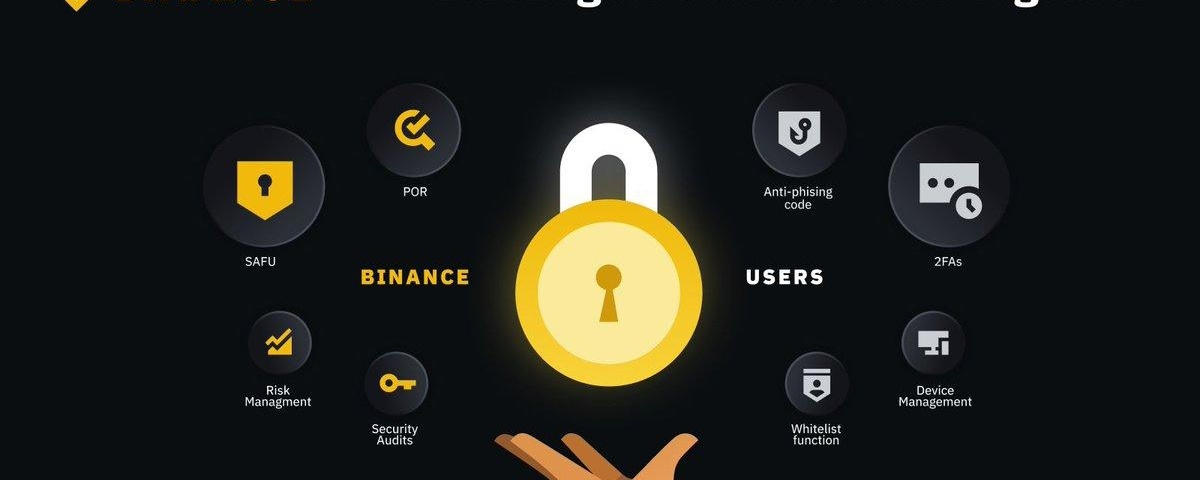
BREAKING NEWSBinance Security Update: Protecting Users and Rebuilding Trust
Security Is More Important Than Ever in Crypto
In the cryptocurrency world, protecting your assets is not optional. Recent security developments at Binance have reminded the entire crypto community that even major exchanges must continuously strengthen their security systems.
On October 30, 2026, Binance disclosed a serious security incident involving unauthorized withdrawals and an estimated impact of approximately $6.3 billion. The exchange stated that it would cover the financial losses using its SAFU fund and company funds. The investigation is ongoing.
Latest Binance Security Developments
According to Binance's official updates:
- Asset replenishment: Binance reported that approximately 90% of affected assets had been replenished by October 31.
- Reserve transparency: Binance published a Proof of Reserves snapshot to help users verify asset backing.
- User protection: Binance stated that BTC, ETH, USDT, BNB, SOL, USDC, XRP, USD1, RLUSD, and ZEC were fully backed at 100%.
- Withdrawal recovery: Withdrawals are being restored in phases following additional security checks.
- Investigation: Binance is continuing to investigate the incident and strengthen its security infrastructure.
These steps are important, but rebuilding trust requires continued transparency, independent verification, and stronger protection against future attacks.
5 Ways to Protect Your Crypto
You don't need to be a professional trader to improve your security. Start with these essential habits:
1. Enable two-factor authentication (2FA). Use an authenticator app or security key whenever possible.
2. Activate anti-phishing protection. Verify that emails and messages genuinely come from Binance.
3. Never share verification codes. Real support staff should never ask for your password or 2FA codes.
4. Check withdrawal addresses carefully. Verify the network and address before sending crypto.
5. Beware of fake links and giveaways. Avoid suspicious links, unofficial apps, and promises of guaranteed profits.
Final Thoughts
The latest security incident is a reminder that crypto security is a shared responsibility. Exchanges must protect their infrastructure and user assets, while individuals must secure their accounts and remain alert to scams.
Stay informed. Verify everything. Protect your crypto.
What do you think is the most important security feature every crypto exchange should provide?
#CryptoSecurit #SAFU #ProofOfReserves #CryptoNews #Blockchain
BREAKING NEWS
Binance Security Update: Protecting Users and Rebuilding Trust
Security Is More Important Than Ever in Crypto
In the cryptocurrency world, protecting your assets is not optional. Recent security developments at Binance have reminded the entire crypto community that even major exchanges must continuously strengthen their security systems.
On October 30, 2026, Binance disclosed a serious security incident involving unauthorized withdrawals and an estimated impact of approximately $6.3 billion. The exchange stated that it would cover the financial losses using its SAFU fund and company funds. The investigation is ongoing.
Latest Binance Security Developments
According to Binance's official updates:
- Asset replenishment: Binance reported that approximately 90% of affected assets had been replenished by October 31.
- Reserve transparency: Binance published a Proof of Reserves snapshot to help users verify asset backing.
- User protection: Binance stated that BTC, ETH, USDT, BNB, SOL, USDC, XRP, USD1, RLUSD, and ZEC were fully backed at 100%.
- Withdrawal recovery: Withdrawals are being restored in phases following additional security checks.
- Investigation: Binance is continuing to investigate the incident and strengthen its security infrastructure.
These steps are important, but rebuilding trust requires continued transparency, independent verification, and stronger protection against future attacks.
5 Ways to Protect Your Crypto
You don't need to be a professional trader to improve your security. Start with these essential habits:
1. Enable two-factor authentication (2FA). Use an authenticator app or security key whenever possible.
2. Activate anti-phishing protection. Verify that emails and messages genuinely come from Binance.
3. Never share verification codes. Real support staff should never ask for your password or 2FA codes.
4. Check withdrawal addresses carefully. Verify the network and address before sending crypto.
5. Beware of fake links and giveaways. Avoid suspicious links, unofficial apps, and promises of guaranteed profits.
Final Thoughts
The latest security incident is a reminder that crypto security is a shared responsibility. Exchanges must protect their infrastructure and user assets, while individuals must secure their accounts and remain alert to scams.
Stay informed. Verify everything. Protect your crypto.
What do you think is the most important security feature every crypto exchange should provide?
#CryptoSecurit #SAFU #ProofOfReserves #CryptoNews #Blockchain
2
118

·
--
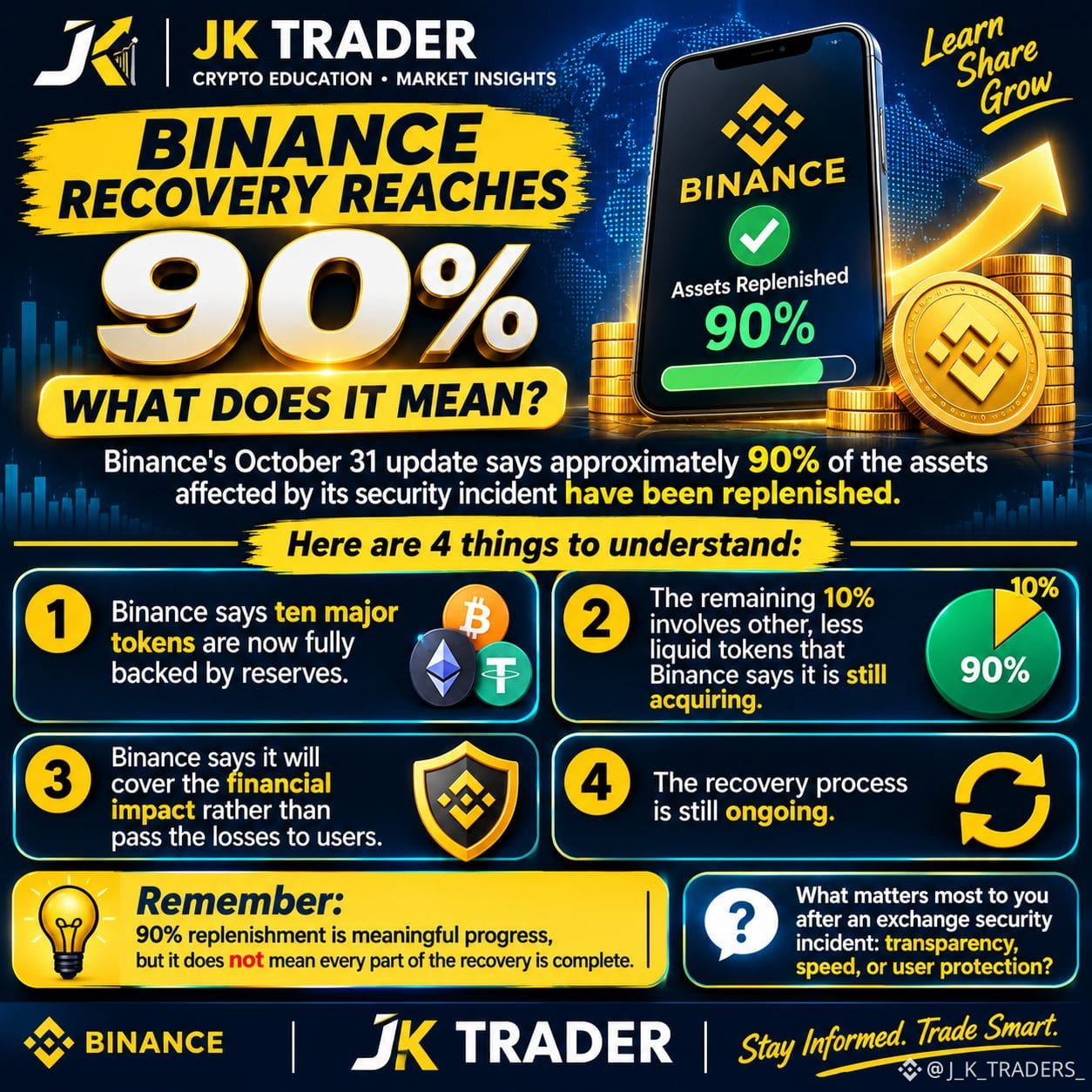
🟢 BINANCE RECOVERY REACHES 90%: WHAT DOES IT MEAN?
Binance's October 31 update says approximately 90% of the assets affected by its security incident have been replenished.
Here are four things to understand:
1️⃣ Binance says ten major tokens are now fully backed by reserves.
2️⃣ The remaining 10% involves other, less liquid tokens that Binance says it is still acquiring.
3️⃣ Binance says it will cover the financial impact rather than pass the losses to users.
4️⃣ The recovery process is still ongoing.
💡 Remember: 90% replenishment is meaningful progress, but it does not mean every part of the recovery is complete.
💬 What matters most to you after an exchange security incident: transparency, speed, or user protection?
#BinanceRecovery #CryptoNews #CryptoSecurit #BinanceSquare
27
·
--
{spot}(BNBUSDT)
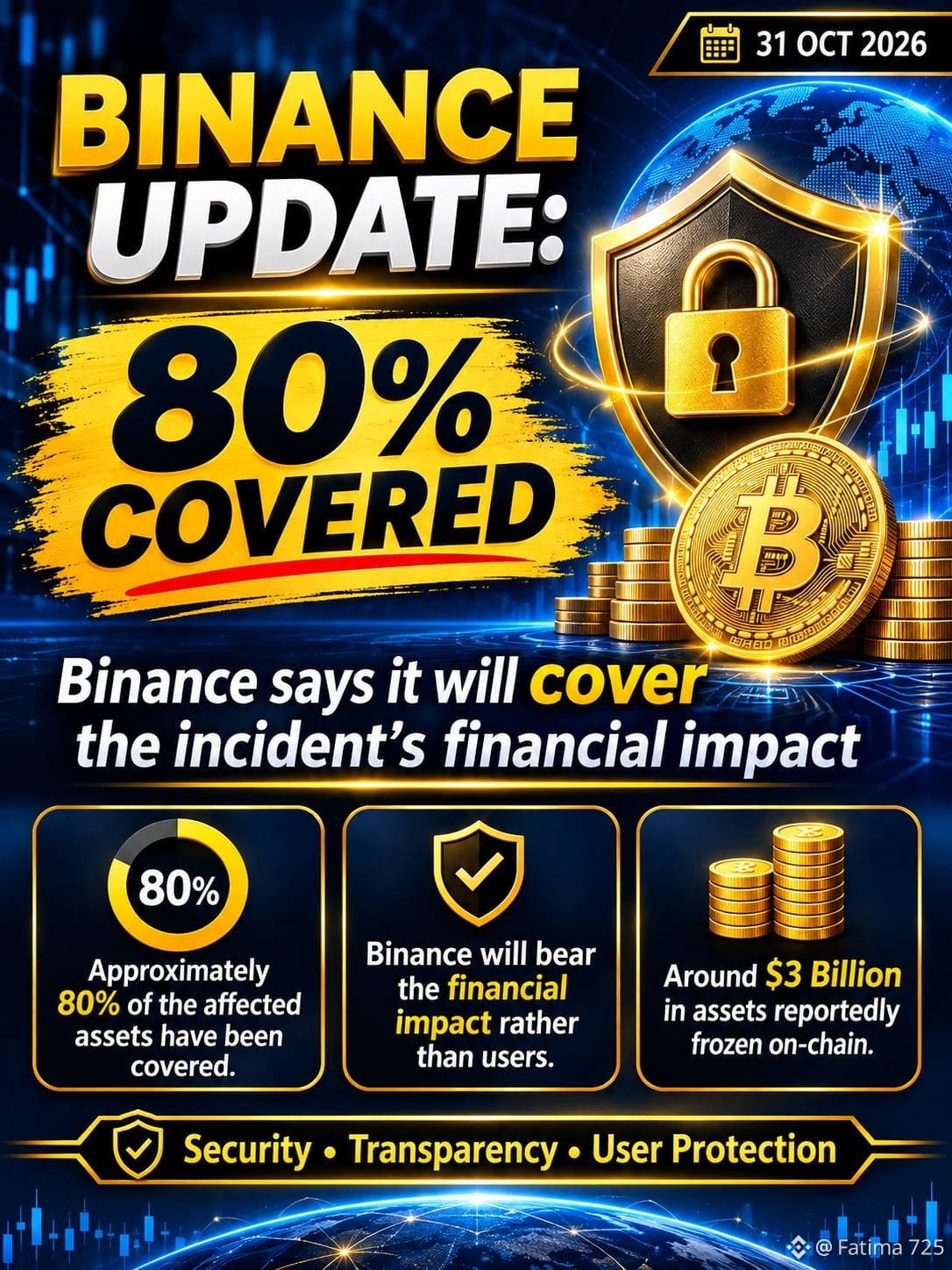
CE SECURITY UPDATE: 80% COVERED!
Binance has shared a major update after its reported $6.3 billion security incident.
According to Binance:
🔹 Around 80% of the affected assets have been covered.
🔹 The company says it will bear the financial impact, not users.
🔹 Around $3 billion in assets has reportedly been frozen on-chain.
🔹 Withdrawals are expected to resume in phases after security checks.
This is a major reminder that security and transparency matter in crypto.
What matters more to you: user protection or platform trust?
#Binance #CryptoNewss #bitcoin.” #CryptoSecurit #SAFU🙏
56
Article
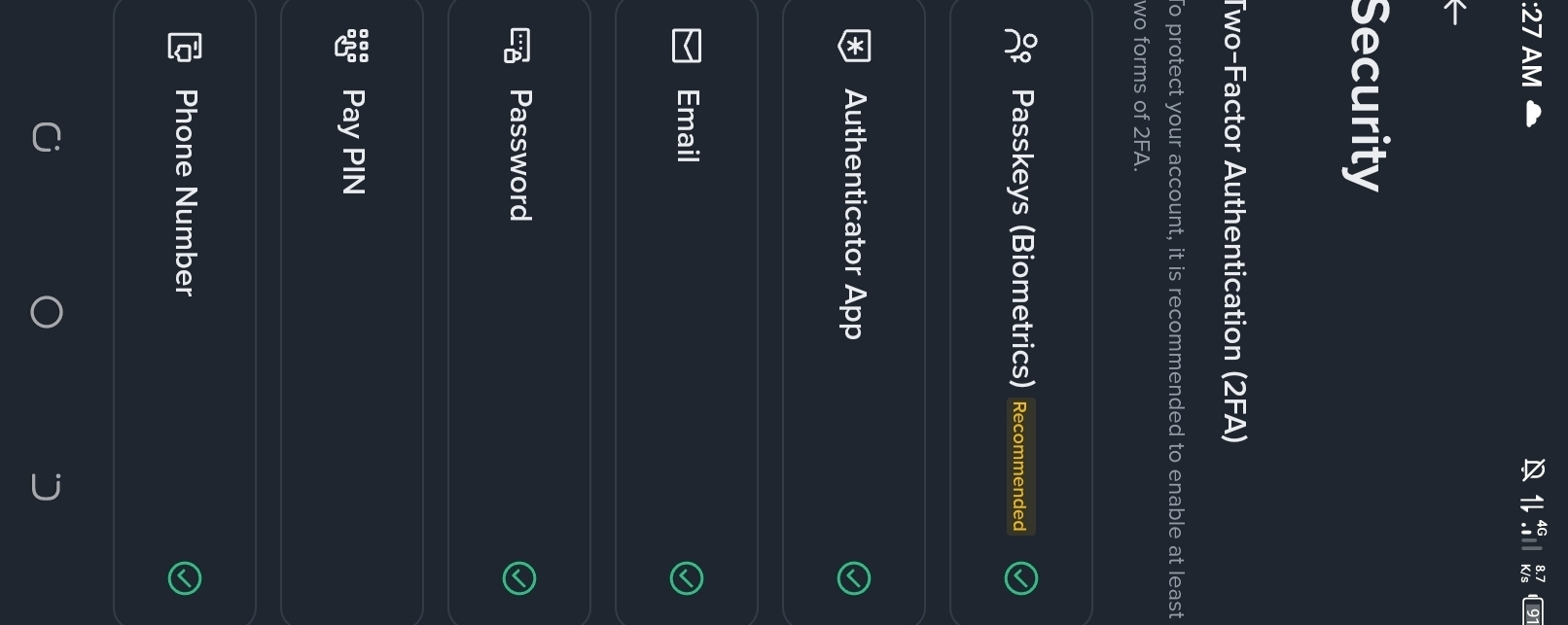
Crypto Security: One Mistake Can Be Costly 🔐In crypto, protecting your account is just as important as understanding the market.
Here are some essential security habits:
🔒 Enable two-factor authentication where available.
🔒 Never share your password, verification codes, or private keys.
🔒 Check website addresses carefully before logging in.
🔒 Avoid suspicious links and fake giveaways.
🔒 Review withdrawal addresses and network details before confirming a transfer.
Remember that genuine support staff should never ask you to reveal your password or one-time security codes.
Security is not a one-time task. Make it a habit.
Which security habit do you think every crypto beginner should learn first?
#CryptoSecurit #Binance #SecuritizeSharesRiseOver10%AfterTokenizedStocksLaunch #StaySafe"
Crypto Security: One Mistake Can Be Costly 🔐
In crypto, protecting your account is just as important as understanding the market.
Here are some essential security habits:
🔒 Enable two-factor authentication where available.
🔒 Never share your password, verification codes, or private keys.
🔒 Check website addresses carefully before logging in.
🔒 Avoid suspicious links and fake giveaways.
🔒 Review withdrawal addresses and network details before confirming a transfer.
Remember that genuine support staff should never ask you to reveal your password or one-time security codes.
Security is not a one-time task. Make it a habit.
Which security habit do you think every crypto beginner should learn first?
#CryptoSecurit #Binance #SecuritizeSharesRiseOver10%AfterTokenizedStocksLaunch #StaySafe"
1
80
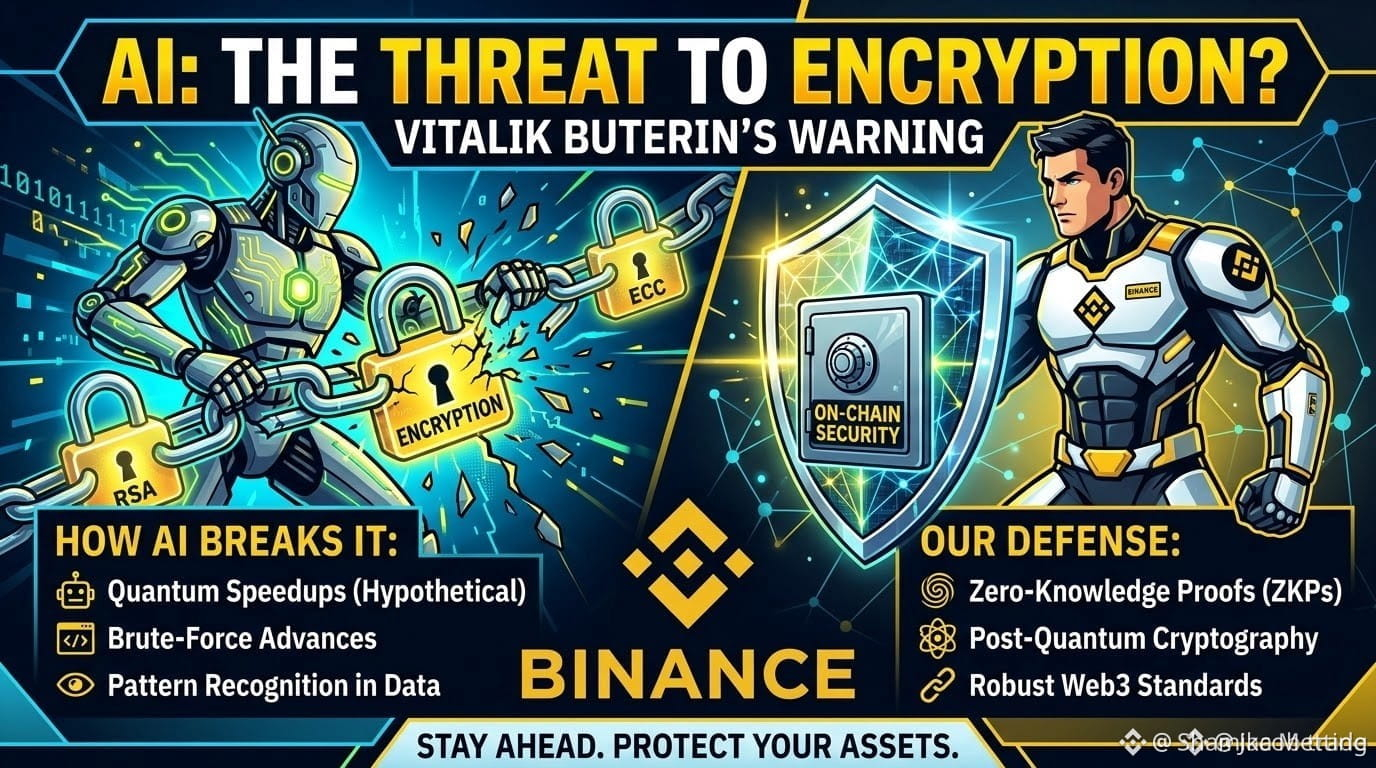
#VitalikWarnsAICouldWeakenCryptographySecurity 🔒 Can AI break encryption? Vitalik Buterin thinks it can.
Ethereum’s founder warns that rapid AI progress may soon uncover vulnerabilities in traditional cryptography.
If encryption becomes weaker, how do we keep Web3 resilient?
Discover Zero-Knowledge Proofs (ZKPs) & Post-Quantum Cryptography—the ultimate defense that protects your on-chain assets.
💡 Stay secure, stay ahead:
Improve your security hygiene practices.
Store assets safely with the Binance Web3 Wallet.
Keep learning through Binance Academy.
🛡️ Your encryption, your security.
What do you think—does AI pose a threat or a tool for defending Web3? Share your thoughts below! 👇
Please continue
#Binance #Web3 #CryptoSecurit #AI
$OGN
{future}(OGNUSDT)
#VitalikWarnsAICouldWeakenCryptographySecurity 🔒 Can AI break encryption? Vitalik Buterin thinks it can.
Ethereum’s founder warns that rapid AI progress may soon uncover vulnerabilities in traditional cryptography.
If encryption becomes weaker, how do we keep Web3 resilient?
Discover Zero-Knowledge Proofs (ZKPs) & Post-Quantum Cryptography—the ultimate defense that protects your on-chain assets.
💡 Stay secure, stay ahead:
Improve your security hygiene practices.
Store assets safely with the Binance Web3 Wallet.
Keep learning through Binance Academy.
🛡️ Your encryption, your security.
What do you think—does AI pose a threat or a tool for defending Web3? Share your thoughts below! 👇
Please continue
#Binance #Web3 #CryptoSecurit #AI
$OGN
1
83

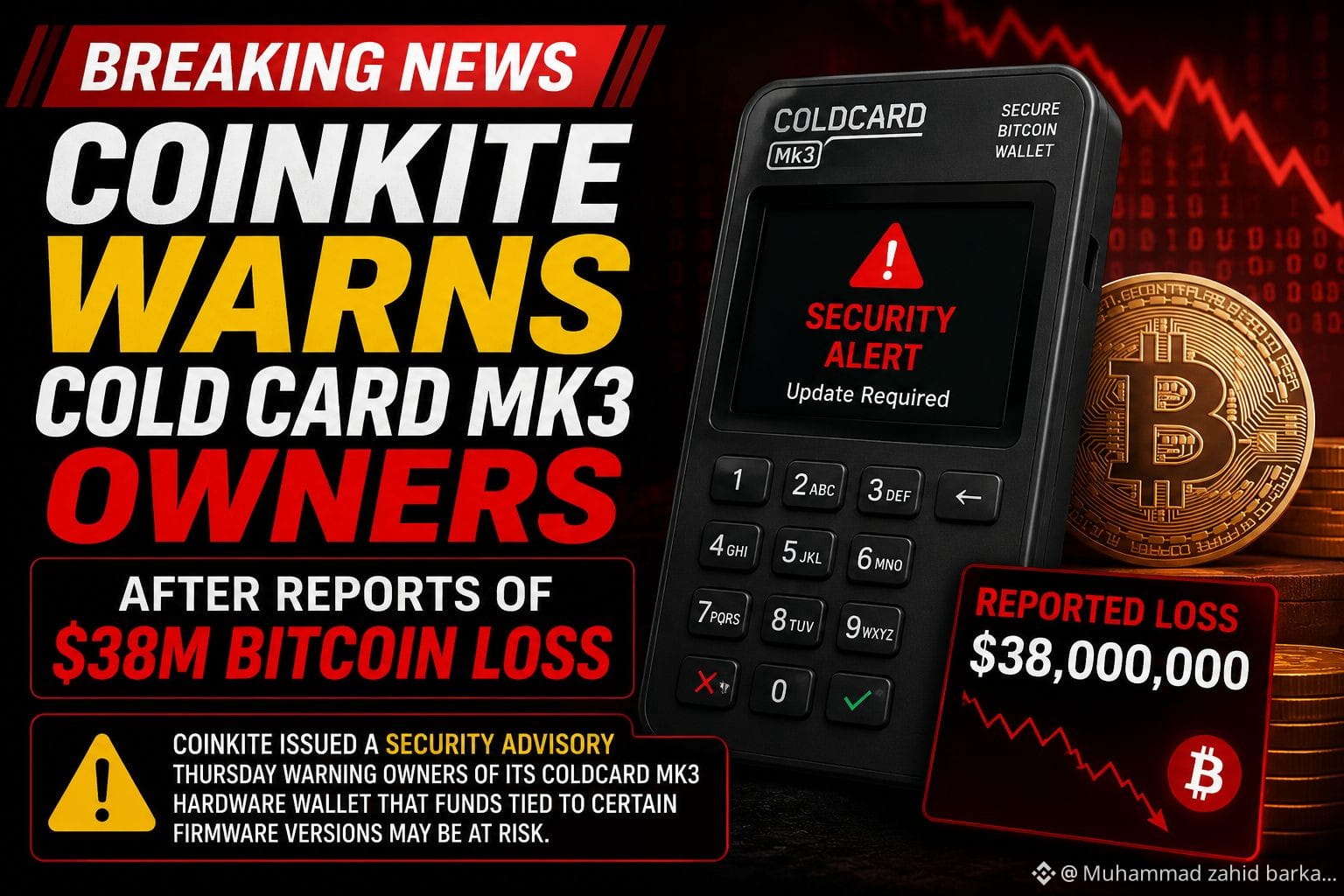
Coinkite Issues Urgent Warning to Coldcard Mk3 Users After $38M Bitcoin Loss
Breaking News!
If you own a Coldcard Mk3 Bitcoin hardware wallet, pay close attention.
Coinkite has issued an urgent security advisory warning that certain firmware versions may put users' Bitcoin funds at risk.
The warning follows reports linked to an estimated $38 million Bitcoin loss, raising serious concerns about wallet security.
If you're using a Coldcard Mk3, check your firmware version immediately, follow Coinkite's official security guidance, and never share your recovery seed phrase with anyone.
This is a reminder that even hardware wallets require regular security updates and careful maintenance.
Follow for more Bitcoin and crypto security news!
Hashtags:
#bitcoinhakving #bitcoin #Coldcard #coinrocco #CryptoSecurit
$NVDAB
{spot}(NVDABUSDT)
$AAPL.US
{stock_us}(AAPL.US)
Coinkite Issues Urgent Warning to Coldcard Mk3 Users After $38M Bitcoin Loss
Breaking News!
If you own a Coldcard Mk3 Bitcoin hardware wallet, pay close attention.
Coinkite has issued an urgent security advisory warning that certain firmware versions may put users' Bitcoin funds at risk.
The warning follows reports linked to an estimated $38 million Bitcoin loss, raising serious concerns about wallet security.
If you're using a Coldcard Mk3, check your firmware version immediately, follow Coinkite's official security guidance, and never share your recovery seed phrase with anyone.
This is a reminder that even hardware wallets require regular security updates and careful maintenance.
Follow for more Bitcoin and crypto security news!
Hashtags:
#bitcoinhakving #bitcoin #Coldcard #coinrocco #CryptoSecurit
$NVDAB
$AAPL.US
103

·
--
Bullish
🔐 YOUR CRYPTO SECURITY CHECKLIST
Before you trade today:
✅ Enable 2FA
✅ Use a strong unique password
✅ Check website URLs carefully
✅ Never share your seed phrase
✅ Don't click suspicious links
✅ Verify wallet addresses
✅ Be careful with fake support accounts
Remember:
If someone asks for your seed phrase, it's a huge red flag. 🚩
#CryptoSecurit #bitcoin #BinanceSquare #Web3
7

Binance published its Recovery Update #4 on November 1, saying it was beginning a phased resumption of withdrawals. The first phase covers selected assets and networks, including BTC, ETH, BNB, USDT, USDC, SOL and XRP.
Binance also says it has replenished approximately 95% of the affected assets. It reports that BTC, ETH, USDT, BNB, SOL, USDC, XRP, USD1, RLUSD and ZEC are fully backed.
But there is an important distinction: a phased reopening does not mean every asset and network is available at once. Binance says users should check the withdrawal page or network status for their specific asset and network. Temporary delays may also occur.
The lesson: don't rely on a headline saying “withdrawals resumed.” Verify the exact network, token and status before making a transaction.
What matters most to you after an exchange security incident: withdrawal access, transparent reserves, or a detailed technical investigation?
Source: [https://www.binance.com/en-PH/support/announcement/detail/73911fb819b240f88b88256bdd318eda](https://www.binance.com/en-PH/support/announcement/detail/73911fb819b240f88b88256bdd318eda?utm_source=chatgpt.com)
#Binance #CryptoSecurit #ProofOfReserves #CryptoEducation #Royalstradings
Binance published its Recovery Update #4 on November 1, saying it was beginning a phased resumption of withdrawals. The first phase covers selected assets and networks, including BTC, ETH, BNB, USDT, USDC, SOL and XRP.
Binance also says it has replenished approximately 95% of the affected assets. It reports that BTC, ETH, USDT, BNB, SOL, USDC, XRP, USD1, RLUSD and ZEC are fully backed.
But there is an important distinction: a phased reopening does not mean every asset and network is available at once. Binance says users should check the withdrawal page or network status for their specific asset and network. Temporary delays may also occur.
The lesson: don't rely on a headline saying “withdrawals resumed.” Verify the exact network, token and status before making a transaction.
What matters most to you after an exchange security incident: withdrawal access, transparent reserves, or a detailed technical investigation?
Source: https://www.binance.com/en-PH/support/announcement/detail/73911fb819b240f88b88256bdd318eda
#Binance #CryptoSecurit #ProofOfReserves #CryptoEducation #Royalstradings
1
277

Article
🔥 Billions at Risk, Heroes in Action! How Binance Fought Back and Rebuilt Trust! 🔐💛🔐 Binance's Biggest Security Test: The Fight to Recover Billions!
The cryptocurrency world has witnessed many challenges, but a major security incident can test even the strongest platforms.
When Binance faced a serious security crisis, one question came to everyone's mind:
Can a crypto exchange protect its users when billions of dollars are at risk?
The recovery effort involved much more than one company. Binance worked on tracing suspicious transactions, protecting user assets, and coordinating with blockchain security experts and industry partners.
Some important names associated with the wider recovery and security efforts include:
- Richard Teng – Binance Co-CEO.
- Yi He – Binance Co-CEO.
- Paolo Ardoino – Tether CEO.
- Jeremy Allaire – Circle CEO.
- TRM Labs – Blockchain intelligence and investigation.
- Chainalysis – Crypto transaction tracking and security analysis.
- FBI – Law enforcement support and investigations.
These names represent important leadership, industry cooperation, and investigation efforts. Not every individual or organization should be credited with directly recovering the funds.
🛡️ What Does This Mean for Crypto Users?
This incident reminds us that security is not just a technical feature. It is the foundation of trust in the cryptocurrency industry.
Users need transparency, strong protection systems, responsible leadership, and quick action during emergencies.
My Final Thoughts ❤️
A platform's real strength is not measured only by its trading volume, popularity, or market position.
Its real strength is tested when things go wrong.
The future of crypto depends on security, transparency, cooperation, and trust.
Billions can be lost in a moment, but rebuilding trust takes courage, responsibility, and action.
#Binance #CryptoSecurit y #SAFU🙏 #BinanceRecovery #Blockchain
🔥 Billions at Risk, Heroes in Action! How Binance Fought Back and Rebuilt Trust! 🔐💛
🔐 Binance's Biggest Security Test: The Fight to Recover Billions!
The cryptocurrency world has witnessed many challenges, but a major security incident can test even the strongest platforms.
When Binance faced a serious security crisis, one question came to everyone's mind:
Can a crypto exchange protect its users when billions of dollars are at risk?
The recovery effort involved much more than one company. Binance worked on tracing suspicious transactions, protecting user assets, and coordinating with blockchain security experts and industry partners.
Some important names associated with the wider recovery and security efforts include:
- Richard Teng – Binance Co-CEO.
- Yi He – Binance Co-CEO.
- Paolo Ardoino – Tether CEO.
- Jeremy Allaire – Circle CEO.
- TRM Labs – Blockchain intelligence and investigation.
- Chainalysis – Crypto transaction tracking and security analysis.
- FBI – Law enforcement support and investigations.
These names represent important leadership, industry cooperation, and investigation efforts. Not every individual or organization should be credited with directly recovering the funds.
🛡️ What Does This Mean for Crypto Users?
This incident reminds us that security is not just a technical feature. It is the foundation of trust in the cryptocurrency industry.
Users need transparency, strong protection systems, responsible leadership, and quick action during emergencies.
My Final Thoughts ❤️
A platform's real strength is not measured only by its trading volume, popularity, or market position.
Its real strength is tested when things go wrong.
The future of crypto depends on security, transparency, cooperation, and trust.
Billions can be lost in a moment, but rebuilding trust takes courage, responsibility, and action.
#Binance #CryptoSecurit y #SAFU🙏 #BinanceRecovery #Blockchain
77
BINANCE RELEASES SECURITY UPDATE #2 — HERE'S WHAT USERS SHOULD KNOW
Binance has published another update following its reported $6.3 billion hot-wallet security incident.
Here are the important developments:
🔹 Financial coverage: Binance says it has set aside more than $6.34 billion in company funds to cover the incident.
🔹 Assets already secured: The exchange says more than $5 billion in corresponding token assets are already in place.
🔹 Frozen funds: Approximately $3 billion has been frozen on-chain, according to Binance.
🔹 Withdrawals: Binance is targeting a phased restoration within approximately 34 hours of its announcement, subject to security checks. This is a target, not confirmation that withdrawals have reopened.
🔹 Proof of Reserves: Binance plans to publish an updated snapshot, with results expected by Monday, November 2.
🔹 Investigation: Binance says its investigation has uncovered additional points of compromise. It has found no evidence so far that wallet private keys were leaked.
The investigation is still ongoing. These figures and commitments are Binance's own statements.
What should users do?
✅ Follow official announcements.
✅ Avoid fake recovery agents and impersonators.
✅ Never share passwords, verification codes or seed phrases.
✅ Check withdrawal status directly through the official platform.
Transparency and verification matter most during a security incident.
What would restore your confidence in an exchange after an incident like this: independent audits, Proof of Reserves, or a detailed technical report?
Official announcement:
[https://www.binance.com/en/support/announcement/detail/d3306d9dca5243548c813b605e1d1751](https://www.binance.com/en/support/announcement/detail/d3306d9dca5243548c813b605e1d1751)
#Binance #CryptoSecurit #CryptoNews #ProofOfReserves #Royalstradings
BINANCE RELEASES SECURITY UPDATE #2 — HERE'S WHAT USERS SHOULD KNOW
Binance has published another update following its reported $6.3 billion hot-wallet security incident.
Here are the important developments:
🔹 Financial coverage: Binance says it has set aside more than $6.34 billion in company funds to cover the incident.
🔹 Assets already secured: The exchange says more than $5 billion in corresponding token assets are already in place.
🔹 Frozen funds: Approximately $3 billion has been frozen on-chain, according to Binance.
🔹 Withdrawals: Binance is targeting a phased restoration within approximately 34 hours of its announcement, subject to security checks. This is a target, not confirmation that withdrawals have reopened.
🔹 Proof of Reserves: Binance plans to publish an updated snapshot, with results expected by Monday, November 2.
🔹 Investigation: Binance says its investigation has uncovered additional points of compromise. It has found no evidence so far that wallet private keys were leaked.
The investigation is still ongoing. These figures and commitments are Binance's own statements.
What should users do?
✅ Follow official announcements.
✅ Avoid fake recovery agents and impersonators.
✅ Never share passwords, verification codes or seed phrases.
✅ Check withdrawal status directly through the official platform.
Transparency and verification matter most during a security incident.
What would restore your confidence in an exchange after an incident like this: independent audits, Proof of Reserves, or a detailed technical report?
Official announcement:
https://www.binance.com/en/support/announcement/detail/d3306d9dca5243548c813b605e1d1751
#Binance #CryptoSecurit #CryptoNews #ProofOfReserves #Royalstradings
1
107

·
--
Bullish
Why today's Google announcement is BULLISH for NAORIS 🛡️
BREAKING: Google announces Google Multi-Party Compute (MPC) for banks' crypto custody. [Bitcoin Magazine]
Details:
- Splits private keys into fragments to prevent hacks (40% of the $16.69B in hacks involved stolen keys)
- Several banks are already testing it
- Commercial launch: Early 2027
But here's the detail nobody noticed:
Google will initially only sign with ECDSA and Ed25519. It is NOT post-quantum. They themselves say post-quantum "could be added in the future."
And this is where NAORIS comes in:
1. Google centralizes security in Google Cloud. NAORIS decentralizes it across a mesh of thousands of nodes.
2. Google solves custody TODAY. NAORIS solves TOMORROW'S quantum resistance, which is already here.
3. Google will have to upgrade to post-quantum. NAORIS IS ALREADY post-quantum.
Google validated the biggest thesis: banks need a new security infrastructure. First, they need custody (Google); then they need that custody to be safe from quantum attacks (Naoris).
Current $NAORIS data:
KuCoin Spot $0.03555 +19.97% - Volume $2.69M and rising
EMA 7 > 25 > 99 bullish trend
RSI 61.73 with room to run
3.361 holders - Early
The official Naoris team replied to me today: "The math winning in the end is the whole bet"
Early, patient, shielded.
#NAORIS #PostQuantum #Google #CryptoSecurit
1
207

·
--
594 BTC stolen in just 25 minutes — How did hackers breach a cold wallet?
The recent headlines reporting 594 BTC stolen within 25 minutes are a stark reminder: "cold wallet" does not mean "invulnerable."
In most security breaches, attackers don't crack the hardware itself—they target human and software vulnerabilities. Common exploits include leaked seed phrases, rogue firmware updates, fake wallet apps, phishing scams, and targeted social engineering. Ultimately, your security is only as strong as how well you guard your private keys.
Despite the shocking news, Bitcoin remains resilient, hovering around $63.4K with modest gains as buyers brush off the negative sentiment. The market's stability proves that isolated security breaches don't alter Bitcoin’s core fundamentals—though they do underline the critical need for strict self-custody habits.
Key takeaways:
- Safeguard your private keys at all costs.
- Always double check and verify every transaction detail.
- Never under any circumstances, reveal your recovery phrase.
#Bitcoin #CryptoSecurit #BTC #SelfCustody #Blockchain $BTC
75

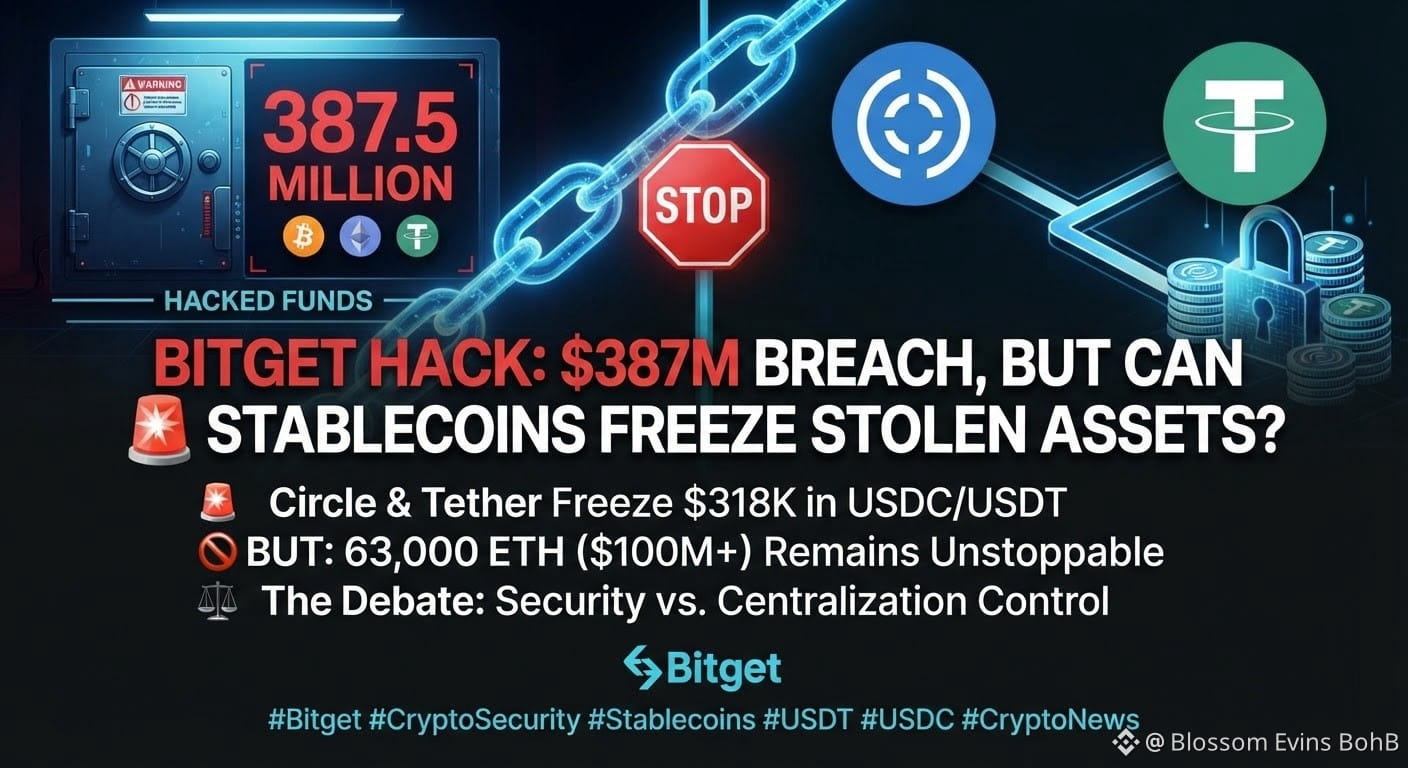
🚨 A $387M HACK — BUT SOME OF THE MONEY COULD ACTUALLY BE FROZEN 👀
The Bitget security breach has raised a bigger question for the crypto market:
How much control do stablecoin issuers really have over stolen funds?
Bitget initially estimated the September 24 incident at around $351.6M, before revising the figure to approximately $387.5M after including additional assets such as Zcash and TRON.
Now here’s where things get interesting. 👇
🔒 Circle and Tether stepped in
A wallet identified as “Bitget Exploiter 8” was blacklisted by Circle, and Tether later blocked the same address.
That wallet reportedly contained around:
• 99,990 USDC
• 218,023 USDT
• 170.47 ETH
So, roughly $318K worth of USDC and USDT was effectively frozen.
But there’s a catch. ⚠️
Circle and Tether can freeze their own tokens at the contract level.
They cannot freeze native ETH.
Reports indicate other exploiter wallets still contained more than 63,000 ETH, showing just how different the control mechanisms are between stablecoins and assets like ETH.
Bitget CEO Gracy Chen said the attackers compromised a backend system connected to the exchange’s wallet infrastructure and manipulated transaction data, rather than taking users’ private keys.
Bitget also said its cold wallets were unaffected and that its User Protection Fund holds over $464M.
👀 The bigger question:
Does this incident show the strength of stablecoin security — or the risks of centralized control?
$BTC • $ETH • $XRP
#CryptoSecurit #Circle #USDC✅ #USDT #CryptoNewss
127

·
--
#kelpdaoexploitfreeze
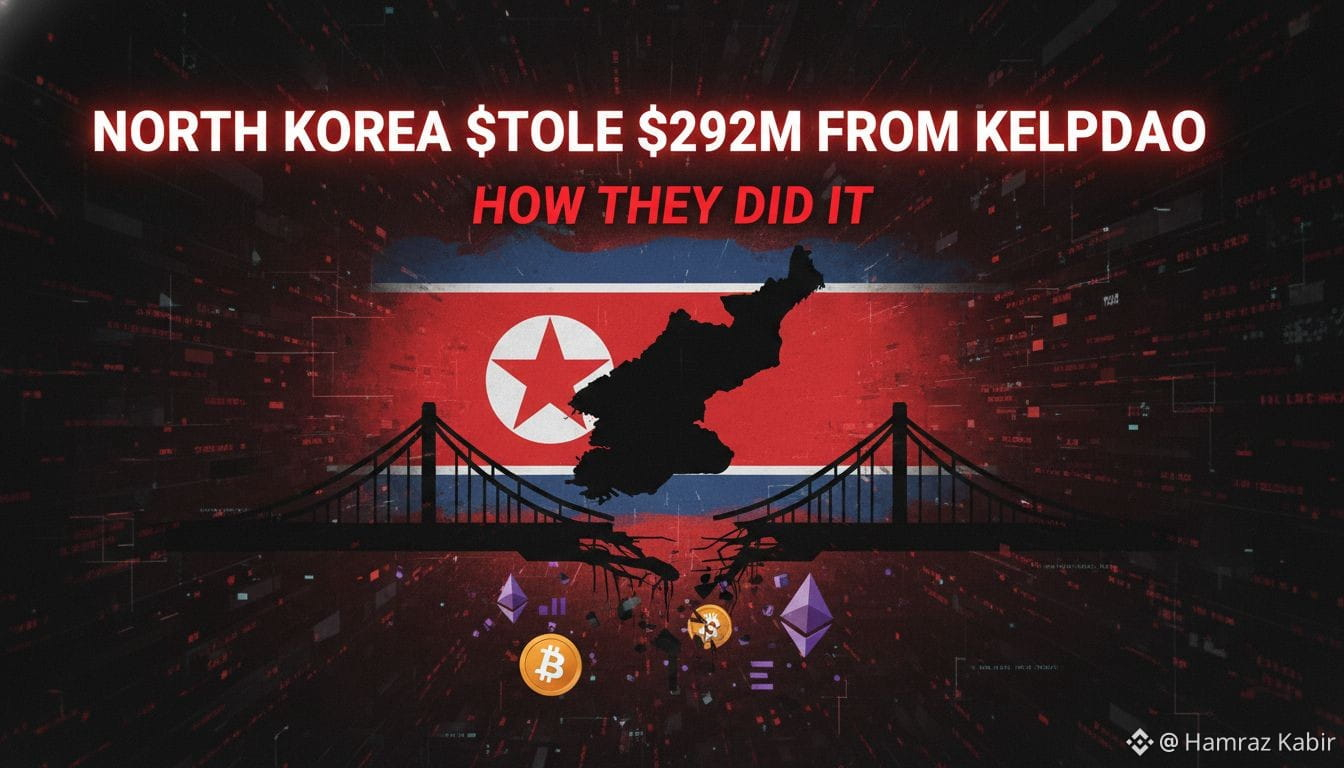
🚨 North Korea Stole $292M from KelpDAO — Here's Exactly How They Did It!
The biggest DeFi hack of 2026 has been linked to North Korea's Lazarus Group — and the attack method was unlike anything we've seen before!
What Happened on April 18, 2026:
Hackers exploited KelpDAO's LayerZero cross-chain bridge — but this was NOT a typical smart contract bug. Every single on-chain transaction looked completely valid!
The Attack Method — Step by Step:
1️⃣ Lazarus Group compromised KelpDAO's internal RPC nodes
2️⃣ DDoS'd external nodes to eliminate any second check
3️⃣ Fed false data to a single-point-of-failure verification system
4️⃣ Tricked the Ethereum contract into releasing 116,500 rsETH
5️⃣ Deposited 90,000 stolen rsETH into Aave as collateral
6️⃣ Borrowed $190M+ in real ETH against worthless collateral
7️⃣ Laundered $176M through THORChain into Bitcoin
The Freeze Response:
On April 20, Arbitrum's Security Council executed an emergency action — freezing 30,766 ETH worth ~$71M tied to the exploiter. This was one of the fastest governance responses in DeFi history!
$ETH $AAVE
The root cause? A "1-of-1" single verifier setup — meaning only ONE validator needed to approve cross-chain messages. No second check. No backup. A single point of failure that North Korea's best hackers exploited perfectly.
Not Financial Advice. DYOR 📊
#DeFiHack #NorthKorea #CryptoSecurit
{spot}(ETHUSDT)
{spot}(AAVEUSDT)
#kelpdaoexploitfreeze
🚨 North Korea Stole $292M from KelpDAO — Here's Exactly How They Did It!
The biggest DeFi hack of 2026 has been linked to North Korea's Lazarus Group — and the attack method was unlike anything we've seen before!
What Happened on April 18, 2026:
Hackers exploited KelpDAO's LayerZero cross-chain bridge — but this was NOT a typical smart contract bug. Every single on-chain transaction looked completely valid!
The Attack Method — Step by Step:
1️⃣ Lazarus Group compromised KelpDAO's internal RPC nodes
2️⃣ DDoS'd external nodes to eliminate any second check
3️⃣ Fed false data to a single-point-of-failure verification system
4️⃣ Tricked the Ethereum contract into releasing 116,500 rsETH
5️⃣ Deposited 90,000 stolen rsETH into Aave as collateral
6️⃣ Borrowed $190M+ in real ETH against worthless collateral
7️⃣ Laundered $176M through THORChain into Bitcoin
The Freeze Response:
On April 20, Arbitrum's Security Council executed an emergency action — freezing 30,766 ETH worth ~$71M tied to the exploiter. This was one of the fastest governance responses in DeFi history!
$ETH $AAVE
The root cause? A "1-of-1" single verifier setup — meaning only ONE validator needed to approve cross-chain messages. No second check. No backup. A single point of failure that North Korea's best hackers exploited perfectly.
Not Financial Advice. DYOR 📊
#DeFiHack #NorthKorea #CryptoSecurit
178

·
--
🔐 How to Keep Your Crypto Safe: A Simple Guide for New Users
Security should always come before profits. Start with a strong, unique password and enable 2FA on every crypto account. Never share your recovery phrase, private keys, or OTPs with anyone. Double-check website URLs, avoid suspicious links and messages, and stay alert to phishing scams pretending to be trusted platforms.
Before investing, take time to learn. A few minutes of caution can protect years of savings.
Stay secure. Stay informed. Always DYOR. 🛡️
#IndiaCreatesOnSquare #CryptoSecurit #BinanceSquare #DYOR
71
·
--
🚨 5 CRYPTO SCAMS YOU SHOULD KNOW
⚠️ Fake giveaways
⚠️ Fake customer support
⚠️ Phishing websites
⚠️ Fake investment platforms
⚠️ "Send crypto and receive double" scams
If someone promises guaranteed returns, stop.
If someone pressures you to act immediately, stop.
If someone asks for your seed phrase, STOP.
Stay safe. 🔐
#CryptoScams #CryptoSecurit #BinanceSquare
18
Log in to explore more content
Join global crypto users on Binance Square
⚡️ Get latest and useful information about crypto.
💬 Trusted by the world’s largest crypto exchange.
👍 Discover real insights from verified creators.
Email / Phone number
Trending Topics
1
#BinanceIncidentReport
29,159 views
520 Discussing
2
#BinanceReopensWithdrawalsForMoreAssets
138,808 views
1,730 Discussing
3
#BinanceHourlyDepositsExceedWithdrawals
66,765 views
791 Discussing
4
#USMidtermElections
878,688 views
4,621 Discussing
5
#AnthropicIPOPricedDownasInvestorsEye$1.5T
3,826 views
49 Discussing
6
#USOctoberNFP-AreRateCutsStillPossible
164,075 views
1,274 Discussing
7
#AppleReportsMixedResults
63,892 views
973 Discussing
8
#PalantirSlides3PercentOn$2BRevenue
5,550 views
47 Discussing
9
#FrenchAssemblyRejectsTwoCryptoExitTaxProposals
11,701 views
176 Discussing
10
#Nasdaq100EntersCorrection
15,127 views
192 Discussing