
#binanceblockchainweek
binanceblockchainweek
50.3M views
245,092 Discussing
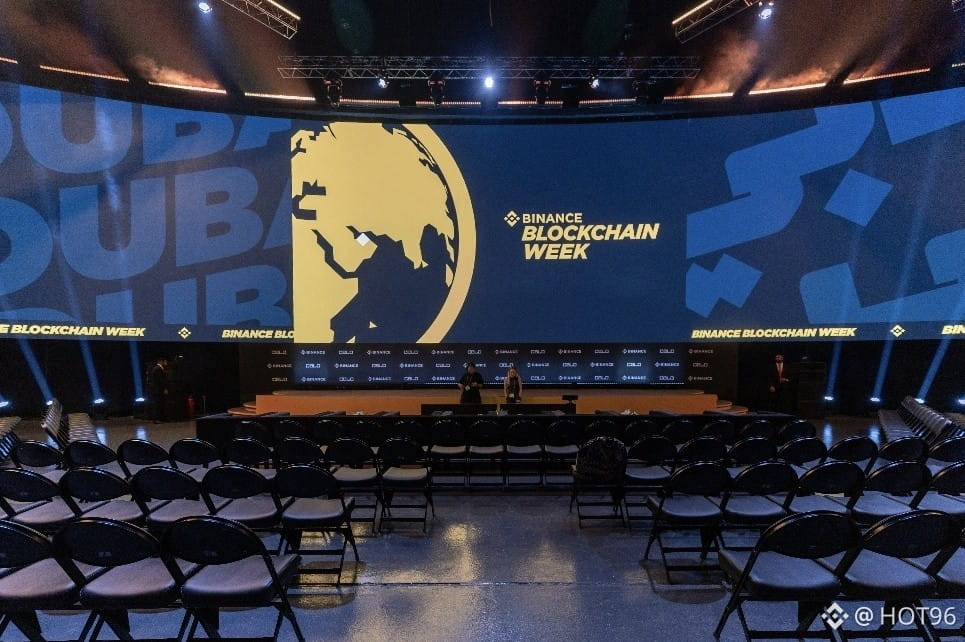
Ready for Binance Blockchain Week? The event has become one of the most influential annual gatherings in the global crypto industry, previously held in Singapore, Paris, Istanbul, and Dubai.
Hot
Latest

Bangkok, we've made contact. 🛸
Consider this your sign to join us at Binance Blockchain Week 2026.
🎟️ [Get your ticket](https://www.binanceblockchainweek.com/event/Bangkok2026/Home)
Bangkok, we've made contact. 🛸
Consider this your sign to join us at Binance Blockchain Week 2026.
🎟️ Get your ticket
Consider this your sign to join us at Binance Blockchain Week 2026.
🎟️ Get your ticket
362
385
1.6k
2.5M


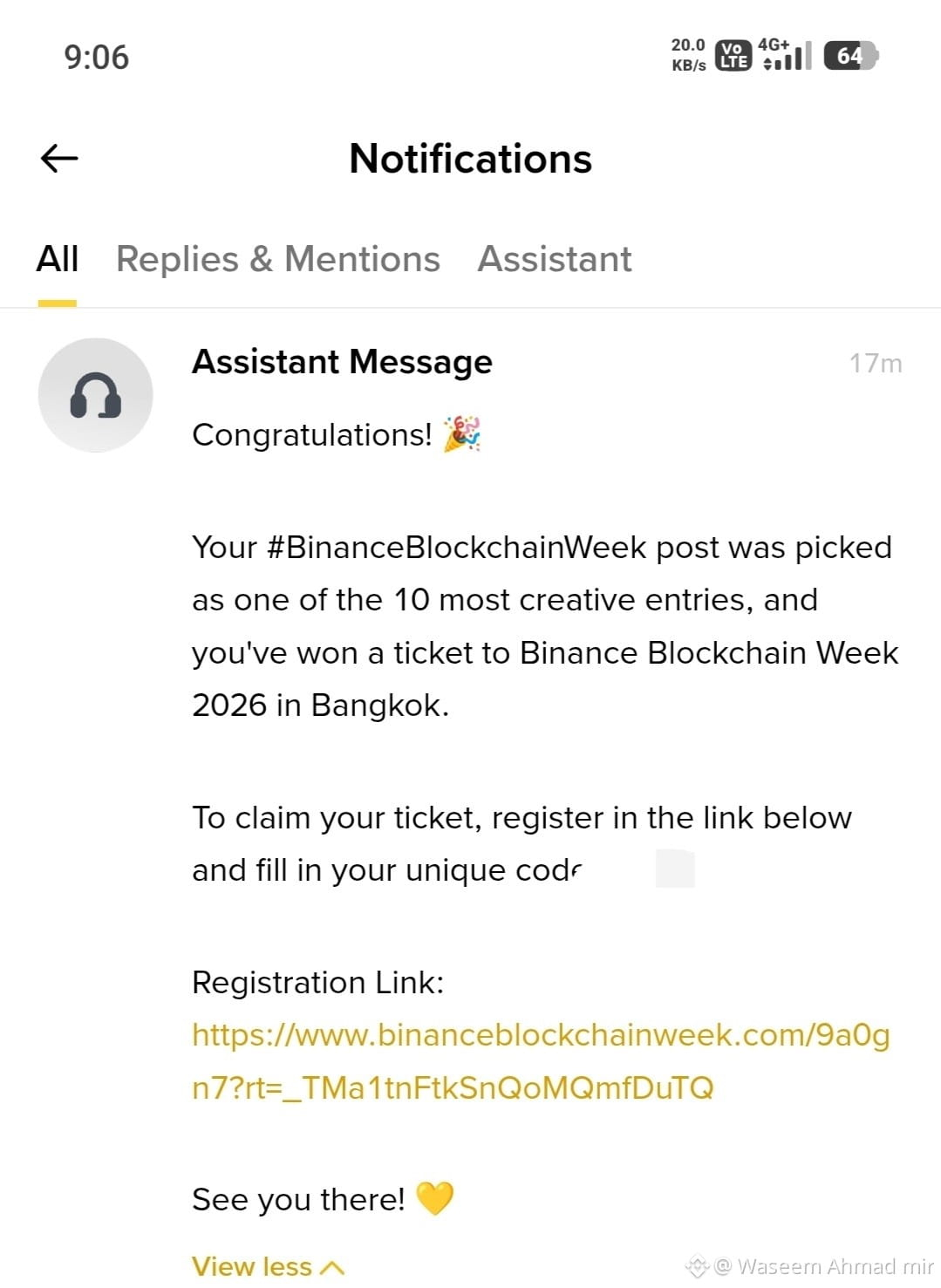
Some achievements make you smile, even when you cannot fully celebrate them in person!
I'm truly happy that my Binance Square post was selected as one of the 10 most creative entries in the Binance Blockchain Week 2026 giveaway.
A huge thank you to @BinanceBlockchainWeek @Binance_Square_Official ,@heyi and the Binance Angels for this opportunity and recognition.
I won a ticket to the Bangkok event, but unfortunately, I don't have my passport yet, so I won't be able to travel this time.
Although I may miss the event, this recognition means a lot to me. Hopefully, I'll get the chance to attend in person next time.
Congratulations to all the winners, and thank you once again!
#BinanceBlockchainWeek
Some achievements make you smile, even when you cannot fully celebrate them in person!
I'm truly happy that my Binance Square post was selected as one of the 10 most creative entries in the Binance Blockchain Week 2026 giveaway.
A huge thank you to @Binance Blockchain Week @Binance Square Official ,@Yi He and the Binance Angels for this opportunity and recognition.
I won a ticket to the Bangkok event, but unfortunately, I don't have my passport yet, so I won't be able to travel this time.
Although I may miss the event, this recognition means a lot to me. Hopefully, I'll get the chance to attend in person next time.
Congratulations to all the winners, and thank you once again!
#BinanceBlockchainWeek
Binance Blockchain Week
·
--
10 Binance Blockchain Week 2026 tickets up for grabs! 🎟️
This year’s theme is EVOLVE. From traditional finance moving onchain to AI and blockchain coming together, what would you like to see change next in finance?
How to enter 👇
1️⃣ Follow this account — the official Binance Blockchain Week account.
2️⃣ Post on Binance Square using #BinanceBlockchainWeek and share your take on how finance will evolve, or the topic you’re most excited to explore at this year’s event.
We'll pick the 10 most creative posts and give each winner a ticket!
⏰ Entries close November 18 at 4:00 PM (UTC+4).
Join us live tonight. See you in Bangkok on November 28–29!
Sohel shaik 03:
mubarak bro
1
1
78

·
--
Everyone is talking about Web3.
But very few are actually BUILDING in it.
I'm going to Binance Blockchain Week 2026 not to watch,
but to learn from the builders who are shaping the future.
Nov 28-29 | Bangkok
This is where the future is built.
Are you coming to build or just to watch? 👀
#BinanceBlockchainWeek #Web3
$BTC
{spot}(BTCUSDT)
Everyone is talking about Web3.
But very few are actually BUILDING in it.
I'm going to Binance Blockchain Week 2026 not to watch,
but to learn from the builders who are shaping the future.
Nov 28-29 | Bangkok
This is where the future is built.
Are you coming to build or just to watch? 👀
#BinanceBlockchainWeek #Web3
$BTC
But very few are actually BUILDING in it.
I'm going to Binance Blockchain Week 2026 not to watch,
but to learn from the builders who are shaping the future.
Nov 28-29 | Bangkok
This is where the future is built.
Are you coming to build or just to watch? 👀
#BinanceBlockchainWeek #Web3
$BTC

MH ok:
good
2
28

Article
When everyone on Square is echoing the exact same bullish bullet points about RWA, AI,I spent the last 48 hours digging through the agenda, speaker rosters, and Square feeds ahead of Binance Blockchain Week 2026 in Bangkok, and I think most people are misreading what the theme "Evolve" actually signals.
At first glance, #EvolveAtBinanceBlockchainWeek looks like standard conference branding. Another catchy banner slapped onto panels about innovation and adoption.
But when you look past the marketing copy and examine who is actually taking the stage on November 28–29 at the Queen Sirikit National Convention Center, a very different picture emerges.
We are watching the quiet death of the "crypto versus Wall Street" narrative and the birth of something far more complex, institutional, and slightly uncomfortable for Web3 purists.
Actually, wait—let me push back on my own take for a second. Part of me wonders if I'm over-indexing on the TradFi logos on the flyer, because we've seen "institutional adoption" panels at every major conference since 2021 without retail ever seeing the yield.
Still, looking closely at what's actually being built and pitched right now, something deeper is shifting. Here is my honest breakdown as I map out the themes, protocols, and capital flows converging in Bangkok this week 🧵
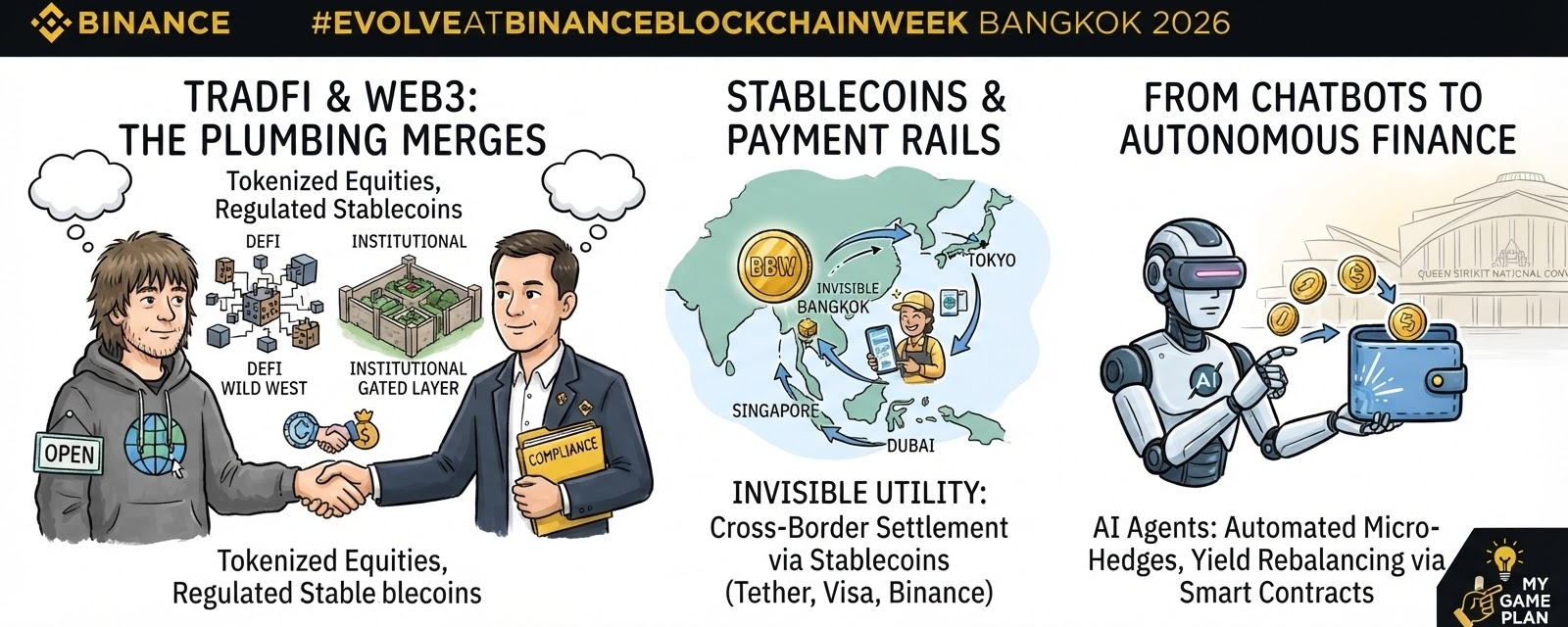
1. The Speaker List Reads Like a TradFi Merger
If you told me five years ago that a flagship Binance event would feature executives from BlackRock, Franklin Templeton, Visa, Mirae Asset, and PayPay sharing panels with CZ, Richard Teng, and Yi He, I would have assumed one side had surrendered.
Neither side surrendered; instead, the plumbing merged.
Looking at the session tracks, the conversation has shifted away from speculative tokenomics toward real-world financial infrastructure—specifically tokenized equities, institutional settlement layers, and regulated stablecoin rails.
When Ondo Finance, Alpaca, and BlackRock’s digital asset teams sit in the same room as $BNB Chain leadership, they aren't debating decentralization philosophy.
They are negotiating how trillions of dollars in traditional off-chain liquidity get wrapped, settled, and traded 24/7 on public and permissioned ledgers.
For retail traders holding BTC andETH, this structural shift changes how market cycles behave.
We are moving away from pure retail-driven boom-and-bust reflexivity toward slower, deeper, compliance-gated liquidity pools.
2. Stablecoins and Payment Rails Are Quietly Winning
Everyone loves chasing volatile AI agent tokens or high-beta meme plays, yet the sharpest signal coming out of Bangkok is boring old payment infrastructure.
Look at the timing: Thailand’s SEC is actively preparing new stablecoin frameworks right as Tether, Visa, and Binance’s payment divisions converge in the city.
I have been testing cross-border stablecoin settlement flows across several Asia-Pacific corridors over the past few months, and the user experience gap between Web2 fintech and Web3 wallets has practically vanished.
Sub-second finality and near-zero gas fees on networks like $BNB have turned stablecoins from a "crypto trading pair" into actual commercial working capital.
The real evolution isn't people buying coffee with volatile tokens; it's merchants and payment processors settling cross-border invoices in stablecoins without even realizing a blockchain was involved.
That invisible utility is where sustainable fee generation lives—though I keep catching myself wondering how a system that works best when nobody notices the rails is supposed to hold long-term attention.
3. AI Agents Are Moving From Chatbots to On-Chain Wallets
Another major thread weaving through the #EvolveAtBinanceBlockchainWeek discussions is the intersection of artificial intelligence and on-chain execution.
Until recently, "AI x Crypto" mostly meant slapping an AI sticker onto a decentralized compute token and hoping liquidity rotated into it.
What I am actually seeing builders test right now—and what figures like YZi Labs and government AI ministries are highlighting on the Bangkok agenda—is autonomous financial agency.
Think about what happens when an AI agent needs to pay for API calls, execute micro-hedges, or rebalance yield across DeFi protocols without waiting for human approval.
Traditional banking rails cannot issue a checking account to an autonomous software script, whereas an on-chain wallet with programmable smart contract permissions handles it natively.
Watching how protocols like BNB andSOL compete to become the default settlement layer for machine-to-machine commerce will be one of the most lucrative research tracks heading into 2027.
But Here’s What Worries Me... 🤔
As genuinely exciting as institutional validation and invisible payment rails sound, I cannot shake a growing sense of unease about what "evolving" costs us.
The catch is that institutionalization always demands permission, surveillance, and standardization.
When TradFi giants like BlackRock and regulated payment networks integrate with on-chain infrastructure, they bring strict compliance perimeters with them.
We risk ending up with a bifurcated crypto ecosystem: a clean, KYC-gated, institutionally blessed layer where tokenized stocks and regulated stablecoins thrive, and a marginalized, liquidity-starved "wild west" layer for permissionless DeFi.
Here is the economic catch nobody on stage wants to talk about: if enterprise stablecoins and RWA settlements scale on near-zero-fee rails or private app-chains, where does the fee burn go? For base-layer tokens like BNB orETH to actually capture that institutional volume, transaction velocity alone isn't enough—network usage has to outpace fee compression, otherwise we get massive adoption with flat token value accrual.
There is also a classic market timing risk here that every seasoned trader needs to respect 📉
Major conferences historically act as sentiment peaks or "sell-the-news" catalysts for ecosystem tokens.
When everyone on Square is echoing the exact same bullish bullet points about RWA, AI, and institutional adoption ahead of a two-day event, short-term leverage tends to pile up on one side of the boat.
Smart capital rarely chases green candles during conference week; it watches which announced partnerships actually ship live code three months after the stage lights turn off.
My Personal Game Plan for the Week 💡
Instead of blindly aping into whatever narrative trends during the keynotes, I am tracking three concrete metrics over the next 72 hours:
* On-chain TVL and stablecoin inflows across ecosystems announcing enterprise payment integrations, rather than relying on press releases.
* Developer tooling updates around account abstraction and AI wallet permissions that lower friction for non-crypto natives.
* Funding rate spikes on $BNB,$BTC, and major RWA tokens to spot overcrowded long positions before weekend volatility hits.
Crypto has survived for over a decade precisely because it refuses to stay static, shedding old skin every cycle to survive harsher regulatory and macroeconomic climates.
It genuinely feels like the biggest structural leap forward in crypto history—and at the exact same time, it feels like we might be automating away the very permissionless edge that made this market worth betting on in the first place. Which side of that trade are you actually positioned for?
#EvolveAtBinanceBlockchainWeek #BinanceBlockchainWeek #Web3 #Write2Earn
Not financial advice. Always DYOR.
Would you like to tighten up any part of this draft
further before you publish it on Binance Square?
When everyone on Square is echoing the exact same bullish bullet points about RWA, AI,
I spent the last 48 hours digging through the agenda, speaker rosters, and Square feeds ahead of Binance Blockchain Week 2026 in Bangkok, and I think most people are misreading what the theme "Evolve" actually signals.
At first glance, #EvolveAtBinanceBlockchainWeek looks like standard conference branding. Another catchy banner slapped onto panels about innovation and adoption.
But when you look past the marketing copy and examine who is actually taking the stage on November 28–29 at the Queen Sirikit National Convention Center, a very different picture emerges.
We are watching the quiet death of the "crypto versus Wall Street" narrative and the birth of something far more complex, institutional, and slightly uncomfortable for Web3 purists.
Actually, wait—let me push back on my own take for a second. Part of me wonders if I'm over-indexing on the TradFi logos on the flyer, because we've seen "institutional adoption" panels at every major conference since 2021 without retail ever seeing the yield.
Still, looking closely at what's actually being built and pitched right now, something deeper is shifting. Here is my honest breakdown as I map out the themes, protocols, and capital flows converging in Bangkok this week 🧵
1. The Speaker List Reads Like a TradFi Merger
If you told me five years ago that a flagship Binance event would feature executives from BlackRock, Franklin Templeton, Visa, Mirae Asset, and PayPay sharing panels with CZ, Richard Teng, and Yi He, I would have assumed one side had surrendered.
Neither side surrendered; instead, the plumbing merged.
Looking at the session tracks, the conversation has shifted away from speculative tokenomics toward real-world financial infrastructure—specifically tokenized equities, institutional settlement layers, and regulated stablecoin rails.
When Ondo Finance, Alpaca, and BlackRock’s digital asset teams sit in the same room as $BNB Chain leadership, they aren't debating decentralization philosophy.
They are negotiating how trillions of dollars in traditional off-chain liquidity get wrapped, settled, and traded 24/7 on public and permissioned ledgers.
For retail traders holding BTC andETH, this structural shift changes how market cycles behave.
We are moving away from pure retail-driven boom-and-bust reflexivity toward slower, deeper, compliance-gated liquidity pools.
2. Stablecoins and Payment Rails Are Quietly Winning
Everyone loves chasing volatile AI agent tokens or high-beta meme plays, yet the sharpest signal coming out of Bangkok is boring old payment infrastructure.
Look at the timing: Thailand’s SEC is actively preparing new stablecoin frameworks right as Tether, Visa, and Binance’s payment divisions converge in the city.
I have been testing cross-border stablecoin settlement flows across several Asia-Pacific corridors over the past few months, and the user experience gap between Web2 fintech and Web3 wallets has practically vanished.
Sub-second finality and near-zero gas fees on networks like $BNB have turned stablecoins from a "crypto trading pair" into actual commercial working capital.
The real evolution isn't people buying coffee with volatile tokens; it's merchants and payment processors settling cross-border invoices in stablecoins without even realizing a blockchain was involved.
That invisible utility is where sustainable fee generation lives—though I keep catching myself wondering how a system that works best when nobody notices the rails is supposed to hold long-term attention.
3. AI Agents Are Moving From Chatbots to On-Chain Wallets
Another major thread weaving through the #EvolveAtBinanceBlockchainWeek discussions is the intersection of artificial intelligence and on-chain execution.
Until recently, "AI x Crypto" mostly meant slapping an AI sticker onto a decentralized compute token and hoping liquidity rotated into it.
What I am actually seeing builders test right now—and what figures like YZi Labs and government AI ministries are highlighting on the Bangkok agenda—is autonomous financial agency.
Think about what happens when an AI agent needs to pay for API calls, execute micro-hedges, or rebalance yield across DeFi protocols without waiting for human approval.
Traditional banking rails cannot issue a checking account to an autonomous software script, whereas an on-chain wallet with programmable smart contract permissions handles it natively.
Watching how protocols like BNB andSOL compete to become the default settlement layer for machine-to-machine commerce will be one of the most lucrative research tracks heading into 2027.
But Here’s What Worries Me... 🤔
As genuinely exciting as institutional validation and invisible payment rails sound, I cannot shake a growing sense of unease about what "evolving" costs us.
The catch is that institutionalization always demands permission, surveillance, and standardization.
When TradFi giants like BlackRock and regulated payment networks integrate with on-chain infrastructure, they bring strict compliance perimeters with them.
We risk ending up with a bifurcated crypto ecosystem: a clean, KYC-gated, institutionally blessed layer where tokenized stocks and regulated stablecoins thrive, and a marginalized, liquidity-starved "wild west" layer for permissionless DeFi.
Here is the economic catch nobody on stage wants to talk about: if enterprise stablecoins and RWA settlements scale on near-zero-fee rails or private app-chains, where does the fee burn go? For base-layer tokens like BNB orETH to actually capture that institutional volume, transaction velocity alone isn't enough—network usage has to outpace fee compression, otherwise we get massive adoption with flat token value accrual.
There is also a classic market timing risk here that every seasoned trader needs to respect 📉
Major conferences historically act as sentiment peaks or "sell-the-news" catalysts for ecosystem tokens.
When everyone on Square is echoing the exact same bullish bullet points about RWA, AI, and institutional adoption ahead of a two-day event, short-term leverage tends to pile up on one side of the boat.
Smart capital rarely chases green candles during conference week; it watches which announced partnerships actually ship live code three months after the stage lights turn off.
My Personal Game Plan for the Week 💡
Instead of blindly aping into whatever narrative trends during the keynotes, I am tracking three concrete metrics over the next 72 hours:
* On-chain TVL and stablecoin inflows across ecosystems announcing enterprise payment integrations, rather than relying on press releases.
* Developer tooling updates around account abstraction and AI wallet permissions that lower friction for non-crypto natives.
* Funding rate spikes on $BNB,$BTC, and major RWA tokens to spot overcrowded long positions before weekend volatility hits.
Crypto has survived for over a decade precisely because it refuses to stay static, shedding old skin every cycle to survive harsher regulatory and macroeconomic climates.
It genuinely feels like the biggest structural leap forward in crypto history—and at the exact same time, it feels like we might be automating away the very permissionless edge that made this market worth betting on in the first place. Which side of that trade are you actually positioned for?
#EvolveAtBinanceBlockchainWeek #BinanceBlockchainWeek #Web3 #Write2Earn
Not financial advice. Always DYOR.
Would you like to tighten up any part of this draft
further before you publish it on Binance Square?
1
124

·
--
Bullish
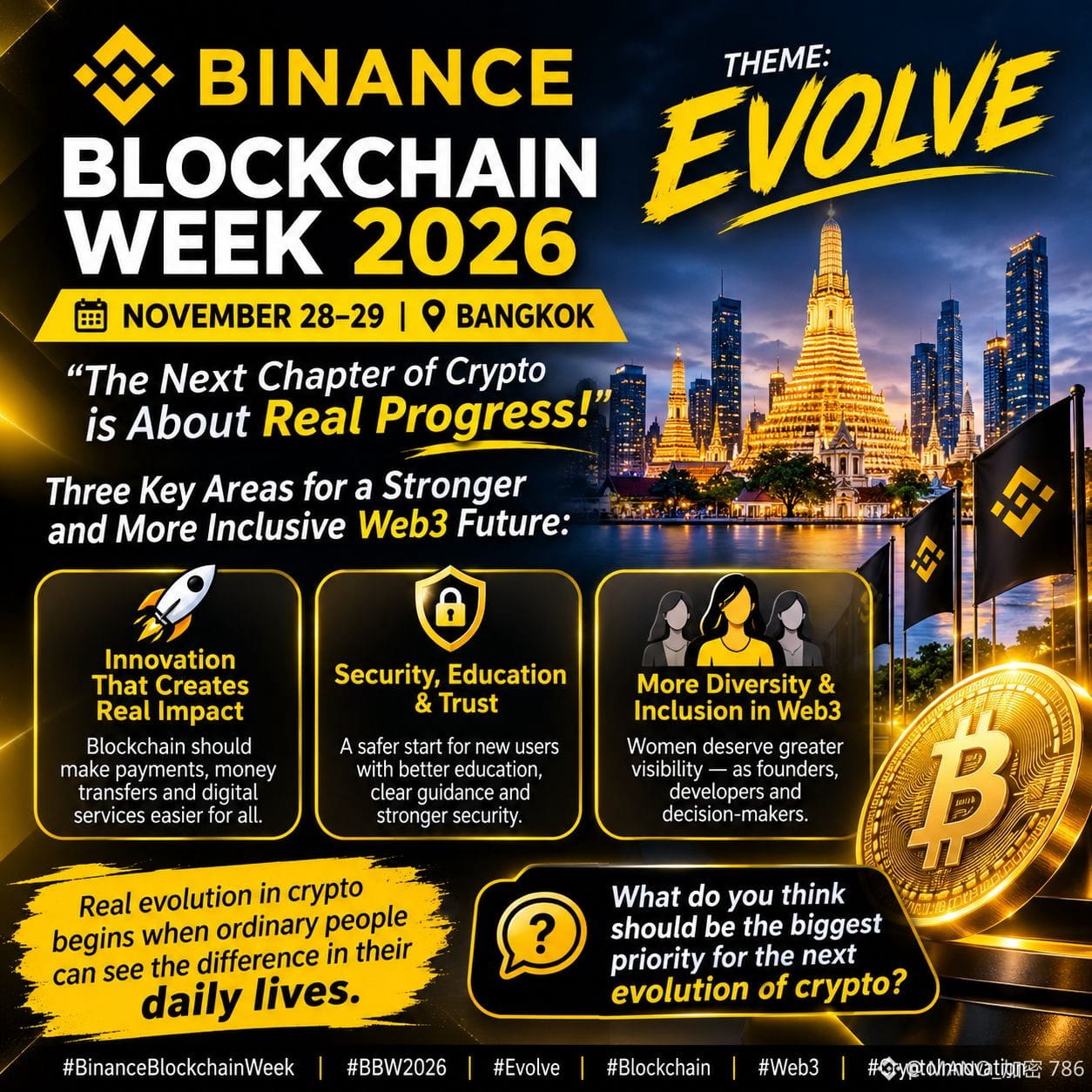
🚀 BINANCE BLOCKCHAIN WEEK 2026 | THE FUTURE IS EVOLVING!
The next chapter of crypto should be defined by real progress, meaningful innovation, and solutions that people can experience in their everyday lives — not just promises and big announcements.
🌏 Binance Blockchain Week returns to Bangkok on November 28–29, bringing together innovators, developers, founders, and Web3 enthusiasts to explore what comes next for blockchain technology.
This year's theme, EVOLVE, highlights an important question: How far has the crypto industry really come, and what needs to improve?
Here are three key areas I believe deserve more attention:
🔹 Innovation That Creates Real Impact
Blockchain technology should solve real-world problems by making payments, money transfers, and digital asset management faster, easier, and more accessible.
🔹 Security, Education & Trust
The future of crypto depends on building a safer environment for everyone. Better education, transparent information, and stronger security practices can help new users enter the space with confidence.
🔹 More Diversity & Inclusion in Web3
Women deserve a stronger voice in shaping the future of blockchain — as founders, developers, leaders, and decision-makers. True growth means creating opportunities for everyone.
Although I won't be attending physically in Bangkok, I'll be following the event online with great interest.
I'm looking forward to meaningful conversations, fresh perspectives, and practical ideas that can move the industry forward.
💡 My perspective: Real evolution in crypto isn't measured by hype or headlines. It's measured by the positive difference blockchain brings to people's lives.
🔥 What do you think should be the biggest priority for the next evolution of crypto?
#BinanceBlockchainWeek #BBW2026 #Evolve #BlockchainLifeAwards2024 #Web3metaverse
1
5
119

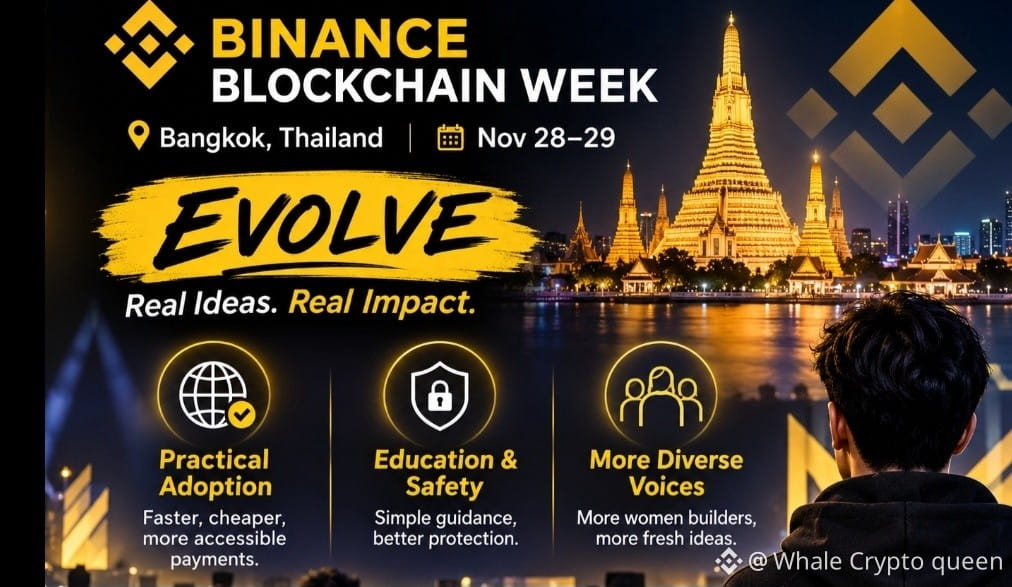
Crypto has reached a point where talking about the future isn't enough. It's time to show what this technology can actually do.
#Binance Blockchain Week is coming to Bangkok on November 28–29, with Evolve as its theme.
I am especially interested in a few things this year. Practical adoption: How can blockchain make everyday payments faster, cheaper, and more accessible?
Education and safety:New users need simple guidance to understand wallets, avoid scams, and protect their assets.
More diverse voices:I want to see more women builders sharing their experiences and getting recognition for their work.
For me the success of this event won't be about big promises or market predictions. It will be about useful ideas, honest discussions, and solutions that can make a difference beyond the crypto community.
I will be following the event online. Let's see what real progress looks like this year.
#BinanceBlockchainWeek
2
177

·
--
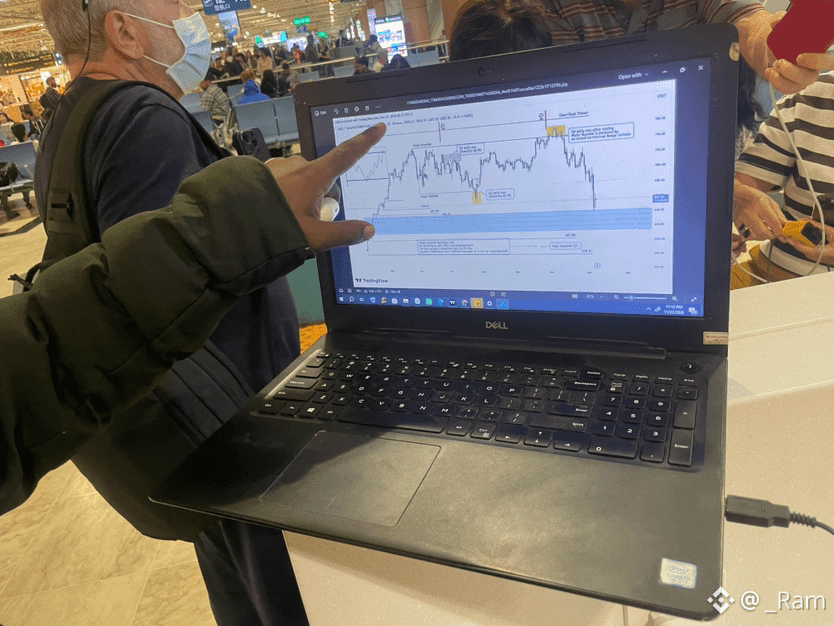
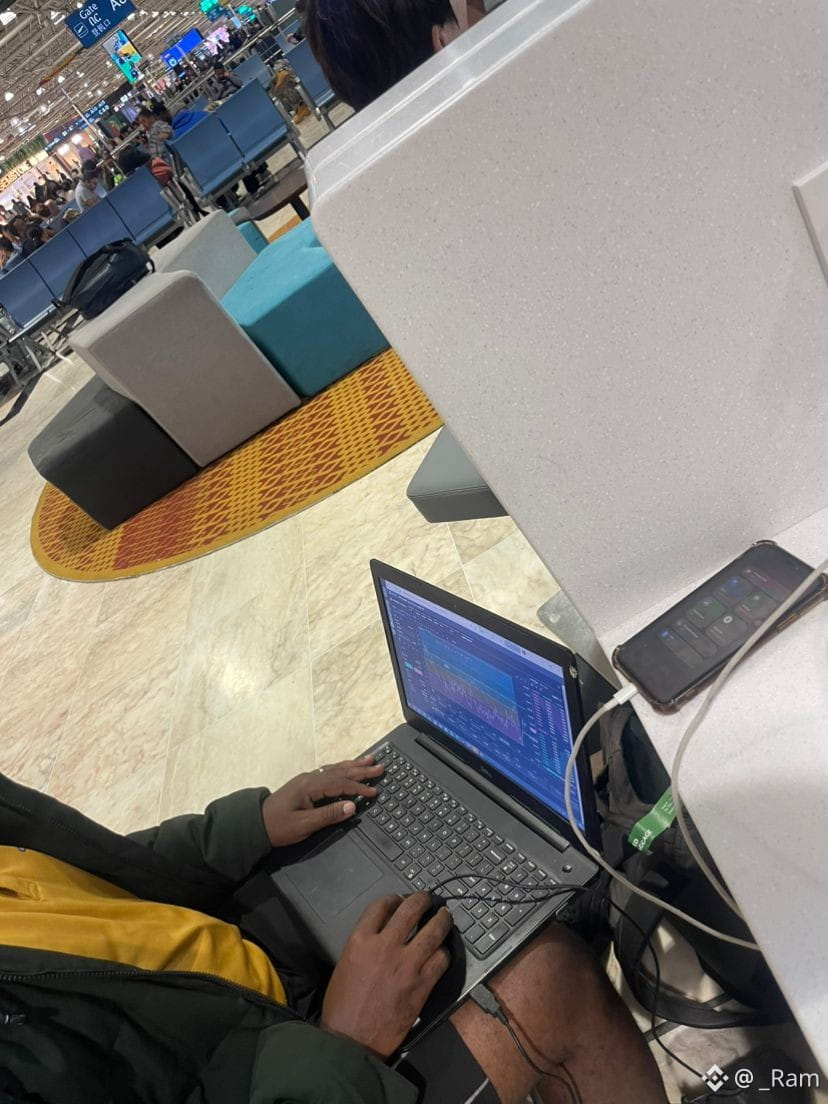
layover in addis ababa on my way to binance blockchain week.
the guy next to me wasn't sleeping or scrolling. he was eating btc charts. 😂 on tradingview, but straight on binance charts.
i just asked him if he's into crypto. that one question turned into minutes of market talk. he's waiting for a dip, i shared my view, and we only stopped when i said said it’s time for boarding. we're connected now.
not even in bangkok yet and the bbw energy already started.
#BinanceBlockchainWeek $BNB
Nice Crypto bd:
Invited me
4
12
785

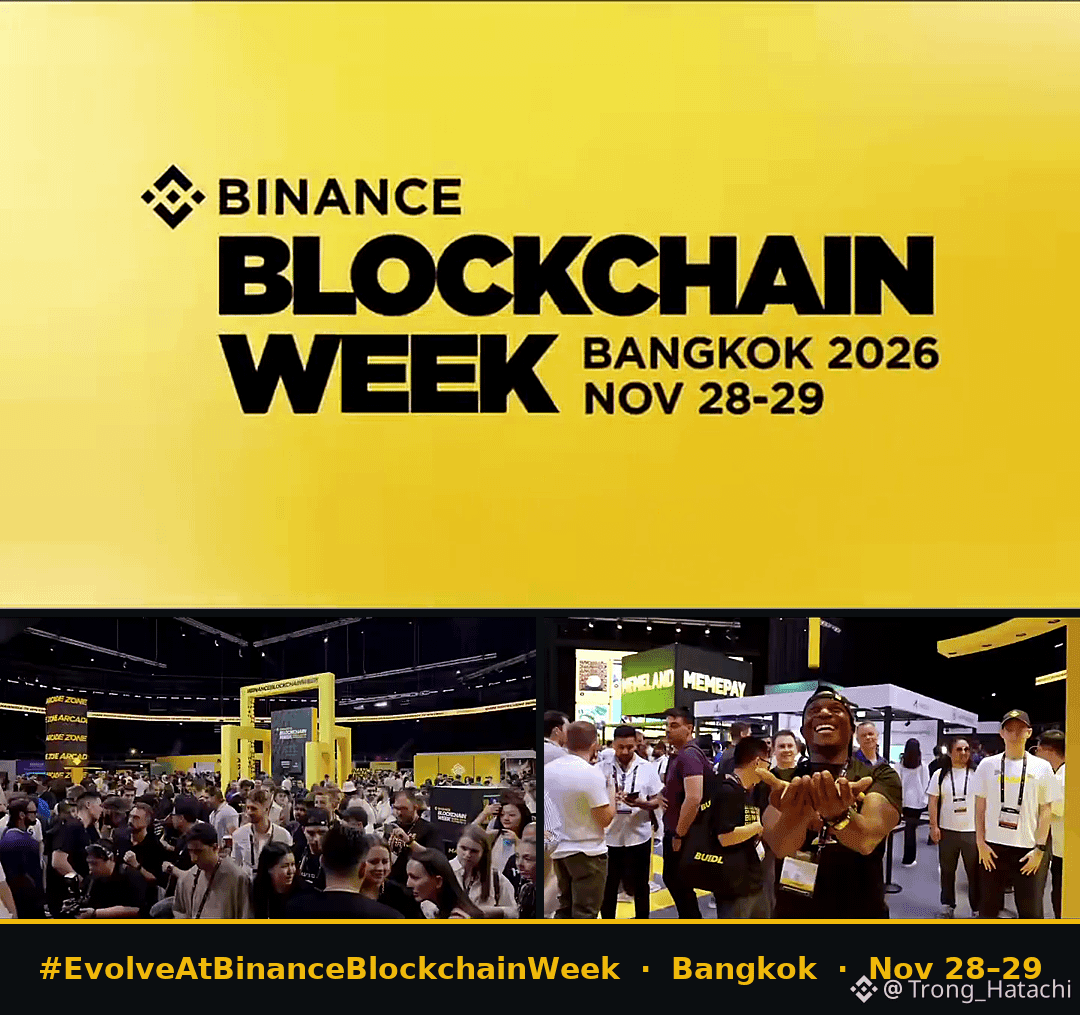
"Evolve" is a bold theme for a week when most of the market is still nursing red candles.
That's exactly why I'm watching Binance Blockchain Week in Bangkok (Nov 28–29) closely. Slow markets are when the builders who stay shape the next cycle.
What I'm looking forward to:
• AI x crypto: agents that can pay and transact on-chain by themselves. Fewer slides, more working demos.
• The Binance Trading Master Tournament, live on Square on Nov 28: 10 traders, real decisions, a $170K prize pool. Watching pros manage risk under pressure teaches more than any course.
• Real-world use: payments and tools normal people actually use, not just another token launch.
I'll be following online and sharing the moments that stand out.
What's one thing you want to see evolve in crypto next year? 👇
#EvolveAtBinanceBlockchainWeek #BinanceBlockchainWeek #BinanceSquare
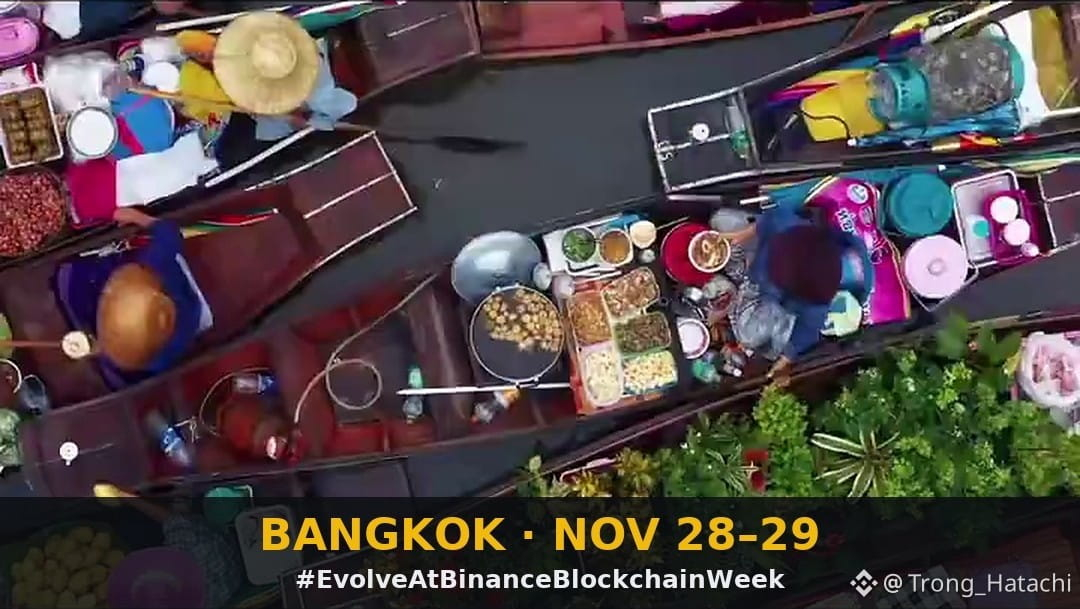
Binance Blockchain Week
·
--
Binance Blockchain Week 2026 is coming to Bangkok! 🌍
On November 28–29, industry leaders, builders and community members from around the world will come together.
This year’s theme is Evolve. From technological innovation to real-world applications, we’ll explore the future of blockchain and crypto. Whether you’re joining us in person or following online, your voice is part of the conversation!
Starting today, follow this account and post on Binance Square using #EvolveAtBinanceBlockchainWeek . Include an image and share what you’re looking forward to, your perspectives on the industry, or the ideas and moments that stand out during the event. 🎉🙌
🎁 We’ll select 20 users who post with the hashtag to receive 50 USDT each! The cutoff for draw entries is November 29 at 23:59 (UTC).
Let’s be part of this evolution and explore what’s possible together!
8
374

·
--
Bullish
Verified
Bangkok's Next Financial Frontier 🌏
Binance Blockchain Week returns November 28-29, bringing institutional leaders, policymakers, and blockchain builders together under one theme: EVOLVE.
One of the biggest conversations? How traditional finance can operate on blockchain infrastructure without sacrificing confidentiality.
🔹 Tokenized assets need selective disclosure.
🔹 Institutions require verifiable compliance.
🔹 Financial applications must protect sensitive information.
This is where Midnight's programmable privacy architecture becomes especially relevant, combining zero-knowledge technology with practical requirements for financial applications.
As the industry gathers in Bangkok, the conversation is shifting from what blockchain can do to what institutions actually need.
#BinanceBlockchainWeek
1
1.4k
Verified
News: Binance Blockchain Week Bangkok Starts November 28
Binance Blockchain Week Bangkok starts in five days, and its first offline trading tournament is on the schedule.
According to Binance's announcement, the Asia edition runs November 28-29 at the Queen Sirikit National Convention Center (QSNCC) in Bangkok, under the theme EVOLVE.
What we know:
Celo is the title sponsor, and Kite and Plasma are Platinum sponsors.
The Trading Master Tournament is Binance's first offline trading tournament. It takes place on Nov 28 and streams live on Binance Square from 1:00 to 3:00 PM Bangkok time (UTC+7).
Early bird tickets are listed at $59 in Binance's latest release.
Events like this are showcases, so I'm watching product announcements and regulatory comments from Asia more than the headline sessions.
What I'm watching: Day 1 announcements, tournament results, and which Asian regulators speak.
This is analysis, not financial advice.
Are you following BBW for product news or for the speakers?
#BinanceBlockchainWeek #BBW #Bangkok $KITE
Trong_Hatachi:
I’m watching for product announcements and what Asian regulators say. The offline trading tournament sounds interesting too. Follow me back so we can compare notes!
1
2
705
·
--
Article
EVOLVE: BINANCE BLOCKCHAIN WEEK 2026 IS COMING!#EvolveAtBinanceBlockchainWeek
🚀 EVOLVE: THE NEXT CHAPTER OF CRYPTO STARTS AT BINANCE BLOCKCHAIN WEEK!
The global crypto community is heading to Bangkok!
📅 November 28–29, 2026
📍 Bangkok, Thailand
This year's theme is EVOLVE, and the agenda signals something BIG for the future of finance.
🔥 What's on the agenda?
• AI-powered financial innovation
• Tokenized stocks & real-world assets
• Institutional crypto adoption
• Stablecoins & global payments
• The future of DeFi and blockchain
🌍 With industry leaders from Binance, BlackRock, Visa, Nasdaq and Tether, this event could shape some important conversations about where digital finance is heading.
The biggest question: Is crypto evolving into the financial infrastructure of tomorrow?
👇 Which development are you most excited about?
#BinanceBlockchainWeek #Evolve #Binance
EVOLVE: BINANCE BLOCKCHAIN WEEK 2026 IS COMING!
#EvolveAtBinanceBlockchainWeek
🚀 EVOLVE: THE NEXT CHAPTER OF CRYPTO STARTS AT BINANCE BLOCKCHAIN WEEK!
The global crypto community is heading to Bangkok!
📅 November 28–29, 2026
📍 Bangkok, Thailand
This year's theme is EVOLVE, and the agenda signals something BIG for the future of finance.
🔥 What's on the agenda?
• AI-powered financial innovation
• Tokenized stocks & real-world assets
• Institutional crypto adoption
• Stablecoins & global payments
• The future of DeFi and blockchain
🌍 With industry leaders from Binance, BlackRock, Visa, Nasdaq and Tether, this event could shape some important conversations about where digital finance is heading.
The biggest question: Is crypto evolving into the financial infrastructure of tomorrow?
👇 Which development are you most excited about?
#BinanceBlockchainWeek #Evolve #Binance
45

·
--

Article
From a P2P Scam to Financial Freedom: 8 Years of Crypto Lessons in the Binance Blockchain Week SimulWhat if you could experience eight years of crypto life in just one interactive simulation?
I recently completed the Binance Blockchain Week 2026 life simulation, taking my character, Mai Le, from 2021 to 2029. The journey included market risks, financial decisions, career changes and technological evolution.
The final result was interesting:
- Starting portfolio: 18,143 USDT
- Final portfolio: 30,957 USDT
- Portfolio growth: Approximately 1.71x
- Life satisfaction: 75/100
- Player ranking: Top 32%
- Final lifestyle: Digital Nomad
But the most interesting part wasn't the final balance. It was the lessons behind those numbers.
1. Security Is More Important Than Profit
One of the biggest turning points happened in 2022 when Mai Le fell for a fake P2P payment screenshot.
This represents a very real problem in crypto markets.
Scammers often send edited screenshots or fake payment confirmations to convince sellers to release their cryptocurrency before the money actually arrives.
The important lesson is simple:
Never trust screenshots as proof of payment.
Always independently open your banking application, verify the actual credited amount and check that the transaction has settled before releasing crypto.
In P2P trading, one careless decision can erase the profits from several successful trades.
Security isn't an optional feature. It's the foundation of long-term participation in crypto.
2. Portfolio Allocation Matters More Than Random Hype
The simulation showed another important lesson: portfolio growth doesn't necessarily require chasing every trending altcoin.
The final portfolio allocation was:
- Bitcoin (BTC): 32%
- USDT: 21%
- BNB: 19%
- Flexible Earn: 15%
- Gold and TradFi: 12%
- Speculative altcoins: 0%
This strategy combined different financial roles.
Bitcoin represented the core crypto allocation. BNB added exposure to the Binance ecosystem. USDT provided liquidity and flexibility. Flexible Earn represented passive-yield exposure, while Gold and traditional financial assets offered diversification.
The portfolio increased from 18,143 USDT to 30,957 USDT.
That's approximately 70.6% growth, or 1.71 times the starting capital.
However, an important point: this is a simulated outcome, not a guaranteed real-world investment return. Every asset carries different risks, and even a diversified portfolio can experience losses.
My takeaway is that allocation, patience and risk management deserve more attention than short-term excitement.
3. Liquidity Is an Underrated Advantage
Holding 21% in USDT is another interesting decision.
Many investors become fully invested during bullish markets and have no capital available when opportunities appear.
Liquidity gives investors flexibility.
It can help manage unexpected expenses, reduce forced selling and provide capital when attractive opportunities emerge.
But stablecoins are not risk-free. Issuer risk, depegging, exchange risk and custody risks still matter.
The objective should be maintaining a sensible balance between investment and available capital.
4. Technology Changes, So Investors Must Adapt
The simulation also highlighted the importance of career development.
Mai Le moved towards design in 2024 and explored AI and Agentic Finance during Binance Blockchain Week Bangkok 2026.
This is particularly interesting because Web3 is evolving beyond simple cryptocurrency trading.
AI agents, automated financial workflows, blockchain infrastructure and digital payments are creating new possibilities.
Agentic Finance could allow AI agents to interact with financial systems, execute predefined tasks and coordinate transactions under specific permissions.
However, automation also introduces new risks, including excessive permissions, malicious instructions and compromised wallets.
Understanding these technologies before adopting them is becoming increasingly important.
5. Financial Freedom Is More Than a Portfolio Number
The character finished the simulation as a Digital Nomad with 75/100 life satisfaction.
That ending represents something bigger than financial growth.
Building wealth is important, but so are flexibility, personal development, security and control over your time.
A portfolio can grow while financial stress remains high. Real financial progress should also consider how safely and sustainably someone manages their money.
My Personal Takeaway
This eight-year simulation reminded me of something important:
The crypto market rewards knowledge, but long-term survival requires discipline.
Don't release crypto without verifying payments. Don't invest everything because of FOMO. Don't ignore liquidity. And don't stop learning when the technology changes.
Bitcoin, DeFi, AI and Agentic Finance may represent different chapters of the same evolving digital economy.
The biggest opportunity isn't simply predicting which coin will pump next. It's learning how to participate in this ecosystem while managing risk.
Now I want to know about your experience:
Did your character become a Digital Nomad, a successful investor, a Web3 builder or something completely different?
Share your final result and biggest lesson from the simulation.
#BinanceBlockchainWeek #Mr_SPONDY_13
$BNB $CELO
{future}(CELOUSDT)
$KITE
{future}(KITEUSDT)
From a P2P Scam to Financial Freedom: 8 Years of Crypto Lessons in the Binance Blockchain Week Simul
What if you could experience eight years of crypto life in just one interactive simulation?
I recently completed the Binance Blockchain Week 2026 life simulation, taking my character, Mai Le, from 2021 to 2029. The journey included market risks, financial decisions, career changes and technological evolution.
The final result was interesting:
- Starting portfolio: 18,143 USDT
- Final portfolio: 30,957 USDT
- Portfolio growth: Approximately 1.71x
- Life satisfaction: 75/100
- Player ranking: Top 32%
- Final lifestyle: Digital Nomad
But the most interesting part wasn't the final balance. It was the lessons behind those numbers.
1. Security Is More Important Than Profit
One of the biggest turning points happened in 2022 when Mai Le fell for a fake P2P payment screenshot.
This represents a very real problem in crypto markets.
Scammers often send edited screenshots or fake payment confirmations to convince sellers to release their cryptocurrency before the money actually arrives.
The important lesson is simple:
Never trust screenshots as proof of payment.
Always independently open your banking application, verify the actual credited amount and check that the transaction has settled before releasing crypto.
In P2P trading, one careless decision can erase the profits from several successful trades.
Security isn't an optional feature. It's the foundation of long-term participation in crypto.
2. Portfolio Allocation Matters More Than Random Hype
The simulation showed another important lesson: portfolio growth doesn't necessarily require chasing every trending altcoin.
The final portfolio allocation was:
- Bitcoin (BTC): 32%
- USDT: 21%
- BNB: 19%
- Flexible Earn: 15%
- Gold and TradFi: 12%
- Speculative altcoins: 0%
This strategy combined different financial roles.
Bitcoin represented the core crypto allocation. BNB added exposure to the Binance ecosystem. USDT provided liquidity and flexibility. Flexible Earn represented passive-yield exposure, while Gold and traditional financial assets offered diversification.
The portfolio increased from 18,143 USDT to 30,957 USDT.
That's approximately 70.6% growth, or 1.71 times the starting capital.
However, an important point: this is a simulated outcome, not a guaranteed real-world investment return. Every asset carries different risks, and even a diversified portfolio can experience losses.
My takeaway is that allocation, patience and risk management deserve more attention than short-term excitement.
3. Liquidity Is an Underrated Advantage
Holding 21% in USDT is another interesting decision.
Many investors become fully invested during bullish markets and have no capital available when opportunities appear.
Liquidity gives investors flexibility.
It can help manage unexpected expenses, reduce forced selling and provide capital when attractive opportunities emerge.
But stablecoins are not risk-free. Issuer risk, depegging, exchange risk and custody risks still matter.
The objective should be maintaining a sensible balance between investment and available capital.
4. Technology Changes, So Investors Must Adapt
The simulation also highlighted the importance of career development.
Mai Le moved towards design in 2024 and explored AI and Agentic Finance during Binance Blockchain Week Bangkok 2026.
This is particularly interesting because Web3 is evolving beyond simple cryptocurrency trading.
AI agents, automated financial workflows, blockchain infrastructure and digital payments are creating new possibilities.
Agentic Finance could allow AI agents to interact with financial systems, execute predefined tasks and coordinate transactions under specific permissions.
However, automation also introduces new risks, including excessive permissions, malicious instructions and compromised wallets.
Understanding these technologies before adopting them is becoming increasingly important.
5. Financial Freedom Is More Than a Portfolio Number
The character finished the simulation as a Digital Nomad with 75/100 life satisfaction.
That ending represents something bigger than financial growth.
Building wealth is important, but so are flexibility, personal development, security and control over your time.
A portfolio can grow while financial stress remains high. Real financial progress should also consider how safely and sustainably someone manages their money.
My Personal Takeaway
This eight-year simulation reminded me of something important:
The crypto market rewards knowledge, but long-term survival requires discipline.
Don't release crypto without verifying payments. Don't invest everything because of FOMO. Don't ignore liquidity. And don't stop learning when the technology changes.
Bitcoin, DeFi, AI and Agentic Finance may represent different chapters of the same evolving digital economy.
The biggest opportunity isn't simply predicting which coin will pump next. It's learning how to participate in this ecosystem while managing risk.
Now I want to know about your experience:
Did your character become a Digital Nomad, a successful investor, a Web3 builder or something completely different?
Share your final result and biggest lesson from the simulation.
#BinanceBlockchainWeek #Mr_SPONDY_13
$BNB $CELO
$KITE
2
444

·
--
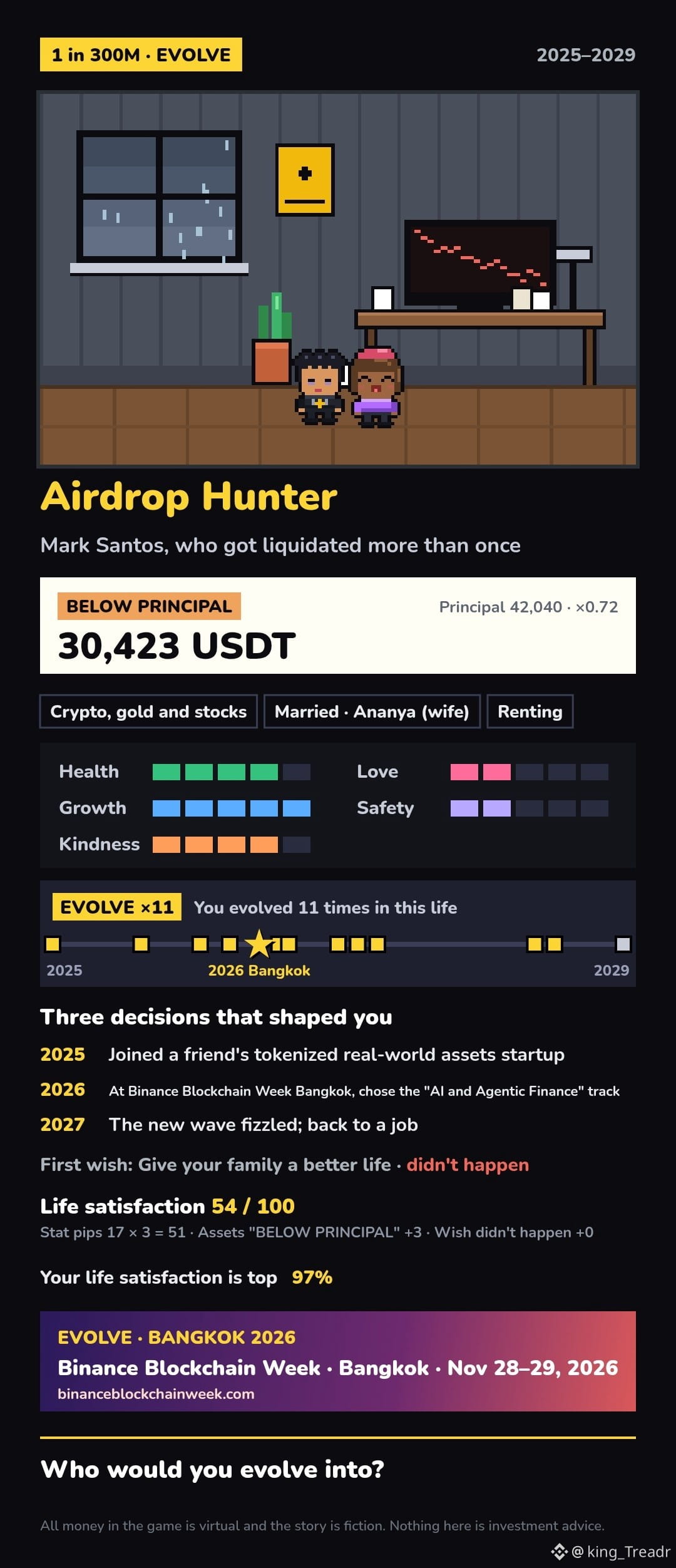
This #BinanceBlockchainWeek
I played the Binance Blockchain Week Pixel Mini Game and generate my life completion card.
My Avatar name Mark Santos,
Age 36, live in Philippines as Web3 developer.
He Joined Binance On 2025.
In "1 in 300M" I became the Airdrop Hunter who got liquidated more than once and evolved 11 times.
Final assets: 30,423 USDT (virtual).
Life satisfaction: top 97%.
Who would you evolve into?
See you at Binance Blockchain Week Bangkok, Nov 28–29! #EvolveAtBinanceBlockchainWeek
1
104

·
--
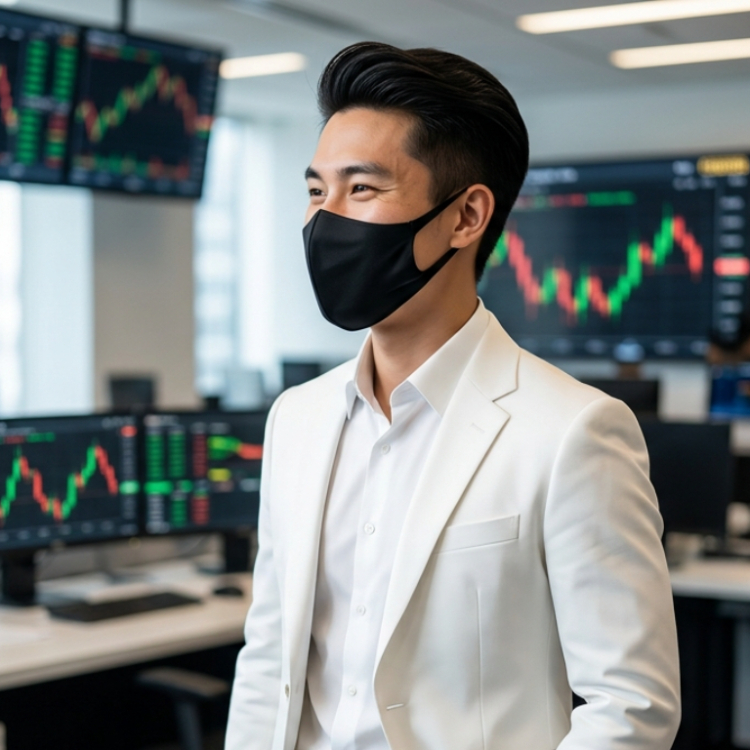
This Saturday, Binance Square is livestreaming a trading showdown from Bangkok.
On 28 Nov, the official Trading Master Tournament takes place live at Binance Blockchain Week Bangkok. Ten traders start with the same conditions — standardized accounts of 10,000 USDT each — and trade Binance Futures USDT pairs for 90 minutes. Prizes listed in the announcement are $100,000 / $50,000 / $20,000 for 1st–3rd.
You do not have to be there in person. Binance Square will livestream the whole tournament, starting at 06:00 UTC (13:00 WIB). Rankings and PnL are shown in real time. The official post also says traders will wear heart-rate devices on the venue screen and the stream, with live commentary and invited observers. Follow the official Binance Square Official account for the lineup and to set a reminder.
This is a different event from the BNB Chain hackathon / Demo Night (25–27 Nov). Binance Blockchain Week itself runs 28–29 Nov at Queen Sirikit National Convention Center, per the official event site.
Futures and leveraged trading can amplify losses. The announcement is clear: the strategies on stage are for the show, not investment advice, and you should not blindly copy them.
Not financial advice. DYOR.
$BNB #Binance #BinanceSquare #BinanceBlockchainWeek #Bangkok
148
·
--
#evolveatbinanceblockchainweek
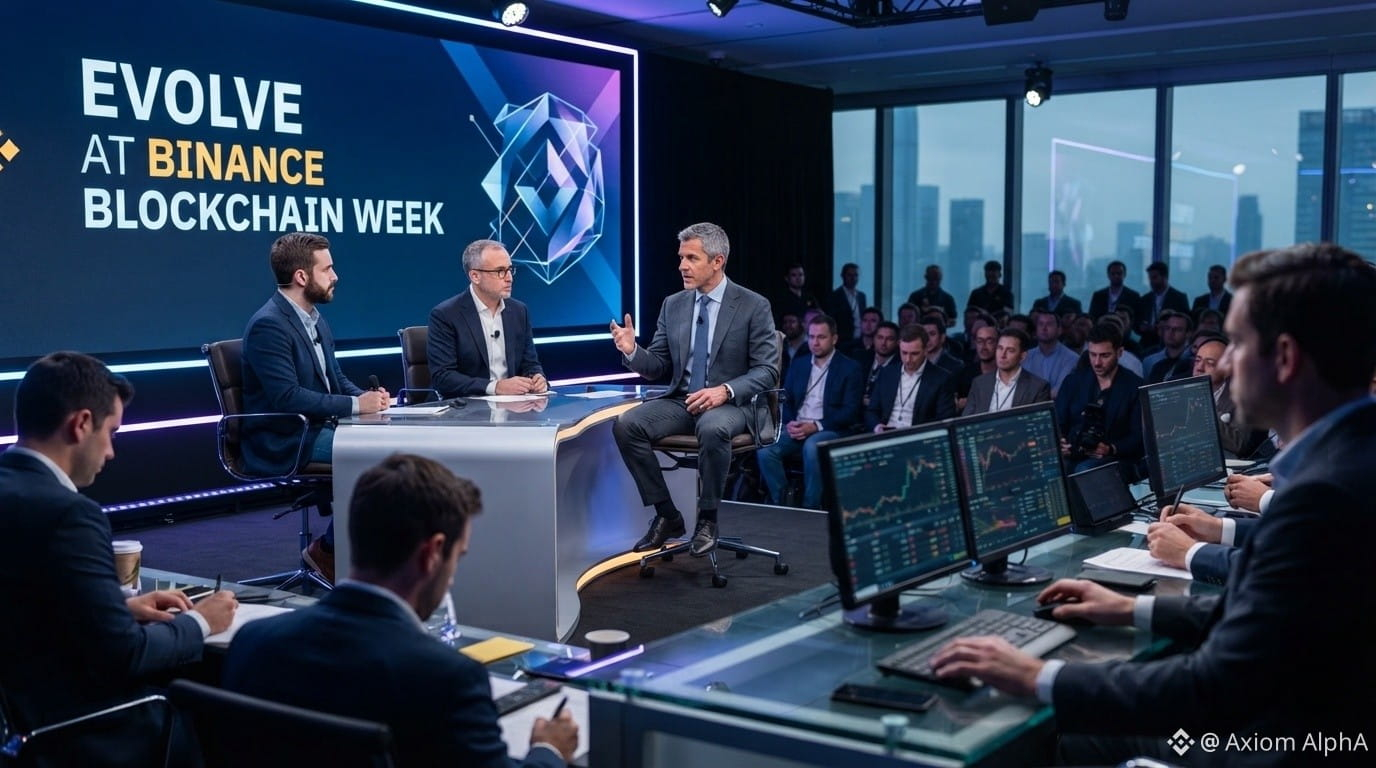
Binance Blockchain Week: The Evolution is Here! 🚀
The energy at #BinanceBlockchainWeek is electric. The key takeaway from our desk: the industry is moving beyond speculation and focusing on real-world utility and institutional adoption. The panels are confirming that smart money is positioning for the next wave of growth, driven by clearer regulation and scalable infrastructure. The future is being built right here. 🏗️
Tradeable Asset Trade Plans: BTC, ETH, SOL 🎯
With the macro landscape stabilizing and industry sentiment turning aggressively bullish, the path of least resistance is upward.
Bitcoin ($BTC ): The king of crypto is consolidating after re-testing $35,000. 👑
Action: We are looking for a confirmed daily close above $37,000 to validate the next leg up toward $40,000.
Stop-Loss: Below $34,500 on a swing failure. ⚠️
Ethereum ($ETH ): ETH is showing significant relative strength, pressing against the $2,000 psychological level. 💎
Action: A clean breakout above $2,050 targets a quick move to $2,200.
Stop-Loss: Below $1,950. 🆙
Solana ($SOL ): SOL remains a market leader, consolidating in a strong bullish flag. ⛓️
Action: A high-volume break above $60 targets price discovery toward $68–$72.
Stop-Loss: Below $50. 📈
Trade the levels, not the headlines. Risk management is mandatory. 🤜🤛
{spot}(BTCUSDT)
{spot}(ETHUSDT)
{spot}(SOLUSDT)
#CryptoNews #Binance #cryptotrading
#evolveatbinanceblockchainweek
Binance Blockchain Week: The Evolution is Here! 🚀
The energy at #BinanceBlockchainWeek is electric. The key takeaway from our desk: the industry is moving beyond speculation and focusing on real-world utility and institutional adoption. The panels are confirming that smart money is positioning for the next wave of growth, driven by clearer regulation and scalable infrastructure. The future is being built right here. 🏗️
Tradeable Asset Trade Plans: BTC, ETH, SOL 🎯
With the macro landscape stabilizing and industry sentiment turning aggressively bullish, the path of least resistance is upward.
Bitcoin ($BTC ): The king of crypto is consolidating after re-testing $35,000. 👑
Action: We are looking for a confirmed daily close above $37,000 to validate the next leg up toward $40,000.
Stop-Loss: Below $34,500 on a swing failure. ⚠️
Ethereum ($ETH ): ETH is showing significant relative strength, pressing against the $2,000 psychological level. 💎
Action: A clean breakout above $2,050 targets a quick move to $2,200.
Stop-Loss: Below $1,950. 🆙
Solana ($SOL ): SOL remains a market leader, consolidating in a strong bullish flag. ⛓️
Action: A high-volume break above $60 targets price discovery toward $68–$72.
Stop-Loss: Below $50. 📈
Trade the levels, not the headlines. Risk management is mandatory. 🤜🤛
#CryptoNews #Binance #cryptotrading
78
·
--
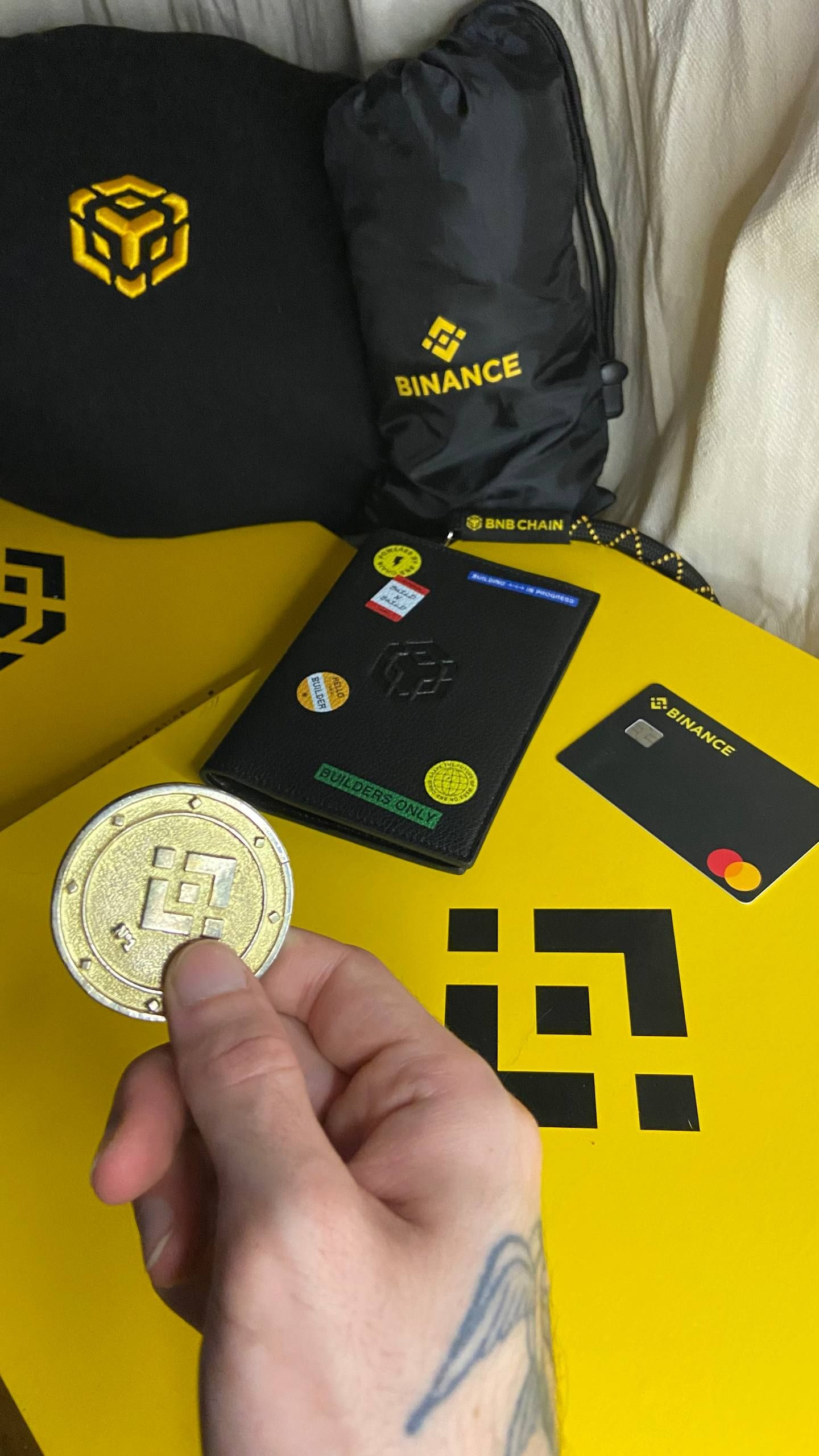
What's in my BBW suitcase? 💛
Binance Blockchain Week Bangkok. The theme is EVOLVE, so I packed what got me here.
• BNB Chain wallet. The sticker says "Builders Only." Fair.
• Binance Card. A trader still has to buy coffee.
• BNB Chain hoodie. Conference rooms run cold.
• Binance tee. For day two.
• Lucky coin. No price target, just superstition.
• Everyday essentials. The boring stuff saves the day.
In 2021 I downloaded an app. In 2026 I'm packing for Binance's flagship event.
Everything is ready. Everything except the suitcase. @binancebrasil , I know how to pack. I just need something to pack it in. #BinanceBlockchainWeek
What's in my BBW suitcase? 💛
Binance Blockchain Week Bangkok. The theme is EVOLVE, so I packed what got me here.
• BNB Chain wallet. The sticker says "Builders Only." Fair.
• Binance Card. A trader still has to buy coffee.
• BNB Chain hoodie. Conference rooms run cold.
• Binance tee. For day two.
• Lucky coin. No price target, just superstition.
• Everyday essentials. The boring stuff saves the day.
In 2021 I downloaded an app. In 2026 I'm packing for Binance's flagship event.
Everything is ready. Everything except the suitcase. @Binance Brasil Official , I know how to pack. I just need something to pack it in. #BinanceBlockchainWeek
1
159

·
--
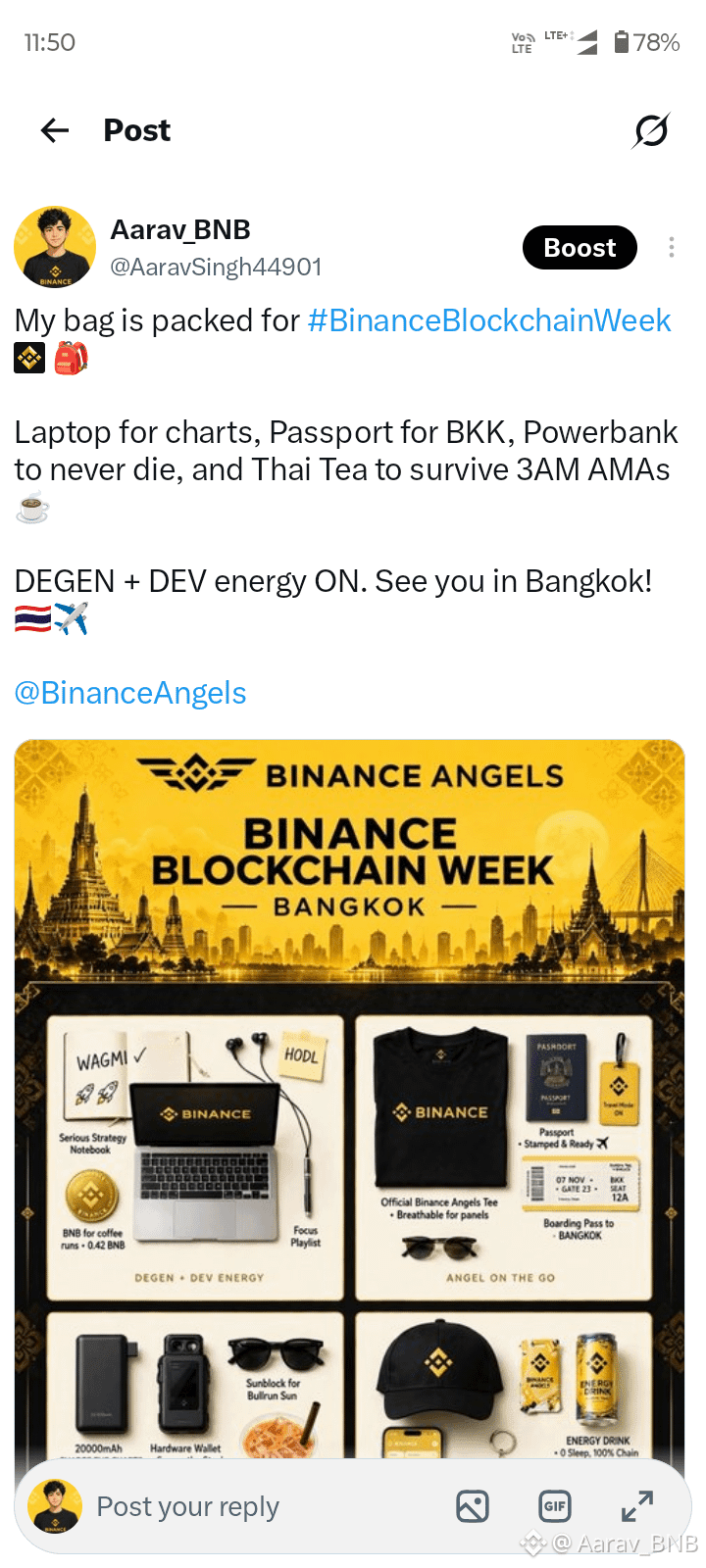
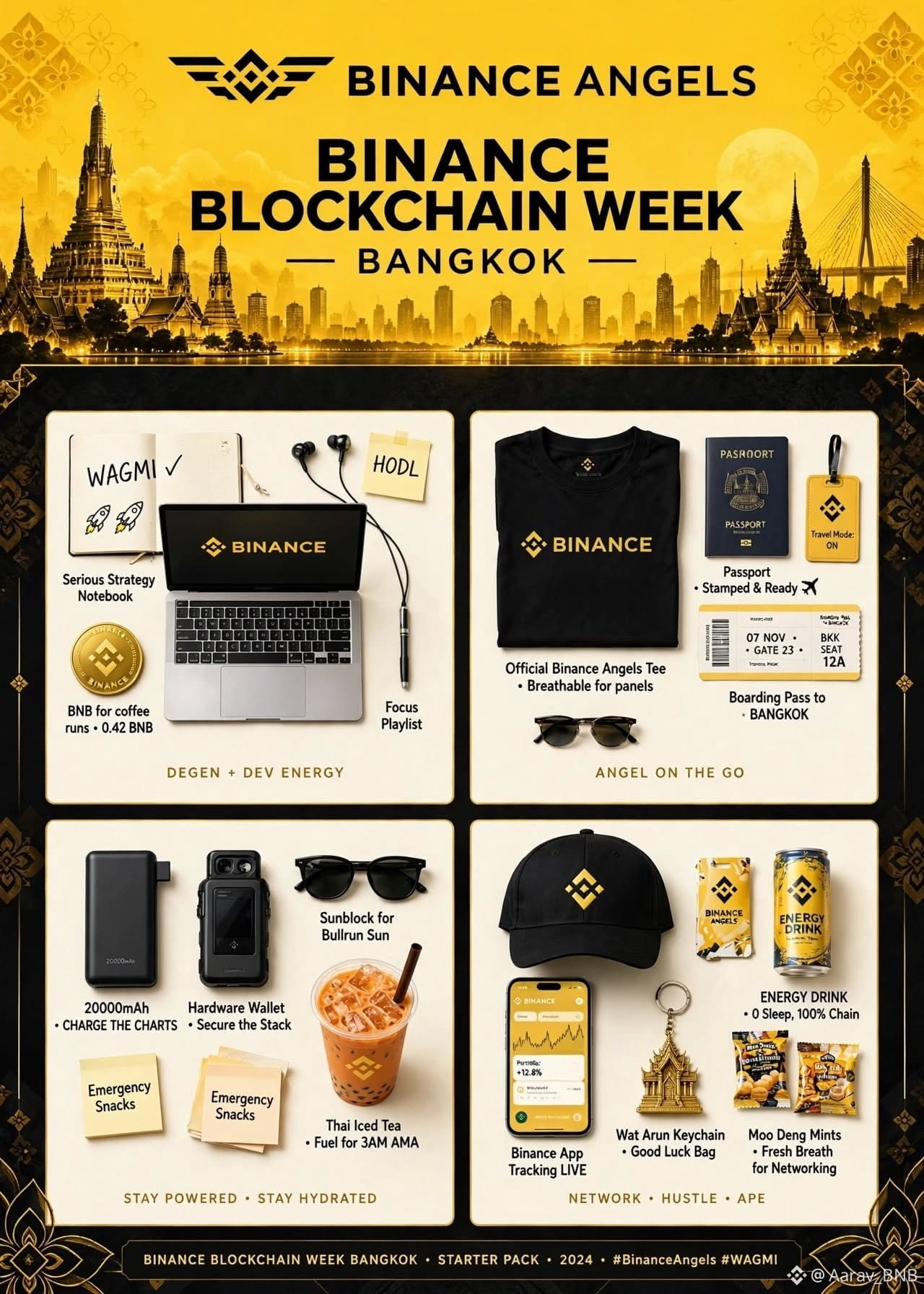
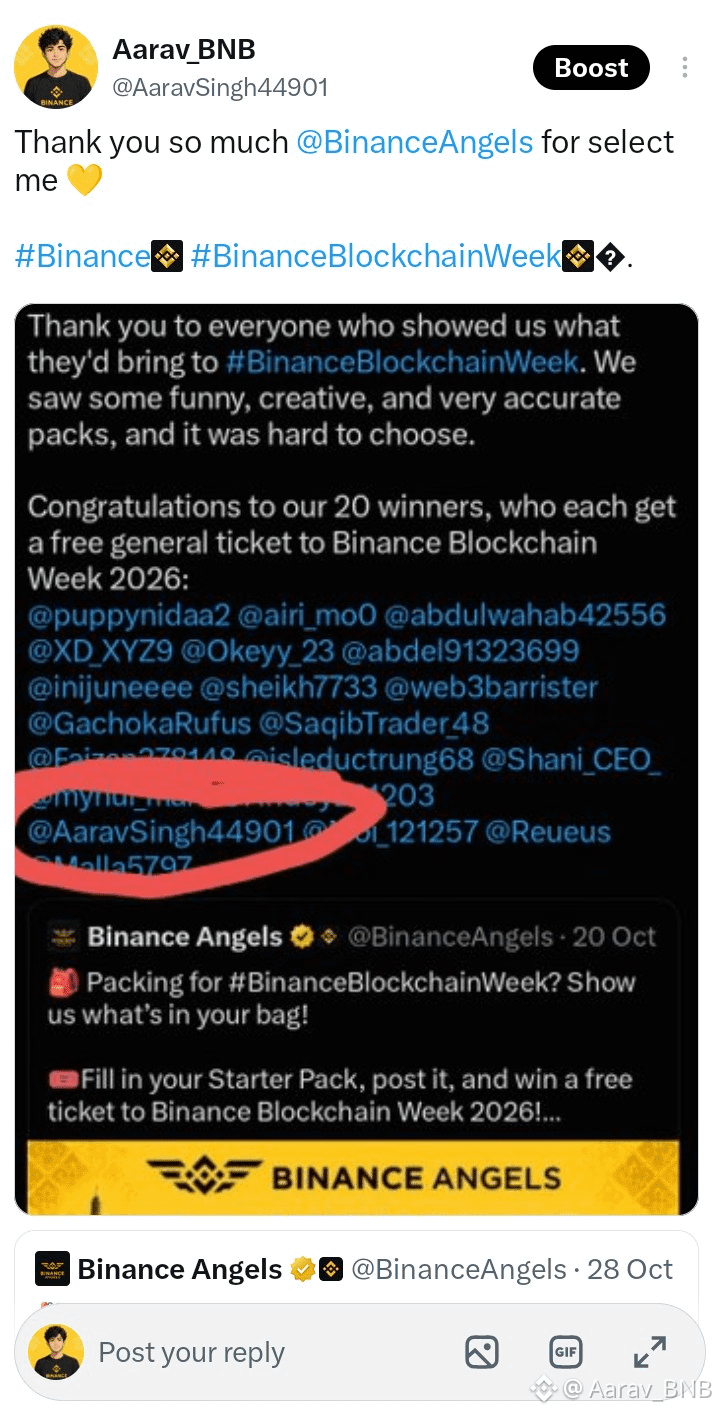
From winning a free ticket to now counting days for Bangkok! 🇹🇭✈️
I won my ticket to #BinanceBlockchainWeek 2026 with my Starter Pack, and now I can't wait for the main event on Nov 28-29.
This year's theme is EVOLVE, and for me evolve means - blockchain is no longer just about charts and trading. It's about real-world use cases, builders building real products, and community growing together.
What am I looking forward to?
- Meeting builders & creators in person
- Learning about new innovations
- 3AM AMAs with Thai Tea ☕️
My most memorable moment till now was when @Binance_Angels selected my pack. Now the next memorable moment will be in Bangkok!
Are you ready to evolve?
#EvolveAtBinanceBlockchainWeek
From winning a free ticket to now counting days for Bangkok! 🇹🇭✈️
I won my ticket to #BinanceBlockchainWeek 2026 with my Starter Pack, and now I can't wait for the main event on Nov 28-29.
This year's theme is EVOLVE, and for me evolve means - blockchain is no longer just about charts and trading. It's about real-world use cases, builders building real products, and community growing together.
What am I looking forward to?
- Meeting builders & creators in person
- Learning about new innovations
- 3AM AMAs with Thai Tea ☕️
My most memorable moment till now was when @Binance Angels selected my pack. Now the next memorable moment will be in Bangkok!
Are you ready to evolve?
#EvolveAtBinanceBlockchainWeek
Binance Blockchain Week
·
--
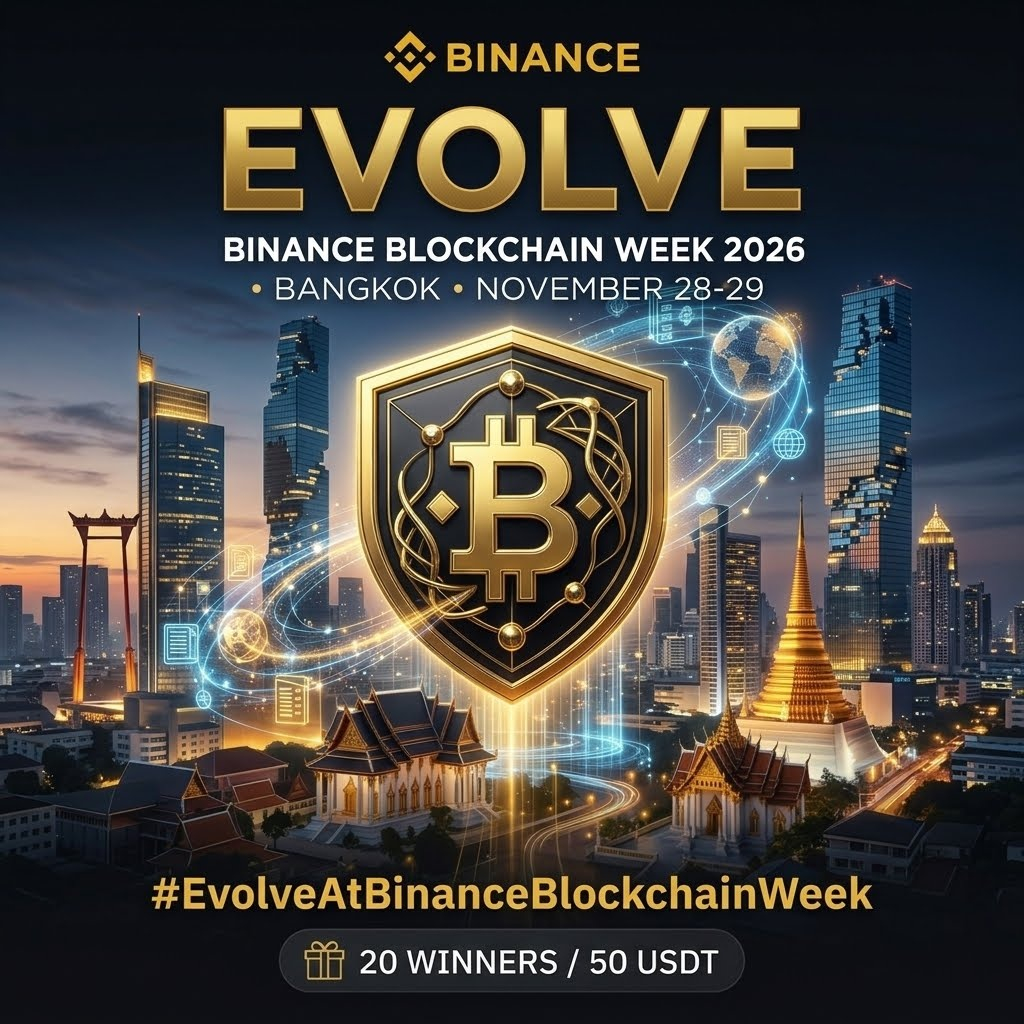
Binance Blockchain Week 2026 is coming to Bangkok! 🌍
On November 28–29, industry leaders, builders and community members from around the world will come together.
This year’s theme is Evolve. From technological innovation to real-world applications, we’ll explore the future of blockchain and crypto. Whether you’re joining us in person or following online, your voice is part of the conversation!
Starting today, follow this account and post on Binance Square using #EvolveAtBinanceBlockchainWeek . Include an image and share what you’re looking forward to, your perspectives on the industry, or the ideas and moments that stand out during the event. 🎉🙌
🎁 We’ll select 20 users who post with the hashtag to receive 50 USDT each! The cutoff for draw entries is November 29 at 23:59 (UTC).
Let’s be part of this evolution and explore what’s possible together!
On November 28–29, industry leaders, builders and community members from around the world will come together.
This year’s theme is Evolve. From technological innovation to real-world applications, we’ll explore the future of blockchain and crypto. Whether you’re joining us in person or following online, your voice is part of the conversation!
Starting today, follow this account and post on Binance Square using #EvolveAtBinanceBlockchainWeek . Include an image and share what you’re looking forward to, your perspectives on the industry, or the ideas and moments that stand out during the event. 🎉🙌
🎁 We’ll select 20 users who post with the hashtag to receive 50 USDT each! The cutoff for draw entries is November 29 at 23:59 (UTC).
Let’s be part of this evolution and explore what’s possible together!
3
473

·
--
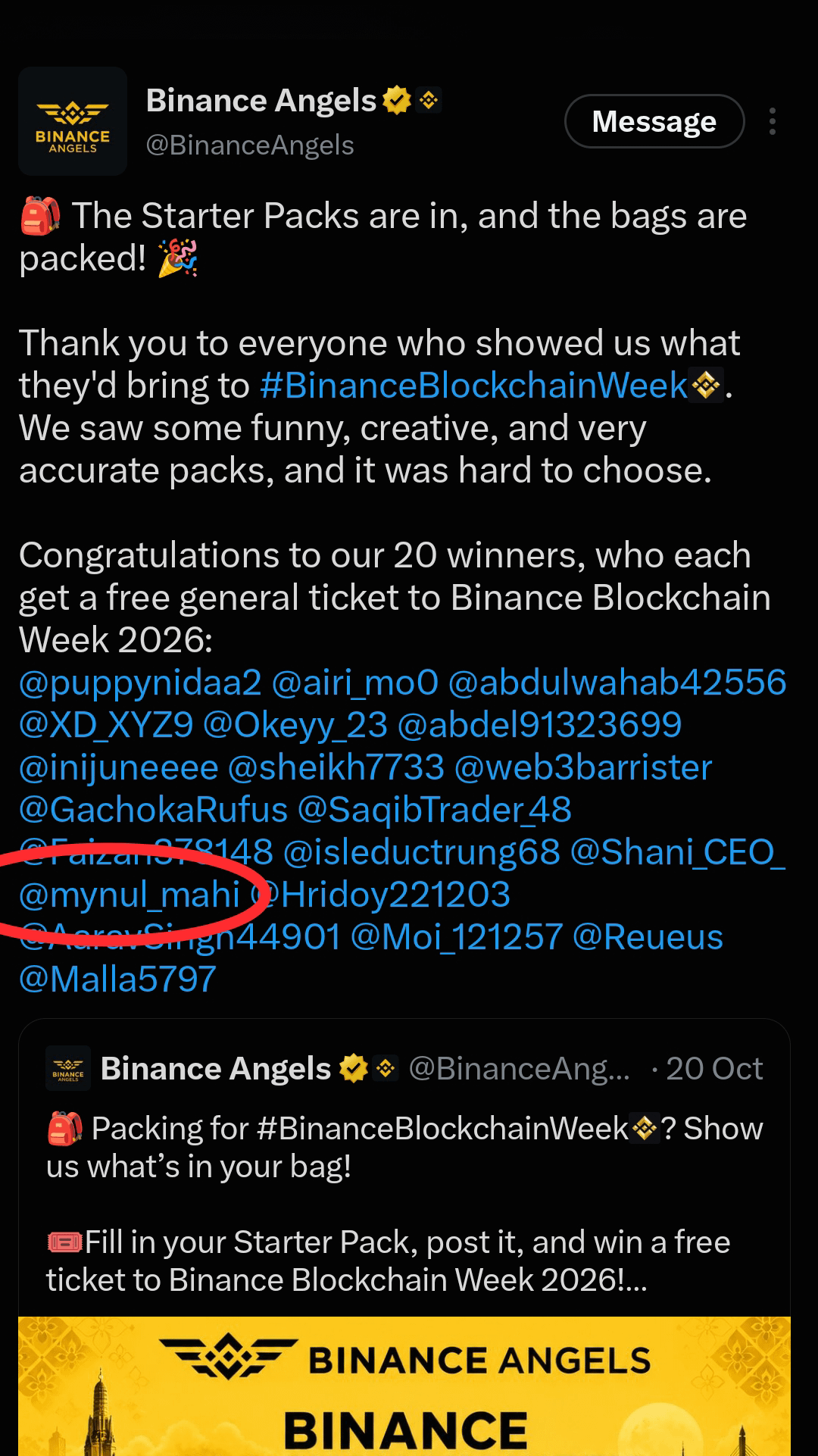
From winning a free ticket to now counting days for Bangkok! 🇹🇭✈️
I won my ticket to #BinanceBlockchainWeek 2026 with my Starter Pack, and now I can't wait for the main event on Nov 28-29.
The future of Web3 isn't just about what we build it's about how blockchain evolves to power everyday life. As Binance Blockchain Week 2026 kicks off in Bangkok on November 28–29, I'm most excited to see the shift from pure technical innovation to real world adoption. From seamless cross border payments to decentralized applications that anyone can use effortlessly, this year's Evolve theme hits the exact milestone our industry needs next.
Whether tuning in online or joining on the ground, it’s inspiring to watch builders and community members shape the next chapter of crypto together.
Follow @BinanceBlockchainWeek for more updates... What real world blockchain use case are you hoping to see take center stage this year? Drop your thoughts below! 👇🚀
#EvolveAtBinanceBlockchainWeek #BinanceSquareFamily #BBW2026
$BNB
{future}(BNBUSDT)
From winning a free ticket to now counting days for Bangkok! 🇹🇭✈️
I won my ticket to #BinanceBlockchainWeek 2026 with my Starter Pack, and now I can't wait for the main event on Nov 28-29.
The future of Web3 isn't just about what we build it's about how blockchain evolves to power everyday life. As Binance Blockchain Week 2026 kicks off in Bangkok on November 28–29, I'm most excited to see the shift from pure technical innovation to real world adoption. From seamless cross border payments to decentralized applications that anyone can use effortlessly, this year's Evolve theme hits the exact milestone our industry needs next.
Whether tuning in online or joining on the ground, it’s inspiring to watch builders and community members shape the next chapter of crypto together.
Follow @Binance Blockchain Week for more updates... What real world blockchain use case are you hoping to see take center stage this year? Drop your thoughts below! 👇🚀
#EvolveAtBinanceBlockchainWeek #BinanceSquareFamily #BBW2026
$BNB
1
383

·
--
Bullish
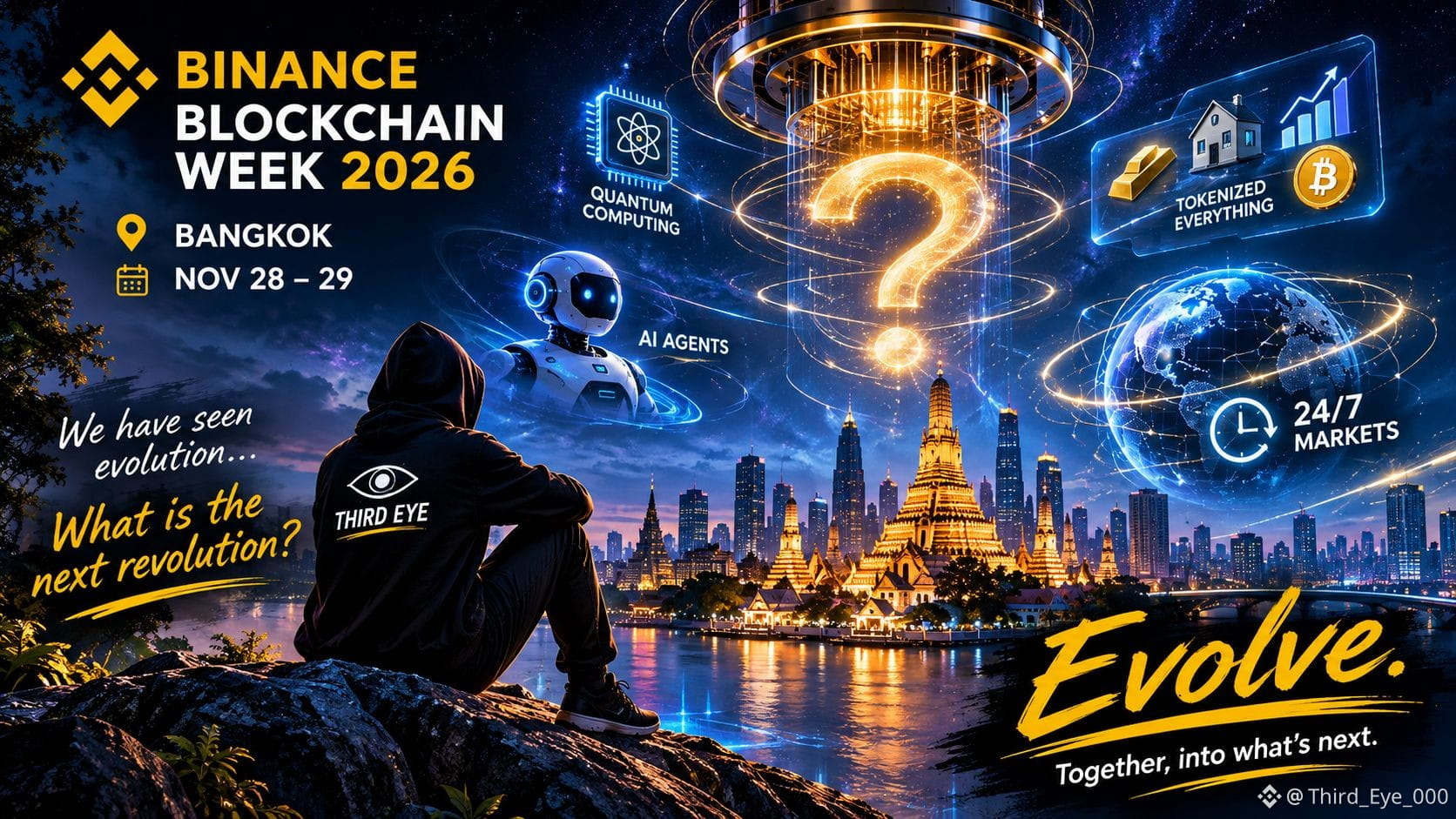
Sometimes I stop and think: this industry is moving so fast. Are we even ready for what comes next? 🤔
This year, #BinanceBlockchainWeek comes to Bangkok with one theme: Evolve. 😱
And honestly, the word fits.😘
Look at what changed 👇
🤖 AI can research, analyze, and even trade.
🥇 Markets are moving toward 24/7 trading.
⛓️ Blockchain has grown far beyond what we thought possible a few years ago.
Now the big question: what about quantum computing? Could it change security, blockchain, and all technology?
I don't know what the next big thing will be. That's the exciting part.☺️
On Nov 28–29, builders and leaders will meet in Bangkok. I want to hear what they say about the future. 🤔
We have seen evolution. What is the next revolution?
#EvolveAtBinanceBlockchainWeek
@BinanceBlockchainWeek
Sometimes I stop and think: this industry is moving so fast. Are we even ready for what comes next? 🤔
This year, #BinanceBlockchainWeek comes to Bangkok with one theme: Evolve. 😱
And honestly, the word fits.😘
Look at what changed 👇
🤖 AI can research, analyze, and even trade.
🥇 Markets are moving toward 24/7 trading.
⛓️ Blockchain has grown far beyond what we thought possible a few years ago.
Now the big question: what about quantum computing? Could it change security, blockchain, and all technology?
I don't know what the next big thing will be. That's the exciting part.☺️
On Nov 28–29, builders and leaders will meet in Bangkok. I want to hear what they say about the future. 🤔
We have seen evolution. What is the next revolution?
#EvolveAtBinanceBlockchainWeek
@Binance Blockchain Week
314

·
--
Countdown is on for Binance Blockchain Week 2026 in Bangkok (Nov 28–29) under the theme "Evolve"! 🎉🙌
The Web3 conversation has officially shifted from hype to real-world financial plumbing—and this lineup proves it. Here’s what I’m most excited to watch unfold:
🤖 The Agentic Economy: Autonomous AI agents are moving from theory to infrastructure, with payment networks and builders mapping out machine-to-machine commerce and trading rails.
🏦 TradFi Meets DeFi: Heavyweights like BlackRock, Nasdaq, and Visa sharing the stage with Ondo Finance, BNB Chain, and Tether to tackle tokenized RWAs and 24/7 markets.
💳 Stablecoins as Global Rails: Moving beyond if they work to how they power everyday cross-border settlement, retail payments, and transparent global aid.
The biggest takeaway? Institutional pragmatism. Instead of trying to disrupt legacy finance from the outside, crypto is actively upgrading it from the inside—building the compliance, cybersecurity, and UX bridges to onboard the next wave of everyday users.
Who else is tuning in or heading to Bangkok? 👇
#BinanceBlockchainWeek #EvolveAtBinanceBlockchainWeek #Web3 #Crypto
BLKUS-0.58%
182
Five days until Bangkok becomes the center of crypto. 🌏
Binance Blockchain Week 2026 kicks off Nov 28–29 at the Queen Sirikit National Convention Center, and the agenda tells you where smart money is looking next.
As a trader, I don't watch conferences for hype—I watch who is in the room. This year, leaders from BlackRock, Nasdaq, Visa, Tether, Ondo, and YZi Labs join regulators from four countries on stage.
Two narratives dominate the schedule:
⚡ Day 1 (Evolution of Capital): Stablecoin payment rails, institutional liquidity, and real-world asset tokenization.
🤖 Day 2 (Next-Gen Tech): AI agents and practical on-chain financial tools.
Retail chases yesterday’s candles. Institutions build tomorrow’s rails. Keeping a close eye on BNB,BTC, and key AI/RWA setups heading into next week.
Which sector are you positioning for right now—AI agents or tokenization? Drop your take below 👇
$BTC $BNB $ONDO
{future}(ONDOUSDT)
{future}(BTCUSDT)
{future}(BNBUSDT)
#evolveatbinanceblockchainweek
#BinanceBlockchainWeek #Tokenization #AIAgents
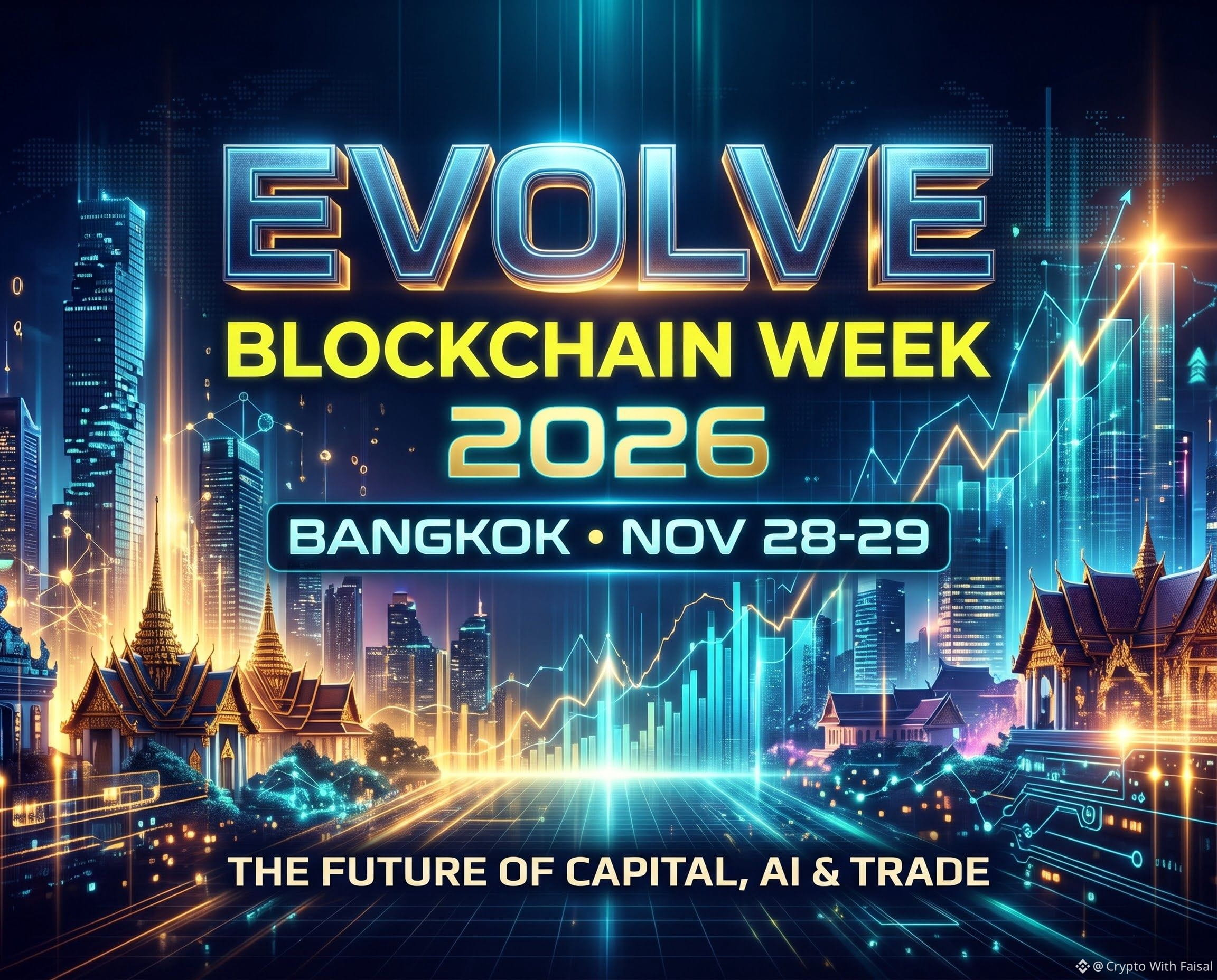
Five days until Bangkok becomes the center of crypto. 🌏
Binance Blockchain Week 2026 kicks off Nov 28–29 at the Queen Sirikit National Convention Center, and the agenda tells you where smart money is looking next.
As a trader, I don't watch conferences for hype—I watch who is in the room. This year, leaders from BlackRock, Nasdaq, Visa, Tether, Ondo, and YZi Labs join regulators from four countries on stage.
Two narratives dominate the schedule:
⚡ Day 1 (Evolution of Capital): Stablecoin payment rails, institutional liquidity, and real-world asset tokenization.
🤖 Day 2 (Next-Gen Tech): AI agents and practical on-chain financial tools.
Retail chases yesterday’s candles. Institutions build tomorrow’s rails. Keeping a close eye on BNB,BTC, and key AI/RWA setups heading into next week.
Which sector are you positioning for right now—AI agents or tokenization? Drop your take below 👇
$BTC $BNB $ONDO
#evolveatbinanceblockchainweek
#BinanceBlockchainWeek #Tokenization #AIAgents
3
283
Log in to explore more content
Join global crypto users on Binance Square
⚡️ Get latest and useful information about crypto.
💬 Trusted by the world’s largest crypto exchange.
👍 Discover real insights from verified creators.
Email / Phone number
Trending Topics
1
#AnthropicBreaksBelowIPOPriceAmidAISlump
6,363 views
129 Discussing
2
#Bitcoin'sReboundFadesBelow$60K
53,267 views
286 Discussing
3
#WillMarketsStageAThanksgivingReliefRally?
469,526 views
3,129 Discussing
4
#EthereumFoundationPlansShiftToHashBasedSignaturesBy2028
1,321 views
68 Discussing
5
#ADPWeeklyPrivatePayrollsSlowTo21000
902 views
36 Discussing
6
#WillOctCorePCEShiftFedHikeExpectations?
186,718 views
1,651 Discussing
7
#USReportedlyPreparesNewTariffsOn16TradingPartners
2,709 views
51 Discussing
8
#SouthKoreaDigitalAssetBillProposes20%ShareholderCap
610 views
10 Discussing
9
#SouthKoreaProposesBanksHoldOver50%OfStablecoinIssuers
255 views
7 Discussing
10
#EvolveAtBinanceBlockchainWeek
332,105 views
2,009 Discussing