

OroCryptoTrends
8.9k Posts

OroCryptoTrends
 Square Verified+
Report
Block User
OroCryptoTrends | Crypto Insights: Real-time crypto news, market analysis, Web3, DeFi & emerging trends. Research-driven, actionable insights. No hype.
Open Trade
Frequent Trader
3.3 Years
3.3K+ Following
51.2K+ Followers
49.2K+ Liked
Posts
Portfolio
All
Quotes
Videos
Live
Verified
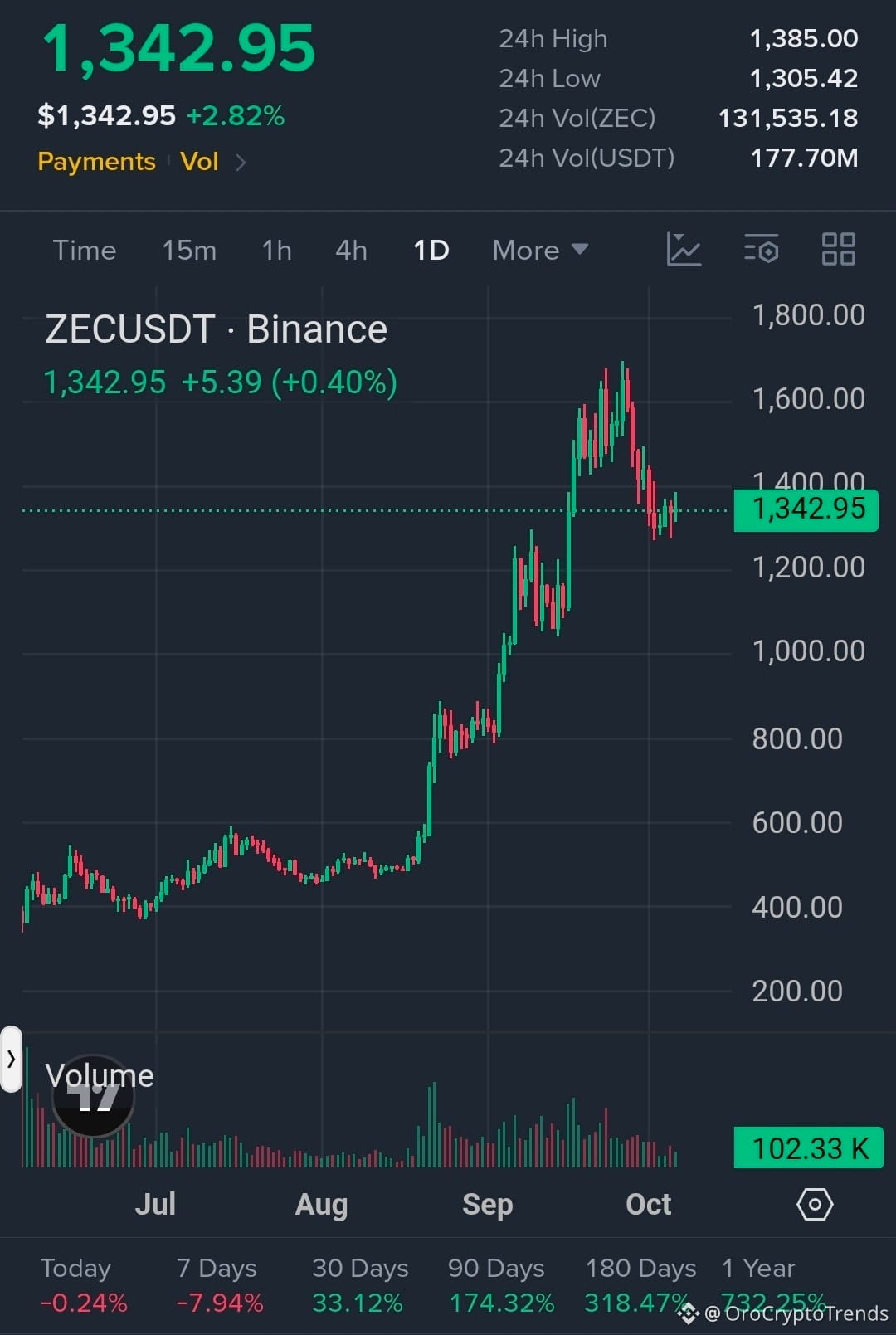
$ZEC Winklevoss just filed for a spot Zcash ETF. And honestly, I think the interesting part isn’t the ticker.
Winklevoss Asset Services filed an S-1 with the SEC for a proposed Zcash ETF that would hold ZEC directly and, if approved, trade on Nasdaq under WINK. Gemini Trust would provide custody.
But wait — a filing is not an approval.
What catches my attention is what this says about Zcash’s position in the market. Privacy coins have spent years sitting in a weird regulatory gray area. Now we’re seeing regulated investment products being built around ZEC anyway.
That changes the conversation.
It also means Zcash ETF competition is starting to become real. Grayscale already has ZCSH trading in the U.S., so this isn’t just about opening the first institutional door. It’s about competing for capital that already has a regulated route into ZEC.
And that’s where I’m watching closely.
More ETF access can increase legitimacy and potentially broaden demand. But it doesn’t automatically mean ZEC goes up. Approval, actual inflows, liquidity, fees, and investor demand matter much more than the headline.
Still trying to figure out whether this becomes a genuine institutional-demand story or just another ETF filing that gets overhyped.
$ZEC Winklevoss just filed for a spot Zcash ETF. And honestly, I think the interesting part isn’t the ticker.
Winklevoss Asset Services filed an S-1 with the SEC for a proposed Zcash ETF that would hold ZEC directly and, if approved, trade on Nasdaq under WINK. Gemini Trust would provide custody.
But wait — a filing is not an approval.
What catches my attention is what this says about Zcash’s position in the market. Privacy coins have spent years sitting in a weird regulatory gray area. Now we’re seeing regulated investment products being built around ZEC anyway.
That changes the conversation.
It also means Zcash ETF competition is starting to become real. Grayscale already has ZCSH trading in the U.S., so this isn’t just about opening the first institutional door. It’s about competing for capital that already has a regulated route into ZEC.
And that’s where I’m watching closely.
More ETF access can increase legitimacy and potentially broaden demand. But it doesn’t automatically mean ZEC goes up. Approval, actual inflows, liquidity, fees, and investor demand matter much more than the headline.
Still trying to figure out whether this becomes a genuine institutional-demand story or just another ETF filing that gets overhyped.
Winklevoss Asset Services filed an S-1 with the SEC for a proposed Zcash ETF that would hold ZEC directly and, if approved, trade on Nasdaq under WINK. Gemini Trust would provide custody.
But wait — a filing is not an approval.
What catches my attention is what this says about Zcash’s position in the market. Privacy coins have spent years sitting in a weird regulatory gray area. Now we’re seeing regulated investment products being built around ZEC anyway.
That changes the conversation.
It also means Zcash ETF competition is starting to become real. Grayscale already has ZCSH trading in the U.S., so this isn’t just about opening the first institutional door. It’s about competing for capital that already has a regulated route into ZEC.
And that’s where I’m watching closely.
More ETF access can increase legitimacy and potentially broaden demand. But it doesn’t automatically mean ZEC goes up. Approval, actual inflows, liquidity, fees, and investor demand matter much more than the headline.
Still trying to figure out whether this becomes a genuine institutional-demand story or just another ETF filing that gets overhyped.
2
975
$BTC Bitcoin ETFs just flipped back to outflows — but I don’t think the $89.9M number tells the whole story.
U.S. spot Bitcoin ETFs recorded roughly $89.9M in net outflows on October 5, after about $292.5M of combined inflows across October 1–2. BlackRock’s IBIT was the exception, pulling in about $69.9M while ARKB and FBTC saw much larger redemptions.
And honestly, this is where I get a little cautious about the “institutional demand is disappearing” narrative.
One negative session doesn’t erase the recent demand. What interests me more is the composition: money is still entering IBIT while other funds are seeing withdrawals. That looks less like a clean exit from Bitcoin and more like selective positioning.
But there’s another problem. BTC has struggled around $87K while Treasury yields remain elevated. If yields stay attractive and Bitcoin keeps failing at resistance, institutions have less reason to chase the move higher.
So I’m watching the next few ETF sessions closely. If outflows persist while BTC loses support, the reversal becomes more meaningful. If IBIT keeps absorbing capital, the bearish interpretation gets harder to defend.
Am I reading this wrong, or is the market overreacting to one day of ETF outflows?
$BTC Bitcoin ETFs just flipped back to outflows — but I don’t think the $89.9M number tells the whole story.
U.S. spot Bitcoin ETFs recorded roughly $89.9M in net outflows on October 5, after about $292.5M of combined inflows across October 1–2. BlackRock’s IBIT was the exception, pulling in about $69.9M while ARKB and FBTC saw much larger redemptions.
And honestly, this is where I get a little cautious about the “institutional demand is disappearing” narrative.
One negative session doesn’t erase the recent demand. What interests me more is the composition: money is still entering IBIT while other funds are seeing withdrawals. That looks less like a clean exit from Bitcoin and more like selective positioning.
But there’s another problem. BTC has struggled around $87K while Treasury yields remain elevated. If yields stay attractive and Bitcoin keeps failing at resistance, institutions have less reason to chase the move higher.
So I’m watching the next few ETF sessions closely. If outflows persist while BTC loses support, the reversal becomes more meaningful. If IBIT keeps absorbing capital, the bearish interpretation gets harder to defend.
Am I reading this wrong, or is the market overreacting to one day of ETF outflows?
U.S. spot Bitcoin ETFs recorded roughly $89.9M in net outflows on October 5, after about $292.5M of combined inflows across October 1–2. BlackRock’s IBIT was the exception, pulling in about $69.9M while ARKB and FBTC saw much larger redemptions.
And honestly, this is where I get a little cautious about the “institutional demand is disappearing” narrative.
One negative session doesn’t erase the recent demand. What interests me more is the composition: money is still entering IBIT while other funds are seeing withdrawals. That looks less like a clean exit from Bitcoin and more like selective positioning.
But there’s another problem. BTC has struggled around $87K while Treasury yields remain elevated. If yields stay attractive and Bitcoin keeps failing at resistance, institutions have less reason to chase the move higher.
So I’m watching the next few ETF sessions closely. If outflows persist while BTC loses support, the reversal becomes more meaningful. If IBIT keeps absorbing capital, the bearish interpretation gets harder to defend.
Am I reading this wrong, or is the market overreacting to one day of ETF outflows?
1
870
Guinea’s biggest risk may not be failing to develop Simandou. It may be developing it successfully — and still failing to diversify.
The World Bank is pushing Guinea to use the coming iron-ore revenues to build growth beyond mining. That matters because Simandou is expected to drive a major acceleration in Guinea’s economy as iron-ore production ramps up.
But here’s the part I find more interesting.
A mining boom can make headline GDP look incredible while leaving the underlying economy vulnerable. If most of the new wealth stays concentrated around extraction, infrastructure linked to mining, and government revenue, then the country can become even more exposed to commodity cycles.
Wait — maybe “diversification” is actually the real Simandou story.
The opportunity is to turn mining revenue into things that keep producing value after the ore cycle changes: better infrastructure, agriculture, education, skills, private investment and stronger institutions. That is essentially the direction the World Bank is advocating.
So I wouldn’t judge Simandou only by how much iron ore Guinea exports.
I’d judge it by what Guinea manages to build with the money.
That’s the harder test.
Still trying to figure out what this actually changes.
Guinea’s biggest risk may not be failing to develop Simandou. It may be developing it successfully — and still failing to diversify.
The World Bank is pushing Guinea to use the coming iron-ore revenues to build growth beyond mining. That matters because Simandou is expected to drive a major acceleration in Guinea’s economy as iron-ore production ramps up.
But here’s the part I find more interesting.
A mining boom can make headline GDP look incredible while leaving the underlying economy vulnerable. If most of the new wealth stays concentrated around extraction, infrastructure linked to mining, and government revenue, then the country can become even more exposed to commodity cycles.
Wait — maybe “diversification” is actually the real Simandou story.
The opportunity is to turn mining revenue into things that keep producing value after the ore cycle changes: better infrastructure, agriculture, education, skills, private investment and stronger institutions. That is essentially the direction the World Bank is advocating.
So I wouldn’t judge Simandou only by how much iron ore Guinea exports.
I’d judge it by what Guinea manages to build with the money.
That’s the harder test.
Still trying to figure out what this actually changes.
The World Bank is pushing Guinea to use the coming iron-ore revenues to build growth beyond mining. That matters because Simandou is expected to drive a major acceleration in Guinea’s economy as iron-ore production ramps up.
But here’s the part I find more interesting.
A mining boom can make headline GDP look incredible while leaving the underlying economy vulnerable. If most of the new wealth stays concentrated around extraction, infrastructure linked to mining, and government revenue, then the country can become even more exposed to commodity cycles.
Wait — maybe “diversification” is actually the real Simandou story.
The opportunity is to turn mining revenue into things that keep producing value after the ore cycle changes: better infrastructure, agriculture, education, skills, private investment and stronger institutions. That is essentially the direction the World Bank is advocating.
So I wouldn’t judge Simandou only by how much iron ore Guinea exports.
I’d judge it by what Guinea manages to build with the money.
That’s the harder test.
Still trying to figure out what this actually changes.

389
$BTC Bitcoin’s institutional demand isn’t disappearing — it’s splitting into two very different behaviors: strategic corporate accumulation on one side, and tactical ETF positioning on the other.
$BTC Bitcoin’s institutional demand isn’t disappearing — it’s splitting into two very different behaviors: strategic corporate accumulation on one side, and tactical ETF positioning on the other.
163
#ADAGains10%Above$0.27
ADA being up 10% matters less to me than what happens around $0.27 now.
The interesting part isn’t really the move itself. It’s that ADA has reclaimed a level the market now has to defend.
I keep reading these moves differently. A breakout can look convincing for a few hours, then completely lose meaning if buyers disappear when the first pullback arrives.
So $0.27 is the part I’m watching.
If ADA can stay above it and turn that old breakout area into actual support, the move starts looking more structural. If it slips straight back below, then the 10% gain starts looking more like momentum than confirmation.
Wait — maybe “breakout” isn’t even the right frame yet. The market still has to prove that this level has changed roles.
That’s the distinction I care about here: reclaiming resistance is one thing. Building support above it is another.
Am I reading this wrong, or is $0.27 the real test?
#ADAGains10%Above$0.27
ADA being up 10% matters less to me than what happens around $0.27 now.
The interesting part isn’t really the move itself. It’s that ADA has reclaimed a level the market now has to defend.
I keep reading these moves differently. A breakout can look convincing for a few hours, then completely lose meaning if buyers disappear when the first pullback arrives.
So $0.27 is the part I’m watching.
If ADA can stay above it and turn that old breakout area into actual support, the move starts looking more structural. If it slips straight back below, then the 10% gain starts looking more like momentum than confirmation.
Wait — maybe “breakout” isn’t even the right frame yet. The market still has to prove that this level has changed roles.
That’s the distinction I care about here: reclaiming resistance is one thing. Building support above it is another.
Am I reading this wrong, or is $0.27 the real test?
ADA being up 10% matters less to me than what happens around $0.27 now.
The interesting part isn’t really the move itself. It’s that ADA has reclaimed a level the market now has to defend.
I keep reading these moves differently. A breakout can look convincing for a few hours, then completely lose meaning if buyers disappear when the first pullback arrives.
So $0.27 is the part I’m watching.
If ADA can stay above it and turn that old breakout area into actual support, the move starts looking more structural. If it slips straight back below, then the 10% gain starts looking more like momentum than confirmation.
Wait — maybe “breakout” isn’t even the right frame yet. The market still has to prove that this level has changed roles.
That’s the distinction I care about here: reclaiming resistance is one thing. Building support above it is another.
Am I reading this wrong, or is $0.27 the real test?
3
1.1k
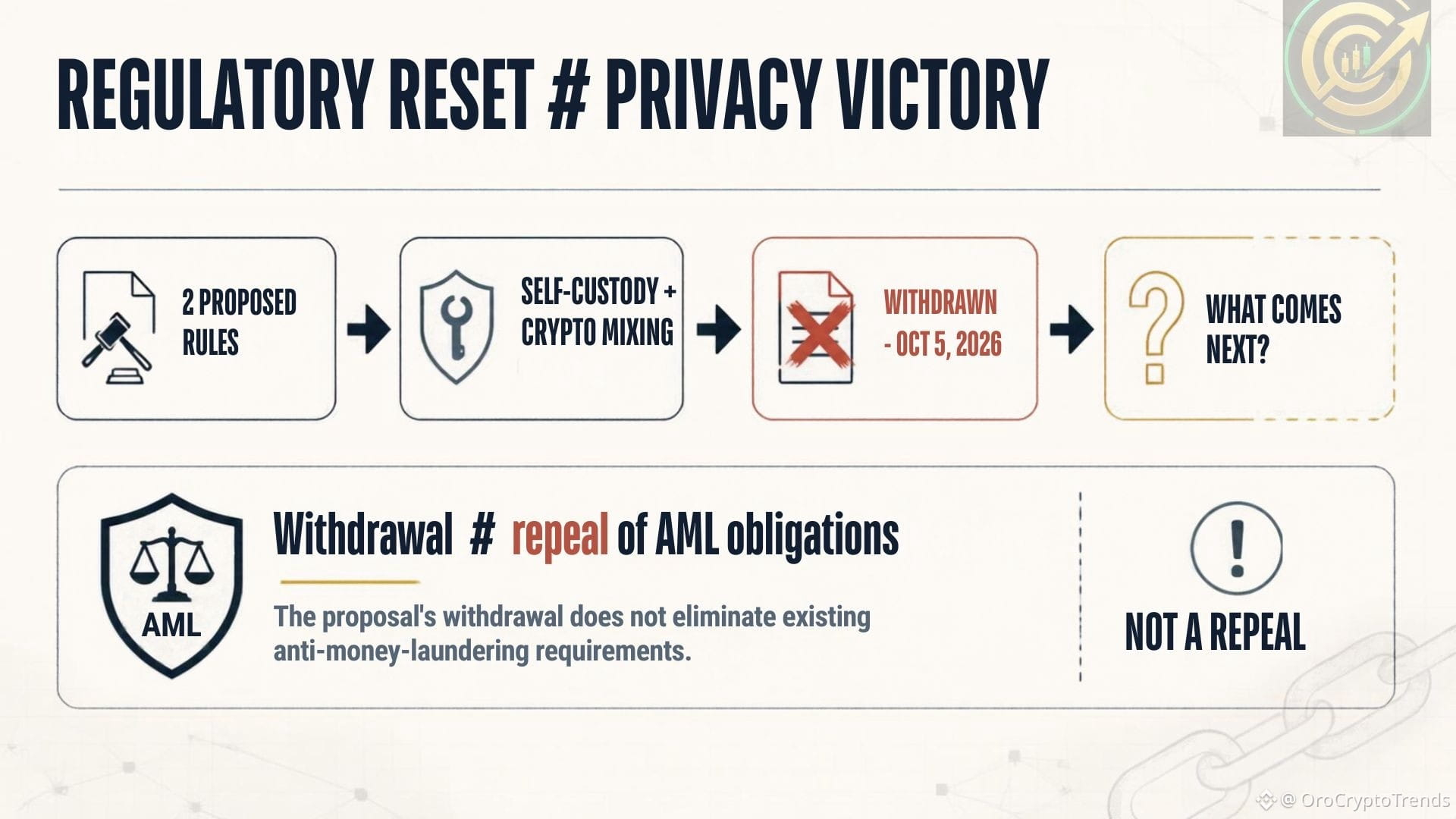
FinCEN just withdrew two proposed crypto rules. But I think the headline is easier to misunderstand than it looks.
One proposal would have created additional recordkeeping, verification and reporting requirements around certain convertible virtual-currency transactions involving unhosted or self-custody wallets. The other concerned a special measure involving crypto mixing.
Both were withdrawn on October 5.
My first reaction is not “privacy won.”
That feels too simple.
What actually changed is the regulatory direction. These particular proposals are no longer moving forward in the form they were proposed. And that matters for anyone building around self-custody, privacy tools, exchanges, or compliance infrastructure.
But wait — withdrawing a proposal isn't the same thing as removing existing AML obligations. It also doesn't mean mixers suddenly have some new blanket protection.
That distinction is important.
Honestly, the more interesting question is what comes next. If the administration wants digital-asset rules to be more “fit-for-purpose,” does that mean lighter requirements? More targeted enforcement? Different surveillance mechanisms?
We don't know yet.
So I wouldn't frame this as the U.S. abandoning crypto oversight. I'd frame it as a regulatory reset — and the replacement framework may tell us much more than the withdrawal itself.
Still trying to figure out what this actually changes.
FinCEN just withdrew two proposed crypto rules. But I think the headline is easier to misunderstand than it looks.
One proposal would have created additional recordkeeping, verification and reporting requirements around certain convertible virtual-currency transactions involving unhosted or self-custody wallets. The other concerned a special measure involving crypto mixing.
Both were withdrawn on October 5.
My first reaction is not “privacy won.”
That feels too simple.
What actually changed is the regulatory direction. These particular proposals are no longer moving forward in the form they were proposed. And that matters for anyone building around self-custody, privacy tools, exchanges, or compliance infrastructure.
But wait — withdrawing a proposal isn't the same thing as removing existing AML obligations. It also doesn't mean mixers suddenly have some new blanket protection.
That distinction is important.
Honestly, the more interesting question is what comes next. If the administration wants digital-asset rules to be more “fit-for-purpose,” does that mean lighter requirements? More targeted enforcement? Different surveillance mechanisms?
We don't know yet.
So I wouldn't frame this as the U.S. abandoning crypto oversight. I'd frame it as a regulatory reset — and the replacement framework may tell us much more than the withdrawal itself.
Still trying to figure out what this actually changes.
One proposal would have created additional recordkeeping, verification and reporting requirements around certain convertible virtual-currency transactions involving unhosted or self-custody wallets. The other concerned a special measure involving crypto mixing.
Both were withdrawn on October 5.
My first reaction is not “privacy won.”
That feels too simple.
What actually changed is the regulatory direction. These particular proposals are no longer moving forward in the form they were proposed. And that matters for anyone building around self-custody, privacy tools, exchanges, or compliance infrastructure.
But wait — withdrawing a proposal isn't the same thing as removing existing AML obligations. It also doesn't mean mixers suddenly have some new blanket protection.
That distinction is important.
Honestly, the more interesting question is what comes next. If the administration wants digital-asset rules to be more “fit-for-purpose,” does that mean lighter requirements? More targeted enforcement? Different surveillance mechanisms?
We don't know yet.
So I wouldn't frame this as the U.S. abandoning crypto oversight. I'd frame it as a regulatory reset — and the replacement framework may tell us much more than the withdrawal itself.
Still trying to figure out what this actually changes.
1
1.1k
$XRP The interesting XRP story may not be the upgrade itself. It’s whether anyone actually uses what’s being built.
XRPL is moving toward features that make the network more practical for institutional and financial applications. Confidential Transfers can shield token balances and transfer amounts while retaining mechanisms for auditing and compliance. Batch transactions can group multiple transactions so they execute together or fail together. And Ripple has already introduced tooling for AI-agent payments using XRP and RLUSD.
That sounds significant. But I think the harder question is still sitting underneath it.
How much of this becomes real economic activity?
A protocol can have better privacy, better transaction coordination and better AI tooling without automatically creating sustained demand for XRP. That's the part I don't want to blur.
If institutions actually deploy tokenized assets, use confidential transfers, settle transactions through XRPL, and generate meaningful activity, then the infrastructure story gets much stronger.
But an upgrade being available isn't the same thing as adoption.
So I'm watching implementation, transaction activity, liquidity and actual integrations more closely than another short-term XRP price target.
The technology is becoming more capable. Now the market has to prove there is a reason to use it.
$XRP The interesting XRP story may not be the upgrade itself. It’s whether anyone actually uses what’s being built.
XRPL is moving toward features that make the network more practical for institutional and financial applications. Confidential Transfers can shield token balances and transfer amounts while retaining mechanisms for auditing and compliance. Batch transactions can group multiple transactions so they execute together or fail together. And Ripple has already introduced tooling for AI-agent payments using XRP and RLUSD.
That sounds significant. But I think the harder question is still sitting underneath it.
How much of this becomes real economic activity?
A protocol can have better privacy, better transaction coordination and better AI tooling without automatically creating sustained demand for XRP. That's the part I don't want to blur.
If institutions actually deploy tokenized assets, use confidential transfers, settle transactions through XRPL, and generate meaningful activity, then the infrastructure story gets much stronger.
But an upgrade being available isn't the same thing as adoption.
So I'm watching implementation, transaction activity, liquidity and actual integrations more closely than another short-term XRP price target.
The technology is becoming more capable. Now the market has to prove there is a reason to use it.
XRPL is moving toward features that make the network more practical for institutional and financial applications. Confidential Transfers can shield token balances and transfer amounts while retaining mechanisms for auditing and compliance. Batch transactions can group multiple transactions so they execute together or fail together. And Ripple has already introduced tooling for AI-agent payments using XRP and RLUSD.
That sounds significant. But I think the harder question is still sitting underneath it.
How much of this becomes real economic activity?
A protocol can have better privacy, better transaction coordination and better AI tooling without automatically creating sustained demand for XRP. That's the part I don't want to blur.
If institutions actually deploy tokenized assets, use confidential transfers, settle transactions through XRPL, and generate meaningful activity, then the infrastructure story gets much stronger.
But an upgrade being available isn't the same thing as adoption.
So I'm watching implementation, transaction activity, liquidity and actual integrations more closely than another short-term XRP price target.
The technology is becoming more capable. Now the market has to prove there is a reason to use it.
988
Trump just turned “SI” from a social-media phrase into official U.S. government terminology.
On September 29, the White House ordered the executive branch to use “Super Intelligence” and “SI” instead of “Artificial Intelligence” and “AI.” Then today, Trump announced a new Super Intelligence Force, with DNI Director Jay Clayton among the officials leading it.
That part is real.
What I’m more interested in is what happens when this kind of political narrative collides with crypto.
Because if a token already trades under an “SI” ticker, it’s very easy for social attention to jump from the headline → ticker recognition → speculation.
But wait — that’s not the same thing as fundamental value.
The government changing its terminology doesn’t automatically create adoption, revenue, users, or technological utility for an unrelated token. In fact, the executive order currently defines “SI” around technologies already covered by the existing federal AI definition.
So I’d separate two things.
The policy story could matter enormously for the AI industry.
The crypto ticker reaction is a completely different transmission mechanism.
That distinction matters because narrative can move a market long before fundamentals do.
Still trying to figure out what this actually changes.
Trump just turned “SI” from a social-media phrase into official U.S. government terminology.
On September 29, the White House ordered the executive branch to use “Super Intelligence” and “SI” instead of “Artificial Intelligence” and “AI.” Then today, Trump announced a new Super Intelligence Force, with DNI Director Jay Clayton among the officials leading it.
That part is real.
What I’m more interested in is what happens when this kind of political narrative collides with crypto.
Because if a token already trades under an “SI” ticker, it’s very easy for social attention to jump from the headline → ticker recognition → speculation.
But wait — that’s not the same thing as fundamental value.
The government changing its terminology doesn’t automatically create adoption, revenue, users, or technological utility for an unrelated token. In fact, the executive order currently defines “SI” around technologies already covered by the existing federal AI definition.
So I’d separate two things.
The policy story could matter enormously for the AI industry.
The crypto ticker reaction is a completely different transmission mechanism.
That distinction matters because narrative can move a market long before fundamentals do.
Still trying to figure out what this actually changes.
On September 29, the White House ordered the executive branch to use “Super Intelligence” and “SI” instead of “Artificial Intelligence” and “AI.” Then today, Trump announced a new Super Intelligence Force, with DNI Director Jay Clayton among the officials leading it.
That part is real.
What I’m more interested in is what happens when this kind of political narrative collides with crypto.
Because if a token already trades under an “SI” ticker, it’s very easy for social attention to jump from the headline → ticker recognition → speculation.
But wait — that’s not the same thing as fundamental value.
The government changing its terminology doesn’t automatically create adoption, revenue, users, or technological utility for an unrelated token. In fact, the executive order currently defines “SI” around technologies already covered by the existing federal AI definition.
So I’d separate two things.
The policy story could matter enormously for the AI industry.
The crypto ticker reaction is a completely different transmission mechanism.
That distinction matters because narrative can move a market long before fundamentals do.
Still trying to figure out what this actually changes.
1
1
777
Verified
PayPay isn’t accepting crypto. And that’s actually the interesting part.
Binance Pay users visiting Japan can now pay at PayPay-supported merchants, with the connection running through TBCASoft’s HIVEX network. The merchant still receives Japanese yen, while the visitor pays through Binance Pay.
At first, I thought this was just another “crypto payments are expanding” headline.
Wait — maybe that’s not the right frame.
The more interesting piece is what stays unchanged.
The merchant doesn’t suddenly need to understand wallets, tokens, or blockchain settlement. There’s no new crypto checkout system for the store to learn. The payment infrastructure on the merchant side remains familiar, while Binance Pay effectively becomes another funding route behind the transaction.
That distinction matters.
It suggests one possible path for crypto payments: don’t ask merchants to rebuild their payment stack. Connect crypto users to systems people already use.
But there’s a limitation here that shouldn’t get buried. This launch is aimed at eligible international visitors to Japan. It is not available to Japanese residents. So this is currently much more about cross-border travel payments than domestic crypto adoption.
The real test, to me, is whether this architecture keeps getting connected to established payment networks in other markets.
That’s where this could become more interesting.
Still trying to figure out what this actually changes.
PayPay isn’t accepting crypto. And that’s actually the interesting part.
Binance Pay users visiting Japan can now pay at PayPay-supported merchants, with the connection running through TBCASoft’s HIVEX network. The merchant still receives Japanese yen, while the visitor pays through Binance Pay.
At first, I thought this was just another “crypto payments are expanding” headline.
Wait — maybe that’s not the right frame.
The more interesting piece is what stays unchanged.
The merchant doesn’t suddenly need to understand wallets, tokens, or blockchain settlement. There’s no new crypto checkout system for the store to learn. The payment infrastructure on the merchant side remains familiar, while Binance Pay effectively becomes another funding route behind the transaction.
That distinction matters.
It suggests one possible path for crypto payments: don’t ask merchants to rebuild their payment stack. Connect crypto users to systems people already use.
But there’s a limitation here that shouldn’t get buried. This launch is aimed at eligible international visitors to Japan. It is not available to Japanese residents. So this is currently much more about cross-border travel payments than domestic crypto adoption.
The real test, to me, is whether this architecture keeps getting connected to established payment networks in other markets.
That’s where this could become more interesting.
Still trying to figure out what this actually changes.
Binance Pay users visiting Japan can now pay at PayPay-supported merchants, with the connection running through TBCASoft’s HIVEX network. The merchant still receives Japanese yen, while the visitor pays through Binance Pay.
At first, I thought this was just another “crypto payments are expanding” headline.
Wait — maybe that’s not the right frame.
The more interesting piece is what stays unchanged.
The merchant doesn’t suddenly need to understand wallets, tokens, or blockchain settlement. There’s no new crypto checkout system for the store to learn. The payment infrastructure on the merchant side remains familiar, while Binance Pay effectively becomes another funding route behind the transaction.
That distinction matters.
It suggests one possible path for crypto payments: don’t ask merchants to rebuild their payment stack. Connect crypto users to systems people already use.
But there’s a limitation here that shouldn’t get buried. This launch is aimed at eligible international visitors to Japan. It is not available to Japanese residents. So this is currently much more about cross-border travel payments than domestic crypto adoption.
The real test, to me, is whether this architecture keeps getting connected to established payment networks in other markets.
That’s where this could become more interesting.
Still trying to figure out what this actually changes.

1
998
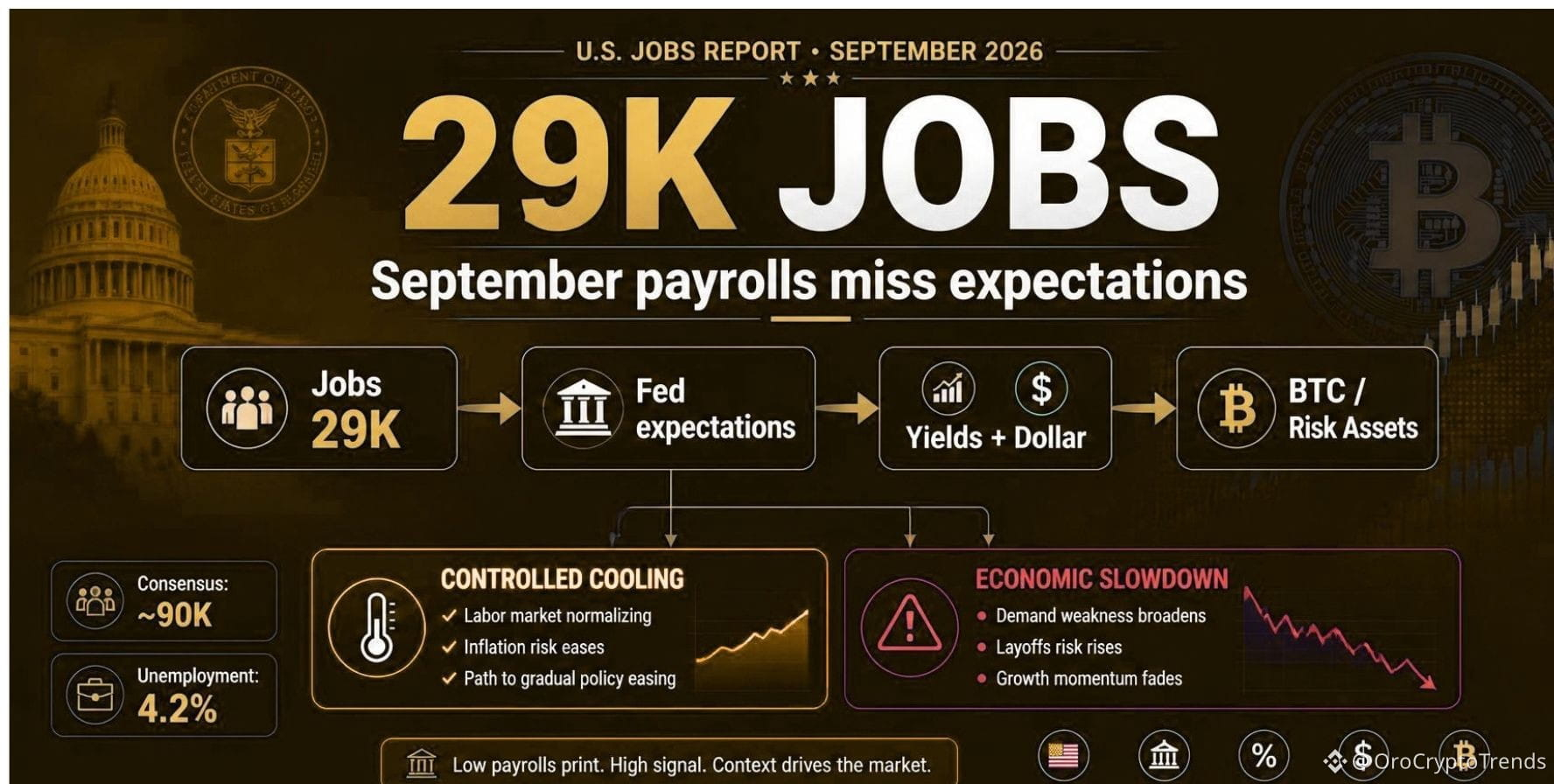
#NFPWatch 29K jobs. That’s the number that changes the conversation.
The September U.S. payroll report came in far below the roughly 90K consensus, while unemployment rose to 4.2% from 4.1%.
For crypto, I think the important part isn’t simply “weak jobs = bullish Bitcoin.” That’s too easy.
The bigger transmission mechanism is rates.
A softer labor market can reduce pressure on the Federal Reserve to keep tightening, which can pull Treasury yields and the dollar lower and improve the relative backdrop for risk assets. Reuters reported that markets moved toward a much lower probability of an October rate hike after the data, while equities gained and Treasury yields fell.
But there’s a contradiction here.
Weak employment is supportive for rate-sensitive assets only if investors interpret it as controlled cooling. If the labor market starts deteriorating rapidly, the narrative can shift from “less restrictive Fed” to “economic slowdown.”
That distinction matters for Bitcoin.
So I’m watching the reaction in yields, the dollar and BTC rather than treating the payroll headline by itself as a trade signal.
Still trying to figure out what this actually changes.
#NFPWatch 29K jobs. That’s the number that changes the conversation.
The September U.S. payroll report came in far below the roughly 90K consensus, while unemployment rose to 4.2% from 4.1%.
For crypto, I think the important part isn’t simply “weak jobs = bullish Bitcoin.” That’s too easy.
The bigger transmission mechanism is rates.
A softer labor market can reduce pressure on the Federal Reserve to keep tightening, which can pull Treasury yields and the dollar lower and improve the relative backdrop for risk assets. Reuters reported that markets moved toward a much lower probability of an October rate hike after the data, while equities gained and Treasury yields fell.
But there’s a contradiction here.
Weak employment is supportive for rate-sensitive assets only if investors interpret it as controlled cooling. If the labor market starts deteriorating rapidly, the narrative can shift from “less restrictive Fed” to “economic slowdown.”
That distinction matters for Bitcoin.
So I’m watching the reaction in yields, the dollar and BTC rather than treating the payroll headline by itself as a trade signal.
Still trying to figure out what this actually changes.
The September U.S. payroll report came in far below the roughly 90K consensus, while unemployment rose to 4.2% from 4.1%.
For crypto, I think the important part isn’t simply “weak jobs = bullish Bitcoin.” That’s too easy.
The bigger transmission mechanism is rates.
A softer labor market can reduce pressure on the Federal Reserve to keep tightening, which can pull Treasury yields and the dollar lower and improve the relative backdrop for risk assets. Reuters reported that markets moved toward a much lower probability of an October rate hike after the data, while equities gained and Treasury yields fell.
But there’s a contradiction here.
Weak employment is supportive for rate-sensitive assets only if investors interpret it as controlled cooling. If the labor market starts deteriorating rapidly, the narrative can shift from “less restrictive Fed” to “economic slowdown.”
That distinction matters for Bitcoin.
So I’m watching the reaction in yields, the dollar and BTC rather than treating the payroll headline by itself as a trade signal.
Still trying to figure out what this actually changes.
3
2k
$NEAR $3.8M disappeared from NEAR Intents — and the interesting part is where the failure happened.
NEAR Intents said today that a bug involving its Omni deposit-and-withdrawal infrastructure and smart contracts led to roughly $3.8 million in losses. The team says the vulnerability has been patched and affected users will be fully compensated. Deposits and withdrawals across several networks were also paused while the fix is completed.
What catches my attention is that this doesn’t look like a simple “the blockchain was hacked” story. The reported weakness sits around the infrastructure connecting assets across chains.
That distinction matters.
Cross-chain systems are basically trust pipelines. Every extra bridge, custody layer, settlement mechanism or contract interaction creates another place where assumptions have to hold. You can have good monitoring on one side and still get hurt when two components interact in a way nobody expected.
And honestly, that’s probably the bigger lesson here.
NEAR Intents had just demonstrated its ability to block much of a separate large illicit flow days earlier. Now its own infrastructure has taken a hit.
The team says users will be made whole, but the compensation is still a promise rather than a completed reimbursement.
So I’m watching the recovery process as closely as the exploit itself.
Still trying to figure out what this actually changes.
$NEAR $3.8M disappeared from NEAR Intents — and the interesting part is where the failure happened.
NEAR Intents said today that a bug involving its Omni deposit-and-withdrawal infrastructure and smart contracts led to roughly $3.8 million in losses. The team says the vulnerability has been patched and affected users will be fully compensated. Deposits and withdrawals across several networks were also paused while the fix is completed.
What catches my attention is that this doesn’t look like a simple “the blockchain was hacked” story. The reported weakness sits around the infrastructure connecting assets across chains.
That distinction matters.
Cross-chain systems are basically trust pipelines. Every extra bridge, custody layer, settlement mechanism or contract interaction creates another place where assumptions have to hold. You can have good monitoring on one side and still get hurt when two components interact in a way nobody expected.
And honestly, that’s probably the bigger lesson here.
NEAR Intents had just demonstrated its ability to block much of a separate large illicit flow days earlier. Now its own infrastructure has taken a hit.
The team says users will be made whole, but the compensation is still a promise rather than a completed reimbursement.
So I’m watching the recovery process as closely as the exploit itself.
Still trying to figure out what this actually changes.
NEAR Intents said today that a bug involving its Omni deposit-and-withdrawal infrastructure and smart contracts led to roughly $3.8 million in losses. The team says the vulnerability has been patched and affected users will be fully compensated. Deposits and withdrawals across several networks were also paused while the fix is completed.
What catches my attention is that this doesn’t look like a simple “the blockchain was hacked” story. The reported weakness sits around the infrastructure connecting assets across chains.
That distinction matters.
Cross-chain systems are basically trust pipelines. Every extra bridge, custody layer, settlement mechanism or contract interaction creates another place where assumptions have to hold. You can have good monitoring on one side and still get hurt when two components interact in a way nobody expected.
And honestly, that’s probably the bigger lesson here.
NEAR Intents had just demonstrated its ability to block much of a separate large illicit flow days earlier. Now its own infrastructure has taken a hit.
The team says users will be made whole, but the compensation is still a promise rather than a completed reimbursement.
So I’m watching the recovery process as closely as the exploit itself.
Still trying to figure out what this actually changes.
2
997
$XLK.ETF
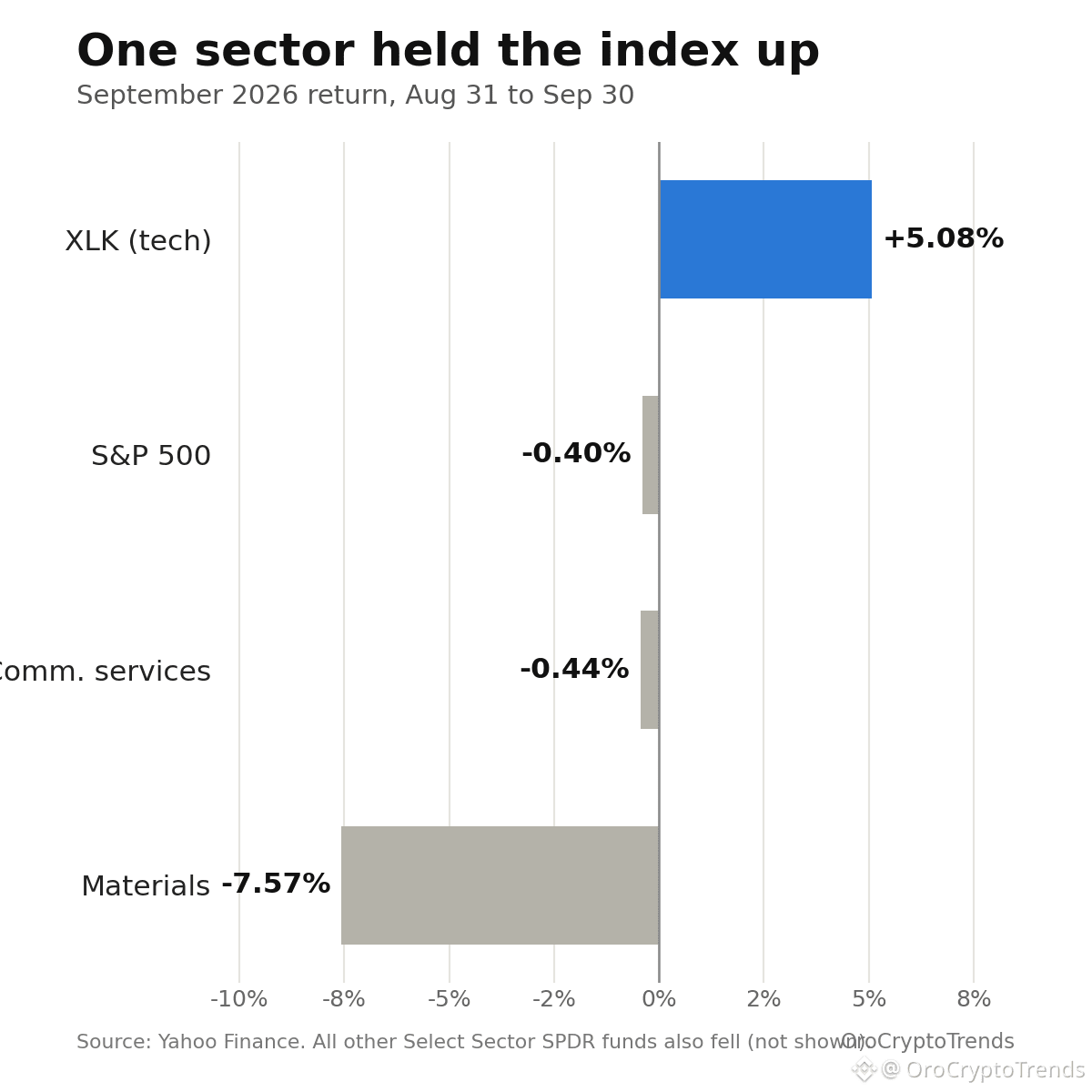
XLK returned 5.08% in September while every other S&P sector fund finished the month in the red.
Read that again. Materials lost 7.57%, communication services lost 0.44%, and the S&P 500 still only slipped 0.4%. One sector held the whole index up.
I keep seeing this framed as tech strength. I read it as a market with one pillar. AI demand, cloud spend and semiconductor momentum are real, but oil and Treasury yields were hammering cyclicals and rate-sensitive names at the same time.
Money didn't rotate into the rest of the market. It crowded into the one trade that was working. That looks like strength on the index chart, but it's actually fragility, because the headline number hides how little is participating.
The risk is simple. If mega-cap earnings or semiconductor guidance wobble, there's nothing underneath to catch the index. And if yields stay elevated, long-duration growth faces valuation pressure even with strong fundamentals.
For crypto traders, this matters. Risk appetite that depends on a single equity theme tends to leak into everything else, so I'm watching breadth more closely than the index level.
Am I reading this wrong, or is everyone celebrating a rally that's really a concentration problem?
$XLK.ETF
XLK returned 5.08% in September while every other S&P sector fund finished the month in the red.
Read that again. Materials lost 7.57%, communication services lost 0.44%, and the S&P 500 still only slipped 0.4%. One sector held the whole index up.
I keep seeing this framed as tech strength. I read it as a market with one pillar. AI demand, cloud spend and semiconductor momentum are real, but oil and Treasury yields were hammering cyclicals and rate-sensitive names at the same time.
Money didn't rotate into the rest of the market. It crowded into the one trade that was working. That looks like strength on the index chart, but it's actually fragility, because the headline number hides how little is participating.
The risk is simple. If mega-cap earnings or semiconductor guidance wobble, there's nothing underneath to catch the index. And if yields stay elevated, long-duration growth faces valuation pressure even with strong fundamentals.
For crypto traders, this matters. Risk appetite that depends on a single equity theme tends to leak into everything else, so I'm watching breadth more closely than the index level.
Am I reading this wrong, or is everyone celebrating a rally that's really a concentration problem?
XLK returned 5.08% in September while every other S&P sector fund finished the month in the red.
Read that again. Materials lost 7.57%, communication services lost 0.44%, and the S&P 500 still only slipped 0.4%. One sector held the whole index up.
I keep seeing this framed as tech strength. I read it as a market with one pillar. AI demand, cloud spend and semiconductor momentum are real, but oil and Treasury yields were hammering cyclicals and rate-sensitive names at the same time.
Money didn't rotate into the rest of the market. It crowded into the one trade that was working. That looks like strength on the index chart, but it's actually fragility, because the headline number hides how little is participating.
The risk is simple. If mega-cap earnings or semiconductor guidance wobble, there's nothing underneath to catch the index. And if yields stay elevated, long-duration growth faces valuation pressure even with strong fundamentals.
For crypto traders, this matters. Risk appetite that depends on a single equity theme tends to leak into everything else, so I'm watching breadth more closely than the index level.
Am I reading this wrong, or is everyone celebrating a rally that's really a concentration problem?
XLKETF+0.61%
SPYB+0.54%
2
348
8,065 ZEC long, nearly $380K underwater — if the reported position is accurate, the interesting part isn’t the loss. It’s the risk structure behind it.
A trader reportedly holds a massive ZEC long on Hyperliquid while sitting on a large unrealized loss, after another multimillion-dollar ZEC position from the same account was liquidated.
That’s the part I keep coming back to.
A leveraged position can look manageable right up until the liquidation threshold becomes the market’s only real deadline. Funding costs keep accumulating, margin gets thinner, and every move against the position has a bigger effect on the account.
And ZEC has been moving violently enough lately that leverage can turn a strong thesis into a very expensive timing problem.
Wait — maybe “bullish or bearish on ZEC” isn’t even the right frame here.
The more useful question is how much leverage the market can absorb before forced liquidations start becoming the story themselves.
Recent Onchain Lens tracking shows just how large ZEC positions on Hyperliquid have become, including traders carrying multimillion-dollar exposure in both directions.
I’m watching the liquidation levels and position changes more closely than the headline PnL.
Still trying to figure out what this actually changes.
8,065 ZEC long, nearly $380K underwater — if the reported position is accurate, the interesting part isn’t the loss. It’s the risk structure behind it.
A trader reportedly holds a massive ZEC long on Hyperliquid while sitting on a large unrealized loss, after another multimillion-dollar ZEC position from the same account was liquidated.
That’s the part I keep coming back to.
A leveraged position can look manageable right up until the liquidation threshold becomes the market’s only real deadline. Funding costs keep accumulating, margin gets thinner, and every move against the position has a bigger effect on the account.
And ZEC has been moving violently enough lately that leverage can turn a strong thesis into a very expensive timing problem.
Wait — maybe “bullish or bearish on ZEC” isn’t even the right frame here.
The more useful question is how much leverage the market can absorb before forced liquidations start becoming the story themselves.
Recent Onchain Lens tracking shows just how large ZEC positions on Hyperliquid have become, including traders carrying multimillion-dollar exposure in both directions.
I’m watching the liquidation levels and position changes more closely than the headline PnL.
Still trying to figure out what this actually changes.
A trader reportedly holds a massive ZEC long on Hyperliquid while sitting on a large unrealized loss, after another multimillion-dollar ZEC position from the same account was liquidated.
That’s the part I keep coming back to.
A leveraged position can look manageable right up until the liquidation threshold becomes the market’s only real deadline. Funding costs keep accumulating, margin gets thinner, and every move against the position has a bigger effect on the account.
And ZEC has been moving violently enough lately that leverage can turn a strong thesis into a very expensive timing problem.
Wait — maybe “bullish or bearish on ZEC” isn’t even the right frame here.
The more useful question is how much leverage the market can absorb before forced liquidations start becoming the story themselves.
Recent Onchain Lens tracking shows just how large ZEC positions on Hyperliquid have become, including traders carrying multimillion-dollar exposure in both directions.
I’m watching the liquidation levels and position changes more closely than the headline PnL.
Still trying to figure out what this actually changes.
1.3k
$BTC US core PCE just dropped to 3.0% — and crypto reacted instantly.
The forecast was 3.3%, so the softer inflation reading immediately changed the rate narrative. Goldman Sachs reportedly pushed its expected Fed rate-hike timing from October to December, while CME FedWatch showed a 52.9% probability of an October hold.
And BTC didn’t wait around. It pushed above $85K, while ETH reclaimed $2,700. Around $255M in crypto shorts were liquidated.
But here’s the part I’m watching.
A softer PCE print doesn’t automatically mean the Fed is about to become aggressively dovish. Inflation is still above the Fed’s 2% target, and one monthly reading doesn’t change the entire macro picture.
Still, markets trade expectations, not just absolute numbers. If traders start pricing fewer near-term hikes, liquidity-sensitive assets like crypto can react quickly.
Wait — maybe the better frame is not “inflation is solved.”
It’s that the immediate rate-pressure narrative just weakened.
That distinction matters. If the next inflation and labor-market data confirm the trend, this move could have more room to develop. If they don’t, today’s reaction can fade just as quickly.
$BTC US core PCE just dropped to 3.0% — and crypto reacted instantly.
The forecast was 3.3%, so the softer inflation reading immediately changed the rate narrative. Goldman Sachs reportedly pushed its expected Fed rate-hike timing from October to December, while CME FedWatch showed a 52.9% probability of an October hold.
And BTC didn’t wait around. It pushed above $85K, while ETH reclaimed $2,700. Around $255M in crypto shorts were liquidated.
But here’s the part I’m watching.
A softer PCE print doesn’t automatically mean the Fed is about to become aggressively dovish. Inflation is still above the Fed’s 2% target, and one monthly reading doesn’t change the entire macro picture.
Still, markets trade expectations, not just absolute numbers. If traders start pricing fewer near-term hikes, liquidity-sensitive assets like crypto can react quickly.
Wait — maybe the better frame is not “inflation is solved.”
It’s that the immediate rate-pressure narrative just weakened.
That distinction matters. If the next inflation and labor-market data confirm the trend, this move could have more room to develop. If they don’t, today’s reaction can fade just as quickly.
The forecast was 3.3%, so the softer inflation reading immediately changed the rate narrative. Goldman Sachs reportedly pushed its expected Fed rate-hike timing from October to December, while CME FedWatch showed a 52.9% probability of an October hold.
And BTC didn’t wait around. It pushed above $85K, while ETH reclaimed $2,700. Around $255M in crypto shorts were liquidated.
But here’s the part I’m watching.
A softer PCE print doesn’t automatically mean the Fed is about to become aggressively dovish. Inflation is still above the Fed’s 2% target, and one monthly reading doesn’t change the entire macro picture.
Still, markets trade expectations, not just absolute numbers. If traders start pricing fewer near-term hikes, liquidity-sensitive assets like crypto can react quickly.
Wait — maybe the better frame is not “inflation is solved.”
It’s that the immediate rate-pressure narrative just weakened.
That distinction matters. If the next inflation and labor-market data confirm the trend, this move could have more room to develop. If they don’t, today’s reaction can fade just as quickly.

1.3k
$BTC $3.55B flowed into digital asset investment products last week. That’s the biggest weekly inflow of 2026 — and Bitcoin took $2.52B of it.
Honestly, this is more interesting than the headline makes it sound.
What I’m watching isn’t just the size of the number. It’s where the money is going. Bitcoin captured roughly 71% of the weekly total, while Ethereum also pulled in $702M. Total AUM across digital asset investment products climbed to around $173B.
That tells me institutional demand isn’t disappearing when crypto gets boring. It’s still there, but it’s showing up through regulated investment products rather than the kind of retail frenzy we usually associate with strong flows.
But wait — I don’t think $3.55B automatically means the next leg up is guaranteed.
Weekly flows can be powerful confirmation, but they’re still a snapshot. The bigger question is whether this level of allocation persists after the initial burst of demand fades.
That’s the part I’ll be watching now: not whether institutions came back, but whether they keep coming back.
Still trying to figure out whether this is the start of a broader allocation trend or simply a very strong week.
$BTC $3.55B flowed into digital asset investment products last week. That’s the biggest weekly inflow of 2026 — and Bitcoin took $2.52B of it.
Honestly, this is more interesting than the headline makes it sound.
What I’m watching isn’t just the size of the number. It’s where the money is going. Bitcoin captured roughly 71% of the weekly total, while Ethereum also pulled in $702M. Total AUM across digital asset investment products climbed to around $173B.
That tells me institutional demand isn’t disappearing when crypto gets boring. It’s still there, but it’s showing up through regulated investment products rather than the kind of retail frenzy we usually associate with strong flows.
But wait — I don’t think $3.55B automatically means the next leg up is guaranteed.
Weekly flows can be powerful confirmation, but they’re still a snapshot. The bigger question is whether this level of allocation persists after the initial burst of demand fades.
That’s the part I’ll be watching now: not whether institutions came back, but whether they keep coming back.
Still trying to figure out whether this is the start of a broader allocation trend or simply a very strong week.
Honestly, this is more interesting than the headline makes it sound.
What I’m watching isn’t just the size of the number. It’s where the money is going. Bitcoin captured roughly 71% of the weekly total, while Ethereum also pulled in $702M. Total AUM across digital asset investment products climbed to around $173B.
That tells me institutional demand isn’t disappearing when crypto gets boring. It’s still there, but it’s showing up through regulated investment products rather than the kind of retail frenzy we usually associate with strong flows.
But wait — I don’t think $3.55B automatically means the next leg up is guaranteed.
Weekly flows can be powerful confirmation, but they’re still a snapshot. The bigger question is whether this level of allocation persists after the initial burst of demand fades.
That’s the part I’ll be watching now: not whether institutions came back, but whether they keep coming back.
Still trying to figure out whether this is the start of a broader allocation trend or simply a very strong week.
370
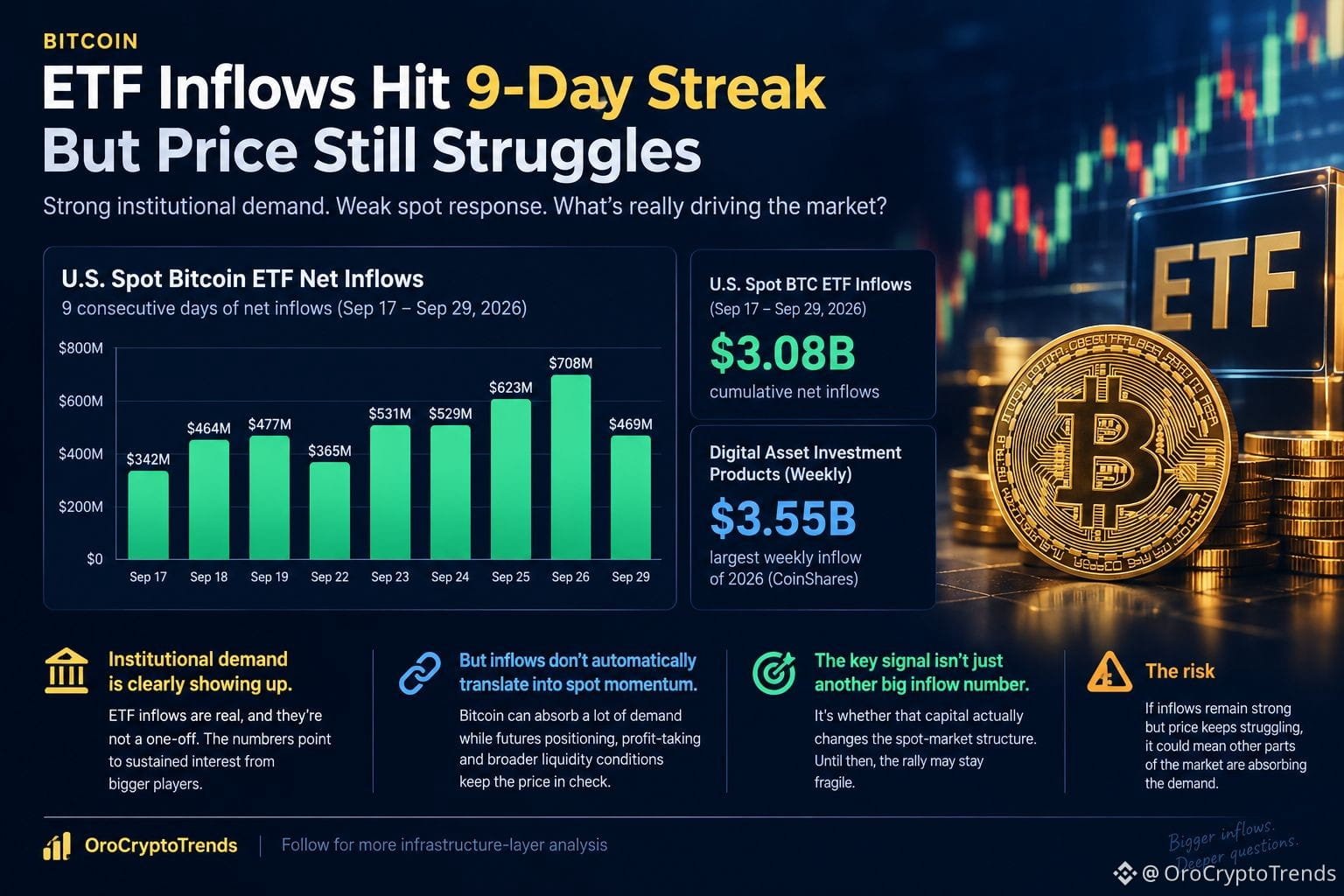
$BTC 9 straight trading days of BTC ETF inflows — and Bitcoin still can’t make the move look easy.
That’s the part I keep coming back to.
From Sept. 17 through Sept. 29, U.S. spot Bitcoin ETFs recorded roughly $3.08B in cumulative net inflows, according to Farside data. CoinShares also reported $3.55B flowing into digital-asset investment products in the latest week, the largest weekly inflow of 2026 so far.
So yes, institutional demand is clearly showing up.
But here’s where I’m less convinced by the bullish interpretation.
Money entering ETFs doesn’t automatically mean immediate spot-market momentum. Bitcoin can absorb substantial demand while futures positioning, profit-taking and broader liquidity conditions keep the price from accelerating.
That distinction matters.
If ETF inflows keep building and spot demand starts translating into stronger price discovery, the structure becomes much more convincing. If inflows remain strong while price keeps struggling, I’d read that as a sign that other parts of the market are absorbing the demand.
Honestly, I think the next signal isn’t simply another big inflow number. It’s whether that capital actually changes the spot-market structure.
Still trying to figure out what this actually changes.
Follow for more infrastructure-layer analysis
$BTC 9 straight trading days of BTC ETF inflows — and Bitcoin still can’t make the move look easy.
That’s the part I keep coming back to.
From Sept. 17 through Sept. 29, U.S. spot Bitcoin ETFs recorded roughly $3.08B in cumulative net inflows, according to Farside data. CoinShares also reported $3.55B flowing into digital-asset investment products in the latest week, the largest weekly inflow of 2026 so far.
So yes, institutional demand is clearly showing up.
But here’s where I’m less convinced by the bullish interpretation.
Money entering ETFs doesn’t automatically mean immediate spot-market momentum. Bitcoin can absorb substantial demand while futures positioning, profit-taking and broader liquidity conditions keep the price from accelerating.
That distinction matters.
If ETF inflows keep building and spot demand starts translating into stronger price discovery, the structure becomes much more convincing. If inflows remain strong while price keeps struggling, I’d read that as a sign that other parts of the market are absorbing the demand.
Honestly, I think the next signal isn’t simply another big inflow number. It’s whether that capital actually changes the spot-market structure.
Still trying to figure out what this actually changes.
Follow for more infrastructure-layer analysis
That’s the part I keep coming back to.
From Sept. 17 through Sept. 29, U.S. spot Bitcoin ETFs recorded roughly $3.08B in cumulative net inflows, according to Farside data. CoinShares also reported $3.55B flowing into digital-asset investment products in the latest week, the largest weekly inflow of 2026 so far.
So yes, institutional demand is clearly showing up.
But here’s where I’m less convinced by the bullish interpretation.
Money entering ETFs doesn’t automatically mean immediate spot-market momentum. Bitcoin can absorb substantial demand while futures positioning, profit-taking and broader liquidity conditions keep the price from accelerating.
That distinction matters.
If ETF inflows keep building and spot demand starts translating into stronger price discovery, the structure becomes much more convincing. If inflows remain strong while price keeps struggling, I’d read that as a sign that other parts of the market are absorbing the demand.
Honestly, I think the next signal isn’t simply another big inflow number. It’s whether that capital actually changes the spot-market structure.
Still trying to figure out what this actually changes.
Follow for more infrastructure-layer analysis
4
2.1k
Verified
$XRP Brazil just gave the XRP Ledger a much more interesting use case than another tokenization demo.
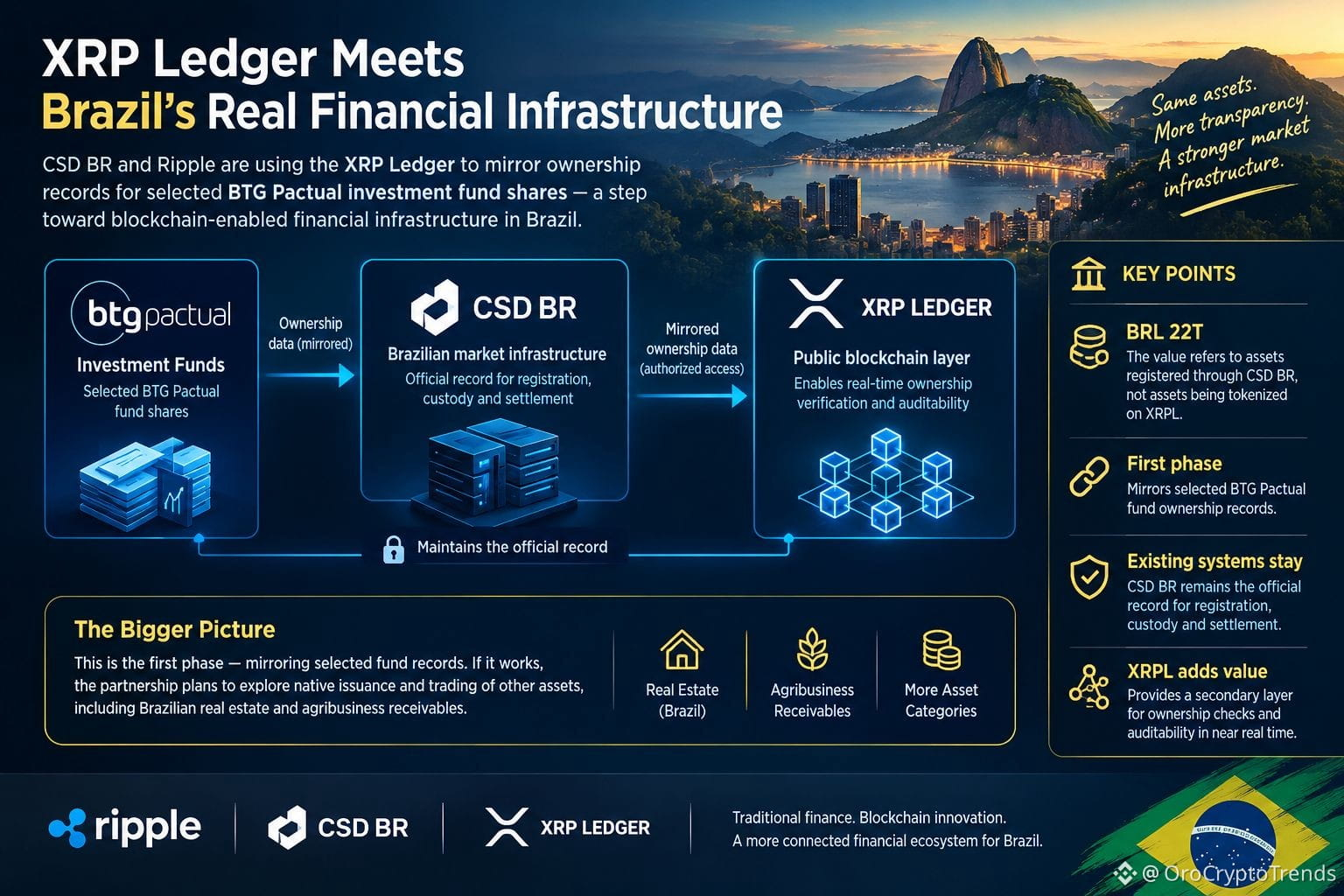
CSD BR, a regulated Brazilian market-infrastructure operator with more than BRL 22 trillion in registered assets, is now using XRPL to mirror ownership records for selected BTG Pactual investment fund shares.
But wait — the BRL 22T number needs context. That entire amount is NOT being moved onto XRPL.
CSD BR’s existing system remains the official record for registration, custody and settlement. XRPL is being added as a secondary layer where authorized institutions can check ownership data and audit changes in near real time.
Honestly, I think that distinction makes this more interesting, not less.
The real experiment here is whether a public blockchain can sit beside critical financial infrastructure without forcing institutions to throw away the systems they already trust.
That’s a very different adoption path from “put everything onchain.”
And if the mirroring phase works, the partnership says it plans to explore native issuance and trading of other assets, including Brazilian real-estate and agribusiness receivables.
So I’m watching the infrastructure layer more than the headline.
The big question isn’t whether XRPL can tokenize an asset. It’s whether regulated institutions find enough operational value to keep expanding the role of the ledger.
Still trying to figure out what this actually changes.
$XRP Brazil just gave the XRP Ledger a much more interesting use case than another tokenization demo.
CSD BR, a regulated Brazilian market-infrastructure operator with more than BRL 22 trillion in registered assets, is now using XRPL to mirror ownership records for selected BTG Pactual investment fund shares.
But wait — the BRL 22T number needs context. That entire amount is NOT being moved onto XRPL.
CSD BR’s existing system remains the official record for registration, custody and settlement. XRPL is being added as a secondary layer where authorized institutions can check ownership data and audit changes in near real time.
Honestly, I think that distinction makes this more interesting, not less.
The real experiment here is whether a public blockchain can sit beside critical financial infrastructure without forcing institutions to throw away the systems they already trust.
That’s a very different adoption path from “put everything onchain.”
And if the mirroring phase works, the partnership says it plans to explore native issuance and trading of other assets, including Brazilian real-estate and agribusiness receivables.
So I’m watching the infrastructure layer more than the headline.
The big question isn’t whether XRPL can tokenize an asset. It’s whether regulated institutions find enough operational value to keep expanding the role of the ledger.
Still trying to figure out what this actually changes.
CSD BR, a regulated Brazilian market-infrastructure operator with more than BRL 22 trillion in registered assets, is now using XRPL to mirror ownership records for selected BTG Pactual investment fund shares.
But wait — the BRL 22T number needs context. That entire amount is NOT being moved onto XRPL.
CSD BR’s existing system remains the official record for registration, custody and settlement. XRPL is being added as a secondary layer where authorized institutions can check ownership data and audit changes in near real time.
Honestly, I think that distinction makes this more interesting, not less.
The real experiment here is whether a public blockchain can sit beside critical financial infrastructure without forcing institutions to throw away the systems they already trust.
That’s a very different adoption path from “put everything onchain.”
And if the mirroring phase works, the partnership says it plans to explore native issuance and trading of other assets, including Brazilian real-estate and agribusiness receivables.
So I’m watching the infrastructure layer more than the headline.
The big question isn’t whether XRPL can tokenize an asset. It’s whether regulated institutions find enough operational value to keep expanding the role of the ledger.
Still trying to figure out what this actually changes.
1
5
2k
Verified
$BNB CZ posted “Soon....” and suddenly people are calling it the start of “BNB szn.”
Maybe. But I think the more interesting part is what’s happening around that meme.
CZ also shared bullish BNB Chain content pointing to tokenized U.S. equities moving on-chain. BNB Chain says its ecosystem had more than 709 tokenized stocks and ETFs by June, with cumulative tokenized-stock volume above $5B. That’s an actual infrastructure trend, not just a meme.
Then there’s the corporate side.
CEA Industries officially became BNB Standard Corporation on September 29, while keeping the Nasdaq ticker BNC. The company said nearly 5,800 community votes were cast on the new name, with BNB Standard receiving about 47%.
That combination is what catches my attention: ecosystem expansion, tokenized assets, and a public company explicitly building around a BNB treasury.
But wait — maybe I’m giving the meme too much weight.
“Soon....” is not a confirmed signal from CZ that BNB is about to rally. Bonk Guy interpreted it that way; the market still has to validate the narrative.
For me, the real question is whether these catalysts translate into sustained usage and capital flows, rather than another short-lived narrative.
Still trying to figure out what this actually changes.
$BNB CZ posted “Soon....” and suddenly people are calling it the start of “BNB szn.”
Maybe. But I think the more interesting part is what’s happening around that meme.
CZ also shared bullish BNB Chain content pointing to tokenized U.S. equities moving on-chain. BNB Chain says its ecosystem had more than 709 tokenized stocks and ETFs by June, with cumulative tokenized-stock volume above $5B. That’s an actual infrastructure trend, not just a meme.
Then there’s the corporate side.
CEA Industries officially became BNB Standard Corporation on September 29, while keeping the Nasdaq ticker BNC. The company said nearly 5,800 community votes were cast on the new name, with BNB Standard receiving about 47%.
That combination is what catches my attention: ecosystem expansion, tokenized assets, and a public company explicitly building around a BNB treasury.
But wait — maybe I’m giving the meme too much weight.
“Soon....” is not a confirmed signal from CZ that BNB is about to rally. Bonk Guy interpreted it that way; the market still has to validate the narrative.
For me, the real question is whether these catalysts translate into sustained usage and capital flows, rather than another short-lived narrative.
Still trying to figure out what this actually changes.
Maybe. But I think the more interesting part is what’s happening around that meme.
CZ also shared bullish BNB Chain content pointing to tokenized U.S. equities moving on-chain. BNB Chain says its ecosystem had more than 709 tokenized stocks and ETFs by June, with cumulative tokenized-stock volume above $5B. That’s an actual infrastructure trend, not just a meme.
Then there’s the corporate side.
CEA Industries officially became BNB Standard Corporation on September 29, while keeping the Nasdaq ticker BNC. The company said nearly 5,800 community votes were cast on the new name, with BNB Standard receiving about 47%.
That combination is what catches my attention: ecosystem expansion, tokenized assets, and a public company explicitly building around a BNB treasury.
But wait — maybe I’m giving the meme too much weight.
“Soon....” is not a confirmed signal from CZ that BNB is about to rally. Bonk Guy interpreted it that way; the market still has to validate the narrative.
For me, the real question is whether these catalysts translate into sustained usage and capital flows, rather than another short-lived narrative.
Still trying to figure out what this actually changes.
3
3
4k
September 30 is a bigger date for UK crypto than the headline makes it sound.
The FCA’s new authorization window opens today, and firms have until February 28, 2027 to apply if they want to use the relevant saving provisions. The wider regime is scheduled to take effect on October 25, 2027.
What catches my attention isn’t simply “more crypto regulation.”
It’s that authorization is becoming part of the actual operating infrastructure.
Trading platforms, dealing and arranging, safeguarding, staking and qualifying stablecoin issuance are among the activities coming inside the new framework. And existing registrations won’t automatically turn into the new permissions.
That changes the economics.
A crypto business operating in the UK will increasingly have to treat compliance, controls, custody and reporting as part of the product itself — not something sitting around the edges of the business.
And there’s a real trade-off here.
Higher standards can strengthen consumer protection and market integrity. But the cost of meeting those standards could also affect which firms can economically serve UK users.
So I’m less interested in whether this is “bullish” or “bearish” for crypto.
The more interesting question is which business models still work when regulation becomes part of the infrastructure stack.
Still trying to figure out what this actually changes.
September 30 is a bigger date for UK crypto than the headline makes it sound.
The FCA’s new authorization window opens today, and firms have until February 28, 2027 to apply if they want to use the relevant saving provisions. The wider regime is scheduled to take effect on October 25, 2027.
What catches my attention isn’t simply “more crypto regulation.”
It’s that authorization is becoming part of the actual operating infrastructure.
Trading platforms, dealing and arranging, safeguarding, staking and qualifying stablecoin issuance are among the activities coming inside the new framework. And existing registrations won’t automatically turn into the new permissions.
That changes the economics.
A crypto business operating in the UK will increasingly have to treat compliance, controls, custody and reporting as part of the product itself — not something sitting around the edges of the business.
And there’s a real trade-off here.
Higher standards can strengthen consumer protection and market integrity. But the cost of meeting those standards could also affect which firms can economically serve UK users.
So I’m less interested in whether this is “bullish” or “bearish” for crypto.
The more interesting question is which business models still work when regulation becomes part of the infrastructure stack.
Still trying to figure out what this actually changes.
The FCA’s new authorization window opens today, and firms have until February 28, 2027 to apply if they want to use the relevant saving provisions. The wider regime is scheduled to take effect on October 25, 2027.
What catches my attention isn’t simply “more crypto regulation.”
It’s that authorization is becoming part of the actual operating infrastructure.
Trading platforms, dealing and arranging, safeguarding, staking and qualifying stablecoin issuance are among the activities coming inside the new framework. And existing registrations won’t automatically turn into the new permissions.
That changes the economics.
A crypto business operating in the UK will increasingly have to treat compliance, controls, custody and reporting as part of the product itself — not something sitting around the edges of the business.
And there’s a real trade-off here.
Higher standards can strengthen consumer protection and market integrity. But the cost of meeting those standards could also affect which firms can economically serve UK users.
So I’m less interested in whether this is “bullish” or “bearish” for crypto.
The more interesting question is which business models still work when regulation becomes part of the infrastructure stack.
Still trying to figure out what this actually changes.

1
2.4k
The UK just opened the door to its new crypto authorization regime.
From September 30, firms can start applying to the FCA for authorization under the UK’s new cryptoasset framework. The application window runs until February 28, 2027, while the full regime is scheduled to take effect on October 25, 2027.
What stands out to me isn’t just the headline “crypto regulation.”
It’s the shift in what operating a crypto business in the UK will actually require.
The FCA says the new regime covers activities including cryptoasset trading platforms, dealing and arranging, safeguarding, staking arrangements and qualifying stablecoin issuance. Existing registrations also won’t simply convert automatically into the new permissions.
That matters because regulation is moving from something firms prepare around to something increasingly built into the market’s infrastructure.
But there’s a trade-off here.
Higher standards can improve consumer protection and market integrity, yet the cost and complexity of authorization could also change which firms can realistically serve UK users.
So I’m less interested in whether this is “bullish” or “bearish” for crypto.
The bigger question is which business models still make economic sense once compliance becomes part of the operating stack.
Still trying to figure out what this actually changes.
The UK just opened the door to its new crypto authorization regime.
From September 30, firms can start applying to the FCA for authorization under the UK’s new cryptoasset framework. The application window runs until February 28, 2027, while the full regime is scheduled to take effect on October 25, 2027.
What stands out to me isn’t just the headline “crypto regulation.”
It’s the shift in what operating a crypto business in the UK will actually require.
The FCA says the new regime covers activities including cryptoasset trading platforms, dealing and arranging, safeguarding, staking arrangements and qualifying stablecoin issuance. Existing registrations also won’t simply convert automatically into the new permissions.
That matters because regulation is moving from something firms prepare around to something increasingly built into the market’s infrastructure.
But there’s a trade-off here.
Higher standards can improve consumer protection and market integrity, yet the cost and complexity of authorization could also change which firms can realistically serve UK users.
So I’m less interested in whether this is “bullish” or “bearish” for crypto.
The bigger question is which business models still make economic sense once compliance becomes part of the operating stack.
Still trying to figure out what this actually changes.
From September 30, firms can start applying to the FCA for authorization under the UK’s new cryptoasset framework. The application window runs until February 28, 2027, while the full regime is scheduled to take effect on October 25, 2027.
What stands out to me isn’t just the headline “crypto regulation.”
It’s the shift in what operating a crypto business in the UK will actually require.
The FCA says the new regime covers activities including cryptoasset trading platforms, dealing and arranging, safeguarding, staking arrangements and qualifying stablecoin issuance. Existing registrations also won’t simply convert automatically into the new permissions.
That matters because regulation is moving from something firms prepare around to something increasingly built into the market’s infrastructure.
But there’s a trade-off here.
Higher standards can improve consumer protection and market integrity, yet the cost and complexity of authorization could also change which firms can realistically serve UK users.
So I’m less interested in whether this is “bullish” or “bearish” for crypto.
The bigger question is which business models still make economic sense once compliance becomes part of the operating stack.
Still trying to figure out what this actually changes.
1
2.3k
Log in to explore more content
Join global crypto users on Binance Square
⚡️ Get latest and useful information about crypto.
💬 Trusted by the world’s largest crypto exchange.
👍 Discover real insights from verified creators.
Email / Phone number
Trending Topics
BinanceLaunchesBinanceIntelligence
366,753 views
2,925 Discussing
#BinanceLaunchesBinanceIntelligence
📢 What is Binance Intelligence?
$NVDAB
$BTC
$AAPLB
Binance has officially launched Binance Intelligence — a new platform designed to provide users with real-time market insights, data-driven analysis, and smarter decision-making tools.
Key Features:
- 📊 Real-time Crypto Market Data – live trends, price movements & market depth
- 🧠 AI-Powered Analysis – smart forecasts & pattern recognition
- 📰 News & Impact Tracking – how events move the market
- 📈 Portfolio Analytics – performance overview & risk management
- 🔍 Deep Research Tools – comprehensive data for informed trading
#BinanceLaunchesBinanceIntelligence
#BinanceSquareFamily
#BinanceLaunchesBinanceIntelligence
#BinanceIntelligence
#Binance
Hawk Manan 1
·0 Likes
·209 views
BitcoinTargets2026OpenAt$87570
1,802 views
62 Discussing
BitcoinRejectedAt$87KThirdTime
1,908 views
52 Discussing