

Sulaiman 零号猎人
2.5k Публикации

Sulaiman 零号猎人
Отправить жалобу
Заблокировать пользователя
ZeroHunter | Hunting 10X potential in micro-caps & RWA with on-chain research. I show how I check a project's data before I trust it. NFA. #ZeroResearch
Открытая сделка
Трейдер с регулярными сделками
6.2 г
133 подписок(и/а)
885 подписчиков(а)
2.2K+ понравилось
Посты
Портфель
Все
Цитирования
Активно
PINNED
Статья
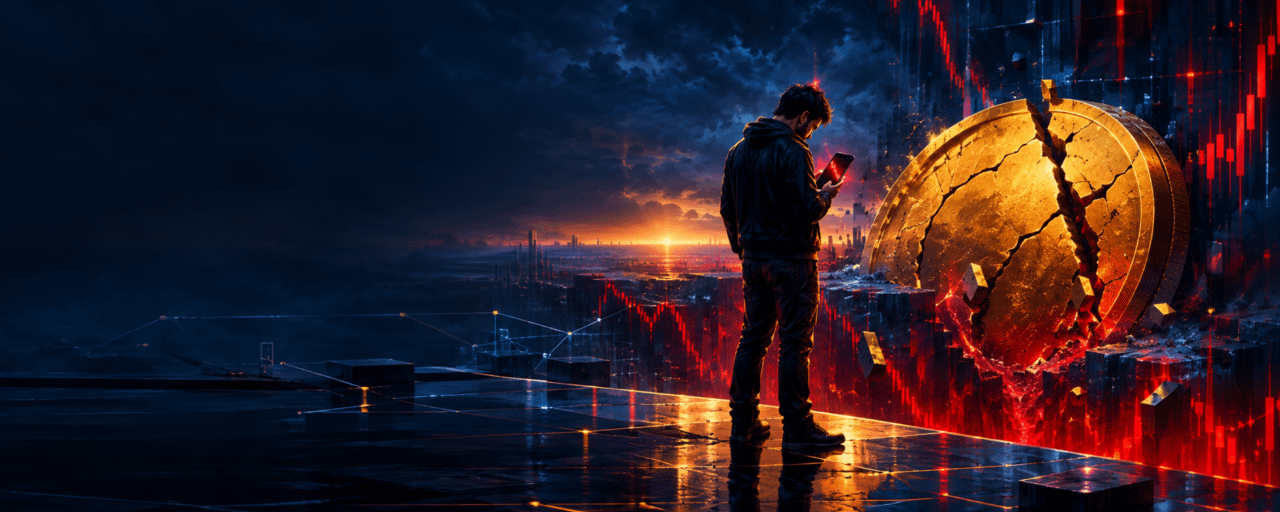
I lost 750 USDT on LUNA because I skipped one stepDisclosure: I hold no Terra coins (LUNA or LUNC).
I lost around 750 USDT on one coin, and it was my own fault.
The worst part? I bought it without checking anything.
LUNA (the old Terra) was a hero back then. Many people, including me, wanted it in their portfolio.
One morning in May 2022, I woke up and saw it at 3.5 USDT. I did not check the news. I did not ask why. I just bought around 350 USDT worth, fast.
Then I opened X and saw CZ's thread. He said some users kept buying LUNA without understanding the risk.
That was me. 👇
Source: CZ (@cz_binance) on X, May 13, 2022
So I started DCA to "save" my money. I kept buying while the supply kept growing and I saw no clear plan from the team. In my opinion, that silence was a red flag.
Later I looked at the burn mechanism and made a decision. I closed my position with a loss of around 750 USDT.
Here's my advice:
"It was a hero before" is not a reason to buy.
Check first, buy later. Five minutes of research could have saved me.
Buying more of a broken project is not a rescue plan. In my opinion, it only makes the loss bigger.
That day changed how I research. Now, before I trust any project, I check:
Supply: Can new tokens be minted? Who controls it?Holders: Do a few wallets own most of the supply?Liquidity: Can people sell without crashing the price?Team: Does the team respond when there is a problem?Real usage: Are people using it, or only talking about it?
None of these guarantees safety. But skipping them cost me.
I share these checks step by step, so you can learn the process too.
Every project is high risk, big names and micro caps both. I could be wrong, and I have been wrong before.
This is my personal opinion, not financial advice. Do your own research.
What is one mistake that taught you the most?
#ZeroResearch
#CryptoEducation
#DYOR
I lost 750 USDT on LUNA because I skipped one step
Disclosure: I hold no Terra coins (LUNA or LUNC).
I lost around 750 USDT on one coin, and it was my own fault.
The worst part? I bought it without checking anything.
LUNA (the old Terra) was a hero back then. Many people, including me, wanted it in their portfolio.
One morning in May 2022, I woke up and saw it at 3.5 USDT. I did not check the news. I did not ask why. I just bought around 350 USDT worth, fast.
Then I opened X and saw CZ's thread. He said some users kept buying LUNA without understanding the risk.
That was me. 👇
Source: CZ (@cz_binance) on X, May 13, 2022
So I started DCA to "save" my money. I kept buying while the supply kept growing and I saw no clear plan from the team. In my opinion, that silence was a red flag.
Later I looked at the burn mechanism and made a decision. I closed my position with a loss of around 750 USDT.
Here's my advice:
"It was a hero before" is not a reason to buy.
Check first, buy later. Five minutes of research could have saved me.
Buying more of a broken project is not a rescue plan. In my opinion, it only makes the loss bigger.
That day changed how I research. Now, before I trust any project, I check:
Supply: Can new tokens be minted? Who controls it?Holders: Do a few wallets own most of the supply?Liquidity: Can people sell without crashing the price?Team: Does the team respond when there is a problem?Real usage: Are people using it, or only talking about it?
None of these guarantees safety. But skipping them cost me.
I share these checks step by step, so you can learn the process too.
Every project is high risk, big names and micro caps both. I could be wrong, and I have been wrong before.
This is my personal opinion, not financial advice. Do your own research.
What is one mistake that taught you the most?
#ZeroResearch
#CryptoEducation
#DYOR
I lost around 750 USDT on one coin, and it was my own fault.
The worst part? I bought it without checking anything.
LUNA (the old Terra) was a hero back then. Many people, including me, wanted it in their portfolio.
One morning in May 2022, I woke up and saw it at 3.5 USDT. I did not check the news. I did not ask why. I just bought around 350 USDT worth, fast.
Then I opened X and saw CZ's thread. He said some users kept buying LUNA without understanding the risk.
That was me. 👇
Source: CZ (@cz_binance) on X, May 13, 2022
So I started DCA to "save" my money. I kept buying while the supply kept growing and I saw no clear plan from the team. In my opinion, that silence was a red flag.
Later I looked at the burn mechanism and made a decision. I closed my position with a loss of around 750 USDT.
Here's my advice:
"It was a hero before" is not a reason to buy.
Check first, buy later. Five minutes of research could have saved me.
Buying more of a broken project is not a rescue plan. In my opinion, it only makes the loss bigger.
That day changed how I research. Now, before I trust any project, I check:
Supply: Can new tokens be minted? Who controls it?Holders: Do a few wallets own most of the supply?Liquidity: Can people sell without crashing the price?Team: Does the team respond when there is a problem?Real usage: Are people using it, or only talking about it?
None of these guarantees safety. But skipping them cost me.
I share these checks step by step, so you can learn the process too.
Every project is high risk, big names and micro caps both. I could be wrong, and I have been wrong before.
This is my personal opinion, not financial advice. Do your own research.
What is one mistake that taught you the most?
#ZeroResearch
#CryptoEducation
#DYOR
2
3
8
961
🎙️ 🎉2026狂暴牛市,号角已吹响,行情尽在BSC链!!11月1号马斯克将为火星狗Marvin庆祝生日,这波链上行情一定要抓住!
Завершено
02 ч 13 мин 13 сек
4.5k
15
42
Comebacks Don't Announce Themselves
$ICP has been rebuilding its story in silence — real network activity, real AI integration — while the market kept judging it by an old chapter. Comebacks never announce themselves, they just show up once you stop watching the price and start watching the product.
$SKY carries the DNA of a protocol that helped define an entire era of decentralized finance, now reintroducing itself to a market that forgot how foundational it was.
$MINA is proof that small footprint doesn't mean small ambition — lightweight infrastructure is quietly becoming one of the most underrated theses in the space.
The market has a short memory. Builders don't.
DYOR 🚀Share With Your Friends, Follow @SulemaOFCrypto For Next Update.
#ICP #SKY #MINA #defi #Sulaiman零号猎人
Comebacks Don't Announce Themselves
$ICP has been rebuilding its story in silence — real network activity, real AI integration — while the market kept judging it by an old chapter. Comebacks never announce themselves, they just show up once you stop watching the price and start watching the product.
$SKY carries the DNA of a protocol that helped define an entire era of decentralized finance, now reintroducing itself to a market that forgot how foundational it was.
$MINA is proof that small footprint doesn't mean small ambition — lightweight infrastructure is quietly becoming one of the most underrated theses in the space.
The market has a short memory. Builders don't.
DYOR 🚀Share With Your Friends, Follow @Sulaiman 零号猎人 For Next Update.
#ICP #SKY #MINA #defi #Sulaiman零号猎人
$ICP has been rebuilding its story in silence — real network activity, real AI integration — while the market kept judging it by an old chapter. Comebacks never announce themselves, they just show up once you stop watching the price and start watching the product.
$SKY carries the DNA of a protocol that helped define an entire era of decentralized finance, now reintroducing itself to a market that forgot how foundational it was.
$MINA is proof that small footprint doesn't mean small ambition — lightweight infrastructure is quietly becoming one of the most underrated theses in the space.
The market has a short memory. Builders don't.
DYOR 🚀Share With Your Friends, Follow @Sulaiman 零号猎人 For Next Update.
#ICP #SKY #MINA #defi #Sulaiman零号猎人
2
265
The Loud One and the Quiet Ones-
Everyone knows $NEAR 's name — but not everyone remembers why it became one first. AI-chain narratives are cycling back around, and the OG believers are watching the story repeat itself in real time.
$TRB is the kind of token that doesn't trend until it already moved — data infrastructure never gets the hype it deserves until the market suddenly needs it. Oracle demand doesn't disappear, it just waits.
$TSLAB is one most people haven't even looked at twice — and that's exactly the phase where real accumulation happens quietly, away from the crowd's attention.
The loudest name and the quietest one can both be early — most people just aren't watching the right signals.
DYOR Share with Your Friends 🚀Follow @SulemaOFCrypto For Next Update!
#NEAR #TRB #TSLAB #Web3 #Sulaiman零号猎人
The Loud One and the Quiet Ones-
Everyone knows $NEAR 's name — but not everyone remembers why it became one first. AI-chain narratives are cycling back around, and the OG believers are watching the story repeat itself in real time.
$TRB is the kind of token that doesn't trend until it already moved — data infrastructure never gets the hype it deserves until the market suddenly needs it. Oracle demand doesn't disappear, it just waits.
$TSLAB is one most people haven't even looked at twice — and that's exactly the phase where real accumulation happens quietly, away from the crowd's attention.
The loudest name and the quietest one can both be early — most people just aren't watching the right signals.
DYOR Share with Your Friends 🚀Follow @Sulaiman 零号猎人 For Next Update!
#NEAR #TRB #TSLAB #Web3 #Sulaiman零号猎人
Everyone knows $NEAR 's name — but not everyone remembers why it became one first. AI-chain narratives are cycling back around, and the OG believers are watching the story repeat itself in real time.
$TRB is the kind of token that doesn't trend until it already moved — data infrastructure never gets the hype it deserves until the market suddenly needs it. Oracle demand doesn't disappear, it just waits.
$TSLAB is one most people haven't even looked at twice — and that's exactly the phase where real accumulation happens quietly, away from the crowd's attention.
The loudest name and the quietest one can both be early — most people just aren't watching the right signals.
DYOR Share with Your Friends 🚀Follow @Sulaiman 零号猎人 For Next Update!
#NEAR #TRB #TSLAB #Web3 #Sulaiman零号猎人
1
188
Old Fear, New Confidence
$QNT just reminded the market why patience beats panic — years of being called "too early" and now the ones who stayed are the ones smiling. Institutions don't chase noise, they build quietly, and QNT is proof of that discipline.
$ASTER is showing the market what real momentum looks like when builders execute instead of just talking. Fresh eyes are noticing what early believers already knew.
$SOL keeps proving that the strongest ecosystems don't need to shout — they just keep shipping while the market argues about who's "dead" this cycle. The builders never left. The doubters just weren't paying attention.
Conviction always outlasts noise.
DYOR 🚀 Follow @SulemaOFCrypto For More Update!
#QNT #ASTER #SOL #Sulaiman零号猎人
Old Fear, New Confidence
$QNT just reminded the market why patience beats panic — years of being called "too early" and now the ones who stayed are the ones smiling. Institutions don't chase noise, they build quietly, and QNT is proof of that discipline.
$ASTER is showing the market what real momentum looks like when builders execute instead of just talking. Fresh eyes are noticing what early believers already knew.
$SOL keeps proving that the strongest ecosystems don't need to shout — they just keep shipping while the market argues about who's "dead" this cycle. The builders never left. The doubters just weren't paying attention.
Conviction always outlasts noise.
DYOR 🚀 Follow @Sulaiman 零号猎人 For More Update!
#QNT #ASTER #SOL #Sulaiman零号猎人
$QNT just reminded the market why patience beats panic — years of being called "too early" and now the ones who stayed are the ones smiling. Institutions don't chase noise, they build quietly, and QNT is proof of that discipline.
$ASTER is showing the market what real momentum looks like when builders execute instead of just talking. Fresh eyes are noticing what early believers already knew.
$SOL keeps proving that the strongest ecosystems don't need to shout — they just keep shipping while the market argues about who's "dead" this cycle. The builders never left. The doubters just weren't paying attention.
Conviction always outlasts noise.
DYOR 🚀 Follow @Sulaiman 零号猎人 For More Update!
#QNT #ASTER #SOL #Sulaiman零号猎人
3
644
Частичная правда
🔥Important — The Biggest Unlock Day of the Month Is Coming
$HYPE faces the single largest token unlock of October on the 6th — over $850M worth of supply hitting circulation in one day. This isn't a small technical footnote; it's one of the biggest supply events of the entire month.
History has shown the same pattern again and again: large unlocks don't always crash price instantly, but they do test conviction. The market has to absorb real new supply, and that absorption takes real demand — not just narrative.
$ENA and $OPN also see unlocks the same day, adding to the total supply pressure hitting the market simultaneously.
Old traders don't panic on unlock day — they prepare for it. Know your dates, size your positions, and don't let a headline number catch you off guard.
DYOR 🚀 Follow @SulemaOFCrypto
#HYPE #ENA #TokenUnlock #ZeroResearch
🔥Important — The Biggest Unlock Day of the Month Is Coming
$HYPE faces the single largest token unlock of October on the 6th — over $850M worth of supply hitting circulation in one day. This isn't a small technical footnote; it's one of the biggest supply events of the entire month.
History has shown the same pattern again and again: large unlocks don't always crash price instantly, but they do test conviction. The market has to absorb real new supply, and that absorption takes real demand — not just narrative.
$ENA and $OPN also see unlocks the same day, adding to the total supply pressure hitting the market simultaneously.
Old traders don't panic on unlock day — they prepare for it. Know your dates, size your positions, and don't let a headline number catch you off guard.
DYOR 🚀 Follow @Sulaiman 零号猎人
#HYPE #ENA #TokenUnlock #ZeroResearch
$HYPE faces the single largest token unlock of October on the 6th — over $850M worth of supply hitting circulation in one day. This isn't a small technical footnote; it's one of the biggest supply events of the entire month.
History has shown the same pattern again and again: large unlocks don't always crash price instantly, but they do test conviction. The market has to absorb real new supply, and that absorption takes real demand — not just narrative.
$ENA and $OPN also see unlocks the same day, adding to the total supply pressure hitting the market simultaneously.
Old traders don't panic on unlock day — they prepare for it. Know your dates, size your positions, and don't let a headline number catch you off guard.
DYOR 🚀 Follow @Sulaiman 零号猎人
#HYPE #ENA #TokenUnlock #ZeroResearch
1
2
695
October Kicks Off With Real Supply Pressure
$SUI leads the day with the biggest single unlock — a reminder that even the strongest narratives face real supply tests. Smart holders track these dates before the crowd reacts to price alone.
$EIGEN follows close behind — restaking's rise doesn't erase the fact that tokens still hit circulation on schedule. Fundamentals and unlock calendars move on separate clocks.
$ZETA rounds out the day's major unlocks, alongside nine other projects releasing supply simultaneously.
The lesson old traders never forget: price doesn't just react to news — it reacts to new supply hitting the market. Know the calendar before you position.
DYOR 🚀
#SUI #EIGEN #ZETA #TokenUnlock #Sulaiman零号猎人
October Kicks Off With Real Supply Pressure
$SUI leads the day with the biggest single unlock — a reminder that even the strongest narratives face real supply tests. Smart holders track these dates before the crowd reacts to price alone.
$EIGEN follows close behind — restaking's rise doesn't erase the fact that tokens still hit circulation on schedule. Fundamentals and unlock calendars move on separate clocks.
$ZETA rounds out the day's major unlocks, alongside nine other projects releasing supply simultaneously.
The lesson old traders never forget: price doesn't just react to news — it reacts to new supply hitting the market. Know the calendar before you position.
DYOR 🚀
#SUI #EIGEN #ZETA #TokenUnlock #Sulaiman零号猎人
$SUI leads the day with the biggest single unlock — a reminder that even the strongest narratives face real supply tests. Smart holders track these dates before the crowd reacts to price alone.
$EIGEN follows close behind — restaking's rise doesn't erase the fact that tokens still hit circulation on schedule. Fundamentals and unlock calendars move on separate clocks.
$ZETA rounds out the day's major unlocks, alongside nine other projects releasing supply simultaneously.
The lesson old traders never forget: price doesn't just react to news — it reacts to new supply hitting the market. Know the calendar before you position.
DYOR 🚀
#SUI #EIGEN #ZETA #TokenUnlock #Sulaiman零号猎人
2
2
397
$ONDO — Zero Hunter Update 🎯
{future}(ONDOUSDT)
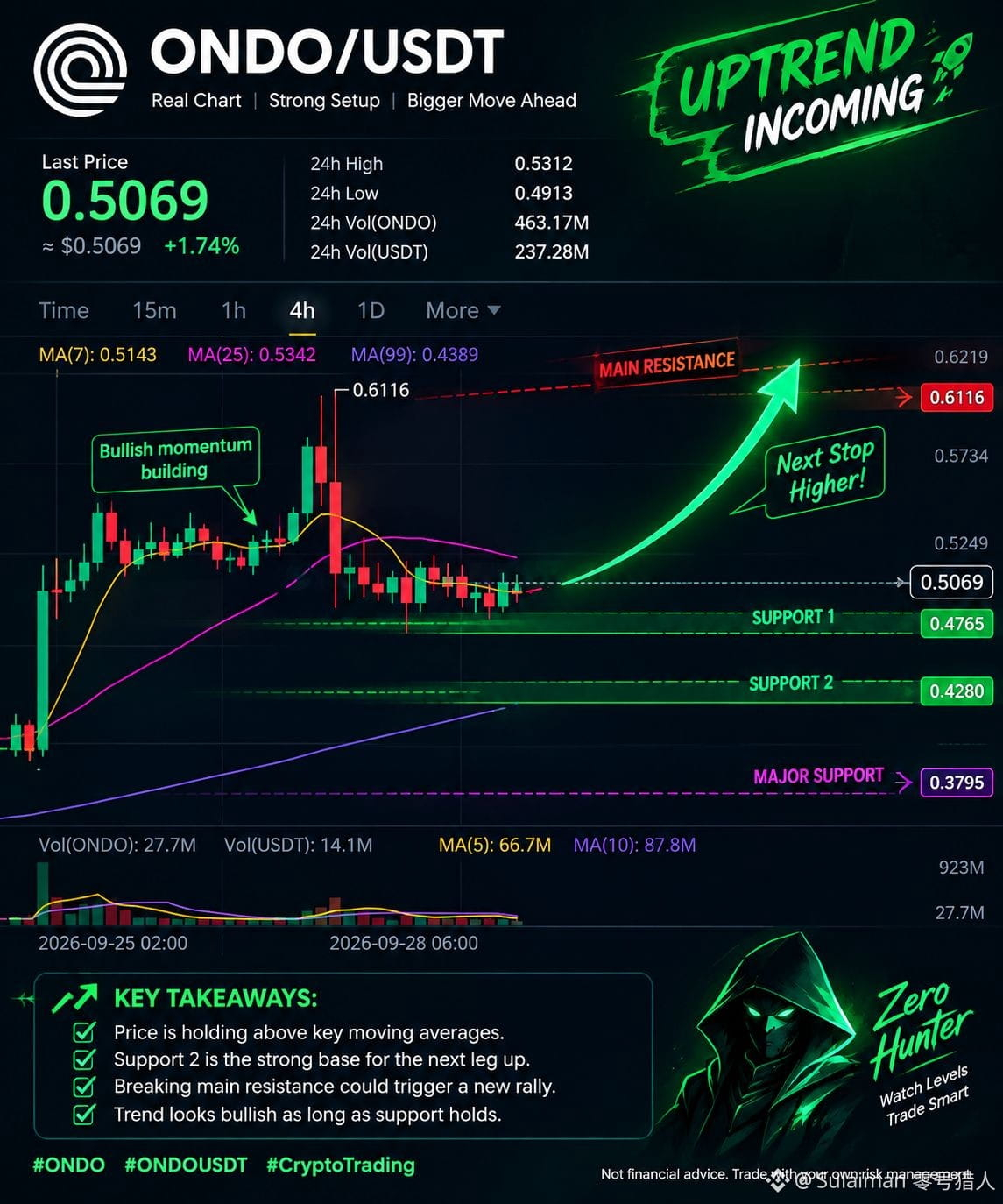
$ONDO is holding around the key support zone.
A bounce from Support 2 could open the door for another push higher. 🚀
But if support breaks, the downside scenario remains open.
No chasing. No guessing.
Watch the levels. Wait for confirmation. 🎯
#ONDO #ONDOUSDT #CryptoTrading #ZeroResearch
Not financial advice. Trade with your own risk management.
$ONDO — Zero Hunter Update 🎯
$ONDO is holding around the key support zone.
A bounce from Support 2 could open the door for another push higher. 🚀
But if support breaks, the downside scenario remains open.
No chasing. No guessing.
Watch the levels. Wait for confirmation. 🎯
#ONDO #ONDOUSDT #CryptoTrading #ZeroResearch
Not financial advice. Trade with your own risk management.
$ONDO is holding around the key support zone.
A bounce from Support 2 could open the door for another push higher. 🚀
But if support breaks, the downside scenario remains open.
No chasing. No guessing.
Watch the levels. Wait for confirmation. 🎯
#ONDO #ONDOUSDT #CryptoTrading #ZeroResearch
Not financial advice. Trade with your own risk management.
4
359
·
--
Рост
Проверено
$MU reports today after the close. I'm bullish going in, and I've got money on it.
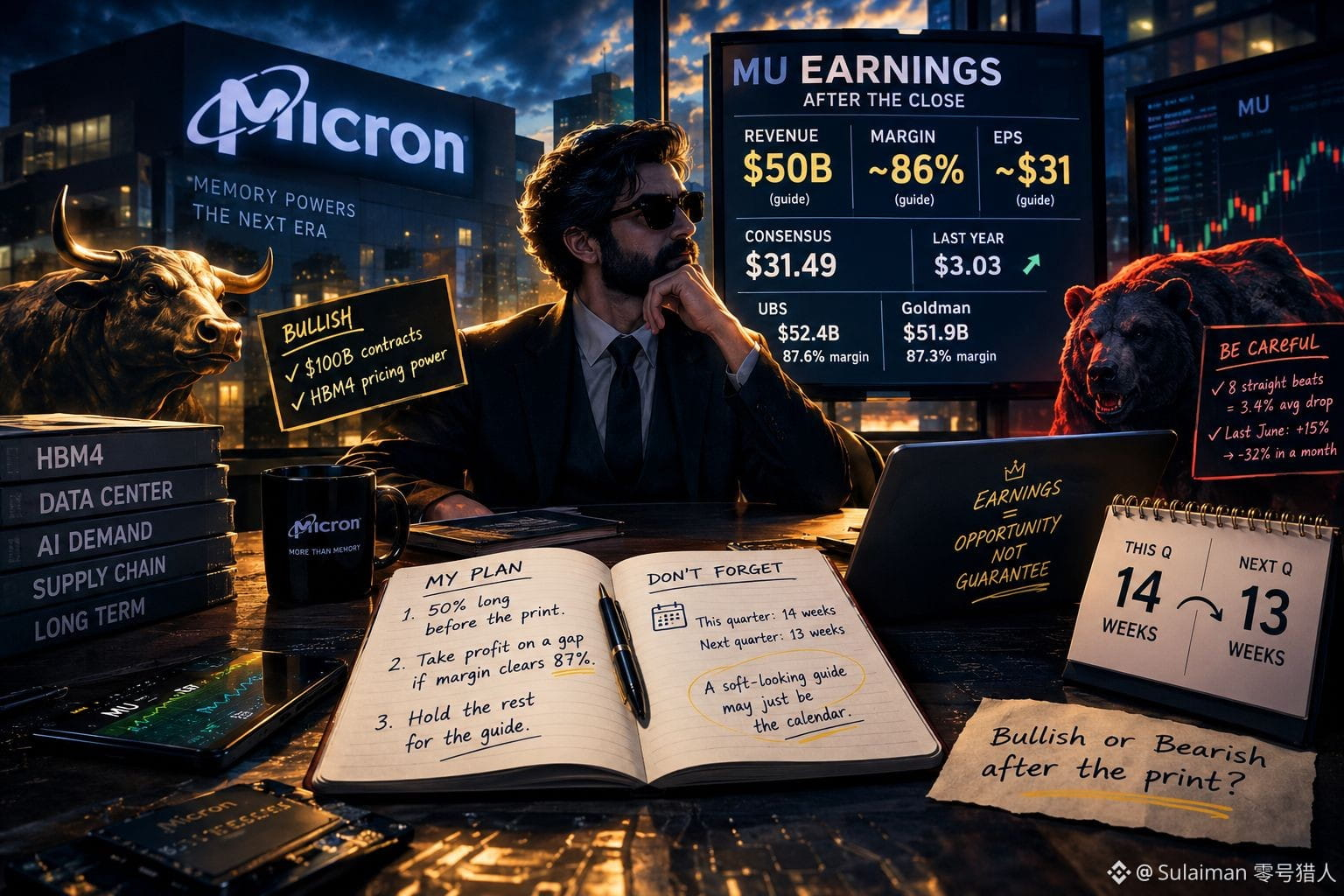
Guide is about $50B revenue, ~86% margin, ~$31 EPS. Consensus is already at $31.49, vs $3.03 a year ago. UBS is at $52.4B and 87.6% margin. Goldman is at $51.9B and 87.3%. The Street is above the guide, and I think that's fair.
I'm in for the $100B in contracted obligations and HBM4 pricing power. That's a real edge.
Yes, 8 beats in a row and the stock still averages a 3.4% drop the week after. Last June it jumped 15%, then gave back 32% in a month. I know the risk. That's why I'm sized for it.
50% long before the print. If margin clears 87% and it gaps up, I take profit. The rest rides for the guide.
Also, this quarter has 14 weeks and next has 13. A soft-looking guide can be a fake signal.
Bullish or bearish after the print?
#EarningsSeason #MicronGuideWatch #stockmarketnews
$MU reports today after the close. I'm bullish going in, and I've got money on it.
Guide is about $50B revenue, ~86% margin, ~$31 EPS. Consensus is already at $31.49, vs $3.03 a year ago. UBS is at $52.4B and 87.6% margin. Goldman is at $51.9B and 87.3%. The Street is above the guide, and I think that's fair.
I'm in for the $100B in contracted obligations and HBM4 pricing power. That's a real edge.
Yes, 8 beats in a row and the stock still averages a 3.4% drop the week after. Last June it jumped 15%, then gave back 32% in a month. I know the risk. That's why I'm sized for it.
50% long before the print. If margin clears 87% and it gaps up, I take profit. The rest rides for the guide.
Also, this quarter has 14 weeks and next has 13. A soft-looking guide can be a fake signal.
Bullish or bearish after the print?
#EarningsSeason #MicronGuideWatch #stockmarketnews
Guide is about $50B revenue, ~86% margin, ~$31 EPS. Consensus is already at $31.49, vs $3.03 a year ago. UBS is at $52.4B and 87.6% margin. Goldman is at $51.9B and 87.3%. The Street is above the guide, and I think that's fair.
I'm in for the $100B in contracted obligations and HBM4 pricing power. That's a real edge.
Yes, 8 beats in a row and the stock still averages a 3.4% drop the week after. Last June it jumped 15%, then gave back 32% in a month. I know the risk. That's why I'm sized for it.
50% long before the print. If margin clears 87% and it gaps up, I take profit. The rest rides for the guide.
Also, this quarter has 14 weeks and next has 13. A soft-looking guide can be a fake signal.
Bullish or bearish after the print?
#EarningsSeason #MicronGuideWatch #stockmarketnews
2
2
179
What The Market Missed While Watching the Price
$ICP just quietly broke its own network activity record — becoming one of the busiest chains in existence — while everyone was still judging it by an old chart. Fundamentals moved first. Attention hasn't caught up yet.
$RARE has been paying real holders real yield from real transaction revenue this whole time, while the crowd chased tokens with nothing behind them. Substance doesn't need to shout.
$ZRO is quietly becoming the plumbing traditional finance runs on — enterprise payment giants are already building on it. The old bridge-token narrative is dead; what's replacing it is bigger than most people have noticed.
The pattern never changes: price reacts last. The story always moves first.
Follow @SulemaOFCrypto For More. DYOR 🚀
#ICP #RARE #ZRO #Web3 #ZeroResearch
What The Market Missed While Watching the Price
$ICP just quietly broke its own network activity record — becoming one of the busiest chains in existence — while everyone was still judging it by an old chart. Fundamentals moved first. Attention hasn't caught up yet.
$RARE has been paying real holders real yield from real transaction revenue this whole time, while the crowd chased tokens with nothing behind them. Substance doesn't need to shout.
$ZRO is quietly becoming the plumbing traditional finance runs on — enterprise payment giants are already building on it. The old bridge-token narrative is dead; what's replacing it is bigger than most people have noticed.
The pattern never changes: price reacts last. The story always moves first.
Follow @Sulaiman 零号猎人 For More. DYOR 🚀
#ICP #RARE #ZRO #Web3 #ZeroResearch
$ICP just quietly broke its own network activity record — becoming one of the busiest chains in existence — while everyone was still judging it by an old chart. Fundamentals moved first. Attention hasn't caught up yet.
$RARE has been paying real holders real yield from real transaction revenue this whole time, while the crowd chased tokens with nothing behind them. Substance doesn't need to shout.
$ZRO is quietly becoming the plumbing traditional finance runs on — enterprise payment giants are already building on it. The old bridge-token narrative is dead; what's replacing it is bigger than most people have noticed.
The pattern never changes: price reacts last. The story always moves first.
Follow @Sulaiman 零号猎人 For More. DYOR 🚀
#ICP #RARE #ZRO #Web3 #ZeroResearch
1
656
Silent Movers, Loud Comebacks
$QNT has been the interoperability project institutions quietly respect while retail argues about the next shiny thing. The ones who understood the vision years ago are watching it prove them right, again.
$TRUMP showed the market that culture and momentum can move faster than any roadmap. New money chased the name — but the ones who understood the attention economy got in before the crowd even noticed.
$FIL was building the decentralized storage backbone before "real utility" became a buzzword. Old holders didn't need a narrative to believe — they just needed time.
Different stories, same lesson: the market always circles back to what was quietly built to last.
DYOR 🚀
#QNT #TRUMP #FIL #ZeroResearch #Sulaiman零号猎人
Silent Movers, Loud Comebacks
$QNT has been the interoperability project institutions quietly respect while retail argues about the next shiny thing. The ones who understood the vision years ago are watching it prove them right, again.
$TRUMP showed the market that culture and momentum can move faster than any roadmap. New money chased the name — but the ones who understood the attention economy got in before the crowd even noticed.
$FIL was building the decentralized storage backbone before "real utility" became a buzzword. Old holders didn't need a narrative to believe — they just needed time.
Different stories, same lesson: the market always circles back to what was quietly built to last.
DYOR 🚀
#QNT #TRUMP #FIL #ZeroResearch #Sulaiman零号猎人
$QNT has been the interoperability project institutions quietly respect while retail argues about the next shiny thing. The ones who understood the vision years ago are watching it prove them right, again.
$TRUMP showed the market that culture and momentum can move faster than any roadmap. New money chased the name — but the ones who understood the attention economy got in before the crowd even noticed.
$FIL was building the decentralized storage backbone before "real utility" became a buzzword. Old holders didn't need a narrative to believe — they just needed time.
Different stories, same lesson: the market always circles back to what was quietly built to last.
DYOR 🚀
#QNT #TRUMP #FIL #ZeroResearch #Sulaiman零号猎人
1
997
Quiet Accumulation, Loud Results
$HBAR has been the enterprise world's quiet secret for years — while retail argued about memes, institutions were building on it in silence.
$NMR proved something rare in crypto: a token tied to real intelligence, not just vibes. Long-time holders bet on substance when nobody else cared.
$ALGO was written off as "old news" more times than anyone can count — and every single time, the ones who stayed said nothing and just watched it come back.
The market forgets. The holders remember.
DYOR 🚀
#HBAR #NMR #ALGO #CryptoAI
Quiet Accumulation, Loud Results
$HBAR has been the enterprise world's quiet secret for years — while retail argued about memes, institutions were building on it in silence.
$NMR proved something rare in crypto: a token tied to real intelligence, not just vibes. Long-time holders bet on substance when nobody else cared.
$ALGO was written off as "old news" more times than anyone can count — and every single time, the ones who stayed said nothing and just watched it come back.
The market forgets. The holders remember.
DYOR 🚀
#HBAR #NMR #ALGO #CryptoAI
$HBAR has been the enterprise world's quiet secret for years — while retail argued about memes, institutions were building on it in silence.
$NMR proved something rare in crypto: a token tied to real intelligence, not just vibes. Long-time holders bet on substance when nobody else cared.
$ALGO was written off as "old news" more times than anyone can count — and every single time, the ones who stayed said nothing and just watched it come back.
The market forgets. The holders remember.
DYOR 🚀
#HBAR #NMR #ALGO #CryptoAI
1
261
Legacy Coins, Fresh Momentum
$IOTA was building "internet of things" before most of CT knew what IoT meant. Original holders have seen every cycle — and they're still here.
$CELO rebuilt itself quietly while the market wasn't watching, proving real infrastructure doesn't need hype to survive.
$ALICE carried the metaverse dream through the coldest bear market and came out the other side. Patience is the only alpha that never expires.
Old charts. New energy. This is what a real comeback looks like.
DYOR 🚀
#IOTA #CELO #ALICE #Web3 #Sulaiman零号猎人
Legacy Coins, Fresh Momentum
$IOTA was building "internet of things" before most of CT knew what IoT meant. Original holders have seen every cycle — and they're still here.
$CELO rebuilt itself quietly while the market wasn't watching, proving real infrastructure doesn't need hype to survive.
$ALICE carried the metaverse dream through the coldest bear market and came out the other side. Patience is the only alpha that never expires.
Old charts. New energy. This is what a real comeback looks like.
DYOR 🚀
#IOTA #CELO #ALICE #Web3 #Sulaiman零号猎人
$IOTA was building "internet of things" before most of CT knew what IoT meant. Original holders have seen every cycle — and they're still here.
$CELO rebuilt itself quietly while the market wasn't watching, proving real infrastructure doesn't need hype to survive.
$ALICE carried the metaverse dream through the coldest bear market and came out the other side. Patience is the only alpha that never expires.
Old charts. New energy. This is what a real comeback looks like.
DYOR 🚀
#IOTA #CELO #ALICE #Web3 #Sulaiman零号猎人
363
The Believers Never Left
$CRV built the entire DeFi yield era before most people even knew what "liquidity pool" meant. Old holders never sold the dream — they just waited.
$0G is what CRV's generation dreamed of building: real AI infrastructure, backed by names that don't chase hype. New money is just now finding what smart money already knew.
$MUBARAK came from culture, not code — and culture always outlasts a chart. The believers who held through the noise are the ones smiling today.
Same story, different chapter: conviction always outperforms panic.
DYOR 🚀
#CRV #0G #MUBARAK #DeFi
The Believers Never Left
$CRV built the entire DeFi yield era before most people even knew what "liquidity pool" meant. Old holders never sold the dream — they just waited.
$0G is what CRV's generation dreamed of building: real AI infrastructure, backed by names that don't chase hype. New money is just now finding what smart money already knew.
$MUBARAK came from culture, not code — and culture always outlasts a chart. The believers who held through the noise are the ones smiling today.
Same story, different chapter: conviction always outperforms panic.
DYOR 🚀
#CRV #0G #MUBARAK #DeFi
$CRV built the entire DeFi yield era before most people even knew what "liquidity pool" meant. Old holders never sold the dream — they just waited.
$0G is what CRV's generation dreamed of building: real AI infrastructure, backed by names that don't chase hype. New money is just now finding what smart money already knew.
$MUBARAK came from culture, not code — and culture always outlasts a chart. The believers who held through the noise are the ones smiling today.
Same story, different chapter: conviction always outperforms panic.
DYOR 🚀
#CRV #0G #MUBARAK #DeFi
168
Old money is waking up. New money hasn't noticed yet.
$CRV — the OG DeFi blue-chip that built the yield-farming era. Everyone forgot it existed. It just quietly climbed back to $0.40. Sleeping giants don't stay asleep forever.
$HBAR — enterprise money has been accumulating this in silence for months while retail chased memes. Now it's breaking $0.11 and the institutional crowd is smiling.
$NMR — the AI-data token nobody talks about at parties. Just printed $12+ while everyone was busy watching the loud coins. Quiet builders always catch up to loud talkers eventually.
Same psychology, different decade: the market always rotates back to what actually has substance once the hype coins run dry.
Old charts, new momentum. This is what a real rotation looks like.
Not financial advice. DYOR 🚀
Old money is waking up. New money hasn't noticed yet.
$CRV — the OG DeFi blue-chip that built the yield-farming era. Everyone forgot it existed. It just quietly climbed back to $0.40. Sleeping giants don't stay asleep forever.
$HBAR — enterprise money has been accumulating this in silence for months while retail chased memes. Now it's breaking $0.11 and the institutional crowd is smiling.
$NMR — the AI-data token nobody talks about at parties. Just printed $12+ while everyone was busy watching the loud coins. Quiet builders always catch up to loud talkers eventually.
Same psychology, different decade: the market always rotates back to what actually has substance once the hype coins run dry.
Old charts, new momentum. This is what a real rotation looks like.
Not financial advice. DYOR 🚀
$CRV — the OG DeFi blue-chip that built the yield-farming era. Everyone forgot it existed. It just quietly climbed back to $0.40. Sleeping giants don't stay asleep forever.
$HBAR — enterprise money has been accumulating this in silence for months while retail chased memes. Now it's breaking $0.11 and the institutional crowd is smiling.
$NMR — the AI-data token nobody talks about at parties. Just printed $12+ while everyone was busy watching the loud coins. Quiet builders always catch up to loud talkers eventually.
Same psychology, different decade: the market always rotates back to what actually has substance once the hype coins run dry.
Old charts, new momentum. This is what a real rotation looks like.
Not financial advice. DYOR 🚀
149
Проверено
Maple's assets under management grew about 81% in a year, to $4.6B.
That growth is real. And a passed vote now sends 10% to 30% of monthly revenue into SYRUP buybacks.
But revenue is still small, about $22M over the last 12 months. So buybacks alone won't move the price much.
My take: the business is growing, but the token side is still early.
Are you watching SYRUP or waiting for more proof?
Save for later.
#SYRUPWatch #Sulaiman零号猎人 #MapleFinance #BuybackReality
Maple's assets under management grew about 81% in a year, to $4.6B.
That growth is real. And a passed vote now sends 10% to 30% of monthly revenue into SYRUP buybacks.
But revenue is still small, about $22M over the last 12 months. So buybacks alone won't move the price much.
My take: the business is growing, but the token side is still early.
Are you watching SYRUP or waiting for more proof?
Save for later.
#SYRUPWatch #Sulaiman零号猎人 #MapleFinance #BuybackReality
That growth is real. And a passed vote now sends 10% to 30% of monthly revenue into SYRUP buybacks.
But revenue is still small, about $22M over the last 12 months. So buybacks alone won't move the price much.
My take: the business is growing, but the token side is still early.
Are you watching SYRUP or waiting for more proof?
Save for later.
#SYRUPWatch #Sulaiman零号猎人 #MapleFinance #BuybackReality
1
243
Проверено
ENA is trading around $0.27 right now.
The buyback plan is real. But it only starts when USDe supply hits $7.5B. Today it sits near $4.9B.
The last investor unlock also lands on October 5.
My take: the story is good, but the switch isn't on yet. And the price already ran ahead of it.
Are you holding through the unlock or waiting on the side? Tell me below.
Save for later.
#ENAUnlockWatch #Sulaiman零号猎人 #EthenaBuyback #USDeSupply
ENA is trading around $0.27 right now.
The buyback plan is real. But it only starts when USDe supply hits $7.5B. Today it sits near $4.9B.
The last investor unlock also lands on October 5.
My take: the story is good, but the switch isn't on yet. And the price already ran ahead of it.
Are you holding through the unlock or waiting on the side? Tell me below.
Save for later.
#ENAUnlockWatch #Sulaiman零号猎人 #EthenaBuyback #USDeSupply
The buyback plan is real. But it only starts when USDe supply hits $7.5B. Today it sits near $4.9B.
The last investor unlock also lands on October 5.
My take: the story is good, but the switch isn't on yet. And the price already ran ahead of it.
Are you holding through the unlock or waiting on the side? Tell me below.
Save for later.
#ENAUnlockWatch #Sulaiman零号猎人 #EthenaBuyback #USDeSupply
280
Проверено
QNT is up more than 250% in a week.
The reason is real. The Clearing House picked Quant for its new On Chain Money initiative.
Good news, but the price already ran ahead. And nobody has shown yet that banks using Quant's software will actually need QNT.
What do you think? Does the token really benefit from this?
Share if useful.
#QNTAfterTheCandle #Sulaiman零号猎人 #TokenizedDeposits #QuantClearingHouse
$QNT $CRV $EGLD
QNT is up more than 250% in a week.
The reason is real. The Clearing House picked Quant for its new On Chain Money initiative.
Good news, but the price already ran ahead. And nobody has shown yet that banks using Quant's software will actually need QNT.
What do you think? Does the token really benefit from this?
Share if useful.
#QNTAfterTheCandle #Sulaiman零号猎人 #TokenizedDeposits #QuantClearingHouse
$QNT $CRV $EGLD
The reason is real. The Clearing House picked Quant for its new On Chain Money initiative.
Good news, but the price already ran ahead. And nobody has shown yet that banks using Quant's software will actually need QNT.
What do you think? Does the token really benefit from this?
Share if useful.
#QNTAfterTheCandle #Sulaiman零号猎人 #TokenizedDeposits #QuantClearingHouse
$QNT $CRV $EGLD
2
1
406
Статья
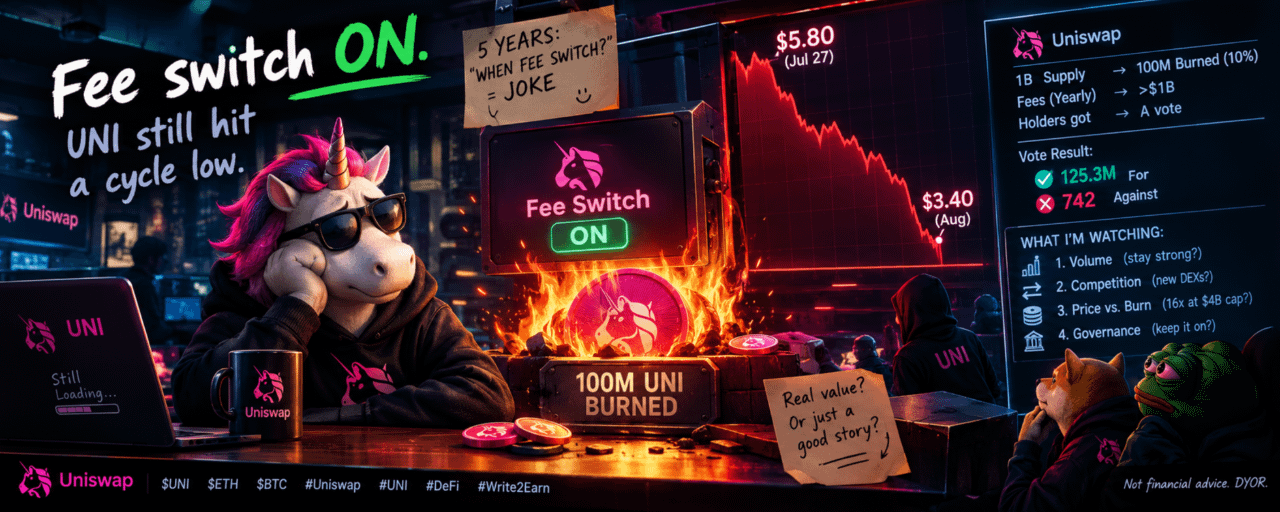
Fee switch ON. UNI still hit a cycle low.For five years, "when fee switch?" was a joke.
Then it happened. 100M UNI burned. Fee switch live.
And the price still fell.
Not overnight. It bled for months, from about $5.80 when the vote passed to around $3.40 by August.
That is strange, because UNI used to be the most famous token that captured nothing. More than $1B in fees a year, and holders got one thing: a vote.
This time the vote was not even close. 125.3M in favor, 742 against. The treasury burned 100M UNI in one go, which is 10% of the original 1B supply.
Most people expected a moonshot. They got a slide.
Why?
My guess: the market had heard "the fee switch is coming" for so long that it stopped believing it. It did not want a vote. It wanted proof.
And the proof came slowly.
On July 27, the fee switch reached v4 pools. In one snapshot, daily protocol revenue went from about $114K to about $325K.
By September 9, Hayden Adams said the burn rate, if it kept going for a full year, would pass $250M.
UNI then climbed to about $6.56 in mid-September. That is roughly 91% above the August low.
How it works, simple version:
Every swap → fees collected → TokenJar buys UNI on the open market → UNI is burned forever → less supply.
Nobody has to vote every week. The more people trade, the more UNI disappears.
That is why I keep saying: the burn story lives and dies on trading volume.
But let me be honest about what this is NOT.
UNI is not a dividend token. Uniswap's own developer docs say holders have no direct claim on protocol revenue. Value comes only through burns, and whatever governance approves later.
What I am watching:
Volume: does trading stay strong when the market goes quiet? Less trading means less burn.
Competition: do aggregators and new DEXs pull liquidity away from Uniswap?
Price vs. burn: at roughly a $4B market cap, $250M a year of burns is about 16x. Cheaper than before, still not cheap. (My own estimate. Check the live market cap.)
Governance: does the DAO keep the switch on, or does someone try to change it later?
The market did not reward the announcement. It rewarded the numbers, months later.
So what is UNI now? A real value-accrual story, or a good story that ran too fast? Tell me below 👇
$UNI $ETH $BTC #Uniswap #UNI #DeFi #Write2Earn #mostsearched
Not financial advice. DYOR.
Fee switch ON. UNI still hit a cycle low.
For five years, "when fee switch?" was a joke.
Then it happened. 100M UNI burned. Fee switch live.
And the price still fell.
Not overnight. It bled for months, from about $5.80 when the vote passed to around $3.40 by August.
That is strange, because UNI used to be the most famous token that captured nothing. More than $1B in fees a year, and holders got one thing: a vote.
This time the vote was not even close. 125.3M in favor, 742 against. The treasury burned 100M UNI in one go, which is 10% of the original 1B supply.
Most people expected a moonshot. They got a slide.
Why?
My guess: the market had heard "the fee switch is coming" for so long that it stopped believing it. It did not want a vote. It wanted proof.
And the proof came slowly.
On July 27, the fee switch reached v4 pools. In one snapshot, daily protocol revenue went from about $114K to about $325K.
By September 9, Hayden Adams said the burn rate, if it kept going for a full year, would pass $250M.
UNI then climbed to about $6.56 in mid-September. That is roughly 91% above the August low.
How it works, simple version:
Every swap → fees collected → TokenJar buys UNI on the open market → UNI is burned forever → less supply.
Nobody has to vote every week. The more people trade, the more UNI disappears.
That is why I keep saying: the burn story lives and dies on trading volume.
But let me be honest about what this is NOT.
UNI is not a dividend token. Uniswap's own developer docs say holders have no direct claim on protocol revenue. Value comes only through burns, and whatever governance approves later.
What I am watching:
Volume: does trading stay strong when the market goes quiet? Less trading means less burn.
Competition: do aggregators and new DEXs pull liquidity away from Uniswap?
Price vs. burn: at roughly a $4B market cap, $250M a year of burns is about 16x. Cheaper than before, still not cheap. (My own estimate. Check the live market cap.)
Governance: does the DAO keep the switch on, or does someone try to change it later?
The market did not reward the announcement. It rewarded the numbers, months later.
So what is UNI now? A real value-accrual story, or a good story that ran too fast? Tell me below 👇
$UNI $ETH $BTC #Uniswap #UNI #DeFi #Write2Earn #mostsearched
Not financial advice. DYOR.
Then it happened. 100M UNI burned. Fee switch live.
And the price still fell.
Not overnight. It bled for months, from about $5.80 when the vote passed to around $3.40 by August.
That is strange, because UNI used to be the most famous token that captured nothing. More than $1B in fees a year, and holders got one thing: a vote.
This time the vote was not even close. 125.3M in favor, 742 against. The treasury burned 100M UNI in one go, which is 10% of the original 1B supply.
Most people expected a moonshot. They got a slide.
Why?
My guess: the market had heard "the fee switch is coming" for so long that it stopped believing it. It did not want a vote. It wanted proof.
And the proof came slowly.
On July 27, the fee switch reached v4 pools. In one snapshot, daily protocol revenue went from about $114K to about $325K.
By September 9, Hayden Adams said the burn rate, if it kept going for a full year, would pass $250M.
UNI then climbed to about $6.56 in mid-September. That is roughly 91% above the August low.
How it works, simple version:
Every swap → fees collected → TokenJar buys UNI on the open market → UNI is burned forever → less supply.
Nobody has to vote every week. The more people trade, the more UNI disappears.
That is why I keep saying: the burn story lives and dies on trading volume.
But let me be honest about what this is NOT.
UNI is not a dividend token. Uniswap's own developer docs say holders have no direct claim on protocol revenue. Value comes only through burns, and whatever governance approves later.
What I am watching:
Volume: does trading stay strong when the market goes quiet? Less trading means less burn.
Competition: do aggregators and new DEXs pull liquidity away from Uniswap?
Price vs. burn: at roughly a $4B market cap, $250M a year of burns is about 16x. Cheaper than before, still not cheap. (My own estimate. Check the live market cap.)
Governance: does the DAO keep the switch on, or does someone try to change it later?
The market did not reward the announcement. It rewarded the numbers, months later.
So what is UNI now? A real value-accrual story, or a good story that ran too fast? Tell me below 👇
$UNI $ETH $BTC #Uniswap #UNI #DeFi #Write2Earn #mostsearched
Not financial advice. DYOR.
2
1
1
88
Проверено
Статья
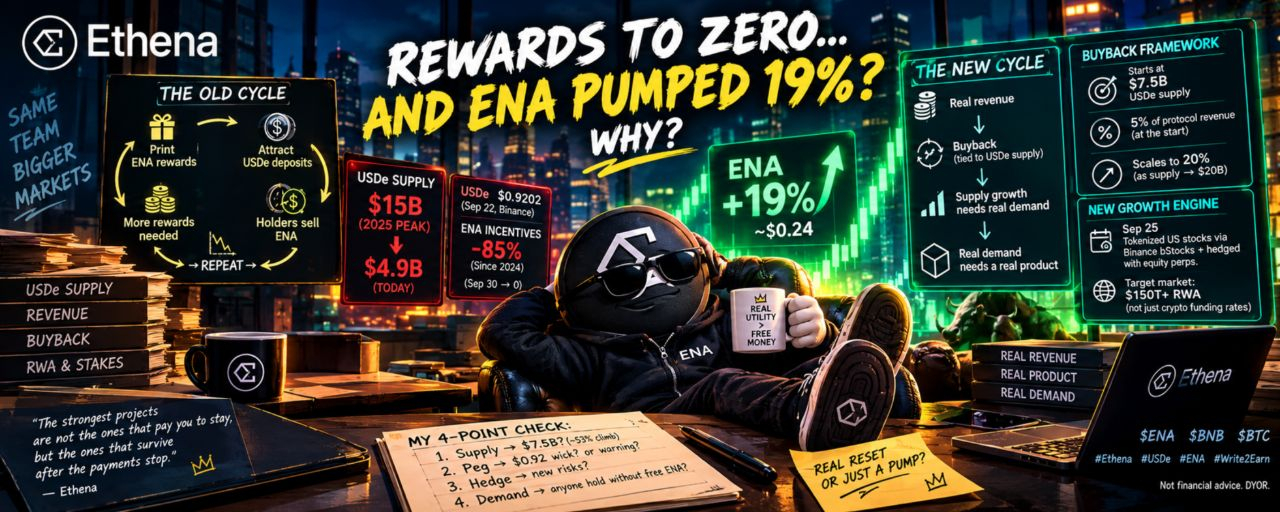
Ethena just cut its rewards to ZERO, and ENA pumped 19%. Why?Two weeks ago I would have called this a bearish setup. I'm not so sure anymore.
Look at the facts.
USDe supply peaked at $15B in 2025. Today it sits near $4.9B. On September 22, USDe briefly dropped to $0.9202 on Binance. On September 30, ENA incentives for USDe go to zero, after an 85% cut since 2024.
Any normal trader reads that and sells.
But what did ENA do? It jumped ~19% to around $0.24.
Why?
The old Ethena cycle:
Print ENA rewards → attract USDe deposits → holders sell ENA → price drops → more rewards needed → repeat.
That is a subsidy machine. It works until the subsidies stop being worth it. And that is exactly what happened to the supply.
The new Ethena cycle:
Real revenue → buyback tied to USDe supply → supply growth needs real demand → real demand needs a real product.
The buyback framework is simple:
Starts only when USDe supply reaches $7.5B
5% of protocol revenue at the start
Scales up to 20% as supply approaches $20B
Ethena stopped paying people to hold its stablecoin. Now the token only gets support if the stablecoin actually grows.
And the growth engine is new:
On September 25, Ethena started backing part of USDe with tokenized US stocks through Binance bStocks, hedged with equity perpetuals. Same delta-neutral logic, but the target market is now $150 trillion+ in real-world assets, not just crypto funding rates.
Founder Guy Young called it the biggest change to USDe since launch. I agree that it's big. I don't agree that it's risk-free.
My 4-point check before getting excited:
Supply: does USDe move from $4.9B toward $7.5B? That is a ~53% climb, and until then the buyback sends $0 to ENA.
Peg: was the $0.92 wick just one venue's thin liquidity, or a warning?
Hedge: equity perps add new funding and venue risk. Does it hold in a volatile week?
Demand: does anyone hold USDe without free ENA on top?
The market priced the story in one day. The proof will take months.
I said it before and I'll say it again: the strongest projects are not the ones that pay you to stay, but the ones that survive after the payments stop.
Ethena is about to find out which kind it is.
What do you think: real reset, or a pump on a narrative? 👇
$ENA $BNB $BTC #Ethena #USDe #ENA #Write2Earn #Sulaiman零号猎人
Not financial advice. DYOR.
Ethena just cut its rewards to ZERO, and ENA pumped 19%. Why?
Two weeks ago I would have called this a bearish setup. I'm not so sure anymore.
Look at the facts.
USDe supply peaked at $15B in 2025. Today it sits near $4.9B. On September 22, USDe briefly dropped to $0.9202 on Binance. On September 30, ENA incentives for USDe go to zero, after an 85% cut since 2024.
Any normal trader reads that and sells.
But what did ENA do? It jumped ~19% to around $0.24.
Why?
The old Ethena cycle:
Print ENA rewards → attract USDe deposits → holders sell ENA → price drops → more rewards needed → repeat.
That is a subsidy machine. It works until the subsidies stop being worth it. And that is exactly what happened to the supply.
The new Ethena cycle:
Real revenue → buyback tied to USDe supply → supply growth needs real demand → real demand needs a real product.
The buyback framework is simple:
Starts only when USDe supply reaches $7.5B
5% of protocol revenue at the start
Scales up to 20% as supply approaches $20B
Ethena stopped paying people to hold its stablecoin. Now the token only gets support if the stablecoin actually grows.
And the growth engine is new:
On September 25, Ethena started backing part of USDe with tokenized US stocks through Binance bStocks, hedged with equity perpetuals. Same delta-neutral logic, but the target market is now $150 trillion+ in real-world assets, not just crypto funding rates.
Founder Guy Young called it the biggest change to USDe since launch. I agree that it's big. I don't agree that it's risk-free.
My 4-point check before getting excited:
Supply: does USDe move from $4.9B toward $7.5B? That is a ~53% climb, and until then the buyback sends $0 to ENA.
Peg: was the $0.92 wick just one venue's thin liquidity, or a warning?
Hedge: equity perps add new funding and venue risk. Does it hold in a volatile week?
Demand: does anyone hold USDe without free ENA on top?
The market priced the story in one day. The proof will take months.
I said it before and I'll say it again: the strongest projects are not the ones that pay you to stay, but the ones that survive after the payments stop.
Ethena is about to find out which kind it is.
What do you think: real reset, or a pump on a narrative? 👇
$ENA $BNB $BTC #Ethena #USDe #ENA #Write2Earn #Sulaiman零号猎人
Not financial advice. DYOR.
Look at the facts.
USDe supply peaked at $15B in 2025. Today it sits near $4.9B. On September 22, USDe briefly dropped to $0.9202 on Binance. On September 30, ENA incentives for USDe go to zero, after an 85% cut since 2024.
Any normal trader reads that and sells.
But what did ENA do? It jumped ~19% to around $0.24.
Why?
The old Ethena cycle:
Print ENA rewards → attract USDe deposits → holders sell ENA → price drops → more rewards needed → repeat.
That is a subsidy machine. It works until the subsidies stop being worth it. And that is exactly what happened to the supply.
The new Ethena cycle:
Real revenue → buyback tied to USDe supply → supply growth needs real demand → real demand needs a real product.
The buyback framework is simple:
Starts only when USDe supply reaches $7.5B
5% of protocol revenue at the start
Scales up to 20% as supply approaches $20B
Ethena stopped paying people to hold its stablecoin. Now the token only gets support if the stablecoin actually grows.
And the growth engine is new:
On September 25, Ethena started backing part of USDe with tokenized US stocks through Binance bStocks, hedged with equity perpetuals. Same delta-neutral logic, but the target market is now $150 trillion+ in real-world assets, not just crypto funding rates.
Founder Guy Young called it the biggest change to USDe since launch. I agree that it's big. I don't agree that it's risk-free.
My 4-point check before getting excited:
Supply: does USDe move from $4.9B toward $7.5B? That is a ~53% climb, and until then the buyback sends $0 to ENA.
Peg: was the $0.92 wick just one venue's thin liquidity, or a warning?
Hedge: equity perps add new funding and venue risk. Does it hold in a volatile week?
Demand: does anyone hold USDe without free ENA on top?
The market priced the story in one day. The proof will take months.
I said it before and I'll say it again: the strongest projects are not the ones that pay you to stay, but the ones that survive after the payments stop.
Ethena is about to find out which kind it is.
What do you think: real reset, or a pump on a narrative? 👇
$ENA $BNB $BTC #Ethena #USDe #ENA #Write2Earn #Sulaiman零号猎人
Not financial advice. DYOR.
261
Войдите, чтобы посмотреть больше материала
Присоединяйтесь к пользователям криптовалют по всему миру на Binance Square
⚡️ Получайте новейшую и полезную информацию о криптоактивах.
💬 Нам доверяет крупнейшая в мире криптобиржа.
👍 Получите достоверные аналитические данные от верифицированных создателей контента.
Эл. почта/номер телефона
В тренде
BinanceKZ
Просмотров: 20,927
70 обсуждают
Как я потерял 180 000 тенге на «менеджере Binance» из WhatsApp — и почему всё равно остался в крипте
phpdead
·Лайков: 6
·Просмотров: 2.4k
BitcoinClears$85200
Просмотров: 9,866
202 обсуждают
AltcoinSeasonIndexHoldsAbove60For5Days
Просмотров: 49,985
1,108 обсуждают