
#cryptobeginners
cryptobeginners
Просмотров: 631,430
1,310 обсуждают
Популярные
Новые

·
--
Рост
💰 How to Earn $USDC a Day in Crypto — Without Investment
Want to start earning crypto without putting in your own money? 👀
Beginners can explore FREE opportunities such as:
🎁 Binance campaigns & rewards
📚 Learn & Earn programs when available
🎯 Community events and tasks
🤝 Referral rewards when eligible
📈 Building useful crypto content and sharing knowledge
⚠️ Important: $USDC per day is NOT guaranteed. Rewards, eligibility and campaigns can change, and you should avoid anyone promising guaranteed daily income.
Start with learning, stay consistent, and never pay someone just to “unlock” an earning opportunity. 🚀
#Binance #BinanceSquare #CryptoBeginners #freecrypto #LearnAndEarn
$NVDAB
💰 How to Earn $USDC a Day in Crypto — Without Investment
Want to start earning crypto without putting in your own money? 👀
Beginners can explore FREE opportunities such as:
🎁 Binance campaigns & rewards
📚 Learn & Earn programs when available
🎯 Community events and tasks
🤝 Referral rewards when eligible
📈 Building useful crypto content and sharing knowledge
⚠️ Important: $USDC per day is NOT guaranteed. Rewards, eligibility and campaigns can change, and you should avoid anyone promising guaranteed daily income.
Start with learning, stay consistent, and never pay someone just to “unlock” an earning opportunity. 🚀
#Binance #BinanceSquare #CryptoBeginners #freecrypto #LearnAndEarn
$NVDAB
Want to start earning crypto without putting in your own money? 👀
Beginners can explore FREE opportunities such as:
🎁 Binance campaigns & rewards
📚 Learn & Earn programs when available
🎯 Community events and tasks
🤝 Referral rewards when eligible
📈 Building useful crypto content and sharing knowledge
⚠️ Important: $USDC per day is NOT guaranteed. Rewards, eligibility and campaigns can change, and you should avoid anyone promising guaranteed daily income.
Start with learning, stay consistent, and never pay someone just to “unlock” an earning opportunity. 🚀
#Binance #BinanceSquare #CryptoBeginners #freecrypto #LearnAndEarn
$NVDAB
AngelOfCrypto_-:
nice
10
16
2.5k
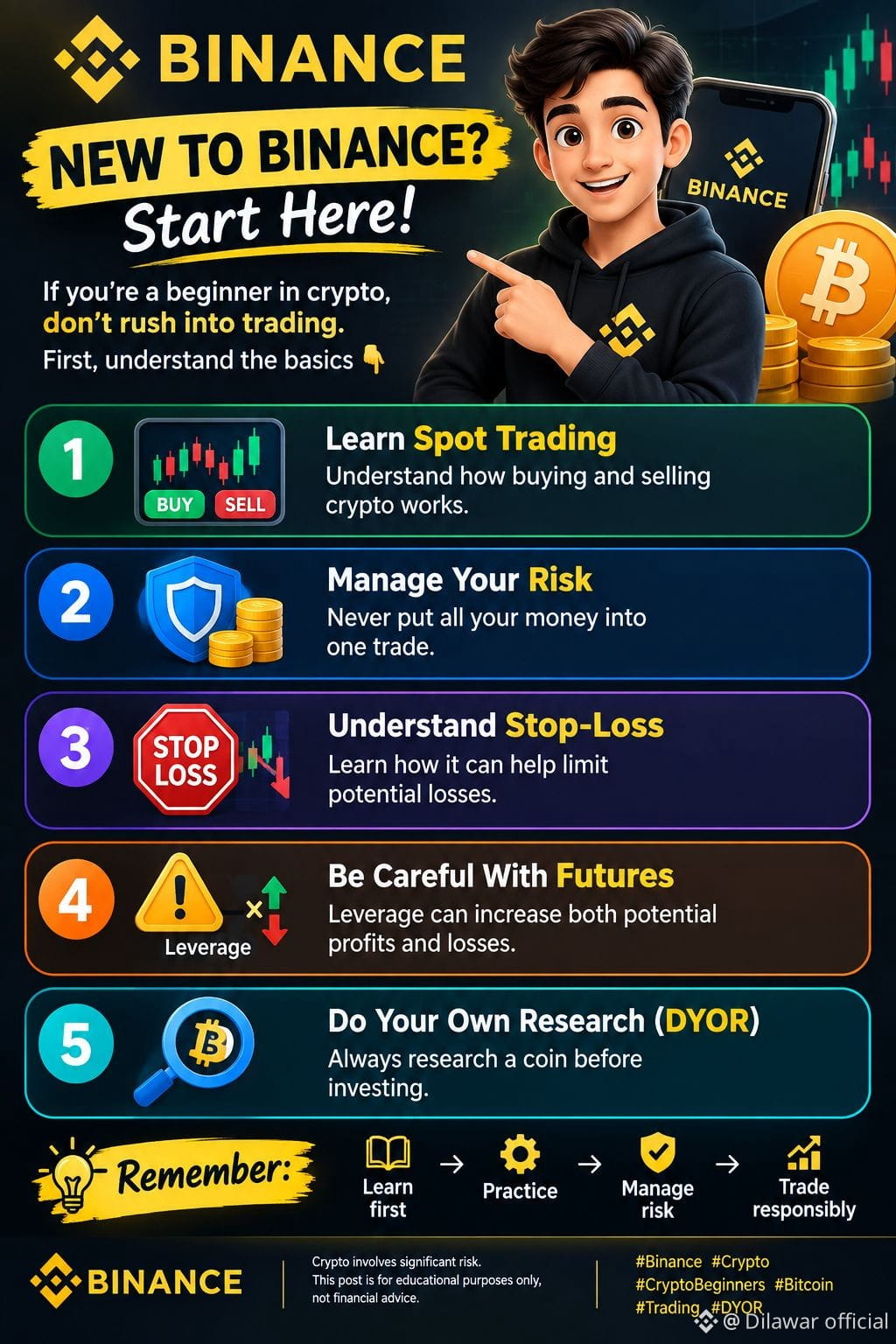
🚀 New to Binance? Start Here!
If you’re a beginner in crypto, don’t rush into trading. First, understand the basics 👇
🔹 Learn Spot Trading — Understand how buying and selling crypto works.
🔹 Manage Your Risk — Never put all your money into one trade.
🔹 Understand Stop-Loss — Learn how it can help limit potential losses.
🔹 Be Careful With Futures ⚠️ — Leverage can increase both potential profits and losses.
🔹 Do Your Own Research (DYOR) 🔎 — Always research a coin before investing.
💡 Remember: Learn first → Practice → Manage risk → Trade responsibly.
⚠️ Crypto involves significant risk. This post is for educational purposes only, not financial advice.
#Binance #Crypto #CryptoBeginners #Trading #DYOR*
$NVDAB $ETH $NVDA.US
{spot}(NVDABUSDT)
🚀 New to Binance? Start Here!
If you’re a beginner in crypto, don’t rush into trading. First, understand the basics 👇
🔹 Learn Spot Trading — Understand how buying and selling crypto works.
🔹 Manage Your Risk — Never put all your money into one trade.
🔹 Understand Stop-Loss — Learn how it can help limit potential losses.
🔹 Be Careful With Futures ⚠️ — Leverage can increase both potential profits and losses.
🔹 Do Your Own Research (DYOR) 🔎 — Always research a coin before investing.
💡 Remember: Learn first → Practice → Manage risk → Trade responsibly.
⚠️ Crypto involves significant risk. This post is for educational purposes only, not financial advice.
#Binance #Crypto #CryptoBeginners #Trading #DYOR*
$NVDAB $ETH $NVDA.US
If you’re a beginner in crypto, don’t rush into trading. First, understand the basics 👇
🔹 Learn Spot Trading — Understand how buying and selling crypto works.
🔹 Manage Your Risk — Never put all your money into one trade.
🔹 Understand Stop-Loss — Learn how it can help limit potential losses.
🔹 Be Careful With Futures ⚠️ — Leverage can increase both potential profits and losses.
🔹 Do Your Own Research (DYOR) 🔎 — Always research a coin before investing.
💡 Remember: Learn first → Practice → Manage risk → Trade responsibly.
⚠️ Crypto involves significant risk. This post is for educational purposes only, not financial advice.
#Binance #Crypto #CryptoBeginners #Trading #DYOR*
$NVDAB $ETH $NVDA.US
2
100

🚨 Crypto beginners, ye galti mat karna!
Crypto me profit dekhkar FOMO me entry lena easy hai…
Lekin risk management samajhna usse bhi zyada important hai. 📊
💡 Simple rule:
• Ek hi coin me saara paisa mat lagao
• Leverage se beginner stage par door raho
• Profit ke saath risk bhi calculate karo
• Kisi ke “100% profit guaranteed” wale claims par blindly trust mat karo
• Apna research khud karo 🔎
Crypto me survive karna pehle seekho, profit baad me. 🧠
#bitcoin #CryptoBeginners #trading #BTC #CryptoTips
🚨 Crypto beginners, ye galti mat karna!
Crypto me profit dekhkar FOMO me entry lena easy hai…
Lekin risk management samajhna usse bhi zyada important hai. 📊
💡 Simple rule:
• Ek hi coin me saara paisa mat lagao
• Leverage se beginner stage par door raho
• Profit ke saath risk bhi calculate karo
• Kisi ke “100% profit guaranteed” wale claims par blindly trust mat karo
• Apna research khud karo 🔎
Crypto me survive karna pehle seekho, profit baad me. 🧠
#bitcoin #CryptoBeginners #trading #BTC #CryptoTips
Crypto me profit dekhkar FOMO me entry lena easy hai…
Lekin risk management samajhna usse bhi zyada important hai. 📊
💡 Simple rule:
• Ek hi coin me saara paisa mat lagao
• Leverage se beginner stage par door raho
• Profit ke saath risk bhi calculate karo
• Kisi ke “100% profit guaranteed” wale claims par blindly trust mat karo
• Apna research khud karo 🔎
Crypto me survive karna pehle seekho, profit baad me. 🧠
#bitcoin #CryptoBeginners #trading #BTC #CryptoTips
1
63

·
--
🚀 JUST STARTING WITH CRYPTO? READ THIS FIRST.
Crypto doesn’t have to be confusing.
Before you think about making money, focus on building the right foundation. 🧠
1️⃣ Learn the Basics
Understand Bitcoin, blockchain, wallets, exchanges and how crypto actually works.
2️⃣ Secure Your Account 🔐
Use a strong password, enable 2FA and complete verification when required.
3️⃣ Understand Your Funds 💰
Learn how deposits, withdrawals, Spot Wallets and P2P work before moving serious money.
4️⃣ Start Simple
If trading charts feel overwhelming, begin by learning simple tools such as Convert.
5️⃣ Learn Before You Trade 📊
Understand Spot trading, trading pairs, market/limit orders and basic market movements.
6️⃣ Protect Your Capital 🛡️
Never risk money you cannot afford to lose. Risk management matters more than chasing quick profits.
🔥 Remember:
In crypto, knowledge comes before profit.
Learn → Practice → Manage Risk → Trade Smart.
#BinanceSquare #Crypto #bitcoin #CryptoBeginners #Trading #Blockchain #RiskManagement
🚀 JUST STARTING WITH CRYPTO? READ THIS FIRST.
Crypto doesn’t have to be confusing.
Before you think about making money, focus on building the right foundation. 🧠
1️⃣ Learn the Basics
Understand Bitcoin, blockchain, wallets, exchanges and how crypto actually works.
2️⃣ Secure Your Account 🔐
Use a strong password, enable 2FA and complete verification when required.
3️⃣ Understand Your Funds 💰
Learn how deposits, withdrawals, Spot Wallets and P2P work before moving serious money.
4️⃣ Start Simple
If trading charts feel overwhelming, begin by learning simple tools such as Convert.
5️⃣ Learn Before You Trade 📊
Understand Spot trading, trading pairs, market/limit orders and basic market movements.
6️⃣ Protect Your Capital 🛡️
Never risk money you cannot afford to lose. Risk management matters more than chasing quick profits.
🔥 Remember:
In crypto, knowledge comes before profit.
Learn → Practice → Manage Risk → Trade Smart.
#BinanceSquare #Crypto #bitcoin #CryptoBeginners #Trading #Blockchain #RiskManagement
Crypto doesn’t have to be confusing.
Before you think about making money, focus on building the right foundation. 🧠
1️⃣ Learn the Basics
Understand Bitcoin, blockchain, wallets, exchanges and how crypto actually works.
2️⃣ Secure Your Account 🔐
Use a strong password, enable 2FA and complete verification when required.
3️⃣ Understand Your Funds 💰
Learn how deposits, withdrawals, Spot Wallets and P2P work before moving serious money.
4️⃣ Start Simple
If trading charts feel overwhelming, begin by learning simple tools such as Convert.
5️⃣ Learn Before You Trade 📊
Understand Spot trading, trading pairs, market/limit orders and basic market movements.
6️⃣ Protect Your Capital 🛡️
Never risk money you cannot afford to lose. Risk management matters more than chasing quick profits.
🔥 Remember:
In crypto, knowledge comes before profit.
Learn → Practice → Manage Risk → Trade Smart.
#BinanceSquare #Crypto #bitcoin #CryptoBeginners #Trading #Blockchain #RiskManagement
1
77
{spot}(BTCUSDT)
🟠 5 Things Every Beginner Should Know About Bitcoin
$BTC | Bitcoin for Beginners 📚
New to crypto? Before buying Bitcoin, make sure you know these 5 points 👇
1️⃣ Bitcoin is highly volatile
BTC prices can fluctuate rapidly. Do not invest money you cannot afford to lose.
2️⃣ Don't buy based on FOMO
If you see BTC surging, don't rush to jump in just because others are. Learn and do your research first.
3️⃣ Understand risk management
Managing your capital is more important than chasing quick profits.
4️⃣ Bitcoin is not a guaranteed way to make money
No one can guarantee that the price will always go up.
5️⃣ Start by learning
Understand BTC, Spot Trading, DCA, and account security before using real money.
💬 A question for you:
Are you new to crypto, or do you already have experience?
Comment “BEGINNER” if you are just starting out 👇
#bitcoin #BTC #crypto #BinanceSquare #CryptoBeginners $BTC
🟠 5 Things Every Beginner Should Know About Bitcoin
$BTC | Bitcoin for Beginners 📚
New to crypto? Before buying Bitcoin, make sure you know these 5 points 👇
1️⃣ Bitcoin is highly volatile
BTC prices can fluctuate rapidly. Do not invest money you cannot afford to lose.
2️⃣ Don't buy based on FOMO
If you see BTC surging, don't rush to jump in just because others are. Learn and do your research first.
3️⃣ Understand risk management
Managing your capital is more important than chasing quick profits.
4️⃣ Bitcoin is not a guaranteed way to make money
No one can guarantee that the price will always go up.
5️⃣ Start by learning
Understand BTC, Spot Trading, DCA, and account security before using real money.
💬 A question for you:
Are you new to crypto, or do you already have experience?
Comment “BEGINNER” if you are just starting out 👇
#bitcoin #BTC #crypto #BinanceSquare #CryptoBeginners $BTC
$BTC | Bitcoin for Beginners 📚
New to crypto? Before buying Bitcoin, make sure you know these 5 points 👇
1️⃣ Bitcoin is highly volatile
BTC prices can fluctuate rapidly. Do not invest money you cannot afford to lose.
2️⃣ Don't buy based on FOMO
If you see BTC surging, don't rush to jump in just because others are. Learn and do your research first.
3️⃣ Understand risk management
Managing your capital is more important than chasing quick profits.
4️⃣ Bitcoin is not a guaranteed way to make money
No one can guarantee that the price will always go up.
5️⃣ Start by learning
Understand BTC, Spot Trading, DCA, and account security before using real money.
💬 A question for you:
Are you new to crypto, or do you already have experience?
Comment “BEGINNER” if you are just starting out 👇
#bitcoin #BTC #crypto #BinanceSquare #CryptoBeginners $BTC
1
63

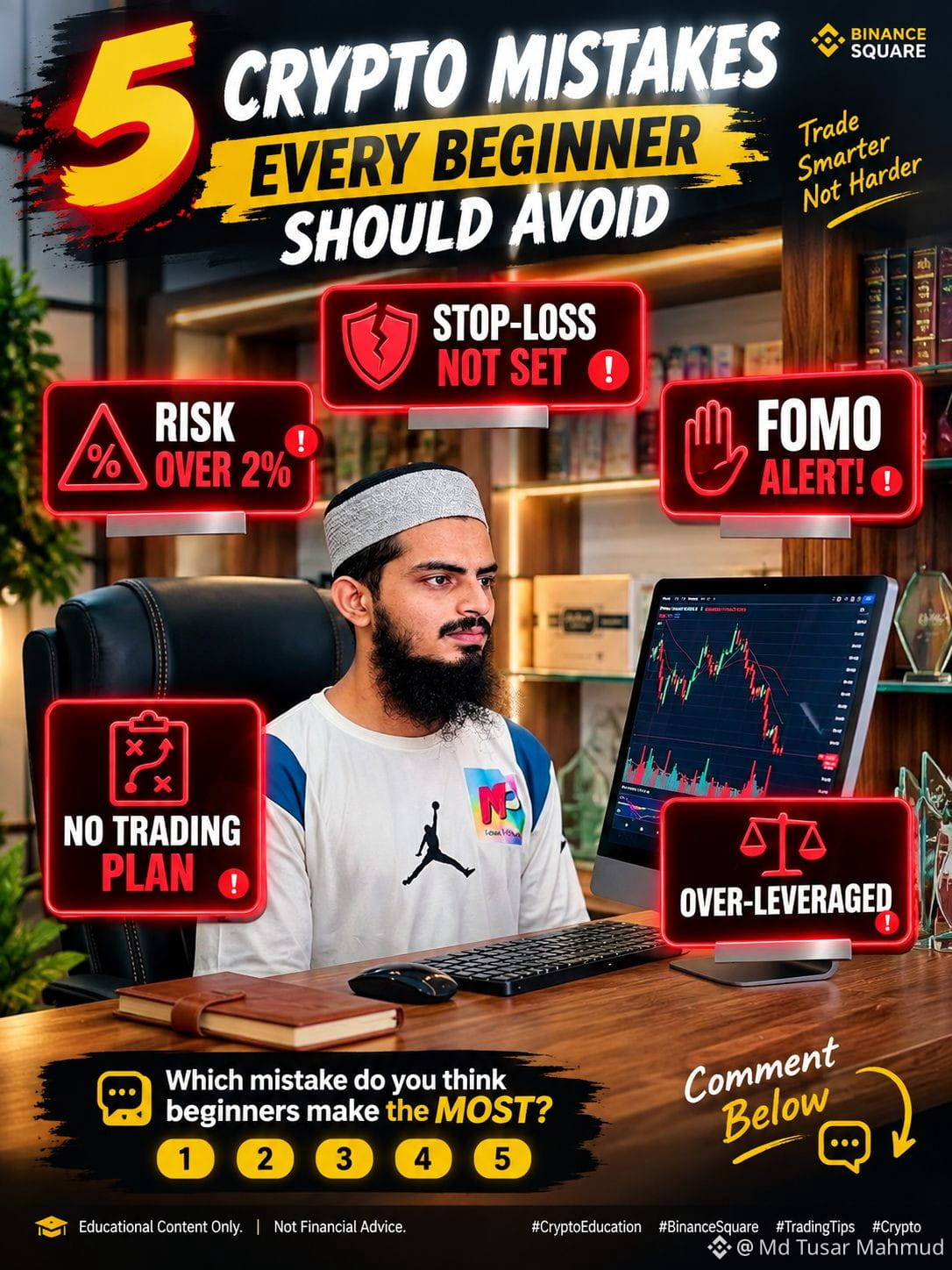
🚨 5 CRYPTO MISTAKES EVERY BEGINNER SHOULD AVOID
Starting crypto trading? Don’t make these mistakes 👇
❌ 1. STOP-LOSS NOT SET
❌ 2. RISKING TOO MUCH
❌ 3. TRADING WITH FOMO
❌ 4. NO TRADING PLAN
❌ 5. USING TOO MUCH LEVERAGE
💡 Remember:
You don't need to win every trade.
You need to protect your capital and manage your risk.
A smart trader doesn't chase every pump.
They wait for a setup and follow a plan. 📊
👇 Which mistake do you think beginners make the MOST?
1️⃣ Stop-loss
2️⃣ Too much risk
3️⃣ FOMO
4️⃣ No plan
5️⃣ Too much leverage
Comment your answer! 👇
⚠️ Educational content only. Not financial advice.
#CryptoEducation #CryptoBeginners #tradingtips #BinanceSquare #cryptouniverseofficial
🚨 5 CRYPTO MISTAKES EVERY BEGINNER SHOULD AVOID
Starting crypto trading? Don’t make these mistakes 👇
❌ 1. STOP-LOSS NOT SET
❌ 2. RISKING TOO MUCH
❌ 3. TRADING WITH FOMO
❌ 4. NO TRADING PLAN
❌ 5. USING TOO MUCH LEVERAGE
💡 Remember:
You don't need to win every trade.
You need to protect your capital and manage your risk.
A smart trader doesn't chase every pump.
They wait for a setup and follow a plan. 📊
👇 Which mistake do you think beginners make the MOST?
1️⃣ Stop-loss
2️⃣ Too much risk
3️⃣ FOMO
4️⃣ No plan
5️⃣ Too much leverage
Comment your answer! 👇
⚠️ Educational content only. Not financial advice.
#CryptoEducation #CryptoBeginners #tradingtips #BinanceSquare #cryptouniverseofficial
Starting crypto trading? Don’t make these mistakes 👇
❌ 1. STOP-LOSS NOT SET
❌ 2. RISKING TOO MUCH
❌ 3. TRADING WITH FOMO
❌ 4. NO TRADING PLAN
❌ 5. USING TOO MUCH LEVERAGE
💡 Remember:
You don't need to win every trade.
You need to protect your capital and manage your risk.
A smart trader doesn't chase every pump.
They wait for a setup and follow a plan. 📊
👇 Which mistake do you think beginners make the MOST?
1️⃣ Stop-loss
2️⃣ Too much risk
3️⃣ FOMO
4️⃣ No plan
5️⃣ Too much leverage
Comment your answer! 👇
⚠️ Educational content only. Not financial advice.
#CryptoEducation #CryptoBeginners #tradingtips #BinanceSquare #cryptouniverseofficial
1
79

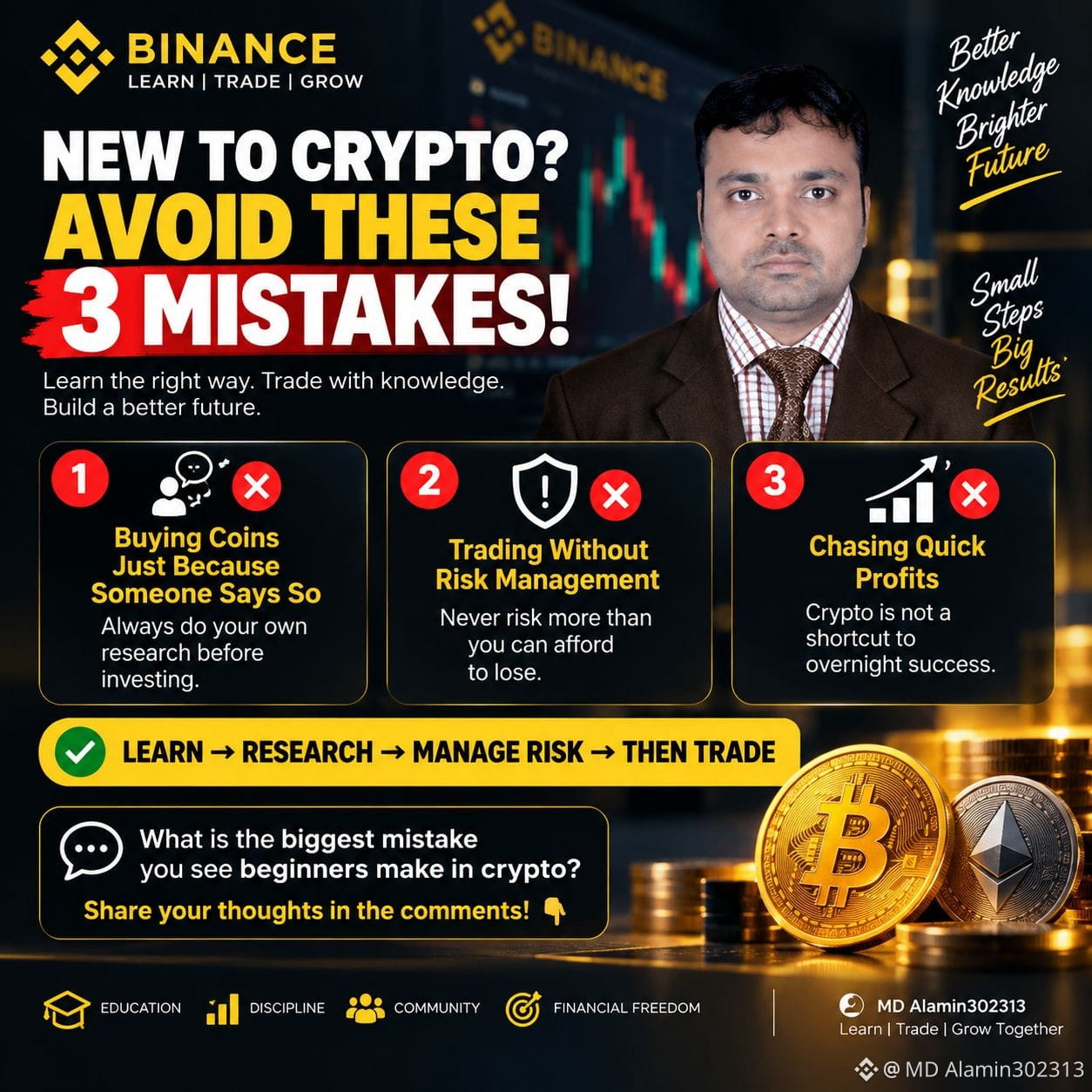
🚀 NEW TO CRYPTO?
AVOID THESE 3 MISTAKES!
❌ 1. Buying Coins Just Because Someone Says So
Always do your own research before investing.
❌ 2. Trading Without Risk Management
Never risk more than you can afford to lose.
❌ 3. Chasing Quick Profits
Crypto is not a shortcut to overnight success.
✅ LEARN → RESEARCH → MANAGE RISK → THEN TRADE
💬 What is the biggest mistake you see beginners make in crypto?
Share your thoughts in the comments! 👇
#Crypto #CryptoEducation #Binance #RiskManagement #TradingTips #DYOR #CryptoBeginners
🚀 NEW TO CRYPTO?
AVOID THESE 3 MISTAKES!
❌ 1. Buying Coins Just Because Someone Says So
Always do your own research before investing.
❌ 2. Trading Without Risk Management
Never risk more than you can afford to lose.
❌ 3. Chasing Quick Profits
Crypto is not a shortcut to overnight success.
✅ LEARN → RESEARCH → MANAGE RISK → THEN TRADE
💬 What is the biggest mistake you see beginners make in crypto?
Share your thoughts in the comments! 👇
#Crypto #CryptoEducation #Binance #RiskManagement #TradingTips #DYOR #CryptoBeginners
AVOID THESE 3 MISTAKES!
❌ 1. Buying Coins Just Because Someone Says So
Always do your own research before investing.
❌ 2. Trading Without Risk Management
Never risk more than you can afford to lose.
❌ 3. Chasing Quick Profits
Crypto is not a shortcut to overnight success.
✅ LEARN → RESEARCH → MANAGE RISK → THEN TRADE
💬 What is the biggest mistake you see beginners make in crypto?
Share your thoughts in the comments! 👇
#Crypto #CryptoEducation #Binance #RiskManagement #TradingTips #DYOR #CryptoBeginners
1
93

·
--
If You Could Learn Only ONE Crypto Topic First, What Would It Be? 🤔
$BNB
Crypto can feel overwhelming when you’re just starting.
$ETH
There are so many terms:
🔹 Bitcoin
🔹 Ethereum
🔹 Blockchain
🔹 Stablecoins
🔹 DeFi
🔹 NFTs
🔹 Wallets
🔹 Trading
🔹 Web3
So let’s make it simple.
If you could learn only ONE topic first, which would you choose?
A️⃣ Bitcoin
B️⃣ Ethereum
C️⃣ Blockchain
D️⃣ Stablecoins
E️⃣ Crypto wallets & security
F️⃣ DeFi / Web3
👇 Comment your answer and tell me WHY.
I’ll use the most popular answer for my next beginner-friendly post.
#CryptoBeginners #CryptoEducation💡🚀 #bitcoin #Ethereum✅ #Blockchain
If You Could Learn Only ONE Crypto Topic First, What Would It Be? 🤔
$BNB
Crypto can feel overwhelming when you’re just starting.
$ETH
There are so many terms:
🔹 Bitcoin
🔹 Ethereum
🔹 Blockchain
🔹 Stablecoins
🔹 DeFi
🔹 NFTs
🔹 Wallets
🔹 Trading
🔹 Web3
So let’s make it simple.
If you could learn only ONE topic first, which would you choose?
A️⃣ Bitcoin
B️⃣ Ethereum
C️⃣ Blockchain
D️⃣ Stablecoins
E️⃣ Crypto wallets & security
F️⃣ DeFi / Web3
👇 Comment your answer and tell me WHY.
I’ll use the most popular answer for my next beginner-friendly post.
#CryptoBeginners #CryptoEducation💡🚀 #bitcoin #Ethereum✅ #Blockchain
$BNB
Crypto can feel overwhelming when you’re just starting.
$ETH
There are so many terms:
🔹 Bitcoin
🔹 Ethereum
🔹 Blockchain
🔹 Stablecoins
🔹 DeFi
🔹 NFTs
🔹 Wallets
🔹 Trading
🔹 Web3
So let’s make it simple.
If you could learn only ONE topic first, which would you choose?
A️⃣ Bitcoin
B️⃣ Ethereum
C️⃣ Blockchain
D️⃣ Stablecoins
E️⃣ Crypto wallets & security
F️⃣ DeFi / Web3
👇 Comment your answer and tell me WHY.
I’ll use the most popular answer for my next beginner-friendly post.
#CryptoBeginners #CryptoEducation💡🚀 #bitcoin #Ethereum✅ #Blockchain
1
81

💔 Your First Crypto Loss Can Teach You Your Biggest Lesson
If you’re new to crypto, don’t rush into small or trending coins just because they’re moving fast.
🧠 Start by learning risk management, position sizing, and BTC/ETH market structure before chasing altcoins.
Your first goal isn’t to make money fast — it’s to learn how not to lose it fast. 📚
👉 Follow for more simple, practical crypto learning.
#CryptoBeginners #RiskManagement #Binance
💔 Your First Crypto Loss Can Teach You Your Biggest Lesson
If you’re new to crypto, don’t rush into small or trending coins just because they’re moving fast.
🧠 Start by learning risk management, position sizing, and BTC/ETH market structure before chasing altcoins.
Your first goal isn’t to make money fast — it’s to learn how not to lose it fast. 📚
👉 Follow for more simple, practical crypto learning.
#CryptoBeginners #RiskManagement #Binance
If you’re new to crypto, don’t rush into small or trending coins just because they’re moving fast.
🧠 Start by learning risk management, position sizing, and BTC/ETH market structure before chasing altcoins.
Your first goal isn’t to make money fast — it’s to learn how not to lose it fast. 📚
👉 Follow for more simple, practical crypto learning.
#CryptoBeginners #RiskManagement #Binance
2
108

·
--
💡 NEW TO CRYPTO? START HERE.
You don't need to know 100 different indicators to understand the market.
Start with these 5 things:
1️⃣ Learn what Bitcoin actually is.
2️⃣ Understand Spot vs Futures.
3️⃣ Learn basic support & resistance.
4️⃣ Understand risk management.
5️⃣ Never invest money you can't afford to lose.
The biggest mistake beginners make is focusing only on profits.
First learn how to protect your capital.
Then learn how to grow it.
📚 Knowledge first. Profit second.
What crypto topic should I explain next?
#cryptoeducation #bitcoin.” #CryptoBeginners #BinanceSquare
💡 NEW TO CRYPTO? START HERE.
You don't need to know 100 different indicators to understand the market.
Start with these 5 things:
1️⃣ Learn what Bitcoin actually is.
2️⃣ Understand Spot vs Futures.
3️⃣ Learn basic support & resistance.
4️⃣ Understand risk management.
5️⃣ Never invest money you can't afford to lose.
The biggest mistake beginners make is focusing only on profits.
First learn how to protect your capital.
Then learn how to grow it.
📚 Knowledge first. Profit second.
What crypto topic should I explain next?
#cryptoeducation #bitcoin.” #CryptoBeginners #BinanceSquare
You don't need to know 100 different indicators to understand the market.
Start with these 5 things:
1️⃣ Learn what Bitcoin actually is.
2️⃣ Understand Spot vs Futures.
3️⃣ Learn basic support & resistance.
4️⃣ Understand risk management.
5️⃣ Never invest money you can't afford to lose.
The biggest mistake beginners make is focusing only on profits.
First learn how to protect your capital.
Then learn how to grow it.
📚 Knowledge first. Profit second.
What crypto topic should I explain next?
#cryptoeducation #bitcoin.” #CryptoBeginners #BinanceSquare
1
70

·
--
Beginner Mistakes
🧠 New traders, remember these 3 things
❌ FOMO করে Entry নিও না
❌ Stop Loss ছাড়া Trade করো না
❌ এক Trade-এ সব Capital ব্যবহার করো না
Trading-এ আগে Survival, তারপর Profit. 📊
তুমি নতুন হলে—এই ৩টার মধ্যে কোন ভুলটা সবচেয়ে বেশি করো? 👇
#Binance #Crypto #Trading #BTC #CryptoBeginners
Beginner Mistakes
🧠 New traders, remember these 3 things
❌ FOMO করে Entry নিও না
❌ Stop Loss ছাড়া Trade করো না
❌ এক Trade-এ সব Capital ব্যবহার করো না
Trading-এ আগে Survival, তারপর Profit. 📊
তুমি নতুন হলে—এই ৩টার মধ্যে কোন ভুলটা সবচেয়ে বেশি করো? 👇
#Binance #Crypto #Trading #BTC #CryptoBeginners
🧠 New traders, remember these 3 things
❌ FOMO করে Entry নিও না
❌ Stop Loss ছাড়া Trade করো না
❌ এক Trade-এ সব Capital ব্যবহার করো না
Trading-এ আগে Survival, তারপর Profit. 📊
তুমি নতুন হলে—এই ৩টার মধ্যে কোন ভুলটা সবচেয়ে বেশি করো? 👇
#Binance #Crypto #Trading #BTC #CryptoBeginners
2
40

·
--
My early days in crypto taught me a few important lessons 🇵🇰
1. Chasing quick profits can turn into quick losses.
2. Start by understanding $BTC and $ETH before exploring riskier coins.
3. Learning first is better than blindly following hype.
4. Patience matters more than checking charts every minute.
My approach now: Learn → Research → Hold → Stay calm.
What was the first lesson crypto taught you? 👇
#BTC #CryptoBeginners #Crypto
My early days in crypto taught me a few important lessons 🇵🇰
1. Chasing quick profits can turn into quick losses.
2. Start by understanding $BTC and $ETH before exploring riskier coins.
3. Learning first is better than blindly following hype.
4. Patience matters more than checking charts every minute.
My approach now: Learn → Research → Hold → Stay calm.
What was the first lesson crypto taught you? 👇
#BTC #CryptoBeginners #Crypto
1. Chasing quick profits can turn into quick losses.
2. Start by understanding $BTC and $ETH before exploring riskier coins.
3. Learning first is better than blindly following hype.
4. Patience matters more than checking charts every minute.
My approach now: Learn → Research → Hold → Stay calm.
What was the first lesson crypto taught you? 👇
#BTC #CryptoBeginners #Crypto
1
59

💡 Crypto Beginners — Avoid This Mistake!
Many people see a coin pumping and immediately think:
#crypto
“🔥 I need to buy now!”
#CryptoBeginners
But before entering, ask yourself:
❌ Why is the price rising?
❌ Is the volume supporting the move?
❌ Is there any major news?
❌ What is the overall market trend?
Never let FOMO make your trading decisions.
Research first. Emotion second. 🧠
What was your biggest mistake when you started crypto?
#CryptoNewss
👇 Share your experience. It might help another beginner.
#CryptoTips #CryptoEducation #Bitcoin #BinanceSquare #Web3
💡 Crypto Beginners — Avoid This Mistake!
Many people see a coin pumping and immediately think:
#crypto
“🔥 I need to buy now!”
#CryptoBeginners
But before entering, ask yourself:
❌ Why is the price rising?
❌ Is the volume supporting the move?
❌ Is there any major news?
❌ What is the overall market trend?
Never let FOMO make your trading decisions.
Research first. Emotion second. 🧠
What was your biggest mistake when you started crypto?
#CryptoNewss
👇 Share your experience. It might help another beginner.
#CryptoTips #CryptoEducation #Bitcoin #BinanceSquare #Web3
Many people see a coin pumping and immediately think:
#crypto
“🔥 I need to buy now!”
#CryptoBeginners
But before entering, ask yourself:
❌ Why is the price rising?
❌ Is the volume supporting the move?
❌ Is there any major news?
❌ What is the overall market trend?
Never let FOMO make your trading decisions.
Research first. Emotion second. 🧠
What was your biggest mistake when you started crypto?
#CryptoNewss
👇 Share your experience. It might help another beginner.
#CryptoTips #CryptoEducation #Bitcoin #BinanceSquare #Web3
1
63
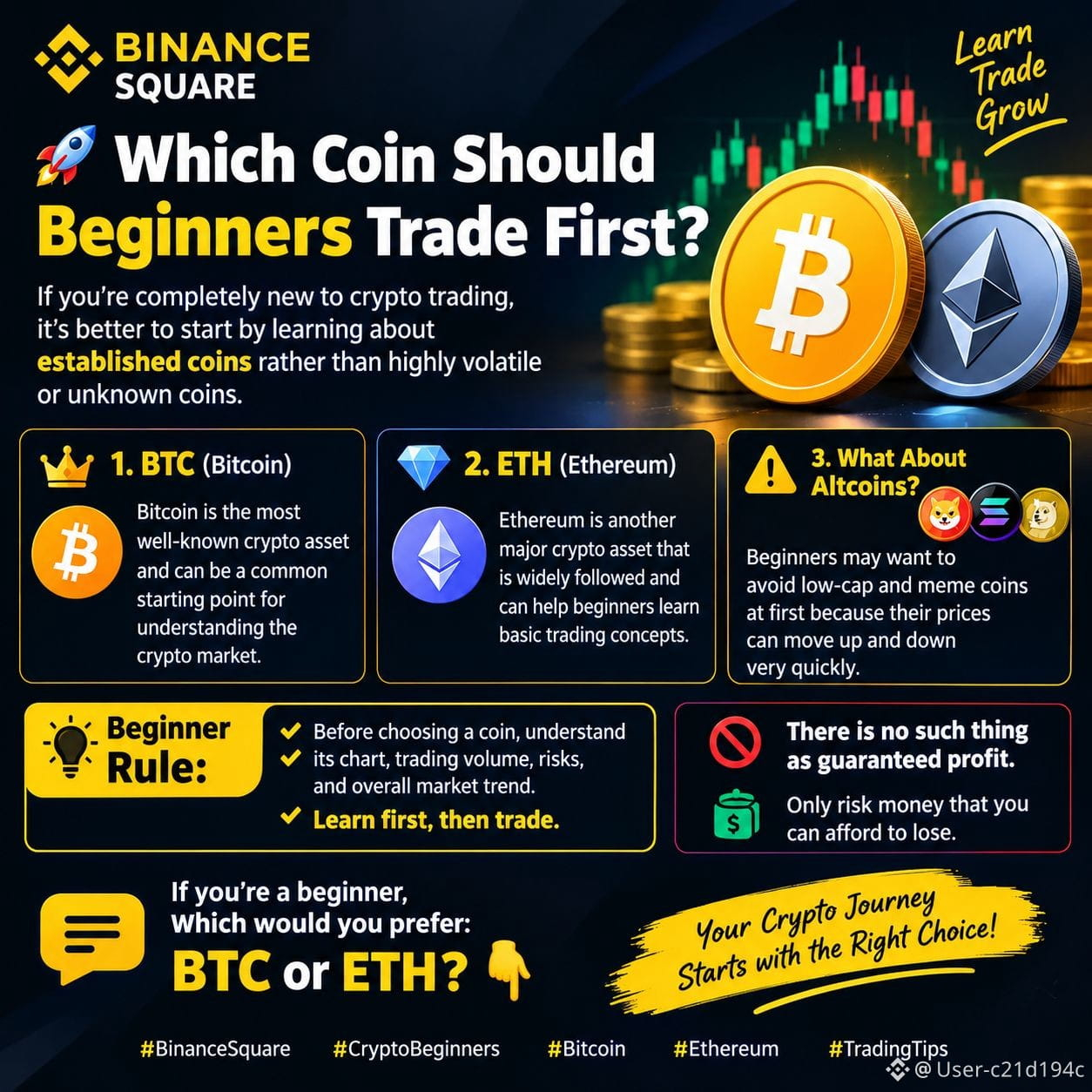
🚀 Which Coin Should Beginners Trade First?
$BTC
{spot}(BTCUSDT)
$ETH
{spot}(ETHUSDT)
If you’re completely new to crypto trading, it’s better to start by learning about established coins rather than highly volatile or unknown coins.
👑 1. BTC (Bitcoin)
Bitcoin is the most well-known crypto asset and can be a common starting point for understanding the crypto market.
💎 2. ETH (Ethereum)
Ethereum is another major crypto asset that is widely followed and can help beginners learn basic trading concepts.
⚠️ 3. What About Altcoins?
Beginners may want to avoid low-cap and meme coins at first because their prices can move up and down very quickly.
📌 Beginner Rule:
Before choosing a coin, understand its chart, trading volume, risks, and overall market trend. Learn first, then trade.
❌ There is no such thing as guaranteed profit.
💰 Only risk money that you can afford to lose.
If you’re a beginner, which would you prefer: BTC or ETH? 👇
#BinanceSquare #CryptoBeginners #bitcoin #Ethereum #TradingTips"
🚀 Which Coin Should Beginners Trade First?
$BTC
$ETH
If you’re completely new to crypto trading, it’s better to start by learning about established coins rather than highly volatile or unknown coins.
👑 1. BTC (Bitcoin)
Bitcoin is the most well-known crypto asset and can be a common starting point for understanding the crypto market.
💎 2. ETH (Ethereum)
Ethereum is another major crypto asset that is widely followed and can help beginners learn basic trading concepts.
⚠️ 3. What About Altcoins?
Beginners may want to avoid low-cap and meme coins at first because their prices can move up and down very quickly.
📌 Beginner Rule:
Before choosing a coin, understand its chart, trading volume, risks, and overall market trend. Learn first, then trade.
❌ There is no such thing as guaranteed profit.
💰 Only risk money that you can afford to lose.
If you’re a beginner, which would you prefer: BTC or ETH? 👇
#BinanceSquare #CryptoBeginners #bitcoin #Ethereum #TradingTips"
$BTC
$ETH
If you’re completely new to crypto trading, it’s better to start by learning about established coins rather than highly volatile or unknown coins.
👑 1. BTC (Bitcoin)
Bitcoin is the most well-known crypto asset and can be a common starting point for understanding the crypto market.
💎 2. ETH (Ethereum)
Ethereum is another major crypto asset that is widely followed and can help beginners learn basic trading concepts.
⚠️ 3. What About Altcoins?
Beginners may want to avoid low-cap and meme coins at first because their prices can move up and down very quickly.
📌 Beginner Rule:
Before choosing a coin, understand its chart, trading volume, risks, and overall market trend. Learn first, then trade.
❌ There is no such thing as guaranteed profit.
💰 Only risk money that you can afford to lose.
If you’re a beginner, which would you prefer: BTC or ETH? 👇
#BinanceSquare #CryptoBeginners #bitcoin #Ethereum #TradingTips"
2
248

·
--
📚 YOUR BEST CRYPTO INVESTMENT MIGHT BE KNOWLEDGE
Before looking for the next 100x coin, learn the basics.
Understand:
💰 Market Cap
🪙 Token Supply
💧 Liquidity
🔐 Wallet Security
📊 Volatility
⚠️ Risk Management
You don't need to become a blockchain developer.
But you should understand what you're putting your money into.
The more you learn, the easier it becomes to separate:
Information from hype.
Research from rumors.
Opportunities from scams.
Crypto is not a race.
Learn at your own pace and make decisions you understand.
👇 Which topic should I explain in my next post?
#CryptoEducation💡🚀 #BinanceSquareFamily #web3_binance #blockchain #CryptoBeginners
📚 YOUR BEST CRYPTO INVESTMENT MIGHT BE KNOWLEDGE
Before looking for the next 100x coin, learn the basics.
Understand:
💰 Market Cap
🪙 Token Supply
💧 Liquidity
🔐 Wallet Security
📊 Volatility
⚠️ Risk Management
You don't need to become a blockchain developer.
But you should understand what you're putting your money into.
The more you learn, the easier it becomes to separate:
Information from hype.
Research from rumors.
Opportunities from scams.
Crypto is not a race.
Learn at your own pace and make decisions you understand.
👇 Which topic should I explain in my next post?
#CryptoEducation💡🚀 #BinanceSquareFamily #web3_binance #blockchain #CryptoBeginners
Before looking for the next 100x coin, learn the basics.
Understand:
💰 Market Cap
🪙 Token Supply
💧 Liquidity
🔐 Wallet Security
📊 Volatility
⚠️ Risk Management
You don't need to become a blockchain developer.
But you should understand what you're putting your money into.
The more you learn, the easier it becomes to separate:
Information from hype.
Research from rumors.
Opportunities from scams.
Crypto is not a race.
Learn at your own pace and make decisions you understand.
👇 Which topic should I explain in my next post?
#CryptoEducation💡🚀 #BinanceSquareFamily #web3_binance #blockchain #CryptoBeginners
1
43

Crypto for beginnersCrypto for Beginners: What Is Cryptocurrency and How Does It Work?
If you are new to the world of cryptocurrency, you may have heard words like Bitcoin, Blockchain, Crypto Wallet, and Exchange but wondered what they actually mean.
Let’s understand crypto in a simple way. 👇
🔹 What Is Cryptocurrency?
Cryptocurrency is a type of digital asset that uses blockchain technology to record transactions.
Unlike traditional money, many cryptocurrencies operate on decentralized networks rather than being controlled by a single bank or institution.
🔹 What Is Bitcoin?
Bitcoin is the first and one of the best-known cryptocurrencies. It was introduced in 2009 and is based on blockchain technology.
Bitcoin is often discussed as a digital asset and a possible alternative to traditional forms of value transfer.
🔹 What Is Blockchain?
Think of blockchain as a digital record book.
Transactions are recorded on a network of computers, and the information is organized into blocks that are linked together.
This technology is one of the key foundations of cryptocurrencies.
🔹 What Is a Crypto Exchange?
A crypto exchange is a platform where users can buy, sell, or trade digital assets.
Before using any platform, beginners should learn about security, fees, account protection, and the risks involved.
⚠️ Important: Crypto Has Risks
Cryptocurrency prices can change very quickly. You can lose money, and past performance does not guarantee future results.
Always Do Your Own Research (DYOR) and never invest money you cannot afford to lose.
This article is for educational purposes only and is not financial advice.
💡 Final Thoughts
Crypto can seem complicated at first, but learning the basics step by step can make the subject much easier to understand.
If you're just starting your crypto journey, focus first on learning, security, and risk management rather than chasing quick profits.
📚 Learn first. Research carefully. Stay safe.
#Crypto #Bitcoin #Blockchain #BinanceSquare #CryptoEducation #DYOR #Cryptocurrency #Web3 #CryptoBeginners
Crypto for beginners
Crypto for Beginners: What Is Cryptocurrency and How Does It Work?
If you are new to the world of cryptocurrency, you may have heard words like Bitcoin, Blockchain, Crypto Wallet, and Exchange but wondered what they actually mean.
Let’s understand crypto in a simple way. 👇
🔹 What Is Cryptocurrency?
Cryptocurrency is a type of digital asset that uses blockchain technology to record transactions.
Unlike traditional money, many cryptocurrencies operate on decentralized networks rather than being controlled by a single bank or institution.
🔹 What Is Bitcoin?
Bitcoin is the first and one of the best-known cryptocurrencies. It was introduced in 2009 and is based on blockchain technology.
Bitcoin is often discussed as a digital asset and a possible alternative to traditional forms of value transfer.
🔹 What Is Blockchain?
Think of blockchain as a digital record book.
Transactions are recorded on a network of computers, and the information is organized into blocks that are linked together.
This technology is one of the key foundations of cryptocurrencies.
🔹 What Is a Crypto Exchange?
A crypto exchange is a platform where users can buy, sell, or trade digital assets.
Before using any platform, beginners should learn about security, fees, account protection, and the risks involved.
⚠️ Important: Crypto Has Risks
Cryptocurrency prices can change very quickly. You can lose money, and past performance does not guarantee future results.
Always Do Your Own Research (DYOR) and never invest money you cannot afford to lose.
This article is for educational purposes only and is not financial advice.
💡 Final Thoughts
Crypto can seem complicated at first, but learning the basics step by step can make the subject much easier to understand.
If you're just starting your crypto journey, focus first on learning, security, and risk management rather than chasing quick profits.
📚 Learn first. Research carefully. Stay safe.
#Crypto #Bitcoin #Blockchain #BinanceSquare #CryptoEducation #DYOR #Cryptocurrency #Web3 #CryptoBeginners
If you are new to the world of cryptocurrency, you may have heard words like Bitcoin, Blockchain, Crypto Wallet, and Exchange but wondered what they actually mean.
Let’s understand crypto in a simple way. 👇
🔹 What Is Cryptocurrency?
Cryptocurrency is a type of digital asset that uses blockchain technology to record transactions.
Unlike traditional money, many cryptocurrencies operate on decentralized networks rather than being controlled by a single bank or institution.
🔹 What Is Bitcoin?
Bitcoin is the first and one of the best-known cryptocurrencies. It was introduced in 2009 and is based on blockchain technology.
Bitcoin is often discussed as a digital asset and a possible alternative to traditional forms of value transfer.
🔹 What Is Blockchain?
Think of blockchain as a digital record book.
Transactions are recorded on a network of computers, and the information is organized into blocks that are linked together.
This technology is one of the key foundations of cryptocurrencies.
🔹 What Is a Crypto Exchange?
A crypto exchange is a platform where users can buy, sell, or trade digital assets.
Before using any platform, beginners should learn about security, fees, account protection, and the risks involved.
⚠️ Important: Crypto Has Risks
Cryptocurrency prices can change very quickly. You can lose money, and past performance does not guarantee future results.
Always Do Your Own Research (DYOR) and never invest money you cannot afford to lose.
This article is for educational purposes only and is not financial advice.
💡 Final Thoughts
Crypto can seem complicated at first, but learning the basics step by step can make the subject much easier to understand.
If you're just starting your crypto journey, focus first on learning, security, and risk management rather than chasing quick profits.
📚 Learn first. Research carefully. Stay safe.
#Crypto #Bitcoin #Blockchain #BinanceSquare #CryptoEducation #DYOR #Cryptocurrency #Web3 #CryptoBeginners
86

BTC vs ETH: What’s the Difference?
If you're new to crypto, you’ll probably hear about Bitcoin and Ethereum everywhere.
Bitcoin (BTC) was created primarily as a decentralized digital asset and a way to transfer value without a central authority.
Ethereum (ETH) is a blockchain platform designed to run smart contracts and decentralized applications.
🔸 BTC: Focuses mainly on decentralized money and storing/transferring value.
🔸 ETH: Powers the Ethereum network and its smart-contract ecosystem.
Another important difference:
Bitcoin has a maximum supply of 21 million BTC.
Ethereum does not have the same fixed maximum supply.
💡 Simple way to remember it:
BTC = digital money
ETH = blockchain + smart contracts
This doesn't mean one is automatically “better.” They were designed with different goals.
Learn first. Invest later. 📚
$BTC $ETH
#Bitcoin #Ethereum #BTC #ETH #crypto #BinanceSquare #CryptoBeginners
BTC vs ETH: What’s the Difference?
If you're new to crypto, you’ll probably hear about Bitcoin and Ethereum everywhere.
Bitcoin (BTC) was created primarily as a decentralized digital asset and a way to transfer value without a central authority.
Ethereum (ETH) is a blockchain platform designed to run smart contracts and decentralized applications.
🔸 BTC: Focuses mainly on decentralized money and storing/transferring value.
🔸 ETH: Powers the Ethereum network and its smart-contract ecosystem.
Another important difference:
Bitcoin has a maximum supply of 21 million BTC.
Ethereum does not have the same fixed maximum supply.
💡 Simple way to remember it:
BTC = digital money
ETH = blockchain + smart contracts
This doesn't mean one is automatically “better.” They were designed with different goals.
Learn first. Invest later. 📚
$BTC $ETH
#Bitcoin #Ethereum #BTC #ETH #crypto #BinanceSquare #CryptoBeginners
If you're new to crypto, you’ll probably hear about Bitcoin and Ethereum everywhere.
Bitcoin (BTC) was created primarily as a decentralized digital asset and a way to transfer value without a central authority.
Ethereum (ETH) is a blockchain platform designed to run smart contracts and decentralized applications.
🔸 BTC: Focuses mainly on decentralized money and storing/transferring value.
🔸 ETH: Powers the Ethereum network and its smart-contract ecosystem.
Another important difference:
Bitcoin has a maximum supply of 21 million BTC.
Ethereum does not have the same fixed maximum supply.
💡 Simple way to remember it:
BTC = digital money
ETH = blockchain + smart contracts
This doesn't mean one is automatically “better.” They were designed with different goals.
Learn first. Invest later. 📚
$BTC $ETH
#Bitcoin #Ethereum #BTC #ETH #crypto #BinanceSquare #CryptoBeginners
76

·
--
🚀 Crypto for Beginners: Day 1 Question!
Welcome to my page! If you are just starting out in the crypto world, it is easy to feel overwhelmed by all the charts, terms, and noise. My goal here is simple: zero trading jargon, just clear guides, web3 basics, and daily updates for absolute beginners.
Let's start with a quick check-in: What is the very first thing that confused you when you started looking into crypto?
Drop it in the comments, and let's learn together! 👇
#CryptoBeginners #web3空投 #CryptoEducation💡🚀 #LearnCrypto
$BTC
{future}(BTCUSDT)
$SOL
{future}(SOLUSDT)
🚀 Crypto for Beginners: Day 1 Question!
Welcome to my page! If you are just starting out in the crypto world, it is easy to feel overwhelmed by all the charts, terms, and noise. My goal here is simple: zero trading jargon, just clear guides, web3 basics, and daily updates for absolute beginners.
Let's start with a quick check-in: What is the very first thing that confused you when you started looking into crypto?
Drop it in the comments, and let's learn together! 👇
#CryptoBeginners #web3空投 #CryptoEducation💡🚀 #LearnCrypto
$BTC
$SOL
Welcome to my page! If you are just starting out in the crypto world, it is easy to feel overwhelmed by all the charts, terms, and noise. My goal here is simple: zero trading jargon, just clear guides, web3 basics, and daily updates for absolute beginners.
Let's start with a quick check-in: What is the very first thing that confused you when you started looking into crypto?
Drop it in the comments, and let's learn together! 👇
#CryptoBeginners #web3空投 #CryptoEducation💡🚀 #LearnCrypto
$BTC
$SOL
49
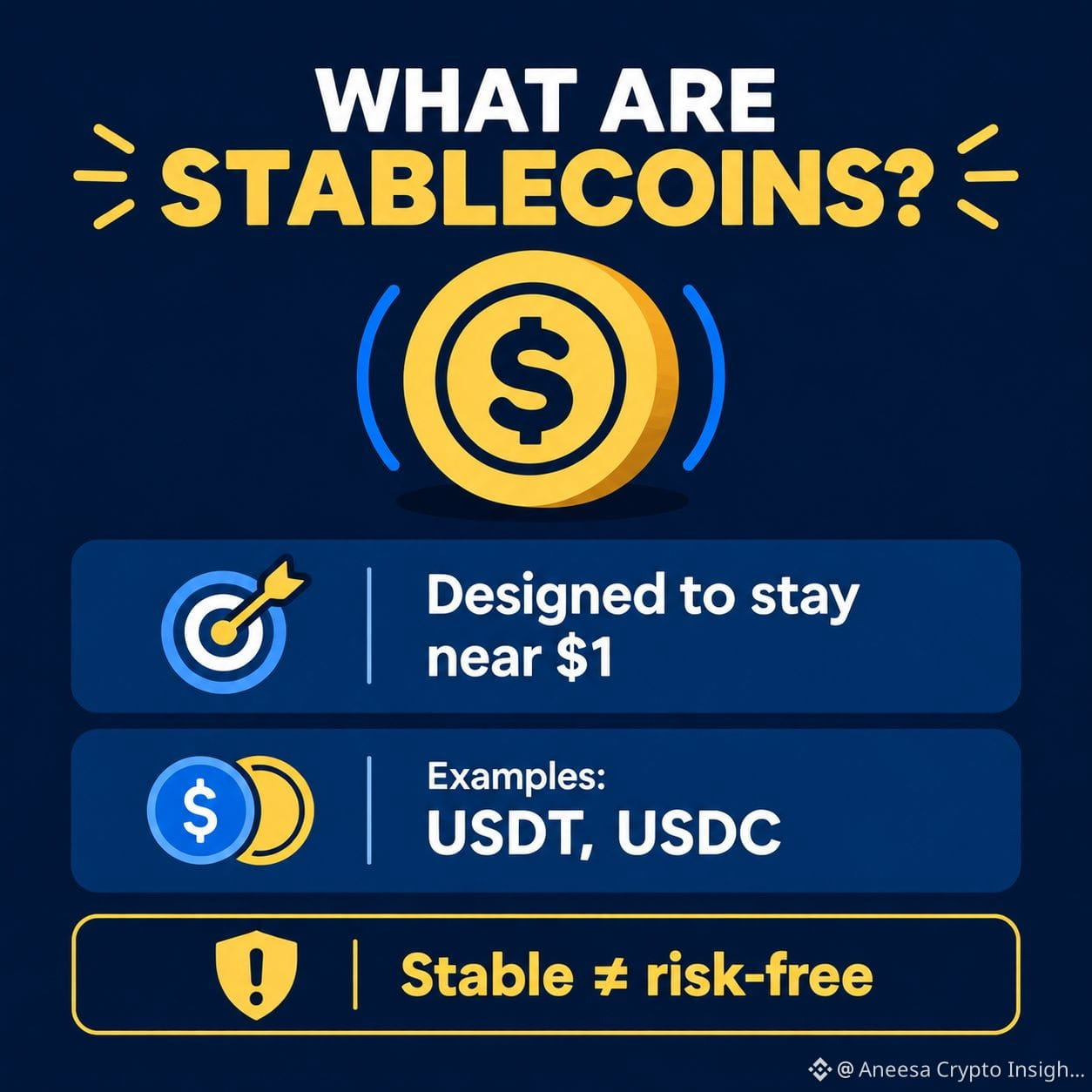
💵 What Are Stablecoins?
Stablecoins are crypto tokens designed to stay close to $1.
Examples: USDT, USDC.
“Stable” does not mean risk-free.
Follow for simple crypto lessons.
Educational content only—not financial advice.
#Stablecoins #CryptoBeginners #BinanceSquare
💵 What Are Stablecoins?
Stablecoins are crypto tokens designed to stay close to $1.
Examples: USDT, USDC.
“Stable” does not mean risk-free.
Follow for simple crypto lessons.
Educational content only—not financial advice.
#Stablecoins #CryptoBeginners #BinanceSquare
Stablecoins are crypto tokens designed to stay close to $1.
Examples: USDT, USDC.
“Stable” does not mean risk-free.
Follow for simple crypto lessons.
Educational content only—not financial advice.
#Stablecoins #CryptoBeginners #BinanceSquare
80
What Is a Satoshi?
You don't need to buy 1 whole Bitcoin to own Bitcoin.
Bitcoin is divided into very small units called Satoshis (sats).
1 BTC = 100,000,000 Satoshis
So: • 0.1 BTC = 10,000,000 sats
• 0.01 BTC = 1,000,000 sats
• 0.001 BTC = 100,000 sats
Think of a satoshi like a tiny unit of Bitcoin similar to how a cent is a small unit of a dollar.
That's why the price of 1 BTC can look huge, but you can still buy a small fraction of it.
💡 Beginner tip: Don't focus only on the price of 1 BTC. Focus on how much BTC you actually own.
Learn first. Invest later. 📚
$BTC
#Bitcoin #BTC #Satoshi #cryptouniverseofficial #BinanceSquare #CryptoBeginners
What Is a Satoshi?
You don't need to buy 1 whole Bitcoin to own Bitcoin.
Bitcoin is divided into very small units called Satoshis (sats).
1 BTC = 100,000,000 Satoshis
So: • 0.1 BTC = 10,000,000 sats
• 0.01 BTC = 1,000,000 sats
• 0.001 BTC = 100,000 sats
Think of a satoshi like a tiny unit of Bitcoin similar to how a cent is a small unit of a dollar.
That's why the price of 1 BTC can look huge, but you can still buy a small fraction of it.
💡 Beginner tip: Don't focus only on the price of 1 BTC. Focus on how much BTC you actually own.
Learn first. Invest later. 📚
$BTC
#Bitcoin #BTC #Satoshi #cryptouniverseofficial #BinanceSquare #CryptoBeginners
You don't need to buy 1 whole Bitcoin to own Bitcoin.
Bitcoin is divided into very small units called Satoshis (sats).
1 BTC = 100,000,000 Satoshis
So: • 0.1 BTC = 10,000,000 sats
• 0.01 BTC = 1,000,000 sats
• 0.001 BTC = 100,000 sats
Think of a satoshi like a tiny unit of Bitcoin similar to how a cent is a small unit of a dollar.
That's why the price of 1 BTC can look huge, but you can still buy a small fraction of it.
💡 Beginner tip: Don't focus only on the price of 1 BTC. Focus on how much BTC you actually own.
Learn first. Invest later. 📚
$BTC
#Bitcoin #BTC #Satoshi #cryptouniverseofficial #BinanceSquare #CryptoBeginners
1
116
Войдите, чтобы посмотреть больше материала
Присоединяйтесь к пользователям криптовалют по всему миру на Binance Square
⚡️ Получайте новейшую и полезную информацию о криптоактивах.
💬 Нам доверяет крупнейшая в мире криптобиржа.
👍 Получите достоверные аналитические данные от верифицированных создателей контента.
Эл. почта/номер телефона
В тренде
1
#BinanceKZ
Просмотров: 404
6 обсуждают
2
#SolanaCutsTargetSlotTimeTo250ms
Просмотров: 345
50 обсуждают
3
#EthereumSurpasses$2700
Просмотров: 5,078
134 обсуждают
4
#CanaryFilesSecondAmendmentForStakedSEIETF
Просмотров: 21,905
496 обсуждают
5
#SaylorHintsStrategyBitcoinBuy
Просмотров: 2.3M
13,253 обсуждают
6
#BOJRaisesRatesTo31YearHigh
Просмотров: 321,225
3,747 обсуждают
7
#BuffettStepsDownAsBerkshireChairman
Просмотров: 155,069
2,059 обсуждают
8
#XRPExchangeReservesHitSevenYearLow
Просмотров: 177,730
1,873 обсуждают
9
#HKCompletesFirstHKDStablecoinUseCase
Просмотров: 178,974
2,100 обсуждают
10
#VietnamPlansFirstCryptoLicensesIn2026
Просмотров: 116,383
1,412 обсуждают