
Mawalii Burhiya
2.4k 投稿

Mawalii Burhiya
報告
ユーザーをブロック
375 フォロー
6.8K+ フォロワー
2.1K+ いいね
投稿
すべて
引用
ライブ
PINNED
確認済み
翻訳参照
#termmax @termmax yesterday short $STAR booked loss of $15 now look it's again in the gainers today Hurry up go long on $SKYAI 0.15 is the tp also long
spent part of the afternoon reading through @TermMax's TMX pre-mine structure and one number made me stop.
40 million TMX.
out of a fixed 1 billion total supply, 4% was allocated specifically to incentivize early users through pre-mining.
At first I read it like another rewards campaign. deposit, provide liquidity, collect rewards, move on.
then noticed the split in how those rewards were actually earned.
FT holders accumulated TMX daily based on their FT balances.
Order makers earned TMX based on the trading volume of their matched orders. And when Curators qualified as order makers, their rewards were distributed directly to depositors of the corresponding vault.
hold up, thats two pretty different behaviors being subsidized.
one side rewards capital for holding fixed-rate positions.
the other rewards capital for actually creating order flow that gets matched.
kinda feels less like an airdrop faucet and more like TermMax trying to incentivize both participation and usable liquidity while the market is still developing.
and the displayed TMX APY makes it even more interesting.
TermMax's docs say that incentive APY was calculated using a $60M FDV assumption, based on the valuation of its funding round.
So TMX APY wasn't purely the underlying fixed-rate yield in the normal sense. The USD value assigned to those token incentives depended on an assumed valuation for TMX while the pre-mined tokens themselves were non-transferable during the campaign period.
thats the part I'd watch.
once TMX becomes liquid and the incentive gets an actual market price, do users still like the fixed-rate product underneath it…
or were the incentives doing more work than the interest rate?
$USELESS will pump again
{future}(MAGMAUSDT)
{future}(CYSUSDT)
{spot}(REUSDT)
@termmax #TermMax
Poll: What really proves TermMax demand after incentives?
#termmax @TermMax yesterday short $STAR booked loss of $15 now look it's again in the gainers today Hurry up go long on $SKYAI 0.15 is the tp also long
spent part of the afternoon reading through @TermMax's TMX pre-mine structure and one number made me stop.
40 million TMX.
out of a fixed 1 billion total supply, 4% was allocated specifically to incentivize early users through pre-mining.
At first I read it like another rewards campaign. deposit, provide liquidity, collect rewards, move on.
then noticed the split in how those rewards were actually earned.
FT holders accumulated TMX daily based on their FT balances.
Order makers earned TMX based on the trading volume of their matched orders. And when Curators qualified as order makers, their rewards were distributed directly to depositors of the corresponding vault.
hold up, thats two pretty different behaviors being subsidized.
one side rewards capital for holding fixed-rate positions.
the other rewards capital for actually creating order flow that gets matched.
kinda feels less like an airdrop faucet and more like TermMax trying to incentivize both participation and usable liquidity while the market is still developing.
and the displayed TMX APY makes it even more interesting.
TermMax's docs say that incentive APY was calculated using a $60M FDV assumption, based on the valuation of its funding round.
So TMX APY wasn't purely the underlying fixed-rate yield in the normal sense. The USD value assigned to those token incentives depended on an assumed valuation for TMX while the pre-mined tokens themselves were non-transferable during the campaign period.
thats the part I'd watch.
once TMX becomes liquid and the incentive gets an actual market price, do users still like the fixed-rate product underneath it…
or were the incentives doing more work than the interest rate?
$USELESS will pump again
@TermMax #TermMax
Poll: What really proves TermMax demand after incentives?
spent part of the afternoon reading through @TermMax's TMX pre-mine structure and one number made me stop.
40 million TMX.
out of a fixed 1 billion total supply, 4% was allocated specifically to incentivize early users through pre-mining.
At first I read it like another rewards campaign. deposit, provide liquidity, collect rewards, move on.
then noticed the split in how those rewards were actually earned.
FT holders accumulated TMX daily based on their FT balances.
Order makers earned TMX based on the trading volume of their matched orders. And when Curators qualified as order makers, their rewards were distributed directly to depositors of the corresponding vault.
hold up, thats two pretty different behaviors being subsidized.
one side rewards capital for holding fixed-rate positions.
the other rewards capital for actually creating order flow that gets matched.
kinda feels less like an airdrop faucet and more like TermMax trying to incentivize both participation and usable liquidity while the market is still developing.
and the displayed TMX APY makes it even more interesting.
TermMax's docs say that incentive APY was calculated using a $60M FDV assumption, based on the valuation of its funding round.
So TMX APY wasn't purely the underlying fixed-rate yield in the normal sense. The USD value assigned to those token incentives depended on an assumed valuation for TMX while the pre-mined tokens themselves were non-transferable during the campaign period.
thats the part I'd watch.
once TMX becomes liquid and the incentive gets an actual market price, do users still like the fixed-rate product underneath it…
or were the incentives doing more work than the interest rate?
$USELESS will pump again
@TermMax #TermMax
Poll: What really proves TermMax demand after incentives?
◉ Strong fixed-rate usage
70%
◉ Deep matched liquidity
10%
◉ Both need to hold up
0%
◉ TMX incentives still matter
20%
10 投票 • 投票は終了しました
41
31
903
PINNED
#termmax 大興奮の@termmax ランキング!どれだけ強いか見てみよう kitny teer Mary meny
冗談はさておき、利益を両方から確定するために予約します:$ACE n $BTW 取引、最後に利益で取引がクローズしました。長期で持つなら$BR 、すぐに0.24に到達するはず… @termmax に戻ります
以前は、TermMaxの流動性プロバイダーは最初に決める必要があると思っていました。ここで貸すのか、それとも借りるのか?
Two-Way Range Orders は、その区別をかなり奇妙なものにします。
1つの注文には、借り入れ用のカーブと貸し出し用のカーブがあります。どちらが約定されるかで、設定者(setter)が実際に何者になるかが決まるのです。
まず借り入れ側を追跡しました。貸し出し側のマーケットテイカーがそれを埋めると、彼らの負債トークンが、同等量のFTとXTを鋳造します。XTは、その後、追加のFTを得るために、Two-Way Range Orderと交換されます。
そして来るのが、ほとんど飛ばしそうになった部分。
TermMaxは、その注文に交換のための十分なFT準備があるかを確認します。もし足りなければ、設定者のGTから追加のFTを鋳造でき、そしてそのGTの中に記録される負債が増えます。
つまり設定者は、単に「流動性を提供した」だけではありません。市場の需要が機械的に彼らを、Gearing Tokenの中に負債を抱えた借り手のポジションへと変えてしまうのです。
もう一方を約定すると逆転します。設定者は貸し手として振る舞い、元本と固定利回りを表すFTを蓄積します。
このことで、Two-Way Range Orderは受動的な流動性というより、実際にどちらの側がユーザーの需要を満たすかに応じてバランスシートが変化する「ポジション」に感じられます。
1つのTermMaxポジションが動的に借り手にも貸し手にもなるのを許すことで、資本効率は本当に良くなるのか?それとも、設定者が最終的にさらされるリスク(エクスポージャー)の見通しがより難しくなるだけなのか??
TermMax Two-Way Orders:最大のトレードオフ?
{future}(SKYAIUSDT)
{spot}(ALPINEUSDT)
{future}(ESPORTSUSDT)
#termmax 大興奮の@TermMax ランキング!どれだけ強いか見てみよう kitny teer Mary meny
冗談はさておき、利益を両方から確定するために予約します:$ACE n $BTW 取引、最後に利益で取引がクローズしました。長期で持つなら$BR 、すぐに0.24に到達するはず… @TermMax に戻ります
以前は、TermMaxの流動性プロバイダーは最初に決める必要があると思っていました。ここで貸すのか、それとも借りるのか?
Two-Way Range Orders は、その区別をかなり奇妙なものにします。
1つの注文には、借り入れ用のカーブと貸し出し用のカーブがあります。どちらが約定されるかで、設定者(setter)が実際に何者になるかが決まるのです。
まず借り入れ側を追跡しました。貸し出し側のマーケットテイカーがそれを埋めると、彼らの負債トークンが、同等量のFTとXTを鋳造します。XTは、その後、追加のFTを得るために、Two-Way Range Orderと交換されます。
そして来るのが、ほとんど飛ばしそうになった部分。
TermMaxは、その注文に交換のための十分なFT準備があるかを確認します。もし足りなければ、設定者のGTから追加のFTを鋳造でき、そしてそのGTの中に記録される負債が増えます。
つまり設定者は、単に「流動性を提供した」だけではありません。市場の需要が機械的に彼らを、Gearing Tokenの中に負債を抱えた借り手のポジションへと変えてしまうのです。
もう一方を約定すると逆転します。設定者は貸し手として振る舞い、元本と固定利回りを表すFTを蓄積します。
このことで、Two-Way Range Orderは受動的な流動性というより、実際にどちらの側がユーザーの需要を満たすかに応じてバランスシートが変化する「ポジション」に感じられます。
1つのTermMaxポジションが動的に借り手にも貸し手にもなるのを許すことで、資本効率は本当に良くなるのか?それとも、設定者が最終的にさらされるリスク(エクスポージャー)の見通しがより難しくなるだけなのか??
TermMax Two-Way Orders:最大のトレードオフ?
冗談はさておき、利益を両方から確定するために予約します:$ACE n $BTW 取引、最後に利益で取引がクローズしました。長期で持つなら$BR 、すぐに0.24に到達するはず… @TermMax に戻ります
以前は、TermMaxの流動性プロバイダーは最初に決める必要があると思っていました。ここで貸すのか、それとも借りるのか?
Two-Way Range Orders は、その区別をかなり奇妙なものにします。
1つの注文には、借り入れ用のカーブと貸し出し用のカーブがあります。どちらが約定されるかで、設定者(setter)が実際に何者になるかが決まるのです。
まず借り入れ側を追跡しました。貸し出し側のマーケットテイカーがそれを埋めると、彼らの負債トークンが、同等量のFTとXTを鋳造します。XTは、その後、追加のFTを得るために、Two-Way Range Orderと交換されます。
そして来るのが、ほとんど飛ばしそうになった部分。
TermMaxは、その注文に交換のための十分なFT準備があるかを確認します。もし足りなければ、設定者のGTから追加のFTを鋳造でき、そしてそのGTの中に記録される負債が増えます。
つまり設定者は、単に「流動性を提供した」だけではありません。市場の需要が機械的に彼らを、Gearing Tokenの中に負債を抱えた借り手のポジションへと変えてしまうのです。
もう一方を約定すると逆転します。設定者は貸し手として振る舞い、元本と固定利回りを表すFTを蓄積します。
このことで、Two-Way Range Orderは受動的な流動性というより、実際にどちらの側がユーザーの需要を満たすかに応じてバランスシートが変化する「ポジション」に感じられます。
1つのTermMaxポジションが動的に借り手にも貸し手にもなるのを許すことで、資本効率は本当に良くなるのか?それとも、設定者が最終的にさらされるリスク(エクスポージャー)の見通しがより難しくなるだけなのか??
TermMax Two-Way Orders:最大のトレードオフ?
🔘 Better capital efficiency
42%
🔘 Harder exposure planning
8%
🔘 Best of both sides
25%
🔘 Too complex for LPs
25%
12 投票 • 投票は終了しました
34
33
6.3k
翻訳参照
#dusk $DUSK @Dusk_Foundation I used to think the interesting part of Phoenix was simply that Dusk has a UTXO-based transaction model.
The deeper part is what that actually changes.
Instead of keeping one continuously updated account balance, ownership is represented through individual outputs that can later be consumed and replaced by new outputs. Each transaction effectively proves what can be spent and what new ownership state should exist.
That structure fits confidential transactions surprisingly well.
The protocol can reason about specific pieces of state without requiring every transaction to expose one global account history. Its a cleaner way to isolate what is being spent from everything else happening around it.
But theres a cost.
UTXO systems make state more explicit, which can also make applications harder to reason about when multiple pieces of state need to interact at once. The privacy benefit doesnt automatically make the programming model simpler.
So does discrete UTXO state give Dusk a better foundation for confidential financial transactions, or does the extra state complexity become the price of that privacy model??
#dusk @Dusk
#dusk $DUSK @Dusk I used to think the interesting part of Phoenix was simply that Dusk has a UTXO-based transaction model.
The deeper part is what that actually changes.
Instead of keeping one continuously updated account balance, ownership is represented through individual outputs that can later be consumed and replaced by new outputs. Each transaction effectively proves what can be spent and what new ownership state should exist.
That structure fits confidential transactions surprisingly well.
The protocol can reason about specific pieces of state without requiring every transaction to expose one global account history. Its a cleaner way to isolate what is being spent from everything else happening around it.
But theres a cost.
UTXO systems make state more explicit, which can also make applications harder to reason about when multiple pieces of state need to interact at once. The privacy benefit doesnt automatically make the programming model simpler.
So does discrete UTXO state give Dusk a better foundation for confidential financial transactions, or does the extra state complexity become the price of that privacy model??
#dusk @Dusk
The deeper part is what that actually changes.
Instead of keeping one continuously updated account balance, ownership is represented through individual outputs that can later be consumed and replaced by new outputs. Each transaction effectively proves what can be spent and what new ownership state should exist.
That structure fits confidential transactions surprisingly well.
The protocol can reason about specific pieces of state without requiring every transaction to expose one global account history. Its a cleaner way to isolate what is being spent from everything else happening around it.
But theres a cost.
UTXO systems make state more explicit, which can also make applications harder to reason about when multiple pieces of state need to interact at once. The privacy benefit doesnt automatically make the programming model simpler.
So does discrete UTXO state give Dusk a better foundation for confidential financial transactions, or does the extra state complexity become the price of that privacy model??
#dusk @Dusk

3
4
158
翻訳参照
#dusk $DUSK @Dusk_Foundation
Spent the Dusk task reading the ECSP plan again and one thing kept nagging at me: building infrastructure for regulated assets is one problem. Actually getting those assets onto the infrastructure is another.
Dusk is applying for an ECSP licence to connect European businesses raising capital with investors through eligible offerings like loans, shares and bonds.
thats the bit i got stuck on.
Europe has roughly 34 million SMEs according to Dusk's update, while the same piece points to nearly $70B facilitated by crowdfunding platforms globally in 2025. Then theres the financing pressure: Dusk cites Q2 2026 data showing a 43-percentage-point margin of SMEs reporting rising bank-loan rates.
So this isnt really just another licence sitting beside the tech stack.
If approved, the ECSP route gives Dusk a way to bring businesses seeking capital into the same ecosystem where the resulting financial assets can eventually interact with identity, privacy, distribution and settlement infrastructure. Dusk's older regulatory material already positions ECSP as the permission covering retail-funded investment instruments across the EU.
Hmm, thats a different growth model from waiting for somebody else to tokenize something.
Businesses get another capital route. Investors get access to regulated offerings. Dusk potentially gets new assets and activity flowing into its own product stack.
But hold up, an application isnt an approval, and a licence isnt demand. Businesses still have to choose the route and investors still have to fund the offerings.
Coffee went cold while i kept coming back to that. Infrastructure can move assets once they exist. ECSP could help answer where those assets actually come from.
So does pursuing ECSP turn Dusk from infrastructure waiting for regulated assets into infrastructure capable of sourcing them, or does that only matter once real businesses and investors start using the route at scale??
#dusk @Dusk $DUSK
#dusk $DUSK @Dusk
Spent the Dusk task reading the ECSP plan again and one thing kept nagging at me: building infrastructure for regulated assets is one problem. Actually getting those assets onto the infrastructure is another.
Dusk is applying for an ECSP licence to connect European businesses raising capital with investors through eligible offerings like loans, shares and bonds.
thats the bit i got stuck on.
Europe has roughly 34 million SMEs according to Dusk's update, while the same piece points to nearly $70B facilitated by crowdfunding platforms globally in 2025. Then theres the financing pressure: Dusk cites Q2 2026 data showing a 43-percentage-point margin of SMEs reporting rising bank-loan rates.
So this isnt really just another licence sitting beside the tech stack.
If approved, the ECSP route gives Dusk a way to bring businesses seeking capital into the same ecosystem where the resulting financial assets can eventually interact with identity, privacy, distribution and settlement infrastructure. Dusk's older regulatory material already positions ECSP as the permission covering retail-funded investment instruments across the EU.
Hmm, thats a different growth model from waiting for somebody else to tokenize something.
Businesses get another capital route. Investors get access to regulated offerings. Dusk potentially gets new assets and activity flowing into its own product stack.
But hold up, an application isnt an approval, and a licence isnt demand. Businesses still have to choose the route and investors still have to fund the offerings.
Coffee went cold while i kept coming back to that. Infrastructure can move assets once they exist. ECSP could help answer where those assets actually come from.
So does pursuing ECSP turn Dusk from infrastructure waiting for regulated assets into infrastructure capable of sourcing them, or does that only matter once real businesses and investors start using the route at scale??
#dusk @Dusk $DUSK
Spent the Dusk task reading the ECSP plan again and one thing kept nagging at me: building infrastructure for regulated assets is one problem. Actually getting those assets onto the infrastructure is another.
Dusk is applying for an ECSP licence to connect European businesses raising capital with investors through eligible offerings like loans, shares and bonds.
thats the bit i got stuck on.
Europe has roughly 34 million SMEs according to Dusk's update, while the same piece points to nearly $70B facilitated by crowdfunding platforms globally in 2025. Then theres the financing pressure: Dusk cites Q2 2026 data showing a 43-percentage-point margin of SMEs reporting rising bank-loan rates.
So this isnt really just another licence sitting beside the tech stack.
If approved, the ECSP route gives Dusk a way to bring businesses seeking capital into the same ecosystem where the resulting financial assets can eventually interact with identity, privacy, distribution and settlement infrastructure. Dusk's older regulatory material already positions ECSP as the permission covering retail-funded investment instruments across the EU.
Hmm, thats a different growth model from waiting for somebody else to tokenize something.
Businesses get another capital route. Investors get access to regulated offerings. Dusk potentially gets new assets and activity flowing into its own product stack.
But hold up, an application isnt an approval, and a licence isnt demand. Businesses still have to choose the route and investors still have to fund the offerings.
Coffee went cold while i kept coming back to that. Infrastructure can move assets once they exist. ECSP could help answer where those assets actually come from.
So does pursuing ECSP turn Dusk from infrastructure waiting for regulated assets into infrastructure capable of sourcing them, or does that only matter once real businesses and investors start using the route at scale??
#dusk @Dusk $DUSK

2
4
125
翻訳参照
#dusk @Dusk_Foundation $TUT +22.66%, $UAI +25.87%, $ZRO+24.80%…
Gainers tab is basically a party i wasn't invited to 😂
something about Dusk's DLT-TSS work kept making me read the roadmap wrong.
i was treating it like DuskEVM.
engineers build it.
testing finishes.
someone flips the switch.
then i went back through @Dusk's update on the NPEX application and… this milestone runs on a completely different clock.
DLT-TSS means DLT Trading and Settlement System.
the important part isn't another smart contract going live.
Dusk and NPEX are pursuing the regulatory permission needed to combine trading and settlement of regulated DLT financial instruments within the EU framework.
and Dusk's own description of the work is almost the opposite of a normal software release.
technical team involved.
business development involved.
Norton Rose Fulbright involved.
meetings with regulators.
changing requirements.
questions and revisions after submission.
that's the thing that stuck.
you can't GitHub your way through the last stage.
Dusk said in October 2025 that it was close to finalizing the application, after which regulators could come back with questions, revisions and ultimately a decision.
and Dusk's later material still labels the NPEX DLT-TSS as in progress.
so i'm careful with the word “launch” here.
the infrastructure can be technically ready while permission isn't.
and regulatory feedback could still force the infrastructure to change.
21X is useful context because an EU DLT-TSS-authorized venue already exists and Dusk works with it.
so this regulatory route isn't theoretical.
but NPEX still has its own process to clear.
hmm.
maybe that's why this milestone matters more than another product release.
software proves Dusk can build the rails.
DLT-TSS permission would test whether regulators are willing to let an existing securities venue actually run regulated trading and settlement over them.
which one is harder to achieve?
#Dusk $DUSK
{spot}(ZROUSDT)
#dusk @Dusk $TUT +22.66%, $UAI +25.87%, $ZRO+24.80%…
Gainers tab is basically a party i wasn't invited to 😂
something about Dusk's DLT-TSS work kept making me read the roadmap wrong.
i was treating it like DuskEVM.
engineers build it.
testing finishes.
someone flips the switch.
then i went back through @Dusk's update on the NPEX application and… this milestone runs on a completely different clock.
DLT-TSS means DLT Trading and Settlement System.
the important part isn't another smart contract going live.
Dusk and NPEX are pursuing the regulatory permission needed to combine trading and settlement of regulated DLT financial instruments within the EU framework.
and Dusk's own description of the work is almost the opposite of a normal software release.
technical team involved.
business development involved.
Norton Rose Fulbright involved.
meetings with regulators.
changing requirements.
questions and revisions after submission.
that's the thing that stuck.
you can't GitHub your way through the last stage.
Dusk said in October 2025 that it was close to finalizing the application, after which regulators could come back with questions, revisions and ultimately a decision.
and Dusk's later material still labels the NPEX DLT-TSS as in progress.
so i'm careful with the word “launch” here.
the infrastructure can be technically ready while permission isn't.
and regulatory feedback could still force the infrastructure to change.
21X is useful context because an EU DLT-TSS-authorized venue already exists and Dusk works with it.
so this regulatory route isn't theoretical.
but NPEX still has its own process to clear.
hmm.
maybe that's why this milestone matters more than another product release.
software proves Dusk can build the rails.
DLT-TSS permission would test whether regulators are willing to let an existing securities venue actually run regulated trading and settlement over them.
which one is harder to achieve?
#Dusk $DUSK
Gainers tab is basically a party i wasn't invited to 😂
something about Dusk's DLT-TSS work kept making me read the roadmap wrong.
i was treating it like DuskEVM.
engineers build it.
testing finishes.
someone flips the switch.
then i went back through @Dusk's update on the NPEX application and… this milestone runs on a completely different clock.
DLT-TSS means DLT Trading and Settlement System.
the important part isn't another smart contract going live.
Dusk and NPEX are pursuing the regulatory permission needed to combine trading and settlement of regulated DLT financial instruments within the EU framework.
and Dusk's own description of the work is almost the opposite of a normal software release.
technical team involved.
business development involved.
Norton Rose Fulbright involved.
meetings with regulators.
changing requirements.
questions and revisions after submission.
that's the thing that stuck.
you can't GitHub your way through the last stage.
Dusk said in October 2025 that it was close to finalizing the application, after which regulators could come back with questions, revisions and ultimately a decision.
and Dusk's later material still labels the NPEX DLT-TSS as in progress.
so i'm careful with the word “launch” here.
the infrastructure can be technically ready while permission isn't.
and regulatory feedback could still force the infrastructure to change.
21X is useful context because an EU DLT-TSS-authorized venue already exists and Dusk works with it.
so this regulatory route isn't theoretical.
but NPEX still has its own process to clear.
hmm.
maybe that's why this milestone matters more than another product release.
software proves Dusk can build the rails.
DLT-TSS permission would test whether regulators are willing to let an existing securities venue actually run regulated trading and settlement over them.
which one is harder to achieve?
#Dusk $DUSK

3
4
551
#dusk $DUSK @Dusk_Foundation 購入 $ZEC 今 365 になったので、見てください。史上最高値を更新してしまう。300+ の利益。忍耐はいつも報われます。
$POL はまもなく燃料をショートします。いま終わったところです。
そしていつも考えてしまうんですが、ウォレットのフリクション(摩擦)は「ブロックチェーンのせいだ」と責められがちなのに、実際には単に“発見できないだけ”のこともあるんです。
Dusk Connect の面白いところは、実は「コネクト」ボタンではありません。つまり、dApp が複数の互換ウォレット提供者を発見でき、ユーザーに提示し、ユーザーが選べるようにすることで、アプリに 1 つの拡張機能をハードコードしないで済むという点です。
それって些細に聞こえます。でも、違います。
同じブラウザ内に複数のウォレットが存在すると、昔の「単一提供者前提」がすぐにややこしくなります。EIP-6963 型の発見は、dApp がたまたま見つけた“唯一の対象”を取り合うのではなく、提供者側が自分を名乗り出られるようにすることで、こうした一般的な問題に対処します。Dusk Connect は Dusk 上でも同じ現実的な結果を目指しています。まず利用可能なものを発見し、次に選択し、その後にアクセスを要求する、と。
分離されているのはいいと思います。ですが、「発見だけで本当の摩擦がなくなるのか」はまだ確信できていません。接続後に、選択された提供者、プロフィール、認可、ネットワークが変わったとき、アプリが正しく反応できる必要がまだ残っています。
そこで、きれいな標準はたいてい、厄介なユーザー行動にぶつかります。
では、マルチウォレットの発見は本当に接続問題を解決するのか?それとも、難しい部分を“ウォレットを見つけること”から“状態を正しく管理すること”へ移しているだけなのでしょうか??
@Dusk_Foundation #dusk
{spot}(POLUSDT)
#dusk $DUSK @Dusk 購入 $ZEC 今 365 になったので、見てください。史上最高値を更新してしまう。300+ の利益。忍耐はいつも報われます。
$POL はまもなく燃料をショートします。いま終わったところです。
そしていつも考えてしまうんですが、ウォレットのフリクション(摩擦)は「ブロックチェーンのせいだ」と責められがちなのに、実際には単に“発見できないだけ”のこともあるんです。
Dusk Connect の面白いところは、実は「コネクト」ボタンではありません。つまり、dApp が複数の互換ウォレット提供者を発見でき、ユーザーに提示し、ユーザーが選べるようにすることで、アプリに 1 つの拡張機能をハードコードしないで済むという点です。
それって些細に聞こえます。でも、違います。
同じブラウザ内に複数のウォレットが存在すると、昔の「単一提供者前提」がすぐにややこしくなります。EIP-6963 型の発見は、dApp がたまたま見つけた“唯一の対象”を取り合うのではなく、提供者側が自分を名乗り出られるようにすることで、こうした一般的な問題に対処します。Dusk Connect は Dusk 上でも同じ現実的な結果を目指しています。まず利用可能なものを発見し、次に選択し、その後にアクセスを要求する、と。
分離されているのはいいと思います。ですが、「発見だけで本当の摩擦がなくなるのか」はまだ確信できていません。接続後に、選択された提供者、プロフィール、認可、ネットワークが変わったとき、アプリが正しく反応できる必要がまだ残っています。
そこで、きれいな標準はたいてい、厄介なユーザー行動にぶつかります。
では、マルチウォレットの発見は本当に接続問題を解決するのか?それとも、難しい部分を“ウォレットを見つけること”から“状態を正しく管理すること”へ移しているだけなのでしょうか??
@Dusk #dusk
$POL はまもなく燃料をショートします。いま終わったところです。
そしていつも考えてしまうんですが、ウォレットのフリクション(摩擦)は「ブロックチェーンのせいだ」と責められがちなのに、実際には単に“発見できないだけ”のこともあるんです。
Dusk Connect の面白いところは、実は「コネクト」ボタンではありません。つまり、dApp が複数の互換ウォレット提供者を発見でき、ユーザーに提示し、ユーザーが選べるようにすることで、アプリに 1 つの拡張機能をハードコードしないで済むという点です。
それって些細に聞こえます。でも、違います。
同じブラウザ内に複数のウォレットが存在すると、昔の「単一提供者前提」がすぐにややこしくなります。EIP-6963 型の発見は、dApp がたまたま見つけた“唯一の対象”を取り合うのではなく、提供者側が自分を名乗り出られるようにすることで、こうした一般的な問題に対処します。Dusk Connect は Dusk 上でも同じ現実的な結果を目指しています。まず利用可能なものを発見し、次に選択し、その後にアクセスを要求する、と。
分離されているのはいいと思います。ですが、「発見だけで本当の摩擦がなくなるのか」はまだ確信できていません。接続後に、選択された提供者、プロフィール、認可、ネットワークが変わったとき、アプリが正しく反応できる必要がまだ残っています。
そこで、きれいな標準はたいてい、厄介なユーザー行動にぶつかります。
では、マルチウォレットの発見は本当に接続問題を解決するのか?それとも、難しい部分を“ウォレットを見つけること”から“状態を正しく管理すること”へ移しているだけなのでしょうか??
@Dusk #dusk

2
3
210
#dusk $DUSK @Dusk_Foundation
「機関のためのプライバシー」とは実際に何を意味するのか――夕暮れ(Dusk)のタスクを考えながら考えていたら、「すべてを隠せばいい」という答えは有用ではない気がしてきました。
銀行、会場、保管業者(カストディアン)は、取引について何かを確認する必要があるかもしれません。監査人や監督者も、証拠が必要になるでしょう。ですが、それだからといって、特定の当事者が仕事をするために、すべての残高や取引相手、取引の詳細まで公開にするべきだということにはなりません。
そこで、Duskの「選択的開示(selective disclosure)」のモデルが面白くなるのです。
Duskは、ゼロ知識証明と、監査・監督・規制に基づく開示のための制御された可視性によって、ネットワークをデフォルトで機密として扱うと説明しています。機微な金融状態は保護されたままで、特定の参加者や権限当局に必要な証拠だけが開示されます。
つまり、検証と公開が同じものではなくなる。
それを考え直しては戻ってしまったのは、パブリック・ブロックチェーンでは通常、この2つの考えが一緒くたになってしまうからです。みんなが検証できるなら、みんなが見えてしまう。これは一部の資産なら問題ないかもしれません。でも、顧客の残高やポジション、取引相手が商業的・個人的にセンシティブになり得る金融インフラでは、かなり変です。
良い点は明らかです。規制されたワークフローなら、顧客データをインターネットにさらすか、プライベートなデータベースを承認済みの当事者に信頼させるか、という二択を選ぶ必要がありません。
ただ待ってください。選択的開示は別の問いも生みます。誰が「誰に見せる権限があるか」を決めるのか?暗号は可視性を制御できますが、結局はポリシーがオーディエンス(閲覧者)を定義します。
その区別について、タブを開けっぱなしにしすぎました。誰も何も検証できないのならプライバシーは役に立ちませんし、検証にすべてをさらす必要があるのなら透明性も役に立ちません。
では選択的開示は、「承認済みの当事者が必要な証拠を得る」という意味で適切な中間解なのか、それとも可視性の割り当てを決めることで、最も難しい信頼の問題を認可ポリシーの中に単に移してしまうだけなのでしょうか?
#dusk @Dusk_Foundation $DUSK
選択的開示 = 最適な中間解?
#dusk $DUSK @Dusk
「機関のためのプライバシー」とは実際に何を意味するのか――夕暮れ(Dusk)のタスクを考えながら考えていたら、「すべてを隠せばいい」という答えは有用ではない気がしてきました。
銀行、会場、保管業者(カストディアン)は、取引について何かを確認する必要があるかもしれません。監査人や監督者も、証拠が必要になるでしょう。ですが、それだからといって、特定の当事者が仕事をするために、すべての残高や取引相手、取引の詳細まで公開にするべきだということにはなりません。
そこで、Duskの「選択的開示(selective disclosure)」のモデルが面白くなるのです。
Duskは、ゼロ知識証明と、監査・監督・規制に基づく開示のための制御された可視性によって、ネットワークをデフォルトで機密として扱うと説明しています。機微な金融状態は保護されたままで、特定の参加者や権限当局に必要な証拠だけが開示されます。
つまり、検証と公開が同じものではなくなる。
それを考え直しては戻ってしまったのは、パブリック・ブロックチェーンでは通常、この2つの考えが一緒くたになってしまうからです。みんなが検証できるなら、みんなが見えてしまう。これは一部の資産なら問題ないかもしれません。でも、顧客の残高やポジション、取引相手が商業的・個人的にセンシティブになり得る金融インフラでは、かなり変です。
良い点は明らかです。規制されたワークフローなら、顧客データをインターネットにさらすか、プライベートなデータベースを承認済みの当事者に信頼させるか、という二択を選ぶ必要がありません。
ただ待ってください。選択的開示は別の問いも生みます。誰が「誰に見せる権限があるか」を決めるのか?暗号は可視性を制御できますが、結局はポリシーがオーディエンス(閲覧者)を定義します。
その区別について、タブを開けっぱなしにしすぎました。誰も何も検証できないのならプライバシーは役に立ちませんし、検証にすべてをさらす必要があるのなら透明性も役に立ちません。
では選択的開示は、「承認済みの当事者が必要な証拠を得る」という意味で適切な中間解なのか、それとも可視性の割り当てを決めることで、最も難しい信頼の問題を認可ポリシーの中に単に移してしまうだけなのでしょうか?
#dusk @Dusk $DUSK
選択的開示 = 最適な中間解?
「機関のためのプライバシー」とは実際に何を意味するのか――夕暮れ(Dusk)のタスクを考えながら考えていたら、「すべてを隠せばいい」という答えは有用ではない気がしてきました。
銀行、会場、保管業者(カストディアン)は、取引について何かを確認する必要があるかもしれません。監査人や監督者も、証拠が必要になるでしょう。ですが、それだからといって、特定の当事者が仕事をするために、すべての残高や取引相手、取引の詳細まで公開にするべきだということにはなりません。
そこで、Duskの「選択的開示(selective disclosure)」のモデルが面白くなるのです。
Duskは、ゼロ知識証明と、監査・監督・規制に基づく開示のための制御された可視性によって、ネットワークをデフォルトで機密として扱うと説明しています。機微な金融状態は保護されたままで、特定の参加者や権限当局に必要な証拠だけが開示されます。
つまり、検証と公開が同じものではなくなる。
それを考え直しては戻ってしまったのは、パブリック・ブロックチェーンでは通常、この2つの考えが一緒くたになってしまうからです。みんなが検証できるなら、みんなが見えてしまう。これは一部の資産なら問題ないかもしれません。でも、顧客の残高やポジション、取引相手が商業的・個人的にセンシティブになり得る金融インフラでは、かなり変です。
良い点は明らかです。規制されたワークフローなら、顧客データをインターネットにさらすか、プライベートなデータベースを承認済みの当事者に信頼させるか、という二択を選ぶ必要がありません。
ただ待ってください。選択的開示は別の問いも生みます。誰が「誰に見せる権限があるか」を決めるのか?暗号は可視性を制御できますが、結局はポリシーがオーディエンス(閲覧者)を定義します。
その区別について、タブを開けっぱなしにしすぎました。誰も何も検証できないのならプライバシーは役に立ちませんし、検証にすべてをさらす必要があるのなら透明性も役に立ちません。
では選択的開示は、「承認済みの当事者が必要な証拠を得る」という意味で適切な中間解なのか、それとも可視性の割り当てを決めることで、最も難しい信頼の問題を認可ポリシーの中に単に移してしまうだけなのでしょうか?
#dusk @Dusk $DUSK
選択的開示 = 最適な中間解?
🔒 Yes, privacy + proof
100%
⚖️ if access is governed well
0%
🤔 Depends controls visibility
0%
🌐 Full transparency is better
0%
1 投票 • 投票は終了しました
3
3
126
一部該当
翻訳参照
#dusk disappointed my rank is not improving tried each and everything now I'm done $TREE n $HEMI are the rising star of today
Spent the Dusk task digging through an engineering update and got stuck on a transfer mechanic i genuinely hadnt thought about: a smart contract doesnt have to accept DUSK just because another contract sends it.
Dusk added transfer_to_contract, where one contract can transfer DUSK to another and attach arbitrary data to the call. The receiving contract gets to inspect that data and either accept or reject the transfer.
sounds tiny. It isnt.
A normal transfer model basically treats receiving money as passive. If somebody sends value to an address, the value arrives. Here, receiving can become part of the application's logic. A contract can effectively say “i accept this payment only if the information attached to it satisfies my rules.”
I kept coming back to what that means for financial workflows. A payment might need to correspond to a particular instruction, state or condition before the receiving application should treat it as valid. Instead of accepting funds first and figuring out what they were for afterward, the receiver can make acceptance part of execution itself.
Thats cleaner, but it also means payments arent universally neutral anymore. The destination contract has agency over whether the transfer completes, and badly designed acceptance logic can reject perfectly legitimate flows.
Weirdly, the interesting part isnt that contracts can send money. Thats expected. Its that the receiving side gets a vote.
So is explicit receiver acceptance the right primitive for financial contracts that need conditional payments, or does letting contracts reject incoming value add complexity to something transfers should keep simple??
#dusk $DUSK @Dusk_Foundation
Conditional DUSK payments: better primitive or extra complexity?
{spot}(MUBARAKUSDT)
{future}(STARUSDT)
{spot}(TREEUSDT)
#dusk disappointed my rank is not improving tried each and everything now I'm done $TREE n $HEMI are the rising star of today
Spent the Dusk task digging through an engineering update and got stuck on a transfer mechanic i genuinely hadnt thought about: a smart contract doesnt have to accept DUSK just because another contract sends it.
Dusk added transfer_to_contract, where one contract can transfer DUSK to another and attach arbitrary data to the call. The receiving contract gets to inspect that data and either accept or reject the transfer.
sounds tiny. It isnt.
A normal transfer model basically treats receiving money as passive. If somebody sends value to an address, the value arrives. Here, receiving can become part of the application's logic. A contract can effectively say “i accept this payment only if the information attached to it satisfies my rules.”
I kept coming back to what that means for financial workflows. A payment might need to correspond to a particular instruction, state or condition before the receiving application should treat it as valid. Instead of accepting funds first and figuring out what they were for afterward, the receiver can make acceptance part of execution itself.
Thats cleaner, but it also means payments arent universally neutral anymore. The destination contract has agency over whether the transfer completes, and badly designed acceptance logic can reject perfectly legitimate flows.
Weirdly, the interesting part isnt that contracts can send money. Thats expected. Its that the receiving side gets a vote.
So is explicit receiver acceptance the right primitive for financial contracts that need conditional payments, or does letting contracts reject incoming value add complexity to something transfers should keep simple??
#dusk $DUSK @Dusk
Conditional DUSK payments: better primitive or extra complexity?
Spent the Dusk task digging through an engineering update and got stuck on a transfer mechanic i genuinely hadnt thought about: a smart contract doesnt have to accept DUSK just because another contract sends it.
Dusk added transfer_to_contract, where one contract can transfer DUSK to another and attach arbitrary data to the call. The receiving contract gets to inspect that data and either accept or reject the transfer.
sounds tiny. It isnt.
A normal transfer model basically treats receiving money as passive. If somebody sends value to an address, the value arrives. Here, receiving can become part of the application's logic. A contract can effectively say “i accept this payment only if the information attached to it satisfies my rules.”
I kept coming back to what that means for financial workflows. A payment might need to correspond to a particular instruction, state or condition before the receiving application should treat it as valid. Instead of accepting funds first and figuring out what they were for afterward, the receiver can make acceptance part of execution itself.
Thats cleaner, but it also means payments arent universally neutral anymore. The destination contract has agency over whether the transfer completes, and badly designed acceptance logic can reject perfectly legitimate flows.
Weirdly, the interesting part isnt that contracts can send money. Thats expected. Its that the receiving side gets a vote.
So is explicit receiver acceptance the right primitive for financial contracts that need conditional payments, or does letting contracts reject incoming value add complexity to something transfers should keep simple??
#dusk $DUSK @Dusk
Conditional DUSK payments: better primitive or extra complexity?
🔘 Receiver acceptance makes s
100%
🔘 Transfers should stay simpl
0%
🔘 Useful for financial apps
0%
🔘 Depends on contract design
0%
5 投票 • 投票は終了しました
23
19
787
確認済み
#dusk @Dusk_Foundation $DUSK
$CLO $ALPINE 最高の一日になったよ、利益も出て嬉しいのに、でも「ランク見たら全員の気分が最悪になった」って…
DuskVMとDuskEVMを比較すると、何をそれぞれが守ろうとしているのか理解した途端に、その比較が崩れていくのが不思議な点です。
DuskVMは、Duskそのものへの近さを維持します。
Dusk L1上でRust/WASMのコントラクトを直接実行します。そうすることで、コントラクトはDuskネイティブの資産、取引モデル、プライバシーに配慮したフロー、そしてベースとなるプロトコルに近いゼロ知識の能力にアクセスできます。Duskの公式ドキュメントでは、それを「プロトコルレベルのロジックや、そうしたプリミティブを本当に必要とするアプリケーションのためのルート」と位置づけています。
しかし、ネイティブであるということは、より具体的な世界を受け入れることでもあります。
開発者は、長年のEthereum習慣をそのまま持ち込んで到着するのではなく、Duskのアーキテクチャ、ABI、そしてツールを理解しなければなりません。
DuskEVMは、その摩擦を中心に設計されているように見えます。
これはOP StackベースのEVM環境で、開発者はSolidityまたはVyperを使え、Hardhat、Foundry、EVMウォレットなどおなじみのインフラも利用できます。ですが、実行がDuskから完全に切り離されているわけではありません。DuskEVMは決済とデータ可用性にDuskDSを使い、DUSKがガストークンとして機能します。
それによって、この比較の見え方が変わります。
DuskVMは、アプリがプロトコルに近い何かを必要としているからこそ「ネットワークの母国語を選ぶ」感じです。DuskEVMは、ゼロから開発者カルチャーを丸ごと作り直すのは不要な摩擦になり得るからこそ「互換性を選ぶ」感じです。
そしてDuskは、すでにこれらの環境をつないでいます。現在のブリッジでは、テストネットのDUSKがDusk L1とDuskEVM Testnetの間で移動できます。ただし、出金にはL1での証明とファイナライズが必要です。
つまり、DuskVM対DuskEVMというのは、たぶん不適切な対決なのかもしれません。
より興味深いのは、Duskが2つの実行環境を、開発者が頭の中でつなぎ合わせる「別々の世界」ではなく、意図した選択として感じられるようにできるかどうかです。
.あなたならどのDuskの道を作り上げますか?
{future}(CYSUSDT)
{spot}(ACEUSDT)
#dusk @Dusk $DUSK
$CLO $ALPINE 最高の一日になったよ、利益も出て嬉しいのに、でも「ランク見たら全員の気分が最悪になった」って…
DuskVMとDuskEVMを比較すると、何をそれぞれが守ろうとしているのか理解した途端に、その比較が崩れていくのが不思議な点です。
DuskVMは、Duskそのものへの近さを維持します。
Dusk L1上でRust/WASMのコントラクトを直接実行します。そうすることで、コントラクトはDuskネイティブの資産、取引モデル、プライバシーに配慮したフロー、そしてベースとなるプロトコルに近いゼロ知識の能力にアクセスできます。Duskの公式ドキュメントでは、それを「プロトコルレベルのロジックや、そうしたプリミティブを本当に必要とするアプリケーションのためのルート」と位置づけています。
しかし、ネイティブであるということは、より具体的な世界を受け入れることでもあります。
開発者は、長年のEthereum習慣をそのまま持ち込んで到着するのではなく、Duskのアーキテクチャ、ABI、そしてツールを理解しなければなりません。
DuskEVMは、その摩擦を中心に設計されているように見えます。
これはOP StackベースのEVM環境で、開発者はSolidityまたはVyperを使え、Hardhat、Foundry、EVMウォレットなどおなじみのインフラも利用できます。ですが、実行がDuskから完全に切り離されているわけではありません。DuskEVMは決済とデータ可用性にDuskDSを使い、DUSKがガストークンとして機能します。
それによって、この比較の見え方が変わります。
DuskVMは、アプリがプロトコルに近い何かを必要としているからこそ「ネットワークの母国語を選ぶ」感じです。DuskEVMは、ゼロから開発者カルチャーを丸ごと作り直すのは不要な摩擦になり得るからこそ「互換性を選ぶ」感じです。
そしてDuskは、すでにこれらの環境をつないでいます。現在のブリッジでは、テストネットのDUSKがDusk L1とDuskEVM Testnetの間で移動できます。ただし、出金にはL1での証明とファイナライズが必要です。
つまり、DuskVM対DuskEVMというのは、たぶん不適切な対決なのかもしれません。
より興味深いのは、Duskが2つの実行環境を、開発者が頭の中でつなぎ合わせる「別々の世界」ではなく、意図した選択として感じられるようにできるかどうかです。
.あなたならどのDuskの道を作り上げますか?
$CLO $ALPINE 最高の一日になったよ、利益も出て嬉しいのに、でも「ランク見たら全員の気分が最悪になった」って…
DuskVMとDuskEVMを比較すると、何をそれぞれが守ろうとしているのか理解した途端に、その比較が崩れていくのが不思議な点です。
DuskVMは、Duskそのものへの近さを維持します。
Dusk L1上でRust/WASMのコントラクトを直接実行します。そうすることで、コントラクトはDuskネイティブの資産、取引モデル、プライバシーに配慮したフロー、そしてベースとなるプロトコルに近いゼロ知識の能力にアクセスできます。Duskの公式ドキュメントでは、それを「プロトコルレベルのロジックや、そうしたプリミティブを本当に必要とするアプリケーションのためのルート」と位置づけています。
しかし、ネイティブであるということは、より具体的な世界を受け入れることでもあります。
開発者は、長年のEthereum習慣をそのまま持ち込んで到着するのではなく、Duskのアーキテクチャ、ABI、そしてツールを理解しなければなりません。
DuskEVMは、その摩擦を中心に設計されているように見えます。
これはOP StackベースのEVM環境で、開発者はSolidityまたはVyperを使え、Hardhat、Foundry、EVMウォレットなどおなじみのインフラも利用できます。ですが、実行がDuskから完全に切り離されているわけではありません。DuskEVMは決済とデータ可用性にDuskDSを使い、DUSKがガストークンとして機能します。
それによって、この比較の見え方が変わります。
DuskVMは、アプリがプロトコルに近い何かを必要としているからこそ「ネットワークの母国語を選ぶ」感じです。DuskEVMは、ゼロから開発者カルチャーを丸ごと作り直すのは不要な摩擦になり得るからこそ「互換性を選ぶ」感じです。
そしてDuskは、すでにこれらの環境をつないでいます。現在のブリッジでは、テストネットのDUSKがDusk L1とDuskEVM Testnetの間で移動できます。ただし、出金にはL1での証明とファイナライズが必要です。
つまり、DuskVM対DuskEVMというのは、たぶん不適切な対決なのかもしれません。
より興味深いのは、Duskが2つの実行環境を、開発者が頭の中でつなぎ合わせる「別々の世界」ではなく、意図した選択として感じられるようにできるかどうかです。
.あなたならどのDuskの道を作り上げますか?
🟣 DuskVM — native power
40%
🔵 DuskEVM — EVM familiarity
60%
5 投票 • 投票は終了しました
25
21
748

確認済み
#dusk $DUSK @Dusk_Foundation $TUT flying again go long on $PORTAL
夕暮れが対象として認める前に、準備ができているように見えるプロビジョナーがいる場合があります。これは、ステーキングを預け入れから「準備状況を継続して試されるもの」へと変えてしまうギャップであり、私の注意を引きました。
最初の条件は率直です。少なくとも1,000 DUSKはステークとして残っていなければなりません。この数値を入場価格のように読むことは簡単ですが、実際には運営者が踏み続ける必要のある「床」のような挙動をします。部分的なアンステークや、それによってポジションがその下に押し下げられるペナルティは、単に影響力を減らすだけではありません。対象資格(エリジビリティ)が失われます。
成熟(マチュリティ)も静かです。新しいステークは、その取引が確定した直後には参加できません。#dusk は、次の境界の後、通常は6〜12時間待ちます。この間隔は、ステーキングを「購入」と見なす場合だけ不便に感じられます。ネットワーク側から見れば、それは緩衝材です。資金は素早く到着できますが、責任までそうあるべきではありません。
そして、どんな残高でも保証できない条件として conduct(行為・運用)が来ます。プロビジョナーは十分なステークを保持し、同期されたノードを動かしていても、正しく参加できなかったことで停止されることがあります。@Dusk_Foundation は、単なる通常の失敗と、証明可能な無効な振る舞いを区別します。ソフトペナルティは、アクティブなステークをロック領域へ移すことがあり、その一方でステーカー(保有者)自身の所有権は残ります。ハードペナルティは、無効な投票や競合する署名によりステークを焼却することができます。停止時間と欺瞞はいずれもコンセンサスを脅かしますが、それらを同列に扱うのは乱暴です。
率直だと感じるのは、これらの条件が互いを埋め合わせることができない点です。資産(wealth)で待機期間は消せません。成熟で不安定な運用を許しはしません。清い記録でも、最低額を下回ったステークを救うことはできません。
つまりエリジビリティは、いったん獲得した「バッジ」ではありません。それは「生きた判断」です。運営者は今日条件を満たしていても、不在、誤設定、あるいは重複したコンセンサスキーによって、明日にはその地位を失い得ます。おそらく本質はここです。Duskは、いったん信頼できそうに見えたプロビジョナーを一度きりで信用しません。次のブロックに向けて、そのプロビジョナーが準備できているかを、引き続き問い続けます。
Duskのプロビジョナーの適格性にとって最も重要なのは何ですか?
{future}(STARUSDT)
{spot}(ACEUSDT)
{spot}(GPSUSDT)
#dusk $DUSK @Dusk $TUT flying again go long on $PORTAL
夕暮れが対象として認める前に、準備ができているように見えるプロビジョナーがいる場合があります。これは、ステーキングを預け入れから「準備状況を継続して試されるもの」へと変えてしまうギャップであり、私の注意を引きました。
最初の条件は率直です。少なくとも1,000 DUSKはステークとして残っていなければなりません。この数値を入場価格のように読むことは簡単ですが、実際には運営者が踏み続ける必要のある「床」のような挙動をします。部分的なアンステークや、それによってポジションがその下に押し下げられるペナルティは、単に影響力を減らすだけではありません。対象資格(エリジビリティ)が失われます。
成熟(マチュリティ)も静かです。新しいステークは、その取引が確定した直後には参加できません。#dusk は、次の境界の後、通常は6〜12時間待ちます。この間隔は、ステーキングを「購入」と見なす場合だけ不便に感じられます。ネットワーク側から見れば、それは緩衝材です。資金は素早く到着できますが、責任までそうあるべきではありません。
そして、どんな残高でも保証できない条件として conduct(行為・運用)が来ます。プロビジョナーは十分なステークを保持し、同期されたノードを動かしていても、正しく参加できなかったことで停止されることがあります。@Dusk は、単なる通常の失敗と、証明可能な無効な振る舞いを区別します。ソフトペナルティは、アクティブなステークをロック領域へ移すことがあり、その一方でステーカー(保有者)自身の所有権は残ります。ハードペナルティは、無効な投票や競合する署名によりステークを焼却することができます。停止時間と欺瞞はいずれもコンセンサスを脅かしますが、それらを同列に扱うのは乱暴です。
率直だと感じるのは、これらの条件が互いを埋め合わせることができない点です。資産(wealth)で待機期間は消せません。成熟で不安定な運用を許しはしません。清い記録でも、最低額を下回ったステークを救うことはできません。
つまりエリジビリティは、いったん獲得した「バッジ」ではありません。それは「生きた判断」です。運営者は今日条件を満たしていても、不在、誤設定、あるいは重複したコンセンサスキーによって、明日にはその地位を失い得ます。おそらく本質はここです。Duskは、いったん信頼できそうに見えたプロビジョナーを一度きりで信用しません。次のブロックに向けて、そのプロビジョナーが準備できているかを、引き続き問い続けます。
Duskのプロビジョナーの適格性にとって最も重要なのは何ですか?
夕暮れが対象として認める前に、準備ができているように見えるプロビジョナーがいる場合があります。これは、ステーキングを預け入れから「準備状況を継続して試されるもの」へと変えてしまうギャップであり、私の注意を引きました。
最初の条件は率直です。少なくとも1,000 DUSKはステークとして残っていなければなりません。この数値を入場価格のように読むことは簡単ですが、実際には運営者が踏み続ける必要のある「床」のような挙動をします。部分的なアンステークや、それによってポジションがその下に押し下げられるペナルティは、単に影響力を減らすだけではありません。対象資格(エリジビリティ)が失われます。
成熟(マチュリティ)も静かです。新しいステークは、その取引が確定した直後には参加できません。#dusk は、次の境界の後、通常は6〜12時間待ちます。この間隔は、ステーキングを「購入」と見なす場合だけ不便に感じられます。ネットワーク側から見れば、それは緩衝材です。資金は素早く到着できますが、責任までそうあるべきではありません。
そして、どんな残高でも保証できない条件として conduct(行為・運用)が来ます。プロビジョナーは十分なステークを保持し、同期されたノードを動かしていても、正しく参加できなかったことで停止されることがあります。@Dusk は、単なる通常の失敗と、証明可能な無効な振る舞いを区別します。ソフトペナルティは、アクティブなステークをロック領域へ移すことがあり、その一方でステーカー(保有者)自身の所有権は残ります。ハードペナルティは、無効な投票や競合する署名によりステークを焼却することができます。停止時間と欺瞞はいずれもコンセンサスを脅かしますが、それらを同列に扱うのは乱暴です。
率直だと感じるのは、これらの条件が互いを埋め合わせることができない点です。資産(wealth)で待機期間は消せません。成熟で不安定な運用を許しはしません。清い記録でも、最低額を下回ったステークを救うことはできません。
つまりエリジビリティは、いったん獲得した「バッジ」ではありません。それは「生きた判断」です。運営者は今日条件を満たしていても、不在、誤設定、あるいは重複したコンセンサスキーによって、明日にはその地位を失い得ます。おそらく本質はここです。Duskは、いったん信頼できそうに見えたプロビジョナーを一度きりで信用しません。次のブロックに向けて、そのプロビジョナーが準備できているかを、引き続き問い続けます。
Duskのプロビジョナーの適格性にとって最も重要なのは何ですか?
Stake maturity
46%
Enough stake
16%
Reliable conduct
23%
All three equally
15%
13 投票 • 投票は終了しました
53
34
3.1k
確認済み
#dusk $DUSK
正直、驚いています。5Kの閲覧を得たのに5ポイントのみとは、本当に不公平で、がっかりです。
重い気持ちで今日投稿します…でも投稿の前に、ちょっとスキャルプをどうぞ:
Long $PORTAL 📈
Short $CYS 📉
利益を予約(ブック)するときは、忘れずに感謝してください
当初、@Dusk_Foundation でスラッシュされたのは「ある意味では1つのこと」を意味すると思っていました:ステークを失ってノードをやり直す。
でも、リカバリーガイドはもっとはっきり線引きしています。
ソフトペナルティは、プロビジョナーの資格を停止させたり、アクティブステークの一部をロックドステークへ移したりできます。そのステークはオペレーターに属したままで、アンステーク可能です。
ハードペナルティは、矛盾する投票やエクイボケーションのような、証明可能な無効なコンセンサス行動に適用されます。ステークの一部は焼失し、再起動や再ステークでも取り戻せません。
その違いが刺さりました。
Duskは、参加の取り逃しと、矛盾した参加を別物として扱います。古いバージョン、延びたダウンタイム、同期不良、あるいはブロックされたネットワークトラフィックは、運用上の失敗を生みえます。矛盾するメッセージへの署名は、プロトコルが無効だったと証明できる振る舞いに踏み込むことになります。
重複キーの警告が、その境界を実用的にします。
同じコンセンサスキーを2つのアクティブノードで動かすと、オペレーターが「2つ目はバックアップだけのはず」と思っていても、両方のマシンが互いに両立しないメッセージへ署名してしまう可能性があります。
リカバリーは、新しいプロビジョナーのポジションを作る前に、バージョン・同期・接続性・キー設定を直すことから始めるのが良いと思います。原因を見つけずに再ステークしても、同じ壊れたセットアップの背後に新しいポジションを置くだけになってしまいます。
また、このモデルは冗長性も慎重に設計しないといけないことを意味します。可用性を高めるために意図したバックアップでも、同じキーでアクティブになってしまうとハード・スラッシングのリスクが発生します。
運用上の失敗とエクイボケーションを分けて、より公平なペナルティにできるのでしょうか?それとも、プロビジョナー運用で最も容赦ないのはコンセンサスキー管理だということになるのでしょうか?
@Duskでのプロビジョナーのスラッシングは、興味深い問いを提起します
バリデータを安全に保つのに、何がより重要ですか?
{future}(BEATUSDT)
{future}(BTWUSDT)
{spot}(DOLOUSDT)
#dusk $DUSK
正直、驚いています。5Kの閲覧を得たのに5ポイントのみとは、本当に不公平で、がっかりです。
重い気持ちで今日投稿します…でも投稿の前に、ちょっとスキャルプをどうぞ:
Long $PORTAL 📈
Short $CYS 📉
利益を予約(ブック)するときは、忘れずに感謝してください
当初、@Dusk でスラッシュされたのは「ある意味では1つのこと」を意味すると思っていました:ステークを失ってノードをやり直す。
でも、リカバリーガイドはもっとはっきり線引きしています。
ソフトペナルティは、プロビジョナーの資格を停止させたり、アクティブステークの一部をロックドステークへ移したりできます。そのステークはオペレーターに属したままで、アンステーク可能です。
ハードペナルティは、矛盾する投票やエクイボケーションのような、証明可能な無効なコンセンサス行動に適用されます。ステークの一部は焼失し、再起動や再ステークでも取り戻せません。
その違いが刺さりました。
Duskは、参加の取り逃しと、矛盾した参加を別物として扱います。古いバージョン、延びたダウンタイム、同期不良、あるいはブロックされたネットワークトラフィックは、運用上の失敗を生みえます。矛盾するメッセージへの署名は、プロトコルが無効だったと証明できる振る舞いに踏み込むことになります。
重複キーの警告が、その境界を実用的にします。
同じコンセンサスキーを2つのアクティブノードで動かすと、オペレーターが「2つ目はバックアップだけのはず」と思っていても、両方のマシンが互いに両立しないメッセージへ署名してしまう可能性があります。
リカバリーは、新しいプロビジョナーのポジションを作る前に、バージョン・同期・接続性・キー設定を直すことから始めるのが良いと思います。原因を見つけずに再ステークしても、同じ壊れたセットアップの背後に新しいポジションを置くだけになってしまいます。
また、このモデルは冗長性も慎重に設計しないといけないことを意味します。可用性を高めるために意図したバックアップでも、同じキーでアクティブになってしまうとハード・スラッシングのリスクが発生します。
運用上の失敗とエクイボケーションを分けて、より公平なペナルティにできるのでしょうか?それとも、プロビジョナー運用で最も容赦ないのはコンセンサスキー管理だということになるのでしょうか?
@Duskでのプロビジョナーのスラッシングは、興味深い問いを提起します
バリデータを安全に保つのに、何がより重要ですか?
正直、驚いています。5Kの閲覧を得たのに5ポイントのみとは、本当に不公平で、がっかりです。
重い気持ちで今日投稿します…でも投稿の前に、ちょっとスキャルプをどうぞ:
Long $PORTAL 📈
Short $CYS 📉
利益を予約(ブック)するときは、忘れずに感謝してください
当初、@Dusk でスラッシュされたのは「ある意味では1つのこと」を意味すると思っていました:ステークを失ってノードをやり直す。
でも、リカバリーガイドはもっとはっきり線引きしています。
ソフトペナルティは、プロビジョナーの資格を停止させたり、アクティブステークの一部をロックドステークへ移したりできます。そのステークはオペレーターに属したままで、アンステーク可能です。
ハードペナルティは、矛盾する投票やエクイボケーションのような、証明可能な無効なコンセンサス行動に適用されます。ステークの一部は焼失し、再起動や再ステークでも取り戻せません。
その違いが刺さりました。
Duskは、参加の取り逃しと、矛盾した参加を別物として扱います。古いバージョン、延びたダウンタイム、同期不良、あるいはブロックされたネットワークトラフィックは、運用上の失敗を生みえます。矛盾するメッセージへの署名は、プロトコルが無効だったと証明できる振る舞いに踏み込むことになります。
重複キーの警告が、その境界を実用的にします。
同じコンセンサスキーを2つのアクティブノードで動かすと、オペレーターが「2つ目はバックアップだけのはず」と思っていても、両方のマシンが互いに両立しないメッセージへ署名してしまう可能性があります。
リカバリーは、新しいプロビジョナーのポジションを作る前に、バージョン・同期・接続性・キー設定を直すことから始めるのが良いと思います。原因を見つけずに再ステークしても、同じ壊れたセットアップの背後に新しいポジションを置くだけになってしまいます。
また、このモデルは冗長性も慎重に設計しないといけないことを意味します。可用性を高めるために意図したバックアップでも、同じキーでアクティブになってしまうとハード・スラッシングのリスクが発生します。
運用上の失敗とエクイボケーションを分けて、より公平なペナルティにできるのでしょうか?それとも、プロビジョナー運用で最も容赦ないのはコンセンサスキー管理だということになるのでしょうか?
@Duskでのプロビジョナーのスラッシングは、興味深い問いを提起します
バリデータを安全に保つのに、何がより重要ですか?
- Fair penalty design
35%
- Consensus-key security
22%
- Reliable node uptime
13%
- All equally important
30%
23 投票 • 投票は終了しました
47
32
6.1k
確認済み
#dusk @Dusk_Foundation
ちょっとショートしてみる $APR 今日、うまくいけば利益でクローズできるといいね。ちなみに $COW けっこう魅力的。全部置いていきたくなる 😜
「金融市場をオンチェーンにしろ」と聞くたびに、それを頭の中で「株式をトークン化する」と言い換えていた。
資産をミントする。
トークンとして取引する。
終わり。
それで @Dusk_Foundation と NPEX が何をつなげようとしているのか掘り下げ始めたら、トークン化は思ったより小さな要素に感じてきた。
Dusk の市場インフラのドキュメントは、昔からある問題をかなり率直に説明している。
発行体、取引所(会場)、投資家、ウォレット、支払いレッグ、レポーティング、決済は、しばしば別々のシステムで動いている。
つまり、全員が同じ現実のバージョンを持っていることを確認するために、常に突合作業(リコンサイル)が必要になる。
NPEX は、それをもっと現実的にする。
Dusk のサイトでは、会場が確認済み発行額で €200M+、かつ 20,000+ の投資家基盤を持つとされている。
計画は単に、Dusk に NPEX の証券を置いて「デジタル化した」と呼ぶことじゃない。
発行、取引、開示、決済を 1 つのオンチェーンのワークフローに持ち込むことだ。
だから、提携の捉え方が変わった。
もし資産側と支払い側が同じインフラで連携して、結果として得られる状態が決定的な最終性を受け取るなら、Dusk は PDF の株券証明書と競争しているわけじゃない。
機関の間に挟まっている、リコンサイルの仕組みと競争している。
ずっと大きなターゲット。
しかも証明するのがずっと難しい。
リコンサイルが消えるのは、機関が共有された状態を「本当の記録」として扱う場合だけ。
もしレガシーの台帳を真実の出所として残し続けるなら、ブロックチェーンは結局、突合作業(リコンサイル)が必要なただの別のデータベースになってしまうかもしれない。
だから NPEX は「役に立つ試験」っぽく感じる:
「Dusk は証券をトークン化できるのか?」じゃない。
ブロックチェーンはすでにトークンを作れる。
本当の問いは、規制された会場が重複した帳簿作業を十分に取り除けるかどうかで、決済が記録になる—記録についての別メッセージになるのではなく。
もし NPEX がそこに到達できたら、ブロックチェーンはついに市場インフラになり、単なる資産ラッパーではなくなるのだろうか?
$DUSK
{future}(AIOUSDT)
{spot}(ACEUSDT)
{spot}(HEMIUSDT)
#dusk @Dusk
ちょっとショートしてみる $APR 今日、うまくいけば利益でクローズできるといいね。ちなみに $COW けっこう魅力的。全部置いていきたくなる 😜
「金融市場をオンチェーンにしろ」と聞くたびに、それを頭の中で「株式をトークン化する」と言い換えていた。
資産をミントする。
トークンとして取引する。
終わり。
それで @Dusk と NPEX が何をつなげようとしているのか掘り下げ始めたら、トークン化は思ったより小さな要素に感じてきた。
Dusk の市場インフラのドキュメントは、昔からある問題をかなり率直に説明している。
発行体、取引所(会場)、投資家、ウォレット、支払いレッグ、レポーティング、決済は、しばしば別々のシステムで動いている。
つまり、全員が同じ現実のバージョンを持っていることを確認するために、常に突合作業(リコンサイル)が必要になる。
NPEX は、それをもっと現実的にする。
Dusk のサイトでは、会場が確認済み発行額で €200M+、かつ 20,000+ の投資家基盤を持つとされている。
計画は単に、Dusk に NPEX の証券を置いて「デジタル化した」と呼ぶことじゃない。
発行、取引、開示、決済を 1 つのオンチェーンのワークフローに持ち込むことだ。
だから、提携の捉え方が変わった。
もし資産側と支払い側が同じインフラで連携して、結果として得られる状態が決定的な最終性を受け取るなら、Dusk は PDF の株券証明書と競争しているわけじゃない。
機関の間に挟まっている、リコンサイルの仕組みと競争している。
ずっと大きなターゲット。
しかも証明するのがずっと難しい。
リコンサイルが消えるのは、機関が共有された状態を「本当の記録」として扱う場合だけ。
もしレガシーの台帳を真実の出所として残し続けるなら、ブロックチェーンは結局、突合作業(リコンサイル)が必要なただの別のデータベースになってしまうかもしれない。
だから NPEX は「役に立つ試験」っぽく感じる:
「Dusk は証券をトークン化できるのか?」じゃない。
ブロックチェーンはすでにトークンを作れる。
本当の問いは、規制された会場が重複した帳簿作業を十分に取り除けるかどうかで、決済が記録になる—記録についての別メッセージになるのではなく。
もし NPEX がそこに到達できたら、ブロックチェーンはついに市場インフラになり、単なる資産ラッパーではなくなるのだろうか?
$DUSK
ちょっとショートしてみる $APR 今日、うまくいけば利益でクローズできるといいね。ちなみに $COW けっこう魅力的。全部置いていきたくなる 😜
「金融市場をオンチェーンにしろ」と聞くたびに、それを頭の中で「株式をトークン化する」と言い換えていた。
資産をミントする。
トークンとして取引する。
終わり。
それで @Dusk と NPEX が何をつなげようとしているのか掘り下げ始めたら、トークン化は思ったより小さな要素に感じてきた。
Dusk の市場インフラのドキュメントは、昔からある問題をかなり率直に説明している。
発行体、取引所(会場)、投資家、ウォレット、支払いレッグ、レポーティング、決済は、しばしば別々のシステムで動いている。
つまり、全員が同じ現実のバージョンを持っていることを確認するために、常に突合作業(リコンサイル)が必要になる。
NPEX は、それをもっと現実的にする。
Dusk のサイトでは、会場が確認済み発行額で €200M+、かつ 20,000+ の投資家基盤を持つとされている。
計画は単に、Dusk に NPEX の証券を置いて「デジタル化した」と呼ぶことじゃない。
発行、取引、開示、決済を 1 つのオンチェーンのワークフローに持ち込むことだ。
だから、提携の捉え方が変わった。
もし資産側と支払い側が同じインフラで連携して、結果として得られる状態が決定的な最終性を受け取るなら、Dusk は PDF の株券証明書と競争しているわけじゃない。
機関の間に挟まっている、リコンサイルの仕組みと競争している。
ずっと大きなターゲット。
しかも証明するのがずっと難しい。
リコンサイルが消えるのは、機関が共有された状態を「本当の記録」として扱う場合だけ。
もしレガシーの台帳を真実の出所として残し続けるなら、ブロックチェーンは結局、突合作業(リコンサイル)が必要なただの別のデータベースになってしまうかもしれない。
だから NPEX は「役に立つ試験」っぽく感じる:
「Dusk は証券をトークン化できるのか?」じゃない。
ブロックチェーンはすでにトークンを作れる。
本当の問いは、規制された会場が重複した帳簿作業を十分に取り除けるかどうかで、決済が記録になる—記録についての別メッセージになるのではなく。
もし NPEX がそこに到達できたら、ブロックチェーンはついに市場インフラになり、単なる資産ラッパーではなくなるのだろうか?
$DUSK
• settlement becomes the recor
59%
• adoption will decide
25%
• legacy ledgers will remain
8%
• just an asset wrapper
8%
12 投票 • 投票は終了しました
29
23
4.2k
#dusk それでもモチベーションは高いまま、濃いコーヒーと、ランキングに対する一切の感情的執着なしで、トップ100の座を追いかけ続けている。
一貫性が私をトップ100へ連れていけるか見てみよう。
$ACE はロングを誘惑してくるし、$BEAT は落ち方が激しすぎてビートを忘れたみたいだ。さらに、私の厳密にはライセンスされていない水晶玉によると、$DUSK はキャンペーン終了時に$0.20にタッチするらしい。🌙
キャンペーン戦略:しっかり調べて、慎重にトレードして、全部うまくいかなかったらコーヒーのせいにする。😂
以前は、「公開ブロックチェーン上の規制対象証券」って、わりと気まずい選択を迫られるものだと思っていた。
投資家はプライバシーを失うか、規制当局はルールを執行するための十分な情報を得られないか、どちらか。
でも、@Dusk_Foundation のXSCとCitadelの設計を見直してみたら、その分岐はそれよりずっと面白かった。
XSCは、発行体がまだコントロールを必要とする証券向けに作られている:適格性ルール、管理された譲渡、償還、投票、配当、さらには保有上限まで。
一方でCitadel 2は、アイデンティティを別のやり方で扱う。
ユーザーは、個人の属性、ウォレットの鍵、正確なライセンスをオンチェーンに置くことなく、有効でプロバイダー署名済みの資格(クレデンシャル)を保有していることを証明できる。サービスはそれでも、どの資格プロバイダーを信頼するか、そしてそのルールを満たす属性は何かを決定する。
Duskは、プライバシーの裏にコンプライアンスを消したいわけじゃない。
「投資家が何かを行うことを許されている」ことを証明することと、「その投資家が誰かについてのすべてを公にさらすこと」を切り分けている。
それは一見すると当たり前に聞こえるけど、通常の透明なチェーンと比べると分かる。
透明なチェーンでは、コンプライアンスが“本来公開する必要のなかった”金融関係を、永続的に公表することに変わり得る。
XSCは引き続き発行体にコントロールを残し、Citadelは引き続きサービス方針をサービス提供者側に残す。
だからこれは、コンプライアンスのシール付きの匿名ファイナンスではない。
それは選択的可視性。
規制当局や機関が、暗号学的な証明+制御された開示を十分な証拠として最終的に受け入れるのか…
#dusk
規制された市場は、プライバシーを守るためのコンプライアンスを受け入れるのか?
{spot}(TUTUSDT)
{alpha}(560x0510101ec6c49d24ed911f0011e22a0d697ee776)
{future}(AKEUSDT)
#dusk それでもモチベーションは高いまま、濃いコーヒーと、ランキングに対する一切の感情的執着なしで、トップ100の座を追いかけ続けている。
一貫性が私をトップ100へ連れていけるか見てみよう。
$ACE はロングを誘惑してくるし、$BEAT は落ち方が激しすぎてビートを忘れたみたいだ。さらに、私の厳密にはライセンスされていない水晶玉によると、$DUSK はキャンペーン終了時に$0.20にタッチするらしい。🌙
キャンペーン戦略:しっかり調べて、慎重にトレードして、全部うまくいかなかったらコーヒーのせいにする。😂
以前は、「公開ブロックチェーン上の規制対象証券」って、わりと気まずい選択を迫られるものだと思っていた。
投資家はプライバシーを失うか、規制当局はルールを執行するための十分な情報を得られないか、どちらか。
でも、@Dusk のXSCとCitadelの設計を見直してみたら、その分岐はそれよりずっと面白かった。
XSCは、発行体がまだコントロールを必要とする証券向けに作られている:適格性ルール、管理された譲渡、償還、投票、配当、さらには保有上限まで。
一方でCitadel 2は、アイデンティティを別のやり方で扱う。
ユーザーは、個人の属性、ウォレットの鍵、正確なライセンスをオンチェーンに置くことなく、有効でプロバイダー署名済みの資格(クレデンシャル)を保有していることを証明できる。サービスはそれでも、どの資格プロバイダーを信頼するか、そしてそのルールを満たす属性は何かを決定する。
Duskは、プライバシーの裏にコンプライアンスを消したいわけじゃない。
「投資家が何かを行うことを許されている」ことを証明することと、「その投資家が誰かについてのすべてを公にさらすこと」を切り分けている。
それは一見すると当たり前に聞こえるけど、通常の透明なチェーンと比べると分かる。
透明なチェーンでは、コンプライアンスが“本来公開する必要のなかった”金融関係を、永続的に公表することに変わり得る。
XSCは引き続き発行体にコントロールを残し、Citadelは引き続きサービス方針をサービス提供者側に残す。
だからこれは、コンプライアンスのシール付きの匿名ファイナンスではない。
それは選択的可視性。
規制当局や機関が、暗号学的な証明+制御された開示を十分な証拠として最終的に受け入れるのか…
#dusk
規制された市場は、プライバシーを守るためのコンプライアンスを受け入れるのか?
一貫性が私をトップ100へ連れていけるか見てみよう。
$ACE はロングを誘惑してくるし、$BEAT は落ち方が激しすぎてビートを忘れたみたいだ。さらに、私の厳密にはライセンスされていない水晶玉によると、$DUSK はキャンペーン終了時に$0.20にタッチするらしい。🌙
キャンペーン戦略:しっかり調べて、慎重にトレードして、全部うまくいかなかったらコーヒーのせいにする。😂
以前は、「公開ブロックチェーン上の規制対象証券」って、わりと気まずい選択を迫られるものだと思っていた。
投資家はプライバシーを失うか、規制当局はルールを執行するための十分な情報を得られないか、どちらか。
でも、@Dusk のXSCとCitadelの設計を見直してみたら、その分岐はそれよりずっと面白かった。
XSCは、発行体がまだコントロールを必要とする証券向けに作られている:適格性ルール、管理された譲渡、償還、投票、配当、さらには保有上限まで。
一方でCitadel 2は、アイデンティティを別のやり方で扱う。
ユーザーは、個人の属性、ウォレットの鍵、正確なライセンスをオンチェーンに置くことなく、有効でプロバイダー署名済みの資格(クレデンシャル)を保有していることを証明できる。サービスはそれでも、どの資格プロバイダーを信頼するか、そしてそのルールを満たす属性は何かを決定する。
Duskは、プライバシーの裏にコンプライアンスを消したいわけじゃない。
「投資家が何かを行うことを許されている」ことを証明することと、「その投資家が誰かについてのすべてを公にさらすこと」を切り分けている。
それは一見すると当たり前に聞こえるけど、通常の透明なチェーンと比べると分かる。
透明なチェーンでは、コンプライアンスが“本来公開する必要のなかった”金融関係を、永続的に公表することに変わり得る。
XSCは引き続き発行体にコントロールを残し、Citadelは引き続きサービス方針をサービス提供者側に残す。
だからこれは、コンプライアンスのシール付きの匿名ファイナンスではない。
それは選択的可視性。
規制当局や機関が、暗号学的な証明+制御された開示を十分な証拠として最終的に受け入れるのか…
#dusk
規制された市場は、プライバシーを守るためのコンプライアンスを受け入れるのか?
proof should be enough
64%
with controlled disclosure
18%
regulators will want more data
9%
Depends on the jurisdiction
9%
11 投票 • 投票は終了しました
34
19
5.3k
確認済み
#dusk Yoohoo、別のキャンペーンだ! 🚀
前回はトップ150のクリエイターに入ることができました。今回はDuskキャンペーンのトップ100を取りに行きます。ワクワクして、やる気満々で、全力を尽くす準備はできています! 💪
一方で、取引の旅は私を謙虚にしてくれています:$AKE で$5の利益、$TUT で$3の損失。つまり、私はまだ$2リッチ…要するに市場の天才。😂
では、運がチャートよりもコンテンツのほうで上手く働くか見てみましょう。@Dusk_Foundation のキャンペーン、来い! 🌙
まず最初に、210M+のDUSKステーク数を眺めがちだけど、もっと難しい問いは「コンセンサスの呼びかけが来たとき、あのステークが実際に参加し続けるのは何が理由なのか?」だと思うんです。
Duskは1ブロックあたり約19.86 DUSKを発行しています。面白いのは発行量だけじゃありません。行き先はどこか、です。70%はブロック生成者へ、さらに最大10%は十分な投票を含めることに応じて配分されます。一方で、バリデーション委員会とラティフィケーション委員会それぞれに5%ずつ、そして10%は開発基金に回ります。
この設計は私にとって理にかなっています。Succinct Attestationは1人の署名者に依存していないからです。選ばれたプロビジョナーは、決定的なファイナリティが意味を持つ前に、提案・検証・承認(ratify)を行う必要があります。
210M+のステークは強そうに見えます。でも、そこに座っているだけのステークでは、必要なときに選ばれたノードがちゃんと応答していることは証明できません。報酬は、ロックされた資本を実際のコンセンサス作業へと変えようとしているんです。
たぶんDuskのセキュリティは「どれだけのDUSKが停められているか」よりも、「インセンティブ配分が委員会の参加を本当に維持しているか」のほうが重要です。
Duskのセキュリティでより重要なのはどっち?総DUSKステーク量、それとも一貫した委員会の参加??
Duskのセキュリティでより重要なのはどっち?
#dusk
$DUSK
{alpha}(CT_501DKu9kykSfbN5LBfFXtNNDPaX35o4Fv6vJ9FKk7pZpump)
{future}(BTWUSDT)
{future}(COTIUSDT)
#dusk Yoohoo、別のキャンペーンだ! 🚀
前回はトップ150のクリエイターに入ることができました。今回はDuskキャンペーンのトップ100を取りに行きます。ワクワクして、やる気満々で、全力を尽くす準備はできています! 💪
一方で、取引の旅は私を謙虚にしてくれています:$AKE で$5の利益、$TUT で$3の損失。つまり、私はまだ$2リッチ…要するに市場の天才。😂
では、運がチャートよりもコンテンツのほうで上手く働くか見てみましょう。@Dusk のキャンペーン、来い! 🌙
まず最初に、210M+のDUSKステーク数を眺めがちだけど、もっと難しい問いは「コンセンサスの呼びかけが来たとき、あのステークが実際に参加し続けるのは何が理由なのか?」だと思うんです。
Duskは1ブロックあたり約19.86 DUSKを発行しています。面白いのは発行量だけじゃありません。行き先はどこか、です。70%はブロック生成者へ、さらに最大10%は十分な投票を含めることに応じて配分されます。一方で、バリデーション委員会とラティフィケーション委員会それぞれに5%ずつ、そして10%は開発基金に回ります。
この設計は私にとって理にかなっています。Succinct Attestationは1人の署名者に依存していないからです。選ばれたプロビジョナーは、決定的なファイナリティが意味を持つ前に、提案・検証・承認(ratify)を行う必要があります。
210M+のステークは強そうに見えます。でも、そこに座っているだけのステークでは、必要なときに選ばれたノードがちゃんと応答していることは証明できません。報酬は、ロックされた資本を実際のコンセンサス作業へと変えようとしているんです。
たぶんDuskのセキュリティは「どれだけのDUSKが停められているか」よりも、「インセンティブ配分が委員会の参加を本当に維持しているか」のほうが重要です。
Duskのセキュリティでより重要なのはどっち?総DUSKステーク量、それとも一貫した委員会の参加??
Duskのセキュリティでより重要なのはどっち?
#dusk
$DUSK
前回はトップ150のクリエイターに入ることができました。今回はDuskキャンペーンのトップ100を取りに行きます。ワクワクして、やる気満々で、全力を尽くす準備はできています! 💪
一方で、取引の旅は私を謙虚にしてくれています:$AKE で$5の利益、$TUT で$3の損失。つまり、私はまだ$2リッチ…要するに市場の天才。😂
では、運がチャートよりもコンテンツのほうで上手く働くか見てみましょう。@Dusk のキャンペーン、来い! 🌙
まず最初に、210M+のDUSKステーク数を眺めがちだけど、もっと難しい問いは「コンセンサスの呼びかけが来たとき、あのステークが実際に参加し続けるのは何が理由なのか?」だと思うんです。
Duskは1ブロックあたり約19.86 DUSKを発行しています。面白いのは発行量だけじゃありません。行き先はどこか、です。70%はブロック生成者へ、さらに最大10%は十分な投票を含めることに応じて配分されます。一方で、バリデーション委員会とラティフィケーション委員会それぞれに5%ずつ、そして10%は開発基金に回ります。
この設計は私にとって理にかなっています。Succinct Attestationは1人の署名者に依存していないからです。選ばれたプロビジョナーは、決定的なファイナリティが意味を持つ前に、提案・検証・承認(ratify)を行う必要があります。
210M+のステークは強そうに見えます。でも、そこに座っているだけのステークでは、必要なときに選ばれたノードがちゃんと応答していることは証明できません。報酬は、ロックされた資本を実際のコンセンサス作業へと変えようとしているんです。
たぶんDuskのセキュリティは「どれだけのDUSKが停められているか」よりも、「インセンティブ配分が委員会の参加を本当に維持しているか」のほうが重要です。
Duskのセキュリティでより重要なのはどっち?総DUSKステーク量、それとも一貫した委員会の参加??
Duskのセキュリティでより重要なのはどっち?
#dusk
$DUSK
🔘 Total DUSK staked
100%
🔘 Committee participation
0%
🔘 Incentives for both
0%
🔘 Both matter equally
0%
4 投票 • 投票は終了しました
34
23
784
確認済み
今めちゃくちゃ落ち込んでる。15日間いろいろ試したけど、順位がまだ全然上がらない。
この時点で、トップ300と私は毒のある関係みたいになってる。追いかけても追いかけても、向こうが無視してくる😭
今日は、$HEI $HFT をロングすべき?ショートすべき?それともサモサを注文して、残りの資本を守る?
トップ300入りするために10ポイントだけ欲しい
$BABY
@babylonlabs_io の創業者向けコールを聞いてたら、あるパートナーの番号がずっと私を引き戻してきた。
GoMiningが予定しているTBV統合は、発表時点で最大1,000 BTC(発表時に約7,500万ドル)まで稼働させ得る。
ビットコイン保有者は、トラストレスなビットコイン・バルトでネイティブBTCをロックし、ステーブルコインを借りて、それをGoMiningが管理するマイニング・プロダクトへ投入する。報酬はBTCで決済される。
一見すると、「メインネットを待っている1,000 BTC分の需要」があるように思える。
でもそのあと、「最大の」という言葉に引っかかった。
そこが引っかかりポイント。
容量は、1,000 BTCが実際にバルトへ入金されることとは同じじゃない。
さらに、担保として有効化されたBTCが、ユーザーが最大に近い借り入れをすることと同じでもない。
誰かがバルトを有効化して、保守的に借りることはできる。
債務なしでそのままにすることもできる。
あるいは、資本が絡むと、借り入れ金利・手数料・清算リスクが戦略に見合わないと判断することもある。
お茶のチャイを置いたまま、1つの発表の中にどれだけの指標を隠せるんだろうって考えてた。
BTCがコミット。
BTCが有効化。
ステーブルコインが借り入れ。
資本が投入。
清算なしでローンが返済。
それぞれが、採用ストーリーの別の部分を語っている。
パートナーパイプラインもまだ重要だ。Babylonはメインネット前に潜在的なビットコインの流動性を見つけようとしていて、GoMiningは借りたステーブルコインに明確な用途を与える。
ただしテストネットなら、フローが機能することは証明できる。
でも、ユーザーが自分のビットコインに対して抱える債務がどれくらいになるかまでは証明できない。
「最大1,000 BTC」は、ローンチ前の最も強い初期シグナルなのかもしれない。
あるいは、真のプロダクト・マーケット・フィットの数字はもっと単純かもしれない:
インセンティブが消えた後、どれくらいのステーブルコイン債務がオープンのまま残るか。
#baby
{future}(UBUSDT)
{future}(ESPORTSUSDT)
{future}(BLESSUSDT)
今めちゃくちゃ落ち込んでる。15日間いろいろ試したけど、順位がまだ全然上がらない。
この時点で、トップ300と私は毒のある関係みたいになってる。追いかけても追いかけても、向こうが無視してくる😭
今日は、$HEI $HFT をロングすべき?ショートすべき?それともサモサを注文して、残りの資本を守る?
トップ300入りするために10ポイントだけ欲しい
$BABY
@BabylonLabs_io の創業者向けコールを聞いてたら、あるパートナーの番号がずっと私を引き戻してきた。
GoMiningが予定しているTBV統合は、発表時点で最大1,000 BTC(発表時に約7,500万ドル)まで稼働させ得る。
ビットコイン保有者は、トラストレスなビットコイン・バルトでネイティブBTCをロックし、ステーブルコインを借りて、それをGoMiningが管理するマイニング・プロダクトへ投入する。報酬はBTCで決済される。
一見すると、「メインネットを待っている1,000 BTC分の需要」があるように思える。
でもそのあと、「最大の」という言葉に引っかかった。
そこが引っかかりポイント。
容量は、1,000 BTCが実際にバルトへ入金されることとは同じじゃない。
さらに、担保として有効化されたBTCが、ユーザーが最大に近い借り入れをすることと同じでもない。
誰かがバルトを有効化して、保守的に借りることはできる。
債務なしでそのままにすることもできる。
あるいは、資本が絡むと、借り入れ金利・手数料・清算リスクが戦略に見合わないと判断することもある。
お茶のチャイを置いたまま、1つの発表の中にどれだけの指標を隠せるんだろうって考えてた。
BTCがコミット。
BTCが有効化。
ステーブルコインが借り入れ。
資本が投入。
清算なしでローンが返済。
それぞれが、採用ストーリーの別の部分を語っている。
パートナーパイプラインもまだ重要だ。Babylonはメインネット前に潜在的なビットコインの流動性を見つけようとしていて、GoMiningは借りたステーブルコインに明確な用途を与える。
ただしテストネットなら、フローが機能することは証明できる。
でも、ユーザーが自分のビットコインに対して抱える債務がどれくらいになるかまでは証明できない。
「最大1,000 BTC」は、ローンチ前の最も強い初期シグナルなのかもしれない。
あるいは、真のプロダクト・マーケット・フィットの数字はもっと単純かもしれない:
インセンティブが消えた後、どれくらいのステーブルコイン債務がオープンのまま残るか。
#baby
この時点で、トップ300と私は毒のある関係みたいになってる。追いかけても追いかけても、向こうが無視してくる😭
今日は、$HEI $HFT をロングすべき?ショートすべき?それともサモサを注文して、残りの資本を守る?
トップ300入りするために10ポイントだけ欲しい
$BABY
@BabylonLabs_io の創業者向けコールを聞いてたら、あるパートナーの番号がずっと私を引き戻してきた。
GoMiningが予定しているTBV統合は、発表時点で最大1,000 BTC(発表時に約7,500万ドル)まで稼働させ得る。
ビットコイン保有者は、トラストレスなビットコイン・バルトでネイティブBTCをロックし、ステーブルコインを借りて、それをGoMiningが管理するマイニング・プロダクトへ投入する。報酬はBTCで決済される。
一見すると、「メインネットを待っている1,000 BTC分の需要」があるように思える。
でもそのあと、「最大の」という言葉に引っかかった。
そこが引っかかりポイント。
容量は、1,000 BTCが実際にバルトへ入金されることとは同じじゃない。
さらに、担保として有効化されたBTCが、ユーザーが最大に近い借り入れをすることと同じでもない。
誰かがバルトを有効化して、保守的に借りることはできる。
債務なしでそのままにすることもできる。
あるいは、資本が絡むと、借り入れ金利・手数料・清算リスクが戦略に見合わないと判断することもある。
お茶のチャイを置いたまま、1つの発表の中にどれだけの指標を隠せるんだろうって考えてた。
BTCがコミット。
BTCが有効化。
ステーブルコインが借り入れ。
資本が投入。
清算なしでローンが返済。
それぞれが、採用ストーリーの別の部分を語っている。
パートナーパイプラインもまだ重要だ。Babylonはメインネット前に潜在的なビットコインの流動性を見つけようとしていて、GoMiningは借りたステーブルコインに明確な用途を与える。
ただしテストネットなら、フローが機能することは証明できる。
でも、ユーザーが自分のビットコインに対して抱える債務がどれくらいになるかまでは証明できない。
「最大1,000 BTC」は、ローンチ前の最も強い初期シグナルなのかもしれない。
あるいは、真のプロダクト・マーケット・フィットの数字はもっと単純かもしれない:
インセンティブが消えた後、どれくらいのステーブルコイン債務がオープンのまま残るか。
#baby
🔘 BTC activation capacity
64%
Stablecoins actually borrowed
23%
🔘 Productive debt retained
9%
🔘 All three metrics
4%
22 投票 • 投票は終了しました
67
36
9k
やあみんな、$UB 、$BLESS 。今日はいい利益を出そう! kun k Mera Rank hy k Girta hi ja raha hy pehly nazron se phir dill se ab 300 se bhi
i以前は、自分のビットコイン鍵を管理しておくことが、自主保管(セルフカストディ)の本当の意味だと思っていました。
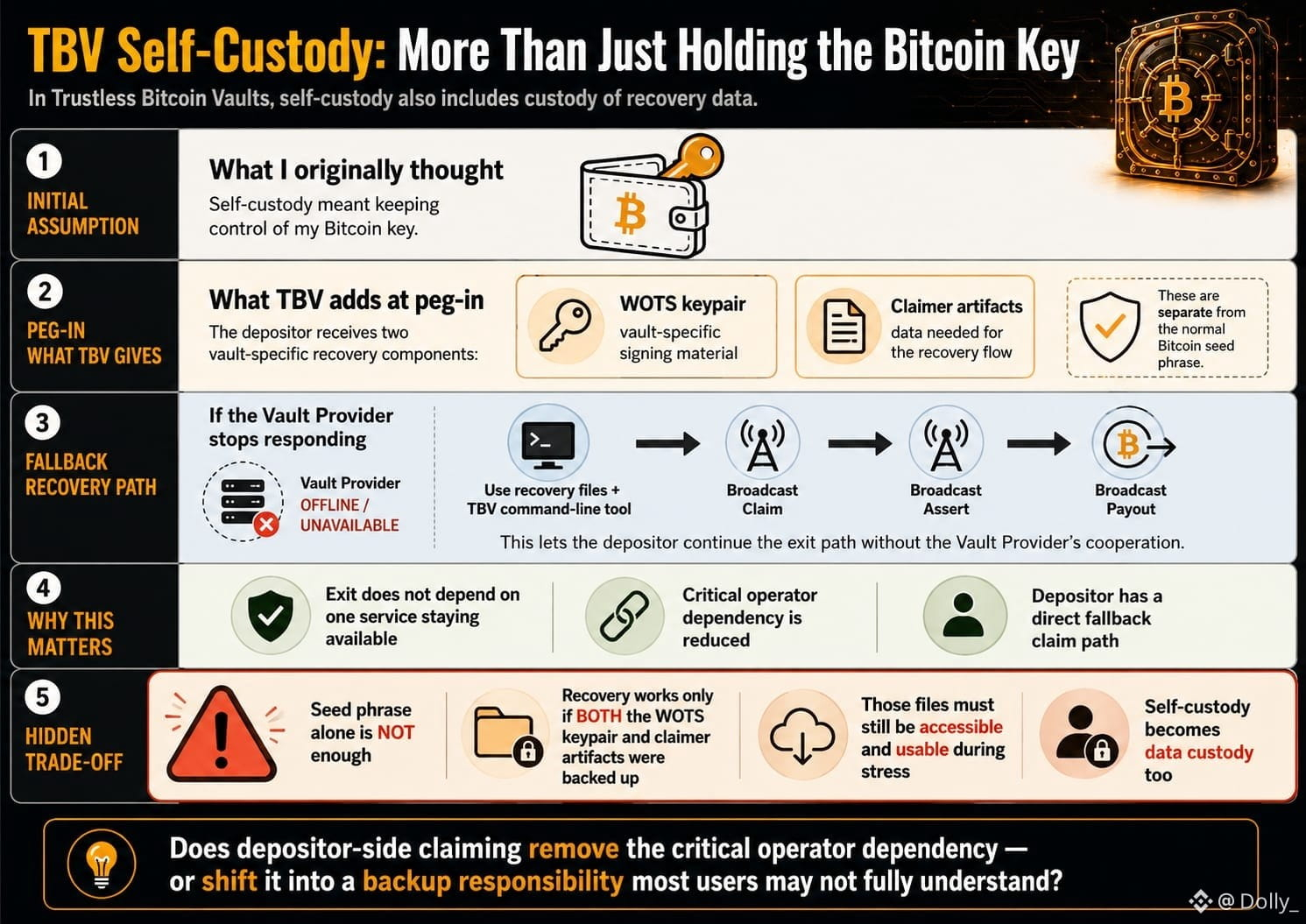
でも、Trustless Bitcoin Vaults(TBV)の中にリカバリーファイルがあるのを見つけました。
ペグインの際、預け手には、バルト固有のWOTS鍵ペアとクレイマーのアーティファクトが渡されます。もし後にVault Providerが応答しなくなった場合でも、これらのファイルをプロトコルのコマンドラインツールで使って、プロバイダーの協力なしにClaim、Assert、Payoutの各トランザクションをブロードキャストできます。
i一つのサービスが使え続けるかどうかに出口が左右されないのがいいと思います。
ただし、このフォールバックは、両方のセットのファイルがバックアップされていて、ストレスが来たときにもまだ使える場合に限って存在します。シードフレーズはビットコイン鍵を守りますが、それだけではこのリカバリーパスを実行するには十分ではありません。
セルフカストディは、静かにデータのカストディにもなります。
預け手に自分自身のクレーム手順を渡すことで、重要なオペレーター依存が取り除かれるのか、それとも、多くのユーザーが十分に理解しない“バックアップの責任”に置き換えられるだけなのでしょうか??
@babylonlabs_io #baby $BABY
{future}(UAIUSDT)
{future}(BEATUSDT)
{future}(KOMAUSDT)
やあみんな、$UB 、$BLESS 。今日はいい利益を出そう! kun k Mera Rank hy k Girta hi ja raha hy pehly nazron se phir dill se ab 300 se bhi
i以前は、自分のビットコイン鍵を管理しておくことが、自主保管(セルフカストディ)の本当の意味だと思っていました。
でも、Trustless Bitcoin Vaults(TBV)の中にリカバリーファイルがあるのを見つけました。
ペグインの際、預け手には、バルト固有のWOTS鍵ペアとクレイマーのアーティファクトが渡されます。もし後にVault Providerが応答しなくなった場合でも、これらのファイルをプロトコルのコマンドラインツールで使って、プロバイダーの協力なしにClaim、Assert、Payoutの各トランザクションをブロードキャストできます。
i一つのサービスが使え続けるかどうかに出口が左右されないのがいいと思います。
ただし、このフォールバックは、両方のセットのファイルがバックアップされていて、ストレスが来たときにもまだ使える場合に限って存在します。シードフレーズはビットコイン鍵を守りますが、それだけではこのリカバリーパスを実行するには十分ではありません。
セルフカストディは、静かにデータのカストディにもなります。
預け手に自分自身のクレーム手順を渡すことで、重要なオペレーター依存が取り除かれるのか、それとも、多くのユーザーが十分に理解しない“バックアップの責任”に置き換えられるだけなのでしょうか??
@BabylonLabs_io #baby $BABY
i以前は、自分のビットコイン鍵を管理しておくことが、自主保管(セルフカストディ)の本当の意味だと思っていました。
でも、Trustless Bitcoin Vaults(TBV)の中にリカバリーファイルがあるのを見つけました。
ペグインの際、預け手には、バルト固有のWOTS鍵ペアとクレイマーのアーティファクトが渡されます。もし後にVault Providerが応答しなくなった場合でも、これらのファイルをプロトコルのコマンドラインツールで使って、プロバイダーの協力なしにClaim、Assert、Payoutの各トランザクションをブロードキャストできます。
i一つのサービスが使え続けるかどうかに出口が左右されないのがいいと思います。
ただし、このフォールバックは、両方のセットのファイルがバックアップされていて、ストレスが来たときにもまだ使える場合に限って存在します。シードフレーズはビットコイン鍵を守りますが、それだけではこのリカバリーパスを実行するには十分ではありません。
セルフカストディは、静かにデータのカストディにもなります。
預け手に自分自身のクレーム手順を渡すことで、重要なオペレーター依存が取り除かれるのか、それとも、多くのユーザーが十分に理解しない“バックアップの責任”に置き換えられるだけなのでしょうか??
@BabylonLabs_io #baby $BABY
23
17
4k
翻訳参照
go long on $FIGHT i used to think that using Bitcoin as collateral naturally meant the lending system also needed some form of control over the asset.
The more i read through @BabylonLabs_io’s design, the more deliberate the opposite started to feel.
The $BTC remains locked on Bitcoin under spending conditions agreed when the vault is created. The borrowing application does not take custody of it. Its responsibility is narrower: managing the loan, calculating the position’s health, processing repayments and deciding when liquidation conditions have been reached.
That separation matters.
Bitcoin handles the part that should remain difficult to change or interfere with.
The application handles the part that needs to respond to interest rates, collateral parameters and market conditions.
I actually like that the two layers are not blended together. A lending protocol can update how it manages risk without gaining the ability to freely move the Bitcoin backing the position.
The tradeoff is that the full system becomes less intuitive.
Users are not interacting with one platform that holds collateral and issues a loan. They are interacting with two connected environments, each responsible for a different part of the position.
Sometimes stronger boundaries make the architecture safer while making the experience harder to explain.
Does keeping Bitcoin custody separate from lending logic create a clearer trust model, or does dividing responsibility across two systems make borrowing feel unnecessarily complicated?
@babylonlabs_io $BABY #baby $KOMA again in loser today
go long on $FIGHT i used to think that using Bitcoin as collateral naturally meant the lending system also needed some form of control over the asset.
The more i read through @BabylonLabs_io’s design, the more deliberate the opposite started to feel.
The $BTC remains locked on Bitcoin under spending conditions agreed when the vault is created. The borrowing application does not take custody of it. Its responsibility is narrower: managing the loan, calculating the position’s health, processing repayments and deciding when liquidation conditions have been reached.
That separation matters.
Bitcoin handles the part that should remain difficult to change or interfere with.
The application handles the part that needs to respond to interest rates, collateral parameters and market conditions.
I actually like that the two layers are not blended together. A lending protocol can update how it manages risk without gaining the ability to freely move the Bitcoin backing the position.
The tradeoff is that the full system becomes less intuitive.
Users are not interacting with one platform that holds collateral and issues a loan. They are interacting with two connected environments, each responsible for a different part of the position.
Sometimes stronger boundaries make the architecture safer while making the experience harder to explain.
Does keeping Bitcoin custody separate from lending logic create a clearer trust model, or does dividing responsibility across two systems make borrowing feel unnecessarily complicated?
@BabylonLabs_io $BABY #baby $KOMA again in loser today
The more i read through @BabylonLabs_io’s design, the more deliberate the opposite started to feel.
The $BTC remains locked on Bitcoin under spending conditions agreed when the vault is created. The borrowing application does not take custody of it. Its responsibility is narrower: managing the loan, calculating the position’s health, processing repayments and deciding when liquidation conditions have been reached.
That separation matters.
Bitcoin handles the part that should remain difficult to change or interfere with.
The application handles the part that needs to respond to interest rates, collateral parameters and market conditions.
I actually like that the two layers are not blended together. A lending protocol can update how it manages risk without gaining the ability to freely move the Bitcoin backing the position.
The tradeoff is that the full system becomes less intuitive.
Users are not interacting with one platform that holds collateral and issues a loan. They are interacting with two connected environments, each responsible for a different part of the position.
Sometimes stronger boundaries make the architecture safer while making the experience harder to explain.
Does keeping Bitcoin custody separate from lending logic create a clearer trust model, or does dividing responsibility across two systems make borrowing feel unnecessarily complicated?
@BabylonLabs_io $BABY #baby $KOMA again in loser today
Clearer trust model
34%
Safer but more complex
0%
Too hard for users
33%
Depends on the interface
33%
3 投票 • 投票は終了しました
12
5
899
翻訳参照
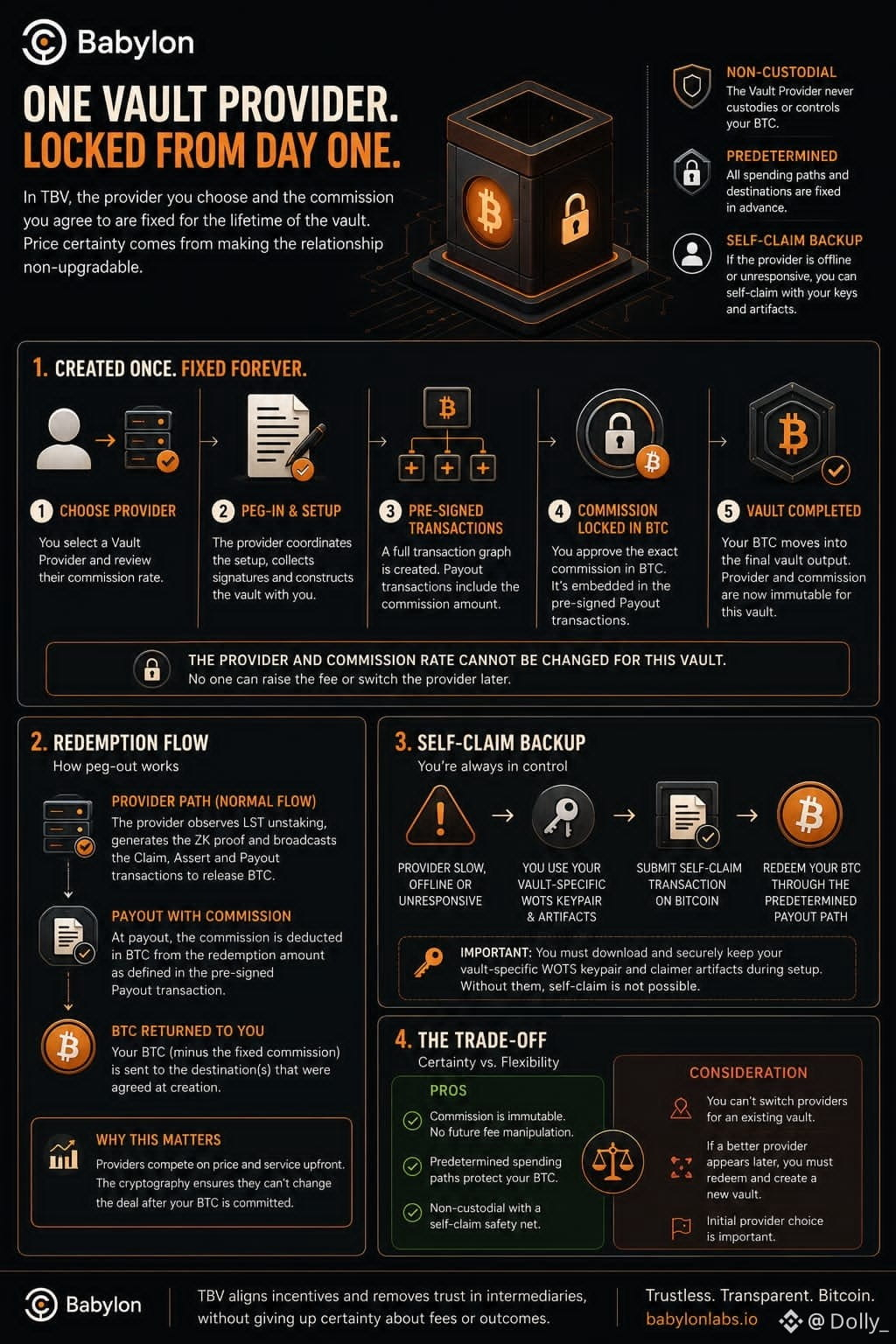
kept thinking the Vault Provider choice inside @babylonlabs_io current TBV flow was mostly an operational detail.
someone coordinates peg-in setup, collects signatures, generates the ZK proof at redemption and broadcasts the Bitcoin Claim, Assert and Payout transactions.
then i reached the commission section.
Each provider sets a fee.
It is deducted in BTC from the redemption payout and embedded in the pre-signed Payout transactions when the vault is created.
The depositor approves the amount before BTC moves into the final vault output.
The provider cannot raise it later.
The depositor cannot switch providers later either.
So the choice is fixed twice.
The operational relationship lasts for the vault’s entire life, while the economic terms are cryptographically locked.
that’s the part that stuck.
A provider cannot attract depositors with one rate and quietly increase it after their BTC is committed. The pre-signed payout prevents the terms from drifting.
But that protection creates inflexibility.
If another provider becomes cheaper, faster or more reliable, the vault cannot migrate. The depositor must redeem it and create a new one with another provider.
Grabbed a snack and kept thinking how unusual that feels in DeFi, where service layers can change while positions stay open.
Here, price certainty comes from making the relationship non-upgradable.
The provider still does not custody or control the BTC. Spending paths and payout destinations are agreed in advance.
If the provider becomes slow, unavailable or refuses a valid redemption, the depositor can use the self-claim path—provided they kept the vault-specific WOTS keypair and claimer artifacts.
So non-custodial does not mean interchangeable.
Maybe fixing the provider and fee at creation is the cleanest protection against future manipulation
Or maybe it puts too much weight on choosing the right provider before users have seen a real redemption
Is an immutable commission stronger user protection, or does it make the initial Vault Provider choice too important?
#baby $BABY $KOMA
kept thinking the Vault Provider choice inside @BabylonLabs_io current TBV flow was mostly an operational detail.
someone coordinates peg-in setup, collects signatures, generates the ZK proof at redemption and broadcasts the Bitcoin Claim, Assert and Payout transactions.
then i reached the commission section.
Each provider sets a fee.
It is deducted in BTC from the redemption payout and embedded in the pre-signed Payout transactions when the vault is created.
The depositor approves the amount before BTC moves into the final vault output.
The provider cannot raise it later.
The depositor cannot switch providers later either.
So the choice is fixed twice.
The operational relationship lasts for the vault’s entire life, while the economic terms are cryptographically locked.
that’s the part that stuck.
A provider cannot attract depositors with one rate and quietly increase it after their BTC is committed. The pre-signed payout prevents the terms from drifting.
But that protection creates inflexibility.
If another provider becomes cheaper, faster or more reliable, the vault cannot migrate. The depositor must redeem it and create a new one with another provider.
Grabbed a snack and kept thinking how unusual that feels in DeFi, where service layers can change while positions stay open.
Here, price certainty comes from making the relationship non-upgradable.
The provider still does not custody or control the BTC. Spending paths and payout destinations are agreed in advance.
If the provider becomes slow, unavailable or refuses a valid redemption, the depositor can use the self-claim path—provided they kept the vault-specific WOTS keypair and claimer artifacts.
So non-custodial does not mean interchangeable.
Maybe fixing the provider and fee at creation is the cleanest protection against future manipulation
Or maybe it puts too much weight on choosing the right provider before users have seen a real redemption
Is an immutable commission stronger user protection, or does it make the initial Vault Provider choice too important?
#baby $BABY $KOMA
someone coordinates peg-in setup, collects signatures, generates the ZK proof at redemption and broadcasts the Bitcoin Claim, Assert and Payout transactions.
then i reached the commission section.
Each provider sets a fee.
It is deducted in BTC from the redemption payout and embedded in the pre-signed Payout transactions when the vault is created.
The depositor approves the amount before BTC moves into the final vault output.
The provider cannot raise it later.
The depositor cannot switch providers later either.
So the choice is fixed twice.
The operational relationship lasts for the vault’s entire life, while the economic terms are cryptographically locked.
that’s the part that stuck.
A provider cannot attract depositors with one rate and quietly increase it after their BTC is committed. The pre-signed payout prevents the terms from drifting.
But that protection creates inflexibility.
If another provider becomes cheaper, faster or more reliable, the vault cannot migrate. The depositor must redeem it and create a new one with another provider.
Grabbed a snack and kept thinking how unusual that feels in DeFi, where service layers can change while positions stay open.
Here, price certainty comes from making the relationship non-upgradable.
The provider still does not custody or control the BTC. Spending paths and payout destinations are agreed in advance.
If the provider becomes slow, unavailable or refuses a valid redemption, the depositor can use the self-claim path—provided they kept the vault-specific WOTS keypair and claimer artifacts.
So non-custodial does not mean interchangeable.
Maybe fixing the provider and fee at creation is the cleanest protection against future manipulation
Or maybe it puts too much weight on choosing the right provider before users have seen a real redemption
Is an immutable commission stronger user protection, or does it make the initial Vault Provider choice too important?
#baby $BABY $KOMA
11
11
116
バビロンのコア設計:カストディ、コンセンサス、ファイナリティ、ガバナンスを分離
バビロン・ジェネシスを「ひとつのセキュリティシステム」のように読んでいたら、実は設計は遠目には束ねられて見える「4つの権限」でできていると気づきました。
カストディはビットコインに残る。
コンセンサスはCometBFTバリデータにある。
ファイナリティはFinality Providersによってもたらされる。
ガバナンスは$BABY ホルダーとそのデリゲートに属する。
この分離が、私にとって図の見え方を変えました。
@BabylonLabs_io を通じてBTCをステークすると、ビットコインネイティブな自己カストディのスクリプトにロックされます。選ばれたFinality Providerはコインではなく、投票権を受け取ります。ファイナリティ投票を提出しても、それがビットコインのカストディ主体になるわけではありません。
BABYのステーカーはCometBFTバリデータに委任し、これらのバリデータがブロック生成とコンセンサスを担当します。Finality Providersはその上に位置し、委任されたBTCを裏付けにした別のファイナリティラウンドを追加します。
同じチェーン。
別の役割。
私が読み直さなければならなかったのはガバナンスの部分でした。BTCステーカーはセキュリティを提供し、BABYの報酬を得られますが、そのBTCの委任が自動的にガバナンス投票権を与えるわけではありません。提案はCosmosのガバナンスモジュールを通じて行われ、BABYホルダーとそのデリゲートが投票します。
コーヒーが冷めていくのを感じながらも、各役割が「設計上どれほど不完全か」について考え続けてしまいました。
Finality Providerは、ブロックを生成しなくても、BTCを保有していなくても、ファイナリティに投票できます。バリデータは、ビットコインのカストディを管理していなくてもブロックを生成できます。BABYの投票者は、チェーンを最終確定せずにネットワークルールに影響を与えられます。
当初私は、バビロンが「1つのバリデータシステム」にビットコインのセキュリティをレイヤーしているのだと思っていました。
読み進めるほど、これは「チェックと境界」に近いものだと見えてきました。ビットコインのスクリプトがカストディ条件を保持し、バリデータがコンセンサスを動かし、Finality ProvidersがBTCに裏付けられたファイナリティを追加し、そしてBABYのガバナンスがルールを変える。
4つすべてを同一の役割が担うことは想定されていません。
この分離によって、バビロンは捉えにくくなるのでしょうか?それとも、ユーザーにとって監視すべき「4つの異なる権力の中心」が増えるだけなのでしょうか?
#baby $BEAT @babylonlabs_io $BABY
バビロンのコア設計:カストディ、コンセンサス、ファイナリティ、ガバナンスを分離
バビロン・ジェネシスを「ひとつのセキュリティシステム」のように読んでいたら、実は設計は遠目には束ねられて見える「4つの権限」でできていると気づきました。
カストディはビットコインに残る。
コンセンサスはCometBFTバリデータにある。
ファイナリティはFinality Providersによってもたらされる。
ガバナンスは$BABY ホルダーとそのデリゲートに属する。
この分離が、私にとって図の見え方を変えました。
@BabylonLabs_io を通じてBTCをステークすると、ビットコインネイティブな自己カストディのスクリプトにロックされます。選ばれたFinality Providerはコインではなく、投票権を受け取ります。ファイナリティ投票を提出しても、それがビットコインのカストディ主体になるわけではありません。
BABYのステーカーはCometBFTバリデータに委任し、これらのバリデータがブロック生成とコンセンサスを担当します。Finality Providersはその上に位置し、委任されたBTCを裏付けにした別のファイナリティラウンドを追加します。
同じチェーン。
別の役割。
私が読み直さなければならなかったのはガバナンスの部分でした。BTCステーカーはセキュリティを提供し、BABYの報酬を得られますが、そのBTCの委任が自動的にガバナンス投票権を与えるわけではありません。提案はCosmosのガバナンスモジュールを通じて行われ、BABYホルダーとそのデリゲートが投票します。
コーヒーが冷めていくのを感じながらも、各役割が「設計上どれほど不完全か」について考え続けてしまいました。
Finality Providerは、ブロックを生成しなくても、BTCを保有していなくても、ファイナリティに投票できます。バリデータは、ビットコインのカストディを管理していなくてもブロックを生成できます。BABYの投票者は、チェーンを最終確定せずにネットワークルールに影響を与えられます。
当初私は、バビロンが「1つのバリデータシステム」にビットコインのセキュリティをレイヤーしているのだと思っていました。
読み進めるほど、これは「チェックと境界」に近いものだと見えてきました。ビットコインのスクリプトがカストディ条件を保持し、バリデータがコンセンサスを動かし、Finality ProvidersがBTCに裏付けられたファイナリティを追加し、そしてBABYのガバナンスがルールを変える。
4つすべてを同一の役割が担うことは想定されていません。
この分離によって、バビロンは捉えにくくなるのでしょうか?それとも、ユーザーにとって監視すべき「4つの異なる権力の中心」が増えるだけなのでしょうか?
#baby $BEAT @BabylonLabs_io $BABY
バビロン・ジェネシスを「ひとつのセキュリティシステム」のように読んでいたら、実は設計は遠目には束ねられて見える「4つの権限」でできていると気づきました。
カストディはビットコインに残る。
コンセンサスはCometBFTバリデータにある。
ファイナリティはFinality Providersによってもたらされる。
ガバナンスは$BABY ホルダーとそのデリゲートに属する。
この分離が、私にとって図の見え方を変えました。
@BabylonLabs_io を通じてBTCをステークすると、ビットコインネイティブな自己カストディのスクリプトにロックされます。選ばれたFinality Providerはコインではなく、投票権を受け取ります。ファイナリティ投票を提出しても、それがビットコインのカストディ主体になるわけではありません。
BABYのステーカーはCometBFTバリデータに委任し、これらのバリデータがブロック生成とコンセンサスを担当します。Finality Providersはその上に位置し、委任されたBTCを裏付けにした別のファイナリティラウンドを追加します。
同じチェーン。
別の役割。
私が読み直さなければならなかったのはガバナンスの部分でした。BTCステーカーはセキュリティを提供し、BABYの報酬を得られますが、そのBTCの委任が自動的にガバナンス投票権を与えるわけではありません。提案はCosmosのガバナンスモジュールを通じて行われ、BABYホルダーとそのデリゲートが投票します。
コーヒーが冷めていくのを感じながらも、各役割が「設計上どれほど不完全か」について考え続けてしまいました。
Finality Providerは、ブロックを生成しなくても、BTCを保有していなくても、ファイナリティに投票できます。バリデータは、ビットコインのカストディを管理していなくてもブロックを生成できます。BABYの投票者は、チェーンを最終確定せずにネットワークルールに影響を与えられます。
当初私は、バビロンが「1つのバリデータシステム」にビットコインのセキュリティをレイヤーしているのだと思っていました。
読み進めるほど、これは「チェックと境界」に近いものだと見えてきました。ビットコインのスクリプトがカストディ条件を保持し、バリデータがコンセンサスを動かし、Finality ProvidersがBTCに裏付けられたファイナリティを追加し、そしてBABYのガバナンスがルールを変える。
4つすべてを同一の役割が担うことは想定されていません。
この分離によって、バビロンは捉えにくくなるのでしょうか?それとも、ユーザーにとって監視すべき「4つの異なる権力の中心」が増えるだけなのでしょうか?
#baby $BEAT @BabylonLabs_io $BABY
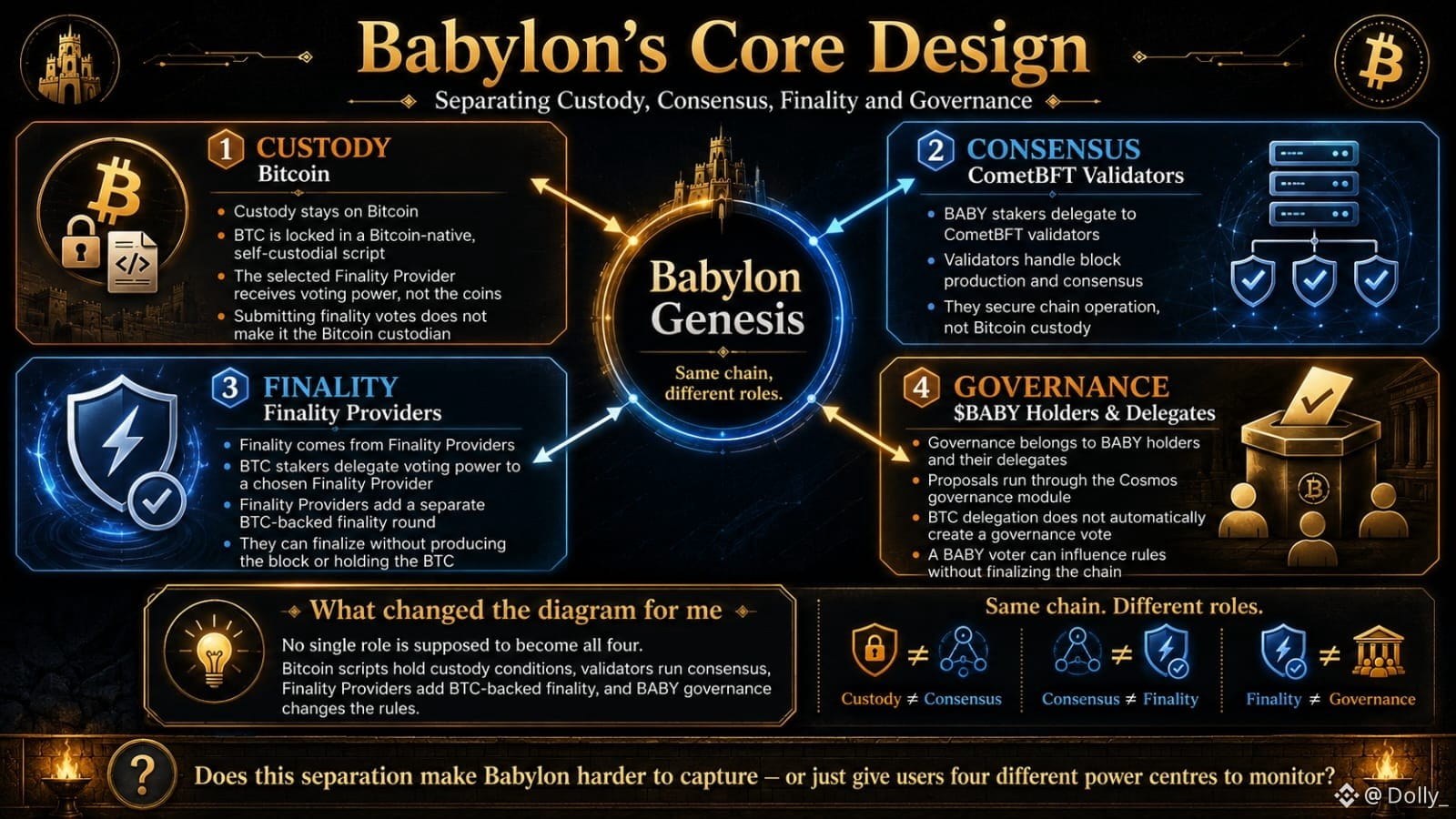
8
5
106
ログインして、さらにコンテンツを読む
厳選トピックで世界の暗号資産トレーダーの仲間入り
⚡️ 暗号資産に関する最新かつ有益な情報が見つかります。
💬 世界最大の暗号資産取引所から信頼されています。
👍 認証を受けたクリエイターから、有益なインサイトを得られます。
メール / 電話番号
トレンドトピック
BitcoinCrosses$78000
閲覧回数 971
69人が討論中
$BTC 至急 最新情報 🚨 大きなチャンス‼️短期下落📉に備えよう
BTCは予想通りリバウンドしています。さらに、今回のリバウンドは78,000まで伸びる可能性があるため、エントリーは最大78,000まで拡大できます。
ストップロス:79,200
目標 🎯
TP1:77,150
TP2:76,450
TP3:75,750
TP4:75,000
$SOL と $ETH はビットコインに追随します。そして予測通り投げ売り(ダンプ)へ 🔥
常にDYOR(自己調査)して、1回の取引に全額を入れないでください
ここでショート 👇
#SECReceivesGrayscaleLitecoinTrustETFFiling #ClarityActFacesProceduralVoteSept15 #US10YearTreasuryYieldNears5%
Panda Traders
·いいね:14件
·閲覧回数 5.8k
AvalancheIntegratesIntoUAEPassDigitalVault
閲覧回数 987
59人が討論中
UKSeeksViewsOnTokenizingGold
閲覧回数 475
33人が討論中