

RIO_X
4k 投稿

RIO_X
報告
ユーザーをブロック
Markets by morning, life by afternoon. ... I trade to fund my freedom, not to lose my mind. Let’s make some money and actually enjoy it.
取引を発注
超高頻度トレーダー
4.9年
2.0K+ フォロー
9.8K+ フォロワー
4.5K+ いいね
投稿
ポートフォリオ
すべて
引用
ライブ
·
--
翻訳参照
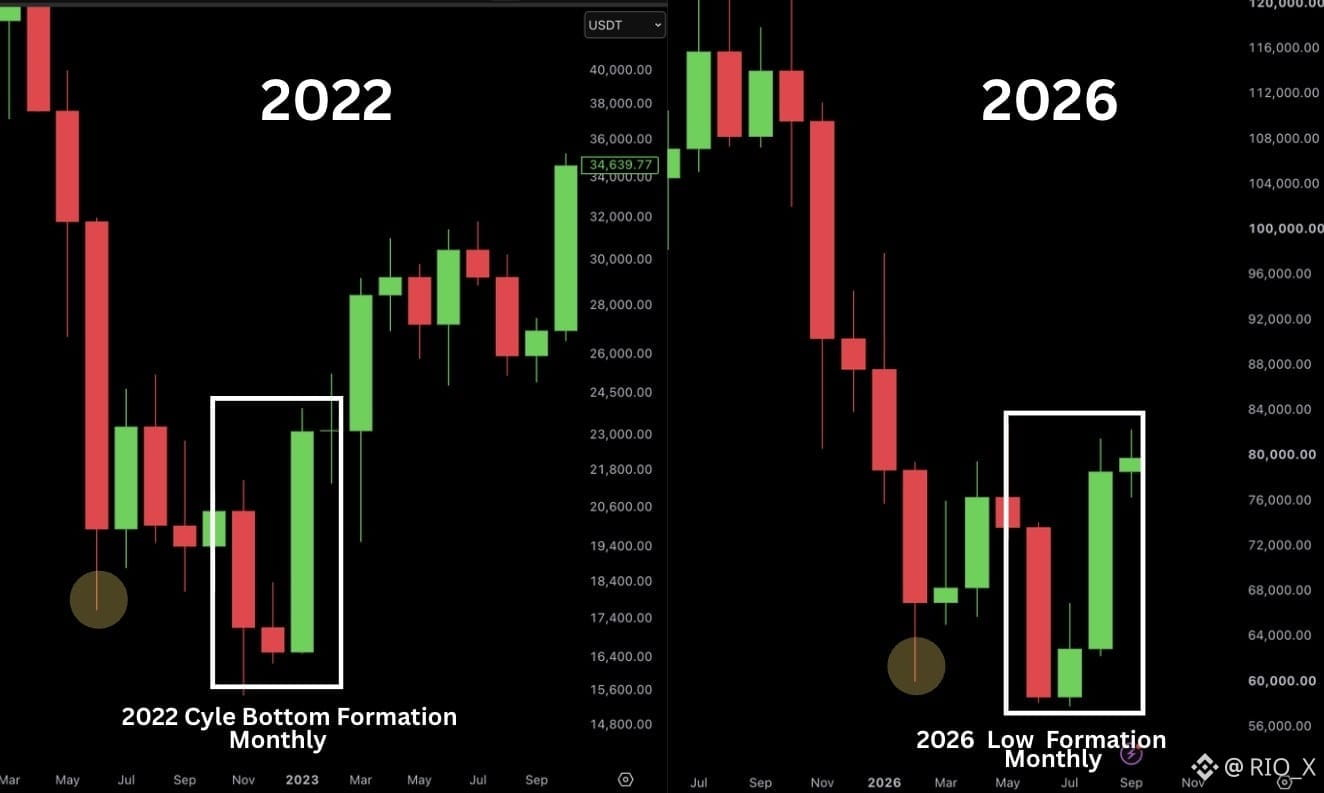
2026 monthly candle pattern looks very similar to the 2022 cycle bottom.
Could history be repeating itself?
$BULLA
$ARB
$MARSCOIN
{future}(MARSCOINUSDT)
2026 monthly candle pattern looks very similar to the 2022 cycle bottom.
Could history be repeating itself?
$BULLA
$ARB
$MARSCOIN
Could history be repeating itself?
$BULLA
$ARB
$MARSCOIN
2
101
·
--
翻訳参照
#dusk $DUSK @Dusk_Foundation
was clearing out old browser tabs on Wednesday and found the Dusk Trade page still open from weeks ago 🤔
reread it and noticed the status. building.
not live. not testnet. building.
and I have been writing about the investor onboarding flow and wallet binding and controlled transfers as though I could go and do them today. I cannot. Nobody can yet.
what the page describes is the intended shape of a neobroker for tokenized financial assets. discovery. onboarding. eligibility. controlled transfers. payment coordination. compliant settlement.
that is a specification more than a product right now.
which is fine honestly. a regulated trading venue should not ship fast. but I should have been clearer about it and I was not.
my caveat on my own caveat is that building can mean six months or three years and the page does not say which.
do you find status labels on project sites useful or too vague to trust
@Dusk_Foundation #dusk $DUSK
{future}(DUSKUSDT)
#dusk $DUSK @Dusk
was clearing out old browser tabs on Wednesday and found the Dusk Trade page still open from weeks ago 🤔
reread it and noticed the status. building.
not live. not testnet. building.
and I have been writing about the investor onboarding flow and wallet binding and controlled transfers as though I could go and do them today. I cannot. Nobody can yet.
what the page describes is the intended shape of a neobroker for tokenized financial assets. discovery. onboarding. eligibility. controlled transfers. payment coordination. compliant settlement.
that is a specification more than a product right now.
which is fine honestly. a regulated trading venue should not ship fast. but I should have been clearer about it and I was not.
my caveat on my own caveat is that building can mean six months or three years and the page does not say which.
do you find status labels on project sites useful or too vague to trust
@Dusk #dusk $DUSK
was clearing out old browser tabs on Wednesday and found the Dusk Trade page still open from weeks ago 🤔
reread it and noticed the status. building.
not live. not testnet. building.
and I have been writing about the investor onboarding flow and wallet binding and controlled transfers as though I could go and do them today. I cannot. Nobody can yet.
what the page describes is the intended shape of a neobroker for tokenized financial assets. discovery. onboarding. eligibility. controlled transfers. payment coordination. compliant settlement.
that is a specification more than a product right now.
which is fine honestly. a regulated trading venue should not ship fast. but I should have been clearer about it and I was not.
my caveat on my own caveat is that building can mean six months or three years and the page does not say which.
do you find status labels on project sites useful or too vague to trust
@Dusk #dusk $DUSK
AGREE
100%
DISAGREE
0%
1 投票 • 投票は終了しました
1
1
167
·
--
翻訳参照
#dusk $DUSK @Dusk_Foundation
I was trying to connect a wallet today and somehow managed to click the wrong option twice.😅 That’s when I remembered how much of crypto depends on little pieces of infrastructure you barely notice when they work.
That’s what I found interesting about Dusk Connect. It isn’t the wallet itself. It’s the layer that helps a Dusk dApp discover compatible wallets, let the user choose one,request account access, track the active account and network, and send transactions for the user to approve. It also isn’t locked to one wallet provider,which means an app can support multiple compatible wallets instead of hardcoding one.
{future}(DUSKUSDT)
DOCS +1
There’s another small detail I like: the wallet keeps control of the keys and the user still approves the actions. The dApp can request access, but it doesn’t simply get to act on your behalf.
DOCS
The price is the obvious thing to look at. Sometimes the more interesting story is the boring layer underneath that makes everything work.
#dusk $DUSK @Dusk
I was trying to connect a wallet today and somehow managed to click the wrong option twice.😅 That’s when I remembered how much of crypto depends on little pieces of infrastructure you barely notice when they work.
That’s what I found interesting about Dusk Connect. It isn’t the wallet itself. It’s the layer that helps a Dusk dApp discover compatible wallets, let the user choose one,request account access, track the active account and network, and send transactions for the user to approve. It also isn’t locked to one wallet provider,which means an app can support multiple compatible wallets instead of hardcoding one.
DOCS +1
There’s another small detail I like: the wallet keeps control of the keys and the user still approves the actions. The dApp can request access, but it doesn’t simply get to act on your behalf.
DOCS
The price is the obvious thing to look at. Sometimes the more interesting story is the boring layer underneath that makes everything work.
I was trying to connect a wallet today and somehow managed to click the wrong option twice.😅 That’s when I remembered how much of crypto depends on little pieces of infrastructure you barely notice when they work.
That’s what I found interesting about Dusk Connect. It isn’t the wallet itself. It’s the layer that helps a Dusk dApp discover compatible wallets, let the user choose one,request account access, track the active account and network, and send transactions for the user to approve. It also isn’t locked to one wallet provider,which means an app can support multiple compatible wallets instead of hardcoding one.
DOCS +1
There’s another small detail I like: the wallet keeps control of the keys and the user still approves the actions. The dApp can request access, but it doesn’t simply get to act on your behalf.
DOCS
The price is the obvious thing to look at. Sometimes the more interesting story is the boring layer underneath that makes everything work.
AGREE
100%
DISAGREE
0%
1 投票 • 投票は終了しました
1
3
309
·
--
#dusk $DUSK @Dusk_Foundation
かつて私はウォレットを接続しようと5分間あれこれしたのですが、実は最初からずっと間違ったボタンを押していたと気づきました。😅
だからこそDusk Connectに惹かれました。これはDuskDSアプリに、対応するウォレットを見つけるための標準的な方法、アカウントの要求、ユーザーにトランザクションへの署名を求める手段を提供します。仕組みとしてはシンプルに聞こえますが、ウォレット接続は、他のすべての前に確実に機能していなければならない“地味だけど重要”な要素のひとつです。
Duskはさらに、ブラウザ・デスクトップ・モバイル向けに独自のウォレットも構築しているため、フロントエンドが後回しにされているわけではありません。???
Dusk
インフラ担当者が最も気づかれにくいところで、ほかのすべてが使えるようになるのです。
#dusk $DUSK @Dusk
かつて私はウォレットを接続しようと5分間あれこれしたのですが、実は最初からずっと間違ったボタンを押していたと気づきました。😅
だからこそDusk Connectに惹かれました。これはDuskDSアプリに、対応するウォレットを見つけるための標準的な方法、アカウントの要求、ユーザーにトランザクションへの署名を求める手段を提供します。仕組みとしてはシンプルに聞こえますが、ウォレット接続は、他のすべての前に確実に機能していなければならない“地味だけど重要”な要素のひとつです。
Duskはさらに、ブラウザ・デスクトップ・モバイル向けに独自のウォレットも構築しているため、フロントエンドが後回しにされているわけではありません。???
Dusk
インフラ担当者が最も気づかれにくいところで、ほかのすべてが使えるようになるのです。
かつて私はウォレットを接続しようと5分間あれこれしたのですが、実は最初からずっと間違ったボタンを押していたと気づきました。😅
だからこそDusk Connectに惹かれました。これはDuskDSアプリに、対応するウォレットを見つけるための標準的な方法、アカウントの要求、ユーザーにトランザクションへの署名を求める手段を提供します。仕組みとしてはシンプルに聞こえますが、ウォレット接続は、他のすべての前に確実に機能していなければならない“地味だけど重要”な要素のひとつです。
Duskはさらに、ブラウザ・デスクトップ・モバイル向けに独自のウォレットも構築しているため、フロントエンドが後回しにされているわけではありません。???
Dusk
インフラ担当者が最も気づかれにくいところで、ほかのすべてが使えるようになるのです。
Dusk Connect
100%
compatible wallets
0%
1 投票 • 投票は終了しました
3
1
338
·
--
翻訳参照
Everyone talks about Dusk's privacy tech. Almost nobody talks about how a block actually travels across the network.
I went looking, and found something called Kadcast.
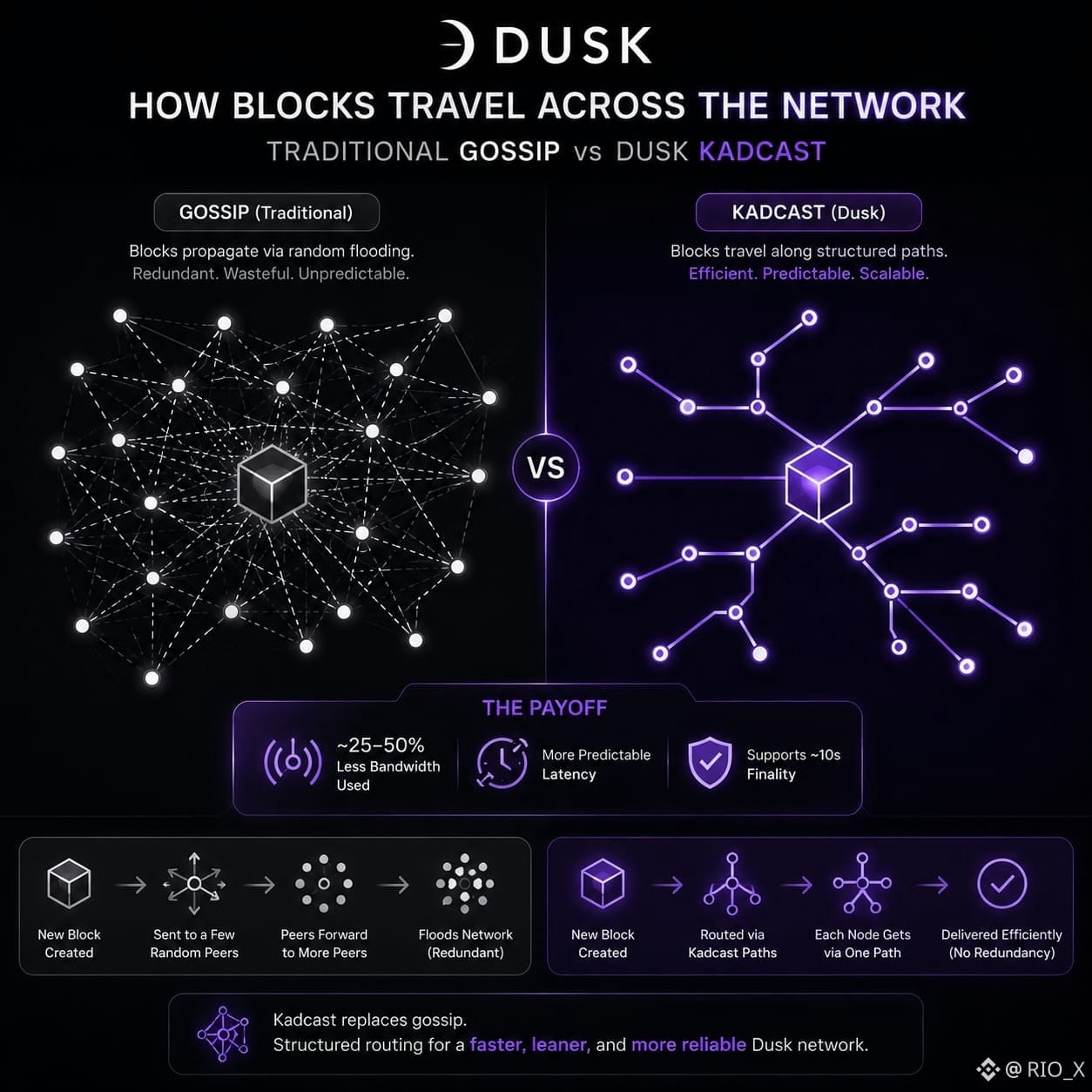
Most blockchains Bitcoin, Ethereum included— spread new blocks through "gossip." A node tells a few peers, those peers tell a few more, and it floods outward. Simple, but wasteful. The same data gets sent to the same nodes over and over.
Dusk replaced that entirely. $TUT
Kadcast routes messages along structured paths instead, based on a well-known peer-to-peer technique originally built for file-sharing networks. Every node has a clear, defined path to reach every other node no random flooding.
The payoff: roughly 25 to 50% less bandwidth used, and more predictable latency, according to Dusk's own published research. $TRUMP
That's not just a nice efficiency stat. Remember the 10-second finality I wrote about last time? None of that works if votes and blocks can't move across the network fast and predictably. Kadcast is the quiet piece making that possible.
Limitation I noticed: most of the detailed technical writeups on Kadcast's real-world performance are a couple years old now. Would like to see fresher benchmarks from mainnet, not just the original research.
Anyone know of newer data on this?
@Dusk_Foundation $DUSK
{future}(DUSKUSDT)
#dusk
Everyone talks about Dusk's privacy tech. Almost nobody talks about how a block actually travels across the network.
I went looking, and found something called Kadcast.
Most blockchains Bitcoin, Ethereum included— spread new blocks through "gossip." A node tells a few peers, those peers tell a few more, and it floods outward. Simple, but wasteful. The same data gets sent to the same nodes over and over.
Dusk replaced that entirely. $TUT
Kadcast routes messages along structured paths instead, based on a well-known peer-to-peer technique originally built for file-sharing networks. Every node has a clear, defined path to reach every other node no random flooding.
The payoff: roughly 25 to 50% less bandwidth used, and more predictable latency, according to Dusk's own published research. $TRUMP
That's not just a nice efficiency stat. Remember the 10-second finality I wrote about last time? None of that works if votes and blocks can't move across the network fast and predictably. Kadcast is the quiet piece making that possible.
Limitation I noticed: most of the detailed technical writeups on Kadcast's real-world performance are a couple years old now. Would like to see fresher benchmarks from mainnet, not just the original research.
Anyone know of newer data on this?
@Dusk $DUSK
#dusk
I went looking, and found something called Kadcast.
Most blockchains Bitcoin, Ethereum included— spread new blocks through "gossip." A node tells a few peers, those peers tell a few more, and it floods outward. Simple, but wasteful. The same data gets sent to the same nodes over and over.
Dusk replaced that entirely. $TUT
Kadcast routes messages along structured paths instead, based on a well-known peer-to-peer technique originally built for file-sharing networks. Every node has a clear, defined path to reach every other node no random flooding.
The payoff: roughly 25 to 50% less bandwidth used, and more predictable latency, according to Dusk's own published research. $TRUMP
That's not just a nice efficiency stat. Remember the 10-second finality I wrote about last time? None of that works if votes and blocks can't move across the network fast and predictably. Kadcast is the quiet piece making that possible.
Limitation I noticed: most of the detailed technical writeups on Kadcast's real-world performance are a couple years old now. Would like to see fresher benchmarks from mainnet, not just the original research.
Anyone know of newer data on this?
@Dusk $DUSK
#dusk
3
8
201

·
--
翻訳参照
#dusk $DUSK @Dusk_Foundation
Been sitting with this since a conversation last Thursday that I handled badly at the time.
A building goes up under one set of fire regulations. Twenty years later the code changes. The building doesnt become illegal— it stands, grandfathered, until somebody touches it . Then the new rules apply to whatever you altered ,and sometimes to the whole structure.
Everyone accepts this. Nobody thinks its strange that a wall built legally in 1998 might need to come down in 2026.
Now put a regulated security on a settlement layer where the compliance rules live inside the contract.
Dusk describe compliance checks enforced in smart contracts rather than manual back office processes, and thats a genuine improvement —the rule applies when the transfer happens instead of getting reviewed afterwards.eligibility, limits, transfer restrictions, all executing rather tha being checked
but rules written into an issued asset were written under the regulation that existed on the day it was issued
Where the building comparison stops working is inspection. an fire officer can walk into a structure, see the old wiring, and require it changed. theres a physical thing to look at and a person with authority to look
an issued asset with compliance logic already executing has no equivalent walk-through. the rule isnt a wall someone can point at, its behaviour, and updating it means either upgradeability that weakens the guarantee or a migration nobody planned for
the strange part is that putting compliance in code makes it MORE reliable and less revisable at the same time, and I dont know anyone who has solved that
whats your take
@Dusk_Foundation #dusk $DUSK
{future}(DUSKUSDT)
$MAGMA
{future}(MAGMAUSDT)
#dusk $DUSK @Dusk
Been sitting with this since a conversation last Thursday that I handled badly at the time.
A building goes up under one set of fire regulations. Twenty years later the code changes. The building doesnt become illegal— it stands, grandfathered, until somebody touches it . Then the new rules apply to whatever you altered ,and sometimes to the whole structure.
Everyone accepts this. Nobody thinks its strange that a wall built legally in 1998 might need to come down in 2026.
Now put a regulated security on a settlement layer where the compliance rules live inside the contract.
Dusk describe compliance checks enforced in smart contracts rather than manual back office processes, and thats a genuine improvement —the rule applies when the transfer happens instead of getting reviewed afterwards.eligibility, limits, transfer restrictions, all executing rather tha being checked
but rules written into an issued asset were written under the regulation that existed on the day it was issued
Where the building comparison stops working is inspection. an fire officer can walk into a structure, see the old wiring, and require it changed. theres a physical thing to look at and a person with authority to look
an issued asset with compliance logic already executing has no equivalent walk-through. the rule isnt a wall someone can point at, its behaviour, and updating it means either upgradeability that weakens the guarantee or a migration nobody planned for
the strange part is that putting compliance in code makes it MORE reliable and less revisable at the same time, and I dont know anyone who has solved that
whats your take
@Dusk #dusk $DUSK
$MAGMA
Been sitting with this since a conversation last Thursday that I handled badly at the time.
A building goes up under one set of fire regulations. Twenty years later the code changes. The building doesnt become illegal— it stands, grandfathered, until somebody touches it . Then the new rules apply to whatever you altered ,and sometimes to the whole structure.
Everyone accepts this. Nobody thinks its strange that a wall built legally in 1998 might need to come down in 2026.
Now put a regulated security on a settlement layer where the compliance rules live inside the contract.
Dusk describe compliance checks enforced in smart contracts rather than manual back office processes, and thats a genuine improvement —the rule applies when the transfer happens instead of getting reviewed afterwards.eligibility, limits, transfer restrictions, all executing rather tha being checked
but rules written into an issued asset were written under the regulation that existed on the day it was issued
Where the building comparison stops working is inspection. an fire officer can walk into a structure, see the old wiring, and require it changed. theres a physical thing to look at and a person with authority to look
an issued asset with compliance logic already executing has no equivalent walk-through. the rule isnt a wall someone can point at, its behaviour, and updating it means either upgradeability that weakens the guarantee or a migration nobody planned for
the strange part is that putting compliance in code makes it MORE reliable and less revisable at the same time, and I dont know anyone who has solved that
whats your take
@Dusk #dusk $DUSK
$MAGMA
Complaince is the key
33%
migration
67%
3 投票 • 投票は終了しました
8
8
692
·
--
翻訳参照
#termmax @termmax
The more I read about @termmax the more I think the secondary market matters almost as much as the original lending market.
Why?
Because FT isn't necessarilymeant to sit untouched until maturity.
It can be transferred and traded before then.
That gives holders another option.
But an option is onlyuseful if the market is liquid enough.
I was thinking about this while reading the FT mechanics and realised the fixed claim itself is only half the story.
The other half is price discovery.
What does the market think that future claim is worth today?
How much does the remaining maturity matter?
What happens when broader interest rates move?
Those questions turn a simple fixed claim into an actual financial instrument.
That's why I'm more interested in the market around FT than just the headline rate.
Liquidity will tell us a LOT.
#TermMax
#termmax @TermMax
The more I read about @TermMax the more I think the secondary market matters almost as much as the original lending market.
Why?
Because FT isn't necessarilymeant to sit untouched until maturity.
It can be transferred and traded before then.
That gives holders another option.
But an option is onlyuseful if the market is liquid enough.
I was thinking about this while reading the FT mechanics and realised the fixed claim itself is only half the story.
The other half is price discovery.
What does the market think that future claim is worth today?
How much does the remaining maturity matter?
What happens when broader interest rates move?
Those questions turn a simple fixed claim into an actual financial instrument.
That's why I'm more interested in the market around FT than just the headline rate.
Liquidity will tell us a LOT.
#TermMax
The more I read about @TermMax the more I think the secondary market matters almost as much as the original lending market.
Why?
Because FT isn't necessarilymeant to sit untouched until maturity.
It can be transferred and traded before then.
That gives holders another option.
But an option is onlyuseful if the market is liquid enough.
I was thinking about this while reading the FT mechanics and realised the fixed claim itself is only half the story.
The other half is price discovery.
What does the market think that future claim is worth today?
How much does the remaining maturity matter?
What happens when broader interest rates move?
Those questions turn a simple fixed claim into an actual financial instrument.
That's why I'm more interested in the market around FT than just the headline rate.
Liquidity will tell us a LOT.
#TermMax
FT
100%
XT
0%
3 投票 • 投票は終了しました
4
145
·
--
翻訳参照
#dusk $DUSK @Dusk_Foundation
I once bought something online and then realized I had skipped the one box that actually mattered. 😅 Turns out, getting the asset is often the easy part.
That’s what I find interesting about Dusk. For regulated assets, putting something onchain is not enough. The system also needs to handle who can own it, who can transfer it, what information should stay private, and when the transaction is finally settled.
That’s the part of Dusk I’m paying attention to: building the rules around the asset, not just putting a token on a blockchain.
In the middle of it, the tokenomics are simple: DUSK is used for gas and staking, and the maximum supply is 1 billion DUSK.
Today yesterday
A token is easy to create. Making it work inside a real financial market is the harder problem.
@Dusk_Foundation $DUSK #dusk
#dusk $DUSK @Dusk
I once bought something online and then realized I had skipped the one box that actually mattered. 😅 Turns out, getting the asset is often the easy part.
That’s what I find interesting about Dusk. For regulated assets, putting something onchain is not enough. The system also needs to handle who can own it, who can transfer it, what information should stay private, and when the transaction is finally settled.
That’s the part of Dusk I’m paying attention to: building the rules around the asset, not just putting a token on a blockchain.
In the middle of it, the tokenomics are simple: DUSK is used for gas and staking, and the maximum supply is 1 billion DUSK.
Today yesterday
A token is easy to create. Making it work inside a real financial market is the harder problem.
@Dusk $DUSK #dusk
I once bought something online and then realized I had skipped the one box that actually mattered. 😅 Turns out, getting the asset is often the easy part.
That’s what I find interesting about Dusk. For regulated assets, putting something onchain is not enough. The system also needs to handle who can own it, who can transfer it, what information should stay private, and when the transaction is finally settled.
That’s the part of Dusk I’m paying attention to: building the rules around the asset, not just putting a token on a blockchain.
In the middle of it, the tokenomics are simple: DUSK is used for gas and staking, and the maximum supply is 1 billion DUSK.
Today yesterday
A token is easy to create. Making it work inside a real financial market is the harder problem.
@Dusk $DUSK #dusk
1 Billion dusk 😁
100%
should be Less than 1B
0%
3 投票 • 投票は終了しました
2
4
192
·
--
TermMaxの3トークンモデルをしばらく分解してみて、ドキュメントの中でひとつの考えがすごく腑に落ちました。システムは「担保価値=GT価値+ローン価値」という価値方程式を中心に構築されており、さらにGT価値は「担保価値から負債の価値を差し引いたもの」になっています。
そのおかげで、3つのトークンが別々の資産というより、同じ金融構造のつながった部品のように感じられます。
FTはERC-20で、ゼロクーポン債のように機能します。たとえば、110 FT-USDCは満期時に110 USDCと引き換えられるため、100 USDCの購入で1年の期間に対して10%のリターンが生まれます。興味深いのは、満期までの期間によって年率リターンがどう変わるかです。同じ割引率でも180日なら、年率リターンは10%ではなくおよそ20%になります。
XTはさらに面白いところです。FTの残り部分というだけではありません。XTは借り手が支払うべき利息の現在価値を表しており、利息が元本とは別に、固有の金融エクスポージャーを持つことになります。
そしてGTです。これは担保と負債をMLTV(最大貸借対照比率)の条件のもとで1つのポジションにまとめる、ERC-721のポジションラッパーです。
私にとっての重要なインサイトはXTです。XTは利息リスクを、それ自体が独立したインストゥルメントとして表現し、FTは元本側を担います。この2つのエクスポージャーをトークン単位で分離することで、途中で価値が「生まれたり消えたり」せずに、システム全体をバランスさせることが可能になるのです。
大きな論点は次に、XTのセカンダリー市場の流動性です。もしXTが特に短期の利息リスクを価格づけするものだとしたら、この市場はどれくらい深くなり得るのでしょうか?
TermMaxのどのトークンが最も重要だと思いますか?
#TermMax @termmax
TermMaxの3トークンモデルをしばらく分解してみて、ドキュメントの中でひとつの考えがすごく腑に落ちました。システムは「担保価値=GT価値+ローン価値」という価値方程式を中心に構築されており、さらにGT価値は「担保価値から負債の価値を差し引いたもの」になっています。
そのおかげで、3つのトークンが別々の資産というより、同じ金融構造のつながった部品のように感じられます。
FTはERC-20で、ゼロクーポン債のように機能します。たとえば、110 FT-USDCは満期時に110 USDCと引き換えられるため、100 USDCの購入で1年の期間に対して10%のリターンが生まれます。興味深いのは、満期までの期間によって年率リターンがどう変わるかです。同じ割引率でも180日なら、年率リターンは10%ではなくおよそ20%になります。
XTはさらに面白いところです。FTの残り部分というだけではありません。XTは借り手が支払うべき利息の現在価値を表しており、利息が元本とは別に、固有の金融エクスポージャーを持つことになります。
そしてGTです。これは担保と負債をMLTV(最大貸借対照比率)の条件のもとで1つのポジションにまとめる、ERC-721のポジションラッパーです。
私にとっての重要なインサイトはXTです。XTは利息リスクを、それ自体が独立したインストゥルメントとして表現し、FTは元本側を担います。この2つのエクスポージャーをトークン単位で分離することで、途中で価値が「生まれたり消えたり」せずに、システム全体をバランスさせることが可能になるのです。
大きな論点は次に、XTのセカンダリー市場の流動性です。もしXTが特に短期の利息リスクを価格づけするものだとしたら、この市場はどれくらい深くなり得るのでしょうか?
TermMaxのどのトークンが最も重要だと思いますか?
#TermMax @TermMax
そのおかげで、3つのトークンが別々の資産というより、同じ金融構造のつながった部品のように感じられます。
FTはERC-20で、ゼロクーポン債のように機能します。たとえば、110 FT-USDCは満期時に110 USDCと引き換えられるため、100 USDCの購入で1年の期間に対して10%のリターンが生まれます。興味深いのは、満期までの期間によって年率リターンがどう変わるかです。同じ割引率でも180日なら、年率リターンは10%ではなくおよそ20%になります。
XTはさらに面白いところです。FTの残り部分というだけではありません。XTは借り手が支払うべき利息の現在価値を表しており、利息が元本とは別に、固有の金融エクスポージャーを持つことになります。
そしてGTです。これは担保と負債をMLTV(最大貸借対照比率)の条件のもとで1つのポジションにまとめる、ERC-721のポジションラッパーです。
私にとっての重要なインサイトはXTです。XTは利息リスクを、それ自体が独立したインストゥルメントとして表現し、FTは元本側を担います。この2つのエクスポージャーをトークン単位で分離することで、途中で価値が「生まれたり消えたり」せずに、システム全体をバランスさせることが可能になるのです。
大きな論点は次に、XTのセカンダリー市場の流動性です。もしXTが特に短期の利息リスクを価格づけするものだとしたら、この市場はどれくらい深くなり得るのでしょうか?
TermMaxのどのトークンが最も重要だと思いますか?
#TermMax @TermMax
XT
100%
GT
0%
2 投票 • 投票は終了しました
3
3
170
·
--
翻訳参照
#dusk $DUSK @Dusk_Foundation
I once confidently explained something to a friend, then realized halfway through I’d misunderstood the one important part. 😅 That’s basically why I like reading the actual mechanics instead of stopping at the headline.
What caught my attention in Dusk’s current architecture is Hedger. It brings confidential workflows into the EVM environment, using homomorphic encryption and zero-knowledge proofs so regulated applications can work with sensitive information while still allowing authorized review. The interesting part isn’t simply “private transactions.” It’s trying to make privacy something an application can actually program around. $BTW
Right in the middle of that, the tokenomics are easy to overlook: DUSK is the native gas and staking token, with a maximum supply of 1 billion DUSK.
On the chart, DUSK is at 0.0703, up 4.77% over 24h, with 10.97M DUSK in 24h volume. The 1H RSI(6) is 39.6467. $ACE
The more I dig into Dusk, the more the interesting question becomes: how do you keep financial information private without making it impossible to verify?
#dusk $DUSK @Dusk
I once confidently explained something to a friend, then realized halfway through I’d misunderstood the one important part. 😅 That’s basically why I like reading the actual mechanics instead of stopping at the headline.
What caught my attention in Dusk’s current architecture is Hedger. It brings confidential workflows into the EVM environment, using homomorphic encryption and zero-knowledge proofs so regulated applications can work with sensitive information while still allowing authorized review. The interesting part isn’t simply “private transactions.” It’s trying to make privacy something an application can actually program around. $BTW
Right in the middle of that, the tokenomics are easy to overlook: DUSK is the native gas and staking token, with a maximum supply of 1 billion DUSK.
On the chart, DUSK is at 0.0703, up 4.77% over 24h, with 10.97M DUSK in 24h volume. The 1H RSI(6) is 39.6467. $ACE
The more I dig into Dusk, the more the interesting question becomes: how do you keep financial information private without making it impossible to verify?
I once confidently explained something to a friend, then realized halfway through I’d misunderstood the one important part. 😅 That’s basically why I like reading the actual mechanics instead of stopping at the headline.
What caught my attention in Dusk’s current architecture is Hedger. It brings confidential workflows into the EVM environment, using homomorphic encryption and zero-knowledge proofs so regulated applications can work with sensitive information while still allowing authorized review. The interesting part isn’t simply “private transactions.” It’s trying to make privacy something an application can actually program around. $BTW
Right in the middle of that, the tokenomics are easy to overlook: DUSK is the native gas and staking token, with a maximum supply of 1 billion DUSK.
On the chart, DUSK is at 0.0703, up 4.77% over 24h, with 10.97M DUSK in 24h volume. The 1H RSI(6) is 39.6467. $ACE
The more I dig into Dusk, the more the interesting question becomes: how do you keep financial information private without making it impossible to verify?
Amazing pump
100%
Going high soon
0%
2 投票 • 投票は終了しました
3
2
179
·
--
#dusk $DUSK @Dusk_Foundation
かつて、5分間支払い画面を見つめたことがありました。ところが、間違ったタブを見ていたと気づいて……。ちょっと恥ずかしいです。😅
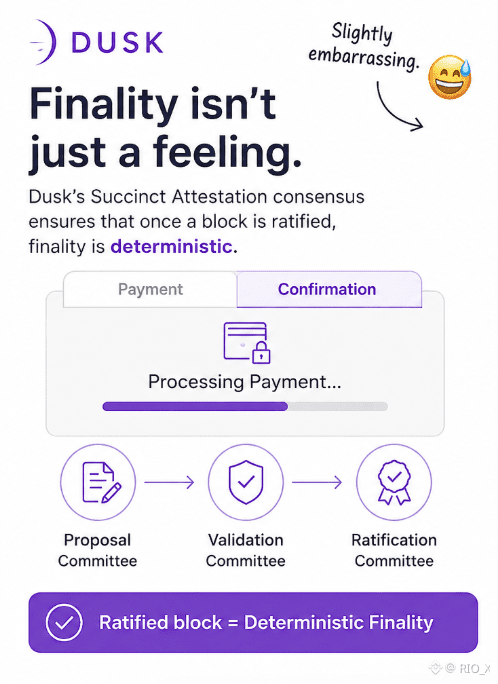
そこで、Duskが語る「確定(finality)」の考え方について考えました。Succinct Attestation のコンセンサスは、提案(proposal)、検証(validation)、そして承認(ratification)の委員会を使っており、ブロックが承認されると、ドキュメントではその確定性を「決定論的(deterministic)」だと説明しています。
金融市場では、この違いが重要です。取引が「完了したように見える」ことと、ネットワークが実際にそれを確定(finalized)したことには差があります。
その中で、トークノミクスの要点はシンプルです。DUSKはガスとステーキングの両方に使われます。
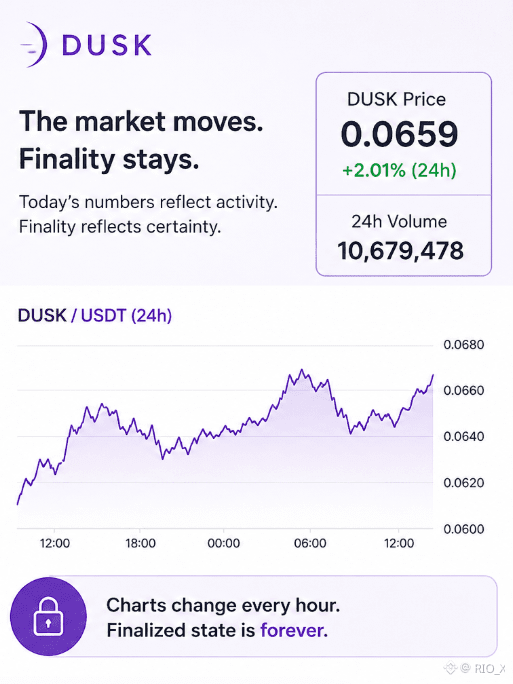
今日のチャートではDUSKは0.0659で、24時間で2.01%上昇。24時間の出来高は10,679,478です。
チャートは1時間ごとに変わります。確定された状態は、もっと明確な意味を持つはずです。
{future}(DUSKUSDT)
$BTW $RICE
#dusk $DUSK @Dusk
かつて、5分間支払い画面を見つめたことがありました。ところが、間違ったタブを見ていたと気づいて……。ちょっと恥ずかしいです。😅
そこで、Duskが語る「確定(finality)」の考え方について考えました。Succinct Attestation のコンセンサスは、提案(proposal)、検証(validation)、そして承認(ratification)の委員会を使っており、ブロックが承認されると、ドキュメントではその確定性を「決定論的(deterministic)」だと説明しています。
金融市場では、この違いが重要です。取引が「完了したように見える」ことと、ネットワークが実際にそれを確定(finalized)したことには差があります。
その中で、トークノミクスの要点はシンプルです。DUSKはガスとステーキングの両方に使われます。
今日のチャートではDUSKは0.0659で、24時間で2.01%上昇。24時間の出来高は10,679,478です。
チャートは1時間ごとに変わります。確定された状態は、もっと明確な意味を持つはずです。
$BTW $RICE
かつて、5分間支払い画面を見つめたことがありました。ところが、間違ったタブを見ていたと気づいて……。ちょっと恥ずかしいです。😅
そこで、Duskが語る「確定(finality)」の考え方について考えました。Succinct Attestation のコンセンサスは、提案(proposal)、検証(validation)、そして承認(ratification)の委員会を使っており、ブロックが承認されると、ドキュメントではその確定性を「決定論的(deterministic)」だと説明しています。
金融市場では、この違いが重要です。取引が「完了したように見える」ことと、ネットワークが実際にそれを確定(finalized)したことには差があります。
その中で、トークノミクスの要点はシンプルです。DUSKはガスとステーキングの両方に使われます。
今日のチャートではDUSKは0.0659で、24時間で2.01%上昇。24時間の出来高は10,679,478です。
チャートは1時間ごとに変わります。確定された状態は、もっと明確な意味を持つはずです。
$BTW $RICE
Dusk’s idea of finality
75%
DUSK at 0.0659
25%
4 投票 • 投票は終了しました
29
13
403
·
--
翻訳参照
TermMax made me rethink what a loan position actually is.
It isn’t just a number sitting in a balance sheet.
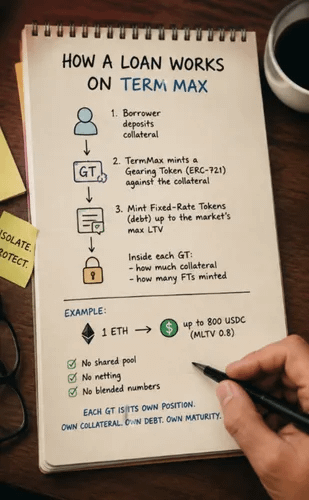
A borrower deposits collateral, and TermMax wraps that position into a Gearing Token, an ERC-721. The market already defines the collateral, debt asset, fixed-rate token and maturity before the GT is created.
Inside each GT, the logic stays simple: collateral deposited and Fixed-Rate Tokens minted against it, subject to the market’s maximum LTV.
With an MLTV of 80%, 1 ETH can support up to 800 USDC of debt.
There’s no shared pool quietly blending positions together.
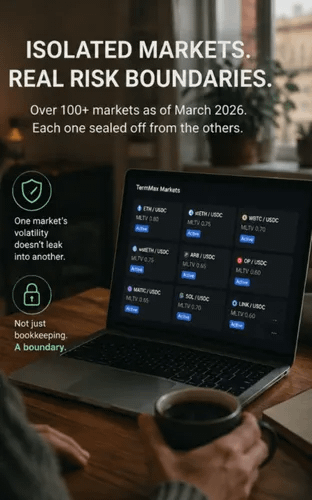
That isolation matters. TermMax had 100+ separate markets in its March 2026 update, with each market operating independently. A collateral event in one market doesn’t automatically spill into GTs from another. $BTW
Repayment can happen by returning the debt tokens directly, or by buying the FTs and returning them. Once the position is settled, the GT closes and the collateral is released.
So the mental model changes:
You don’t have one giant loan balance. $RICE
You have individual GTs, each carrying its own collateral, debt and maturity.
The tradeoff is obvious: does this per-position structure make risk easier to understand, or does managing hundreds of isolated positions become the harder problem?
$CUDIS
@termmax #TermMax
TermMax made me rethink what a loan position actually is.
It isn’t just a number sitting in a balance sheet.
A borrower deposits collateral, and TermMax wraps that position into a Gearing Token, an ERC-721. The market already defines the collateral, debt asset, fixed-rate token and maturity before the GT is created.
Inside each GT, the logic stays simple: collateral deposited and Fixed-Rate Tokens minted against it, subject to the market’s maximum LTV.
With an MLTV of 80%, 1 ETH can support up to 800 USDC of debt.
There’s no shared pool quietly blending positions together.
That isolation matters. TermMax had 100+ separate markets in its March 2026 update, with each market operating independently. A collateral event in one market doesn’t automatically spill into GTs from another. $BTW
Repayment can happen by returning the debt tokens directly, or by buying the FTs and returning them. Once the position is settled, the GT closes and the collateral is released.
So the mental model changes:
You don’t have one giant loan balance. $RICE
You have individual GTs, each carrying its own collateral, debt and maturity.
The tradeoff is obvious: does this per-position structure make risk easier to understand, or does managing hundreds of isolated positions become the harder problem?
$CUDIS
@TermMax #TermMax
It isn’t just a number sitting in a balance sheet.
A borrower deposits collateral, and TermMax wraps that position into a Gearing Token, an ERC-721. The market already defines the collateral, debt asset, fixed-rate token and maturity before the GT is created.
Inside each GT, the logic stays simple: collateral deposited and Fixed-Rate Tokens minted against it, subject to the market’s maximum LTV.
With an MLTV of 80%, 1 ETH can support up to 800 USDC of debt.
There’s no shared pool quietly blending positions together.
That isolation matters. TermMax had 100+ separate markets in its March 2026 update, with each market operating independently. A collateral event in one market doesn’t automatically spill into GTs from another. $BTW
Repayment can happen by returning the debt tokens directly, or by buying the FTs and returning them. Once the position is settled, the GT closes and the collateral is released.
So the mental model changes:
You don’t have one giant loan balance. $RICE
You have individual GTs, each carrying its own collateral, debt and maturity.
The tradeoff is obvious: does this per-position structure make risk easier to understand, or does managing hundreds of isolated positions become the harder problem?
$CUDIS
@TermMax #TermMax
MLTV of 80%
100%
ERC-721
0%
4 投票 • 投票は終了しました
24
17
295
·
--
本人確認中
#dusk $DUSK @Dusk_Foundation
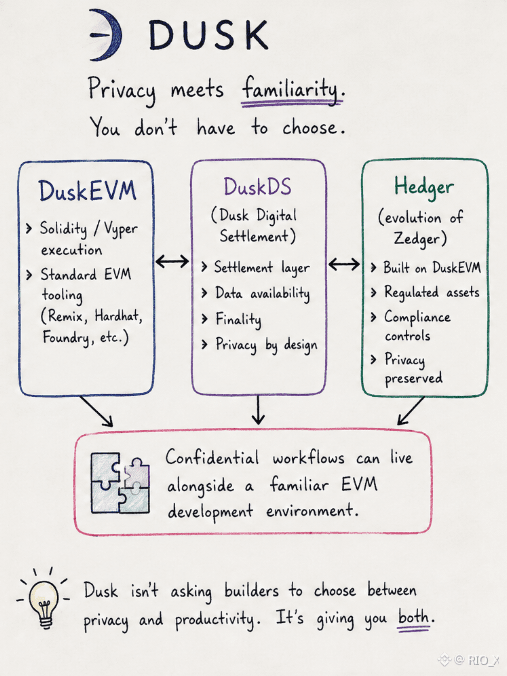
今日はDuskEVMを眺めていて、ある点が気になって立ち止まりました。Duskは、規制対象資産のプライバシー要件と、馴染みのあるEVMツールのどちらかを開発者に選ばせてはいないのです。
DuskEVMは、Solidity/Vyperの実行と標準のEVMツールを提供し、DuskDSは決済およびデータ可用性レイヤーのままです。さらに、HedgerはZedgerの進化版で、規制対象資産向けにDuskEVM上で構築されており、コンプライアンスとプライバシーの制約に対応しています。面白いのは、機密ワークフローが、馴染みのあるEVM開発環境と並存できるという点です。$TUT
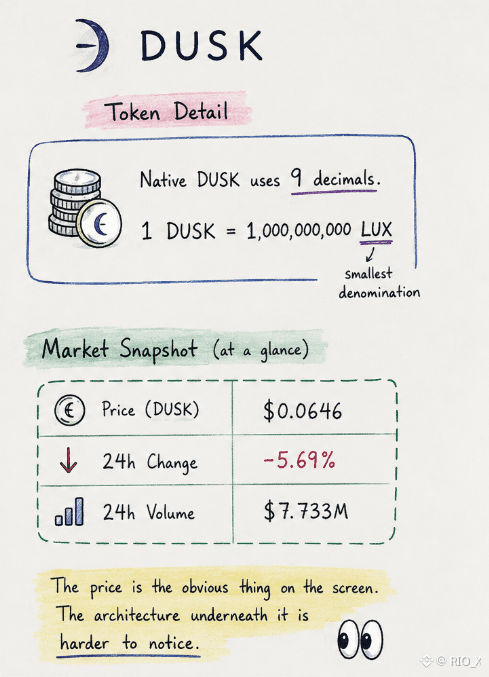
以前気づかなかったトークンの詳細は、ネイティブのDUSKが9デcimal(小数点以下9桁)であること、そしてLUXが最小の呼び名(最小単位)だということです。1 DUSKは1,000,000,000 LUXに相当します。$ACE
チャート上では、DUSKは0.0646で、24時間で5.69%下落しています。24時間の出来高は7.733Mです。
価格は画面上で一番目立つものです。ですが、その下にあるアーキテクチャは、気づきにくいところにあります。
{future}(ACEUSDT)
{future}(TUTUSDT)
{future}(DUSKUSDT)
#dusk $DUSK @Dusk
今日はDuskEVMを眺めていて、ある点が気になって立ち止まりました。Duskは、規制対象資産のプライバシー要件と、馴染みのあるEVMツールのどちらかを開発者に選ばせてはいないのです。
DuskEVMは、Solidity/Vyperの実行と標準のEVMツールを提供し、DuskDSは決済およびデータ可用性レイヤーのままです。さらに、HedgerはZedgerの進化版で、規制対象資産向けにDuskEVM上で構築されており、コンプライアンスとプライバシーの制約に対応しています。面白いのは、機密ワークフローが、馴染みのあるEVM開発環境と並存できるという点です。$TUT
以前気づかなかったトークンの詳細は、ネイティブのDUSKが9デcimal(小数点以下9桁)であること、そしてLUXが最小の呼び名(最小単位)だということです。1 DUSKは1,000,000,000 LUXに相当します。$ACE
チャート上では、DUSKは0.0646で、24時間で5.69%下落しています。24時間の出来高は7.733Mです。
価格は画面上で一番目立つものです。ですが、その下にあるアーキテクチャは、気づきにくいところにあります。
今日はDuskEVMを眺めていて、ある点が気になって立ち止まりました。Duskは、規制対象資産のプライバシー要件と、馴染みのあるEVMツールのどちらかを開発者に選ばせてはいないのです。
DuskEVMは、Solidity/Vyperの実行と標準のEVMツールを提供し、DuskDSは決済およびデータ可用性レイヤーのままです。さらに、HedgerはZedgerの進化版で、規制対象資産向けにDuskEVM上で構築されており、コンプライアンスとプライバシーの制約に対応しています。面白いのは、機密ワークフローが、馴染みのあるEVM開発環境と並存できるという点です。$TUT
以前気づかなかったトークンの詳細は、ネイティブのDUSKが9デcimal(小数点以下9桁)であること、そしてLUXが最小の呼び名(最小単位)だということです。1 DUSKは1,000,000,000 LUXに相当します。$ACE
チャート上では、DUSKは0.0646で、24時間で5.69%下落しています。24時間の出来高は7.733Mです。
価格は画面上で一番目立つものです。ですが、その下にあるアーキテクチャは、気づきにくいところにあります。
1 DUSK equals 1000,000000 LUX.
86%
familiar EVM tooling
0%
the evolution of Zedger
14%
7 投票 • 投票は終了しました
34
24
1.8k
·
--
翻訳参照
#termmax @termmax
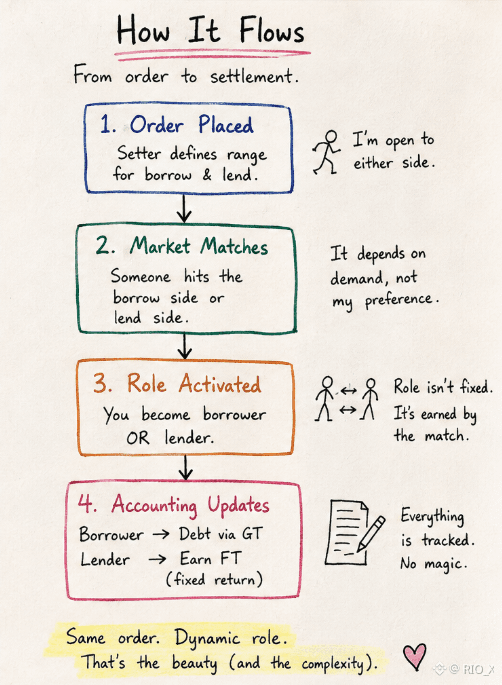
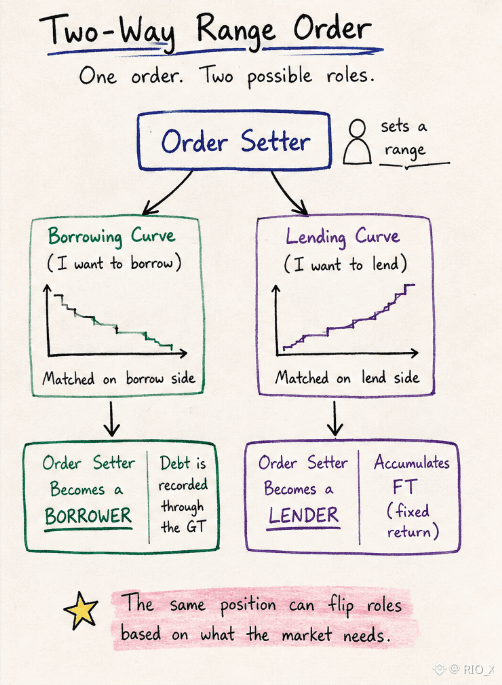
One feature I keep coming back to in @termmax is the two-way range order.
It combines a borrowing curve and a lending curve inside one order.
That means the same order setter can potentially participate on either side depending on what the market actually needs.
If the borrowing curve gets matched, the order setter becomes a borrower and debt gets recorded through the GT. $ACE
If the lending curve gets matched, the order setter becomes a lender and accumulates FT representing the fixed return.
That's a very different mental model from simply depositing assets into a pool.
The position can change role based on which side of the market is filled. $GPS
I like mechanisms like this because the capital isn't assigned to only one outcome from the start.
The trade-off is complexity. $TUT
Dynamic roles require more careful understanding of the accounting, pricing and eventual settlement.
Still, as a MARKET structure, it's one of the more interesting parts of TermMax.
#termmax @TermMax
One feature I keep coming back to in @TermMax is the two-way range order.
It combines a borrowing curve and a lending curve inside one order.
That means the same order setter can potentially participate on either side depending on what the market actually needs.
If the borrowing curve gets matched, the order setter becomes a borrower and debt gets recorded through the GT. $ACE
If the lending curve gets matched, the order setter becomes a lender and accumulates FT representing the fixed return.
That's a very different mental model from simply depositing assets into a pool.
The position can change role based on which side of the market is filled. $GPS
I like mechanisms like this because the capital isn't assigned to only one outcome from the start.
The trade-off is complexity. $TUT
Dynamic roles require more careful understanding of the accounting, pricing and eventual settlement.
Still, as a MARKET structure, it's one of the more interesting parts of TermMax.
One feature I keep coming back to in @TermMax is the two-way range order.
It combines a borrowing curve and a lending curve inside one order.
That means the same order setter can potentially participate on either side depending on what the market actually needs.
If the borrowing curve gets matched, the order setter becomes a borrower and debt gets recorded through the GT. $ACE
If the lending curve gets matched, the order setter becomes a lender and accumulates FT representing the fixed return.
That's a very different mental model from simply depositing assets into a pool.
The position can change role based on which side of the market is filled. $GPS
I like mechanisms like this because the capital isn't assigned to only one outcome from the start.
The trade-off is complexity. $TUT
Dynamic roles require more careful understanding of the accounting, pricing and eventual settlement.
Still, as a MARKET structure, it's one of the more interesting parts of TermMax.
borrowing curve
100%
lending curve
0%
fixed return
0%
4 投票 • 投票は終了しました
19
16
380
ログインして、さらにコンテンツを読む
厳選トピックで世界の暗号資産トレーダーの仲間入り
⚡️ 暗号資産に関する最新かつ有益な情報が見つかります。
💬 世界最大の暗号資産取引所から信頼されています。
👍 認証を受けたクリエイターから、有益なインサイトを得られます。
メール / 電話番号
トレンドトピック
GoldFallsTo$4144
閲覧回数 0
6人が討論中
#GoldFallsTo$4144
🚨 金が4,144ドルまで下落、原油急騰:資金は再び暗号資産/リスク資産へ回帰しているのか? 📉➡️🚀
世界の市場では、今日大きな転換が起きています!金は下落を延ばし、4,144ドル/ozまで押し下げられています。主因は、原油価格の急騰です。さらに、ブレント原油は100ドルの大台を突破しました。
商品ボラティリティが急上昇し、マクロ面でのインフレ懸念が再燃する中、トレーダーたちが抱える大きな疑問はこれです:次に流動性はどこへ向かうのか? 🤔
📰 今日のマクロ&市場ヘッドライン:
金の下落:スポット金は約3.3%下落し4,144ドル/oz。強気の利上げ観測が勢いを増す中で、これまでのサポート水準を手放しました。
エネルギーのリスクオン:地政学的な摩擦によりブレント原油が100ドル/bblを超えて急伸し、世界的にインフレ懸念を高めています。
暗号資産への影響:短期的には幅広い市場に圧力がかかっている一方で、機関投資家のスポットETFへの資金流入は依然として高水準です。投資家は、安全資産としての伝統的な避難先が整理される中、下値の押し目(ボトム)を探るためにリスク資産を見ています。
📊 取引シグナル&セットアップ
🪙 関連コイン:PAXG / BTC
取引バイアス:短期ベアリッシュ/PAXGはニュートラル | BTCではリバウンドの積み増し
重要な背景:PAXGのようなトークン化された金資産は、伝統的な金の下落局面を映し出します。金属から資金が離れる局面では、市場調整の際に非対称的なリターンを狙える暗号資産のプレーへ資金が向かうことがあります。
$PAXG
📍 PAXG/USDT(ショート/レンジ取引セットアップ)
🎯 エントリーゾーン:4,150 – 4,180
🛑 ストップロス:4,220
🟢 テイクプロフィット1:4,110
🟢 テイクプロフィット2:4,050
⚠️ リスクレベル:ミディアム
$BTC
📍 BTC/USDT(スポット積み増しセットアップ)
🎯 買いゾーン:82,200 – 83,000(レバレッジのフラッシュ・エグゾーストを監視)
🛑 ストップロス:81,400
🟢 ターゲット1:84,800
🟢 ターゲット2:86,500
⚠️ リスクレベル:ミディアム・ハイ
🔥 #BTCFallsBelow$83000 #BTC #PAXG #crypto
Lily星星
·いいね:1件
·閲覧回数 181
QNTFallsOver40%FromMorningHigh
閲覧回数 2
30人が討論中
BitgetCEOConfirms$388MStolenInHack
閲覧回数 0
4人が討論中