
AnasOnChain
3.6k Posts

AnasOnChain
Report
Block User
Crypto Trader 📊 | Technical & Fundamental Analysis | Market Trends, Alpha & Insights
Open Trade

INJ Holder
Frequent Trader
2.1 Years
2.1K+ Following
11.3K+ Followers
7.5K+ Liked
Posts
Portfolio
All
Quotes
Videos
Live
·
--
Sometimes I feel that the most important thing in DeFi is what’s hidden beneath the headline.
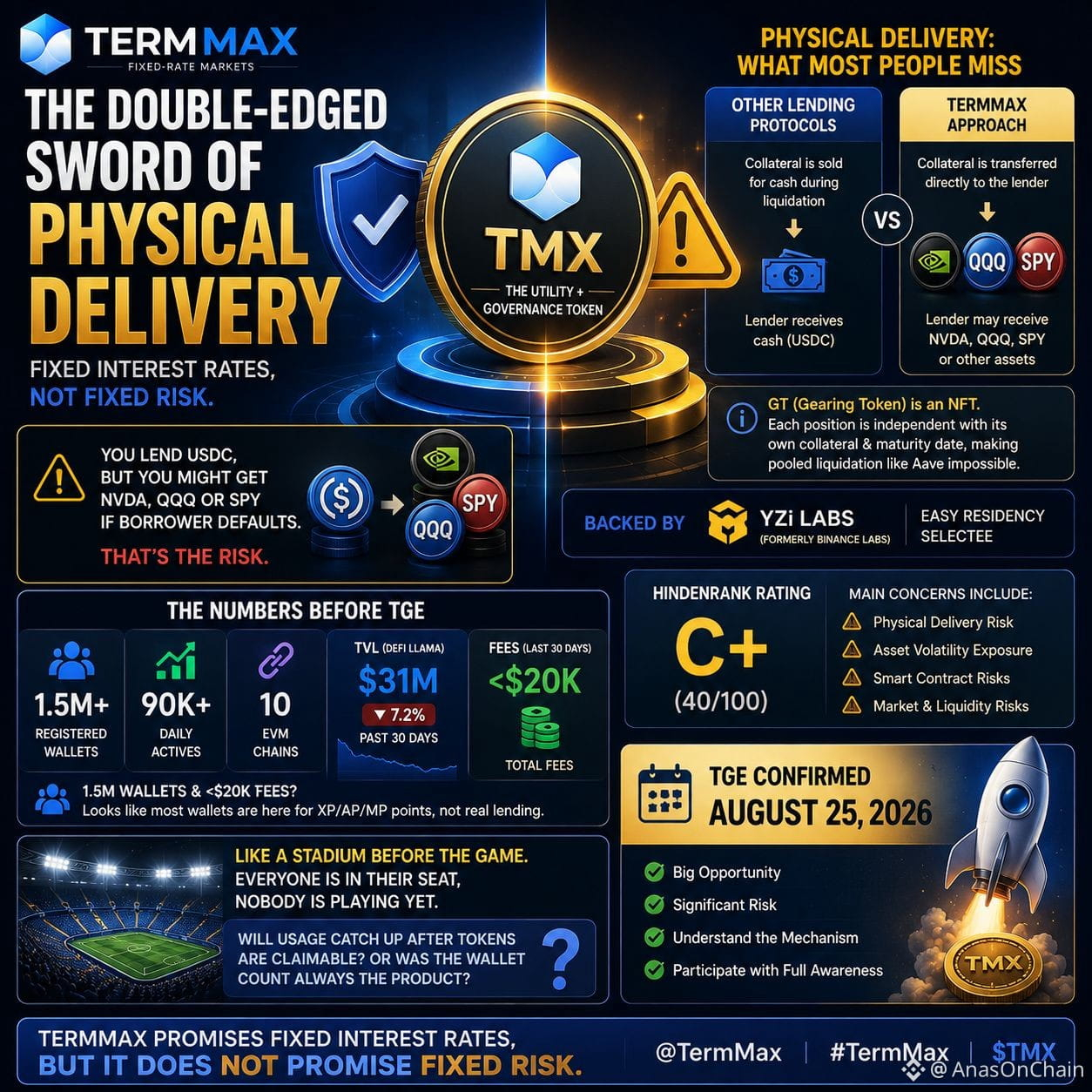
Looking at @termmax , my attention shifted to physical delivery.
In TermMax, GT positions are NFT-based. If the borrower defaults, instead of the collateral simply being sold in the market, it can be delivered directly to the lender.
Here I understood the other side of risk.
You lent USDC and expected fixed interest… but in case of default, the collateral could be exposure to NVDA, QQQ, or SPY.
So fixed rate doesn’t mean fixed risk.
And this point becomes even more interesting when I look at the official numbers alongside on-chain activity.
1.5M+ registered wallets
90K+ daily actives
10 EVM chains
But on DefiLlama, TVL is around $31M—down 7.2% in the last 30 days—and fees are even under $20K.
More than the wallet count, a more important question appears to me here:
How many users are actually using GT positions and vaults, and how many are just farming XP/AP/MP?
TGE is around 25 August, so for me this isn’t a real test yet—real test is whether actual borrowing, lending, and GT activity survive after the incentives are removed.
TermMax’s mechanism is interesting.
But understanding the mechanism and understanding its risk—those are two different things.
#termmax @termmax #TermMax
Sometimes I feel that the most important thing in DeFi is what’s hidden beneath the headline.
Looking at @TermMax , my attention shifted to physical delivery.
In TermMax, GT positions are NFT-based. If the borrower defaults, instead of the collateral simply being sold in the market, it can be delivered directly to the lender.
Here I understood the other side of risk.
You lent USDC and expected fixed interest… but in case of default, the collateral could be exposure to NVDA, QQQ, or SPY.
So fixed rate doesn’t mean fixed risk.
And this point becomes even more interesting when I look at the official numbers alongside on-chain activity.
1.5M+ registered wallets
90K+ daily actives
10 EVM chains
But on DefiLlama, TVL is around $31M—down 7.2% in the last 30 days—and fees are even under $20K.
More than the wallet count, a more important question appears to me here:
How many users are actually using GT positions and vaults, and how many are just farming XP/AP/MP?
TGE is around 25 August, so for me this isn’t a real test yet—real test is whether actual borrowing, lending, and GT activity survive after the incentives are removed.
TermMax’s mechanism is interesting.
But understanding the mechanism and understanding its risk—those are two different things.
#termmax @TermMax #TermMax
Looking at @TermMax , my attention shifted to physical delivery.
In TermMax, GT positions are NFT-based. If the borrower defaults, instead of the collateral simply being sold in the market, it can be delivered directly to the lender.
Here I understood the other side of risk.
You lent USDC and expected fixed interest… but in case of default, the collateral could be exposure to NVDA, QQQ, or SPY.
So fixed rate doesn’t mean fixed risk.
And this point becomes even more interesting when I look at the official numbers alongside on-chain activity.
1.5M+ registered wallets
90K+ daily actives
10 EVM chains
But on DefiLlama, TVL is around $31M—down 7.2% in the last 30 days—and fees are even under $20K.
More than the wallet count, a more important question appears to me here:
How many users are actually using GT positions and vaults, and how many are just farming XP/AP/MP?
TGE is around 25 August, so for me this isn’t a real test yet—real test is whether actual borrowing, lending, and GT activity survive after the incentives are removed.
TermMax’s mechanism is interesting.
But understanding the mechanism and understanding its risk—those are two different things.
#termmax @TermMax #TermMax
1
114
·
--
Sometimes I feel like in DeFi it’s easy to look at the number for TVL, but what’s happening inside that capital is more interesting.
@termmax when I was checking the numbers, my attention paused on a particular ratio.
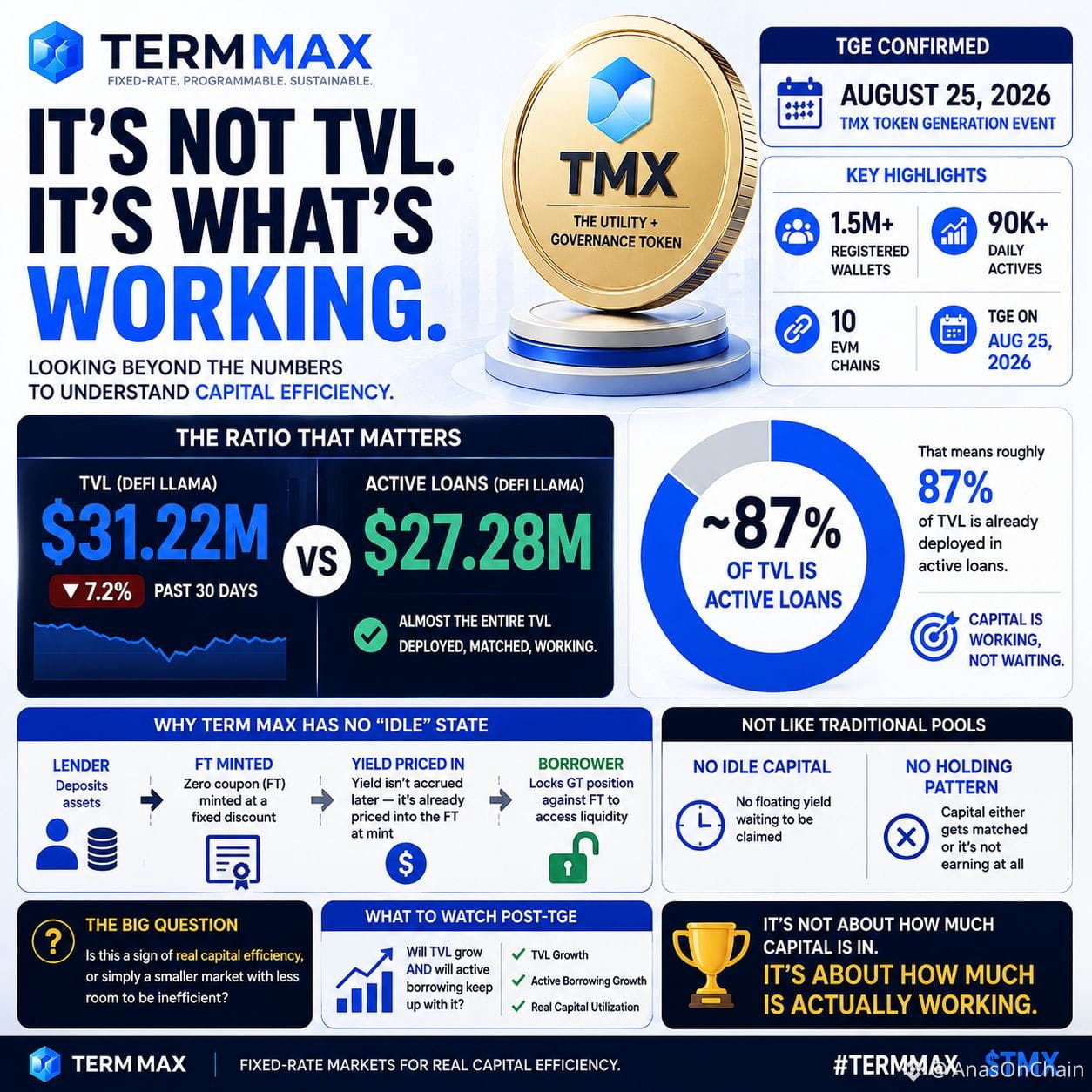
TVL is $31.22M, down 7.2% over the last 30 days.
But active loans are $27.28M.
So roughly 87% of TVL is already deployed.
Here, I found TermMax’s model different from traditional lending pools.
A lender deposits, an FT is minted, and the price moves within a discount to the fixed yield.
The borrower locks the GT position and accesses liquidity against that structure.
So here, the idea of capital isn’t the simple “deposit it and let it stay idle.”
For me, the real question isn’t the $31.22M TVL:
How much capital is actually working?
$27.28M in active loans is definitely interesting, but I’m not automatically taking it as a bullish signal.
High utilization can mean genuine efficiency too, or it could just be the result of limited liquidity in a smaller market.
That’s why after the TGE, I’ll watch TVL vs active borrowing more than just TVL.
If both grow together, then TermMax’s capital-efficiency model will be even more convincing to me.
#TermMax #termmax @termmax
Sometimes I feel like in DeFi it’s easy to look at the number for TVL, but what’s happening inside that capital is more interesting.
@TermMax when I was checking the numbers, my attention paused on a particular ratio.
TVL is $31.22M, down 7.2% over the last 30 days.
But active loans are $27.28M.
So roughly 87% of TVL is already deployed.
Here, I found TermMax’s model different from traditional lending pools.
A lender deposits, an FT is minted, and the price moves within a discount to the fixed yield.
The borrower locks the GT position and accesses liquidity against that structure.
So here, the idea of capital isn’t the simple “deposit it and let it stay idle.”
For me, the real question isn’t the $31.22M TVL:
How much capital is actually working?
$27.28M in active loans is definitely interesting, but I’m not automatically taking it as a bullish signal.
High utilization can mean genuine efficiency too, or it could just be the result of limited liquidity in a smaller market.
That’s why after the TGE, I’ll watch TVL vs active borrowing more than just TVL.
If both grow together, then TermMax’s capital-efficiency model will be even more convincing to me.
#TermMax #termmax @TermMax
@TermMax when I was checking the numbers, my attention paused on a particular ratio.
TVL is $31.22M, down 7.2% over the last 30 days.
But active loans are $27.28M.
So roughly 87% of TVL is already deployed.
Here, I found TermMax’s model different from traditional lending pools.
A lender deposits, an FT is minted, and the price moves within a discount to the fixed yield.
The borrower locks the GT position and accesses liquidity against that structure.
So here, the idea of capital isn’t the simple “deposit it and let it stay idle.”
For me, the real question isn’t the $31.22M TVL:
How much capital is actually working?
$27.28M in active loans is definitely interesting, but I’m not automatically taking it as a bullish signal.
High utilization can mean genuine efficiency too, or it could just be the result of limited liquidity in a smaller market.
That’s why after the TGE, I’ll watch TVL vs active borrowing more than just TVL.
If both grow together, then TermMax’s capital-efficiency model will be even more convincing to me.
#TermMax #termmax @TermMax
1
2
111
·
--
I’m noticing an interesting gap in TermMax now: wallet growth and actual usage aren’t the same thing.
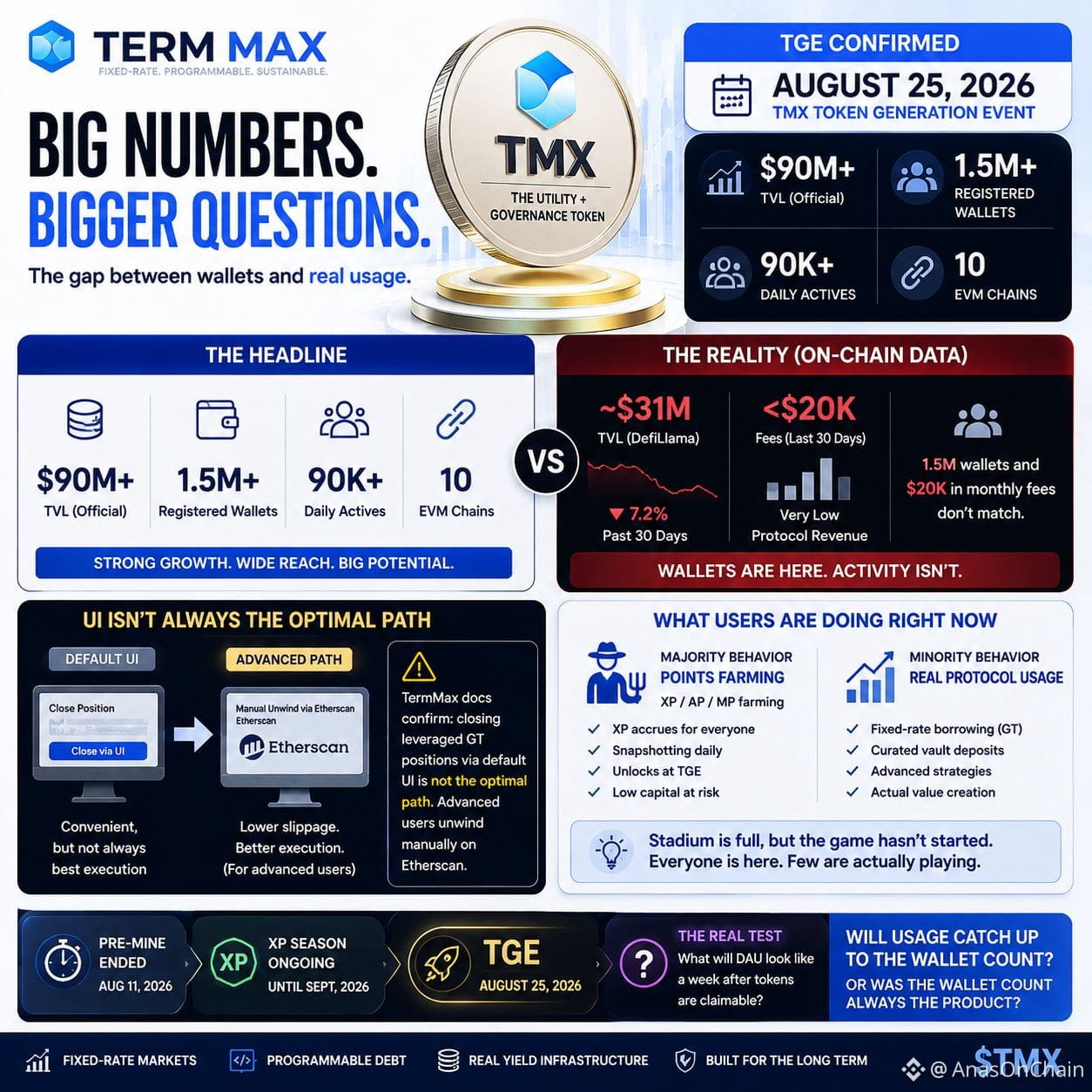
@termmax ka TGE is on 25 August, and the official numbers look impressive — $90M+ TVL, 1.5M+ registered wallets, 90K+ daily actives, and 10 EVM chains.
But when I looked at DefiLlama numbers, the picture seemed a bit different.
TVL is around $31M, down 7.2% over the past month, and fees in the last 30 days are even less than $20K.
That’s where the real question starts for me.
Just because there are 1.5M wallets doesn’t mean 1.5M users are actually lending, borrowing, or using fixed-rate positions.
XP/AP/MP farming can also create activity.
And one more interesting detail: to close advanced GT positions, the TermMax docs have a separate process for manual unwind from Etherscan, because the default UI doesn’t provide the best execution in every situation.
Meaning, within the same protocol, normal user experience and advanced user execution aren’t completely equal yet.
Pre-mine ended on 11 August, the XP season runs until September, and the TGE is on 25 August.
For me, the most important metric won’t be wallet count.
After the TGE, how many wallets actually convert into protocol activity?
If fees, TVL, and real borrowing usage catch up along with wallet growth, then TermMax’s story is stronger.
If not…
then 1.5M wallets might represent more potential users than actual users.
@termmax #TermMax #termmax
I’m noticing an interesting gap in TermMax now: wallet growth and actual usage aren’t the same thing.
@TermMax ka TGE is on 25 August, and the official numbers look impressive — $90M+ TVL, 1.5M+ registered wallets, 90K+ daily actives, and 10 EVM chains.
But when I looked at DefiLlama numbers, the picture seemed a bit different.
TVL is around $31M, down 7.2% over the past month, and fees in the last 30 days are even less than $20K.
That’s where the real question starts for me.
Just because there are 1.5M wallets doesn’t mean 1.5M users are actually lending, borrowing, or using fixed-rate positions.
XP/AP/MP farming can also create activity.
And one more interesting detail: to close advanced GT positions, the TermMax docs have a separate process for manual unwind from Etherscan, because the default UI doesn’t provide the best execution in every situation.
Meaning, within the same protocol, normal user experience and advanced user execution aren’t completely equal yet.
Pre-mine ended on 11 August, the XP season runs until September, and the TGE is on 25 August.
For me, the most important metric won’t be wallet count.
After the TGE, how many wallets actually convert into protocol activity?
If fees, TVL, and real borrowing usage catch up along with wallet growth, then TermMax’s story is stronger.
If not…
then 1.5M wallets might represent more potential users than actual users.
@TermMax #TermMax #termmax
@TermMax ka TGE is on 25 August, and the official numbers look impressive — $90M+ TVL, 1.5M+ registered wallets, 90K+ daily actives, and 10 EVM chains.
But when I looked at DefiLlama numbers, the picture seemed a bit different.
TVL is around $31M, down 7.2% over the past month, and fees in the last 30 days are even less than $20K.
That’s where the real question starts for me.
Just because there are 1.5M wallets doesn’t mean 1.5M users are actually lending, borrowing, or using fixed-rate positions.
XP/AP/MP farming can also create activity.
And one more interesting detail: to close advanced GT positions, the TermMax docs have a separate process for manual unwind from Etherscan, because the default UI doesn’t provide the best execution in every situation.
Meaning, within the same protocol, normal user experience and advanced user execution aren’t completely equal yet.
Pre-mine ended on 11 August, the XP season runs until September, and the TGE is on 25 August.
For me, the most important metric won’t be wallet count.
After the TGE, how many wallets actually convert into protocol activity?
If fees, TVL, and real borrowing usage catch up along with wallet growth, then TermMax’s story is stronger.
If not…
then 1.5M wallets might represent more potential users than actual users.
@TermMax #TermMax #termmax
1
66
·
--
Verified
After I understood something in TermMax, TMX’s role appeared a bit different to me.
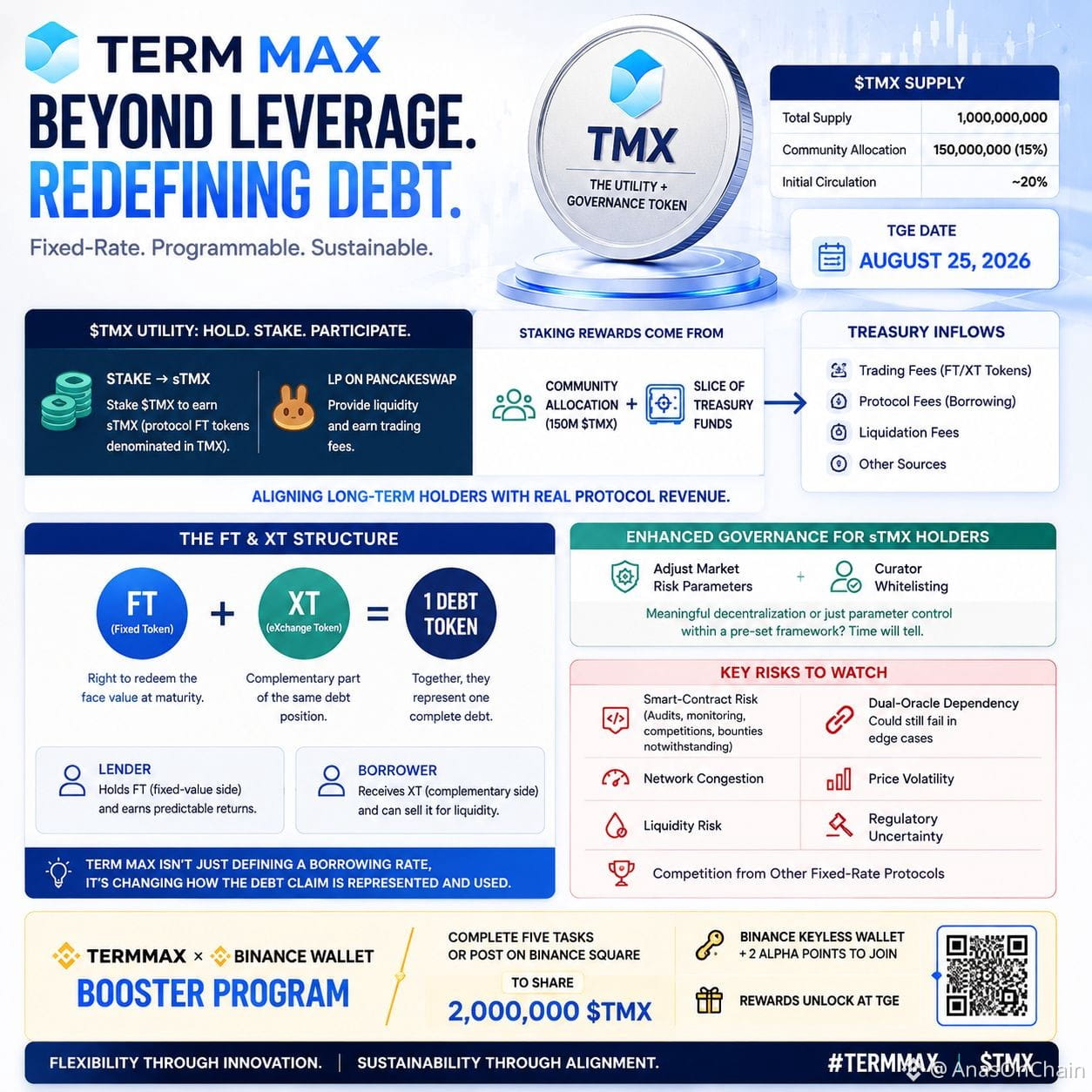
It doesn’t seem like just a governance token. In a fixed 1B supply, there are 150M $TMX (15%) for the Community, and holders can get sTMX through staking.
The interesting part is the Treasury.
FT/XT trading fees, borrowing fees, liquidation fees, and other protocol revenue can go to the Treasury, from which a portion of staking rewards can potentially be funded.
But here’s my question: how much of the Treasury revenue will actually go to stakers?
Then I looked at the FT/XT model:
1 FT + 1 XT = 1 debt token.
A lender can hold the fixed-value side, while a borrower can use the complementary XT for liquidity.
For me, this is the interesting part of TermMax—the protocol isn’t just creating loans; it’s dividing debt into different financial exposures.
Flexibility increases, but so does complexity.
And sTMX holders get enhanced governance rights on risk parameters and curator whitelisting. So the real test will be not just the token price, but also governance and Treasury distribution.
In the Binance WalletBooster, there are 2M $TMX rewards, and the rewards will be unlocked at TGE.
Now we’ll see if campaign users only claim rewards...
Or if they also stake, govern, and participate in the actual TermMax economy.
@termmax #TermMax
After I understood something in TermMax, TMX’s role appeared a bit different to me.
It doesn’t seem like just a governance token. In a fixed 1B supply, there are 150M $TMX (15%) for the Community, and holders can get sTMX through staking.
The interesting part is the Treasury.
FT/XT trading fees, borrowing fees, liquidation fees, and other protocol revenue can go to the Treasury, from which a portion of staking rewards can potentially be funded.
But here’s my question: how much of the Treasury revenue will actually go to stakers?
Then I looked at the FT/XT model:
1 FT + 1 XT = 1 debt token.
A lender can hold the fixed-value side, while a borrower can use the complementary XT for liquidity.
For me, this is the interesting part of TermMax—the protocol isn’t just creating loans; it’s dividing debt into different financial exposures.
Flexibility increases, but so does complexity.
And sTMX holders get enhanced governance rights on risk parameters and curator whitelisting. So the real test will be not just the token price, but also governance and Treasury distribution.
In the Binance WalletBooster, there are 2M $TMX rewards, and the rewards will be unlocked at TGE.
Now we’ll see if campaign users only claim rewards...
Or if they also stake, govern, and participate in the actual TermMax economy.
@TermMax #TermMax
It doesn’t seem like just a governance token. In a fixed 1B supply, there are 150M $TMX (15%) for the Community, and holders can get sTMX through staking.
The interesting part is the Treasury.
FT/XT trading fees, borrowing fees, liquidation fees, and other protocol revenue can go to the Treasury, from which a portion of staking rewards can potentially be funded.
But here’s my question: how much of the Treasury revenue will actually go to stakers?
Then I looked at the FT/XT model:
1 FT + 1 XT = 1 debt token.
A lender can hold the fixed-value side, while a borrower can use the complementary XT for liquidity.
For me, this is the interesting part of TermMax—the protocol isn’t just creating loans; it’s dividing debt into different financial exposures.
Flexibility increases, but so does complexity.
And sTMX holders get enhanced governance rights on risk parameters and curator whitelisting. So the real test will be not just the token price, but also governance and Treasury distribution.
In the Binance WalletBooster, there are 2M $TMX rewards, and the rewards will be unlocked at TGE.
Now we’ll see if campaign users only claim rewards...
Or if they also stake, govern, and participate in the actual TermMax economy.
@TermMax #TermMax
1
1
160
·
--
Verified
While looking at TMX, one thing felt more interesting than expected.
I went to see a zero-liquidation leverage story, but the numbers stopped me on the yield side.
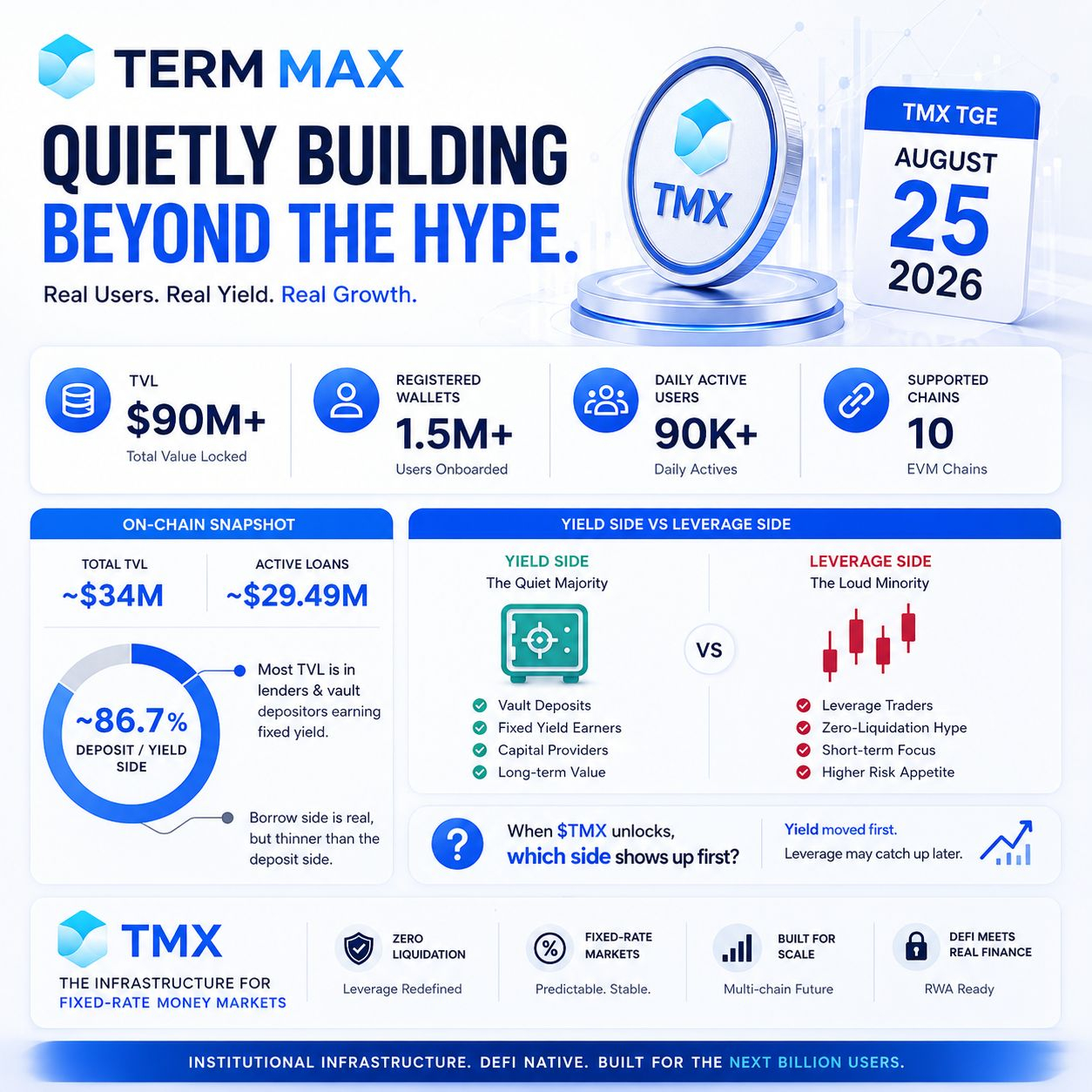
TermMax has confirmed TMX’s TGE for 25 August 2026. Along with that, they shared 1.5M+ registered wallets, 90K+ daily active users, and a footprint across 10 EVM chains.
But there’s an important difference here.
The narrative that’s loudest is about leverage.
The activity that interested me more was from lenders and vault depositors.
In my tracked data, TVL was roughly $34M, while active loans were around $29.49M. Broader ecosystem numbers are being reported up to $90M+ TVL.
So the borrow side is real, but it’s hard to ignore the deposit/yield side.
And TermMax’s core design also supports this direction: fixed-rate lending and borrowing, where users get predefined terms instead of variable-rate uncertainty.
For me, leverage wasn’t the real question here.
The question is: after the TGE, who will drive TMX?
The trader who uses leverage?
Or the much larger user base that deposits capital to generate fixed yield?
If the yield side grew first, it’s possible the market isn’t viewing TMX only through the lens of a “leverage token.”
Yield moved first. Leverage may catch up later.
@termmax #TermMax
While looking at TMX, one thing felt more interesting than expected.
I went to see a zero-liquidation leverage story, but the numbers stopped me on the yield side.
TermMax has confirmed TMX’s TGE for 25 August 2026. Along with that, they shared 1.5M+ registered wallets, 90K+ daily active users, and a footprint across 10 EVM chains.
But there’s an important difference here.
The narrative that’s loudest is about leverage.
The activity that interested me more was from lenders and vault depositors.
In my tracked data, TVL was roughly $34M, while active loans were around $29.49M. Broader ecosystem numbers are being reported up to $90M+ TVL.
So the borrow side is real, but it’s hard to ignore the deposit/yield side.
And TermMax’s core design also supports this direction: fixed-rate lending and borrowing, where users get predefined terms instead of variable-rate uncertainty.
For me, leverage wasn’t the real question here.
The question is: after the TGE, who will drive TMX?
The trader who uses leverage?
Or the much larger user base that deposits capital to generate fixed yield?
If the yield side grew first, it’s possible the market isn’t viewing TMX only through the lens of a “leverage token.”
Yield moved first. Leverage may catch up later.
@TermMax #TermMax
I went to see a zero-liquidation leverage story, but the numbers stopped me on the yield side.
TermMax has confirmed TMX’s TGE for 25 August 2026. Along with that, they shared 1.5M+ registered wallets, 90K+ daily active users, and a footprint across 10 EVM chains.
But there’s an important difference here.
The narrative that’s loudest is about leverage.
The activity that interested me more was from lenders and vault depositors.
In my tracked data, TVL was roughly $34M, while active loans were around $29.49M. Broader ecosystem numbers are being reported up to $90M+ TVL.
So the borrow side is real, but it’s hard to ignore the deposit/yield side.
And TermMax’s core design also supports this direction: fixed-rate lending and borrowing, where users get predefined terms instead of variable-rate uncertainty.
For me, leverage wasn’t the real question here.
The question is: after the TGE, who will drive TMX?
The trader who uses leverage?
Or the much larger user base that deposits capital to generate fixed yield?
If the yield side grew first, it’s possible the market isn’t viewing TMX only through the lens of a “leverage token.”
Yield moved first. Leverage may catch up later.
@TermMax #TermMax
1
2
105
·
--
You don’t see it with the price chart today; you see it with the security scorecard and staking mechanics — and I noticed an interesting gap here.
DUSK is building the story of institutional-grade, MiCA-compliant financial infrastructure. But when I looked at the security metrics, the picture wasn’t that polished.
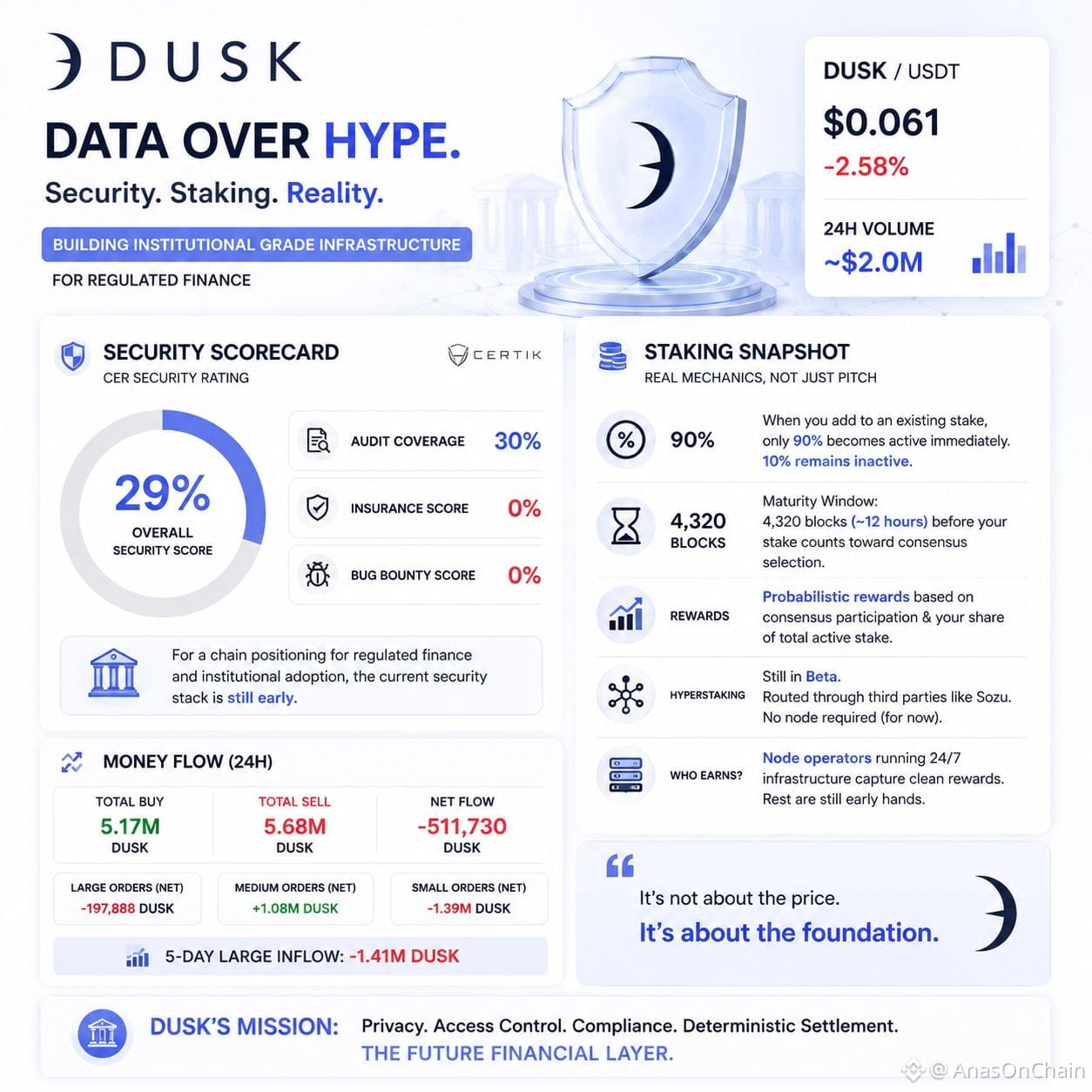
On the CER scorecard: Overall security: 29%
Audit coverage: 30%
Insurance: 0%
Bug bounty: 0%
For me, the most interesting number was 0%.
In RWA and regulated finance, institutions don’t just look at what the protocol promises. They also look at how mature the protection is in the worst case.
Then I tested staking myself.
Only 90% of the stake becomes active immediately. The remaining 10% stays inactive.
And in consensus selection, there’s a maturity window of 4,320 blocks (~12 hours) before it counts.
Rewards also aren’t a fixed APR. They depend on your stake compared to consensus participation and the total active stake.
Hyperstaking is also currently in beta and works through third-party infrastructure.
So DUSK’s story doesn’t only feel like “privacy + RWA” to me anymore.
The real test is:
Is the security and staking infrastructure maturing at the same speed as the institutional narrative?
Price was around $0.061 and 24H volume was about ~$2M, but honestly I remember more than the price—the 0% insurance and 0% bug bounty.
If DUSK wants to bring future financial assets on-chain, then the next chapter won’t be only about adoption.
Trust has to be proven.
@Dusk_Foundation #dusk $DUSK
You don’t see it with the price chart today; you see it with the security scorecard and staking mechanics — and I noticed an interesting gap here.
DUSK is building the story of institutional-grade, MiCA-compliant financial infrastructure. But when I looked at the security metrics, the picture wasn’t that polished.
On the CER scorecard: Overall security: 29%
Audit coverage: 30%
Insurance: 0%
Bug bounty: 0%
For me, the most interesting number was 0%.
In RWA and regulated finance, institutions don’t just look at what the protocol promises. They also look at how mature the protection is in the worst case.
Then I tested staking myself.
Only 90% of the stake becomes active immediately. The remaining 10% stays inactive.
And in consensus selection, there’s a maturity window of 4,320 blocks (~12 hours) before it counts.
Rewards also aren’t a fixed APR. They depend on your stake compared to consensus participation and the total active stake.
Hyperstaking is also currently in beta and works through third-party infrastructure.
So DUSK’s story doesn’t only feel like “privacy + RWA” to me anymore.
The real test is:
Is the security and staking infrastructure maturing at the same speed as the institutional narrative?
Price was around $0.061 and 24H volume was about ~$2M, but honestly I remember more than the price—the 0% insurance and 0% bug bounty.
If DUSK wants to bring future financial assets on-chain, then the next chapter won’t be only about adoption.
Trust has to be proven.
@Dusk #dusk $DUSK
DUSK is building the story of institutional-grade, MiCA-compliant financial infrastructure. But when I looked at the security metrics, the picture wasn’t that polished.
On the CER scorecard: Overall security: 29%
Audit coverage: 30%
Insurance: 0%
Bug bounty: 0%
For me, the most interesting number was 0%.
In RWA and regulated finance, institutions don’t just look at what the protocol promises. They also look at how mature the protection is in the worst case.
Then I tested staking myself.
Only 90% of the stake becomes active immediately. The remaining 10% stays inactive.
And in consensus selection, there’s a maturity window of 4,320 blocks (~12 hours) before it counts.
Rewards also aren’t a fixed APR. They depend on your stake compared to consensus participation and the total active stake.
Hyperstaking is also currently in beta and works through third-party infrastructure.
So DUSK’s story doesn’t only feel like “privacy + RWA” to me anymore.
The real test is:
Is the security and staking infrastructure maturing at the same speed as the institutional narrative?
Price was around $0.061 and 24H volume was about ~$2M, but honestly I remember more than the price—the 0% insurance and 0% bug bounty.
If DUSK wants to bring future financial assets on-chain, then the next chapter won’t be only about adoption.
Trust has to be proven.
@Dusk #dusk $DUSK
5
4
114
·
--
Partly True
When I looked at DUSK’s money-flow data today, I found an interesting question beyond the price.
If tomorrow BTC holders collectively sell, or a major exchange gets hacked and shakes market trust… then the problem won’t be just the price.
The problem will be: how resilient is the financial infrastructure?
That’s why I find DUSK interesting.
DUSK isn’t a bet to replace BTC. Its focus is bringing regulated assets onto on-chain infrastructure where privacy, access control, and settlement work together.
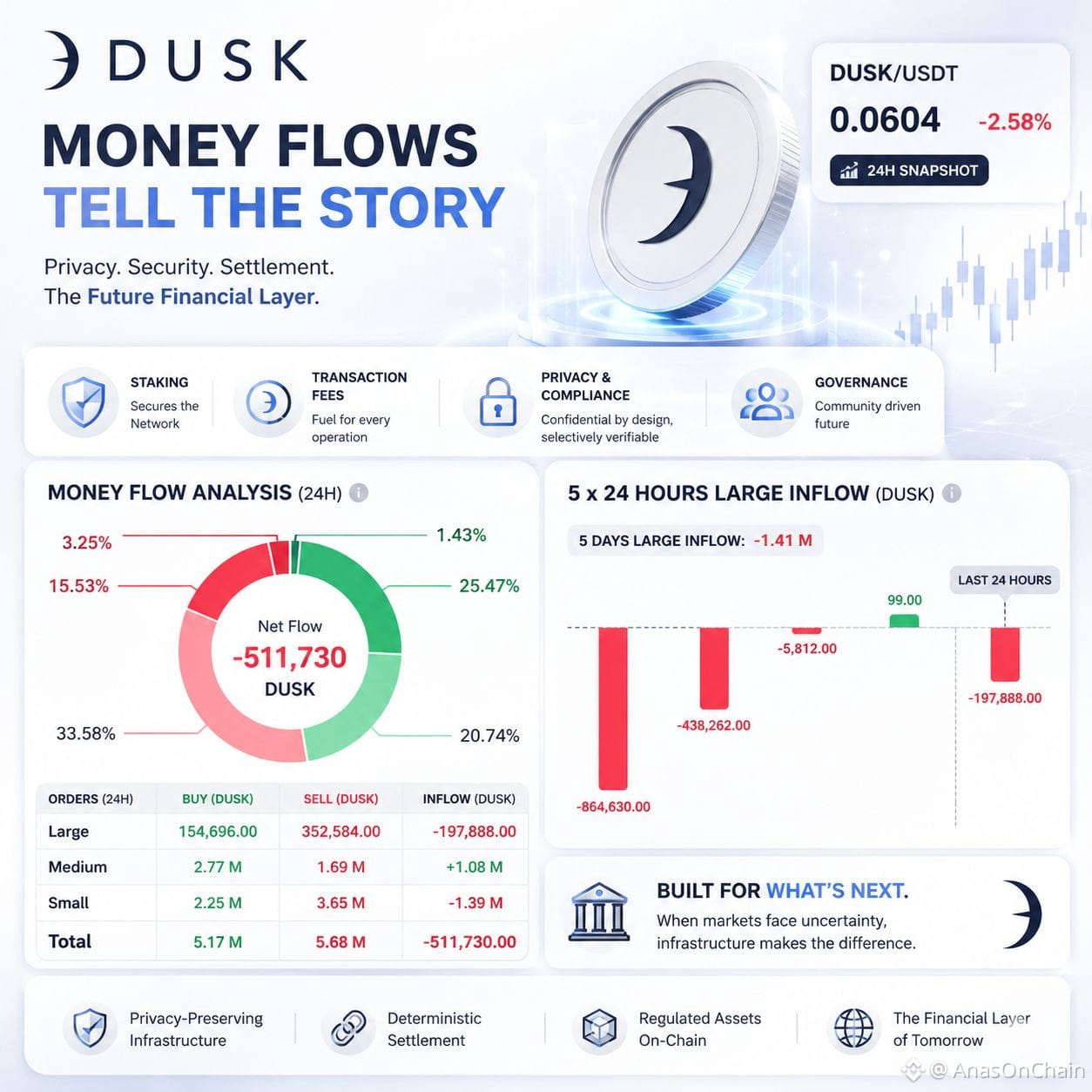
In today’s 24H data:
• Buy: 5.17M DUSK
• Sell: 5.68M DUSK
• Net: -511,730 DUSK
• Large orders: -197,888
• Medium: +1.08M
• Small: -1.39M
• 5-day large inflow: -1.41M
• Price: $0.0604 (-2.58%)
Market pressure is there, but the utility story is different.
DUSK is powered by staking, transaction fees, and DuskEVM. In privacy-focused financial applications, selective disclosure also plays an important role.
If BTC gets hacked, DUSK won’t recover BTC.
If Binance gets hacked, the DUSK Foundation won’t rescue the exchange.
But if such events expose weaknesses in financial infrastructure, then the importance of privacy + compliance + access control + deterministic settlement can become very clear.
BTC’s future will be decided by BTC holders.
But what kind of next-generation financial rails will we have?
Maybe the real opportunity is in this very question: $DUSK ka.
@Dusk_Foundation #dusk $DUSK
When I looked at DUSK’s money-flow data today, I found an interesting question beyond the price.
If tomorrow BTC holders collectively sell, or a major exchange gets hacked and shakes market trust… then the problem won’t be just the price.
The problem will be: how resilient is the financial infrastructure?
That’s why I find DUSK interesting.
DUSK isn’t a bet to replace BTC. Its focus is bringing regulated assets onto on-chain infrastructure where privacy, access control, and settlement work together.
In today’s 24H data:
• Buy: 5.17M DUSK
• Sell: 5.68M DUSK
• Net: -511,730 DUSK
• Large orders: -197,888
• Medium: +1.08M
• Small: -1.39M
• 5-day large inflow: -1.41M
• Price: $0.0604 (-2.58%)
Market pressure is there, but the utility story is different.
DUSK is powered by staking, transaction fees, and DuskEVM. In privacy-focused financial applications, selective disclosure also plays an important role.
If BTC gets hacked, DUSK won’t recover BTC.
If Binance gets hacked, the DUSK Foundation won’t rescue the exchange.
But if such events expose weaknesses in financial infrastructure, then the importance of privacy + compliance + access control + deterministic settlement can become very clear.
BTC’s future will be decided by BTC holders.
But what kind of next-generation financial rails will we have?
Maybe the real opportunity is in this very question: $DUSK ka.
@Dusk #dusk $DUSK
If tomorrow BTC holders collectively sell, or a major exchange gets hacked and shakes market trust… then the problem won’t be just the price.
The problem will be: how resilient is the financial infrastructure?
That’s why I find DUSK interesting.
DUSK isn’t a bet to replace BTC. Its focus is bringing regulated assets onto on-chain infrastructure where privacy, access control, and settlement work together.
In today’s 24H data:
• Buy: 5.17M DUSK
• Sell: 5.68M DUSK
• Net: -511,730 DUSK
• Large orders: -197,888
• Medium: +1.08M
• Small: -1.39M
• 5-day large inflow: -1.41M
• Price: $0.0604 (-2.58%)
Market pressure is there, but the utility story is different.
DUSK is powered by staking, transaction fees, and DuskEVM. In privacy-focused financial applications, selective disclosure also plays an important role.
If BTC gets hacked, DUSK won’t recover BTC.
If Binance gets hacked, the DUSK Foundation won’t rescue the exchange.
But if such events expose weaknesses in financial infrastructure, then the importance of privacy + compliance + access control + deterministic settlement can become very clear.
BTC’s future will be decided by BTC holders.
But what kind of next-generation financial rails will we have?
Maybe the real opportunity is in this very question: $DUSK ka.
@Dusk #dusk $DUSK
3
3
249
·
--
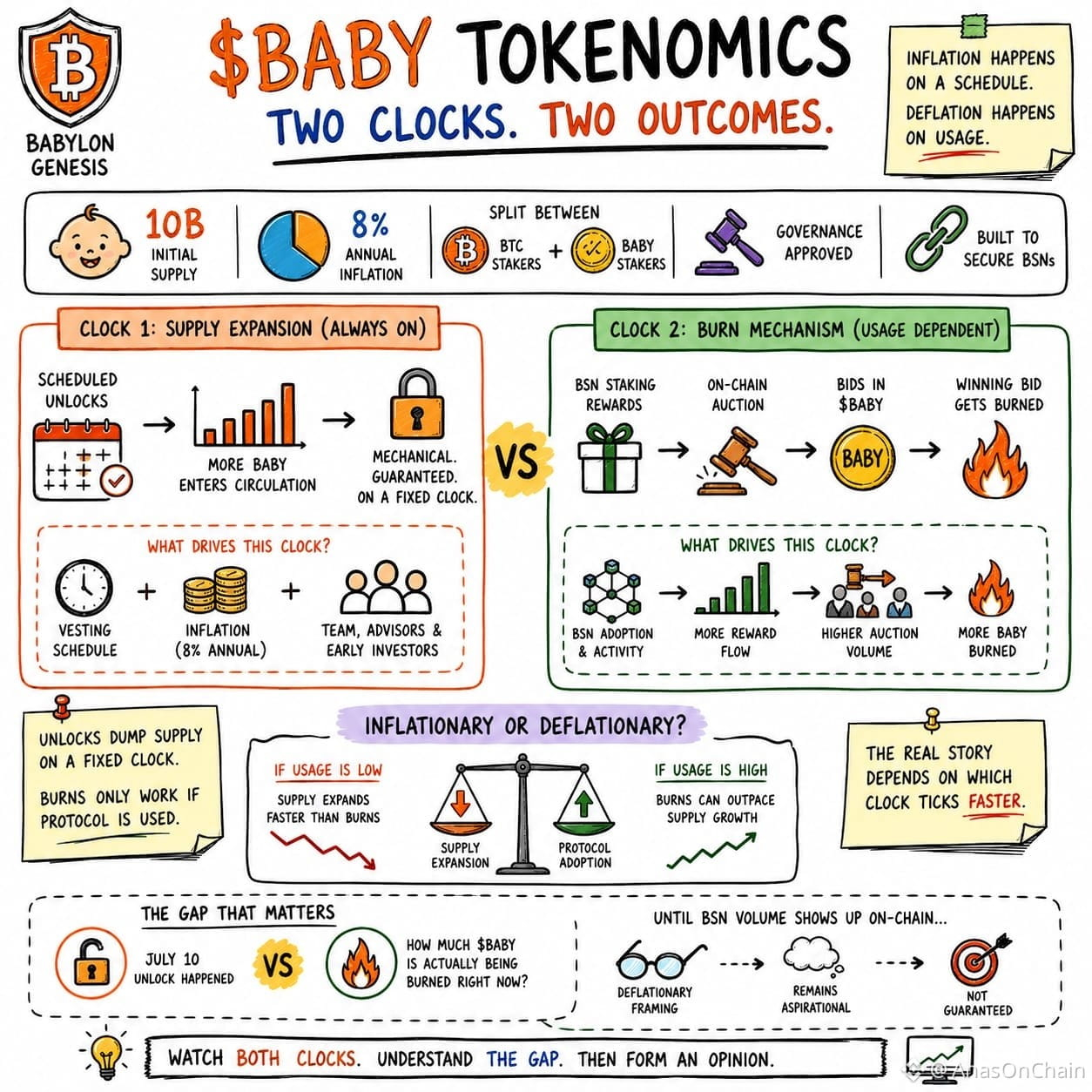
Everyone is only talking about $BABY inflation right now, but I found something else in Genesis tokenomics even more interesting.
BABY’s initial supply was 10B, and the protocol rewards BTC and BABY stakers with an 8% annual inflation. Everyone knows this part.
Then I looked at the BSN reward mechanism. The rewards coming from BSN go into an on-chain auction; the bids are made in BABY, and the winning bid gets burned. This is where it seemed to me that the real story isn’t just inflation or burn—it’s all about timing in the model.
On one side, scheduled unlocks and inflation run according to their timeline. On the other side, the burn only becomes meaningful when BSNs generate real activity and there’s enough BABY flow into the auctions.
For me, the question isn’t whether BABY is inflationary or deflationary.
The real question is: which clock runs faster? The supply-expansion clock… or the protocol-adoption clock?
If BSN adoption accelerates in the future, the impact of the burn mechanism will naturally grow too. If adoption stays slow, the market will feel the supply side first.
That’s why, in my view, BABY’s long-term economics won’t be determined only by token issuance, but by the BSN activity that gets built on Babylon Genesis.
@babylonlabs_io $BABY #baby
Everyone is only talking about $BABY inflation right now, but I found something else in Genesis tokenomics even more interesting.
BABY’s initial supply was 10B, and the protocol rewards BTC and BABY stakers with an 8% annual inflation. Everyone knows this part.
Then I looked at the BSN reward mechanism. The rewards coming from BSN go into an on-chain auction; the bids are made in BABY, and the winning bid gets burned. This is where it seemed to me that the real story isn’t just inflation or burn—it’s all about timing in the model.
On one side, scheduled unlocks and inflation run according to their timeline. On the other side, the burn only becomes meaningful when BSNs generate real activity and there’s enough BABY flow into the auctions.
For me, the question isn’t whether BABY is inflationary or deflationary.
The real question is: which clock runs faster? The supply-expansion clock… or the protocol-adoption clock?
If BSN adoption accelerates in the future, the impact of the burn mechanism will naturally grow too. If adoption stays slow, the market will feel the supply side first.
That’s why, in my view, BABY’s long-term economics won’t be determined only by token issuance, but by the BSN activity that gets built on Babylon Genesis.
@BabylonLabs_io $BABY #baby
BABY’s initial supply was 10B, and the protocol rewards BTC and BABY stakers with an 8% annual inflation. Everyone knows this part.
Then I looked at the BSN reward mechanism. The rewards coming from BSN go into an on-chain auction; the bids are made in BABY, and the winning bid gets burned. This is where it seemed to me that the real story isn’t just inflation or burn—it’s all about timing in the model.
On one side, scheduled unlocks and inflation run according to their timeline. On the other side, the burn only becomes meaningful when BSNs generate real activity and there’s enough BABY flow into the auctions.
For me, the question isn’t whether BABY is inflationary or deflationary.
The real question is: which clock runs faster? The supply-expansion clock… or the protocol-adoption clock?
If BSN adoption accelerates in the future, the impact of the burn mechanism will naturally grow too. If adoption stays slow, the market will feel the supply side first.
That’s why, in my view, BABY’s long-term economics won’t be determined only by token issuance, but by the BSN activity that gets built on Babylon Genesis.
@BabylonLabs_io $BABY #baby
3
2
92
·
--
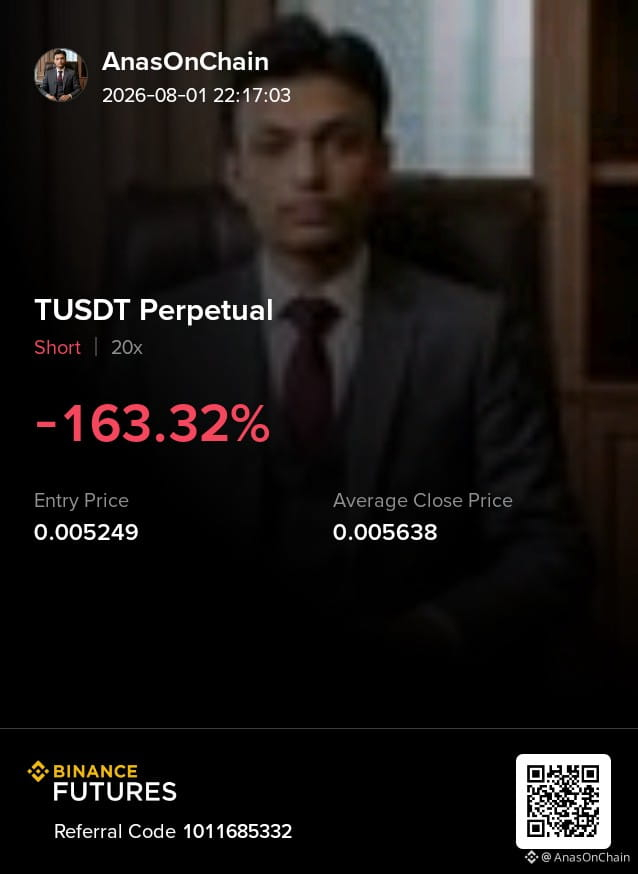
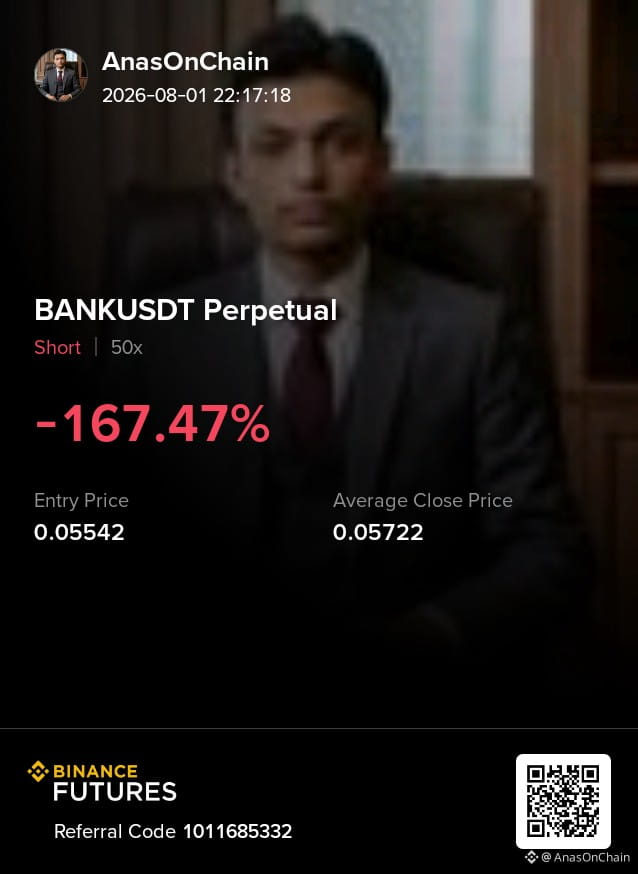
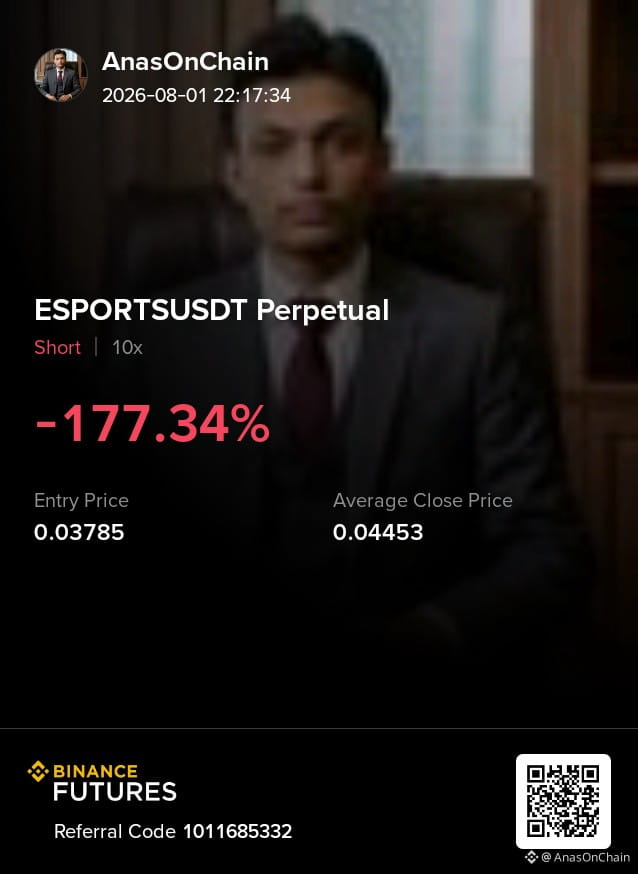
Started with losses. 📉
Three shorts. Three mistakes. Three lessons.
Every red trade paid for experience that no course can teach.
I don't post only wins. I post the journey.
Discipline > Emotion. Consistency > Perfection.
The goal isn't to avoid losses. The goal is to become the trader who survives them.
Started with losses. 📉
Three shorts. Three mistakes. Three lessons.
Every red trade paid for experience that no course can teach.
I don't post only wins. I post the journey.
Discipline > Emotion. Consistency > Perfection.
The goal isn't to avoid losses. The goal is to become the trader who survives them.
Three shorts. Three mistakes. Three lessons.
Every red trade paid for experience that no course can teach.
I don't post only wins. I post the journey.
Discipline > Emotion. Consistency > Perfection.
The goal isn't to avoid losses. The goal is to become the trader who survives them.
1
384
·
--
Partly True
Today, while doing a study again on @babylonlabs_io , something caught my attention.
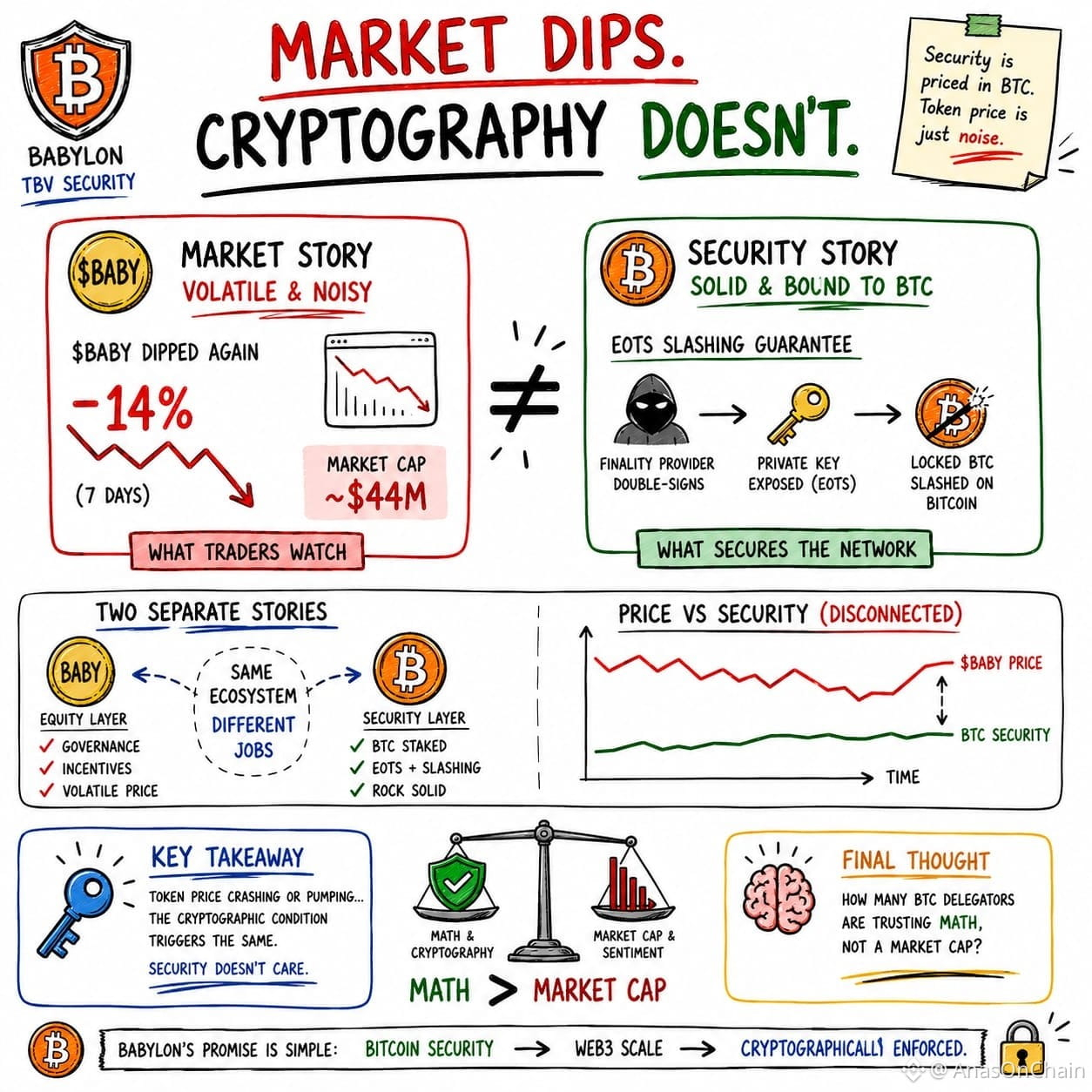
$BABY is down by roughly 14% this week; the market cap has come down to around $44M. On the other hand, behind the protocol, billions of dollars’ worth of BTC economic security are staked.
Here, the design of EOTS seems interesting.
If a Finality Provider double-signs, then its private key is exposed, and the locked BTC backed by it gets slashed on the Bitcoin layer. It doesn’t matter whether $BABY is pumping or dumping.
So, two different layers are running in Babylon.
The BTC protocol enforces economic security.
Baby governance, coordination, and incentives are powered.
Market sentiment understands both as one story, but the protocol architecture doesn’t.
I also previously assumed that a token dip might be a signal of network security. After rereading the whitepaper, I realized that security guarantees and token price are two different systems that merely share the ecosystem.
That’s why BTC delegators are not trusting the market cap as much as they’re trusting cryptographic accountability.
This separation felt like the most underrated part of Babylon’s design.
@babylonlabs_io #baby $BABY
Today, while doing a study again on @BabylonLabs_io , something caught my attention.
$BABY is down by roughly 14% this week; the market cap has come down to around $44M. On the other hand, behind the protocol, billions of dollars’ worth of BTC economic security are staked.
Here, the design of EOTS seems interesting.
If a Finality Provider double-signs, then its private key is exposed, and the locked BTC backed by it gets slashed on the Bitcoin layer. It doesn’t matter whether $BABY is pumping or dumping.
So, two different layers are running in Babylon.
The BTC protocol enforces economic security.
Baby governance, coordination, and incentives are powered.
Market sentiment understands both as one story, but the protocol architecture doesn’t.
I also previously assumed that a token dip might be a signal of network security. After rereading the whitepaper, I realized that security guarantees and token price are two different systems that merely share the ecosystem.
That’s why BTC delegators are not trusting the market cap as much as they’re trusting cryptographic accountability.
This separation felt like the most underrated part of Babylon’s design.
@BabylonLabs_io #baby $BABY
$BABY is down by roughly 14% this week; the market cap has come down to around $44M. On the other hand, behind the protocol, billions of dollars’ worth of BTC economic security are staked.
Here, the design of EOTS seems interesting.
If a Finality Provider double-signs, then its private key is exposed, and the locked BTC backed by it gets slashed on the Bitcoin layer. It doesn’t matter whether $BABY is pumping or dumping.
So, two different layers are running in Babylon.
The BTC protocol enforces economic security.
Baby governance, coordination, and incentives are powered.
Market sentiment understands both as one story, but the protocol architecture doesn’t.
I also previously assumed that a token dip might be a signal of network security. After rereading the whitepaper, I realized that security guarantees and token price are two different systems that merely share the ecosystem.
That’s why BTC delegators are not trusting the market cap as much as they’re trusting cryptographic accountability.
This separation felt like the most underrated part of Babylon’s design.
@BabylonLabs_io #baby $BABY
6
1
159
·
--
@babylonlabs_io ki As I looked at TBV architecture, I came across an interesting thing.
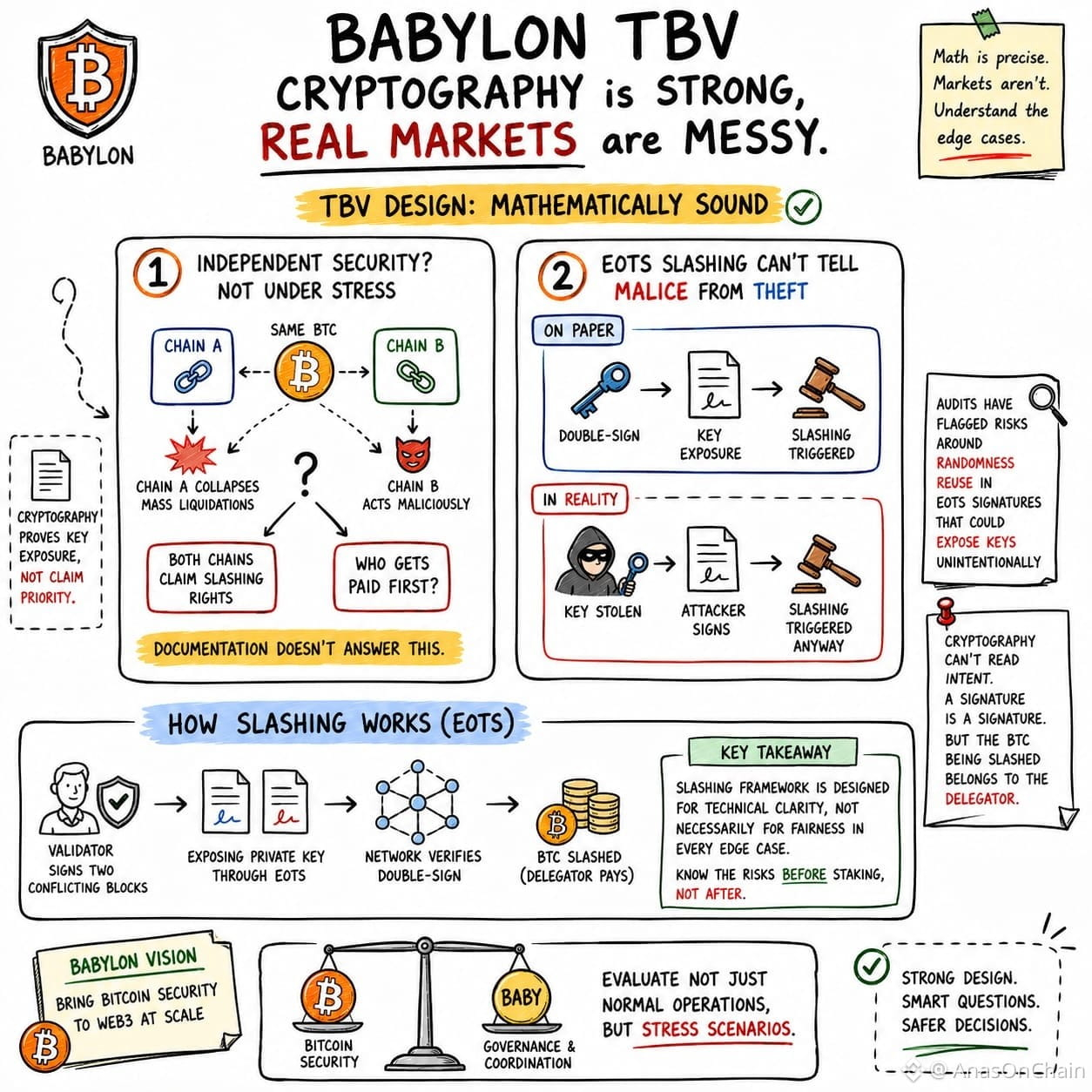
The whitepaper’s cryptographic guarantees seem very strong, but in real-world security, it’s not only mathematics—it’s also tested against edge cases.
TBV’s model allows a single BTC to provide economic security to multiple Bitcoin Secured Networks. This is a powerful design for capital efficiency. But if, during extreme market stress, two chains generate a slashing claim against the same validator, how will priority be decided on what basis? This scenario is not clearly defined in the documentation.
My second observation is about the EOTS slashing mechanism.
EOTS enforces validator honesty because double-signing exposes the private key and triggers slashing. But a blockchain can only see signatures—not intention. If the key gets compromised and an attacker signs with that same key, the on-chain result still appears as double-signing.
That’s why independent security reviews also consider randomness handling and key management to be critical areas, because the technical implementation is as important a part of security as the cryptographic design.
For me, this isn’t a weakness of the protocol...
It’s about understanding the trust model.
Delegators aren’t just choosing yield or rewards. They’re also placing trust in that slashing framework, which provides technical clarity, even if it can’t identify intent in every edge case.
Babylon is extending Bitcoin’s security to Web3, but when evaluating that security model, you also need to look at stress scenarios—not just normal operations.
@babylonlabs_io $BABY #baby
@BabylonLabs_io ki As I looked at TBV architecture, I came across an interesting thing.
The whitepaper’s cryptographic guarantees seem very strong, but in real-world security, it’s not only mathematics—it’s also tested against edge cases.
TBV’s model allows a single BTC to provide economic security to multiple Bitcoin Secured Networks. This is a powerful design for capital efficiency. But if, during extreme market stress, two chains generate a slashing claim against the same validator, how will priority be decided on what basis? This scenario is not clearly defined in the documentation.
My second observation is about the EOTS slashing mechanism.
EOTS enforces validator honesty because double-signing exposes the private key and triggers slashing. But a blockchain can only see signatures—not intention. If the key gets compromised and an attacker signs with that same key, the on-chain result still appears as double-signing.
That’s why independent security reviews also consider randomness handling and key management to be critical areas, because the technical implementation is as important a part of security as the cryptographic design.
For me, this isn’t a weakness of the protocol...
It’s about understanding the trust model.
Delegators aren’t just choosing yield or rewards. They’re also placing trust in that slashing framework, which provides technical clarity, even if it can’t identify intent in every edge case.
Babylon is extending Bitcoin’s security to Web3, but when evaluating that security model, you also need to look at stress scenarios—not just normal operations.
@BabylonLabs_io $BABY #baby
The whitepaper’s cryptographic guarantees seem very strong, but in real-world security, it’s not only mathematics—it’s also tested against edge cases.
TBV’s model allows a single BTC to provide economic security to multiple Bitcoin Secured Networks. This is a powerful design for capital efficiency. But if, during extreme market stress, two chains generate a slashing claim against the same validator, how will priority be decided on what basis? This scenario is not clearly defined in the documentation.
My second observation is about the EOTS slashing mechanism.
EOTS enforces validator honesty because double-signing exposes the private key and triggers slashing. But a blockchain can only see signatures—not intention. If the key gets compromised and an attacker signs with that same key, the on-chain result still appears as double-signing.
That’s why independent security reviews also consider randomness handling and key management to be critical areas, because the technical implementation is as important a part of security as the cryptographic design.
For me, this isn’t a weakness of the protocol...
It’s about understanding the trust model.
Delegators aren’t just choosing yield or rewards. They’re also placing trust in that slashing framework, which provides technical clarity, even if it can’t identify intent in every edge case.
Babylon is extending Bitcoin’s security to Web3, but when evaluating that security model, you also need to look at stress scenarios—not just normal operations.
@BabylonLabs_io $BABY #baby
7
4
150
·
--
Sometimes the real value of a protocol isn’t in the thing being verified...
Instead, it’s in the system that gets everyone to agree on the same reality.
Looking at Babylon Genesis, this seemed quite interesting.
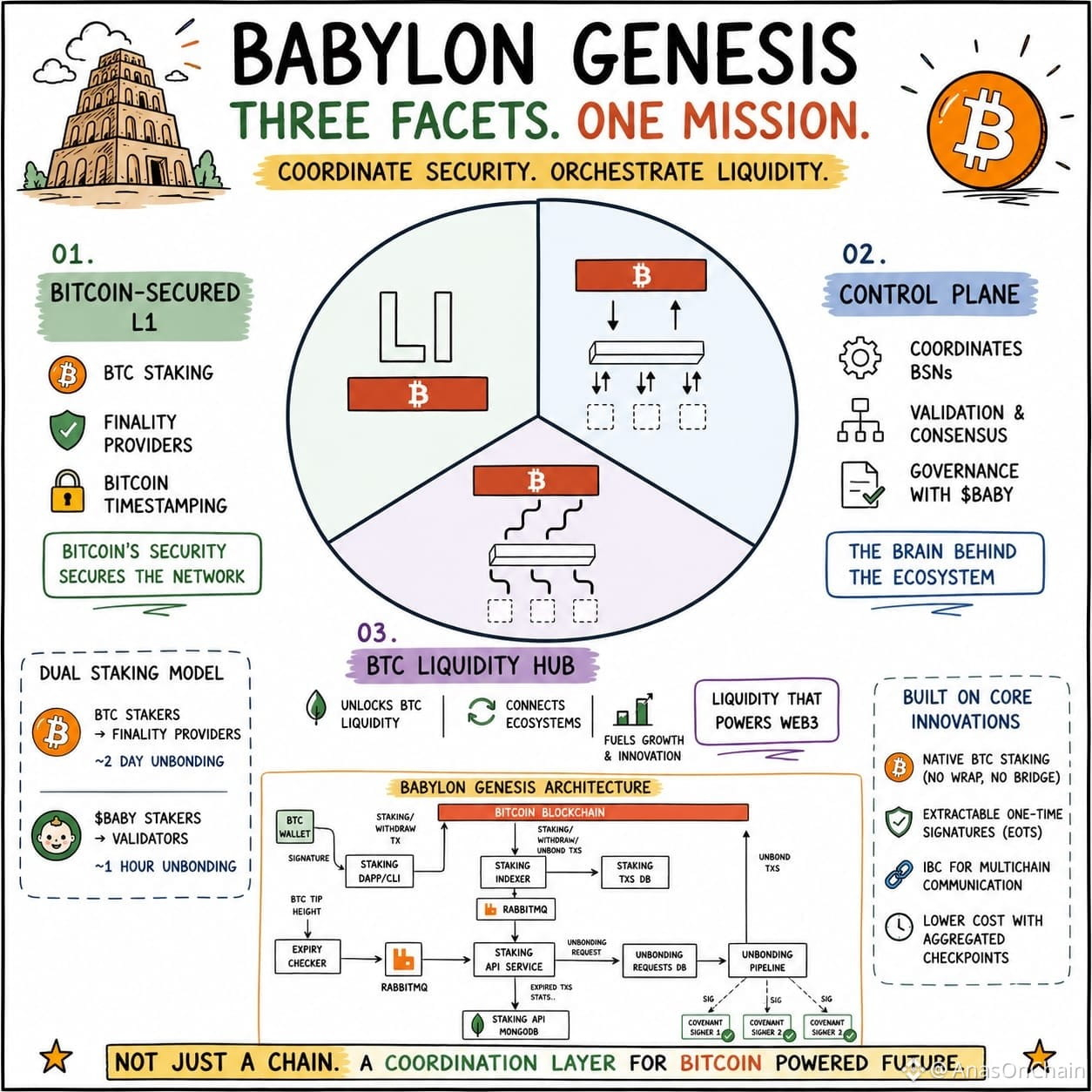
At first, seeing the diagram, I thought it was only a Bitcoin-backed Layer 1. But when you understand the architecture in detail, you realize that Genesis performs three different roles together: a Bitcoin-secured L1, a Control Plane, and a BTC Liquidity Hub.
Even if a repayment proof or an on-chain condition is completed, the system only works when every validator interprets that same proof, the same price feed, and the same predefined rules in exactly the same way.
Here, the protocol isn’t just protecting with cryptography...
It’s protecting shared agreement.
That’s why BTC provides economic security, Finality Providers strengthen verification, and BABY governance and network operations coordinate. This separation doesn’t just make the infrastructure secure—it also makes it consistent.
For me, the most interesting part of Babylon isn’t Bitcoin staking...
Rather, it’s that the protocol builds a consensus of reality before value can move.
If future Web3 coordination becomes a game, will coordination layers become even more important than execution layers?
@babylonlabs_io $BABY #baby
Sometimes the real value of a protocol isn’t in the thing being verified...
Instead, it’s in the system that gets everyone to agree on the same reality.
Looking at Babylon Genesis, this seemed quite interesting.
At first, seeing the diagram, I thought it was only a Bitcoin-backed Layer 1. But when you understand the architecture in detail, you realize that Genesis performs three different roles together: a Bitcoin-secured L1, a Control Plane, and a BTC Liquidity Hub.
Even if a repayment proof or an on-chain condition is completed, the system only works when every validator interprets that same proof, the same price feed, and the same predefined rules in exactly the same way.
Here, the protocol isn’t just protecting with cryptography...
It’s protecting shared agreement.
That’s why BTC provides economic security, Finality Providers strengthen verification, and BABY governance and network operations coordinate. This separation doesn’t just make the infrastructure secure—it also makes it consistent.
For me, the most interesting part of Babylon isn’t Bitcoin staking...
Rather, it’s that the protocol builds a consensus of reality before value can move.
If future Web3 coordination becomes a game, will coordination layers become even more important than execution layers?
@BabylonLabs_io $BABY #baby
Instead, it’s in the system that gets everyone to agree on the same reality.
Looking at Babylon Genesis, this seemed quite interesting.
At first, seeing the diagram, I thought it was only a Bitcoin-backed Layer 1. But when you understand the architecture in detail, you realize that Genesis performs three different roles together: a Bitcoin-secured L1, a Control Plane, and a BTC Liquidity Hub.
Even if a repayment proof or an on-chain condition is completed, the system only works when every validator interprets that same proof, the same price feed, and the same predefined rules in exactly the same way.
Here, the protocol isn’t just protecting with cryptography...
It’s protecting shared agreement.
That’s why BTC provides economic security, Finality Providers strengthen verification, and BABY governance and network operations coordinate. This separation doesn’t just make the infrastructure secure—it also makes it consistent.
For me, the most interesting part of Babylon isn’t Bitcoin staking...
Rather, it’s that the protocol builds a consensus of reality before value can move.
If future Web3 coordination becomes a game, will coordination layers become even more important than execution layers?
@BabylonLabs_io $BABY #baby
6
7
140
·
--
Verified
Sometimes the biggest protocol innovation lies in the thing it removes... not the thing it adds.
Looking closely at @babylonlabs_io , I came to an observation.
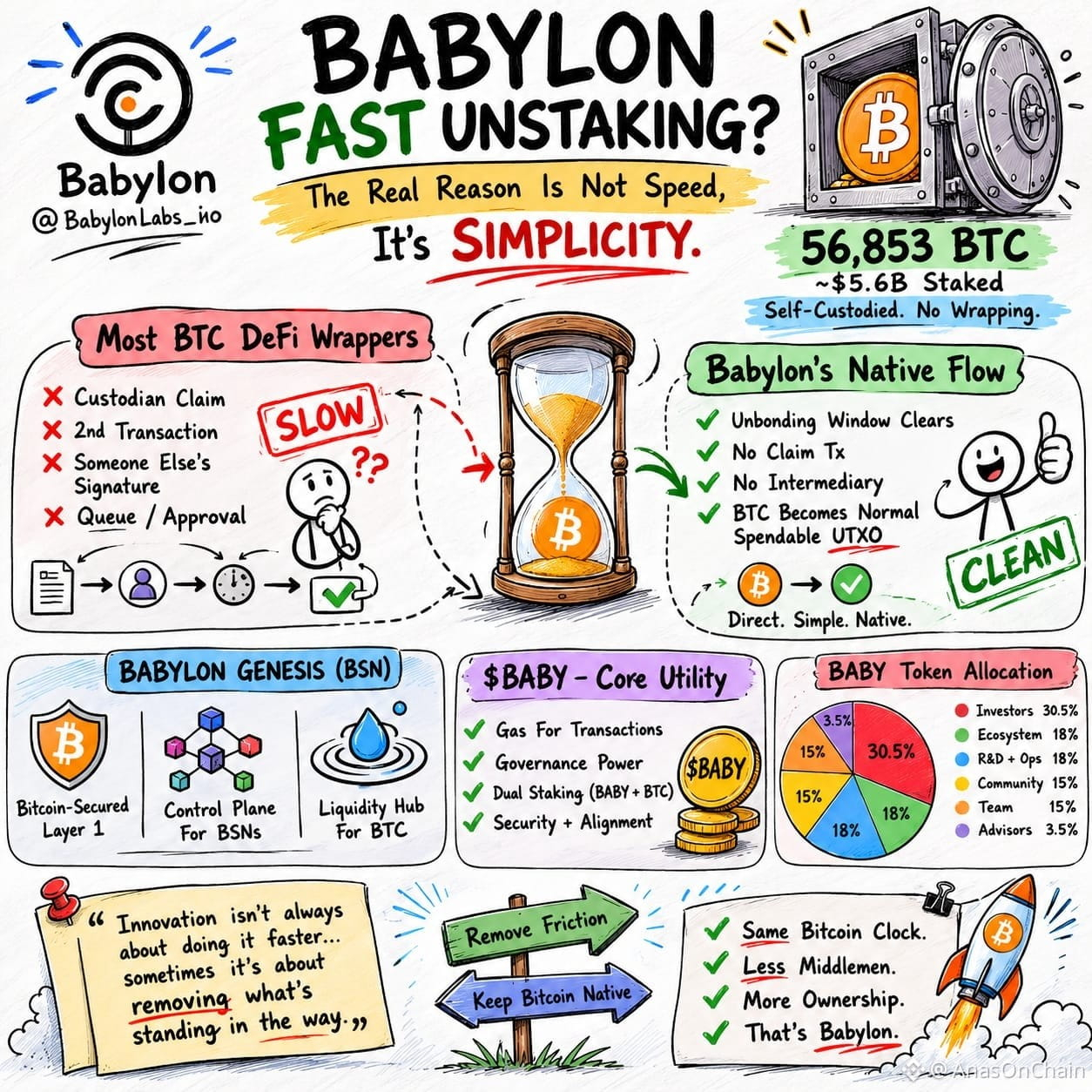
Today, Babylon has a self-custodial stake of 56,853 BTC (~$5.6B). At first glance, they talk about "fast unstaking," but the architecture tells a different story.
The reality is that Bitcoin completes its native unbonding process. The difference isn’t that Bitcoin’s clock got faster.
The difference is that after that, there’s no need for any custodian claim, bridge approval, or intermediary confirmation. BTC directly becomes a normal spendable UTXO.
So it’s not Bitcoin’s speed—it’s workflow optimization.
This approach also aligns with Babylon Genesis’s broader design. Genesis isn’t just a Layer 1; it’s a Bitcoin-secured control plane and liquidity hub where the focus of the infrastructure is to remove unnecessary trust layers—not replace them.
For me, this is more a story of trust minimization than "fast unstaking."
Marketing highlights speed.
It removes protocol friction.
They sound similar... but from an engineering perspective, they’re completely different concepts.
In your opinion, will the real value of future Bitcoin infrastructure be faster transactions, or the gradual elimination of intermediaries?
@babylonlabs_io $BABY #baby
Sometimes the biggest protocol innovation lies in the thing it removes... not the thing it adds.
Looking closely at @BabylonLabs_io , I came to an observation.
Today, Babylon has a self-custodial stake of 56,853 BTC (~$5.6B). At first glance, they talk about "fast unstaking," but the architecture tells a different story.
The reality is that Bitcoin completes its native unbonding process. The difference isn’t that Bitcoin’s clock got faster.
The difference is that after that, there’s no need for any custodian claim, bridge approval, or intermediary confirmation. BTC directly becomes a normal spendable UTXO.
So it’s not Bitcoin’s speed—it’s workflow optimization.
This approach also aligns with Babylon Genesis’s broader design. Genesis isn’t just a Layer 1; it’s a Bitcoin-secured control plane and liquidity hub where the focus of the infrastructure is to remove unnecessary trust layers—not replace them.
For me, this is more a story of trust minimization than "fast unstaking."
Marketing highlights speed.
It removes protocol friction.
They sound similar... but from an engineering perspective, they’re completely different concepts.
In your opinion, will the real value of future Bitcoin infrastructure be faster transactions, or the gradual elimination of intermediaries?
@BabylonLabs_io $BABY #baby
Looking closely at @BabylonLabs_io , I came to an observation.
Today, Babylon has a self-custodial stake of 56,853 BTC (~$5.6B). At first glance, they talk about "fast unstaking," but the architecture tells a different story.
The reality is that Bitcoin completes its native unbonding process. The difference isn’t that Bitcoin’s clock got faster.
The difference is that after that, there’s no need for any custodian claim, bridge approval, or intermediary confirmation. BTC directly becomes a normal spendable UTXO.
So it’s not Bitcoin’s speed—it’s workflow optimization.
This approach also aligns with Babylon Genesis’s broader design. Genesis isn’t just a Layer 1; it’s a Bitcoin-secured control plane and liquidity hub where the focus of the infrastructure is to remove unnecessary trust layers—not replace them.
For me, this is more a story of trust minimization than "fast unstaking."
Marketing highlights speed.
It removes protocol friction.
They sound similar... but from an engineering perspective, they’re completely different concepts.
In your opinion, will the real value of future Bitcoin infrastructure be faster transactions, or the gradual elimination of intermediaries?
@BabylonLabs_io $BABY #baby
4
1
112
·
--
Verified
Sometimes the market and the protocol are telling totally different stories.
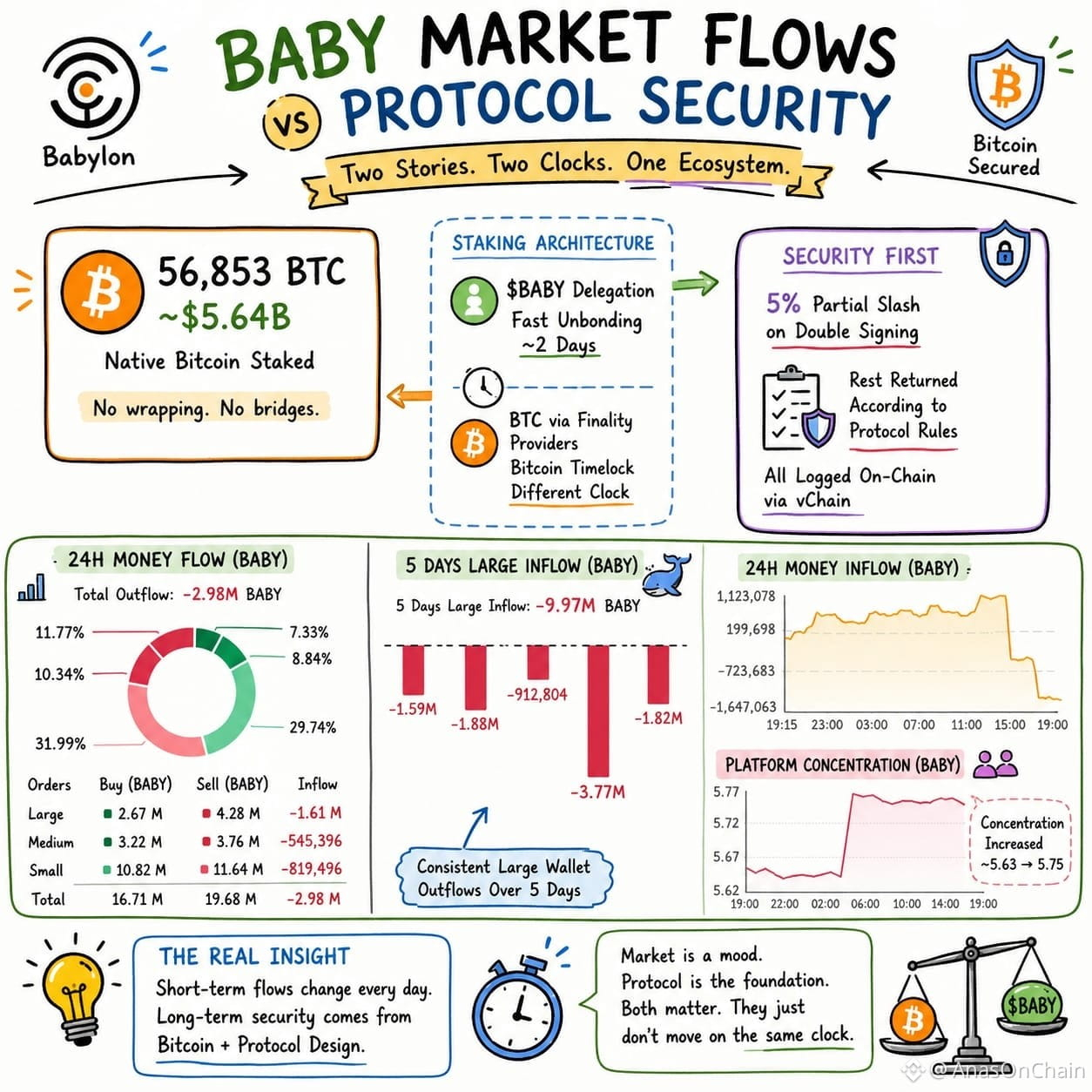
Today I was looking at exchange data. 24h total outflow was -2.98M BABY, large wallets’ net outflow was -1.61M BABY, and in the previous 5 days there was a large inflow of -9.97M BABY. Clearly, short-term sentiment is showing pressure.
But at the same time, on the protocol side of @babylonlabs_io , a completely different picture appears.
56,853 BTC (~$5.64B) are providing the network’s economic security through Native Bitcoin Staking, without wrapping and bridges. The real insight for me was that the Babylon market activity and protocol security don’t treat the same thing as the same thing.
Even the staking architecture follows the same philosophy.
$BABY ’s delegation has fast unbonding of about 2 days, while BTC follows its settlement rhythm through Finality Providers and Bitcoin timelocks. The two assets are in the same ecosystem, but their purposes are different.
Likewise, short-term exchange flows don’t define the protocol’s long-term security.
Today money flow might be negative; tomorrow it might be positive too. But Bitcoin-backed security, validator accountability, and protocol coordination are the layers that sustain the ecosystem.
For me, what’s interesting about Babylon isn’t the APY or daily inflows...
It’s that it’s designed market behavior and infrastructure behavior as separate systems.
In Web3, do we still give more importance to exchange flows than to protocol fundamentals?
@babylonlabs_io $BABY #baby
Sometimes the market and the protocol are telling totally different stories.
Today I was looking at exchange data. 24h total outflow was -2.98M BABY, large wallets’ net outflow was -1.61M BABY, and in the previous 5 days there was a large inflow of -9.97M BABY. Clearly, short-term sentiment is showing pressure.
But at the same time, on the protocol side of @BabylonLabs_io , a completely different picture appears.
56,853 BTC (~$5.64B) are providing the network’s economic security through Native Bitcoin Staking, without wrapping and bridges. The real insight for me was that the Babylon market activity and protocol security don’t treat the same thing as the same thing.
Even the staking architecture follows the same philosophy.
$BABY ’s delegation has fast unbonding of about 2 days, while BTC follows its settlement rhythm through Finality Providers and Bitcoin timelocks. The two assets are in the same ecosystem, but their purposes are different.
Likewise, short-term exchange flows don’t define the protocol’s long-term security.
Today money flow might be negative; tomorrow it might be positive too. But Bitcoin-backed security, validator accountability, and protocol coordination are the layers that sustain the ecosystem.
For me, what’s interesting about Babylon isn’t the APY or daily inflows...
It’s that it’s designed market behavior and infrastructure behavior as separate systems.
In Web3, do we still give more importance to exchange flows than to protocol fundamentals?
@BabylonLabs_io $BABY #baby
Today I was looking at exchange data. 24h total outflow was -2.98M BABY, large wallets’ net outflow was -1.61M BABY, and in the previous 5 days there was a large inflow of -9.97M BABY. Clearly, short-term sentiment is showing pressure.
But at the same time, on the protocol side of @BabylonLabs_io , a completely different picture appears.
56,853 BTC (~$5.64B) are providing the network’s economic security through Native Bitcoin Staking, without wrapping and bridges. The real insight for me was that the Babylon market activity and protocol security don’t treat the same thing as the same thing.
Even the staking architecture follows the same philosophy.
$BABY ’s delegation has fast unbonding of about 2 days, while BTC follows its settlement rhythm through Finality Providers and Bitcoin timelocks. The two assets are in the same ecosystem, but their purposes are different.
Likewise, short-term exchange flows don’t define the protocol’s long-term security.
Today money flow might be negative; tomorrow it might be positive too. But Bitcoin-backed security, validator accountability, and protocol coordination are the layers that sustain the ecosystem.
For me, what’s interesting about Babylon isn’t the APY or daily inflows...
It’s that it’s designed market behavior and infrastructure behavior as separate systems.
In Web3, do we still give more importance to exchange flows than to protocol fundamentals?
@BabylonLabs_io $BABY #baby
4
2
158
·
--
Partly True
Sometimes, even to understand an ecosystem, it’s important to look at unlock dates... not just to see how many tokens will be released, but because it shows how protocol incentives evolve.
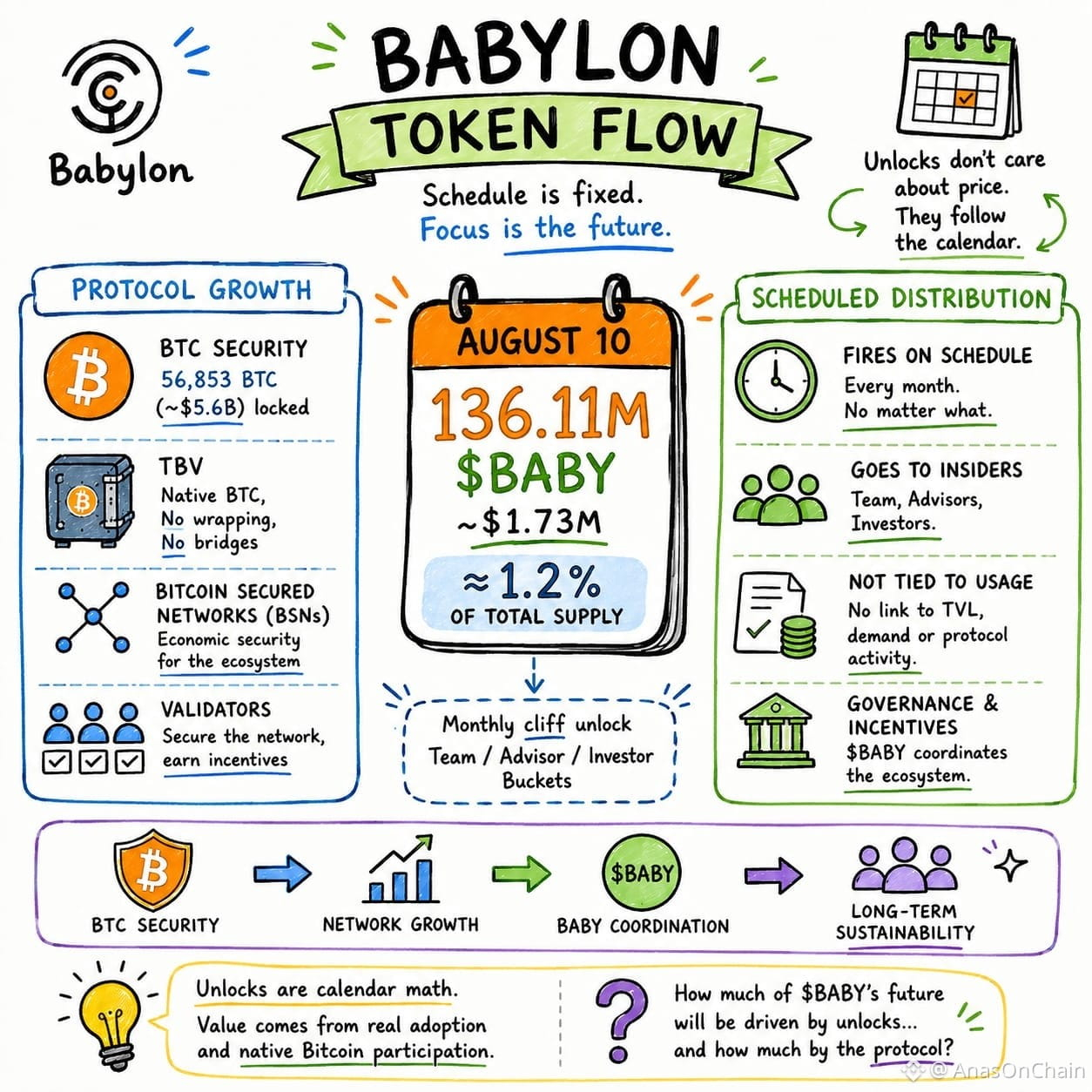
@babylonlabs_io ’s next scheduled unlock is on 10 August, where 136.11M $BABY tokens will be released according to the ecosystem allocation schedule. This process isn’t tied to market conditions—it’s tied to the protocol’s predefined distribution framework.
For me, what was interesting wasn’t the unlock...
It was that Babylon’s long-term value won’t be defined solely by token distribution.
If Native Bitcoin Staking, Trustless Bitcoin Vaults (TBV), and Bitcoin Secured Networks see higher adoption, then the protocol’s real strength will come from infrastructure usage and economic security—not just from circulating supply.
BABY’s role is also for this reason: not just as a reward token. Governance, validator incentives, and ecosystem coordination are its core responsibilities, while Bitcoin network’s economic security is the foundation.
Strong ecosystems aren’t built from schedules.
Strong ecosystems form when incentives and real protocol utility move in the same direction.
For me, the real question wasn’t the unlock...
It’s how quickly, in the coming months, protocol adoption and native Bitcoin participation are growing.
@babylonlabs_io $BABY #baby
Sometimes, even to understand an ecosystem, it’s important to look at unlock dates... not just to see how many tokens will be released, but because it shows how protocol incentives evolve.
@BabylonLabs_io ’s next scheduled unlock is on 10 August, where 136.11M $BABY tokens will be released according to the ecosystem allocation schedule. This process isn’t tied to market conditions—it’s tied to the protocol’s predefined distribution framework.
For me, what was interesting wasn’t the unlock...
It was that Babylon’s long-term value won’t be defined solely by token distribution.
If Native Bitcoin Staking, Trustless Bitcoin Vaults (TBV), and Bitcoin Secured Networks see higher adoption, then the protocol’s real strength will come from infrastructure usage and economic security—not just from circulating supply.
BABY’s role is also for this reason: not just as a reward token. Governance, validator incentives, and ecosystem coordination are its core responsibilities, while Bitcoin network’s economic security is the foundation.
Strong ecosystems aren’t built from schedules.
Strong ecosystems form when incentives and real protocol utility move in the same direction.
For me, the real question wasn’t the unlock...
It’s how quickly, in the coming months, protocol adoption and native Bitcoin participation are growing.
@BabylonLabs_io $BABY #baby
@BabylonLabs_io ’s next scheduled unlock is on 10 August, where 136.11M $BABY tokens will be released according to the ecosystem allocation schedule. This process isn’t tied to market conditions—it’s tied to the protocol’s predefined distribution framework.
For me, what was interesting wasn’t the unlock...
It was that Babylon’s long-term value won’t be defined solely by token distribution.
If Native Bitcoin Staking, Trustless Bitcoin Vaults (TBV), and Bitcoin Secured Networks see higher adoption, then the protocol’s real strength will come from infrastructure usage and economic security—not just from circulating supply.
BABY’s role is also for this reason: not just as a reward token. Governance, validator incentives, and ecosystem coordination are its core responsibilities, while Bitcoin network’s economic security is the foundation.
Strong ecosystems aren’t built from schedules.
Strong ecosystems form when incentives and real protocol utility move in the same direction.
For me, the real question wasn’t the unlock...
It’s how quickly, in the coming months, protocol adoption and native Bitcoin participation are growing.
@BabylonLabs_io $BABY #baby
4
3
136
·
--
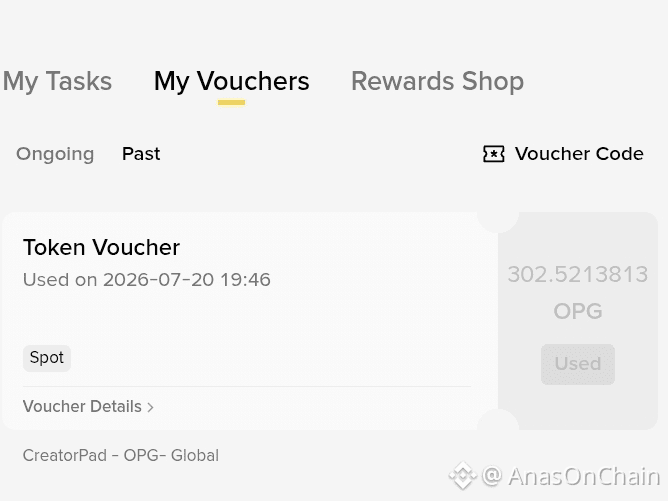
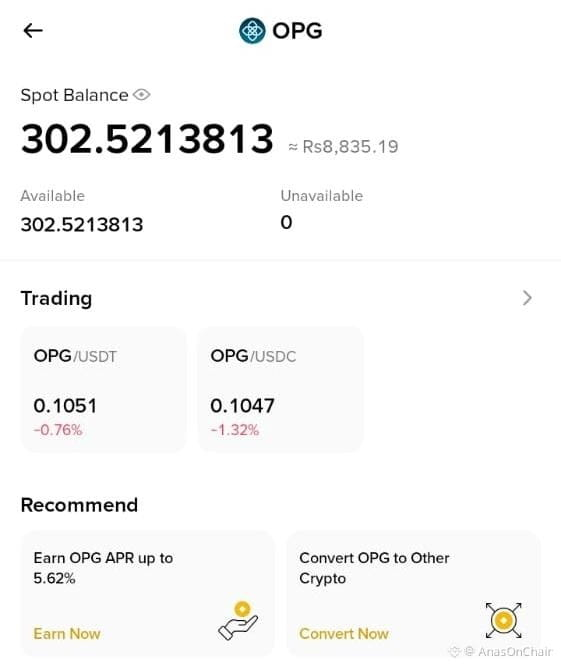
Finally received my OpenGradient CreatorPad reward: 302.52 $OPG (around $30).
To be honest, I'm disappointed. I finished around Top 150, so I expected a much better reward. $30 feels far below what many participants were hoping for.
I appreciate the opportunity, but I hope future CreatorPad campaigns offer rewards that better reflect participants' effort and rankings.
#OpenGradient #CreatorPad $OPG
Finally received my OpenGradient CreatorPad reward: 302.52 $OPG (around $30).
To be honest, I'm disappointed. I finished around Top 150, so I expected a much better reward. $30 feels far below what many participants were hoping for.
I appreciate the opportunity, but I hope future CreatorPad campaigns offer rewards that better reflect participants' effort and rankings.
#OpenGradient #CreatorPad $OPG
To be honest, I'm disappointed. I finished around Top 150, so I expected a much better reward. $30 feels far below what many participants were hoping for.
I appreciate the opportunity, but I hope future CreatorPad campaigns offer rewards that better reflect participants' effort and rankings.
#OpenGradient #CreatorPad $OPG
1
157
·
--

Article
$NEWT AI Builders Is Not Freedom, It’s Building TrustSometimes the market views a project from the wrong angle.
I also initially thought Newton Protocol was just creating yet another marketplace for AI developers. Then I reread the whitepaper and recent updates, and the picture was completely different.
The idea of a Model Registry is not just to list agents.
The real thing is that every AI agent operates within an authorization framework. Registration, policy enforcement, and execution proofs together create an environment where AI not only does the work, but also verifies every action it takes.
$NEWT AI Builders Is Not Freedom, It’s Building Trust
Sometimes the market views a project from the wrong angle.
I also initially thought Newton Protocol was just creating yet another marketplace for AI developers. Then I reread the whitepaper and recent updates, and the picture was completely different.
The idea of a Model Registry is not just to list agents.
The real thing is that every AI agent operates within an authorization framework. Registration, policy enforcement, and execution proofs together create an environment where AI not only does the work, but also verifies every action it takes.
I also initially thought Newton Protocol was just creating yet another marketplace for AI developers. Then I reread the whitepaper and recent updates, and the picture was completely different.
The idea of a Model Registry is not just to list agents.
The real thing is that every AI agent operates within an authorization framework. Registration, policy enforcement, and execution proofs together create an environment where AI not only does the work, but also verifies every action it takes.
2
3
104
·
--
Main aaj @NewtonProtocol Explorer dekh raha tha aur ek cheez baar baar dimagh mein aa rahi thi.
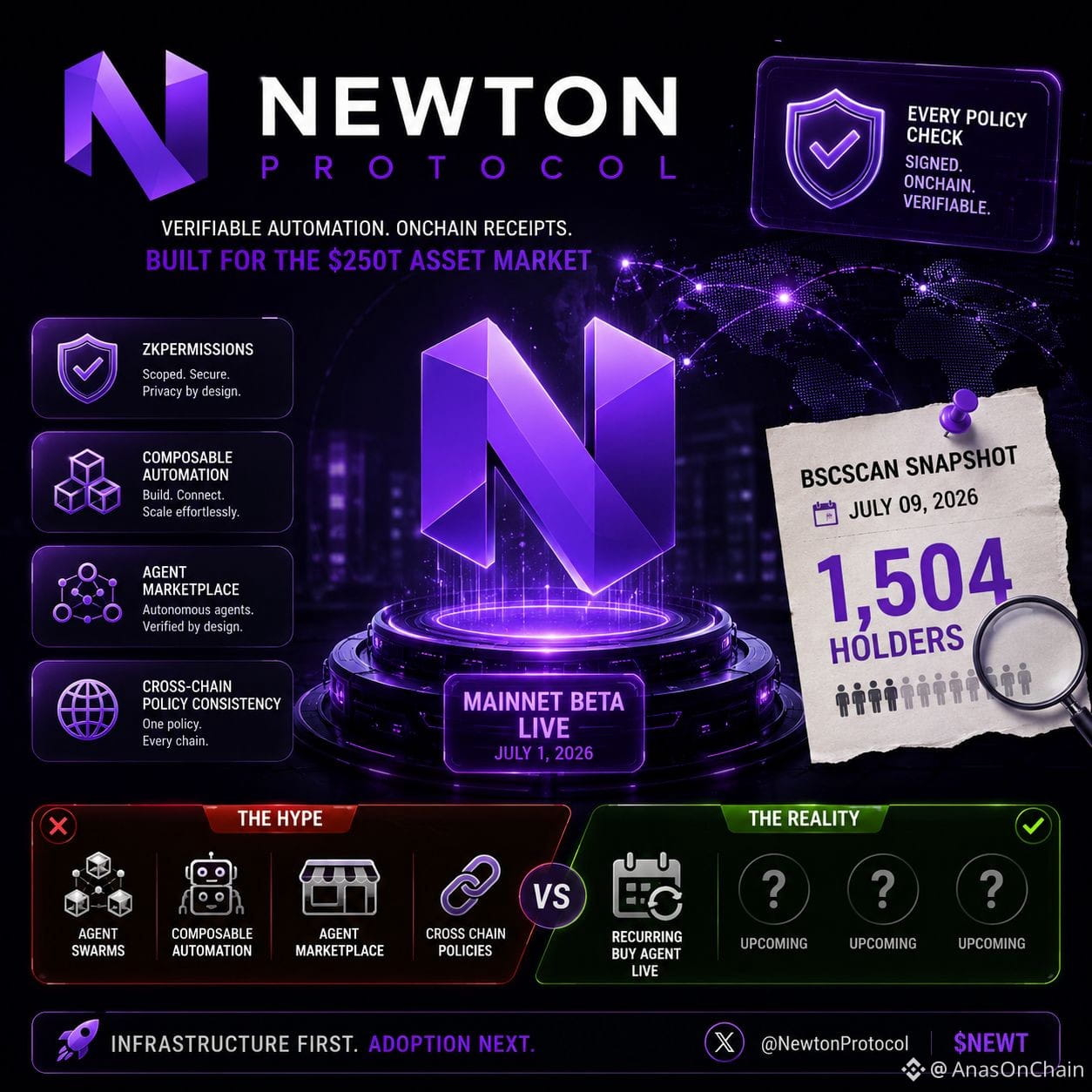
Mainnet Beta went live on Base and Ethereum on 1 July. For every policy check, a signed on-chain receipt is generated, and theoretically anyone can verify it. The whitepaper’s core idea is also that instead of trust, cryptographic proofs are used.
Then I checked BscScan.
In the 9 July snapshot, only 1,504 holders were visible.
At that time, I felt that technology and adoption don’t always grow at the same pace.
The whitepaper talks about the agent marketplace, composable automation, zkPermissions Rollup, and cross-chain policy consistency.
But in reality, the Recurring Buy Agent is live, while the other features are still on the roadmap.
I didn’t find anything negative in it.
Infrastructure is often built before the traffic arrives.
But there is one difference.
“Verifiable by anyone” and “actually verified by users” are two different things.
Receipts are present on-chain...
But how many people are actually inspecting them?
Maybe there are more builders right now and fewer end users.
For me, the next important metric won’t be just price.
I want to see, after the next unlocks and ecosystem growth, how quickly the holder count, agent adoption, and cross-chain activity start to mature.
If it grows naturally along with the usage roadmap...
Then Newton can become not just an AI narrative, but a long-term authorization infrastructure.
@NewtonProtocol $NEWT #Newt
Main aaj @NewtonProtocol Explorer dekh raha tha aur ek cheez baar baar dimagh mein aa rahi thi.
Mainnet Beta went live on Base and Ethereum on 1 July. For every policy check, a signed on-chain receipt is generated, and theoretically anyone can verify it. The whitepaper’s core idea is also that instead of trust, cryptographic proofs are used.
Then I checked BscScan.
In the 9 July snapshot, only 1,504 holders were visible.
At that time, I felt that technology and adoption don’t always grow at the same pace.
The whitepaper talks about the agent marketplace, composable automation, zkPermissions Rollup, and cross-chain policy consistency.
But in reality, the Recurring Buy Agent is live, while the other features are still on the roadmap.
I didn’t find anything negative in it.
Infrastructure is often built before the traffic arrives.
But there is one difference.
“Verifiable by anyone” and “actually verified by users” are two different things.
Receipts are present on-chain...
But how many people are actually inspecting them?
Maybe there are more builders right now and fewer end users.
For me, the next important metric won’t be just price.
I want to see, after the next unlocks and ecosystem growth, how quickly the holder count, agent adoption, and cross-chain activity start to mature.
If it grows naturally along with the usage roadmap...
Then Newton can become not just an AI narrative, but a long-term authorization infrastructure.
@NewtonProtocol $NEWT #Newt
Mainnet Beta went live on Base and Ethereum on 1 July. For every policy check, a signed on-chain receipt is generated, and theoretically anyone can verify it. The whitepaper’s core idea is also that instead of trust, cryptographic proofs are used.
Then I checked BscScan.
In the 9 July snapshot, only 1,504 holders were visible.
At that time, I felt that technology and adoption don’t always grow at the same pace.
The whitepaper talks about the agent marketplace, composable automation, zkPermissions Rollup, and cross-chain policy consistency.
But in reality, the Recurring Buy Agent is live, while the other features are still on the roadmap.
I didn’t find anything negative in it.
Infrastructure is often built before the traffic arrives.
But there is one difference.
“Verifiable by anyone” and “actually verified by users” are two different things.
Receipts are present on-chain...
But how many people are actually inspecting them?
Maybe there are more builders right now and fewer end users.
For me, the next important metric won’t be just price.
I want to see, after the next unlocks and ecosystem growth, how quickly the holder count, agent adoption, and cross-chain activity start to mature.
If it grows naturally along with the usage roadmap...
Then Newton can become not just an AI narrative, but a long-term authorization infrastructure.
@NewtonProtocol $NEWT #Newt
1
105
Log in to explore more content
Join global crypto users on Binance Square
⚡️ Get latest and useful information about crypto.
💬 Trusted by the world’s largest crypto exchange.
👍 Discover real insights from verified creators.
Email / Phone number
Trending Topics
BitcoinRebounds$75KAsChipsLead
10,563 views
147 Discussing
Market Watch | Bitcoin Rebounds to $75,600 After Dip Below $75,000 as Chip Stocks Lead Rally on Jobs Beat
Binance News
·17 Likes
·5.1k views
JobsReportRaisesHikeOdds
137,209 views
1,211 Discussing
US Data Center Rules May Constrain AI Expansion
20,479 views
111 Discussing