@BabylonLabs_io ki As I looked at TBV architecture, I came across an interesting thing.
The whitepaper’s cryptographic guarantees seem very strong, but in real-world security, it’s not only mathematics—it’s also tested against edge cases.
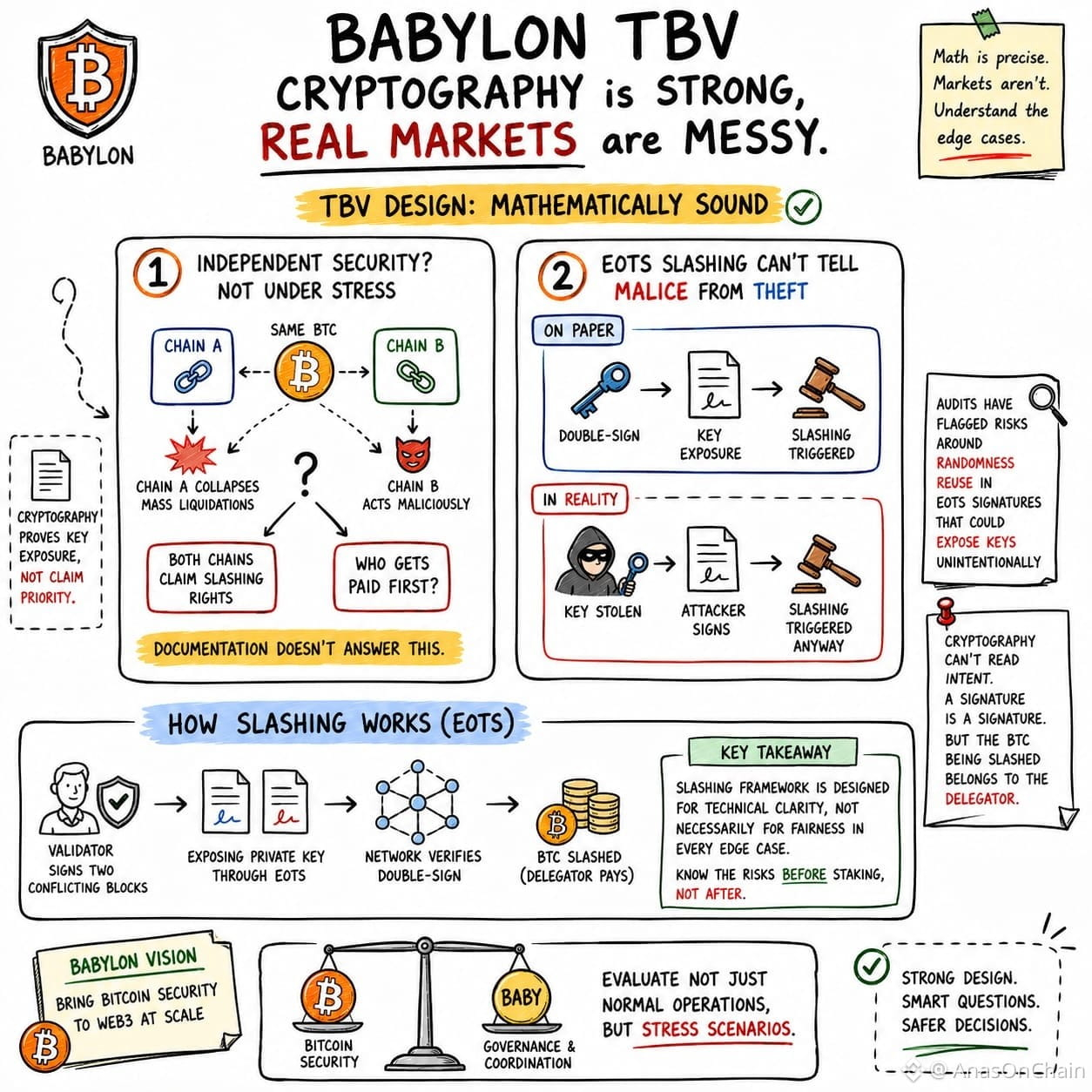
TBV’s model allows a single BTC to provide economic security to multiple Bitcoin Secured Networks. This is a powerful design for capital efficiency. But if, during extreme market stress, two chains generate a slashing claim against the same validator, how will priority be decided on what basis? This scenario is not clearly defined in the documentation.
My second observation is about the EOTS slashing mechanism.
EOTS enforces validator honesty because double-signing exposes the private key and triggers slashing. But a blockchain can only see signatures—not intention. If the key gets compromised and an attacker signs with that same key, the on-chain result still appears as double-signing.
That’s why independent security reviews also consider randomness handling and key management to be critical areas, because the technical implementation is as important a part of security as the cryptographic design.
For me, this isn’t a weakness of the protocol...
It’s about understanding the trust model.
Delegators aren’t just choosing yield or rewards. They’re also placing trust in that slashing framework, which provides technical clarity, even if it can’t identify intent in every edge case.
Babylon is extending Bitcoin’s security to Web3, but when evaluating that security model, you also need to look at stress scenarios—not just normal operations.
@BabylonLabs_io $BABY #baby
The whitepaper’s cryptographic guarantees seem very strong, but in real-world security, it’s not only mathematics—it’s also tested against edge cases.
TBV’s model allows a single BTC to provide economic security to multiple Bitcoin Secured Networks. This is a powerful design for capital efficiency. But if, during extreme market stress, two chains generate a slashing claim against the same validator, how will priority be decided on what basis? This scenario is not clearly defined in the documentation.
My second observation is about the EOTS slashing mechanism.
EOTS enforces validator honesty because double-signing exposes the private key and triggers slashing. But a blockchain can only see signatures—not intention. If the key gets compromised and an attacker signs with that same key, the on-chain result still appears as double-signing.
That’s why independent security reviews also consider randomness handling and key management to be critical areas, because the technical implementation is as important a part of security as the cryptographic design.
For me, this isn’t a weakness of the protocol...
It’s about understanding the trust model.
Delegators aren’t just choosing yield or rewards. They’re also placing trust in that slashing framework, which provides technical clarity, even if it can’t identify intent in every edge case.
Babylon is extending Bitcoin’s security to Web3, but when evaluating that security model, you also need to look at stress scenarios—not just normal operations.
@BabylonLabs_io $BABY #baby