Everyone is only talking about $BABY inflation right now, but I found something else in Genesis tokenomics even more interesting.
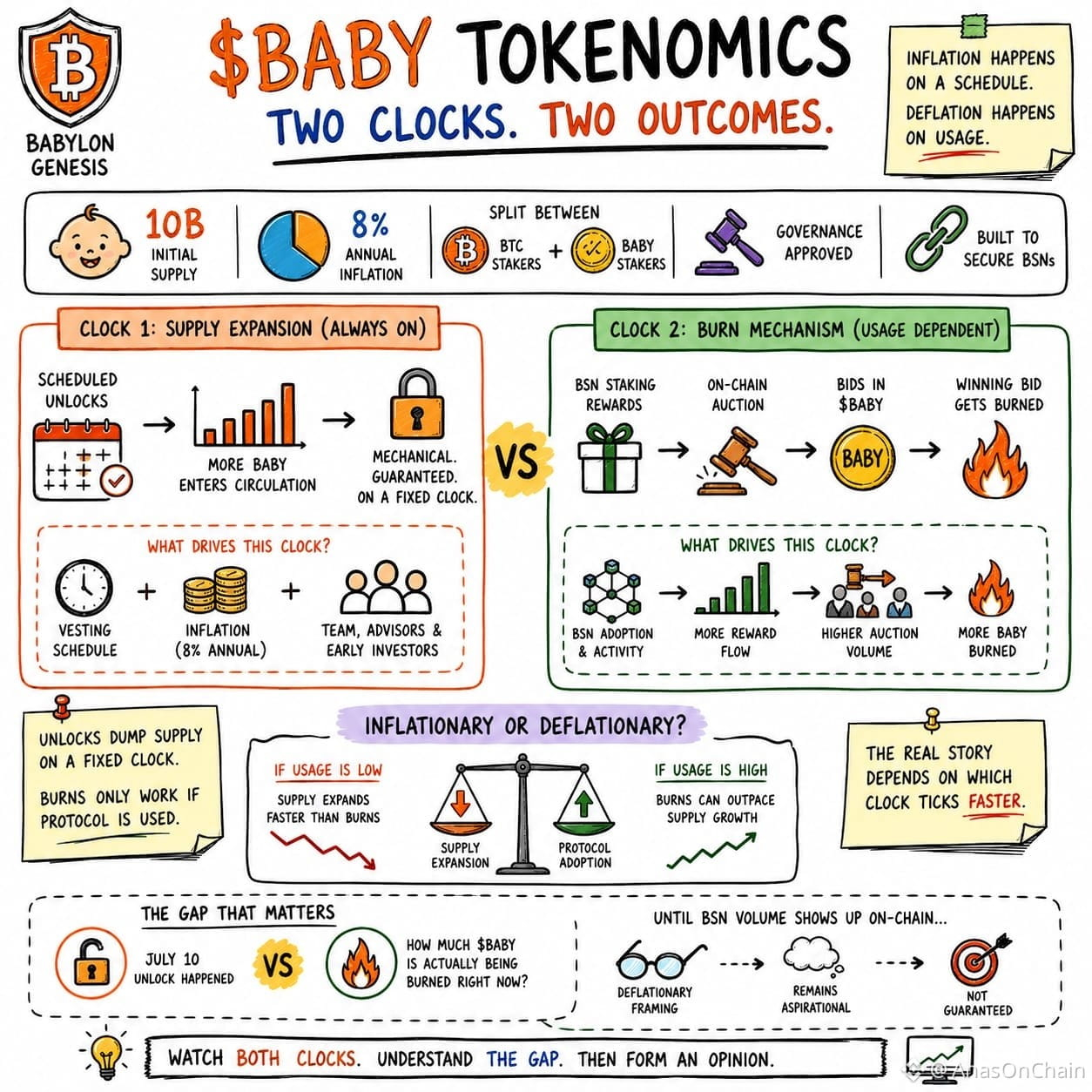
BABY’s initial supply was 10B, and the protocol rewards BTC and BABY stakers with an 8% annual inflation. Everyone knows this part.
Then I looked at the BSN reward mechanism. The rewards coming from BSN go into an on-chain auction; the bids are made in BABY, and the winning bid gets burned. This is where it seemed to me that the real story isn’t just inflation or burn—it’s all about timing in the model.
On one side, scheduled unlocks and inflation run according to their timeline. On the other side, the burn only becomes meaningful when BSNs generate real activity and there’s enough BABY flow into the auctions.
For me, the question isn’t whether BABY is inflationary or deflationary.
The real question is: which clock runs faster? The supply-expansion clock… or the protocol-adoption clock?
If BSN adoption accelerates in the future, the impact of the burn mechanism will naturally grow too. If adoption stays slow, the market will feel the supply side first.
That’s why, in my view, BABY’s long-term economics won’t be determined only by token issuance, but by the BSN activity that gets built on Babylon Genesis.
@BabylonLabs_io $BABY #baby