Sometimes the market and the protocol are telling totally different stories.
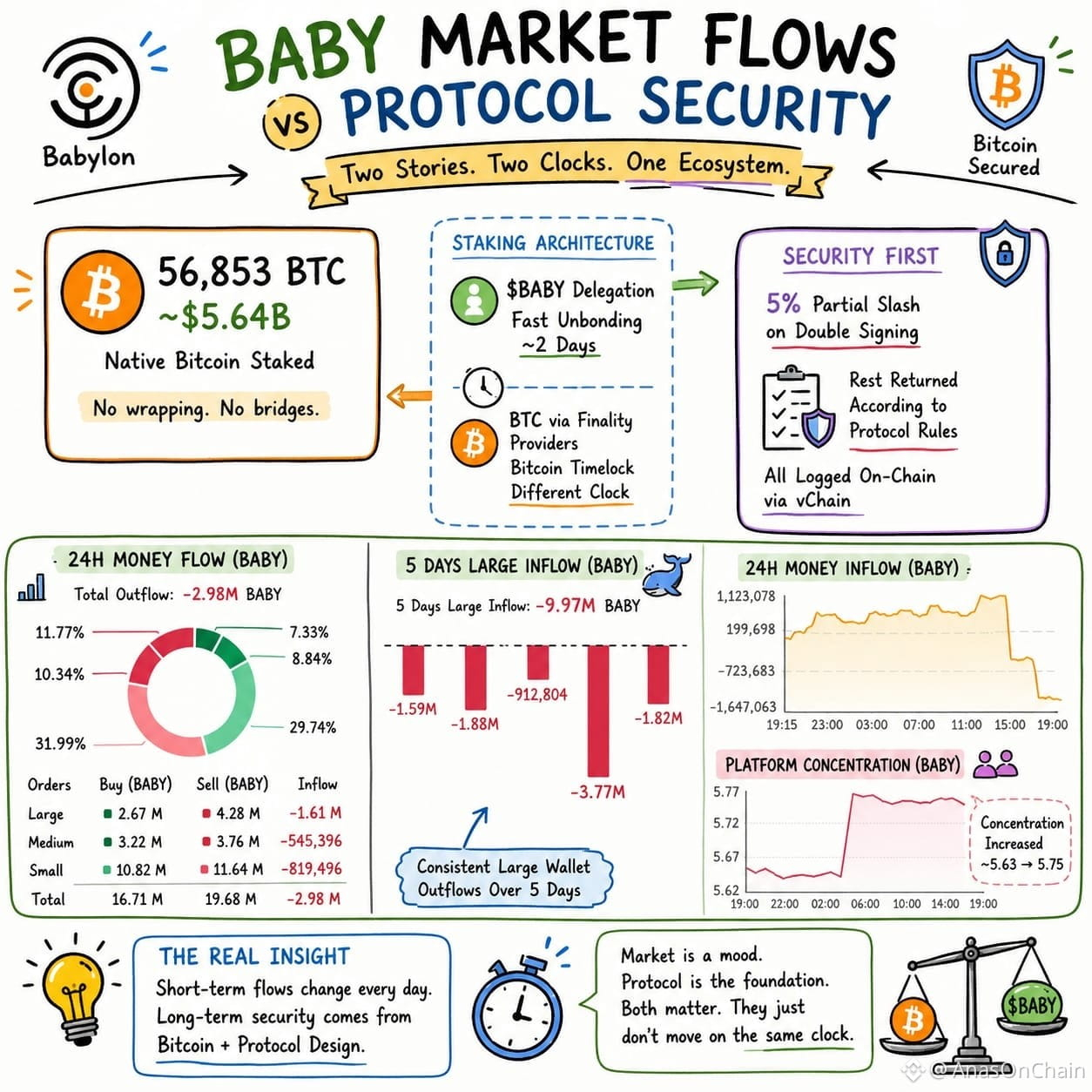
Today I was looking at exchange data. 24h total outflow was -2.98M BABY, large wallets’ net outflow was -1.61M BABY, and in the previous 5 days there was a large inflow of -9.97M BABY. Clearly, short-term sentiment is showing pressure.
But at the same time, on the protocol side of @BabylonLabs_io , a completely different picture appears.
56,853 BTC (~$5.64B) are providing the network’s economic security through Native Bitcoin Staking, without wrapping and bridges. The real insight for me was that the Babylon market activity and protocol security don’t treat the same thing as the same thing.
Even the staking architecture follows the same philosophy.
$BABY ’s delegation has fast unbonding of about 2 days, while BTC follows its settlement rhythm through Finality Providers and Bitcoin timelocks. The two assets are in the same ecosystem, but their purposes are different.
Likewise, short-term exchange flows don’t define the protocol’s long-term security.
Today money flow might be negative; tomorrow it might be positive too. But Bitcoin-backed security, validator accountability, and protocol coordination are the layers that sustain the ecosystem.
For me, what’s interesting about Babylon isn’t the APY or daily inflows...
It’s that it’s designed market behavior and infrastructure behavior as separate systems.
In Web3, do we still give more importance to exchange flows than to protocol fundamentals?
@BabylonLabs_io $BABY #baby