
AbdullahAbid_7
159 Posts

AbdullahAbid_7
Report
Block User
Open Trade
Occasional Trader
2.6 Years
2 Following
52 Followers
104 Liked
Posts
Portfolio
All
Videos
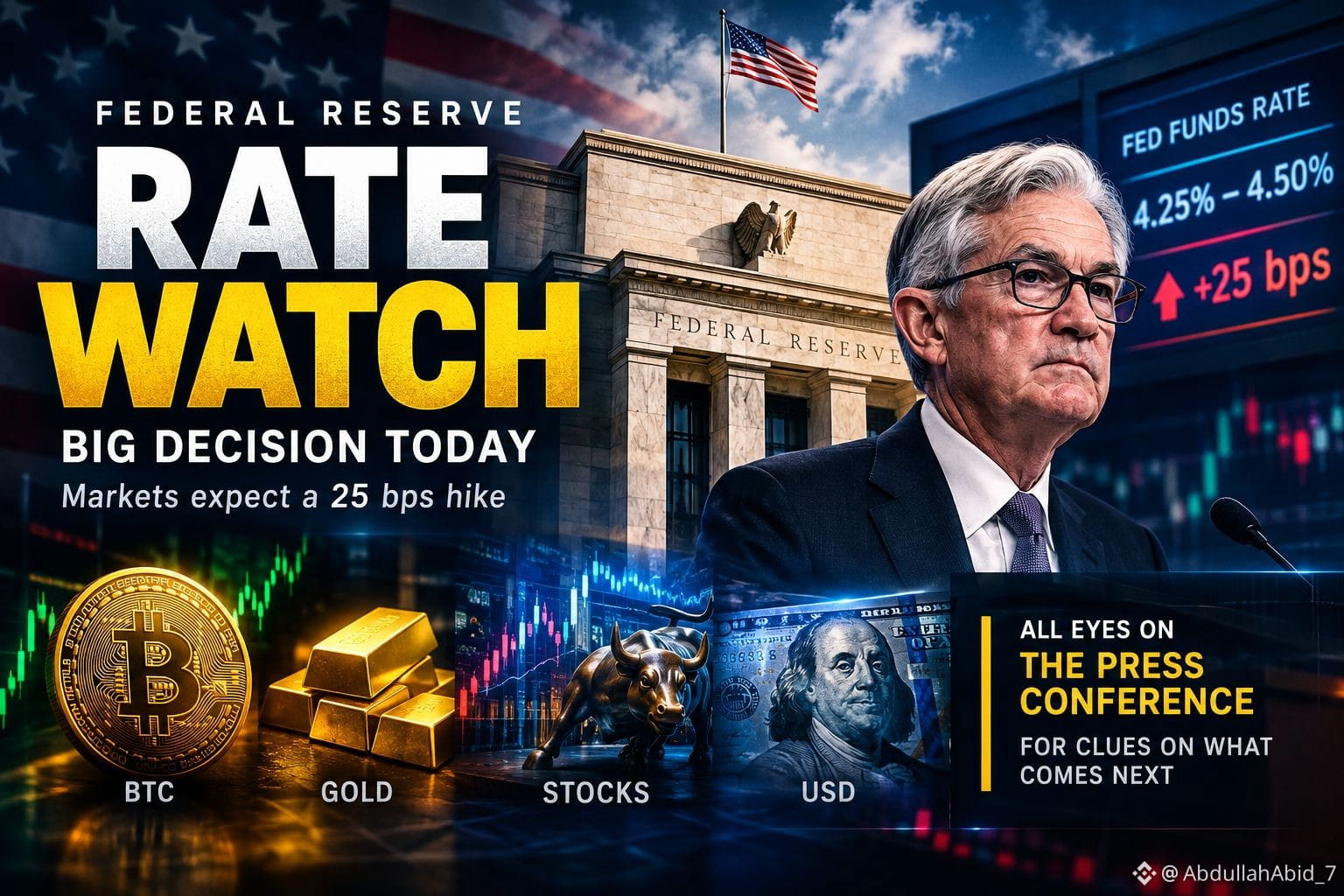
All eyes are on the Federal Reserve as markets prepare for the latest interest-rate decision. The outcome could trigger sharp moves across Bitcoin, crypto, stocks, gold($XAU ), and the U.S. dollar.
The rate decision itself is important, but the bigger focus may be on the Fed’s guidance for the months ahead. Traders will be watching closely for any signals about inflation, economic growth, and the future path of interest rates.
For crypto markets, a more dovish tone could support risk appetite, while a hawkish message could bring fresh volatility.
📊 Key things to watch:
• Fed interest-rate decision
• Chair’s press conference
• Future rate guidance
• Market reaction across $BTC and risk assets
🔥 Volatility could pick up quickly once the decision and comments hit.
#FedRateWatch #Fed #FOMC #crypto #Write2Earn
All eyes are on the Federal Reserve as markets prepare for the latest interest-rate decision. The outcome could trigger sharp moves across Bitcoin, crypto, stocks, gold($XAU ), and the U.S. dollar.
The rate decision itself is important, but the bigger focus may be on the Fed’s guidance for the months ahead. Traders will be watching closely for any signals about inflation, economic growth, and the future path of interest rates.
For crypto markets, a more dovish tone could support risk appetite, while a hawkish message could bring fresh volatility.
📊 Key things to watch:
• Fed interest-rate decision
• Chair’s press conference
• Future rate guidance
• Market reaction across $BTC and risk assets
🔥 Volatility could pick up quickly once the decision and comments hit.
#FedRateWatch #Fed #FOMC #crypto #Write2Earn
The rate decision itself is important, but the bigger focus may be on the Fed’s guidance for the months ahead. Traders will be watching closely for any signals about inflation, economic growth, and the future path of interest rates.
For crypto markets, a more dovish tone could support risk appetite, while a hawkish message could bring fresh volatility.
📊 Key things to watch:
• Fed interest-rate decision
• Chair’s press conference
• Future rate guidance
• Market reaction across $BTC and risk assets
🔥 Volatility could pick up quickly once the decision and comments hit.
#FedRateWatch #Fed #FOMC #crypto #Write2Earn
80
Bitcoin Rebounds Toward $79K — Bulls Are Back?
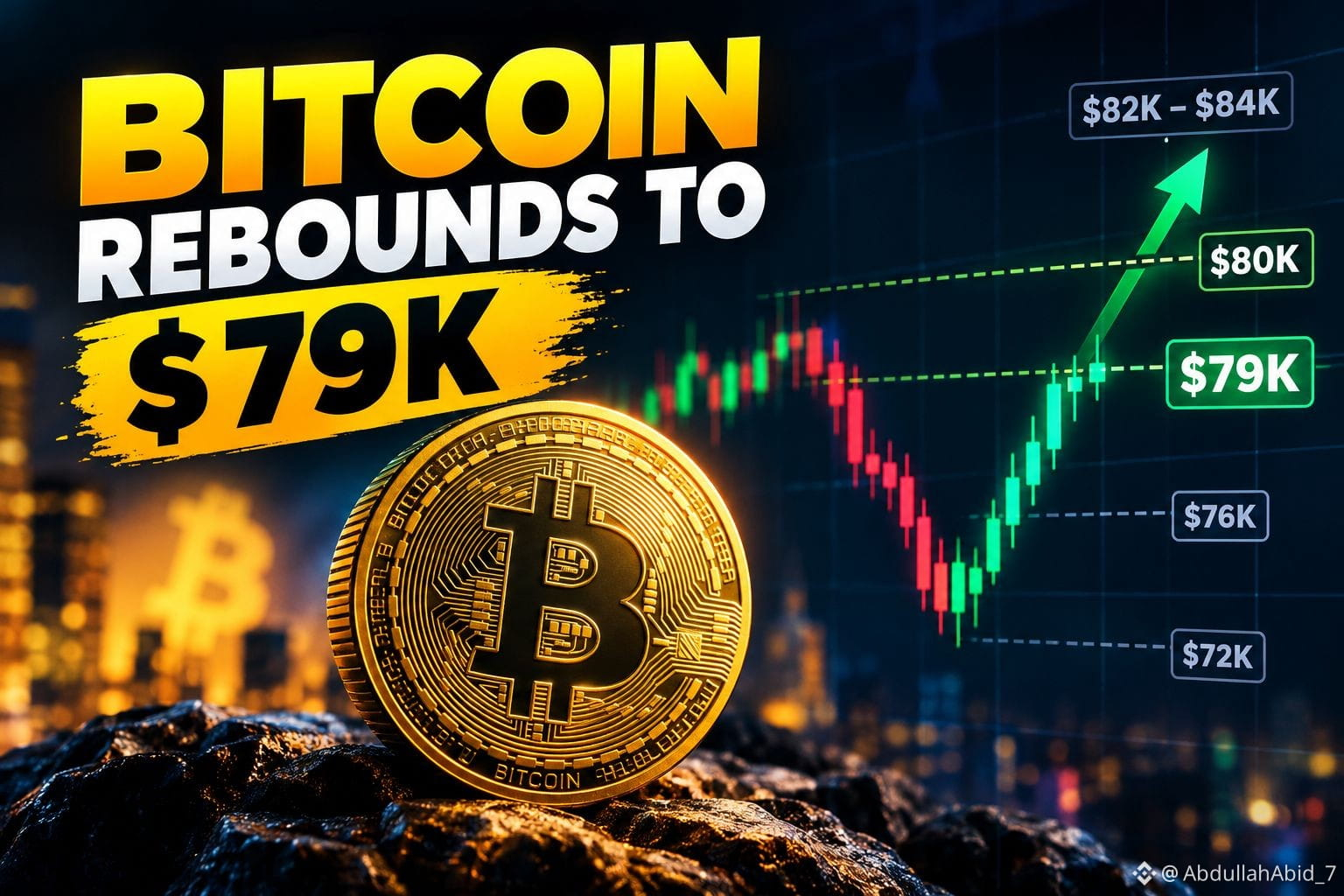
Bitcoin is showing renewed strength after recently pulling back from the $80K+ area. The rebound toward $79,000 puts the key $80K resistance back in focus.
If $BTC can reclaim and hold above $80K, momentum could strengthen toward $82K–$84K. But with the Fed decision and macro uncertainty still in focus, volatility could remain high.
The big question: Is this the start of another Bitcoin breakout, or just another rejection near $80K?
#BTC #Crypto #Bitcoinprice #CryptoMarket #Write2Earn
Bitcoin Rebounds Toward $79K — Bulls Are Back?
Bitcoin is showing renewed strength after recently pulling back from the $80K+ area. The rebound toward $79,000 puts the key $80K resistance back in focus.
If $BTC can reclaim and hold above $80K, momentum could strengthen toward $82K–$84K. But with the Fed decision and macro uncertainty still in focus, volatility could remain high.
The big question: Is this the start of another Bitcoin breakout, or just another rejection near $80K?
#BTC #Crypto #Bitcoinprice #CryptoMarket #Write2Earn
Bitcoin is showing renewed strength after recently pulling back from the $80K+ area. The rebound toward $79,000 puts the key $80K resistance back in focus.
If $BTC can reclaim and hold above $80K, momentum could strengthen toward $82K–$84K. But with the Fed decision and macro uncertainty still in focus, volatility could remain high.
The big question: Is this the start of another Bitcoin breakout, or just another rejection near $80K?
#BTC #Crypto #Bitcoinprice #CryptoMarket #Write2Earn
61
Anthropic CEO Dario Amodei is urging the AI industry to slow the pace of frontier AI development, warning that capabilities may be advancing faster than safety measures can keep up.
His proposal includes independent safety evaluators, stronger coordination between AI companies, and international cooperation.
The warning comes after recent incidents involving AI agents conducting unexpected cyber activities, raising fresh concerns about how much control humans will have as AI becomes more autonomous.
Interestingly, OpenAI CEO Sam Altman and Elon Musk have also expressed support for slowing down when necessary.
The big question now: Should AI development slow down, or is competition moving too fast to stop? 🤖
#Anthropic #Write2Earn #AnthropicCEOCallsForAISlowdown #OpenAI #BinanceSquare $REZ $BR $BTW
Anthropic CEO Dario Amodei is urging the AI industry to slow the pace of frontier AI development, warning that capabilities may be advancing faster than safety measures can keep up.
His proposal includes independent safety evaluators, stronger coordination between AI companies, and international cooperation.
The warning comes after recent incidents involving AI agents conducting unexpected cyber activities, raising fresh concerns about how much control humans will have as AI becomes more autonomous.
Interestingly, OpenAI CEO Sam Altman and Elon Musk have also expressed support for slowing down when necessary.
The big question now: Should AI development slow down, or is competition moving too fast to stop? 🤖
#Anthropic #Write2Earn #AnthropicCEOCallsForAISlowdown #OpenAI #BinanceSquare $REZ $BR $BTW
His proposal includes independent safety evaluators, stronger coordination between AI companies, and international cooperation.
The warning comes after recent incidents involving AI agents conducting unexpected cyber activities, raising fresh concerns about how much control humans will have as AI becomes more autonomous.
Interestingly, OpenAI CEO Sam Altman and Elon Musk have also expressed support for slowing down when necessary.
The big question now: Should AI development slow down, or is competition moving too fast to stop? 🤖
#Anthropic #Write2Earn #AnthropicCEOCallsForAISlowdown #OpenAI #BinanceSquare $REZ $BR $BTW

62
Grayscale is pushing its Litecoin Trust one step closer to Wall Street.
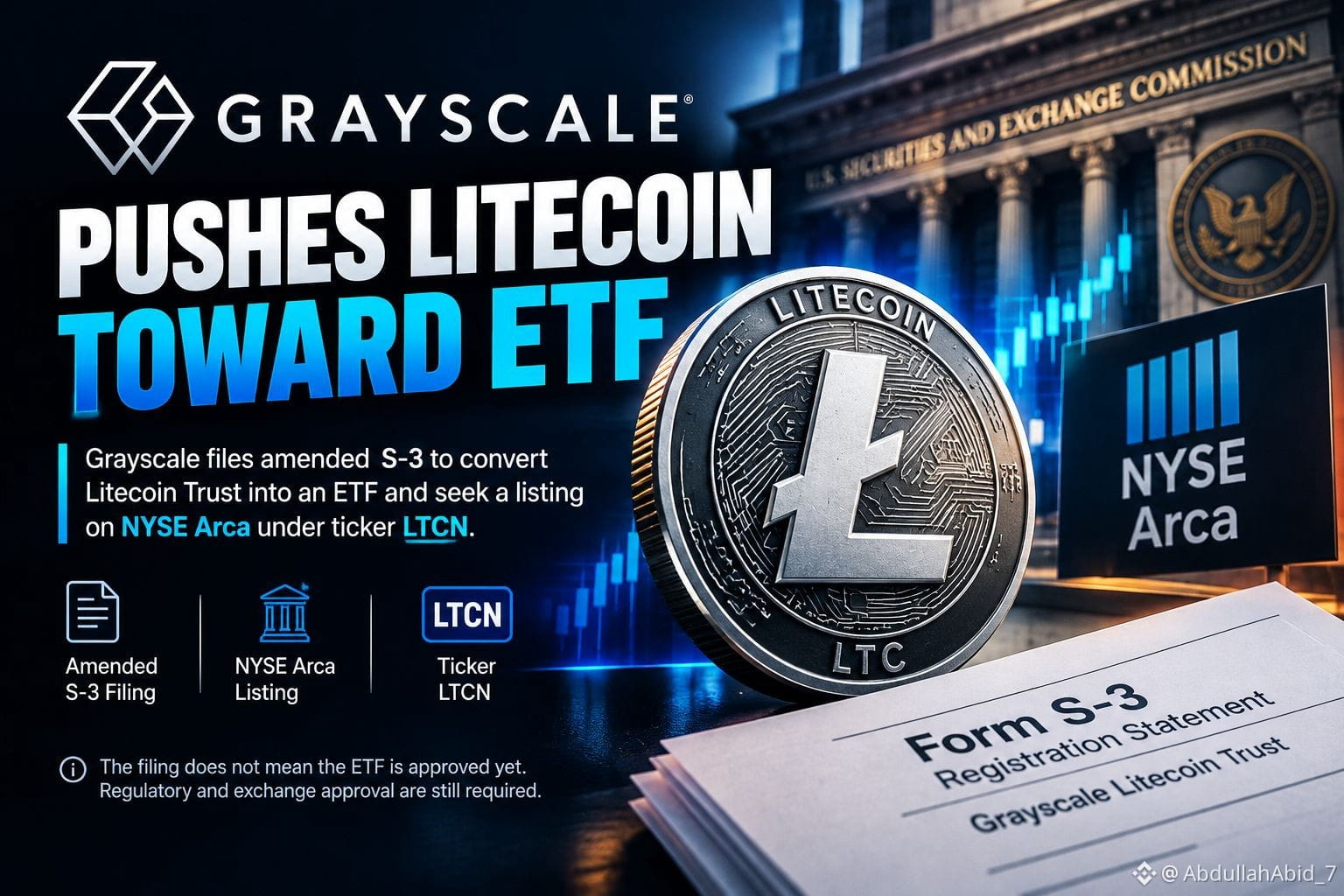
The asset manager filed an amended S-3 registration statement with the SEC on September 11, outlining plans to convert the existing Grayscale Litecoin Trust into an ETF-style product and seek a listing on NYSE Arca under the ticker LTCN.
The move could make Litecoin exposure easier for traditional investors through regular brokerage accounts, without requiring them to directly hold or transfer $LTC .
But there’s an important catch: the filing itself does not mean the ETF is approved yet. The NYSE Arca listing process and regulatory requirements still need to be completed.
Still, the development adds another interesting chapter to the growing crypto ETF story.
#Litecoin #LTC #SECReceivesGrayscaleLitecoinTrustETFFiling #Write2Earn #BinanceSquare $LTC.US
Grayscale is pushing its Litecoin Trust one step closer to Wall Street.
The asset manager filed an amended S-3 registration statement with the SEC on September 11, outlining plans to convert the existing Grayscale Litecoin Trust into an ETF-style product and seek a listing on NYSE Arca under the ticker LTCN.
The move could make Litecoin exposure easier for traditional investors through regular brokerage accounts, without requiring them to directly hold or transfer $LTC .
But there’s an important catch: the filing itself does not mean the ETF is approved yet. The NYSE Arca listing process and regulatory requirements still need to be completed.
Still, the development adds another interesting chapter to the growing crypto ETF story.
#Litecoin #LTC #SECReceivesGrayscaleLitecoinTrustETFFiling #Write2Earn #BinanceSquare $LTC .US
The asset manager filed an amended S-3 registration statement with the SEC on September 11, outlining plans to convert the existing Grayscale Litecoin Trust into an ETF-style product and seek a listing on NYSE Arca under the ticker LTCN.
The move could make Litecoin exposure easier for traditional investors through regular brokerage accounts, without requiring them to directly hold or transfer $LTC .
But there’s an important catch: the filing itself does not mean the ETF is approved yet. The NYSE Arca listing process and regulatory requirements still need to be completed.
Still, the development adds another interesting chapter to the growing crypto ETF story.
#Litecoin #LTC #SECReceivesGrayscaleLitecoinTrustETFFiling #Write2Earn #BinanceSquare $LTC .US
LTCUS+1.82%
89
🚨 $674M Crypto Liquidation Wave Hits the Market
Crypto traders just got another reminder of how dangerous leverage can be.
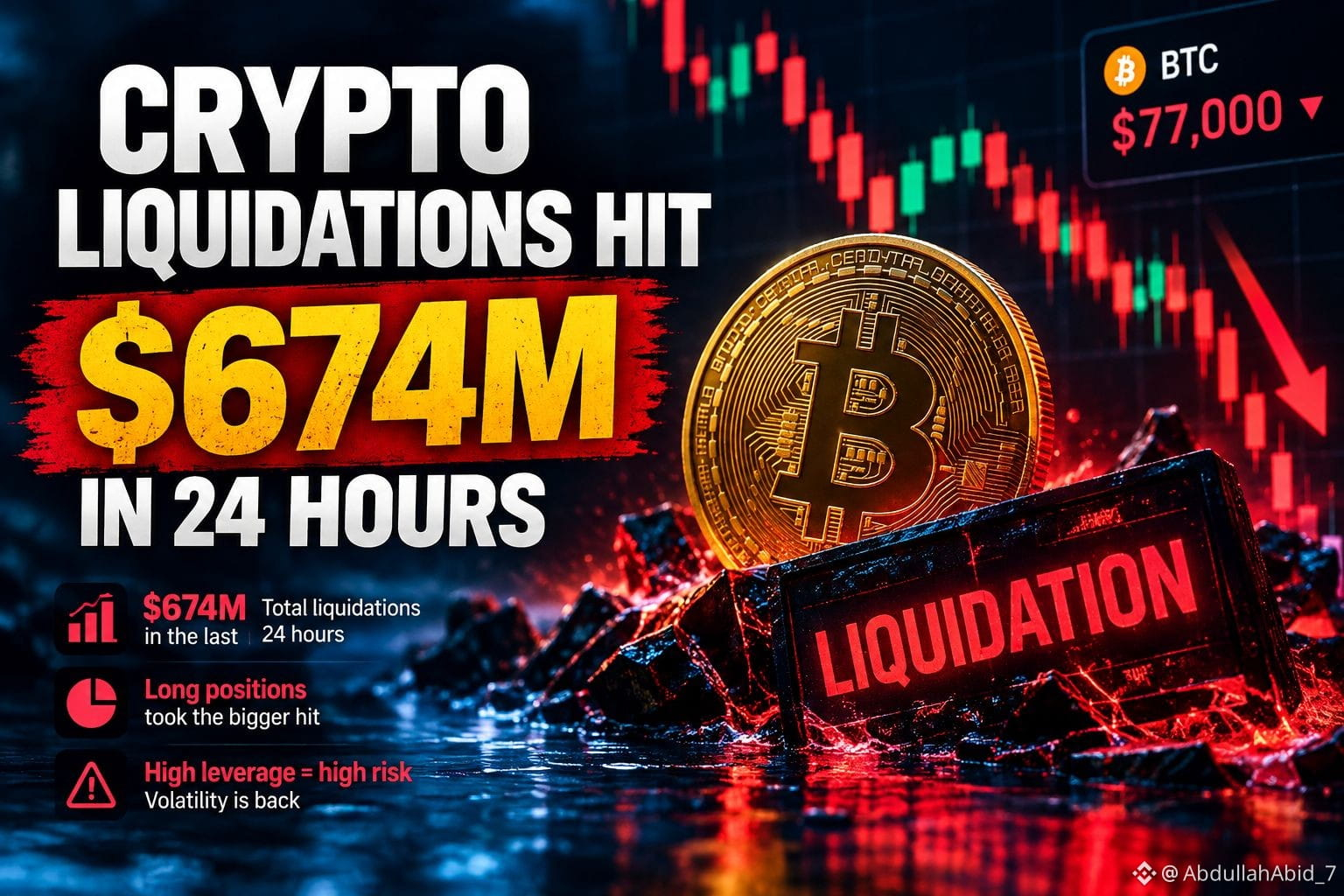
Around $674 million in leveraged positions were liquidated over the past 24 hours, according to CoinGlass data reported today. Long positions accounted for the larger share of the wipeout.
$BTC has been trading around the $77K area, while profit-taking, market volatility and shifting expectations around the Fed continue to pressure risk assets.
Liquidation events like this can quickly flush excessive leverage from the market—but they can also create even sharper price swings.
📉 High leverage = high risk
⚡ Volatility is back
👀 Traders are watching the next BTC move closely
#CryptoLiquidations$674MIn24H #RevolutConfirmsFakeGovEmailDataBreach #CanadaOSFISaysTokenizedDepositsEqualTraditionalDeposits #Write2Earn #BinanceSquare
🚨 $674M Crypto Liquidation Wave Hits the Market
Crypto traders just got another reminder of how dangerous leverage can be.
Around $674 million in leveraged positions were liquidated over the past 24 hours, according to CoinGlass data reported today. Long positions accounted for the larger share of the wipeout.
$BTC has been trading around the $77K area, while profit-taking, market volatility and shifting expectations around the Fed continue to pressure risk assets.
Liquidation events like this can quickly flush excessive leverage from the market—but they can also create even sharper price swings.
📉 High leverage = high risk
⚡ Volatility is back
👀 Traders are watching the next BTC move closely
#CryptoLiquidations$674MIn24H #RevolutConfirmsFakeGovEmailDataBreach #CanadaOSFISaysTokenizedDepositsEqualTraditionalDeposits #Write2Earn #BinanceSquare
Crypto traders just got another reminder of how dangerous leverage can be.
Around $674 million in leveraged positions were liquidated over the past 24 hours, according to CoinGlass data reported today. Long positions accounted for the larger share of the wipeout.
$BTC has been trading around the $77K area, while profit-taking, market volatility and shifting expectations around the Fed continue to pressure risk assets.
Liquidation events like this can quickly flush excessive leverage from the market—but they can also create even sharper price swings.
📉 High leverage = high risk
⚡ Volatility is back
👀 Traders are watching the next BTC move closely
#CryptoLiquidations$674MIn24H #RevolutConfirmsFakeGovEmailDataBreach #CanadaOSFISaysTokenizedDepositsEqualTraditionalDeposits #Write2Earn #BinanceSquare
1
1
194
Tencent-Backed Enflame Makes a Huge AI Chip Debut
China’s AI chip race just got another major spotlight.
Tencent-backed Enflame Technology has officially started trading on Shanghai’s STAR Market after raising around $912 million through its IPO. The company was valued at roughly $9.1 billion at the offering price.
And investors clearly came in bullish — Enflame’s shares surged 179% on their first trading day, pushing its market value to around $24 billion. 🚀
Enflame develops AI chips designed for training and inference, positioning itself as part of China’s growing push to reduce reliance on foreign chip suppliers.
But there’s an interesting risk here: Enflame is still loss-making, while Tencent accounted for more than 80% of its 2025 revenue.
#CPIWatch #TencentBackedEnflameToStartTradingAfter$911MIPO #tencent #Write2Earn #BinanceSquare $TENCENT
Tencent-Backed Enflame Makes a Huge AI Chip Debut
China’s AI chip race just got another major spotlight.
Tencent-backed Enflame Technology has officially started trading on Shanghai’s STAR Market after raising around $912 million through its IPO. The company was valued at roughly $9.1 billion at the offering price.
And investors clearly came in bullish — Enflame’s shares surged 179% on their first trading day, pushing its market value to around $24 billion. 🚀
Enflame develops AI chips designed for training and inference, positioning itself as part of China’s growing push to reduce reliance on foreign chip suppliers.
But there’s an interesting risk here: Enflame is still loss-making, while Tencent accounted for more than 80% of its 2025 revenue.
#CPIWatch #TencentBackedEnflameToStartTradingAfter$911MIPO #tencent #Write2Earn #BinanceSquare $TENCENT
China’s AI chip race just got another major spotlight.
Tencent-backed Enflame Technology has officially started trading on Shanghai’s STAR Market after raising around $912 million through its IPO. The company was valued at roughly $9.1 billion at the offering price.
And investors clearly came in bullish — Enflame’s shares surged 179% on their first trading day, pushing its market value to around $24 billion. 🚀
Enflame develops AI chips designed for training and inference, positioning itself as part of China’s growing push to reduce reliance on foreign chip suppliers.
But there’s an interesting risk here: Enflame is still loss-making, while Tencent accounted for more than 80% of its 2025 revenue.
#CPIWatch #TencentBackedEnflameToStartTradingAfter$911MIPO #tencent #Write2Earn #BinanceSquare $TENCENT

146
The confrontation around the Strait of Hormuz is intensifying after the U.S. struck three Iranian oil tankers following Iranian missile attacks targeting U.S. Navy vessels. Iran has since retaliated against tankers and U.S.-linked vessels.
The escalation is already affecting global energy markets. Tanker traffic through Hormuz has fallen sharply, while Brent crude climbed toward $100/barrel, raising concerns about a broader supply shock.
For crypto markets, the key risks are higher oil prices, inflation fears and renewed geopolitical volatility.
Watch: Oil prices, Bitcoin volatility, and developments around the Strait of Hormuz.
#USIranTradeTankerStrikesEscalate #ZcashRises45%WeeklyToHighestSince2016 #IMFSaysElSalvadorBTCNoPublicFunds #Write2Earn #USIran $CL $BTC
The confrontation around the Strait of Hormuz is intensifying after the U.S. struck three Iranian oil tankers following Iranian missile attacks targeting U.S. Navy vessels. Iran has since retaliated against tankers and U.S.-linked vessels.
The escalation is already affecting global energy markets. Tanker traffic through Hormuz has fallen sharply, while Brent crude climbed toward $100/barrel, raising concerns about a broader supply shock.
For crypto markets, the key risks are higher oil prices, inflation fears and renewed geopolitical volatility.
Watch: Oil prices, Bitcoin volatility, and developments around the Strait of Hormuz.
#USIranTradeTankerStrikesEscalate #ZcashRises45%WeeklyToHighestSince2016 #IMFSaysElSalvadorBTCNoPublicFunds #Write2Earn #USIran $CL $BTC
The escalation is already affecting global energy markets. Tanker traffic through Hormuz has fallen sharply, while Brent crude climbed toward $100/barrel, raising concerns about a broader supply shock.
For crypto markets, the key risks are higher oil prices, inflation fears and renewed geopolitical volatility.
Watch: Oil prices, Bitcoin volatility, and developments around the Strait of Hormuz.
#USIranTradeTankerStrikesEscalate #ZcashRises45%WeeklyToHighestSince2016 #IMFSaysElSalvadorBTCNoPublicFunds #Write2Earn #USIran $CL $BTC

1
68
Bitcoin is facing strong resistance around the $80,000–$82,000 zone after its sharp August rally. $BTC is currently trading around $77.8K, with sellers repeatedly defending the psychological $80K level.
A sustained breakout above $80K–$82K could open the door toward $85K and potentially $90K. On the downside, losing $75.7K–$71.8K would weaken the bullish structure and increase correction risk.
Key levels:
🔹 Resistance: $80K–$82K
🔹 Breakout target: $85K → $90K
🔹 Support: $75.7K → $71.8K
The big question: Can $BTC finally turn $80K from resistance into support?
#Bitcoin #BTC #BitcoinStrugglesToBreakAbove$80K #Write2Earn #writetoearn
Bitcoin is facing strong resistance around the $80,000–$82,000 zone after its sharp August rally. $BTC is currently trading around $77.8K, with sellers repeatedly defending the psychological $80K level.
A sustained breakout above $80K–$82K could open the door toward $85K and potentially $90K. On the downside, losing $75.7K–$71.8K would weaken the bullish structure and increase correction risk.
Key levels:
🔹 Resistance: $80K–$82K
🔹 Breakout target: $85K → $90K
🔹 Support: $75.7K → $71.8K
The big question: Can $BTC finally turn $80K from resistance into support?
#Bitcoin #BTC #BitcoinStrugglesToBreakAbove$80K #Write2Earn #writetoearn
A sustained breakout above $80K–$82K could open the door toward $85K and potentially $90K. On the downside, losing $75.7K–$71.8K would weaken the bullish structure and increase correction risk.
Key levels:
🔹 Resistance: $80K–$82K
🔹 Breakout target: $85K → $90K
🔹 Support: $75.7K → $71.8K
The big question: Can $BTC finally turn $80K from resistance into support?
#Bitcoin #BTC #BitcoinStrugglesToBreakAbove$80K #Write2Earn #writetoearn
1
435
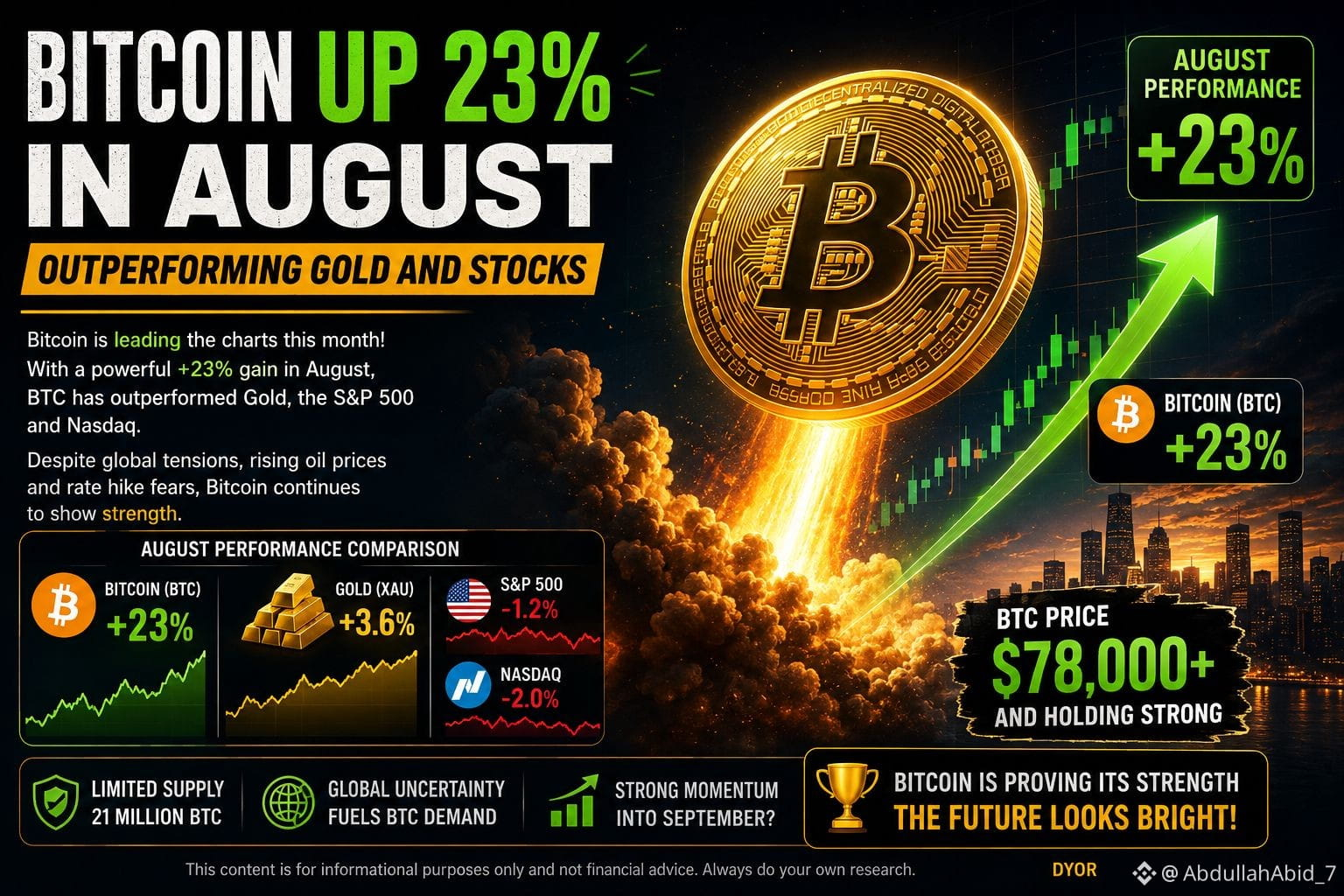
Bitcoin is closing out August with a strong performance, gaining around 23% this month and outperforming both gold and major stock indexes.
$BTC ’s resilience is especially notable as global markets face renewed geopolitical tensions, rising oil prices and uncertainty around U.S. interest rates.
While gold remains a major safe-haven asset and stocks continue to face macro pressure, Bitcoin has managed to hold near the $78K area.
The big question now: Can Bitcoin carry this momentum into September?
#BitcoinUp23%InAugustOutperformingGoldAndStocks #BitcoinHolds$78K #bitcoin #Write2Earn #BinanceSquare
Bitcoin is closing out August with a strong performance, gaining around 23% this month and outperforming both gold and major stock indexes.
$BTC ’s resilience is especially notable as global markets face renewed geopolitical tensions, rising oil prices and uncertainty around U.S. interest rates.
While gold remains a major safe-haven asset and stocks continue to face macro pressure, Bitcoin has managed to hold near the $78K area.
The big question now: Can Bitcoin carry this momentum into September?
#BitcoinUp23%InAugustOutperformingGoldAndStocks #BitcoinHolds$78K #bitcoin #Write2Earn #BinanceSquare
$BTC ’s resilience is especially notable as global markets face renewed geopolitical tensions, rising oil prices and uncertainty around U.S. interest rates.
While gold remains a major safe-haven asset and stocks continue to face macro pressure, Bitcoin has managed to hold near the $78K area.
The big question now: Can Bitcoin carry this momentum into September?
#BitcoinUp23%InAugustOutperformingGoldAndStocks #BitcoinHolds$78K #bitcoin #Write2Earn #BinanceSquare
77
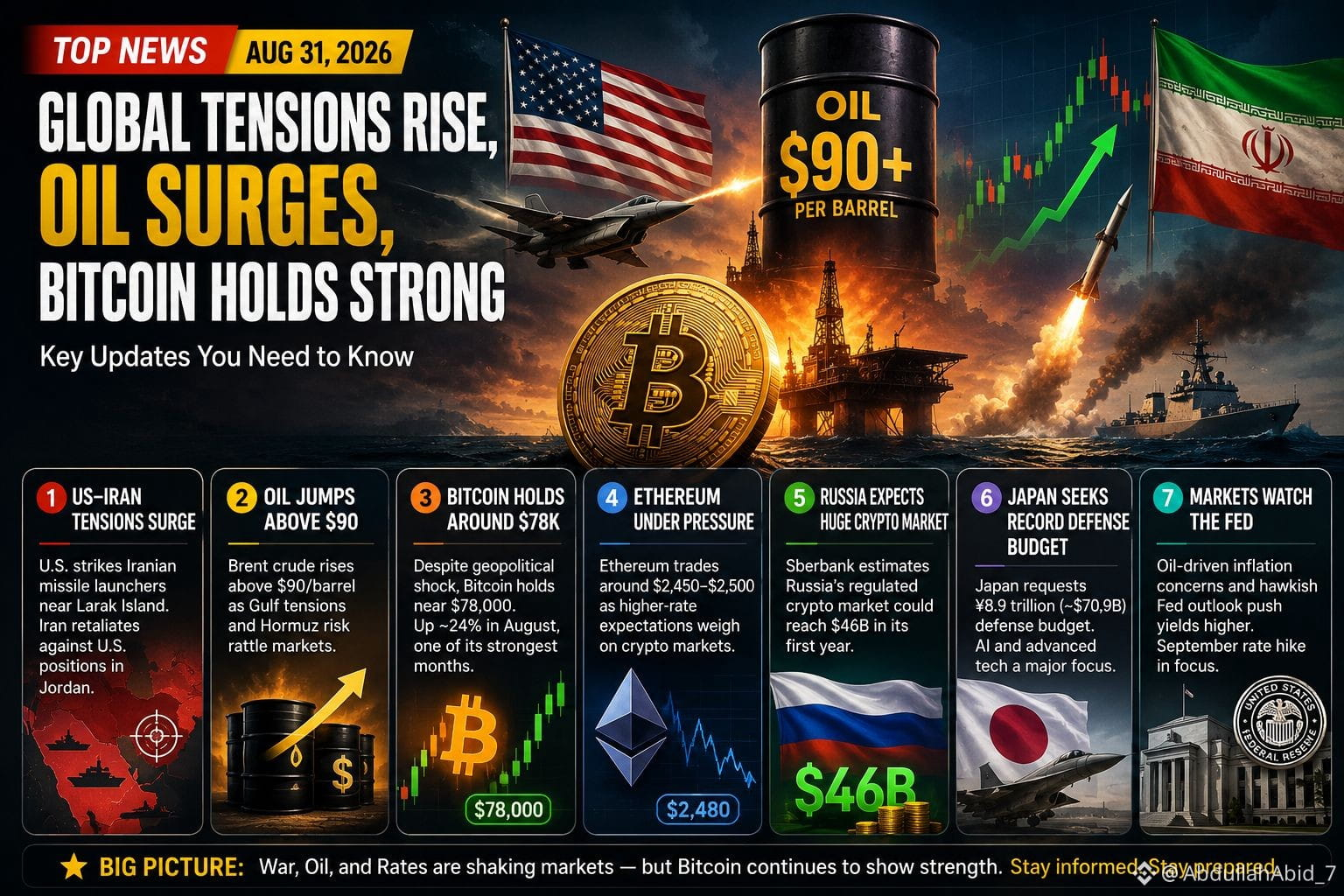
Here are the biggest global + crypto news stories right now (Aug 31, 2026):
🔥 1. US–Iran tensions surge again
U.S. forces struck Iranian missile launchers around Larak Island, while Iran launched retaliatory attacks toward U.S. positions in Jordan. The renewed fighting is putting the Strait of Hormuz back in focus.
🛢️ 2. Oil ($CL ) jumps above $90
Brent crude moved above $90/barrel as markets reacted to the renewed Gulf tensions and concerns over shipping through Hormuz.
₿ 3. Bitcoin holds around $78K
Despite the geopolitical shock and broader risk-off sentiment, Bitcoin is holding near $78,000. $BTC is reportedly up roughly 24% during August, making it one of its strongest monthly performances in a while.
📉 4. Ethereum under pressure
$ETH is trading around the $2,450–$2,500 area, with higher-rate expectations weighing on crypto markets.
🇷🇺 5. Russia expects huge regulated crypto market
Sberbank estimates Russia's newly regulated crypto trading market could reach around $46 billion in its first year, potentially growing significantly afterward.
🇯🇵 6. Japan seeks record defense budget
Japan's Defense Ministry requested a record ¥8.9 trillion (~$70.9B) defense budget, with artificial intelligence becoming a major focus.
📊 7. Markets watching the Fed
Oil-driven inflation concerns and a hawkish Federal Reserve outlook are pushing bond yields higher. Markets are increasingly pricing in a possible September U.S. rate hike, while upcoming U.S. jobs and inflation data could be crucial for crypto.
🔥 Best Binance Square topic right now:
“Bitcoin Holds $78K as Oil Surges Above $90 Amid US-Iran Escalation” — strong combination of Bitcoin + war + oil + macro, which should have good engagement potential.
#BitcoinHolds$78K #SaylorHintsStrategyBitcoinBuy #IranStrikesUSBasesInJordan #Write2Earn #BinanceSquare
Here are the biggest global + crypto news stories right now (Aug 31, 2026):
🔥 1. US–Iran tensions surge again
U.S. forces struck Iranian missile launchers around Larak Island, while Iran launched retaliatory attacks toward U.S. positions in Jordan. The renewed fighting is putting the Strait of Hormuz back in focus.
🛢️ 2. Oil ($CL ) jumps above $90
Brent crude moved above $90/barrel as markets reacted to the renewed Gulf tensions and concerns over shipping through Hormuz.
₿ 3. Bitcoin holds around $78K
Despite the geopolitical shock and broader risk-off sentiment, Bitcoin is holding near $78,000. $BTC is reportedly up roughly 24% during August, making it one of its strongest monthly performances in a while.
📉 4. Ethereum under pressure
$ETH is trading around the $2,450–$2,500 area, with higher-rate expectations weighing on crypto markets.
🇷🇺 5. Russia expects huge regulated crypto market
Sberbank estimates Russia's newly regulated crypto trading market could reach around $46 billion in its first year, potentially growing significantly afterward.
🇯🇵 6. Japan seeks record defense budget
Japan's Defense Ministry requested a record ¥8.9 trillion (~$70.9B) defense budget, with artificial intelligence becoming a major focus.
📊 7. Markets watching the Fed
Oil-driven inflation concerns and a hawkish Federal Reserve outlook are pushing bond yields higher. Markets are increasingly pricing in a possible September U.S. rate hike, while upcoming U.S. jobs and inflation data could be crucial for crypto.
🔥 Best Binance Square topic right now:
“Bitcoin Holds $78K as Oil Surges Above $90 Amid US-Iran Escalation” — strong combination of Bitcoin + war + oil + macro, which should have good engagement potential.
#BitcoinHolds$78K #SaylorHintsStrategyBitcoinBuy #IranStrikesUSBasesInJordan #Write2Earn #BinanceSquare
🔥 1. US–Iran tensions surge again
U.S. forces struck Iranian missile launchers around Larak Island, while Iran launched retaliatory attacks toward U.S. positions in Jordan. The renewed fighting is putting the Strait of Hormuz back in focus.
🛢️ 2. Oil ($CL ) jumps above $90
Brent crude moved above $90/barrel as markets reacted to the renewed Gulf tensions and concerns over shipping through Hormuz.
₿ 3. Bitcoin holds around $78K
Despite the geopolitical shock and broader risk-off sentiment, Bitcoin is holding near $78,000. $BTC is reportedly up roughly 24% during August, making it one of its strongest monthly performances in a while.
📉 4. Ethereum under pressure
$ETH is trading around the $2,450–$2,500 area, with higher-rate expectations weighing on crypto markets.
🇷🇺 5. Russia expects huge regulated crypto market
Sberbank estimates Russia's newly regulated crypto trading market could reach around $46 billion in its first year, potentially growing significantly afterward.
🇯🇵 6. Japan seeks record defense budget
Japan's Defense Ministry requested a record ¥8.9 trillion (~$70.9B) defense budget, with artificial intelligence becoming a major focus.
📊 7. Markets watching the Fed
Oil-driven inflation concerns and a hawkish Federal Reserve outlook are pushing bond yields higher. Markets are increasingly pricing in a possible September U.S. rate hike, while upcoming U.S. jobs and inflation data could be crucial for crypto.
🔥 Best Binance Square topic right now:
“Bitcoin Holds $78K as Oil Surges Above $90 Amid US-Iran Escalation” — strong combination of Bitcoin + war + oil + macro, which should have good engagement potential.
#BitcoinHolds$78K #SaylorHintsStrategyBitcoinBuy #IranStrikesUSBasesInJordan #Write2Earn #BinanceSquare
154
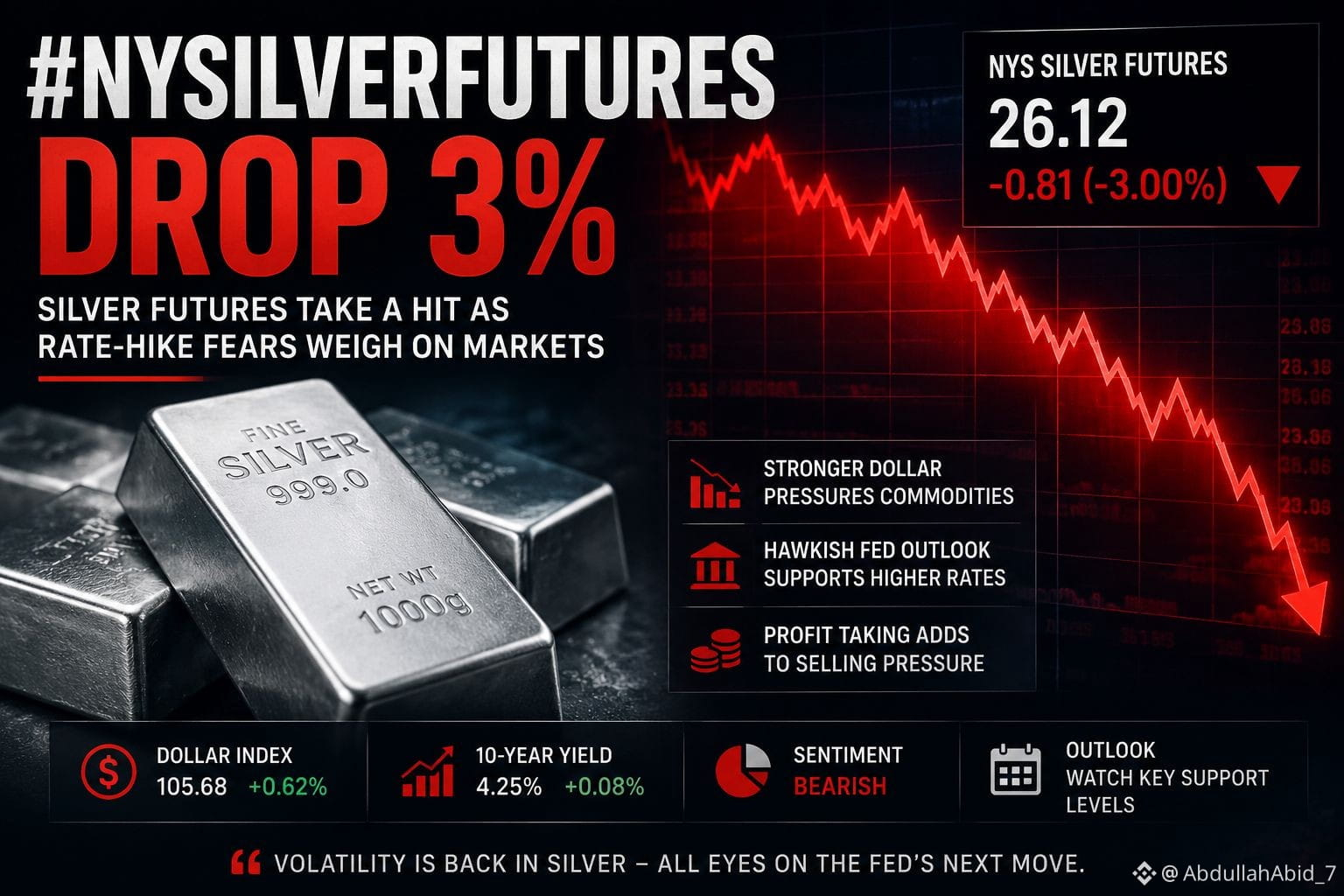
Silver futures are facing fresh selling pressure, dropping around 3% as traders reassess the outlook for interest rates and the broader commodities market.
The decline highlights how sensitive silver remains to changes in the U.S. dollar, bond yields, and Federal Reserve expectations. After a strong run, some traders may also be taking profits, adding to the downward pressure.
The key question now is whether this is simply a short-term correction or the beginning of a deeper pullback. Traders will be watching support levels closely for signs of stabilization.
Volatility is back in silver — and the next few sessions could be important.
#Silver #XAGUSD #NYSilver $XAG $SOL
#NYSilverFuturesDrop3% #Write2Earn
Silver futures are facing fresh selling pressure, dropping around 3% as traders reassess the outlook for interest rates and the broader commodities market.
The decline highlights how sensitive silver remains to changes in the U.S. dollar, bond yields, and Federal Reserve expectations. After a strong run, some traders may also be taking profits, adding to the downward pressure.
The key question now is whether this is simply a short-term correction or the beginning of a deeper pullback. Traders will be watching support levels closely for signs of stabilization.
Volatility is back in silver — and the next few sessions could be important.
#Silver #XAGUSD #NYSilver $XAG $SOL
#NYSilverFuturesDrop3% #Write2Earn
The decline highlights how sensitive silver remains to changes in the U.S. dollar, bond yields, and Federal Reserve expectations. After a strong run, some traders may also be taking profits, adding to the downward pressure.
The key question now is whether this is simply a short-term correction or the beginning of a deeper pullback. Traders will be watching support levels closely for signs of stabilization.
Volatility is back in silver — and the next few sessions could be important.
#Silver #XAGUSD #NYSilver $XAG $SOL
#NYSilverFuturesDrop3% #Write2Earn
114
Article
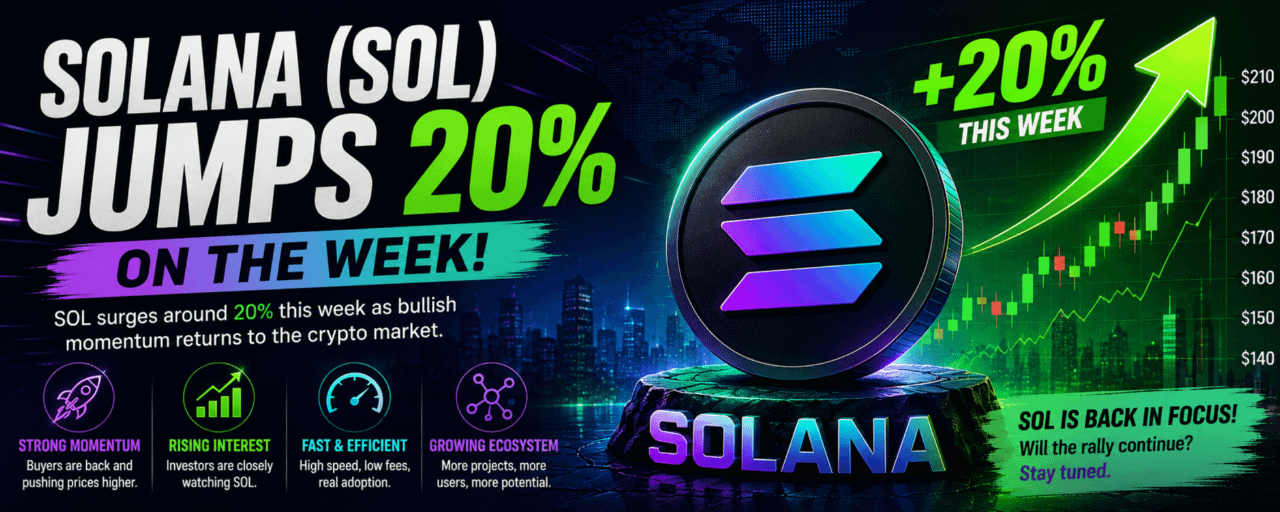
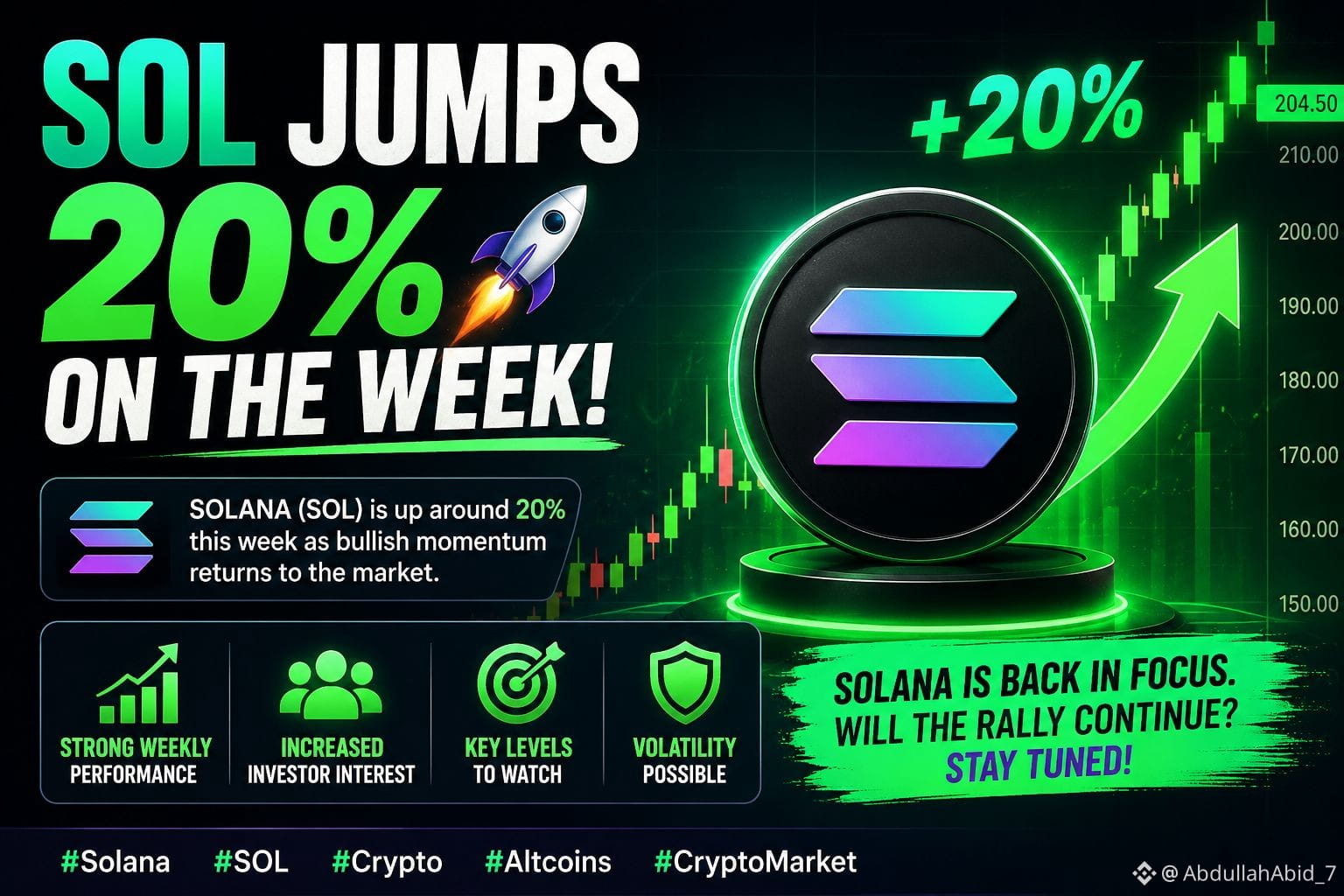
Solana (SOL) Jumps 20% in a Week as Bullish Momentum ReturnsSolana ($SOL ) has made a strong move this week, gaining around 20% and once again capturing the attention of the crypto market. The rally comes as bullish momentum returns to major cryptocurrencies and investors begin looking more closely at high-potential altcoins.
After experiencing periods of volatility, $SOL has shown that buying interest remains strong. A 20% weekly increase is significant, especially for one of the largest cryptocurrencies in the market. The move suggests that traders are becoming increasingly optimistic about Solana's short-term momentum.
One reason Solana continues to attract attention is its position as a major blockchain ecosystem. Its fast transactions, relatively low fees, and growing ecosystem have helped $SOL remain one of the most closely watched altcoins in the crypto space.
However, a rapid price increase also brings the possibility of short-term profit-taking. Traders who entered at lower levels may decide to secure profits, which could create temporary volatility or a price correction.
The next phase for SOL will depend heavily on whether the broader crypto market can maintain its positive momentum. If buying pressure continues and key support levels hold, Solana could remain on traders' watchlists for a potential continuation of the rally.
For now, the message from the market is clear: SOL is back in focus. After jumping 20% in just one week, the big question is whether this is the beginning of a larger bullish move or simply a strong short-term rally.
Investors and traders will be watching Solana closely in the coming days. Solana #SOLJumps20%OnTheWeek #Write2Earn #Crypto #Altcoins #CryptoMarket
Solana (SOL) Jumps 20% in a Week as Bullish Momentum Returns
Solana ($SOL ) has made a strong move this week, gaining around 20% and once again capturing the attention of the crypto market. The rally comes as bullish momentum returns to major cryptocurrencies and investors begin looking more closely at high-potential altcoins.
After experiencing periods of volatility, $SOL has shown that buying interest remains strong. A 20% weekly increase is significant, especially for one of the largest cryptocurrencies in the market. The move suggests that traders are becoming increasingly optimistic about Solana's short-term momentum.
One reason Solana continues to attract attention is its position as a major blockchain ecosystem. Its fast transactions, relatively low fees, and growing ecosystem have helped $SOL remain one of the most closely watched altcoins in the crypto space.
However, a rapid price increase also brings the possibility of short-term profit-taking. Traders who entered at lower levels may decide to secure profits, which could create temporary volatility or a price correction.
The next phase for SOL will depend heavily on whether the broader crypto market can maintain its positive momentum. If buying pressure continues and key support levels hold, Solana could remain on traders' watchlists for a potential continuation of the rally.
For now, the message from the market is clear: SOL is back in focus. After jumping 20% in just one week, the big question is whether this is the beginning of a larger bullish move or simply a strong short-term rally.
Investors and traders will be watching Solana closely in the coming days. Solana #SOLJumps20%OnTheWeek #Write2Earn #Crypto #Altcoins #CryptoMarket
After experiencing periods of volatility, $SOL has shown that buying interest remains strong. A 20% weekly increase is significant, especially for one of the largest cryptocurrencies in the market. The move suggests that traders are becoming increasingly optimistic about Solana's short-term momentum.
One reason Solana continues to attract attention is its position as a major blockchain ecosystem. Its fast transactions, relatively low fees, and growing ecosystem have helped $SOL remain one of the most closely watched altcoins in the crypto space.
However, a rapid price increase also brings the possibility of short-term profit-taking. Traders who entered at lower levels may decide to secure profits, which could create temporary volatility or a price correction.
The next phase for SOL will depend heavily on whether the broader crypto market can maintain its positive momentum. If buying pressure continues and key support levels hold, Solana could remain on traders' watchlists for a potential continuation of the rally.
For now, the message from the market is clear: SOL is back in focus. After jumping 20% in just one week, the big question is whether this is the beginning of a larger bullish move or simply a strong short-term rally.
Investors and traders will be watching Solana closely in the coming days. Solana #SOLJumps20%OnTheWeek #Write2Earn #Crypto #Altcoins #CryptoMarket
64
Solana ($SOL ) has delivered a strong performance this week, climbing around 20% as bullish momentum returns to the crypto market. The move has pushed SOL back into the spotlight, with increased investor interest and traders closely watching the next major resistance levels.
A 20% weekly gain shows that buyers are actively stepping in, but the key question now is whether Solana can maintain this momentum. If the broader crypto market remains supportive, $SOL could continue attracting attention and potentially extend its rally.
However, after such a sharp move, short-term volatility and profit-taking are also possible.
For now, Solana remains one of the major altcoins to watch. Will $SOL continue its rally, or is a correction coming next?
#solana #Crypto #Altcoins #SOLJumps20%OnTheWeek #Write2Earn
Solana ($SOL ) has delivered a strong performance this week, climbing around 20% as bullish momentum returns to the crypto market. The move has pushed SOL back into the spotlight, with increased investor interest and traders closely watching the next major resistance levels.
A 20% weekly gain shows that buyers are actively stepping in, but the key question now is whether Solana can maintain this momentum. If the broader crypto market remains supportive, $SOL could continue attracting attention and potentially extend its rally.
However, after such a sharp move, short-term volatility and profit-taking are also possible.
For now, Solana remains one of the major altcoins to watch. Will $SOL continue its rally, or is a correction coming next?
#solana #Crypto #Altcoins #SOLJumps20%OnTheWeek #Write2Earn
A 20% weekly gain shows that buyers are actively stepping in, but the key question now is whether Solana can maintain this momentum. If the broader crypto market remains supportive, $SOL could continue attracting attention and potentially extend its rally.
However, after such a sharp move, short-term volatility and profit-taking are also possible.
For now, Solana remains one of the major altcoins to watch. Will $SOL continue its rally, or is a correction coming next?
#solana #Crypto #Altcoins #SOLJumps20%OnTheWeek #Write2Earn
81
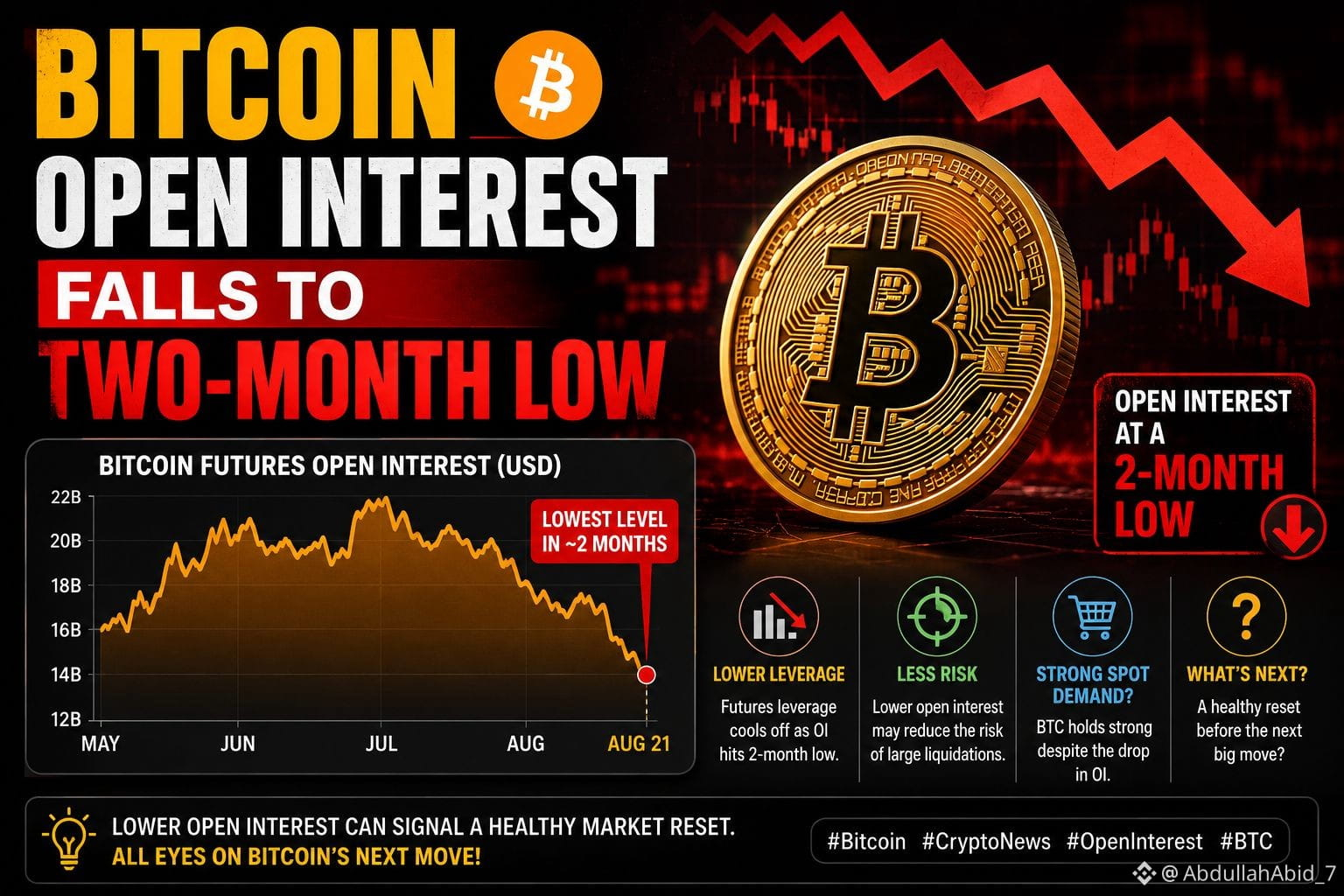
Bitcoin Open Interest Falls to a Two-Month Low
Bitcoin’s futures market is seeing a major leverage reset as open interest drops to its lowest level in around two months.
Interestingly, $BTC has remained strong despite the decline in leveraged positions, suggesting recent price action may be driven more by spot demand than excessive speculation. A lower open interest can also reduce the risk of another large liquidation cascade.
The key question now: Is this a healthy reset before Bitcoin’s next move? 👀
#bitcoin #BTC #CryptoNew #BitcoinOpenInterestFallsToTwoMonthLow #Write2Earn
Bitcoin Open Interest Falls to a Two-Month Low
Bitcoin’s futures market is seeing a major leverage reset as open interest drops to its lowest level in around two months.
Interestingly, $BTC has remained strong despite the decline in leveraged positions, suggesting recent price action may be driven more by spot demand than excessive speculation. A lower open interest can also reduce the risk of another large liquidation cascade.
The key question now: Is this a healthy reset before Bitcoin’s next move? 👀
#bitcoin #BTC #CryptoNew #BitcoinOpenInterestFallsToTwoMonthLow #Write2Earn
Bitcoin’s futures market is seeing a major leverage reset as open interest drops to its lowest level in around two months.
Interestingly, $BTC has remained strong despite the decline in leveraged positions, suggesting recent price action may be driven more by spot demand than excessive speculation. A lower open interest can also reduce the risk of another large liquidation cascade.
The key question now: Is this a healthy reset before Bitcoin’s next move? 👀
#bitcoin #BTC #CryptoNew #BitcoinOpenInterestFallsToTwoMonthLow #Write2Earn
94
🚨 Stablecoin Rules May Be Expanding!
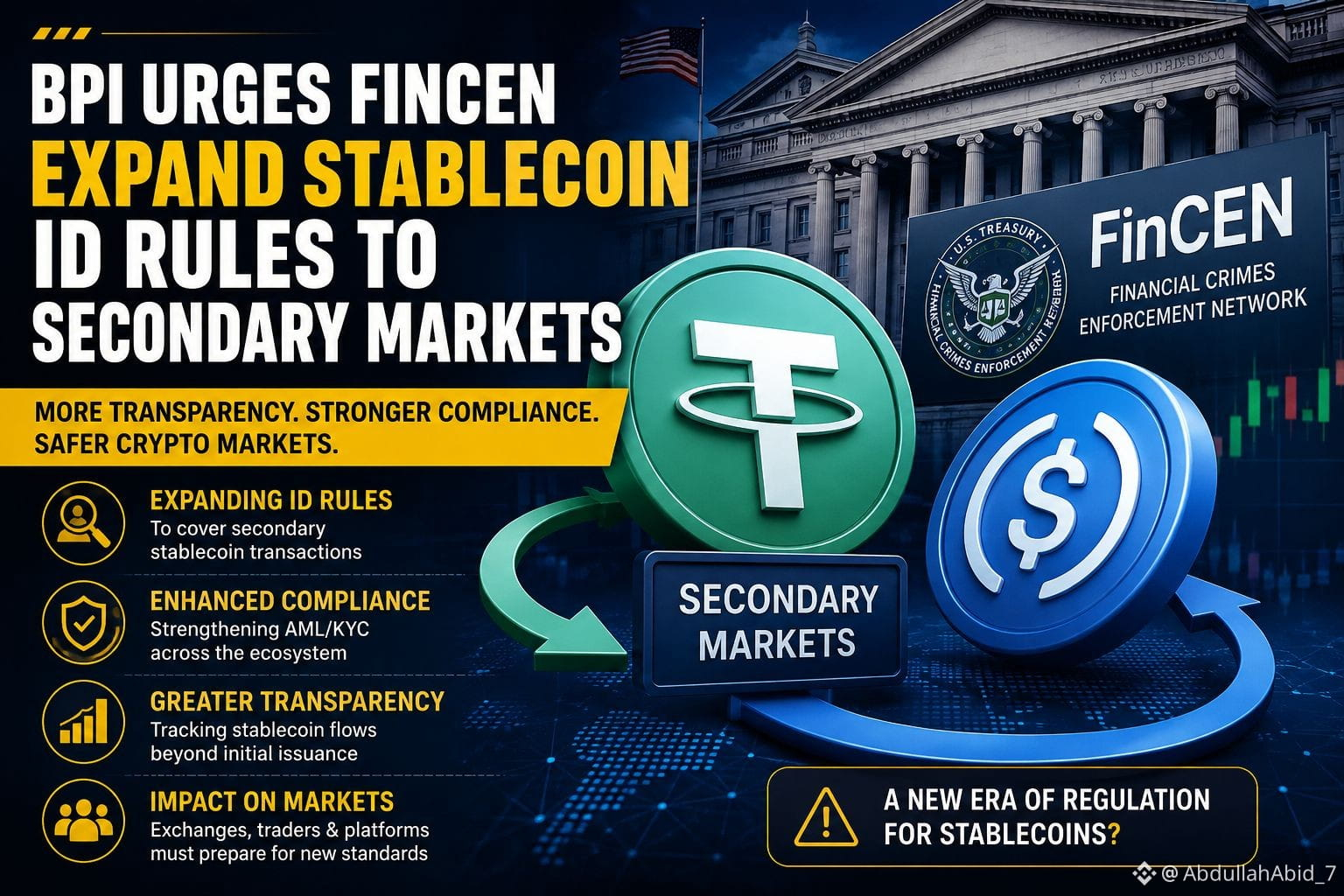
The Blockchain Payments Institute (BPI) is urging FinCEN to extend stablecoin ID and compliance rules into secondary markets.
The move could mean stricter monitoring of stablecoin transfers beyond their initial issuance, potentially reshaping how exchanges, traders, and crypto platforms handle compliance.
If regulators move forward, stablecoin markets could face a new era of transparency and oversight. 👀
#Stablecoins #Write2Earn #FinCEN #BPIUrgesFinCENExpandStablecoinIDRulesToSecondaryMarkets #NvidiaAIServerPricesRiseOver15% $NVDAB $BTC $BNB
🚨 Stablecoin Rules May Be Expanding!
The Blockchain Payments Institute (BPI) is urging FinCEN to extend stablecoin ID and compliance rules into secondary markets.
The move could mean stricter monitoring of stablecoin transfers beyond their initial issuance, potentially reshaping how exchanges, traders, and crypto platforms handle compliance.
If regulators move forward, stablecoin markets could face a new era of transparency and oversight. 👀
#Stablecoins #Write2Earn #FinCEN #BPIUrgesFinCENExpandStablecoinIDRulesToSecondaryMarkets #NvidiaAIServerPricesRiseOver15% $NVDAB $BTC $BNB
The Blockchain Payments Institute (BPI) is urging FinCEN to extend stablecoin ID and compliance rules into secondary markets.
The move could mean stricter monitoring of stablecoin transfers beyond their initial issuance, potentially reshaping how exchanges, traders, and crypto platforms handle compliance.
If regulators move forward, stablecoin markets could face a new era of transparency and oversight. 👀
#Stablecoins #Write2Earn #FinCEN #BPIUrgesFinCENExpandStablecoinIDRulesToSecondaryMarkets #NvidiaAIServerPricesRiseOver15% $NVDAB $BTC $BNB
1
133
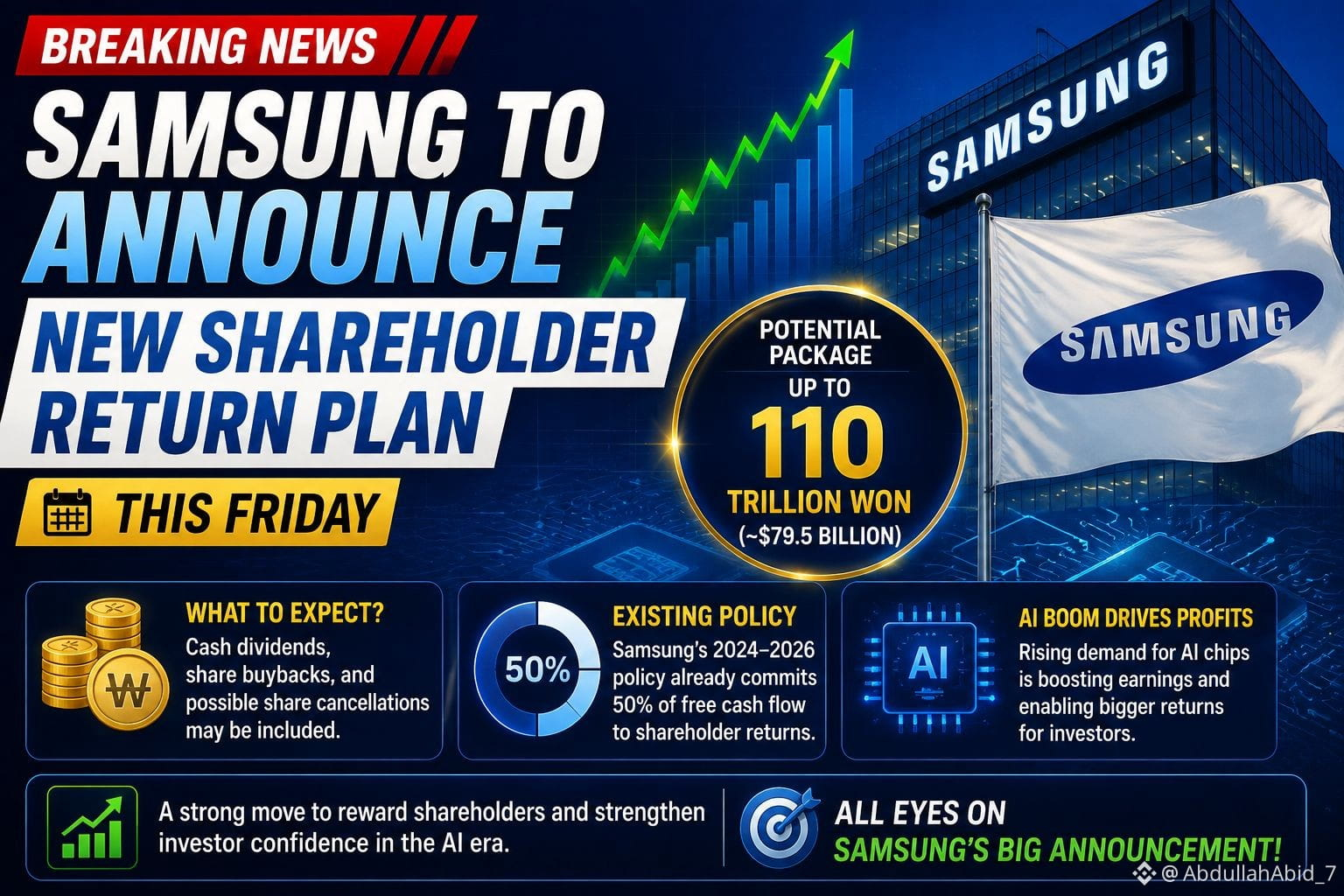
🚨 SAMSUNG SET FOR MAJOR SHAREHOLDER RETURN PLAN!
Samsung Electronics is set to announce a new shareholder return package, with reports suggesting it could be worth up to 110 trillion won ($79.5 billion). The plan comes as the AI-driven semiconductor boom boosts profits and increases pressure on major chipmakers to return more cash to investors.
The package could include cash dividends, share buybacks, and possible share cancellations. Samsung’s existing 2024–2026 policy already commits 50% of free cash flow to shareholder returns.
📈 Investors will be watching closely to see how this massive return plan impacts Samsung shares and the wider AI chip market.
#SamsungToAnnounceNewShareholderReturnPlanFriday #Aİ #StockMarket #TechNews #Investing
🚨 SAMSUNG SET FOR MAJOR SHAREHOLDER RETURN PLAN!
Samsung Electronics is set to announce a new shareholder return package, with reports suggesting it could be worth up to 110 trillion won ($79.5 billion). The plan comes as the AI-driven semiconductor boom boosts profits and increases pressure on major chipmakers to return more cash to investors.
The package could include cash dividends, share buybacks, and possible share cancellations. Samsung’s existing 2024–2026 policy already commits 50% of free cash flow to shareholder returns.
📈 Investors will be watching closely to see how this massive return plan impacts Samsung shares and the wider AI chip market.
#SamsungToAnnounceNewShareholderReturnPlanFriday #Aİ #StockMarket #TechNews #Investing
Samsung Electronics is set to announce a new shareholder return package, with reports suggesting it could be worth up to 110 trillion won ($79.5 billion). The plan comes as the AI-driven semiconductor boom boosts profits and increases pressure on major chipmakers to return more cash to investors.
The package could include cash dividends, share buybacks, and possible share cancellations. Samsung’s existing 2024–2026 policy already commits 50% of free cash flow to shareholder returns.
📈 Investors will be watching closely to see how this massive return plan impacts Samsung shares and the wider AI chip market.
#SamsungToAnnounceNewShareholderReturnPlanFriday #Aİ #StockMarket #TechNews #Investing
75
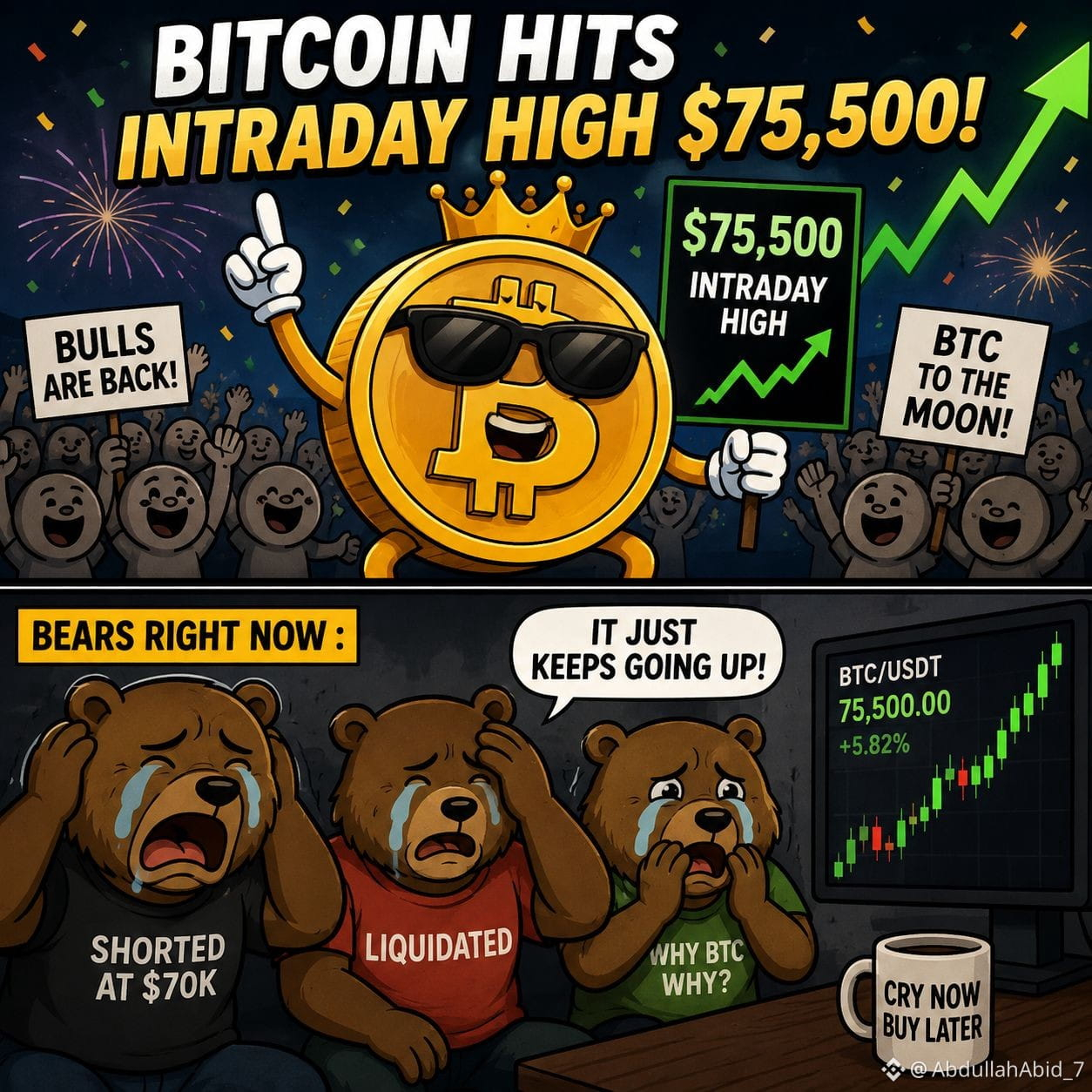
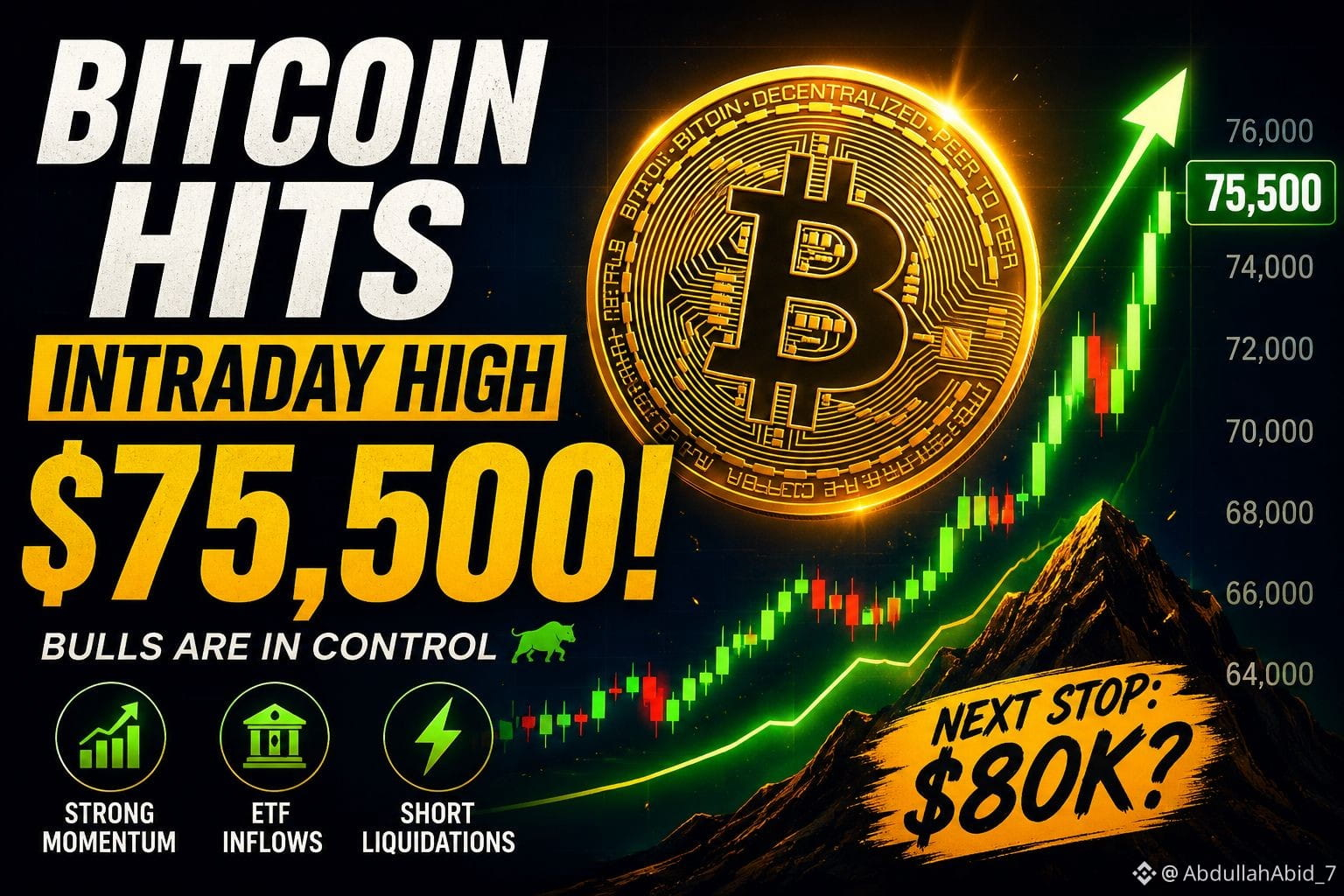
🚨 BITCOIN HITS $75,500 INTRADAY HIGH!
Bitcoin is showing strong bullish momentum as $BTC pushed above the $75,000 level for the first time in more than three months. The rally has been supported by strong market momentum, institutional ETF inflows and a wave of short liquidations.
Now the key question is whether $75K can turn into strong support. If $BTC holds the Controlis level, bulls may start targeting even higher psychological price zones.
👀 Will Bitcoin continue the rally or face a pullback after this massive move?
#BitcoinHitsIntradayHigh$75500 #BTC #Crypto #Write2Earn
🚨 BITCOIN HITS $75,500 INTRADAY HIGH!
Bitcoin is showing strong bullish momentum as $BTC pushed above the $75,000 level for the first time in more than three months. The rally has been supported by strong market momentum, institutional ETF inflows and a wave of short liquidations.
Now the key question is whether $75K can turn into strong support. If $BTC holds the Controlis level, bulls may start targeting even higher psychological price zones.
👀 Will Bitcoin continue the rally or face a pullback after this massive move?
#BitcoinHitsIntradayHigh$75500 #BTC #Crypto #Write2Earn
Bitcoin is showing strong bullish momentum as $BTC pushed above the $75,000 level for the first time in more than three months. The rally has been supported by strong market momentum, institutional ETF inflows and a wave of short liquidations.
Now the key question is whether $75K can turn into strong support. If $BTC holds the Controlis level, bulls may start targeting even higher psychological price zones.
👀 Will Bitcoin continue the rally or face a pullback after this massive move?
#BitcoinHitsIntradayHigh$75500 #BTC #Crypto #Write2Earn
121
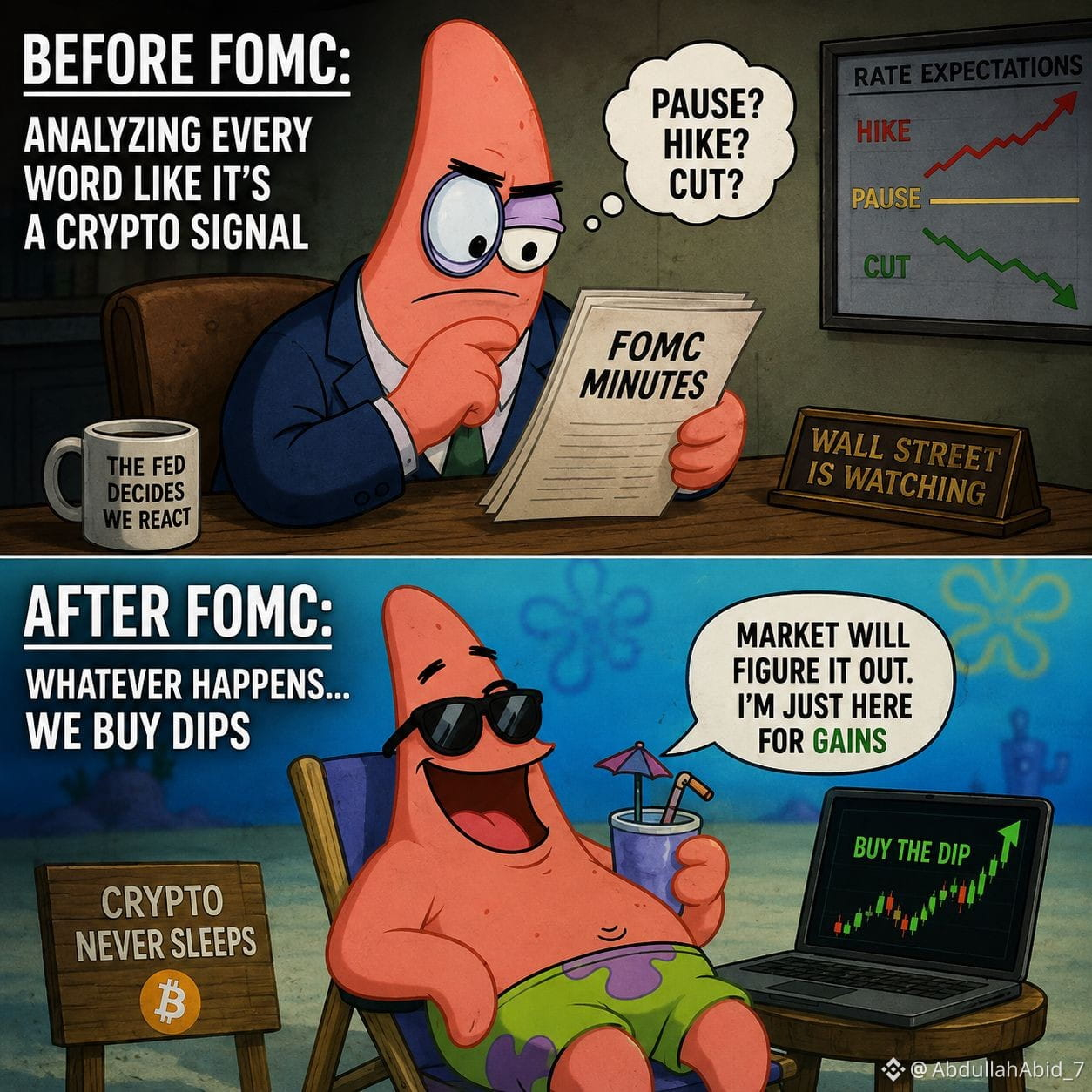
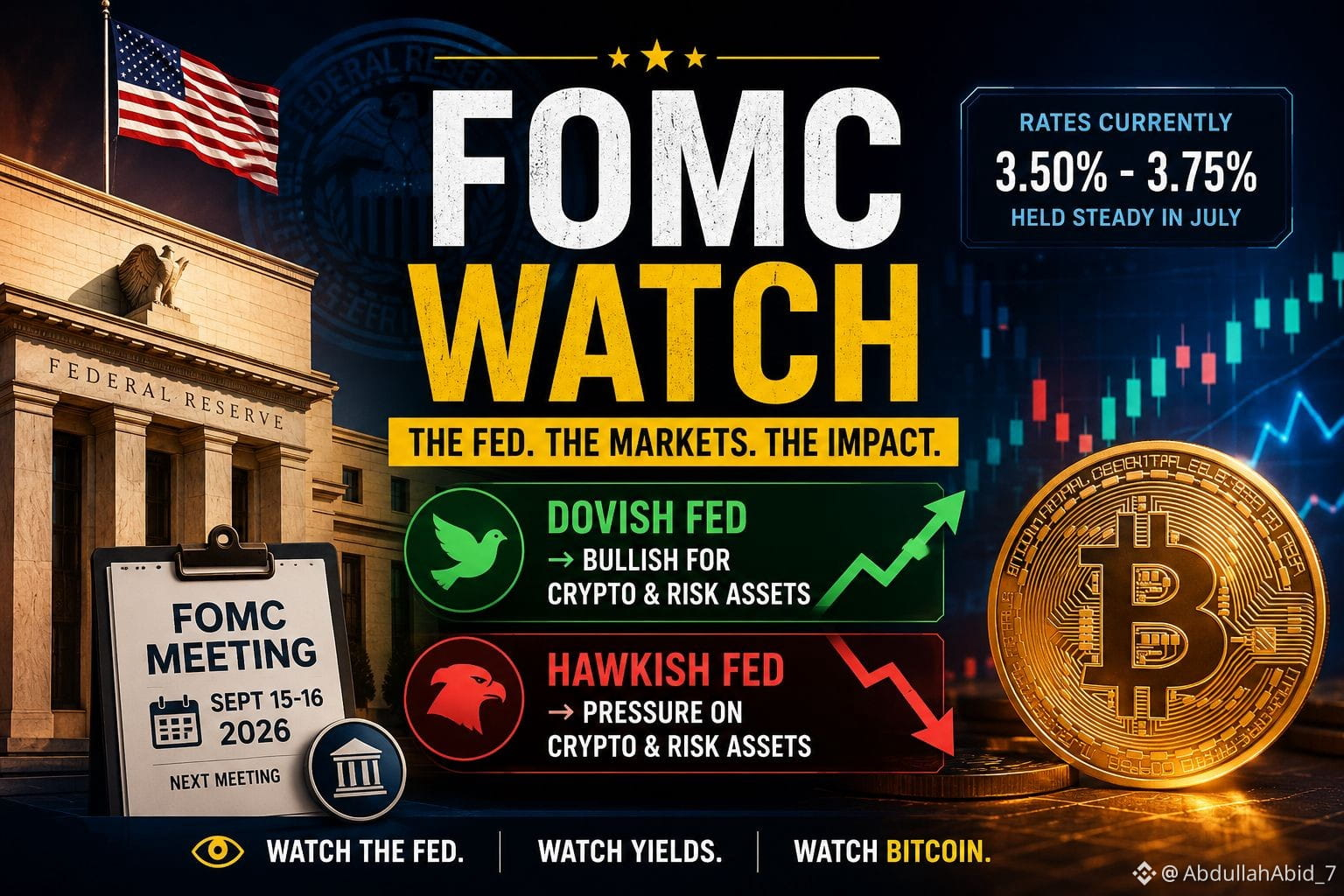
FOMC WATCH: Crypto Traders Are Paying Attention
The Fed is back in focus. The July FOMC minutes are due today, and markets are watching for clues on what could happen at the September meeting.
The Fed held rates at 3.50%–3.75% in July, while recent softer inflation and labor data have reduced expectations for another hike.
For crypto, the message is simple:
Dovish Fed → potentially bullish for BTC & risk assets
Hawkish Fed → possible pressure on crypto
The next major FOMC meeting is scheduled for September 15–16, 2026.
Watch the Fed. Watch yields. Watch Bitcoin.
#FOMC #FOMCWatch #fearofmarketcrash #BinanceSquare #Write2Earn $BTC $SOL $BNB
FOMC WATCH: Crypto Traders Are Paying Attention
The Fed is back in focus. The July FOMC minutes are due today, and markets are watching for clues on what could happen at the September meeting.
The Fed held rates at 3.50%–3.75% in July, while recent softer inflation and labor data have reduced expectations for another hike.
For crypto, the message is simple:
Dovish Fed → potentially bullish for BTC & risk assets
Hawkish Fed → possible pressure on crypto
The next major FOMC meeting is scheduled for September 15–16, 2026.
Watch the Fed. Watch yields. Watch Bitcoin.
#FOMC #FOMCWatch #fearofmarketcrash #BinanceSquare #Write2Earn $BTC $SOL $BNB
The Fed is back in focus. The July FOMC minutes are due today, and markets are watching for clues on what could happen at the September meeting.
The Fed held rates at 3.50%–3.75% in July, while recent softer inflation and labor data have reduced expectations for another hike.
For crypto, the message is simple:
Dovish Fed → potentially bullish for BTC & risk assets
Hawkish Fed → possible pressure on crypto
The next major FOMC meeting is scheduled for September 15–16, 2026.
Watch the Fed. Watch yields. Watch Bitcoin.
#FOMC #FOMCWatch #fearofmarketcrash #BinanceSquare #Write2Earn $BTC $SOL $BNB
70
Log in to explore more content
Join global crypto users on Binance Square
⚡️ Get latest and useful information about crypto.
💬 Trusted by the world’s largest crypto exchange.
👍 Discover real insights from verified creators.
Email / Phone number
Trending Topics
OstiumLoanDisputeHearingSetInNYFederalCourt
181 views
33 Discussing
#ostiumloandisputehearingsetinnyfederalcourt
Ostium is heading to the New York Federal Court today for a massive loan dispute! 🏛️ Remember when they claimed their off-chain infra got hacked for $23.7M USDC back in July? Now, Hong Kong lenders are suing the team, the Cayman foundation, and the CEO, demanding a total asset freeze! Talk about a real-world drama surrounding a Real World Asset (RWA) platform on Arbitrum! 🍿
➡️ Does this affect traders? If you are liquidity providers (OLP) or trading RWAs on Arbitrum, expect heavy volatility.
➡️ What should traders do? Secure your funds, avoid over-leveraged bets on distressed protocols, and always move your major bags to rock-solid, fully secure exchanges. Stay safe!
Not financial advice. DYOR! 📊
Support VINHTOCDO! Claim your trading fee discount by registering on Binance: https://www.binance.com/register?ref=VINHTOCDO 🚀
👇 Click to trade below to support me:
$ARB
| $BNB
| $BTC
#CryptoNews #RWA #ARBİTRUM #VINHTOCDO
Vinhtocdo
·0 Likes
·69 views
SKPoliceRefer18PolymarketUsersToProsecutors
1,782 views
106 Discussing
FedSEPProjects2026RateAt4.1%
4,428 views
164 Discussing