
Liên Bảo Trân
363 Posts

Liên Bảo Trân
524 Following
148 Followers
329 Liked
Posts
All
Quotes
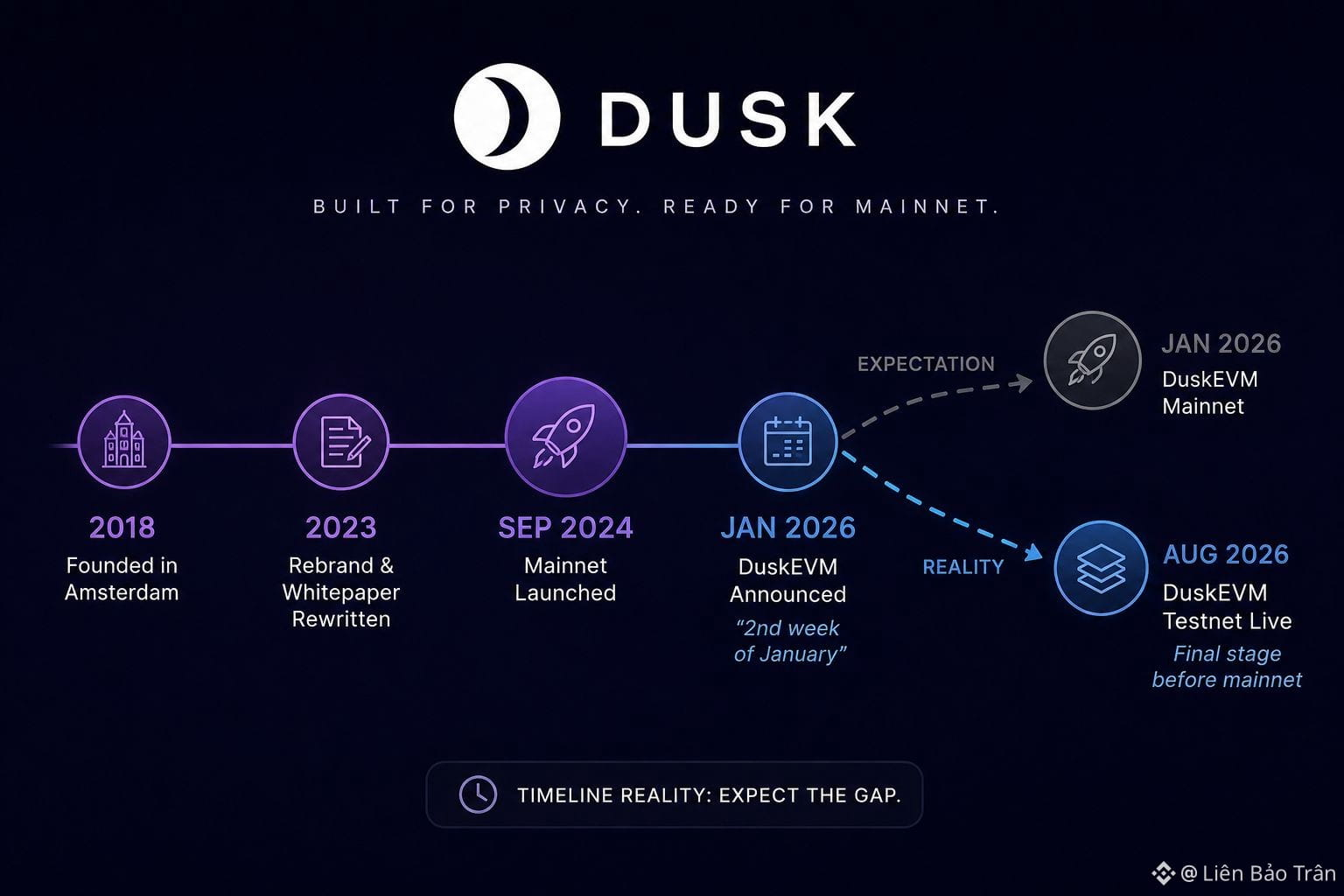
6 years. That's how long it took Dusk to go from its 2018 founding in Amsterdam to an actual mainnet in September 2024. For a project built around zero-knowledge cryptography and a brand new consensus protocol, some of that time is defensible. Hard cryptography takes time to get right, and I'd rather a financial infrastructure project ship late than ship broken. Those years also covered a full rebrand from Dusk Network to Dusk in 2023 and a rewritten whitepaper, so the delay wasn't pure inactivity, it was a genuinely different company by the time mainnet arrived.
What interests me more is the pattern repeating on a smaller scale. Dusk's team announced in late 2025 that DuskEVM, the Solidity-compatible execution layer meant to unlock Ethereum's developer base, would launch on mainnet in the second week of January 2026. January came and went. By August 2026, what actually shipped was a public DuskEVM testnet, described by the team itself as the final stage before mainnet, not mainnet itself. A specific calendar date turned into a general "final stage" description seven months later.
I don't think this makes Dusk unusual. Roadmap slippage is close to universal in this industry, and building a modular stack that separates settlement, WASM execution and now an OP Stack based EVM layer is genuinely more complex than shipping a single-purpose chain. But it does mean I read every future date Dusk publishes as a floor, not a ceiling. The gap between "launching in the second week of January" and "testnet live in August" is 8 months on a single feature. Anyone allocating around Dusk's next milestone, whether that's a securities exchange going fully live with NPEX or broader DuskEVM adoption, should size their expectations around that historical gap, not around the press release. The mainnet itself is still coming, and once it lands it's expected to carry Hedger's confidential transaction workflows into the EVM environment, not just plain Solidity compatibility on its own.
@Dusk #dusk $DUSK
What interests me more is the pattern repeating on a smaller scale. Dusk's team announced in late 2025 that DuskEVM, the Solidity-compatible execution layer meant to unlock Ethereum's developer base, would launch on mainnet in the second week of January 2026. January came and went. By August 2026, what actually shipped was a public DuskEVM testnet, described by the team itself as the final stage before mainnet, not mainnet itself. A specific calendar date turned into a general "final stage" description seven months later.
I don't think this makes Dusk unusual. Roadmap slippage is close to universal in this industry, and building a modular stack that separates settlement, WASM execution and now an OP Stack based EVM layer is genuinely more complex than shipping a single-purpose chain. But it does mean I read every future date Dusk publishes as a floor, not a ceiling. The gap between "launching in the second week of January" and "testnet live in August" is 8 months on a single feature. Anyone allocating around Dusk's next milestone, whether that's a securities exchange going fully live with NPEX or broader DuskEVM adoption, should size their expectations around that historical gap, not around the press release. The mainnet itself is still coming, and once it lands it's expected to carry Hedger's confidential transaction workflows into the EVM environment, not just plain Solidity compatibility on its own.
@Dusk #dusk $DUSK
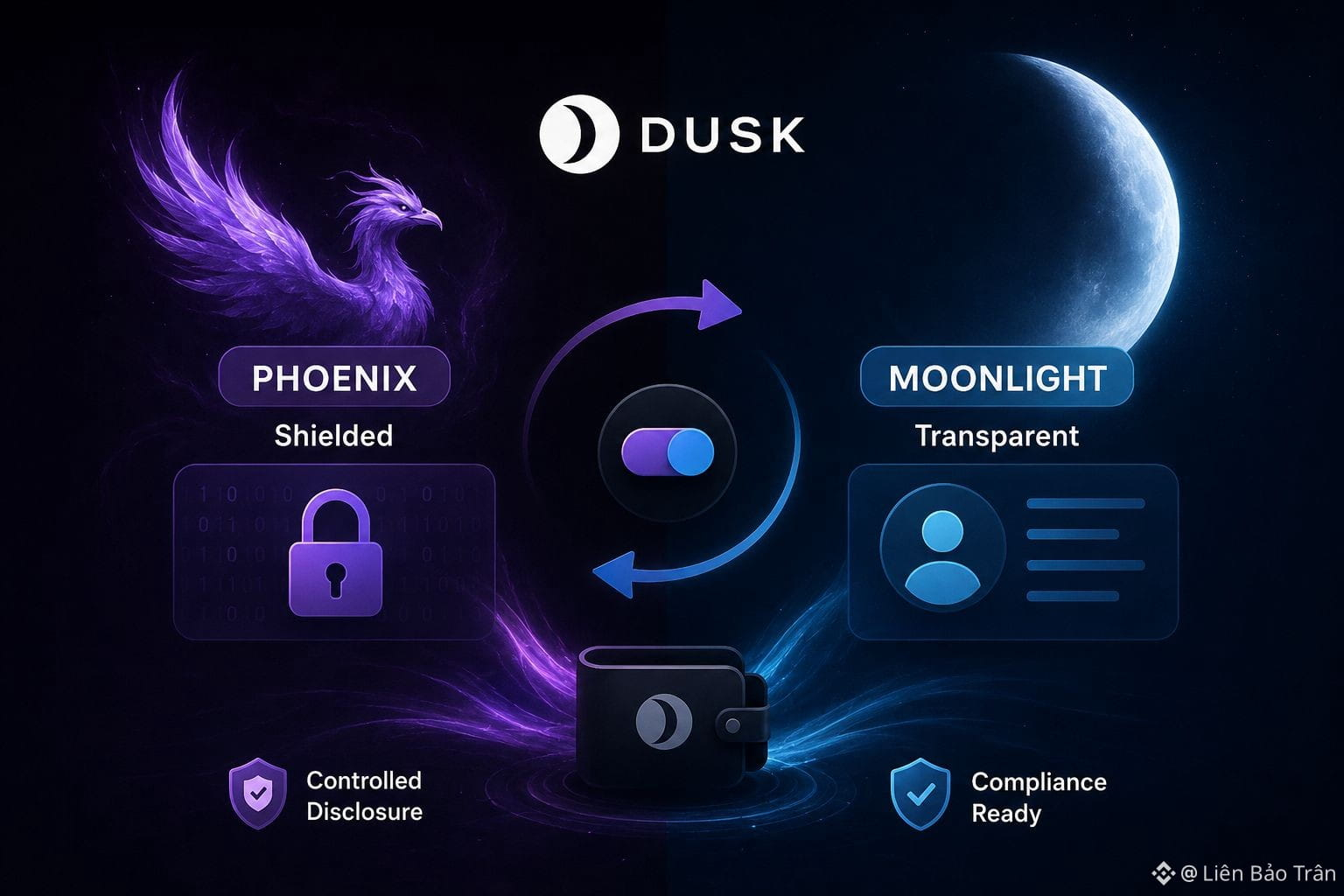
Every privacy chain eventually runs into the same wall: full anonymity is elegant in a paper and radioactive on an exchange listing form. Dusk Network hit that wall early and made an unusual choice in response. Early on, a purely shielded chain risked the same fate that has hit anonymity focused assets before it, delisting risk from exchanges unable to screen flows for sanctioned addresses or suspicious activity, which is precisely the failure mode the team eventually built around rather than ignored. Instead of picking a side, they built two transaction models into the same base layer and let users switch between them.
Phoenix is the shielded model, hiding balances and transfer amounts while still allowing a sender to prove specific details to an authorized party when compliance requires it. Moonlight is the public model, transparent by default, built for the exchanges, institutions, and integrations that need an account they can see clearly without extra tooling. A user can move between the two inside the same wallet, which sounds like a small convenience feature until you think about what it replaces: a separate privacy coin and a separate compliant asset, bridged awkwardly, trusted fully by neither community. Together the two are how Dusk pairs confidentiality with transparent, deterministic settlement, a combination the team markets as programmable privacy for regulated markets.
I think this design decision says more about Dusk's read on regulation than any whitepaper paragraph could. The team clearly decided that a privacy protocol which cannot prove anything to anyone is not a financial product, it is a liability waiting for a delisting notice. Whether that bet pays off depends on adoption neither model alone could deliver. A dual system also means double the surface area to secure and double the mental model a new developer has to learn before shipping anything useful.
@Dusk #dusk $DUSK
Phoenix is the shielded model, hiding balances and transfer amounts while still allowing a sender to prove specific details to an authorized party when compliance requires it. Moonlight is the public model, transparent by default, built for the exchanges, institutions, and integrations that need an account they can see clearly without extra tooling. A user can move between the two inside the same wallet, which sounds like a small convenience feature until you think about what it replaces: a separate privacy coin and a separate compliant asset, bridged awkwardly, trusted fully by neither community. Together the two are how Dusk pairs confidentiality with transparent, deterministic settlement, a combination the team markets as programmable privacy for regulated markets.
I think this design decision says more about Dusk's read on regulation than any whitepaper paragraph could. The team clearly decided that a privacy protocol which cannot prove anything to anyone is not a financial product, it is a liability waiting for a delisting notice. Whether that bet pays off depends on adoption neither model alone could deliver. A dual system also means double the surface area to secure and double the mental model a new developer has to learn before shipping anything useful.
@Dusk #dusk $DUSK
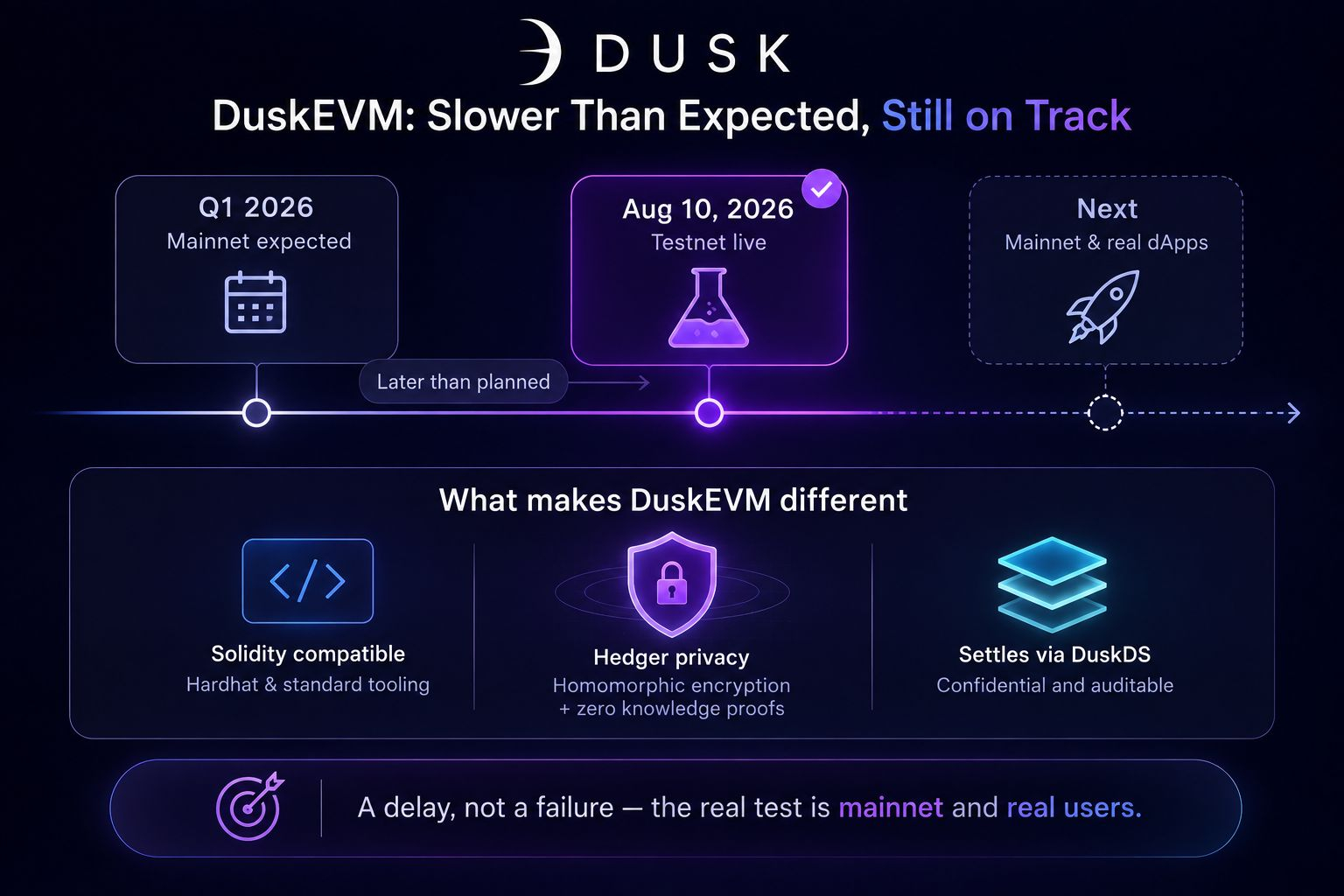
Back in the spring, coverage of Dusk Network's roadmap circled a specific expectation: DuskEVM, the Solidity compatible execution layer, reaching mainnet in the first quarter of 2026. That is what got repeated across trackers and watchlists, and it is the kind of date that quietly becomes a promise even when nobody at the project phrased it that firmly. By August 10, what actually shipped was a testnet, letting developers deploy and test applications using Hardhat and standard Ethereum tooling. Useful, real progress, and also months past the window people had circled on a calendar.
I want to be precise about what this gap is and is not. It is not a broken protocol or a failed idea. DuskEVM's architecture, an EVM execution layer settling through DuskDS, is a genuinely more complex build than a typical EVM sidechain, since it has to preserve confidentiality guarantees while still running unmodified Solidity contracts. The privacy piece specifically comes from Hedger, a module combining homomorphic encryption with zero knowledge proofs so balances and transfers can stay encrypted end to end while remaining auditable, a meaningfully different approach than most EVM privacy attempts that lean on just one technique. Complex systems slip. That is not unique to Dusk Network, and the same window saw the project ship a separate developer SDK for wallet connectivity, suggesting the delay sits specifically with the EVM layer rather than a broader stall.
What the gap does tell me is how to read future dates from this team. A testnet in August after a Q1 target is not catastrophic, but it is the second time a public timeline turned out aspirational rather than committed. Mainnet activation and real Solidity applications with actual users still sit ahead. I would rather see the working testnet than another confident date, and for now that is exactly what Dusk Network has given me.
@Dusk #dusk $DUSK
I want to be precise about what this gap is and is not. It is not a broken protocol or a failed idea. DuskEVM's architecture, an EVM execution layer settling through DuskDS, is a genuinely more complex build than a typical EVM sidechain, since it has to preserve confidentiality guarantees while still running unmodified Solidity contracts. The privacy piece specifically comes from Hedger, a module combining homomorphic encryption with zero knowledge proofs so balances and transfers can stay encrypted end to end while remaining auditable, a meaningfully different approach than most EVM privacy attempts that lean on just one technique. Complex systems slip. That is not unique to Dusk Network, and the same window saw the project ship a separate developer SDK for wallet connectivity, suggesting the delay sits specifically with the EVM layer rather than a broader stall.
What the gap does tell me is how to read future dates from this team. A testnet in August after a Q1 target is not catastrophic, but it is the second time a public timeline turned out aspirational rather than committed. Mainnet activation and real Solidity applications with actual users still sit ahead. I would rather see the working testnet than another confident date, and for now that is exactly what Dusk Network has given me.
@Dusk #dusk $DUSK
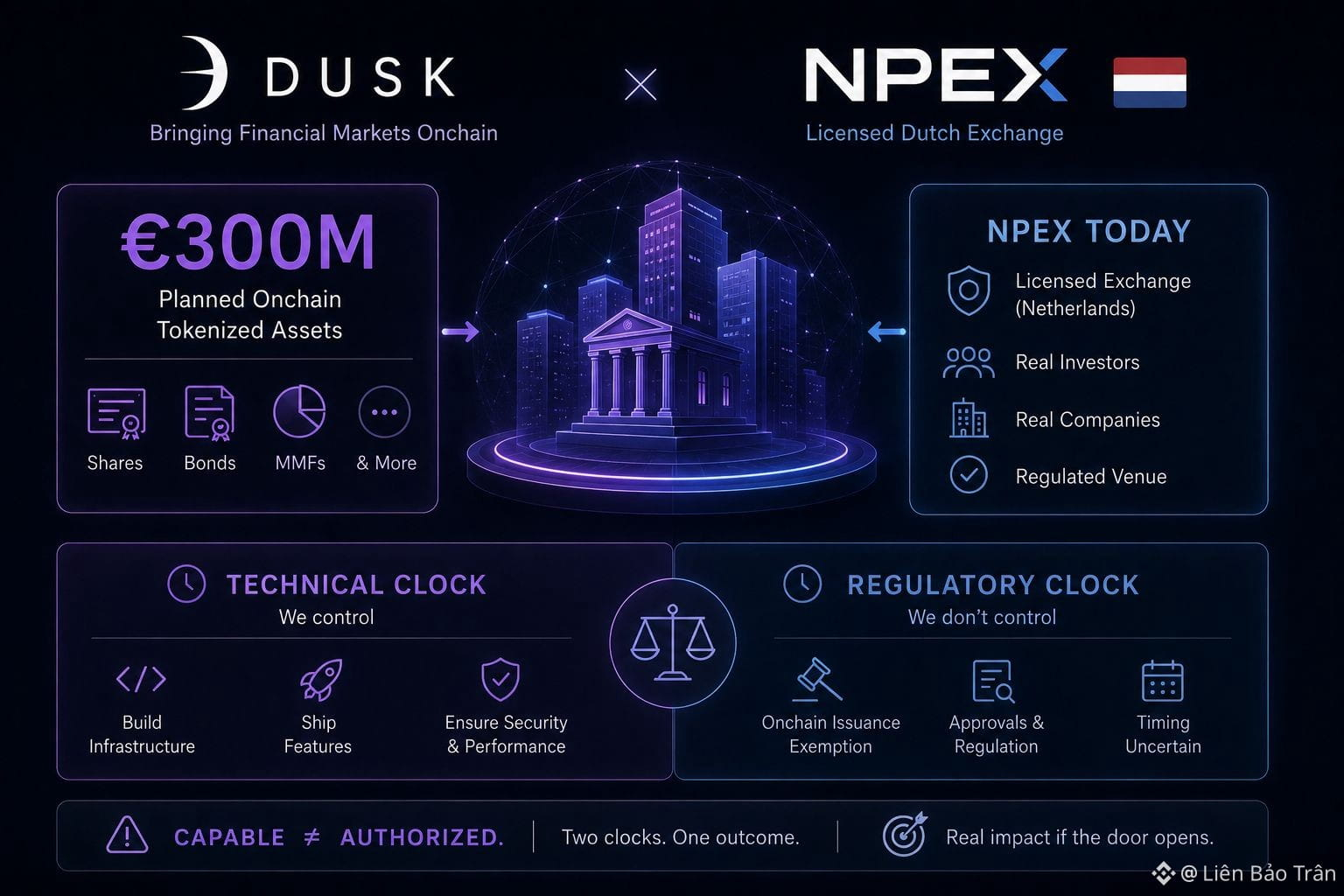
Three hundred million euros is not a hypothetical number. It is the figure NPEX, a licensed Dutch exchange, has said it plans to move onto Dusk as tokenized assets. I think that detail gets lost in a lot of RWA talk that stays abstract. Dusk describes its mission as bringing financial markets onchain, and NPEX is the closest thing to a live test of that claim. NPEX already runs a regulated venue for smaller company shares and debt instruments in the Netherlands. Moving a meaningful slice of that book onto Dusk would mean real investors holding real claims on real companies, settled on a public blockchain instead of a closed ledger only a handful of institutions can see into. This is the part that deserves more scrutiny than it usually gets. Dusk's infrastructure is built to carry native issuance workflows, meaning assets that are born digital rather than tokenized after the fact as a wrapper. NPEX already holds a license to run that secondary market and another to source assets like money market funds and bonds. What it does not yet hold is the specific exemption that would let issuance happen directly onchain, instead of through a hybrid process that still leans on offchain paperwork somewhere behind the scenes. So there are two clocks running here, not one. There is the technical clock, mostly about shipping features, and there is the regulatory clock, which nobody in crypto controls. I do not think it is fair to treat the 300 million euro figure as already secured. It is a plan with real institutional backing, sitting behind a door that has not fully opened yet. If the exemption lands on schedule, this becomes one of the larger real world validations onchain finance has had. If it slips, the 300 million euro figure will keep getting repeated anyway, because announcements travel faster than filings ever do. That gap between capable and authorized is worth remembering every time this partnership comes up again.
@Dusk #dusk $DUSK
@Dusk #dusk $DUSK
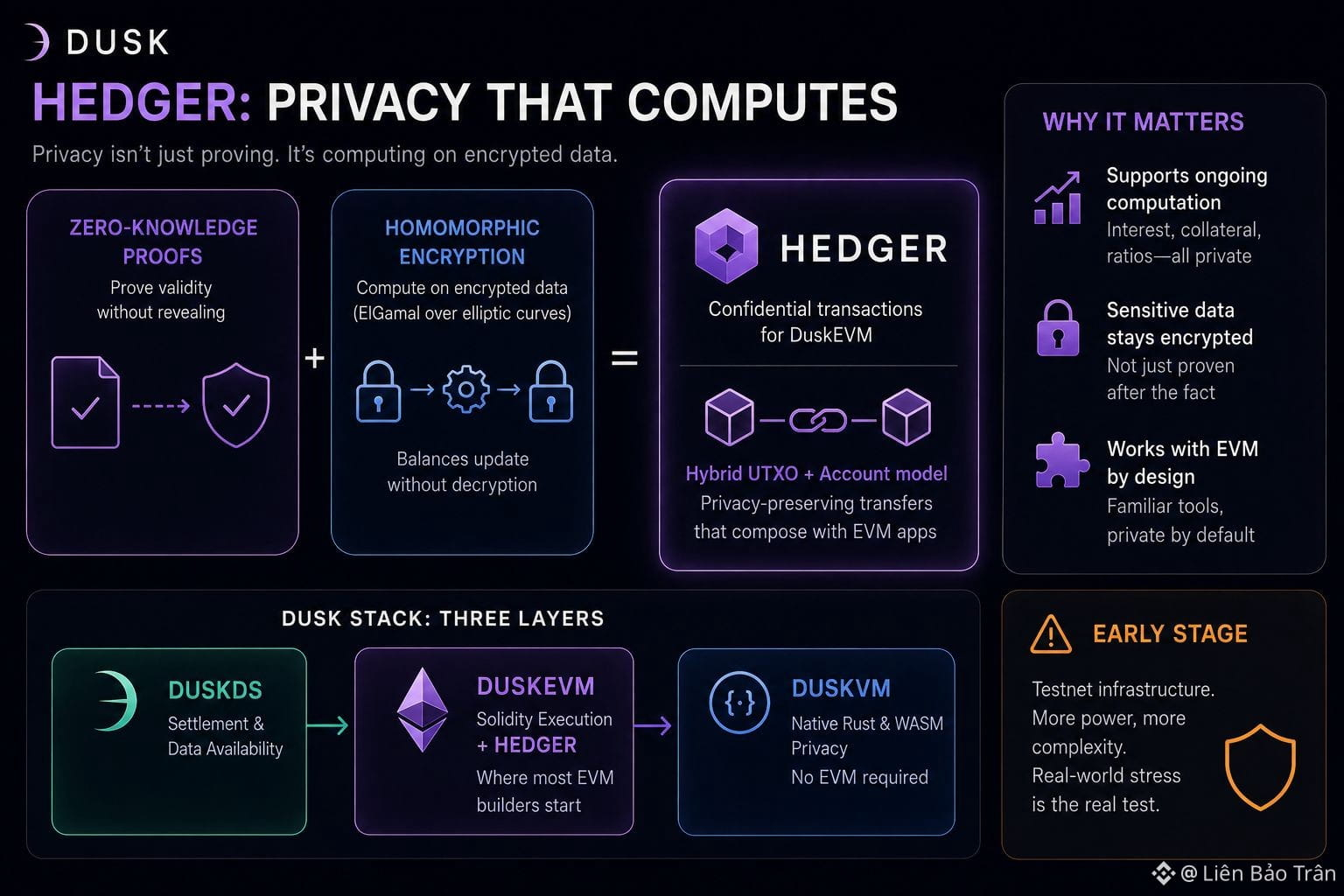
Most people hear zero-knowledge proofs and assume that is the whole privacy story on this project. It isn't, not for Hedger. Hedger, Dusk Network's confidential transaction module for DuskEVM, actually combines two different cryptographic tools. Zero-knowledge proofs handle the part everyone expects: proving a transaction is valid without revealing its contents. Homomorphic encryption, built on ElGamal over elliptic curves, handles something harder. It lets the network perform computation directly on encrypted values, so balances and amounts can update without ever being decrypted along the way. Why does that matter for Dusk specifically? Because financial applications, the kind Dusk is actually built for, rarely stop at a single private transfer. They need ongoing computation, interest accruing, collateral ratios updating, all while sensitive figures stay hidden from public view. A system that only proves things after the fact struggles with that. One that can compute on encrypted data while it happens is a different category of tool entirely. Hedger also supports a hybrid UTXO and account model, which sounds technical but solves a real problem: letting privacy-preserving transfers compose cleanly with the account-based logic most EVM applications already assume. It helps to place Hedger inside the bigger picture. Dusk's stack runs in three layers: DuskDS for settlement and data availability, DuskEVM for familiar Solidity execution, and DuskVM for teams that want native Rust and WASM privacy without touching EVM tooling at all. Hedger lives in that middle layer, exactly where most builders coming from Ethereum will land first. I'll say the obvious part too. This is still testnet infrastructure. Combining multiple cryptographic primitives is powerful, but it's also more surface area to get right, more edge cases to audit, more places a subtle bug could hide. Ambitious cryptography earns skepticism until it has been stress tested in production, not admiration in advance.
@Dusk #dusk $DUSK
@Dusk #dusk $DUSK
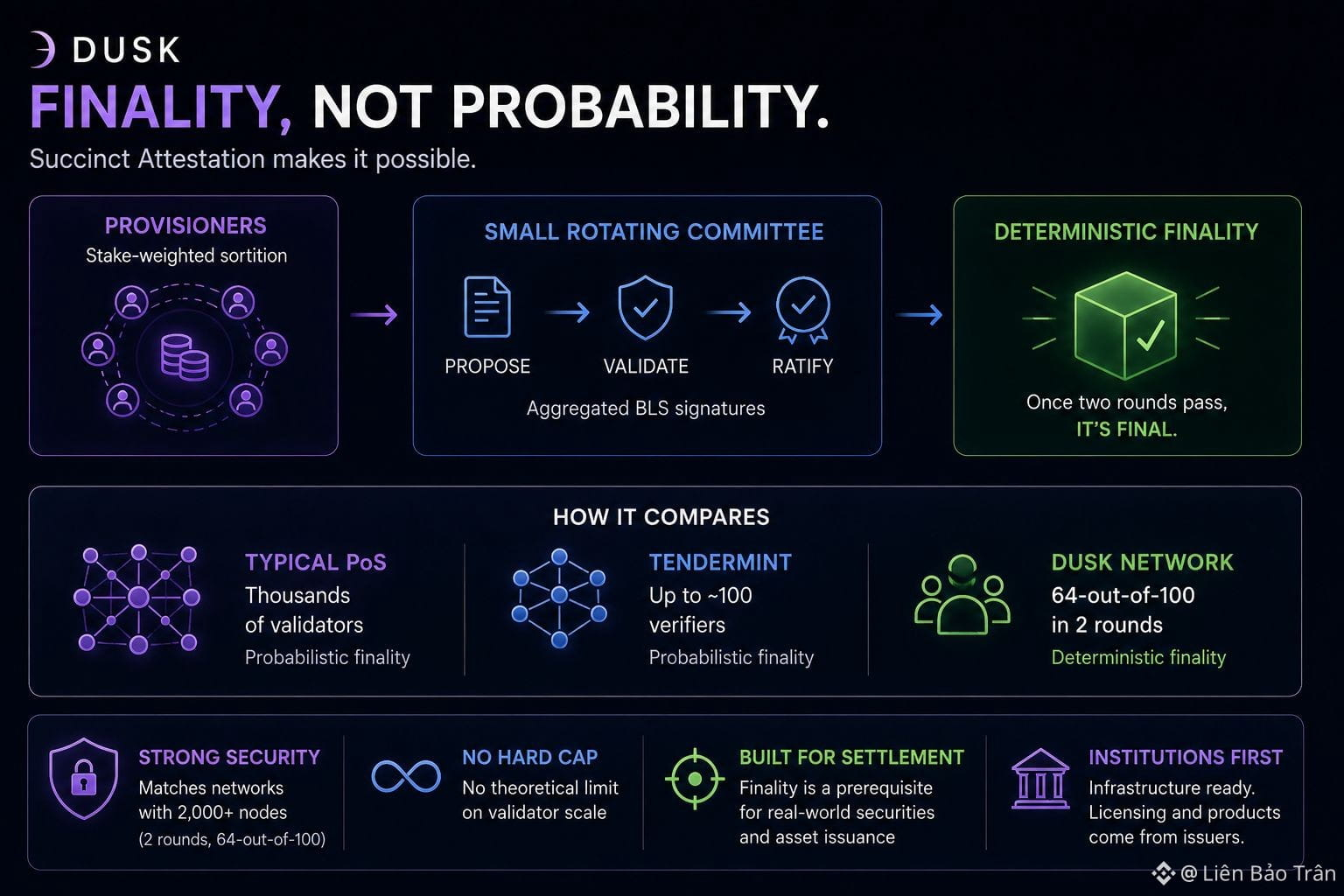
I keep hearing the same objection when I explain Dusk Network's consensus: how do you get finality without thousands of validators? Fair question. The answer is Succinct Attestation, one of the more underrated pieces of engineering in this space. Traditional proof-of-stake networks either wait for probabilistic finality, where a block becomes final enough after several confirmations, or lean on committee sizes that balloon into the thousands to stay secure. Dusk Network's Succinct Attestation takes a different route. Provisioners, the network's validators, are chosen by stake-weighted sortition into small rotating committees that propose, validate, and ratify each block using aggregated BLS signatures. Once a block clears both voting rounds, it's deterministically final. Not probably final. Final. Emanuele Francioni, who designed the mechanism, has noted that Dusk Network can match the security of networks needing 2,000-plus nodes with two rounds of 64-out-of-100 participation. Tendermint caps out around 100 verifiers by comparison. Succinct Attestation has no hard verifier ceiling, which matters if Dusk Network's institutional ambitions pan out and validator interest keeps growing. I won't pretend this is solved forever, though. Small committee designs live or die on sortition randomness and on how the network behaves under real adversarial pressure, not just testnet conditions. Dusk Network has years of research behind Succinct Attestation, but research and adversarial mainnet stress are different resumes. The design is elegant on paper and has held up post-mainnet so far. What convinces me isn't the theory. It's that finality is a prerequisite for securities settlement, not a nice-to-have, and Dusk Network built the whole chain around that constraint from day one. That really adds up to a settlement backbone capable of carrying genuine issuance workflows, though the licensing and product work still has to come from whichever institution or venue is actually issuing.
@Dusk #dusk $DUSK $ONG $BTW
@Dusk #dusk $DUSK $ONG $BTW
One TermMax audit fix made me think differently about what a “price update” actually means inside a fixed-rate market.
An order is not priced from one number alone. TermMax uses a virtual reserve of X Token (XT) alongside a pricing curve to determine where the order sits and how its price changes as more liquidity is taken.
The audit found that those two pieces could previously be updated separately.
That matters because each input can be valid on its own while the combination is not. A new virtual XT reserve paired with an old curve, or the other way around, can describe a pricing state that was never actually intended.
So the issue is not simply whether the pricing formula is correct. It is whether all of the inputs feeding that formula still describe the same version of the order.
What I don't know yet is how broadly TermMax now enforces that consistency across every path that can reprice or reconfigure an order.
The stronger evidence would be that every repricing path preserves the same rule: a quote can only be produced from one internally consistent order state. That goes beyond checking whether the reserve and curve are individually valid, or even whether one update path changes them together.
What matters is whether a mixed old-and-new configuration can be ruled out everywhere the order can change.
The question is whether TermMax now treats price as one coherent state across an order, rather than a collection of separate settings that can drift out of sync.
I am watching repricing paths, order updates and the tests that enforce that consistency.
@TermMax #TermMax $BTW $ACE $ONG
An order is not priced from one number alone. TermMax uses a virtual reserve of X Token (XT) alongside a pricing curve to determine where the order sits and how its price changes as more liquidity is taken.
The audit found that those two pieces could previously be updated separately.
That matters because each input can be valid on its own while the combination is not. A new virtual XT reserve paired with an old curve, or the other way around, can describe a pricing state that was never actually intended.
So the issue is not simply whether the pricing formula is correct. It is whether all of the inputs feeding that formula still describe the same version of the order.
What I don't know yet is how broadly TermMax now enforces that consistency across every path that can reprice or reconfigure an order.
The stronger evidence would be that every repricing path preserves the same rule: a quote can only be produced from one internally consistent order state. That goes beyond checking whether the reserve and curve are individually valid, or even whether one update path changes them together.
What matters is whether a mixed old-and-new configuration can be ruled out everywhere the order can change.
The question is whether TermMax now treats price as one coherent state across an order, rather than a collection of separate settings that can drift out of sync.
I am watching repricing paths, order updates and the tests that enforce that consistency.
@TermMax #TermMax $BTW $ACE $ONG
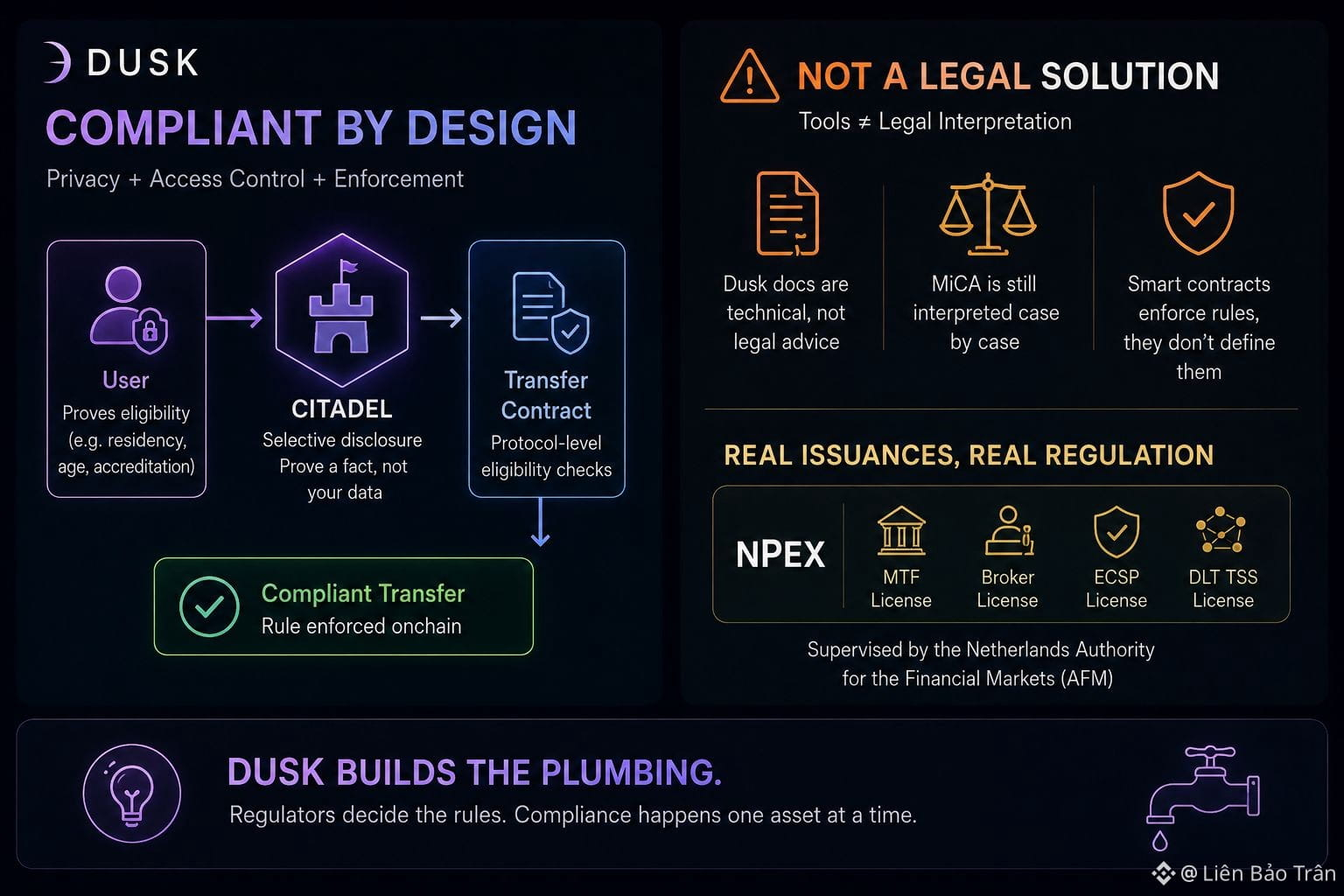
Read enough marketing copy about Dusk Network and you will find some version of the phrase compliant by design. I understand why it gets used. Citadel lets a user prove residency, age, or accreditation status without revealing anything beyond that single fact. The transfer contract can enforce eligibility checks at the protocol level instead of leaving them to a back office spreadsheet. That is a genuine engineering achievement, and it is rare among Layer 1 networks. Here is the part that gets left out of most threads. Dusk Network's own documentation, when it discusses MiCA, says plainly that the material is a technical overview for builders and not legal advice, and it points readers to ESMA and official legal text for actual interpretation. That single disclaimer tells you something important. Building the primitives that regulated markets need, access control, selective disclosure, reporting hooks, is not the same task as resolving how a given regulator in a given jurisdiction will treat a given tokenized instrument. A smart contract can enforce a rule once that rule is settled. It cannot settle the rule itself, and MiCA's application to specific asset classes is still worked out case by case across Europe. So when I see a claim that Dusk Network has solved compliance, I read it as shorthand for something narrower and still valuable: it has built the plumbing compliance requires. The legal work sits on top, asset by asset, issuer by issuer, and no protocol closes that gap by itself. That distinction matters more as Dusk Trade and NPEX bring real securities on chain, not less. NPEX alone carries an MTF license, a broker license, an ECSP license, and a DLT TSS license under supervision from the Netherlands Authority for the Financial Markets, and each of those answers to its own regulator with its own open questions. Dusk Network gave builders the tools to encode a rule once regulators agree on it. It did not make that agreement happen faster, and I would rather see the project own that limit plainly than let a slogan.
@Dusk #dusk $DUSK $BTW $ACE
@Dusk #dusk $DUSK $BTW $ACE
One reason TermMax Alpha's zero-liquidation design is appealing is simple: a bad price move cannot force the protocol to close my position.
But that does not mean I can always close it myself whenever I want.
For TermMax, a decentralized options trading protocol, that creates an important distinction between avoiding a forced exit and having liquidity for a voluntary one.
Closing a position early still requires a counterparty. If liquidity is thin, I may have to accept heavy slippage or may not be able to unwind at all.
TermMax can remove the protocol's ability to force me out of a position. It cannot guarantee that the market will let me out when I choose.
What I don't know yet is whether removing forced liquidation also gives Alpha traders meaningful control over their own exits during the periods when that control matters most.
If counterparties remain available even when markets become volatile, zero liquidation translates into something stronger: practical control over position management.
If liquidity disappears at the same time traders most want to reduce exposure, the downside is still bounded by the premium, but the position can become difficult to unwind before maturity.
That is why I would learn more from early-close fill rates and slippage during stressed or thin markets than from the contract mechanics alone.
The deeper change TermMax makes may be where exit risk lives. The protocol no longer decides when the position ends through liquidation, but market liquidity can still decide whether a voluntary exit is executable and at what price.
The question is whether TermMax Alpha's zero-liquidation design gives traders control over their exits in practice, or mainly guarantees that the protocol itself will not choose the exit for them.
I am watching early-close fill rates, slippage during volatile periods, and whether exit quality holds up when liquidity gets thinner.
@TermMax #TermMax $BTW $ACE $PORTAL
But that does not mean I can always close it myself whenever I want.
For TermMax, a decentralized options trading protocol, that creates an important distinction between avoiding a forced exit and having liquidity for a voluntary one.
Closing a position early still requires a counterparty. If liquidity is thin, I may have to accept heavy slippage or may not be able to unwind at all.
TermMax can remove the protocol's ability to force me out of a position. It cannot guarantee that the market will let me out when I choose.
What I don't know yet is whether removing forced liquidation also gives Alpha traders meaningful control over their own exits during the periods when that control matters most.
If counterparties remain available even when markets become volatile, zero liquidation translates into something stronger: practical control over position management.
If liquidity disappears at the same time traders most want to reduce exposure, the downside is still bounded by the premium, but the position can become difficult to unwind before maturity.
That is why I would learn more from early-close fill rates and slippage during stressed or thin markets than from the contract mechanics alone.
The deeper change TermMax makes may be where exit risk lives. The protocol no longer decides when the position ends through liquidation, but market liquidity can still decide whether a voluntary exit is executable and at what price.
The question is whether TermMax Alpha's zero-liquidation design gives traders control over their exits in practice, or mainly guarantees that the protocol itself will not choose the exit for them.
I am watching early-close fill rates, slippage during volatile periods, and whether exit quality holds up when liquidity gets thinner.
@TermMax #TermMax $BTW $ACE $PORTAL
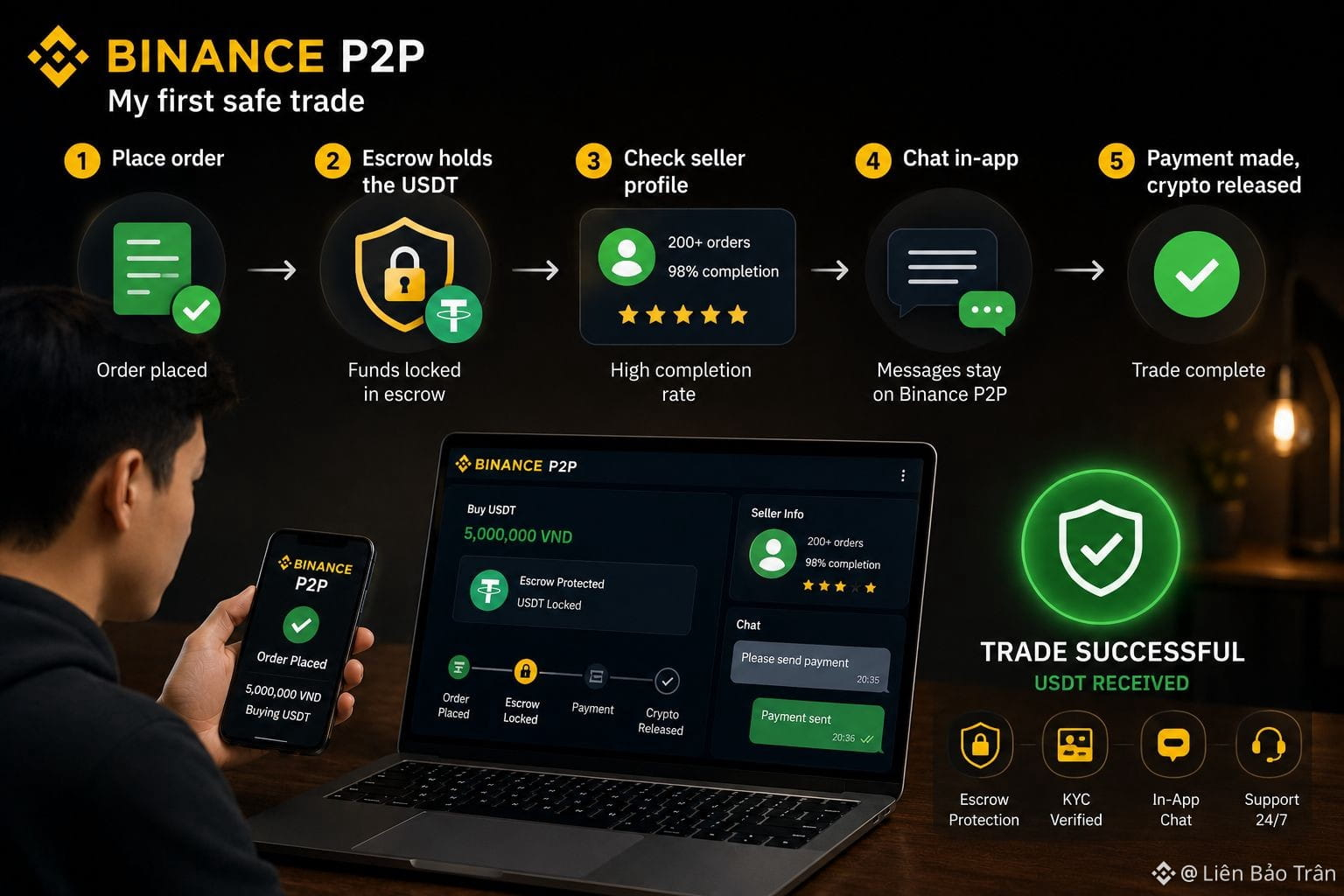
My first trade on Binance P2P happened on a weekend evening, when I needed to buy 5 million VND worth of USDT to transfer to a friend overseas. My hands were a little shaky when I placed the order, because before that I’d only heard about crypto scams on social media and had never tried it myself. What reassured me most was Binance P2P’s escrow mechanism. As soon as I placed the buy order, the corresponding amount of USDT from the seller was locked in the system—neither party could withdraw it on their own until the transaction was completed or there was a resolution decision from Binance’s team. Thanks to that, I didn’t have to worry that the seller would take the money and disappear without delivering the crypto. Before making the bank transfer, I took some time to review the seller’s profile: the number of orders completed, the completion rate over the most recent 30 days, and the ratings from previous buyers. This seller had more than 200 successful orders with a 98% completion rate, which gave me much more confidence than trading with a brand-new account with no history.
Throughout the whole process, I chatted with the seller directly within the Binance P2P chat window, without switching to any other messaging app. Every message, the time it was sent, and the content exchanged were automatically saved—this is an important piece of evidence if any dispute arises later. After it was all done, I realized that my initial anxiety largely came from not understanding the process. Once I understood the role of escrow and knew how to read a counterparty’s profile, I became much more confident in the trades that followed.
@Binance Vietnam #BinanceP2PAnToan $BTW $ACE $PORTAL
Throughout the whole process, I chatted with the seller directly within the Binance P2P chat window, without switching to any other messaging app. Every message, the time it was sent, and the content exchanged were automatically saved—this is an important piece of evidence if any dispute arises later. After it was all done, I realized that my initial anxiety largely came from not understanding the process. Once I understood the role of escrow and knew how to read a counterparty’s profile, I became much more confident in the trades that followed.
@Binance Vietnam #BinanceP2PAnToan $BTW $ACE $PORTAL
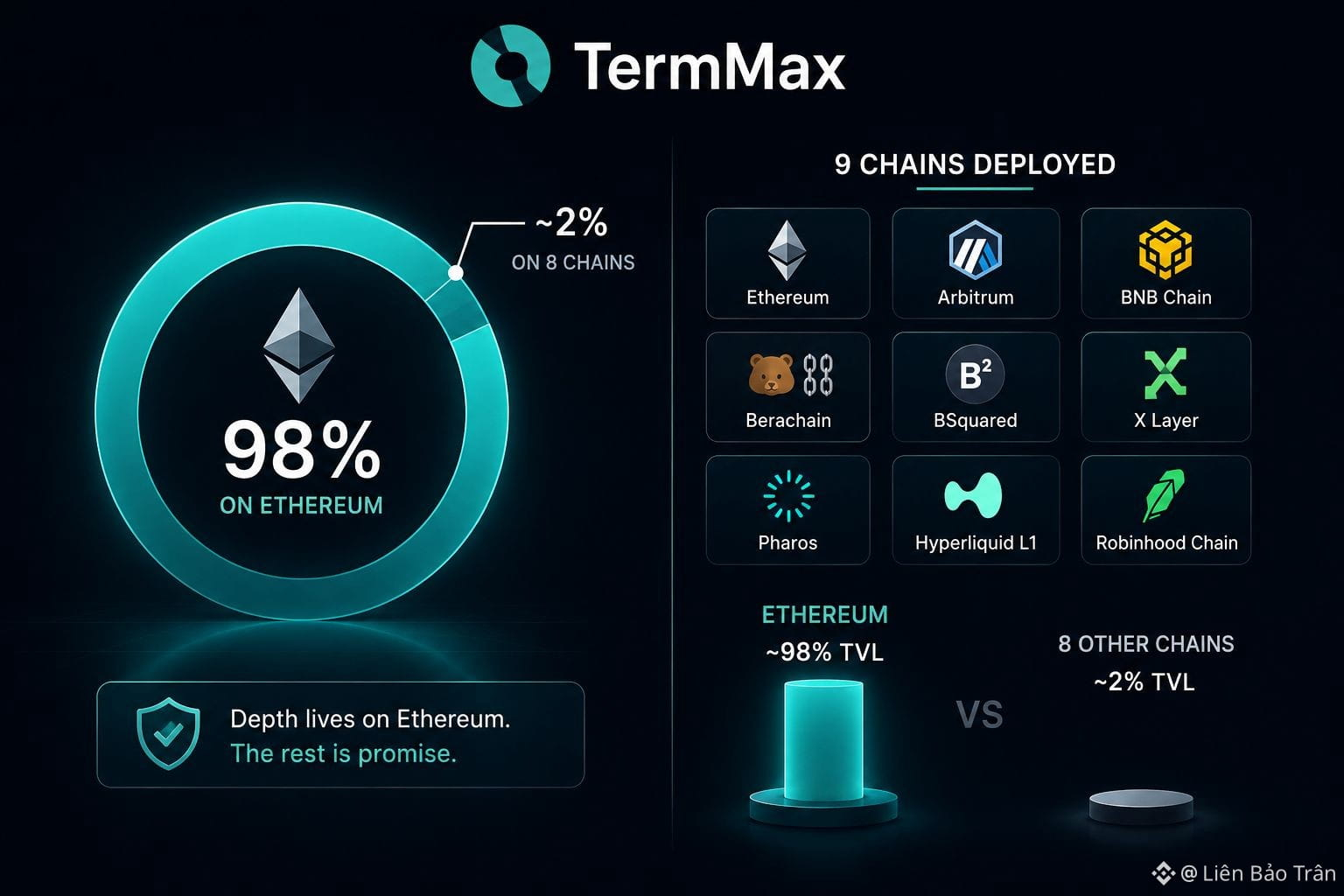
TermMax lists deployments across nine chains: Ethereum, Arbitrum, BNB Chain, Berachain, BSquared, X Layer, Pharos, Hyperliquid L1, and Robinhood Chain. Read that list fast and TermMax looks like it's everywhere, a protocol that chased liquidity into every corner of the modular blockchain landscape. Read the on-chain numbers slower and a different picture shows up: roughly 98% of TermMax's total value sits on Ethereum alone. Eight chains, combined, hold the leftover slice. I don't say this to dismiss the expansion. Deploying to nine chains is real engineering work, and it positions TermMax to catch liquidity if any of those ecosystems grow later. But there's a gap between the theory of multi-chain presence, where more chains signals more reach and more resilience, and the reality of where capital actually decided to sit. Users didn't distribute themselves the way the deployment map did. They picked Ethereum, the chain with the deepest liquidity and the longest track record, and mostly left the rest alone. Liquidity depth is the practical version of this problem. A borrower filling a range order on Ethereum chooses from a market with real depth and several competing makers. The same borrower on Pharos or Robinhood Chain might be filling the only order available, at whatever rate that single maker decided to post, with no second quote anywhere nearby to compare it against. That's worth sitting with before reading "nine chains" as a strength on its own. A chain list is a map of where TermMax can be used, not a map of where TermMax is being used. That second question matters more to a lender deciding whether their fixed-rate position on, say, X Layer or BSquared will have enough counterpart liquidity to fill at a fair rate, versus sitting in a thin book with a handful of range orders and little real competition. Expansion is a bet on future liquidity. Right now TermMax's own numbers say the bet hasn't paid off much outside of Ethereum.
@TermMax #TermMax $BTW $PORTAL $HEMI
@TermMax #TermMax $BTW $PORTAL $HEMI
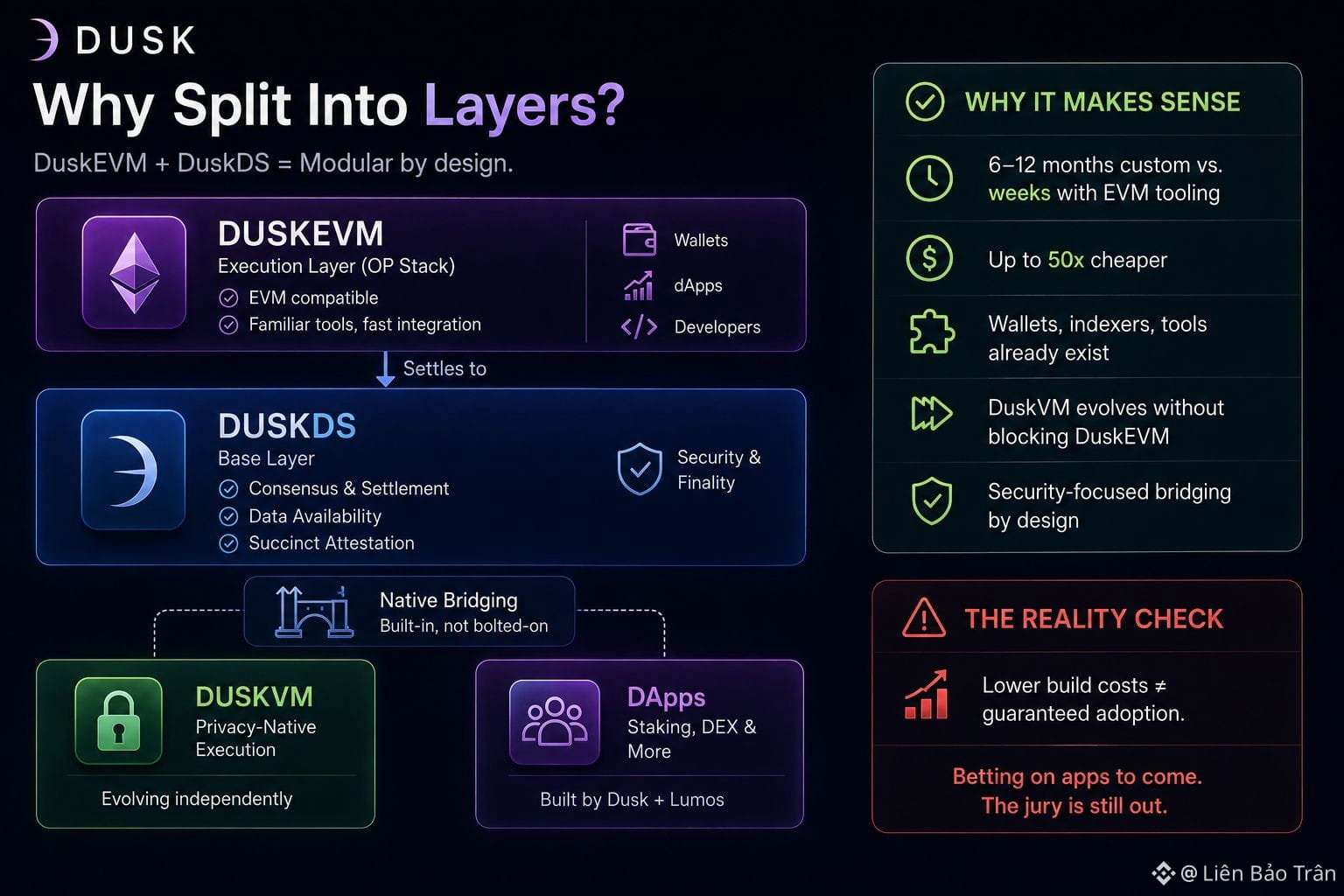
Splitting a blockchain into layers sounds like added complexity for its own sake, so I wanted to understand why Dusk Network chose to do exactly that with DuskEVM instead of just extending its original native chain. Dusk's base layer, DuskDS, was already handling consensus, data availability and settlement through Succinct Attestation before DuskEVM existed. Rather than bolting EVM support directly onto that design, the team built DuskEVM as a separate execution environment on the OP Stack, one that settles back to DuskDS instead of running its own independent security. Development is a mix of Dusk's internal engineers and an outside team, Lumos, brought in specifically to move faster on the bridge between the two layers and on early applications like staking and a decentralized exchange. Native bridging between DuskDS and each execution layer is part of the base design too, not a bolted-on afterthought, which matters given how bridge security turned into Dusk's biggest operational headache elsewhere in the stack. The reasoning holds up when you look at the alternative. Custom integrations on a fully bespoke Layer 1 can take 6 to 12 months and cost up to 50 times more than plugging into standard EVM tooling, according to Dusk's own comparisons. Exchanges reportedly spent months adapting to native Dusk in the past, where EVM-based integrations can be finished in weeks because wallets, indexers and developer tools already exist. Separating settlement from execution also means DuskVM, the privacy-focused native environment still being extracted from the older Piecrust virtual machine, can keep evolving without dragging DuskEVM's release schedule down with it. What this decision does not solve is adoption speed. A modular architecture lowers the cost of building, it does not guarantee anyone builds. Dusk Network is betting that cheaper integration paths translate into real applications choosing the chain, and that bet has not fully paid off yet.
@Dusk #dusk $BTW $DUSK $PORTAL
@Dusk #dusk $BTW $DUSK $PORTAL
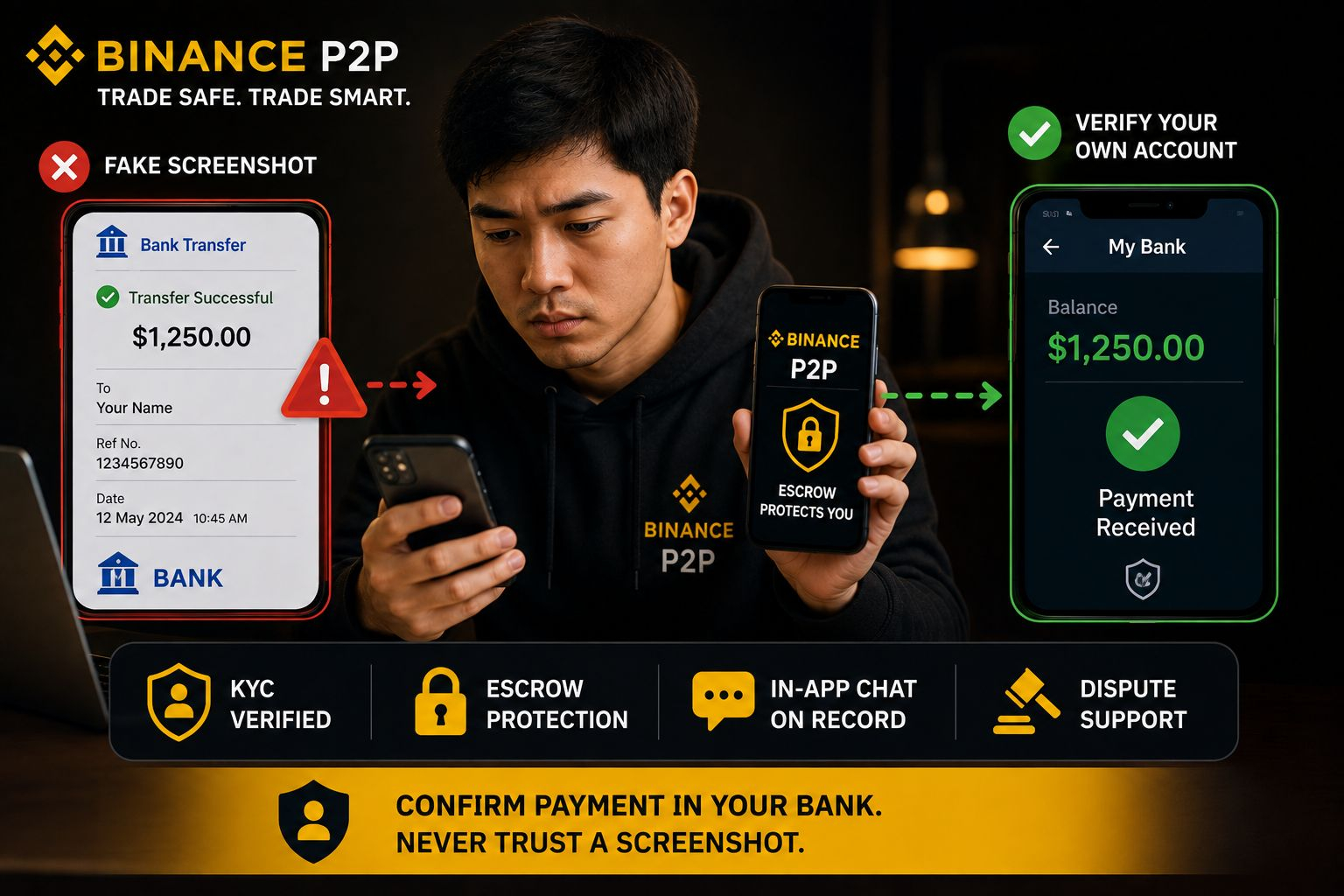
On Binance P2P, protection for sellers works just as much as it does for buyers. Every account is tied to a verified identity through KYC, and once I accept an order as a seller, my crypto asset sits in escrow rather than moving anywhere until the trade is actually finished. That escrow step matters because it gives me room to confirm payment properly instead of feeling pressured to release funds the second a message comes through. If a dispute ever happens, Binance keeps the full chat history on file, which becomes useful evidence during an appeal. A few months into trading, a buyer sent me what looked like a clean transfer screenshot within seconds of the order opening. It had my name, the right amount, even a transaction reference number. Something about the timing felt off though, so instead of releasing the crypto asset right away, I opened my banking app directly and searched for the transfer myself. Nothing had actually landed. I contacted the buyer, explained calmly that I could not find the payment yet, and gave them a short window to send it properly. A genuine transfer showed up 8 minutes later, and the order completed without any issue. That experience changed how I trade. A fabricated screenshot is one of the most common red flags on Binance P2P, and the resolution is always the same: check your own account, never someone else's image. I also started saving records of every completed order, including screenshots of the final confirmation and the chat log, because Binance support asked me for exactly that kind of documentation once during an unrelated dispute. Having it ready made the whole process faster. I also learned to trust my instincts about timing. A payment that arrives within seconds of an order opening, before a bank transfer could realistically process, is often a sign worth pausing over rather than dismissing as luck. Trusting that instinct once was enough to make it a permanent part of how I sell on Binance P2P.
@Binance Vietnam #BinanceP2PAnToan $BTW $HEMI $PORTAL
@Binance Vietnam #BinanceP2PAnToan $BTW $HEMI $PORTAL
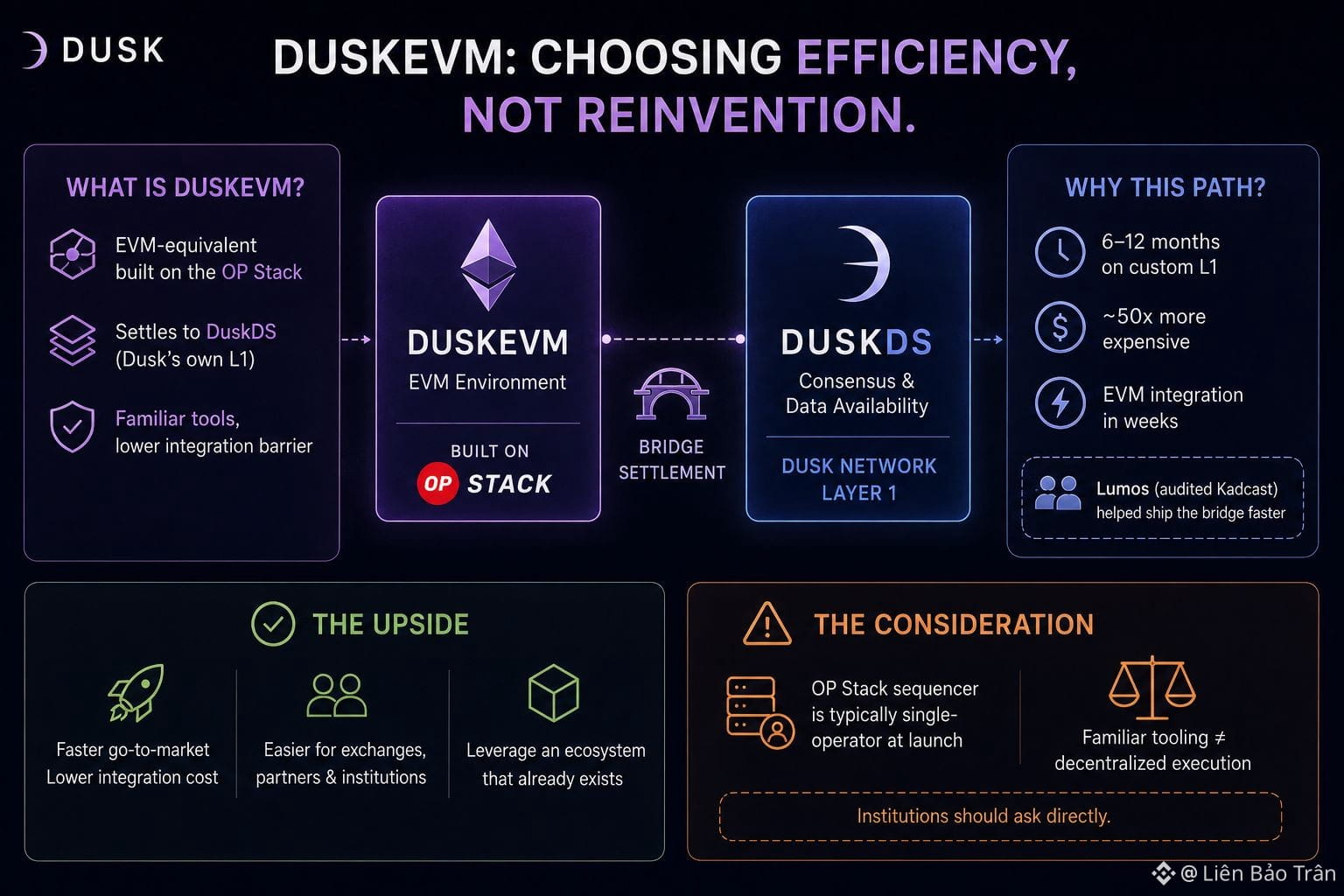
Dusk Network hit the same fork in the road every privacy blockchain eventually reaches: build your own execution environment from scratch and keep full control over the cryptography, or adopt something the rest of the industry already uses and accept the constraints that come with it. It picked the second path when it built DuskEVM, and I think the reasoning behind that choice says more about the project's priorities than any feature list does. DuskEVM is an EVM-equivalent environment built on the OP Stack, the same rollup framework powering a large share of Ethereum's layer 2 ecosystem. It settles back to DuskDS, Dusk Network's own consensus and data availability layer, rather than existing as an island. By Dusk Network's own account of the transition, custom integrations on a bespoke layer 1 can take 6 to 12 months and cost roughly 50 times more than deploying through standard EVM tooling. Exchanges reportedly spent months adapting to native Dusk in the past, while EVM-based integration work can close in weeks. Dusk Network also brought in Lumos, an outside engineering group that previously audited its Kadcast networking protocol, to help the DuskDS to DuskEVM bridge ship faster, which suggests the team did not see this transition as simple enough to handle entirely in-house. That is a real efficiency argument, not just a marketing line, because integration cost is exactly what determines whether institutions bother showing up at all. But adopting the OP Stack also means inheriting its assumptions, including a sequencer model that in most OP Stack deployments starts out operated by a single team rather than a distributed set of operators. For a project built around regulated finance and selective disclosure, that detail deserves more scrutiny than it usually gets. Familiar tooling lowers the barrier to entry. It does not, by itself, prove decentralization at the execution layer, and that is a distinction institutions evaluating Dusk Network for real settlement work should be asking about directly.
@Dusk #dusk $DUSK $VELVET $BTW
@Dusk #dusk $DUSK $VELVET $BTW
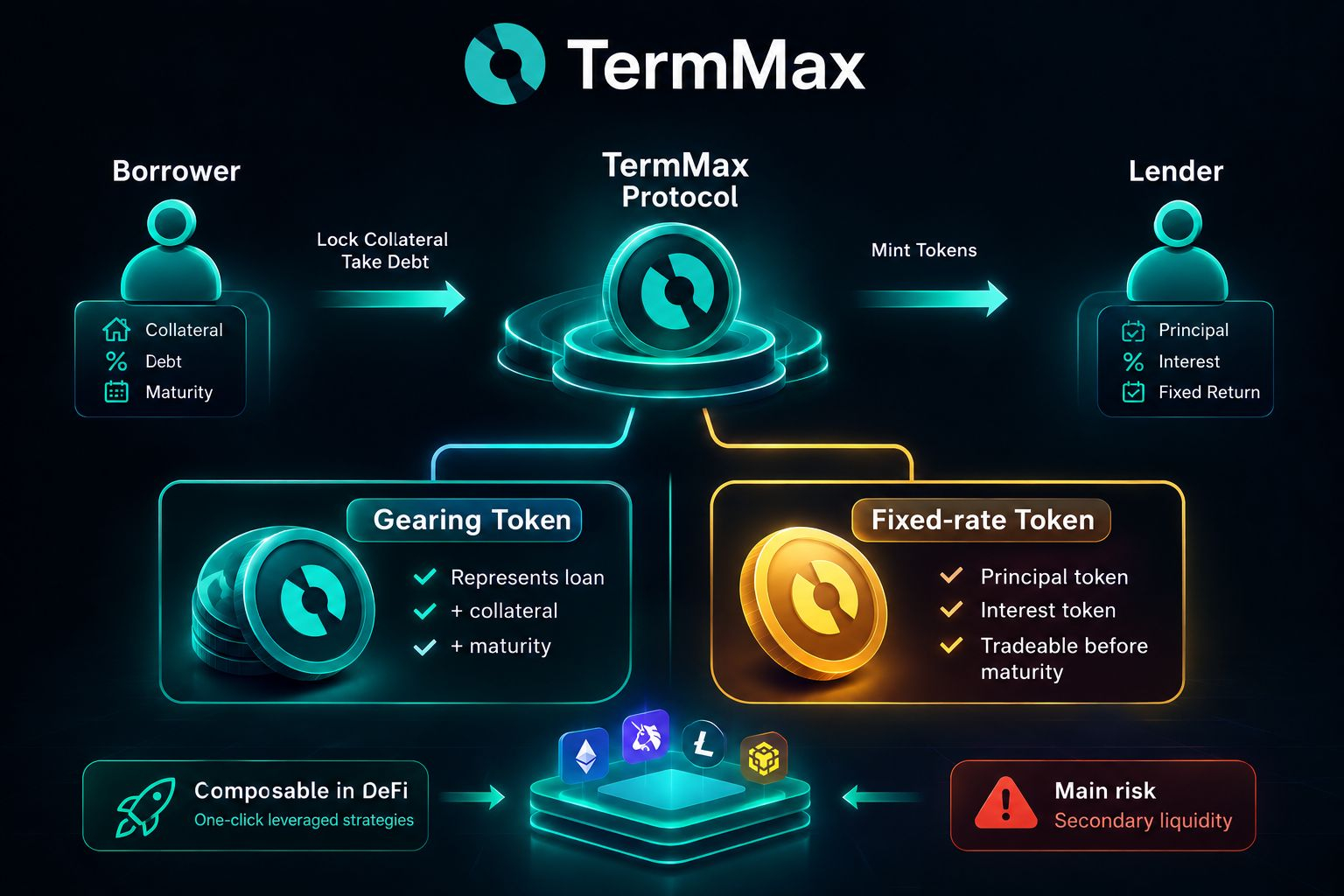
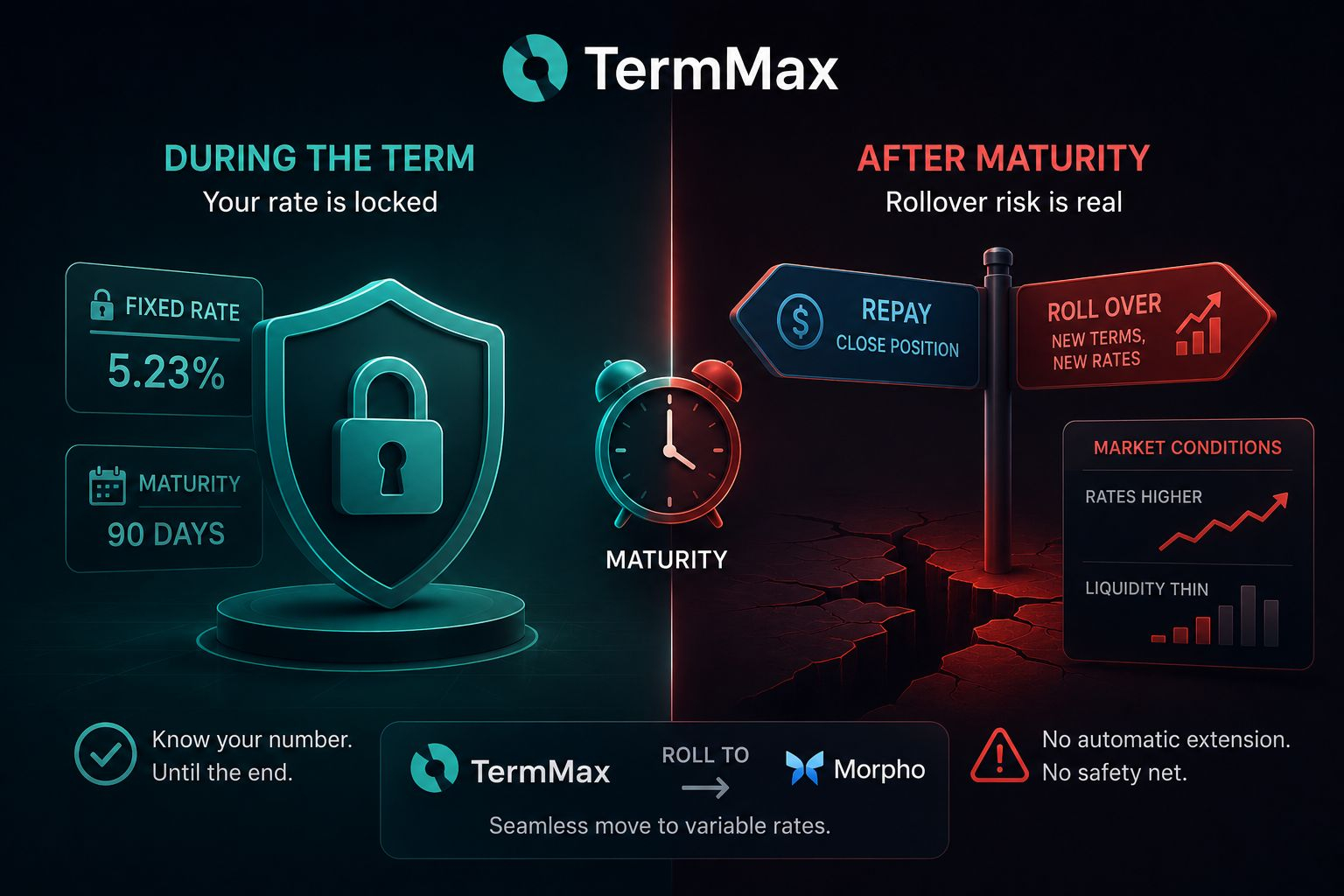
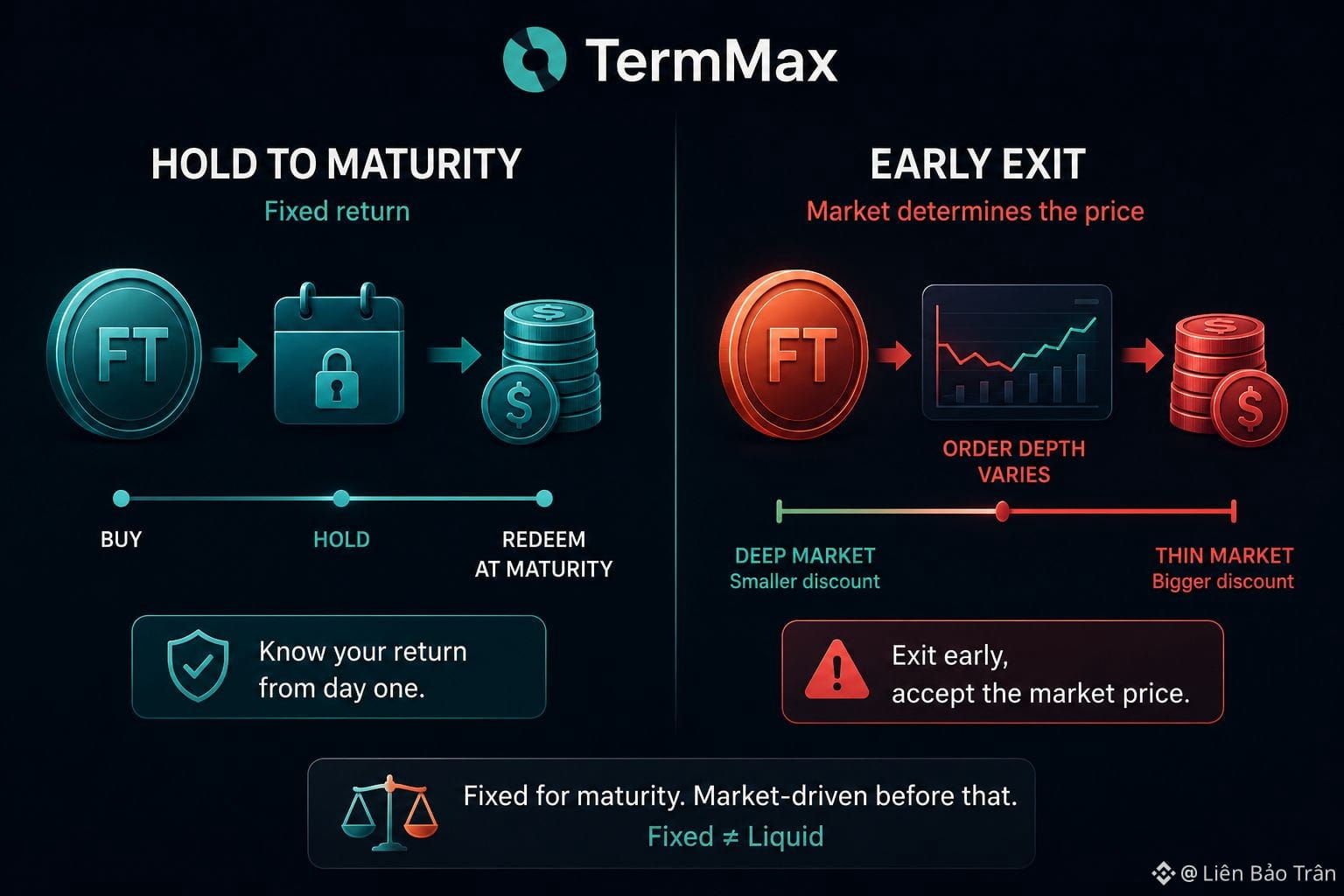
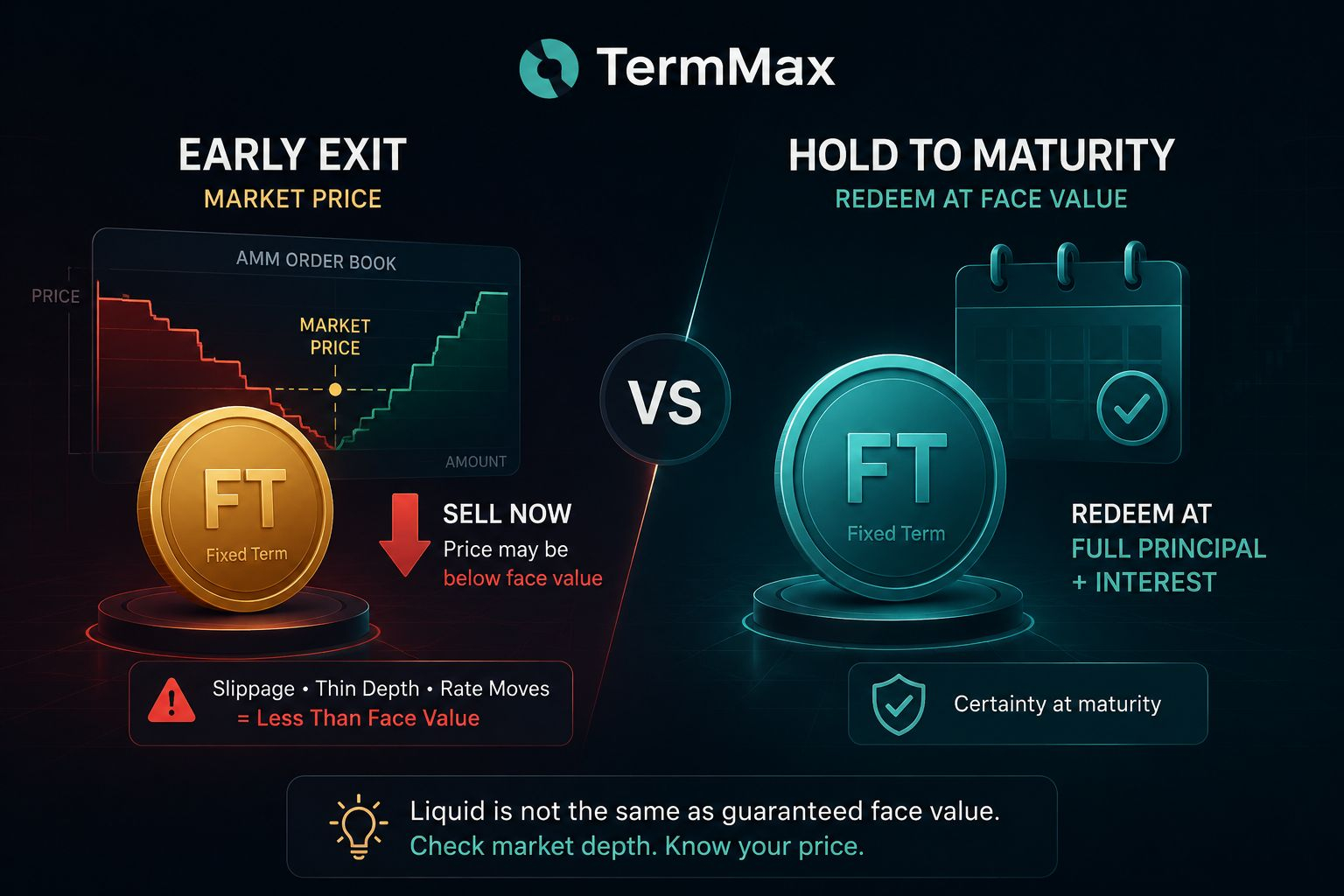
TermMax sells its fixed-rate tokens on a simple promise: buy an FT below face value, hold it, redeem it at maturity for the full amount, and you know your return the second you buy in. That part is real and I've checked the mechanics myself. What the marketing doesn't dwell on is what happens if you need your money back before the term ends. An FT is tradable, which sounds like an exit ramp. But tradable only matters if someone on the other side wants to buy it at a fair price, and that depends entirely on how deep the range orders are for that specific market and maturity date. A USDC market against ETH collateral with heavy volume might let you sell an FT close to its theoretical value. A newer market against a long-tail RWA or a thinly traded LST could leave you selling at a real discount just to get out early, on top of the discount you already accepted at purchase. I'd add that this gap tends to shrink as a market ages. The earliest range orders placed against a brand-new collateral type are usually thin, since market makers haven't built confidence in pricing it yet, and depth tends to improve once more curators commit capital after a market proves itself over a few cycles. That's a reasonable trajectory, but it means the fixed-rate guarantee is effectively stronger for TermMax's oldest, most established markets than for anything freshly listed. This is the quiet asterisk on every fixed-rate pitch in DeFi, not just TermMax's. The rate is fixed for someone who holds to maturity. For someone who needs liquidity mid-term, the realized rate is whatever the secondary market will bear that day. TermMax's range order and AMM design does make execution faster than older order-book style matching, and that's a genuine improvement over waiting for a counterparty. But faster execution isn't the same as guaranteed depth. I'd rather see TermMax publish average exit slippage by market than let users assume every FT behaves like the deepest one. Fixed doesn't mean liquid. Those are two different promises.
@TermMax #TermMax $VELVET $BTW $ACE
@TermMax #TermMax $VELVET $BTW $ACE
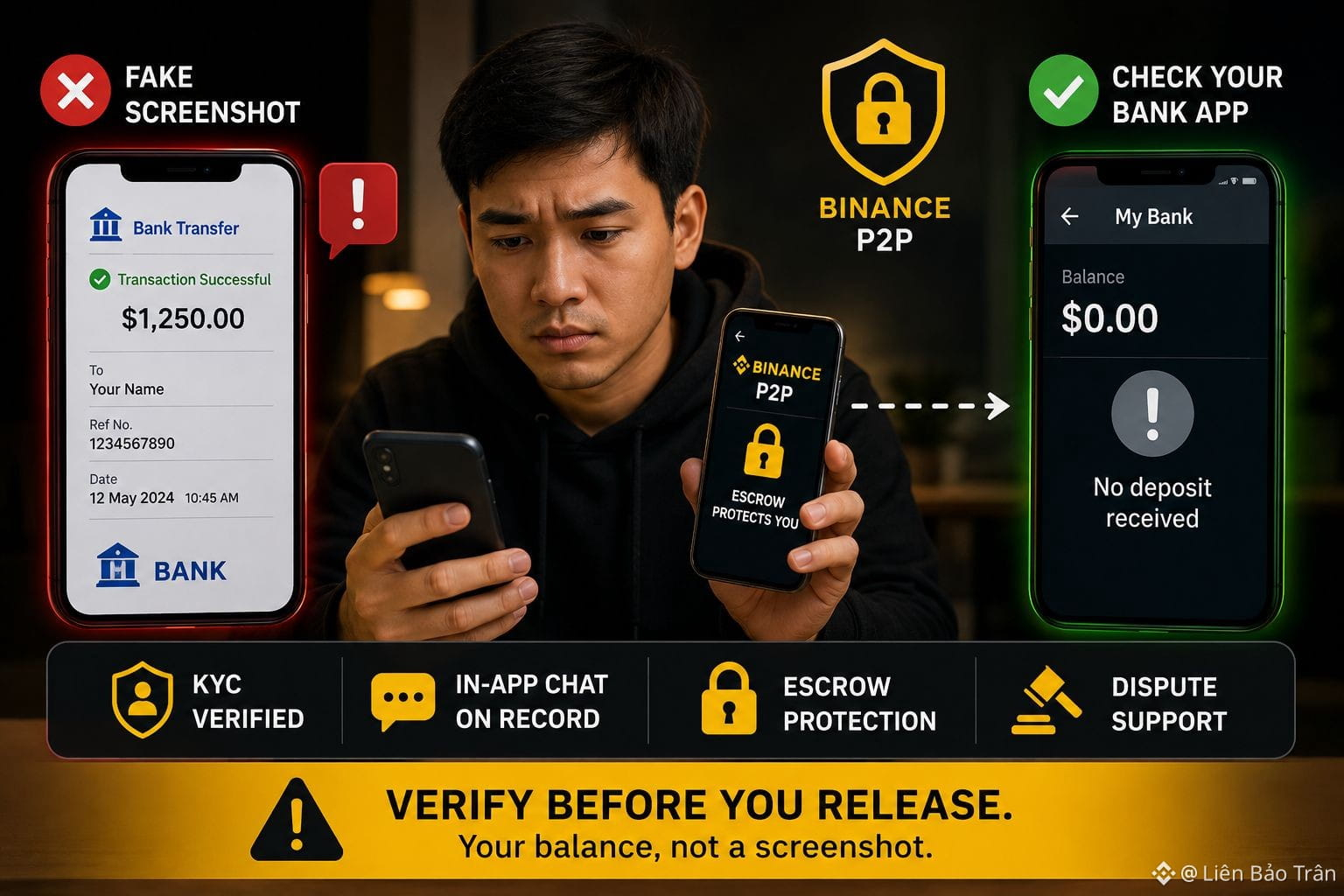
A buyer once sent me a payment screenshot on Binance P2P that looked completely real, timestamp, bank logo, transaction reference, all of it. I almost tapped release right there. Instead I opened my own banking app first, and the deposit simply wasn't there. That gap between what a chat image shows and what your account actually reflects is exactly why Binance P2P built escrow into every order: the crypto stays locked until the seller, not the chat window, confirms the money has landed. Binance P2P works because it forces verification at each stage. Every user completes KYC before trading, so identities are on record. The chat log keeps a timestamped history of everything said, which matters later if a dispute appeal becomes necessary. In my case, I told the buyer calmly that I hadn't received funds yet and would wait for confirmation. Within minutes the messages turned to pressure, asking me to release now and promising the payment would show up soon. That urgency is a textbook red flag on Binance P2P, and it's usually a sign to slow down, not speed up. I reported the order and contacted Binance support with screenshots of the chat and my bank statement showing no deposit. Having that archive ready made the process fast; support could see exactly what happened without me reconstructing the timeline from memory. Looking back, the biggest tell wasn't even the screenshot itself, it was how quickly the conversation shifted once I said I hadn't received anything. A genuine buyer dealing with a slow bank tends to stay patient and even apologizes for the wait, while someone hoping you'll release early tends to escalate fast. A few habits stuck with me after that: never trust a payment image alone, always check the source account directly, and keep every screenshot from a trade until it's fully closed. Binance P2P gives you the tools to stay safe, but only if you actually pause when something doesn't add up.
@Binance Vietnam #BinanceP2PAnToan $BTW $VELVET $ACE
@Binance Vietnam #BinanceP2PAnToan $BTW $VELVET $ACE
TermMax's interface tells lenders they can exit a position anytime, turning a locked loan into tradeable liquidity whenever they want out early. That line is technically true and functionally incomplete, and the gap between those two words matters if you're the one clicking sell. The mechanic underneath it works like this. A lender who deposits into TermMax receives an FT, a token that behaves like a zero coupon bond and redeems for the full principal plus interest at maturity. Sell that FT before maturity and you're not redeeming at face value, you're selling into whatever the market is bidding at that moment, priced through the AMM's range orders. If rates have moved against you since you entered, or a market simply has thin depth that day, the price you get can sit well under what you'd have received by waiting. Vault depositors face a related version of the same issue. TermMax's own documentation is direct about it: withdrawals can be queued under certain market conditions, and a depositor may receive less value than they put in due to market movement or fees, full stop, no asterisk softening that sentence. That's not a hidden flaw, it's printed on the risk page, but it rarely makes it into the pitch alongside "exit anytime." Every AMM based exit carries slippage, every fixed term product trades certainty at maturity for uncertainty before it, and TermMax is not unusual among lending protocols on that front. What's worth naming is that "liquid" and "guaranteed face value" are two different promises, and TermMax is only making the first one. Check the order depth on a market before assuming an early exit will look like the number on the dashboard. Lock to maturity if the rate is the point. Treat early exit as a market transaction, not a withdrawal, because inside TermMax that's precisely what it is.
@TermMax #TermMax $VELVET $PORTAL $BTW
@TermMax #TermMax $VELVET $PORTAL $BTW
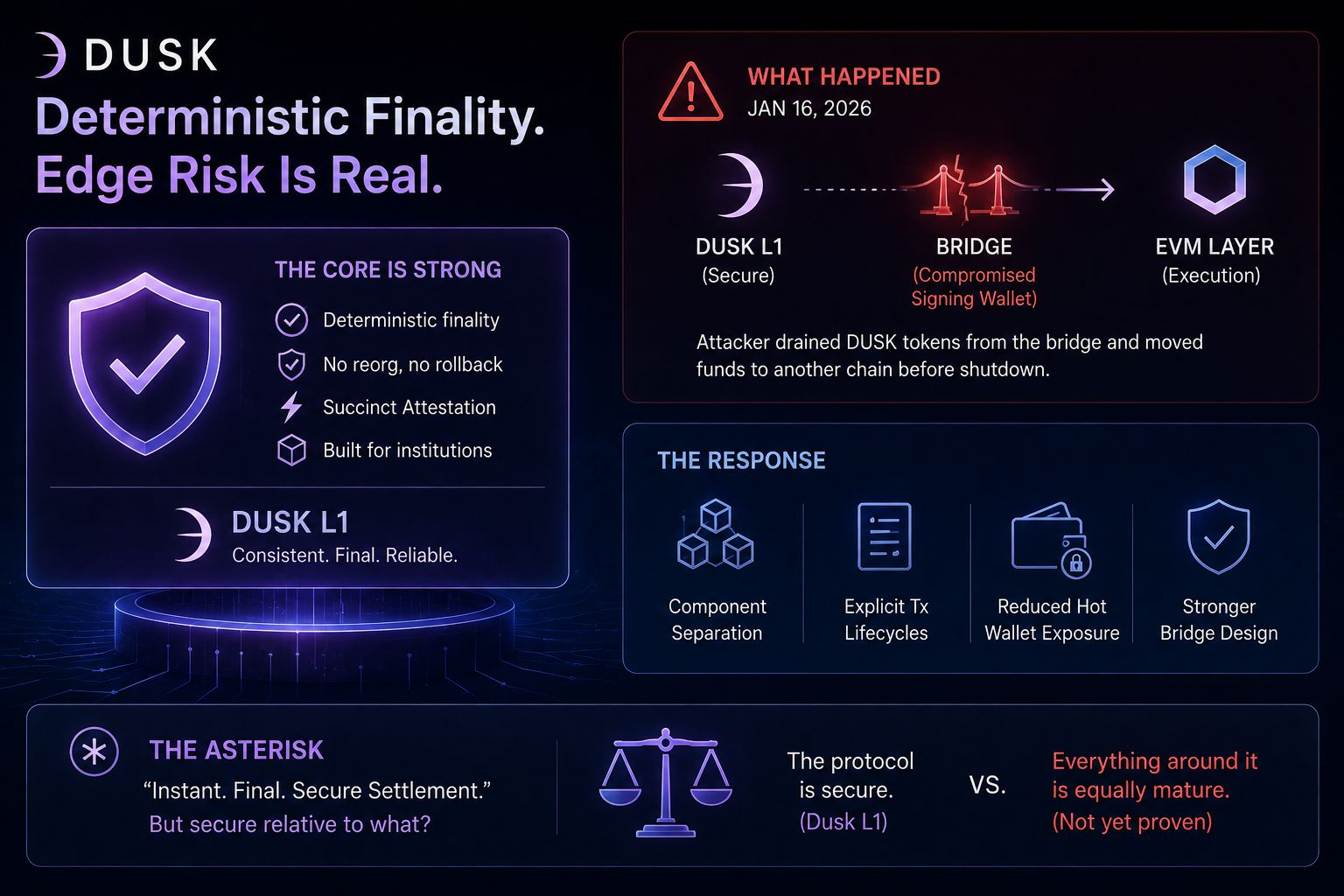
Dusk Network markets deterministic finality as one of its core advantages: once a transaction settles, there's no reorg, no waiting for confirmations to stack up, no theoretical rollback. Succinct Attestation was built specifically to give financial institutions something Bitcoin-style probabilistic finality never could. That part of the promise held up well through the network's first year of mainnet operation. Then, on January 16, 2026, an attacker drained DUSK tokens from the bridge connecting Dusk Network to its EVM execution layer, moving stolen funds onward to another chain before the bridge was shut down. The root cause, per the team's own post-mortem, was a compromised signing wallet inside a bridge design that lacked proper isolation between components. The core consensus layer was never touched. Settlement finality on Dusk Network itself worked exactly as designed. The theft happened at the edge, in the connective tissue between chains, which is precisely where a large share of crypto's worst incidents keep happening industry-wide. That's the gap worth sitting with. A protocol can be cryptographically sound at its center and still be only as strong as the least isolated piece bolted onto it. Dusk Network's response was a full bridge redesign: component separation, explicit transaction lifecycles, reduced hot-wallet exposure. Sensible engineering. But it also means the "instant, final, secure settlement" pitch needs an asterisk most marketing copy leaves out: secure relative to what, the base layer, or every piece of infrastructure a user actually touches? I don't think this disqualifies Dusk Network's core thesis. Deterministic finality at the consensus layer is real and genuinely rare among Layer-1 chains. But I do think anyone evaluating the project should separate "the protocol is secure" from "everything built around the protocol is equally mature," because those are 2 different claims with 2 very different track records so far.
@Dusk #dusk $DUSK
@Dusk #dusk $DUSK
A lot of people don't realize how much protection Binance P2P actually builds in until they need it. Binance holds a seller's crypto in escrow the moment an order opens, releasing it only once payment is confirmed, and that sits on top of mandatory KYC for every account, a chat thread on every order, and a dispute appeal Binance can use to review evidence if two sides disagree. All of it depends on the trade staying completely inside Binance P2P, since anything settled outside the app leaves nothing for Binance to check later. Before accepting an order I look at the counterparty's completion rate, total trades, and recent activity, and I treat a fake looking screenshot, a rushed payment request, or a mismatched name as immediate red flags rather than minor annoyances. I confirm every payment through my own banking app before releasing anything, and I save the chat and proof afterward in case I ever need to contact support. The buyer sent me a screenshot that looked completely real, bank logo, my name, correct amount, a timestamp that lined up perfectly. For a second I actually reached for the release button. Instead I opened my own banking app first, which has become the one habit that's saved me more than once, and the balance hadn't moved at all. I told him I needed to see it land on my end before releasing anything. He got pushy, blamed a delay, then asked if we could sort things out through a different method entirely, which is exactly the kind of request that ends a trade for me on the spot. I closed the order, reported the account through support, and kept the fake screenshot along with the full chat log saved in case the pattern showed up again with someone else. My rule now is simple: never release on a picture, only on your own confirmed balance, and always archive the evidence, order ID, chat, and payment proof, for at least a month after the trade closes.
@Binance Vietnam #BinanceP2PAnToan $BTW $VELVET $PORTAL
What’s your #1 P2P rule?
@Binance Vietnam #BinanceP2PAnToan $BTW $VELVET $PORTAL
What’s your #1 P2P rule?
🔐 Verify your own balance
75%
🚫 Never trust screenshots
25%
💬 Stay inside Binance
0%
🛡️ Save all trade evidence
0%
4 votes • Voting closed
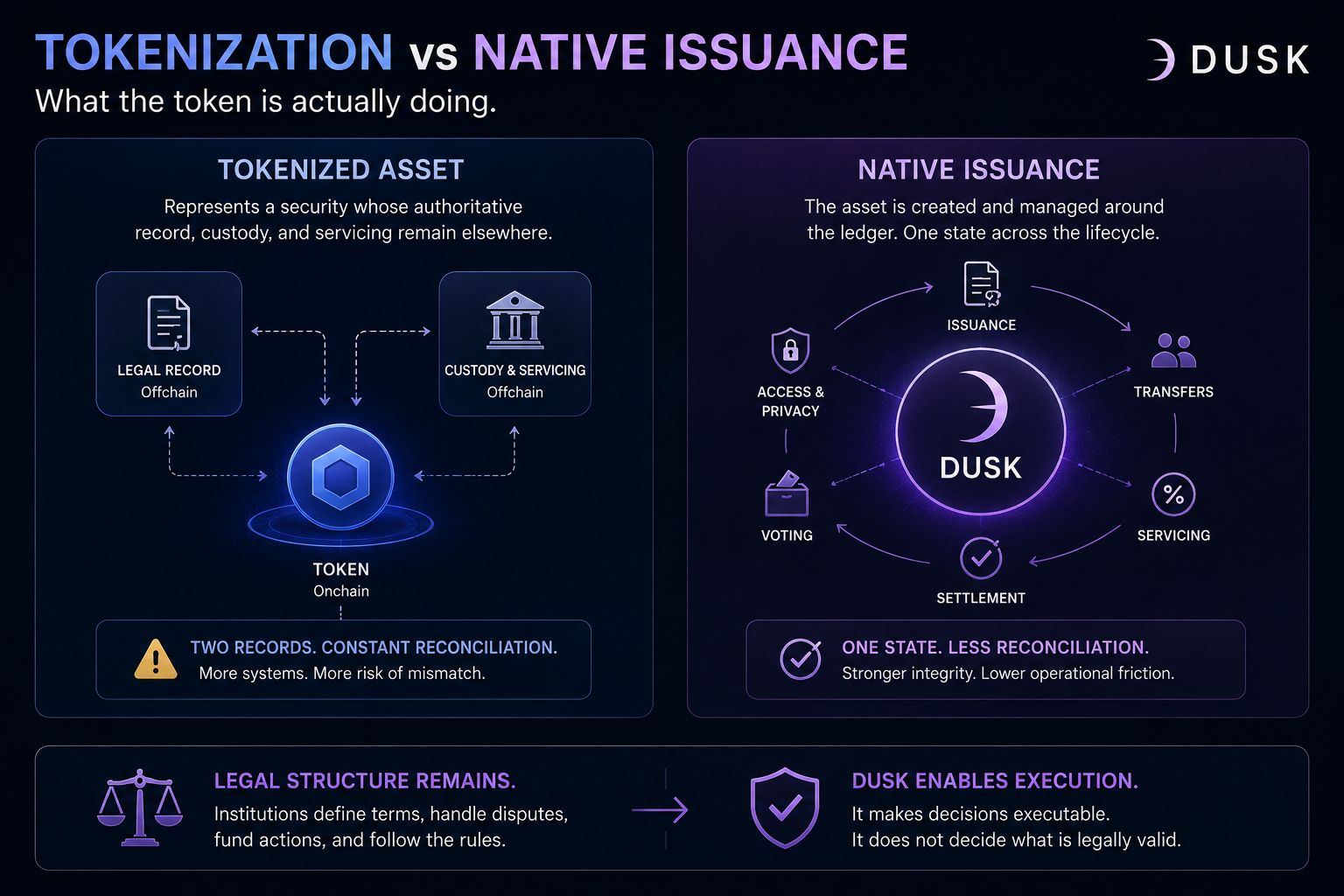
I used to place every blockchain security under the same label: tokenized asset. Dusk Network made me look more closely at what the token is actually doing. A token can represent a security whose authoritative record, custody, and servicing remain somewhere else. That may improve distribution and programmability, but it also creates a second record that must stay aligned with the first. Ownership moves onchain while legal reality can still move through registries, administrators, and settlement systems. Native issuance changes the question. The asset itself is created and managed around the ledger, so issuance, transfers, servicing, and settlement can share one state. Dusk is built for that deeper workflow through access controls, privacy with selective disclosure, and deterministic finality. The part I find important is not the word "native." It is the reduction in reconciliation. Suppose an issuer allocates an asset on Dusk and an eligible investor receives it. If the same ownership state later drives a coupon or vote, fewer systems need to disagree about who owns what. That is a stronger improvement than wrapping an unchanged process in a token contract. But native issuance does not make the legal structure disappear. Someone still defines the instrument, approves its terms, handles disputes, funds corporate actions, and follows the rules of the relevant market. Dusk can make those decisions executable. It cannot decide which decisions are legally valid. That is the boundary I would watch in a live Dusk issuance. Is the ledger the authoritative operating record, or is it still mirroring another book? Do transfers and servicing use the same state, or does reconciliation return after the first sale? Tokenization can put a financial asset onchain. Native issuance can move more of the financial lifecycle there. Dusk becomes much more interesting if it proves the second claim without pretending the chain replaces accountable institutions.
@Dusk #dusk $DUSK $BTW $VELVET
@Dusk #dusk $DUSK $BTW $VELVET
Log in to explore more content