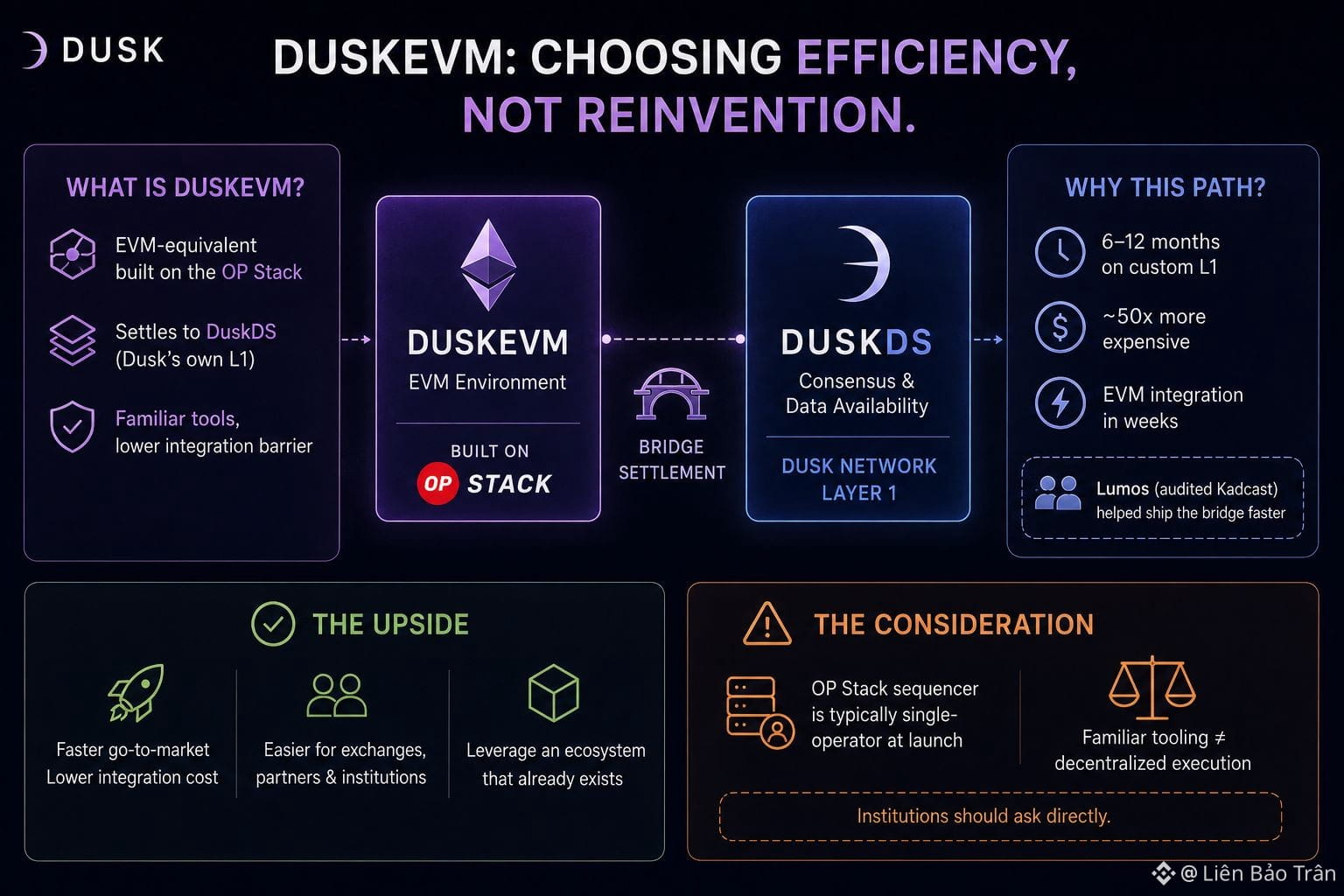
Dusk Network hit the same fork in the road every privacy blockchain eventually reaches: build your own execution environment from scratch and keep full control over the cryptography, or adopt something the rest of the industry already uses and accept the constraints that come with it. It picked the second path when it built DuskEVM, and I think the reasoning behind that choice says more about the project's priorities than any feature list does. DuskEVM is an EVM-equivalent environment built on the OP Stack, the same rollup framework powering a large share of Ethereum's layer 2 ecosystem. It settles back to DuskDS, Dusk Network's own consensus and data availability layer, rather than existing as an island. By Dusk Network's own account of the transition, custom integrations on a bespoke layer 1 can take 6 to 12 months and cost roughly 50 times more than deploying through standard EVM tooling. Exchanges reportedly spent months adapting to native Dusk in the past, while EVM-based integration work can close in weeks. Dusk Network also brought in Lumos, an outside engineering group that previously audited its Kadcast networking protocol, to help the DuskDS to DuskEVM bridge ship faster, which suggests the team did not see this transition as simple enough to handle entirely in-house. That is a real efficiency argument, not just a marketing line, because integration cost is exactly what determines whether institutions bother showing up at all. But adopting the OP Stack also means inheriting its assumptions, including a sequencer model that in most OP Stack deployments starts out operated by a single team rather than a distributed set of operators. For a project built around regulated finance and selective disclosure, that detail deserves more scrutiny than it usually gets. Familiar tooling lowers the barrier to entry. It does not, by itself, prove decentralization at the execution layer, and that is a distinction institutions evaluating Dusk Network for real settlement work should be asking about directly.
@Dusk #dusk $DUSK $VELVET $BTW
@Dusk #dusk $DUSK $VELVET $BTW