Every privacy chain eventually runs into the same wall: full anonymity is elegant in a paper and radioactive on an exchange listing form. Dusk Network hit that wall early and made an unusual choice in response. Early on, a purely shielded chain risked the same fate that has hit anonymity focused assets before it, delisting risk from exchanges unable to screen flows for sanctioned addresses or suspicious activity, which is precisely the failure mode the team eventually built around rather than ignored. Instead of picking a side, they built two transaction models into the same base layer and let users switch between them.
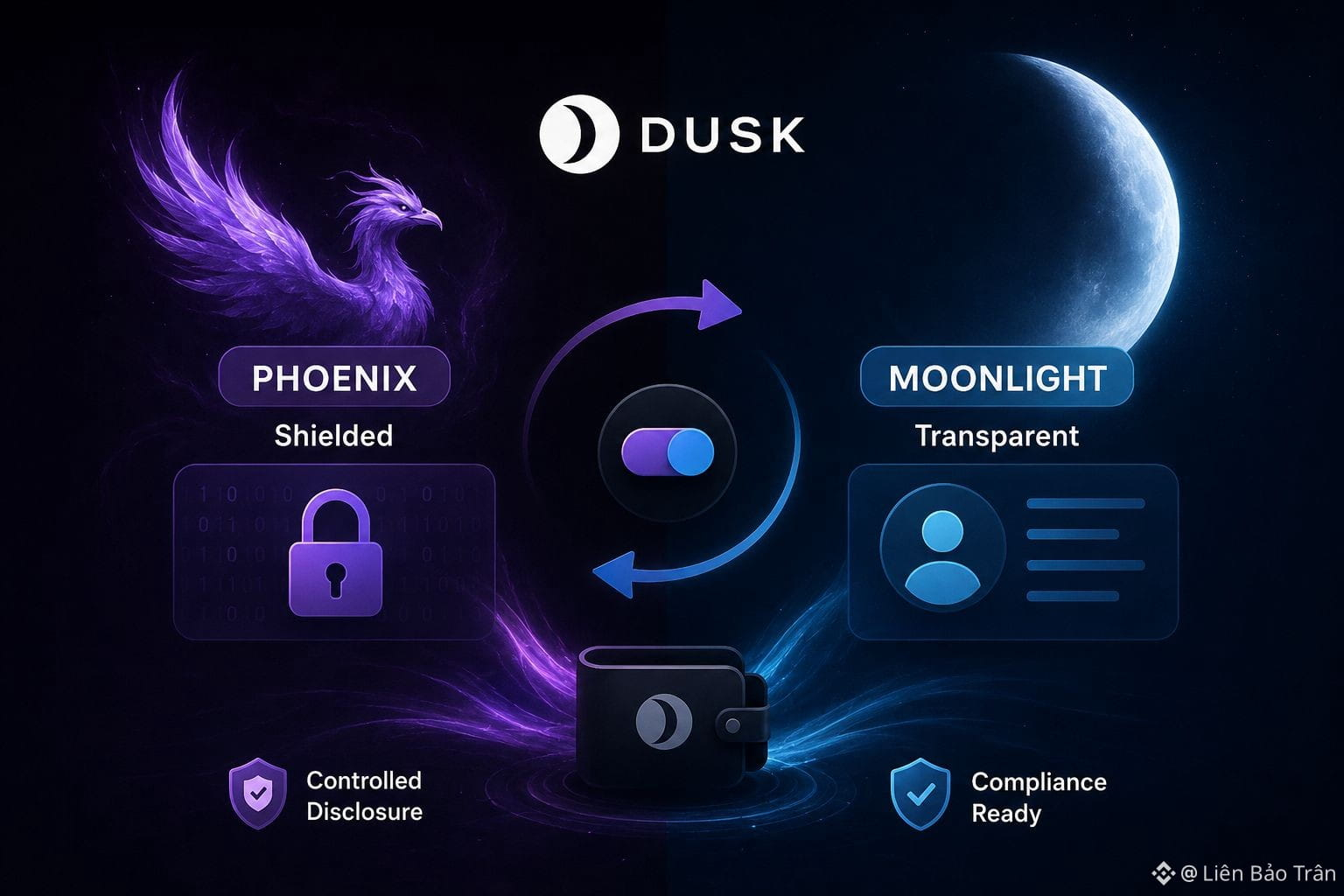
Phoenix is the shielded model, hiding balances and transfer amounts while still allowing a sender to prove specific details to an authorized party when compliance requires it. Moonlight is the public model, transparent by default, built for the exchanges, institutions, and integrations that need an account they can see clearly without extra tooling. A user can move between the two inside the same wallet, which sounds like a small convenience feature until you think about what it replaces: a separate privacy coin and a separate compliant asset, bridged awkwardly, trusted fully by neither community. Together the two are how Dusk pairs confidentiality with transparent, deterministic settlement, a combination the team markets as programmable privacy for regulated markets.
I think this design decision says more about Dusk's read on regulation than any whitepaper paragraph could. The team clearly decided that a privacy protocol which cannot prove anything to anyone is not a financial product, it is a liability waiting for a delisting notice. Whether that bet pays off depends on adoption neither model alone could deliver. A dual system also means double the surface area to secure and double the mental model a new developer has to learn before shipping anything useful.
@Dusk #dusk $DUSK
Phoenix is the shielded model, hiding balances and transfer amounts while still allowing a sender to prove specific details to an authorized party when compliance requires it. Moonlight is the public model, transparent by default, built for the exchanges, institutions, and integrations that need an account they can see clearly without extra tooling. A user can move between the two inside the same wallet, which sounds like a small convenience feature until you think about what it replaces: a separate privacy coin and a separate compliant asset, bridged awkwardly, trusted fully by neither community. Together the two are how Dusk pairs confidentiality with transparent, deterministic settlement, a combination the team markets as programmable privacy for regulated markets.
I think this design decision says more about Dusk's read on regulation than any whitepaper paragraph could. The team clearly decided that a privacy protocol which cannot prove anything to anyone is not a financial product, it is a liability waiting for a delisting notice. Whether that bet pays off depends on adoption neither model alone could deliver. A dual system also means double the surface area to secure and double the mental model a new developer has to learn before shipping anything useful.
@Dusk #dusk $DUSK