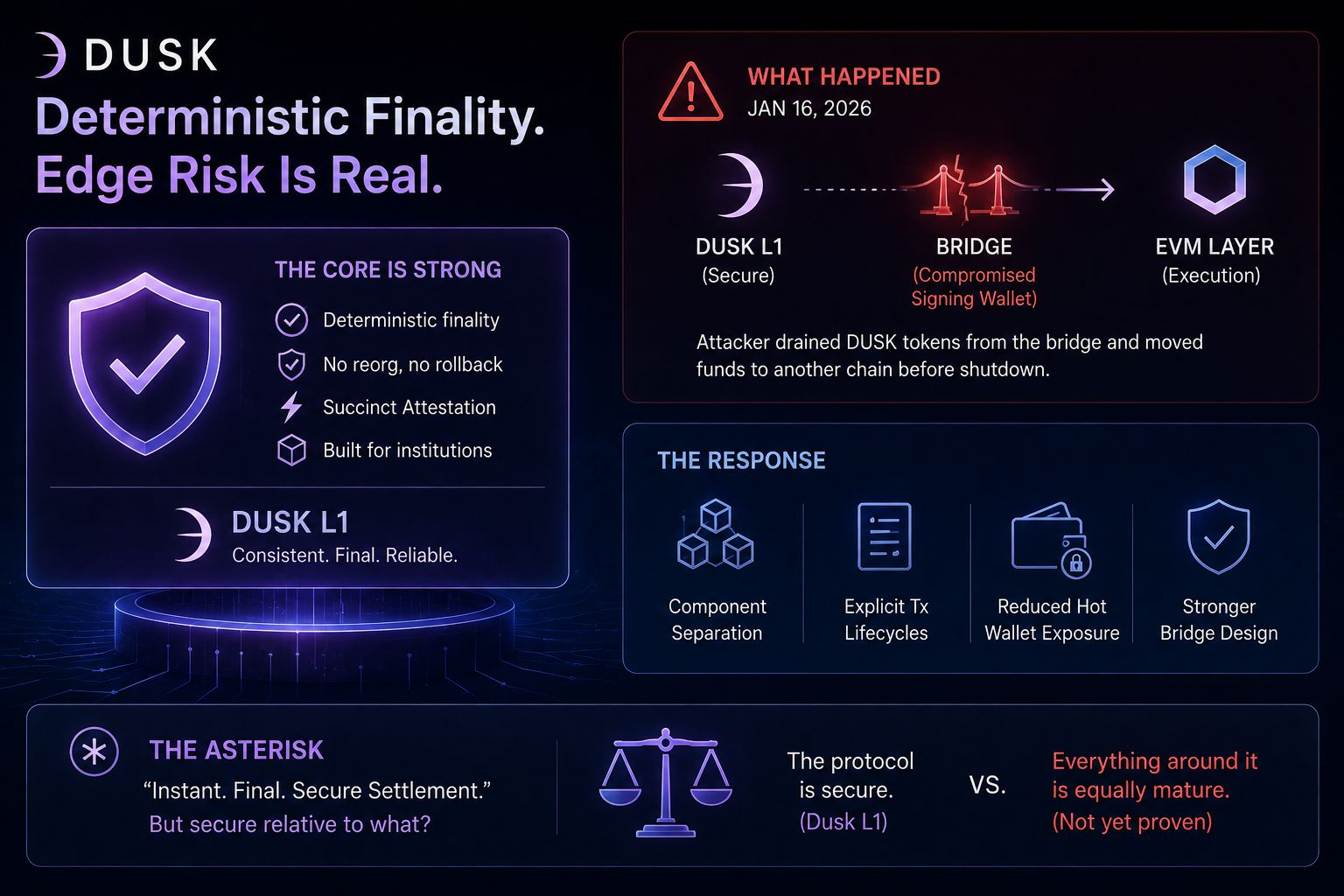
Dusk Network markets deterministic finality as one of its core advantages: once a transaction settles, there's no reorg, no waiting for confirmations to stack up, no theoretical rollback. Succinct Attestation was built specifically to give financial institutions something Bitcoin-style probabilistic finality never could. That part of the promise held up well through the network's first year of mainnet operation. Then, on January 16, 2026, an attacker drained DUSK tokens from the bridge connecting Dusk Network to its EVM execution layer, moving stolen funds onward to another chain before the bridge was shut down. The root cause, per the team's own post-mortem, was a compromised signing wallet inside a bridge design that lacked proper isolation between components. The core consensus layer was never touched. Settlement finality on Dusk Network itself worked exactly as designed. The theft happened at the edge, in the connective tissue between chains, which is precisely where a large share of crypto's worst incidents keep happening industry-wide. That's the gap worth sitting with. A protocol can be cryptographically sound at its center and still be only as strong as the least isolated piece bolted onto it. Dusk Network's response was a full bridge redesign: component separation, explicit transaction lifecycles, reduced hot-wallet exposure. Sensible engineering. But it also means the "instant, final, secure settlement" pitch needs an asterisk most marketing copy leaves out: secure relative to what, the base layer, or every piece of infrastructure a user actually touches? I don't think this disqualifies Dusk Network's core thesis. Deterministic finality at the consensus layer is real and genuinely rare among Layer-1 chains. But I do think anyone evaluating the project should separate "the protocol is secure" from "everything built around the protocol is equally mature," because those are 2 different claims with 2 very different track records so far.
@Dusk #dusk $DUSK
@Dusk #dusk $DUSK