

#binancep2pantoan
binancep2pantoan
1.8M views
8,344 Discussing
Hot
Latest
·
--
Article
7 "Blood and Sweat" Rules for Safe Binance P2P Trading and Never Losing MoneyP2P (Peer-to-Peer) trading on Binance is currently the most popular and convenient channel for depositing/withdrawing fiat currency (VND). However, convenience also comes with many risks, such as getting involved with "dirty money," which can lead to bank account freezes, or being scammed by malicious opponents.
Whether you are a newbie or a long-time investor, mastering the safety rules when trading P2P is a must to protect your own assets.
7 "Blood and Sweat" Rules for Safe Binance P2P Trading and Never Losing Money
P2P (Peer-to-Peer) trading on Binance is currently the most popular and convenient channel for depositing/withdrawing fiat currency (VND). However, convenience also comes with many risks, such as getting involved with "dirty money," which can lead to bank account freezes, or being scammed by malicious opponents.
Whether you are a newbie or a long-time investor, mastering the safety rules when trading P2P is a must to protect your own assets.
Whether you are a newbie or a long-time investor, mastering the safety rules when trading P2P is a must to protect your own assets.
1
149
💡 Dealing with Binance P2P Transaction Issues: What Should You Do?
When trading P2P, if you encounter unexpected situations, stay calm and handle them according to the safe instructions below:
❓ Situation 1: The buyer has clicked “Paid”, but your bank hasn’t reported receiving the funds?
👉 How to handle: Under no circumstances should you release the coins. Message the buyer to request a screenshot of the transaction receipt. Check your banking app carefully. If the countdown time passes and you still haven’t received the money, click Appeal and submit evidence for Binance to investigate.
❓ Situation 2: You transferred too much/too little, or you entered the transfer content incorrectly?
👉 How to handle: Message your counterparty directly through the chat box in the Binance app to agree on a solution. If the counterparty doesn’t cooperate for a refund or doesn’t release the coins, click Appeal and upload the bank transfer invoice.
🔒 Always trade 100% on the Binance app and follow the safety guidelines from @Bi
#BinanceP2PAnToan
@Binance_Vietnam
💡 Dealing with Binance P2P Transaction Issues: What Should You Do?
When trading P2P, if you encounter unexpected situations, stay calm and handle them according to the safe instructions below:
❓ Situation 1: The buyer has clicked “Paid”, but your bank hasn’t reported receiving the funds?
👉 How to handle: Under no circumstances should you release the coins. Message the buyer to request a screenshot of the transaction receipt. Check your banking app carefully. If the countdown time passes and you still haven’t received the money, click Appeal and submit evidence for Binance to investigate.
❓ Situation 2: You transferred too much/too little, or you entered the transfer content incorrectly?
👉 How to handle: Message your counterparty directly through the chat box in the Binance app to agree on a solution. If the counterparty doesn’t cooperate for a refund or doesn’t release the coins, click Appeal and upload the bank transfer invoice.
🔒 Always trade 100% on the Binance app and follow the safety guidelines from @Bi
#BinanceP2PAnToan
@Binance Vietnam
When trading P2P, if you encounter unexpected situations, stay calm and handle them according to the safe instructions below:
❓ Situation 1: The buyer has clicked “Paid”, but your bank hasn’t reported receiving the funds?
👉 How to handle: Under no circumstances should you release the coins. Message the buyer to request a screenshot of the transaction receipt. Check your banking app carefully. If the countdown time passes and you still haven’t received the money, click Appeal and submit evidence for Binance to investigate.
❓ Situation 2: You transferred too much/too little, or you entered the transfer content incorrectly?
👉 How to handle: Message your counterparty directly through the chat box in the Binance app to agree on a solution. If the counterparty doesn’t cooperate for a refund or doesn’t release the coins, click Appeal and upload the bank transfer invoice.
🔒 Always trade 100% on the Binance app and follow the safety guidelines from @Bi
#BinanceP2PAnToan
@Binance Vietnam
112


·
--
Bullish
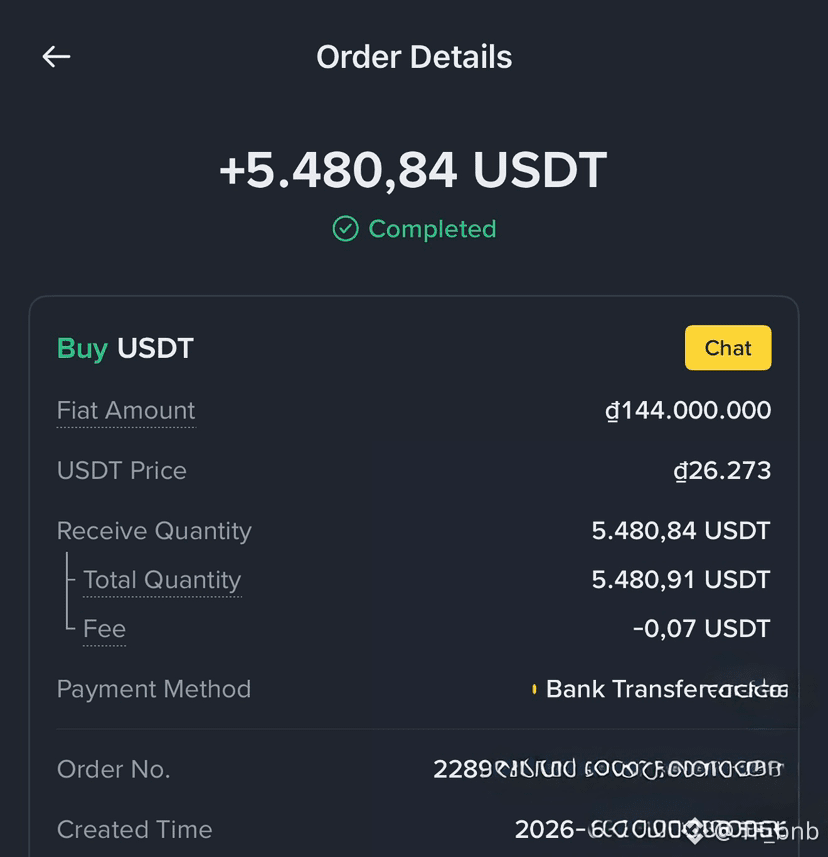
Deposited $5,480 through Binance P2P to continue trading Futures.
But here’s something I want to remind new traders: sometimes the problem isn’t your trading strategy ; it starts with the deposit process.
One small mistake can cause a transaction to fail, waste your time, or even put your funds at risk before you’ve even entered the market.
These are some of the most common mistakes beginners make:
1/ Sending money to the wrong bank
2/ Sending the wrong amount because they forgot to double-check
3/ Correct name but incorrect bank account number
4/ Entering the wrong transfer note
5/ Being asked to move the conversation or transaction to another platform
And there are many other situations you may encounter.
My advice: don’t start with a large amount.
If you’re new to Binance P2P, start with $50 → $100 first. Treat it as a small “learning fee” to understand the entire process: choosing a merchant, checking the payment details, making the transfer, confirming the payment, and receiving USDT.
Once you can consistently avoid these small mistakes, you can gradually increase the amount.
Trading is already risky enough ; don’t let a simple operational mistake cost you money before you even start trading.
Everyone has to start somewhere.
I did too.
Thank you, Binance, for being with me since 2017.
I love Binance. ❤️
#BinanceP2PAnToan
@Binance_Vietnam $BTC $SNDK $SPCX
{future}(BTCUSDT)
Deposited $5,480 through Binance P2P to continue trading Futures.
But here’s something I want to remind new traders: sometimes the problem isn’t your trading strategy ; it starts with the deposit process.
One small mistake can cause a transaction to fail, waste your time, or even put your funds at risk before you’ve even entered the market.
These are some of the most common mistakes beginners make:
1/ Sending money to the wrong bank
2/ Sending the wrong amount because they forgot to double-check
3/ Correct name but incorrect bank account number
4/ Entering the wrong transfer note
5/ Being asked to move the conversation or transaction to another platform
And there are many other situations you may encounter.
My advice: don’t start with a large amount.
If you’re new to Binance P2P, start with $50 → $100 first. Treat it as a small “learning fee” to understand the entire process: choosing a merchant, checking the payment details, making the transfer, confirming the payment, and receiving USDT.
Once you can consistently avoid these small mistakes, you can gradually increase the amount.
Trading is already risky enough ; don’t let a simple operational mistake cost you money before you even start trading.
Everyone has to start somewhere.
I did too.
Thank you, Binance, for being with me since 2017.
I love Binance. ❤️
#BinanceP2PAnToan
@Binance Vietnam $BTC $SNDK $SPCX
But here’s something I want to remind new traders: sometimes the problem isn’t your trading strategy ; it starts with the deposit process.
One small mistake can cause a transaction to fail, waste your time, or even put your funds at risk before you’ve even entered the market.
These are some of the most common mistakes beginners make:
1/ Sending money to the wrong bank
2/ Sending the wrong amount because they forgot to double-check
3/ Correct name but incorrect bank account number
4/ Entering the wrong transfer note
5/ Being asked to move the conversation or transaction to another platform
And there are many other situations you may encounter.
My advice: don’t start with a large amount.
If you’re new to Binance P2P, start with $50 → $100 first. Treat it as a small “learning fee” to understand the entire process: choosing a merchant, checking the payment details, making the transfer, confirming the payment, and receiving USDT.
Once you can consistently avoid these small mistakes, you can gradually increase the amount.
Trading is already risky enough ; don’t let a simple operational mistake cost you money before you even start trading.
Everyone has to start somewhere.
I did too.
Thank you, Binance, for being with me since 2017.
I love Binance. ❤️
#BinanceP2PAnToan
@Binance Vietnam $BTC $SNDK $SPCX
22
22
3k

·
--
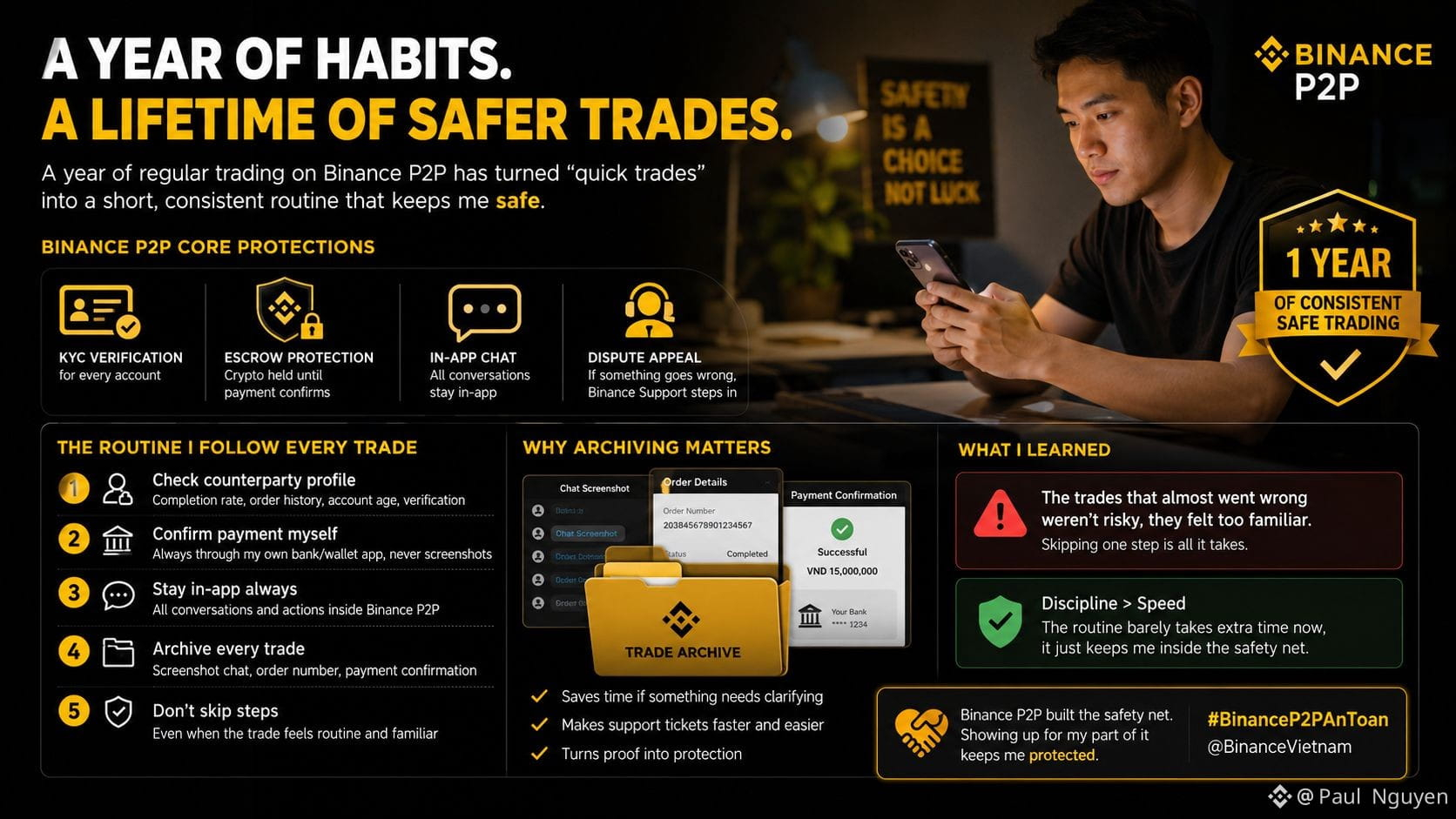
A year of regular trading on Binance P2P has completely changed how I think about a quick trade. What used to feel like just tapping through a few screens is now a short, consistent routine I follow every single time, and it's made a genuine difference in how safe the whole process feels.
Binance P2P's core protections haven't changed over that year, KYC verification for every account, escrow holding crypto until payment confirms, in app chat, and dispute appeal if something breaks down. What changed is how deliberately I actually use them. I check a counterparty's completion rate and order history before every trade now, not just the ones that feel unusual. I confirm payment directly through my own bank or wallet app, never through a chat screenshot, regardless of how convincing it looks or how many times I've traded with that person before.
The habit that's paid off the most is archiving. Every order gets a screenshot of the chat, the order number, and payment confirmation saved together, whether the trade was routine or not. I didn't think I'd need most of them, but on the handful of times something needed clarifying, having that record ready meant contacting Binance support was quick instead of a scramble.
Looking back at the trades that felt closest to going wrong, every single one involved me skipping a step because everything up to that point had felt routine and safe. That's the part nobody warns you about early on, it's not the obviously risky trades that catch you off guard, it's the ones that feel too familiar to bother double checking. So even now, the trades I'm most careful with aren't the unusual ones, they're the ones that feel exactly like every other trade I've done successfully on Binance P2P before.
A year in, the routine barely takes extra time anymore, it's just how I trade now. Binance P2P built the safety net; showing up consistently for my part of it is what actually keeps me inside it.
@Binance_Vietnam #BinanceP2PAnToan
A year of regular trading on Binance P2P has completely changed how I think about a quick trade. What used to feel like just tapping through a few screens is now a short, consistent routine I follow every single time, and it's made a genuine difference in how safe the whole process feels.
Binance P2P's core protections haven't changed over that year, KYC verification for every account, escrow holding crypto until payment confirms, in app chat, and dispute appeal if something breaks down. What changed is how deliberately I actually use them. I check a counterparty's completion rate and order history before every trade now, not just the ones that feel unusual. I confirm payment directly through my own bank or wallet app, never through a chat screenshot, regardless of how convincing it looks or how many times I've traded with that person before.
The habit that's paid off the most is archiving. Every order gets a screenshot of the chat, the order number, and payment confirmation saved together, whether the trade was routine or not. I didn't think I'd need most of them, but on the handful of times something needed clarifying, having that record ready meant contacting Binance support was quick instead of a scramble.
Looking back at the trades that felt closest to going wrong, every single one involved me skipping a step because everything up to that point had felt routine and safe. That's the part nobody warns you about early on, it's not the obviously risky trades that catch you off guard, it's the ones that feel too familiar to bother double checking. So even now, the trades I'm most careful with aren't the unusual ones, they're the ones that feel exactly like every other trade I've done successfully on Binance P2P before.
A year in, the routine barely takes extra time anymore, it's just how I trade now. Binance P2P built the safety net; showing up consistently for my part of it is what actually keeps me inside it.
@Binance Vietnam #BinanceP2PAnToan
Binance P2P's core protections haven't changed over that year, KYC verification for every account, escrow holding crypto until payment confirms, in app chat, and dispute appeal if something breaks down. What changed is how deliberately I actually use them. I check a counterparty's completion rate and order history before every trade now, not just the ones that feel unusual. I confirm payment directly through my own bank or wallet app, never through a chat screenshot, regardless of how convincing it looks or how many times I've traded with that person before.
The habit that's paid off the most is archiving. Every order gets a screenshot of the chat, the order number, and payment confirmation saved together, whether the trade was routine or not. I didn't think I'd need most of them, but on the handful of times something needed clarifying, having that record ready meant contacting Binance support was quick instead of a scramble.
Looking back at the trades that felt closest to going wrong, every single one involved me skipping a step because everything up to that point had felt routine and safe. That's the part nobody warns you about early on, it's not the obviously risky trades that catch you off guard, it's the ones that feel too familiar to bother double checking. So even now, the trades I'm most careful with aren't the unusual ones, they're the ones that feel exactly like every other trade I've done successfully on Binance P2P before.
A year in, the routine barely takes extra time anymore, it's just how I trade now. Binance P2P built the safety net; showing up consistently for my part of it is what actually keeps me inside it.
@Binance Vietnam #BinanceP2PAnToan
226

·
--
Bullish
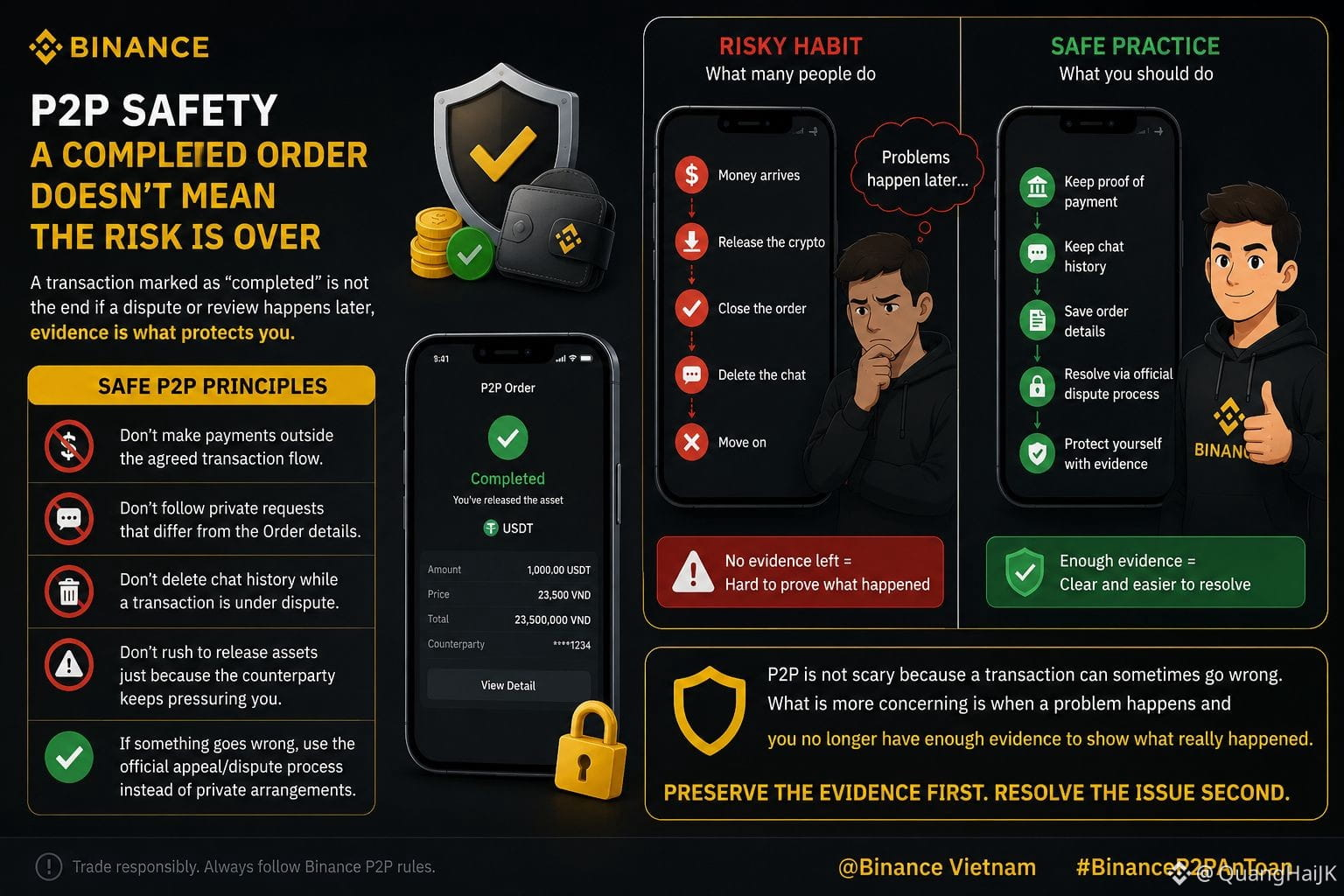
P2P Safety: A Completed Order Doesn’t Always Mean the Risk Is Over
P2P has a type of risk that many people only recognize after their account runs into a problem: a “completed order” does not necessarily mean everything is over.
There is a dangerous habit in P2P trading:
Money arrives → release the crypto → close the order → delete the chat → move on.
But if a dispute arises later, a transaction is reviewed, or one party files a complaint, the things that seemed unimportant at the time can become critical evidence.
For example:
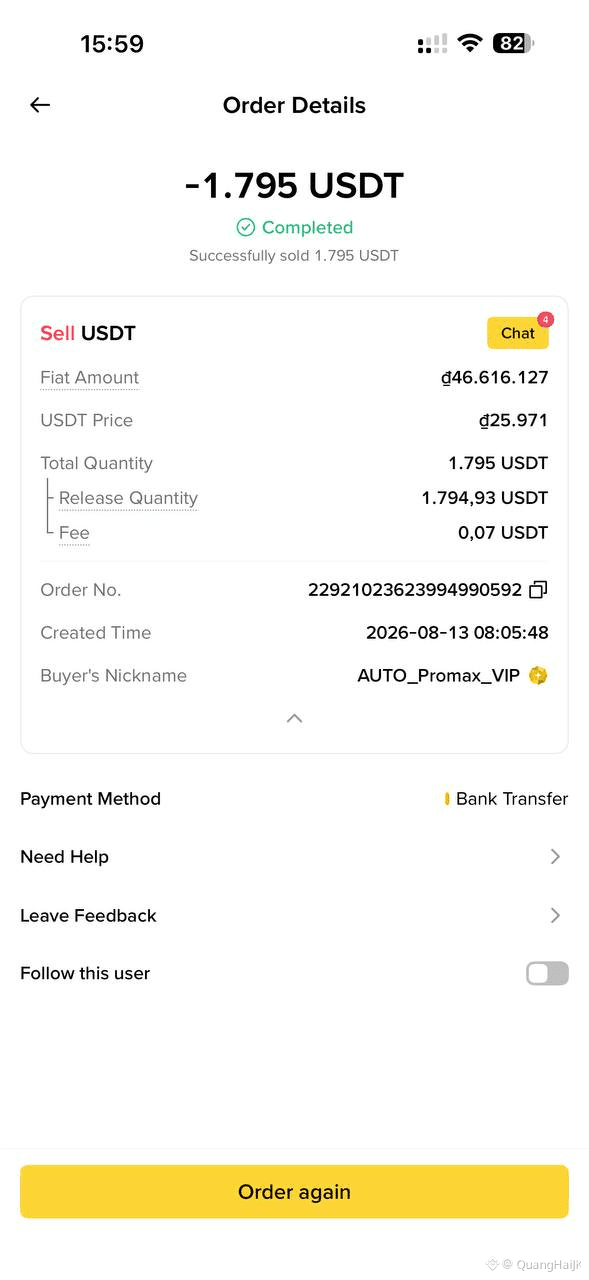
A USDT P2P transaction is completed normally. A few hours later, an issue arises involving the payment. If you no longer have screenshots of the bank transaction, the conversation history, or a clear record of what the counterparty requested, it can become much harder to explain the situation accurately to customer support.
The key question is not “Who reported whom?”
The real question is:
Do you have enough evidence to prove exactly how the transaction took place?
From a P2P safety perspective, I believe there is one simple rule worth following:
The more unusual a transaction looks, the more carefully you should preserve the evidence.
Don’t make payments outside the agreed transaction flow.Don’t follow private requests that differ from the Order details.Don’t delete chat history while a transaction is under dispute.Don’t rush to release assets simply because the counterparty keeps pressuring you.If something goes wrong, use the official appeal/dispute process instead of making private arrangements that are not reflected in the Order.
P2P is not scary simply because a transaction can sometimes go wrong.
What is more concerning is when a problem happens and you no longer have enough evidence to accurately show what actually happened.
That is why my rule is simple:
Preserve the evidence first. Resolve the issue second.
$BNB $SOL $ZEC
{future}(ZECUSDT)
{future}(SOLUSDT)
{future}(BNBUSDT)
#binancep2pantoan @Binance_Vietnam
P2P Safety: A Completed Order Doesn’t Always Mean the Risk Is Over
P2P has a type of risk that many people only recognize after their account runs into a problem: a “completed order” does not necessarily mean everything is over.
There is a dangerous habit in P2P trading:
Money arrives → release the crypto → close the order → delete the chat → move on.
But if a dispute arises later, a transaction is reviewed, or one party files a complaint, the things that seemed unimportant at the time can become critical evidence.
For example:
A USDT P2P transaction is completed normally. A few hours later, an issue arises involving the payment. If you no longer have screenshots of the bank transaction, the conversation history, or a clear record of what the counterparty requested, it can become much harder to explain the situation accurately to customer support.
The key question is not “Who reported whom?”
The real question is:
Do you have enough evidence to prove exactly how the transaction took place?
From a P2P safety perspective, I believe there is one simple rule worth following:
The more unusual a transaction looks, the more carefully you should preserve the evidence.
Don’t make payments outside the agreed transaction flow.Don’t follow private requests that differ from the Order details.Don’t delete chat history while a transaction is under dispute.Don’t rush to release assets simply because the counterparty keeps pressuring you.If something goes wrong, use the official appeal/dispute process instead of making private arrangements that are not reflected in the Order.
P2P is not scary simply because a transaction can sometimes go wrong.
What is more concerning is when a problem happens and you no longer have enough evidence to accurately show what actually happened.
That is why my rule is simple:
Preserve the evidence first. Resolve the issue second.
$BNB $SOL $ZEC
#binancep2pantoan @Binance Vietnam
P2P has a type of risk that many people only recognize after their account runs into a problem: a “completed order” does not necessarily mean everything is over.
There is a dangerous habit in P2P trading:
Money arrives → release the crypto → close the order → delete the chat → move on.
But if a dispute arises later, a transaction is reviewed, or one party files a complaint, the things that seemed unimportant at the time can become critical evidence.
For example:
A USDT P2P transaction is completed normally. A few hours later, an issue arises involving the payment. If you no longer have screenshots of the bank transaction, the conversation history, or a clear record of what the counterparty requested, it can become much harder to explain the situation accurately to customer support.
The key question is not “Who reported whom?”
The real question is:
Do you have enough evidence to prove exactly how the transaction took place?
From a P2P safety perspective, I believe there is one simple rule worth following:
The more unusual a transaction looks, the more carefully you should preserve the evidence.
Don’t make payments outside the agreed transaction flow.Don’t follow private requests that differ from the Order details.Don’t delete chat history while a transaction is under dispute.Don’t rush to release assets simply because the counterparty keeps pressuring you.If something goes wrong, use the official appeal/dispute process instead of making private arrangements that are not reflected in the Order.
P2P is not scary simply because a transaction can sometimes go wrong.
What is more concerning is when a problem happens and you no longer have enough evidence to accurately show what actually happened.
That is why my rule is simple:
Preserve the evidence first. Resolve the issue second.
$BNB $SOL $ZEC
#binancep2pantoan @Binance Vietnam
1
7
2.1k

·
--
I Turned On 2FA Before My First P2P Trade.
Before I started worrying about which merchant to choose, which payment method was better, or whether the price was good enough, I did one thing first:
I secured my Binance account.
On August 19, 2026, before making my first P2P trade, I checked my account security and enabled 2FA.
It sounds basic.
But think about it.
I could spend 10 minutes checking a merchant’s completion rate and trading history, then ignore the security of the account holding the crypto.
That doesn't make much sense.
2FA adds another verification layer when someone tries to access the account. Even if a password is compromised, the password alone isn't supposed to be enough to get in. Binance specifically recommends enabling 2FA for P2P accounts.
For me, P2P safety starts before the order.
My basic setup is:
Secure the account -> choose the counterparty carefully -> keep communication on Binance -> verify the payment -> release only when everything checks out.
And 2FA isn't a replacement for those checks.
It protects one part of the process: my account.
The merchant profile protects another: who I'm trading with.
Payment verification protects another: what actually happened in the transaction.
That's why I don't think P2P safety is one big feature.
It's a chain of small checks.
If one layer is missing, I'm making the whole process weaker than it needs to be.
Before I trade with someone else, I make sure my own account is protected first.
@Binance_Vietnam
#BinanceP2PAnToan
Do you use 2FA for P2P?
I Turned On 2FA Before My First P2P Trade.
Before I started worrying about which merchant to choose, which payment method was better, or whether the price was good enough, I did one thing first:
I secured my Binance account.
On August 19, 2026, before making my first P2P trade, I checked my account security and enabled 2FA.
It sounds basic.
But think about it.
I could spend 10 minutes checking a merchant’s completion rate and trading history, then ignore the security of the account holding the crypto.
That doesn't make much sense.
2FA adds another verification layer when someone tries to access the account. Even if a password is compromised, the password alone isn't supposed to be enough to get in. Binance specifically recommends enabling 2FA for P2P accounts.
For me, P2P safety starts before the order.
My basic setup is:
Secure the account -> choose the counterparty carefully -> keep communication on Binance -> verify the payment -> release only when everything checks out.
And 2FA isn't a replacement for those checks.
It protects one part of the process: my account.
The merchant profile protects another: who I'm trading with.
Payment verification protects another: what actually happened in the transaction.
That's why I don't think P2P safety is one big feature.
It's a chain of small checks.
If one layer is missing, I'm making the whole process weaker than it needs to be.
Before I trade with someone else, I make sure my own account is protected first.
@Binance Vietnam
#BinanceP2PAnToan
Do you use 2FA for P2P?
Before I started worrying about which merchant to choose, which payment method was better, or whether the price was good enough, I did one thing first:
I secured my Binance account.
On August 19, 2026, before making my first P2P trade, I checked my account security and enabled 2FA.
It sounds basic.
But think about it.
I could spend 10 minutes checking a merchant’s completion rate and trading history, then ignore the security of the account holding the crypto.
That doesn't make much sense.
2FA adds another verification layer when someone tries to access the account. Even if a password is compromised, the password alone isn't supposed to be enough to get in. Binance specifically recommends enabling 2FA for P2P accounts.
For me, P2P safety starts before the order.
My basic setup is:
Secure the account -> choose the counterparty carefully -> keep communication on Binance -> verify the payment -> release only when everything checks out.
And 2FA isn't a replacement for those checks.
It protects one part of the process: my account.
The merchant profile protects another: who I'm trading with.
Payment verification protects another: what actually happened in the transaction.
That's why I don't think P2P safety is one big feature.
It's a chain of small checks.
If one layer is missing, I'm making the whole process weaker than it needs to be.
Before I trade with someone else, I make sure my own account is protected first.
@Binance Vietnam
#BinanceP2PAnToan
Do you use 2FA for P2P?
Yes, always
75%
Not yet
0%
Only for login
25%
I should enable it
0%
4 votes • Voting closed
1
2
1.6k
·
--
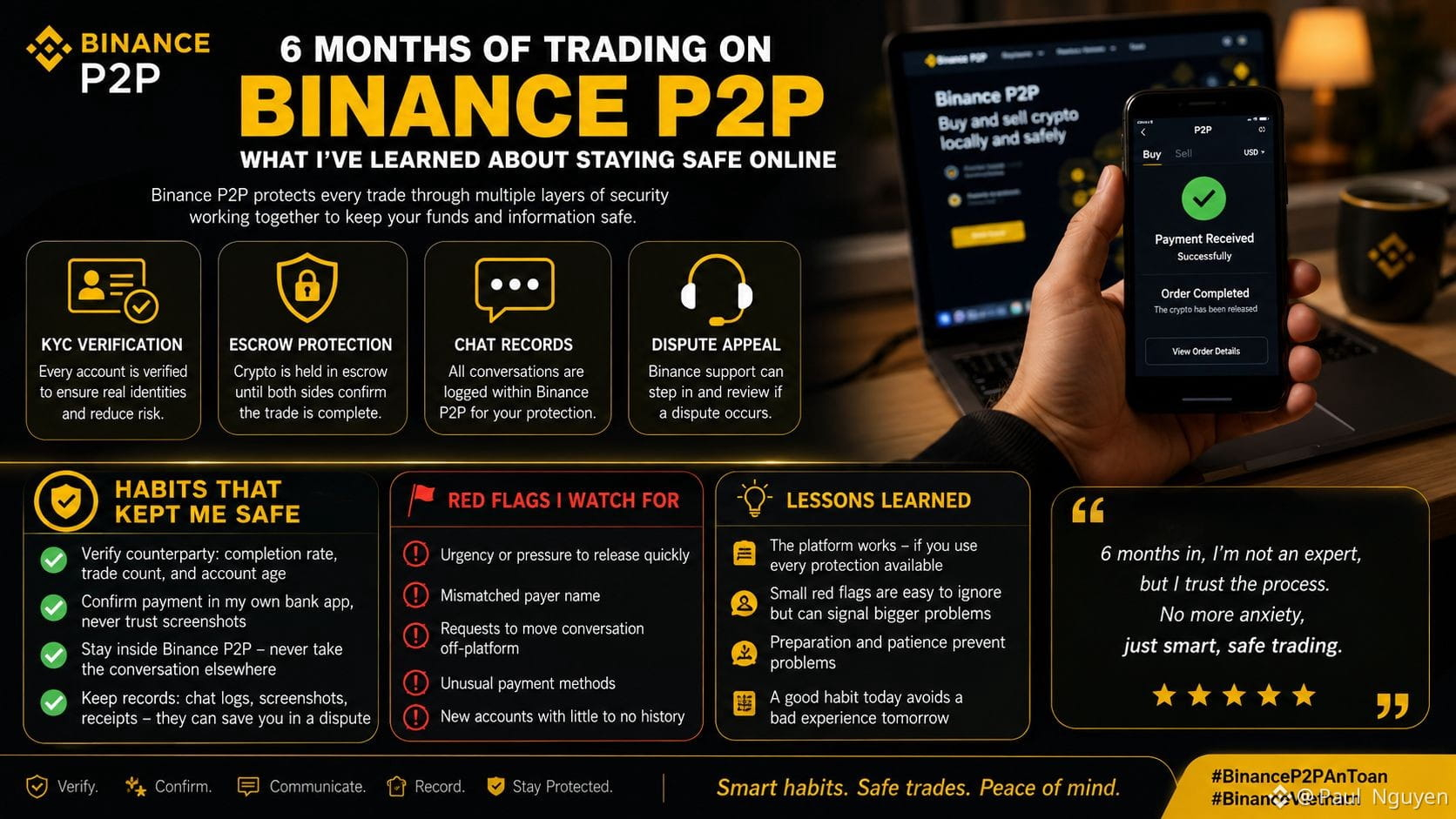
6 months of trading on Binance P2P have taught me more about staying safe online than I expected when I placed my first small order. Binance P2P protects every trade through several layers working together: KYC verification on every account, escrow that holds the crypto asset until both sides confirm completion, a chat system that records the full conversation, and a dispute appeal process if Binance support needs to step in and review what happened.
Looking back, almost every close call I had traces back to skipping one specific habit rather than the platform itself failing in some way. Counterparty verification, checking completion rate, trade count, and account age, has stopped me from trading with a handful of accounts that later turned out to have patterns of complaints in their feedback. Confirming payment directly through my own bank app, rather than trusting a screenshot, has caught more than one attempted fake transfer over these months. And staying entirely within Binance P2P, never moving a conversation elsewhere no matter how convenient it sounded, has kept every protection active on every single order.
The habit I undervalued at first was record keeping. Saving chat logs, confirmation screenshots, and transfer receipts felt unnecessary for months, until one dispute made that archive genuinely useful within minutes rather than hours. If I could tell my first week self anything, it would be this: the red flags are rarely dramatic, they are usually small, like urgency or a name that does not quite match, and noticing them consistently is what makes trading on Binance P2P feel safe rather than stressful.
6 months in, I still would not call myself an expert, but I trust the process enough now to trade without the anxiety that defined my very first order on Binance P2P, and that shift alone has made the entire habit worth building from the start.
@Binance_Vietnam #BinanceP2PAnToan
6 months of trading on Binance P2P have taught me more about staying safe online than I expected when I placed my first small order. Binance P2P protects every trade through several layers working together: KYC verification on every account, escrow that holds the crypto asset until both sides confirm completion, a chat system that records the full conversation, and a dispute appeal process if Binance support needs to step in and review what happened.
Looking back, almost every close call I had traces back to skipping one specific habit rather than the platform itself failing in some way. Counterparty verification, checking completion rate, trade count, and account age, has stopped me from trading with a handful of accounts that later turned out to have patterns of complaints in their feedback. Confirming payment directly through my own bank app, rather than trusting a screenshot, has caught more than one attempted fake transfer over these months. And staying entirely within Binance P2P, never moving a conversation elsewhere no matter how convenient it sounded, has kept every protection active on every single order.
The habit I undervalued at first was record keeping. Saving chat logs, confirmation screenshots, and transfer receipts felt unnecessary for months, until one dispute made that archive genuinely useful within minutes rather than hours. If I could tell my first week self anything, it would be this: the red flags are rarely dramatic, they are usually small, like urgency or a name that does not quite match, and noticing them consistently is what makes trading on Binance P2P feel safe rather than stressful.
6 months in, I still would not call myself an expert, but I trust the process enough now to trade without the anxiety that defined my very first order on Binance P2P, and that shift alone has made the entire habit worth building from the start.
@Binance Vietnam #BinanceP2PAnToan
Looking back, almost every close call I had traces back to skipping one specific habit rather than the platform itself failing in some way. Counterparty verification, checking completion rate, trade count, and account age, has stopped me from trading with a handful of accounts that later turned out to have patterns of complaints in their feedback. Confirming payment directly through my own bank app, rather than trusting a screenshot, has caught more than one attempted fake transfer over these months. And staying entirely within Binance P2P, never moving a conversation elsewhere no matter how convenient it sounded, has kept every protection active on every single order.
The habit I undervalued at first was record keeping. Saving chat logs, confirmation screenshots, and transfer receipts felt unnecessary for months, until one dispute made that archive genuinely useful within minutes rather than hours. If I could tell my first week self anything, it would be this: the red flags are rarely dramatic, they are usually small, like urgency or a name that does not quite match, and noticing them consistently is what makes trading on Binance P2P feel safe rather than stressful.
6 months in, I still would not call myself an expert, but I trust the process enough now to trade without the anxiety that defined my very first order on Binance P2P, and that shift alone has made the entire habit worth building from the start.
@Binance Vietnam #BinanceP2PAnToan
1
209

·
--
#binancep2pantoan @Binance_Vietnam P2P 300 MILLION, SO ALMOST “FROZEN/ENDED” JUST BECAUSE THE TRANSFER CONTENT WAS WRONG 😭
There are times when P2P transactions don’t have any issues because of the money, but they get stuck because of… a tiny detail 🥲
The other day, I learned about a P2P transaction case worth nearly 300 million VND. At first everything went normally: the buyer had transferred the money, but when they checked again, they found that the bank transfer information had been entered incorrectly.
That’s when things started to get panicky =)))
The money had already left the account, but the transaction couldn’t be completed as expected. In the end, they had to file an Appeal for the platform to review and match the records.
Luckily, the trading party still had everything:
👉 Transfer receipt
👉 Bank transaction history
👉 Order ID and P2P order information
Thanks to the complete evidence, the reconciliation was much smoother.
Through this case, I realized something:
THE LARGER THE P2P AMOUNT → THE LESS YOU CAN BE CARELESS/SELF-CONTROL-FREE.
Before you press “send,” take an extra 10–20 seconds to double-check:
✅ Recipient name/bank and account number
✅ The amount that needs to be transferred
✅ Transfer content/details according to the Order’s requirements
After you transfer, don’t rush to delete the receipt—keep all transaction evidence until the Order is completed.
Whether it’s 300 million or 3 million, the principle is the same.
One wrong number can be created in just a few seconds, but sometimes it takes hours to sort out 😭
Guys trading P2P, remember: CHECK BEFORE YOU PRESS TRANSFER nhé =)))
Sincerely, thank you.
#binancep2pantoan @Binance Vietnam P2P 300 MILLION, SO ALMOST “FROZEN/ENDED” JUST BECAUSE THE TRANSFER CONTENT WAS WRONG 😭
There are times when P2P transactions don’t have any issues because of the money, but they get stuck because of… a tiny detail 🥲
The other day, I learned about a P2P transaction case worth nearly 300 million VND. At first everything went normally: the buyer had transferred the money, but when they checked again, they found that the bank transfer information had been entered incorrectly.
That’s when things started to get panicky =)))
The money had already left the account, but the transaction couldn’t be completed as expected. In the end, they had to file an Appeal for the platform to review and match the records.
Luckily, the trading party still had everything:
👉 Transfer receipt
👉 Bank transaction history
👉 Order ID and P2P order information
Thanks to the complete evidence, the reconciliation was much smoother.
Through this case, I realized something:
THE LARGER THE P2P AMOUNT → THE LESS YOU CAN BE CARELESS/SELF-CONTROL-FREE.
Before you press “send,” take an extra 10–20 seconds to double-check:
✅ Recipient name/bank and account number
✅ The amount that needs to be transferred
✅ Transfer content/details according to the Order’s requirements
After you transfer, don’t rush to delete the receipt—keep all transaction evidence until the Order is completed.
Whether it’s 300 million or 3 million, the principle is the same.
One wrong number can be created in just a few seconds, but sometimes it takes hours to sort out 😭
Guys trading P2P, remember: CHECK BEFORE YOU PRESS TRANSFER nhé =)))
Sincerely, thank you.
There are times when P2P transactions don’t have any issues because of the money, but they get stuck because of… a tiny detail 🥲
The other day, I learned about a P2P transaction case worth nearly 300 million VND. At first everything went normally: the buyer had transferred the money, but when they checked again, they found that the bank transfer information had been entered incorrectly.
That’s when things started to get panicky =)))
The money had already left the account, but the transaction couldn’t be completed as expected. In the end, they had to file an Appeal for the platform to review and match the records.
Luckily, the trading party still had everything:
👉 Transfer receipt
👉 Bank transaction history
👉 Order ID and P2P order information
Thanks to the complete evidence, the reconciliation was much smoother.
Through this case, I realized something:
THE LARGER THE P2P AMOUNT → THE LESS YOU CAN BE CARELESS/SELF-CONTROL-FREE.
Before you press “send,” take an extra 10–20 seconds to double-check:
✅ Recipient name/bank and account number
✅ The amount that needs to be transferred
✅ Transfer content/details according to the Order’s requirements
After you transfer, don’t rush to delete the receipt—keep all transaction evidence until the Order is completed.
Whether it’s 300 million or 3 million, the principle is the same.
One wrong number can be created in just a few seconds, but sometimes it takes hours to sort out 😭
Guys trading P2P, remember: CHECK BEFORE YOU PRESS TRANSFER nhé =)))
Sincerely, thank you.
2
2
97

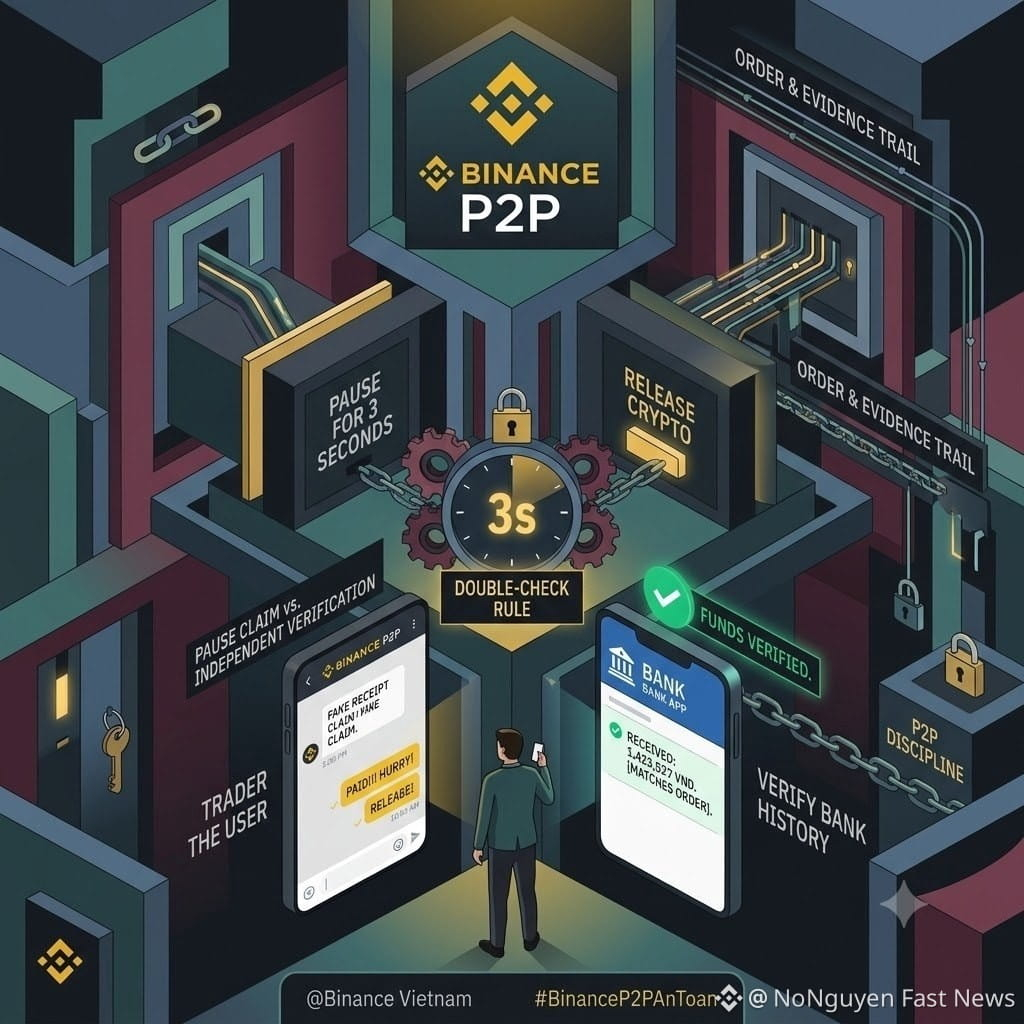
In February 2025, I sold 56 USDT in a hurry for 1,423,527 VND. The buyer sent a fake transfer receipt and kept pushing me in chat. Because the amount was small, I lowered my guard and almost released the crypto without opening my banking app to verify the payment
That mistake changed one part of my P2P routine. After reviewing Binance P2P guidance and discussing the process with Binance Support, I learned to separate a payment claim from a payment I can independently verify. “Payment Completed” on the other side is not the same as “Funds Received” in my own bank account. Escrow protects the crypto during the order, but it does not replace my final payment check
That became my Double-Check 3-Second Rule
When a buyer says “I’ve paid”, even if they spam the chat or push for speed, I pause for three seconds. One breath. Then I open my banking app and check the transaction history. I verify that the actual funds arrived, the amount matches the order, and the payment details make sense. Only then do I tap Release Crypto
The three seconds are not about trading slowly. They create a deliberate pause between a payment claim and an irreversible action. A screenshot is evidence supplied by the counterparty. My bank transaction is independent evidence that the money actually reached me. That distinction is small, but it changes the decision
I also keep the Binance P2P order and chat history intact. If a dispute happens, the order record, conversation and payment evidence help establish the timeline for an Appeal. Staying inside the platform also preserves that evidence trail instead of moving the conversation somewhere harder to document
I no longer treat speed as the goal. I release only when the evidence is complete. That 56 USDT trade taught me that P2P discipline is not about trusting faster; it is about knowing exactly when to slow down
@Binance_Vietnam #BinanceP2PAnToan
In February 2025, I sold 56 USDT in a hurry for 1,423,527 VND. The buyer sent a fake transfer receipt and kept pushing me in chat. Because the amount was small, I lowered my guard and almost released the crypto without opening my banking app to verify the payment
That mistake changed one part of my P2P routine. After reviewing Binance P2P guidance and discussing the process with Binance Support, I learned to separate a payment claim from a payment I can independently verify. “Payment Completed” on the other side is not the same as “Funds Received” in my own bank account. Escrow protects the crypto during the order, but it does not replace my final payment check
That became my Double-Check 3-Second Rule
When a buyer says “I’ve paid”, even if they spam the chat or push for speed, I pause for three seconds. One breath. Then I open my banking app and check the transaction history. I verify that the actual funds arrived, the amount matches the order, and the payment details make sense. Only then do I tap Release Crypto
The three seconds are not about trading slowly. They create a deliberate pause between a payment claim and an irreversible action. A screenshot is evidence supplied by the counterparty. My bank transaction is independent evidence that the money actually reached me. That distinction is small, but it changes the decision
I also keep the Binance P2P order and chat history intact. If a dispute happens, the order record, conversation and payment evidence help establish the timeline for an Appeal. Staying inside the platform also preserves that evidence trail instead of moving the conversation somewhere harder to document
I no longer treat speed as the goal. I release only when the evidence is complete. That 56 USDT trade taught me that P2P discipline is not about trusting faster; it is about knowing exactly when to slow down
@Binance Vietnam #BinanceP2PAnToan
That mistake changed one part of my P2P routine. After reviewing Binance P2P guidance and discussing the process with Binance Support, I learned to separate a payment claim from a payment I can independently verify. “Payment Completed” on the other side is not the same as “Funds Received” in my own bank account. Escrow protects the crypto during the order, but it does not replace my final payment check
That became my Double-Check 3-Second Rule
When a buyer says “I’ve paid”, even if they spam the chat or push for speed, I pause for three seconds. One breath. Then I open my banking app and check the transaction history. I verify that the actual funds arrived, the amount matches the order, and the payment details make sense. Only then do I tap Release Crypto
The three seconds are not about trading slowly. They create a deliberate pause between a payment claim and an irreversible action. A screenshot is evidence supplied by the counterparty. My bank transaction is independent evidence that the money actually reached me. That distinction is small, but it changes the decision
I also keep the Binance P2P order and chat history intact. If a dispute happens, the order record, conversation and payment evidence help establish the timeline for an Appeal. Staying inside the platform also preserves that evidence trail instead of moving the conversation somewhere harder to document
I no longer treat speed as the goal. I release only when the evidence is complete. That 56 USDT trade taught me that P2P discipline is not about trusting faster; it is about knowing exactly when to slow down
@Binance Vietnam #BinanceP2PAnToan
2
1
708

·
--
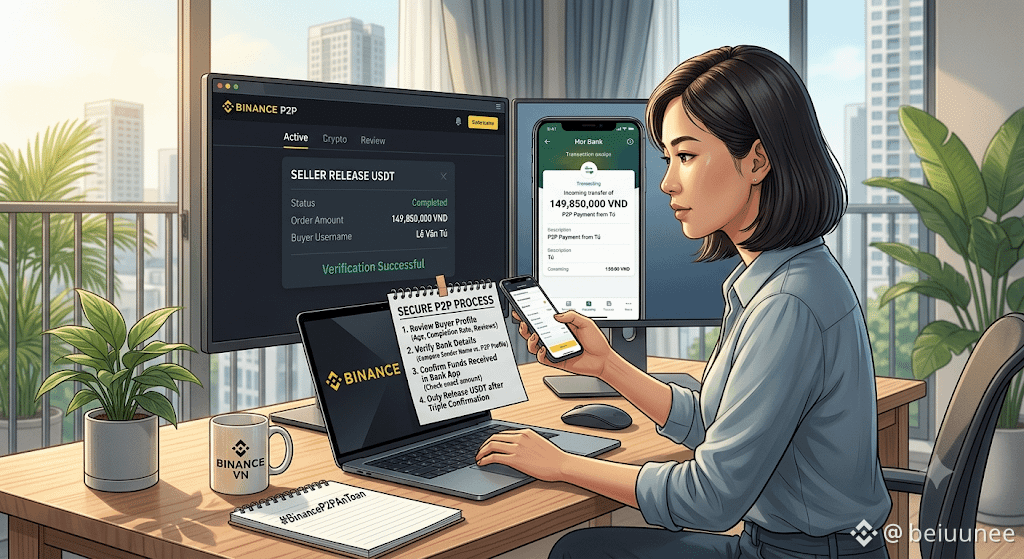
The most money I’ve ever transacted on Binance P2P was when I sold a USDT amount worth nearly 150 million VND to prepare capital for another investment. With that kind of money, I understood that even a small mistake could cause significant losses, so I followed a more thorough verification process than usual.
First, I carefully review the buyer’s profile: how long they’ve been on Binance P2P, the number of orders they’ve completed, the completion rate, and especially the most recent feedback from other sellers. An account with a long history and positive ratings is always more trustworthy than a new one, no matter how attractive the listed price is.
Second, when the buyer sends the notification that they’ve transferred the funds, I don’t release immediately. I open my banking app to check directly. I cross-check three things: whether the amount matches exactly down to the individual unit, whether the account holder name matches the name registered in the buyer’s Binance P2P profile, and whether the transaction time is reasonable.
That time, everything matched—the money arrived correctly and in full within 3 minutes. But I still remember the anxious feeling while waiting, because the amount was far from small. This experience helped me understand that no matter whether the trade is large or small, the process of verifying the counterparty and confirming payment should never be shortened or skipped.
Since then, for any transaction worth over 50 million VND, I’ve taken the initiative to spend a few extra minutes cross-checking every small detail. I see it as a reasonable cost to ensure the safety of my assets on Binance P2P.
#binancep2pantoan @Binance_Vietnam $AVAAI
{future}(AVAAIUSDT)
The most money I’ve ever transacted on Binance P2P was when I sold a USDT amount worth nearly 150 million VND to prepare capital for another investment. With that kind of money, I understood that even a small mistake could cause significant losses, so I followed a more thorough verification process than usual.
First, I carefully review the buyer’s profile: how long they’ve been on Binance P2P, the number of orders they’ve completed, the completion rate, and especially the most recent feedback from other sellers. An account with a long history and positive ratings is always more trustworthy than a new one, no matter how attractive the listed price is.
Second, when the buyer sends the notification that they’ve transferred the funds, I don’t release immediately. I open my banking app to check directly. I cross-check three things: whether the amount matches exactly down to the individual unit, whether the account holder name matches the name registered in the buyer’s Binance P2P profile, and whether the transaction time is reasonable.
That time, everything matched—the money arrived correctly and in full within 3 minutes. But I still remember the anxious feeling while waiting, because the amount was far from small. This experience helped me understand that no matter whether the trade is large or small, the process of verifying the counterparty and confirming payment should never be shortened or skipped.
Since then, for any transaction worth over 50 million VND, I’ve taken the initiative to spend a few extra minutes cross-checking every small detail. I see it as a reasonable cost to ensure the safety of my assets on Binance P2P.
#binancep2pantoan @Binance Vietnam $AVAAI
First, I carefully review the buyer’s profile: how long they’ve been on Binance P2P, the number of orders they’ve completed, the completion rate, and especially the most recent feedback from other sellers. An account with a long history and positive ratings is always more trustworthy than a new one, no matter how attractive the listed price is.
Second, when the buyer sends the notification that they’ve transferred the funds, I don’t release immediately. I open my banking app to check directly. I cross-check three things: whether the amount matches exactly down to the individual unit, whether the account holder name matches the name registered in the buyer’s Binance P2P profile, and whether the transaction time is reasonable.
That time, everything matched—the money arrived correctly and in full within 3 minutes. But I still remember the anxious feeling while waiting, because the amount was far from small. This experience helped me understand that no matter whether the trade is large or small, the process of verifying the counterparty and confirming payment should never be shortened or skipped.
Since then, for any transaction worth over 50 million VND, I’ve taken the initiative to spend a few extra minutes cross-checking every small detail. I see it as a reasonable cost to ensure the safety of my assets on Binance P2P.
#binancep2pantoan @Binance Vietnam $AVAAI
107

A Payment Can Arrive and Still Be the Wrong P2P Payment
One detail in Binance P2P is easy to underestimate: receiving the correct amount is not the same as receiving a valid payment for that order.
Binance’s current P2P policy says the buyer should pay from an account whose owner name is identical to the name verified on Binance. The seller’s receiving account is held to the same identity principle. In the Appeal Handling Rules, if the buyer’s payment-account name does not match the verified Binance name, the crypto should not be released; the seller may be asked to refund the payment, and the buyer’s P2P function can be suspended.
Why does this matter? Because “money arrived” answers only one question: did funds reach the account? It does not answer a second question: did they come from the counterparty Binance identifies for this order?
That distinction changes the seller’s decision point. Before tapping Confirm Release, check three things together: the amount received, the sender/account-holder name shown by the payment method, and the verified counterparty details available in the order. A screenshot of a transfer is not a substitute for checking the actual account.
There is also a useful nuance: a name mismatch is not proof that the buyer is a scammer. It can come from a payment mistake or use of another person’s account. But it is still a rule-level mismatch, so treating it casually removes an important identity check from the transaction.
The deeper lesson is that payment verification and counterparty verification solve different problems. On Binance P2P, a safe release needs both.
@Binance_Vietnam #BinanceP2PAnToan $BTC $ETH $SOL
A Payment Can Arrive and Still Be the Wrong P2P Payment
One detail in Binance P2P is easy to underestimate: receiving the correct amount is not the same as receiving a valid payment for that order.
Binance’s current P2P policy says the buyer should pay from an account whose owner name is identical to the name verified on Binance. The seller’s receiving account is held to the same identity principle. In the Appeal Handling Rules, if the buyer’s payment-account name does not match the verified Binance name, the crypto should not be released; the seller may be asked to refund the payment, and the buyer’s P2P function can be suspended.
Why does this matter? Because “money arrived” answers only one question: did funds reach the account? It does not answer a second question: did they come from the counterparty Binance identifies for this order?
That distinction changes the seller’s decision point. Before tapping Confirm Release, check three things together: the amount received, the sender/account-holder name shown by the payment method, and the verified counterparty details available in the order. A screenshot of a transfer is not a substitute for checking the actual account.
There is also a useful nuance: a name mismatch is not proof that the buyer is a scammer. It can come from a payment mistake or use of another person’s account. But it is still a rule-level mismatch, so treating it casually removes an important identity check from the transaction.
The deeper lesson is that payment verification and counterparty verification solve different problems. On Binance P2P, a safe release needs both.
@Binance Vietnam #BinanceP2PAnToan $BTC $ETH $SOL
One detail in Binance P2P is easy to underestimate: receiving the correct amount is not the same as receiving a valid payment for that order.
Binance’s current P2P policy says the buyer should pay from an account whose owner name is identical to the name verified on Binance. The seller’s receiving account is held to the same identity principle. In the Appeal Handling Rules, if the buyer’s payment-account name does not match the verified Binance name, the crypto should not be released; the seller may be asked to refund the payment, and the buyer’s P2P function can be suspended.
Why does this matter? Because “money arrived” answers only one question: did funds reach the account? It does not answer a second question: did they come from the counterparty Binance identifies for this order?
That distinction changes the seller’s decision point. Before tapping Confirm Release, check three things together: the amount received, the sender/account-holder name shown by the payment method, and the verified counterparty details available in the order. A screenshot of a transfer is not a substitute for checking the actual account.
There is also a useful nuance: a name mismatch is not proof that the buyer is a scammer. It can come from a payment mistake or use of another person’s account. But it is still a rule-level mismatch, so treating it casually removes an important identity check from the transaction.
The deeper lesson is that payment verification and counterparty verification solve different problems. On Binance P2P, a safe release needs both.
@Binance Vietnam #BinanceP2PAnToan $BTC $ETH $SOL
178

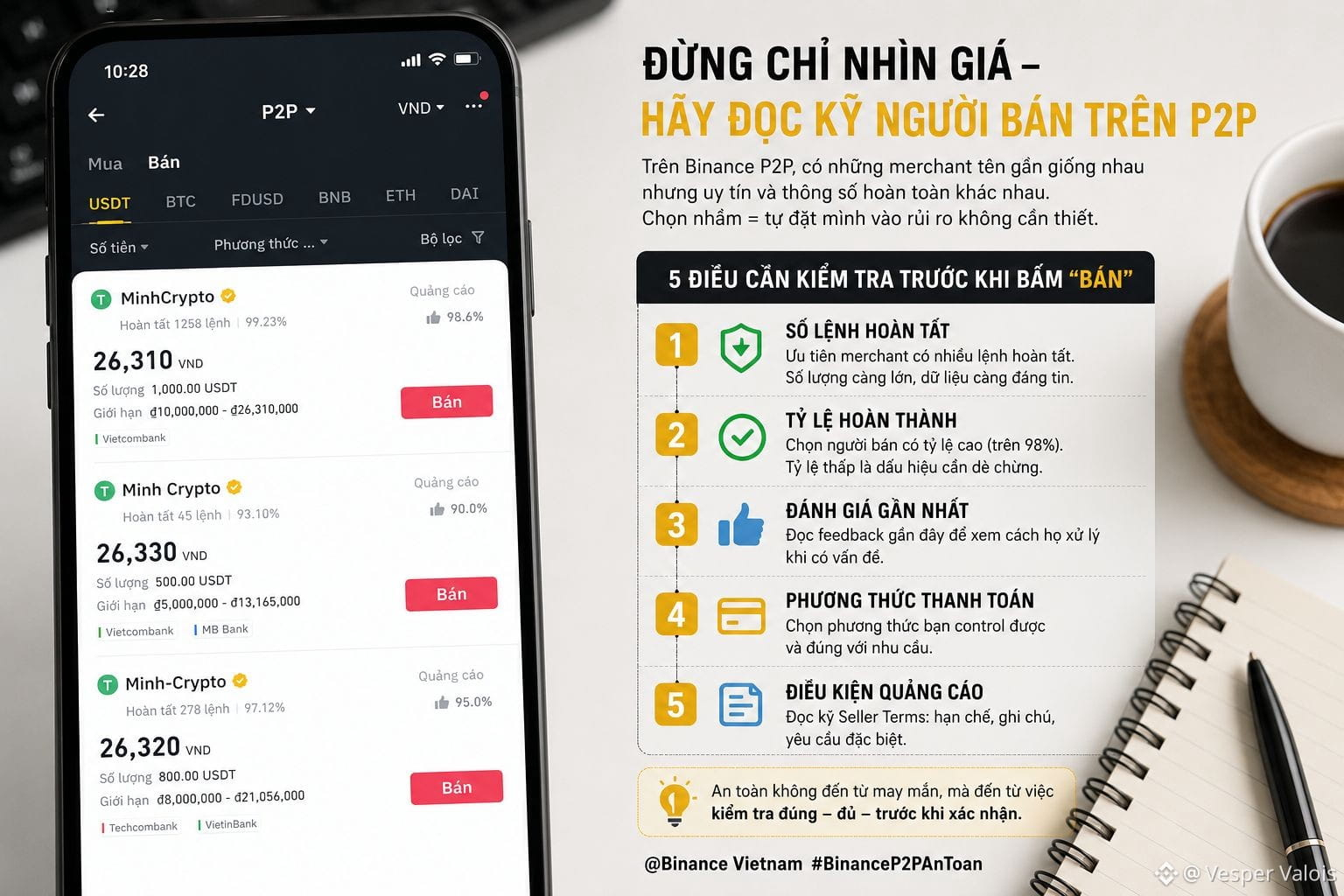
If you’re new to Binance P2P, there’s a habit I think you should start right away from your very first trades: in my opinion, don’t choose a seller just because they have a better price.
I used to think that a difference of a few coins wasn’t that much, so I would usually look at the price first and then check the other details. But after many trades, and when I read more carefully how Binance displays the data for each ad, I started to realize that what’s worth checking isn’t only the price level.
I tried to build a simple process for myself before each order—something you can refer to.
First, I look at the number of transactions and the completion rate. Then I read feedback, especially if there are negative responses that repeat.
Next, I check the order limits and whether the payment method is truly suitable.
More importantly, I cross-check the payment information and don’t intentionally move the conversation to Telegram or other platforms.
However, one thing I’ve found is that this data can’t turn a partner into “absolute safety”—it only gives us more basis to evaluate before trading.
For P2P transactions, in my view, the most important thing isn’t finding the cheapest seller, but forming the habit of checking before you press confirm.
I don’t know if these experiences help everyone, but at least that’s what I’ve learned after verifying it myself.
#binancep2pantoan @Binance_Vietnam $BTC
If you’re new to Binance P2P, there’s a habit I think you should start right away from your very first trades: in my opinion, don’t choose a seller just because they have a better price.
I used to think that a difference of a few coins wasn’t that much, so I would usually look at the price first and then check the other details. But after many trades, and when I read more carefully how Binance displays the data for each ad, I started to realize that what’s worth checking isn’t only the price level.
I tried to build a simple process for myself before each order—something you can refer to.
First, I look at the number of transactions and the completion rate. Then I read feedback, especially if there are negative responses that repeat.
Next, I check the order limits and whether the payment method is truly suitable.
More importantly, I cross-check the payment information and don’t intentionally move the conversation to Telegram or other platforms.
However, one thing I’ve found is that this data can’t turn a partner into “absolute safety”—it only gives us more basis to evaluate before trading.
For P2P transactions, in my view, the most important thing isn’t finding the cheapest seller, but forming the habit of checking before you press confirm.
I don’t know if these experiences help everyone, but at least that’s what I’ve learned after verifying it myself.
#binancep2pantoan @Binance Vietnam $BTC
I used to think that a difference of a few coins wasn’t that much, so I would usually look at the price first and then check the other details. But after many trades, and when I read more carefully how Binance displays the data for each ad, I started to realize that what’s worth checking isn’t only the price level.
I tried to build a simple process for myself before each order—something you can refer to.
First, I look at the number of transactions and the completion rate. Then I read feedback, especially if there are negative responses that repeat.
Next, I check the order limits and whether the payment method is truly suitable.
More importantly, I cross-check the payment information and don’t intentionally move the conversation to Telegram or other platforms.
However, one thing I’ve found is that this data can’t turn a partner into “absolute safety”—it only gives us more basis to evaluate before trading.
For P2P transactions, in my view, the most important thing isn’t finding the cheapest seller, but forming the habit of checking before you press confirm.
I don’t know if these experiences help everyone, but at least that’s what I’ve learned after verifying it myself.
#binancep2pantoan @Binance Vietnam $BTC
1
208
#binancep2pantoan @Binance_Vietnam
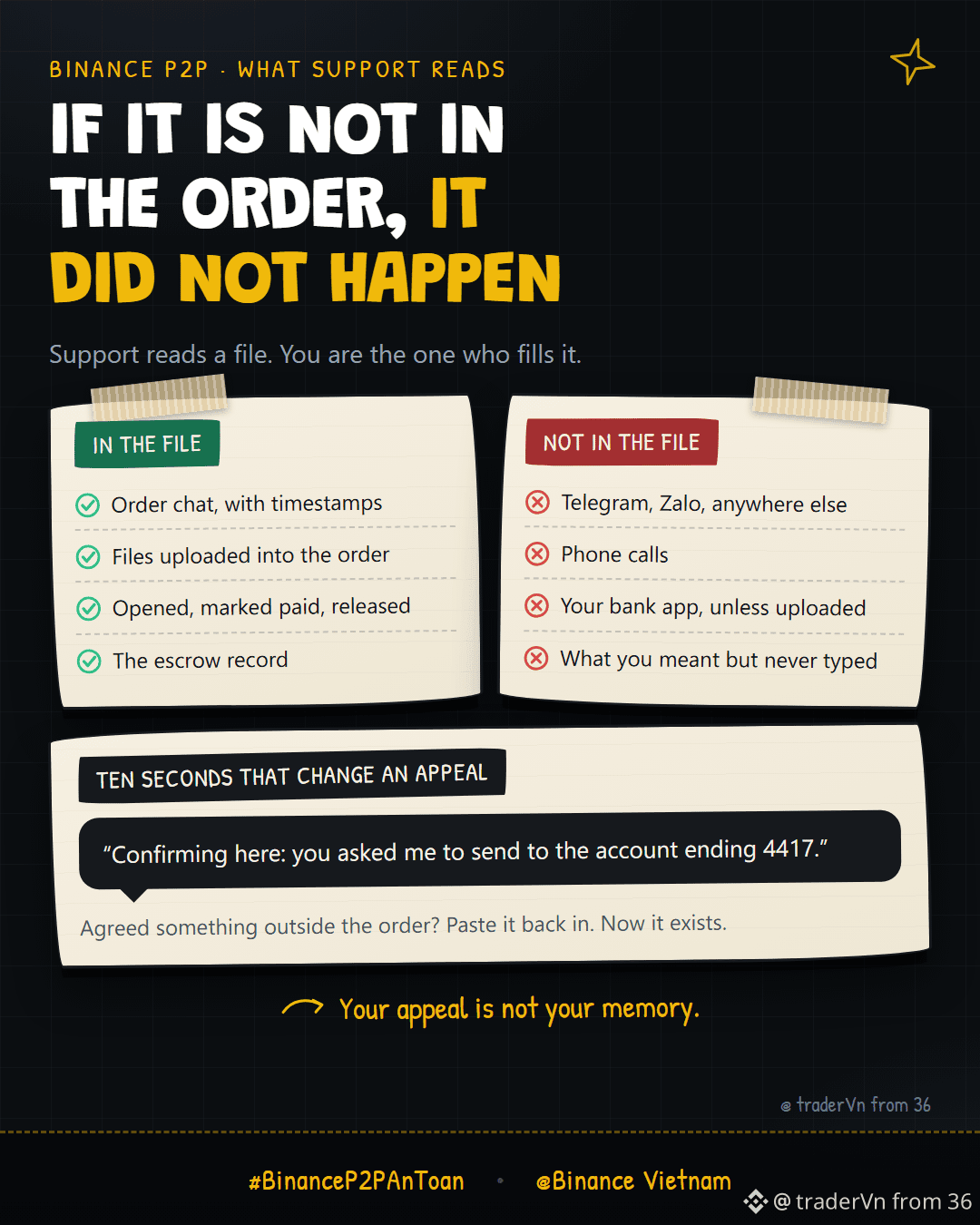
IF IT IS NOT IN THE ORDER, IT DID NOT HAPPEN
❓ If a trade went wrong tonight, how much of your side of it could Support actually read?
Most people assume Support sees everything. It does not. It reads a file, and you fill it.
👁️ What Support can read
The order chat with its timestamps. Anything uploaded into the order. When the order opened, was marked paid, and was released. The escrow record.
🚫 What Support cannot read
Your Telegram or Zalo. Your phone calls. Your bank app, unless you put the screenshot in. What either of you meant but never typed.
🔗 The platform rule is really a records rule
Moving the conversation elsewhere is not risky because the other app is dangerous. It is risky because it moves the evidence where nobody neutral will read it.
⌨️ Ten seconds that change an appeal
If anything gets agreed outside the order, paste it back in. "Confirming here: you asked me to send to the account ending 4417." Now it exists.
👤 The part only you can do
The badge and the completion rate sit on the ad before you accept. Support cannot un-choose a counterparty for you.
🔍 Before releasing
Open the bank app itself and watch the balance change. A notification is not the account.
📁 Afterwards
The Order ID is the only handle that finds this trade months from now.
Your appeal is not your memory. It is the file.
What is the one line you always type into the order chat?
#P2P
#binancep2pantoan @Binance Vietnam
IF IT IS NOT IN THE ORDER, IT DID NOT HAPPEN
❓ If a trade went wrong tonight, how much of your side of it could Support actually read?
Most people assume Support sees everything. It does not. It reads a file, and you fill it.
👁️ What Support can read
The order chat with its timestamps. Anything uploaded into the order. When the order opened, was marked paid, and was released. The escrow record.
🚫 What Support cannot read
Your Telegram or Zalo. Your phone calls. Your bank app, unless you put the screenshot in. What either of you meant but never typed.
🔗 The platform rule is really a records rule
Moving the conversation elsewhere is not risky because the other app is dangerous. It is risky because it moves the evidence where nobody neutral will read it.
⌨️ Ten seconds that change an appeal
If anything gets agreed outside the order, paste it back in. "Confirming here: you asked me to send to the account ending 4417." Now it exists.
👤 The part only you can do
The badge and the completion rate sit on the ad before you accept. Support cannot un-choose a counterparty for you.
🔍 Before releasing
Open the bank app itself and watch the balance change. A notification is not the account.
📁 Afterwards
The Order ID is the only handle that finds this trade months from now.
Your appeal is not your memory. It is the file.
What is the one line you always type into the order chat?
#P2P
IF IT IS NOT IN THE ORDER, IT DID NOT HAPPEN
❓ If a trade went wrong tonight, how much of your side of it could Support actually read?
Most people assume Support sees everything. It does not. It reads a file, and you fill it.
👁️ What Support can read
The order chat with its timestamps. Anything uploaded into the order. When the order opened, was marked paid, and was released. The escrow record.
🚫 What Support cannot read
Your Telegram or Zalo. Your phone calls. Your bank app, unless you put the screenshot in. What either of you meant but never typed.
🔗 The platform rule is really a records rule
Moving the conversation elsewhere is not risky because the other app is dangerous. It is risky because it moves the evidence where nobody neutral will read it.
⌨️ Ten seconds that change an appeal
If anything gets agreed outside the order, paste it back in. "Confirming here: you asked me to send to the account ending 4417." Now it exists.
👤 The part only you can do
The badge and the completion rate sit on the ad before you accept. Support cannot un-choose a counterparty for you.
🔍 Before releasing
Open the bank app itself and watch the balance change. A notification is not the account.
📁 Afterwards
The Order ID is the only handle that finds this trade months from now.
Your appeal is not your memory. It is the file.
What is the one line you always type into the order chat?
#P2P
8
3
5
28

·
--
#binancep2pantoan @Binance_Vietnam Check the actual balance: If you are a seller, only unlock crypto (release) when you open the banking app and see that the money has arrived in your actual wallet. Don’t trust any transfer receipt images (or screenshots), as editing technology or AI today can create very sophisticated forgeries
#binancep2pantoan @Binance Vietnam Check the actual balance: If you are a seller, only unlock crypto (release) when you open the banking app and see that the money has arrived in your actual wallet. Don’t trust any transfer receipt images (or screenshots), as editing technology or AI today can create very sophisticated forgeries
74

BINANCE P2P TRADING SAFETY GUIDE FOR EVERY TRADER
P2P trading is extremely fast and convenient, but to protect your account absolutely, always remember these 3 golden rules:
1️⃣ Trade only from your own account: The bank account name MUST match 100% with the KYC-verified name on Binance. Absolutely do not transfer to or receive money from any third party!
2️⃣ Check your actual balance: Log directly into your Bank App to see whether the money has arrived in your account before clicking "Release USDT". Absolutely DO NOT rely on screenshots or SMS notifications that money has been received.
3️⃣ Use the correct transfer details: Only enter the correct Order ID. Avoid writing sensitive terms like "Crypto", "USDT", "BTC" or "Binance".
Be proactive in improving your security knowledge so you can trade with peace of mind. Let’s learn more useful lessons from @Binance Vietnam!
#BinanceP2PAnToan
@Binance_Vietnam
BINANCE P2P TRADING SAFETY GUIDE FOR EVERY TRADER
P2P trading is extremely fast and convenient, but to protect your account absolutely, always remember these 3 golden rules:
1️⃣ Trade only from your own account: The bank account name MUST match 100% with the KYC-verified name on Binance. Absolutely do not transfer to or receive money from any third party!
2️⃣ Check your actual balance: Log directly into your Bank App to see whether the money has arrived in your account before clicking "Release USDT". Absolutely DO NOT rely on screenshots or SMS notifications that money has been received.
3️⃣ Use the correct transfer details: Only enter the correct Order ID. Avoid writing sensitive terms like "Crypto", "USDT", "BTC" or "Binance".
Be proactive in improving your security knowledge so you can trade with peace of mind. Let’s learn more useful lessons from @Binance Vietnam!
#BinanceP2PAnToan
@Binance Vietnam
P2P trading is extremely fast and convenient, but to protect your account absolutely, always remember these 3 golden rules:
1️⃣ Trade only from your own account: The bank account name MUST match 100% with the KYC-verified name on Binance. Absolutely do not transfer to or receive money from any third party!
2️⃣ Check your actual balance: Log directly into your Bank App to see whether the money has arrived in your account before clicking "Release USDT". Absolutely DO NOT rely on screenshots or SMS notifications that money has been received.
3️⃣ Use the correct transfer details: Only enter the correct Order ID. Avoid writing sensitive terms like "Crypto", "USDT", "BTC" or "Binance".
Be proactive in improving your security knowledge so you can trade with peace of mind. Let’s learn more useful lessons from @Binance Vietnam!
#BinanceP2PAnToan
@Binance Vietnam
1
74

#binancep2pantoan @Binance_Vietnam P2P If the price deal is so sweet that you shouldn’t get “smitten” like you’ve just met your crush 😂 Check the trader carefully, the amount, and the receiving account; the money must truly land in the account before you confirm. If someone invites you to “go outside Binance to make it faster,” be quick… avoid it! 😎 The best part of P2P is when you finish the transaction with your money and trust still intact—and you don’t have to call a detective 🔎😂
#binancep2pantoan @Binance Vietnam P2P If the price deal is so sweet that you shouldn’t get “smitten” like you’ve just met your crush 😂 Check the trader carefully, the amount, and the receiving account; the money must truly land in the account before you confirm. If someone invites you to “go outside Binance to make it faster,” be quick… avoid it! 😎 The best part of P2P is when you finish the transaction with your money and trust still intact—and you don’t have to call a detective 🔎😂
66

·
--
#binancep2pantoan @Binance_Vietnam
💡 How Binance P2P worksThe platform operates based on a secured margin (escrow) mechanism:Place an order: You choose a suitable buy or sell advertisement on the Binance P2P Marketplace.Lock the coins: Binance’s system automatically locks the seller’s crypto amount.Payment: The buyer transfers money via a bank account or e-wallet to the seller.Release coins: After the seller confirms that they have received the full payment, the system unlocks and sends the coins to the buyer’s wallet.🛡️ Common risks and how to avoid them (Latest update)Even with a margin protection system, scams are becoming more and more sophisticated. You should be aware of the following tricks:AI-generated fake receipts: Bad actors send images or screenshots of a supposed transfer. Solution: Only click the confirm button when your bank account balance has truly increased.Chargeback scams: The buyer makes a real payment, receives the coins, then reports to the bank that they were scammed to reclaim the money. Solution: Only trade with merchants who have very high credibility.Off-app transactions: Scammers entice you with “transfer separately to be faster.” Solution: Absolutely only chat and operate within the Binance app.
#binancep2pantoan @Binance Vietnam
💡 How Binance P2P worksThe platform operates based on a secured margin (escrow) mechanism:Place an order: You choose a suitable buy or sell advertisement on the Binance P2P Marketplace.Lock the coins: Binance’s system automatically locks the seller’s crypto amount.Payment: The buyer transfers money via a bank account or e-wallet to the seller.Release coins: After the seller confirms that they have received the full payment, the system unlocks and sends the coins to the buyer’s wallet.🛡️ Common risks and how to avoid them (Latest update)Even with a margin protection system, scams are becoming more and more sophisticated. You should be aware of the following tricks:AI-generated fake receipts: Bad actors send images or screenshots of a supposed transfer. Solution: Only click the confirm button when your bank account balance has truly increased.Chargeback scams: The buyer makes a real payment, receives the coins, then reports to the bank that they were scammed to reclaim the money. Solution: Only trade with merchants who have very high credibility.Off-app transactions: Scammers entice you with “transfer separately to be faster.” Solution: Absolutely only chat and operate within the Binance app.
💡 How Binance P2P worksThe platform operates based on a secured margin (escrow) mechanism:Place an order: You choose a suitable buy or sell advertisement on the Binance P2P Marketplace.Lock the coins: Binance’s system automatically locks the seller’s crypto amount.Payment: The buyer transfers money via a bank account or e-wallet to the seller.Release coins: After the seller confirms that they have received the full payment, the system unlocks and sends the coins to the buyer’s wallet.🛡️ Common risks and how to avoid them (Latest update)Even with a margin protection system, scams are becoming more and more sophisticated. You should be aware of the following tricks:AI-generated fake receipts: Bad actors send images or screenshots of a supposed transfer. Solution: Only click the confirm button when your bank account balance has truly increased.Chargeback scams: The buyer makes a real payment, receives the coins, then reports to the bank that they were scammed to reclaim the money. Solution: Only trade with merchants who have very high credibility.Off-app transactions: Scammers entice you with “transfer separately to be faster.” Solution: Absolutely only chat and operate within the Binance app.
77
#binancep2pantoan @Binance_Vietnam How to prevent:Unchanging rules: Only trade official/owner accounts.Before clicking transfer money or releasing coins, cross-check the name on the bank account and the verified name (KYC) shown on Binance.If you find that these two names are different (regardless of the counterparty's reason, such as "transferring on behalf", "using the spouse’s bank account number"...), click Appeal immediately to request cancellation of the order.
#binancep2pantoan @Binance Vietnam How to prevent:Unchanging rules: Only trade official/owner accounts.Before clicking transfer money or releasing coins, cross-check the name on the bank account and the verified name (KYC) shown on Binance.If you find that these two names are different (regardless of the counterparty's reason, such as "transferring on behalf", "using the spouse’s bank account number"...), click Appeal immediately to request cancellation of the order.
68

The Math Every Trader Learns The Hard Way
3 minutes checking a counterparty's profile, or 3 days stuck in an appeal chasing your own money. That's not a rhetorical question. That's the actual trade you're making every time you rush a P2P deal. I've watched newbies lose hours, sometimes their whole weekend, because they wouldn't spend the time upfront. Let me break down the arithmetic nobody teaches you.
Verifying a counterparty costs you almost nothing. Glance at their completion rate. Look at trade volume, are they a ghost account or someone with history. Check if the name on the bank transfer actually matches their verified ID. That's maybe ninety seconds of your life. Skip it, and you're gambling with counterparty risk blind.
Payment verification is the same story. Open your actual bank app. Confirm the funds landed, real balance, not a fake slip, not a doctored screenshot somebody rushed you into believing. Panic release under pressure is how people get cleaned out in under a minute. That minute of checking your real balance is the cheapest insurance you'll ever buy in this game.
Now flip the equation. Skip verification, hit release on a fake payment, and you're not looking at minutes anymore. You're filing an Appeal, dumping your chat logs and transaction screenshots into escrow's dispute system, and waiting on Binance Support to untangle what happened. That's hours bleeding into days. Documentation you didn't bother saving becomes the difference between winning that appeal and eating the loss.
Escrow exists to protect you, but it protects the prepared. The trader who screenshots everything, keeps live chat records, matches every name and bank detail before clicking confirm, that trader recovers fast when something goes sideways. The one who skipped the math pays for it in stress and lost time.
Front-load the caution. It's always cheaper than the cleanup. And when something feels off, don't gamble on being right. Pause and hit Binance Support immediately.
@Binance_Vietnam #BinanceP2PAnToan
The Math Every Trader Learns The Hard Way
3 minutes checking a counterparty's profile, or 3 days stuck in an appeal chasing your own money. That's not a rhetorical question. That's the actual trade you're making every time you rush a P2P deal. I've watched newbies lose hours, sometimes their whole weekend, because they wouldn't spend the time upfront. Let me break down the arithmetic nobody teaches you.
Verifying a counterparty costs you almost nothing. Glance at their completion rate. Look at trade volume, are they a ghost account or someone with history. Check if the name on the bank transfer actually matches their verified ID. That's maybe ninety seconds of your life. Skip it, and you're gambling with counterparty risk blind.
Payment verification is the same story. Open your actual bank app. Confirm the funds landed, real balance, not a fake slip, not a doctored screenshot somebody rushed you into believing. Panic release under pressure is how people get cleaned out in under a minute. That minute of checking your real balance is the cheapest insurance you'll ever buy in this game.
Now flip the equation. Skip verification, hit release on a fake payment, and you're not looking at minutes anymore. You're filing an Appeal, dumping your chat logs and transaction screenshots into escrow's dispute system, and waiting on Binance Support to untangle what happened. That's hours bleeding into days. Documentation you didn't bother saving becomes the difference between winning that appeal and eating the loss.
Escrow exists to protect you, but it protects the prepared. The trader who screenshots everything, keeps live chat records, matches every name and bank detail before clicking confirm, that trader recovers fast when something goes sideways. The one who skipped the math pays for it in stress and lost time.
Front-load the caution. It's always cheaper than the cleanup. And when something feels off, don't gamble on being right. Pause and hit Binance Support immediately.
@Binance Vietnam #BinanceP2PAnToan
3 minutes checking a counterparty's profile, or 3 days stuck in an appeal chasing your own money. That's not a rhetorical question. That's the actual trade you're making every time you rush a P2P deal. I've watched newbies lose hours, sometimes their whole weekend, because they wouldn't spend the time upfront. Let me break down the arithmetic nobody teaches you.
Verifying a counterparty costs you almost nothing. Glance at their completion rate. Look at trade volume, are they a ghost account or someone with history. Check if the name on the bank transfer actually matches their verified ID. That's maybe ninety seconds of your life. Skip it, and you're gambling with counterparty risk blind.
Payment verification is the same story. Open your actual bank app. Confirm the funds landed, real balance, not a fake slip, not a doctored screenshot somebody rushed you into believing. Panic release under pressure is how people get cleaned out in under a minute. That minute of checking your real balance is the cheapest insurance you'll ever buy in this game.
Now flip the equation. Skip verification, hit release on a fake payment, and you're not looking at minutes anymore. You're filing an Appeal, dumping your chat logs and transaction screenshots into escrow's dispute system, and waiting on Binance Support to untangle what happened. That's hours bleeding into days. Documentation you didn't bother saving becomes the difference between winning that appeal and eating the loss.
Escrow exists to protect you, but it protects the prepared. The trader who screenshots everything, keeps live chat records, matches every name and bank detail before clicking confirm, that trader recovers fast when something goes sideways. The one who skipped the math pays for it in stress and lost time.
Front-load the caution. It's always cheaper than the cleanup. And when something feels off, don't gamble on being right. Pause and hit Binance Support immediately.
@Binance Vietnam #BinanceP2PAnToan
76

·
--
Brothers, when playing P2P, remember one simple thing:
If the other party keeps asking to cancel the order, then switches to a private transaction outside Binance, don’t follow them.
They may say:
“Trade outside for faster.”
“It’s easier to chat on Zalo.”
“You don’t need to go through the exchange.”
👉 Just refuse and keep the transaction on Binance.
If you notice any unusual signs, click Dispute/Report, and send the chat screenshots and related evidence so Binance can review.
Don’t put yourself at risk just to trade faster.
@Binance_Vietnam
#binancep2pantoan
Brothers, when playing P2P, remember one simple thing:
If the other party keeps asking to cancel the order, then switches to a private transaction outside Binance, don’t follow them.
They may say:
“Trade outside for faster.”
“It’s easier to chat on Zalo.”
“You don’t need to go through the exchange.”
👉 Just refuse and keep the transaction on Binance.
If you notice any unusual signs, click Dispute/Report, and send the chat screenshots and related evidence so Binance can review.
Don’t put yourself at risk just to trade faster.
@Binance Vietnam
#binancep2pantoan
If the other party keeps asking to cancel the order, then switches to a private transaction outside Binance, don’t follow them.
They may say:
“Trade outside for faster.”
“It’s easier to chat on Zalo.”
“You don’t need to go through the exchange.”
👉 Just refuse and keep the transaction on Binance.
If you notice any unusual signs, click Dispute/Report, and send the chat screenshots and related evidence so Binance can review.
Don’t put yourself at risk just to trade faster.
@Binance Vietnam
#binancep2pantoan
72
Log in to explore more content
Join global crypto users on Binance Square
⚡️ Get latest and useful information about crypto.
💬 Trusted by the world’s largest crypto exchange.
👍 Discover real insights from verified creators.
Email / Phone number
Trending Topics
1
#StrategyStriveAdd2305BitcoinThisWeek
11,138 views
430 Discussing
2
#TrumpRejectsIranHormuzReopening
15,326 views
442 Discussing
3
#CircleTetherFreezeBitgetHackerWallet
36,727 views
584 Discussing
4
#SECSaysTokenBuybacksNotAutoSecurities
15,896 views
292 Discussing
5
#ChinaUSAgreeOn$30BTariffCut
667 views
20 Discussing
6
#CoinMarketCapCompletesCoinglassAcquisition
32,681 views
440 Discussing
7
#CircleMints500MUSDCOnSolana
197,057 views
3,005 Discussing
8
#PolymarketBankFailureBetsDrawFDICConcern
170,504 views
2,329 Discussing
9
#BlackRockBuildsTokenizedPortfoliosForOndo
160,286 views
1,676 Discussing
10
#BitwiseFilesToListNEARETFOnNYSEArca
110,204 views
1,301 Discussing