

QuantVanta
42 Posts

QuantVanta
Report
Block User
Crypto Market Intelligence | Technical Analysis & Market Insights | Trading Psychology | Risk Management | No Hype. Just Data & Discipline.
8 Following
10 Followers
20 Liked
Posts
·
--
Verified
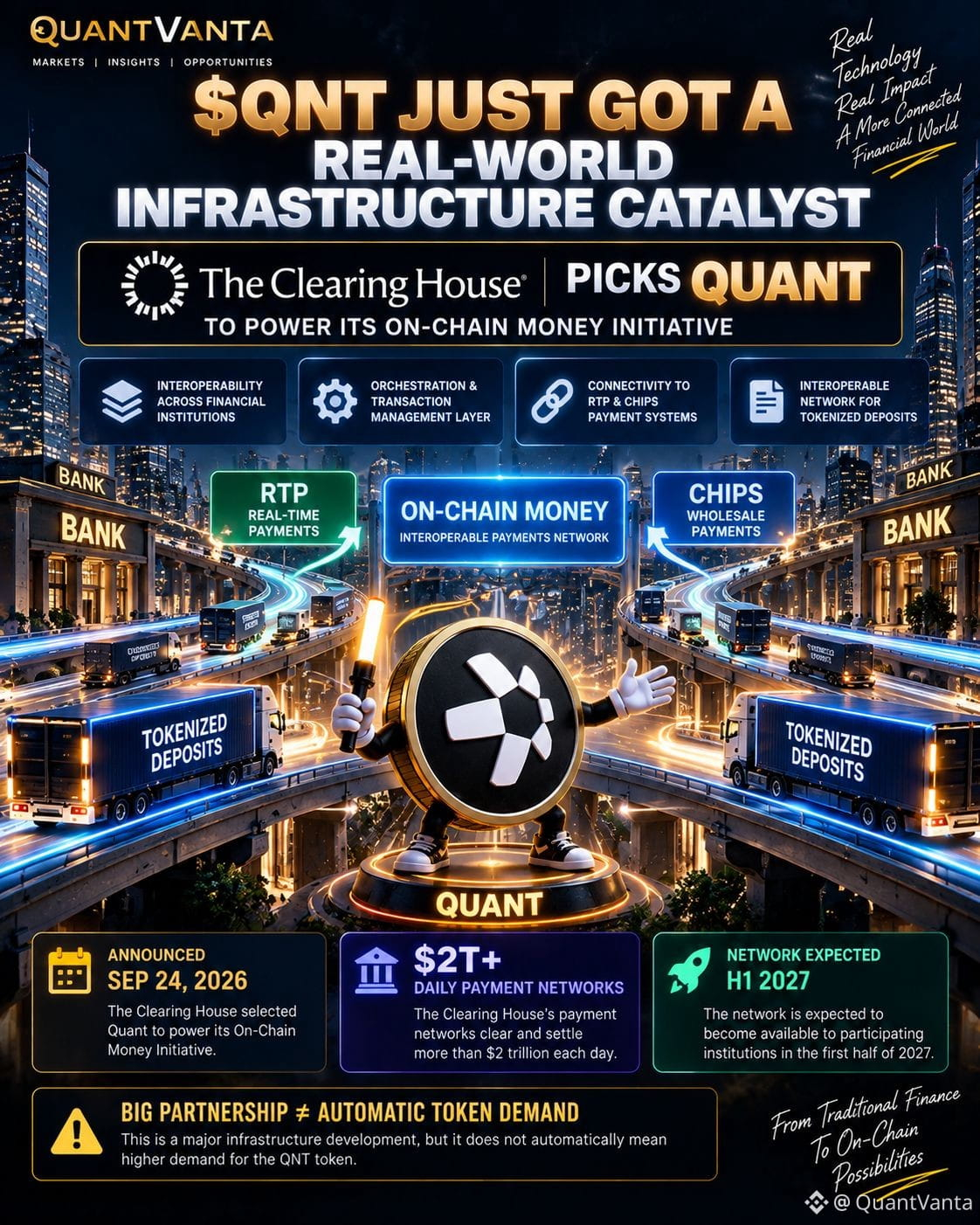
🚨 $QNT JUST GOT A REAL WORLD INFRASTRUCTURE CATALYST
Quant is suddenly back on the crypto radar after The Clearing House selected its technology to power the On-Chain Money Initiative.
This is not a vague “partnership” headline.
Quant will provide the interoperability, orchestration and transaction-management layer for a network designed to clear and settle tokenized deposits, with connectivity to the existing RTP and CHIPS payment systems. 0
The planned network is expected to become available to participating institutions in H1 2027. The Clearing House says its payment networks process more than $2 trillion per day. 1
And the market noticed:
QNT is up roughly 30% over 24 hours across major market-data feeds. 2
📊 LEVELS I’M WATCHING
🟢 $90 → key breakout/retest area
🟡 $100 → psychological level
🔴 $105 → near-term extension zone
But there’s one BIG distinction:
The Clearing House selected *Quant’s technology*
The announcement does NOT say that QNT itself is required for every transaction on the planned network. 3
So I’m watching whether the infrastructure win turns into sustained network adoption not simply whether the token keeps moving after the headline.
This is the kind of catalyst that can change a narrative.
Now the market has to prove it can hold it.
Does $QNT turn this institutional infrastructure win into a lasting repricing or does the first wave of momentum fade? 👀
Follow QuantVanta for daily crypto market intelligence.
$QNT
{future}(QNTUSDT)
#Quant #QNT #crypto #RWA #blockchain
🚨 $QNT JUST GOT A REAL WORLD INFRASTRUCTURE CATALYST
Quant is suddenly back on the crypto radar after The Clearing House selected its technology to power the On-Chain Money Initiative.
This is not a vague “partnership” headline.
Quant will provide the interoperability, orchestration and transaction-management layer for a network designed to clear and settle tokenized deposits, with connectivity to the existing RTP and CHIPS payment systems. 0
The planned network is expected to become available to participating institutions in H1 2027. The Clearing House says its payment networks process more than $2 trillion per day. 1
And the market noticed:
QNT is up roughly 30% over 24 hours across major market-data feeds. 2
📊 LEVELS I’M WATCHING
🟢 $90 → key breakout/retest area
🟡 $100 → psychological level
🔴 $105 → near-term extension zone
But there’s one BIG distinction:
The Clearing House selected *Quant’s technology*
The announcement does NOT say that QNT itself is required for every transaction on the planned network. 3
So I’m watching whether the infrastructure win turns into sustained network adoption not simply whether the token keeps moving after the headline.
This is the kind of catalyst that can change a narrative.
Now the market has to prove it can hold it.
Does $QNT turn this institutional infrastructure win into a lasting repricing or does the first wave of momentum fade? 👀
Follow QuantVanta for daily crypto market intelligence.
$QNT
#Quant #QNT #crypto #RWA #blockchain
Quant is suddenly back on the crypto radar after The Clearing House selected its technology to power the On-Chain Money Initiative.
This is not a vague “partnership” headline.
Quant will provide the interoperability, orchestration and transaction-management layer for a network designed to clear and settle tokenized deposits, with connectivity to the existing RTP and CHIPS payment systems. 0
The planned network is expected to become available to participating institutions in H1 2027. The Clearing House says its payment networks process more than $2 trillion per day. 1
And the market noticed:
QNT is up roughly 30% over 24 hours across major market-data feeds. 2
📊 LEVELS I’M WATCHING
🟢 $90 → key breakout/retest area
🟡 $100 → psychological level
🔴 $105 → near-term extension zone
But there’s one BIG distinction:
The Clearing House selected *Quant’s technology*
The announcement does NOT say that QNT itself is required for every transaction on the planned network. 3
So I’m watching whether the infrastructure win turns into sustained network adoption not simply whether the token keeps moving after the headline.
This is the kind of catalyst that can change a narrative.
Now the market has to prove it can hold it.
Does $QNT turn this institutional infrastructure win into a lasting repricing or does the first wave of momentum fade? 👀
Follow QuantVanta for daily crypto market intelligence.
$QNT
#Quant #QNT #crypto #RWA #blockchain
89
·
--
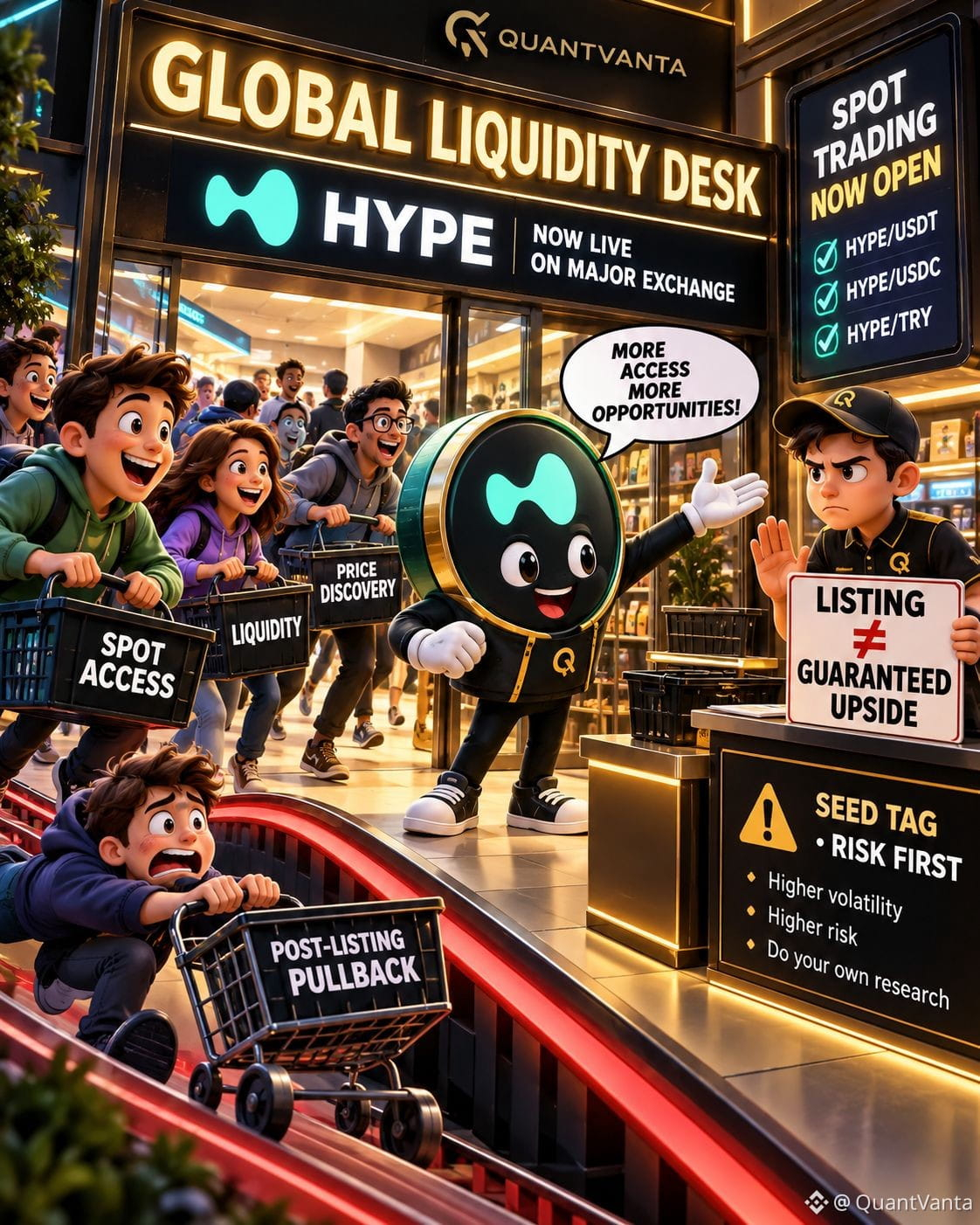
🚨 $HYPE GOT THE BINANCE LISTING THEN PRICE COOLED OFF
The big exchange catalyst finally arrived.
Binance opened spot trading for Hyperliquid’s $HYPE on September 24 with HYPE/USDT, HYPE/USDC and HYPE/TRY.
But the interesting part is what happened after the headline.
is around $91.25, down roughly 0.9% over 24 hours, while still up about 5.8% over seven days.
The recent 24h range is roughly $89.91–$94.82.
📊 LEVELS I’M WATCHING
🟢 $89.91 → Near-term support
🟡 $94.82 → Immediate resistance
🔴 $97.96 → Recent all-time high
My take:
The Binance listing expands access and gives HYPE another major spot venue.
But the market has already shown something important:
A major listing does NOT guarantee immediate upside.
If HYPE reclaims $94.82 and holds it, the market may be ready to retest the recent high.
If $89.91 fails, I’d rather watch for stabilization than chase the first bounce.
Listing = access.
Price action = confirmation.
Risk management = mandatory. 👀
Is this a healthy post-listing cooldown or the start of deeper profit-taking?
Follow QuantVanta for daily crypto market intelligence.
$HYPE
{future}(HYPEUSDT)
#Hyperliquid #hype #crypto #defi #CryptoMarket
🚨 $HYPE GOT THE BINANCE LISTING THEN PRICE COOLED OFF
The big exchange catalyst finally arrived.
Binance opened spot trading for Hyperliquid’s $HYPE on September 24 with HYPE/USDT, HYPE/USDC and HYPE/TRY.
But the interesting part is what happened after the headline.
is around $91.25, down roughly 0.9% over 24 hours, while still up about 5.8% over seven days.
The recent 24h range is roughly $89.91–$94.82.
📊 LEVELS I’M WATCHING
🟢 $89.91 → Near-term support
🟡 $94.82 → Immediate resistance
🔴 $97.96 → Recent all-time high
My take:
The Binance listing expands access and gives HYPE another major spot venue.
But the market has already shown something important:
A major listing does NOT guarantee immediate upside.
If HYPE reclaims $94.82 and holds it, the market may be ready to retest the recent high.
If $89.91 fails, I’d rather watch for stabilization than chase the first bounce.
Listing = access.
Price action = confirmation.
Risk management = mandatory. 👀
Is this a healthy post-listing cooldown or the start of deeper profit-taking?
Follow QuantVanta for daily crypto market intelligence.
$HYPE
#Hyperliquid #hype #crypto #defi #CryptoMarket
The big exchange catalyst finally arrived.
Binance opened spot trading for Hyperliquid’s $HYPE on September 24 with HYPE/USDT, HYPE/USDC and HYPE/TRY.
But the interesting part is what happened after the headline.
is around $91.25, down roughly 0.9% over 24 hours, while still up about 5.8% over seven days.
The recent 24h range is roughly $89.91–$94.82.
📊 LEVELS I’M WATCHING
🟢 $89.91 → Near-term support
🟡 $94.82 → Immediate resistance
🔴 $97.96 → Recent all-time high
My take:
The Binance listing expands access and gives HYPE another major spot venue.
But the market has already shown something important:
A major listing does NOT guarantee immediate upside.
If HYPE reclaims $94.82 and holds it, the market may be ready to retest the recent high.
If $89.91 fails, I’d rather watch for stabilization than chase the first bounce.
Listing = access.
Price action = confirmation.
Risk management = mandatory. 👀
Is this a healthy post-listing cooldown or the start of deeper profit-taking?
Follow QuantVanta for daily crypto market intelligence.
$HYPE
#Hyperliquid #hype #crypto #defi #CryptoMarket
79
·
--
🚨 $QNT JUST GOT A REAL-WORLD VALIDATION NOT ANOTHER WHITEPAPER
UK banks have completed their first live customer transactions using tokenised sterling deposits through the Great British Tokenised Deposit initiative.
And there’s an important detail for Quant:
The GBTD platform was developed by Quant as shared infrastructure for tokenised commercial bank money.
The live transactions included:
🏠 Remortgage completions
🛒 A consumer marketplace purchase
🔒 Funds locked until conditions were met
⚡ Automatic release once those conditions were satisfied
That matters because this moves tokenised deposits beyond a pure sandbox experiment.
But don’t confuse technology adoption with guaranteed QNT upside.
The bigger question is whether these early use cases can scale into broader banking, payments and digital-asset settlement.
Quant says further pilots are expected, including digital-asset settlement.
📊 QNT MARKET CHECK
Binance currently shows QNT around $79.60, with a 24-hour high of $81.64 and low of $69.83.
So I’m watching:
🟢 $81.64 → immediate breakout reference
🔴 $69.83 → current 24h downside reference
⚠️ A sharp move without sustained volume could still mean a news-driven spike rather than a durable trend.
My take:
The strongest part of this story isn't the token price it's real bank money moving through infrastructure that has now reached live transactions.
If tokenised deposits scale, interoperability becomes a much bigger market.
And that’s exactly where Quant wants to play.
Is this the beginning of real institutional tokenisation or still an early proof-of-concept?
Follow QuantVanta for verified crypto developments and market analysis.
$QNT
{future}(QNTUSDT)
#QNT #Quant #RWA #crypto
🚨 $QNT JUST GOT A REAL-WORLD VALIDATION NOT ANOTHER WHITEPAPER
UK banks have completed their first live customer transactions using tokenised sterling deposits through the Great British Tokenised Deposit initiative.
And there’s an important detail for Quant:
The GBTD platform was developed by Quant as shared infrastructure for tokenised commercial bank money.
The live transactions included:
🏠 Remortgage completions
🛒 A consumer marketplace purchase
🔒 Funds locked until conditions were met
⚡ Automatic release once those conditions were satisfied
That matters because this moves tokenised deposits beyond a pure sandbox experiment.
But don’t confuse technology adoption with guaranteed QNT upside.
The bigger question is whether these early use cases can scale into broader banking, payments and digital-asset settlement.
Quant says further pilots are expected, including digital-asset settlement.
📊 QNT MARKET CHECK
Binance currently shows QNT around $79.60, with a 24-hour high of $81.64 and low of $69.83.
So I’m watching:
🟢 $81.64 → immediate breakout reference
🔴 $69.83 → current 24h downside reference
⚠️ A sharp move without sustained volume could still mean a news-driven spike rather than a durable trend.
My take:
The strongest part of this story isn't the token price it's real bank money moving through infrastructure that has now reached live transactions.
If tokenised deposits scale, interoperability becomes a much bigger market.
And that’s exactly where Quant wants to play.
Is this the beginning of real institutional tokenisation or still an early proof-of-concept?
Follow QuantVanta for verified crypto developments and market analysis.
$QNT
#QNT #Quant #RWA #crypto
UK banks have completed their first live customer transactions using tokenised sterling deposits through the Great British Tokenised Deposit initiative.
And there’s an important detail for Quant:
The GBTD platform was developed by Quant as shared infrastructure for tokenised commercial bank money.
The live transactions included:
🏠 Remortgage completions
🛒 A consumer marketplace purchase
🔒 Funds locked until conditions were met
⚡ Automatic release once those conditions were satisfied
That matters because this moves tokenised deposits beyond a pure sandbox experiment.
But don’t confuse technology adoption with guaranteed QNT upside.
The bigger question is whether these early use cases can scale into broader banking, payments and digital-asset settlement.
Quant says further pilots are expected, including digital-asset settlement.
📊 QNT MARKET CHECK
Binance currently shows QNT around $79.60, with a 24-hour high of $81.64 and low of $69.83.
So I’m watching:
🟢 $81.64 → immediate breakout reference
🔴 $69.83 → current 24h downside reference
⚠️ A sharp move without sustained volume could still mean a news-driven spike rather than a durable trend.
My take:
The strongest part of this story isn't the token price it's real bank money moving through infrastructure that has now reached live transactions.
If tokenised deposits scale, interoperability becomes a much bigger market.
And that’s exactly where Quant wants to play.
Is this the beginning of real institutional tokenisation or still an early proof-of-concept?
Follow QuantVanta for verified crypto developments and market analysis.
$QNT
#QNT #Quant #RWA #crypto

130
·
--
Verified
🚨 $SOL HAS A REAL CATALYST BUT THE MARKET STILL HAS TO CONFIRM IT
Solana’s Alpenglow consensus upgrade has now reached public testnet.
That’s the important update tonight.
The upgrade is designed to replace Solana’s current TowerBFT consensus with Votor and target roughly 150ms finality a massive reduction from the current ~12.8-second finality model described by Solana’s own upgrade documentation. 0
But here’s the part I’m watching:
SOL is around $115 after recently trading near $120, so the market is already pricing in a meaningful recovery.
📊 LEVELS I’M WATCHING
🟢 $110–$112 → support zone
🟡 $115 → current decision area
🔴 $119–$120 → recent resistance zone
These are watch zones, not predictions.
The fundamental catalyst is real.
The price reaction still needs to prove itself.
And one important correction:
You may have seen September 28 described as the Alpenglow mainnet date.
That is **NOT confirmed
Anza’s latest schedule says September 28 is when mainnet feature activation resumes; it is not a confirmed Alpenglow activation date. 1
So I’m watching two things:
Alpenglow testing → does the technology perform?
SOL price → does the market reward it?
That separation matters.
Would you trade the upgrade narrative or wait for SOL to reclaim $120 first? 👀
Follow QuantVanta for daily crypto market intelligence.
$SOL
{future}(SOLUSDT)
#solana #SOL #crypto #Altcoins #blockchain
🚨 $SOL HAS A REAL CATALYST BUT THE MARKET STILL HAS TO CONFIRM IT
Solana’s Alpenglow consensus upgrade has now reached public testnet.
That’s the important update tonight.
The upgrade is designed to replace Solana’s current TowerBFT consensus with Votor and target roughly 150ms finality a massive reduction from the current ~12.8-second finality model described by Solana’s own upgrade documentation. 0
But here’s the part I’m watching:
SOL is around $115 after recently trading near $120, so the market is already pricing in a meaningful recovery.
📊 LEVELS I’M WATCHING
🟢 $110–$112 → support zone
🟡 $115 → current decision area
🔴 $119–$120 → recent resistance zone
These are watch zones, not predictions.
The fundamental catalyst is real.
The price reaction still needs to prove itself.
And one important correction:
You may have seen September 28 described as the Alpenglow mainnet date.
That is **NOT confirmed
Anza’s latest schedule says September 28 is when mainnet feature activation resumes; it is not a confirmed Alpenglow activation date. 1
So I’m watching two things:
Alpenglow testing → does the technology perform?
SOL price → does the market reward it?
That separation matters.
Would you trade the upgrade narrative or wait for SOL to reclaim $120 first? 👀
Follow QuantVanta for daily crypto market intelligence.
$SOL
#solana #SOL #crypto #Altcoins #blockchain
Solana’s Alpenglow consensus upgrade has now reached public testnet.
That’s the important update tonight.
The upgrade is designed to replace Solana’s current TowerBFT consensus with Votor and target roughly 150ms finality a massive reduction from the current ~12.8-second finality model described by Solana’s own upgrade documentation. 0
But here’s the part I’m watching:
SOL is around $115 after recently trading near $120, so the market is already pricing in a meaningful recovery.
📊 LEVELS I’M WATCHING
🟢 $110–$112 → support zone
🟡 $115 → current decision area
🔴 $119–$120 → recent resistance zone
These are watch zones, not predictions.
The fundamental catalyst is real.
The price reaction still needs to prove itself.
And one important correction:
You may have seen September 28 described as the Alpenglow mainnet date.
That is **NOT confirmed
Anza’s latest schedule says September 28 is when mainnet feature activation resumes; it is not a confirmed Alpenglow activation date. 1
So I’m watching two things:
Alpenglow testing → does the technology perform?
SOL price → does the market reward it?
That separation matters.
Would you trade the upgrade narrative or wait for SOL to reclaim $120 first? 👀
Follow QuantVanta for daily crypto market intelligence.
$SOL
#solana #SOL #crypto #Altcoins #blockchain

1
1
733
·
--
Partly True
🚨 $ZEC JUST GOT A NEW INSTITUTIONAL ACCESS POINT THEN THE MARKET HIT SELL
Zcash is showing exactly why catalysts and price action need to be separated.
21Shares launched its physically backed Zcash ETP in Europe on September 21, giving traditional brokerage investors another way to gain Zcash exposure without directly holding the coin.
Then volatility took over.
$ZEC is around $1,524, down roughly 5.8% over 24 hours, after trading as high as about $1,659 during the session.
That’s the setup I’m watching:
📊 LEVELS
🟢 ~$1,482 → 24h support
🟡 ~$1,524 → Current decision area
🔴 ~$1,659 → Recent upside rejection zone
The ETP is a genuine access catalyst.
But the chart is showing that new access does NOT automatically mean straight-line upside.
My take:
Privacy is back in the conversation.
Institutional access is expanding.
But after a violent move, confirmation matters more than chasing the headline.
If ZEC can reclaim the upper range with sustained volume, the structure becomes more interesting.
If $1,482 breaks, I’d rather see where buyers actually return than guess.
Catalyst ≠ confirmation.
Would you watch the ETP narrative or the price structure more closely here? 👀
Follow QuantVanta for daily crypto market intelligence.
$ZEC
{future}(ZECUSDT)
#zcash #zec #crypto #PrivacyCoins #CryptoMarket
🚨 $ZEC JUST GOT A NEW INSTITUTIONAL ACCESS POINT THEN THE MARKET HIT SELL
Zcash is showing exactly why catalysts and price action need to be separated.
21Shares launched its physically backed Zcash ETP in Europe on September 21, giving traditional brokerage investors another way to gain Zcash exposure without directly holding the coin.
Then volatility took over.
$ZEC is around $1,524, down roughly 5.8% over 24 hours, after trading as high as about $1,659 during the session.
That’s the setup I’m watching:
📊 LEVELS
🟢 ~$1,482 → 24h support
🟡 ~$1,524 → Current decision area
🔴 ~$1,659 → Recent upside rejection zone
The ETP is a genuine access catalyst.
But the chart is showing that new access does NOT automatically mean straight-line upside.
My take:
Privacy is back in the conversation.
Institutional access is expanding.
But after a violent move, confirmation matters more than chasing the headline.
If ZEC can reclaim the upper range with sustained volume, the structure becomes more interesting.
If $1,482 breaks, I’d rather see where buyers actually return than guess.
Catalyst ≠ confirmation.
Would you watch the ETP narrative or the price structure more closely here? 👀
Follow QuantVanta for daily crypto market intelligence.
$ZEC
#zcash #zec #crypto #PrivacyCoins #CryptoMarket
Zcash is showing exactly why catalysts and price action need to be separated.
21Shares launched its physically backed Zcash ETP in Europe on September 21, giving traditional brokerage investors another way to gain Zcash exposure without directly holding the coin.
Then volatility took over.
$ZEC is around $1,524, down roughly 5.8% over 24 hours, after trading as high as about $1,659 during the session.
That’s the setup I’m watching:
📊 LEVELS
🟢 ~$1,482 → 24h support
🟡 ~$1,524 → Current decision area
🔴 ~$1,659 → Recent upside rejection zone
The ETP is a genuine access catalyst.
But the chart is showing that new access does NOT automatically mean straight-line upside.
My take:
Privacy is back in the conversation.
Institutional access is expanding.
But after a violent move, confirmation matters more than chasing the headline.
If ZEC can reclaim the upper range with sustained volume, the structure becomes more interesting.
If $1,482 breaks, I’d rather see where buyers actually return than guess.
Catalyst ≠ confirmation.
Would you watch the ETP narrative or the price structure more closely here? 👀
Follow QuantVanta for daily crypto market intelligence.
$ZEC
#zcash #zec #crypto #PrivacyCoins #CryptoMarket

699
·
--
🚨 $SOL HAS A NEW SPEED TEST BUT THE CHART IS ALREADY HOT
Solana’s Alpenglow consensus upgrade is now moving into public testnet testing.
The goal is ambitious: replace the current TowerBFT consensus with Votor, targeting roughly 150ms finality versus about 12.8 seconds today.
That could materially change how quickly Solana reaches finality.
But this is the important distinction:
It is a testnet milestone not a mainnet activation yet.
Solana’s official upgrade documentation says Alpenglow changes the consensus layer while leaving the SVM, transaction execution, programs and fees unchanged. The current roadmap points to Agave 4.3 for activation, with mainnet timing still subject to the rollout schedule.
Now the chart:
$SOL is around $115, after closing near $118.51 on September 22. CoinLore’s latest daily analysis shows RSI around 64, with price still above major moving averages but approaching the upper end of the recent range.
📊 LEVELS I’M WATCHING
🟢 $112–$113 → near-term support zone
🔴 $121–$123 → resistance zone
⚠️ ~$105 → deeper pullback reference
The bullish case is simple:
If Alpenglow performs reliably through testing, Solana’s latency/finality story gets stronger.
The risk is equally simple:
A testnet upgrade is not the same as proven mainnet performance.
I’m watching the technology first then the price reaction.
Does Alpenglow strengthen Solana’s competitive edge, or is the market already pricing in the upgrade?
Follow QuantVanta for verified crypto developments and market analysis.
$SOL
{future}(SOLUSDT)
#sol #solana #crypto #defi
🚨 $SOL HAS A NEW SPEED TEST BUT THE CHART IS ALREADY HOT
Solana’s Alpenglow consensus upgrade is now moving into public testnet testing.
The goal is ambitious: replace the current TowerBFT consensus with Votor, targeting roughly 150ms finality versus about 12.8 seconds today.
That could materially change how quickly Solana reaches finality.
But this is the important distinction:
It is a testnet milestone not a mainnet activation yet.
Solana’s official upgrade documentation says Alpenglow changes the consensus layer while leaving the SVM, transaction execution, programs and fees unchanged. The current roadmap points to Agave 4.3 for activation, with mainnet timing still subject to the rollout schedule.
Now the chart:
$SOL is around $115, after closing near $118.51 on September 22. CoinLore’s latest daily analysis shows RSI around 64, with price still above major moving averages but approaching the upper end of the recent range.
📊 LEVELS I’M WATCHING
🟢 $112–$113 → near-term support zone
🔴 $121–$123 → resistance zone
⚠️ ~$105 → deeper pullback reference
The bullish case is simple:
If Alpenglow performs reliably through testing, Solana’s latency/finality story gets stronger.
The risk is equally simple:
A testnet upgrade is not the same as proven mainnet performance.
I’m watching the technology first then the price reaction.
Does Alpenglow strengthen Solana’s competitive edge, or is the market already pricing in the upgrade?
Follow QuantVanta for verified crypto developments and market analysis.
$SOL
#sol #solana #crypto #defi
Solana’s Alpenglow consensus upgrade is now moving into public testnet testing.
The goal is ambitious: replace the current TowerBFT consensus with Votor, targeting roughly 150ms finality versus about 12.8 seconds today.
That could materially change how quickly Solana reaches finality.
But this is the important distinction:
It is a testnet milestone not a mainnet activation yet.
Solana’s official upgrade documentation says Alpenglow changes the consensus layer while leaving the SVM, transaction execution, programs and fees unchanged. The current roadmap points to Agave 4.3 for activation, with mainnet timing still subject to the rollout schedule.
Now the chart:
$SOL is around $115, after closing near $118.51 on September 22. CoinLore’s latest daily analysis shows RSI around 64, with price still above major moving averages but approaching the upper end of the recent range.
📊 LEVELS I’M WATCHING
🟢 $112–$113 → near-term support zone
🔴 $121–$123 → resistance zone
⚠️ ~$105 → deeper pullback reference
The bullish case is simple:
If Alpenglow performs reliably through testing, Solana’s latency/finality story gets stronger.
The risk is equally simple:
A testnet upgrade is not the same as proven mainnet performance.
I’m watching the technology first then the price reaction.
Does Alpenglow strengthen Solana’s competitive edge, or is the market already pricing in the upgrade?
Follow QuantVanta for verified crypto developments and market analysis.
$SOL
#sol #solana #crypto #defi

272
·
--
🚨 $BTC HAS A BIG DATE AHEAD AND IT’S NOT JUST ANOTHER PRICE LEVEL
Bitcoin is holding around the $86K area while traders head into Friday’s quarterly options expiry.
Coinbase Markets puts the BTC + ETH options notional scheduled for Sept. 25 at roughly $18.1B.
Here’s the part I’m watching:
BTC options have a 0.66 open-interest put/call ratio, while recent 24-hour volume is even more call-heavy at 0.37.
Call open interest is concentrated around $90K and $100K.
But don’t confuse positioning with a prediction.
Large call interest does NOT mean BTC has to reach those strikes.
It simply means the expiry could become an important volatility and hedging event as traders adjust positions.
📊 MY WATCH ZONES
🟢 $85K → first area I want bulls to defend
🟡 $86K–$87K → current decision zone
🔴 $90K → major options-interest area
The setup is straightforward:
Hold the recent breakout structure → momentum stays constructive.
Lose the $85K area → the market may need to reset before another attempt higher.
Friday’s expiry is the catalyst.
Price action decides the reaction.
Are you watching the $90K calls or the $85K level underneath spot? 👀
Follow QuantVanta for daily crypto market intelligence.
$BTC
{future}(BTCUSDT)
#bitcoin #BTC #crypto #options #CryptoMarketAlert
🚨 $BTC HAS A BIG DATE AHEAD AND IT’S NOT JUST ANOTHER PRICE LEVEL
Bitcoin is holding around the $86K area while traders head into Friday’s quarterly options expiry.
Coinbase Markets puts the BTC + ETH options notional scheduled for Sept. 25 at roughly $18.1B.
Here’s the part I’m watching:
BTC options have a 0.66 open-interest put/call ratio, while recent 24-hour volume is even more call-heavy at 0.37.
Call open interest is concentrated around $90K and $100K.
But don’t confuse positioning with a prediction.
Large call interest does NOT mean BTC has to reach those strikes.
It simply means the expiry could become an important volatility and hedging event as traders adjust positions.
📊 MY WATCH ZONES
🟢 $85K → first area I want bulls to defend
🟡 $86K–$87K → current decision zone
🔴 $90K → major options-interest area
The setup is straightforward:
Hold the recent breakout structure → momentum stays constructive.
Lose the $85K area → the market may need to reset before another attempt higher.
Friday’s expiry is the catalyst.
Price action decides the reaction.
Are you watching the $90K calls or the $85K level underneath spot? 👀
Follow QuantVanta for daily crypto market intelligence.
$BTC
#bitcoin #BTC #crypto #options #CryptoMarketAlert
Bitcoin is holding around the $86K area while traders head into Friday’s quarterly options expiry.
Coinbase Markets puts the BTC + ETH options notional scheduled for Sept. 25 at roughly $18.1B.
Here’s the part I’m watching:
BTC options have a 0.66 open-interest put/call ratio, while recent 24-hour volume is even more call-heavy at 0.37.
Call open interest is concentrated around $90K and $100K.
But don’t confuse positioning with a prediction.
Large call interest does NOT mean BTC has to reach those strikes.
It simply means the expiry could become an important volatility and hedging event as traders adjust positions.
📊 MY WATCH ZONES
🟢 $85K → first area I want bulls to defend
🟡 $86K–$87K → current decision zone
🔴 $90K → major options-interest area
The setup is straightforward:
Hold the recent breakout structure → momentum stays constructive.
Lose the $85K area → the market may need to reset before another attempt higher.
Friday’s expiry is the catalyst.
Price action decides the reaction.
Are you watching the $90K calls or the $85K level underneath spot? 👀
Follow QuantVanta for daily crypto market intelligence.
$BTC
#bitcoin #BTC #crypto #options #CryptoMarketAlert

60
·
--
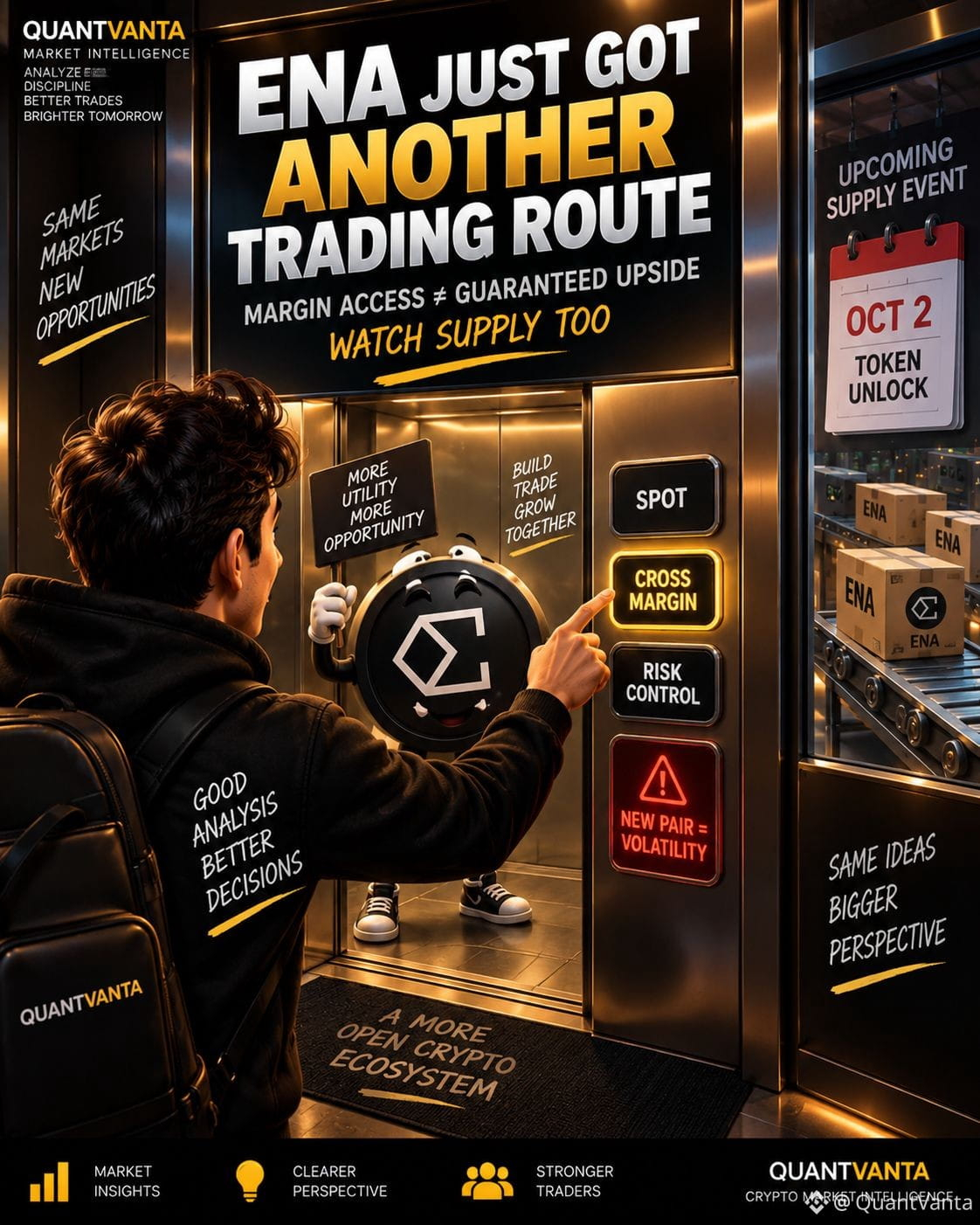
🚨 $ENA JUST GOT ANOTHER TRADING ROUTE BUT THERE’S A CATCH
Binance Margin has added ENA/USD1 to Cross Margin.
That gives ENA another route into Binance’s margin ecosystem but it doesn’t automatically mean bullish price action.
The market is already reacting.
ENA is around 0.218 USD, with the current 24h range roughly 0.204–0.221 USD.
📊 LEVELS I’M WATCHING
🟢 0.204 → Near-term support
🟡 0.218 → Current decision area
🔴 0.221 → Immediate resistance
A clean break above 0.221 could keep short-term momentum alive.
A rejection followed by a move back below 0.204 would weaken the setup.
There’s another thing I’m watching:
ENA’s next scheduled token unlock is approaching, so increased trading access and supply dynamics are both part of the equation.
My take:
More market access can increase attention and liquidity.
It can also increase volatility.
So I’m watching the reaction not assuming the catalyst guarantees upside.
Does the new margin pair strengthen ENA’s setup, or simply make the trade more volatile? 👀
Follow QuantVanta for daily crypto market intelligence.
$ENA
{future}(ENAUSDT)
#ethena #crypto #DeFi #CryptoMarket #trading
🚨 $ENA JUST GOT ANOTHER TRADING ROUTE BUT THERE’S A CATCH
Binance Margin has added ENA/USD1 to Cross Margin.
That gives ENA another route into Binance’s margin ecosystem but it doesn’t automatically mean bullish price action.
The market is already reacting.
ENA is around 0.218 USD, with the current 24h range roughly 0.204–0.221 USD.
📊 LEVELS I’M WATCHING
🟢 0.204 → Near-term support
🟡 0.218 → Current decision area
🔴 0.221 → Immediate resistance
A clean break above 0.221 could keep short-term momentum alive.
A rejection followed by a move back below 0.204 would weaken the setup.
There’s another thing I’m watching:
ENA’s next scheduled token unlock is approaching, so increased trading access and supply dynamics are both part of the equation.
My take:
More market access can increase attention and liquidity.
It can also increase volatility.
So I’m watching the reaction not assuming the catalyst guarantees upside.
Does the new margin pair strengthen ENA’s setup, or simply make the trade more volatile? 👀
Follow QuantVanta for daily crypto market intelligence.
$ENA
#ethena #crypto #DeFi #CryptoMarket #trading
Binance Margin has added ENA/USD1 to Cross Margin.
That gives ENA another route into Binance’s margin ecosystem but it doesn’t automatically mean bullish price action.
The market is already reacting.
ENA is around 0.218 USD, with the current 24h range roughly 0.204–0.221 USD.
📊 LEVELS I’M WATCHING
🟢 0.204 → Near-term support
🟡 0.218 → Current decision area
🔴 0.221 → Immediate resistance
A clean break above 0.221 could keep short-term momentum alive.
A rejection followed by a move back below 0.204 would weaken the setup.
There’s another thing I’m watching:
ENA’s next scheduled token unlock is approaching, so increased trading access and supply dynamics are both part of the equation.
My take:
More market access can increase attention and liquidity.
It can also increase volatility.
So I’m watching the reaction not assuming the catalyst guarantees upside.
Does the new margin pair strengthen ENA’s setup, or simply make the trade more volatile? 👀
Follow QuantVanta for daily crypto market intelligence.
$ENA
#ethena #crypto #DeFi #CryptoMarket #trading
247
·
--
🚨 $SUI JUST MADE ONCHAIN DATA REAL-TIME NOW THE PRICE HAS TO PROVE THE MOVE
Sui has launched GraphQL Subscriptions on Mainnet, giving developers live streams of checkpoints, transactions and events through the same GraphQL interface.
The useful part isn’t just “faster data.
Apps can now subscribe to specific onchain activity, receive new events as they happen, backfill from an earlier cursor, and reconnect without losing the data stream.
That can simplify infrastructure for wallets, trading apps, analytics platforms and automation systems.
Now look at the market.
$SUI is around $1.01, with a 24-hour range near $0.99–$1.06.
Independent historical data shows SUI closed around $1.041 on September 21 after climbing from $0.6865 on September 15.
The setup is getting interesting:
🟢 $0.99 → immediate downside reference
🔴 $1.08 → key recent resistance/high
⚠️ $0.90 → deeper pullback reference
Daily technical data is also showing an RSI around 74, meaning momentum is strong but the market is entering an overbought zone.
My read:
The technology story is improving, but the chart has already priced in a lot of excitement.
For $SUI, I’d watch whether price can stay above the $0.99 area and eventually challenge the $1.08 zone without another sharp momentum flush.
The catalyst is real.
The next question is adoption.
Would real-time onchain data make your crypto app noticeably better?
Follow QuantVanta for verified crypto developments and market analysis.
$SUI
{future}(SUIUSDT)
#sui #Sui #crypto #defi
🚨 $SUI JUST MADE ONCHAIN DATA REAL-TIME NOW THE PRICE HAS TO PROVE THE MOVE
Sui has launched GraphQL Subscriptions on Mainnet, giving developers live streams of checkpoints, transactions and events through the same GraphQL interface.
The useful part isn’t just “faster data.
Apps can now subscribe to specific onchain activity, receive new events as they happen, backfill from an earlier cursor, and reconnect without losing the data stream.
That can simplify infrastructure for wallets, trading apps, analytics platforms and automation systems.
Now look at the market.
$SUI is around $1.01, with a 24-hour range near $0.99–$1.06.
Independent historical data shows SUI closed around $1.041 on September 21 after climbing from $0.6865 on September 15.
The setup is getting interesting:
🟢 $0.99 → immediate downside reference
🔴 $1.08 → key recent resistance/high
⚠️ $0.90 → deeper pullback reference
Daily technical data is also showing an RSI around 74, meaning momentum is strong but the market is entering an overbought zone.
My read:
The technology story is improving, but the chart has already priced in a lot of excitement.
For $SUI , I’d watch whether price can stay above the $0.99 area and eventually challenge the $1.08 zone without another sharp momentum flush.
The catalyst is real.
The next question is adoption.
Would real-time onchain data make your crypto app noticeably better?
Follow QuantVanta for verified crypto developments and market analysis.
$SUI
#sui #Sui #crypto #defi
Sui has launched GraphQL Subscriptions on Mainnet, giving developers live streams of checkpoints, transactions and events through the same GraphQL interface.
The useful part isn’t just “faster data.
Apps can now subscribe to specific onchain activity, receive new events as they happen, backfill from an earlier cursor, and reconnect without losing the data stream.
That can simplify infrastructure for wallets, trading apps, analytics platforms and automation systems.
Now look at the market.
$SUI is around $1.01, with a 24-hour range near $0.99–$1.06.
Independent historical data shows SUI closed around $1.041 on September 21 after climbing from $0.6865 on September 15.
The setup is getting interesting:
🟢 $0.99 → immediate downside reference
🔴 $1.08 → key recent resistance/high
⚠️ $0.90 → deeper pullback reference
Daily technical data is also showing an RSI around 74, meaning momentum is strong but the market is entering an overbought zone.
My read:
The technology story is improving, but the chart has already priced in a lot of excitement.
For $SUI , I’d watch whether price can stay above the $0.99 area and eventually challenge the $1.08 zone without another sharp momentum flush.
The catalyst is real.
The next question is adoption.
Would real-time onchain data make your crypto app noticeably better?
Follow QuantVanta for verified crypto developments and market analysis.
$SUI
#sui #Sui #crypto #defi

146
·
--
🚨 $USDC JUST GOT A MUCH BIGGER STRATEGIC BACKER
Binance has invested $100M in Circle, the company behind USDC.
That’s the headline.
But the bigger story is what the deal signals for stablecoins.
Binance and Circle are deepening their relationship around USDC and the broader digital-asset ecosystem putting even more attention on stablecoin infrastructure as crypto moves toward mainstream financial rails.
And there’s an important distinction:
This is NOT a claim that USDC will suddenly gain market share or that the investment guarantees higher adoption.
The confirmed fact is the investment.
The potential impact is infrastructure, distribution and deeper alignment between one of crypto’s largest exchanges and one of its major stablecoin issuers.
📊 WHAT I’M WATCHING
🟢 USDC adoption across exchanges
🟡 Stablecoin transaction activity
🔴 Whether deeper infrastructure actually translates into sustained usage
The interesting part isn’t the $100M headline by itself.
It’s what Binance + Circle can build around the stablecoin economy from here.
Stablecoins started as a crypto trading tool.
They’re increasingly becoming financial infrastructure.
Is this a bigger story for $USDC or for the entire stablecoin market? 👀
Follow QuantVanta for daily crypto market intelligence.
$USDC
{future}(USDCUSDT)
#USDC #Stablecoins #crypto #DigitalAssets
🚨 $USDC JUST GOT A MUCH BIGGER STRATEGIC BACKER
Binance has invested $100M in Circle, the company behind USDC.
That’s the headline.
But the bigger story is what the deal signals for stablecoins.
Binance and Circle are deepening their relationship around USDC and the broader digital-asset ecosystem putting even more attention on stablecoin infrastructure as crypto moves toward mainstream financial rails.
And there’s an important distinction:
This is NOT a claim that USDC will suddenly gain market share or that the investment guarantees higher adoption.
The confirmed fact is the investment.
The potential impact is infrastructure, distribution and deeper alignment between one of crypto’s largest exchanges and one of its major stablecoin issuers.
📊 WHAT I’M WATCHING
🟢 USDC adoption across exchanges
🟡 Stablecoin transaction activity
🔴 Whether deeper infrastructure actually translates into sustained usage
The interesting part isn’t the $100M headline by itself.
It’s what Binance + Circle can build around the stablecoin economy from here.
Stablecoins started as a crypto trading tool.
They’re increasingly becoming financial infrastructure.
Is this a bigger story for $USDC or for the entire stablecoin market? 👀
Follow QuantVanta for daily crypto market intelligence.
$USDC
#USDC #Stablecoins #crypto #DigitalAssets
Binance has invested $100M in Circle, the company behind USDC.
That’s the headline.
But the bigger story is what the deal signals for stablecoins.
Binance and Circle are deepening their relationship around USDC and the broader digital-asset ecosystem putting even more attention on stablecoin infrastructure as crypto moves toward mainstream financial rails.
And there’s an important distinction:
This is NOT a claim that USDC will suddenly gain market share or that the investment guarantees higher adoption.
The confirmed fact is the investment.
The potential impact is infrastructure, distribution and deeper alignment between one of crypto’s largest exchanges and one of its major stablecoin issuers.
📊 WHAT I’M WATCHING
🟢 USDC adoption across exchanges
🟡 Stablecoin transaction activity
🔴 Whether deeper infrastructure actually translates into sustained usage
The interesting part isn’t the $100M headline by itself.
It’s what Binance + Circle can build around the stablecoin economy from here.
Stablecoins started as a crypto trading tool.
They’re increasingly becoming financial infrastructure.
Is this a bigger story for $USDC or for the entire stablecoin market? 👀
Follow QuantVanta for daily crypto market intelligence.
$USDC
#USDC #Stablecoins #crypto #DigitalAssets

30
·
--
Verified
🚨 $NEAR JUST TURNED INTO THE MARKET’S MOMENTUM TEST
NEAR is suddenly moving much faster than the broader market.
The token is around 4.13 USD, with CoinGecko showing a 24-hour range of roughly 3.92–4.44 USD and a 7-day gain of about 62%.
But the more interesting part is happening underneath the chart.
NEAR Intents now reports more than 29B USD in cumulative volume across 35 chains.
And NEAR has also expanded confidential trading infrastructure, including confidential deposits and withdrawals for perpetual futures through near.com.
That gives the rally a stronger fundamental narrative than price action alone.
📊 LEVELS I’M WATCHING
🟢 3.92 → Near-term support
🟡 4.44 → Current resistance
🔴 Below 3.92 → Momentum starts losing structure
My take:
NEAR has real ecosystem activity behind the move.
But a 60%+ weekly expansion also raises the risk of crowded momentum.
I’m more interested in whether NEAR can consolidate above the recent range than whether it prints another vertical candle.
Momentum is attention.
Follow-through is confirmation.
Would you rather see NEAR consolidate here or keep pushing immediately? 👀
Follow QuantVanta for daily crypto market intelligence.
$NEAR
{future}(NEARUSDT)
#crypto #Altcoins #DeFi #ChainAbstraction #CryptoMarket
🚨 $NEAR JUST TURNED INTO THE MARKET’S MOMENTUM TEST
NEAR is suddenly moving much faster than the broader market.
The token is around 4.13 USD, with CoinGecko showing a 24-hour range of roughly 3.92–4.44 USD and a 7-day gain of about 62%.
But the more interesting part is happening underneath the chart.
NEAR Intents now reports more than 29B USD in cumulative volume across 35 chains.
And NEAR has also expanded confidential trading infrastructure, including confidential deposits and withdrawals for perpetual futures through near.com.
That gives the rally a stronger fundamental narrative than price action alone.
📊 LEVELS I’M WATCHING
🟢 3.92 → Near-term support
🟡 4.44 → Current resistance
🔴 Below 3.92 → Momentum starts losing structure
My take:
NEAR has real ecosystem activity behind the move.
But a 60%+ weekly expansion also raises the risk of crowded momentum.
I’m more interested in whether NEAR can consolidate above the recent range than whether it prints another vertical candle.
Momentum is attention.
Follow-through is confirmation.
Would you rather see NEAR consolidate here or keep pushing immediately? 👀
Follow QuantVanta for daily crypto market intelligence.
$NEAR
#crypto #Altcoins #DeFi #ChainAbstraction #CryptoMarket
NEAR is suddenly moving much faster than the broader market.
The token is around 4.13 USD, with CoinGecko showing a 24-hour range of roughly 3.92–4.44 USD and a 7-day gain of about 62%.
But the more interesting part is happening underneath the chart.
NEAR Intents now reports more than 29B USD in cumulative volume across 35 chains.
And NEAR has also expanded confidential trading infrastructure, including confidential deposits and withdrawals for perpetual futures through near.com.
That gives the rally a stronger fundamental narrative than price action alone.
📊 LEVELS I’M WATCHING
🟢 3.92 → Near-term support
🟡 4.44 → Current resistance
🔴 Below 3.92 → Momentum starts losing structure
My take:
NEAR has real ecosystem activity behind the move.
But a 60%+ weekly expansion also raises the risk of crowded momentum.
I’m more interested in whether NEAR can consolidate above the recent range than whether it prints another vertical candle.
Momentum is attention.
Follow-through is confirmation.
Would you rather see NEAR consolidate here or keep pushing immediately? 👀
Follow QuantVanta for daily crypto market intelligence.
$NEAR
#crypto #Altcoins #DeFi #ChainAbstraction #CryptoMarket

645
·
--
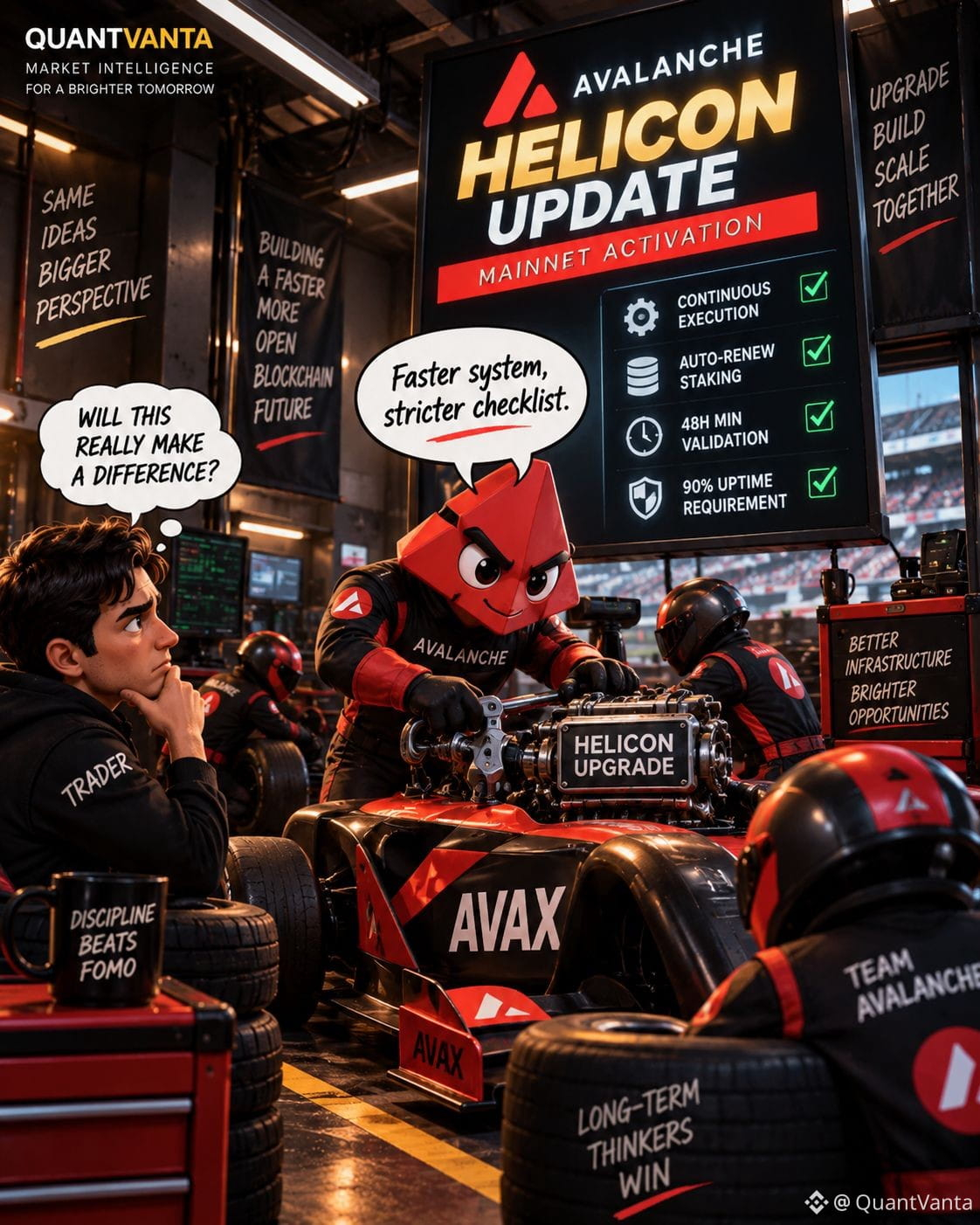
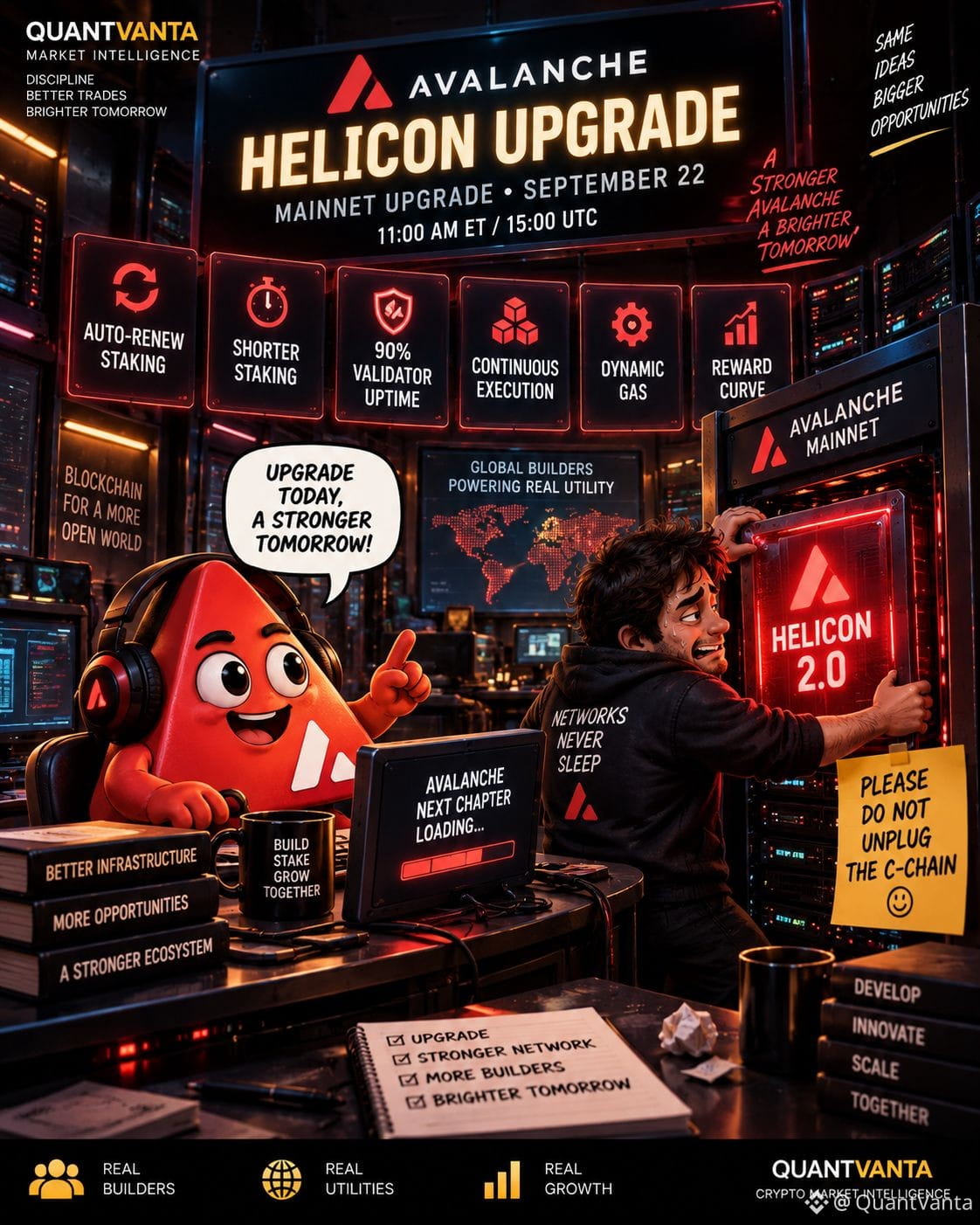
🚨 $AVAX HAS A BIG TEST TODAY AND IT’S NOT JUST THE CHART
Avalanche’s Helicon upgrade is scheduled to activate on Mainnet today, September 22, at 15:00 UTC.
This is a real network upgrade, not a marketing headline.
Helicon introduces several protocol changes, including:
⚙️ Continuous Execution on C-Chain
🔄 Auto-renewed staking
⏱️ 48-hour minimum validator duration
🛡️ 90% validator uptime requirement
⛽ Dynamic C-Chain gas pricing
📉 A phased reduction in the minimum consumption rate
Avalanche’s official documentation confirms the Mainnet activation schedule and that validators need to upgrade to AvalancheGo v1.15.0 before activation.
And the market is already paying attention.
AVAX closed around 11.34 on September 20 after a sharp multi-session rebound. Independent market data also showed the token recently trading around the 11 area, with the 11.4–11.5 region becoming an important short-term reference zone.
The risk is simple:
A major upgrade can attract attention, but price momentum does not guarantee successful post-upgrade continuation.
📊 WHAT I’M WATCHING
🟢 11.4–11.5 → Recent resistance area
🔴 ~9.5–9.6 → Recent downside reference
👀 Sept. 22 → Helicon activation
The real signal comes after the upgrade:
Does the network execute smoothly, and does AVAX hold the momentum without relying purely on speculation?
That’s more important than the headline.
What are you watching first Helicon performance or AVAX price reaction?
Follow QuantVanta for verified crypto developments and market analysis.
$AVAX
{future}(AVAXUSDT)
#AVAX #Avalanche #crypto #Blockchain #defi
🚨 $AVAX HAS A BIG TEST TODAY AND IT’S NOT JUST THE CHART
Avalanche’s Helicon upgrade is scheduled to activate on Mainnet today, September 22, at 15:00 UTC.
This is a real network upgrade, not a marketing headline.
Helicon introduces several protocol changes, including:
⚙️ Continuous Execution on C-Chain
🔄 Auto-renewed staking
⏱️ 48-hour minimum validator duration
🛡️ 90% validator uptime requirement
⛽ Dynamic C-Chain gas pricing
📉 A phased reduction in the minimum consumption rate
Avalanche’s official documentation confirms the Mainnet activation schedule and that validators need to upgrade to AvalancheGo v1.15.0 before activation.
And the market is already paying attention.
AVAX closed around 11.34 on September 20 after a sharp multi-session rebound. Independent market data also showed the token recently trading around the 11 area, with the 11.4–11.5 region becoming an important short-term reference zone.
The risk is simple:
A major upgrade can attract attention, but price momentum does not guarantee successful post-upgrade continuation.
📊 WHAT I’M WATCHING
🟢 11.4–11.5 → Recent resistance area
🔴 ~9.5–9.6 → Recent downside reference
👀 Sept. 22 → Helicon activation
The real signal comes after the upgrade:
Does the network execute smoothly, and does AVAX hold the momentum without relying purely on speculation?
That’s more important than the headline.
What are you watching first Helicon performance or AVAX price reaction?
Follow QuantVanta for verified crypto developments and market analysis.
$AVAX
#AVAX #Avalanche #crypto #Blockchain #defi
Avalanche’s Helicon upgrade is scheduled to activate on Mainnet today, September 22, at 15:00 UTC.
This is a real network upgrade, not a marketing headline.
Helicon introduces several protocol changes, including:
⚙️ Continuous Execution on C-Chain
🔄 Auto-renewed staking
⏱️ 48-hour minimum validator duration
🛡️ 90% validator uptime requirement
⛽ Dynamic C-Chain gas pricing
📉 A phased reduction in the minimum consumption rate
Avalanche’s official documentation confirms the Mainnet activation schedule and that validators need to upgrade to AvalancheGo v1.15.0 before activation.
And the market is already paying attention.
AVAX closed around 11.34 on September 20 after a sharp multi-session rebound. Independent market data also showed the token recently trading around the 11 area, with the 11.4–11.5 region becoming an important short-term reference zone.
The risk is simple:
A major upgrade can attract attention, but price momentum does not guarantee successful post-upgrade continuation.
📊 WHAT I’M WATCHING
🟢 11.4–11.5 → Recent resistance area
🔴 ~9.5–9.6 → Recent downside reference
👀 Sept. 22 → Helicon activation
The real signal comes after the upgrade:
Does the network execute smoothly, and does AVAX hold the momentum without relying purely on speculation?
That’s more important than the headline.
What are you watching first Helicon performance or AVAX price reaction?
Follow QuantVanta for verified crypto developments and market analysis.
$AVAX
#AVAX #Avalanche #crypto #Blockchain #defi
144
·
--
🚨 $BTC IS ABOVE $85K AND THE BUYING DIDN’T STOP
Bitcoin just pushed above $85,000, but the more interesting signal tonight is happening underneath the price.
Strategy disclosed a fresh purchase of 950 BTC for $75.7M between September 14–20, taking its holdings to 846,000 BTC.
And it wasn’t alone.
Strive separately disclosed another 1,355 BTC purchase during September 14–18.
That doesn’t guarantee the rally continues.
But it does show that corporate Bitcoin accumulation remains active while BTC is trading near an eight-month high.
📊 LEVELS I’M WATCHING
🟢 $84K → first support to defend
🟡 $85K → breakout/retest zone
🔴 $85.4K → recent high area
The setup I care about now is simple:
Can BTC turn the $85K area into support?
If yes, momentum remains constructive.
If price quickly falls back below the breakout zone, the move deserves more caution.
The bigger takeaway:
Price tells us what the market is doing.
Treasury purchases tell us who is still willing to allocate capital.
Is $85K becoming support or just another stop on the way to a pullback? 👀
Follow QuantVanta for daily crypto market intelligence.
$BTC
{future}(BTCUSDT)
#bitcoin #BTC #crypto #CryptoMarket #DigitalAssets
🚨 $BTC IS ABOVE $85K AND THE BUYING DIDN’T STOP
Bitcoin just pushed above $85,000, but the more interesting signal tonight is happening underneath the price.
Strategy disclosed a fresh purchase of 950 BTC for $75.7M between September 14–20, taking its holdings to 846,000 BTC.
And it wasn’t alone.
Strive separately disclosed another 1,355 BTC purchase during September 14–18.
That doesn’t guarantee the rally continues.
But it does show that corporate Bitcoin accumulation remains active while BTC is trading near an eight-month high.
📊 LEVELS I’M WATCHING
🟢 $84K → first support to defend
🟡 $85K → breakout/retest zone
🔴 $85.4K → recent high area
The setup I care about now is simple:
Can BTC turn the $85K area into support?
If yes, momentum remains constructive.
If price quickly falls back below the breakout zone, the move deserves more caution.
The bigger takeaway:
Price tells us what the market is doing.
Treasury purchases tell us who is still willing to allocate capital.
Is $85K becoming support or just another stop on the way to a pullback? 👀
Follow QuantVanta for daily crypto market intelligence.
$BTC
#bitcoin #BTC #crypto #CryptoMarket #DigitalAssets
Bitcoin just pushed above $85,000, but the more interesting signal tonight is happening underneath the price.
Strategy disclosed a fresh purchase of 950 BTC for $75.7M between September 14–20, taking its holdings to 846,000 BTC.
And it wasn’t alone.
Strive separately disclosed another 1,355 BTC purchase during September 14–18.
That doesn’t guarantee the rally continues.
But it does show that corporate Bitcoin accumulation remains active while BTC is trading near an eight-month high.
📊 LEVELS I’M WATCHING
🟢 $84K → first support to defend
🟡 $85K → breakout/retest zone
🔴 $85.4K → recent high area
The setup I care about now is simple:
Can BTC turn the $85K area into support?
If yes, momentum remains constructive.
If price quickly falls back below the breakout zone, the move deserves more caution.
The bigger takeaway:
Price tells us what the market is doing.
Treasury purchases tell us who is still willing to allocate capital.
Is $85K becoming support or just another stop on the way to a pullback? 👀
Follow QuantVanta for daily crypto market intelligence.
$BTC
#bitcoin #BTC #crypto #CryptoMarket #DigitalAssets

1
95
·
--
Verified
🚨 $AVAX HAS A NETWORK CATALYST MOST TRADERS ARE IGNORING
Avalanche is preparing for the Helicon mainnet upgrade on September 22.
This isn’t just a branding update.
Helicon introduces changes around staking, validator requirements, Continuous Execution on the C-Chain, dynamic gas pricing, and the staking reward curve.
That gives AVAX a real protocol-level catalyst to watch.
📊 LEVELS I’M WATCHING
🟢 $11 area → Current decision zone
🔴 Recent local high → Breakout confirmation
⚠️ Previous support → Key risk if momentum fails
My take:
A scheduled network upgrade can improve the fundamentals, but it does NOT automatically mean price goes higher.
The important question is whether AVAX can turn the catalyst into sustained demand and follow-through.
Catalyst first.
Confirmation second.
FOMO last. 👀
What matters more for $AVAX right now the Helicon upgrade or the price reaction to it?
Follow QuantVanta for daily crypto market intelligence.
$AVAX
{future}(AVAXUSDT)
#Avalanche #AVAX #crypto #altcoins #CryptoMarket
🚨 $AVAX HAS A NETWORK CATALYST MOST TRADERS ARE IGNORING
Avalanche is preparing for the Helicon mainnet upgrade on September 22.
This isn’t just a branding update.
Helicon introduces changes around staking, validator requirements, Continuous Execution on the C-Chain, dynamic gas pricing, and the staking reward curve.
That gives AVAX a real protocol-level catalyst to watch.
📊 LEVELS I’M WATCHING
🟢 $11 area → Current decision zone
🔴 Recent local high → Breakout confirmation
⚠️ Previous support → Key risk if momentum fails
My take:
A scheduled network upgrade can improve the fundamentals, but it does NOT automatically mean price goes higher.
The important question is whether AVAX can turn the catalyst into sustained demand and follow-through.
Catalyst first.
Confirmation second.
FOMO last. 👀
What matters more for $AVAX right now the Helicon upgrade or the price reaction to it?
Follow QuantVanta for daily crypto market intelligence.
$AVAX
#Avalanche #AVAX #crypto #altcoins #CryptoMarket
Avalanche is preparing for the Helicon mainnet upgrade on September 22.
This isn’t just a branding update.
Helicon introduces changes around staking, validator requirements, Continuous Execution on the C-Chain, dynamic gas pricing, and the staking reward curve.
That gives AVAX a real protocol-level catalyst to watch.
📊 LEVELS I’M WATCHING
🟢 $11 area → Current decision zone
🔴 Recent local high → Breakout confirmation
⚠️ Previous support → Key risk if momentum fails
My take:
A scheduled network upgrade can improve the fundamentals, but it does NOT automatically mean price goes higher.
The important question is whether AVAX can turn the catalyst into sustained demand and follow-through.
Catalyst first.
Confirmation second.
FOMO last. 👀
What matters more for $AVAX right now the Helicon upgrade or the price reaction to it?
Follow QuantVanta for daily crypto market intelligence.
$AVAX
#Avalanche #AVAX #crypto #altcoins #CryptoMarket
1
687
·
--
🚨 $NEAR JUST WENT FROM QUIET TO CROWDED
NEAR is suddenly one of the tokens demanding attention.
The move has been aggressive over the last few sessions, with NEAR posting back-to-back strong daily gains and pushing into the 4.00+ area.
But this is where the chart gets interesting.
A fast move creates two separate questions:
📈 Can buyers keep the breakout alive?
⚠️ Or does crowded positioning turn the move into a sharp pullback?
There’s another signal worth watching.
NEAR’s perpetual market activity on Hyperliquid has also picked up, showing that derivatives traders are paying much more attention to the token.
📊 LEVELS I’M WATCHING
🟢 3.90–4.00 → First area to defend
🟡 4.00–4.30 → Momentum zone
🔴 4.30+ → Breakout area to watch
A clean hold above the recent breakout zone would keep momentum interesting.
A rejection followed by a move back below 3.90 would tell a very different story.
The important part:
Price moving fast is not the same as a trend being confirmed.
For $NEAR
{future}(NEARUSDT)
I’m watching price + liquidity + positioning together.
Is NEAR starting a bigger move, or is the market getting too crowded too quickly? 👀
Follow QuantVanta for daily crypto market intelligence.
#altcoins #DeFi #CryptoMarket #TechnicalAnalysis #trading
🚨 $NEAR JUST WENT FROM QUIET TO CROWDED
NEAR is suddenly one of the tokens demanding attention.
The move has been aggressive over the last few sessions, with NEAR posting back-to-back strong daily gains and pushing into the 4.00+ area.
But this is where the chart gets interesting.
A fast move creates two separate questions:
📈 Can buyers keep the breakout alive?
⚠️ Or does crowded positioning turn the move into a sharp pullback?
There’s another signal worth watching.
NEAR’s perpetual market activity on Hyperliquid has also picked up, showing that derivatives traders are paying much more attention to the token.
📊 LEVELS I’M WATCHING
🟢 3.90–4.00 → First area to defend
🟡 4.00–4.30 → Momentum zone
🔴 4.30+ → Breakout area to watch
A clean hold above the recent breakout zone would keep momentum interesting.
A rejection followed by a move back below 3.90 would tell a very different story.
The important part:
Price moving fast is not the same as a trend being confirmed.
For $NEAR
I’m watching price + liquidity + positioning together.
Is NEAR starting a bigger move, or is the market getting too crowded too quickly? 👀
Follow QuantVanta for daily crypto market intelligence.
#altcoins #DeFi #CryptoMarket #TechnicalAnalysis #trading
NEAR is suddenly one of the tokens demanding attention.
The move has been aggressive over the last few sessions, with NEAR posting back-to-back strong daily gains and pushing into the 4.00+ area.
But this is where the chart gets interesting.
A fast move creates two separate questions:
📈 Can buyers keep the breakout alive?
⚠️ Or does crowded positioning turn the move into a sharp pullback?
There’s another signal worth watching.
NEAR’s perpetual market activity on Hyperliquid has also picked up, showing that derivatives traders are paying much more attention to the token.
📊 LEVELS I’M WATCHING
🟢 3.90–4.00 → First area to defend
🟡 4.00–4.30 → Momentum zone
🔴 4.30+ → Breakout area to watch
A clean hold above the recent breakout zone would keep momentum interesting.
A rejection followed by a move back below 3.90 would tell a very different story.
The important part:
Price moving fast is not the same as a trend being confirmed.
For $NEAR
I’m watching price + liquidity + positioning together.
Is NEAR starting a bigger move, or is the market getting too crowded too quickly? 👀
Follow QuantVanta for daily crypto market intelligence.
#altcoins #DeFi #CryptoMarket #TechnicalAnalysis #trading

1
1.1k
·
--
Verified
🚨 $AVAX HAS A 48-HOUR CATALYST BUT PRICE STILL HAS TO CONFIRM IT
Avalanche’s next major network upgrade is almost here.
Helicon is scheduled to activate on Mainnet on September 22 at 15:00 UTC.
And this is more than a cosmetic upgrade.
Helicon introduces Continuous Execution on the C-Chain, auto-renewed staking, a shorter minimum staking duration, a higher validator uptime requirement and dynamic gas-price mechanics.
That gives $AVAX a very clear near-term event to trade around.
But I’m separating the catalyst from the chart.
📊 LEVELS I’M WATCHING
🟢 9.0–9.3 USD → support/retest zone
🟡 10.0 USD → psychological resistance
🔴 10.2+ USD → momentum confirmation area
These are my technical watch zones not predictions.
The key question:
Can hold the recovery structure into the Helicon activation, or will traders sell the event before the upgrade arrives?
One thing I don’t want to assume:
A successful network upgrade does NOT automatically mean higher token demand.
The real confirmation comes from what happens afterward network activity, usage and sustained market demand.
Upgrade first.
Confirmation second.
Price comes last.
What matters more for now: the Helicon upgrade itself, or the network activity that follows it? 👀
Follow QuantVanta for daily crypto market intelligence.
$AVAX
{future}(AVAXUSDT)
#AVAX #crypto #altcoins #blockchain #CryptoMarket
🚨 $AVAX HAS A 48-HOUR CATALYST BUT PRICE STILL HAS TO CONFIRM IT
Avalanche’s next major network upgrade is almost here.
Helicon is scheduled to activate on Mainnet on September 22 at 15:00 UTC.
And this is more than a cosmetic upgrade.
Helicon introduces Continuous Execution on the C-Chain, auto-renewed staking, a shorter minimum staking duration, a higher validator uptime requirement and dynamic gas-price mechanics.
That gives $AVAX a very clear near-term event to trade around.
But I’m separating the catalyst from the chart.
📊 LEVELS I’M WATCHING
🟢 9.0–9.3 USD → support/retest zone
🟡 10.0 USD → psychological resistance
🔴 10.2+ USD → momentum confirmation area
These are my technical watch zones not predictions.
The key question:
Can hold the recovery structure into the Helicon activation, or will traders sell the event before the upgrade arrives?
One thing I don’t want to assume:
A successful network upgrade does NOT automatically mean higher token demand.
The real confirmation comes from what happens afterward network activity, usage and sustained market demand.
Upgrade first.
Confirmation second.
Price comes last.
What matters more for now: the Helicon upgrade itself, or the network activity that follows it? 👀
Follow QuantVanta for daily crypto market intelligence.
$AVAX
#AVAX #crypto #altcoins #blockchain #CryptoMarket
Avalanche’s next major network upgrade is almost here.
Helicon is scheduled to activate on Mainnet on September 22 at 15:00 UTC.
And this is more than a cosmetic upgrade.
Helicon introduces Continuous Execution on the C-Chain, auto-renewed staking, a shorter minimum staking duration, a higher validator uptime requirement and dynamic gas-price mechanics.
That gives $AVAX a very clear near-term event to trade around.
But I’m separating the catalyst from the chart.
📊 LEVELS I’M WATCHING
🟢 9.0–9.3 USD → support/retest zone
🟡 10.0 USD → psychological resistance
🔴 10.2+ USD → momentum confirmation area
These are my technical watch zones not predictions.
The key question:
Can hold the recovery structure into the Helicon activation, or will traders sell the event before the upgrade arrives?
One thing I don’t want to assume:
A successful network upgrade does NOT automatically mean higher token demand.
The real confirmation comes from what happens afterward network activity, usage and sustained market demand.
Upgrade first.
Confirmation second.
Price comes last.
What matters more for now: the Helicon upgrade itself, or the network activity that follows it? 👀
Follow QuantVanta for daily crypto market intelligence.
$AVAX
#AVAX #crypto #altcoins #blockchain #CryptoMarket

628
·
--
Verified
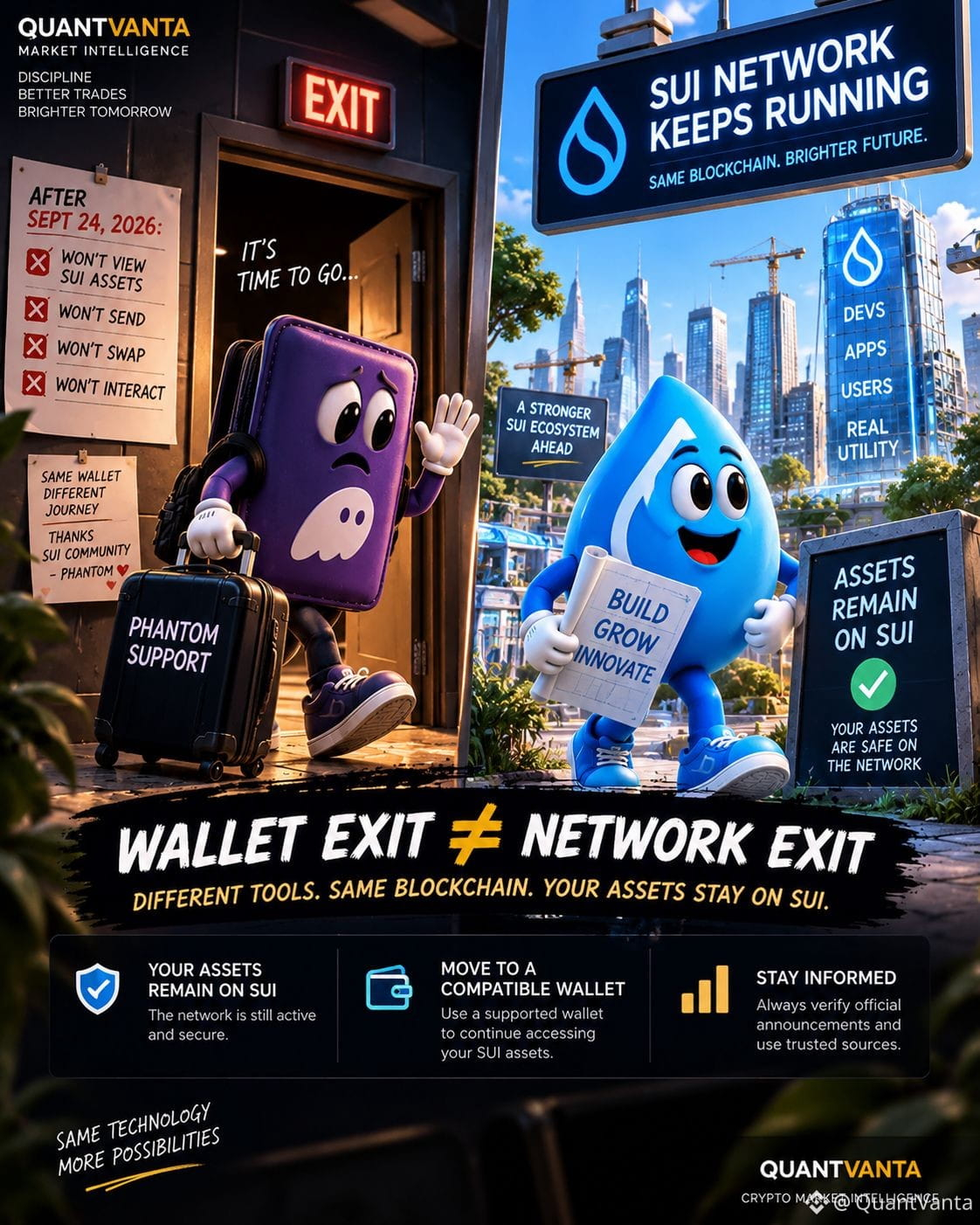
🚨 $SUI HAS A WALLET PROBLEM NOT A BLOCKCHAIN SHUTDOWN
Phantom is ending support for the Sui network on September 24.
That sounds scary.
But there’s an important distinction:
This is a wallet-support change, not a shutdown of the Sui blockchain.
After September 24, Phantom users will no longer be able to view, send, swap, or interact with Sui assets through Phantom.
The assets themselves remain on the Sui blockchain and can be accessed through a compatible wallet.
Meanwhile, $SUI is trading around 0.824 USD, with the current 24-hour range roughly 0.774–0.833 USD.
📊 LEVELS I’M WATCHING
🟢 0.833 → Near-term breakout reference
🟡 0.824 → Current decision area
🔴 0.774 → Current 24h downside reference
My take:
The Phantom exit creates short-term sentiment risk, especially for users who rely on that wallet.
But it should NOT automatically be interpreted as “Sui is failing.”
The bigger test is whether Sui can keep attracting developers, applications, liquidity and users while this transition happens.
Wallet exit ≠ network exit.
For $SUI, I’m watching whether price can hold the recent range while the ecosystem absorbs the wallet change.
Would you treat the Phantom exit as a red flag or simply a wallet migration event?
Follow QuantVanta for daily crypto market intelligence.
$SUI
{future}(SUIUSDT)
#SuiNetwork #Crypto #altcoins #defi #CryptoMarket
🚨 $SUI HAS A WALLET PROBLEM NOT A BLOCKCHAIN SHUTDOWN
Phantom is ending support for the Sui network on September 24.
That sounds scary.
But there’s an important distinction:
This is a wallet-support change, not a shutdown of the Sui blockchain.
After September 24, Phantom users will no longer be able to view, send, swap, or interact with Sui assets through Phantom.
The assets themselves remain on the Sui blockchain and can be accessed through a compatible wallet.
Meanwhile, $SUI is trading around 0.824 USD, with the current 24-hour range roughly 0.774–0.833 USD.
📊 LEVELS I’M WATCHING
🟢 0.833 → Near-term breakout reference
🟡 0.824 → Current decision area
🔴 0.774 → Current 24h downside reference
My take:
The Phantom exit creates short-term sentiment risk, especially for users who rely on that wallet.
But it should NOT automatically be interpreted as “Sui is failing.”
The bigger test is whether Sui can keep attracting developers, applications, liquidity and users while this transition happens.
Wallet exit ≠ network exit.
For $SUI , I’m watching whether price can hold the recent range while the ecosystem absorbs the wallet change.
Would you treat the Phantom exit as a red flag or simply a wallet migration event?
Follow QuantVanta for daily crypto market intelligence.
$SUI
#SuiNetwork #Crypto #altcoins #defi #CryptoMarket
Phantom is ending support for the Sui network on September 24.
That sounds scary.
But there’s an important distinction:
This is a wallet-support change, not a shutdown of the Sui blockchain.
After September 24, Phantom users will no longer be able to view, send, swap, or interact with Sui assets through Phantom.
The assets themselves remain on the Sui blockchain and can be accessed through a compatible wallet.
Meanwhile, $SUI is trading around 0.824 USD, with the current 24-hour range roughly 0.774–0.833 USD.
📊 LEVELS I’M WATCHING
🟢 0.833 → Near-term breakout reference
🟡 0.824 → Current decision area
🔴 0.774 → Current 24h downside reference
My take:
The Phantom exit creates short-term sentiment risk, especially for users who rely on that wallet.
But it should NOT automatically be interpreted as “Sui is failing.”
The bigger test is whether Sui can keep attracting developers, applications, liquidity and users while this transition happens.
Wallet exit ≠ network exit.
For $SUI , I’m watching whether price can hold the recent range while the ecosystem absorbs the wallet change.
Would you treat the Phantom exit as a red flag or simply a wallet migration event?
Follow QuantVanta for daily crypto market intelligence.
$SUI
#SuiNetwork #Crypto #altcoins #defi #CryptoMarket
1
1
833
·
--
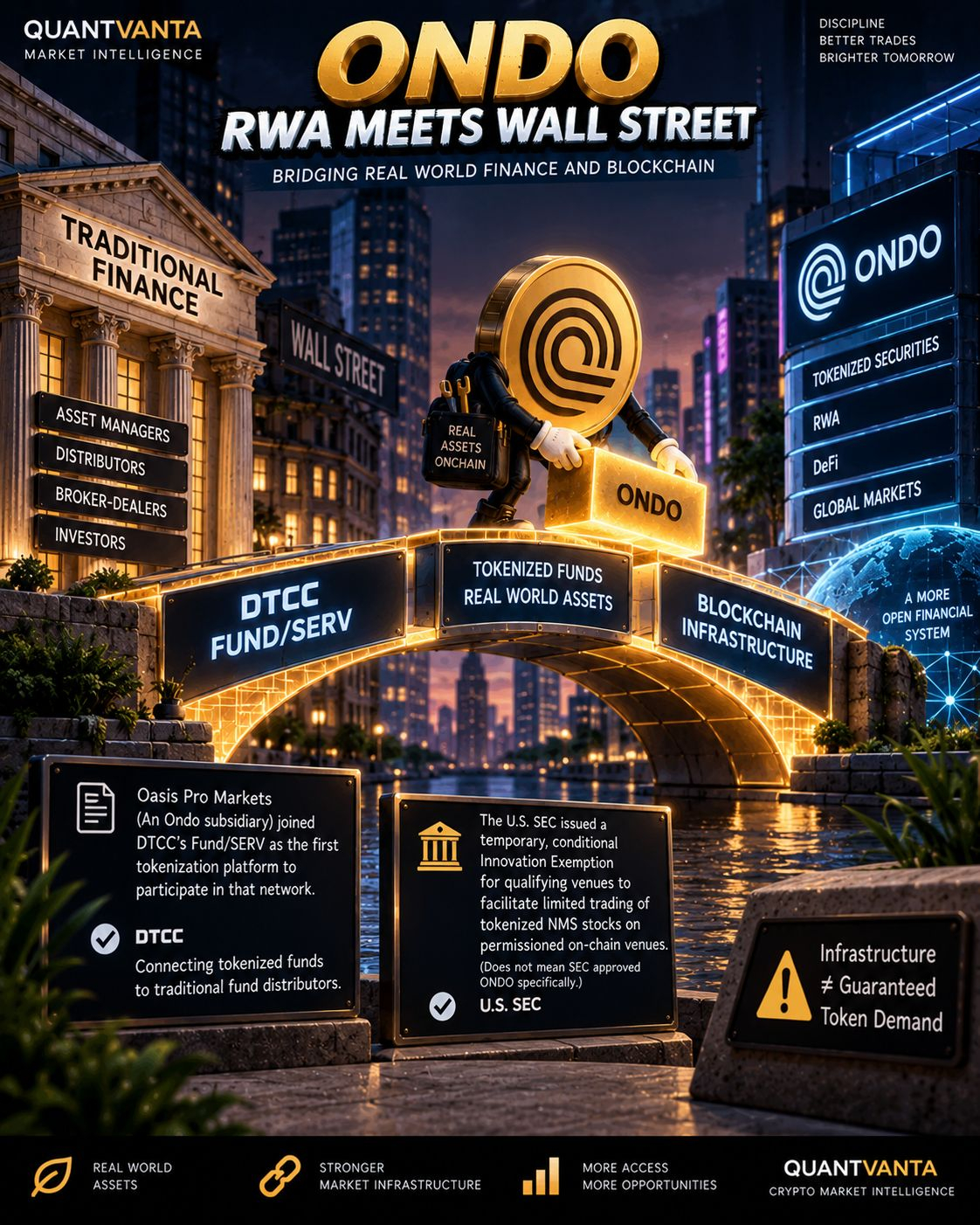
🚨 $ONDO JUST BUILT A BRIDGE TO TRADITIONAL FINANCE
This isn’t just another RWA headline.
Ondo Finance’s subsidiary, Oasis Pro Markets, has joined DTCC’s Fund/SERV network as its first tokenization-platform member.
Why is that important?
DTCC says Fund/SERV currently serves more than 85% of U.S. mutual-fund transaction activity.
That means Ondo’s tokenized-fund infrastructure is now connected to a major piece of the traditional fund-distribution system.
And that’s the part I’m watching.
🏦 Institutional distribution
🔗 Tokenized funds
🌎 Real-world assets onchain
⚙️ Traditional + blockchain infrastructure
But there’s an important distinction:
Infrastructure growth does NOT automatically mean token demand.
The real test is whether this connectivity eventually leads to more products, more users and more onchain activity.
For $ONDO, the RWA narrative is becoming increasingly tied to actual financial infrastructure not just speculation.
That makes the next phase interesting.
Can Ondo turn infrastructure into real adoption?
That’s the signal I’ll be watching. 👀
Follow QuantVanta for daily crypto market intelligence.
$ONDO
{future}(ONDOUSDT)
#RWA #crypto #Tokenization #defi #CryptoMarket
🚨 $ONDO JUST BUILT A BRIDGE TO TRADITIONAL FINANCE
This isn’t just another RWA headline.
Ondo Finance’s subsidiary, Oasis Pro Markets, has joined DTCC’s Fund/SERV network as its first tokenization-platform member.
Why is that important?
DTCC says Fund/SERV currently serves more than 85% of U.S. mutual-fund transaction activity.
That means Ondo’s tokenized-fund infrastructure is now connected to a major piece of the traditional fund-distribution system.
And that’s the part I’m watching.
🏦 Institutional distribution
🔗 Tokenized funds
🌎 Real-world assets onchain
⚙️ Traditional + blockchain infrastructure
But there’s an important distinction:
Infrastructure growth does NOT automatically mean token demand.
The real test is whether this connectivity eventually leads to more products, more users and more onchain activity.
For $ONDO , the RWA narrative is becoming increasingly tied to actual financial infrastructure not just speculation.
That makes the next phase interesting.
Can Ondo turn infrastructure into real adoption?
That’s the signal I’ll be watching. 👀
Follow QuantVanta for daily crypto market intelligence.
$ONDO
#RWA #crypto #Tokenization #defi #CryptoMarket
This isn’t just another RWA headline.
Ondo Finance’s subsidiary, Oasis Pro Markets, has joined DTCC’s Fund/SERV network as its first tokenization-platform member.
Why is that important?
DTCC says Fund/SERV currently serves more than 85% of U.S. mutual-fund transaction activity.
That means Ondo’s tokenized-fund infrastructure is now connected to a major piece of the traditional fund-distribution system.
And that’s the part I’m watching.
🏦 Institutional distribution
🔗 Tokenized funds
🌎 Real-world assets onchain
⚙️ Traditional + blockchain infrastructure
But there’s an important distinction:
Infrastructure growth does NOT automatically mean token demand.
The real test is whether this connectivity eventually leads to more products, more users and more onchain activity.
For $ONDO , the RWA narrative is becoming increasingly tied to actual financial infrastructure not just speculation.
That makes the next phase interesting.
Can Ondo turn infrastructure into real adoption?
That’s the signal I’ll be watching. 👀
Follow QuantVanta for daily crypto market intelligence.
$ONDO
#RWA #crypto #Tokenization #defi #CryptoMarket
208
·
--
🚨 $XLM JUST RECLAIMED $0.20 NOW IT HAS TO PROVE IT
Stellar is showing one of the stronger moves among major altcoins tonight.
XLM is around $0.20, with the latest market data showing an intraday high near $0.2033.
But there’s a second story behind the chart.
Stellar’s Protocol 28 upgrade has reached the mainnet rollout stage, bringing changes focused on faster consensus, safer smart-contract upgrades and more flexible contract-data migrations.
That matters because this isn’t a price-only catalyst.
It’s infrastructure.
📊 LEVELS I’M WATCHING
🟢 $0.190–$0.195 → Key support zone
🟡 $0.200 → Psychological level
🔴 $0.203–$0.205 → Immediate breakout area
If XLM can hold above $0.20 and push through the recent high, the recovery structure becomes more convincing.
If it slips back below $0.19, I’d be much more cautious about calling this a sustained breakout.
One important distinction:
Protocol upgrades can improve a network.
They do NOT automatically create token demand.
So the real test is whether stronger infrastructure eventually shows up in actual network usage.
Is XLM finally breaking out or is $0.20 just another resistance level? 👀
Follow QuantVanta for daily crypto market intelligence.
$XLM
{future}(XLMUSDT)
#XLM #crypto #Altcoins #blockchain #CryptoMarket
🚨 $XLM JUST RECLAIMED $0.20 NOW IT HAS TO PROVE IT
Stellar is showing one of the stronger moves among major altcoins tonight.
XLM is around $0.20, with the latest market data showing an intraday high near $0.2033.
But there’s a second story behind the chart.
Stellar’s Protocol 28 upgrade has reached the mainnet rollout stage, bringing changes focused on faster consensus, safer smart-contract upgrades and more flexible contract-data migrations.
That matters because this isn’t a price-only catalyst.
It’s infrastructure.
📊 LEVELS I’M WATCHING
🟢 $0.190–$0.195 → Key support zone
🟡 $0.200 → Psychological level
🔴 $0.203–$0.205 → Immediate breakout area
If XLM can hold above $0.20 and push through the recent high, the recovery structure becomes more convincing.
If it slips back below $0.19, I’d be much more cautious about calling this a sustained breakout.
One important distinction:
Protocol upgrades can improve a network.
They do NOT automatically create token demand.
So the real test is whether stronger infrastructure eventually shows up in actual network usage.
Is XLM finally breaking out or is $0.20 just another resistance level? 👀
Follow QuantVanta for daily crypto market intelligence.
$XLM
#XLM #crypto #Altcoins #blockchain #CryptoMarket
Stellar is showing one of the stronger moves among major altcoins tonight.
XLM is around $0.20, with the latest market data showing an intraday high near $0.2033.
But there’s a second story behind the chart.
Stellar’s Protocol 28 upgrade has reached the mainnet rollout stage, bringing changes focused on faster consensus, safer smart-contract upgrades and more flexible contract-data migrations.
That matters because this isn’t a price-only catalyst.
It’s infrastructure.
📊 LEVELS I’M WATCHING
🟢 $0.190–$0.195 → Key support zone
🟡 $0.200 → Psychological level
🔴 $0.203–$0.205 → Immediate breakout area
If XLM can hold above $0.20 and push through the recent high, the recovery structure becomes more convincing.
If it slips back below $0.19, I’d be much more cautious about calling this a sustained breakout.
One important distinction:
Protocol upgrades can improve a network.
They do NOT automatically create token demand.
So the real test is whether stronger infrastructure eventually shows up in actual network usage.
Is XLM finally breaking out or is $0.20 just another resistance level? 👀
Follow QuantVanta for daily crypto market intelligence.
$XLM
#XLM #crypto #Altcoins #blockchain #CryptoMarket
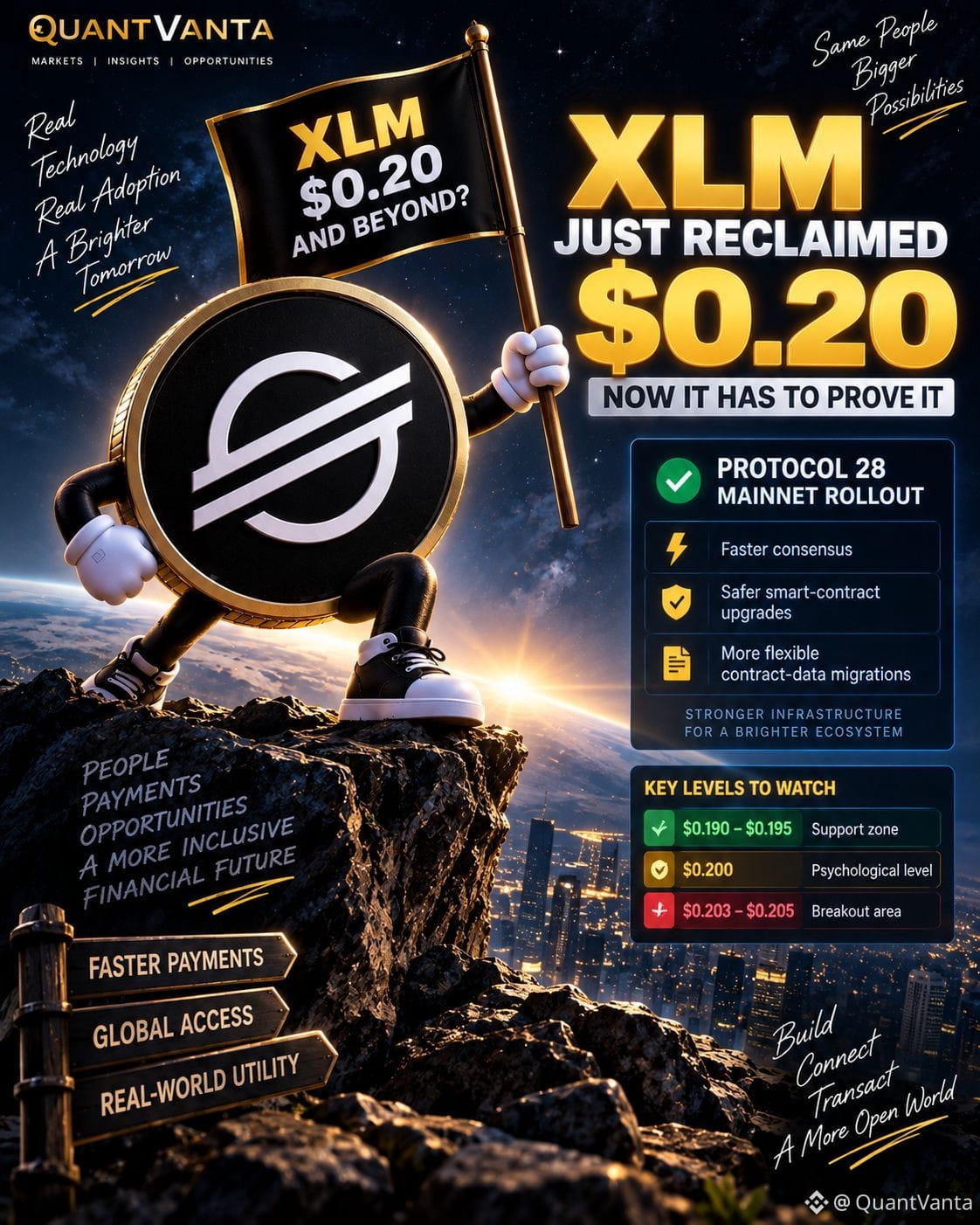
103
·
--
🚨 $SOL JUST GOT A BIG INSTITUTIONAL SIGNAL
Solana is back around $112.7 after climbing from roughly $101.6 on September 18.
But the price move isn’t the only thing getting interesting.
Spot Solana ETFs recorded about $47.62M in net inflows on September 18 their strongest daily inflow of September so far.
That creates an important setup:
Price is moving higher.
Capital is flowing into the ETFs.
Now the market has to prove the move has follow-through.
📊 LEVELS I’M WATCHING
🟢 ~$110 → Near-term support
🔴 ~$114 → Immediate resistance
🚨 ~$100 → Bigger downside reference
If SOL holds above $110 and pushes through the recent ~$114 area, the recovery starts looking more convincing.
If price loses $110, I’d want to see whether buyers step back in or the move starts fading.
My take:
ETF flows are encouraging.
But one strong day of inflows is not enough to confirm a lasting trend.
Price + flows + follow-through.
That’s the combination I’m watching. 👀
Do you think $SOL can hold this momentum into next week?
Follow QuantVanta for daily crypto market intelligence.
$SOL
{future}(SOLUSDT)
#sol #crypto #altcoins #CryptoMarket #etf
🚨 $SOL JUST GOT A BIG INSTITUTIONAL SIGNAL
Solana is back around $112.7 after climbing from roughly $101.6 on September 18.
But the price move isn’t the only thing getting interesting.
Spot Solana ETFs recorded about $47.62M in net inflows on September 18 their strongest daily inflow of September so far.
That creates an important setup:
Price is moving higher.
Capital is flowing into the ETFs.
Now the market has to prove the move has follow-through.
📊 LEVELS I’M WATCHING
🟢 ~$110 → Near-term support
🔴 ~$114 → Immediate resistance
🚨 ~$100 → Bigger downside reference
If SOL holds above $110 and pushes through the recent ~$114 area, the recovery starts looking more convincing.
If price loses $110, I’d want to see whether buyers step back in or the move starts fading.
My take:
ETF flows are encouraging.
But one strong day of inflows is not enough to confirm a lasting trend.
Price + flows + follow-through.
That’s the combination I’m watching. 👀
Do you think $SOL can hold this momentum into next week?
Follow QuantVanta for daily crypto market intelligence.
$SOL
#sol #crypto #altcoins #CryptoMarket #etf
Solana is back around $112.7 after climbing from roughly $101.6 on September 18.
But the price move isn’t the only thing getting interesting.
Spot Solana ETFs recorded about $47.62M in net inflows on September 18 their strongest daily inflow of September so far.
That creates an important setup:
Price is moving higher.
Capital is flowing into the ETFs.
Now the market has to prove the move has follow-through.
📊 LEVELS I’M WATCHING
🟢 ~$110 → Near-term support
🔴 ~$114 → Immediate resistance
🚨 ~$100 → Bigger downside reference
If SOL holds above $110 and pushes through the recent ~$114 area, the recovery starts looking more convincing.
If price loses $110, I’d want to see whether buyers step back in or the move starts fading.
My take:
ETF flows are encouraging.
But one strong day of inflows is not enough to confirm a lasting trend.
Price + flows + follow-through.
That’s the combination I’m watching. 👀
Do you think $SOL can hold this momentum into next week?
Follow QuantVanta for daily crypto market intelligence.
$SOL
#sol #crypto #altcoins #CryptoMarket #etf

1
3
479
Log in to explore more content
Join global crypto users on Binance Square
⚡️ Get latest and useful information about crypto.
💬 Trusted by the world’s largest crypto exchange.
👍 Discover real insights from verified creators.
Email / Phone number
Trending Topics
QNTRises39%
8,672 views
491 Discussing
#qntrises39%
🚀 $QNT PUMPS +39% ON HUGE INSTITUTIONAL NEWS! 💥
QNT is surging past $100 after massive momentum in institutional adoption! 🔥
$QNT
📰 The Big News Driving the Rally:
Quant Network's Overledger infrastructure is leading the push for tokenized deposits and digital banking solutions. With enterprise volume up over 553%, QNT has surged from $70 to over $100 in just hours! 📊📈
🟡 Binance Updates You Need to Know:
Funding Account Migration: Binance is officially migrating user crypto balances from Funding Accounts to Spot Accounts.
"Stocks Account" Rebrand: Funding Accounts will be renamed to Stocks Account, reserved for stock & stock-options trading settlement using 6 major assets (USD, USDC, USDT, USD1, U, BNB).
Action Required: Check your Binance app for the "One-Click Migration" feature to move your crypto to Spot Accounts before automatic batch transfers begin!
🤔 Is QNT set to smash $110 next, or are we consolidating here? Drop your price predictions below! 👇
#QNT #Quant #BinanceUpdates #CryptoNews
Lily星星
·1 Likes
·2.9k views
EthereumBreaksAbove$2700
1,059 views
59 Discussing
BitgetBreachForgedRequestsNotStolenKeys
7,498 views
398 Discussing