
#avalanche
avalanche
2.3M views
5,429 Discussing
Hot
Latest

$AVAX
AVAX (AVAX/USDT) – Futures Trading Setup
Entry Zone: $7.42 – $7.50
Stop Loss (SL): $7.25
Take Profit (TP) Targets:
TP1: $7.65
TP2: $7.85
TP3: $8.10
Trading Strategy: AVAX is consolidating near $7.50 after finding support. Holding above $7.42 provides a base for an upward move toward $7.85. A drop below $7.25 invalidates the short-term recovery.
#AVAX #Avalanche #CryptoTrading #Futures
AVAX (AVAX/USDT) – Futures Trading Setup
Entry Zone: $7.42 – $7.50
Stop Loss (SL): $7.25
Take Profit (TP) Targets:
TP1: $7.65
TP2: $7.85
TP3: $8.10
Trading Strategy: AVAX is consolidating near $7.50 after finding support. Holding above $7.42 provides a base for an upward move toward $7.85. A drop below $7.25 invalidates the short-term recovery.
#AVAX #Avalanche #CryptoTrading #Futures

Alert 🚨. Market is going to be crazy. Avalanche ( $AVAX ) shows robust SMC order blocks and volume momentum that hint at a bullish wave. Worldcoin ( $WLD ) is gaining adoption and investor sentiment is soaring, fueling ecosystem growth. Chip ( $CHIP ) delivers innovation and liquidity, boosting trading activity. Strong buy for all three as momentum builds. #Crypto #SMC #Avalanche #Worldcoin #Chip

$AVAX : The Critical Support Zone! (Wait For Confirmation 🎯)
The broader market is choppy due to "Rektember" seasonality and rising yields. While the long-term fundamentals for AVAX remain strong due to institutional tokenization, the short-term momentum is still uncertain.
AVAX is currently testing a crucial support zone ($7.44 - $7.47). The 15m RSI is flashing oversold, but volume is weak and heavy resistance sits above at $8.08 (200-day SMA).
📍 Entry: $7.44 - $7.47 (Buy the support)
🎯 Target 1: $7.53
🎯 Target 2: $7.58
🛑 Stop Loss: $7.38
Will AVAX hit $7.58 or retest $7.38 first? comment below! 👇
#AVAX #Avalanche #Crypto #BinanceSquare
(Follow me for disciplined, high-probability setups!)
The broader market is choppy due to "Rektember" seasonality and rising yields. While the long-term fundamentals for AVAX remain strong due to institutional tokenization, the short-term momentum is still uncertain.
AVAX is currently testing a crucial support zone ($7.44 - $7.47). The 15m RSI is flashing oversold, but volume is weak and heavy resistance sits above at $8.08 (200-day SMA).
📍 Entry: $7.44 - $7.47 (Buy the support)
🎯 Target 1: $7.53
🎯 Target 2: $7.58
🛑 Stop Loss: $7.38
Will AVAX hit $7.58 or retest $7.38 first? comment below! 👇
#AVAX #Avalanche #Crypto #BinanceSquare
(Follow me for disciplined, high-probability setups!)

$AVAX is sneaking higher while nobody’s paying attention 👀
That’s the tell.
Up 3.09% on the day, +3.1% in the last 4h, and still sitting above the 20d + 50d MAs. RSI on the 4h is 65, so it’s got heat but it’s not fully cooked yet. Funding at 0.010% means longs are finally paying up. That’s the part people miss.
Volume is only $21.33M though. Tiny vs the 20d average. So this is not broad conviction yet, it’s a squeeze starting to form.
$SOL usually leads the clean beta moves, but $AVAX is setting up its own little pop here if it keeps pressing. Around $7.50 is the line I’m watching. If it loses that cleanly, I’d want to see where it stalls next. If it holds, this can get loud fast 🔥
Watching how it reacts at $7.50?
#Avalanche
#Crypto
#Altcoin
That’s the tell.
Up 3.09% on the day, +3.1% in the last 4h, and still sitting above the 20d + 50d MAs. RSI on the 4h is 65, so it’s got heat but it’s not fully cooked yet. Funding at 0.010% means longs are finally paying up. That’s the part people miss.
Volume is only $21.33M though. Tiny vs the 20d average. So this is not broad conviction yet, it’s a squeeze starting to form.
$SOL usually leads the clean beta moves, but $AVAX is setting up its own little pop here if it keeps pressing. Around $7.50 is the line I’m watching. If it loses that cleanly, I’d want to see where it stalls next. If it holds, this can get loud fast 🔥
Watching how it reacts at $7.50?
#Avalanche
#Crypto
#Altcoin

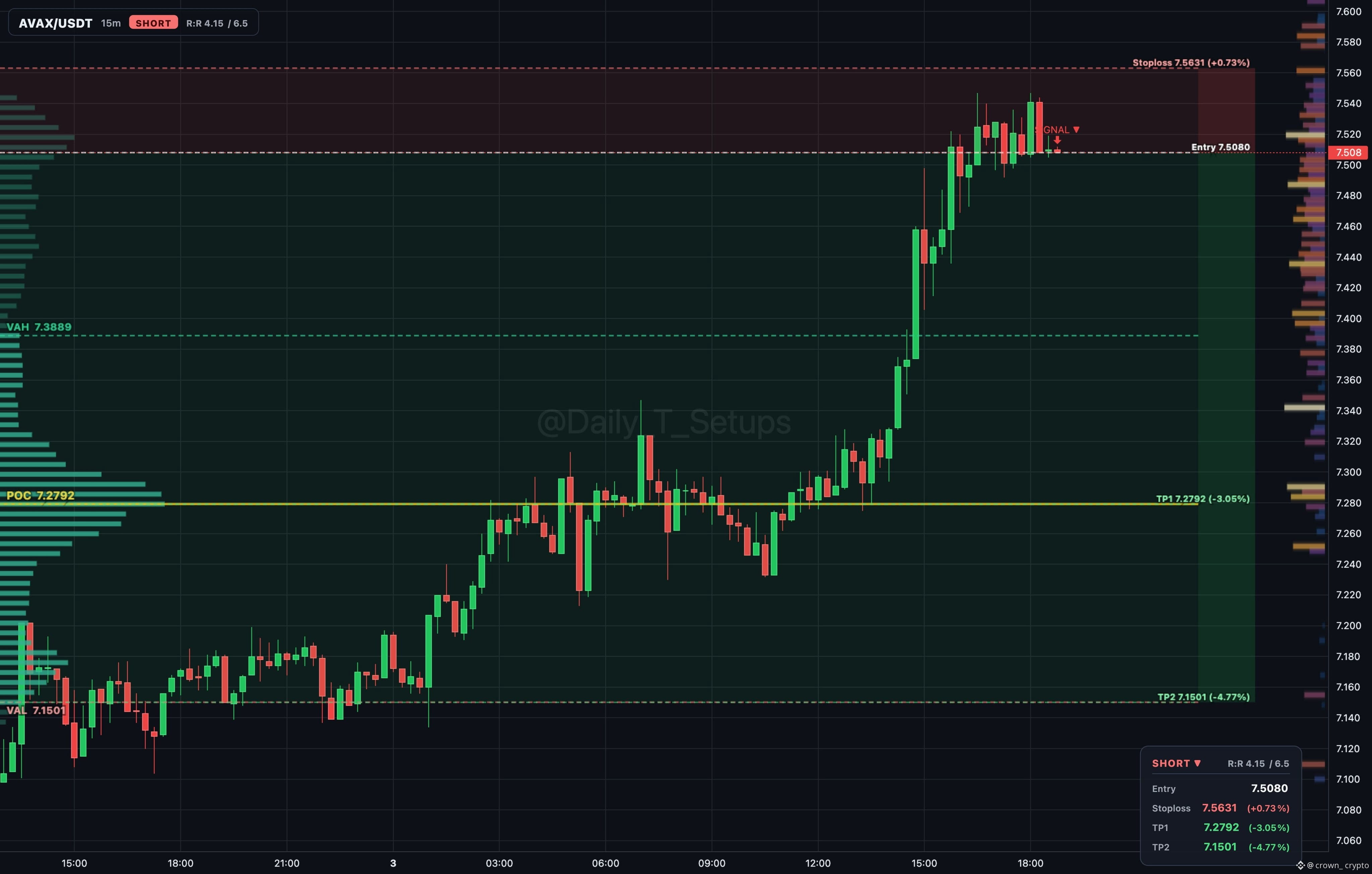
$AVAX auction rotation shows sellers distributing near VAH at 7.389 above value.
🔽 Short setup
📍 Entry: 7.511
🛑 Stop: 7.566 (+0.7%)
🎯 TP1: 7.279 (-3.1%)
🎯 TP2: 7.150 (-4.8%)
⚖️ Half off at TP1 → stop to entry
#Avalanche #AuctionTheory
🔽 Short setup
📍 Entry: 7.511
🛑 Stop: 7.566 (+0.7%)
🎯 TP1: 7.279 (-3.1%)
🎯 TP2: 7.150 (-4.8%)
⚖️ Half off at TP1 → stop to entry
#Avalanche #AuctionTheory
$AVAX
Avalanche (AVAX) is currently hovering around $7.15, trading tightly inside a high-stakes compression zone. While the broad Layer-1 market struggles with weak institutional flows, Avalanche is showing a massive utility surge. The network just launched Ethena Pay, bringing digital dollar neobanking entirely onto its subnets, with cashback rewards being distributed natively in AVAX.
Buy Before FOMO: Beneath this quiet price action, the supply dynamics are shifting. Avalanche has already locked in over $1.7 billion in tokenized real-world assets (RWAs), compressing the available open-market supply. A clean 4-hour candle close above the $7.80 technical resistance cluster will trigger immediate retail FOMO. This will force shorts to cover rapidly, opening a clean parabolic path back toward $9.50 and $12.00. Don't wait on the sidelines until the green candles escape your entry zone—use the attached Binance Trade Widget below to lock in your position now before the volume spikes!
Don't Gamble (Wait/Sell): Do not recklessly throw high leverage into this range without structural validation. AVAX is currently sitting below its 200-day SMA, indicating that the bears still hold macro control. If the market drops and AVAX breaks the line-in-the-sand support at $6.50, the bullish framework completely invalidates. A clean structural breakdown there will trigger a fast liquidation sweep down to the macro swing low at $5.69. Smart money doesn't guess the exact pivot point in a bearish trend; they wait for either a verified breakout or a volume-backed support bounce. Save your capital first.
Want to catch the exact breakout moment before the market moves? Hit that +FOLLOW button right now to get my immediate real-time alerts!
#Avalanche #AVAX #RWA #Write2Earn
Avalanche (AVAX) is currently hovering around $7.15, trading tightly inside a high-stakes compression zone. While the broad Layer-1 market struggles with weak institutional flows, Avalanche is showing a massive utility surge. The network just launched Ethena Pay, bringing digital dollar neobanking entirely onto its subnets, with cashback rewards being distributed natively in AVAX.
Buy Before FOMO: Beneath this quiet price action, the supply dynamics are shifting. Avalanche has already locked in over $1.7 billion in tokenized real-world assets (RWAs), compressing the available open-market supply. A clean 4-hour candle close above the $7.80 technical resistance cluster will trigger immediate retail FOMO. This will force shorts to cover rapidly, opening a clean parabolic path back toward $9.50 and $12.00. Don't wait on the sidelines until the green candles escape your entry zone—use the attached Binance Trade Widget below to lock in your position now before the volume spikes!
Don't Gamble (Wait/Sell): Do not recklessly throw high leverage into this range without structural validation. AVAX is currently sitting below its 200-day SMA, indicating that the bears still hold macro control. If the market drops and AVAX breaks the line-in-the-sand support at $6.50, the bullish framework completely invalidates. A clean structural breakdown there will trigger a fast liquidation sweep down to the macro swing low at $5.69. Smart money doesn't guess the exact pivot point in a bearish trend; they wait for either a verified breakout or a volume-backed support bounce. Save your capital first.
Want to catch the exact breakout moment before the market moves? Hit that +FOLLOW button right now to get my immediate real-time alerts!
#Avalanche #AVAX #RWA #Write2Earn
Partly True
🏔️ $AVAX : paradox of the year — record volumes while the price is falling? 🔍
📊 The picture
AVAX is at $7.4 with a cap of $3.14B. The network is processing record transaction volumes, but the price is 75%+ below the September 2025 peak of $35. The market is ignoring fundamentals — for now.
📈 Technically
Support $7.12-7.30, resistance $7.50-7.84. A break above $7.84 will open the way to $10.
🔥 Main triggers
The government is restructuring the entire securities ecosystem on Avalanche! Trust at the state level.
Plus, Schwab plans to add AVAX, and on September 16-17 there will be an Avalanche Summit in New York. A week of catalysts!
🎯 Scenarios:
🚀 Bullish: a breakout above $7.84 on institutional news ➡ $10-12
📉 Bearish: losing $7.12 ➡ slide to $6.3
⚠️ DYOR — not financial advice.
Do you believe AVAX will catch up to its fundamentals?
#AVAX #Avalanche
📊 The picture
AVAX is at $7.4 with a cap of $3.14B. The network is processing record transaction volumes, but the price is 75%+ below the September 2025 peak of $35. The market is ignoring fundamentals — for now.
📈 Technically
Support $7.12-7.30, resistance $7.50-7.84. A break above $7.84 will open the way to $10.
🔥 Main triggers
The government is restructuring the entire securities ecosystem on Avalanche! Trust at the state level.
Plus, Schwab plans to add AVAX, and on September 16-17 there will be an Avalanche Summit in New York. A week of catalysts!
🎯 Scenarios:
🚀 Bullish: a breakout above $7.84 on institutional news ➡ $10-12
📉 Bearish: losing $7.12 ➡ slide to $6.3
⚠️ DYOR — not financial advice.
Do you believe AVAX will catch up to its fundamentals?
#AVAX #Avalanche
🚀 Да, $10+ до конца года
📉 Нет, будет отставать
⏸ Держу, жду Summit
14 hr(s) left

When everyone is watching the ups and downs of $BTC , Avalanche, once known as an "Ethereum killer," is quietly laying out an institutional-grade narrative. It’s down just 0.01% over 24 hours, yet the funding rate shows longs are paying to hold positions — a signal many people missed. 🧐
First, a quick concept: what is an "institutional-grade public chain"? Simply put, it’s a blockchain that traditional financial giants are willing to use. Bitcoin $BTC is digital gold, Ethereum is the infrastructure of the decentralized world, and Avalanche is playing a different card — **sub-second finality**. What do traditional finance players fear most? Slow settlement. On $AVAX , a transaction confirms so quickly it feels almost instant, and that’s exactly the kind of trait institutions love.
Look at the data: the current price is $7.49, the 24-hour range is from $7.27 to $7.53, and trading volume is 2.38 million coins. What does that tell us? The market is waiting, but not panicking. The last four hourly candles have been almost perfectly flat, with volatility compressed to the extreme — this kind of "calm" is often a precursor to a major move. The funding rate is +0.01%; while not large, the direction is clear: longs are paying to maintain positions, and sentiment is leaning optimistic.
Why do institutions favor Avalanche? Three keywords: **subnets, compliance, speed**. Subnets allow institutions to customize their own private chains while still sharing the mainnet’s security — like renting a floor in an office tower and remodeling it, while sharing the same fire system and lobby security. For banks and brokerages that need regulatory compliance, this flexibility is more attractive than Ethereum’s one-size-fits-all approach. Another killer feature is the built-in compliance framework, designed specifically for real-world asset tokenization. When Wall Street starts talking about RWA (real-world assets), Avalanche is already armed with the tools.
Retail investors often think public-chain competition is a technical battle, but in reality it’s a battle for major customers. Ethereum $ETH has an ecosystem that’s too vast; every upgrade is like changing the engine on a plane already in flight. By contrast, $AVAX is more like a "private jet" tailored for institutions — fast takeoff, flexible routes. At the current price of $7.49, its market cap ranks among the top public chains, but it has already pulled back significantly from its peak. This is precisely the process of value discovery: when market sentiment recedes, networks with real demand slowly rise to the surface.
Of course, this isn’t telling you to go all in right now. It’s just that the next time you hear the argument that "public chains are dead," think a little harder: when traditional financial giants enter the market, will they choose a chain that cannot be regulated, or one that actively embraces compliance? The answer may be simpler than you think. 💡
One last question: if institutional capital really floods into the public-chain sector, would you bet on the technical path of $AVAX , or on the ecosystem moat of $ETH ? Drop your pick in the comments and let’s discuss 👇
#Avalanche #公链竞争 #RWA
First, a quick concept: what is an "institutional-grade public chain"? Simply put, it’s a blockchain that traditional financial giants are willing to use. Bitcoin $BTC is digital gold, Ethereum is the infrastructure of the decentralized world, and Avalanche is playing a different card — **sub-second finality**. What do traditional finance players fear most? Slow settlement. On $AVAX , a transaction confirms so quickly it feels almost instant, and that’s exactly the kind of trait institutions love.
Look at the data: the current price is $7.49, the 24-hour range is from $7.27 to $7.53, and trading volume is 2.38 million coins. What does that tell us? The market is waiting, but not panicking. The last four hourly candles have been almost perfectly flat, with volatility compressed to the extreme — this kind of "calm" is often a precursor to a major move. The funding rate is +0.01%; while not large, the direction is clear: longs are paying to maintain positions, and sentiment is leaning optimistic.
Why do institutions favor Avalanche? Three keywords: **subnets, compliance, speed**. Subnets allow institutions to customize their own private chains while still sharing the mainnet’s security — like renting a floor in an office tower and remodeling it, while sharing the same fire system and lobby security. For banks and brokerages that need regulatory compliance, this flexibility is more attractive than Ethereum’s one-size-fits-all approach. Another killer feature is the built-in compliance framework, designed specifically for real-world asset tokenization. When Wall Street starts talking about RWA (real-world assets), Avalanche is already armed with the tools.
Retail investors often think public-chain competition is a technical battle, but in reality it’s a battle for major customers. Ethereum $ETH has an ecosystem that’s too vast; every upgrade is like changing the engine on a plane already in flight. By contrast, $AVAX is more like a "private jet" tailored for institutions — fast takeoff, flexible routes. At the current price of $7.49, its market cap ranks among the top public chains, but it has already pulled back significantly from its peak. This is precisely the process of value discovery: when market sentiment recedes, networks with real demand slowly rise to the surface.
Of course, this isn’t telling you to go all in right now. It’s just that the next time you hear the argument that "public chains are dead," think a little harder: when traditional financial giants enter the market, will they choose a chain that cannot be regulated, or one that actively embraces compliance? The answer may be simpler than you think. 💡
One last question: if institutional capital really floods into the public-chain sector, would you bet on the technical path of $AVAX , or on the ecosystem moat of $ETH ? Drop your pick in the comments and let’s discuss 👇
#Avalanche #公链竞争 #RWA

Avalanche ($AVAX ) Gains Momentum in DeFi Expansion
Avalanche ($AVAX ) is making waves with its robust DeFi ecosystem. Despite a slight 1.52% dip in the last 24 hours, $AVAX is still a top-31 market cap with a strong community and growing developer activity. The network’s high throughput and low fees are attracting new projects and users. With ongoing partnerships and ecosystem grants, $AVAX is poised to remain a key player in the DeFi space. 🚀🔥
Follow for daily crypto updates.
#DeGenYuv #Avalanche
Avalanche ($AVAX ) is making waves with its robust DeFi ecosystem. Despite a slight 1.52% dip in the last 24 hours, $AVAX is still a top-31 market cap with a strong community and growing developer activity. The network’s high throughput and low fees are attracting new projects and users. With ongoing partnerships and ecosystem grants, $AVAX is poised to remain a key player in the DeFi space. 🚀🔥
Follow for daily crypto updates.
#DeGenYuv #Avalanche

Avalanche ($AVAX ) Gains Momentum Despite Market Dips
Avalanche ($AVAX ) is trending despite a slight 1.50% dip in the last 24 hours. The ecosystem is buzzing with new DeFi projects and partnerships, driving interest and adoption. With a robust 24-hour volume of $71.2M, $AVAX is showing strong liquidity and trader activity. The community is also hyped about upcoming protocol upgrades, which could further enhance its scalability and security. Keep an eye on $AVAX as it continues to build momentum in a volatile market. ⚡🔥
Follow for more setups like this.
#HahaProfit #Avalanche
Avalanche ($AVAX ) is trending despite a slight 1.50% dip in the last 24 hours. The ecosystem is buzzing with new DeFi projects and partnerships, driving interest and adoption. With a robust 24-hour volume of $71.2M, $AVAX is showing strong liquidity and trader activity. The community is also hyped about upcoming protocol upgrades, which could further enhance its scalability and security. Keep an eye on $AVAX as it continues to build momentum in a volatile market. ⚡🔥
Follow for more setups like this.
#HahaProfit #Avalanche

🚀 AVAX Breakout Ready? Range tightening around the $7.50 level, building momentum toward higher targets
Avalanche ($AVAX ) is holding its key $7.20 – $7.40 support zone and continuing to consolidate as it looks to break above the range highs at $8.00 and $8.50 resistance.
🔥 Today’s main market factors:
• Corporate treasury & RWA demand: Network demand is expanding thanks to the growth of subnet ecosystem development and an increase in real-world asset (RWA) tokenization projects.
• Derivatives liquidation complete: Open interest (OI) adjustments on major exchanges have been completed, increasing room for upside tests through spot buybacks.
• Technical convergence: A bullish pattern of higher lows is forming on the 4-hour chart. A clear break above $7.50 could accelerate momentum.
📊 Key technical levels to watch:
• Pullback support zone: $7.20 – $7.40
• Breakout trigger / resistance: $8.00
• Upside targets: $8.50 – $9.20
💡 Trading tip: During rebounds from major support zones, order-book liquidity can change rapidly. Before placing an order, check the real-time bid/ask and order book information in the trade widget.
Check the latest price action and start trading from the live trade widget below for $AVAX ! 📈
Do you think $AVAX will break above $8.00 this week? Share your prediction in the comments! 👇
#Avalanche #AVAX #CryptoNews #BinanceSquare #仮想通貨
Avalanche ($AVAX ) is holding its key $7.20 – $7.40 support zone and continuing to consolidate as it looks to break above the range highs at $8.00 and $8.50 resistance.
🔥 Today’s main market factors:
• Corporate treasury & RWA demand: Network demand is expanding thanks to the growth of subnet ecosystem development and an increase in real-world asset (RWA) tokenization projects.
• Derivatives liquidation complete: Open interest (OI) adjustments on major exchanges have been completed, increasing room for upside tests through spot buybacks.
• Technical convergence: A bullish pattern of higher lows is forming on the 4-hour chart. A clear break above $7.50 could accelerate momentum.
📊 Key technical levels to watch:
• Pullback support zone: $7.20 – $7.40
• Breakout trigger / resistance: $8.00
• Upside targets: $8.50 – $9.20
💡 Trading tip: During rebounds from major support zones, order-book liquidity can change rapidly. Before placing an order, check the real-time bid/ask and order book information in the trade widget.
Check the latest price action and start trading from the live trade widget below for $AVAX ! 📈
Do you think $AVAX will break above $8.00 this week? Share your prediction in the comments! 👇
#Avalanche #AVAX #CryptoNews #BinanceSquare #仮想通貨

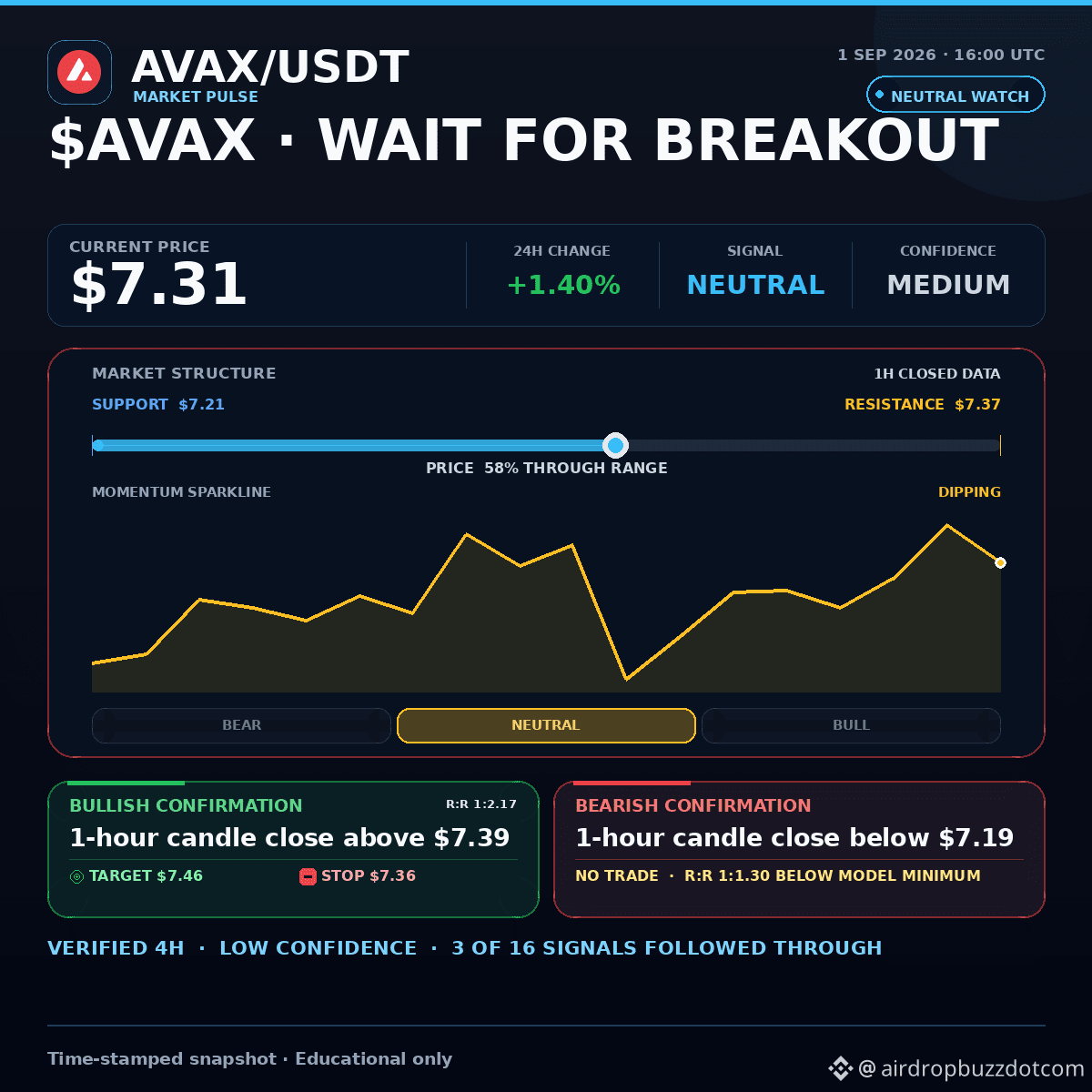
The number that matters for $AVAX : 3 of 16 recent directional moves finished favorably.
📊 Snapshot
• Price: $7.31
• 24H: +1.40%
• Bias: Neutral
📈 Bull Trigger
1-hour close above $7.39 with open interest confirmation
📉 Bear Trigger
1-hour close below $7.19 with open interest confirmation
🎯 Signal Read
The setup is balanced enough to punish guesses; wait for price and participation to confirm the same side.
📌 Confidence
Medium · Low historical confidence · 3 of 16 directional moves were favorable
Signal Quality
- OI: Flat (+0.36%)
- 4H: Bullish | 1D: Bullish (Aligned)
- ATR filter: 0.50 ATR ($0.04)
- Risk/reward: 1:2.17
Bull scenario risk plan
- Entry: $7.39
- Stop: $7.36
- Target: $7.46
Use closed-candle confirmation because these levels define conditions, not future price forecasts.
Bull or bear first? Drop 🐂 or 🐻.
#AVAX #Avalanche #CryptoTrading #MarketPulse
Educational only. Time-stamped market snapshot, not financial advice.
📊 Snapshot
• Price: $7.31
• 24H: +1.40%
• Bias: Neutral
📈 Bull Trigger
1-hour close above $7.39 with open interest confirmation
📉 Bear Trigger
1-hour close below $7.19 with open interest confirmation
🎯 Signal Read
The setup is balanced enough to punish guesses; wait for price and participation to confirm the same side.
📌 Confidence
Medium · Low historical confidence · 3 of 16 directional moves were favorable
Signal Quality
- OI: Flat (+0.36%)
- 4H: Bullish | 1D: Bullish (Aligned)
- ATR filter: 0.50 ATR ($0.04)
- Risk/reward: 1:2.17
Bull scenario risk plan
- Entry: $7.39
- Stop: $7.36
- Target: $7.46
Use closed-candle confirmation because these levels define conditions, not future price forecasts.
Bull or bear first? Drop 🐂 or 🐻.
#AVAX #Avalanche #CryptoTrading #MarketPulse
Educational only. Time-stamped market snapshot, not financial advice.

Partly True
Ethena has just launched a self-custody payment application that uses Avalanche for settlement. This news directly pushed the $ENA price intraday up by 0.167 USD, and the 24-hour trading volume immediately surged to $270 million, sending market hype through the roof.
Self-custody payments have long been an important direction for real-world adoption in the crypto space. This time Ethena chose Avalanche for settlement, which also makes use of Avalanche’s advantages of high throughput and low fees—so users’ experience will indeed be much better.
The stablecoin sector has recently been short on new stories. Whether this product update from Ethena can continue to drive the price higher remains to be seen, and we can keep observing.
$ENA #加密货币 #Avalanche
Self-custody payments have long been an important direction for real-world adoption in the crypto space. This time Ethena chose Avalanche for settlement, which also makes use of Avalanche’s advantages of high throughput and low fees—so users’ experience will indeed be much better.
The stablecoin sector has recently been short on new stories. Whether this product update from Ethena can continue to drive the price higher remains to be seen, and we can keep observing.
$ENA #加密货币 #Avalanche

Partly True
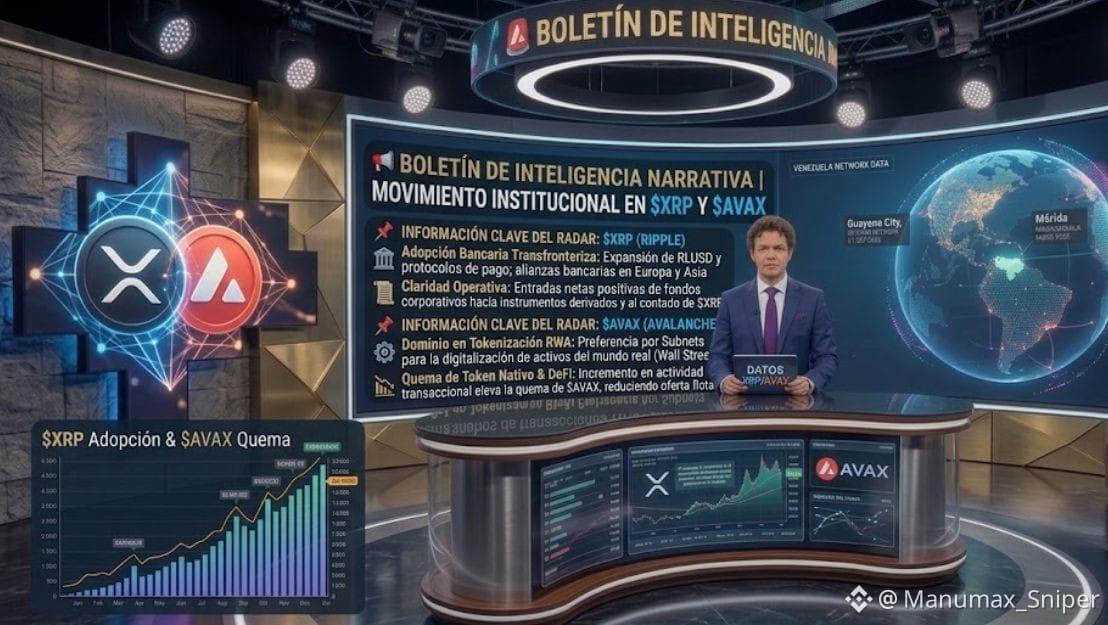
📡 NARRATIVE INTELLIGENCE BULLETIN | INSTITUTIONAL MOVEMENT IN XRP AND AVAX
The market opens September with the liquidity of wholesale capital focused on two of the most solid infrastructure protocols: Ripple (XRP) and Avalanche (AVAX).
📌 KEY RADAR INFORMATION: $XRP (RIPPLE)
🏦 Cross-Border Banking Adoption: The expansion of the use of Ripple’s native stablecoin (RLUSD) and its cross-border payment protocols continues to add alliances with financial institutions in Europe and Asia.
📜 Operational Clarity: Regulatory consolidation continues to attract positive net inflows of corporate funds into XRP derivatives and spot instruments.
📌 KEY RADAR INFORMATION: $AVAX (AVALANCHE)
⚙️ Dominance in RWA Tokenization: Avalanche positions itself as one of the preferred networks by Wall Street firms for digitizing real-world assets (Real World Assets) through its custom Subnets.
📉 Native Token Burn & DeFi: The increase in transaction activity within its dedicated networks has raised the steady burn of AVAX, reducing the circulating floating supply.
💬 Which of these two institutional narratives do you think will drive the session today with the greatest force?
📌 LATER ON I WILL UPLOAD THE TACTICAL ANALYSIS OF THESE TWO CRYPTOS.
#xrp #AVAX #Ripple #Avalanche
The market opens September with the liquidity of wholesale capital focused on two of the most solid infrastructure protocols: Ripple (XRP) and Avalanche (AVAX).
📌 KEY RADAR INFORMATION: $XRP (RIPPLE)
🏦 Cross-Border Banking Adoption: The expansion of the use of Ripple’s native stablecoin (RLUSD) and its cross-border payment protocols continues to add alliances with financial institutions in Europe and Asia.
📜 Operational Clarity: Regulatory consolidation continues to attract positive net inflows of corporate funds into XRP derivatives and spot instruments.
📌 KEY RADAR INFORMATION: $AVAX (AVALANCHE)
⚙️ Dominance in RWA Tokenization: Avalanche positions itself as one of the preferred networks by Wall Street firms for digitizing real-world assets (Real World Assets) through its custom Subnets.
📉 Native Token Burn & DeFi: The increase in transaction activity within its dedicated networks has raised the steady burn of AVAX, reducing the circulating floating supply.
💬 Which of these two institutional narratives do you think will drive the session today with the greatest force?
📌 LATER ON I WILL UPLOAD THE TACTICAL ANALYSIS OF THESE TWO CRYPTOS.
#xrp #AVAX #Ripple #Avalanche

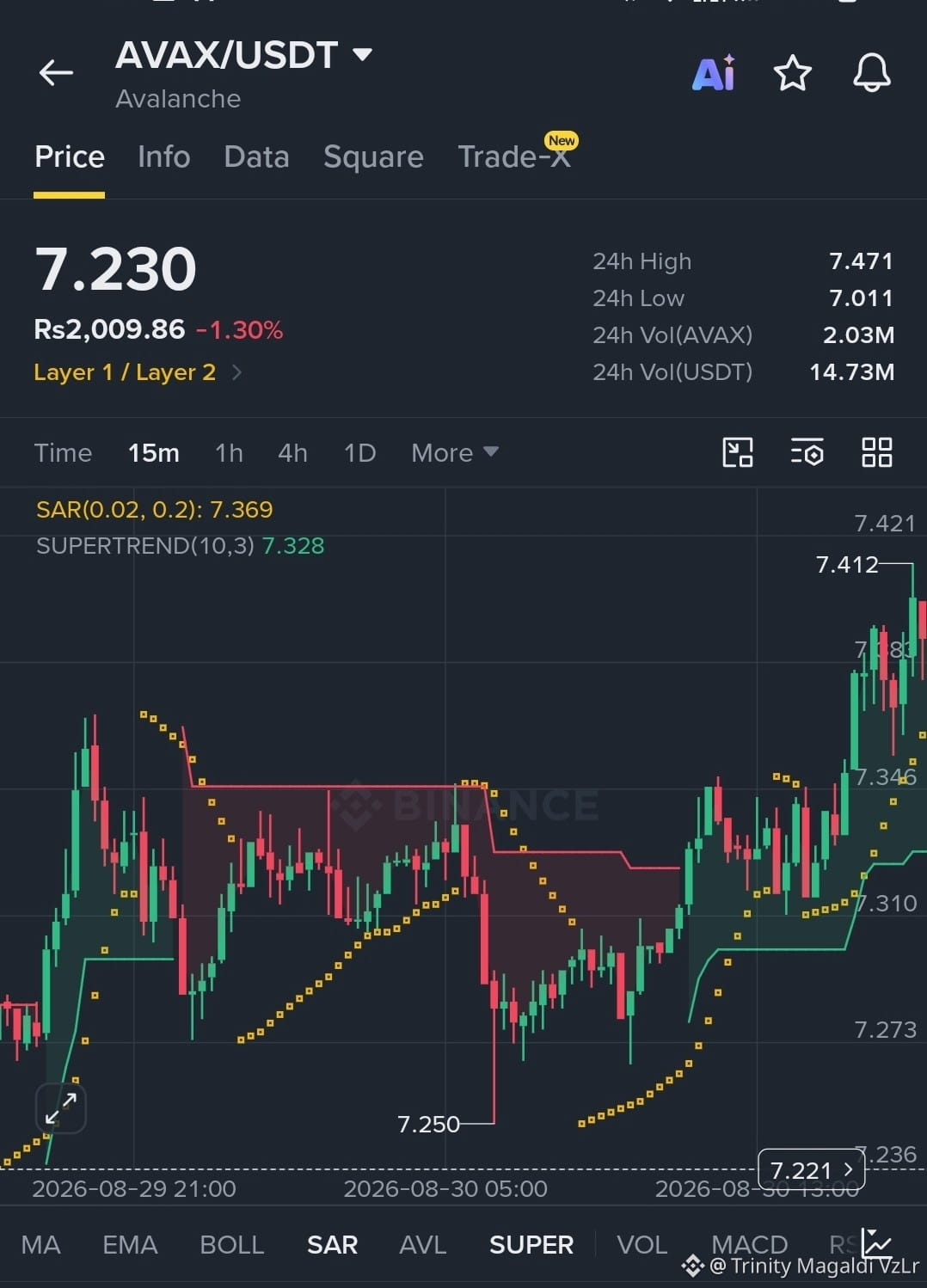
🚨$AVAX AVAX ALERT 🚨
AVAX is under pressure at $7.23, trading below both SAR $7.369 and Supertrend $7.328. Bulls need a quick reclaim of $7.33 to shift momentum. Failure could expose the recent $7.01 low as sellers remain active.
#AVAX #Avalanche #Crypto #BinanceSquare
$GIGGLE
$RIVER
AVAX is under pressure at $7.23, trading below both SAR $7.369 and Supertrend $7.328. Bulls need a quick reclaim of $7.33 to shift momentum. Failure could expose the recent $7.01 low as sellers remain active.
#AVAX #Avalanche #Crypto #BinanceSquare
$GIGGLE
$RIVER

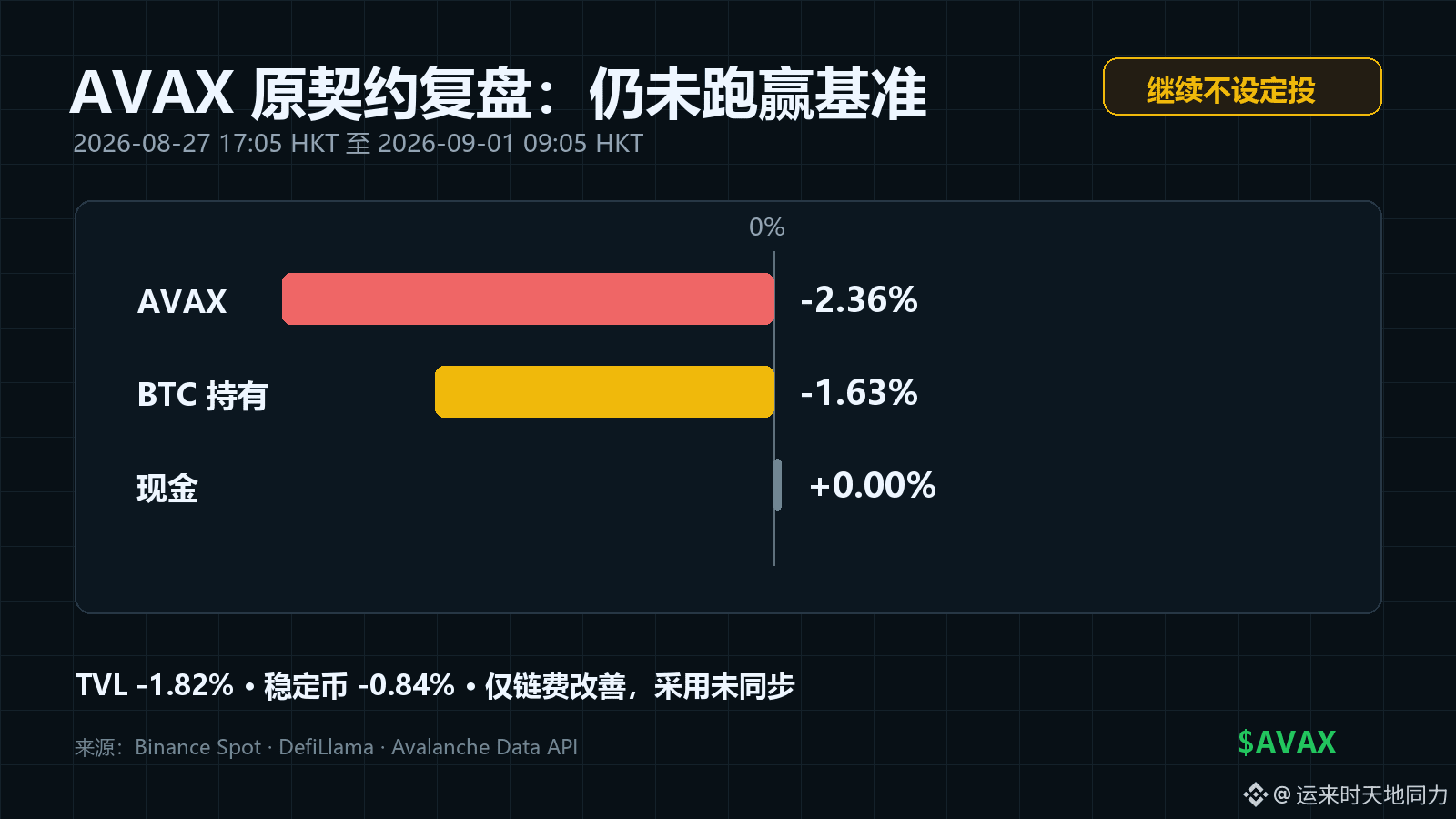
$AVAX post-mortem on prior judgment: require TVL, stablecoin supply, and chain fees to expand in sync; otherwise, no investment will be set. The original contract ID was AVAX-20260827-1705-RWA-ATTENTION-ADOPTION-DIVERGENCE-NOTRADE; five days later, the viewpoint received partial confirmation, and the 60-day outlook is still under validation.
Calculated from the contract start time, AVAX fell 2.36%, BTC fell 1.63%, and cash was 0; AVAX lagged by 0.73 and 2.36 percentage points, respectively. The original contract had no trading plan and did not trigger any trades, so profit/loss does not apply, and it cannot be packaged as account win rate.
In the same period, Avalanche TVL fell by 1.82%, and stablecoin supply fell by 0.84%. Only the 30-day average chain fees grew by 8.88% versus the previous window. The Square discussion continued to increase; the 90-day spot volume was about 50% of the one-year benchmark, and attention remained within normal levels.
Continue to not set any investment. Going forward, only monitor whether TVL, stablecoin supply, and chain fees can remain continuously above the original benchmark for 60 days, and whether fee burn can offset the newly added rewards; if not met, do not reassess.
#AVAX #Avalanche #链上数据 # Long-term post-mortem
Calculated from the contract start time, AVAX fell 2.36%, BTC fell 1.63%, and cash was 0; AVAX lagged by 0.73 and 2.36 percentage points, respectively. The original contract had no trading plan and did not trigger any trades, so profit/loss does not apply, and it cannot be packaged as account win rate.
In the same period, Avalanche TVL fell by 1.82%, and stablecoin supply fell by 0.84%. Only the 30-day average chain fees grew by 8.88% versus the previous window. The Square discussion continued to increase; the 90-day spot volume was about 50% of the one-year benchmark, and attention remained within normal levels.
Continue to not set any investment. Going forward, only monitor whether TVL, stablecoin supply, and chain fees can remain continuously above the original benchmark for 60 days, and whether fee burn can offset the newly added rewards; if not met, do not reassess.
#AVAX #Avalanche #链上数据 # Long-term post-mortem

Alert 🚨. Market is going to be crazy. Avalanche ( $AVAX ) shows robust order blocks and SMC signals, pushing volume momentum as the ecosystem scales. Ondo ( $ONDO ) fuels investor sentiment with new DeFi innovations, boosting liquidity. Bico ( $BICO ) rides adoption growth, trading activity surges. Strong buy for all three. 🚀📈 #Avalanche #Ondo #Bico

Even old-school Wall Street types like Lianjiaxin Wealth Management are listing Avalanche now, while the bears are still shouting “go to zero”? 😏
This time it’s not some minor exchange. It’s a mainstream U.S. brokerage that’s adding Solana, Avalanche, and Chainlink to its crypto trading roster. Plainly put, traditional capital no longer just clings to BTC and ETH and goes to sleep. It’s starting to pick away at chains with ecosystems and stories. If AVAX can make it onto this list, you can figure it out—it's basically institutions casting votes with their feet, betting that it will survive long-term. The specific launch date hasn’t been given yet, but the direction is right there in your face. I’ll be blunt: do you want to wait for an official announcement to jump in? By then, the price won’t be what it is now.
Are you positioning yourselves right now, or waiting for traditional funds to move in and lift the car for you? Drop a comment in the section below 👇
#Avalanche #加密货币 #BTC
This time it’s not some minor exchange. It’s a mainstream U.S. brokerage that’s adding Solana, Avalanche, and Chainlink to its crypto trading roster. Plainly put, traditional capital no longer just clings to BTC and ETH and goes to sleep. It’s starting to pick away at chains with ecosystems and stories. If AVAX can make it onto this list, you can figure it out—it's basically institutions casting votes with their feet, betting that it will survive long-term. The specific launch date hasn’t been given yet, but the direction is right there in your face. I’ll be blunt: do you want to wait for an official announcement to jump in? By then, the price won’t be what it is now.
Are you positioning yourselves right now, or waiting for traditional funds to move in and lift the car for you? Drop a comment in the section below 👇
#Avalanche #加密货币 #BTC
Order blocks on Avalanche ( AVAX ) surge as institutional flow builds momentum, pushing liquidity deeper. Penguin Finance ( PENGU ) staking rewards fuel adoption, while Zero Knowledge Protocol ( ZKP ) layer 2 roll ups spark innovation. Trading activity climbs, reflecting bullish sentiment and a robust ecosystem. Strong buy signal across all three tokens. 🚀📈💹 #Avalanche #PenguinFinance #ZeroKnowledgeProtocol #SMC #BinanceSquare

#SchwabPlansToAddSOLAVAXLINKTrading
Charles Schwab to Add $SOL , $AVAX and $LINK Trading! 🌐💼
Traditional finance is bridging the gap with crypto. Charles Schwab is reportedly planning to introduce trading options for Solana, Avalanche, and Chainlink.
Key Benefits:
Institutional Liquidity: Brings massive capital inflows from traditional brokerage clients. 📈
Mainstream Adoption: Validates top-tier altcoins as core components of modern finance. 🚀
Ecosystem Growth: Increases long-term utility and network strength.⚡️
Will this integration trigger the next major altcoin rally? Share your thoughts below! 👇💬
#SchwabPlansToAddSOLAVAXLINKTrading #Avalanche #Chainlink #CryptoNews
Charles Schwab to Add $SOL , $AVAX and $LINK Trading! 🌐💼
Traditional finance is bridging the gap with crypto. Charles Schwab is reportedly planning to introduce trading options for Solana, Avalanche, and Chainlink.
Key Benefits:
Institutional Liquidity: Brings massive capital inflows from traditional brokerage clients. 📈
Mainstream Adoption: Validates top-tier altcoins as core components of modern finance. 🚀
Ecosystem Growth: Increases long-term utility and network strength.⚡️
Will this integration trigger the next major altcoin rally? Share your thoughts below! 👇💬
#SchwabPlansToAddSOLAVAXLINKTrading #Avalanche #Chainlink #CryptoNews
Log in to explore more content