

#fincen
fincen
59,465 views
81 Discussing
Hot
Latest

·
--
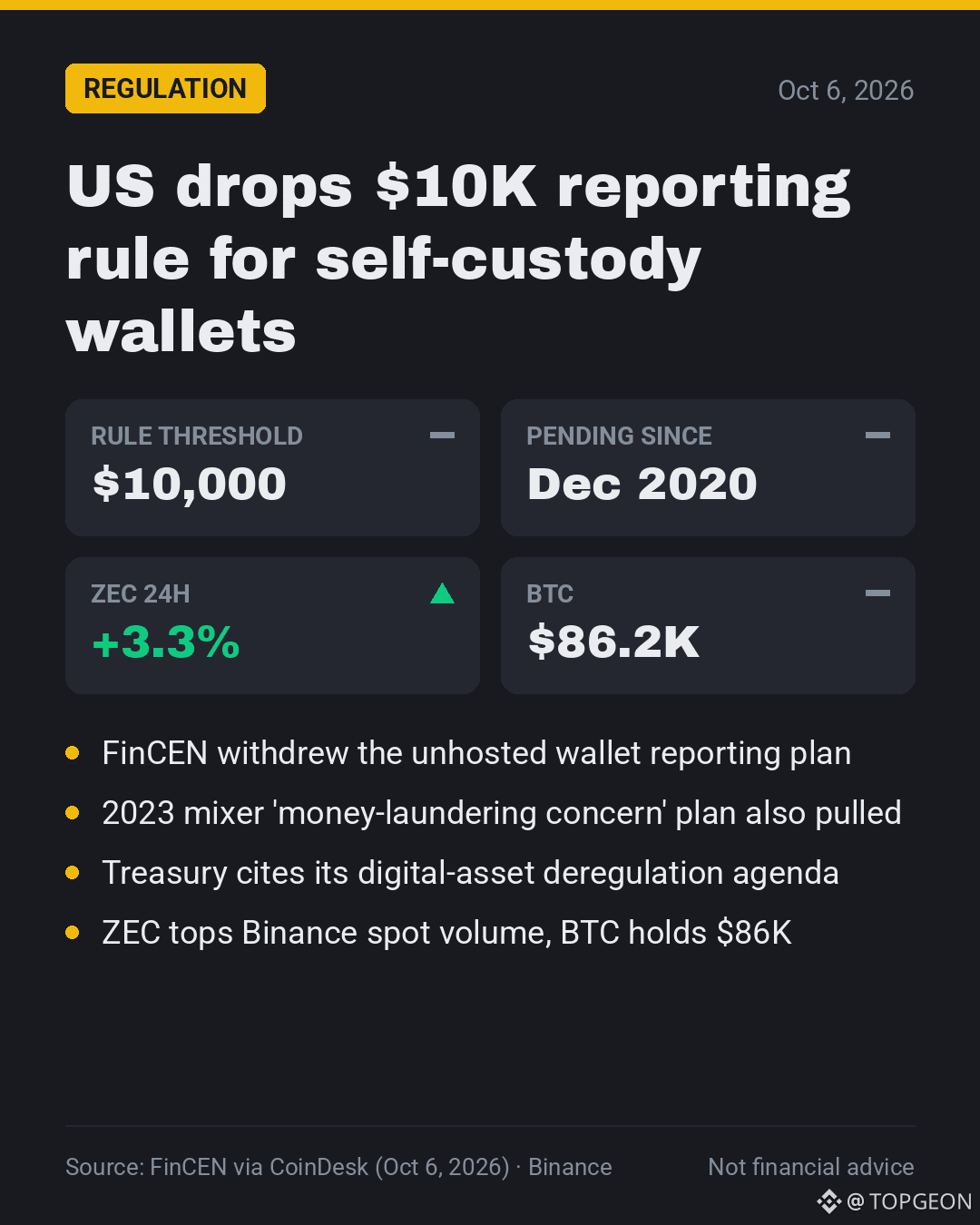
🏦 US kills its $10K self-custody wallet rule: $BTC at $86.3K
• FinCEN withdrew the plan, stuck since Dec 2020
• Banks and exchanges would have reported wallet sends over $10K
• A 2023 crypto-mixer crackdown proposal was pulled too
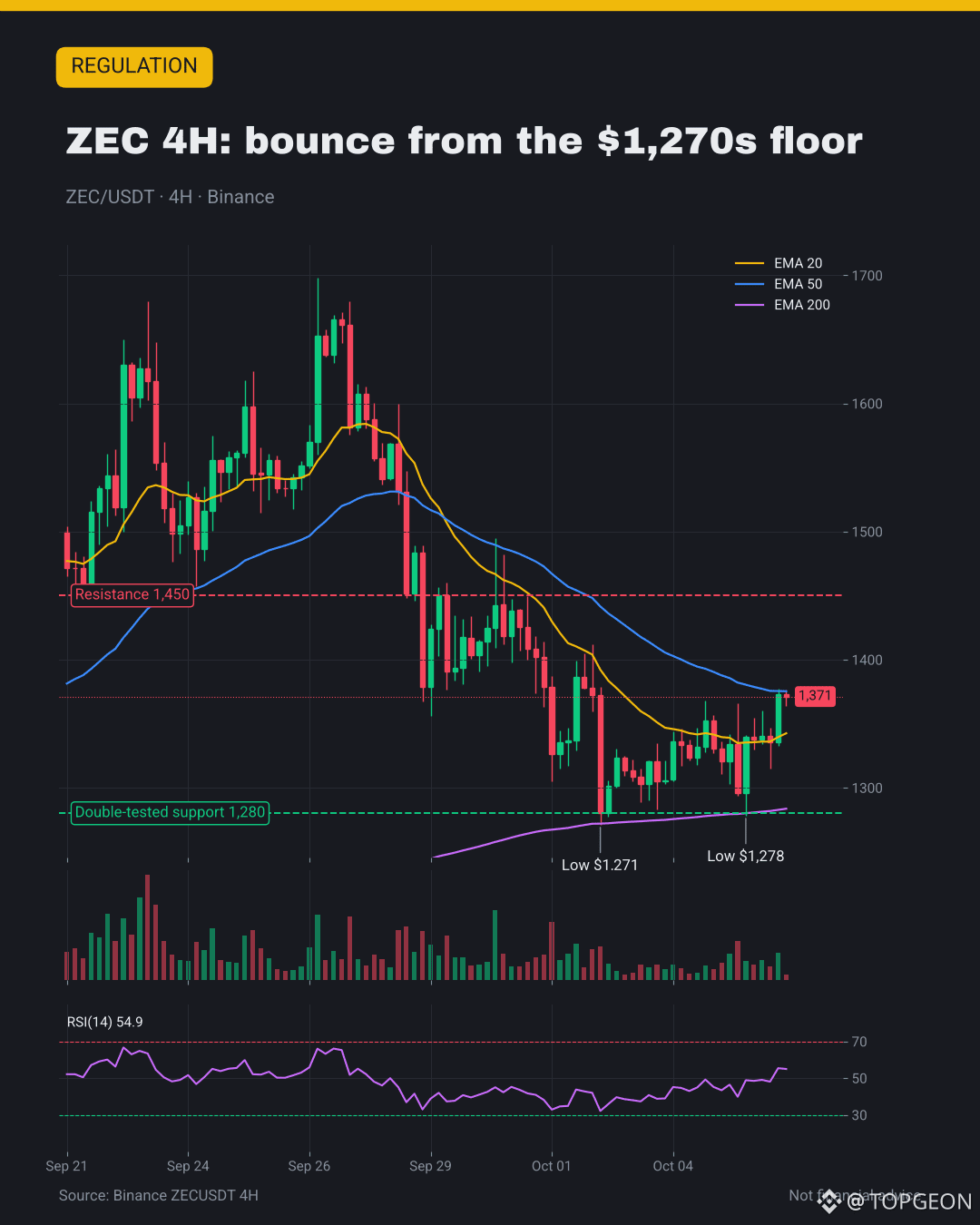
• $ZEC leads Binance spot volume: $1,373, +3.6% today
🎯 My take: ZEC over $1,375 (50 EMA) opens $1,450; losing $1,270 = weak
💬 Does this push you to keep coins in your own wallet? 👇
#SelfCustody #FinCEN #Zcash
🏦 US kills its $10K self-custody wallet rule: $BTC at $86.3K
• FinCEN withdrew the plan, stuck since Dec 2020
• Banks and exchanges would have reported wallet sends over $10K
• A 2023 crypto-mixer crackdown proposal was pulled too
• $ZEC leads Binance spot volume: $1,373, +3.6% today
🎯 My take: ZEC over $1,375 (50 EMA) opens $1,450; losing $1,270 = weak
💬 Does this push you to keep coins in your own wallet? 👇
#SelfCustody #FinCEN #Zcash
• FinCEN withdrew the plan, stuck since Dec 2020
• Banks and exchanges would have reported wallet sends over $10K
• A 2023 crypto-mixer crackdown proposal was pulled too
• $ZEC leads Binance spot volume: $1,373, +3.6% today
🎯 My take: ZEC over $1,375 (50 EMA) opens $1,450; losing $1,270 = weak
💬 Does this push you to keep coins in your own wallet? 👇
#SelfCustody #FinCEN #Zcash
2
269


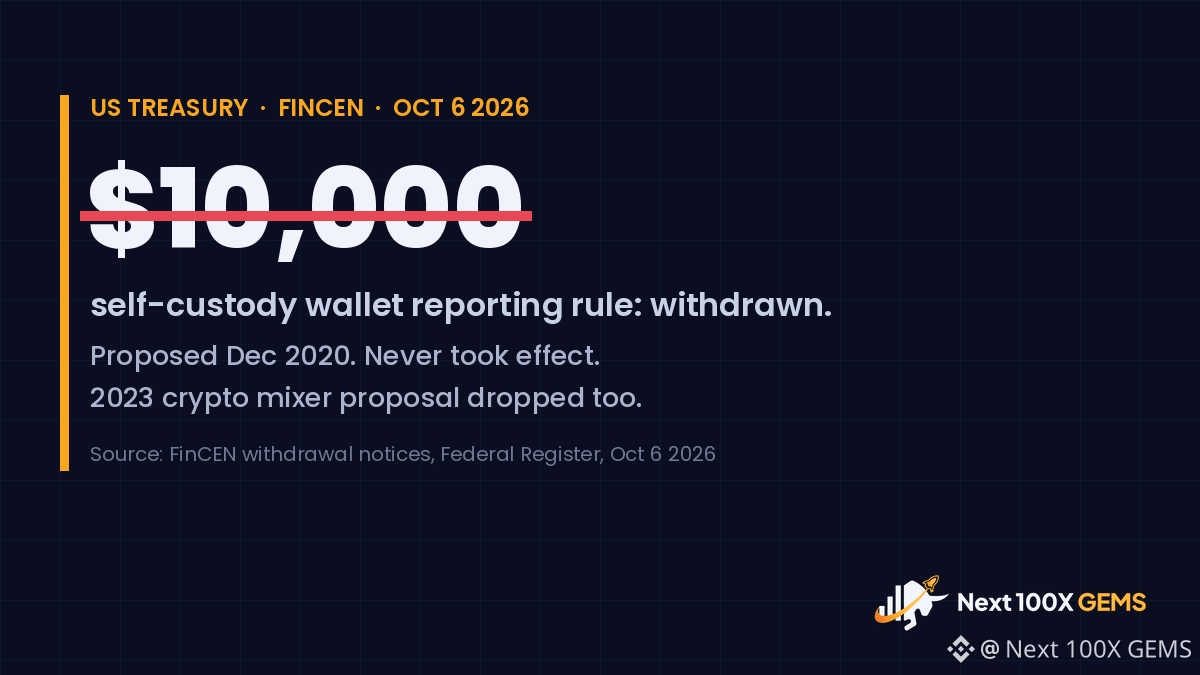
the US just dropped a crypto rule that sat on the table for almost 6 years.
the 2020 plan: send more than $10,000 between a US exchange and your own wallet, and it gets reported to FinCEN. records kept from $3,000. smaller transfers counted too if they added up past $10k in 24 hours.
it never took effect. this week Treasury withdrew it, along with a 2023 proposal aimed at mixers.
honestly this matters more than most of today's headlines. moving $BTC to a wallet you control shouldn't come with paperwork.
the catch: nothing stops Treasury from proposing something similar later. Coin Center already pointed that out.
where do you keep most of your coins, on an exchange or in your own wallet?
$BTC
NFA. DYOR.
#FinCEN #SelfCustody #CryptoRegulation #CryptoNews
the US just dropped a crypto rule that sat on the table for almost 6 years.
the 2020 plan: send more than $10,000 between a US exchange and your own wallet, and it gets reported to FinCEN. records kept from $3,000. smaller transfers counted too if they added up past $10k in 24 hours.
it never took effect. this week Treasury withdrew it, along with a 2023 proposal aimed at mixers.
honestly this matters more than most of today's headlines. moving $BTC to a wallet you control shouldn't come with paperwork.
the catch: nothing stops Treasury from proposing something similar later. Coin Center already pointed that out.
where do you keep most of your coins, on an exchange or in your own wallet?
$BTC
NFA. DYOR.
#FinCEN #SelfCustody #CryptoRegulation #CryptoNews
the 2020 plan: send more than $10,000 between a US exchange and your own wallet, and it gets reported to FinCEN. records kept from $3,000. smaller transfers counted too if they added up past $10k in 24 hours.
it never took effect. this week Treasury withdrew it, along with a 2023 proposal aimed at mixers.
honestly this matters more than most of today's headlines. moving $BTC to a wallet you control shouldn't come with paperwork.
the catch: nothing stops Treasury from proposing something similar later. Coin Center already pointed that out.
where do you keep most of your coins, on an exchange or in your own wallet?
$BTC
NFA. DYOR.
#FinCEN #SelfCustody #CryptoRegulation #CryptoNews
1
787

FinCEN dropping its aggressive crypto mixing proposal is a major quiet win for financial privacy advocates. The original plan risked overreaching and freezing entirely legal blockchain transactions just to catch bad actors. While compliance and anti-money laundering remain top priorities, regulators are finally realizing that sledgehammer policies hurt everyday users more than criminals. Striking the right balance between security and open-network freedom is essential for healthy crypto adoption moving forward. $BTC $ETH #CryptoRegulation #Privacy #FinCEN
FinCEN dropping its aggressive crypto mixing proposal is a major quiet win for financial privacy advocates. The original plan risked overreaching and freezing entirely legal blockchain transactions just to catch bad actors. While compliance and anti-money laundering remain top priorities, regulators are finally realizing that sledgehammer policies hurt everyday users more than criminals. Striking the right balance between security and open-network freedom is essential for healthy crypto adoption moving forward. $BTC $ETH #CryptoRegulation #Privacy #FinCEN
33

The US Treasury is withdrawing controversial rules that would have forced financial institutions to report on self custody wallets and mixers, marking a massive win for user privacy and decentralization.
#FinCEN #SelfCustody
The US Treasury is withdrawing controversial rules that would have forced financial institutions to report on self custody wallets and mixers, marking a massive win for user privacy and decentralization.
#FinCEN #SelfCustody
#FinCEN #SelfCustody
3

【Policy Shift and Self-Custody Benefits】U.S. FinCEN officially withdraws proposed rules to monitor unhosted wallets and crypto mixers: Six years of regulatory uncertainty come to an end, ushering in an institutional easing of restrictions on crypto self-custody
On October 5, the U.S. Treasury Department’s Financial Crimes Enforcement Network (FinCEN) officially announced the withdrawal of two major proposed rules (NPRMs) on crypto assets that had been controversial for years, and filed the withdrawal for publication in the Federal Register. This move marks the end of federal requirements for intrusive reporting on “Unhosted Wallets” and “Crypto Mixing” services.
■ Key areas covered by the withdrawn rules and background:
1. 2020 proposed rule on reporting transactions involving unhosted wallets: The rule would have required regulated banks and money services businesses (MSBs) to record the counterparties’ identities (KYC) for transactions exceeding $3,000 involving unhosted wallets, and to file Currency Transaction Reports (CTRs) for deposits or withdrawals totaling more than $10,000 in a single day. Because the proposal directly threatened the decentralized nature of peer-to-peer settlement, it drew fierce industry opposition over the past six years.
2. 2023 Patriot Act Section 311 proposal on mixers: The rule would have designated international convertible virtual currency mixing transactions as a “Primary Money Laundering Concern,” requiring financial institutions to collect comprehensive monitoring data related to mixing, including IP addresses, wallet addresses, and transaction hashes.
■ Reasons for the withdrawal and official determination:
- Avoiding a “chilling effect” on legitimate economic activity: In its withdrawal notice, FinCEN specifically cited public feedback and the 2025 Presidential Working Group on Digital Asset Markets report, acknowledging that although mixing technology may be exploited by illegal actors, it also serves essential legitimate purposes for users concerned about financial privacy. Overly broad regulatory definitions have placed excessive constraints on lawful financial activity.
- Alignment with the federal deregulatory agenda: The withdrawal is consistent with the current administration’s policy agenda to ensure that digital asset rules are “fit for purpose,” and definitively ends the administrative process for advancing the proposed rules.
■ Institutional research perspective and analysis of structural impacts:
- Elimination of the “legal compliance discount” on the self-custody ecosystem: In recent years, institutions allocating to on-chain native assets and building cold-wallet treasuries have faced the potential policy tail risk that unhosted wallets could be subject to mandatory KYC tracing. The formal withdrawal of the proposals effectively removes a long-standing institutional ceiling for Ledger, Trezor, and various smart-contract custody structures.
- New room for on-chain privacy and DeFi settlement: Moving away from the default administrative presumption that privacy-enhancing technologies are inherently suspect and toward case-by-case risk management creates healthy breathing room for zero-knowledge proofs (ZKPs), privacy account abstraction, and cross-chain liquidity structures.
- A return to reasonable compliance boundaries: Note that this withdrawal does not remove existing obligations relating to anti-money laundering (AML), know-your-customer (KYC), or Office of Foreign Assets Control (OFAC) sanctions. Financial institutions must continue to conduct risk-based due diligence on high-risk transactions, but no longer need to bear the substantial administrative compliance burden of precautionary advance reporting.
#FinCEN #SelfCustody #CryptoRegulation #DeFi $BTC
【Policy Shift and Self-Custody Benefits】U.S. FinCEN officially withdraws proposed rules to monitor unhosted wallets and crypto mixers: Six years of regulatory uncertainty come to an end, ushering in an institutional easing of restrictions on crypto self-custody
On October 5, the U.S. Treasury Department’s Financial Crimes Enforcement Network (FinCEN) officially announced the withdrawal of two major proposed rules (NPRMs) on crypto assets that had been controversial for years, and filed the withdrawal for publication in the Federal Register. This move marks the end of federal requirements for intrusive reporting on “Unhosted Wallets” and “Crypto Mixing” services.
■ Key areas covered by the withdrawn rules and background:
1. 2020 proposed rule on reporting transactions involving unhosted wallets: The rule would have required regulated banks and money services businesses (MSBs) to record the counterparties’ identities (KYC) for transactions exceeding $3,000 involving unhosted wallets, and to file Currency Transaction Reports (CTRs) for deposits or withdrawals totaling more than $10,000 in a single day. Because the proposal directly threatened the decentralized nature of peer-to-peer settlement, it drew fierce industry opposition over the past six years.
2. 2023 Patriot Act Section 311 proposal on mixers: The rule would have designated international convertible virtual currency mixing transactions as a “Primary Money Laundering Concern,” requiring financial institutions to collect comprehensive monitoring data related to mixing, including IP addresses, wallet addresses, and transaction hashes.
■ Reasons for the withdrawal and official determination:
- Avoiding a “chilling effect” on legitimate economic activity: In its withdrawal notice, FinCEN specifically cited public feedback and the 2025 Presidential Working Group on Digital Asset Markets report, acknowledging that although mixing technology may be exploited by illegal actors, it also serves essential legitimate purposes for users concerned about financial privacy. Overly broad regulatory definitions have placed excessive constraints on lawful financial activity.
- Alignment with the federal deregulatory agenda: The withdrawal is consistent with the current administration’s policy agenda to ensure that digital asset rules are “fit for purpose,” and definitively ends the administrative process for advancing the proposed rules.
■ Institutional research perspective and analysis of structural impacts:
- Elimination of the “legal compliance discount” on the self-custody ecosystem: In recent years, institutions allocating to on-chain native assets and building cold-wallet treasuries have faced the potential policy tail risk that unhosted wallets could be subject to mandatory KYC tracing. The formal withdrawal of the proposals effectively removes a long-standing institutional ceiling for Ledger, Trezor, and various smart-contract custody structures.
- New room for on-chain privacy and DeFi settlement: Moving away from the default administrative presumption that privacy-enhancing technologies are inherently suspect and toward case-by-case risk management creates healthy breathing room for zero-knowledge proofs (ZKPs), privacy account abstraction, and cross-chain liquidity structures.
- A return to reasonable compliance boundaries: Note that this withdrawal does not remove existing obligations relating to anti-money laundering (AML), know-your-customer (KYC), or Office of Foreign Assets Control (OFAC) sanctions. Financial institutions must continue to conduct risk-based due diligence on high-risk transactions, but no longer need to bear the substantial administrative compliance burden of precautionary advance reporting.
#FinCEN #SelfCustody #CryptoRegulation #DeFi $BTC
On October 5, the U.S. Treasury Department’s Financial Crimes Enforcement Network (FinCEN) officially announced the withdrawal of two major proposed rules (NPRMs) on crypto assets that had been controversial for years, and filed the withdrawal for publication in the Federal Register. This move marks the end of federal requirements for intrusive reporting on “Unhosted Wallets” and “Crypto Mixing” services.
■ Key areas covered by the withdrawn rules and background:
1. 2020 proposed rule on reporting transactions involving unhosted wallets: The rule would have required regulated banks and money services businesses (MSBs) to record the counterparties’ identities (KYC) for transactions exceeding $3,000 involving unhosted wallets, and to file Currency Transaction Reports (CTRs) for deposits or withdrawals totaling more than $10,000 in a single day. Because the proposal directly threatened the decentralized nature of peer-to-peer settlement, it drew fierce industry opposition over the past six years.
2. 2023 Patriot Act Section 311 proposal on mixers: The rule would have designated international convertible virtual currency mixing transactions as a “Primary Money Laundering Concern,” requiring financial institutions to collect comprehensive monitoring data related to mixing, including IP addresses, wallet addresses, and transaction hashes.
■ Reasons for the withdrawal and official determination:
- Avoiding a “chilling effect” on legitimate economic activity: In its withdrawal notice, FinCEN specifically cited public feedback and the 2025 Presidential Working Group on Digital Asset Markets report, acknowledging that although mixing technology may be exploited by illegal actors, it also serves essential legitimate purposes for users concerned about financial privacy. Overly broad regulatory definitions have placed excessive constraints on lawful financial activity.
- Alignment with the federal deregulatory agenda: The withdrawal is consistent with the current administration’s policy agenda to ensure that digital asset rules are “fit for purpose,” and definitively ends the administrative process for advancing the proposed rules.
■ Institutional research perspective and analysis of structural impacts:
- Elimination of the “legal compliance discount” on the self-custody ecosystem: In recent years, institutions allocating to on-chain native assets and building cold-wallet treasuries have faced the potential policy tail risk that unhosted wallets could be subject to mandatory KYC tracing. The formal withdrawal of the proposals effectively removes a long-standing institutional ceiling for Ledger, Trezor, and various smart-contract custody structures.
- New room for on-chain privacy and DeFi settlement: Moving away from the default administrative presumption that privacy-enhancing technologies are inherently suspect and toward case-by-case risk management creates healthy breathing room for zero-knowledge proofs (ZKPs), privacy account abstraction, and cross-chain liquidity structures.
- A return to reasonable compliance boundaries: Note that this withdrawal does not remove existing obligations relating to anti-money laundering (AML), know-your-customer (KYC), or Office of Foreign Assets Control (OFAC) sanctions. Financial institutions must continue to conduct risk-based due diligence on high-risk transactions, but no longer need to bear the substantial administrative compliance burden of precautionary advance reporting.
#FinCEN #SelfCustody #CryptoRegulation #DeFi $BTC


·
--
On October 5, the U.S. Treasury Department’s Financial Crimes Enforcement Network (FinCEN) announced that it was withdrawing a proposed rule requiring reports on cryptocurrency mixer transactions. The proposal would have required financial institutions to report related transactions and customer information, extending even beyond dedicated mixing services. FinCEN also withdrew its 2023 conclusion that international cryptocurrency mixing constitutes a class of transactions of “primary money laundering concern.” As policy shifts, the Justice Department is still pursuing its case against Tornado Cash co-founder Roman Storm in New York. #加密货币 #监管 #FinCEN
(Source: X)
On October 5, the U.S. Treasury Department’s Financial Crimes Enforcement Network (FinCEN) announced that it was withdrawing a proposed rule requiring reports on cryptocurrency mixer transactions. The proposal would have required financial institutions to report related transactions and customer information, extending even beyond dedicated mixing services. FinCEN also withdrew its 2023 conclusion that international cryptocurrency mixing constitutes a class of transactions of “primary money laundering concern.” As policy shifts, the Justice Department is still pursuing its case against Tornado Cash co-founder Roman Storm in New York. #加密货币 #监管 #FinCEN
(Source: X)
(Source: X)
60

·
--
【U.S. Suddenly Withdraws $10,000 Crypto Wallet Reporting Rule! Are Self-Custody Wallets Getting a Break? 🔥】
[🌟 美国加密监管动向进群聊](https://app.binance.com/uni-qr/MwYFhLo4)
U.S. crypto regulation has recently seen a major development.
FinCEN, part of the U.S. Treasury Department, announced that it is withdrawing a proposed crypto wallet regulation that had been under discussion for nearly six years.
What was the original proposal?
If users transferred more than $10,000 worth of crypto from an exchange to their own self-custody wallet, banks and crypto service providers would have had to report the transactions to regulators.
Now, the proposal has been officially withdrawn.
Put simply:
If you move your own BTC or ETH from an exchange to your own wallet, this additional $10,000 reporting rule will not take effect.
FinCEN has also withdrawn another proposed regulation targeting crypto mixer services.
Why the sudden withdrawal?
FinCEN says this is part of the Trump administration’s efforts to “deregulate” the crypto industry and establish rules better suited to the digital asset sector.
But there’s an important detail:
Withdrawing the proposals does not mean that crypto regulation is being broadly relaxed.
Existing requirements for exchanges, including KYC, anti-money laundering measures, and suspicious transaction reporting, remain in place.
📌 So the key takeaway is that regulatory pressure on self-custody wallets in the U.S. has eased for now, but that doesn’t mean crypto is entering a “completely unregulated” environment.
For BTC and ETH holders, what really matters is whether the U.S. will go on to introduce more favorable rules for self-custody, stablecoins, and digital assets.
#FinCEN
【U.S. Suddenly Withdraws $10,000 Crypto Wallet Reporting Rule! Are Self-Custody Wallets Getting a Break? 🔥】
🌟 美国加密监管动向进群聊
U.S. crypto regulation has recently seen a major development.
FinCEN, part of the U.S. Treasury Department, announced that it is withdrawing a proposed crypto wallet regulation that had been under discussion for nearly six years.
What was the original proposal?
If users transferred more than $10,000 worth of crypto from an exchange to their own self-custody wallet, banks and crypto service providers would have had to report the transactions to regulators.
Now, the proposal has been officially withdrawn.
Put simply:
If you move your own BTC or ETH from an exchange to your own wallet, this additional $10,000 reporting rule will not take effect.
FinCEN has also withdrawn another proposed regulation targeting crypto mixer services.
Why the sudden withdrawal?
FinCEN says this is part of the Trump administration’s efforts to “deregulate” the crypto industry and establish rules better suited to the digital asset sector.
But there’s an important detail:
Withdrawing the proposals does not mean that crypto regulation is being broadly relaxed.
Existing requirements for exchanges, including KYC, anti-money laundering measures, and suspicious transaction reporting, remain in place.
📌 So the key takeaway is that regulatory pressure on self-custody wallets in the U.S. has eased for now, but that doesn’t mean crypto is entering a “completely unregulated” environment.
For BTC and ETH holders, what really matters is whether the U.S. will go on to introduce more favorable rules for self-custody, stablecoins, and digital assets.
#FinCEN
🌟 美国加密监管动向进群聊
U.S. crypto regulation has recently seen a major development.
FinCEN, part of the U.S. Treasury Department, announced that it is withdrawing a proposed crypto wallet regulation that had been under discussion for nearly six years.
What was the original proposal?
If users transferred more than $10,000 worth of crypto from an exchange to their own self-custody wallet, banks and crypto service providers would have had to report the transactions to regulators.
Now, the proposal has been officially withdrawn.
Put simply:
If you move your own BTC or ETH from an exchange to your own wallet, this additional $10,000 reporting rule will not take effect.
FinCEN has also withdrawn another proposed regulation targeting crypto mixer services.
Why the sudden withdrawal?
FinCEN says this is part of the Trump administration’s efforts to “deregulate” the crypto industry and establish rules better suited to the digital asset sector.
But there’s an important detail:
Withdrawing the proposals does not mean that crypto regulation is being broadly relaxed.
Existing requirements for exchanges, including KYC, anti-money laundering measures, and suspicious transaction reporting, remain in place.
📌 So the key takeaway is that regulatory pressure on self-custody wallets in the U.S. has eased for now, but that doesn’t mean crypto is entering a “completely unregulated” environment.
For BTC and ETH holders, what really matters is whether the U.S. will go on to introduce more favorable rules for self-custody, stablecoins, and digital assets.
#FinCEN
2
6
7.8k

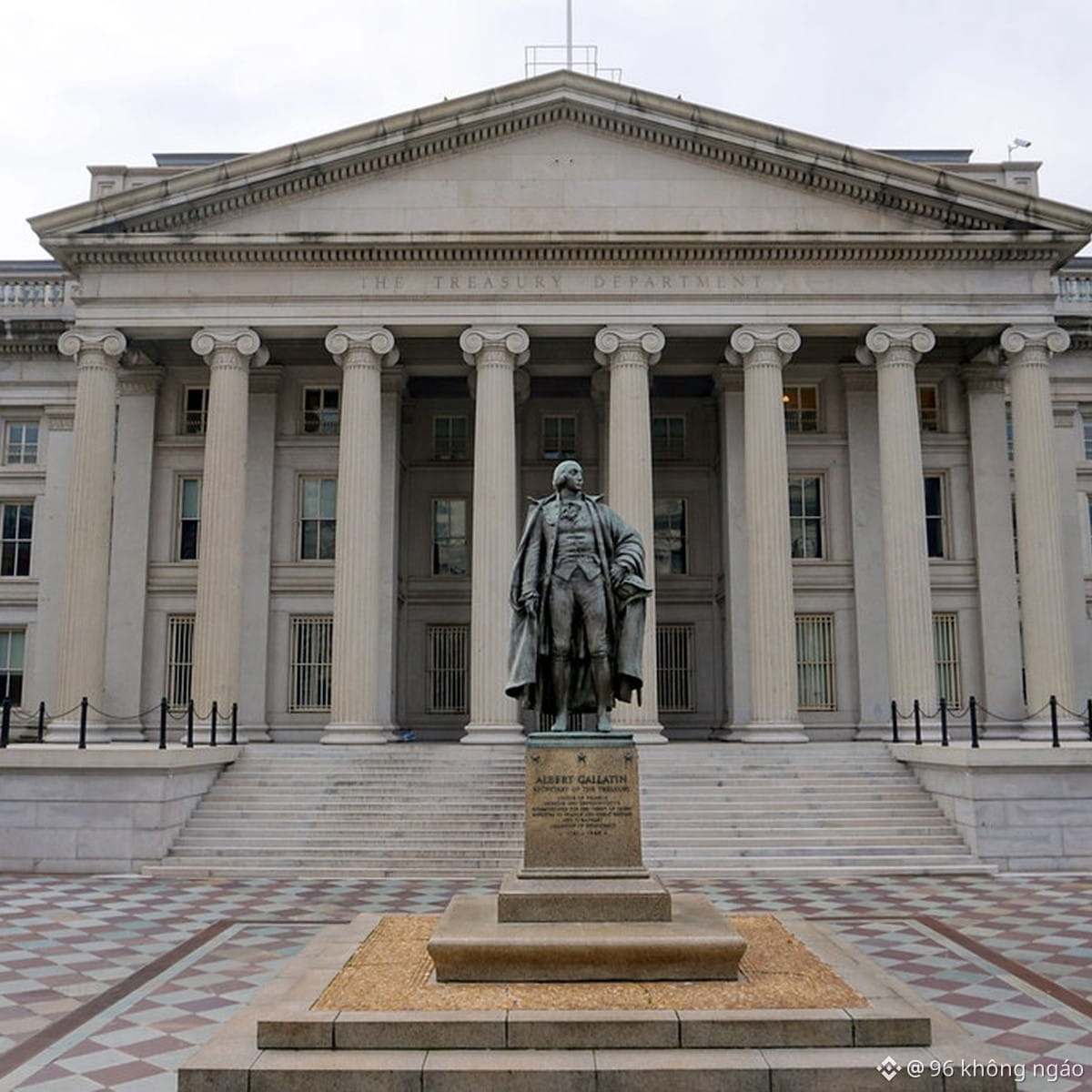
U.S. withdraws two proposals to monitor personal crypto wallets. $BTC remains steady around $86,000.
The U.S. Treasury has just withdrawn two proposed rules that were never approved: a rule requiring reports on transactions involving unhosted wallets (personal wallets not held on an exchange), proposed in 2020, and a rule targeting crypto-mixing services, proposed in 2023. FinCEN, the Treasury’s anti-money-laundering agency, filed notices on Monday to withdraw both.
Coin Center, a crypto industry advocacy group, called this a major victory for financial privacy. If enacted, the two rules would have required exchanges to report detailed information on withdrawals to personal wallets above a certain threshold — something the crypto industry has opposed for years, arguing that it would undermine people’s ability to control their own assets.
$BTC has shown no clear reaction, staying around $86,000 as it was before the news broke. FinCEN says it will continue monitoring money laundering and terrorist financing, and could take action again in the future — so this is not the end, just a pause.
Personal observation, not investment advice
#BTC #Crypto #FinCEN #CryptoRegulation #Bitcoin
U.S. withdraws two proposals to monitor personal crypto wallets. $BTC remains steady around $86,000.
The U.S. Treasury has just withdrawn two proposed rules that were never approved: a rule requiring reports on transactions involving unhosted wallets (personal wallets not held on an exchange), proposed in 2020, and a rule targeting crypto-mixing services, proposed in 2023. FinCEN, the Treasury’s anti-money-laundering agency, filed notices on Monday to withdraw both.
Coin Center, a crypto industry advocacy group, called this a major victory for financial privacy. If enacted, the two rules would have required exchanges to report detailed information on withdrawals to personal wallets above a certain threshold — something the crypto industry has opposed for years, arguing that it would undermine people’s ability to control their own assets.
$BTC has shown no clear reaction, staying around $86,000 as it was before the news broke. FinCEN says it will continue monitoring money laundering and terrorist financing, and could take action again in the future — so this is not the end, just a pause.
Personal observation, not investment advice
#BTC #Crypto #FinCEN #CryptoRegulation #Bitcoin
The U.S. Treasury has just withdrawn two proposed rules that were never approved: a rule requiring reports on transactions involving unhosted wallets (personal wallets not held on an exchange), proposed in 2020, and a rule targeting crypto-mixing services, proposed in 2023. FinCEN, the Treasury’s anti-money-laundering agency, filed notices on Monday to withdraw both.
Coin Center, a crypto industry advocacy group, called this a major victory for financial privacy. If enacted, the two rules would have required exchanges to report detailed information on withdrawals to personal wallets above a certain threshold — something the crypto industry has opposed for years, arguing that it would undermine people’s ability to control their own assets.
$BTC has shown no clear reaction, staying around $86,000 as it was before the news broke. FinCEN says it will continue monitoring money laundering and terrorist financing, and could take action again in the future — so this is not the end, just a pause.
Personal observation, not investment advice
#BTC #Crypto #FinCEN #CryptoRegulation #Bitcoin
146

·
--
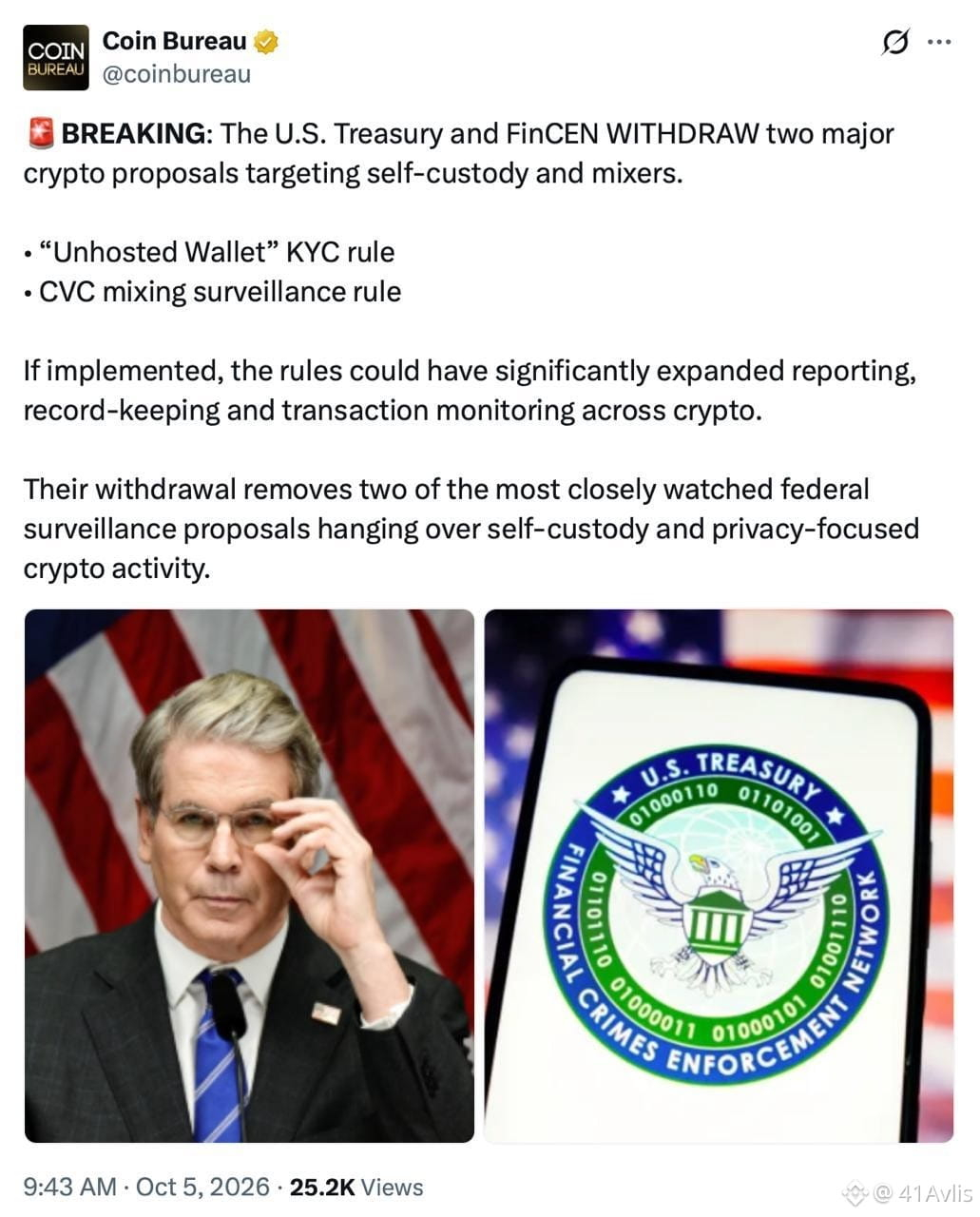
🚨 U.S. Treasury withdraws controversial crypto surveillance proposals!
FinCEN has officially withdrawn two regulatory proposals that were creating significant uncertainty in the market:
1️⃣ 2020 rule: Requirements for transactions involving self-hosted wallets (unhosted wallets). 2️⃣ 2023 proposal: Restrictions and monitoring of the mixing of convertible virtual currencies (mixers).
💡 What does this mean for the market?
Less uncertainty: Removes two major regulatory risks related to self-custody and privacy-focused protocols.
More appropriate regulation: FinCEN stated that the decision aims to make digital asset regulation more efficient and fit for purpose.
A major victory for privacy and decentralization in the crypto ecosystem! 🛡️✨
#FinCEN $BTC #Bitcoin
🚨 U.S. Treasury withdraws controversial crypto surveillance proposals!
FinCEN has officially withdrawn two regulatory proposals that were creating significant uncertainty in the market:
1️⃣ 2020 rule: Requirements for transactions involving self-hosted wallets (unhosted wallets). 2️⃣ 2023 proposal: Restrictions and monitoring of the mixing of convertible virtual currencies (mixers).
💡 What does this mean for the market?
Less uncertainty: Removes two major regulatory risks related to self-custody and privacy-focused protocols.
More appropriate regulation: FinCEN stated that the decision aims to make digital asset regulation more efficient and fit for purpose.
A major victory for privacy and decentralization in the crypto ecosystem! 🛡️✨
#FinCEN $BTC #Bitcoin
FinCEN has officially withdrawn two regulatory proposals that were creating significant uncertainty in the market:
1️⃣ 2020 rule: Requirements for transactions involving self-hosted wallets (unhosted wallets). 2️⃣ 2023 proposal: Restrictions and monitoring of the mixing of convertible virtual currencies (mixers).
💡 What does this mean for the market?
Less uncertainty: Removes two major regulatory risks related to self-custody and privacy-focused protocols.
More appropriate regulation: FinCEN stated that the decision aims to make digital asset regulation more efficient and fit for purpose.
A major victory for privacy and decentralization in the crypto ecosystem! 🛡️✨
#FinCEN $BTC #Bitcoin
78

·
--
【Old Leek Watch】 #FinCEN
Another important change has emerged in U.S. crypto regulation.
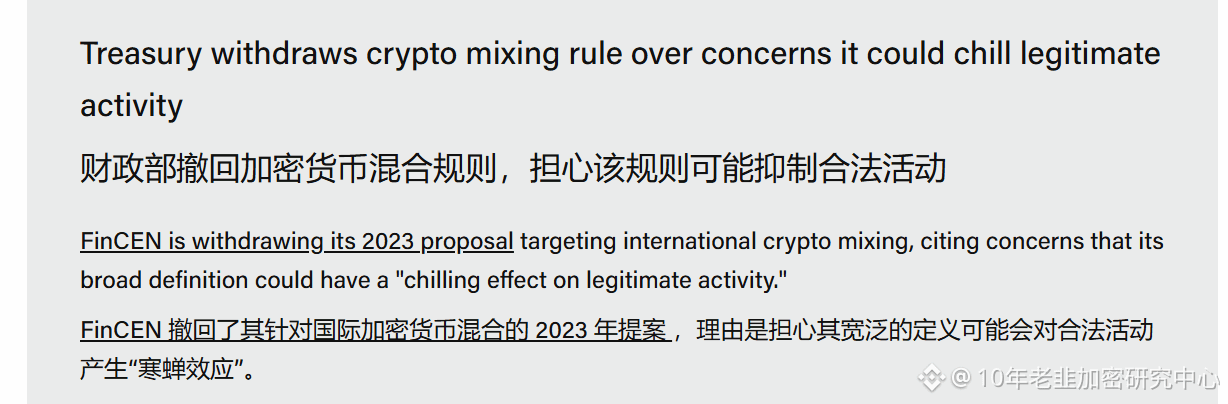
FinCEN, under the U.S. Treasury Department, today withdrew its 2023 proposal to regulate international crypto mixers.
The original proposal considered designating international mixing activity as a “primary money laundering concern” and requiring relevant financial institutions to report mixing transactions, including wallet addresses, transaction hashes, and even IP addresses.
But the reason for the withdrawal is straightforward:
Regulators were concerned that the definition was too broad, could affect legitimate activity, and would impose a substantial compliance burden on financial institutions.
This doesn’t mean the U.S. is abandoning regulation.
But it does show at least one thing:
The U.S. is now starting to distinguish between “cracking down on illicit funds” and “not regulating legitimate crypto activity into oblivion.”
For the crypto industry as a whole, this is a somewhat positive regulatory signal.$BTC $ETH
【Old Leek Watch】 #FinCEN
Another important change has emerged in U.S. crypto regulation.
FinCEN, under the U.S. Treasury Department, today withdrew its 2023 proposal to regulate international crypto mixers.
The original proposal considered designating international mixing activity as a “primary money laundering concern” and requiring relevant financial institutions to report mixing transactions, including wallet addresses, transaction hashes, and even IP addresses.
But the reason for the withdrawal is straightforward:
Regulators were concerned that the definition was too broad, could affect legitimate activity, and would impose a substantial compliance burden on financial institutions.
This doesn’t mean the U.S. is abandoning regulation.
But it does show at least one thing:
The U.S. is now starting to distinguish between “cracking down on illicit funds” and “not regulating legitimate crypto activity into oblivion.”
For the crypto industry as a whole, this is a somewhat positive regulatory signal.$BTC $ETH
Another important change has emerged in U.S. crypto regulation.
FinCEN, under the U.S. Treasury Department, today withdrew its 2023 proposal to regulate international crypto mixers.
The original proposal considered designating international mixing activity as a “primary money laundering concern” and requiring relevant financial institutions to report mixing transactions, including wallet addresses, transaction hashes, and even IP addresses.
But the reason for the withdrawal is straightforward:
Regulators were concerned that the definition was too broad, could affect legitimate activity, and would impose a substantial compliance burden on financial institutions.
This doesn’t mean the U.S. is abandoning regulation.
But it does show at least one thing:
The U.S. is now starting to distinguish between “cracking down on illicit funds” and “not regulating legitimate crypto activity into oblivion.”
For the crypto industry as a whole, this is a somewhat positive regulatory signal.$BTC $ETH
1
359

·
--
Bearish
FinCEN withdrew its 2020 rule on non-custodial wallets. It never took effect anyway)
On October 5, two proposed rules were withdrawn:
- non-custodial wallets: records for transactions over $3,000, reports to FinCEN for transactions over $10,000
- 2023 rule on international crypto mixers
Coin Center, which fought both, is happy
but in Decrypt, that same Coin Center says the law these rules are based on is still in place
On mixers, FinCEN explicitly says it will keep monitoring and may revisit this
In short, a paper victory. The 2020 rule was proposed by the first Trump administration and withdrawn by the second. The next one could change its mind
KYC on exchanges hasn't been canceled. My BNB and stablecoins in Flexible on Binance couldn't care less
$BTC
{future}(BTCUSDT)
down 0.5% in 24 hours, the market shrugged
#FinCEN #гаманці #Регулювання
FinCEN withdrew its 2020 rule on non-custodial wallets. It never took effect anyway)
On October 5, two proposed rules were withdrawn:
- non-custodial wallets: records for transactions over $3,000, reports to FinCEN for transactions over $10,000
- 2023 rule on international crypto mixers
Coin Center, which fought both, is happy
but in Decrypt, that same Coin Center says the law these rules are based on is still in place
On mixers, FinCEN explicitly says it will keep monitoring and may revisit this
In short, a paper victory. The 2020 rule was proposed by the first Trump administration and withdrawn by the second. The next one could change its mind
KYC on exchanges hasn't been canceled. My BNB and stablecoins in Flexible on Binance couldn't care less
$BTC
down 0.5% in 24 hours, the market shrugged
#FinCEN #гаманці #Регулювання
On October 5, two proposed rules were withdrawn:
- non-custodial wallets: records for transactions over $3,000, reports to FinCEN for transactions over $10,000
- 2023 rule on international crypto mixers
Coin Center, which fought both, is happy
but in Decrypt, that same Coin Center says the law these rules are based on is still in place
On mixers, FinCEN explicitly says it will keep monitoring and may revisit this
In short, a paper victory. The 2020 rule was proposed by the first Trump administration and withdrawn by the second. The next one could change its mind
KYC on exchanges hasn't been canceled. My BNB and stablecoins in Flexible on Binance couldn't care less
$BTC
down 0.5% in 24 hours, the market shrugged
#FinCEN #гаманці #Регулювання

Satoshi Pupil:
А що це дає?🤔
1
7
89

·
--
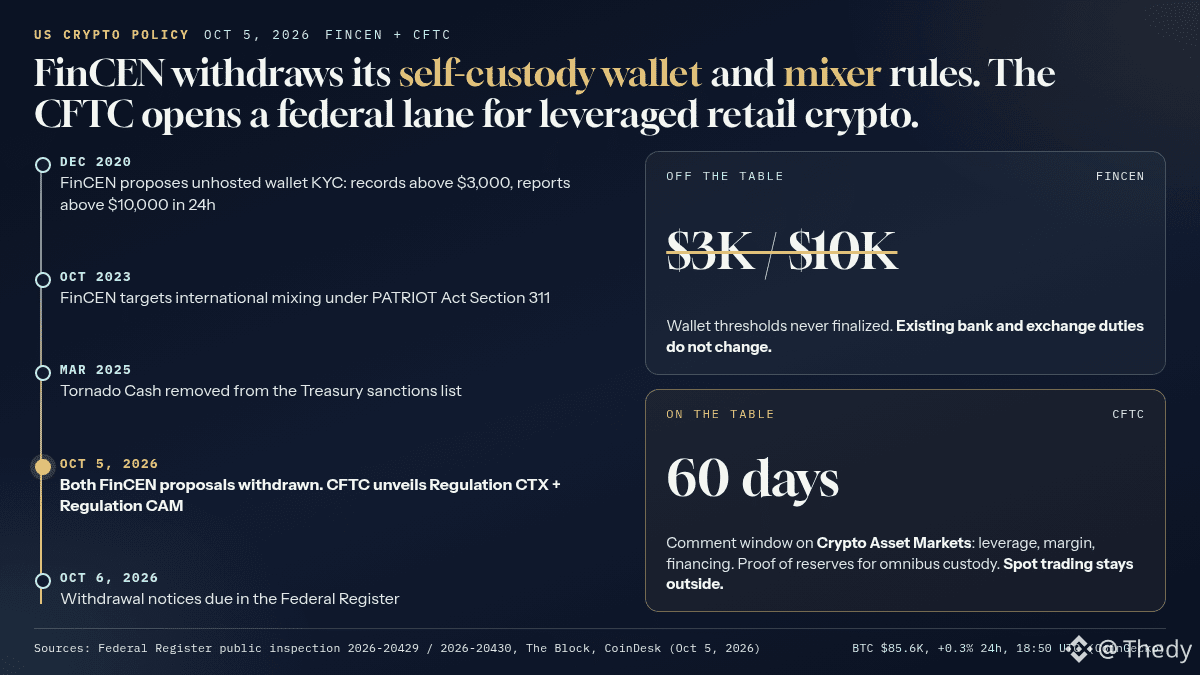
Washington moved twice on crypto this Monday, October 5: FinCEN (the U.S. Treasury) is withdrawing its proposed rules on self-hosted wallets and mixers, and the CFTC is opening a federal framework for retail leveraged crypto trading.
Here’s the timeline, to gauge the shift.
December 2020: FinCEN proposes identity verification for transactions of $3,000 or more involving an unhosted wallet, and reporting for amounts over $10,000 in 24 hours.
October 2023: a second proposal targets international mixing, with reporting down to addresses, hashes, and IPs (Section 311 of the Patriot Act).
March 2025: Tornado Cash is removed from the Treasury’s sanctions list.
On October 5, both proposals are withdrawn, with notice in the Federal Register on October 6 (The Block). On the same day, CFTC Chair Mike Selig presents Regulation CTX and Regulation CAM: “crypto asset markets” for leverage, margin, and financing, proof of reserves for omnibus accounts, and a 60-day consultation period (CoinDesk).
My take: for anyone keeping their $BTC or $ETH in self-custody, this is a regulatory risk disappearing, not a new right. Nothing had been finalized, and institutions’ current obligations are unchanged. And the CFTC isn’t touching spot trading as long as the Clarity Act remains stalled in the Senate.
The market didn’t react: $BTC was around $85,600 at 18:50 UTC (+0.3% over 24 hours, CoinGecko), below the annual open of $87,570.
If major U.S. exchanges apply for CAM status, retail leverage will come back under federal supervision. If the consultation drags on, it’s status quo, and spot remains the gap in the framework.
Do you think this CFTC framework could bring back to the U.S. traders who went offshore for leverage?
$BTC $ETH
#CFTC #FinCEN
Washington moved twice on crypto this Monday, October 5: FinCEN (the U.S. Treasury) is withdrawing its proposed rules on self-hosted wallets and mixers, and the CFTC is opening a federal framework for retail leveraged crypto trading.
Here’s the timeline, to gauge the shift.
December 2020: FinCEN proposes identity verification for transactions of $3,000 or more involving an unhosted wallet, and reporting for amounts over $10,000 in 24 hours.
October 2023: a second proposal targets international mixing, with reporting down to addresses, hashes, and IPs (Section 311 of the Patriot Act).
March 2025: Tornado Cash is removed from the Treasury’s sanctions list.
On October 5, both proposals are withdrawn, with notice in the Federal Register on October 6 (The Block). On the same day, CFTC Chair Mike Selig presents Regulation CTX and Regulation CAM: “crypto asset markets” for leverage, margin, and financing, proof of reserves for omnibus accounts, and a 60-day consultation period (CoinDesk).
My take: for anyone keeping their $BTC or $ETH in self-custody, this is a regulatory risk disappearing, not a new right. Nothing had been finalized, and institutions’ current obligations are unchanged. And the CFTC isn’t touching spot trading as long as the Clarity Act remains stalled in the Senate.
The market didn’t react: $BTC was around $85,600 at 18:50 UTC (+0.3% over 24 hours, CoinGecko), below the annual open of $87,570.
If major U.S. exchanges apply for CAM status, retail leverage will come back under federal supervision. If the consultation drags on, it’s status quo, and spot remains the gap in the framework.
Do you think this CFTC framework could bring back to the U.S. traders who went offshore for leverage?
$BTC $ETH
#CFTC #FinCEN
Here’s the timeline, to gauge the shift.
December 2020: FinCEN proposes identity verification for transactions of $3,000 or more involving an unhosted wallet, and reporting for amounts over $10,000 in 24 hours.
October 2023: a second proposal targets international mixing, with reporting down to addresses, hashes, and IPs (Section 311 of the Patriot Act).
March 2025: Tornado Cash is removed from the Treasury’s sanctions list.
On October 5, both proposals are withdrawn, with notice in the Federal Register on October 6 (The Block). On the same day, CFTC Chair Mike Selig presents Regulation CTX and Regulation CAM: “crypto asset markets” for leverage, margin, and financing, proof of reserves for omnibus accounts, and a 60-day consultation period (CoinDesk).
My take: for anyone keeping their $BTC or $ETH in self-custody, this is a regulatory risk disappearing, not a new right. Nothing had been finalized, and institutions’ current obligations are unchanged. And the CFTC isn’t touching spot trading as long as the Clarity Act remains stalled in the Senate.
The market didn’t react: $BTC was around $85,600 at 18:50 UTC (+0.3% over 24 hours, CoinGecko), below the annual open of $87,570.
If major U.S. exchanges apply for CAM status, retail leverage will come back under federal supervision. If the consultation drags on, it’s status quo, and spot remains the gap in the framework.
Do you think this CFTC framework could bring back to the U.S. traders who went offshore for leverage?
$BTC $ETH
#CFTC #FinCEN
126

·
--
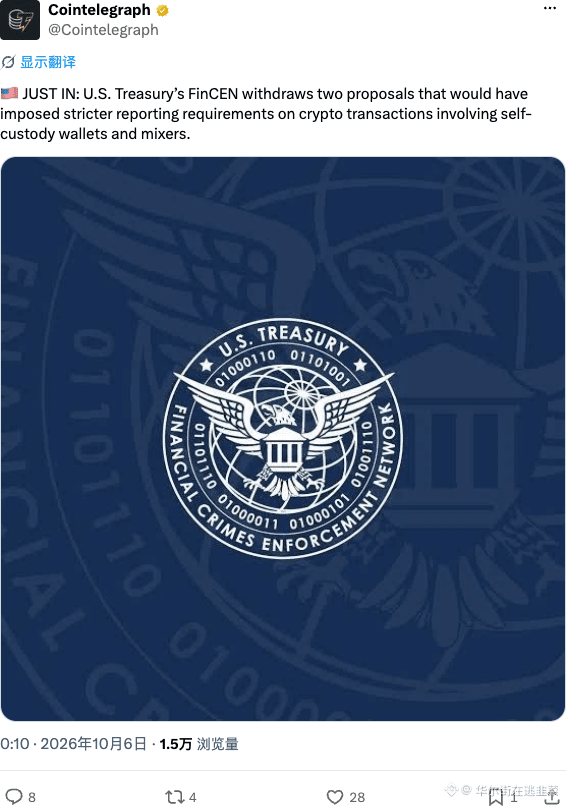
FinCEN has withdrawn its strict reporting proposal targeting self-hosted wallets and mixers. The Treasury is serious about easing up. This proposal nearly became reality under the Gensler era; now they won’t even leave a paper trail. As the regulatory reins keep loosening, the privacy sector stands to benefit first. Protecting the right to self-custody is the bottom line for decentralization—and markets love this kind of certainty 🚀
$BTC $XMR #加密监管 #FinCEN #PrivacySector
FinCEN has withdrawn its strict reporting proposal targeting self-hosted wallets and mixers. The Treasury is serious about easing up. This proposal nearly became reality under the Gensler era; now they won’t even leave a paper trail. As the regulatory reins keep loosening, the privacy sector stands to benefit first. Protecting the right to self-custody is the bottom line for decentralization—and markets love this kind of certainty 🚀
$BTC $XMR #加密监管 #FinCEN #PrivacySector
$BTC $XMR #加密监管 #FinCEN #PrivacySector
311

FINCEN UNCOVERS $12.7B IN SUSPECTED FRAUD IMPACTING $CRYPTO MARKETS! 🚨 🔍
Financial watchdogs just pulled back the curtain on $12.7 billion in suspected illicit activity across 33,904 filings between late 2023 and late 2025. 📊 The heavy concentration links back to organized criminal networks operating out of Southeast Asia, highlighting how shadow capital flows impact global sentiment.
While headlines like this trigger initial friction, purging bad actors ultimately creates a cleaner venue for institutional capital to step in with size. 🛡️ Operational security and non-custodial discipline remain paramount while regulatory eyes fixate on tracking unverified order flow.
💬 Does aggressive enforcement like this pave the way for the next institutional bid, or are you preparing for tighter compliance headwinds? 👇
⚠️ Not financial advice. Always manage your risk. 🛡️
🏷️ #Crypto #CryptoNews #Security #FinCEN #MarketInsights
🛡️ 👁️
FINCEN UNCOVERS $12.7B IN SUSPECTED FRAUD IMPACTING $CRYPTO MARKETS! 🚨 🔍
Financial watchdogs just pulled back the curtain on $12.7 billion in suspected illicit activity across 33,904 filings between late 2023 and late 2025. 📊 The heavy concentration links back to organized criminal networks operating out of Southeast Asia, highlighting how shadow capital flows impact global sentiment.
While headlines like this trigger initial friction, purging bad actors ultimately creates a cleaner venue for institutional capital to step in with size. 🛡️ Operational security and non-custodial discipline remain paramount while regulatory eyes fixate on tracking unverified order flow.
💬 Does aggressive enforcement like this pave the way for the next institutional bid, or are you preparing for tighter compliance headwinds? 👇
⚠️ Not financial advice. Always manage your risk. 🛡️
🏷️ #Crypto #CryptoNews #Security #FinCEN #MarketInsights
🛡️ 👁️
Financial watchdogs just pulled back the curtain on $12.7 billion in suspected illicit activity across 33,904 filings between late 2023 and late 2025. 📊 The heavy concentration links back to organized criminal networks operating out of Southeast Asia, highlighting how shadow capital flows impact global sentiment.
While headlines like this trigger initial friction, purging bad actors ultimately creates a cleaner venue for institutional capital to step in with size. 🛡️ Operational security and non-custodial discipline remain paramount while regulatory eyes fixate on tracking unverified order flow.
💬 Does aggressive enforcement like this pave the way for the next institutional bid, or are you preparing for tighter compliance headwinds? 👇
⚠️ Not financial advice. Always manage your risk. 🛡️
🏷️ #Crypto #CryptoNews #Security #FinCEN #MarketInsights
🛡️ 👁️
29

FinCEN, affiliated with the U.S. Department of the Treasury, announced that Asia-based organized fraud campaigns were linked to $12.7 billion worth of cryptocurrency. The average 18% increase in monthly reports shows how quickly these illegal activities are growing. Experts note that these structures are now spreading beyond Southeast Asia as well. It is of great importance for investors to increase their security measures against such scam variants. #CryptoSecurity #FinCEN #ScamAlert
FinCEN, affiliated with the U.S. Department of the Treasury, announced that Asia-based organized fraud campaigns were linked to $12.7 billion worth of cryptocurrency. The average 18% increase in monthly reports shows how quickly these illegal activities are growing. Experts note that these structures are now spreading beyond Southeast Asia as well. It is of great importance for investors to increase their security measures against such scam variants. #CryptoSecurity #FinCEN #ScamAlert
35

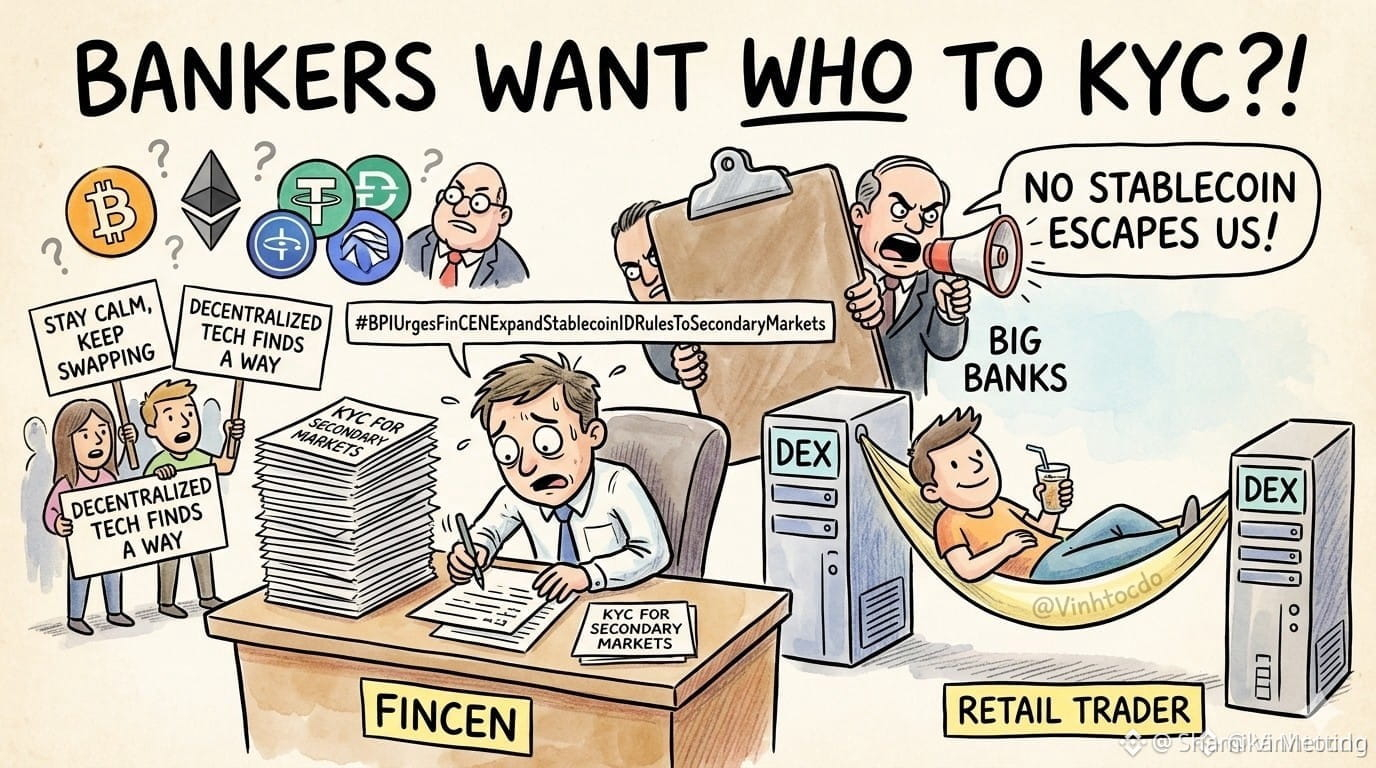
#BPIUrgesFinCENExpandStablecoinIDRules 💸
Wait, what?! Now do the big banks want FinCEN to impose KYC requirements on secondary markets? Does that mean our self-custody wallets, DEXs, and OTC trading operations will be next on the paperwork party list? 😱
They say it’s to stop illicit technology, but we all know they just want to track every stablecoin that moves. What should the individual trader do? Stay calm, keep swapping, and remember that decentralized tech always finds a way. Don’t panic and don’t sell your holdings just because the banks are in a mood! 🛡️
⚠️ NFA (not financial advice).
Please continue following
#Stablecoins #FinCEN #defi
$BTC
{future}(BTCUSDT)
#BPIUrgesFinCENExpandStablecoinIDRules 💸
Wait, what?! Now do the big banks want FinCEN to impose KYC requirements on secondary markets? Does that mean our self-custody wallets, DEXs, and OTC trading operations will be next on the paperwork party list? 😱
They say it’s to stop illicit technology, but we all know they just want to track every stablecoin that moves. What should the individual trader do? Stay calm, keep swapping, and remember that decentralized tech always finds a way. Don’t panic and don’t sell your holdings just because the banks are in a mood! 🛡️
⚠️ NFA (not financial advice).
Please continue following
#Stablecoins #FinCEN #defi
$BTC
Wait, what?! Now do the big banks want FinCEN to impose KYC requirements on secondary markets? Does that mean our self-custody wallets, DEXs, and OTC trading operations will be next on the paperwork party list? 😱
They say it’s to stop illicit technology, but we all know they just want to track every stablecoin that moves. What should the individual trader do? Stay calm, keep swapping, and remember that decentralized tech always finds a way. Don’t panic and don’t sell your holdings just because the banks are in a mood! 🛡️
⚠️ NFA (not financial advice).
Please continue following
#Stablecoins #FinCEN #defi
$BTC
1
144

·
--
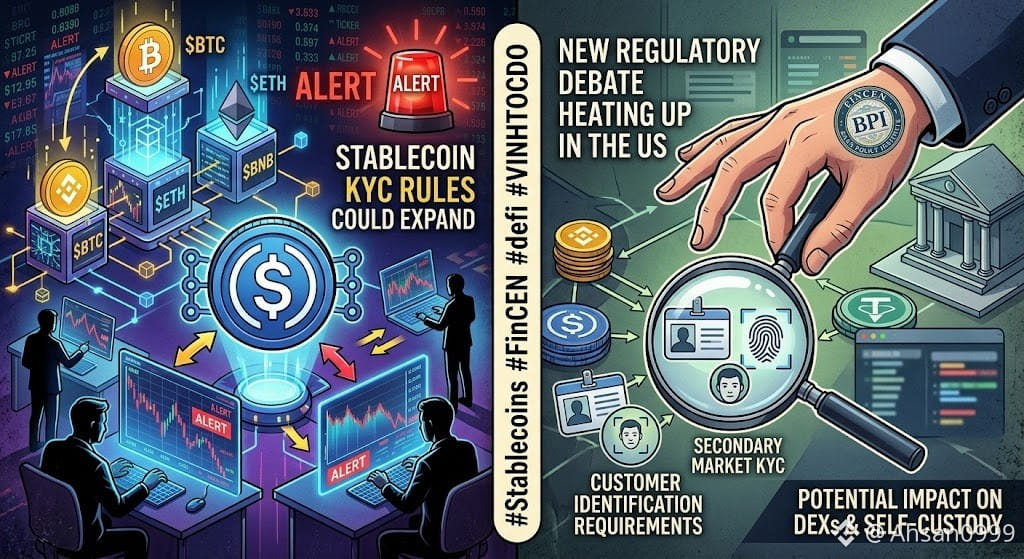
Stablecoin KYC Rules Could Expand — What Crypto Traders Should Know 🚨
A new regulatory debate is heating up in the US.
The Bank Policy Institute (BPI) is urging FinCEN to apply customer-identification requirements to secondary stablecoin markets, including exchanges and other platforms that directly interact with customers.
The bigger question is what this could mean for DEXs, self-custody and stablecoin transfers if regulators expand these requirements further.
🔑 Why It Matters
🔹 More KYC requirements could mean greater compliance for crypto platforms.
🔹 Exchanges and other secondary-market participants could face additional regulatory obligations.
🔹 For traders, the direction of stablecoin regulation could become increasingly important.
💡 Key Takeaway
This is a regulatory proposal/debate, not a new rule that has already taken effect.
For now, traders should avoid panic and keep an eye on how FinCEN and US regulators respond.
$BTC $ETH $BNB
#FinCEN
Stablecoin KYC Rules Could Expand — What Crypto Traders Should Know 🚨
A new regulatory debate is heating up in the US.
The Bank Policy Institute (BPI) is urging FinCEN to apply customer-identification requirements to secondary stablecoin markets, including exchanges and other platforms that directly interact with customers.
The bigger question is what this could mean for DEXs, self-custody and stablecoin transfers if regulators expand these requirements further.
🔑 Why It Matters
🔹 More KYC requirements could mean greater compliance for crypto platforms.
🔹 Exchanges and other secondary-market participants could face additional regulatory obligations.
🔹 For traders, the direction of stablecoin regulation could become increasingly important.
💡 Key Takeaway
This is a regulatory proposal/debate, not a new rule that has already taken effect.
For now, traders should avoid panic and keep an eye on how FinCEN and US regulators respond.
$BTC $ETH $BNB
#FinCEN
A new regulatory debate is heating up in the US.
The Bank Policy Institute (BPI) is urging FinCEN to apply customer-identification requirements to secondary stablecoin markets, including exchanges and other platforms that directly interact with customers.
The bigger question is what this could mean for DEXs, self-custody and stablecoin transfers if regulators expand these requirements further.
🔑 Why It Matters
🔹 More KYC requirements could mean greater compliance for crypto platforms.
🔹 Exchanges and other secondary-market participants could face additional regulatory obligations.
🔹 For traders, the direction of stablecoin regulation could become increasingly important.
💡 Key Takeaway
This is a regulatory proposal/debate, not a new rule that has already taken effect.
For now, traders should avoid panic and keep an eye on how FinCEN and US regulators respond.
$BTC $ETH $BNB
#FinCEN
1
93

Article
FinCEN Uncovers Massive Global Crypto Scam NetworkThe recent report from FinCEN is a massive wake up call for anyone holding digital assets. Finding out that $13 billion has been siphoned through transnational criminal organizations based in Southeast Asian compounds is nothing short of staggering. This is not just some minor phishing attempt or a few rug pulls. We are talking about organized large scale operations specifically targeting US residents.
For the average trader, this news highlights the massive gap between actual blockchain utility and the predatory landscape surrounding it. While we focus on the next big pump or technical upgrades, these syndicates are operating in the shadows, leveraging the pseudonymity of crypto to move stolen funds across borders with ease.
From a market perspective, this kind of regulatory pressure is a double edged sword. On one hand, the crackdown on these criminal entities is necessary to clean up the space and attract real institutional money. If the industry wants to go mainstream, it cannot have a reputation for being a playground for international scammers. On the other hand, increased scrutiny from agencies like FinCEN often leads to tighter compliance requirements and more friction for users.
Traders should watch how US authorities react to these findings. Expect more pressure on centralized exchanges to tighten their KYC and AML protocols to prevent these scam funds from entering the main ecosystem. Staying vigilant and using self custody solutions remains the best defense against being caught in the crossfire of these global criminal networks.
#FinCEN #CyberCrime
FinCEN Uncovers Massive Global Crypto Scam Network
The recent report from FinCEN is a massive wake up call for anyone holding digital assets. Finding out that $13 billion has been siphoned through transnational criminal organizations based in Southeast Asian compounds is nothing short of staggering. This is not just some minor phishing attempt or a few rug pulls. We are talking about organized large scale operations specifically targeting US residents.
For the average trader, this news highlights the massive gap between actual blockchain utility and the predatory landscape surrounding it. While we focus on the next big pump or technical upgrades, these syndicates are operating in the shadows, leveraging the pseudonymity of crypto to move stolen funds across borders with ease.
From a market perspective, this kind of regulatory pressure is a double edged sword. On one hand, the crackdown on these criminal entities is necessary to clean up the space and attract real institutional money. If the industry wants to go mainstream, it cannot have a reputation for being a playground for international scammers. On the other hand, increased scrutiny from agencies like FinCEN often leads to tighter compliance requirements and more friction for users.
Traders should watch how US authorities react to these findings. Expect more pressure on centralized exchanges to tighten their KYC and AML protocols to prevent these scam funds from entering the main ecosystem. Staying vigilant and using self custody solutions remains the best defense against being caught in the crossfire of these global criminal networks.
#FinCEN #CyberCrime
For the average trader, this news highlights the massive gap between actual blockchain utility and the predatory landscape surrounding it. While we focus on the next big pump or technical upgrades, these syndicates are operating in the shadows, leveraging the pseudonymity of crypto to move stolen funds across borders with ease.
From a market perspective, this kind of regulatory pressure is a double edged sword. On one hand, the crackdown on these criminal entities is necessary to clean up the space and attract real institutional money. If the industry wants to go mainstream, it cannot have a reputation for being a playground for international scammers. On the other hand, increased scrutiny from agencies like FinCEN often leads to tighter compliance requirements and more friction for users.
Traders should watch how US authorities react to these findings. Expect more pressure on centralized exchanges to tighten their KYC and AML protocols to prevent these scam funds from entering the main ecosystem. Staying vigilant and using self custody solutions remains the best defense against being caught in the crossfire of these global criminal networks.
#FinCEN #CyberCrime
9
FinCEN is sounding the alarm as $12.7 billion is linked to massive crypto scam operations running out of Asian compounds. These organized crime rings are expanding their reach, signaling a major security threat.
#FinCen #CyberCrime
FinCEN is sounding the alarm as $12.7 billion is linked to massive crypto scam operations running out of Asian compounds. These organized crime rings are expanding their reach, signaling a major security threat.
#FinCen #CyberCrime
#FinCen #CyberCrime
5

·
--
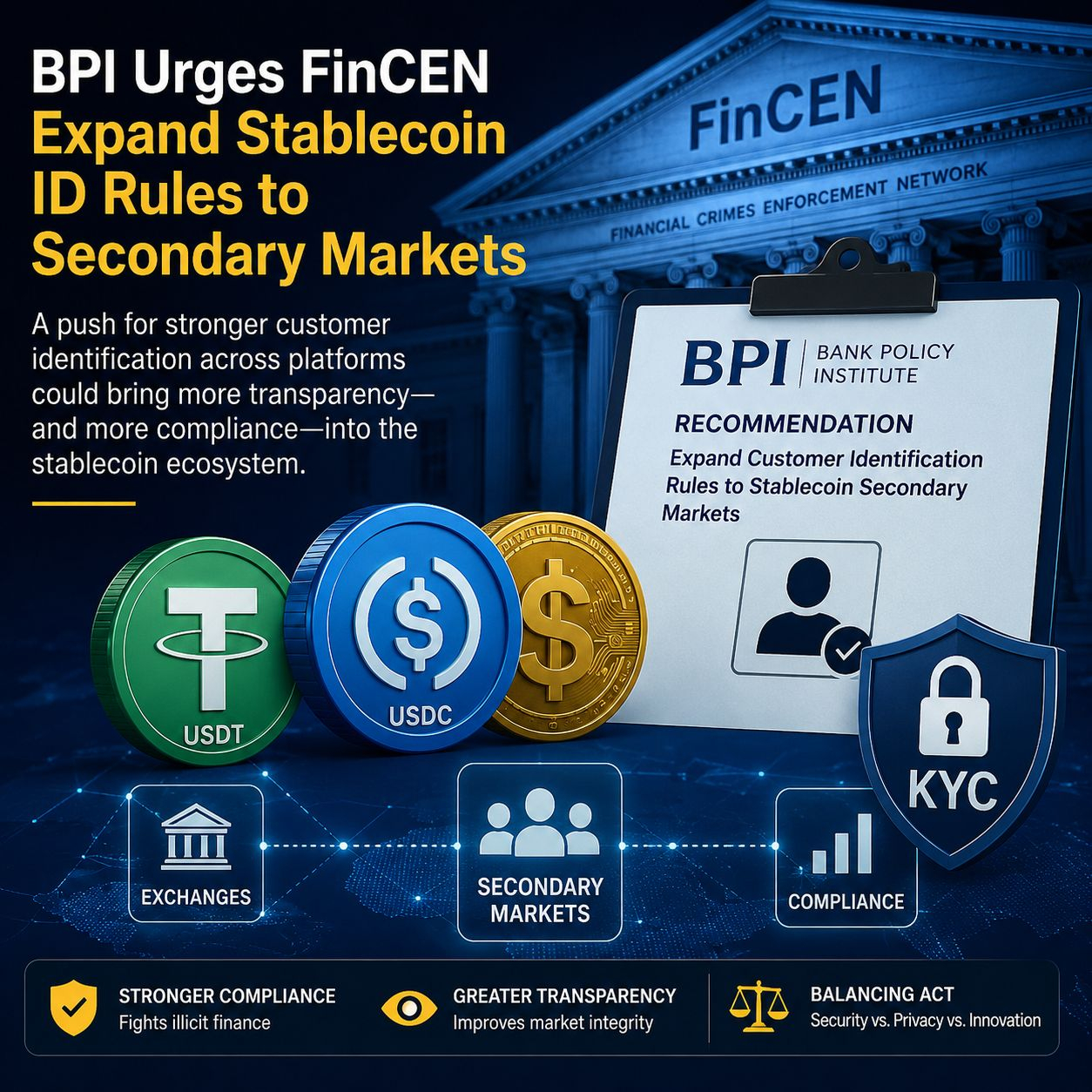
#BPIUrgesFinCENExpandStablecoinIDRulesToSecondaryMarkets"
Crypto Perspective"} 🔎 A major regulatory debate is heating up around stablecoins. BPI is asking FinCEN to consider customer-identification rules for secondary-market participants, arguing that significant stablecoi activity happens beyond the issuer level. This could reshape how exchanges and other platforms handle compliance. For crypto users, the balance between financial security, privacy, and decentralization will be worth watching closely. 🚀
$BTC $ETH $USDT $USDC
#BPI #FinCEN #Stablecoins #KYC #CryptoRegulation #DeFi :::
citeturn0search3turn0search8
#BPIUrgesFinCENExpandStablecoinIDRulesToSecondaryMarkets"
Crypto Perspective"} 🔎 A major regulatory debate is heating up around stablecoins. BPI is asking FinCEN to consider customer-identification rules for secondary-market participants, arguing that significant stablecoi activity happens beyond the issuer level. This could reshape how exchanges and other platforms handle compliance. For crypto users, the balance between financial security, privacy, and decentralization will be worth watching closely. 🚀
$BTC $ETH $USDT $USDC
#BPI #FinCEN #Stablecoins #KYC #CryptoRegulation #DeFi :::
citeturn0search3turn0search8
Crypto Perspective"} 🔎 A major regulatory debate is heating up around stablecoins. BPI is asking FinCEN to consider customer-identification rules for secondary-market participants, arguing that significant stablecoi activity happens beyond the issuer level. This could reshape how exchanges and other platforms handle compliance. For crypto users, the balance between financial security, privacy, and decentralization will be worth watching closely. 🚀
$BTC $ETH $USDT $USDC
#BPI #FinCEN #Stablecoins #KYC #CryptoRegulation #DeFi :::
citeturn0search3turn0search8
91
Log in to explore more content
Join global crypto users on Binance Square
⚡️ Get latest and useful information about crypto.
💬 Trusted by the world’s largest crypto exchange.
👍 Discover real insights from verified creators.
Email / Phone number
Trending Topics
1
#FedMinutesFocusOnOctoberPause
22,243 views
431 Discussing
2
#BinanceLaunchesBinanceIntelligence
934,890 views
5,708 Discussing
3
#RobinhoodAdds$25MInBitcoinToBalanceSheet
958 views
32 Discussing
4
#SP500AndNasdaqHitRecordHighs
5,355 views
230 Discussing
5
#USMortgageRatesRiseTo7.49%
5,215 views
188 Discussing
6
#BTCFallsBelow$84K
75,709 views
196 Discussing
7
#DubaiVARAIssuesReserveAssetAuditCircular
29,782 views
798 Discussing
8
#SECApproves3XBitcoinETF
29,027 views
644 Discussing
9
#WinklevossFilesSpotZcashETFApplication
36,851 views
757 Discussing
10
#SouthKoreaAITradeLiftsWorldcoinTo$7.41B
3,922 views
52 Discussing