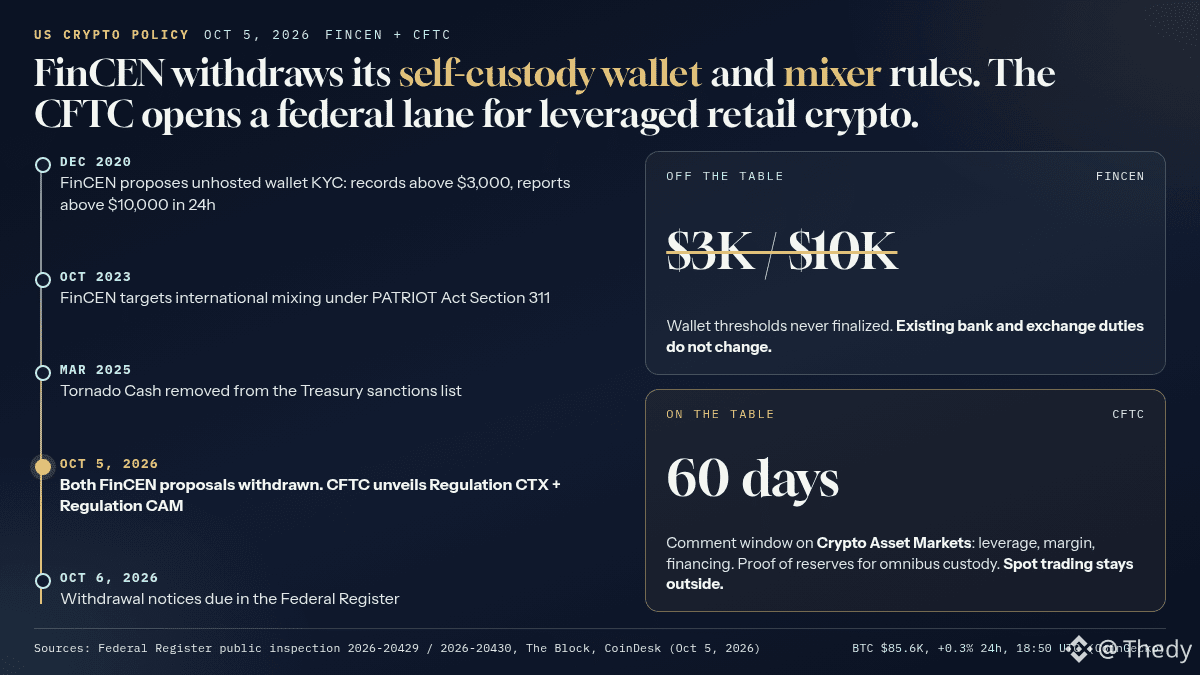
Washington moved twice on crypto this Monday, October 5: FinCEN (the U.S. Treasury) is withdrawing its proposed rules on self-hosted wallets and mixers, and the CFTC is opening a federal framework for retail leveraged crypto trading.
Here’s the timeline, to gauge the shift.
December 2020: FinCEN proposes identity verification for transactions of $3,000 or more involving an unhosted wallet, and reporting for amounts over $10,000 in 24 hours.
October 2023: a second proposal targets international mixing, with reporting down to addresses, hashes, and IPs (Section 311 of the Patriot Act).
March 2025: Tornado Cash is removed from the Treasury’s sanctions list.
On October 5, both proposals are withdrawn, with notice in the Federal Register on October 6 (The Block). On the same day, CFTC Chair Mike Selig presents Regulation CTX and Regulation CAM: “crypto asset markets” for leverage, margin, and financing, proof of reserves for omnibus accounts, and a 60-day consultation period (CoinDesk).
My take: for anyone keeping their $BTC or $ETH in self-custody, this is a regulatory risk disappearing, not a new right. Nothing had been finalized, and institutions’ current obligations are unchanged. And the CFTC isn’t touching spot trading as long as the Clarity Act remains stalled in the Senate.
The market didn’t react: $BTC was around $85,600 at 18:50 UTC (+0.3% over 24 hours, CoinGecko), below the annual open of $87,570.
If major U.S. exchanges apply for CAM status, retail leverage will come back under federal supervision. If the consultation drags on, it’s status quo, and spot remains the gap in the framework.
Do you think this CFTC framework could bring back to the U.S. traders who went offshore for leverage?
$BTC $ETH
#CFTC #FinCEN
Here’s the timeline, to gauge the shift.
December 2020: FinCEN proposes identity verification for transactions of $3,000 or more involving an unhosted wallet, and reporting for amounts over $10,000 in 24 hours.
October 2023: a second proposal targets international mixing, with reporting down to addresses, hashes, and IPs (Section 311 of the Patriot Act).
March 2025: Tornado Cash is removed from the Treasury’s sanctions list.
On October 5, both proposals are withdrawn, with notice in the Federal Register on October 6 (The Block). On the same day, CFTC Chair Mike Selig presents Regulation CTX and Regulation CAM: “crypto asset markets” for leverage, margin, and financing, proof of reserves for omnibus accounts, and a 60-day consultation period (CoinDesk).
My take: for anyone keeping their $BTC or $ETH in self-custody, this is a regulatory risk disappearing, not a new right. Nothing had been finalized, and institutions’ current obligations are unchanged. And the CFTC isn’t touching spot trading as long as the Clarity Act remains stalled in the Senate.
The market didn’t react: $BTC was around $85,600 at 18:50 UTC (+0.3% over 24 hours, CoinGecko), below the annual open of $87,570.
If major U.S. exchanges apply for CAM status, retail leverage will come back under federal supervision. If the consultation drags on, it’s status quo, and spot remains the gap in the framework.
Do you think this CFTC framework could bring back to the U.S. traders who went offshore for leverage?
$BTC $ETH
#CFTC #FinCEN