
#polymarket
polymarket
3.6M views
6,886 Discussing
Hot
Latest

Louisiana's AG is firing back hard at the CFTC, slamming the agency over its defense of prediction markets like Polymarket and Kalshi. This battle highlights a massive jurisdictional tug-of-war between federal regulators and state authorities over decentralized forecasting. As election and event betting surges, expect state-level crackdowns to escalate, creating a complex web of compliance hurdles for the crypto and prediction platform ecosystem moving forward. #CryptoRegulation #Polymarket #DeFi
Louisiana's AG is firing back hard at the CFTC, slamming the agency over its defense of prediction markets like Polymarket and Kalshi. This battle highlights a massive jurisdictional tug-of-war between federal regulators and state authorities over decentralized forecasting. As election and event betting surges, expect state-level crackdowns to escalate, creating a complex web of compliance hurdles for the crypto and prediction platform ecosystem moving forward. #CryptoRegulation #Polymarket #DeFi

·
--
Bearish
LOUISIANA JUST BLOCKED PREDICTION MARKETS — BUT WASHINGTON DISAGREES
A Louisiana judge has issued a temporary order targeting event contracts offered by Kalshi, Polymarket US, Robinhood, Coinbase and other platforms
Without a state gaming license, the companies must restrict access to users located in Louisiana
But there's an unusual conflict
$PREDICT
{future}(PREDICTUSDT)
⚖️ On November 5, the CFTC said federally regulated derivatives exchanges generally cannot restrict eligible US traders simply because of which state they're in
Now Louisiana is ordering the geographic restrictions that federal regulators say conflict with impartial market access rules
For traders, this isn't just a legal debate
Access to new contracts can change even when an existing position hasn't been settled
The court order is temporary, and the wider question of federal versus state authority remains unresolved
$BTC
{future}(BTCUSDT)
🔎 The next test comes through court challenges and Louisiana's November 30 injunction hearing
Prediction markets are growing fast
But who gets to regulate them may determine who gets to trade
#PredictionMarkets #Kalshi #Polymarket
LOUISIANA JUST BLOCKED PREDICTION MARKETS — BUT WASHINGTON DISAGREES
A Louisiana judge has issued a temporary order targeting event contracts offered by Kalshi, Polymarket US, Robinhood, Coinbase and other platforms
Without a state gaming license, the companies must restrict access to users located in Louisiana
But there's an unusual conflict
$PREDICT
⚖️ On November 5, the CFTC said federally regulated derivatives exchanges generally cannot restrict eligible US traders simply because of which state they're in
Now Louisiana is ordering the geographic restrictions that federal regulators say conflict with impartial market access rules
For traders, this isn't just a legal debate
Access to new contracts can change even when an existing position hasn't been settled
The court order is temporary, and the wider question of federal versus state authority remains unresolved
$BTC
🔎 The next test comes through court challenges and Louisiana's November 30 injunction hearing
Prediction markets are growing fast
But who gets to regulate them may determine who gets to trade
#PredictionMarkets #Kalshi #Polymarket

488

Polymarket is testing Nex, a new Rust based trading engine capable of 100,000 commands per second, targeting a mid December launch to scale capacity.
#Polymarket
Polymarket is testing Nex, a new Rust based trading engine capable of 100,000 commands per second, targeting a mid December launch to scale capacity.
#Polymarket
#Polymarket
4

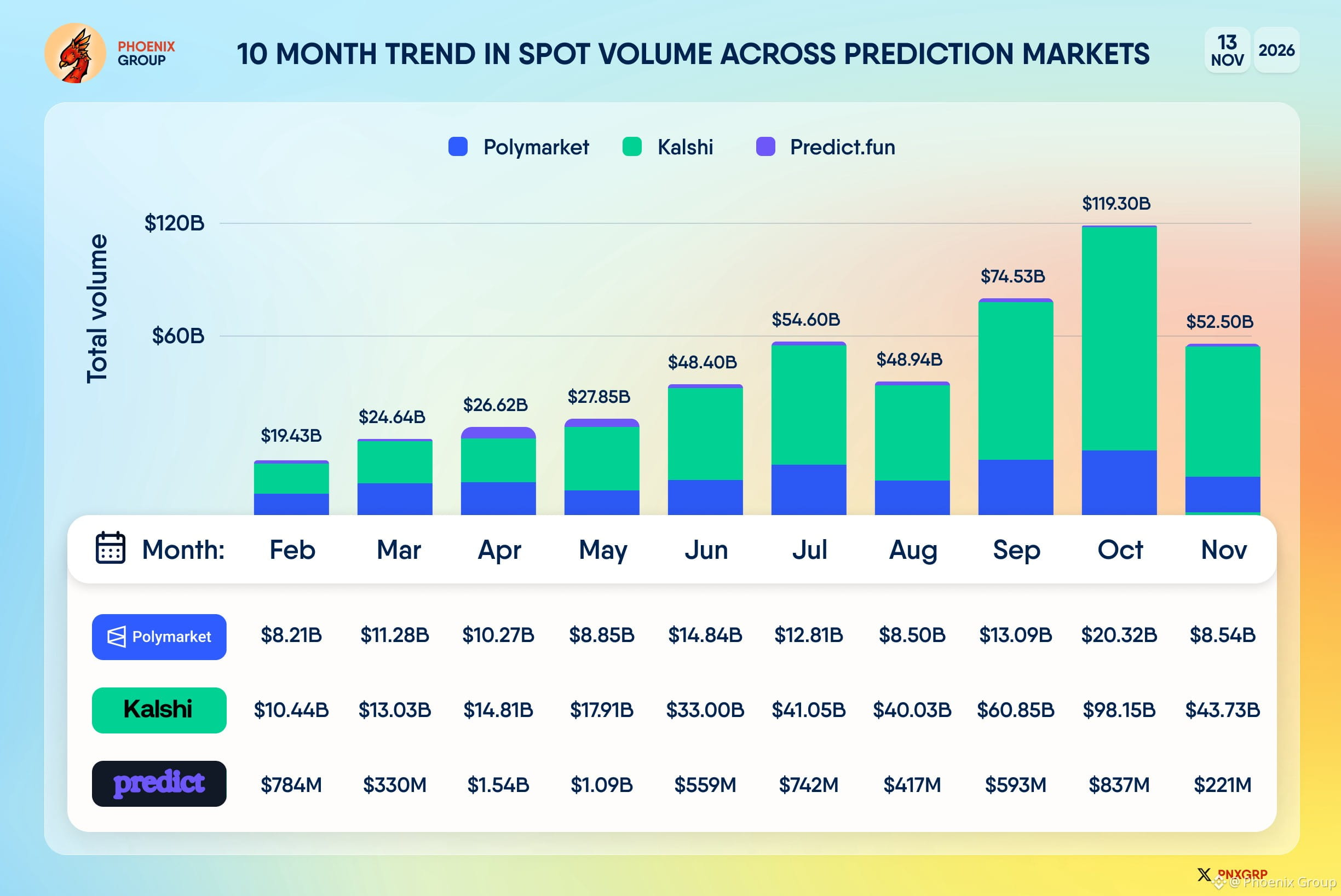
10-MONTH TREND IN SPOT VOLUME ACROSS PREDICTION MARKETS
For the last 10 months, the spot volume of prediction markets has grown by 170%. In November, the leading platforms by trading volume are #Kalshi with $43.73B, #Polymarket with $8.54B, and #Predictfun with $221M.
10-MONTH TREND IN SPOT VOLUME ACROSS PREDICTION MARKETS
For the last 10 months, the spot volume of prediction markets has grown by 170%. In November, the leading platforms by trading volume are #Kalshi with $43.73B, #Polymarket with $8.54B, and #Predictfun with $221M.
For the last 10 months, the spot volume of prediction markets has grown by 170%. In November, the leading platforms by trading volume are #Kalshi with $43.73B, #Polymarket with $8.54B, and #Predictfun with $221M.
233

·
--
📰 Polymarket Lays Off Employees and Ends Contractor Deals, Denies Reports of 30% Workforce Cuts
The company did not disclose how many employees and contractors were affected by the cuts.
Source : Cryptopotato
Time : 2026-11-12 20:20:15
Credit : chayanika deka
#crypto_news #kalshi #polymarket #aa_news #prediction_markets
$MATIC
Share your opinion in the comment section below
The company did not disclose how many employees and contractors were affected by the cuts.
Source : Cryptopotato
Time : 2026-11-12 20:20:15
Credit : chayanika deka
#crypto_news #kalshi #polymarket #aa_news #prediction_markets
$MATIC
Share your opinion in the comment section below

·
--
📰 Polymarket Lays Off Employees and Ends Contractor Deals, Denies Reports of 30% Workforce Cuts
The company did not disclose how many employees and contractors were affected by the cuts.
Source : Cryptopotato
Time : 2026-11-12 20:20:15
Credit : chayanika deka
#crypto_news #kalshi #polymarket #aa_news #prediction_markets
$MATIC
Share your opinion in the comment section below
📰 Polymarket Lays Off Employees and Ends Contractor Deals, Denies Reports of 30% Workforce Cuts
The company did not disclose how many employees and contractors were affected by the cuts.
Source : Cryptopotato
Time : 2026-11-12 20:20:15
Credit : chayanika deka
#crypto_news #kalshi #polymarket #aa_news #prediction_markets
$MATIC
Share your opinion in the comment section below
The company did not disclose how many employees and contractors were affected by the cuts.
Source : Cryptopotato
Time : 2026-11-12 20:20:15
Credit : chayanika deka
#crypto_news #kalshi #polymarket #aa_news #prediction_markets
$MATIC
Share your opinion in the comment section below
3

·
--
Polymarket is acting weird right now
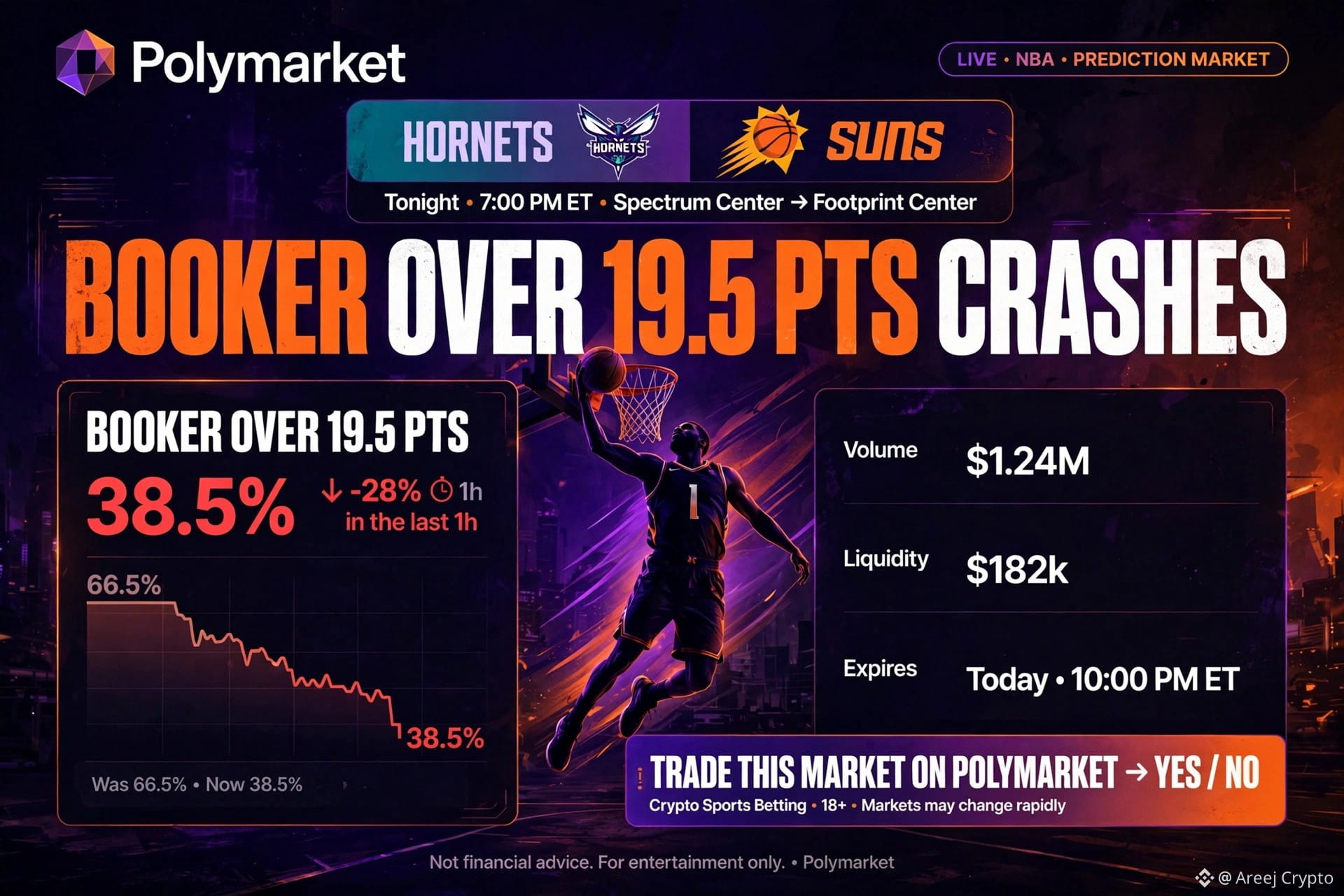
Hornets vs Suns market.
Devin Booker Over 19.5 points
Was 66.5% an hour ago
Now down to 38.5%
That's a 28% drop in just 1 hour.
That's not normal. Booker averages around 25 points. 19.5 should be easy for him on a normal night.
Looks like the market knows something. Maybe a minutes issue, maybe a lineup change, or maybe someone got inside news early.
I'm not touching the Over after this kind of move.
#Polymarket #NBA #Booker
3
50

·
--
A Sunday night chat about some serious stuff nobody cared about today: Polymarket is facing lawsuits.
One prediction market, 29 lawsuits, all filed in Manhattan federal court. The dispute comes down to two things: a “qualification” restriction was added to the rules after trading had already begun; token holders voted, with 98.6% choosing NO. The odds stayed up, the result was settled, and anyone who disagreed had to go to court.
This is worth thinking about more than any single win or loss. Prediction markets have been touted over the past couple of years as more accurate than polls, and institutions are eager to use them. But accuracy depends on settlements not going haywire. Users bet on outcomes, but the outcomes are decided by the wording of the rules and the platform’s power to interpret them. Strictly speaking, that’s not a prediction market—it’s a betting game where the platform moonlights as the referee.
The old problems with UMA’s dispute mechanism have been argued over since last year. Trading volume keeps growing, but the referee problem hasn’t budged. A market facing 29 lawsuits shows there’s real money at stake—not just a meme.
Next week, $NVDA draws and the Russian central bank opens up exchange trading; odds will once again be cited as a sentiment indicator. On a weekend when Bitcoin ($BTC) is languishing below 70,000, maybe it’s better to first get the prediction market’s own governance in order.
One takeaway: this sector’s lifeline isn’t liquidity—it’s fairness.
NFA DYOR
#Polymarket #预测市场 #比特币 #加密货币 #regulation
A Sunday night chat about some serious stuff nobody cared about today: Polymarket is facing lawsuits.
One prediction market, 29 lawsuits, all filed in Manhattan federal court. The dispute comes down to two things: a “qualification” restriction was added to the rules after trading had already begun; token holders voted, with 98.6% choosing NO. The odds stayed up, the result was settled, and anyone who disagreed had to go to court.
This is worth thinking about more than any single win or loss. Prediction markets have been touted over the past couple of years as more accurate than polls, and institutions are eager to use them. But accuracy depends on settlements not going haywire. Users bet on outcomes, but the outcomes are decided by the wording of the rules and the platform’s power to interpret them. Strictly speaking, that’s not a prediction market—it’s a betting game where the platform moonlights as the referee.
The old problems with UMA’s dispute mechanism have been argued over since last year. Trading volume keeps growing, but the referee problem hasn’t budged. A market facing 29 lawsuits shows there’s real money at stake—not just a meme.
Next week, $NVDA draws and the Russian central bank opens up exchange trading; odds will once again be cited as a sentiment indicator. On a weekend when Bitcoin ($BTC ) is languishing below 70,000, maybe it’s better to first get the prediction market’s own governance in order.
One takeaway: this sector’s lifeline isn’t liquidity—it’s fairness.
NFA DYOR
#Polymarket #预测市场 #比特币 #加密货币 #regulation
192

·
--
🇺🇸💰 OFFICIALS BETTING WITH SECRET INFORMATION?
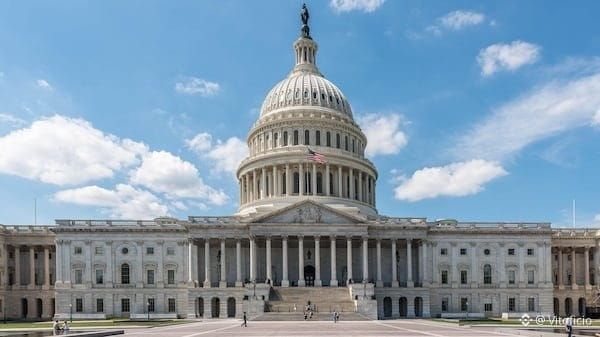
Have you seen this? In the United States, Congress wants to ban government officials from betting on Polymarket and Kalshi, platforms where people bet on the outcomes of events. After reviewing nearly 1,700 pages of documents, they found cases of people with access to secret information who allegedly made money by betting before anyone else.
The most serious case is that of a soldier accused of making more than $409,000 by betting on the military operation that ended with the capture of Nicolás Maduro. They also fined a former White House employee who bet on the president’s speeches.
To me, the problem isn’t the platforms, but that someone with information no one else has can turn it into money.
Do you think all government officials should be banned from betting, or only on government-related matters?
#Polymarket
32

·
--
Verified
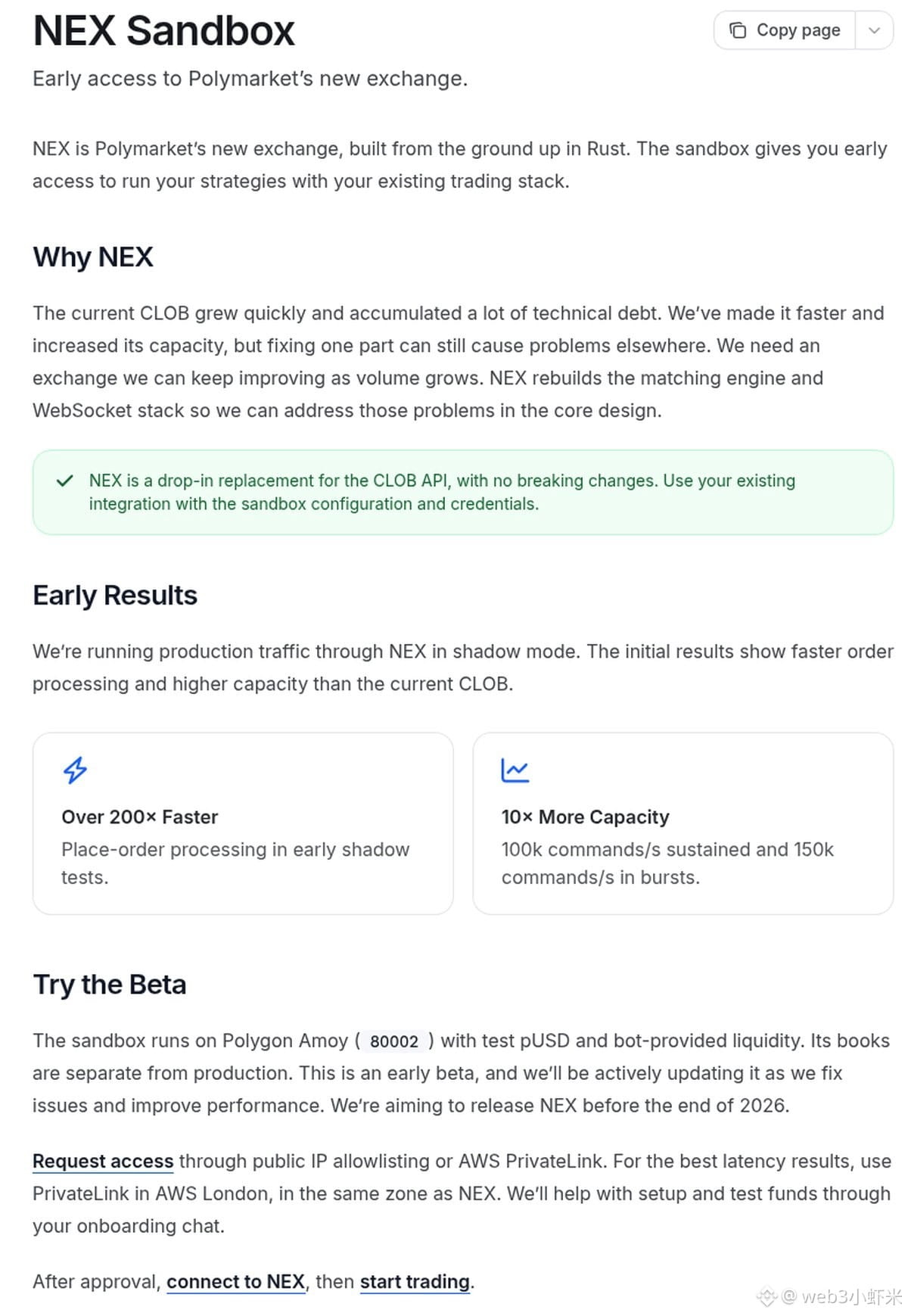
Official Polymarket update: The sandbox for the new exchange, Nex, is now open.
The engineering team says the original CLOB had too much technical debt, so this time they rewrote the matching engine and the entire WebSocket stack in Rust. For the past week, they’ve been running it in shadow mode against real live orders.
The figures shared by the team measure internal latency, not end-to-end latency: order placement p99 dropped from 1.55 seconds to 3.76 milliseconds, while sustained throughput rose from 10,000 to 100,000 instructions per second. The sandbox runs on the Polygon Amoy testnet, uses test pUSD, and is separate from the live order book. They plan to continue shadow mode for another four weeks and, if all goes well, aim to launch in mid-December. There will be no breaking changes for existing integrations.
#Polymarket
Diego V:
disculpen mi ignorancia pero en pocas palabras que quiere decir esto
1
1
324

·
--
This set of Polymarket IPO markets looks like it offers 9.5% upside. But when you do the math, it turns out to be fake.
On predict.fun, for “When will Polymarket IPO?”:
- IPO before the end of 2026: Yes 0.018
- IPO before the end of June 2027: No 0.838 (Yes is 0.162)
At first glance: 0.018 + 0.838 = 0.856, leaving a 0.144 gap to 1. After fees and slippage, that’s still around 9.5%. Looks like arbitrage.
Wrong. The problem is the window in between:
- IPO by the end of 2026: this position pays 1
- IPO in the first half of 2027: both legs pay 0
- No IPO at all: this position pays 1
The market prices the first-half-of-2027 window at 14.4% (0.162 - 0.018). Expected payout = 0.856, exactly the combined price of the two legs, before fees. That 9.5% comes from treating “pays 1” as a sure thing, without accounting for the risk of the IPO falling in that window. This isn’t arbitrage; it’s a bet that the window is less likely than the market thinks.
Two more catches: these prices haven’t moved in 2 hours—the same number across 5 scans, possibly a zombie quote. And even if you believe in that 9.5%, the algorithm says you’d need at least 49U to get in.
Numbers can deceive. The math can’t.
#预测市场 #Polymarket #Arbitrage
Trading involves risk. Invest with caution.
51

·
--

Article
Annualized Revenue Hits $1.8 Billion, Yet Polymarket Is Still Laying People Off: Where Does Its $21 Billion Valuation Come From?On November 10, Polymarket told CNBC that its annualized revenue had topped $1.8 billion, up from just over $1 billion in June. That same week, Front Office Sports reported that the company had laid off a group of employees the previous week, with marketing taking the biggest hit. Layoffs when you’re making the most money sounds contradictory, but the numbers make sense. This has nothing directly to do with the coin you hold; the connection comes in the second half.
First, where is the money coming from? The U.S. site had $14.77 billion in nominal trading volume in October, compared with just $4.04 billion in June. That $14.77 billion is nominal volume calculated using the full payout value of contracts; the actual cash involved is much lower. Of October’s volume, combination contracts accounted for $8.6 billion, nearly 60%, while sports contracts made up 30%. In the ten days before November’s midterm elections, election-related contracts generated $108 million—more than six times the total for all of September—and still accounted for just 2.2% of the month’s overall volume. A platform that got its start with elections now makes its money from sports and combination bets. The $1.8 billion figure needs a caveat: it’s an annualized figure reported by the company itself, extrapolating recent revenue over a full year, not an audited number. Independent firm Sacra estimated just $375 million in May, and calculating fees directly from trading volume doesn’t add up.
Annualized Revenue Hits $1.8 Billion, Yet Polymarket Is Still Laying People Off: Where Does Its $21 Billion Valuation Come From?
On November 10, Polymarket told CNBC that its annualized revenue had topped $1.8 billion, up from just over $1 billion in June. That same week, Front Office Sports reported that the company had laid off a group of employees the previous week, with marketing taking the biggest hit. Layoffs when you’re making the most money sounds contradictory, but the numbers make sense. This has nothing directly to do with the coin you hold; the connection comes in the second half.
First, where is the money coming from? The U.S. site had $14.77 billion in nominal trading volume in October, compared with just $4.04 billion in June. That $14.77 billion is nominal volume calculated using the full payout value of contracts; the actual cash involved is much lower. Of October’s volume, combination contracts accounted for $8.6 billion, nearly 60%, while sports contracts made up 30%. In the ten days before November’s midterm elections, election-related contracts generated $108 million—more than six times the total for all of September—and still accounted for just 2.2% of the month’s overall volume. A platform that got its start with elections now makes its money from sports and combination bets. The $1.8 billion figure needs a caveat: it’s an annualized figure reported by the company itself, extrapolating recent revenue over a full year, not an audited number. Independent firm Sacra estimated just $375 million in May, and calculating fees directly from trading volume doesn’t add up.
First, where is the money coming from? The U.S. site had $14.77 billion in nominal trading volume in October, compared with just $4.04 billion in June. That $14.77 billion is nominal volume calculated using the full payout value of contracts; the actual cash involved is much lower. Of October’s volume, combination contracts accounted for $8.6 billion, nearly 60%, while sports contracts made up 30%. In the ten days before November’s midterm elections, election-related contracts generated $108 million—more than six times the total for all of September—and still accounted for just 2.2% of the month’s overall volume. A platform that got its start with elections now makes its money from sports and combination bets. The $1.8 billion figure needs a caveat: it’s an annualized figure reported by the company itself, extrapolating recent revenue over a full year, not an audited number. Independent firm Sacra estimated just $375 million in May, and calculating fees directly from trading volume doesn’t add up.
38

·
--
【U.S. soldier accused of using classified information to bet on “Maduro’s capture alive” and earn $400,000! White House teleprompter operator also fined; Congress considers banning officials from prediction markets】
On November 13, the U.S. House Committee on Oversight released an investigative memo naming several cases of insider trading on prediction markets: a U.S. Army master sergeant was indicted on suspicion of using classified information about the operation to capture Venezuelan President Maduro to place bets on Polymarket, earning more than $409,000; a White House teleprompter operator was fined about $172,000 by the CFTC on suspicion of betting on the wording of Trump’s speech using unpublished information learned at work; and former congressman Santos was also fined $35,000. The committee recommended that Congress pass legislation to at least prohibit government employees from betting on contracts related to government actions and political outcomes. The Senate had already barred senators and their staff from participating in prediction markets in April this year.
#预测市场 #Polymarket #Kalshi
921

·
--
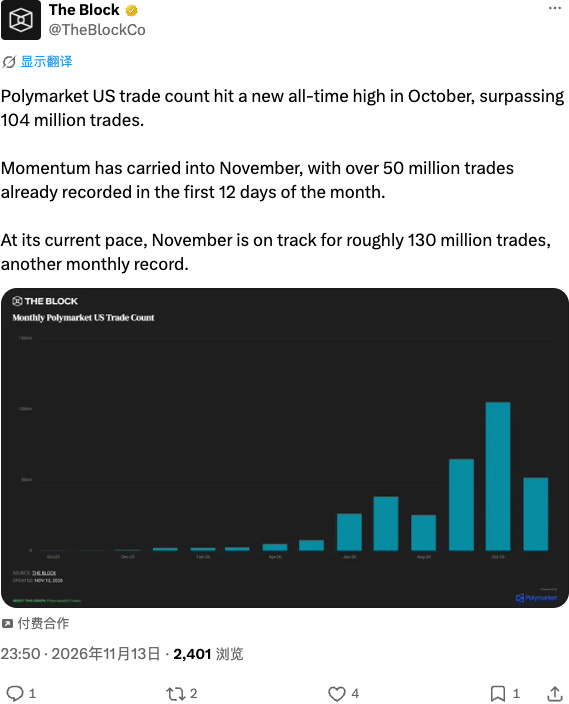
Polymarket’s trading volume surged past 100 million in October, and November is off to a blazing start. At this pace, it could top 130 million by month-end.
The data doesn’t lie—this thing is really taking off, with liquidity pouring in like a flood. For memes and cyber politics, this is the perfect fuel. If you’re looking to make a big play, you’d better keep a close eye on it.
🚀
#Polymarket #预测市场 #Meme #CyberPolitics
The data doesn’t lie—this thing is really taking off, with liquidity pouring in like a flood. For memes and cyber politics, this is the perfect fuel. If you’re looking to make a big play, you’d better keep a close eye on it.
🚀
#Polymarket #预测市场 #Meme #CyberPolitics
7
·
--
【Caught playing both sides and “asked to leave”! Donald Trump Jr. loses Kalshi adviser role because his own fund backed rival Polymarket】
Prediction market Kalshi confirmed on November 12 that it had agreed with Donald Trump Jr., the president’s eldest son, to end his advisory contract. The move came after 1789 Capital, where he is a partner, led a $1 billion funding round for rival Polymarket, valuing it at $21 billion. He remains an adviser to Polymarket. Democrats have just won control of both chambers of Congress, and Senator Warren and others have written to the White House asking it to clarify his role and interests in prediction markets by November 23.
#Kalshi #Polymarket #predictionmarket
69

·
--
Bearish
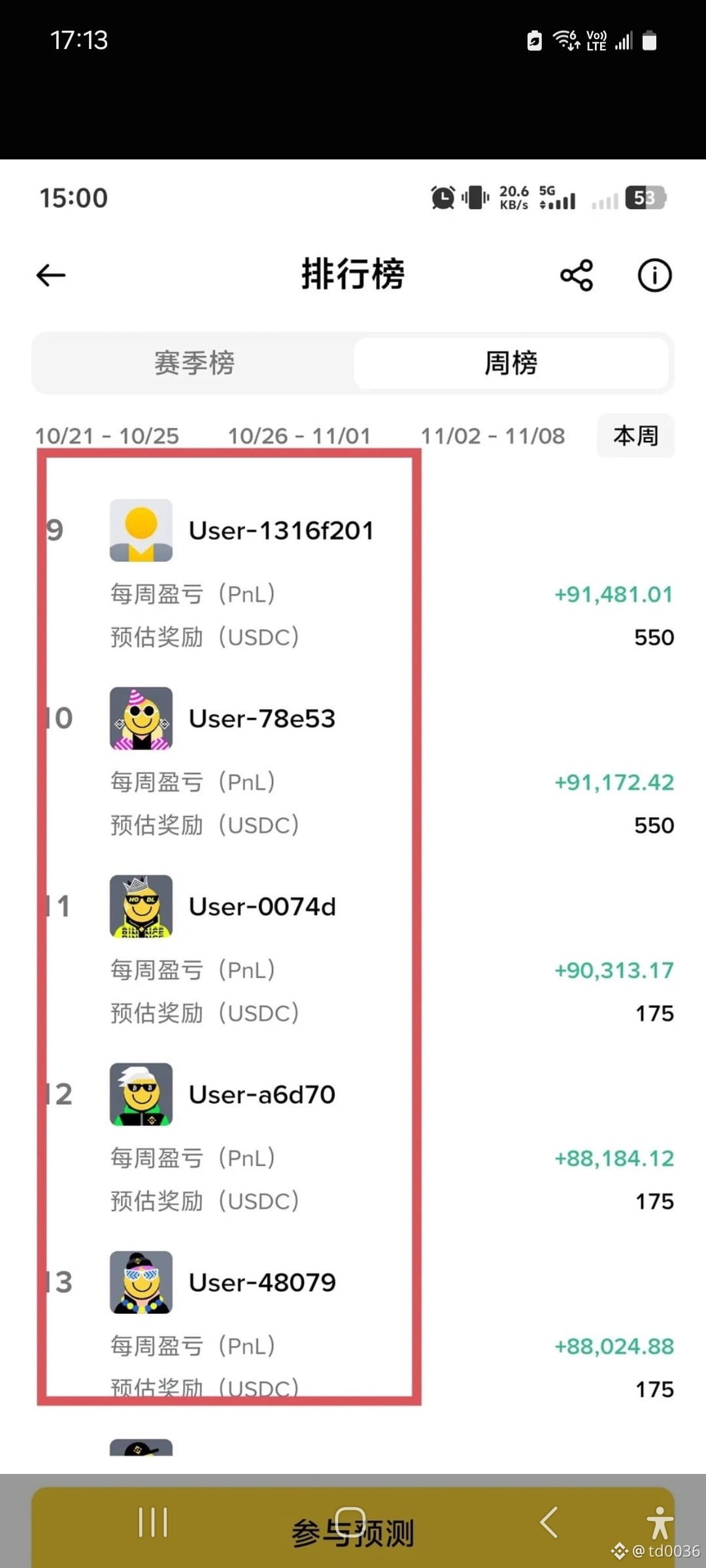
There's a betting opportunity on Polymarket for this Jensen Huang event on the 11th. It settles according to US time, meaning he would have to announce his resignation within an hour and a half. I don't think that's likely.
#Polymarket $BNB
#黄仁勋
There's a betting opportunity on Polymarket for this Jensen Huang event on the 11th. It settles according to US time, meaning he would have to announce his resignation within an hour and a half. I don't think that's likely.
#Polymarket $BNB
#黄仁勋
#Polymarket $BNB
#黄仁勋


币定起飞:
你懂个锤子,还有说美国政府披露外星人的盘。
5
5
15.7k

·
--
🤔 Who will lead Nvidia? Polymarket odds
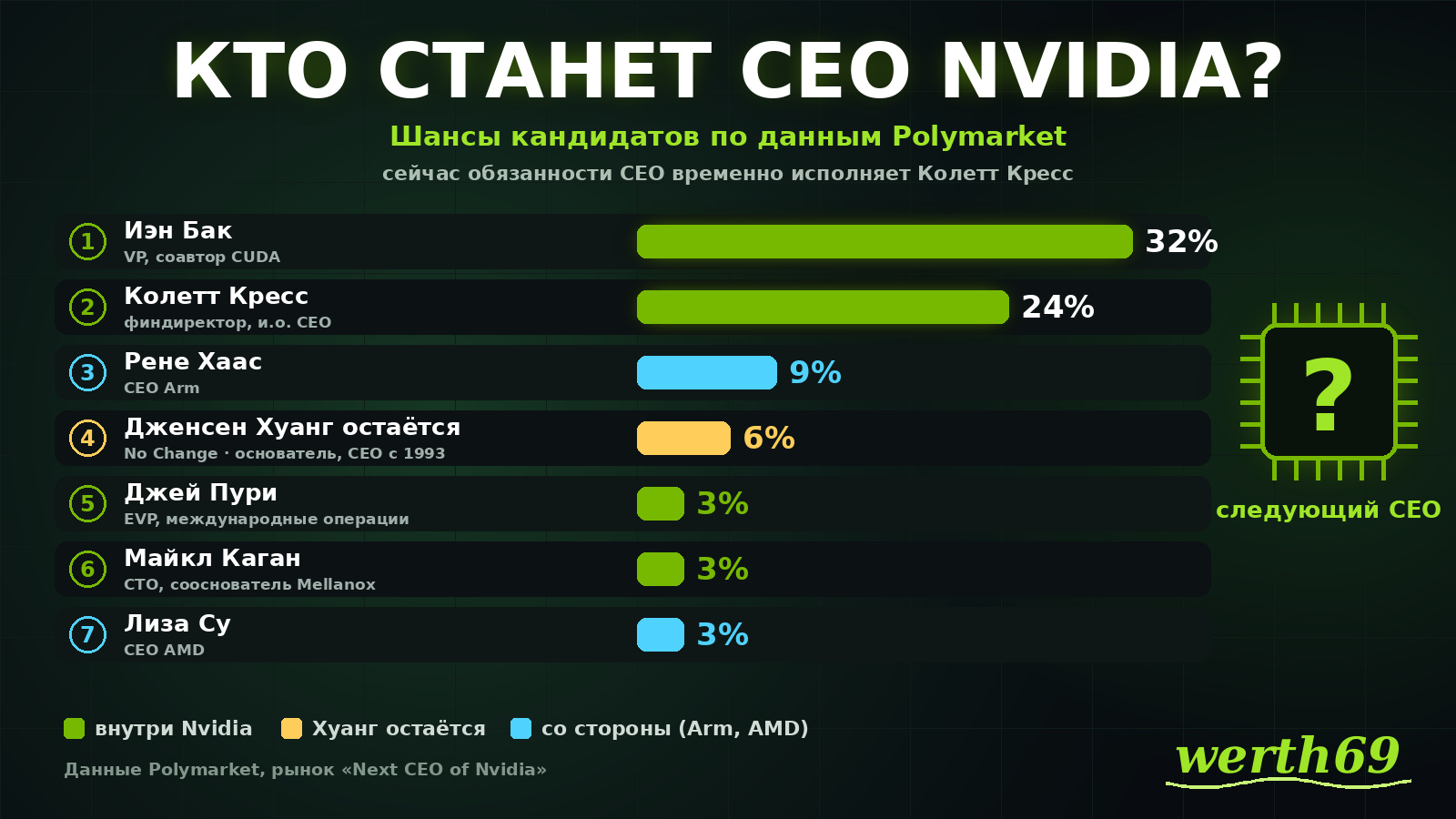
Amid rumors of a possible change in Nvidia’s leadership, Polymarket has updated its list of candidates for CEO. Here are the top favorites:
1. Ian Buck — 32%
Nvidia’s vice president responsible for hyperscale computing. One of the creators of CUDA—the technology that became the foundation of the company’s success in AI. He has worked at Nvidia for more than 20 years.
2. Colette Kress — 24%
Nvidia’s CFO since 2013, currently serving as acting CEO. She previously worked at Microsoft and Cisco. She oversaw the company’s financial strategy during the AI boom.
3. Rene Haas — 9%
CEO of Arm since 2022. He previously spent about seven years in leadership roles at Nvidia.
4. Jensen Huang (No Change) — 6%
Nvidia co-founder and its CEO since 1993. The market thinks he may keep his position.
Other candidates:
🔹 Jay Puri — 3%
🔹 Michael Kagan — 3%
🔹 Lisa Su — 3% (the head of AMD moving to Nvidia would be a sensation)
Interestingly, Jensen Huang’s chances of keeping his position are estimated at just 6%, even though he is the face of the company. What do you think—is this a real threat or just Polymarket traders’ hype? 👇
#NVIDIA #altcoins #Polymarket #technews
$BTC
{future}(BTCUSDT)
$ETH
{future}(ETHUSDT)
🤔 Who will lead Nvidia? Polymarket odds
Amid rumors of a possible change in Nvidia’s leadership, Polymarket has updated its list of candidates for CEO. Here are the top favorites:
1. Ian Buck — 32%
Nvidia’s vice president responsible for hyperscale computing. One of the creators of CUDA—the technology that became the foundation of the company’s success in AI. He has worked at Nvidia for more than 20 years.
2. Colette Kress — 24%
Nvidia’s CFO since 2013, currently serving as acting CEO. She previously worked at Microsoft and Cisco. She oversaw the company’s financial strategy during the AI boom.
3. Rene Haas — 9%
CEO of Arm since 2022. He previously spent about seven years in leadership roles at Nvidia.
4. Jensen Huang (No Change) — 6%
Nvidia co-founder and its CEO since 1993. The market thinks he may keep his position.
Other candidates:
🔹 Jay Puri — 3%
🔹 Michael Kagan — 3%
🔹 Lisa Su — 3% (the head of AMD moving to Nvidia would be a sensation)
Interestingly, Jensen Huang’s chances of keeping his position are estimated at just 6%, even though he is the face of the company. What do you think—is this a real threat or just Polymarket traders’ hype? 👇
#NVIDIA #altcoins #Polymarket #technews
$BTC
$ETH
Eva Green x:
I have followed you; please follow me back.
1
264

“The probability that Jensen Huang stays on is down to just 11%”—don’t rush to share a chart like this before checking which market it comes from.
The succession odds making the rounds today should be for Polymarket’s “Next CEO of NVIDIA” market. It settles on January 1, 2029. The platform shows total trading volume of just over $100,000 for the entire event, with about $22,600 traded on “No Change” (meaning Jensen Huang stays on). When I checked at 4 p.m. today, the price was 18%, not 11%. In a market with only tens of thousands of dollars in volume, one or two people can move the price by several points. Calling that “market consensus” is giving it far too much credit.
The real money is in another market: whether Jensen Huang “announces his resignation or is removed,” with separate outcomes based on the deadline. The platform shows total trading volume of about $17.13 million. Around 4 p.m. Beijing time on November 12:
By November 12 (11:59 p.m. ET that day): about 59.5%
By November 13: about 65.5%
By November 30: about 77%
By December 31: about 81%
This curve tells us more than any odds chart. Most of the probability is riding on “an announcement sometime today, ET,” with only about 20 more points added between today and year-end. My read is that the market thinks the board will either act in the next day or two, or the longer it waits, the more likely it is to do nothing. That’s an inference from the price structure, not a news report.
The rules are an even bigger trap. This market only counts an “explicit” announcement of resignation or removal, and it has to take effect within 18 months. A temporary leave, suspension, administrative leave, “under consideration,” or a conditional statement doesn’t count. Bloomberg says the board is meeting and is also working with external firms to identify potential replacements. But if the final outcome is some compromise like “temporary leave + CFO as acting CEO,” anyone who bought YES still loses everything.
Read the rules before following the news. That matters more than guessing who will take over.
#英伟达 #Polymarket
35

·
--
Prediction markets keep scaling: Polymarket says annualized revenue topped 1.8 billion dollars, up from 1 billion+ in June, as its US exchange hit 14.5B+ dollars in October volume. A broad CFTC probe is still a headwind. #Polymarket #PredictionMarkets #Crypto
Prediction markets keep scaling: Polymarket says annualized revenue topped 1.8 billion dollars, up from 1 billion+ in June, as its US exchange hit 14.5B+ dollars in October volume. A broad CFTC probe is still a headwind. #Polymarket #PredictionMarkets #Crypto
44

·
--
🧠 $POLYMARKET VOLUME EXPLODES 266% AS PREDICTION MARKETS BECOME THE ULTIMATE ARENA 📊 🚀
Institutional liquidity is flooding decentralized prediction rails as monthly volume rockets from four billion to nearly fifteen billion in record time. Combo and sports contracts are driving this massive demand wave, pushing annualized revenue past the one billion mark while heavyweights battle for regulatory clarity in court. ⚡
Smart money recognizes that political and macro speculation has evolved from side bets into a primary asset class commanding multi-billion-dollar valuations. Regulatory crosswinds may test jurisdictional boundaries, but the underlying transaction velocity proves participants are voting with heavy capital. 💡
💬 Are prediction markets shaping up to be the dominant narrative of this market cycle or just a temporary sideshow? 👇
⚠️ Not financial advice. Always manage your risk. 🛡️
🏷️ #POLYMARKET #PredictionMarkets #CFTC #Crypto
🦈 💎

19
Log in to explore more content
Join global crypto users on Binance Square
⚡️ Get latest and useful information about crypto.
💬 Trusted by the world’s largest crypto exchange.
👍 Discover real insights from verified creators.
Email / Phone number
Trending Topics
1
#CryptoSelloffTriggersMultipleWhaleLiquidations
119,447 views
1,359 Discussing
2
#USSpotXRPETFsSeeLargestWeeklyOutflowIn8Months
119,881 views
1,355 Discussing
3
#WillFOMCMinutesReinforceRateHikeExpectations?
29,543 views
581 Discussing
4
#BitcoinActiveSupplyInProfitDropsBelow45%
197,644 views
1,619 Discussing
5
#TONStrategyReports$23.97MQ3NetLoss
16,979 views
131 Discussing
6
#KavaSaysAbnormalActivityLimitedToKavaLend
127,673 views
923 Discussing
7
#WORPTLetsTouristsConvertCryptoToThaiBaht
40,616 views
355 Discussing
8
#WhoWillSucceedJensenHuangatNvidia?
314,763 views
2,098 Discussing
9
#WhatWillDriveCryptoandStocks’NextRebound?
825,594 views
3,886 Discussing
10
#TradFiForBeginners
824,157 views
4,905 Discussing