
#polymarket
polymarket
3.6M views
6,909 Discussing
Hot
Latest

·
--
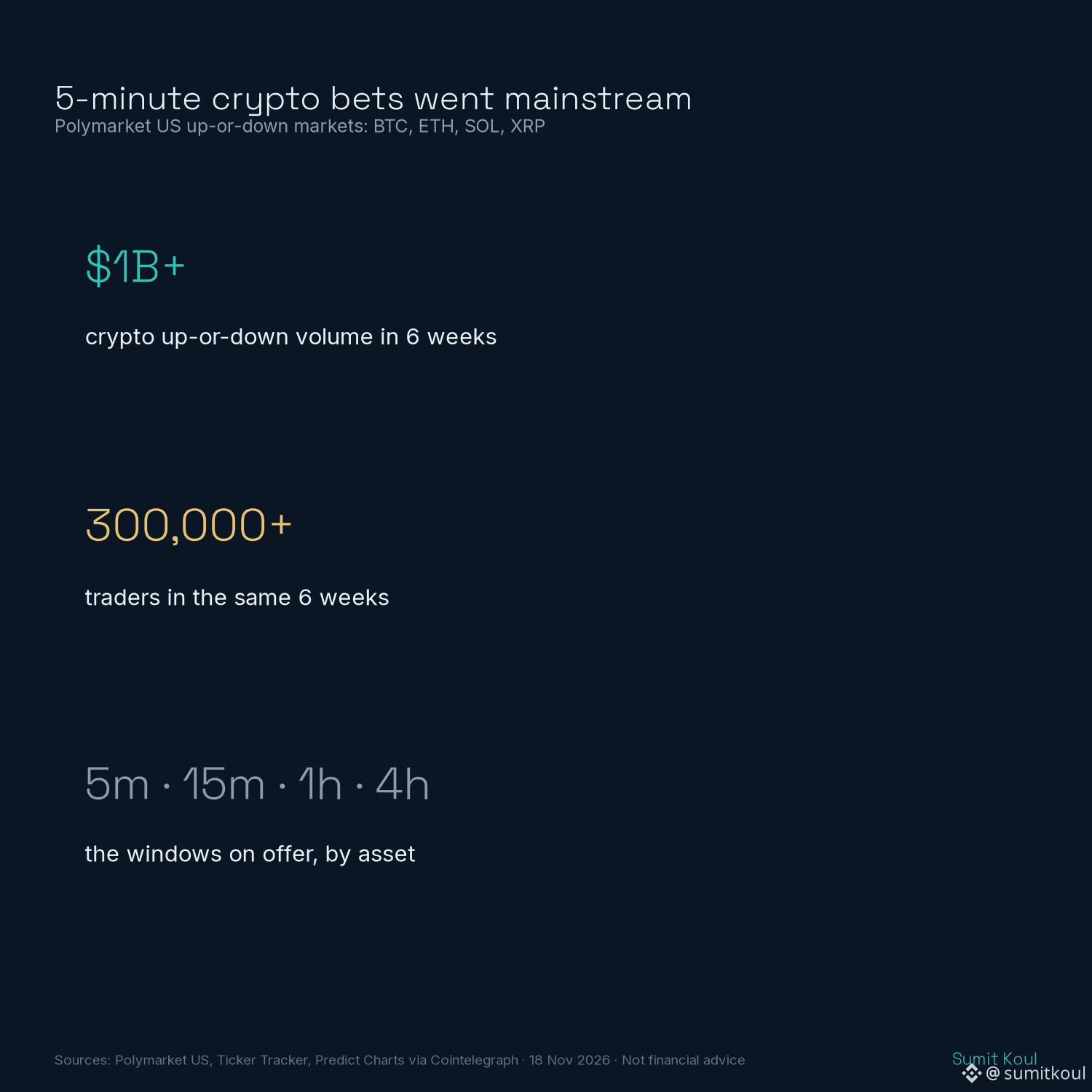
5-minute $BTC bets just crossed $1B on Polymarket US. Now it wants oil. 🛢️
Swipe →
1️⃣ $1B+ volume and 300K+ traders in 6 weeks on crypto up-or-down markets ($BTC, $ETH, $SOL)
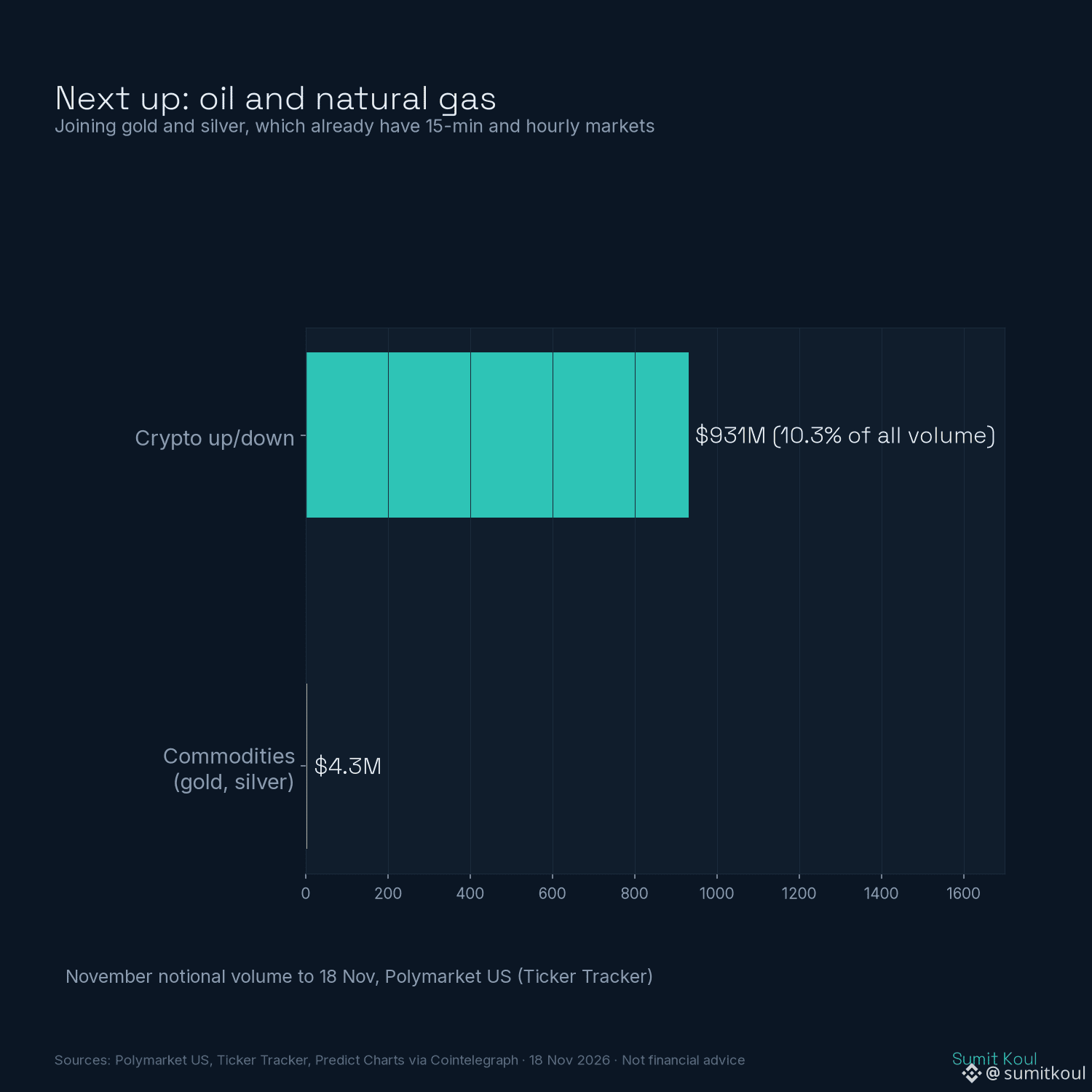
2️⃣ Crypto up-or-down = $931M in November so far, 10.3% of Polymarket US volume. Oil and gas are next
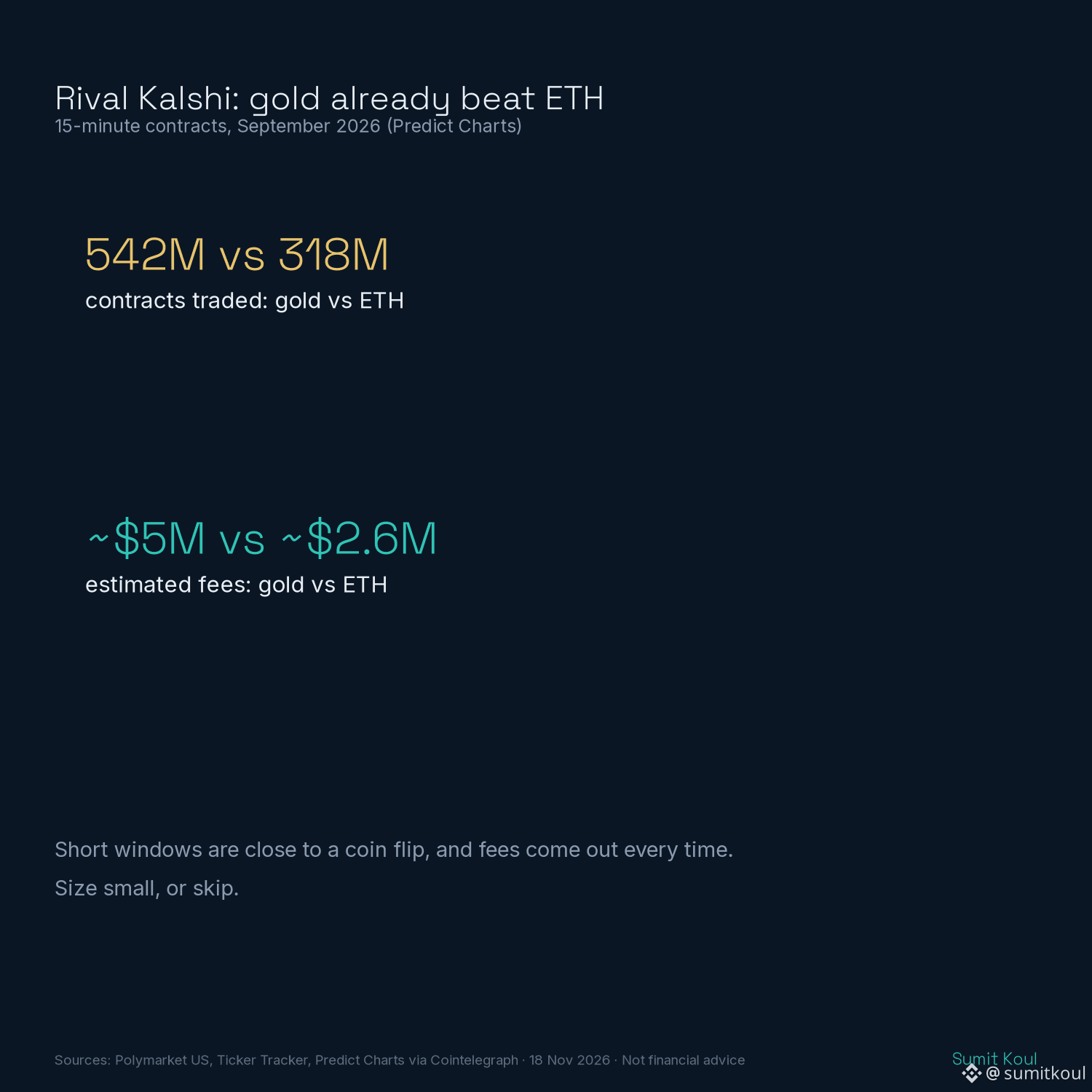
3️⃣ On rival Kalshi, 15-minute gold contracts already beat ETH in September
A 5-minute window is close to a coin flip, and fees come out every round. Size small, or skip.
Have you tried these? 👇
#PredictionMarkets #Polymarket #Crypto
Not financial advice.
5-minute $BTC bets just crossed $1B on Polymarket US. Now it wants oil. 🛢️
Swipe →
1️⃣ $1B+ volume and 300K+ traders in 6 weeks on crypto up-or-down markets ($BTC , $ETH , $SOL )
2️⃣ Crypto up-or-down = $931M in November so far, 10.3% of Polymarket US volume. Oil and gas are next
3️⃣ On rival Kalshi, 15-minute gold contracts already beat ETH in September
A 5-minute window is close to a coin flip, and fees come out every round. Size small, or skip.
Have you tried these? 👇
#PredictionMarkets #Polymarket #Crypto
Not financial advice.
39

·
--
🧐 Polymarket predictions show that the probability of BTC touching $52,500 during the rest of November has risen to 64%, up 51% over the past 24 hours. Similarly, the probability of it touching $50,000 has increased from 34% to 44%. 💬
These figures are based on the PPP monitoring tool, which uses only the highest prices from Binance BTC/USDT 1-minute candlesticks and excludes data from other exchanges. Therefore, they reflect market sentiment for a specific trading pair, not a unified price trend across the entire market.
It’s worth noting that predictions of this kind are essentially probability models. They are influenced by participants’ bets and the flow of information, and can fluctuate at any time. We can only say that expectations for higher prices are currently growing, but whether they materialize depends on various factors, such as overall demand, macroeconomic conditions, and on-chain activity.
🤔 To what extent do you think predictions based on data from a single exchange can help assess Bitcoin’s short-term trend?
This is not investment advice.
#BTC #比特币 #Polymarket #MarketForecast

492


Article
A Quiet Revolution in DeFi: Why Did Polymarket Drop Binance Candles for Chainlink? 🔄📊$BTC $LINK $BNB
While the broader market watches Bitcoin hover around $64,000–$65,000 with the Fear & Greed Index deep in extreme fear, a major Web3 infrastructure shift just happened under the radar — one that directly changes the game for algorithmic traders.
Leading decentralized prediction platform Polymarket officially completed migrating its international hourly and daily crypto markets (Up/Down) from direct Binance spot candles to Chainlink Data Streams.
What Changed and Why Does It Matter?
• Shift to aggregated pricing. Previously, hourly and daily Polymarket outcomes were settled based on the open and close of 1-minute or 1-hour BTC/USDT candles on Binance. Now, settlement uses Chainlink’s aggregated 60-second time-weighted average price (USD TWAP-60s), matching how 5-minute and 15-minute contracts already operate.
• Protection against last-second spikes. Relying on a single order book — even on the world’s most liquid exchange — always carried the risk of sudden last-second volatility flipping a contract outcome. Chainlink’s aggregated feed smooths out those spikes and keeps settlements neutral.
• New rules for trading bots. Tie-breaker logic in daily contracts has also been updated: exact price matches now resolve to the Up side. Algorithmic traders using PolyBolt have until November 30 to migrate their systems to Chainlink APIs.
Binance’s Role Remains Fundamental
It is important to note that this update does not diminish Binance’s market leadership in any way. On the contrary, Binance’s unmatched liquidity and benchmark price discovery across spot and futures markets still form the core backbone of global crypto pricing — the exact data that market makers and Chainlink’s own aggregators rely on. For Chainlink ($LINK), this is another strong validation as the leading DeFi oracle, while for Binance, it proves once again that its ecosystem remains the foundation of the entire crypto industry.
What do you think: is shifting DeFi protocols from direct exchange feeds to aggregated oracles a win for security, or does it make things harder for everyday traders? Drop a like, share your thoughts in the comments, and let’s get an active discussion going! 🔥👇
Not financial advice. Always do your own research (DYOR).
#Chainlink #LINK #Binance #Polymarket
A Quiet Revolution in DeFi: Why Did Polymarket Drop Binance Candles for Chainlink? 🔄📊
$BTC $LINK $BNB
While the broader market watches Bitcoin hover around $64,000–$65,000 with the Fear & Greed Index deep in extreme fear, a major Web3 infrastructure shift just happened under the radar — one that directly changes the game for algorithmic traders.
Leading decentralized prediction platform Polymarket officially completed migrating its international hourly and daily crypto markets (Up/Down) from direct Binance spot candles to Chainlink Data Streams.
What Changed and Why Does It Matter?
• Shift to aggregated pricing. Previously, hourly and daily Polymarket outcomes were settled based on the open and close of 1-minute or 1-hour BTC/USDT candles on Binance. Now, settlement uses Chainlink’s aggregated 60-second time-weighted average price (USD TWAP-60s), matching how 5-minute and 15-minute contracts already operate.
• Protection against last-second spikes. Relying on a single order book — even on the world’s most liquid exchange — always carried the risk of sudden last-second volatility flipping a contract outcome. Chainlink’s aggregated feed smooths out those spikes and keeps settlements neutral.
• New rules for trading bots. Tie-breaker logic in daily contracts has also been updated: exact price matches now resolve to the Up side. Algorithmic traders using PolyBolt have until November 30 to migrate their systems to Chainlink APIs.
Binance’s Role Remains Fundamental
It is important to note that this update does not diminish Binance’s market leadership in any way. On the contrary, Binance’s unmatched liquidity and benchmark price discovery across spot and futures markets still form the core backbone of global crypto pricing — the exact data that market makers and Chainlink’s own aggregators rely on. For Chainlink ($LINK ), this is another strong validation as the leading DeFi oracle, while for Binance, it proves once again that its ecosystem remains the foundation of the entire crypto industry.
What do you think: is shifting DeFi protocols from direct exchange feeds to aggregated oracles a win for security, or does it make things harder for everyday traders? Drop a like, share your thoughts in the comments, and let’s get an active discussion going! 🔥👇
Not financial advice. Always do your own research (DYOR).
#Chainlink #LINK #Binance #Polymarket
99

·
--
Crypto Briefing reported a rather contrasting set of results: traders on Polymarket got the date of Anthropic’s IPO right, but the stock price subsequently fell below $85, so they missed the valuation. The takeaway from this piece is clear—prediction markets are good at timing, not pricing. My observation: don’t interpret “getting the date right” as “having correctly assessed the company.” The piece itself treats these as two separate things.$BTC #Polymarket #IPO. First see whether the market buys it; don’t rush in just because you saw the headline.
Crypto Briefing reported a rather contrasting set of results: traders on Polymarket got the date of Anthropic’s IPO right, but the stock price subsequently fell below $85, so they missed the valuation. The takeaway from this piece is clear—prediction markets are good at timing, not pricing. My observation: don’t interpret “getting the date right” as “having correctly assessed the company.” The piece itself treats these as two separate things.$BTC #Polymarket #IPO. First see whether the market buys it; don’t rush in just because you saw the headline.

6

Verified
Prediction markets are officially breaking out of crypto and into traditional commodities. After pulling in over 300,000 traders with lightning-fast crypto bets, Polymarket US is now bringing the same high-speed format to oil and natural gas. This bridge between decentralized speculation and real-world energy assets marks a major shift in how retail investors track and trade global commodities. Will traditional finance adapt to this speed? #Polymarket #CryptoTrading #Commodities
Prediction markets are officially breaking out of crypto and into traditional commodities. After pulling in over 300,000 traders with lightning-fast crypto bets, Polymarket US is now bringing the same high-speed format to oil and natural gas. This bridge between decentralized speculation and real-world energy assets marks a major shift in how retail investors track and trade global commodities. Will traditional finance adapt to this speed? #Polymarket #CryptoTrading #Commodities
555

THE MARKET IS BETTING ON A FED HIKE. BUT HOW MUCH?
Polymarket traders are sending a strong signal ahead of the December FOMC meeting.
Here is what the prediction market is pricing in:
- 92.5% — Fed raises rates by 25 bps.
- 4.3% — Fed raises rates by 50 bps or more.
- 3.6% — No change.
With approximately $37.5 million in trading volume, this is a market worth watching.
Meanwhile, the US 10-year Treasury yield is hovering around 5.08%.
Now, here's where things get interesting.
I think the real story isn't just whether FED raises rates by 25 or 50 bps.
It's the competition for capital.
If investors can earn attractive yields from US Treasuries, speculative assets must offer a much stronger reason to attract liquidity.
Bitcoin doesn't necessarily lose this battle. But the cost of holding risk becomes harder to ignore.
My question:
If Polymarket is right and the Fed delivers another 25 bps hike, while Treasury yields remain above 5%, where does capital go next?
BTC, US stocks, gold or oil?
And what happens if the 4.3% scenario becomes reality?
#WillFedHike50bps #Bitcoin #Polymarket

Trong_Hatachi:
Mức 92,5% cho khả năng tăng 25 bps thật đáng chú ý, nhất là khi lợi suất trái phiếu 10 năm quanh 5,08%. Bạn nghiêng về BTC hay vàng? Follow lại mình nhé!
2
2
762

Verified
Polymarket US is expanding into oil and natural gas markets after hitting $1B in crypto volume in just 6 weeks. This move signals a shift toward broader macro asset speculation within prediction market ecosystems.
#Polymarket #MacroTrading
Polymarket US is expanding into oil and natural gas markets after hitting $1B in crypto volume in just 6 weeks. This move signals a shift toward broader macro asset speculation within prediction market ecosystems.
#Polymarket #MacroTrading
#Polymarket #MacroTrading
438

The Senate passed the DEATH BETS Act by voice vote, and the headlines are all saying, “Prediction markets can’t bet on war and death anymore.” After reading the original text, my feeling is that this law is aimed with remarkable precision—so precise that it manages to steer right around where the most money is.
First, the facts. S.4035, introduced by Schiff and Curtis, passed on the evening of 11/19 Eastern Time. It amends Section 5c of the Commodity Exchange Act, and applies to “registered entities”—that is, exchanges and clearinghouses registered with the CFTC. It prohibits listing two types of contracts: those involving terrorism, assassination, war, “or other similar activity as determined by the CFTC”; and those involving the death of a person, or “that could reasonably be understood to be highly correlated with the death of a person.” It has only passed the Senate so far; the House hasn’t acted, and it certainly hasn’t been signed into law.
A few points that are easy to overlook:
1. Under current law, the CFTC can already ban contracts involving war, terrorism, and assassination on the grounds that they violate the public interest. This bill turns “may ban” into “must ban.” The main new provision is the one about “the death of a person.”
2. It applies to licensed exchanges. Platforms like Kalshi and the U.S. version of Polymarket, which operate within the CFTC framework, have to comply. The international version of Polymarket, which operates on-chain, serves users overseas, and blocks U.S. IP addresses, isn’t a “registered entity” as defined here, so this law can’t reach it. Schiff’s own argument is that “people with inside information can profit from violence and geopolitical events.” The result: regulated markets shut down, while similar markets remain on-chain, where they’re harder to regulate. The insider-trading problem is no smaller.
3. According to reports, an amendment passed alongside the bill specifies that it won’t affect ongoing sports contracts, the CFTC’s jurisdiction, or litigation over state gambling laws. Sports are the main battleground in this regulatory fight. What Congress unanimously agreed on this time was just the part no one wants to be seen opposing.
4. The CFTC gets to decide what counts as “similar activity.” On Tuesday, Schiff had just accused CFTC Chair Selig of misleading lawmakers at a Senate hearing. With the authority to interpret this provision in his hands, no one can say yet how strictly it will be enforced.
Bottom line: It’s a signal about the prediction-market sector, but the practical impact is small. The real things to watch are the lawsuits over sports contracts and whether the House slips anything else into the bill.
#预测市场 #Polymarket
4

Verified
Polymarket expands fast-trading markets to include oil and natural gas
Polymarket US announced the addition of short-term markets for oil and natural gas, after trading volume in existing crypto contracts predicting whether prices will rise or fall surpassed $1 billion in six weeks.
The new markets will join gold and silver, which already have contracts with 15-minute and one-hour durations.
According to the company, these markets attracted more than 300,000 traders in six weeks.
Crypto contract trading volume also reached approximately $931 million in November, representing 10.3% of the platform’s total trading volume.
#Polymarket #SquareBinance
Mr-Adam:
هذا جيد! التقدم دائم للبلوكشين ولكن لاشي الا السلبية بالأسواق
1
2
183

·
--
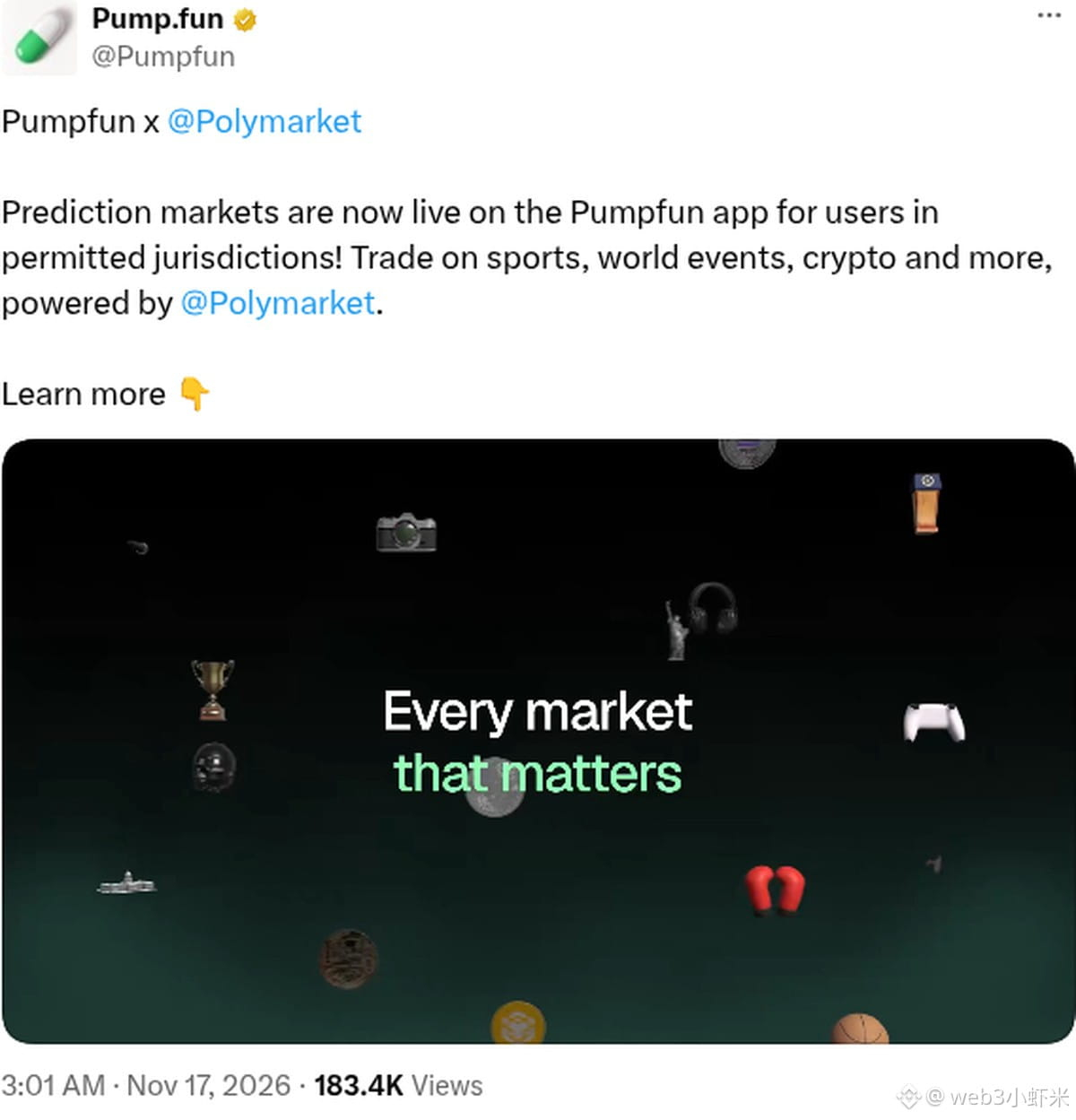
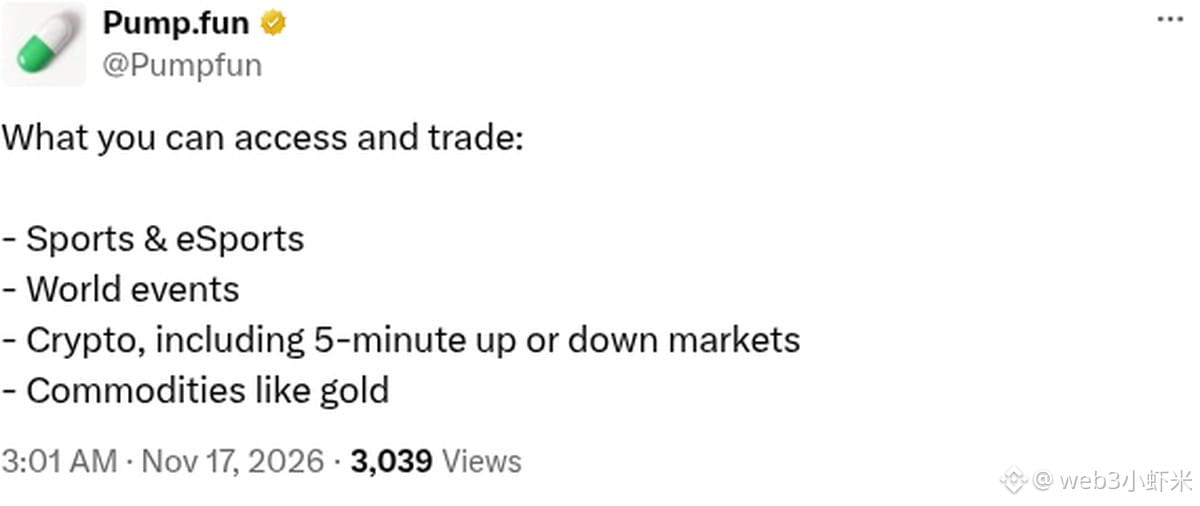
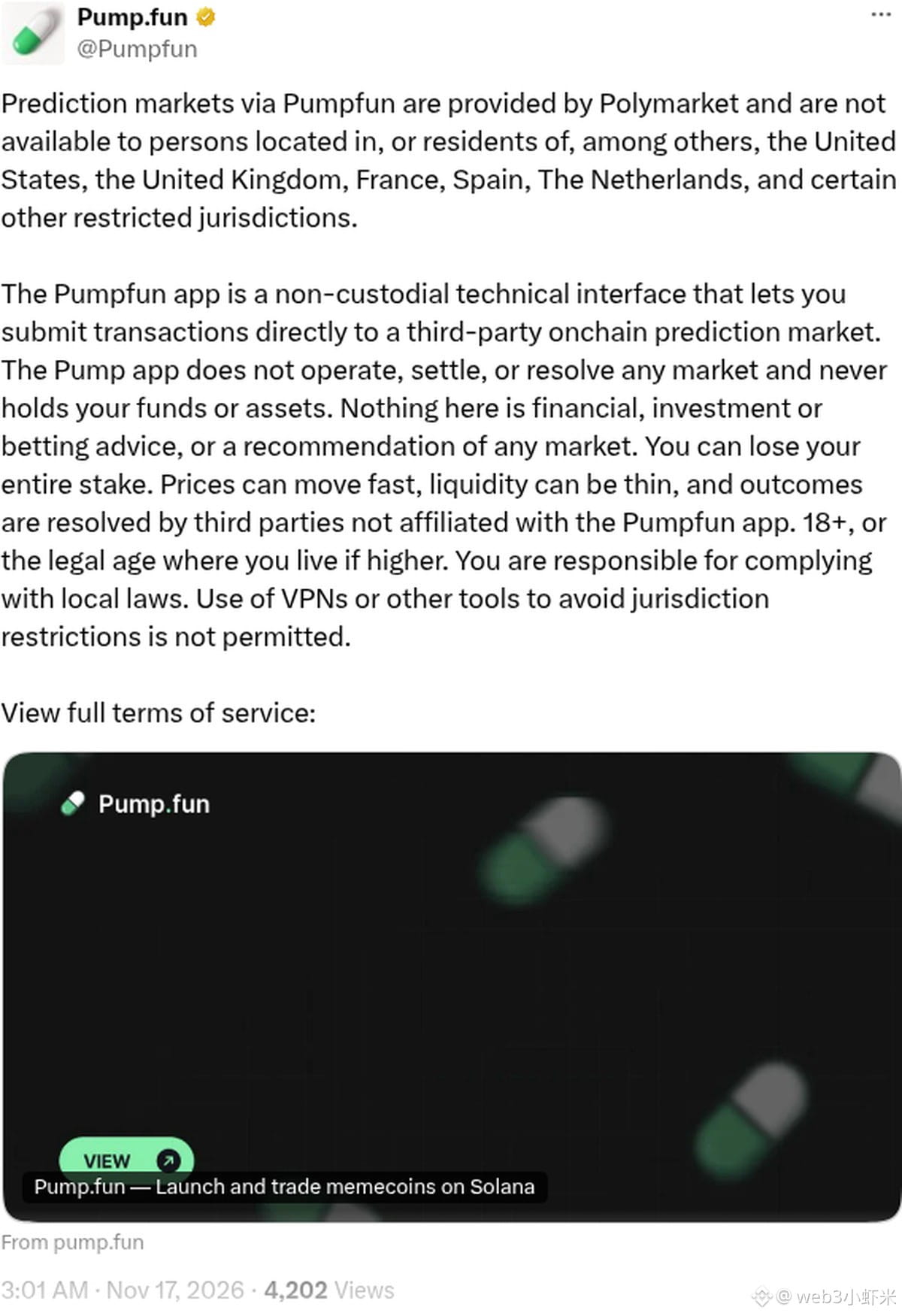
I just came across an official Pump.fun post. They announced that they’ve integrated with Polymarket: in permitted jurisdictions, users can access prediction markets in the Pumpfun app covering sports and esports, world events, crypto (including 5-minute up-or-down markets), and commodities like gold. The official post states that these markets are provided by Polymarket.
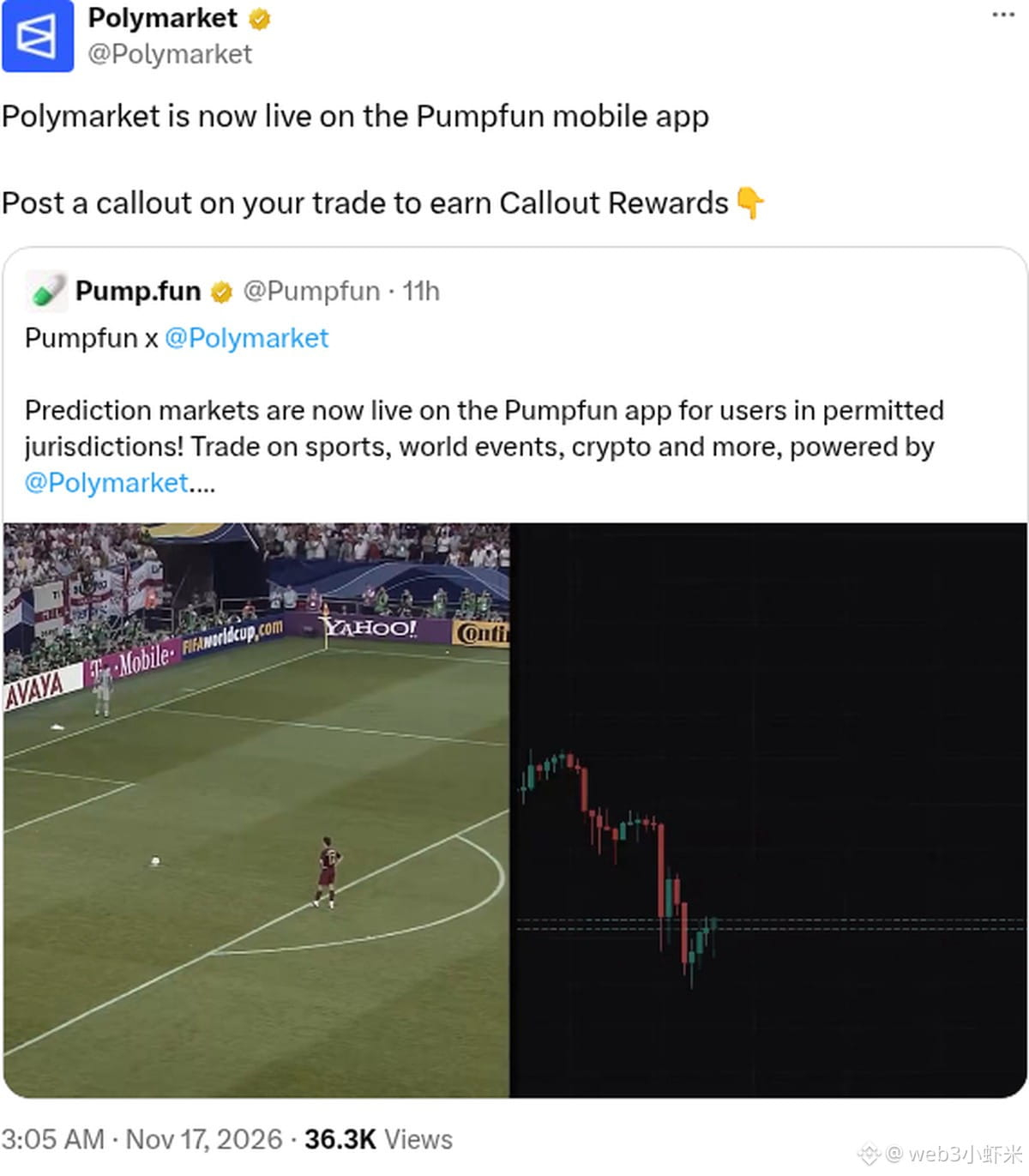
The post also makes it clear that the service is unavailable to people located in or residents of the US, UK, France, Spain, the Netherlands, and some other restricted regions. The Pumpfun app is simply a non-custodial technical interface for submitting trades to third-party on-chain prediction markets; the app itself does not operate, settle, or adjudicate any markets, nor does it hold users’ funds. Polymarket’s official account also confirmed that it has launched in the Pumpfun mobile app.
#Pumpfun #Polymarket
44

·
--
The biggest fear for a token-launch platform isn’t having nobody play—it’s having nowhere for them to bet. Pump.fun just copied the answer today.
This morning, it announced a partnership with Polymarket. Prediction markets are coming to the app, where users can bet on sports, major events, and crypto—even whether Bitcoin will rise or fall over five minutes. The platform is just the gateway; it won’t handle funds or settle bets. It’s also unavailable in the US, UK, and France.
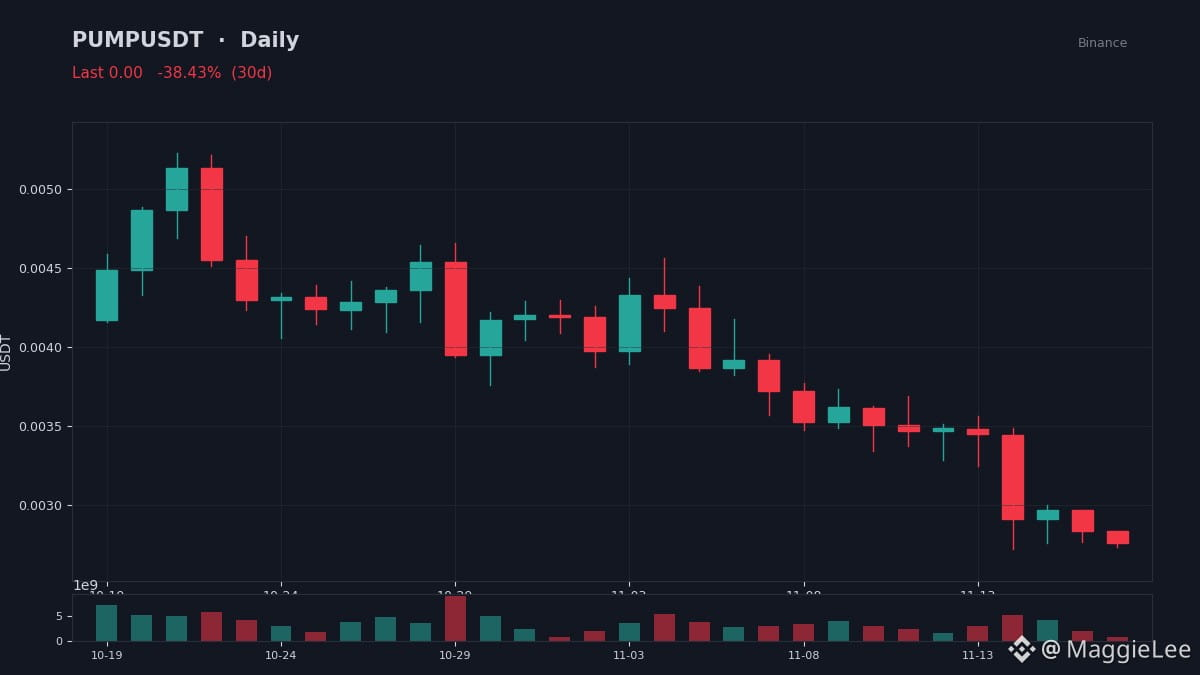
The interesting thing is that PUMP fell instead of rising after the news broke. It’s currently at $0.0028, down more than 20% in a week and nearly 40% in a month. The token-launch business is already shrinking, and whether simply adding a gateway can bring users back depends on trading volume.
My take: the direction makes sense. The people launching meme coins and betting on predictions are largely the same crowd. But don’t rush to buy on the news—PUMP needs to stop falling first.
$PUMP $BTC
#Pumpfun #预测市场 #Polymarket
312

·
--
A Sunday night chat about some serious stuff nobody cared about today: Polymarket is facing lawsuits.
One prediction market, 29 lawsuits, all filed in Manhattan federal court. The dispute comes down to two things: a “qualification” restriction was added to the rules after trading had already begun; token holders voted, with 98.6% choosing NO. The odds stayed up, the result was settled, and anyone who disagreed had to go to court.
This is worth thinking about more than any single win or loss. Prediction markets have been touted over the past couple of years as more accurate than polls, and institutions are eager to use them. But accuracy depends on settlements not going haywire. Users bet on outcomes, but the outcomes are decided by the wording of the rules and the platform’s power to interpret them. Strictly speaking, that’s not a prediction market—it’s a betting game where the platform moonlights as the referee.
The old problems with UMA’s dispute mechanism have been argued over since last year. Trading volume keeps growing, but the referee problem hasn’t budged. A market facing 29 lawsuits shows there’s real money at stake—not just a meme.
Next week, $NVDA draws and the Russian central bank opens up exchange trading; odds will once again be cited as a sentiment indicator. On a weekend when Bitcoin ($BTC) is languishing below 70,000, maybe it’s better to first get the prediction market’s own governance in order.
One takeaway: this sector’s lifeline isn’t liquidity—it’s fairness.
NFA DYOR
#Polymarket #预测市场 #比特币 #加密货币 #regulation
A Sunday night chat about some serious stuff nobody cared about today: Polymarket is facing lawsuits.
One prediction market, 29 lawsuits, all filed in Manhattan federal court. The dispute comes down to two things: a “qualification” restriction was added to the rules after trading had already begun; token holders voted, with 98.6% choosing NO. The odds stayed up, the result was settled, and anyone who disagreed had to go to court.
This is worth thinking about more than any single win or loss. Prediction markets have been touted over the past couple of years as more accurate than polls, and institutions are eager to use them. But accuracy depends on settlements not going haywire. Users bet on outcomes, but the outcomes are decided by the wording of the rules and the platform’s power to interpret them. Strictly speaking, that’s not a prediction market—it’s a betting game where the platform moonlights as the referee.
The old problems with UMA’s dispute mechanism have been argued over since last year. Trading volume keeps growing, but the referee problem hasn’t budged. A market facing 29 lawsuits shows there’s real money at stake—not just a meme.
Next week, $NVDA draws and the Russian central bank opens up exchange trading; odds will once again be cited as a sentiment indicator. On a weekend when Bitcoin ($BTC ) is languishing below 70,000, maybe it’s better to first get the prediction market’s own governance in order.
One takeaway: this sector’s lifeline isn’t liquidity—it’s fairness.
NFA DYOR
#Polymarket #预测市场 #比特币 #加密货币 #regulation
275
Louisiana's AG is firing back hard at the CFTC, slamming the agency over its defense of prediction markets like Polymarket and Kalshi. This battle highlights a massive jurisdictional tug-of-war between federal regulators and state authorities over decentralized forecasting. As election and event betting surges, expect state-level crackdowns to escalate, creating a complex web of compliance hurdles for the crypto and prediction platform ecosystem moving forward. #CryptoRegulation #Polymarket #DeFi
Louisiana's AG is firing back hard at the CFTC, slamming the agency over its defense of prediction markets like Polymarket and Kalshi. This battle highlights a massive jurisdictional tug-of-war between federal regulators and state authorities over decentralized forecasting. As election and event betting surges, expect state-level crackdowns to escalate, creating a complex web of compliance hurdles for the crypto and prediction platform ecosystem moving forward. #CryptoRegulation #Polymarket #DeFi
6

·
--
Bearish
LOUISIANA JUST BLOCKED PREDICTION MARKETS — BUT WASHINGTON DISAGREES
A Louisiana judge has issued a temporary order targeting event contracts offered by Kalshi, Polymarket US, Robinhood, Coinbase and other platforms
Without a state gaming license, the companies must restrict access to users located in Louisiana
But there's an unusual conflict
$PREDICT
{future}(PREDICTUSDT)
⚖️ On November 5, the CFTC said federally regulated derivatives exchanges generally cannot restrict eligible US traders simply because of which state they're in
Now Louisiana is ordering the geographic restrictions that federal regulators say conflict with impartial market access rules
For traders, this isn't just a legal debate
Access to new contracts can change even when an existing position hasn't been settled
The court order is temporary, and the wider question of federal versus state authority remains unresolved
$BTC
{future}(BTCUSDT)
🔎 The next test comes through court challenges and Louisiana's November 30 injunction hearing
Prediction markets are growing fast
But who gets to regulate them may determine who gets to trade
#PredictionMarkets #Kalshi #Polymarket
LOUISIANA JUST BLOCKED PREDICTION MARKETS — BUT WASHINGTON DISAGREES
A Louisiana judge has issued a temporary order targeting event contracts offered by Kalshi, Polymarket US, Robinhood, Coinbase and other platforms
Without a state gaming license, the companies must restrict access to users located in Louisiana
But there's an unusual conflict
$PREDICT
⚖️ On November 5, the CFTC said federally regulated derivatives exchanges generally cannot restrict eligible US traders simply because of which state they're in
Now Louisiana is ordering the geographic restrictions that federal regulators say conflict with impartial market access rules
For traders, this isn't just a legal debate
Access to new contracts can change even when an existing position hasn't been settled
The court order is temporary, and the wider question of federal versus state authority remains unresolved
$BTC
🔎 The next test comes through court challenges and Louisiana's November 30 injunction hearing
Prediction markets are growing fast
But who gets to regulate them may determine who gets to trade
#PredictionMarkets #Kalshi #Polymarket

498

·
--
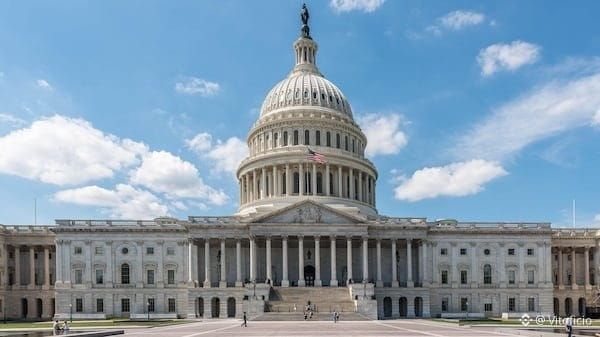
🇺🇸💰 OFFICIALS BETTING WITH SECRET INFORMATION?
Have you seen this? In the United States, Congress wants to ban government officials from betting on Polymarket and Kalshi, platforms where people bet on the outcomes of events. After reviewing nearly 1,700 pages of documents, they found cases of people with access to secret information who allegedly made money by betting before anyone else.
The most serious case is that of a soldier accused of making more than $409,000 by betting on the military operation that ended with the capture of Nicolás Maduro. They also fined a former White House employee who bet on the president’s speeches.
To me, the problem isn’t the platforms, but that someone with information no one else has can turn it into money.
Do you think all government officials should be banned from betting, or only on government-related matters?
#Polymarket
33
·
--
Verified
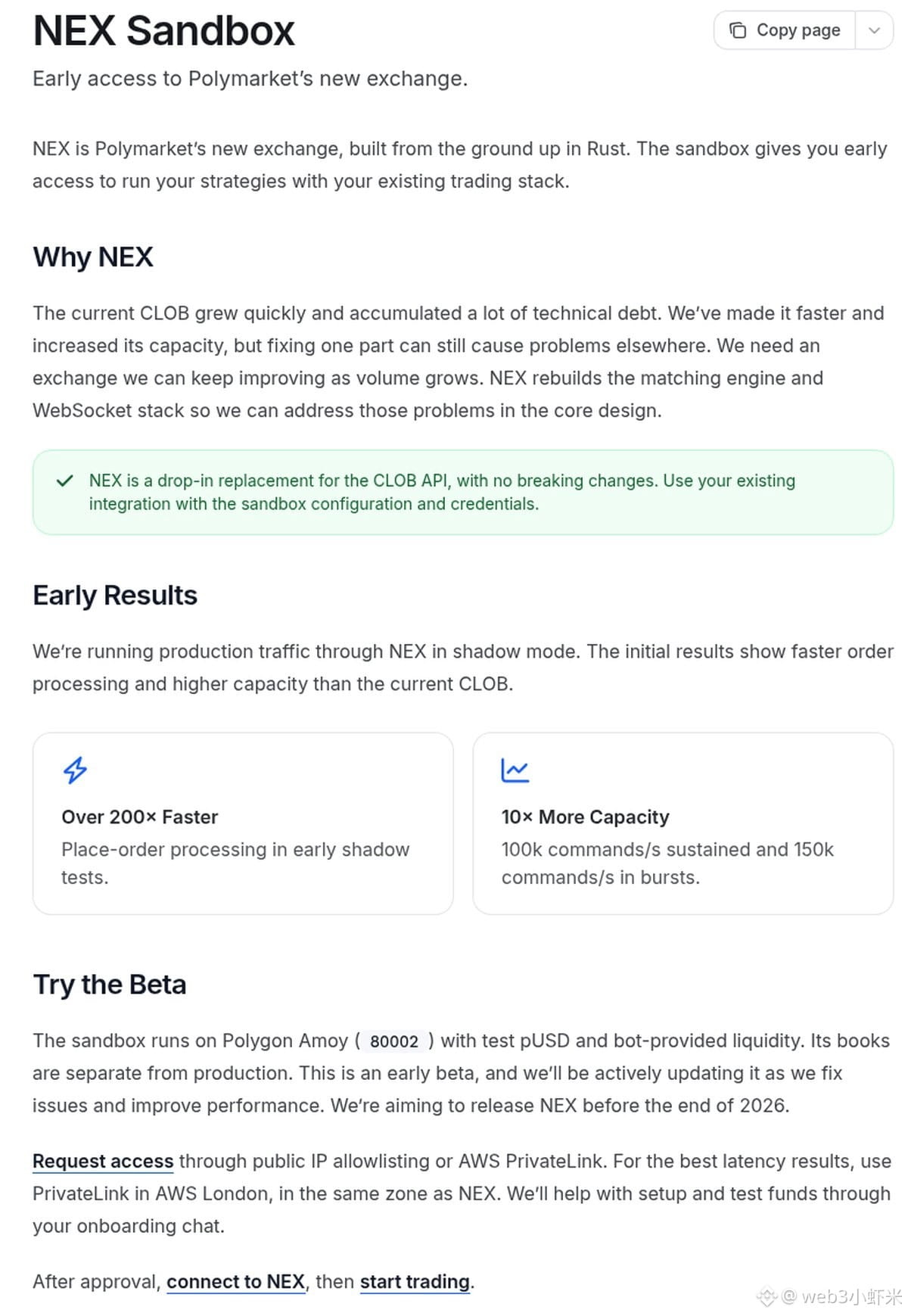
Official Polymarket update: The sandbox for the new exchange, Nex, is now open.
The engineering team says the original CLOB had too much technical debt, so this time they rewrote the matching engine and the entire WebSocket stack in Rust. For the past week, they’ve been running it in shadow mode against real live orders.
The figures shared by the team measure internal latency, not end-to-end latency: order placement p99 dropped from 1.55 seconds to 3.76 milliseconds, while sustained throughput rose from 10,000 to 100,000 instructions per second. The sandbox runs on the Polygon Amoy testnet, uses test pUSD, and is separate from the live order book. They plan to continue shadow mode for another four weeks and, if all goes well, aim to launch in mid-December. There will be no breaking changes for existing integrations.
#Polymarket
1
1
527

·
--
This set of Polymarket IPO markets looks like it offers 9.5% upside. But when you do the math, it turns out to be fake.
On predict.fun, for “When will Polymarket IPO?”:
- IPO before the end of 2026: Yes 0.018
- IPO before the end of June 2027: No 0.838 (Yes is 0.162)
At first glance: 0.018 + 0.838 = 0.856, leaving a 0.144 gap to 1. After fees and slippage, that’s still around 9.5%. Looks like arbitrage.
Wrong. The problem is the window in between:
- IPO by the end of 2026: this position pays 1
- IPO in the first half of 2027: both legs pay 0
- No IPO at all: this position pays 1
The market prices the first-half-of-2027 window at 14.4% (0.162 - 0.018). Expected payout = 0.856, exactly the combined price of the two legs, before fees. That 9.5% comes from treating “pays 1” as a sure thing, without accounting for the risk of the IPO falling in that window. This isn’t arbitrage; it’s a bet that the window is less likely than the market thinks.
Two more catches: these prices haven’t moved in 2 hours—the same number across 5 scans, possibly a zombie quote. And even if you believe in that 9.5%, the algorithm says you’d need at least 49U to get in.
Numbers can deceive. The math can’t.
#预测市场 #Polymarket #Arbitrage
Trading involves risk. Invest with caution.
61

·
--

Article
Annualized Revenue Hits $1.8 Billion, Yet Polymarket Is Still Laying People Off: Where Does Its $21 Billion Valuation Come From?On November 10, Polymarket told CNBC that its annualized revenue had topped $1.8 billion, up from just over $1 billion in June. That same week, Front Office Sports reported that the company had laid off a group of employees the previous week, with marketing taking the biggest hit. Layoffs when you’re making the most money sounds contradictory, but the numbers make sense. This has nothing directly to do with the coin you hold; the connection comes in the second half.
First, where is the money coming from? The U.S. site had $14.77 billion in nominal trading volume in October, compared with just $4.04 billion in June. That $14.77 billion is nominal volume calculated using the full payout value of contracts; the actual cash involved is much lower. Of October’s volume, combination contracts accounted for $8.6 billion, nearly 60%, while sports contracts made up 30%. In the ten days before November’s midterm elections, election-related contracts generated $108 million—more than six times the total for all of September—and still accounted for just 2.2% of the month’s overall volume. A platform that got its start with elections now makes its money from sports and combination bets. The $1.8 billion figure needs a caveat: it’s an annualized figure reported by the company itself, extrapolating recent revenue over a full year, not an audited number. Independent firm Sacra estimated just $375 million in May, and calculating fees directly from trading volume doesn’t add up.
Annualized Revenue Hits $1.8 Billion, Yet Polymarket Is Still Laying People Off: Where Does Its $21 Billion Valuation Come From?
On November 10, Polymarket told CNBC that its annualized revenue had topped $1.8 billion, up from just over $1 billion in June. That same week, Front Office Sports reported that the company had laid off a group of employees the previous week, with marketing taking the biggest hit. Layoffs when you’re making the most money sounds contradictory, but the numbers make sense. This has nothing directly to do with the coin you hold; the connection comes in the second half.
First, where is the money coming from? The U.S. site had $14.77 billion in nominal trading volume in October, compared with just $4.04 billion in June. That $14.77 billion is nominal volume calculated using the full payout value of contracts; the actual cash involved is much lower. Of October’s volume, combination contracts accounted for $8.6 billion, nearly 60%, while sports contracts made up 30%. In the ten days before November’s midterm elections, election-related contracts generated $108 million—more than six times the total for all of September—and still accounted for just 2.2% of the month’s overall volume. A platform that got its start with elections now makes its money from sports and combination bets. The $1.8 billion figure needs a caveat: it’s an annualized figure reported by the company itself, extrapolating recent revenue over a full year, not an audited number. Independent firm Sacra estimated just $375 million in May, and calculating fees directly from trading volume doesn’t add up.
First, where is the money coming from? The U.S. site had $14.77 billion in nominal trading volume in October, compared with just $4.04 billion in June. That $14.77 billion is nominal volume calculated using the full payout value of contracts; the actual cash involved is much lower. Of October’s volume, combination contracts accounted for $8.6 billion, nearly 60%, while sports contracts made up 30%. In the ten days before November’s midterm elections, election-related contracts generated $108 million—more than six times the total for all of September—and still accounted for just 2.2% of the month’s overall volume. A platform that got its start with elections now makes its money from sports and combination bets. The $1.8 billion figure needs a caveat: it’s an annualized figure reported by the company itself, extrapolating recent revenue over a full year, not an audited number. Independent firm Sacra estimated just $375 million in May, and calculating fees directly from trading volume doesn’t add up.
42
Polymarket is testing Nex, a new Rust based trading engine capable of 100,000 commands per second, targeting a mid December launch to scale capacity.
#Polymarket
Polymarket is testing Nex, a new Rust based trading engine capable of 100,000 commands per second, targeting a mid December launch to scale capacity.
#Polymarket
#Polymarket
8

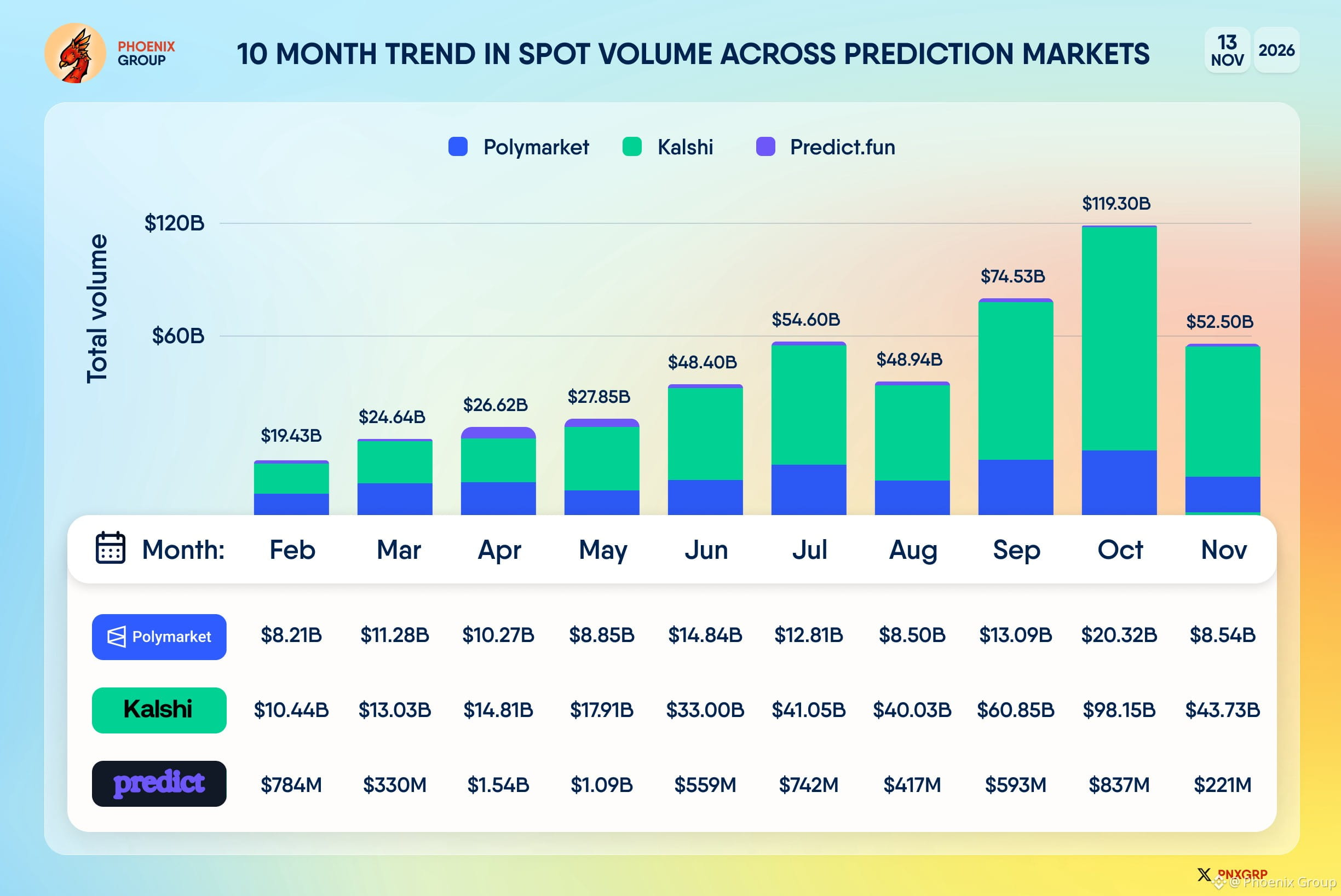
10-MONTH TREND IN SPOT VOLUME ACROSS PREDICTION MARKETS
For the last 10 months, the spot volume of prediction markets has grown by 170%. In November, the leading platforms by trading volume are #Kalshi with $43.73B, #Polymarket with $8.54B, and #Predictfun with $221M.
10-MONTH TREND IN SPOT VOLUME ACROSS PREDICTION MARKETS
For the last 10 months, the spot volume of prediction markets has grown by 170%. In November, the leading platforms by trading volume are #Kalshi with $43.73B, #Polymarket with $8.54B, and #Predictfun with $221M.
For the last 10 months, the spot volume of prediction markets has grown by 170%. In November, the leading platforms by trading volume are #Kalshi with $43.73B, #Polymarket with $8.54B, and #Predictfun with $221M.
246
Log in to explore more content
Join global crypto users on Binance Square
⚡️ Get latest and useful information about crypto.
💬 Trusted by the world’s largest crypto exchange.
👍 Discover real insights from verified creators.
Email / Phone number
Trending Topics
1
#BTCReboundsAbove$60KAmidWhaleDipBuying
3,848 views
43 Discussing
2
#NvidiaLoses$2.7TrillionInMonthAndAHalf
42,024 views
201 Discussing
3
#GlobalStocksFaceLongestLosingStreakSince2023
390,844 views
2,564 Discussing
4
#BlackRockIBITPostsRecord$541MSingleDayOutflow
56,817 views
139 Discussing
5
#AnthropicPlungesTowardIPOPriceonDay2
206,743 views
1,644 Discussing
6
#TwentyOneCapitalAdds172.25BTC
99,558 views
1,036 Discussing
7
#HKBillWouldExcludeTokenizedDepositsFromVirtualAssets
14,345 views
65 Discussing
8
#HKBillProposesHK$100KFineForUnauthorizedCryptoTitles
3,534 views
30 Discussing
9
#BitMineFaces$10.1BUnrealizedETHLoss
6,889 views
32 Discussing
10
#StrategyReports$35BNetReserves
3,665 views
23 Discussing